1. INTRODUCTION
This silent rock, this nature about which we argue so much, is also among the most important things we have in common. That is why we care so much about it. It is, paradoxically, the uncommon ground we cannot help but share. (Cronon Reference Cronon1995: 56)
The ‘environment’ in environmental sonic art refers to a specific kind of ‘nature’ and ‘natural’ that exists in the world. But what is ‘nature’ and ‘natural’ in this context? While all sound waves interact with an environment, environmental sonic art starts with a specific notion of sound that is defined by its context. One common contextual thread with all works of environmental sonic art – defined as art where environmental sound is the material, and/or subject matter – is the intention to raise awareness of something commonly referred to as the ‘natural world’. However, if definitions of ‘nature’ and ‘natural’ are amorphous, what are these artists raising awareness of?
Grounded in Western music history, environmental sonic art employs an array of approaches such as soundwalking (Westerkamp Reference Westerkamp2007), field recording (Schafer 1997), electroacoustic composition (Respighi Reference Respighi1967), instrumental music (Doolittle Reference Doolittle2008), sonification (Dodge 1970), sound sculpture (Hankins and Silverman Reference Hankins and Silverman1995), site-specificity (Bašić Reference Bašić2005), deep listening (Oliveros Reference Oliveros2005) and immersive sonic environments (Lopez Reference Lopez2004). The book Environmental Sound Artists: In Their Own Words (Bianchi and Manzo Reference Bianchi and Manzo2016) features environmental sonic artists – including Andrea Polli, Bernie Krause, John Luther Adams and Gordon Hempton – who exhibit a range of ‘purposes, meanings, and messages: some aim to provide new insights about a particular environment; some investigate the sonic characteristics of particular spaces, elements, or phenomena; and some touch on cultural, sociopolitical, or environmental issues’ (ibid.: xx). One thing is clear: each artist in this book represents their environmental sonic art as having the ability to ‘draw attention to the sounds that surround us, encouraging us to practice conscious, focused listening as a means to enhance our knowledge, understanding, and appreciation of the world we live in’ (ibid.).
While ‘gaining awareness’ is an important epistemological tool in art, many of the artists featured in Environmental Sound Artists: In Their Own Words and The Book of Music and Nature (Rothenberg and Ulvaeus Reference Rothenberg and Ulvaeus2013) refrain from demonstrating a critical awareness to the history of ‘nature’ and ‘natural’ as something that has contributed to the evolution and contextual representation of their sonic art. This history is essential to understand because nature – both a material object and a socially constructed metaphor that is infinitely interpretable and ideologically malleable – is perhaps, as literary and cultural theorist Raymond Williams notes, ‘the most complex word in the language’ (Williams Reference Williams1976: 219). Within the context of environmental sonic art, critical reflection on nature through a framework that includes an understanding of its autonomy will make the important relationships between the human and the non-human more just and more accountable. A critique of any kind of environmental sonic art has the potential to be read as hostile, mocking, or even authoritarian to the general cause of environmentalism because ideas of ‘right’ and ‘wrong’ in environmental sonic art are relative to an individual’s values. Therefore, I am not arguing that environmental sonic art is on the ‘wrong track’; I am advocating for its sustainability – albeit in a more nuanced, contextualised and epistemologically humble iteration.
What if environmental sonic art resounded with more historical and cultural elements, including narratives about the meaning and moral imperatives that contribute to and inspire an engagement with nature? What if environmental sonic art showed that many different ‘natures’ flow from human values? What if environmental sonic art always worked through issues of environmental justice (Adamson, Evans and Stein 2002)? Instead of thinking about environmental sonic art as occupying one pole of the nature/culture dualism – between ‘autonomous natural actors or absolute social productions’ (Demeritt Reference Demeritt1994: 163) – what if environmental sonic art was approached with metaphors such as philosopher Bruno Latour’s ‘quasi-object’ or feminist scholar Donna Haraway’s ‘cyborg’, ones that allow for a part-nature/part-culture object to be both ideal and material? Seth Kim-Cohen, in his book Against Ambience and Other Essays, pleads for a sonic art that carries not only ‘sooth[ing] washes of sound’ but also methods and intentions (Kim-Cohen Reference Kim-Cohen2016). In this regard, we need to ask: what is self-critical environmental sonic art? This article will illuminate this conversation by critiquing the construction of ‘nature’ by one of America’s most celebrated environmental sonic artists – John Luther Adams. The work of Adams and those who follow his views has become a keystone for defining environmental sonic art today. However, Adams’s conception of environmental sonic art has at its foundation a one-dimensional concept of nature that is defined by the wilderness ideology; relying on it to define the field of environmental sonic art prevents composers and scholars from confronting the cultural construction of ‘nature’ and forming more nuanced understandings of its limitations.
2. Context
Landscape in art is ‘a framed representation of a section of the natural world, a cropped view, selected and reduced so that it can be a portable memento of an arresting or pleasing visual experience of rural scenery’ (Andrew Reference Andrews1999: 201–2). This definition implies that landscape art is an abstraction from and an appropriation of a representation of the artist pointing to their own conception of ‘nature’. As characterised by geographer Neil Smith, nature is as much a material object as it is a spiritual force; it is both given and made – ‘a gift of God’ and a product of its own evolution, a totality and a series of parts (Smith Reference Smith1984: 11). Anthroplogist David Harvey explains, ‘the framework of interpreting nature is given in the metaphor rather than in the evidence’ (Harvey Reference Harvey1990: 163). Western society’s interpretation of nature is directly tied to ‘ways of seeing landscape’ that may be represented in a variety of materials and on many surfaces – including musical ones (Cosgrove Reference Cosgrove1998: xiv). It is important to remember that a landscape park (like a national park for example) is no more real than a landscape painting or music that points to a landscape.
Bifurcations of the landscape into the practical and the aesthetic can be traced back to eighteenth-century English landscape parks that emerged from a wealthy class of landowners. This division separated the observer from the land, implying both a sense of ownership and control. The postmodernist approach to the landscape – which maintains that nature is something ‘other’ than human culture – has been linked to Greek and Roman history, where the human mind was viewed as something superior to any other in nature (Glacken Reference Glacken1967; Cosgrove and Daniels Reference Cosgrove and Daniels1988). After nature was placed ‘out there’, individuals and groups continued to spend time trying to decide how, where, when and what should be done with it.
Influenced by a long lineage of Baroque (e.g. Vivaldi) and Romantic (e.g. Beethoven) composers (Service Reference Service2015), American composer John Luther Adams has come to define what it means to compose environmental sonic art inspired by natural processes and wilderness landscapes (Adams Reference Adams2009: 145). Right before Adams’s cascade of successes – a Pulitzer Prize in Music (2014) and a Grammy Award (2015) for his orchestral work Become Ocean – the Boston Globe published ‘The Portable Wilderness of John Luther Adams’ (Eichler Reference Eichler2015). It celebrates the ways in which Adams’s music resonates within the broader wilderness ideology as a kind of ‘natural’ or ‘place making’ narrative (Adams Reference Adams2015b). Although grounded in Hegelian aesthetics (Hegel Reference Hegel1975), Adams regularly confuses these notions by rejecting any type of musical narrative, expressing his desire to leave ‘the story behind to get to this primary experience of listening, where it is no longer about what the composer is telling you: you are in the musical wilderness and need to find your own way out’ (Adams Reference Adams2015a). This classic avant-garde viewpoint – to let ‘the music be whatever it wants to be’ (ibid.), autonomous and separate from the composer who authored it – shares similarities with the wilderness ideology that insists ‘nature’ is separate from the human and the history from which it arose. Environmental historian William Cronon writes:
The removal of Indians to create an ‘uninhabited wilderness’ reminds us just how invented, just how constructed, the American wilderness really is … there is nothing natural about the concept of wilderness. Indeed, one of the most striking proofs of the cultural invention of wilderness is its thoroughgoing erasure of the history from which it sprang. (Cronon Reference Cronon1995: 79)
Wilderness, both as material and as an idea, builds upon romanticised myths of the frontier: returning to simpler, more primitive living; moving out of the confinements of civilation; finding that truer world that would allow one to rejuvenate one’s sense of self. These ideas form an important part of Adams’s own life narrative, including his environmental sonic art.
Adams travelled to Alaska in the 1970s – at the height of the environmental, back-to-the-land movement – to work for the Wilderness Society, the Alaska Coalition and the Northern Alaska Environmental Centre. Influenced by ‘realist assumptions and primitivist fantasies’ (Foster Reference Foster1996: 302–7), Adams was inspired to flee to Alaska in order to protect the United States’ most sacred myth of origin – a place where the ‘last bastion of rugged individualism’ could be accessed and held (Cronon Reference Cronon1995: 77). However, Adams has failed to acknowledge the particularly situated context of his journey to Alaska and the colonialist foundation to his assumptions, as well as the influence these impulses have in his environmental sonic art portraying a form of artistic ‘fieldwork’ representation (Mattern Reference Mattern2016). Does Adams consider what effects his contribution to the Alaska National Interest Lands Conservation Act (the largest land preservation law in US history) had in perpetuating the dualism between humans and nature – in this case, humans (white, male adventurers in a new land) and nature (land untouched by humans)? Does he consider how this activism ignores a variety of relationships that indigenous and local people have created with the land? Is it Adams’s responsibility to address this dynamic in the way he represents his environmental sonic art inspired by the landscape in question?
It is imperative that individuals acknowledge that the ‘nature’ people seek to understand and protect is always encountered through the lens of a culture’s own conceptions. To support this exploration, authors of environmental sonic art should refer to Cronon’s eight cultural constructions of nature: (1) nature as a naive reality, (2) nature as moral imperative, (3) nature as Eden, (4) nature as artifice, (5) nature as virtual reality, (6) nature as commodity, (7) nature as demonic other/avenging angel and (8) nature as contested terrain. Applying Cronon’s conceptions of nature to the practice of environmental sonic art will reveal not only the context of the things we label with the term ‘nature’, but also our own role in forming, sustaining and defending the ‘nature’ ostensibly existing out there.
3. Critique
Bernd Herzogenrath points out, in the introduction to the book devoted to Adams’s sonic art, The Farthest Place, that the composer ‘does not represent nature through music’ (Herzogenrath Reference Herzogenrath2012: 8). Without providing a definition of nature in this statement, Herzogenrath distinguishes the term as something separate from the music humans compose. Not surprisingly, this nature/culture confusion lies at the foundation of Adams’s sonic art through the presentation of musical materials as a counterpart to the notion that they are ‘deeply rooted’ in something referred to as the ‘the natural world’ (Adams Reference Adams2016). This is illuminated in ‘On Composing Place’ (DeLuca Reference DeLuca2014), my analysis of Adams’s keyboard percussion quartet, Clusters on a Quadrilateral Grid from Strange and Sacred Noise. This analysis unpacks the compositional devices Adams employs to embody ‘calving glaciers, raging rivers, wildfires[,] extreme weather[, and] noise in the primal forces of nature’ (Adams Reference Adams2009: 102). This fascination, with what Adams calls the ‘violence of nature’ (Adams Reference Adams2005), led him to chaos theory, and the translation of simple fractal forms into musical materials.
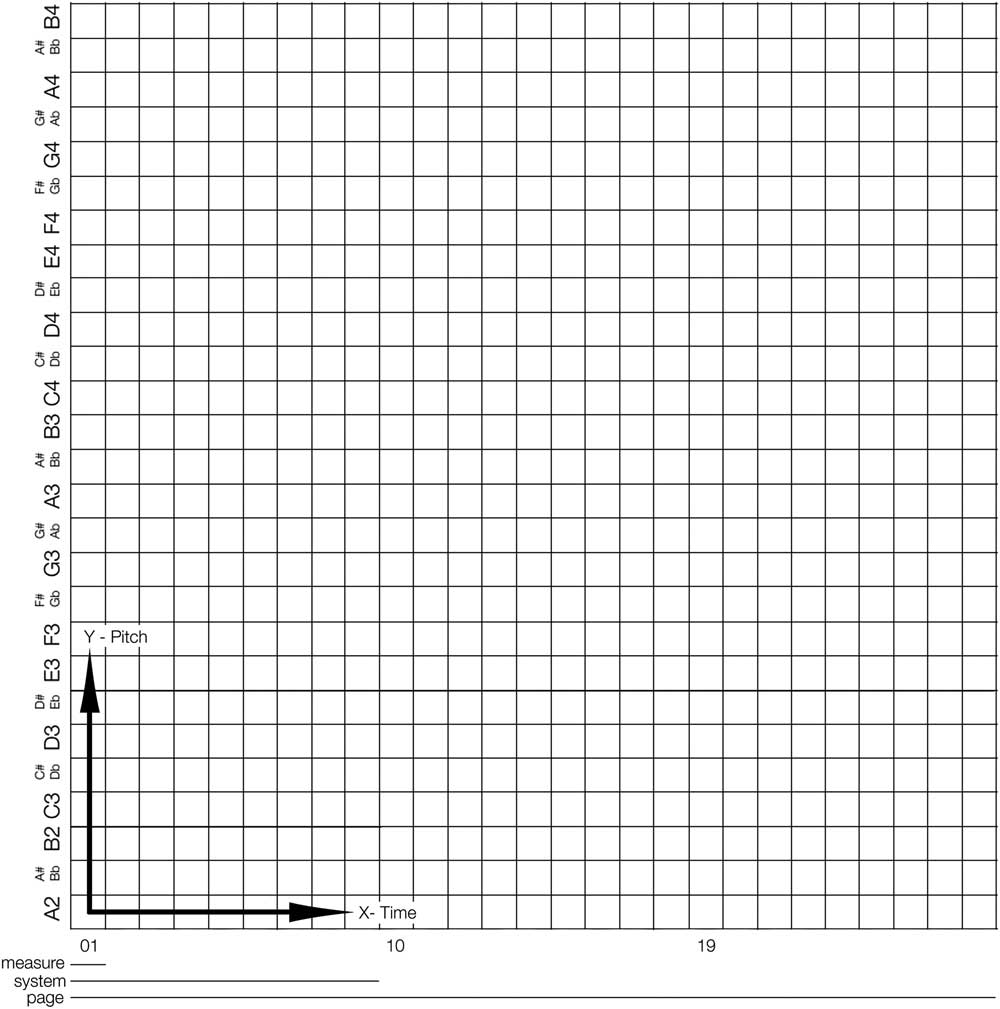
The musical material of Clusters on a Quadrilateral Grid is specifically modelled from the Menger Sponge, a three-dimensional abstraction of the Cantor set and Sierpinski carpet. Each page of the 32-page score has 27 bars organised in three nine-bar systems. These proportions are congruent with a Sierpinski carpet ‘iteration 3’, which has a 27×27 square surface area (see Figure 1). Each page of the score represents an iteration of a Sierpinski carpet and is used as a 27×27 quadrilateral grid where the X axis represents time with 27 linear measures, and the Y axis holds a 27 chromatic, pitch gamut (low to high). When looking at the empty quadrilateral grid (Figure 2) we see that one of the 27 square units holds one pitch in one measure. From this empty quadrilateral grid Adams moulds the carpet iterations by placing clusters on its surface (DeLuca Reference DeLuca2014). Adams’s fractal translations rendered a contraction and expansion of registral space, rhythmic diminution, dynamics, rests and tempo. The first movement of Clusters on a Quadrilateral Grid opens with a 15-pitch chromatic gamut (A2 to B4). The marimba presents this gamut through bar-long tremolos, pianissimo with soft mallets (3/4 time signature, crotchet note equals 72 beats per minute). How do these musical materials refer to Adams’s narrative? Any answer to this question would be a subjective response. I would argue that the awe-inspiring, ‘violent’ nature narrative that Adams speaks and writes about when referring to Clusters on a Quadrilateral Grid seems to be tangential to the sounds themselves. At some point in his career, the materiality of Adams’s sonic art and the messages that he attaches to them became indistinguishable. With this example, the remainder of this critique will be committed to Adams’s written and verbal representations of his context-based sonic art.
Sierpinski carpet ‘iteration 3’ with a 27×27 square surface area.

Sierpinski carpet as a 27×27 quadrilateral grid: X axis represents time with 27 linear measures and the Y axis holds a 27 chromatic, pitch gamut (low to high).
Adams’s work – most notably his electroacoustic sonification of real-time weather data, The Place Where You Go To Listen – is represented as a simulated or virtual nature (Hermann, Hunt and Neuhoff Reference Hermann, Hunt and Neuhoff2011; Grimshaw Reference Grimshaw2014) where individuals can experience the ‘vibrations of natural forces [which are] transposed and amplified within reach of our ears’ (Adams Reference Adams2005: 105). Does Adams’s sonic art (like The Place Where You Go To Listen) enact a form of nature as virtual reality where – similar to Sea World and other amusement parks – individuals are confronted with situations where the natural and the virtual coexist? Does this kind of simulated nature present an environment that embraces manipulation because the author has no resistance to their intention, like fantasies (Cronon Reference Cronon1995: 45)? What is ‘nature’ and what is ‘virtual’ in the music of John Luther Adams? And how do answers to these questions transpire in Adams’s intention to raise awareness of the ‘natural world’?
Adams, who values nature as the groundwork of morality, represents his environmental sonic art through the Cronian metaphor of ‘nature as demonic other’ – one in which the non-human world, despite humans’ best efforts, will never be fully controlled. He does this by consistently predicting ecological doom, offering narratives of disaster occurring because of our ‘misdeeds against earth’ (Cronon Reference Cronon1995: 48):
Even if it is too late to avert disaster we have both an ethical and biological imperative to try. The changes we humans have set into motion are potentially catastrophic … are we really so dead set on doing ourselves in (Adams Reference Adams2015a)? Life on this earth first emerged from the sea. As the polar ice melts and sea level rises, we humans find ourselves facing the prospect that once again we may quite literally become ocean. (Adams Reference Adams2013)
These programme notes perpetuate the idea of an avenging nature that holds humans responsible for destroying the pristine natural Eden and the resulting ‘environmental degradation and moral jeopardy’ (Cronon Reference Cronon1995: 37). Adams implies that the nature to which we need to return is a place that is some version of the ‘original garden, the paradise that would have been ours if only we hadn’t lost our way’ (ibid.: 39). These metaphors are problematic because they not only reinforce ‘prophecies of ecological doom’, but also lead to individual dogmas (ibid.: 48–52), and present nature as if it was universal and had no cultural context.
In essence, Adams sells the idea that if you buy his art objects – sound recordings or live performances – it will raise not simply your awareness of the ‘natural world’, but also a particular vision of what nature should be. Cultural anthropologist James Igoe discusses the residue of this kind of engagement with exchangeable nature in his chapter ‘A Genealogy of Exchangeable Nature’:
For modern consumers, spectacular images of nature appear as compelling visual evidence that their individual purchases, and their lifestyle in general, are connected to positive environmental effects at locations that are usually distant and exotic (from the perspective of the consumer). The push of a virtual button, or the swipe of a virtual card appears to initiate a chain of events ending in the protection of a family of arctic polar bears or an acre of tropical rainforest. (Igoe Reference Igoe2016: 13)
Adams, therefore, presents a mode of environmental fixing which sells nature to save it – ‘exchangeable nature for contemplation’ (ibid.: 12). This closely models the moral self-licensing practice of carbon offsetting, described by Igoe as ‘nature that can be made exchangeable for the purposes of investment by channelling exchange value for ecological and social good’ (ibid.: 1–2).
Consumable situations such as carbon-offsetting and environmental sonic art are attractive because the socio-ecological effects of our activities and relationships at multiple scales and locales are – rather like sound itself – both far-reaching and impossible to see. ‘We are thus’, Igoe says, ‘exceedingly dependent on abstract models of reality, with few practical means of verifying them’ (ibid.: 4). Again, while I am not arguing that environmental sonic art and the kinds of ‘nature’ it represents are a ‘defective’ commodity, all things considered, I rather want to illuminate Igoe’s point that ‘modern culture and capitalist value making are the source of [abstract, universal,] awe-inspiring nature’ that often detaches the history from which it sprang (ibid.: 10).
Adams still clings to the same Cartesian dualism that inspired his romanticised frontier flight to Alaska in the 1970s; it is the same dualism that plagues the United States National Park Service and the wilderness ideology today. Individuals and groups that maintain positions of separating humans and nature always display contradictions in their ideas of ‘nature’ and ‘natural’, quietly expressing the very values they seek to reject. Adams justifies himself, claiming that his work is not political or ‘about anything’ (Adams Reference Adams2015a). ‘Music has the power to inspire the renewal of human consciousness, culture, and yes – even politics’, says Adams, ‘yet I refuse to make political art. Political art fails as politics and as art … art must be itself’ (ibid.). Meanwhile in a lecture the following year, Adams proclaims with a punitive tone:
A strong gust of wind reminds me of the increasingly capricious weather and the storms that lash this and other shores with growing voracity. The burning sunlight reminds me of melting tundra and expanding desserts, of diminishing polar ice and rising seas all over the earth. What does this mean for music? Or for any artist working in any medium today? These looming threats to the biosphere compel me to write music that is more than mere entertainment, more than a personal narrative, or a celebration of the heroic struggle of the individual. (Banff 2016)
Adams claims to make environmental sonic art not ‘about anything’ (Adams Reference Adams2015a) while also politically proclaiming that his ‘music can inspire people to listen more deeply to this miraculous world we inhabit [in] this perilous era of our own creation’ (ibid.).
Adams copes with the political underpinnings of working with natural themes by presenting listeners with the illusion of choice. While he denies making political environmental sonic art, Adams offers this advice: ‘If a listener feels constrained by any words that I may offer along with the music then I encourage her to ignore them’ (ibid.). This dance is based on the narrative that his sonic art has the ability to ‘contribute to the awakening of our ecological understanding’ and deepen our ‘awareness of our connections to the earth’ (Adams Reference Adams2009: 1). Does this illusion of choice work to naturalise the idea that one can observe problems with the ‘environment’ but is not personally responsible for acting differently? Does this illusion of choice turn ‘nature’ into a naive reality – something that has nothing to do with our own actions?
With all environmental sonic art – which is inherently context-based – one cannot separate a material from its message. Even if Adams aspires to make environmental sonic art separate from his beliefs, listeners – like the Boston Globe writer of ‘The Portable Wilderness of John Luther Adams’ (Eichler Reference Eichler2015) – are going to experience the art through the lens of his environmental politics conveyed through his composition titles, programme notes, op-eds in popular media outlets, books, many speeches and social media presence (Adams Reference Adams2004, Reference Adams2009, Reference Adams2013, Reference Adams2015a, Reference Adams2015b). If nature is partly in the eyes of the beholder, should we trust Adams to see it clearly? This question is important to ask because its response calls ‘into question the familiar modern habit of appealing to nonhuman nature as the objective measure against which human uses of nature should be judged’ (Cronon Reference Cronon1995: 25). In a passage where Adams describes his romanticised intentions for moving to Alaska, we can pinpoint a major contextual pillar in his work:
There was this feeling not only that we could save the wilderness and preserve entire ecosystems intact, but that we could also create a kind of ecotopian society, and show the rest of the country, and the rest of the world, how to do it … That didn’t work out. Alaska has devolved into a colony of big oil, and its politics have become so closed, hard-bitten, and strident. But despite it all, I still cling to that romantic, idealistic, impossible vision of how the world really is, or how it might be, and how we might be in the world … It [Alaska] embodies that sense of openness, of edge, of possibility, of excitement, of extreme beauty and danger, that I found so intoxicating when I was 21, and I still do … I still cling to that Alaska, even if it no longer exists in some way. Maybe it never existed, except in my imagination, and in the imaginations of a few of us who went there with those ideals. (Eichler Reference Eichler2015)
This rare reflection by Adams on his idea of Alaska represents the kind of critical awareness that the environmental sonic artist should always contextually wrap around their sonic art objects. This reflection also illuminates a problem with environmental sonic art: nature has become something that authors create to mimic a ‘landscape’ that may have never existed, one severed from the history from which it emerged. From this perspective, what is the environmental sonic artist raising awareness of?
4. Dialogue
Bearing this critique in mind, how do we as environmental sonic artists move forward? Acoustic ecologist and composer Barry Truax asserts that when a sound leaves a source, it travels and interacts with the environment. This environment includes a human element, for when individuals pick up these sounds after they have travelled across the environment, the sounds change and retain history (Truax Reference Truax2001). This is to suggest that messages embedded in environmental sonic art which relate to ideas of ‘nature’ and ‘natural’ are a function of a society and a culture in which the speaker, the sound and the hearer are all embedded (Le Guin Reference Le Guin2004: 187). Therefore, these environmental sounds reflect time, place and particular values, ebbing and flowing with fades and follies (Wockner Reference Wockner1997: 82). It is the responsibility of the sonic artist to ‘raise awareness’ of this context.
David Dunn, environmental sonic artist and writer, enacts critical awareness through a composition that directly explores the nature in the cracks of his backyard. Climate change has ignited a massive infestation of bark beetles in North America’s forests. David Dunn used the sounds of some of these beetles to compose the album The Sound of Light in Trees (Dunn 2006). Over two years, Dunn listened to one tree in his New Mexico backyard using custom-built microphones bringing to light a spectrum of sounds in our world that are too quiet and too high in frequency for our unmediated ear to detect. The work is an expression that challenges the boundaries between art/science and nature/culture. For example, this creative project led to several published academic papers by Dunn in collaboration with physicist James Crutchfield (Dunn and Crutchfield Reference Dunn and Crutchfield2006, Reference Dunn and Crutchfield2009). These papers include discussions of how forest biologists could implement Dunn’s monitoring methods to find areas of increased beetle activity. In addition, this written work demonstrates that the rich acoustical behaviour of an insect could show how sound is a more essential aspect of the way animals interact and are detected ecologically than previously suspected. Dunn’s innate critical awareness when representing The Sound of Light in Trees articulates his intentions of wanting to create a true synthesis of art and science, one where his field research not only renders sound as art but also produces scientific insight:
I readily admit just how fanciful my flights of hypothetical imagination might be, not to mention my lack of scientific credentials, but I also happen to think that this is one of the most important roles for artists in forging a new collaborative relationship with science: science fiction that might lead to science fact. (Dunn 2006)
Dunn acknowledges that even if the scientific metaphors – or even the very facts – that he attaches to the sounds he records in the world are misguided as science, the sounds separate from those metaphors remain ‘intrinsically interesting. You don’t need to know what all of these sonic machinations might mean to find them aesthetically engaging’ (Dunn 2006). In addition, 100 per cent of album sales go to the Acoustic Ecology Institute. These are the kinds of acknowledgements that represent a self-critical environmental sonic art that takes into account not only the nature/culture dualism, nature as commodity, scientific realities and historical truisms, but also the contextualised and embodied relationship the composer has in perceiving the world around them.
My own ethnography (DeLuca Reference DeLuca2016a, Reference DeLuca2016b) starts by listening to wolf howls as both material objects and socially constructed metaphors to highlight the contested relationship between ‘nature’ and ‘culture’. Relying on field research conducted on Isle Royale National Park from 2011 to 2015, I offer a narrative wherein citizen-scientists who listen for the wolf howl literally ‘lend their ears’ to a wolf biologist who has led the longest continuous predator–prey study in the world. This ethnography proposes that Isle Royal acoustic epistemologies – or as sound studies scholar and artist Steven Feld has coined, acoustemologies: ‘a knowing-with and knowing through the audible’ (Feld 2015: 13) – are a politicised, socioesthetic, citizen-science in sound. This context is a nuanced form of participatory, situational environmental sonic art that plays out in the everyday lives of those listening on a remote, roadless island in Lake Superior to critically engage with nature/culture as a dialectic rather than dualism (Kisliuk Reference Kisliuk1998: 12; Davis and Turpin Reference Davis and Turpin2015; Morton Reference Morton2007; Doherty Reference Doherty2009; Norman Reference Norman2011: 3; DeLuca Reference DeLuca2016a, Reference DeLuca2016b). Paying attention to these communities, which surround ecological acoustic spaces, allows for the identification of an environmental sonic art that emerges from human experience, moving beyond interactivity to intersubjectivity.
During my field research on Isle Royale National Park, twilight was my favourite time. The sounds of change – the dusk chorus, some have called it – the deep blue water, the dark green tree line and the sky all blur together with a purple tint. I valued this moment on the island because I could exist in the differences of fleeting time. Gregory Bateson captures these types of changing experiences in a beautifully nuanced, self-referential paragraph:
All receipt of information is necessarily the receipt of news of difference, and all perception of differences is limited by threshold. Differences that are too slight or too slowly presented are not perceivable. Knowledge at any given moment will be a function of the thresholds of our available means of perception. Not only can we not predict into the next instant of the future, but more profoundly, we cannot predict into the next dimension of the microscopic, the astronomically distant, or the geologically ancient. As a method of perception – and that is all science can claim to be – science, like all other methods of perception, is limited in its ability to collect the outward and visible sign of whatever may be the truth. (Bateson Reference Bateson1979: 29–30)
My ethnography understands the changing threshold of nature through listening. In the words of anthropologist Timothy Ingold – ‘listening in’ is an experience of commingling with the world in which we find ourselves (Ingold Reference Ingold2007: 10–13). Scientists, park employees and park visitors of Isle Royale National Park nurture the embodied human experience of listening for the wolf howl as an emergent property of a listening relationship between wolves and humans. This relationship is fundamentally about aesthetics – defined as an awareness and responsiveness to connecting patterns (Bateson Reference Bateson1979; Neves-Graça Reference Neves-Graça2005: 1). For Isle Royale acoustemologies, human communication with the non-human is not achieved by means of dualistic Cartesian thinking but rather through an appreciation of human’s place within nature. This type of interspecies communication is about identifying the differences and similarities between humans and non-humans – leading to a critical, politicised awareness of environmental issues that is not external to the human agent (DeLuca Reference DeLuca2016a, Reference DeLuca2016b).
When anthropologist Katja Neves-Graça was learning about the aesthetics of whale hunting, she realised that she needed to combat an important pitfall of eco-tourism as she watched for whales: to stop trying to locate the beauty and the sublimity of the whale as an object out there waiting to be found, but instead focus on the whole experience. The ex-whale hunter turned whale-watch skipper directs people’s attention to auditory details, like the sounds that whales make. Neves-Graça says that a skipper – instead of fixating their gaze on brief photographic moments – make eco-tourists aware of distinct patterns of breathing and explains which ones meant the whale was relaxed, nervous, tired or resting. Literary critic, N. Katherine Hayles articulates the act of objectifying nature as a mere picture waiting to be taken as a simulation:
When ‘nature’ becomes an object of visual consumption, to be appreciated by the connoisseur’s eye sweeping over an expanse of landscape, there is a good chance it has already left the realm of firsthand experience and entered the category of constructed experience that we can appropriately call simulation. Ironically, then, many of the experiences that contemporary Americans most readily identify with nature – mountain views seen from conveniently located lookouts, graded trails traversed along gurgling streams, great national parks like Yosemite visited with reservations made months in advance – could equally well be considered simulation. Thus the distinction between simulation and nature with which we began is a crumbling dike, springing leaks everywhere we press upon it. (Hayles Reference Hayles1995: 89)
This passage highlights that the meaning of the communicated message is intrinsic to the interaction which cannot entirely be reducible to a written narrative or objective form like a photograph or sound recording. Ultimately, it raises a variety of important questions: is it worth pursuing an environmental sonic art that raises our awareness of an objectified, simulated nature? What if, ideologically and discursively, the sonic artist focused less on paradoxical objects like wilderness and more on direct experience of wild objects down to wild plant growth in the cracks of a sidewalk?
My ethnography ‘Wolf Listening: Acoustemological Politics and Poetics of Isle Royale National Park’ seeks to answer these questions by describing a ‘sentient ecology’ (Ingold Reference Ingold2000: 25) – or perhaps, as Cronon himself might put it, a common middle ground where nature can be art and art can be nature. This form of environmental sonic art extends R. Murray Schafer’s ideas about authorial control, showing that we can listen to the acoustic environment as a musical composition while also owning responsibility for its composition. This (de)composition is a form of self-critical environmental sonic art that is playing out right now, in everyday life (DeNora Reference DeNora2000) and which forces its participants to confront their own preconceived notions about ‘nature’ and their relationship to it (DeLuca Reference DeLuca2016a, Reference DeLuca2016b).
When I asked David Dunn about the cultural construction of nature in environmental sonic art, he responded:
Our species is brilliant at making our monkey mouth noises in order to convince ourselves that we are the only truly intelligent life-form residing in the biosphere. To the contrary, years ago I had the pleasure to spend time talking with the great Polish theater director Jerzy Grotowski. He had explored forms of ‘environmental theater’ in the forests of Poland in the 1970s. When I expressed my interest in the outdoor sound performances that occupied me for several years, he said to me: ‘When doing this kind of work, there is one thing you must not forget. Everything in the forest is more aware of you than you are of it’. (Dunn Reference Dunn2016)
This is to say, the ‘awareness’ that is intended through environmental sonic art is only worth freeing if the ‘awareness’ is grounded in the assumptive history from which it emerged. In the ‘anthropocene’, representing this context is the responsibility of the self-critical environmental sonic artist.