Higher education institutions have a responsibility to address a nexus of systemic economic, environmental and social problems that imperil human and non-human futures by placing ‘education for sustainability’ (EfS) at the centre of their concerns. This responsibility is grounded in the role of these institutions in providing independent critical analysis, educating professionals, creating new knowledge, and fostering informed public decision-making. This responsibility requires not just diagnosis and treatment of problems outside of the academy, but also critical analysis on the question of how higher education is implicated in the making of these problems. After all, as Cortese notes: ‘it is the people coming out of the world's best colleges and universities that are leading us down the current unhealthy, inequitable, and unsustainable path’ (as cited in Everett, Reference Everett2008, p. 239).
That higher education institutions are seeking to take up the challenge of sustainability is evident in the growing number of high-level statements of commitment to EfS they endorse, the increasing eco-efficiency of their operations, the production of a now extensive research literature on sustainability, and the proliferation of specialist courses and degrees in sustainability studies (Sterling et al., Reference Sterling, Maxey and Luna2013). Despite many important achievements, the practical agendas of ‘higher education for sustainability’ (HEfS) that have taken shape over the past 25 years have encountered significant impediments (Leal Filho, Reference Leal Filho2011; Tilbury, Reference Tilbury2011). In particular, progress in realising the oft-stated ambition of embedding EfS as a core rationale across the higher education curriculum has been considerably less encouraging (De la Harpe & Thomas, Reference De la Harpe and Thomas2009; Leal Filho, Reference Leal Filho2011; Sherren, Reference Sherren2006; Tilbury, Reference Tilbury2011). Equally disappointing has been the failure of higher education institutions to lead political and public debate on key questions of sustainability.
Writing as a diverse team encompassing the disciplines of medicine, environmental studies, geography, politics, and philosophy, we develop a multifaceted analysis of impediments to HEfS. We build upon the insights of others that ambiguity and conceptual confusion (Connelly, Reference Connelly2007; Jacobs, Reference Jacobs and Dobson1999; Sterling, Reference Sterling2010), academic disciplinarity (Pharo et al., Reference Pharo, Davison, Warr, Nursey-Bray, Beswick, Wapstra and Jones2012; Sherren, Reference Sherren2005, Reference Sherren2006; Tilbury, Reference Tilbury2011), and administrative regimes (Bosselmann, Reference Bosselmann2001; Moore, Reference Moore2005; Sherren, Reference Sherren2008) each inhibit reform for sustainability in higher education. While much has been written on the barriers to EfS in general, less has been directed at the particular challenges faced within higher education, and much of this has focused on a specific barrier in isolation. In response, and building on a novel synthesis of discursive, political-economic, institutional and cognitive analyses, we develop a typology that encompasses a variety of different barriers and identifies ways in which they interact. This analysis takes account of emerging changes in the global higher education sector that have so far received little attention in discussions about EfS.
Important impediments to implementing EfS have been identified in the Higher Education management literature (e.g., Mader, Scott, & Razak, Reference Mader, Scott and Razak2013), including senior management disinterest, lack of leadership, and insufficient resources, among others. Our focus in this article is on ‘structural’ impediments to embedding sustainability in higher education rather than directly on questions of individual agency or the capacity of particular institutions. We identify four key structural impediments: (1) conceptual multiplicity, in which concepts, world views and values relating to ‘sustainability’ are variously constituted in different contexts; (2) intra-institutional fragmentation, in which disciplines seek to defend their knowledge base and resist the cross-boundary and interdisciplinary dialogue that sustainability demands; (3) economic embeddedness, in which an ongoing neo-liberal turn in higher education is reshaping the university to play a more direct and subservient role in capital accumulation; and (4) habits of reasoning, or the human cognitive predisposition to employ heuristics or ‘rules of thumb’ in personal and institutional decision-making rather than engage in the sustained critical reflection HEfS requires.
While these four interlocking impediments are among the most important barriers currently preventing the meaningful reform required to place sustainability at the centre of the mission of higher education, we do not claim they constitute an exhaustive list. For example, while we consider the subjective and intersubjective, value-laden nature of the impediments we identify, we do not expressly consider the place of emotion at the individual or social psychological level. But this choice does not imply we think emotion is irrelevant. Our focus is on structural and institutional rather than personal contexts. We do not seek to impose any fixed boundary between personal and institutional contexts, and in our discussion of habits of reasoning we expose opportunities for future analysis of the interplay of reason and emotion in the transition to sustainability.
Our purpose in analysing impediments to HEfS is to better explain the evidence that progress in implementing EfS within higher education has been uneven and, in some areas, disappointing (Tilbury, Reference Tilbury2011). Such diagnosis is vital in improving future prospects for HEfS by enabling understanding of underlying causes of resistance to change for sustainability. Rather than being primarily the result of passive causes, such as ignorance, indifference, or even hostility among academics or administrators, or of a generalised failure of change management strategies, our analysis indicates that much of this lack of progress has its source as much outside the academy as in it. That is, these barriers are to be found as much in global economic structures and entrenched habits of mind as they are in university lecture theatres and higher education management philosophies. To address the barriers we identify below, HEfS needs to be understood, first and foremost, as an intervention into the reciprocal relationship between society and academy. We conclude, then, that progress in HEfS is both dependent upon, and a requirement of, wider social transformation towards sustainability.
Impediment I: Conceptual Multiplicity
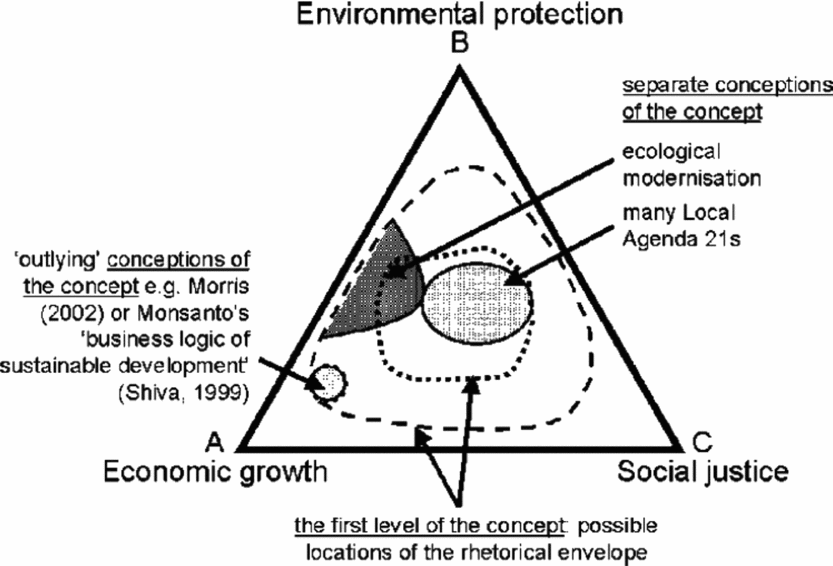
The 1987 World Commission on Environment and Development (WCED) defined sustainable development as ‘development that meets the needs of the present without compromising the ability of future generations to meet their own needs’ (para 2.1). However, the term has since been continually redefined, reflecting both its political importance and its inherent ambiguity (Kates et al., Reference Kates, Parris and Leiserowitz2005; Redclift, Reference Redclift2005). Political theory has long treated concepts like sustainability (e.g., ‘power’, ‘democracy’ and ‘state’) as ‘essentially contested’. Jacobs (Reference Jacobs and Dobson1999, p. 25), for example, argues that sustainability has ‘two levels of “meaning”’. At the first level, the concept is “unitary but vague”, and its meaning can be ‘expressed with a short definition’. At the second level, however, various ‘conceptions’ reflect disputes over ‘how the concept should be interpreted in practice’. While Jacob's analysis leads him to locate sustainability along a conservative-to-radical spectrum, others have developed alternative typologies that build on three central elements: economic prosperity, social equity, and environmental conservation. Connelly (Reference Connelly2007, p. 272) provides a triangular depiction of sustainability conceived as some combination of these three elements (Figure 1). He identifies the dominant conception of sustainability as ecological modernisation, a policy approach that emphasises the role of technological efficiency in creating synergies between environmental and economic outcomes. Connelly places ecological modernisation along the A–B axis, representing a compromise between economic growth and environmental protection without engaging directly with social equity issues. In contrast, a more justice-oriented conception of sustainability, such as that embedded in the United Nations 1992 action plan for sustainable development, the Agenda 21 document, is located towards the diagram's centre.
Mapping the contested concept of sustainability (Connelly, Reference Connelly2007, p. 272). By Permission Local Environment and Taylor & Francis, www.tandfonline.com.

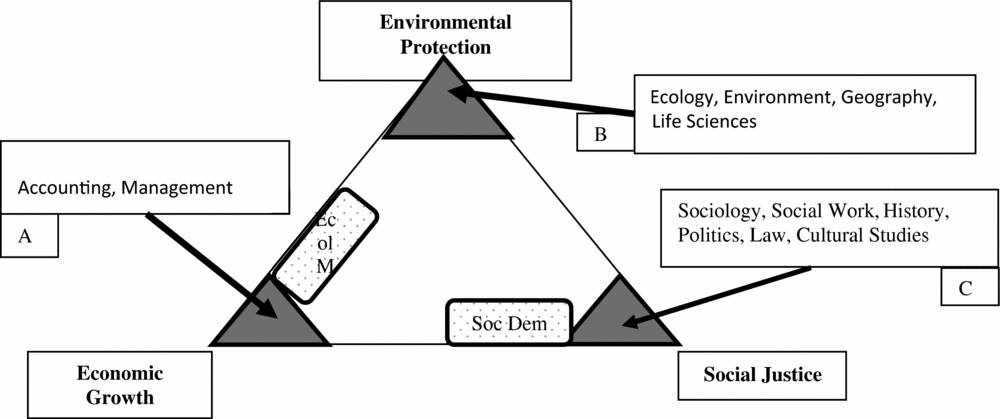
Although it is a clear oversimplification, we can use Connelly's approach illustratively to map much of the disciplinary basis of contestation over sustainability. Adapting his approach to allow for a variety of agendas in addition to those centred on economic prosperity, we map some of the diverse disciplinary perspectives on sustainability to illustrate the challenges confronting universities in seeking coherent approaches to HEfS. Before explaining our results, it is critical that the reader bear in mind three important caveats. First, we are not claiming a one-to-one correspondence between any individual academic's conception of sustainability and their disciplinary affiliation. Second, we recognise that some disciplines can be internally diverse in terms of conceptual approach and ideology and that they vary along qualitative/quantitative methodologies and rationalist/constructivist/positivist epistemologies. Third, we recognise that many scholars work within interdisciplinary fields or at the boundaries of conventional disciplines that include science and technology studies, environmental studies, development studies, political ecology, natural resource management, and urban and regional planning, among others. Bearing these caveats in mind, however, we argue that the structure, content and concerns central to many disciplinary approaches to sustainability can be mapped using Connelly's approach (Figure 2).
Conceptions of sustainability in higher education institutions.
Business disciplines such as economics, accounting and management are located towards the A vertex, being predisposed to emphasise the economic dimensions of sustainability (Stubbs & Cocklin, Reference Stubbs and Cocklin2008; von der Heidt & Lamberton, Reference Von der Heidt and Lamberton2011). Arguably, neoclassical economics is the currently dominant theoretical framework in these disciplines, deploying a rational-deductive approach to knowledge founded on some fundamental assumptions about the nature of social reality: namely, instrumental rationality, market efficiency, and capital substitutability. In determining the meaning of sustainability, neoclassical economists treat the world as composed of ‘natural’ and ‘social’ capital that substitute for each other in the pursuit of ongoing growth through market freedoms (Common & Stagl, Reference Common and Stagl2009, pp. 378–79). The ‘weak sustainability’ of ecological modernisation already noted by Connelly emerges from this perspective when some modest movement is made towards the Environmental Protection vertex.Footnote 1
In contrast, many scholars within disciplines associated with the life sciences, such as ecology, environmental studies and biology, are likely to view nature as intrinsically valuable and thus worthy of preservation despite associated economic and social costs (Odenbaugh, Reference Odenbaugh2003; Wright & Wyatt, Reference Wright and Wyatt2008). Broadly speaking, natural science disciplines have pioneered the development of the rational-deductive method that assumes the observer's separation from the observed and utilises the scientific method of falsification that is now influential in some social science domains, such as economics. Despite the methodological similarity between them, many life scientists, and particularly ecologists and conservation biologists, object to the worldview and approach of the neoclassical economist, especially when it involves reducing the natural world to monetary values (Barry & Oeschlaeger, Reference Barry and Oeschlaeger1996; Gowdy et al., Reference Gowdy, Hall, Klitgaard and Krall2010). However, for those trained in this economic perspective, a ‘strong sustainability’ position may emerge that treats nature as ‘critical natural capital’ to be conserved (Pearce, Hamilton, & Atkinson, Reference Pearce, Hamilton and Atkinson1996). Many other, more applied natural science disciplines — for example, geology, chemistry, agricultural science — generally have a closer alignment to economic institutions, given the role of these disciplines in supporting professions associated with primary production. As with economic disciplines, there is a tendency across the natural sciences to treat the social and the natural world as identical and to ignore the social equity and justice dimensions of sustainability. For example, a survey by Summers, Corney, and Childs (Reference Summers, Corney and Childs2004) of Oxford teaching postgraduates in geography and science found that 60% of those with a science background excluded social considerations in their conception of sustainability whereas only 25% of those with a geography background did so.
The disciplines of sociology and social work are located towards the Social Justice vertex. A qualitative research methodology derived from a constructivist epistemology is not uncommon in these disciplines (Babbie, Reference Babbie2010; Marsh & Stoker, Reference Marsh and Stoker2010). The aim is less to predict future behaviour than to understand and explain current practices and meaning. The primary concern of many academics operating within these disciplines is the plight of the disadvantaged, including women, minorities and the poor, disabled and excluded, and a focus on the implications of environmental change has been slow to emerge (Hackmann & Moser, Reference Hackmann and Moser2013; Hannigan, Reference Hannigan2014). An influential view in these disciplines is that both the operation of the free market and concern about the ‘rights’ of nature often disadvantage these groups; there is support instead for the restoration of rights and direct financial support and job creation. A focus on jobs in particular leads to a ‘social democratic’ compromise, which is depicted in the rectangle that runs parallel to the C–A axis.
Although schematic, this analysis reveals that conceptual disagreement about sustainability may take on a very particular intra-institutional architecture in higher education. Although not the focus of our analysis here, it is important to note that this disagreement is not simply conceptual. As indicated above, different disciplines may attract and cultivate different values. This brings in train different emotional commitments, social identities and political ideologies (Becher & Trowler, Reference Becher and Trowler2001; Hyland, Reference Hyland2005). The passion with which academics disagree about ideas of sustainability is often strong and only partially amenable to reasoned argument. Given that universities likely harbour more disciplines than any other institution, the resulting diversity of deeply entrenched claims about sustainability is profound. This observation leads us to discuss a second, closely related impediment to HEfS, that of the intra-institutional fragmentation created by implicit tensions between disciplines and by predominant administrative regimes within higher education institutions.
Impediment 2: Intra-Institutional Fragmentation
While the implementation of HEfS requires deliberation, collaboration and transformation across disciplinary boundaries, not least to make visible the conceptual and value-laden struggles involved in defining and operationalising sustainability, the institutional structure of universities is commonly that of loosely coupled networks of semi-autonomous centres of influence and decision-making. These centres of power can take a variety of forms that vary by function (education, research, administration), discipline (science, arts, humanities, education, medicine), and type (deanery, department, institute, centre). An analysis of HEfS at the University of British Columbia (UBC), Canada identified four distinct elements that contribute to intra-institutional fragmentation: (1) disciplinary organisation; (2) competitive dynamics; (3) misdirected criteria of evaluation; and (4) unclear priorities, decision making and power (Moore, Reference Moore2005, p. 534). Thus, despite exhortations in the HEfS literature to work against internal fragmentation, ‘we have very few examples of effective systems thinking being achieved in our universities’ (Sharp, Reference Sharp2009, p. 6). For example, analysing HEfS at Harvard University, Sharp (Reference Sharp2009, p. 3) states: ‘The separation of different disciplines, arenas of responsibility, and tiers of management generally prevent people from understanding the broader context or the overall systems that operate across the institution.’
Many proposals for wider collaboration have been put forward in an effort to transcend institutional fragmentation and cross-disciplinary antagonism, and interdisciplinarity has long been identified as a central component of EfS that can assist here (Tilbury, Reference Tilbury1995). What, exactly, interdisciplinarity is and how it is to be characterised is, of course, contested. Stock and Burton (Reference Stock and Burton2011, p. 1094) identify a bewildering array of terms that have been used to capture the idea: ‘collaborative, integral, integrated, complementary, combined, participatory, transepistemic, system-oriented, transprofessional, comprehensive, problem-oriented, cross-boundary, holistic, multidisciplinary, crossdisciplinary, interdisciplinary, and transdisciplinary’. Their own preferred approach is to speak of ‘integrated research’, employing it as ‘a collective noun to refer to all categories of sustainability research involving integrated multiple disciplines’ (p. 1091). In an extended discussion, however, they also consider the idea that the degree of integration practices ranges from the relatively modest goals of multidisciplinary research through cross- and interdisciplinary approaches, to transdisciplinary approaches, which represent the highest degree of disciplinary synthesis and integration.
Whatever the term used, and despite recognition of its benefits, interdisciplinarity or integrated research has proven difficult to embed in the academy. A study by Franks et al. (Reference Franks, Dale, Hindmarsh, Fellows, Buckridge and Cybinski2007) of Griffith University, Australia is instructive. Established in 1975 with an explicitly interdisciplinary mission, the university has inexorably drifted towards a disciplinary structure. While an explicit effort has been made to retain the original interdisciplinary focus of its Australian School of Environmental Studies, Griffith Business School, for example, is organised into eight conventional disciplines that include accounting, management, politics and public policy, and industrial relations. In another account, Kahn (Reference Kahn2011) highlights a range of apparently mundane barriers to interdisciplinary research, teaching and community engagement that, cumulatively, help explain why it becomes hard to implement in practice. He notes how technology and appointment, tenure, promotion and grant processes can collectively prevent easy disciplinary integration, and that even different teaching calendars can serve to divide rather than unite. Kahn (Reference Kahn2011, p. 404) concludes his study by observing:
Although satisfactory understandings may be reached in a fairly ad hoc manner concerning any individual faculty's teaching or service responsibilities, ad hoc arrangements often work to the disadvantage of vulnerable junior faculty. And when it comes to sabbaticals and research leaves, such conflicts become even more complicated, as the institutional practices for such leaves may vary greatly across schools.
Moore (Reference Moore2005) notes considerable resistance to the idea of interdisciplinary learning and teaching in undergraduate programs at UBC, where many academic staff argued ‘it would be “better” for students to get disciplinary training first . . . and wait until later on in their schooling to deconstruct that foundation’ (p. 544). To gain a modicum of understanding of any phenomenon does perhaps require ‘discipline’ — in terms of ontology, epistemology, methodology, and method — providing graduates with an adequate grounding in and grasp of ‘how to do’ their discipline, be it chemistry, physics, sociology, philosophy, or some other field. The problem is, perhaps, not so much the initial focus on disciplinarity as the lack of subsequent options in the curriculum for undergraduates to pursue interdisciplinarity.
The mundane effect of increased demands for academic productivity and related output-focused workloads also figure here. Even the most motivated proponents struggle with time-consuming processes of cross-disciplinary collaboration in institutional environments that provide little or no encouragement. In a study on an interdisciplinary teaching network on climate change, Pharo et al. (Reference Pharo, Davison, Warr, Nursey-Bray, Beswick, Wapstra and Jones2012, p. 504) identify obstacles to curriculum development, with staff finding great difficulty in keeping up with group emails and reporting ‘heavy workloads as the major obstacle to sustaining the network.’ This finding is generalisable to the education profession generally, being highlighted in a recent study of drivers and blockers to embedding EfS in primary teacher education (Wilson, Reference Wilson2012).
Many of the practical issues canvassed above would appear surmountable, and several recent initiatives seek to address this impediment. For example, despite the entrenched disciplinarity of much Australian higher education, the nation's top-ranked University of Melbourne introduced the ‘Melbourne Model’ in 2008, requiring undergraduate students to do a generalist, 3-year degree before specialising in a 2-year masters degree, a key aim being to enhance students’ ‘ability to work across disciplinary boundaries and in interdisciplinary settings through exposure to alternative domains of knowledge, methods of enquiry and/or the interdisciplinary study of major social issues’ (University of Melbourne, 2015). Elsewhere, many universities are experimenting by embedding compulsory, interdisciplinary ‘breadth units’ in undergraduate degrees that are taught by interdisciplinary teams and that introduce students to broad topics like the nature of sustainability, science, society, and culture. While such initiatives are important, they remain underpinned by a range of deep-rooted tensions and divisions within the academy. Proposals for greater integration of academic units within a university are often experienced as a challenge to deeply held ideas and values regarding academic freedom, specialist expertise, and plurality. Proposals for interdisciplinarity blend together operational and normative elements in which disputes over academic territory become inseparable from distinct academic ways of life or culture (Becher & Trowler, Reference Becher and Trowler2001). While this section has focused on an internal impediment of intra-institutional fragmentation, there are a range of wider, external pressures bearing on higher education. We thus turn to our third impediment and address the contemporary university's integration into the wider, neoliberal economic system.
Impediment 3: Economic Embeddedness
The contested nature of sustainability and institutional fragmentation constitute the general context in which universities seek to embed sustainability as a core rationale. However, with higher education fast becoming a new frontier for global capital and profit making (Bellamy Foster, Reference Bellamy Foster2011; Slaughter & Leslie, Reference Slaughter and Leslie1997), the sector's deepening embeddedness in the marketplace is consolidating ecological modernist norms and ideas that regard economic growth as a universal and unquestionable precondition for sustainability. Higher education's priorities are being refocused to drive national economic competitiveness and capital accumulation (Bradley, Reference Bradley2008; Molesworth, Nixon, & Scullion, Reference Molesworth, Nixon and Scullion2009), resulting in competitive funding models for student recruitment (Love, Reference Love2008; Marginson, Reference Marginson1997), quality assurance frameworks to underpin league tables of performance, and research priorities that emphasise the economic contribution of commercialisable ‘intellectual property’ (Department of Education and Skills, 2011). Alternative framings of sustainability, such as economic prosperity ‘without growth’ (Jackson, Reference Jackson2009), are undermined in the pursuit of a mandate of maximising competitiveness. Examining this ‘brave new world’ of the higher education ‘market’, we focus on two key structural dimensions of relevance to EfS: the growing competition for operational finance and research funding.
With regard to operational finance, globalisation and deregulation of the higher education sector has reduced public funding and increased pressure to recover costs from private sources. In many OECD countries, public financing of higher education is on the decline, a trend that accelerated after the 2007 ‘global financial crisis’ (OECD, 2012). Declining public funding has seen governments replace grant schemes with student loans and institutions raise revenue by expanding the number of fee-paying students. Universities have also adopted international branding and marketing campaigns in a strategic bid to attract international students. Peters (Reference Peters2013, p. 12) notes such strategies manifest themselves in ‘multiple campuses and off-shore profit centres’ designed to attract international students whose fees now account for 10% and 15% of university income in the United Kingdom and Australia respectively (O'Malley, Reference O'Malley2007).
The impact of academic capitalism on the student body is also taking its toll. Faced with excessive and rising debt levels, and increasingly working long hours in low paid, part-time work, many students are understandably making enrolment decisions based on estimates of the financial returns likely from different graduate pathways. Corporate style branding and marketing campaigns are fuelling the expectation among students that the purpose of higher education is to provide them with marketable skills to garner a high-paying job. And to fulfil such expectations, the academy is responding by prioritising the skilling of graduates in traditional and new disciplines to meet industry's immediate needs (Australian Government, 2009; Bradley, Reference Bradley2008). Today's student, then, is enmeshed in a market reality that redefines the context in which the message of HEfS must be communicated.
The line between higher education and the market is also increasingly blurred by new arrangements such as industry/university business degree partnerships (Symes, Reference Symes1999) and the recruitment of academics directly from the corporate sector (Molesworth et al., Reference Molesworth, Nixon and Scullion2009). A rise in popularity of industry placements, as noted by Naude and Ivy (Reference Naude and Ivy1999), alongside student aspirations to ensure a substantial return on their higher education investment (Australian Government, 2009; Bradley, Reference Bradley2008) foreshadows a drift to vocationalised university offerings (Symes, Reference Symes1999). Conceivably, this boundary shift may foster the socialisation of students to the norms and values within modern market-capital systems, thereby reinforcing an instrumental view of education and diminishing any desire to challenge unsustainable practices.
With regard to research funding, a similar increase in competition for funding has favoured strategic and applied research, often linked to national research funding priorities in ‘breakthrough’ science and technology. Symes (Reference Symes1999) observes an increasing tendency for research to serve the neoliberal growth agenda of global business and national governments. In an extended study, Radder (Reference Radder2010) identifies several different forms of this commodification of research, including small (e.g., a doctoral student) and large (e.g., a strategic alliance) contract research, the latter involving rights to any of the ensuing intellectual property.
The consequences of a research agenda set by national policy or industry imperatives are twofold. First, disciplinary boundaries and institutional fragmentation are reinforced where institutions narrow their scope of research through specialisation and subspecialisation in an effort to remain at the ‘leading edge’ of any given field. Additionally, academics or disciplines aligned with marginal economic interests, such as those associated with social justice and nature conservation, may fail to attract sufficient funding and resources to pursue this work (Harris, Reference Harris2005). Even more worrying, Miscamble (Reference Miscamble2006) argues that funding pressures are undermining the academy's capacity to engage in a robust critique of existing social relations.
Peters (Reference Peters2013) and Radice (Reference Radice2013) offer converging accounts of the ‘new managerialism’ that has transformed the role of the vice chancellor, deans and heads of departments into ‘knowledge managers’ within a neoliberal knowledge corporation, ‘whose job is to monitor and measure academic performance and to maximise returns from research’ (Peters, Reference Peters2013, p. 13). Counter to the needs of HEfS, there is a shift from academic collegiality and priority setting to executive decision-making and financial management underpinned by ‘performance’ targets and output measures tied to financial incentives (Peters, Reference Peters2013; Radice, Reference Radice2013). The purpose of the institution becomes focused on skilling students for the current economy and reinventing the university as a research provider to business and industry.
Scholars of sustainability have led a trenchant critique of economic growth since the early 1970s (e.g., Daly, Reference Daly1973; O'Connor, Reference O'Connor1988), informing a wide array of social movements. Yet, rarely has this critique been turned inward to focus on the institutions in which these scholars are typically employed. However, the ever deeper embedding of the academy in a globalised and neoliberal political-economic world order over the past 25 years demands that debates about the sustainability of the global economy take account of the function and organisation of higher education (Common & Stagl, Reference Common and Stagl2009; Daly, Reference Daly1973; Jackson, Reference Jackson2009). Relatedly, it is vital to explore the extent to which scholars and students alike are prevented from subjecting the dynamics of capitalism to independent analysis and critique. As Molesworth et al. (Reference Molesworth, Nixon and Scullion2009, p. 278) observe in their study of university brand-building in England, the risk is that some higher education institutions have ‘become so embedded in a market economy they have lost the will — perhaps the capacity — to critique it’.
Impediment 4: Cognitive Predispositions
The conceptual, institutional, and economic impediments outlined above are sufficient on their own to prevent the easy embedding of HEfS in the 21st-century academy. However, a further structural impediment is lodged in human habits of reasoning themselves. Although not specific to the academy, this impediment has been largely ignored in the HEfS literature and is particularly important in the context of large organisations such as universities where academic disciplines pride themselves on being arbiters of rigorous reasoning. This impediment relates to the relationship between the goals that individuals and organisations set for themselves — such as harnessing the academy to the goal of sustainability — and the cognitive resources that are actually employed in an attempt to achieve those goals.
Goals for action are set by individuals and collectives through a complex interplay of reasoning and valuing in concrete contexts of social practice. The goal of sustainability, for example, draws upon ideas about economic, environmental and social systems, as well as values of justice and equity. As Damasio (1994) notes, rational decision-making informed by goals such as sustainability incorporates an affective dimension. These goals engage our emotions as well as our thoughts. However, we focus here on cognitive processes related to the ability or otherwise of goal-setting to bring about change in higher education institutions.
To a large extent, due to the impact of Cartesian philosophies on the Western intellectual tradition, common sense in modern societies encourages us to think of cognitive activity as occurring in a unified cognitive space, the so-called Cartesian Theatre (Dennett, 1991). But this view is now being challenged. Rather than having one unified cognitive space, there is mounting evidence that cognitive activity is undertaken by two distinct cognitive processes. Empirical work is establishing support for both dual process and dual system theories of cognition (Evans & Frankish, Reference Evans and Frankish2009; Frankish, Reference Frankish2010; Kahneman, Reference Kahneman2011). Dual process theories assume humans use two distinct processes when undertaking cognitive tasks, while dual system theories further assume that two distinct cognitive systems generate the two processes. There are numerous versions of such theories (see Frankish, Reference Frankish2010, for a review), and without endorsing the specifics of any one theory, we draw on this literature to illustrate how the theory sheds light on barriers to the implementation of sustainability goals in the university context.
Heuristics and biases research (Gilovich, Griffin, & Kahneman, Reference Gilovich, Griffin and Kahneman2002; Kahneman, Slovic, & Tversky, Reference Kahneman, Slovic and Tversky1982) points to the existence of two systems of reasoning, which Stanovich and West (Reference Stanovich and West2000) term ‘System 1’ and ‘System 2’:
System 1 (intuition): fast; automatic; undemanding of cognitive capacity; acquired by biology, exposure, and personal experience.
System 2 (reasoning): slow; controlled; demanding of cognitive capacity; acquired by cultural and formal tuition (Kahneman, Reference Kahneman2002).
System 1 does a good job of making decisions in appropriate circumstances. It is, however, not appropriate to all decision-making contexts, as the following analogy with a preference for a high-sugar diet illustrates. Our ancestors evolved in circumstances where sources of sugar were scarce, so it was a good idea to consume sugar whenever it was available. But now, in circumstances where sugar is not so scarce, it is not a good idea to consume sugar whenever it is available. A preference for sugar is not produced by System 1 thinking but other habits of mind are, and by analogy there is a need to be aware of when System 1 might get things wrong.
Much of everyday human thought, judgment and action, including that which occurs in university teaching, administration and even standardised research is directed by default by System 1. It is only when System 2 is prompted into action that it reviews the outputs of System 1 and might override them. Furthermore, System 2 has the capacity to create new conditions for the ‘automatic’ operation of System 1 through the deliberate imposition of new habits of mind. This simple distinction between two modes of reasoning is useful in understanding why ideas of sustainability have achieved wide social acceptance inside and outside universities without necessarily producing consequent action and transformation. System 2 reasoning, the slow and deliberative capacity of the mind, is required to critically engage with contested concepts like sustainability and make judgments about how to interpret and pursue it. In contrast, System 1 reasoning, the fast and automatic capacity of the mind, is currently aligned with deeply habituated and embedded habits of mind and body that are produced and reproduced by existing, institutionalised conditions of unsustainability.
What is the specific relevance of these psychological and philosophical insights for HEfS? Universities have historically functioned as a key social repository of and training ground for System 2 thinking that may be applied to question the relationship between perceived rational everyday activities and the goal of sustainability. In this sense, System 2 reasoning is akin to the dispositions of ‘critical thinking’ that are integral to scholarship. The corporatisation of the academy is a threat to System 2 inquiry into sustainability since it is rendering academics intellectually compliant to entrenched economic and political interests through funding allocation, managerial control, career structures, and productivity targets. The collegial basis of scholarly life necessary to enable System 2 reasoning to produce coordinated collective action, rather than just individual responses, is being undermined by increasingly individualised institutional practices of reward and punishment. Such dynamics favour the adoption of System 1 reasoning by academics, guiding and enabling them to respond quickly and efficiently to a status quo in higher education that valorises speed and efficiency. Unfortunately, this is also a status quo, we argue, that is rapidly and efficiently entrenching an ever-deeper state of unsustainability.
Conclusion
We have argued that four interlocking structural impediments currently prevent the embedding of sustainability as a core rationale in higher education institutions. These impediments mire institutions in a dynamic of unsustainability, despite the genuine aspirations of many academics and their managers to contribute to a wider social transition towards sustainability. Thus, for example, the conceptual multiplicity of ‘sustainability’ leads to a too-easy appropriation of meanings compatible with economic growth and administrative rationality by the managers of higher education institutions. This emphasis on market-compatible incremental reform legitimates a deepening of the universities’ enmeshment within existing global and national political-economic systems. A consequent rationalising of university management structures based on logics of market competition is positively reinforced by increased success in attracting students and research funding. While such rationalisation carries with it the possibility of fostering more open, interdisciplinary arrangements, these may only be realised if they are perceived to improve an academic institution's business bottom line. Meanwhile, increasingly time-poor, hierarchically ordered, internally competitive academics and managers are steered via automatic habits of reasoning towards tried and tested, off-the-shelf solutions to the problems confronting them.
The corollary to our integrated account of these structural impediments is that there is no single or simple strategy for overcoming them. Nor can these impediments be addressed solely within the confines of the academy. Any response to these impediments requires forms of political action that locate the academy in its wider political economic contexts and that firmly frame debate about the future of the academy as a broad public concern. Our analysis highlights that the lack of progress in HEfS is not simply the result of a lack of leadership from institutional managers (c.f. Tilbury, Reference Tilbury2011), or a lack of interest from the majority of academics. While many academics do not frame their concerns in terms of concepts of sustainability, all disciplines are founded on coherent arguments about how they contribute to the social good that are relevant to the conceptual multiplicity and contestability that characterises discourses about sustainability. We take the view that whether it be in the performing arts, the health sciences or information science (Sterling et al., Reference Sterling, Jones and Selby2010), all scholarly disciplines seek to advance forms of critical inquiry through teaching and research that are vital to future prospects for sustainability. However, we also take the view that a full commitment to EfS can only emerge from a deep, interdisciplinary engagement across ontological perspectives, epistemological claims and political interests, and that the impediments we have identified make such a dialogical approach to operationalising reform for sustainability increasingly unlikely.
While we have made clear that there are substantial barriers to collaboration across disciplines, there remain important opportunities for resisting the dogmatism and polarisation that has characterised much academic discourse about sustainability. Through a joint commitment to scholarship, academics already share considerable common ground on which respect for the multiplicity of concepts of sustainability can be nurtured. This article, which brings together individuals with various disciplinary backgrounds who have not previously worked together, is itself the product of an EfS ‘community of practice’ that encompasses around 60 academics at one institution. Drawing on a model of collaborative, distributed leadership, communities of practice offer a bottom-up strategy for promoting HEfS (Pharo et al., Reference Pharo, Davison, McGregor, Warr and Brown2014) that sees its proponents foster a common sense of identity, vision and strategy. At our institution, this community of practice approach has been adopted with the aim of promoting a more deliberative, interdisciplinary HEfS agenda across the institution in the full knowledge of the structural impediments we also need to confront.
Author Biographies
Associate Professor Fred Gale conducts interdisciplinary research into the political economy of sustainability. He has published extensively on national and international environmental issues, including comparative forest and fisheries governance (Global Commodity Governance, 2011), Tasmania's Tamar Valley pulp mill (Pulp Friction, 2011) and forest certification and labelling (Setting the Standard, 2008). He is currently developing a pluralist conception of sustainability value with the aim of rewriting political economic theory from a sustainability perspective.
Dr Aidan Davison is fascinated and troubled by cultural, political and ethical questions related to contested concepts of ‘nature’, ‘development’ and ‘sustainability’. In his interdisciplinary teaching and research, his motivation is to pursue environmental sustainability and social justice as a unified goal. He has published one book and over 60 articles and chapters covering diverse topics, including philosophies of technology, urban nature, human–animal and human–plant relations, environmental social movements, climate change and the Anthropocene, everyday practical reasoning, and education for sustainability.
Dr Graham Wood's research concerns the relationship between values and science. He examines this relationship within three realms: environmental philosophy, cognitive science of religion, and moral psychology. In his research, environmental, religious, and moral values are examined using insights from philosophy of mind, cognitive science, and evolutionary psychology.
Dr Stewart Williams is a human geographer with expertise in qualitative methods for use in understanding the world, and a penchant for socio-cultural political theory. These interests have informed his work in teaching, research and community engagement as he continues to employ a number of different approaches in various practices and projects. The emphasis here is often on managing real-world problems such as health, hazards and housing in the context of planning for more sustainable communities.
Dr Nick Towle has pursued an active interest in rural health issues, as a founding member of the National Rural Health Student Network and engaged in assessing the rural health curricula at medical schools around Australia. He was among the first cohort of students to train at the University of Tasmania Rural Clinical School where he is now a senior lecturer in acute care and global health perspectives. His research interests encompass climate change and health and extend to exploration of the ecological and social determinants of health.