Introduction
Cyclocephaline scarabs (Scarabaeidae, Dynastinae, Cyclocephalini) are a diverse group of medium-sized beetles (ca. 10–35 mm) predominantly distributed in South and Central Americas (Endrödi, Reference Endrödi1985). With over 350 species, many of which yet undescribed (Moore et al., Reference Moore, Cave and Branham2018), Cyclocephala encompasses more than 85% of the tribe's diversity and is one of the most speciose genera among all of the Scarabaeoidea (Lawrence et al., Reference Lawrence, Hasting, Dallwitz, Paine and Zurcher1999; Moore et al., Reference Moore, Cave and Branham2018).
Many species of Cyclocephala (i.e., masked chafers) have long gained attention for being lawn, reforestation, and agricultural pests, mainly during the larval stage (i.e., white grubs). Larvae of several species are associated with different cultures, such as blue agave (Agave tequilana F.A.C. Weber, Agavaceae; Garcia et al., Reference García, Ortega-Arenas, Hernández, García, Nápoles and Cortés2009), maize (Zea mays L., Poaceae; Gassen, Reference Gassen1993), Welsh onion (Allium fistulosum L., Alliaceae; Villegas et al., Reference Villegas, Gaigl and Vallejo2008), soy (Glycine max (L.) Merr., Fabaceae; Santos and Ávila, Reference Santos and Ávila2007), sugarcane (Saccharum officinarum L., Poaceae; Cherry, Reference Cherry1985), among others (Ritcher, Reference Ritcher1966; Salvadori et al., Reference Salvadori, Ávila and da Silva2004; Pardo-Locarno et al., Reference Pardo-Locarno, Montoya-Lerma, Bellotti and Van Schoonhoven2005; Diez-Rodríguez et al., Reference Diez-Rodríguez, Hübner, Antunes, Guedes and Nava2015). Different countries in the Americas (e.g., USA, Brazil, Mexico, Colombia) experience moderate to severe difficulties related to damage promoted by white grubs (Ritcher, Reference Ritcher1966; Santos and Ávila, Reference Santos and Ávila2007; Villegas et al., Reference Villegas, Gaigl and Vallejo2008; Garcia et al., Reference García, Ortega-Arenas, Hernández, García, Nápoles and Cortés2009).
On the other hand, adult Cyclocephala scarabs are often associated with flowers (anthophilous), although their role as specialized pollinators has been historically overlooked (Buchmann and Nabham, Reference Buchmann and Nabham1996). Schatz (Reference Schatz, Bawa and Hadley1990) predicted that at least 900 Neotropical night-blooming angiosperm species belonging to nine extant families would rely on these insects for their reproductive success, a testimony of their relevance in natural ecosystems. Moreover, some commercially explored crops (e.g., soursop, Annona muricata L.) are often so dependent on these specialized pollinators that their decline leads to considerable fruit yield losses (Cavalcante, Reference Cavalcante2000; Paulino-Neto and Oliveira, Reference Paulino-Neto and Oliveira2006). Several factors such as scarce or excessive rainfall, low food availability, unfavorable conditions for oviposition, and subsequent development of the soil-dwelling larvae may negatively affect the abundance of Cyclocephala species (Gonçalves et al., Reference Gonçalves, Grossi, Togni, Oliveira and Frizzas2020).
Despite recent advances in studies demonstrating the importance of Cyclocephala spp. to agriculture and natural systems, the knowledge about the biological parameters of these insects is surprisingly limited. Published data on the life cycle of Cyclocephala is restricted to less than 3% of the currently described species (Gavotto, Reference Gavotto1964; Potter, Reference Potter1983; Cherry, Reference Cherry1985; Mondino et al., Reference Mondino, Lopez, Castillo and Carmona1997; Morón, Reference Morón, González-Soriano, Dirzo and Vogt1997, Reference Morón2004; Santos and Ávila, Reference Santos and Ávila2007; Rodrigues et al., Reference Rodrigues, Nogueira, Echeverria and Oliveira2010; Stechauner-Rohringer and Pardo-Locarno, Reference Stechauner-Rohringer and Pardo-Locarno2010; Coutinho et al., Reference Coutinho, Rodrigues, Cruz and Abot2011; Nogueira et al., Reference Nogueira, Rodrigues and Tiago2013; Sisne Luis et al., Reference Sisne Luis, Ravelo, Santana, Machado and Martínez2013; Albuquerque et al., Reference Albuquerque, Souza, Maia and Iannuzzi2014; Souza et al., Reference Souza, Maia, Albuquerque and Iannuzzi2014, Reference Souza, Maia, Albuquerque and Iannuzzi2015; Saldanha et al., Reference Saldanha, Rodrigues, Amaro and Fuhrmann2020). Some of these authors provide a few insights into egg development in species of Cyclocephala, which include the observation of significant weight gain from oviposition until hatching (Gavotto, Reference Gavotto1964; Cherry, Reference Cherry1985; Souza et al., Reference Souza, Maia, Albuquerque and Iannuzzi2014). Potter (Reference Potter1998) reports that the eggs of several soil pest species of Scarabaeiodea engorge up to threefold in weight (and volume) during embryogenesis.
This phenomenon is attributed to water absorption, which is quite common among species that lay their eggs in moist or aquatic environments. Structures in the serosal layer of the eggshell, called hydropyles, promote active uptake of liquid water when the embryo is undergoing rapid growth (Hinton, Reference Hinton1981). Another aspect of egg development in Cyclocephala spp. is their susceptibility to desiccation and shell rupture during the earliest stages (Potter and Gordon, Reference Potter and Gordon1984), which would render them sensitive to experimental manipulation. According to the aforementioned authors, the ability of eggs to survive periods of heat and water stress depends upon egg developmental stage, stress duration, and temperature. Nevertheless, a thorough and comparative assessment of egg development parameters in Cyclocephala spp. is still lacking and long overdue.
A more comprehensive understanding of egg development within the genus Cyclocephala can be applied to (i) refine strategies directed to ovicidal activity and pest management (Canela et al., Reference Canela, Balcells, Dalmau and Avilla2000; Abou-Taleb, Reference Abou-Taleb2010); (ii) improve pollinator management plans (Allen-Wardell et al., Reference Allen-Wardell, Bernhardt, Bitner, Burquez, Buchmann, Cane, Cox, Dalton, Feinsinger, Ingram, Inouye, Jones, Kennedy, Kevan, Koopowitz, Medellin, Medellin-Morales, Nabhan, Pavlik, Tepedino, Torchio and Walker1998; Peña et al., Reference Peña, Sharp and Wysoki2002); (iii) elucidate characters for systematic and phylogenetic studies (Hinton, Reference Hinton1981; Hansen, Reference Hansen2000); and (iv) improve current knowledge on population biology (Fox and Czesak, Reference Fox and Czesak2000) and life-history traits within the genus (Fox et al., Reference Fox, Thakar and Mosseau1997; McIntyre and Gooding, Reference McIntyre and Gooding2000). We tackled this topic by monitoring key parameters of egg development (e.g., incubation duration, viability, and egg weight increase) in three anthophilous species of the genus which are naturally found in forest remnants of the northeastern coastal Atlantic Forest of Brazil: Cyclocephala cearae Höhne, 1923, C. celata Dechambre, 1980, and C. paraguayensis Arrow, 1913.
Both C. cearae and C. celata are implicated with the pollination of night-blooming Araceae (Maia and Schlidwein, Reference Maia and Schlindwein2006; Maia et al., Reference Maia, Schlindwein, Navarro and Gibernau2010, Reference Maia, Gibernau, Dotterl, Navarro, Seifert, Muller and Schlindwein2013). Additionally, C. celata are among the main pollinators of soursop orchards in northeastern Brazil (Parizotto and Grossi, Reference Parizotto and Grossi2019). Adult C. paraguayensis, on the other hand, are florivores associated with numerous plant hosts in the Amaryllidaceae, Annonaceae, Apocynaceae, Cactaceae, Calophyllaceae, and Solanaceae (Moore and Jameson, Reference Moore and Jameson2013; Favaris et al., Reference Favaris, Túler, Silva, Rodrigues, Leal and Bento2020; ACD Maia, pers. comm.). Among the three investigated species, C. paraguayensis exhibits the broadest distribution range and is found from Honduras across most of the extension of non-Andean South America, from Colombia until Uruguay (Endrödi, Reference Endrödi1985). It has also been recently documented as the most ubiquitous species of Cyclocephala recovered in light traps the majority of Brazilian biomes (Gonçalves et al., Reference Gonçalves, Grossi, Togni, Oliveira and Frizzas2020), where its larvae are likely associated with different monocultures (e.g., sugarcane, maize, soy; PC Grossi, pers. comm.).
Focusing on the three aforementioned Cyclocephala species, we asked the following questions: (i) What is the egg weight increase during the incubation phase? (ii) How does egg development vary among species? and (iii) Does experimental manipulation in the laboratory negatively influence egg development? And to which extent? We expect to find a positive correlation between egg weight increase and incubation duration due to the water absorption capacity of the eggs (Potter, Reference Potter1983). We also predict idiosyncratic responses among species, since studies suggest that the development stages of embryogenesis have specific durations (Campos-Ortega and Hartenstein, Reference Campos-Ortega and Hartenstein1985; French, Reference French1988). We also anticipate a negative effect of experimental manipulation (in the laboratory) on all tested parameters of egg development.
Methods
Insect sampling
Male and female adults of three species of Cyclocephala were collected in their natural habitat: Cyclocephala celata Dechambre, 1980; C. cearae Höhne, 1923; and C. paraguayensis Arrow, 1913. Field expeditions were conducted in April and May 2008 (C. celata), June 2008 (C. cearae), and March 2009 (C. paraguayensis) to a private Atlantic Forest reserve on the grounds of the Usina São José S/A sugarcane company (USJ) in the municipality of Igarassu, Pernambuco, Northeastern Brazil (7°49′S; 35°02′W; approx. 110 m a.s.l.), with mean annual temperature and rainfall of 25°C and ca. 2000 mm, respectively (data from 2008 to 2010; Lamepe/Itep, 2012). Although months/years of field expeditions have been different, the fieldwork date was due to the abundance of individuals in the field and during these dates the temperature and humidity ranged only 1.5°C and 10%, respectively (IMEP, 2022).
The Usina São José S/A sugarcane company (USJ) covers the municipalities of Igarassu (where beetles were collected), Abreu e Lima, Araçoiaba, Goiana, Itapissuma, and Itaquitinga (Trindade et al., Reference Trindade, Lins-e-Silva, da Silva, Figueira and Schessl2008). The Usina São José is located within of Atlantic Forest and their vegetation is classified as seasonal semideciduous forest – low lands (Veloso et al., Reference Veloso, Rangel-Filho and Lima1991; IBGE, 2012) and their fragments are embedded mainly within a mosaic of sugarcane monoculture matrix (Trindade et al., Reference Trindade, Lins-e-Silva, da Silva, Figueira and Schessl2008).
Within the private Atlantic Forest we actively searched inside inflorescences of Philodendron acutatum Schott, Caladium bicolor (Aiton) Vent., and Taccarum ulei Engl. & K. Krause (Araceae), known hosts of flower-visiting C. celata and C. cearae (Maia and Schlindwein, Reference Maia and Schlindwein2006; Maia et al., Reference Maia, Schlindwein, Navarro and Gibernau2010). Since most species of cyclocephaline scarabs are attracted to light sources at night (Ratcliffe and Cave, Reference Ratcliffe and Cave2009; Albuquerque et al., Reference Albuquerque, Grossi and Iannuzzi2016), light traps were also installed during early evening hours, from 17h30 to 21h00. A 250 W mercury vapor light bulb was disposed in front of a 2.5 × 2.0 m2 sheet of white cloth, stretched along the border of wooded areas. Settling beetles are then manually recovered (Janzen, Reference Janzen1983). Individuals of C. paraguayensis are frequently sampled with this method (Albuquerque et al., Reference Albuquerque, Souza, Maia and Iannuzzi2014, Reference Albuquerque, Grossi and Iannuzzi2016). Beetles were identified to species through the Neotropical Scarabaeidae specialists Dr Paschoal Coelho Grossi and Dr Fernando Zagury Vaz-de-Mello. Voucher specimens were deposited in the Coleção Entomológica – CEUFPE, Universidade Federal de Pernambuco (UFPE), Brazil.
Captivity breeding and rearing
Collected male and female beetles were accommodated in transparent plastic containers with perforated lids (45 × 45 × 30 cm3) and a layer of ca. 15 cm of topsoil extracted from the collection sites. We distributed 20–50 beetles per container (1:1 gender ratio) and provided them with a diet of fresh sliced apples and plantains, substituted every 2 days.
The rearing containers were kept under permanent shade inside a greenhouse where temperatures oscillated roughly between 22 and 30°C. On a daily basis we examined the soil substrate for newly oviposited eggs, which were recovered and transferred individually to new containers. The methodology of ‘manipulated’ and ‘unmanipulated’ eggs follows Albuquerque et al. (Reference Albuquerque, Souza, Maia and Iannuzzi2014). The oviposition substrate (soil) was kept moist daily with the aid of a hand water sprayer, thus avoiding desiccation of the eggs.
Egg weight measurement
The bioassays were started immediately after laying of the females. Eggs from C. cearae, C. celata, and C. paraguayensis were individually weighted on a daily basis, from oviposition until hatching (eggs were weighted up to 1 day before hatching). This procedure refers only to the ‘manipulated’ eggs and was carried out with a 4-digit electronic scale (AE260 DeltaRange®, Mettler-Toledo, USA) and a precision scale of 0.0001 g.
Statistical analyses
Eggs from each of the three Cyclocephala species were grouped according to the date of oviposition (assumed as the date of recovery from the substrate) and monitored daily to document the egg weight increase, incubation duration, and viability. We calculated egg weight increase as the ratio between final and initial egg weight – this procedure refers only to the ‘manipulated’ eggs –, and egg viability as the percentage ratio between the number of hatched larvae from the initial egg batches in each container. We used linear regression analyses to assess the relationship between egg weight increase and incubation duration. We preliminary assessed the distribution suitability and then model fit through residual analysis. Furthermore, to evaluate the normality of incubation durations, we applied the Shapiro–Wilk normality test for each studied species.
To evaluate if egg development parameters (i.e., initial and final egg weight, incubation duration, egg weight increase ratio, and viability) varies among species, we applied a comparative analysis using Kruskal–Wallis tests, because the data did not follow a normal distribution. When significant relationships (P < 0.05) were found we used a post hoc pairwise test for multiple comparisons of mean rank sums (Nemenyi test) to identify differences between species.
Finally, to assess the influence of laboratory manipulation on egg development parameters, we separated batches of eggs and compared ‘manipulated’ and ‘unmanipulated’ eggs from C. celata (manipulated n = 255; unmanipulated n = 312) to evaluated viability and eggs from C. paraguayensis (manipulated n = 251; unmanipulated n = 237) to access incubation duration. We value the least possible interference in unmanipulated eggs, therefore, destined a goal for each species. C. cearae did not have enough number to allow the test between manipulated and unmanipulated. For that aim, we performed a Mann–Whitney test.
We performed analyses in R software (R Core Team, 2020) using the following packages for computing: (1) Shapiro–Wilk, Kruskal–Wallis, Mann–Whitney, linear regression – stats; (2) Kruskal Nemenyi test – PMCMR; (3) figures – ggplot2.
Results
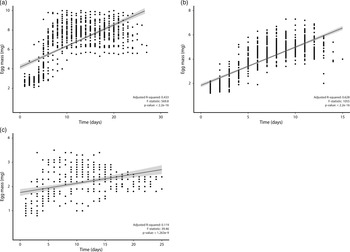
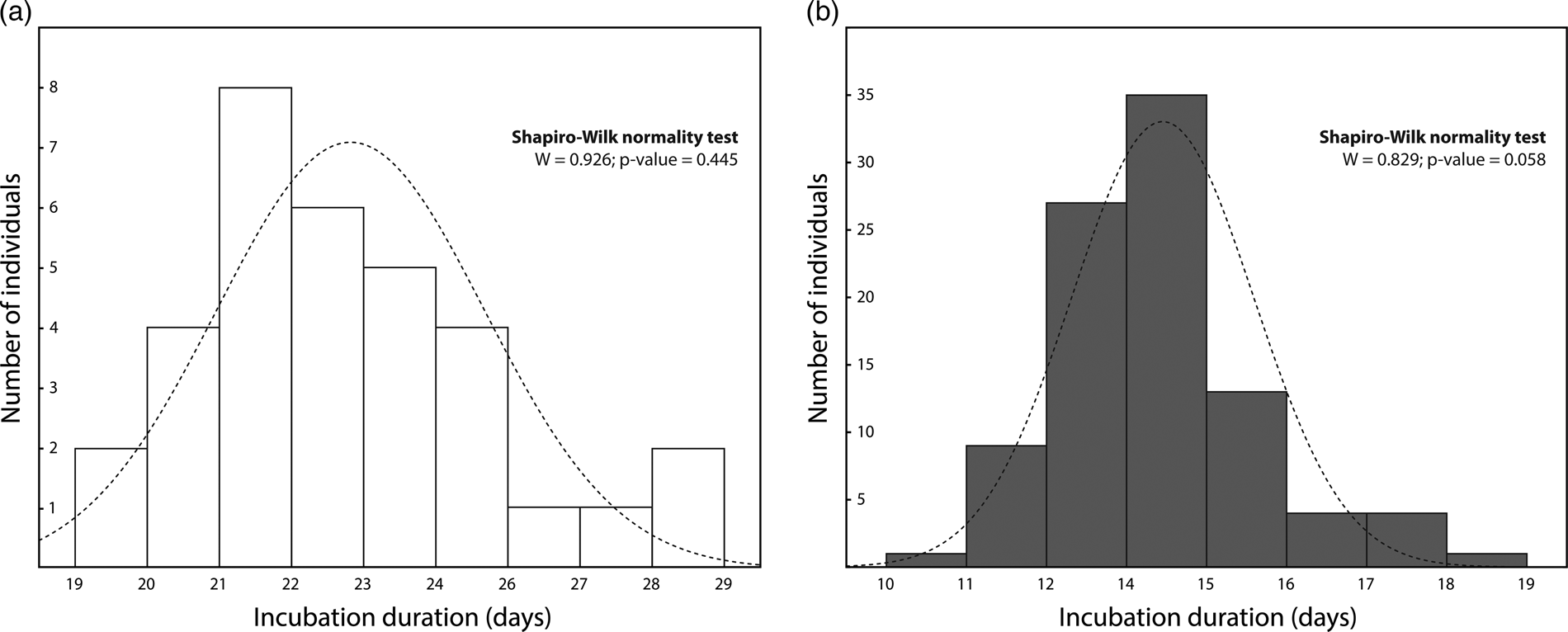
Linear regression analyses revealed strong support for the influence of time interval (days) – during incubation phase – on the gain of mass (mg) in eggs of Cyclocephala (fig. 1). We found a significant positive relationship between egg weight and time interval, for C. cearae (R 2 adjusted: 0.43; P-value: <2.2 × 10⁻¹⁶), C. celata (R 2 adjusted: 0.63; P-value: <2.2 × 10⁻¹⁶), and C. paraguayensis (R 2 adjusted: 0.12; P-value: 1.263 × 10⁻⁹). The incubation durations of C. celata and C. cearae followed a normal distribution (W: 0.83; P-value: 0.06 and W: 0.93; P-value: 0.44, respectively) (fig. 2), implying that the embryonic development of this species is somewhat standardized. The highest hatching rate (median) of C. celata was on day 12 and C. cearae on day 22. On the other hand, C. paraguayensis did not follow a normal distribution in the incubation durations (W: 0.71; P-value: 0.001).
Influence of time interval (days) on egg weight (mg) for three Cyclocephala species: (a) Cyclocephala cearae, (b) Cyclocephala celata, and (c) C. paraguayensis. The black solid line is the linear regression of time interval vs. egg weight for all individuals measured (black circles).

Histogram for the incubation duration of (a) Cyclocephala cearae and (b) C. celata. Black dotted line represents the curve of the normal function.

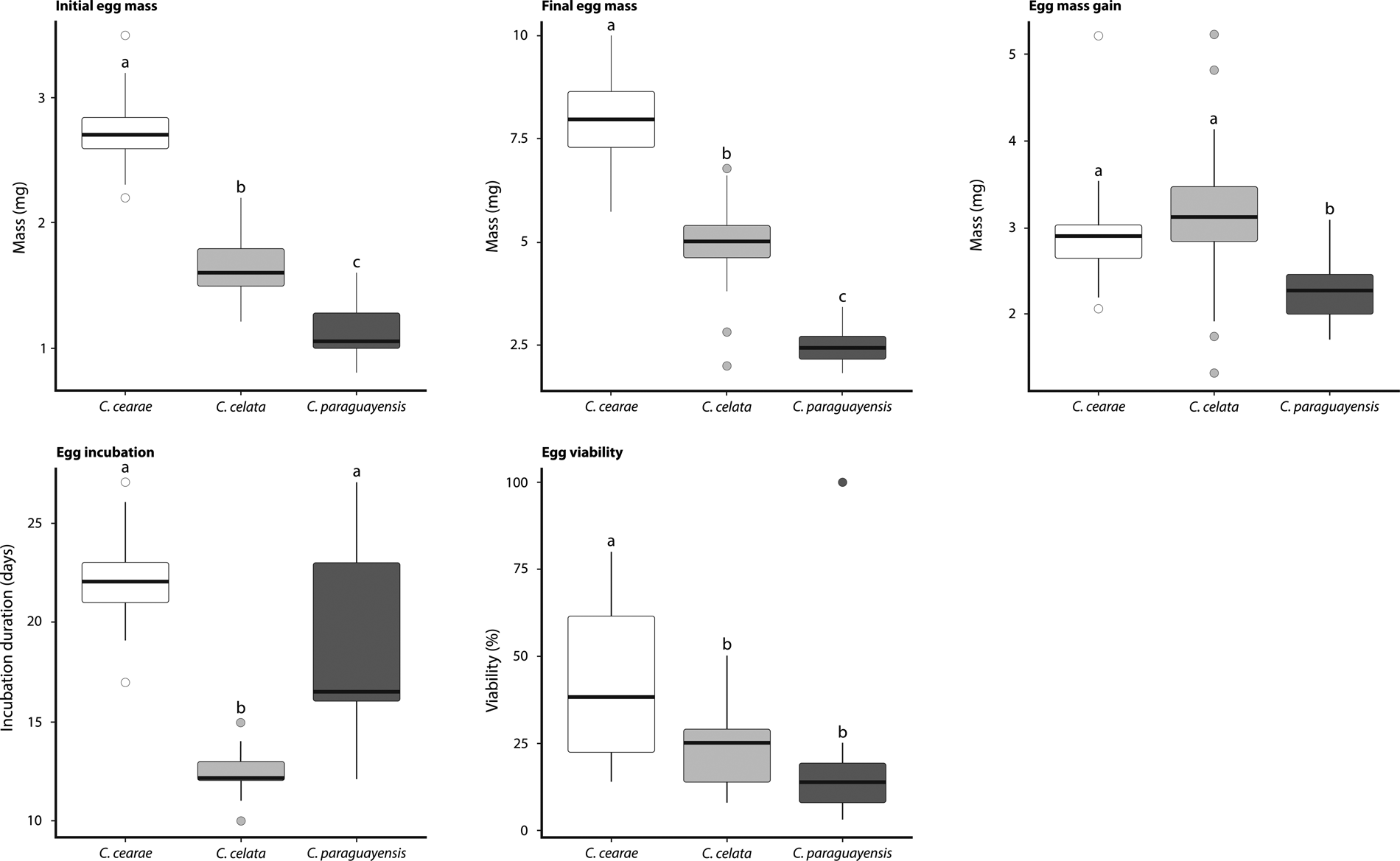
We found that different features of egg development are strongly species-specific (fig. 3, table 1). The initial and final egg weights were higher in C. cearae (Median – Mdn = 2.7 and 8.0 mg, respectively), followed by C. celata (1.7 and 5.0 mg) and C. paraguayensis (1.0 and 2.4 mg). During embryonic development, the eggs of all three studied species bloated and their shells became translucent. The eggs of C. paraguayensis presented a lower rate of mass gain along time (Mdn = 2.0) compared to C. cearae (Mdn = 2.9) and C. celata (Mdn = 3.1); however, no differences were observed between the latter. We also found that the period of egg incubation (days) was shorter in C. celata (Mdn = 12), while C. cearae (Mdn = 22) and C. paraguayensis (Mdn = 17) showed no significant differences between them. Finally, egg development viability in laboratory of C. cearae (38%) was higher when compared with C. paraguayensis eggs (14%).
Boxplots of initial and final egg weights, egg weight gain, egg incubation duration, and egg viability for the three studied Cyclocephala species.

P-value of initial and final egg weights, egg weight gain, egg incubation duration, and egg viability for the three studied Cyclocephala species

The numbers in bold represent a significant difference between species when applied to the Kruskal–Wallis test and the post hoc pairwise comparison Nemenyi test.
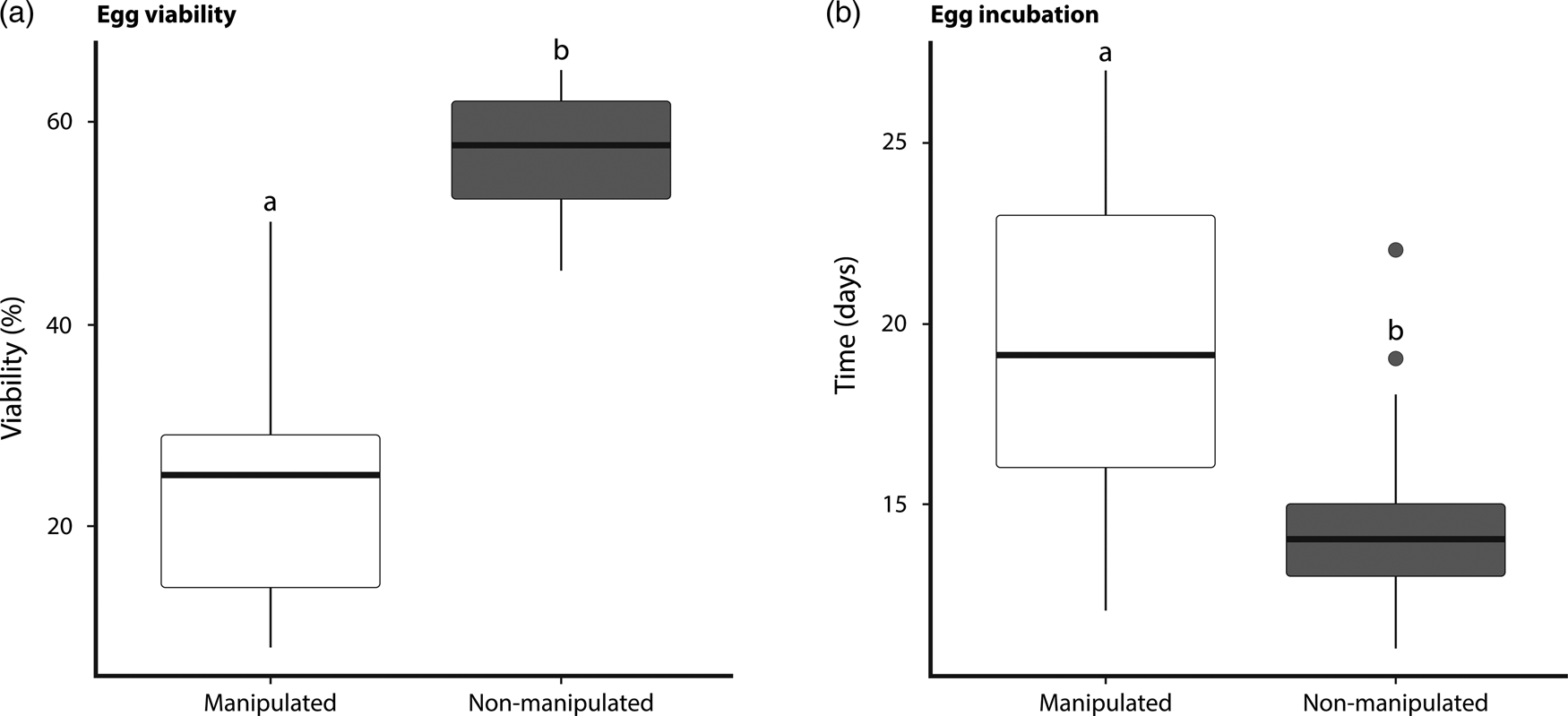
Egg development was negatively affected by manipulation in the laboratory (fig. 4). We found that manipulated eggs had lower viability rate (P-value: 0.0003) and longer incubation durations (P-value: 5.063 × 10⁻⁶) (25% and 18 days, respectively) than unmanipulated eggs (58% and 14 days).
Boxplots showing the influence of manipulation in the laboratory on viability (%) and incubation (days) eggs of (a) C. celata and (b) C. paraguayensis. The letters represent a significant difference between individuals manipulated and unmanipulated.

Discussion
The monitoring of the laying activities of Cyclocephala species in the laboratory allowed us to access information on eggs development of three anthophilous species. We verified the gain mass over the incubation time in the three species, C. paraguayensis in smaller amounts, but the embryonic period was similar between species. Moreover, there is a pattern in the hatching time of C. celata and C. cearae. The handling of eggs contributed to disrupt the natural development of embryo (decreased viability and increased incubation time). Egg weight gain over time is a result of maintaining humidity in the laying chamber (Potter, Reference Potter1983). Female Cyclocephala of the three studied species laid their eggs individually and inside an egg chambers, consisting of spherical clumps of loosely compacted soil. The construction of individualized soil chambers for the laid eggs is commonly recorded among studies with different groups of Scarabaeoidea, including Cyclocephala spp. (Morelli, Reference Morelli1991; McMonigle, Reference McMonigle2006; Lai and Hsin-Ping, Reference Lai and Hsin-Ping2008; Rodrigues et al., Reference Rodrigues, Nogueira, Echeverria and Oliveira2010; Nogueira et al., Reference Nogueira, Rodrigues and Tiago2013; Souza et al., Reference Souza, Maia, Schlindwein, Albuquerque and Iannuzzi2013, Reference Souza, Maia, Albuquerque and Iannuzzi2015, Albuquerque et al., Reference Albuquerque, Souza, Maia and Iannuzzi2014). These chambers protect the egg from desiccation and are likely built by the gravid females (Nogueira et al., Reference Nogueira, Rodrigues and Tiago2013).
Previous research has demonstrated that Cyclocephala lurida Bland, 1863 (=Cyclocephala immaculata) eggs absorbed water and gained mass more intensely during the first 10 days of development (Potter, Reference Potter1983). Eggs of some pest species of Cyclocephala enlarge significantly during embryogenesis, increasing in weight and volume up to threefold (Potter, Reference Potter1998). Although there was a significant positive relationship between egg mass and time interval, for C. cearae, C. celata, and C. paraguayensis there was also a differential water uptake of the species with respect to time. Possibly, the differential water uptake among species may be related to variations in the chorion thickness, fatty-acid water-impermeable layer, stretching of the membranes, or splitting of the chorion (Hinton, Reference Hinton1981; Potter, Reference Potter1983). However, this subject is still little explored in Cyclocephala species (Potter, Reference Potter1983). Thereby, we also support that further research should focus on the structure of eggs that are related to water absorption.
We also verified that egg weight varied between three species, increasing gradually from species with smaller bodies to species with larger bodies and C. paraguayensis had the lowest egg weights. This species is smaller (12 mm) than both C. celata (16 mm) and C. cearae (17 mm). Previous studies suggest that embryonic development stages have a specific duration (Campos-Ortega and Hartenstein, Reference Campos-Ortega and Hartenstein1985; French, Reference French1988) and theoretical models of ontogenetic growth indicate that the metabolic rate of individual organisms may be related to their body size (van der Meer, Reference van der Meer2006). Also, other factors may also influence egg development, such as environmental fluctuation and genetic variation within a population (Johnson et al., Reference Johnson, Zhang, Crawford, Gregory and Young2007).
Cyclocephala cearae and C. celata showed a normal distribution for the incubation duration and a pattern in the hatching period. It could be interpreted as a delicate mechanism for sequential larvae eclosion for mated females that lay all their eggs at a single oviposition event. However, C. paraguayensis showed to follow the rule present among Scarabaeidae females is to oviposit progressively over the course of a few days (McMonigle, Reference McMonigle2006; Lai and Hsin-Ping, Reference Lai and Hsin-Ping2008).
The manipulation of eggs at an early developmental stage may have influenced their incubation and viability, as already observed in a previous study with C. paraguayensis (Albuquerque et al., Reference Albuquerque, Souza, Maia and Iannuzzi2014). Additionally, the destruction of the protective soil chamber might have disrupted normal embryonic development due to stress. We found that egg viability and incubation duration were negatively affected by manipulation, reinforcing the importance of soil chambers built by gravid females to protect their eggs (Triplehorn and Johnson, Reference Triplehorn and Johnson2011; Nogueira et al., Reference Nogueira, Rodrigues and Tiago2013) and the negative influence of environmental stress on egg development (Potter and Gordon, Reference Potter and Gordon1984). The shells of freshly oviposited eggs are thin and highly susceptible to dehydration (Potter and Gordon, Reference Potter and Gordon1984) and the larvae hatched from eggs subjected to stress are significantly smaller in size and sometimes unable to disengage from the chorion membrane (Potter and Gordon, Reference Potter and Gordon1984). Thus, it is crucial to control egg conditions for the successful breeding and rearing of Cyclocephala spp. This information on egg susceptibility is particularly important because it can be applied to strategies on pest management during the initial ontogenic stage of targeted species (e.g., Burgess, Reference Burgess2009; Ferreira et al., Reference Ferreira, Araújo, Braga, Araujo, Carvalho, Silva, Frassy and Freitas2011) or in reinforcing egg care for pollinating and/or threatened species (e.g., Klusener et al., Reference Klusener, Hurtado, Parsons, Vanstreels, Stander, van der Spuy and Ludynia2018; Hanberry et al., Reference Hanberry, DeBano, Kaye, Rowland, Hartway and Shorrock2020).
Final considerations
Our research assessed the egg development of three distinct Cyclocephala species from the Brazilian Atlantic forest hotspot (Myers et al., Reference Myers, Mittermeier, Mittermeier, Da Fonseca and Kent2000). We found a positive correlation between egg weight and incubation duration, and each species presented idiosyncratic traits in egg development. Efforts toward the understanding of Cyclocephala embryogenesis already seem worthwhile from a developmental biology perspective and such investigations should become a standard on life cycle descriptions, helping for conservation and management strategies in agriculture or natural systems.
Taken together, our analyses aim to provide a quantitative understanding of egg development among different species of Cyclocephala, under controlled laboratory conditions. Such/our results contribute to refine strategies related to ovicidal activity and pest management, since the control of initial levels of infestation is economically advantageous and desirable in insect pest management (Dent, Reference Dent2000). Moreover, this type of research can provide a basis for new studies related to breeding captive, pollinator management and developmental biology for biodiversity conservation.
Author contributions
Thamyrys B. Souza: methodology, formal analysis, writing – original draft, writing – review & editing, visualization, project administration. Larissa S. C. Albuquerque: methodology, writing – original draft. Luciana Iannuzzi: methodology, writing – original draft, writing – review & editing, project administration, supervision. Fábio C. Costa: methodology, writing – original draft. Marc Gibernau: methodology, writing – review & editing. Artur C. D. Maia: conceptualization, methodology, writing – original draft, writing – review & editing, project administration, supervision.
Conflict of interest
None.