





High use of emergency departments is a global issue across healthcare systems, with a small proportion of patients responsible for a disproportionately high number of attendances. Reference Soril, Leggett, Lorenzetti, Noseworthy and Clement1 High use contributes to emergency department overcrowding, Reference Morley, Unwin, Peterson, Stankovich and Kinsman2 and the situation has deteriorated significantly across the world in the wake of the COVID-19 pandemic. Reference Sartini, Carbone, Demartini, Giribone, Oliva and Spagnolo3 In England, a national study from 2016 to 2017 found that 9.5% of patients, defined as high-use patients with three or more attendances, accounted for nearly half of all emergency department visits. Reference Greenfield, Blair, Aylin, Saxena, Majeed and Hoofman4 Unsurprisingly, a variety of interventions to reduce emergency department attendance by high-use patients have been evaluated, most involving a case-management/care planning approach. Several systematic reviews have examined the effectiveness of these interventions to decrease emergency department visits by adult high-use patients. Reference Soril, Leggett, Lorenzetti, Noseworthy and Clement1,Reference Althaus, Paroz, Hugli, Ghali, Daeppen and Peytremann-Bridevaux5–Reference Kumar and Klein8 There is some evidence for reductions in attendance from pre–post observational designs, but weak evidence from the small number of randomised controlled trials that have been conducted. Approximately, half of all patients who are identified as high-use stop emergency department attendance without any intervention at all within 12 months, Reference Lago, Westley-Wise, Mullan, Lambert, Zingel and Carrigan9 for which most pre–post evaluations fail to account.
In England, policy was introduced in 2019 to reduce attendance at emergency departments by high-use patients, which promoted two kinds of services: hospital-based liaison psychiatry services targeted at patients with overt mental health problems who frequently use emergency departments, and high-intensity use services based in the community for patients with and without mental health difficulties who frequently use emergency departments. Emergency department high-intensity use hospital-based services offer what have been called continuation of care services, which may include care planning, multidisciplinary team meetings (MDTs) to discuss individual high-use patients, case management and some individual work with high-use patients. Reference Memedovich, Asante, Khan, Eze, Holroyd and Lang10 Such services have relatively small numbers of designated staff, most likely one or two mental health nurses, with additional limited sessional support from an emergency department or liaison psychiatry consultant. A limited amount of outreach follow-up is provided post emergency department, either by telephone or face-to-face work. There are also hospital-based services without any dedicated staff time that usually offer MDTs to discuss a small number of high-use patients with the production of a plan of management, but there is usually no direct involvement with the individual concerned. The MDTs are usually led by an emergency department consultant, but can involve a wide group of professionals from different backgrounds. Community models are essentially non-medical approaches that focus on social interventions, including housing support, managing social isolation, loneliness and deprivation, as well as addressing poor physical and mental health. Although they vary in size, they tend to be larger than emergency department teams, with some having up to six to eight key workers. Some community teams involve liaison psychiatry services, whereas others do not. A key question is whether current services as encouraged by the Department of Health and established and practised in the National Health Service (NHS) are effective in reducing emergency department attendance. We used robust methodology to evaluate the impact of hospital-based and community high-intensity use service models on patients with high emergency department attendance, and controlled for unrelated trends by including emergency departments without either a hospital-based service or a community service in their catchment area. We hypothesised that high-intensity use services would reduce emergency department attendances in high-use patients overall and those with mental health issues.
Method
Study design
The study was conducted in England, using a controlled interrupted time-series (ITS) design to estimate the effect of introducing high-intensity use services on weekly emergency department attendances made by high-use patients across 13 emergency departments. As there are currently no formal guidelines for reporting ITS analyses, we followed recommendations from recent systematic or scoping reviews concerning ITS methodology. Reference Ewusie, Soobiah, Blondal, Beyene, Thabane and Hamid11–Reference Hudson, Fielding and Ramsay13 The Strengthening the Reporting of Observational Studies in Epidemiology checklist was used to guarantee transparency and to report relevant information. Reference von Elm, Altman, Egger, Pocock, Gotzsche and Vandenbroucke14 Artificial intelligence tools were not used in the research or writing process. The data were presented at the European Association for Psychosomatic Research 2026. Reference Guthrie, Saraiva, Kumar, Marshall, Lee and Mason15
Data sources
Data for this study were sourced from the Hospital Episode Statistics (HES) database, a comprehensive repository of routinely collected data from all hospitals in England. This study analysed emergency department attendances from the HES Accident & Emergency (A&E) data-set 16 and the Emergency Care Dataset (ECDS) 17 for the period 1 April 2016 to 1 January 2020. Data from 1 April 2016 to 31 March 2017 were used to define high-use patients, but were not part of the time-series analysis. Data for January 2020 onward were excluded to avoid the potential confounding impact of the start of the COVID-19 pandemic on emergency department attendances.
As diagnosis codes in the A&E and ECDS data-sets are poorly recorded for mental health problems, and subject to omissions and misclassifications, Reference Davis, Sudlow and Hotopf18 linked primary care prescribing data from the English Prescribing Dataset were also utilised to aid the identification of patients in receipt of mental health prescriptions. 19 The English Prescribing Dataset contains detailed information on prescriptions issued in England, with data available from 2014 which are updated monthly. NHS data linkage connects distinct data-sets at the individual patient level, using an individual’s NHS number as a master index, and subsequently anonymises the unified records for research and planning. 20 As the NHS number is a mandatory, nationally standardised identifier, the direct linkage of modern health records is often highly accurate and comprehensive. 20
Data collected included basic demographics, attendances at emergency departments, primary diagnosis recorded at attendance at emergency department and prescribing data regarding recent use of psychotropic medication. All data were pseudo-anonymised at source before transfer for analysis. Patients have the option to opt out of having their data used for purposes beyond direct care, and approximately 5.6% of the population have exercised this right.
Procedures
As part of a broader national survey on liaison psychiatry services, all 171 hospitals in England with an emergency department were invited to provide basic information about high-intensity use services in their locality. The survey was completed by a key informant at each site, familiar with local high-intensity use services, even if they were not directly involved themselves. The results of this mapping project will be reported elsewhere, together with characterisations of the different types of services.
For the purposes of this analysis, high-intensity use services were categorised into four main types, based on a recent review: Reference Memedovich, Asante, Khan, Eze, Holroyd and Lang10
-
(a) Type 1: Hospital-based services providing continuity of care with dedicated staff (usually provided by liaison psychiatry)
-
(b) Type 2: Hospital-based services providing continuity of care without dedicated staff
-
(c) Type 3: Community-based services located outside the emergency department
-
(d) Type 4: Hospitals without any high-intensity use services during the study period identified through the national survey.
Of the 171 hospitals completing the survey, 71 (42%) offered type 1 services; 76 (44%) offered type 2 services; 10 (6%) offered type 3 services, either separate or involving outreach from the hospital; and 14 hospitals (8%) had no current high-intensity use service. From the 157 hospitals with services, we conducted 20 in-depth interviews with representative services of different service types to elicit more details about each service, and then identified 9 exemplar services with established start dates (month and year) for the high-intensity use services. If staff could not recall start dates, we used Freedom of Information Requests to obtain these dates.
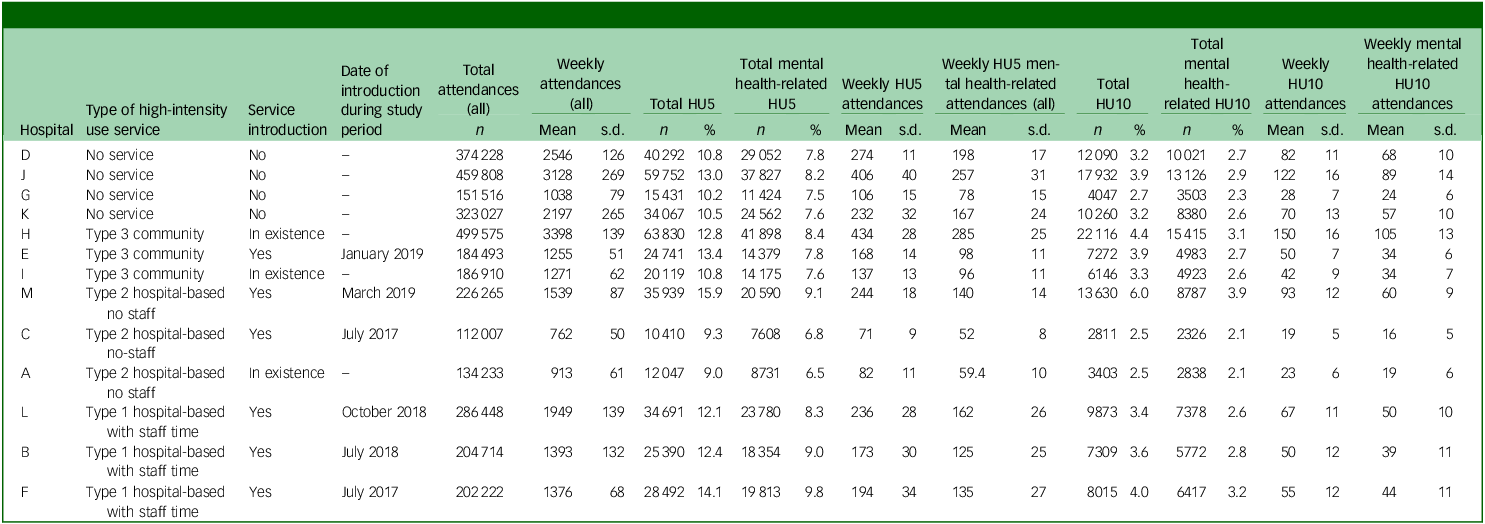
The nine exemplar services included three type 1 services, three type 2 services and three type 3 services. In addition to this, four emergency departments were randomly selected to act as controls (Table 1). All three of the type 1 services commenced during the study period. Two of the type 2 services were in operation throughout the study period and one started during the study period, and one of the type 3 services started during the study period, with two being in operation throughout the study period (Table 1). Six hospital sites were in the North of England, three were in the Midlands and four were in the South of England. Two were inner-city large teaching hospitals, two were coastal, three were rural and the rest were urban.
Baseline attendances for sites for all patients, those with 5 (HU5) or 10 (HU10) or more attendances in 12 months, and HU5 and HU10 patients with likely mental health problems

Table 1 Long description
The table presents data on hospital services and their impact on mental health-related attendances. It includes columns for hospital names, types of high-intensity use services, service introduction dates, total attendances, weekly attendances, total HU5, weekly HU5 attendances, total HU5 mental health-related, weekly HU5 mental health-related attendances, total HU10, weekly HU10 attendances, total HU10 mental health-related, and weekly HU10 mental health-related attendances. Row 1: D, No service, No, 374228, 2546, 126, 40292, 10.8, 29052, 7.8, 274, 11, 198, 17, 12090, 3.2, 10021, 2.7, 82, 11, 68, 10. Row 2: J, No service, No, 459808, 3128, 269, 59752, 13.0, 37827, 8.2, 406, 40, 257, 31, 17932, 3.9, 13126, 2.9, 122, 16, 98, 14. Row 3: G, No service, No, 151516, 1038, 79, 15431, 10.2, 11424, 7.5, 106, 15, 78, 15, 4047, 2.7, 3503, 2.3, 28, 7, 24, 6. Row 4: K, No service, No, 323027, 2197, 265, 34067, 10.5, 24562, 7.6, 232, 32, 167, 24, 10260, 3.2, 8380, 2.6, 107, 13, 57, 10. Row 5: H, Type 3 community, In existence, 499575, 3398, 139, 63830, 12.8, 41898, 8.4, 434, 28, 285, 25, 22116, 4.4, 15415, 3.1, 150, 16, 105, 13. Row 6: E, Type 3 community, January 2019, 184493, 1255, 51, 24741, 13.4, 14379, 7.8, 168, 14, 98, 11, 7272, 3.9, 4983, 2.7, 50, 7, 34, 6. Row 7: I, Type 3 community, In existence, 186910, 1271, 62, 20119, 10.8, 14175, 7.6, 137, 13, 96, 11, 6146, 3.3, 4923, 2.6, 42, 9, 34, 7. Row 8: M, Type 2 hospital-based no staff, March 2019, 226265, 1539, 87, 35939, 15.9, 20590, 9.1, 244, 18, 140, 14, 13630, 6.0, 8787, 3.9, 93, 12, 60, 9. Row 9: C, Type 2 hospital-based no staff, July 2017, 112007, 762, 50, 10410, 9.3, 7608, 6.8, 71, 9, 52, 8, 2811, 2.5, 2238, 2.1, 19, 5, 16, 5. Row 10: A, Type 2 hospital-based no staff, In existence, 134233, 913, 30, 12047, 9.0, 8731, 6.5, 82, 11, 59, 10, 3403, 2.5, 2828, 2.1, 23, 6, 19, 6. Row 11: L, Type 1 hospital-based with staff time, October 2018, 286448, 1949, 139, 34691, 12.1, 23780, 8.3, 236, 28, 162, 26, 9873, 3.4, 7378, 2.6, 67, 11, 50, 10. Row 12: B, Type 1 hospital-based with staff time, July 2018, 204714, 1393, 132, 25390, 12.4, 18354, 9.0, 173, 30, 125, 25, 7309, 3.6, 5772, 2.8, 50, 12, 39, 11. Row 13: F, Type 1 hospital-based with staff time, July 2017, 202222, 1376, 68, 28492, 14.1, 19813, 9.8, 194, 34, 135, 27, 8015, 4.0, 6417, 3.2, 55, 12, 44, 11.
Outcome measures
The main outcome was the change in weekly emergency department attendances made by high-use patients following the implementation of high-intensity use services. We also explored the total number of weekly attendances by high-use patients with probable mental health comorbidities as a complicating factor. This did not mean that the primary reason for attendance had to be a mental health problem, but that the person attending, for whatever reason, was likely to also have comorbid mental health problems. An attendance was counted as having a complicating factor of mental health if any of the following conditions were met: (a) primary diagnosis of a mental health condition was recorded at the emergency department attendance, (b) a referral was made on mental health grounds or (c) the patient had been prescribed a psychotropic drug in a primary care setting within 90 days before the attendance (data from the English Prescribing Dataset).
Psychotropic drugs were grouped into the following categories, using the British National Formulary (BNF): 21 hypnotics and anxiolytics (BNF 4.1), anti-psychotics (BNF 4.2) and antidepressants (BNF 4.3). Prescriptions in the data-set are captured using dictionary of medicines and devices (dm+d) codes (a subset of SNOMED-CT), and were converted to BNF sub-subchapters with the NHS Business Authority mapping file (August 2024 version).
Basic demographic data, including the age and gender of patients, and the time elapsed since the beginning of the study period, were extracted from the hospital record as covariates.
Patients
Emergency department attendances made by adults (aged ≥18 years) at 1 of the 13 hospitals over the study period were extracted from the HES data-set, resulting in 2 938 510 attendances. These attendances were initially grouped by patient and sorted by arrival date. For each attendance, we then applied the criterion whether the individual was currently a high-use patient, defined as either 5 or more attendances (coded as HU5) Reference Locker, Baston, Mason and Nicholl22 or 10 or more attendances (HU10) in the past 365 days. The higher threshold was based on clinical information from the survey we conducted on the 171 hospitals in England and was the most common threshold used by high-intensity use clinical services in England. When an attendance no longer met these criteria, the high-use status was discontinued. High-use patients were identified using rolling thresholds of ≥5 and ≥10 emergency department attendances within the previous 365 days. These cohorts overlap, as individuals with ≥10 attendances are necessarily included in the ≥5 attendance cohort; therefore, the HU10 group constitutes a subset of the HU5 group.
Statistical analysis
For each hospital, weekly aggregates were calculated for total attendances, attendances by HU5 and HU10 patients, and patient demographics (age and gender) over the study period from 1 April 2016 to 1 January 2020. The relationship between high-intensity use services and weekly emergency department attendances was assessed with an ITS analysis. Inference from this approach is strengthened by the temporal association between the intervention (service type) and subsequent change in attendance levels. We modelled the weekly number of emergency department attendances made by current high-use patients across 13 hospitals by using a linear mixed-effects model. The dependent variable was the number of weekly attendances, log-transformed so that hospitals of varying sizes could be compared on a similar scale.
To assess the impact of the implementation of high-intensity use services on emergency department attendances made by high-use patients, we included an indicator variable that activated after the service start date as reported from the national survey. This indicator included a ‘burn-in’ time that captured the period following a service introduction (allowing for a transition period while the new service was brought online to train staff, etc.). This indicator variable took the value of 1 before the introduction of the service, changed to 0 on the date the service was first implemented and subsequently increased by an increment of 1/52 per week thereafter until the variable returned to 1, where it remained – allowing for a 52-week transition to the new service. As a sensitivity analysis, we used a shorter 26 week burn-in period. We modelled the interaction between the burn-in variable and service type to allow the effect of high-intensity use service changes to vary by service type. Services that did not change during the study period (i.e. had no service or already had a high-intensity use service in place which remained in place for the duration of the study period) were recorded as 1 throughout.
Other covariates modelled as fixed effects included an intercept for hospital site identifier, attendances recorded in the previous 1–4 weeks to account for autocorrelation, Reference Burton, Elliott, Cochran and Love23 the month to account for seasonal trends and slopes for weeks since the start of the study period (to account for national trends), the proportion of attenders in the age bands 18–34 and ≥65 years (measured weekly), and the proportion of male attenders attending in each week.
Random effects accounted for clustering at hospital level and service type within hospitals, with random slopes for time (weeks since the start of our data) by hospital, and random intercepts for service type nested within hospital.
Model outputs were reported with fixed effects, back-transformed from the logarithmic scale to express percentage changes in weekly attendances. Hospital-specific coefficients represent baseline levels of weekly attendance, whereas the other coefficients (rate ratios) can be interpreted similarly to risk ratios, where values below one indicate a beneficial effect. For example, an estimated interaction term between the burn-in period and service type of 0.85 indicates a reduction of attendances by 15% over the burn-in period. This analysis was conducted using R (version 4.4.1; R Foundation for Statistical Computing, Vienna, Austria; https://www.r-project.org/foundation/) and the lme4 package. The findings of this study were shared and discussed with targeted stakeholders from NHS services, NHS England and a high-use patient and public involvement group.
Ethics statement
The authors assert that all procedures contributing to this work comply with the ethical standards of the relevant national and institutional committees on human experimentation and with the Helsinki Declaration of 1975, as revised in 2013. All procedures involving human subjects/patients were approved by the School of Medicine Research Ethics Committee, University of Leeds (approval number MREC 21-061).
Consent statement
Formal consent was not required for this study, as all data-sets were limited to pseudonymised records, with no direct identifiers included.
Results
A total of 2 938 510 emergency department attendances were analysed across 13 hospitals (4 controls) from the study period 1 April 2017 to 1 January 2020. Descriptive statistics of the attendances and services employed across each site are shown in Table 1. Total emergency department attendances over the entire study period ranged from 151 516 to 499 575. The mean weekly high-use attendances per hospital ranged from 71 (s.d. 9) to 434 (s.d. 38) for the HU5 group and 19 (s.d. 5) to 140 (s.d. 16) for the HU10 group. The proportion of all attendances meeting HU5 criteria ranged from 9 to 16%, and attendances for HU10 ranged from 3 to 9%. The proportion of high-use attendances that met our mental health-related criteria ranged from 57 to 74% for the HU5 group and 64 to 83% for the HU10 group.
Figure 1(a)–(d) show time series plots of weekly high-use patient emergency department attendances and the date of service introduction from exemplars of each different types of service. Each figure includes weekly high-use attendances (HU5 and HU10) of all attendances and those meeting our mental health-related criteria: Fig. 1(a) displays an emergency department service with designated staff (type 1), Fig. 1(b) displays an emergency department service with no designated staff (type 2), Fig. 1(c) displays a hospital Trust employing a community-based high-intensity use service (type 3) and Fig. 1(d) displays a hospital with no high-intensity use service (type 4).
Time-series data showing weekly emergency department attendances from (a) a type 1 service (hospital-based high-intensity use service with designated staff), (b) a type 2 service (hospital-based high-intensity use service without designated staff), (c) a type 3 service (with a community-based high-intensity use service) and (d) an emergency department with no high-intensity use service. Weekly attendance is stratified by those with 5 or more (HU5) or 10 or more (HU10) attendances in the past 12 months, and those with mental health-related attendances. The red line indicates the date at which the service was introduced. This suggests a reduction in attendance following implementation of the community-based service (c), whereas effects in the hospital-based services appear more heterogeneous, with the most apparent reductions observed among mental health-related HU10 attendances in services with designated staff (a).

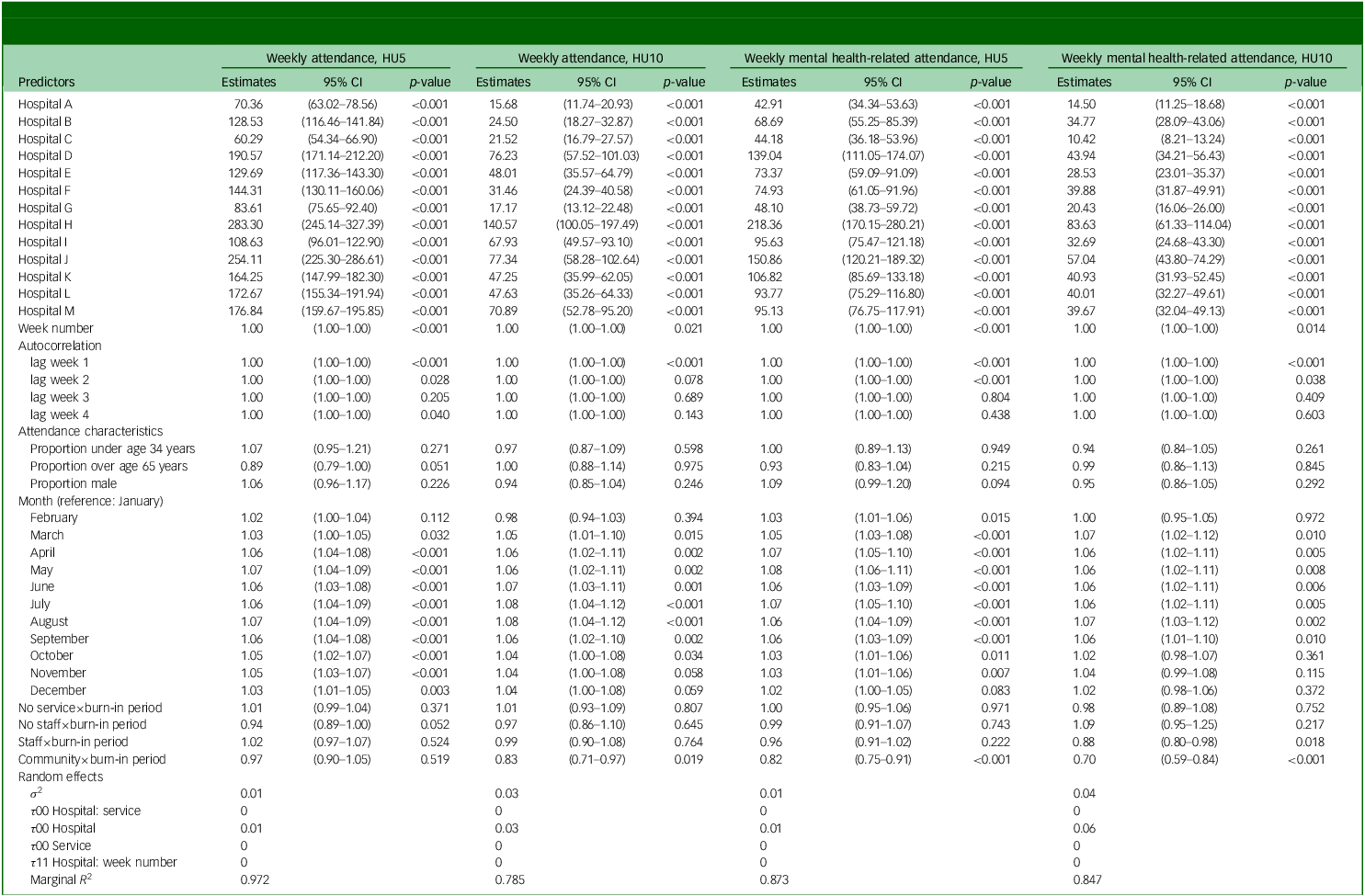
Table 2 shows the results of the ITS analyses. The first 13 rows show the estimated baseline weekly attendances for HU5 patients, HU10 patients and both HU5 and HU10 patients with mental health-related attendances. In particular, we note that the model captures the various site-specific behaviour very well across all four scenarios – closely following local trends without focusing on random variation between months. Our model showed very little evidence of autocorrelation, and the fixed time trend (measured in weeks) was found to have little effect on the weekly emergency department attendances. The table also shows results for individual months with the reference month January. With respect to seasonal trends, high use seems lowest in the winter months.
Interrupted time-series (linear regression) coefficients after fitting the models, showing the individual hospital site intercepts, time-based predictors, case-mix adjustment and estimated effect of the various service types with a 52-week burn-in perioda

Table 2 Long description
The table presents data on weekly attendance and mental health-related attendance for hospitals A to N, including various predictors and their estimates. It is divided into four main sections: Weekly attendance, HU5; Weekly attendance, HU10; Weekly mental health-related attendance, HU5; and Weekly mental health-related attendance, HU10. Each section lists estimates, 95% confidence intervals, and p-values for different hospitals and predictors. The table also includes rows for autocorrelation, attendance characteristics, and random effects. Notable trends include varying estimates and confidence intervals across hospitals and predictors, with significant p-values indicating statistical relevance. The data highlights differences in attendance patterns and mental health-related attendance across the hospitals.
a. The model is fit on log-transformed attendance figures, but the coefficients are back-transformed to the usual scale. The table shows the results of four models fit on those with 5 or more (HU5) or 10 or more (HU10) attendances in the past 12 months, and those with likely mental health problems with 5 or 10 or more attendances in the past 12 months.
The introduction of community-based high-intensity use services (type 3) was associated with a reduction in high use within the burn-in period, with reductions in weekly HU10 (incidence rate ratio 0.83, 95% CI 0.71–0.97), probable mental health-related HU5 (incidence rate ratio 0.82, 95% CI 0.75–0.91) and probable mental health-related HU10 attendances (incidence rate ratio 0.70, 95% CI 0.59–0.84). Hospital-based services with dedicated staff time (type 1) were associated with reduced probable mental health-related HU10 attendances (incidence rate ratio 0.88, 95% CI 0.80–0.98).
Variance in the effect of time (weeks) across hospitals was negligible across all frequent attender metrics (τ ≈ 0.00). Similarly, baseline attendances by high-intensity use service type exhibited minimal variability (τ ≈ 0.00). In contrast, variation in baseline mental health-related HU5 and HU10 attendances by hospital was slightly more pronounced (τ = 0.03 and τ = 0.06), with some variability also observed within specific service-hospital combinations (τ = 0.01). Residual variance (σ 2) was low across all outcome measures, indicating good model fit (HU5 = 0.01, mental health-related HU5 = 0.03, HU10 = 0.01, mental health-related HU10 = 0.04).
Discussion
In this study, we examined the potential impact of different types of high-intensity use services on emergency department attendance for high-use patients. We examined three different types of service that are currently operating in England, and chose three exemplar sites from each service type and four hospital sites without a service as controls. Controlling for natural attrition, our findings suggest there were significant reductions in the weekly rates of emergency department attendances by high-use patients for two types of service. Community services (type 3) had the greatest impact, with significant reductions in attendances by high-use patients with and without probable mental health issues of the order of 17–30%. Hospital-based services with designated staff (type 1), which are mostly liaison psychiatry services, were associated with a significant reduction of the order of 12% for very-high-use patients with probable mental health issues. The average number of weekly attendances by high-use patients (HU5) in the present study across the 13 hospitals was 212 per week. A reduction of the order of 25% clinically equates to an average 53 attendances per week or 2756 attendances per annum per hospital.
Emergency department-based services with dedicated staff only had a significant impact on mental health associated attendances for very-high-use patients (HU10), but many of these services are part of liaison psychiatry teams or have liaison psychiatry input, and were encouraged to develop by NHS England to target high-use patients with mental health issues. So, they result in reduced attendance at emergency departments for those patients who they were set up to help. Community-based services see a wider group of high-use patients. All three community services in this study had at least double or treble the number of staff of the emergency department-based services, so one explanation for the larger impact of these teams may be explained by the greater capacity of the community services to offer help and intervention, but there may be other factors related to the specificity or location of the services themselves that are relevant.
The community services all operated slightly different models, with variations in the amount of mental health input from professional staff, but all offered one-to-one support, help with housing and benefits, attendance at medical appointments and encouragement to join established community groups if appropriate. We found no evidence of any advantage of one type of community service over another. Much of the care provided by both hospital-based and community teams involves care planning and case management, Reference Memedovich, Asante, Khan, Eze, Holroyd and Lang10,Reference Hudon, Chouinard, Aubrey-Bassler, Muhajarine, Burge and Bush24,Reference Di Mauro, Di Silvio, Bosco, Laquintana and Galazzi25 with the community teams offering a greater emphasis on social interventions like housing and help with debt.
Case management is the most widely practised intervention for high-use patients in high-income countries, and involves a comprehensive, interdisciplinary approach to assess, plan, personalise and guide an individual with the help of a case manager or worker, who brokers access to relevant services or activities. Reference Moe, Kirkland, Rawe, Ospina, Vandermeer and Campbell6
Of the small number of trials that have been conducted for interventions to reduce emergency department attendance in high-use patients, only three have shown a significant reduction in emergency department attendances. Reference Shumway, Boccellari, O’Brien and Okin26–Reference Edgren, Anderson, Dolk, Torgerson, Nyberg and Saku28 One of these was a North American study Reference Shumway, Boccellari, O’Brien and Okin26 that evaluated case management, and two were Swedish studies that both evaluated telephone case management. Reference Reinius, Johansson, Fjellner, Werr, Ohlen and Edgren27,Reference Edgren, Anderson, Dolk, Torgerson, Nyberg and Saku28 Most of the evidence to support interventions for high-use patients comes from controlled observational designs. Reference Soril, Leggett, Lorenzetti, Noseworthy and Clement1,Reference Althaus, Paroz, Hugli, Ghali, Daeppen and Peytremann-Bridevaux5–Reference Kumar and Klein8,Reference Gabet, Armoon, Meng and Fleury29
Three single-site studies in the USA – one randomised controlled trial Reference Shumway, Boccellari, O’Brien and Okin26 one using ITS Reference Wang, Lukose, Ensz, Revere and Hammarlund30 and one using difference-in-differences estimation Reference Kim, Park, Everett, Bangerter and Carlson31 – have evaluated community services similar to those included in the present study and found reductions in emergency department attendance over 12 months. Allowing for diverse statistical methods, study populations and health services, these studies show similar findings to those of the present study, but on a smaller scale. Although randomised controlled trials are considered the gold standard, evaluations of services ‘in the real world’ and recruitment of representative clinical populations in hard-to-reach populations is very challenging. The largest trial to show a reduction in emergency department use employed different trial designs in two different centres in Sweden: a Zelen design for one site and a conventional design for the other site. Reference Edgren, Anderson, Dolk, Torgerson, Nyberg and Saku28 Even with the Zelen design, only 50% of eligible participants could be recruited to the study, and with the conventional design it was 30%. Ideally, both randomised controlled trial and ITS types of evaluation can add value to this relatively underresearched area.
This study has several strengths. We specified a clear, measurable outcome and used large, high-quality data sources. Outcomes were assessed using a controlled ITS design, allowing us to determine the differences in changes in emergency department attendances of high-use patients at hospitals with and without access to high-intensity use services. This increases certainty that the differences we found were attributable to service delivery. Bias owing to confounding was minimised by measuring outcomes over a long pre-intervention study period in weekly increments, to appropriately characterise pre-intervention trends in sites with an intervention and those without. We studied exemplar sites, derived from a national survey, to ensure sites chosen were representative of current NHS services, and studied three different types of service.
There are several limitations. It was difficult to establish the start month of many services, which is essential for ITS analyses, and this limited the number of sites we could study. Our period of study was restricted to the pre-pandemic COVID-19 period, because of the disruption to emergency department attendances during 2020. Although the services we evaluated in this study did not have an upper age limit, they tended to focus on young-to middle-aged high-use patients who present with mental health and social problems. ITS designs have certain advantages in being able to evaluate services in real-world settings inclusive of all patients, but there are inherent biases because of the heterogeneity of case-mix and services. For example, all three of our community services differed in their thresholds for accepting high-use patients, staff mix, caseload and approach to case management. Mental health conditions are poorly recorded within secondary care data, and are prone to misclassifications or omissions, Reference Davis, Sudlow and Hotopf18 so we used a combination of data points to identify patients with likely comorbid mental health problems. One of our key indicators was prescription of psychotropics, which we recognise has inherent biases, as medication may be incorrectly prescribed for mental conditions or prescribed for non-mental health conditions. However, prescribed psychotropic medication is significantly associated with symptoms of psychological distress, Reference Espitia-Cepeda, González-Amado, Simó-Algado and Villanueva-Blasco32 and in longitudinal analyses, associated with long-term increased psychosocial distress. Reference Kessing, Ziersen, Caspi, Moffitt and Andersen33 Psychotropic medication has been widely used as a proxy for mental health morbidity in studies using large data sets, such as studies on suicide. Reference Windfuhr, While, Kapur, Ashcroft, Kontopantelis and Carr34,Reference Onyeka, O’Reilly and Maguire35 We have used the term ‘probable mental health issues’ to acknowledge the uncertainty around our method of identifying mental health cases. Without this approach, we would have underestimated the number of high-use patients with mental health issues.
High use of the emergency department is a ubiquitous problem around the world, Reference Shukla, Faber and Sick36,Reference Giannouchos, Kum, Foster and Ohsfeldt37 so our findings are relevant to other healthcare systems and countries who are designing care for this disadvantaged group of people. Further research is required to estimate the impact of high-intensity use services on health service costs and wider societal costs, and to determine which subgroups of high-use patients may benefit most from different types of high-intensity use services.
In conclusion, this observational study provides supportive evidence for the continuation of emergency department-based and community high-intensity use services for patients who frequently use the emergency department.
Data availability
The use of the HES database was subject to a Data Sharing Framework Contract between The University of Leeds and NHS Digital (identifier DARS-NIC-666525-M8L1F-v0.3). No data are available. Requests for any underlying data cannot be granted by the authors because the data were acquired from data under licence/data-sharing agreement from NHS Digital, for which conditions of use (and further use) apply. The analytical code that supports the findings of this study is not publicly available because of ongoing work on a larger project, but is available from the corresponding author, E.G., upon reasonable request.
Acknowledgement
Artificial intelligence was not used in the preparation of this manuscript.
Author contributions
E.G., C. Burton, C. Bojke, S.d.-l.H., S.M., W.L., R.W., S.R. and C.M.v.d.F.-C. conceived of the research and contributed to funding acquisition. A.K., C.M. and S.R. conducted the analysis. A.K. and S.R. wrote the first draft of the manuscript. A.K., S.R. and C.M. have directly accessed and verified the underlying data reported in the manuscript. All authors (A.K., C.M., S.S., W.L., C.M.v.d.F.-C., S.M., C. Burton, S.d.-l.H., R.W., C. Bojke, R.M., S.R. and E.G.) contributed to the manuscript. All authors have read and approved the final manuscript.
Funding
This research was funded solely by the National Institute for Health and Care Research (NIHR) Health Services and Delivery Research Programme (project reference 132852). The views expressed are those of the author(s) and not necessarily those of the NIHR or the Department of Health and Social Care. All authors confirm they had full access to all the data in the study and accept responsibility to submit for publication.
Declaration of Interest
All authors acknowledge funding from the NIHR. S.R. also acknowledge grants from Medical Research Council and UK Research and Innovation in the past 36 months. W.L. is a member of the BJPsych Open Editorial Board, but was not involved in the review or decision-making process of this paper.


 Open access


eLetters
No eLetters have been published for this article.