Implication
This paper aims to provide the latest information on the main fibre production parameters in domestic South American camelids. The research focuses on two characters: skin follicular structure, fibre cuticular cell and their distribution in alpaca and llama. In particular, the information is on the first few months of life of the animals in order to explain how fleece and skin change during the first year and when the fleeces are ready to be collected. New differential data on suri fibre determination and some important clarification on the classification of Q’aras and T’amphullis bolivian llama types was provided.
Introduction
Major genotypes of South American camelids (SAC)
The SAC population is dominated by alpaca (47%) and llama (44%), the former being mainly (91%) distributed in Peru, and the latter (70%) in Bolivia. Smaller populations are found in other countries, which include ca 70 000 alpaca in Australia and 1000 in Italy.
Alpaca (Lama pacos L.) is a domestic mammal specialised in fibre production (Bustinza Choque, Reference Bustinza Choque1985; Flores Ochoa and Mac Quarry, Reference Flores Ochoa and Mac Quarry1995; Bonavia, Reference Bonavia1996). Llama have been traditionally reared as multi-purpose animals providing both meat and fibre mainly utilised for handcraft products (Lusky et al., Reference Lusky, Valbonesi, Rodriguez, Ayala, Weimin and Antonini2006).
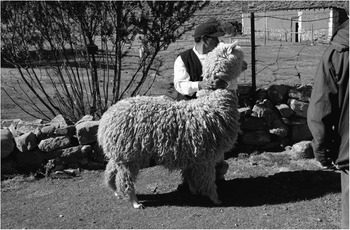
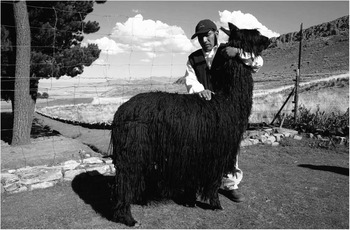
For alpaca, two different types of fleece are produced by genotypes identified as huacaya (Figure 1) and suri (Figure 2; Calle Escobar, Reference Calle Escobar1984; Novoa and Wilson, Reference Novoa and Wilson1992). Huacaya represents 90% of alpaca fleece processed in Peru (Hoffman and Fowler, Reference Hoffman and Fowler1995). It is characterised by compact, soft and highly crimped fibres with blunt-tipped locks that closely resemble those of Merino sheep. By contrast, the suri product has locks with a ‘cork-screw’ shape and straight, less-crimped, lustrous, silky fibres, very similar to mohair of the Angora goat but not as bright. Differences between fleece types for properties of cell-scale frequencysecondary to primary (S/P) follicular ratio have been described previously (Antonini et al., Reference Antonini, Gonzales, Frank, Hick, Pierdominici, Catalano and Castrignanò2001 and Reference Antonini, Gonzales and Valbonesi2004).
Alpaca huacaya.

Alpaca suri.

The genetic background of huacaya and suri is still not clearly defined because the segregation analyses carried out in the past do not show consistent data. This is shown by reports that indicate that suri is inherited as a single recessive gene (Calle Escobar, Reference Calle Escobar1984), a single dominant gene (Velasco, Reference Velasco1980), a single dominant gene or a haplotype (Ponzoni et al., Reference Ponzoni, Hubbard, Kenyon, Tuckwell, McGregor, Howse, Carmichael and Judson1997; Baychelier, Reference Baychelier2000).
Alpaca are particularly valued for fibre production, being characterised by homogeneously fine, long and soft fleeces, very much in demand by the European textile industry.
The main differences in fleece between alpaca and llama may be related to the nature of fibres present. While alpaca produce a more homotricous fleece as in huacaya and suri, llama present as more ‘double-coated’ according to the following classification:
(i) ‘Q’aras’ (or ‘carguera’) (Q), which is the typical double-coated animal, with more guard hair (outercoat) and markedly less woolly fibres (undercoat) ranging from short to very short, and
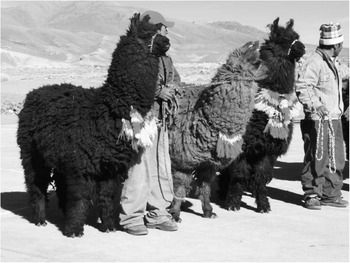
(ii) ‘Chaku (Peruvian expression)/ T’amphullis (Bolivian expression)’ (or woolly) (T), which is a predominantly single-coated animal with soft, crimped secondary fibres, but with a low-quality fleece because of contamination with primary fibres present (Figure 3).
Figure 3T’amphullis (or woolly llama).


SAC fleeces are not, however, limited to the few types illustrated above, but are characterised by a great variability because of extensive interbreeding between and within llama and alpaca and the absence of selection programmes in both Peru and Bolivia.
This paper reviews information concerning the main characteristics of fleece and fibres produced by domesticated SAC in the context of the hair follicles that produce them. Particular focus is given to anatomy and dynamic behaviour of the different types of follicles in skin and to the important and distinguishing properties of fibres such as structure of cuticular cells, diameter and medullation. Specific attention is given to the Bolivian llama types.
Hair follicle characteristics and development
Fibres produced by secondary follicles in the skin are generally of greatest commercial value. For such commercial purpose, skin follicle productive potential can be measured either as the ratio of (S/P follicles or as the density of secondary follicles per unit area of skin. The S/P ratio, however, is often a more appropriate measure as no allowance need be made either for skin expansion during animal growth or for shrinkage of skin at the processing stage (Henderson and Sabine, Reference Henderson and Sabine1991). Hence, the S/P ratio has been extensively used both to compare sheep breeds (Carter and Clarke, Reference Carter and Clarke1957) and as a means of measuring secondary follicle maturation after birth (Fraser, Reference Fraser1954; Schinckel, Reference Schinckel1955).
It is now well established that in Merino sheep all the primary follicles are mature at birth (Fraser, Reference Fraser1954; Lyne, Reference Lyne1961), whereas hardly any of the secondary follicles mature until after birth (Short, Reference Short1955). The age at which all the secondary follicles are fully developed varies between different sheep breeds, for example, it occurs at one month in the Herdwick breed, 3 months in both the Scottish Blackface and the Romney, and at 17 to 18 weeks in Australian Merinos (Burns, Reference Burns1949, Reference Burns1953, Reference Burns1954a and Reference Burns1954b; Fraser, Reference Fraser1952 and Reference Fraser1954; Schinckel, Reference Schinckel1955).
Dreyer and Marincowitz (Reference Dreyer and Marincowitz1967) showed that secondary follicle maturation in Angora goats continued until the age of 6 months, with the greatest increase in S/P ratio occurring within the first 3 months of life. Wentzel and Vosloo (Reference Wentzel and Vosloo1975) confirmed that in Angora goats, at 4 months of age, all secondary follicles produce mohair and this is also in agreement with the relatively small variation in fibre diameter observed in mohair of kid shorn at approximately 6 months of age.
Regarding cashmere production, kids of Australian cashmere goats, at the age of 20 weeks, have attained their full complement of secondary follicles and this is conserved until about 42 weeks of age, when they begin to shed their fleece (Henderson and Sabine, Reference Henderson and Sabine1991).
The development of fully functional hair follicle structures in skin of SAC has not been adequately investigated. This is despite the fact that the age at which maximal fibre production is reached is of fundamental importance for planning correct management of shearing of alpaca and llama. It is therefore important to determine the age at which secondary follicles reach maturity in the commercially valuable huacaya, suri and llama chaku genotypes as well as to define skin follicular structure and the activity and physical properties of fibres produced.
Characteristics of fibre cuticle
Generally, to characterise and analyse fibre samples from different animals, the major parameters utilised are fibre diameter (FD), mean cuticular cell scale frequency (MSF), fibre cuticle cell scale height (SH), its coefficient of variation and appearance and pattern of cuticular scales (Phan et al., Reference Phan, Wortmann, Wortmann and Arns1988).
MSF is defined as the number of scales per 100 μm fibre length. It varies from one type to another, with values ranging from 10 to 12 for Merino wool (Knott, Reference Knott1990), 6 to 8 for cashmere and 6 to 7 for mohair (Phan et al., Reference Phan, Wortmann, Wortmann and Arns1988). The scanning electron microscopy method introduced by Deutsches Wollforschungsinstitut Aachen (Knott, Reference Knott1990) to measure MSF is one of the main methodologies in the textile industry for quantitative analysis of blends of different speciality fibres.
Measurement of SH has been mainly utilised to differentiate between Merino wool (SH > 0.6 μm) and mohair fibres (SH < 0.4 μm) in industrial analysis. Currently, other fine fibres (cashmere, camel hair, alpaca and yak) are classified together with SH <0.4 μm and with a recognised degree of overlap (Wortmann and Arns, Reference Wortmann and Arns1988; Wortmann, Reference Wortmann1991).
Cuticular scale pattern in llama/alpaca fibre of medium fineness was defined as mainly cylindrical with near and ripple-crenated margins that run perpendicular to the fibre axis. In comparison with other fine fibres, samples from SAC have shown very occasional similarities to fine wool and cashmere with scale structures approaching a mosaic pattern.
Despite the apparent inability of textile laboratories to distinguish between the (secondary) fibres of llama and alpaca (Phan et al., Reference Phan, Wortmann, Wortmann and Arns1988), there is logic in the proposal that variations in MSF and SH could be considered useful objective parameters in animal selection. This approach could have merit in differentiating the fibres and consequently the different types of fleeces of individual animals. It is supported by data from the preliminary investigation on the number of cuticular scales detected in fibres of Argentinean camelids (Antonini et al., Reference Antonini, Gonzales, Frank, Hick, Pierdominici, Catalano and Castrignanò2001).
Application of methodology to llama
The situation for classification in llama is complicated and different methods have been applied according to breeding cultures in the different Andean areas. What is known is that Bolivian llama populations are essentially unselected and show wide variability. For example, Martinez et al. (Reference Martinez, Iniguez and Rodriguez1997) analysed variability in a Bolivian llama population for the following fleece parameters: percentage of medullated fibres (fragmented medullation, continuous medullation and kemp), fibre diameter of different fibre types (coarse, fine and medullated), average fibre length (undercoat and guard hair), clean fleece yields and presence of crimp.
The results obtained showed that the Bolivian llama fleece typically consisted of a mix of heterogeneous types ranging from unmedullated to kempy fibres (Martinez et al., Reference Martinez, Iniguez and Rodriguez1997). While a ‘suri’ type of fleece seemed to segregate with low frequency within the population, a ‘suri’ standardised flock was never discovered. The dishomogeneity and the variability of llama flocks appear as a clear consequence of lack of interest in fibre selection by breeders. Until recently, llama fleece was actually mixed with the alpaca fibre in order to increase the quantity of product although compromising the quality of the lots of ‘alpaca’ fleece. In contrast, there is some organised commercialisation of fleece specifically from ‘woolly’ llama flocks in certain Andean highland areas where the fibre is directly classified as llama lots.
Characteristics of fleeces and fibres have been studied in llama populations in the Potosì Department of North and South Lipez Provinces by Quispe et al. (2004). They defined the average weight of commercial fleece of T’amphullis (T) as being greater than that of Q’aras (Q) type, while there was no difference in weight of fleece in the ventral (belly) part of the body. They also showed no differences between the two types of llama in average fibre diameter (21.0 μm (T) and 21.4 μm (Q)) and in percentage of medullation (13.9% (T) and 15.4% (Q)), while for staple length, T was longer than for Q (12.0 v. 10.4 cm).
As indicated above, major parameters affecting the fleece and fibre production characteristics are the structure and activity of follicles, These, to date, have scarcely been investigated in SAC. For Bolivian llama, there is particular lack of information on the pattern fibre growth and the age at which maximal fibre production is reached and their variability. Such information is important in decisions designed to optimise shearing management and methods for the early selection of animals in the context of an overall llama management system.
Material and methods
Study 1. Post-natal development of follicles in skin of alpaca and llama genotypes
The field experimental work was performed in the ‘Alpaquero’ developing centre of Toccra, located in the Arequipa plateau, Caylloma province, Peru, at 4350 to 5200 m above sea level (15°52′S, 71°26′W). The climate of this area is typical of the high Andean Puna ecosystem, with a mean annual rainfall of 545 mm, 90% of which falls between January and March, and a mean annual temperature of 1.7°C, with an absolute variation of 26°C (−11.7°C to 15.1°C).
Twenty-five animals comprising 10 huacaya (four females and six males), five suri (two females and three males) and 10 Chaku (six females and four males) were selected for investigation of the development and activity of skin follicle structures. These camelids ‘crias’ (kids) were born in January 1998, and were the offspring of females selected from a flock of SAC used as a reproductive nucleus in a selection plan of the local SAC population. Crias remained with their mothers until weaning at 8 months of age and ran with the rest of the herd according to the Toccra farm management strategy (Antonini et al., Reference Antonini, Gonzales and Valbonesi2004). Animals were managed in 3217 ha of grazing land, divided into three different plant environments (Bofedales, Pajonales and Tolares), according to the seasonal availability of biomass.
Skin biopsies were taken from the right mid-side of each animal by a 0.8 cm-diameter punch positioned approximately over the 10th rib and about halfway down the body (Frank et al., Reference Frank, Parisi de Fabro and Mendez1989). This body area has been found to give samples more representative of fleece characteristics than other fleece regions (Martinez et al., Reference Martinez, Iniguez and Rodriguez1997). Sampling started at March 1998, when the animals were 2 months old, and was repeated at 4, 6 and 10 months of age. Skin samples were fixed in Bouin solution and stored in ethanol.
After storing, skin samples were dehydrated in a graded ethanol series and embedded in paraffin. Transverse sections of 7 μm were cut with a rotary microtome and stained by using the Sacpic staining procedure, modified by Nixon (Reference Nixon1993). This dyeing method reveals the follicular inner root sheath (IRS, which shows activities only in the anagen phase) and the cellular layer of the outer root sheath, which are the main histological structures for defining skin follicular activity. The level immediately under the sebaceous gland was defined as the most suitable depth for carrying out microscopical observations because it contains the greatest number of detectable skin follicles and thus maximises the possibility of observing the IRS.
With the aid of a calibrated ocular micrometer mounted on an optical microscope, the histological sections under observation were subdivided into 16 areas of 1 mm2. The following parameters were recorded for each area: (i) total number of primary follicles, (ii) active and inactive primary follicle number, (iii) total number of secondary follicles, (iv) active and inactive secondary follicle number and (v) number of medullated fibres in both primary and secondary follicles. The recorded data were used to calculate:
(a) the FD, defined as the number of follicles per mm2 multiplied by 0.84, which is the coefficient of correction measured after skin sample shrinkage, due to fixation and dehydration procedures;
(b) the ratio of S/P follicles;
(c) the percentage of medullated secondary (PMS) fibres (calculated from the total number of secondary fibres);
(d) the percentage of active secondary (PAS) follicles (calculated from the total number of secondary fibres).
Analyses of variance (ANOVA) were performed on FD, S/P, PMS and PAS transformed data (the square root transformation was used for density data, whereas the arcsine, or angular, transformation was used for percentage data). As animals and age were not randomly chosen, a model I ANOVA was utilised, with fleece type, age and sex considered as factors. All the statistical analyses were performed by means of SAS (version 6.12, 1995) statistical software.
Study 2. Diameter and physical characteristics of cuticle cells in fibres of alpaca and llama genotypes
With respect to the Cuticular structure analysis, the fibre samples were taken from the mid-side of 60 Peruvian domestic camelids, bred at the ‘Alpaquero’ developing centre of Toccra, located in the Arequipa Plateau, Caylloma Province (Peru), at 4350 to 5200 m above sea level (15°52′S, 71°26′W). Twenty huacaya, 20 suri and 20 llama ‘chacos’ (or woolly), all homogeneous for sex (male), age (18 months old), fleece colour (white) and time of shearing (first shearing), were randomly chosen in order to represent a random sample of the three fleece types.
The fibres were washed in petroleum ether (pure solution), oven-dried at 60°C for 30 min, coated with gold in a sputtercoating apparatus (Agar Aids) and then examined with the aid of a scanning electron microscope (Cambridge Stereoscan 250 MK3 Scanning Electron Microscope with EDX-Detector Oxford Instruments Mod. 6272), set at an accelerating voltage of 15 kV and a working distance of 23 mm (for further details, see: International Wood Textiles Organization (IWTO) DTM –XX, 1997). Measurements of the fibre diameter and computation of the number of cuticular scales per 100 μm fibre length were performed on a sample of 150 fibres for each specimen. SH was measured on a different sample of 50 fibres. Statistical analyses were performed using the SPSS 12.0 statistical software package (2003).
Study 3. Comparison of skin follicle characteristics between Bolivian llama T’amphullis (T) and Q’aras (Q) genotypes
Thirty-one llama kids of different sex (20 male and 11 female) and type comprising 15 ‘Q’aras’ (10 male and 5 female) and 16 ‘T’amphullis’ (10 male and 6 female), born between January and April 1998, were chosen in the study designed to determine the age at which the hair follicles reach maturity, as well as to compare skin follicular structure and activity. The experiment was performed at the Patacamaya Experimental Station in Bolivia, Department of La Paz, at 3789 m above sea level (17°21′S, 67°45′W). The climate of this area is typical of the high Andean Puna semi-arid ecosystem, with a mean annual precipitation of 402 mm, coefficient of variation of 31%, and a mean annual temperature of 10.4 C degrees (Valdivia and Jetté, Reference Valdivia and Jetté1996). Measurements were made and data analysed using the same methodology as described for Study 1 above.
Results and discussion
Study 1. Post-natal development of follicles in skin of alpaca and llama genotypes
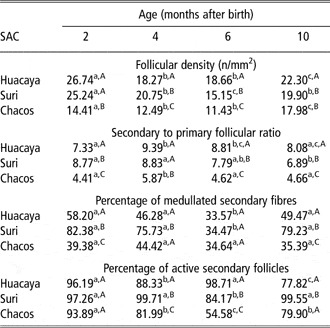
For the alpaca (huacaya and suri) and llama (chacos) genotypes, values for the PMS fibres and PAS follicles were at their maximum by 2 months of age (Table 1) A similar result was obtained for density of skin follicles except for chacos for which the maximum value was reached at 10 months. The fourth parameter, the ratio of secondary to primary follicles, reached its maximum value by 4 months. It was thus shown that SAC developed a complete and mature skin follicle apparatus at an early age.
Mean parameters for skin follicles in three types of South American camelids (SAC), recorded at four different ages (Antonini et al., Reference Antonini, Gonzales and Valbonesi2004)

Superscript letters a, b and c are used within the same type of SAC for comparisons between different ages.
Superscript letters A, B and C are used for comparisons between different SAC, at the same age.
In both comparisons, different letters indicate significantly different values at P < 0.01.
The density of skin follicles, PMS fibres and PAS follicles, with the exception of those of huacaya, were shown to decrease until month 6. This was followed by an increase in values, which, in the majority of cases, were not significantly lower than those recorded at the beginning of the observations at month 2. In terms of environmental conditions, month 6 occurred in July, which is characterised by the coldest temperature, shortest day length and the lowest pasture production of the Peruvian Highlands during the Andean dry season.
Thus, unfavourable environmental conditions are associated with negative effects on both the number and physiological activity of the skin secondary follicles and also with decreases in medullation. Seasonal effects, possibly including photoperiod, may be expected to influence skin follicle activity. In addition, a positive correlation between this parameter and the PMS fibres has been previously reported for a range of mammalian species and breeds, including goats (Nixon et al., Reference Nixon, Gurnsey, Betteridge, Mitchell and Welch1991a and Reference Nixon, Saywell and Bown1991b; Nixon, Reference Nixon1993), while extrinsic melatonin/prolactin regulation has been identified as affecting growth and activity or quiescence of hair shaft production during the hair follicle cycle mechanisms for induction of the medullary cell lineage, including those of intrinsic origin (Galbraith, Reference Galbraith2010), which appears to be unexplained. The possible association with reductions in nutrition requires further study. The only exception to the general trend towards winter-associated reductions occurred in the PAS follicles of huacaya, which were essentially maintained during the winter period although decreasing in month 10 in early spring. Nixon (Reference Nixon1993) reported that in animals selected for fibre production, such as New Zealand predominantly single-coated Angora goats, the activity of secondary follicles remained high from winter to spring, thus suggesting that the growth of fine, generally non-medullated fibres, was continuous and not affected by such seasonal change. Allain and Renieri (Reference Allain and Renieri2010) have recently concluded that predominantly single (secondary-follicle)-coated animals tended to be less affected by changes in photoperiod than those exhibiting active growth by both primary and secondary hair follicles. Thus, it may be assumed that the simple, non-scientific selection, employed by farmers (‘campesiños’) for improving fibre quality in huacaya alpaca, could have produced animals possessing secondary skin follicles with activity maintained throughout the winter period and addressed mainly to the production of non-medullated fibres.
A slightly different trend was shown by the ratio of secondary to primary follicle, which, having peaked 2 months later than the other parameters at month 4, underwent a progressive decrease until the end of the observations (12 months). This indicates that the growth of the new fibres in early spring does not involve the formation of new secondary follicles, but rather the renewal of activity from quiescence. In any case, detection has been performed referring to follicular activities.
Finally, with reference to the magnitude of the values of these four parameters, the huacaya and suri alpaca types generally showed similar maximum values for follicular skin density and ratio of secondary to primary follicles. By contrast, the Chaku llama type appeared well differentiated from the alpaca ones, exhibiting the lowest values throughout for the parameters investigated.
It is important that the above findings on follicle numeracy and activity be exploited for a rational management of, and fibre production from, the SAC crias (kids). This is because the fleece of kids is the most requested in the market and llama and alpaca have the potential to produce valuable fibre from an early age. Farmer-producers may thus be encouraged to practise an early first shearing. This may increase their revenues by a value equivalent to one additional shearing over the productive life of an animal.
It is also evident that the effect of environmental factors on follicular skin activities will require particular investigation, to determine the effects of the harsh conditions (environmental temperature, raining period, feed availability, effect of photoperiod, etc.), of the main traditional production areas of the Peruvian and Bolivian Andean plateau.
Study 2. Diameter and physical characteristics of cuticle cells in fibres of alpaca and llama genotypes
Mean values for fibre diameter, cuticular cell scale frequency (MSF) and cuticle cell SH are shown in Tables 2 to 4. A consistent feature of the data is the wide variability, as shown by differences between minimum and maximum values and large coefficients of variation.
Fibre diameter (μm) in three types of Peruvian domestic camelid fleeces (Valbonesi et al., Reference Valbonesi, Cristofanelli, Pierdominici, Gonzales and Antonini2010)

Cuticular scales counted on a fibre length of 100 μm in three types of Peruvian domestic camelid fleeces (Valbonesi et al., Reference Valbonesi, Cristofanelli, Pierdominici, Gonzales and Antonini2010)

Different superscript letters indicate significantly different values at P ⩽ 0.001.
Cuticular scale height (μm) measured in three types of Peruvian domestic camelid fleeces (Valbonesi et al., Reference Valbonesi, Cristofanelli, Pierdominici, Gonzales and Antonini2010)

Table 2 shows the data related to the fibre diameter in the three different types of Peruvian domestic camelid fleece. A nested analysis of variance was carried out to test whether the means recorded are significantly different from each other. This analysis indicates no evidence of a significant variance component among the types of fleece (F(2; 57) = 1.51, P = 0.247), yet there is a highly significant (F(57; 8940) = 42.83, P < 0.001) added variance component among specimens within the type of fleece. The percentage contribution to the total variation, owing to variation among types of fleece, among specimens within each fleece type and among measurements within each specimen was 1.6%, 21.4% and 76.9%, respectively (Valbonesi et al., Reference Valbonesi, Cristofanelli, Pierdominici, Gonzales and Antonini2010).
Table 3 illustrates the data related to the number of cuticular scales counted on a fibre length of 100 μm. The nested analysis of variance indicates that there is a significant added variance component among the types of fleece (F(2; 57) = 19.61, P < 0.001) as well as among specimens within the same type of fleece (F(57; 8940) = 29.14, P < 0.001; Valbonesi et al., Reference Valbonesi, Cristofanelli, Pierdominici, Gonzales and Antonini2010).
Table 4 illustrates the data related to the height of the cuticular scales. The nested analysis of variance indicates that there is no evidence for a significant variance component among the types of fleece (F(2; 57) = 2.37, P = 0.124). There is a highly significant added variance component among specimens within the type of fleece (F(57; 2940) = 39.06, P < 0.001). The percentage contribution to the total variation owing to variation among types of fleece, among specimens within each fleece type and among measurements within each specimen was 8.3%, 39.6% and 52.0%, respectively. (Valbonesi et al., Reference Valbonesi, Cristofanelli, Pierdominici, Gonzales and Antonini2010).
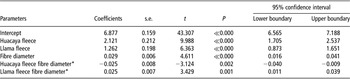
The fitting of a linear regression model (with R 2 = 0.29) for describing this relationship is illustrated in Table 5. These results were confirmed by regression analyses carried out on each fleece type. The huacaya type of fleece showed no significant regression between the number of scales and the diameter of the fibres (b = 0.004, P = 0.386), whereas a significant positive regression was present in both llama (b = 0.054, P < 0.001) and suri types of fleece (b = 0.029, P < 0.001).
Estimate of parameters related to the dependent variable of number of cuticular scalesFootnote * (Valbonesi et al., Reference Valbonesi, Cristofanelli, Pierdominici, Gonzales and Antonini2010)

* The suri type is used as reference fleece.
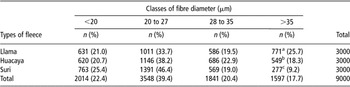
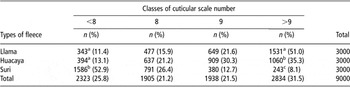
By exploiting a different statistical approach, the data related to the two discrete variables, fibre diameter and number of cuticular scales were arranged into four frequency classes according to the criterion reported in the previous section. The data related to the frequency distribution of these classes were arranged into a contingency table to test whether they were independent of fleece type (Table 6). The results of this analysis (χ 2(6) = 113.68; P < 0.001) show clearly that the frequency of the different classes of fibre diameter is dependent on fleece type. In particular, the frequencies of the class comprising the thickest fibres (diameter above 35 μm) in llama, huacaya and suri significantly differ from each other (llama v. suri + huacaya: χ 2(1) = 68.51, P < 0.001); huacaya v. suri: χ 2(1) = 29.44, P < 0.001). In addition, the variable cuticular scale number, monitored on 100 μm of fibre length, was distributed into four contiguous classes (Table 7). In testing their independence of the fleece type, a significant (P < 0.001) value for χ (6)2 = 864.92 was obtained that rejects the null hypothesis of independence. A further investigation on subsets of the data showed that (i) the frequency of the class comprising the lowest number of scales (below eight) in suri significantly differed from those of llama and huacaya (suri v. huacaya + llama: χ (1)2 = 601.74, P < 0.001), whereas the last two frequencies did not differ from each other (huacaya v. llama: χ (1)2 = 0.81, P = 0.369), and (ii) the frequencies of the class comprising the largest number of scales (above nine) in llama, huacaya and suri significantly differed from each other (suri v. huacaya + llama: χ (1)2 = 399.62, P < 0.001; huacaya v. llama: χ (1)2 = 60.09, P < 0.001).
Frequencies of four classes of fibre diameter in three different types of Peruvian domestic camelid fleeces (Valbonesi et al., Reference Valbonesi, Cristofanelli, Pierdominici, Gonzales and Antonini2010)

Different superscript letters indicate significantly different values at P < 0.001.
Frequencies of four classes of cuticular scale number, counted on a fibre length of 100 μm in three different types of Peruvian domestic camelid fleeces (Valbonesi et al., Reference Valbonesi, Cristofanelli, Pierdominici, Gonzales and Antonini2010)

Different superscript letters indicate significantly different values at P < 0.001.
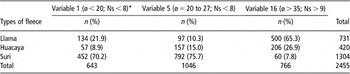
Finally, the frequency classes of these two variables were jointly analysed in all of the pairwise combinations, and the resulting 16 subgroups of data were used as variables to carry out a stepwise discriminant analysis. The original set of variables was reduced to three variables: variable 1 (which corresponds to the number of fibres with a diameter smaller than 20 μm and bearing less than eight scales), variable 5 (number of fibres with a diameter ranging from 20 to 27 μm and bearing less than eight scales) and variable 16 (number of fibres with a diameter larger than 35 μm and bearing more than nine scales). The data relating to these variables are reported in Table 8. Of the two canonical discriminant functions used in the analysis, the first accounts for 89.5% of the variance (Table 9). Furthermore, as the Wilks’ lambda value, associated with the first canonical discriminant function, is close to zero, it can be assumed that the differences among the three types of fleece are adequately described by this function alone. By inspection of the standardised coefficients associated with this function, it can be seen that large values of this function correspond to suri fleece that exhibits a large number of fibres with a small diameter (⩽27 μm) and a small number (less than eight) of scales (i.e. variables 1 and 5) along with a reduced number of fibres with a large diameter (>35 μm) and a large number (more than nine) of scales (variable 16). By using these three variables in a classification analysis, 86.7% of the specimens investigated are assigned to their original type of fleece. In particular, the suri fleece appears clearly differentiated from the other types, as 100% of cases are correctly classified v. the 85.0% and 75.0% of cases correctly classified in huacaya and llama, respectively.
Frequencies of the three variables, selected by the stepwise discriminant analysis in three different types of Peruvian domestic camelid fleeces (Valbonesi et al., Reference Valbonesi, Cristofanelli, Pierdominici, Gonzales and Antonini2010)

*ø = fibre diameter (μm); Ns = number of cuticular scales.
Parameters related to the canonical discriminant functions (Valbonesi et al., Reference Valbonesi, Cristofanelli, Pierdominici, Gonzales and Antonini2010)

*χ 2 transformation of Wilks’ λ is used along with the degree of freedom to determine significance.
Different superscript letters indicate significantly different values (P < 0.001).
All this evidence leads to the conclusion that, in contrast to what has already been reported in the literature (Phan et al., Reference Phan, Wortmann, Wortmann and Arns1988), it is possible to distinguish between the llama, huacaya and suri fleeces. In short, rather than considering mean values of single cuticular parameters, an objective identification of these three types of camelid fleece may be better achieved by a multifactorial approach. This could involve the combination of the two parameters, such as scale frequency and fibre diameter, in the form of a bivariate distribution coupled with the frequency distributions of fibre classes (identified here on the base of these two parameters and either separately or jointly analysed).
On the basis of these results and analysis, it may be concluded that the suri fleece, which exhibits the highest percentage (90.8%) of fibres with a diameter <35 μm and the lowest mean value (7.57/100 μm) of cuticular scales and very close to those reported for both mohair and cashmere (Phan et al., Reference Phan, Wortmann, Wortmann and Arns1988), could be differentiated by huacaya and llama fibre on the basis of fibre diameters and lowest number of cuticular scales. Hence, in selection projects addressed to the production of homogeneous fibres from Peruvian domestic camelid fleeces, the main target should be directed towards the breeding of the suri genotype of alpaca.
Study 3. Comparison of skin follicle characteristics between Bolivian llama T’amphullis (T) and Q’aras (Q) genotypes
The parameter affecting the fleece and fibre production characteristics is the skin follicular structure and activity, but until now it has been scarcely investigated, despite the fact that the age at which llama maximal fibre production is reached is of fundamental importance for understanding the variability of the Bolivian llama population, the correct shearing management and the early animal selection. The aim of this work is to fill this gap by determining the age at which all the secondary follicles reach maturity in T and Q types, as well as to compare the skin follicular structure and activity among these different types of Bolivian llamas.
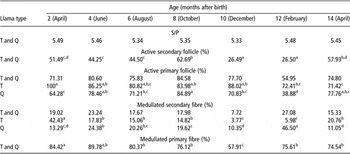
Differences between T’amphullis (T) and Q’aras (Q) llama types in S/P ratio, secondary follicular activities and medullated primary fibre (%) were not significant (Table 10) and results are expressed as means combined for both types. However, T types presented a consistently higher percentage of active primary follicles and lower medullated secondary fibre, apart from the April sample collections, than the Q type llama. No significant effect of sex was shown in any of the parameters analysed between the two types of llama. There was also very limited change in the S/P ratio averaged for both genotypes during the time period of sampling, which reflects increases in age of the llama studied. The differences between Q and T in active primary follicle and in medullated secondary fibres show at first analysis a general reduction of activities in Q with respect to T type. On the other hand, no consistent behaviour was noted with respect to the secondary fibre medullation between the two types. For example, the Q type produces less medullated fibre in April, but had greater values than the T types in the other periods studied. There also appears to be no homogeneous behaviour of the follicular activities during all of the experimental period. In addition, the environmental and photoperiod effects may be expected to affect the expression of the skin follicular characters and therefore deeper investigation is needed to verify their effects.
Means parameters for skin follicle in Bolivian llama types recorded at seven different ages (Lusky et al., Reference Lusky, Valbonesi, Rodriguez, Ayala, Weimin and Antonini2006)

Different superscripts are significantly different. a,b,c and d P ⩽ 0.05.
The great genetic variability of the Bolivian llama (Lauvergne Reference Lauvergne1994 and Lauvergne et al., Reference Lauvergne, Martinez, Ayala and Rodriguez2001) provides a basis for explaining the morphological differences especially in fleece characters between the T and Q genotypes. These also need to be considered in the context of influences arising from environmental effects of the Bolivian husbandry environment as indicated above and by the absence of a defined genetic selection plan.
Frank (Reference Frank2001) supported this theory because he defined the genetic heredity of the double (Q) and single coated (T) Argentinean llama as being obtained by an additive effect where the character of simple and double coat bearing in the llama population seems to be more a quantitative than qualitative parameter. Moreover, the results of Quispe et al. (2004) describing the fibre and fleece characteristics of the Bolivian llama population studied on the South Lipez Provinces seem to confirm the quantitative characteristics of the double and simple fleece structure because there are no parameters in the fleece that can characterise specifically the two type of llama (Q and T). In fact, Quispe et al.’s (2004) results did not show any significant differences in belly fleece weight, average fibre diameter and percentage of medullated fibres between T and Q llama types.
Lusky et al. (Reference Lusky, Valbonesi, Rodriguez, Ayala, Weimin and Antonini2006) also showed, from analysis of the Bolivian llama population, that a complete and mature skin follicle apparatus is present at birth and remains constant until the age of 14 months. For this reason, T and Q types could be considered only a subjective classification due to the variation of the different characters composing the fleece within the same population. As the llama types are generally considered double-coated animals, we can assume that the relation between the under coat and the outer coat in this population seems to be governed by quantitative characters that are difficult to classify in specific categories.
In both the T and Q Bolivian llama types, the ratio of secondary to primary follicles reached maximum value by 2 months of age. This result contrasts with those of Antonini et al. (Reference Antonini, Gonzales and Valbonesi2004) for Peruvian llama in which the S/P Ratio achieved its maximum value after a further 2 months. It was thus confirmed that Domestic SAC (alpaca and llama) gained complete and mature skin follicle development at an early age. Moreover, the variation seems to be associated with seasonal changes, in which unfavourable environmental conditions may negatively affect the physiological activity of skin follicles.
The results obtained confirm that Bolivian llama fleece typically consists of a mix of heterogeneous types of fibre. The dishomogeneity and variability of llama flocks appear as a clear consequence of lack of interest in fibre selection by breeders. The follicle parameters affecting the fleece and fibre production characteristics show no differences between T and Q.
Such information is important in decisions designed to optimise shearing management and methods for the early selection of animals in the context of an overall llama management system.
The results that define the production patterns of juvenile llama, when taken in addition to those obtained by Lusky et al. (Reference Lusky, Valbonesi, Rodriguez, Ayala, Weimin and Antonini2006), may be exploited for an improved management of the ‘crias category’. This is particularly so since llama kid fleece is the most requested in the market, and fibre production is present in llama from an early age. Producers should thus be advised to practise early selection of breeding animals based on fibre production potential, as well as an anticipated earlier first shearing. One suggestion that may be advanced to increase revenues for llama producers would be to breed llama for meat and exploit the maximum potentiality of the baby fibre production before the slaughter. This would be designed to increase the number of shearings by one to take advantage of the finer quality of juvenile fleece that is available until the age of 14 months.
Conclusion
This research carried on alpaca and llama fibre basically shows the three main results.
(a) Maturity of the Domestic SAC. Alpaca and llama gained a complete and mature skin follicle apparatus at an early age as in Peruvian and Bolivian camelids. In Peruvian alpacas and llamas, skin follicular maturity was achieved in a 4-month-old, while in Bolivian llamas it was a little anticipated in the 2-month-old. This apparatus, however, did not remain constant throughout the period of the investigation. The unfavourable environmental conditions might negatively affect both the number and the physiological activity of the skin secondary follicles.
The data presented here may be exploited for a rational management of the ‘crias category’. As kid fleece is the most requested in the market, and fibre production potential is present in llama and alpaca from an early age, producers should practise an anticipated first shearing. This would increase producers’ revenues by a value equivalent to one shearing over the productive life of an animal. In particular, llama kid fleece is the most requested in the market, and fibre production is present in llama from an early age. Producers should practise early selection based on fibre production potential, as well as anticipated first shearing. This would increase producers’ revenues by a value equivalent to one shearing over the productive life of an animal especially for llama meat production purposes.
In order to substantiate the present findings, further studies are required using larger numbers of animals and for periods of at least 3 years. This would also enable the effect of any environmental factors on follicular skin activities (which are responsible for fibre production) to be investigated, potentially a very important consideration in the harsh conditions of the Andean plateau.
(b) Possible differentiation between suri and hucaya alpaca and llama fibre. All of the evidence carried on in study 2 leads to the conclusion that it is possible to distinguish suri fleece from both llama and huacaya fleeces on the basis of the average number of cuticular scales. However, rather than considering only this single, discriminant cuticular parameter, the results suggest a combination of this parameter with the fibre diameter.
It can thus be stated that suri that exhibits the highest percentage (90.8%) of fibres with a diameter <35 μm and the lowest mean value (7.57) of the number of cuticular scales, very close to those reported for both mohair and cashmere, is the best fleece for textile fibre production. A further development of this work will be to verify whether the parameters utilised for distinguishing among the three fleece types are suitable for more heterogeneous conditions, that is, for animals exhibiting different sex, age, fleece colour and different time of shearing.
(c) Classification of Bolivian llama types of fleece. Study 3 shows that since S/P is the main parameter to define the follicular structure, T and Q types could be only a subjective classification due to the variation of the characters inside the same genetic population. Fibre analyses on fleece samples drawn at the same time of the skin sample collection will have to be carried out in order to provide further and defined information on Bolivian llama types and to confirm the skin follicular structure data obtained in this paper.
Acknowledgements
This review is based on an invited presentation at the 59th Annual Meeting of the European Association for Animal Production held in Vilnius, Lithuania during 24–27 August 2008.