Introduction
In teaching, training, service provision, and research, sexuality and dementia remains a neglected topic but we believe that attention to sexuality and intimacy has the potential to contribute to the quality of life of people with dementia and their family and formal carers. In this paper, we focus on recent literature on what is known about sexuality, aging, and dementia, and draw some conclusions that have broad implications for the education and training of staff working in health and social care and for those providing services for families living with dementia (for earlier literature, see Benbow and Jagus (Reference Benbow and Jagus2002) and Jagus and Benbow (Reference Jagus and Benbow2002)).
What is known about sexuality and aging?
In February 2011, SAGA Health surveyed sexual activity among people aged over 50 years asking participants to compare their sex life today with their sex life in their 20s and 30s. Overall, 85% described a decrease in the frequency of sexual activity but 61% said it was more fulfilling and almost half (42%) of sexually active participants described themselves as sexually active at least once a week (SAGA Health, 2011). This is not surprising, given existing research findings, but it attracted some interesting headlines (e.g. “The over-50s having the time of their (love) lives”, Daily Mail, 7 February 2011).
A study in the USA (Lindau et al., Reference Lindau, Schumm, Laumann, Levinson, O'Muircheartaigh and Waite2007) reported on 3,005 community-dwelling adults who were asked about “any mutually voluntary activity with another person that involves sexual contact whether or not intercourse or orgasm occurs.” They found the following figures for reported sexual activity: age 57–64 years, 73%; age 65–74 years, 53%; and age 75–85 years, 26%. With regard to women, they noted that age impacts on the availability of a partner: at age 75–85, 78% of men had a partner, compared with only 40% of women. In those women who had a partner, the most common reason reported for sexual inactivity was the male partner's physical health.
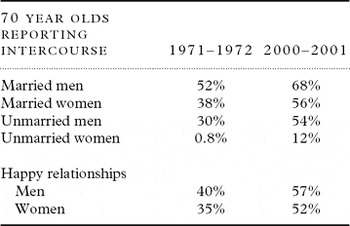
A Swedish study on aging also looked at attitudes to sexuality, frequency of intercourse during the previous 12 months, satisfaction with intercourse, sexual dysfunction, and reasons for cessation of intercourse among 70 year olds in 1971–72, 1976–77, 1992–93, and 2000–2001 (Beckman et al., Reference Beckman, Waern, Gustafson and Skoog2008). Table 1 presents some data from that study. The researchers found that later birth cohorts reported a higher level of satisfaction with their sexuality, fewer sexual dysfunctions, and more positive attitudes. They concluded that the quantity and quality of sexual experiences among Swedish 70 year olds has increased over a 30-year period. The study can be criticized on several grounds. Sexual activity was defined as intercourse and limited to heterosexual activity. Findings were based on self-report and reports of increased sexual activity might reflect increased openness rather than a change in behavior.
Data from study of Swedish 70 year olds (Beckman et al., Reference Beckman, Waern, Gustafson and Skoog2008)

Some authors suggest that it may be appropriate to take a broader view of sexuality in older adults, including touching and holding hands, embracing and hugging, and kissing as sexual experiences rather than focusing solely on intercourse. Another possibility is to focus on intimacy rather than sexuality. A confounder here is that the terms intimacy and sexuality are sometimes used interchangeably (Rheaume and Mitty, Reference Rheaume and Mitty2008). A World Health Organization document suggests the following working definition of sexuality:
“Sexuality is a central aspect of being human throughout life and encompasses sex, gender identities and roles, sexual orientation, eroticism, pleasure, intimacy and reproduction. Sexuality is experienced and expressed in thoughts, fantasies, desires, beliefs, attitudes, values, behaviors, practices, roles and relationships. While sexuality can include all of these dimensions, not all of them are always experienced or expressed. Sexuality is influenced by the interaction of biological, psychological, social, economic, political, cultural, ethical, legal, historical, religious and spiritual factors.” (World Health Organization, 2006, p. 5)
This definition includes intimacy as an aspect of sexuality. Intimacy can be regarded as having five components: commitment, interdependence, emotional intimacy (including positive regard), cognitive intimacy (including thinking about the intimate), and physical intimacy (ranging from closeness to sexual intercourse); (Rheaume and Mitty, Reference Rheaume and Mitty2008). Another distinction can be drawn between sexual and non-sexual intimacy (Waite et al., Reference Waite, Laumann, Das and Schumm2009). A study that investigated the sexual behaviors and preferences of older adults living in the community found that most wanted a sexual relationship which included touching and kissing; masturbation and intercourse were not regarded as essential (Ginsberg et al., Reference Ginsberg, Pomerantz and Kramer-Feeley2005). This research would suggest that a broader view of sexuality would fit better with the experiences of older adults but there is currently no consensus on this.
The relationship between sexuality and quality of life in older adults has been explored (Robinson and Molzahn, Reference Robinson and Molzahn2007): older adults living in the community who reported higher levels of satisfaction with interpersonal relationships achieved higher scores on a quality of life measure and sexual activity contributed to this. The authors noted that there is a distinct lack of literature on the links between intimacy, sexuality, and the quality of life of older adults.
Sexuality and sexual expression in care homes is an area that has been reviewed recently (Elias and Ryan, Reference Elias and Ryan2011). The review found that interest in sex does not necessarily decrease on admission to care homes, but opportunities to engage in sexual behavior do, and that privacy and staff attitudes are major influences on this. They also noted that the model of care in care homes, which is predominantly medical with a focus on ensuring safety and providing physical care, is not conducive to residents’ sexual expression. In addition, they commented that the wishes of family members are often privileged over the wishes of their older relatives.
Given that older adults are typically perceived to be heterosexual, it comes as no surprise that older gay, lesbian, bisexual, and transgendered people constitute an “invisible” population in society (Department of Health, 2007). Several studies report that sexual intimacy is highly valued in older gay men's lives (Berger, Reference Berger1982; Gray and Dressel, Reference Gray and Dressel1985; Pope and Schulz, Reference Pope and Schulz1990). Likewise, two studies by Kehoe (Reference Kehoe1986; Reference Kehoe1988) confirm that older lesbians continue to value sexual expression and sexual intimacy in later life, and where sexual intimacy is absent it is mostly due to lack of opportunity rather than choice. A particular challenge for health services is that many providers report never having encountered gay, lesbian, bisexual, or transgendered older clients (Age Concern, 2006), and only 14% of gay, lesbian, and bisexual older people report being open about their sexuality with their healthcare providers (Heaphy et al., Reference Heaphy, Yip and Thompson2003). It is estimated that in the UK, 5% of the population are gay, lesbian, or bisexual (NHS Inclusion Project, 2006) and, given that homophobic attitudes are often encountered in health professionals and health services appear to operate from a default assumption of heterosexuality (Fish, Reference Fish2006), older gay, lesbian, and bisexual people may face considerable barriers in their need for sexual expression. This may be especially true for those living in care homes (Ward et al., Reference Ward, Vass, Aggarwal, Garfield and Cybyk2005).
We can draw some broad conclusions about sexuality and aging from the literature. Sexual activity decreases in frequency with increasing age but older people remain sexually active, and there is no age limit to sexual responsiveness. In addition, evidence suggests that sexuality is becoming more important to successive cohorts of older people and sexual life impacts on well-being. Gay, lesbian, bisexual, and transgendered elderly people constitute a significant “invisible minority” whose need for sexual expression is not abolished by aging.
There is an important caveat to add to this. Although sexuality is important to older adults, care must be taken in two areas: not to over-sexualize older adulthood and not to over-medicalize the changes in sexual function that accompany aging (Taylor and Gosney, Reference Taylor and Gosney2011).
What is known about attitudes to sexuality and aging?
The media portrayal of sexual activity in later life tends to give messages to the public that: it is not to be spoken of; it may be unacceptable or the subject of humor and embarrassment; and/or that older adults are unattractive or not interested in sex.
Health and social care professionals are not immune to these messages and the associated myths about sexuality and aging. In England, sexual health has been absent from policies related to older people's health (Department of Health/Care Services Improvement Partnership, 2005) and older people are absent from sexual health policies (Department of Health, 2001). Scotland acknowledges the need to define and address the sexual health needs of older people (Scottish Executive Health Department, 2005) and Wales notes the need to take a lifelong learning approach (Welsh Assembly Government, 2010). In this context, it is perhaps not surprising that a study that purported to look at sexual behavior in Britain looked only at people aged from 16 to 44 years of age (Johnson et al., Reference Johnson2001).
Myths and stereotypes about sexuality influence all aspects of older people's care. Gott and colleagues carried out a qualitative study in primary care and found that general practitioners (GPs) regard sexual health as not being a legitimate topic to raise with older adults: they equate it with younger people (Gott et al., Reference Gott, Hinchliff and Galena2004). Their beliefs were based on stereotypical views and myths regarding sexuality and aging and GPs felt uncomfortable and untrained in addressing this area of health.
Residential and nursing home staff members’ attitudes toward the sexuality of residents have also been investigated using the Aging Sexual Knowledge and Attitudes Scale (Bouman et al., Reference Bouman, Arcelus and Benbow2007). Members of care staff were found to be moderately permissive and positive, whereas nursing home staff members were more negative and restrictive than residential home staff. Managers in all homes were more positive and permissive than nursing or care staff. Members of staff who had been working in the area for less than five years were more negative than those with greater work experience. Staff perceptions and responses to nursing home residents’ sexual behaviors have been shown to relate to both staff members’ own levels of comfort with sexuality and organizational ethos (Roach, Reference Roach2004), and some writers note that sexuality is not regarded as within the scope of the caregiving provided by homes (Nagaratnam and Gayagay, Reference Nagaratnam and Gayagay2002). Allen and colleagues have argued that attention to young adults’ attitudes toward late-life sexuality may help lead to interventions to decrease the stigma associated with sexuality and aging (Allen et al., Reference Allen, Petro and Phillips2009).
Negative attitudes toward the sexuality of older residents of nursing and care homes may be further compounded if the resident is gay, lesbian, or bisexual. One American survey found that 67% of doctors and nurses stated that homosexual patients were receiving substandard care or were being denied care (Age Concern, 2002). Beehler reported that 25% of healthcare staff express negative or homophobic attitudes, and it is very unlikely that any in-depth assessment is made of an individual's sexual orientation and needs on admission to a nursing or residential home (Beehler, Reference Beehler2001).
It is now well established that survival rates for individuals with HIV in the UK are such that they are able in many instances to live well into old age. A recent national study of people over 50 living with HIV (Power et al., Reference Power, Bell and Freemantle2010) found that many of those surveyed reported poor experiences of primary care, and feared that social care providers, care homes, and sheltered housing might be HIV prejudiced and/or homophobic. Of particular significance in this study was the finding that 20% of those over 50 living with HIV had experienced HIV discrimination in the previous year and that some of the worst experiences of discrimination had been in healthcare settings.
Again we can draw some broad conclusions from these and other studies. Attitudes and beliefs toward sexuality and aging are often strongly influenced by stereotypes and myths. This is true both among the general public and also among those working in health and social care. One significant challenge for services is to meet the healthcare needs of increasing numbers of people over 50 with HIV both now and in the future.
What is known about the relevance of sexuality and aging to people living with dementia and their care?
If attitudes toward the sexuality of older adults are influenced by myths, it is likely that attitudes toward the sexuality of people living with dementia will be even more influenced, and that this might affect aspects of their care.
Spouse carers of people living with dementia have been interviewed to investigate their perceptions of how dementia has influenced their marriage including their sexual relationship (Eloniemi-Sulkava et al., Reference Eloniemi-Sulkava2002). Sixty percent reported at least one negative sexual behavior change (most commonly an increasing inability to pay attention to the partner's feelings and needs) and 10% reported at least one positive sexual behavior change. The changes reported, however, had little impact on whether or not the couple continued to have intercourse.
For those older adults who live in institutional care, there are a number of important issues including loss of their partner, the relative lack of men, physical health problems, lack of environmental privacy, lack of informational privacy, and the attitudes of other family members, notably adult children. These may be highly relevant to the literature on what is often called “sexually inappropriate behaviors.” A recent systematic review of argument-based ethics literature (Mahieu and Gastmans, Reference Mahieu and Gastmans2011) has highlighted the prominence of the principle of respect for autonomy in ethical debate about sexuality of institutionalized older adults, this principle being privileged over others.
There is little consensus on the terminology or classification to employ for “sexually inappropriate behaviors.” One classification lists verbal behaviors, physical behaviors, and both (Alagiakrishnan et al., Reference Alagiakrishnan2005) with some behavior labeled as “sexually ambiguous.” One difficulty here is who decides what is appropriate as people involved may hold different views. An alternative classification refers to “hypersexual behavior” (sex talk, sex acts, implied sexual acts, e.g. requesting unnecessary genital care); (Prakash et al., Reference Prakash, Pathak, Munda and Bagati2009; Wallace and Safer, Reference Wallace and Safer2009). Another uses the rather quaint term “improper sexual behaviors” (de Medeiros et al., Reference de Medeiros, Rosenberg, Baker and Onyike2008) but uses categories of: intimacy seeking (e.g. misdirected affection when someone with dementia misidentified another person as a significant other); disinhibited behavior (which the authors relate to non-Alzheimer dementias and regard as opportunistic and prompted by closeness); and non-sexual behaviors (which may be mistakenly regarded as sexual by others, e.g. taking off one's clothes in severe dementia). This latter classification draws on interpretations of the behaviors (e.g. misidentifying someone as a partner, misinterpreting personal care, longing for closeness/intimacy) and a more descriptive classification would seem more appropriate. The categories of sex talk, sex acts (which might involve self or others), and implied sexual acts are probably simplest to use in practice and avoid interpretations.
Now we come to the “elephants in the room”: capacity and consent. The law on capacity and consent needs to be considered in the context of a particular country. In the UK, the Sexual Offences Act 2003 states that sexual intercourse without consent may be rape, and any non-consensual sexual behavior may be sexual assault (Stevenson et al., Reference Stevenson, Davies and Gunn2004). In addition, the Mental Capacity Act 2005 (which applies in England and Wales) specifically identifies consent to sexual relations as a decision that cannot be made on behalf of a person lacking capacity. While this creates clarity in the law, it raises some very difficult ethical and social questions. For example, how will a “well carer” who has been in a loving and caring relationship for many decades make judgments about what is appropriate or inappropriate sexual behavior in relation to a partner who may lack capacity? This issue is problematic for carers who are unlikely to know the finer points of sexual offences legislation or engage in formal ethical reasoning about their situation. While the major ethical theories are normative in nature, in everyday life people operate to a large degree using heuristics or “rules of thumb.” A carer might therefore believe that because a partner (who lacks capacity) seems to respond positively to intimate advances, that means it is alright to continue. Given that sexual intimacy often occurs in an informal and spontaneous way, between loving partners in private, deciding what is acceptable must be extremely difficult for the carer, further contributing to the stresses and burdens associated with the role. The International Longevity Centre (ILC-UK, 2011) referred to sexual intimacy in dementia in a recent paper as The Last Taboo particularly in relation to the care home setting. Given that the number of people with dementia is set to rise in the coming years, there is a greater need than ever to establish some clarity in this sensitive area. There is also a pressing need to ensure that such discussions are balanced with the need to protect people with dementia who lack capacity from sexual abuse and exploitation.
Management of sexual behaviors causing concern to others
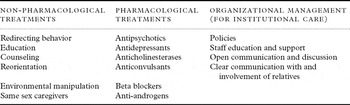
Tucker wrote a useful review of treatment approaches for “inappropriate sexual behaviors” in dementia (Tucker, Reference Tucker2010) and divides them into non-pharmacological and pharmacological. She found no randomized controlled trials of treatment and that the literature is based largely on case reports. A wide variety of drug treatments have been used in management but with remarkably little evidence to support their use. Table 2 sets out some of the treatments and techniques found to be employed by Tucker, with the addition of suggestions for organizational management.
Examples of management of “sexually inappropriate behaviors” in dementia (modified from Tucker, Reference Tucker2010)

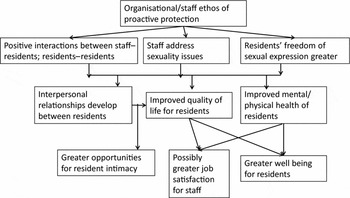
Roach looked at staff perceptions of the sexual behaviors of nursing home residents and how they responded (Roach, Reference Roach2004). She described some staff as “standing guard” against their personal discomfort, and disregarding residents’ sexual needs. However, she also describes “proactive protection” in a setting of a responsive organization that provides staff education and support, gives residents choice and social stimulation, and facilitates independence and dignity. Figure 1 sets out how Roach's construct of “proactive protection” might lead to positive outcomes for residents.
Proposed mechanism for proactive protection leading to positive outcomes for nursing home residents (modified from Roach, Reference Roach2004). Note: If staff are aware of the positive outcomes for residents, this may increase their job satisfaction and lead to positive reinforcement of the cycle of proactive protection.

Protection can be an important issue as some residents are vulnerable to the intrusive sexual behaviors of others, which can be problematic during the night when homes have low staffing levels. Indeed, for staff providing long-term care for people with dementia, the main source of tension in respect of sexuality is often the conflict between the need to protect people who lack capacity to consent to sexual activity and allowing autonomy to residents who do have capacity (Ehrenfeld et al., Reference Ehrenfeld, Tabak, Bronner and Bergman1997; de Medeiros et al., Reference de Medeiros, Rosenberg, Baker and Onyike2008; Elias and Ryan, Reference Elias and Ryan2011). Archibald (Reference Archibald1998) has pointed out that staff are likely to respond differently to residents of differing genders, with a protective stance likely toward women. There may also be “protection” issues for the organization: providers may be concerned about liability should residents be inadequately protected by staff from unwelcome or coercive sexual approaches (Loue, Reference Loue2005; Wallace and Safer, Reference Wallace and Safer2009).
A helpful approach to dealing with these dilemmas has been demonstrated by Ehrenfeld and colleagues who have drawn attention to the sexual needs of older adults with dementia and to the ethical issues involved (Ehrenfeld et al., Reference Ehrenfeld, Tabak, Bronner and Bergman1997; Reference Ehrenfeld, Bronner, Tabak, Alpert and Bergman1999). They assert that the main dilemma in institutional care is the tension between staff members’ desire to protect their elderly residents and maintain their dignity and the residents’ desire to fulfill their sexual needs. They describe working with institutional staff on problems they identified using a decision-making worksheet, which requires identification of the problem, consideration of personal beliefs and professional issues, and listing a number of possible responses to the problem before selecting a course of action. Their approach can be commended for highlighting the influence of beliefs, the importance of openness, sharing, and discussion within the staff team and with other relevant people including relatives, and a recognition that there is no single clear approach to management.
A similar approach is set out in a recent report called The Last Taboo (ILC-UK, 2011), which is aimed at staff working in care homes. This document sets out lots of ideas about how to improve practice in the area and contains case studies, suggestions, links to useful material, and a 12-item quiz designed to get people thinking about the subject and their own beliefs. Its approach is essentially similar to that of Ehrenfeld's group.
Conclusions
Older adults, whether straight, gay, lesbian, or bisexual (just like younger adults), are sexual beings, and their sexuality is important to their health and well-being. This is equally true of older adults living with dementia. Unfortunately, many people are still influenced by inaccurate out-of-date myths about sexuality and aging; this is equally true of staff working in health and social care.
Sometimes the sexual behavior of people with dementia causes concern for other people – particularly in institutional care. These behaviors can be classified as sex talk, sex acts (involving self or others), and implied sexual acts. There is no single answer to dealing with sexual behaviors causing concern to others and there is little evidence to support the prescription of drug treatments: the best strategy to adopt is one of openness, thoughtfulness, inclusion, and discussion. The overall aim is to find a person-centered way forward tailored to the individual involved.
Action is needed to improve sexual health in older people with dementia across a range of settings in education/training and service provision and this should be acknowledged in policy documents. Professional bodies should routinely include sexuality, aging, and dementia in their training curricula, and education and training programs should include knowledge, attitudes, and practice relevant to sexuality, aging, and dementia. More work is needed on the impact of environmental issues, particularly in group living situations. A helpful first step in terms of future research would be to agree on operational definitions of sexuality and intimacy applicable to later life. Consent issues are another area where focused work is needed, including attention to the balance between autonomy and protection, the previous attitudes of people living with dementia in relation to present attitudes, and family and staff attitudes in relation to the attitudes of people living with dementia. Ethical decision-making frameworks are available in the literature and their use in practice could be investigated and developed. In relation to institutional care settings, there is a need to investigate how organizations can support staff in avoiding a problem-orientated approach and instead focus on providing holistic person-centered care to older adults using health and social services.
We might think that attitudes have changed in the twenty-first century, but the evidence is that sexuality in later life continues to be a neglected area. As people graduate into later life with greater expectations of remaining sexually active, this is an area that urgently needs to be addressed.
Conflict of interest
None.
Description of authors' roles
Susan Mary Benbow carried out the original review and presentation on which this paper is based. Derek Beeston assisted in writing the paper and added additional review material.
Acknowledgments
This paper is based in part on a presentation given at the Faculty of Old Age Psychiatry Annual Residential Conference in Stratford-upon-Avon, UK, in March 2011.