


Introduction
The Geneva Conventions of 1949 constituted an essential component of international humanitarian law and standardized explicitly the protection of hospitals, staff, and transport. 1 , 2 The resolution 2286 adopted by the United Nations Security Council in 2016 recalled, “under international law, attacks intentionally directed against hospitals and places where the sick and wounded are collected, provided that they are not military objectives, as well as attacks intentionally directed against buildings, material, medical units and transport and personnel using the distinctive emblems of the Geneva Conventions in conformity with international law are war crimes.” 3 It calls upon states and all parties to armed conflict to develop effective measures to prevent and address acts of violence, attacks, and threats against medical and humanitarian personnel.
Despite the international humanitarian law in armed conflict, 4 attacks on health care have continued and even intensified in recent conflicts. A “weaponisation of healthcare”Reference Fouad, Sparrow and Tarakji 5 has been observed over the past decade. Weaponization means a “strategy of using people’s need for healthcare as a weapon against them by violently depriving them of it.”Reference Fouad, Sparrow and Tarakji 5 One example of this is the civil war of the Syrian Arab Republic.Reference Fouad, Sparrow and Tarakji 5 Another example is Russia’s war of aggression against Ukraine. In the first months of the war, the health care system was hit particularly hard in various parts of the country. The targeted air strike on the hospital in Mariupol, for instance, caused an international outcry at the time.Reference Kim, Bruni and Gorodetska 6 In Sudan, 460 patients and companions were killed in a single massacre at the Saudi Maternity Hospital in Al-Fasher on October 28, 2025. 7 The empirical evidence worldwide indicates that attacks on health care services have not decreased, and they are concentrated in conflict areas.Reference Tekin and Selcen Öcal 8 , 9 This mainly affects low- and middle-income countries.Reference Tekin and Selcen Öcal 8 , 10 They have in common that their health care systems are less developed. Health care facilities and programs often had to be suspended.Reference Afzal and Jafar 11 Given the global scope, attacks on health care can be understood as a global public health challenge.Reference Blanchet, Rubenstein and Taithe 12 , Reference Murray, King and Lopez 13 In this sense, the American Public Health Association called for an end to violent attacks on health services. 14 It urged all public health advocates and organizations to join an international condemnation of attacks on health services.
However, there is limited research available on this topic. A systematic review of the literature on violence against health care in conflict by Haar et al.Reference Haar, Read and Fast 15 revealed that much remains unknown about the global scale and types of attacks that occur. Interestingly, a publication bias is observed in the literature and a deficit of studies, especially in the African context. A mapping of the evidence shows the scarcity of primary studies conducted in conflict settings and a lack of funding sources.Reference Bou-Karroum, El-Harakeh and Kassamany 16 There are also gaps in the data about the impacts of attacks on health care.Reference Haar, Read and Fast 15 There is a general lack of validated standardized reporting tools in the field.Reference Haar, Footer and Singh 17 This results in an underestimation of the full extent of impacts across a wide range of domainsReference Afzal and Jafar 11 and a lack of synthesis of these global and longitudinal datasets.
This study aims to address the research deficit by conducting an empirical secondary data analysis. The aims of this study are twofold: firstly, to explore temporal and geographical patterns; secondly, to identify clusters of attacks on health care between 2018 and 2024. The secondary analysis uses public data from the World Health Organization (WHO)’s “Surveillance System for Attacks on Health Care (SSA).” The database was established because the Security Council had previously requested the Secretary-General of the United Nations to provide country-specific reporting. 3 The WHO Assembly called on to provide leadership at the global level in developing methods for the systematic collection and dissemination of data on attacks on health care. 18 The strength of the WHO’s Surveillance System (SSA) lies in its ability to close significant data gaps in documentation.Reference Patel, Gibson-Fall and Sullivan 19 The WHO defined an attack on health care in its glossary as “any act of verbal or physical violence, the threat of violence or other psychological violence, or obstruction that interferes with the availability, access, and delivery of curative and/or preventive health services.” 20
Methods
The WHO’s database contains verified attacks on health care, but only a selected part of the data is publicly accessible via SSA.who.int. On May 14, 2025, the full list of attacks was downloaded. The public data (Table 1) were exported and prepared for the statistical analyses.
Items of WHO’s “Surveillance System for Attacks on Health Care (SSA)”

The observation period for this study spanned from January 1, 2018, to December 31, 2024. Further details of the WHO’s Surveillance System (SSA) are described by Meier et al.Reference Meier, Rice and Bandara 21 Terminology and methodology are documented by WHO. 20
The research approach employed standard descriptive analyses and conducted Pearson’s chi-square test and Fisher’s exact test (Monte Carlo method), depending on the distribution and prerequisite. A P value of less than .05 was considered statistically significant. A 2-step cluster analysis was conducted using a log-likelihood distance measure based on Schwarz’s Bayesian Information Criterion (BIC). By assuming variables to be independent, it is an exploratory data analysis technique that enables identification of clusters using both continuous and categorical variables in large datasets.Reference Brosius 22 The silhouette measure of cluster cohesion and separation is shaded to indicate poor, fair, or good results. The interpretation of cluster structures, as outlined by Kaufman and Rousseeuw,Reference Kaufman and Rousseeuw 23 forms the basis for this. The order in the data set has been randomized so that the chronological order of the attack dates does not influence cluster analysis. Data analyses were performed using IBM SPSS Statistics version 28.
Results
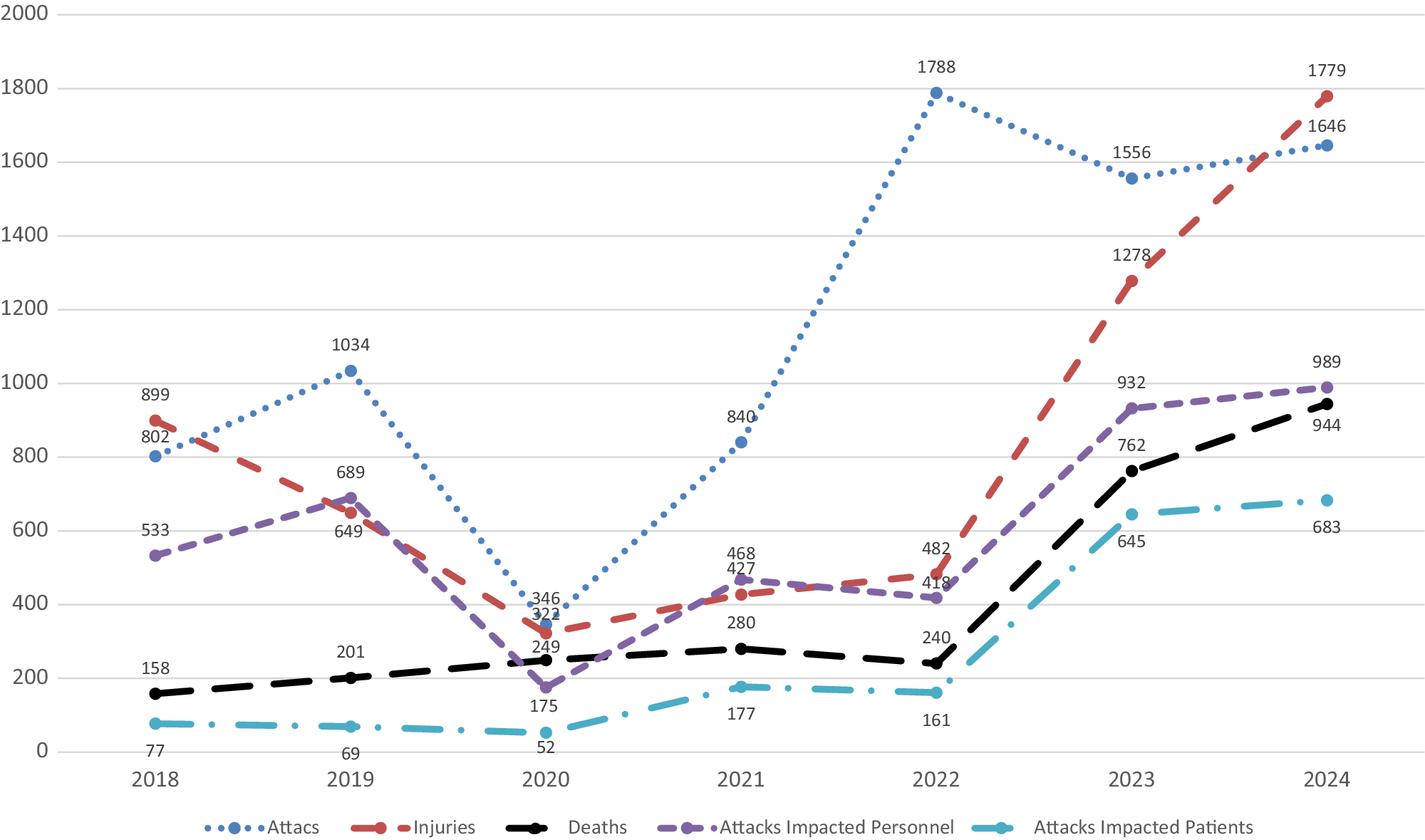
During the observation period, the number of countries affected by attacks on health care had increased from 12 in 2018 to 19 in 2023, then decreased slightly to 16 in 2024. A total of 8,012 attacks on health care in 22 countries were verified during this period by WHO’s “Surveillance System for Attacks on Health Care (SSA).” Figure 1 illustrates the strong growth of health care attacks on an annual average between 2018 and 2024. With the onset of the COVID-19 pandemic, the attacks on health care had decreased to a very low point in 2020. Due to the military coup in Myanmar in 2021 24 and the Russian Federation’s invasion of Ukraine in 2022,Reference Barten, Tin and Granholm 25 the number of attacks on health care increased sharply. Since October 2023, the occupied Palestinian Territory has been subject to military assaults, while attacks on health care have persisted in Myanmar, Ukraine, and other countries. Health care workers have been assaulted and obstructed from delivering care. During the period under investigation, 52.5% of all reported attacks impacted health personnel, while 23.3% impacted patients. Both of them were often affected at the same time; 85.5% of attacks on patients also harmed health care personnel. However, there is a huge regional hot spot: 53.2% of the attacks impacted health care personnel, and 70.1% of the attacks that impacted patients were carried out only in the occupied Palestinian Territory.
Attacks on health care worldwide and impact from year 2018 to 2024.
Data source: WHO’s “Surveillance System for Attacks on Health Care (SSA)” 48; own calculation.

Since 2023, the number of health care workers, as well as patients, who have been wounded or killed by attacks has risen. A comparison of the 2018 annual data with 2024 presented in Figure 1 reveals a 2.1-fold increase in attacks on health care facilities, accompanied by a doubling of injuries and a sixfold increase in deaths.
Attacks on Health Care by Country
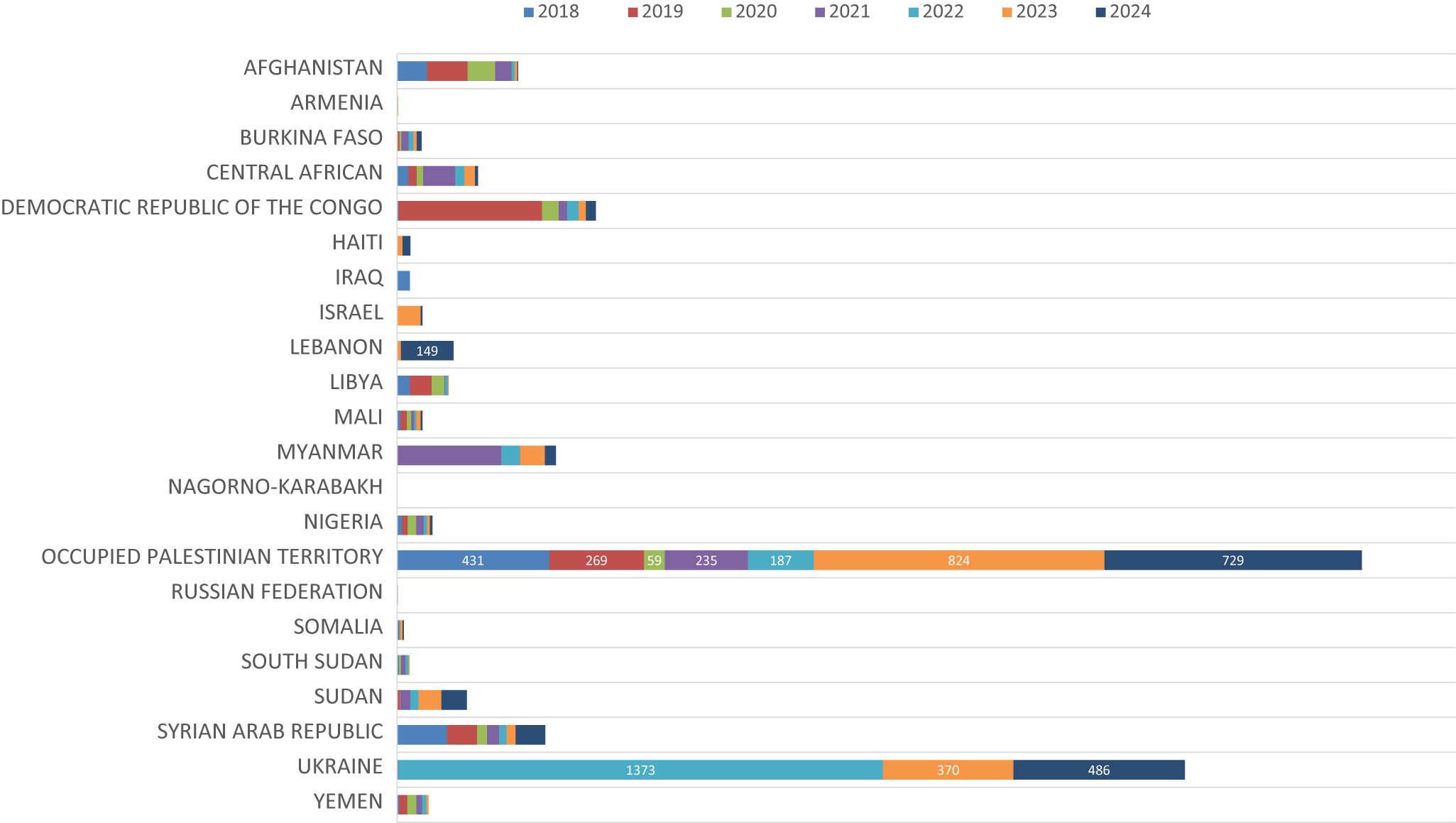
As illustrated by the country comparison in Figure 2, the occupied Palestinian Territory and Ukraine have suffered the most attacks on health care worldwide. No consistent temporal patterns or normal distributions of the attacks were apparent from the bar chart. There are countries whose health care systems were massively attacked at the beginning of the initial phase of the war. Figure 2 and the literatureReference Kim, Bruni and Gorodetska 6 , Reference Barten, Tin and Granholm 25 , Reference Dzhus and Golovach 26 demonstrate that the Russian Federation intensively attacked the health care of Ukraine in the first year of the war. The highest density of attacks was also registered in Myanmar at the beginning of the military coup. In contrast, the violence against health care was always present in the occupied Palestinian Territory in the observation period (Figure 2), but the situation became more radical after Hamas assaulted Israel on October 7, 2023. Afterward, the attacks on health care have increased strongly over time. Overall, phase models cannot be identified in the data as an explanatory approach to how attacks on health care begin or end. Attacks on health care follow the course and intensity of the conflict in a context-related manner. In most countries, the attacks on health care have not been isolated incidents but have occurred over several years. Major improvements can be observed in a few countries according to Figure 2.
Attacks on health care by country.
Data source: WHO’s “Surveillance System for Attacks on Health Care (SSA)” 48; own calculation.

Table 2 differentiates the attacks on health care, whether weapons were used, and if so, whether they were individual or/and heavy weapons (columns 1 to 3). According to the WHO glossary, violence involving heavy weapons requires “more than one person to use such as firearms, tanks, missiles, bombs, mortars”. 20 If no weapons were used, column 4 of Table 2 summarizes the other attack types. Violence against health care is most frequently performed with heavy weapons in 43.4% of the attacks. The percentage has increased significantly during the observation period.
Attack types on health care by country in the period from 2018 to 2024

Data source: WHO’s “Surveillance System for Attacks on Health Care (SSA)” 48; own calculation.
Table 2 discloses that there are significantly large differences in attack types between the countries (Fisher’s exact test = 4,739.61; P <.001). For instance, heavy weapons were used in 86.7% of attacks on health care facilities in Ukraine. In contrast, in the occupied Palestinian Territory, 17.2% of attacks on health care have been perpetrated with heavy weapons, but attacks with individual weapons (35.5%) and other attack types (39.7%) have occurred more frequently.
In total, 26.8% of the 8,012 attacks in the period from 2018 to 2024 resulted in injuries and deaths. In line with expectations,Reference Tekin and Selcen Öcal 8 violence (only) with individual weapons causes remarkably more injuries or deaths than attacks with heavy weapons (49,1% vs. 23,6%). However, the combination of the 2 types in an attack accumulated the danger and led to injuries or deaths in 67.9% of these attacks. This association is statistically significant (Pearson’s chi-square = 1,124.83; df = 3; P <.001).
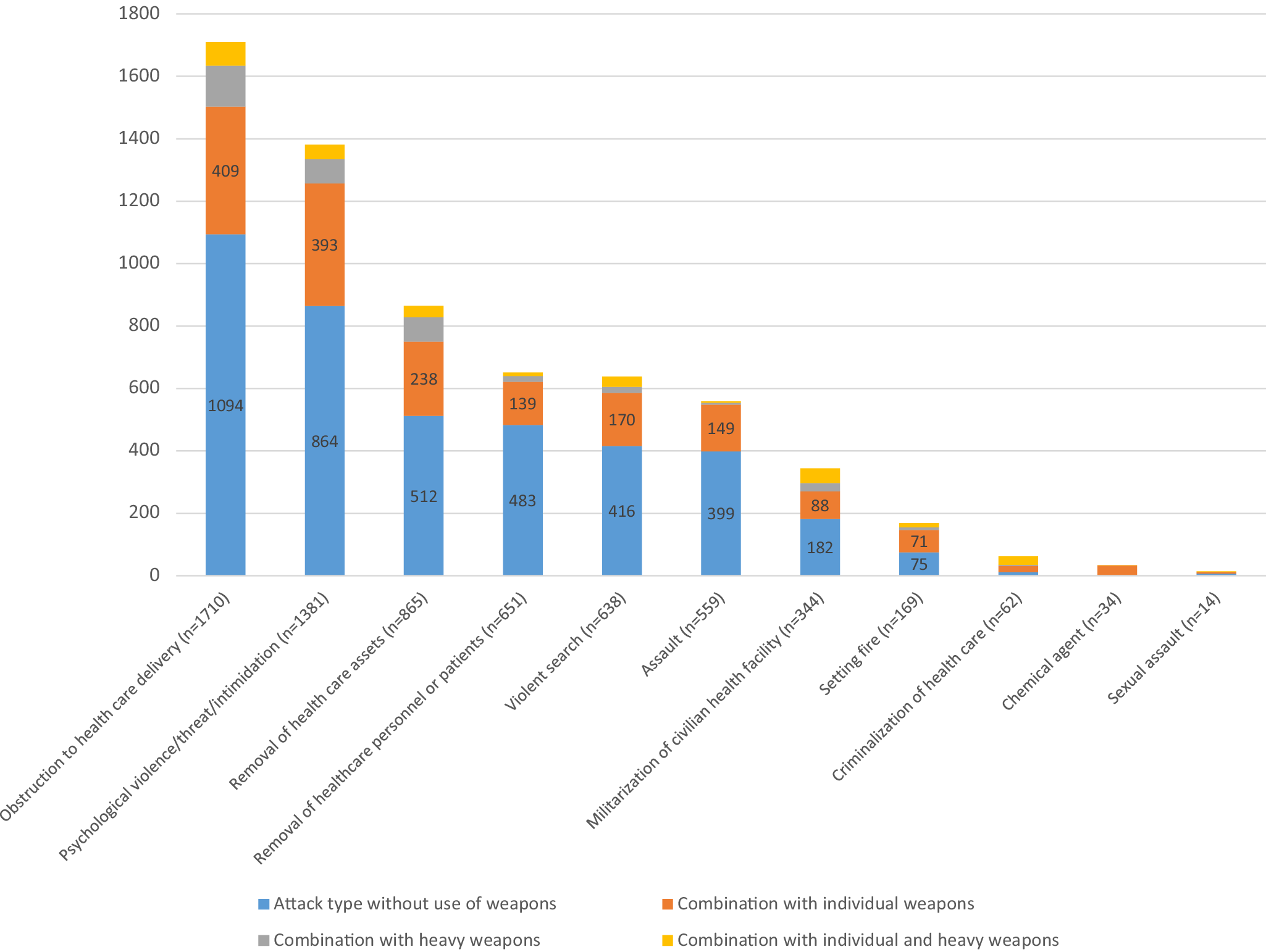
A third (33.3%) of attacks on health care are acts of violence that do not involve the use of individual or heavy weapons. The frequency of occurrence varies considerably between the countries (column 4 of Table 2). As illustrated in Figure 3, the remaining attack types (excluding those involving weapons) primarily comprised obstruction to health care delivery (41.0%), psychological violence (32.4%), removal of health care assets (19.2%), and removal of health care personnel or patients (18.1%). The aforementioned forms of attacks exert an indirect impact on health service delivery, availability, and accessibility. Psychological violence is defined as emotional abuse, which may include insults, belittlement, humiliation, intimidation, or threats of violence. 20 Figure 3 also demonstrates that other attack types are often carried out in combination with the use of individual weapons.
Other attacks on health care from the year 2018 to 2024.
Data source: WHO’s “Surveillance System for Attacks on Health Care (SSA)” 48; own calculation.

The attacks with heavy weapons often targeted the health infrastructure. Among the attacks with heavy weapons recorded, 77.9% affected health care facilities, 18.6% health care transport, and 19.3% health care supplies assets. However, if they affect people, the impact can be dramatic. The attacks with heavy weapons are responsible for approximately two-thirds (68.5%) of injuries and deaths in the period from 2018 to 2024.
Figure 4 illustrates the attacks with injuries or deaths by country. Almost half (47.8%) of these attacks took place in the occupied Palestinian Territory and caused 43.4% of all recorded deaths or injuries in the period from 2018 to 2024. In the ranking, follow Ukraine, the Syrian Arab Republic, and Lebanon.
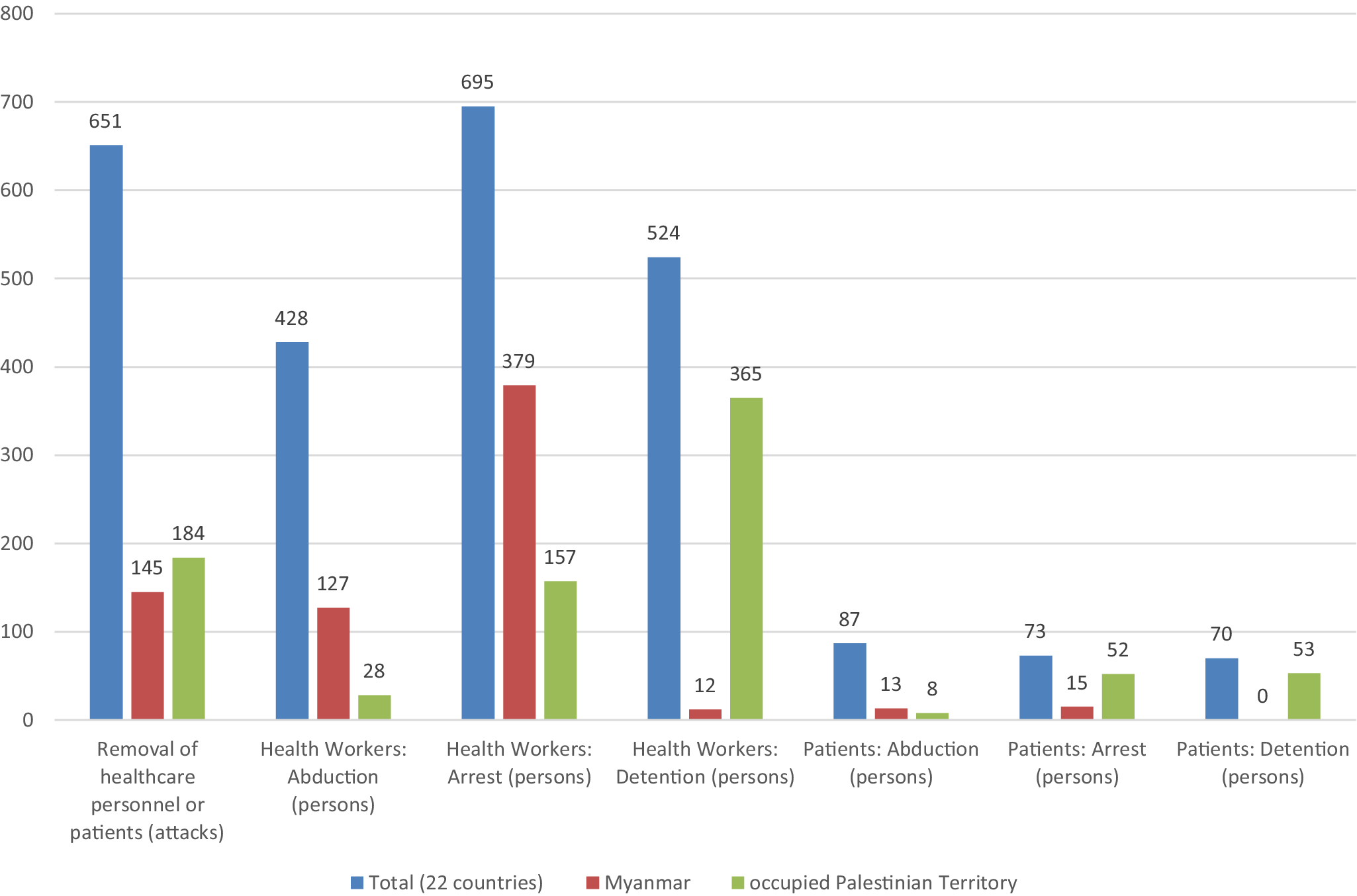
Attacks on health workers or patients from the year 2018 to 2024.
Data source: WHO’s “Surveillance System for Attacks on Health Care (SSA)” 48; own calculation.

In the majority of the countries, attacks with the removal of health care personnel or patients were observed; however, the extent varies significantly (Fisher’s exact test = 699.00; P <.001). It is striking that more than half of the attacks involving the removal of persons occurred only in two countries, the occupied Palestinian Territory and Myanmar. These two countries have an exceptionally high number of arrests and detentions for both health workers and patients.
In Myanmar, the civil resistance against the military coup has been supported peacefully by health workers and health care has become the target of perfidious attacks by Myanmar security forces. 24
Figure 4 shows country-specific attack strategies against health workers and patients. However, no removals of personnel were reported in five of the 22 countries. Removal of personnel was comparatively rare in Ukraine, as well. In contrast, in Ukraine, health care facilities were most frequently affected (44.7% of all attacks against health care facilities worldwide).
As suggested by Figure 3, an act of violence can be committed subtly. During the observation period, 1,381 (17.2%) attacks on health care were classified as psychological violence, threats of violence, or intimidation. Notably, the Democratic Republic of the Congo has been the most affected by this type of violence (412 of the 563 attacks; 73.2%).
Cluster Analysis
A cluster analysis is used to identify groups that are similar. This is a prerequisite for further, in-depth investigations regarding the different effects of attack types on health care. Five factors provide the best fit in the public data set of the WHO’s Surveillance System (SSA). The cluster analysis includes the 3 categorical variables country, violence with individual weapons (yes/no or unknown), and violence with heavy weapons (yes/no or unknown), as well as 2 continuous variables with numbers of injuries and deaths.
Two-step cluster analysis yields groups, with a distribution of 43.5% for Cluster 1 (n = 3,485) and 56.5% for Cluster 2 (n = 4,527). This represents a suitable ratio of size of 1.3. The cluster quality is good according to a silhouette measure of cohesion and separation of 0.7. The most important predictor variables are 1. violence with heavy weapons, and 2. country. Violence involving individual weapons ranks third in terms of predictor importance. The number of injuries and, in particular, the number of deaths are hardly statistically significant for this clustering. All attacks with heavy weapons belong to Cluster 1, while most of the attacks with individual weapons (85.4%) were assigned to Cluster 2.
Figure 5 provides an overview of the relationships found between the countries, categorized dichotomously as strong and weak. In the 2-step cluster analysis results, Cluster 1 is most intensely affected by attacks in Ukraine (1,949 relationship count) and Cluster 2 by attacks in the occupied Palestinian Territory (2,052 relationship count). These 2 relationships are rated as strong. The smaller the nodes are, the weaker the influences. All thin connecting lines represent a weak relationship, which is not further differentiated in Figure 5. Almost all countries have relationships with the 2 clusters. Figure 5 exhibits the majority cluster assignment by country in parentheses. Regional trends are recognizable. For example, all African countries are assigned to Cluster 2 rather than Cluster 1, except Somalia.
Relationship map for 2-step cluster analysis (majority cluster assignment 1 or 2).
Data source: WHO’s “Surveillance System for Attacks on Health Care (SSA)” 48; own calculation.

Cluster 2 is characterized by the use of individual weapons, but also by violence with other attack types. 87.1% of all other attack types excluding the use of weapons have been carried out in Cluster 2 countries. For example, 93.1% of the attacks with the removal of personnel or patients occurred in Cluster 2 countries.
Limitations
Prior to the discussion of the results, it is important to point out the limitations of the research method:
-
1. Underreporting: It is worth noting that the WHO’s Surveillance System (SSA) underreports the worldwide attacks on health care personnel and patients for the following reasons. In general, recording attacks on health care requires dedicated human resources. Access to information in conflict zones is often severely restricted. There are numerous practical challenges to documenting attacks.Reference Haar, Read and Fast 15 In particular, 2 former comparisonsReference Parada, Fast and Briody 27 , Reference Usmany, Barten and Goniewicz 28 with the Security in Insecurity Insight’s Numbers Database (SiND) revealed that the WHO’s Surveillance System (SSA) systematically underestimated attacks on health care, because the WHO is concentrated on fewer countries, but in an emergency context. The inclusion criteria of the WHO’s Surveillance System (SSA) ensured the internal validity, but preselected the datasets.Reference Parada, Fast and Briody 27 Furthermore, it is remarkable that the current attacks on health care in Ethiopia are entirely absent from the WHO’s database. They are well documented in the international literature,Reference Gesesew, Berhane and Siraj 29 –Reference Minwagaw, Mulatu and Motbainor 32 and are ongoing.
-
2. Lack of validation: The WHO’s Surveillance System (SSA) is a limited source of data due to its primary function, which is to monitor emergency situations on a global scale. The system is not designed to generate a validated research instrument for a more extensive range of applications. From a scientific perspective, this questionnaire of the WHO’s Surveillance System (SSA) has not yet been validated. This potential lack of validation may result in bias during the preselection and categorization of data.
-
3. Availability of data: Geographic point location is unavailable due to anonymization and protection of the victims of an attack. Therefore, analysis of public data does not permit the identification of recurrent attacks on the same health care facility, which could be indicative of underlying intentions. Repeated attacks on hospitals have been documented, for example, in UkraineReference Barten, Tin and Granholm 33 and other regions. Furthermore, demographic data regarding the affected health care personnel (e.g., sex) and especially their health profession would be desirable. In addition, there is no information about the perpetrator in the database.
-
4. Health outcomes: The WHO’s Surveillance System (SSA) recorded only impact data and short-term health effects of attacks on health personnel (injuries and deaths). There is a paucity of the medium- and long-term consequences for health personnel regarding both physical and mental health deterioration.
-
5. Gap of denominator data: The number of attacks on health care must be considered in relation to the size of the population and the number of health care facilities or health care professionals. The WHO’s Surveillance System (SSA) is currently lacking these indicators. The WHO stated in May 2025 that “at least 94% of all hospitals in the Gaza Strip are damaged or destroyed” 34, for example. The implementation of such indicator sets would facilitate a more comprehensive approach to monitoring and research at the national level. There is potential for data linkage with the WHO’s health reporting databases and health reports. 35
Discussion
The question raised by the title was “From bad to worse?” During the period under review, the global trend showed that the worldwide situation, as well as the number of attacks on health care and victims, had worsened dramatically. According to the WHO’s Surveillance System (SSA), which has recorded a high number of 22 impacted countries, the danger of attacks on health care becoming “the new normal” 10 is growing.
There are different attack strategies which can be identified in an international comparison between countries. This analysis provides new insights by country and an approach typing of attacks on health care depending on the use of individual or/and heavy weapons. The results of the cluster analysis with the most important predictor “violence with heavy weapons” can be useful for a still-pending categorization of the attacks. The results indicate that a two-cluster solution best fits the data of WHO’s Surveillance System (SSA). It identifies patterns across countries depending on the type of warfare and helps to explain cross-country differences. Interestingly, the number of injuries and number of deaths had little statistical influence on this cluster analysis. The importance and use of explosive weapons affecting health care have increased. 36
The analysis shows that some of the attacks on health care combined different types of attacks. The use of both individual and heavy weapons accumulated the probability of injuries or deaths. In warfare and armed conflicts, attacks on health care can be intentional or accidental. The combination of types of attacks indicates a higher level of planning and is more likely to be intentional.
In a cross-country comparison, the occupied Palestinian Territory stands out due to its strikingly high number of attacks on health care, with the most injuries and deaths. Over half of all attacks that affected personnel and over two-thirds of attacks that impacted patients from 2018 to 2024 occurred in the occupied Palestinian Territory alone. This is in line with previous country-specific analyses.Reference Tekin and Selcen Öcal 8 , Reference Kinik, Dag and Caliskan 37 – 41 The deterioration is not only an attack on health care, but also on the health of the population. It results in a loss of health personnel and facilities, which exerts a long-term impact on health care systems.Reference Afzal and Jafar 11 The rebuilding alone will take many years.Reference Alkhaldi and Alrubaie 42
Ukraine suffered the second-highest number of attacks on health care, with 2,233 incidents in the observation period. It was exposed to a high degree of violence involving heavy weapons. Russia’s war of aggression against Ukraine contravenes international humanitarian law, 43 but vice versa, notably, only 2 attacks on health care in the Russian Federation were reported in the WHO’s database during the same period (with no affected personnel). This contrast discloses the “weaponisation of health care.”
Many aggressors disregard health care’s neutrality, but regional improvements can be observed in some countries within the WHO’s Surveillance System (SSA), particularly when conflicts are pacified (Figure 2).
Grave violations of international humanitarian law and human rights (still) remain unpunished. Resolution 2286 adopted by the Security Council affirms the need for States to ensure “that those responsible do not operate with impunity, and that they are brought to justice, as provided for by national laws and obligations under international law.” 3 It is a prerequisite for change. Therefore, the WHO’s Surveillance System (SSA) has an important function for the preservation of evidence, so that those responsible for war crimes can be sentenced or sanctioned. As shown in Figure 2, the attacks on health care have been perpetrated by certain states over many years. This demonstrates the failure of the international community, specifically of the United Nations Security Council, in contemporary history, when members such as the Russian Federation violate their own resolutions, e.g., resolution 2286. 3
Conclusions
Due to the growing number of attacks on health care and affected countries during the observation period, there is a great lack of prevention and protection. Good practice approaches 44 against attacks on health care promote resilience but do not prevent the attacks. The results show that attacks on the health care system occurred throughout the entire observation period in the occupied Palestinian Territory. For the protection of the right to health and health care, Brennan et al.Reference Brennan, Martinez and Rubenstein 45 recommended (a) strengthening accountability mechanisms, (b) enhancing awareness, (c) building resilience and preparedness, and (d) fostering improved engagement, advocacy, and diplomacy at global, national, and regional levels. These strategies may need to be specified in regional conflict areas, and the cluster analysis could be helpful in anticipation of different attack patterns.
International solidarity could honor the victimsReference Bilgrami, Guy and Carnegie 46 and be combined with own health emergency preparedness. 47 The analysis reveals that attacks occurred on a huge scale in some regions, particularly in the initial phase of war.
In summary, the global trend has worsened in regard to the regional spread, scale, and impact on health care personnel and patients. The WHO’s “Surveillance System for Attacks on Health Care (SSA)” is an important global monitoring system that can provide public data for international comparative analyses and health services research. The validation of reporting tools and further development are recommended. Health systems worldwide need to focus more on the universal human rights to health and health care, as well as to make greater efforts to condemn, prevent, and protect against attacks on health care.
Availability of data and materials
The datasets analyzed during the current study are available in the WHO’s repository “Surveillance System for Attacks on Health Care” via SSA.who.int. 48
Competing interests
None.




 Open access

