Clostridioides difficile infection (CDI) is a well-known cause of healthcare-associated (HA) infectious diarrhea, surpassing Staphylococcus aureus as the most common cause for hospital-acquired infections.Reference Magill, Edwards and Bamberg1 Population-based surveillance of CDI in the last decade has also revealed the rise of community-acquired CDI cases (CA CDI).Reference Khanna, Pardi and Aronson2 The national burden of CDI was estimated in 2017 to be 235,700 HA CDI cases, 226,400 CA CDI cases, and 20,500 in-hospital deaths.Reference Guh, Mu and Winston3 To reduce morbidity and mortality among CDI cases, the Society for Healthcare Epidemiology of America (SHEA) and the Infectious Diseases Society of America (IDSA) routinely revise their national guidelines for CDI treatment based on emerging CDI treatment/diagnostic data.
With a growing evidence base for the effectiveness of vancomycin treatment,Reference Johnson, Louie and Gerding4,Reference Wilcox and Rooney5 the 2017 IDSA/SHEA guidelines were created to update the 2010 guidelines, recommending vancomycin or fidaxomicin over metronidazole as first-line treatment.Reference McDonald, Gerding and Johnson6 The definition of disease severity changed: ‘mild/moderate’ became ‘nonsevere,’ ‘severe’ remained, and ‘severe (complicated)’ became ‘fulminant.’ For nonsevere and severe cases, vancomycin 125 mg given orally 4 times daily for 10 days or fidaxomicin 200 mg given orally twice daily for 10 days is recommended. Vancomycin 500 mg given orally 4 times daily, or by nasogastric tube in rare instances, is recommended for fulminant cases.Reference McDonald, Gerding and Johnson6
The 2017 guidelines incorporate the newer evidence base, but there is concern about medical provider concordance with these revisions, which is likely affected by timely dissemination of these changes.Reference Bariola and Khaden7,Reference Clancy and Nguyen8 Assessing concordance of Connecticut medical providers with these guidelines will identify differences in treatment patterns and help identify consequences, such as CDI recurrence, in cases where discordance is identified.
The Connecticut Emerging Infections Program (EIP) has been conducting enhanced surveillance for CDI since 2011 in New Haven County. The objectives of this study were to assess concordance (2018–2019) of Connecticut medical providers’ prescribed CDI treatment regimen with the 2017 update. A previous study using data from these surveillance efforts examined 2010 IDSA/SHEA concordance and found it to be low.Reference Martinez, Meek and Olson9 Since the 2017 treatment update was published in 2018, concordance of 2017 treatment data was assessed with the 2010 IDSA/SHEA treatment guidelines. Adjusting for potential confounders, the association of concordance on the risk of CDI recurrence was assessed in 2018 and 2019.
Methods
The CDI EIP surveillance program covers 35 counties in 10 states, capturing >12 million people in 2017.Reference Guh, Mu and Winston3 The Connecticut EIP CDI surveillance system encompasses New Haven County, Connecticut, a population of ~860,000. An incident CDI case was defined as a person ≥1 year old with a C. difficile–positive stool test (toxin or molecular assay) and who had no positive tests in the prior 8 weeks.Reference Guh, Mu and Winston3 Multiple episodes of CDI in an individual with specimen collection dates >8 weeks apart were classified as separate incident cases.Reference Guh, Mu and Winston3 Cases were designated into epidemiologic classifications: healthcare-facility onset (HCFO CDI), community-onset healthcare-facility associated (CO-HCFA CDI), or CA CDI. A case was classified as HCFO CDI if the CDI was a detected from a positive stool collected >3 days after admission from either a hospital or long-term care facility.Reference Guh, Mu and Winston3 A case was classified as community-onset (CO CDI) if the positive stool was collected in an outpatient setting or within the 3 days of hospital admission. Of cases that were classified CO CDI, those that did not have documentation of admission to a healthcare facility in the 12 weeks prior to the stool sample were designated CA CDI; all other CO CDI cases were considered CO-HCFA CDI.Reference Guh, Mu and Winston3
According to EIP data-collection methods, a 10% random sample of HCFO CDI cases and all CA CDI and CO-HCFA CDI cases are to undergo chart review dependent on a response by a community practitioner for CA/CO-HCFA CDI cases.Reference Guh, Mu and Winston3 During the study period, the Connecticut EIP attempted chart review on all CA/CO-HCFA CDI cases and a random sample of ≥10% HCFO CDI cases. In 2018 and 2019, 18% and 20% of HCFO CDI cases received chart review, respectively.
The CDI clinical practical guidelines define CDI cases by clinical disease severity in 3 categories: (1) nonsevere CDI cases are defined as having a white blood cell (WBC) count of ≤15,000/μL and a serum creatine level ≤1.5 mg/dL; (2) severe cases are defined as having a WBC count of >15,000/μL or a serum creatinine level >1.5 mg/dL; and (3) fulminant cases as having the presence of a toxic megacolon and/or ileus, regardless of WBC count.Reference McDonald, Gerding and Johnson6 Since Connecticut EIP surveillance does not collect serum creatinine level, nonsevere and severe cases could not be confidently distinguished. Therefore, CDI cases were divided into 2 categories: (1) nonsevere/severe and (2) fulminant.
‘Guideline-concordant care’ was assessed according to 2 factors: duration of treatment and concordant antibiotic prescribed. These durations were captured in 3 scenarios by EIP staff: (1) If a patient was hospitalized for the entire prescribed treatment period, the electronic patient chart was consulted. (2) If a patient was hospitalized for a portion of the prescribed treatment period, the electronic patient chart and the discharge summary, which represents medication administered in the hospital and after discharge, were consulted. And (3) if the patient was not hospitalized and sought care from their outpatient provider, emergency department, or urgent care, the electronic order containing the prescribed duration from their provider was consulted.
First-line treatment was classified as either the independent antibiotic prescribed for the initial treatment or the treatment given for the longest duration if 2 treatments were prescribed. Of cases that had 2 treatments of equal duration, first-line treatment was designated as a combination or unknown. Treatment dosage, route of administration, and dosing frequency (ie, twice daily, every 6 or 8 hours) were not assessed because these data were dropped in 2018 and 2019 surveillance. For pediatric patients, guideline-concordant care was denoted as taking vancomycin or metronidazole for 10 days regardless of severity. For adult patients, guideline-concordant care for nonsevere/severe CDI cases was defined as taking vancomycin or fidaxomicin for 10 days and taking vancomycin for fulminant cases. Furthermore, recommended treatment is identical for nonsevere and severe cases, so the inclusion criteria for this study required treatment history and clear indication of toxic megacolon or ileus absence to be included as nonsevere/severe. Assessment of concordance in fulminant cases did not factor into the treatment duration because the 2017 SHEA/IDSA guidelines do not specify duration. Because concordant duration is noted as 10 days by the 2017 update, duration > or <10 days was deemed discordant.
Unadjusted associations with concordant care and study variables, and CDI recurrence and study variables (separately) were calculated for the adult study sample (≥18 years old) using univariate analysis. Finally, a multivariable logistic regression was created using backward elimination with the outcome of recurrence and the main predictor of discordant care. SAS University Edition software (SAS Institute, Cary, NC) was used to conduct these analyses, with a significance level of .05 for t tests and χReference Khanna, Pardi and Aronson2 tests.
Results
Overall study
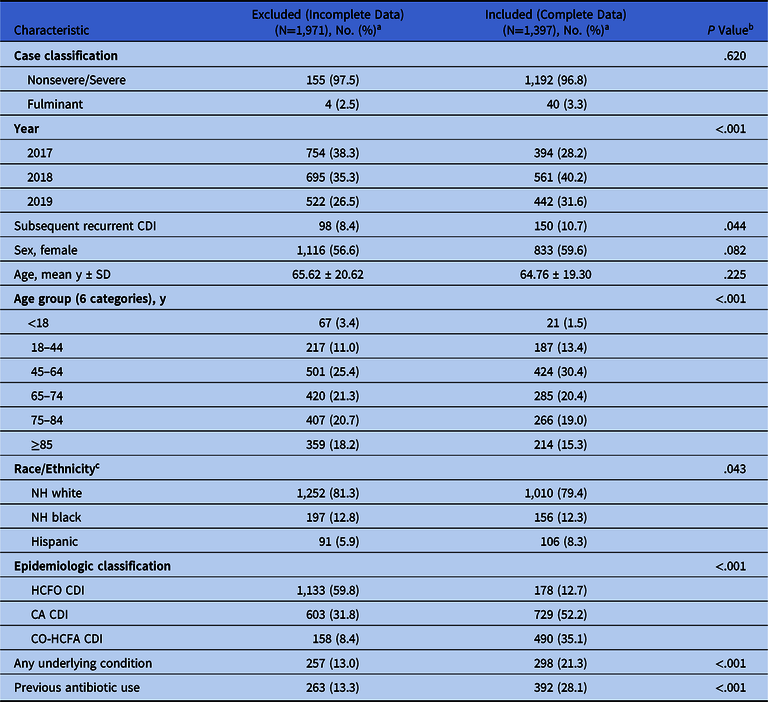
Of the 3,368 New Haven County incident cases reported from 2017–2019, 1,397 cases (41.5%) were eligible to identify case severity and concordance. Cases with complete data compared to those who were excluded were more likely to be aged 18–64 years, to have underlying conditions, and to have had antecedent antibiotic use (Table 1).
Study Characteristics Stratified by Whether Excluded (Incomplete Data) or Included (Complete Data)

Note. CDI, Clostridioides difficile infection; SD, standard deviation; HCFO, healthcare facility onset; CA, community associated; CO-HCFA community-onset healthcare-facility associated; NH, non-Hispanic.
a Values may not sum to N due to missing or unknown values.
b P value for analysis of variance t test (continuous variable) or χReference Khanna, Pardi and Aronson2 test (categorical variable).
c Other/Unknown was removed from the excluded/included analysis.
In total, 16 patients whose treatment was concordant with the initial antibiotic prescribed died before reaching the 10-day duration and were deemed ineligible. Therefore, 1,381 cases were used for analysis. Of the 1,381 cases, there were 1,182 individuals in the study. In total, 91 individuals with multiple episodes of CDI accounted for 199 unique cases (14.4% of study).
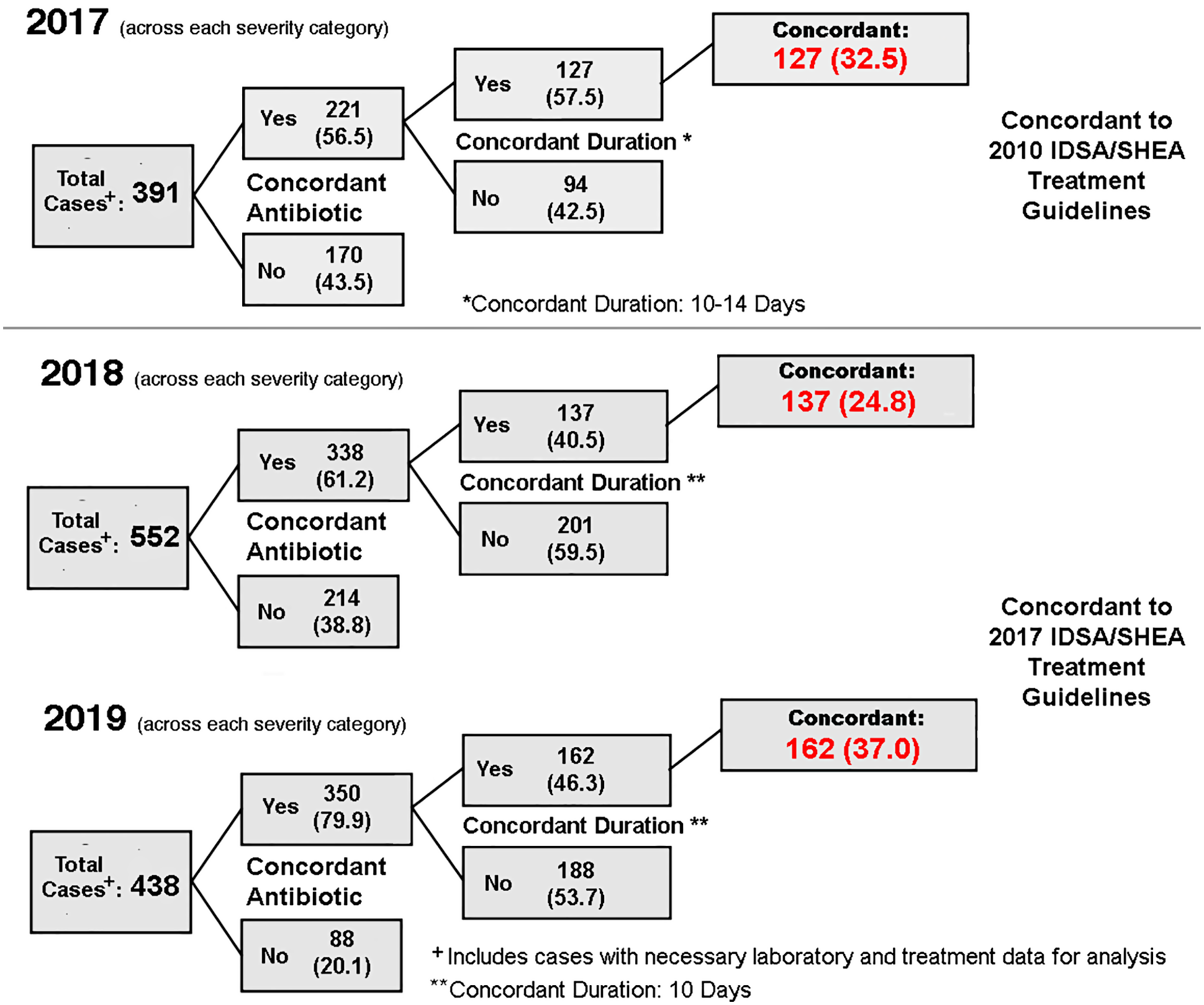
Of these 1,381 cases, there were 990 cases from 2018 to 2019. Guideline concordance increased 12.2% from 2018 to 2019. Concordant antibiotic choice increased 18.7% from 2018 to 2019. Of cases prescribed the concordant antibiotic, concordant duration increased 5.8% from 2018 to 2019 (Fig. 1).
Concordance with selected treatment criteria by year, 2017–2019. All other text in the digital file defines a symbol or is a specific title of a box.

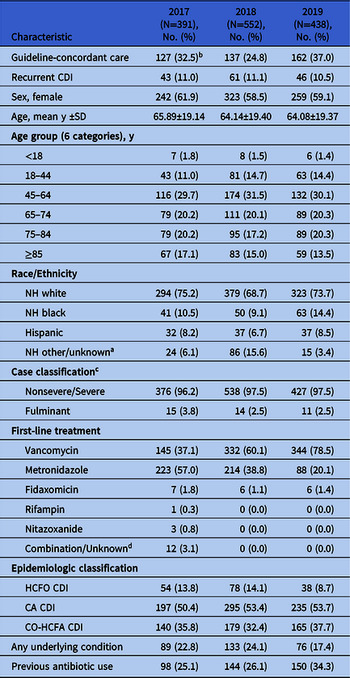
Table 2 shows the description of the study by year. The 2018–2019 total guideline concordance of 30.2% was lower than the 2017 guideline concordance of 32.5%, but 2019 concordance of 37.0% exceeded 2017 concordance. First-line treatment with vancomycin increased with each subsequent year from 2017 to 2019, while metronidazole use decreased.
Description of the Study Population by Year

Note. CDI, Clostridioides difficile infection; SD, standard deviation; HCFO, healthcare facility onset; CA, community associated; CO-HCFA community-onset healthcare-facility associated; NH, non-Hispanic.
a NH Other/Unknown include those who identify as Pacific Islanders, those who identify as American Indian/Alaska Native, those who identify as Asian, and Unknown
b 2017 concordance measured with 2010 IDSA/SHEA CDI treatment guidelines
c According to the 2010 IDSA/SHEA treatment guidelines, 2017 nonsevere cases are defined as “mild to moderate” and severe cases are defined as “severe (uncomplicated).” and fulminant as “severe (complicated).
d 2017 cases had equal duration of treatment for 2 or more medications therefore leading to the other/unknown classification.
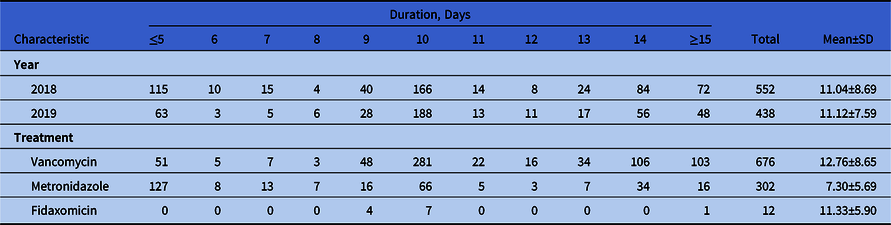
Table 3 delineates the specific frequencies of duration (by days). There was a greater proportion of 10-day vancomycin treatment (41.6%) than 10-day metronidazole treatment (21.9%) (Table 3).
Duration of Treatment With the Initial Antibiotic Prescribed by Study Variables and Specific Antibiotics, 2018–2019

Note. SD, standard deviation.
Pediatric cases
Of the 990 cases, there were 14 pediatric cases (<18 years old). Moreover, 11 cases (78.6%) were denoted as nonsevere, 1 case (7.1%) was severe, and 2 cases (14.3%) were fulminant. Also, 7 cases (50.0%) received concordant treatment, a higher proportion than for adults (n = 292 patients, 29.9%; P = .104). Overall, 10 of the cases (71.4%) were CA CDI and 4 cases (28.6%) were CO-HCFA CDI. Only 1 of these pediatric patients (7.1%) had CDI recurrence.
Adult cases
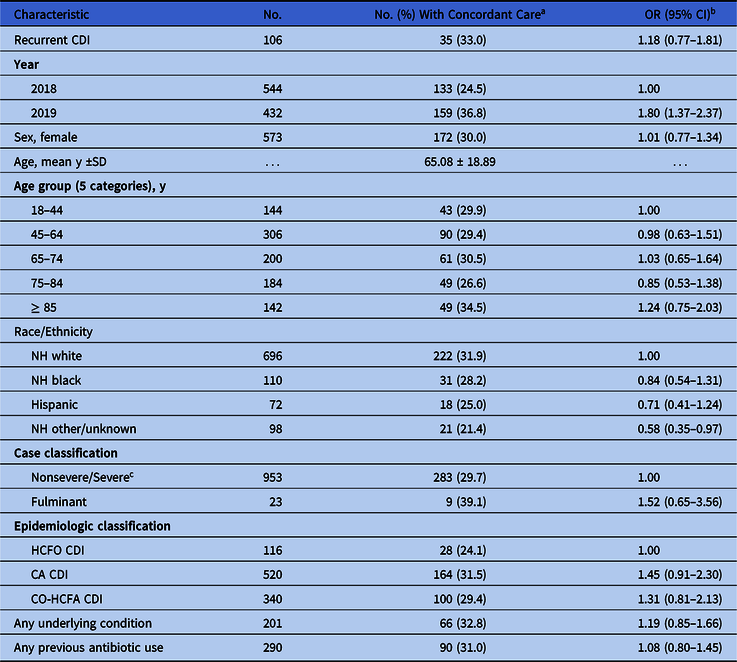
Table 4 shows the associations in adults between 2018 and 2019 concordant care and study variables. Without adjusting for confounding, the odds of receiving guideline-concordant care in 2019 was 1.80 times the odds of receiving guideline-concordant care in 2018 (95% CI, 1.37–2.37) (Table 4).
Unadjusted Associations Between Study Variables and 2017 IDSA/SHEA Concordant Treatment Care in Adults, 2018–2019

Note. CDI, Clostridioides difficile infection; OR, odds ratio; SD, standard deviation; CI, confidence interval; HCFO, healthcare facility onset; CA, community associated; CO-HCFA community-onset healthcare-facility associated; NH, non-Hispanic.
a Percentages may not sum to 100% due to rounding.
b Odds of having concordant care compared to having discordant care.
c Includes unclassified cases that were deemed eligible for analysis as nonsevere/severe.
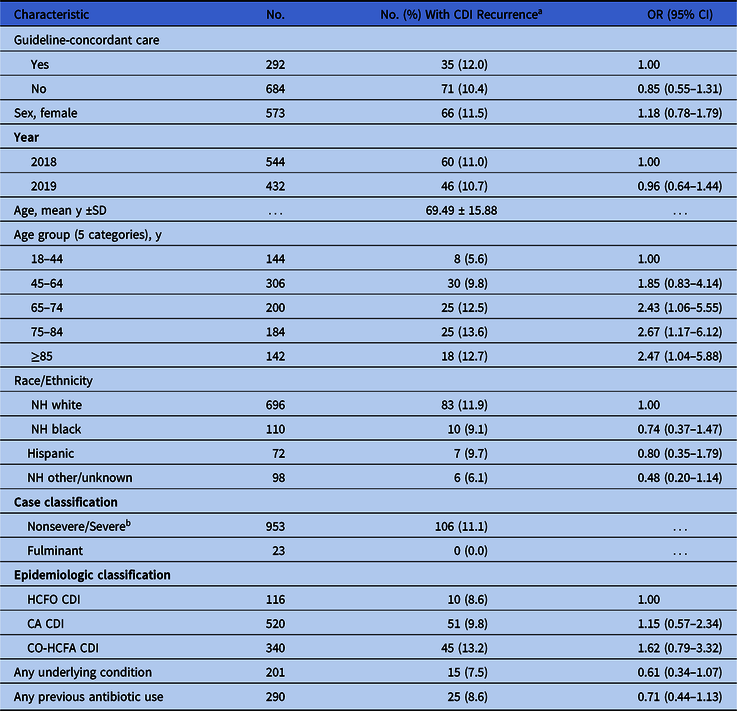
Table 5 shows the unadjusted association of having CDI recurrence with study demographic and treatment variables in adults from 2018 to 2019. The point estimate of having recurrence was lower after receiving discordant care than concordant care (OR, 0.85; 95% CI, 0.55–1.31) (Table 5). The risk of recurrence was significantly associated with those aged ≥65 years, with the highest risk of having recurrence for those aged 75–84 years (OR, 2.67; 95% CI, 1.17–6.12). We also analyzed the effect of duration on recurrence modeled as undertreatment (<10 days) and overtreatment (>10 days), but we did not detect any significant associations.
Unadjusted Associations Between Study Variables and CDI Recurrence in Adults, 2018–2019

Note. CDI, Clostridioides difficile infection; OR, odds ratio; SD, standard deviation; CI, confidence interval; HCFO, healthcare facility onset; CA, community associated; CO-HCFA community-onset healthcare-facility associated; NH, non-Hispanic.
a Percentages may not sum to 100% due to rounding.
b Includes unclassified cases that were deemed eligible for analysis as nonsevere/severe.
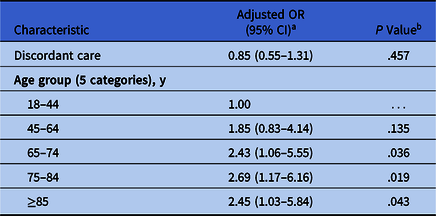
Table 6 shows the results of multiple regression modeling for predictors of CDI recurrence. Adjusting for potential confounding, the point estimate of recurrence with discordant care remained lower than recurrence for concordant care (OR, 0.85; 95% CI, 0.55–1.31) (Table 6). The risk of recurrence was significantly associated with those aged ≥65 years; the highest risk of recurrence occurred among those aged 75–84 years (OR, 2.69; 95% CI, 1.17–6.16).
Multivariable Logistic Regression Between Study Variables and CDI Recurrence in Adults, 2018–2019

Note. CDI, Clostridioides difficile infection; OR, odds ratio; CI, confidence interval.
a Adjusting for sex, year, age, race/ethnicity, case classification, epidemiologic classification, any underlying medical conditions, any previous antibiotic use. Study characteristics with a significant P value for χReference Khanna, Pardi and Aronson2 remained in the model (age group).
b P value for analysis of variance likelihood-ratio χReference Khanna, Pardi and Aronson2.
Discussion
To the best of our knowledge, this is the largest geographically based prospective surveillance study evaluating prescribing practices for CDI, expanding on other studies that were retrospective and/or single centerReference Musher, Aslam and Logan10,Reference Doh, Kim and Jung11 and more limited in scope.Reference Martinez, Meek and Olson9 Furthermore, it complements a recent study examining prescribing trends in CDI antibiotic treatment.Reference Clancy, Buehrle and Vu12
Our study had a number of notable findings. Concordant care in CDI cases increased from 2018 to 2019, with a stark reduction in metronidazole treatment and an increase in vancomycin treatment. Concordance, however, was not significantly associated with recurrence. Controlling for all variables, those aged ≥65 years, specifically those aged 75–84 years had an increased probability of recurrence.
Overall, concordance with the 2017 SHEA/IDSA treatment guideline for CDI cases in New Haven County was low in 2018, but the increase in 2019 is encouraging. The increase in vancomycin prescriptions and reduction in metronidazole from 2017 to 2018 suggest that providers are quick to adjust to the concordant treatment procedures, but fidaxomicin prescriptions still remained low. We did not systematically collect data on rationales behind Connecticut providers’ decisions to prescribe alternative therapy, but a small minority noted in the patient chart that deviations were due to an allergic reaction to first-line treatment or lack of coverage for vancomycin or fidaxomicin by insurance providers. These factors led to use of metronidazole over vancomycin, which is not universally covered by insurance companies.Reference Bunnell, Danziger and Johnson13 A recently published article found similar antibiotic trends: IDSA guideline-concordant prescriptions of vancomycin or fidaxomicin for CDI treatment increased as metronidazole use decreased.Reference Clancy, Buehrle and Vu12 However, it was limited because indications for metronidazole use were not part of the study.Reference Clancy, Buehrle and Vu12
Guideline-concordant care was not significantly associated with CDI recurrence; in particular, the first-line antibiotic recommendation of vancomycin did not have a significant effect on CDI recurrence relative to other antibiotics, mainly metronidazole. These findings are consistent with Martinez et alReference Martinez, Meek and Olson9 as well as other evidence, including Stevens et alReference Stevens, Nelson and Schwab-Daugherty14 and Johnson et al,Reference Johnson, Louie and Gerding4 which are frequently referenced regarding first-line treatment of CDI. In a retrospective observational study of >45,000 patients, Stevens et al (2017)Reference Stevens, Nelson and Schwab-Daugherty14 found that CDI recurrence among cases using vancomycin compared to cases using metronidazole were similar. The study concluded that the use of vancomycin is recommended over metronidazole because 30-day mortality was significantly lower through vancomycin use.Reference Stevens, Nelson and Schwab-Daugherty14 In a prospective randomized and blinded trial of CDI, there were not any notable differences in CDI recurrence between vancomycin and metronidazole groups.Reference Johnson, Louie and Gerding4 However, there was a significant reduced acute cure with metronidazole use relative to vancomycin use.Reference Johnson, Louie and Gerding4 The 2017 IDSA/SHEA guidelines recommendation of the use of vancomycin for a first recurrence of CDI are based on a “weak recommendation, low quality of evidence”Reference McDonald, Gerding and Johnson6 because there are no randomized controlled trials to base treatment of recurrence.
Some evidence has emerged that fidaxomicin has a similar cure rate to vancomycin, with a significantly lower rate of early recurrence.Reference Cornely, Miller and Louie15,Reference Guery, Menichetti and Anttila16 Since fidaxomicin use was low in this study, no strong findings can be made to support this claim.
Although concordance was not significantly associated with recurrence, those aged ≥65 years, specifically 75–84 years, controlling for all other variables, increased the probability of recurrence. Increasing susceptibility to disease as age increases may generally explain the increased risk of recurrent CDI in older age groups. No strong conclusions could be made for severity and recurrence because there were no fulminant cases with recurrence from 2018 to 2019. Medical providers should pay close attention to patients who are aged ≥65 years due to the increased risk for recurrence.
This study has several limitations. Although this was an active population-based public health surveillance program, data were limited to that which was in the medical record. For recurrence from 2017–2018, these data were transmitted manually based on data available at the time of initial chart review, so numerous recurrent values were never captured. As of 2019, there were no missing recurrent values because these data are transmitted automatically. Secondly, the Connecticut EIP only detects laboratory-confirmed cases. Therefore, some cases are never captured, such as those with mild disease who do not seek healthcare and some who do seek healthcare but do not receive CDI testing.
For cases detected in surveillance, there were significant differences between study characteristics in the nonstudy and study samples. Those who had previous antibiotic use or underlying medical conditions were more likely to have a well-documented medical history and complete data. The EIP CDI protocol requires full chart review on all cases classified as CA CDI or CO-HCFA CDI but only a sample of HCFO CDI cases, explaining the high proportion of HCFO cases with missing data. Differences in race or ethnicity were explained primarily by other or unknown values. Once other and unknown values were removed, marginally significant differences existed only for white and Hispanic patients. We are unaware of systematic bias introduced by any exclusions, but cannot be certain.
Duration of treatment was defined by the healthcare provider order as extracted by the Connecticut EIP team. In clinical infectious disease, ordering providers typically prescribe antibiotics in intervals of 7, 10 or 14 days. As mentioned, the Connecticut EIP team reviewed not only the patient chart while a case was inpatient but also discharge summaries if a patient did not complete their treatment while an inpatient. This procedure likely led to unconventional durations because house scripts and outpatient prescriptions may not be true complements. Aside from specific treatment deviations that were discussed previously, other reasons for treatment durations <7 days are numerous: patient expired, patient left against medical advice, symptom severity changed, patient did not respond to treatment, symptoms resolved, patient was given a different prescription when changed to outpatient, among others.
Future CDI surveillance in Connecticut should consider collecting data on the rationale behind the prescribed treatment regimen, particularly for duration. Rationales for concordant treatment deviation would better inform interventions to increase concordance. Insurance coverage and financial barriers to CDI therapeutics after discharge may have influenced treatment decisions and thereby guideline concordance, though these data were not systemically collected. Secondly, evaluating cases based on specific CDI diagnostic methods (eg, toxin positive or PCR positive) and the clinical success of antibiotic therapy for cases in resolving CDI acute symptoms could better inform strategies to increase concordance. Lastly, future surveillance should capture factors such as suspected colonization or prolonged treatment due to another concurrent infection requiring systemic antibiotics.
Treatment dosage, route of administration, and frequency of dosing were not included in the concordant definition, and serum creatinine level was not included in the severity definition because the surveillance did not collect these variables. Due to the lack of serum creatinine data, differences between nonsevere and severe cases could not be assessed.
In conclusion, the updated 2017 IDSA/SHEA guidelines that focus on vancomycin as a first-line treatment in adult patients with CDI have led to a greater proportion of concordance, with the highest frequency of CDI concordant care in 2019. Additional analysis of patients aged ≥65 years is needed to determine what treatment factors may influence recurrence in this group.
Acknowledgments
We thank James Meek, MPH, Associate Director of the Connecticut Emerging Infections Program, and the Connecticut Emerging Infections Program for providing crucial guidance and timely assistance to ensure accuracy and completeness of this research endeavor.
Financial support
No financial support was provided relevant to this article.
Conflicts of interest
All authors report no conflicts of interest relevant to this article.