Introduction
Depression is a common, costly and disabling disorder that reduces life expectancy, impacts people of all ages and has an estimated lifetime prevalence as high as 27% (Kruijshaar et al., Reference Kruijshaar, Barendregt, Vos, de Graaf, Spijker and Andrews2005). Given the personal and social impacts of depression across the lifespan, effective preventive measures could lead to significant benefits for individuals and for the community.
Observational data indicate that people with mild or moderate depression are at greater risk of developing a clinically significant depressive episode in the future (Lyness et al., Reference Lyness, Heo, Datto, Ten Have, Katz, Drayer, Reynolds, Alexopoulos and Bruce2006, Reference Lyness, Chapman, McGriff, Drayer and Duberstein2009), while data from randomised controlled trials suggest that psychological interventions can prevent the conversion of subthreshold depression into a depressive episode (Cuijpers et al., Reference Cuijpers, Smit and Van Straten2007). Notwithstanding these promising results, face-to-face psychological treatment is limited by access barriers such that a major effort is currently under way to develop interventions that are more easily accessible, including Internet-based interventions (Muñoz et al., Reference Muñoz, Cuijpers, Smit, Barrera and Leykin2010). One such intervention is cognitive bias modification (CBM).
Cognitive theories posit that depressed mood is in part produced by biases in information processing (Beck, Reference Beck2008). These biases are believed to contribute to cycles of negative thinking, dysfunctional beliefs and behavioural withdrawal that characterise depression. Experimental findings have identified two specific biases in early stages of cognitive processing that are characteristic of individuals with, or at risk of, depression. These are attentional bias to negative information (Gotlib et al., Reference Gotlib, Krasnoperova, Yue and Joormann2004; Joormann and Gotlib, Reference Joormann and Gotlib2007; Browning et al., Reference Browning, Holmes and Harmer2010) and negatively biased interpretation of ambiguity (Mogg et al., Reference Mogg, Bradbury and Bradley2006; Dearing and Gotlib, Reference Dearing and Gotlib2009). Recent theories have also proposed that attentional and interpretive biases work in combination to influence depression (Everaert et al., Reference Everaert, Koster and Derakshan2012). Experimental data have since supported this notion, by demonstrating that elevated attentional biases can themselves contribute to an elevation in biased interpretations in depression (Everaert et al., Reference Everaert, Tierens, Uzieblo and Koster2013, Reference Everaert, Duyck and Koster2014).
CBM procedures seek to attenuate cognitive biases associated with psychopathology in order to reduce symptom severity. Typical CBM for attention (CBM-A) procedures repeatedly expose participants to pairs of negative and neutral items and require participants to complete an attentional task (e.g. to identify a visual target) under a contingency designed to encourage attentional avoidance of negative items. Typical CBM for interpretation (CBM-I) procedures repeatedly exposes participants to emotionally ambiguous words or sentences, followed by a to-be-completed word fragment that consistently yields words designed to encourage benign interpretations of the ambiguity. For each procedure, repeated execution of the intended cognitive action is believed to implicitly modify cognitive processing to reduce dysfunctional biases.
Such procedures have been shown to be capable of reducing cognitive biases associated with depression and the severity of depressive symptoms (Lang et al., Reference Lang, Moulds and Holmes2009, Reference Lang, Blackwell, Harmer, Davison and Holmes2012; Blackwell and Holmes, Reference Blackwell and Holmes2010; Wells and Beevers, Reference Wells and Beevers2010; Bowler et al., Reference Bowler, Mackintosh, Dunn, Mathews, Dalgleish and Hoppitt2012; Browning et al., Reference Browning, Holmes, Charles, Cowen and Harmer2012; Williams et al., Reference Williams, Blackwell, Mackenzie, Holmes and Andrews2013; Menne-Lothmann et al., Reference Menne-Lothmann, Viechtbauer, Höhn, Kasanova, Haller, Drukker, Van Os, Wichers and Lau2014; Beevers et al., Reference Beevers, Clasen, Enock and Schnyer2015; Yang et al., Reference Yang, Ding, Dai, Peng and Zhang2015; Li et al., Reference Li, Wei, Browning, Du, Zhang and Qiu2016). For example, Yang et al. (Reference Yang, Ding, Dai, Peng and Zhang2015) randomly assigned 54 individuals with depression symptoms to a CBM-A or control procedure involving eight sessions over 2 weeks. Results revealed a reduction in attentional bias and depressive symptoms amongst participants who completed the CBM-A procedure. Similarly, Lang et al. (Reference Lang, Blackwell, Harmer, Davison and Holmes2012) recruited 26 depressed individuals to complete a CBM-I or a control procedure daily at home over one week. Individuals who completed the CBM-I procedure demonstrated attenuated biased interpretation of ambiguous information and depressive symptoms. It must be noted that some studies have failed to observe a change in emotion vulnerability after the delivery of CBM procedures (Baert et al., Reference Baert, De Raedt, Schacht and Koster2010; Carlbring et al., Reference Carlbring, Apelstrand, Sehlin, Amir, Rousseau, Hofmann and Andersson2012; Rapee et al., Reference Rapee, MacLeod, Carpenter, Gaston, Frei, Peters and Baillie2013). The reasons for these conflicting findings are not fully understood and research is ongoing to determine their cause. Critically however, recent reviews have demonstrated that when CBM procedures have been successful in eliciting change in cognitive bias, this success has coincided with change in emotion vulnerability (Grafton et al., Reference Grafton, MacLeod, Rudaizky, Holmes, Salemink, Fox and Notebaert2017).
Critically, though research has demonstrated the capacity for CBM procedures to reduce depression symptoms, it remains to be established whether such procedures can prevent the incidence or relapse of depression when delivered to individuals with mild to moderately severe symptoms of depression (i.e. subthreshold depressive symptoms). Thus, the primary aim of this study was to determine whether the use of a CBM procedure over a period of 1 year would decrease the incidence of major depressive episode among adults with subthreshold symptoms of depression. Given research showing the presence of attention and interpretation biases in depression and the capacity for associated CBM procedures to reduce depression symptoms, the current trial chose to design an intervention capable of targeting these cognitive biases specifically. The study also examined whether participants assigned to the active CBM procedure demonstrated the reduced incidence of clinically significant symptoms of depression, reduced severity of depressive symptoms and reduced negative attentional and interpretive biases thought to underpin vulnerability to depression.
Methods
Trial design
The COgnitive bias modification to Prevent dEpression (COPE) trial (Almeida et al., Reference Almeida, MacLeod, Ford, Grafton, Hirani, Glance and Holmes2014) was a 1-year parallel, randomised, double-blind, controlled trial of CBM delivered via the Internet. The allocation ratio was 1:1. The trial was registered with the Australian and New Zealand Clinical Trials Registry (ACTRN12613001334796). The Human Research Ethics Committee of the Department of Health of Western Australia approved the study protocol and all participants provided written informed consent.
Participants and setting
The goal of the participant recruitment procedure was to recruit a sample of individuals who reported symptoms of depression of mild to moderate severity. Participants were required to fulfil the following criteria to be eligible for participation in the trial:
– Patient Health Questionnaire (PHQ-9) (Kroenke and Spitzer, Reference Kroenke and Spitzer2002) total score between 5 and 14, inclusive
– Age ⩾45 years (to avoid including people with bipolar disorder) (Almeida and Fenner, Reference Almeida and Fenner2002)
– Fluent in written and spoken English
– Have access to a computer with Internet connection
– No current DSM-IV-TR diagnosis of major depressive episode [Structured Clinical Interview for DSM Disorders (SCID-I)] (First et al., Reference First, Spitzer, Gibbon and Williams2002)
– No current or past diagnosis of schizophrenia, schizoaffective disorder or bipolar disorder
– No history of stroke or neurodegenerative diseases (e.g. Parkinson's disease)
– Free of diseases likely to undermine participation in the study for 12 months (e.g. metastatic cancer)
– No evidence of alcohol abuse or dependence (AUDIT ⩾ 15) (Bohn et al., Reference Bohn, Babor and Kranzler1995)
– No evidence of cognitive impairment [Telephone Interview for Cognitive Status (TICS) <27] (Brandt et al., Reference Brandt, Spencer and Folstein1988)
– No evidence of active suicidal intent
– No evidence of visual impairment that might compromise the ability to read or use the computer
– Registered with a general practitioner
Participants were community-dwelling adults aged 45 years or over living in the Western Australian community. A random list of potential participants was retrieved from the electoral roll (enrolment to vote is compulsory in Australia) and these were posted information about the study and a screening survey that included an assessment of recent depression symptoms via the PHQ-9 questionnaire. Invitees were informed that CBM aims to shift dysfunctional biases using computer-based activities and that the present study sought to determine whether CBM can prevent major depressive episodes in people with symptoms of depression. Individuals interested in the study posted the completed screening survey to the research office. Those who met eligibility criteria were contacted for a telephone interview during which research staff conducted the SCID-I, the TICS and asked individuals to reaffirm their consent to participate in the study. During the interview, participants who displayed symptoms consistent with the diagnosis of a current major depressive episode since the return of the screening questionnaire or who scored <27 on the TICS were excluded from further participation in the study and were advised to contact their primary care physician. All data were collected via the world-wide-web or telephone interview. Participants received no reimbursement for their participation in the study.
Intervention
In each intervention condition, 44 CBM sessions were scheduled over a period of 52 weeks according to the following schedule:
– Three times per week for the first 4 weeks.
– Twice weekly for the next 4 weeks (up to week 8).
– Once weekly for the next 18 weeks (up to week 26).
– Once every other week for the next 12 weeks (up to week 38).
– Once per month for the remainder of the follow-up period (up to week 52).
Recruited individuals were provided a username and password to login to a website that delivered the intervention sessions. Prior to each session, an automated email was sent to participants to remind them to complete the upcoming session. Each session was designed to last approximately 20 min. Participants in the active condition were asked to complete tasks designed to reduce attentional bias to negative information and negative interpretation of ambiguous information. Participants in the control condition received tasks that were identical to the active condition, except that the tasks did not encourage change in cognitive bias (responses associated with a random distribution of positive and negative stimuli). We measured cognitive biases across the intervention sessions scheduled for baseline, 6, 11, 27 and 52 weeks.
During each attentional bias modification task, participants were delivered 128 trials. Each trial presented a pair of emotionally-toned images of faces (sad v. neutral or happy) or words (negative v. neutral or positive) for 500 ms, which were then replaced by a target probe (two dots aligned vertically to the left or right) appearing in the screen position previously occupied by one of the images. Participants were instructed to indicate the orientation of this probe as quickly as possible by pressing corresponding keys on their computer keyboard. When the response was executed, the accuracy and time to discriminate probe identity were recorded by the programme and the next trial commenced. In the active CBM condition, all probes appeared in the location of the non-negative face or word stimulus, thereby encouraging attentional avoidance of negative information. In the control, CBM condition probes appeared equally often in the area of the negative and non-negative stimuli.
During each interpretation bias, modification task participants were delivered 128 trials. Each trial presented a single word or sentence that was ambiguous in emotional tone (e.g. ‘GROWTH’; ‘While having lunch with a friend you notice them yawn and you think they must be …’). This ambiguous stimulus was followed 500 ms later by a fragment of a word that was semantically consistent with a negative or non-negative interpretation of the preceding ambiguity (e.g. ‘C_NCER’ or ‘GRE_TER’; ‘B_RED’ or ‘T_RED’). Participants were instructed to use their keyboard to complete the fragment to yield a word consistent with the meaning of the initial word or sentence. When the correct response was executed, the time to solve the word fragment was recorded by the programme and the next trial commenced. In the active CBM condition, all fragments yielded words consistent with non-negative interpretations of the preceding ambiguous stimulus thereby encouraging the benign interpretation of ambiguity. In the control, CBM condition fragments equally often yielded words consistent with a negative and non-negative interpretation of the ambiguous stimulus.
In order to assess change in cognitive biases, the intervention assessed attentional and interpretation biases at regular intervals. For each assessment session, a measure of attentional bias was computed only where participants demonstrated 75% accuracy in their probe discrimination responses. Furthermore, for each task, trial-level response latency data were inspected and latencies that fell more than 1.96 standard deviations from the participant's mean latency were excluded.
A measure of attentional bias was computed separately for trials that presented words and images. Each measure was computed by determining the relative speeding, in milliseconds, for a participant to respond to the probes appearing in the location of the negative stimulus as compared to the non-negative stimulus. Similarly, a measure of negative interpretive bias was computed separately for trials that presented homographs and sentences. Each measure was computed as the relative speeding to complete the word fragments associated with negative interpretations as compared to non-negative interpretations of the ambiguous stimulus. Thus, in each case, a greater value on these measures reflected a greater degree of attentional or interpretive bias favouring negative information.
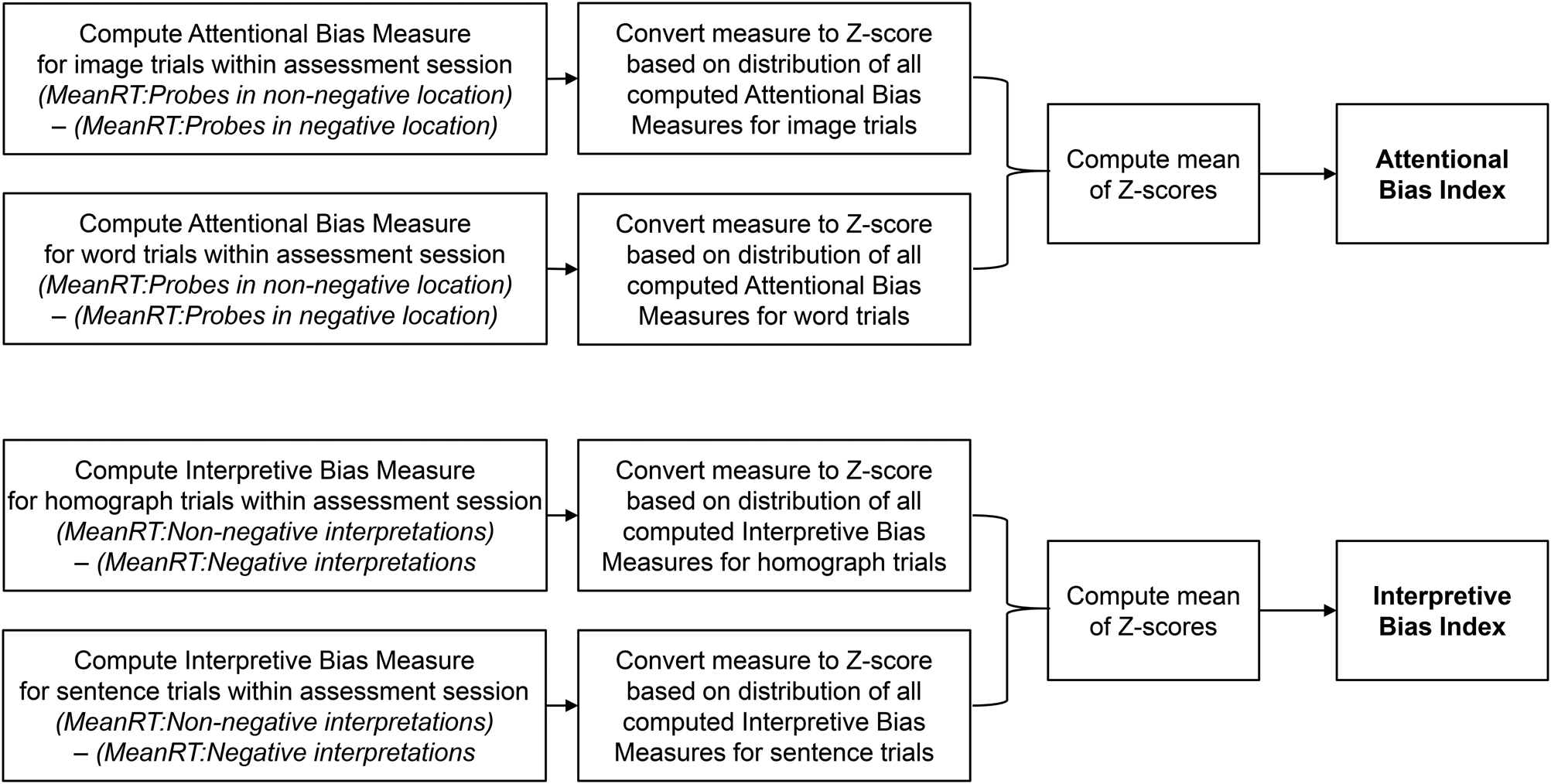
In order to derive an index of the magnitude of attentional and interpretive bias across the different stimulus types, a composite index of each cognitive bias was computed for each session. These indices were computed by first converting, for each stimulus type alone, each observed bias measure to a Z-score based on the distribution of all observed bias measures for the same stimulus type across all assessment sessions. Next, the index was yielded by computing the mean of the two Z-scores for the two stimulus types. This provided each participant an index for each assessment session that reflected the magnitude to which the participant demonstrated an attentional bias to negative information or biased negative interpretation of ambiguity. These indices were labelled the Attentional Bias Index and Interpretation Bias Index. Increasingly positive scores on each index reflected relatively greater magnitudes of bias to negative information and an increasingly negative score reflected relatively reduced magnitudes of bias to negative information, relative to all other index scores computed across the trial. A visual depiction of this computation process is presented in Fig. 1.
Representation of procedure used to compute Attentional Bias Index scores and Interpretive Bias Index scores, for each participant at each assessment session.

Outcomes
The primary outcome of interest for this trial was the onset of a major depressive episode over a 12-month period, which was assessed using the SCID-I at 11, 27 and 52 weeks. The SCID-I provides reliable and valid information to screen for the occurrence of a major depressive episode according to DSM criteria (Lobbestael et al., Reference Lobbestael, Leurgans and Arntz2011). The SCID-I assessment was conducted via a telephone interview with a trained member of the research staff.
Secondary outcomes of interest included the onset of clinically significant symptoms of depression as established by a PHQ-9 score ⩾15, change in the severity of depressive symptoms as measured by the PHQ-9, and changes in attention and interpretive biases. The assessment of depression symptoms took place at 0, 6, 17, 23, 36 and 45 weeks. The assessment of cognitive biases took place at 0, 6, 11, 27 and 52 weeks. These assessments were conducted online via the CBM programme.
Sample size
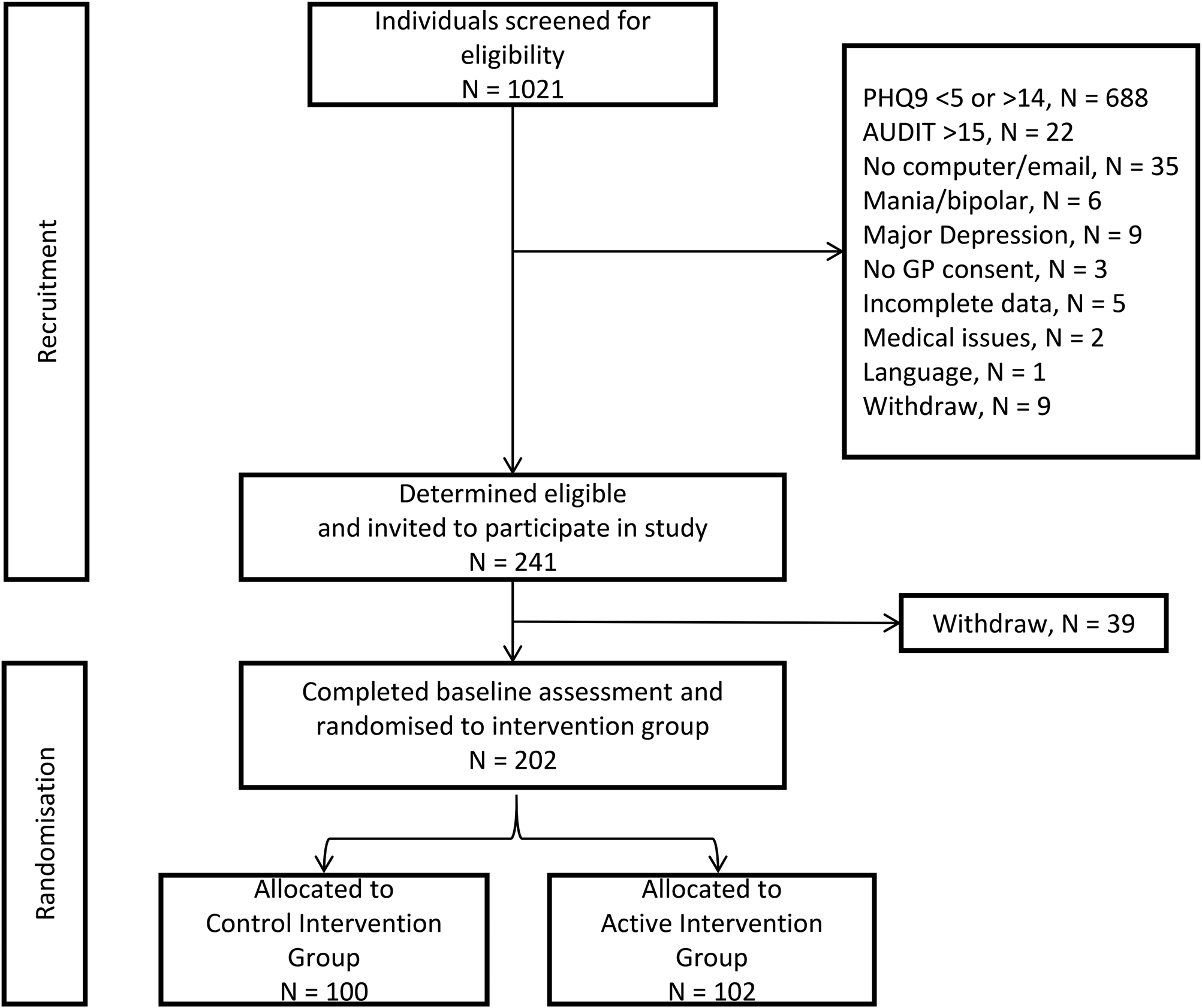
Approximately 10% of adults with subsyndromal symptoms of depression develop a major depressive episode over 12 months (Lyness et al., Reference Lyness, Heo, Datto, Ten Have, Katz, Drayer, Reynolds, Alexopoulos and Bruce2006). It was anticipated that CBM would be associated with an absolute risk reduction of major depression of 6% over this period (i.e. annual incidence of 4% compared with 0.8% for people free of subsyndromal depression). This would require that 444 (222 per group) participants provided valid data to ascertain this endpoint of the study (power of 80% with two tailed α of 5%). We further anticipate that as many as 20% of volunteers may be lost during follow-up, which would require that 532 participants enter the study (266 per group). The trial posted invitations to 20 000 people, screened 1021, interviewed 241 and randomised 202 (see Fig. 2). Further recruitment was not possible because of financial constraints.
Flow of trial participants from the time of screening to analysis. PHQ-9, Patient Health Questionnaire; AUDIT, Alcohol Use Disorders Identification Test; GP, general practitioner.

Randomisation, blinding and implementation
Enrolment of participants in the research trial was conducted by research staff at the Western Australian Centre for Health and Ageing. Randomisation to intervention condition was conducted automatically by the CBM online programme when participants registered for the first time. Participants were randomly allocated to one of two treatment arms: control or active CBM under a parallel design 1:1 allocation ratio. Randomisation occurred according to a list of random numbers generated by a computer and stored by the CBM programme in permuted blocks of 4. After randomisation, the CBM programme was capable of recognizing participants to ensure delivery of the correct condition each time the participants logged on to complete the CBM program. All interview assessments were conducted by research staff the Western Australian Centre for Health and Ageing. Research staff and study participants were blind to allocation until the study was closed.
Statistical analyses
Data were collated and analysed using the R software package (R Development Core Team, 2018). An intention-to-treat approach was adopted when assessing outcomes, which made use of all available data at each time point including available data from participants who did not complete all assessment sessions or who were lost to follow up. No assumptions were made concerning missing data. For readers interested in restricting analysis of outcome measures to participants who were classified as ‘compliant completers’ (at least 70% of CBM sessions competed), additional analyses are available as the online Supplementary Material. Binary outcomes variables, such as the presence or absence of major depressive episode, and continuous outcome variables, such as depression severity and degree of cognitive bias, were analysed via generalised and general linear mixed-models, respectively, using the lme4 and lmerTest packages (Bates et al., Reference Bates, Mächler, Bolker and Walker2015; Kuznetsova et al., Reference Kuznetsova, Brockhoff and Christensen2017). In all models, the fixed effect of assessment time was included as a continuous predictor and intervention condition was included as a categorical predictor. The influence of assessment time and participant was included as within-participant random effects in all models. For models that included binary outcome variables, participant intercept values were constrained at zero (0) as all participants were absent of major depressive episode and clinically significant levels of depression at baseline. The effect estimates of binary outcome variables are expressed as odd ratios (OR) with 95% confidence intervals (95% CI), and the effect estimates of continuous outcome variables are expressed as non-standardised coefficients (b) with 95% 95% CI. In all models, p values were computed using the Satterthwaite method for computing degrees of freedom (Luke, Reference Luke2017).
Results
Recruitment
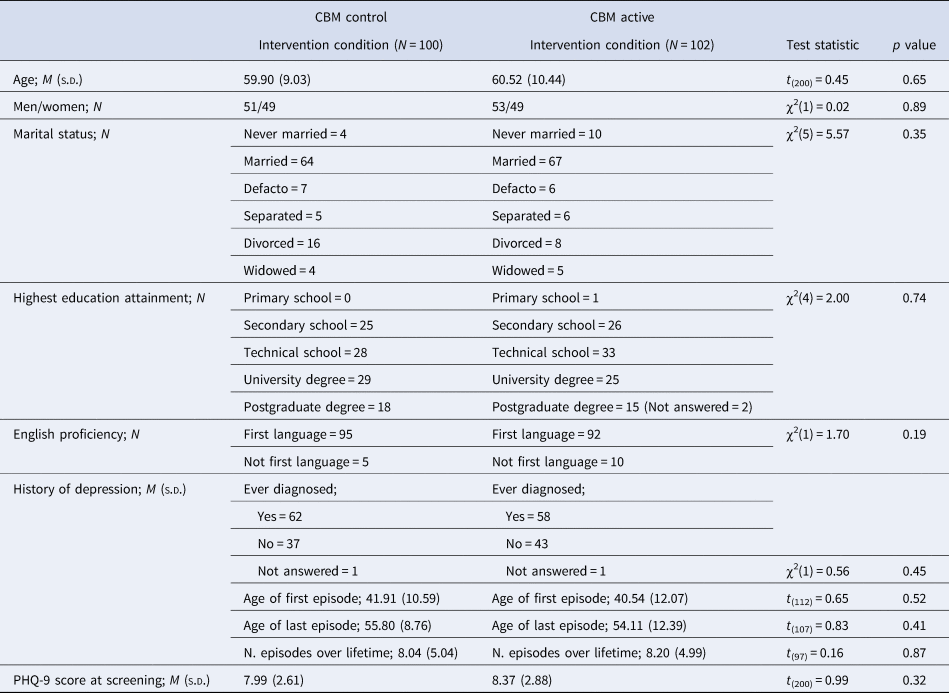
Figure 2 shows the flow of participants from recruitment to allocation to intervention condition and Table 1 shows the characteristics of participants at their baseline assessment. The trial commenced recruitment from February 2013 and data collection was closed on December 2015. The trial was closed prior to reaching recruitment goals due to lack of additional funding. The number of cognitive bias intervention sessions completed by participants varied, though did not differ between participants in the intervention (mean = 19.38, s.d. = 14.89) and control conditions (mean = 21.30, s.d. = 13.57), t (186) = 0.92, p = 0.36.
Characteristics of participants according to their random assignment to intervention conditions

Primary outcome: incidence of major depressive episodes
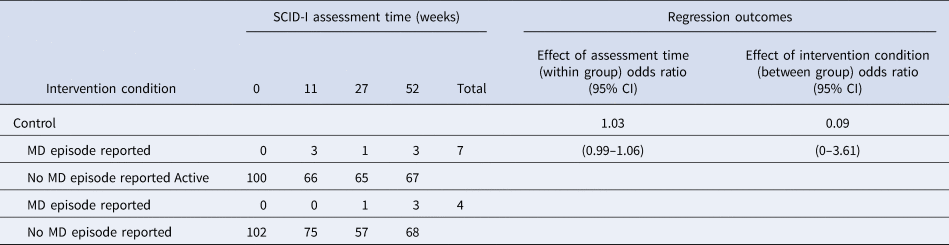
Two hundred and two participants (control = 100, active = 102) completed a total of 611 SCID-I assessments (197 incomplete assessments) for identifying the occurrence of a major depressive episode. Eleven participants were identified as having met criteria for a major depressive episode across the trial. Table 2 presents the number of occurrences in which individuals met criteria for a major depressive episode at each assessment point and for each intervention condition.
Number of occurrences and inferential statistics of major depressive episode, for each assessment time and intervention condition; N

Analysis did not demonstrate a statistically significant main effect of the intervention or assessment time upon the incidence of major depressive episodes over the course of the trial. Further, no statistically significant interaction effect between intervention condition and assessment time was observed.
Secondary outcome: incidence of clinically significant levels of depression and change in the severity of depressive symptoms
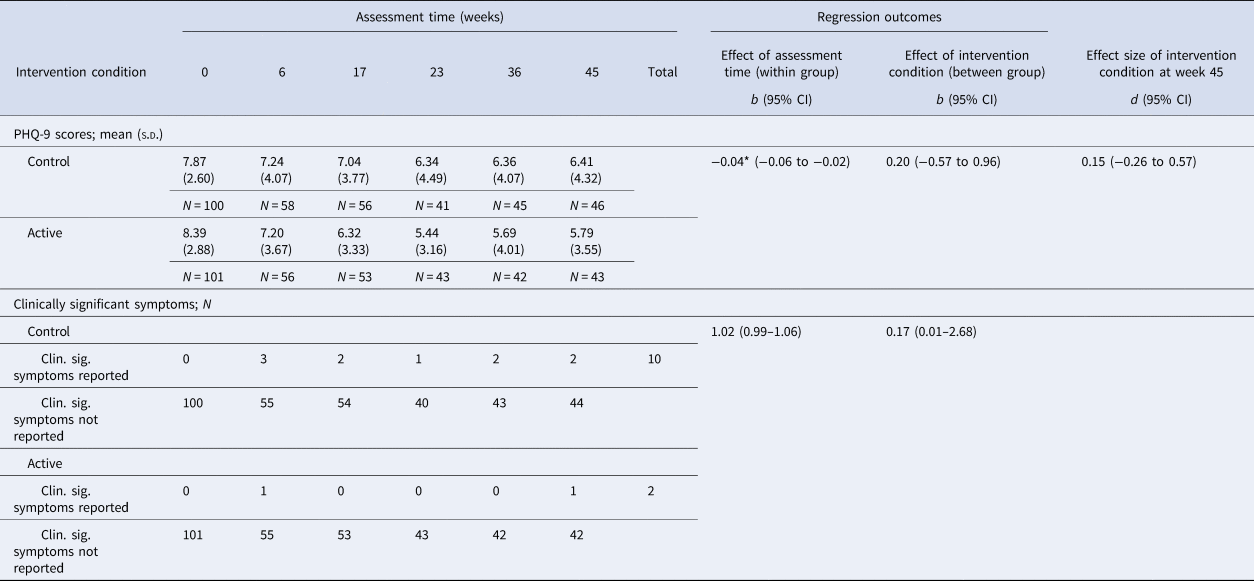
Two hundred and one participants (control = 100, active = 101) completed a total of 684 (522 incomplete assessments) PHQ-9 assessments. Table 3 presents descriptive and inferential statistics for the number of occurrences in which individuals met criteria for clinically significant symptoms of depression at each assessment point and for each intervention condition. Eleven participants recorded 12 instances of having experienced clinically significant symptoms of depression (PHQ-9 score ⩾15) across the assessment points.
Descriptive and inferential statistics for PHQ-9 scores and clinically significant symptoms of depression (PHQ-9 ⩾ 15), for each assessment time and intervention condition

*Statistically significant effect, p < 0.05.
Analysis did not demonstrate a statistically significant main effect of the intervention upon the incidence of major depressive episodes over the course of the trial. No statistically significant effect of assessment time was observed, nor a significant interaction effect between intervention condition and assessment time.
Table 3 also presents descriptive and inferential statistics of PHQ-9 scores reported by participants at each assessment point and for each intervention condition. Analysis revealed a significant main effect of assessment time (b = −0.04, 95% CI −0.06 to −0.02, p < 0.001), demonstrating that, in general, PHQ-9 scores reduced across the trial. No significant main effect of intervention condition or interaction effect involving assessment time and intervention condition was present.
Secondary outcome – change in cognitive bias
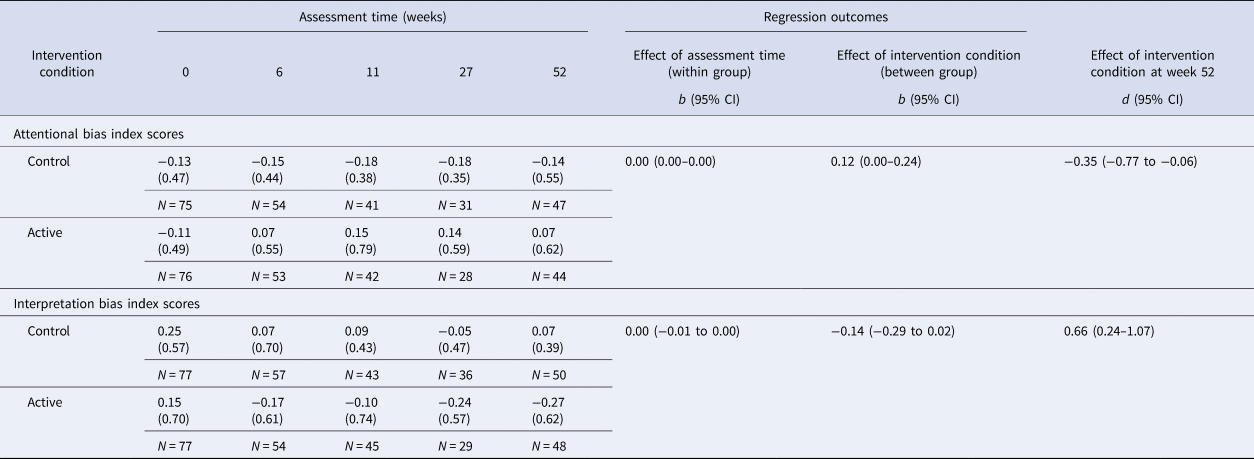
One hundred and eighty-four participants (control = 91, active = 93) completed 502 attentional bias assessments. One participant from the control intervention condition did not meet the necessary probe discrimination accuracy criterion on any assessment and so was not included in analysis. Of the 502 observed assessment, 11 (2.19% of observations) yielded bias index scores greater than three standard deviations from the mean of all scores and so were not included in the model. Table 4 presents descriptive and inferential statistics of Attentional Bias Index scores included in the model for each assessment time and intervention condition.
Descriptive and inferential statistics for Attentional Bias Index scores and Interpretation Bias Index scores, for each assessment time and intervention condition; mean (s.d.)

Analyses did not demonstrate a statistically significant main effect of assessment time or main effect of intervention condition. The interaction effect of these two predictors was also not significant. Therefore, the results of these analyses revealed that attentional bias index scores did not change across the course of the intervention programme, and the degree to which attentional bias index scores changed over the course of the intervention programme did not differ between participants in the intervention conditions.
One hundred and eighty-five participants (control = 91, active = 94) completed 521 assessments of negatively biased interpretation of ambiguous information. Five index scores (0.96% of observations) were greater than three standard deviations from the mean of all Interpretation Bias Index scores and so were not included in the model. Table 4 presents descriptive and inferential statistics of Interpretation Bias Index scores included in the model, for each assessment time and intervention condition. Analysis did not yield a statistically significant main effect of assessment time or main effect of intervention condition, or an interaction effect between these two factors.
Discussion
The primary aim of this trial was to determine whether administration of a CBM procedure designed to attenuate negative attentional and interpretive biases would decrease the incidence of major depressive episodes among adults with subthreshold symptoms of depression. The CBM procedure did not reduce the incidence of major depressive episodes, incidence of clinically significant symptoms of depression or severity of depression symptoms, or degree of cognitive biases.
The benefit of CBM procedures in preventing depression is predicted to result from the procedure's impact upon cognitive biases favouring negative information. Thus, given the failure of the active intervention to attenuate the cognitive biases, it is unsurprising that the intervention did not demonstrate an effect upon depression. Indeed, investigators have recognised that reduction in negative emotion vulnerability from CBM procedures coincides with successful reduction of targeted cognitive biases. In contrast, when the procedures are unsuccessful in effecting change in targeted biases, changes in emotional vulnerability most often do not occur (Clarke et al., Reference Clarke, Notebaert and MacLeod2014; MacLeod and Clarke, Reference MacLeod and Clarke2015). Critically, therefore, while the findings of the present study inform upon the effectiveness of the presently delivered intervention programme in affecting depression vulnerability, the results of the trial do not allow conclusions to be drawn upon the impact that successfully reducing cognitive bias would have on depression vulnerability. In order to answer this question, a trial would need to demonstrate that reduction in cognitive bias had been successfully achieved and that change in cognitive bias either was or was not associated with a change in depression.
This trial had a relatively small sample size and recruitment was halted before the planned number of participants had been reached. Furthermore, the trial had a relatively modest rate of adherence to the CBM intervention sessions across participants. Though the loss of power associated with small sample size and low adherence was mitigated in part by the use of statistical analyses that included the use of all available information using an intention-to-treat approach, although the effect of the intervention would have had to be moderate to large given the available sample size.
Post-hoc analyses investigated whether the present sample size was likely capable of detecting the presently observed effect of the CBM intervention. The observed difference in PHQ-9 scores amongst participants in the intervention and control conditions at the end of the trial was assessed. The Cohen's d effect size of the observed difference was d = 0.15. Accordingly, 698 participants would have been required in each participant group to have achieved 80% power to declare a real effect of this magnitude statistically significant when employing a 0.05 α criterion for significance, well below the recruited number. Thus, while statistical analyses conducted in the trial did not detect a statistically significant effect of CBM upon depression, a true effect of the CBM intervention in the present study cannot be dismissed. However, it is important to consider that even a statistically significant effect of the magnitude observed here may hold only modest clinical significance.
In addition, poor adherence to the intervention may have reduced the capacity of the active intervention to effect change upon depressive symptoms. Similarly, poor adherence rates have been reported by some researchers investigating CBM programmes delivered online or in-home (Boettcher et al., Reference Boettcher, Berger and Renneberg2012, Reference Boettcher, Leek, Matson, Holmes, Browning, MacLeod, Andersson and Carlbring2013; McNally et al., Reference McNally, Enock, Tsai and Tousian2013; Enock et al., Reference Enock, Hofmann and McNally2014). However, the effect size of the present CBM intervention is markedly smaller than effects reported in other studies that have provided repeated CBM sessions to participants with higher rates of adherence (Hallion and Ruscio, Reference Hallion and Ruscio2011). When repeating the computation of effect size amongst only ‘compliant completers’, the observed effect rose from d = 0.15 to d = 0.26, suggesting greater levels of engagement with the intervention were associated with elevated effect of the intervention in reducing depression symptoms. Change was also observed in the size of differences in cognitive bias index scores between participants in the intervention and control conditions at the end of the trial. When analysis was restricted to ‘compliant completers’, the effect size of the observed difference in Attentional Bias Index scores was d = −0.35 but rose to d = −0.80, signalling a heightened effect of the intervention upon attentional bias in the unexpected direction, and for Interpretive Bias Index scores was d = 0.66 but lowered to d = 0.37, signalling a smaller effect upon interpretive biases. Thus, while greater adherence to the CBM intervention programme was associated with greater reduction in depression symptoms, it was not associated with greater attenuation of cognitive biases across the trial.
There are likely several reasons for poor adherence observed in CBM studies. One candidate is tolerability of the intervention. It may be that the repetitive nature of CBM interventions, requiring the completion of many hundreds of similar trials, reduces participant motivation to comply with the relevant procedures. Some researchers have sought increase tolerability by designing CBM interventions that require relatively short sessions and that are available on personal smartphone devices to allow participants to work the intervention into their daily lives less obtrusively (Enock et al., Reference Enock, Hofmann and McNally2014; Clarke et al., Reference Clarke, Bedford, Notebaert, Bucks, Rudaizky, Milkins and MacLeod2016). However, formal examinations of methods to significantly improve adherence are yet to be conducted. Another contributing factor may be the level of psychoeducation about cognitive modification procedures available to participants. While participants in the present study were informed that CBM is being investigated as a potentially useful intervention to alleviate depression, participants were not educated on the precise means by which CBM is anticipated to be effective or necessity of completing large numbers of repetitive trials and sessions. Participants may be less motivated to complete an intervention for which they have little or no understanding of the anticipated mechanism of action or purpose of the intervention design. Future efforts to increase the tolerability of CBM tasks or incorporate psychoeducation alongside CBM interventions could usefully inform upon whether these factors may increase participant adherence or reduce dropout in CBM interventions.
The failure of CBM interventions to impact cognitive biases or depression may have also been driven by other methodological factors. It is possible that the frequency of CBM sessions was not sufficient to elicit a persistent reduction in cognitive biases or depression. At most frequent, the present trial required participants to complete sessions three times per week. In contrast, many studies demonstrating emotional benefits from repeated cognitive bias sessions have required participants to complete sessions more frequently over a relatively shorter time period (Browning et al., Reference Browning, Holmes, Charles, Cowen and Harmer2012; Lang et al., Reference Lang, Blackwell, Harmer, Davison and Holmes2012; Salemink et al., Reference Salemink, Kindt, Rienties and Van Den Hout2014; Torkan et al., Reference Torkan, Blackwell, Holmes, Kalantari, Neshat-Doost, Maroufi and Talebi2014). Though the present study design sought to achieve an appropriate compromise between potential benefits to participants and acceptable participant burden, it may be the case that the delivery of CBM sessions in the present trial was not sufficiently recurrent to evoke persistent change in cognitive biases or depression vulnerability.
It is possible the implicit cognitive modification processes through which CBM-A and CBM-I procedures are believed to influence cognitive bias are not suitable for reducing the incidence of depressive episodes in subsyndromal individuals. Researchers have reported CBM procedures that explicitly instruct participants to direct attention to stimulus items exert a stronger influence on bias and emotional vulnerably (Field et al., Reference Field, Duka, Eastwood, Child, Santarcangelo and Gayton2007; Krebs et al., Reference Krebs, Hirsch and Mathews2010; Notebaert et al., Reference Notebaert, Grafton, Clarke, Rudaizky, Chen and MacLeod2018). However, some researchers have reported that explicit instruction has instead compromised the capacity of modification tasks to reduce emotion vulnerability (Grafton et al., Reference Grafton, Mackintosh, Vujic and MacLeod2014). Given the practical value of CBM procedures will be increased by methodological developments that enhance bias and emotion change, it will be valuable for researchers to continue to investigate procedures that target not only implicit but also voluntary cognitive processes.
The method of participant sampling may have limited the therapeutic effect of the CBM intervention in the present study. The study recruited members of the community who did not meet a clinical diagnosis for major depression. In contrast, studies that have reported therapeutic effects of CBM interventions on depression have typically recruited participants with a clinical diagnosis of depression (Blackwell and Holmes, Reference Blackwell and Holmes2010; Lang et al., Reference Lang, Blackwell, Harmer, Davison and Holmes2012; Williams et al., Reference Williams, Blackwell, Mackenzie, Holmes and Andrews2013). Clinical cohorts may demonstrate greater change from an effective intervention as compared to non-clinical cohorts (Celermajer, Reference Celermajer2001). Though producing results that may be more generalisable, participant samples derived from the community are likely to be more heterogeneous compared to samples derived from individuals with clinical diagnosis (Rothwell, Reference Rothwell2005). Non-clinical ‘at-risk’ individuals are also likely to experience greater natural reduction in symptoms over time following recruitment as compared to individuals with clinical diagnoses, which may obfuscate the effects of the intervention (Linden, Reference Linden2013). It is also noteworthy that many of the participants recruited in the present study had reported experiencing multiple major depressive episodes. Researchers have demonstrated that higher number of lifetime depressive episodes is a predictor of treatment resistance of depression symptoms (Kautzky et al., Reference Kautzky, Dold, Bartova, Spies, Kranz, Souery, Montgomery, Mendlewicz, Zohar, Fabbri, Serretti, Lanzenberger, Dikeos, Rujescu and Kasper2019).
Lastly, it is possible that psychometric unreliability of traditional measures of attentional bias used in the present study impaired the ability to detect true effects of the intervention programme. There has been recent criticism concerning the reliability of traditional methods of computing indices of cognitive bias (Rodebaugh et al., Reference Rodebaugh, Scullin, Langer, Dixon, Huppert, Bernstein, Zvielli and Lenze2016). Some researchers have proposed that methods of indexing the degree of variability in cognitive bias across time may yield a more reliable assessment of attentional characteristics of depression (Zvielli et al., Reference Zvielli, Amir, Goldstein and Bernstein2016a, Reference Zvielli, Vrijsen, Koster and Bernstein2016b). Trials may benefit from designing procedures that allow traditional and novel proposed methods of assessing cognitive bias to assess bias change.
In summary, the results of the present trial found no effect of a 52-week CBM intervention in reducing the incidence of major depressive episodes amongst participants with mild to moderate levels of depression. Results also found no effect of the intervention in reducing depression severity or attenuating cognitive biases to negative information. However, the trial was impacted by low sample size and modest adherence to the intervention protocol. It will remain to be seen whether subsequent CBM programmes that seek to prevent depression will demonstrate consistent or diverging findings. For the moment however, the present findings suggest that a prolonged CBM intervention programme as delivered in the present trial may not serve as an effective intervention for preventing major depression amongst subsyndromal individuals.
Supplementary material
The supplementary material for this article can be found at https://doi.org/10.1017/S0033291719002599
Acknowledgements
We thank the study participants for their generous contribution to this study, and Varsha Hirani for their assistance with recruitment and data collection.
Registration information
Registration
Australian and New Zealand Clinical Trials Registry (ACTRN12613001334796).
Protocol
Almeida, O. P., MacLeod, C., Ford, A., Grafton, B., Hirani, V., Glance, D., & Holmes, E. (2014). Cognitive bias modification to prevent depression (COPE): study protocol for a randomised controlled trial. Trials, 15(1), 282. https://doi.org/10.1186/1745-6215-15-282
Financial support
This project was supported by competitive research project grants from the Australian Research Council (FL170100167, DP170104533) and a Setup Grant from the University of Western Australia.