INTRODUCTION
The recognition of psychosocial and existential needs among lung cancer patients has grown, and research supports the role of palliative care beginning at diagnosis and continuing on until death (Ferrell et al., Reference Ferrell, Sun and Hurria2015; Sanders et al., Reference Sanders, Bantum and Owen2010; Temel et al., Reference Temel, Greer and Muzikansky2010). However, the need for greater understanding of late-stage lung cancer patients' quality of life (QoL) at the end of life (EoL) still exists, as many studies have been conducted in the context of clinical trials that include patients diagnosed with other types of cancer (Pearman, Reference Pearman2007) or that employ health-related QoL (HRQoL) as an implicit proxy for patient concerns during terminal illness (Hirsch, Reference Hirsch2013). Despite the high distress (compared to most other cancers) (Koczywas et al., Reference Koczywas, Cristea and Thomas2013; Zabora et al., Reference Zabora, BrintzenhofeSzoc and Curbow2001) and the likelihood of receiving cancer-directed therapies within weeks or months of dying (Earle et al., Reference Earle, Landrum and Souza2008), little is known about the experience of living with advanced metastatic lung cancer to support tailored palliative care interventions. The present article contributes to our knowledge about quality of life at the end of life (QoLEoL) among persons with late-stage lung cancer by examining psychosocial and existential concerns using the Quality of Life at the End of Life (QUAL–E) “preparation for end-of-life” and “life completion” subscales (Steinhauser et al., Reference Steinhauser, Clipp and Bosworth2004).
Background
Despite modest reductions in the incidence and mortality of lung cancer, it remains one of the most lethal cancer diagnoses. In 2014, some 224,210 individuals were newly diagnosed with lung cancer in the United States, which represents 13% of all new cases of cancer (American Cancer Society [ACS], 2014). Lung cancer alone causes more deaths than the four next deadliest cancers combined (colon, pancreas, breast, and prostate) (ACS, 2014). Considered a disease of older adults, nearly 90% of all lung cancers occur in adults aged 55 and older, with well over a third of cases occurring among persons aged 75 and older (Howlader et al., Reference Howlader, Noone and Krapcho2014).
The outcomes in advanced lung cancer remain poor for several reasons. Lung cancers are often discovered in an advanced, inoperable stage, and many older patients, especially those in poorer health (e.g., with comorbidities, frailty), experience more toxicity from cancer-directed therapies (Rossi et al., Reference Rossi, Maione and Colantuoni2005). Moreover, new advances in late-stage lung cancer-directed therapy have not prolonged or improved life to any great extent. Consequently, a modest survival benefit (e.g., weeks) and questionable improvements in HRQoL make systemic chemotherapy for curative or palliative purposes during late-stage lung cancer a controversial approach (Kalemkerian, Reference Kalemkerian2007). Advances in targeted therapies for non-small-cell lung cancer (NSCLC) provide some hope to patients and their families for longer periods of time, but the evidence suggests that some NSCLC patients are resistant to state-of-the-art cancer-directed therapies (Kanthala et al., Reference Kanthala, Pallerla and Jois2015). In contrast, early integration of palliative care for advanced NSCLC patients portends a better QoL, less aggressive treatment, earlier hospice referral, and longer life than NSCLC patients receiving standard care (Temel et al., Reference Temel, Greer and Muzikansky2010). Consequently, both QoL as a primary goal of care and advance planning discussions should be moved to the forefront during treatment decision making and continued throughout the course of care.
Lung cancer trajectories during the final year of life provide important clinical guideposts for some of the unique needs of persons living with this disease. Murray and colleagues (Reference Murray, Boyd and Kendall2002; Reference Murray, Kendall and Boyd2004; Reference Murray, Kendall and Grant2007) prospectively studied patients with advanced lung cancer at four critical timepoints—diagnosis, treatment completion, recurrence, and terminal phase—to discern trends in social, psychological, and spiritual well-being. Lung cancer patients experience unique patterns of decline in each area and in a context of uncertainty and ambiguity. Specifically, emotional and spiritual well-being decline together at critical junctures, irrespective of physical decline (Murray et al., Reference Murray, Kendall and Grant2007). Collectively, this evidence indicates early and continuous palliative care to be imperative for lung cancer patients, which places psychosocial and existential well-being on a par with pain and symptom management.
Older adults, cancer patients, and persons with terminal illness are at risk for major depressive disorder and depressive symptoms. Older adults are considered more vulnerable to depression due to aging-related structural and biomedical changes and the increased risk of multiple losses, medical illness, and institutionalization (Palsson & Skoog, Reference Palsson and Skoog1997). Moreover, depressive symptoms among older adults diagnosed with cancer is a growing concern, with prevalence rates ranging from 17 to 25% (Massie, Reference Massie2004). Among lung cancer patients, depressive symptoms are associated with poorer QoL, especially in persons with severe symptom and functional decline (Hopwood & Stephens, Reference Hopwood and Stephens2000). While precise prevalence rates are not known, depressive symptoms among cancer patients are considered a serious comorbid condition that affects QoL (Smith et al., Reference Smith, Gomm and Dickens2003). For persons with a terminal cancer diagnosis, depressive symptoms are more prevalent and pose a greater threat to QoL due to the aggressiveness and duration of treatment, uncontrolled pain, intensified symptoms, physical disability, and impending loss and separation (Kelly & McClement, Reference Kelly and McClement2006; Siddiqui et al., Reference Siddiqui, Given and Given2009; Simon et al., Reference Simon, Thompson and Flashman2008). In particular, depressive symptoms at the end of life are associated with a decreased sense of meaning and peace and a diminished ability to handle one's practical affairs (e.g., financial, relationship issues) consistent with the concepts of preparation for the end of life and life completion (Lloyd-Williams et al., Reference Lloyd-Williams, Friedman and Rudd2001). Taken together, depressive symptoms represent an important risk to psychosocial, emotional, and existential QoLEoL, among three overlapping groups: older adults, persons with advanced cancer, and those with a terminal illness regardless of the diagnosis.
End-of-Life Preparation and Life Completion
Dying has been described as the final stage in the life process for individuals, drawing upon the models of Erikson, Piaget, and Maslow, who asserted that “human development is a lifelong process” (Byock, Reference Byock1996). Erikson (Reference Erikson1959/1994) described developmental tensions at each stage of the lifespan, with task resolution being important for human growth and identity development. During mid to late adulthood, life tasks focus on generativity versus stagnation and ego integrity versus despair, respectively, such that their resolution portends psychosocial and existential growth. According to Erikson (Reference Erikson1959/1994), generativity involves establishing and guiding the next generation. Generativity also encompasses a sense that one has cared for others, that knowledge and wisdom have been transmitted, and that one has found meaning and value through these efforts (Lo et al., Reference Lo, Burman and Swami2011; Steinhauser et al., Reference Steinhauser, Alexander and Byock2009). A positive sense of generativity is also associated with emotional well-being and a lessened fear of death (Major et al., Reference Major, Whelton and Schimel2016). Erikson (Reference Erikson1959/1994) did not provide a clear definition of “ego integrity” but described its attributes as “acceptance of one's own and only life cycle and the people who have become significant to it” (p. 104). Ego and emotional integration in late-life functions against hopelessness and despair such that wisdom becomes attainable in later life as one comes to grips with the meaning of one's individual life and the coming of its end.
Terminal illness may also propel these psychosocial and existential tasks into the forefront (Steinhauser et al., Reference Steinhauser, Alexander and Byock2009). Accordingly, persons with a life-limiting illness indicate that social, emotional, and spiritual/existential concerns are as important as pain, physical distress, and functional well-being. Simultaneously preparing for one's dying and death and reviewing one's life represent psychosocial and existential concerns important to people with advanced cancer (Byock, Reference Byock1996; Steinhauser et al., Reference Steinhauser, Christakis and Clipp2000). As such, preparation for the end of life and life completion tasks are particularly relevant for advanced lung cancer patients, who tend to be older and face mortality within a shorter illness trajectory when compared to those with other cancer diagnoses. Preparation for the end of life represents patients' working through worries about family and financial strain, past regrets, and perceived burden (Steinhauser et al., Reference Steinhauser, Clipp and Bosworth2004). Life completion tasks involve an exploration of generativity, interpersonal connections, helping others during one's lifetime, and having meaning and peace despite one's illness (Steinhauser et al., Reference Steinhauser, Clipp and Bosworth2004). Empirical support is growing for palliative interventions that facilitate processes to support a sense of generativity, dignity, and life closure through legacy and life review activities (Ando et al., Reference Ando, Tsuda and Morita2007; Chochinov et al., Reference Chochinov, Kristjanson and Breitbart2011; LeMay & Wilson, Reference LeMay and Wilson2008).
Death is a transition or rite of passage in which we will all participate (Steinhauser, Reference Steinhauser, Christakis and Clipp2000). An existential crisis precipitated by a life-limiting illness can propel an individual to grapple with such core existential themes such as awareness of our individual being, the desire to continue to exist, and the reality of our own mortality. The resolution of existential conflicts (e.g., being vs. nonbeing, meaning vs. meaninglessness) suggests that the potential for growth and transcendence at the end of life is consistent with the paradoxical nature of suffering, dying, and growth (Adorno, Reference Adorno2015). A positive psychological shift can occur among people with a diagnosis of an incurable disease who are able to confront their finitude and reconstruct meaning on their own terms (Yang et al., Reference Yang, Staps and Hijmans2010). This theme is consistent with the concept of the “disability paradox” (Albrecht & Devlieger, Reference Albrecht and Devlieger1999)—that is, despite functional decline during advanced disease, some people report positive well-being (e.g., enhanced meaning) (Steinhauser et al., Reference Steinhauser, Clipp and Bosworth2004). As a positive transition, this passage suggests the resolution of tasks through processes consistent with preparation and completion as conceptualized through Erikson's last stages of the life cycle.
The goals of the present study were: (1) to explore psychosocial and existential QoLEoL among a homogeneous sample of older adult cancer patients, and (2) to utilize theoretically grounded measures consistent with human development and the tasks of dying. Our study contributes to the palliative care literature by adding to the burgeoning knowledge base about psychosocial and existential distress specific to older persons with late-stage lung cancer to inform clinical assessment and palliative care interventions.
METHODS
A cross-sectional exploratory design was employed to examine preparation for the end of life and life completion among advanced metastatic lung cancer patients. The institutional review boards of the relevant universities all approved this study.
Procedures
Study participants were recruited between November of 2010 and May of 2011 from a Veterans Health Administration (VHA) outpatient medical oncology clinic and a not-for-profit comprehensive community hospice both located in the Southeastern United States. As the largest integrated healthcare system in the United States, the VHA provides health and mental health services across the continuum of care to over 8.5 million military veterans (VHA, 2015). Not-for-profit hospices do not profit for individual purposes; rather, they tend to provide a broader range of palliative and supportive care services to patients and families, offer greater benefits and outreach to the community, and maintain academic ties through onsite palliative care education and research (Harrison & Ford, Reference Harrison and Ford2007).
Patients recruited from a VHA outpatient oncology clinic are either enrolled in cancer-directed treatment only or in concurrent care. Concurrent care refers to a treatment plan that combines disease-directed treatments with a palliative care model (e.g., hospice). Participants recruited from a community hospice agency were receiving hospice care only, without any ongoing curative care. Concurrent care only recently became available to dually eligible patients through 140 Medicare-certified hospices as part of the Medicare Choices Model pilot project (Centers for Medicare & Medicaid Services, 2016). However, veterans receiving cancer care at a VHA medical center are technically exempt from the financial barrier to hospice enrollment imposed by the Medicare Hospice Benefit since the VHA pays for veterans' cancer-directed therapies and maintains a policy that hospice must be made available to all eligible veterans (Lorenz & Malin, Reference Lorenz and Malin2010). The VHA began to systematically develop and sustain efforts to improve care for dying veterans starting in 2001. This commitment allows for a unique setting that includes study participants who are receiving integrated hospice and cancer-directed therapy.
The inclusion criteria for our participants were as follows: (1) a diagnosis of stage IIIB or IV NSCLC or extensive stage SCLC; (2) age 55 or older; and (3) an ability to provide voluntary informed consent. Participants were receiving cancer-directed therapy, routine hospice care, or concurrent care at the time. Prior to recruitment, the investigator met with key personnel at the VHA site (e.g., the geriatric palliative care physician, medical oncology clinical director, medical oncology resident, and clinic staff) to discuss the aims of our study and respond to questions about study recruitment. Upon commencement of the study, the investigator reviewed the daily clinic census and notified medical oncologists of patients who met the study's inclusion criteria for age and diagnosis. Study recruitment flyers were also posted at the medical oncology clinic and in the infusion waiting room. If a patient was interested in learning more about the study, GA met with the patient in a private clinic room. The investigator discussed the study's risks and benefits, responded to questions, and obtained informed consent as indicated. The Short Portable Mental Status Questionnaire (SPMSQ; Pfeiffer, Reference Pfeiffer1975) was administered at enrollment to exclude patients who scored lower than 8 out of 10. Due to time and space constraints in the clinic setting, patients were scheduled for a follow-up visit in their homes for data collection.
Participants were also recruited through a not-for-profit community hospice agency unaffiliated with the VHA. An employee of the hospice agency screened admission records for newly admitted lung cancer patients and then determined the patient's interest in study participation via a telephone call. Subsequently, GA contacted potential participants by phone to further describe the study and arrange for a home visit.
On the day of scheduled visits, which could be one to two weeks following the initial recruitment screening, the investigator contacted potential participants to determine if the patient was able to participate in the study. During this visit, participants chose to complete the data collection instruments through reading and writing their responses or by having the investigator read the questions and make note of their responses on the forms. Qualitative data were collected from a subset of participants regarding their experiences living with late-stage lung cancer. A complete report of the qualitative findings is published elsewhere (Adorno & Brownell, Reference Adorno and Brownell2014).
Data Collection Instruments
Data were collected using several instruments: the preparation for the end of life and life completion subscales and the global QoL single-item indicator from the QUAL–E (Steinhauser et al., Reference Steinhauser, Bosworth and Clipp2002; Reference Steinhauser, Clipp and Bosworth2004), and a modified version of the Center for Epidemiologic Studies–Depression (CES–D) scale (Schroevers et al., Reference Schroevers, Sanderman and van Sonderen2000). Additionally, questionnaires specifically created for our study collected relevant sociodemographic and treatment-related variables.
Preparation for End-of-life and Life Completion Subscales
The QUAL–E (Steinhauser et al., Reference Steinhauser, Bosworth and Clipp2002; Reference Steinhauser, Clipp and Bosworth2004) self-report instrument consists of a single-item global QoL indicator and four subscales, all of which have been previously validated: life completion (α = 0.80), preparation for the end of life (α = 0.68), relationship with healthcare provider (α = 0.71), and symptom impact (α = 0.87). The four domains were developed from the perspectives of seriously ill patients, families, and healthcare providers to reflect concerns important at the end of life (Steinhauser et al., Reference Steinhauser, Christakis and Clipp2000). Additionally, the QUAL–E is a theoretically informed measure grounded in a developmental life-course approach consistent with concerns important to older adults, such as generativity, life review, meaning, and purpose in life. In all, the QUAL–E subscale items for preparation for the end of life and for life completion acknowledge a complex process whereby patients simultaneously look ahead to a future without them in it and look back at the life they have lived.
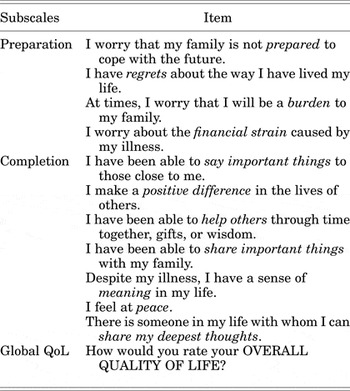
According to Steinhauser and colleagues (Reference Steinhauser, Bosworth and Clipp2002; Reference Steinhauser, Clipp and Bosworth2004), the QUAL–E can be used during the last year of life regardless of diagnosis, model of care, or labeling or acceptance of terminal illness. The preparation subscale (four items) and life completion subscale (seven items) represent an overlap of existential, emotional, and social concepts consistent with specific end-of-life tasks and central tasks of aging (see Table 1). Each subscale item and the single-item global QoL indicator are measured on a 5-point Likert-type scale with scores ranging from 1 (“not at all”) to 5 (“completely”). The subscales are scored and analyzed separately. The preparation and life completion subscales can be summed for a total score (preparation range = 4 to 20, completion range = 7 to 35). For example, low scores on preparation items suggest present and future concerns about loved ones, whereas high scores on life completion suggest greater task accomplishment as one approaches death.
QUAL-E: preparation for dying and life completion subscales, QOL single item

QoL = quality of life.
Center for Epidemiologic Studies–Depression (CES–D)
Depressive symptoms were measured using a 16-item shortened form of the 20-item CES–D (Radloff, Reference Radloff1977). This modified version reduced respondent burden by decreasing the number of items for completion. It was validated in a study of cancer patients as a reliable measure of depression in both cancer patients and healthy individuals (Schroevers et al., Reference Schroevers, Sanderman and van Sonderen2000). Each item is rated on a 4-point scale ranging from 0 (rarely or none of the time [less than 1 day]) to 3 (most or all of the time [5–7 days]). The total score is calculated by summing the responses, with scores ranging from 0 to 48. A cutoff score of >10 represented serious depressive symptoms (Schroevers et al., Reference Schroevers, Sanderman and van Sonderen2000).
Additional Questionnaires
Participants provided sociodemographic information about their age, gender, relationship status, living arrangements, race/ethnicity, health insurance, veteran status, and highest level of education using a self-report questionnaire. A second questionnaire collected information about each participant's primary treatment (i.e., care model) for their diagnosis of advanced metastatic lung cancer at the time of study participation (e.g., systemic chemotherapy and/or radiation therapy, oral-targeted chemotherapy, hospice, or concurrent care).
Data Analysis
The data were analyzed using SPSS 18.0 statistical analysis software. Sociodemographic data were analyzed to describe the characteristics of the sample. Means, standard deviations, and ranges were calculated for the preparation and life completion subscales, the subscale items, global QoL, and the modified CES–D. Given the small sample size (N = 30) and the nonnormal distributions of the dependent variables (preparation, completion), nonparametric methods were employed to examine associations among the study measures (Pett, Reference Pett.1997). Bivariate analysis used Kendall's tau (τ) rank correlation to examine the associations among the preparation and life completion subscales, the global QoL indicator, and the modified CES–D. Kendall's τ further examined the associations among the life completion scale items and the global QoL indicator.
RESULTS
Sample
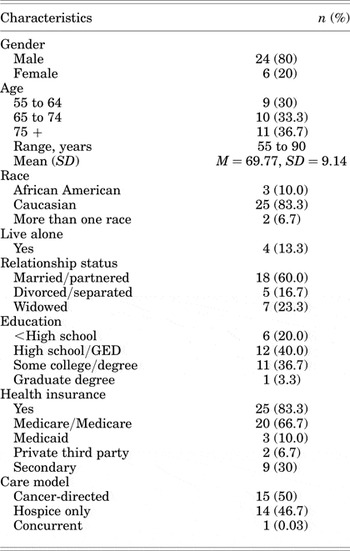
Participants ranged in age from 55 to 90 years, with a fairly equal spread across three age categories: (1) middle age, (2) old age, and 3) oldest old. Two-thirds of the sample were recruited from the VHA oncology clinic. More than two-thirds of the sample were Caucasian males. While three-fifths of the sample were partnered or married, some participants lived alone. Half of the sample were receiving hospice care only, and the other half were receiving either systemic chemotherapy only or concurrent treatment. Four potential participants who initially expressed interest in the study declined to participate due to deteriorating health. A total of 32 participants were enrolled in the study, with two dropping out prior to data collection also because of deteriorating health. Please refer to Table 2 for details on the characteristics of the sample. Some 80% (n = 24) of the study participants opted to have questions read to them and their responses recorded on the study instrument by the investigator.
Sample characteristics (N = 30)

Failed SPMSQ = 0.
Study Instruments
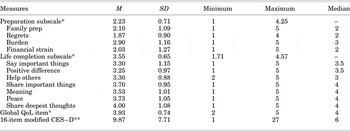
The sample mean scores and standard deviations for the study measures, the individual preparation and completion items, and the global QoL scores are presented in Table 3. Means were lowest for the preparation item “regrets” and highest for “burden.” Means were lowest for completion item “positive difference” and highest for “share deepest thoughts.” Our findings point to a negative inverse association between preparation and life completion subscale scores. Kendall's τ results indicated that the global QoL indicator shares a positive significant association with life completion and a nonsignificant positive relationship with preparation. The reader should refer to Table 4 for the correlations of study measures. Specifically, the life completion items “share important things” (r t = 0.387, p < 0.05), “help others” (r t = 0.404, p < 0.05), and “meaning” (r t = 0.512, p < 0.01) were associated with global QoL. No significant associations were found between depressive symptom scores when correlated with the mean scores for the preparation and life completion subscales.
Descriptive findings from study measures (N = 30)

* Range = 1–5 (1 = not at all, 5 = completely). Lower preparation scores indicate greater preparation for the end of life. Higher completion scores indicate greater completion of life.
** Range = 0–48. CES–D = Center for Epidemiological Studies–Depression.
Correlations between study measures

p < 0.05. CES–D = Center for Epidemiological Studies–Depression.
DISCUSSION
The exploratory aims of our study were to examine psychosocial and existential concerns using theoretically informed measures among a homogenous sample of cancer patients—older adults with metastatic lung cancer. Advanced lung cancer patients tend to have a short prognosis from diagnosis until death, with little time to adequately prepare themselves or family members for their dying. Overall, our study findings affirm the growing scholarship on psychosocial and existential concerns among older late-stage lung cancer patients and the need to address these aspects of QoL early on in the disease trajectory through clinical assessment and empirically supported interventions.
Preparation for the end of life among participants was lowest for regrets about how one lived his or her life and highest for worry about becoming a burden on their family. Participants had fewer concerns about remorse or feeling repentant about past experiences than perceptions of being a burden in the future. Preparation concerns in this sample were consistent with findings from the QUAL–E's validation study among 248 adults with advanced cancer and other end-stage conditions in which perceived burden was of greater concern than other preparation items (Steinhauser et al., Reference Steinhauser, Clipp and Bosworth2004).
Lung cancer patients' perceptions of being a burden on their families demonstrate a form of suffering not readily acknowledged in research or clinical settings (Ellis et al., Reference Ellis, Cobb and O'Connor2015). Self-perceived burden (SPB) at the end of life consists of individual concerns about integrity of self—including dignity, dependency, physical care needs (Chochinov et al., Reference Chochinov, Hack. and McClement2002), and sociorelational dynamics whereby the patient is emotionally concerned about significant others (McPherson et al., Reference McPherson, Wilson and Murray2007). Lung cancer patients have expressed common themes about their family's well-being and how family members will cope with their death (Hill et al., Reference Hill, Amir and Muers2003). For example, the financial impact of illness is one aspect of burden when terminal illness diminishes work income and significant healthcare costs accrue (Chapple et al., Reference Chapple, Ziebland and McPherson2004; Timmons et al., Reference Timmons, Gooberman-Hill and Sharp2013). The weight of viewing oneself as a burden on the family is further fueled when salient roles (e.g., economic provider) are relinquished or when worry about the physical and emotional demands on the caregiver are present. In turn, this can erode self-esteem, with implications for one's value and purpose in life (Adorno & Brownell, Reference Adorno and Brownell2014; McPherson et al., Reference McPherson, Wilson and Murray2007). Furthermore, SPB has also been associated with a desire to hasten death, and with decisions to continue or forgo treatment, to disclose symptoms, and about location of death (McPherson et al., Reference McPherson, Wilson and Murray2007). The relatively short duration between an initial diagnosis of advanced lung cancer and disease progression suggests that an abbreviated dying trajectory is an important predictor of worry when issues involving the family are taken into consideration (Li & Girgis, Reference Li and Girgis2006). Coupled with declining cognitive functioning, a relatively common occurrence in people with lung cancer (Kohli et al., Reference Kohli, Novotny and Sloan2010), preparation for the end of life becomes even more salient. Early referral of lung cancer patients to palliative care presents unique opportunities to understand the preferences and specific needs of persons living with terminal lung cancer who may be prepared for death but not necessarily for dying.
Preparation did not have a significant association with global QoL or depressive symptoms. The lack of a significant relationship with quality of life at the end of life is consistent with Prince-Paul's (Reference Prince-Paul2007) findings from an examination of the preparation and life completion domains among a sample of adults with advanced metastatic cancer. In a psychometric validation of the QUAL–EC, a shortened version of the QUAL–E, among 464 advanced cancer patients the preparation subscale was strongly associated with emotional well-being (Lo et al., Reference Lo, Burman and Swami2011). This suggests that perhaps the preparation domain does not tap into perceptions of overall subjective QoL among this homogenous sample.
In all, it is difficult to draw any conclusions from a handful of studies. However, the concept of death preparedness, as a transition, suggests its longitudinal importance (McLeod-Sordjan, Reference McLeod-Sordjan2014). It first entails an appraisal of one's death attitudes and individual mortality. Second, it involves a process of facilitated communication that culminates in a developed plan with respect to one's unfinished business. Healthcare professionals, family members, and patients newly diagnosed and/or undergoing cancer-directed therapies may not recognize the significance of burden and its relationship to other forms of distress. Further research is needed to determine how preparation discussions in patients diagnosed with advanced metastatic lung cancer might influence death acceptance, emotional well-being, and advance planning behaviors over time.
Life completion represents transcendence, contributing to others, and communicative acts. Moreover, the life completion domain demonstrates a consistent positive relationship with spiritual and social well-being (Lo et al., Reference Lo, Burman and Swami2011; Prince-Paul, Reference Prince-Paul2007; Steinhauser et al., Reference Steinhauser, Clipp and Bosworth2004). Like preparation, life completion was not associated with depressive symptoms. The positive moderate association between life completion and global QoL in the present study was also found in Prince-Paul's (Reference Prince-Paul2007) examination of relationships, spirituality, and communication at the end of life. In the present study, three items from the life completion domain demonstrated positive significant associations with global QoL: finding meaning, helping others, and sharing important things with family. These findings affirm the importance of palliative care interventions that utilize reminiscence, life review, and meaning-making strategies to facilitate life closure as part of comprehensive palliative care (Ando et al., Reference Ando, Tsuda and Morita2007; Chochinov et al., Reference Chochinov, Kristjanson and Breitbart2011; LeMay & Wilson, Reference Steinhauser, Alexander and Byock2008; Steinhauser et al., Reference Steinhauser, Alexander and Byock2008). Furthermore, these findings reflect the importance of relational and communicative aspects important to one's perception of quality of life at the end of life. Life completion's role in the present study provides additional support for the role of generativity as an important dimension of QoLEoL. Generativity in Erikson's (Reference Erikson1963) stage theory of psychosocial development refers to one's perception of making a positive difference in a younger generation and leaving a legacy with respect to work, productivity, or material resources. Since Erikson's work, feminist perspectives have expanded generativity to include contributions to others through one's lived experience (e.g., caregiving roles, lessons learned, interpersonal relationships, time, and wisdom) (Carlson et al., Reference Carlson, Seeman and Fried2000). This finding makes sense from the more inclusive perspective, although it suggests areas for additional research about personal meanings of helping others and their relationship to life closure and quality at the end of life.
The relationships among generativity and concepts of successful aging have been an important focus of scholarship (Schoklitsch & Baumann, Reference Schoklitsch and Baumann2012). However, generativity's role in “successful” dying and death, as suggested by the constructs of preparation and completion, is not fully understood. Advanced lung cancer patients report needs for continuity in terms of identity and personhood, consistent with the importance of interconnectedness, a relational sense of one's being, and a sense of value and purpose (Adorno & Brownell, Reference Adorno and Brownell2014; Murray et al., Reference Murray, Kendall and Grant2007). Indeed, evidence suggests that lung cancer patients identify generative roles as salient in relation to family and their anticipatory grieving whereby the patient helps the family through this process with open communication and advance planning (Cheng et al., Reference Cheng, Lo and Chan2010). Such contributions to others as helping loved ones with anticipatory grieving, even in the face of life-limiting illness, represent important roles that may mitigate SPB and certainly merit further exploration in intervention studies.
IMPLICATIONS FOR PRACTICE
An unforeseen opportunity in this study was observation of the acceptability and feasibility of the preparation and completion subscales in a sample of older late-stage lung cancer patients. The patients who opted to have the questions read to them and their responses recorded by the investigator provided additional information not otherwise evident from the self-report measure alone. The QUAL–E subscales were designed for broad application across persons with serious illnesses who are not necessarily aware of their terminal prognosis (Steinhauser et al., Reference Steinhauser, Bosworth and Clipp2002; Reference Steinhauser, Clipp and Bosworth2004). The preparation and completion items represent sensitive core themes important to persons with a life-limiting illness that can prompt patients and families who are ready for deeper discussion. During data collection, it was clear that persons who readily discussed such topics were aware of their limited life expectancy, regardless of whether they were receiving hospice services, cancer-directed therapy, or concurrent care. Moreover, nearly every participant with a spouse or partner who was receiving cancer-directed treatment requested the presence of a family member during data collection. Patients acknowledged that the concerns raised by the instruments were difficult but important to address, and many expressed gratitude for being able to participate in the study.
These observations are consistent with an investigation of the QUAL–E subscales as an investigator-administered tool among a sample of 52 palliative care patients in two Australian hospitals (Wilkinson et al., Reference Wilkinson, Slatyer and McCullough2014). Similarly, the advanced lung cancer patients in our study frequently asked clarifying questions about such abstract concepts included in items as “finding meaning,” “positive difference,” “share important things” or “say important things to others.” In addition, several of the male advanced lung cancer patients became tearful in response to hearing questions related to family and in some cases disclosed significant concerns during data collection not previously voiced to family members. Participants who desired to have a spouse or partner present were appreciative for what they perceived as an opportunity for communication facilitated and validated through issues raised by the preparation and completion items. The primary difference in our study was that data collection occurred in the patient's current residence, not on a busy outpatient clinic or inpatient palliative care unit. This procedural decision was made specifically due to the sensitive nature of the questions and the constraints on time and space on the parts of the patient and the healthcare system. Moreover, some patients could not complete the instruments due to lethargy, poor vision, or insufficient literacy, thus necessitating investigator administration. As a self-report research or clinical tool, the preparation and completions subscales may not fully capture patients' concerns based on item responses alone. For these reasons, we concur with Wilkinson and colleagues (2014) that the QUAL–E preparation and life completion items may serve as a useful clinical tool for social workers and health psychologists to address psychosocial and existential concerns with advanced lung cancer patients and their families at key transition points in care. We recommend further study of the utility of a facilitated communication intervention using the concepts of preparation for the end of life and life closure to support both patients and their caregivers through critical junctures in the lung cancer experience.
LIMITATIONS OF THE STUDY
While our study represents a preliminary step toward examining end-of-life preparation and life closure among older adults with late-stage lung cancer, there are limits to the generalizability of its findings. The small sample size limits our statistical power to make generalizations outside of the present study. That the mean score for the modified CES–D was below the cutoff threshold for clinical depressive symptoms suggests that perhaps selection bias was present. Participants who were generally not exhibiting depressive symptomatology may have been more open to study participation. Additionally, the presence of a spouse or partner during data collection may have biased participants' reporting. The correlational nature of the study also limited any ability to make causal inferences.
CONCLUSIONS
The QUAL–E preparation and life completion subscales explored quality of life at the end of life through constructs theoretically grounded in Erikson's mid- and late-life stages. By doing so, our examination of QoL is based on psychosocial and existential concerns relevant at the intersection of human development in late life and terminal illness. Our findings contribute to the palliative care literature to help untangle the intensity and complexity of emotional, existential, and family-related concerns among this population and further support the contributions for one's legacy, interpersonal connections, and communication as important components of life closure consistent with developmental approaches to aging (Erikson, Reference Erikson1959/1994) and dying (Byock, Reference Byock1996).
FUNDING
Our study was funded in part by a Department of Veterans Affairs, Office of Academic Affiliations, Pre-Doctoral Social Work Fellowship Grant, and an American Cancer Society Doctoral Training Grant in Oncology Social Work (117251-DSW-09-143-01-SW).