1. Introduction
This article provides an economic analysis of cooperation and competition between the two types of health care providers who administer anesthesia: certified registered nurse anesthetists (CRNAs) and anesthesiologists (MDAs). However, this research has implications far beyond this highly specialized labor market. Our approach can be used to analyze relationships between other professions that have overlapping responsibilities, but differ in educational requirements: for example, the relations between opticians and ophthalmologists, or between nurse practitioners and primary care physicians or certified nurse midwives and obstetrician-gynecologists.
CRNAs and MDAs often work together as a team, and often work by themselves as the sole anesthesia provider. Although there is a substantial difference in their educational requirements – it takes 12 years of specialized training to become an MDA, compared with seven or eight years for a CRNA – there is so much overlap between the work they do that it is not clear whether an MDA actually does anything that a CRNA does not do. There is, however, a substantial earnings differential in favor of the MDA. This situation creates some interesting and unique issues involving competition and cooperation between the two groups.
In this article we analyze (1) the variation of CRNA earnings across mode of practice and other variables, and across States; and (2) differences in the mode of practice (e.g. whether anesthesia is provided by a team (an MDA working with a CRNA) or instead by either a CRNA working alone, or an MDA working alone or with a resident) across different areas within a State, and across States.
There is remarkable variation in the relative numbers of anesthesia providers across different areas. In 1995, the ratio of CRNAs to MDAs varied from 4.7 in California and 4.3 in New York to 0.6 in Michigan and 0.55 in North Carolina.Footnote 1 One explanation that has been offered for this variation is that the two types of anesthesia providers are excellent substitutes for each other. Klein (Reference Klein1997) notes that ‘in most States, a supply of CRNAs per capita in excess of the national median coincides with a supply of MDAs below the median, and conversely’, and cites a government reportFootnote 2 stating that this pattern of geographical distribution demonstrates the substitutability of CRNAs and MDAs.
Previous research (Rosenbach and Cromwell, Reference Rosenbach and Cromwell1989) suggests that differences in the mode of practice are largely explained by variation in the ratio of CRNAs to MDAs. Given the demand for anesthesia, the supply of anesthesia providers and the market share of CRNAs may be expected to influence the earnings of each group and the extent of team care. Our empirical work explores these issues.
2. Background information and the literature
2.1 Comparison of MDAs and CRNAs
The training of MDAs includes four years of college, four years of medical school and four years of medical residency. CRNAs complete a four-year baccalaureate program in nursing; then, after completing a minimum of one year of nursing experience in an acute care setting, they must have an additional two years of training in the delivery of anesthesia.Footnote 3 Thus, it takes a minimum of 12 years of higher education to become an MDA, compared with seven to eight years of education for a CRNA. Most MDAs (79%) are men, whereas most CRNAs (56%) are women.
As previously noted, there is a great disparity in earnings between these groups, which is striking, notwithstanding the fact that more education is required to become an MDA. The earnings differential seems large given that there is a substantial overlap in the scope of practice of these two providers, and that, according to at least some studies, each provider seems to perform essentially the same tasks equally well. In 1998, the median earnings of MDAs were $210,000, more than twice the median earnings of CRNAs of $94,000.Footnote 4 In 2005, the median salary for MDAs was $321,686, whereas average earnings for CRNAs were $160,000.Footnote 5
There have been substantial differences in the growth of each group over time and across States. In 1949, there were 3678 active CRNAs in practice and only 1837 MDAs. In 2006, there were approximately 37,000 CRNAs and 41,193 MDAs.Footnote 6
2.2 Variation in practice patterns
There are major differences in anesthesia practice patterns both within and across States. First, CRNAs generally provide anesthesia without MDA supervision in rural areas.Footnote 7 Orkin (Reference Orkin1995) finds that MDAs are available only half the time in small hospitals (with 50–99 beds) and in less than 40 percent of rural hospitals. CRNAs are also generally the sole providers of anesthesia in specialized outpatient surgery centers, such as those performing eye, dental or plastic surgery.
In places where MDAs are prevalent, like urban hospitals, there is significant variation in practice patterns. Anesthesia may be provided by a team (an MDA working with a CRNA) or by a CRNA working alone, or by an MDA working alone or with a resident. The great majority of CRNAs practice in a team arrangement with MDAs, but in 1991 only about 34% were directly employed by physicians. There is some evidence of a secular trend toward team practice since 1987.Footnote 8
Rosenbach and Cromwell (Reference Rosenbach and Cromwell1989) found that the relative numbers of providers – the ratio of CRNAs to MDAs in the county – was by far the most important factor in determining the dominant mode of practice. The predicted probability that care would be provided by a team, rather than by an MDA working alone, increased from 44% to 64% when the ratio from CRNAs to MDAs increased from one-half to one.
2.3 State regulation of CRNAs
The amount of variation in the relative numbers of these groups naturally raises the question whether and how it can be explained. One might ask, for example, whether variation in the relative numbers can be explained by differences in the regulatory environment, for example, CRNAs may flock to States that grant them a high level of professional independence.Footnote 9
In our data set, however, the county is the geographic unit of observation, and there is no regulation of CRNAs at the county level (all regulation is at the State or federal level). With respect to State regulation, we may consider two types: regulation of what the CRNA can do, and regulation that prescribes the requirements for becoming a CRNA.
With regard to what the CRNA can do, the scope of anesthesia practice of CRNAs is well defined and for all practical purposes unrestricted by law in every State. Differences across States seem to be relatively important for other types of advanced practice nurses (APNs), such as nurse practitioners, certified nurse midwives and clinical nurse specialists. The ability of these APNs to practice independently is closely determined by the extent of their authority to prescribe drugs, and the extent to which they must be supervised by a physician. In contrast, the unique practice status of CRNAs is derived from their history of being ‘the original APNs’Footnote 10; nurses have been trained as anesthesia specialists, and relied on as sole anesthesia providers, in the United States since the late nineteenth century. Tobin (Reference Tobin2001) states that ‘for the most part, formal state recognition and regulation of CRNAs have ratified existing practice rather than reshaping the parameters of the profession’.
However, this does not mean that State regulation of the scope of practice has no effect (if that were true, it would be hard to explain the vigorous lobbying efforts at the State level by the professional associations for the MDAs and CRNAs). As we shall see, differences in language of State statutes can be used to persuade institutions within the State, for example, managed care organizations and hospitals, that certain anesthesia practice arrangements should be adopted.
Second, there is State regulation of the requirements for becoming a CRNA. In particular, 30 States require a Master’s degree, whereas the remainder do not.
2.4 Factors determining the mode of practice (I)
With respect to CRNAs, disputes over State regulation turn on whether they are required to practice ‘under the supervision’ or ‘under the direction’ of a physician. Even the most restrictive of such regulations would clearly allow a CRNA to be the sole anesthesia provider, in accordance with long-established practice, subject to at most a formal requirement that should be under the supervision of the operating physician (surgeons generally do not have the expertise of the CRNA in selecting anesthesia agents and performing anesthesia procedures, except for local anesthesia). From the MDAs’ point of view, the benefit to be derived from relatively restrictive language is its potential use in persuading others, such as hospitals and health maintenance organizations (HMOs), that to minimize malpractice liability or to maintain the quality of anesthesia practice, vacant positions should be filled by MDAs rather than CRNAs, or that CRNAs should be accepted only as employees of MDAs rather than as independent contractors.
To capture the possible effects of State regulation on practice patterns and CRNA earnings, we have two variables designed to measure the Statewide political power of CRNAs, which are described below in the explanation of our econometric model.
In some cases local practice patterns may be explained by private contractual arrangements. Some hospitals have entered into arrangements with MDA groups, which have been described as tie-ins or exclusive dealing arrangements.Footnote 11 Under these agreements, anesthesia services are either provided exclusively by MDAs, or by CRNAs only to the extent that they are employed by MDAs. Some of these arrangements have been challenged by antitrust actions.
Various methods may be used by MDAs to exclude or limit competition by nurse anesthetists – for example, exclusive care agreements with hospitals or managed care organizations, causing hospitals to adopt restrictive medical staff by-laws, or limiting student nurse anesthetists’ access to clinical cases for training purposes. Broadston (Reference Broadston2001) states that
Other MCOs [managed care organizations] …. may allow CRNAs into their network, but only a specific number of providers for a given population will be allowed in a particular region. Furthermore, some MCOs may attempt to limit the providers to only physician providers.
Another illustration is provided by Tobin (Reference Tobin2001):
On a day-to-day basis, institutional policies and procedures sometimes have a greater impact on practice than state statutes and regulations. An example of this practical reality is regional anesthesia practice. Although no state laws or regulations prohibit CRNAs from administering regional anesthesia, some hospitals have institutional policies prohibiting CRNAs from administering regional anesthesia.
One consideration is often cited by the American Association of Nurse Anesthetists (AANA) in support of its position that CRNAs should be allowed to practice without supervision: anesthesia has become much safer over time, owing to advances in pharmaceuticals, anesthesia education and technical advances in clinical monitoring equipment.Footnote 12 The improved safety record is reflected in declining malpractice insurance rates for both MDAs and CRNAs.Footnote 13
MDAs concerned about the independence of CRNAs may also seek to replace them with anesthesiology assistants (AAs). The American Society of Anesthesiologists (ASA) recently adopted resolutions in favor of efforts to obtain licensure and rights to reimbursement for AAs.Footnote 14 AAs now have the right to bill Medicare directly for their services.Footnote 15 As of 2003 there were fewer than 600 AAs in the United States; however, in the last decade the number of AA educational programs has grown from two to seven.Footnote 16
2.5 The effect of relative numbers of CRNAs and MDAs
We wish to investigate (1) the CRNAs’ share of the anesthesia market and their earnings, and (2) the CRNAs’ share of the market and the extent of their supervision by MDAs. MDAs can benefit from anticompetitive lobbying efforts that restrict the professional independence of CRNAs, but there are costs involved in such efforts – costs in terms of time, money and social relationships. MDAs must incur costs to (1) enter into and monitor exclusive care agreements with HMOs or hospitals, or to (2) induce hospitals to adopt restrictive medical staff by-laws, for example, one requiring that an MDA be assigned to cover each case in which a CRNA is providing anesthesia, or to (3) persuade managed care organizations to limit the number of CRNAs allowed into the network, or to replace them with substitutes such as anesthesia assistants, or to (4) dissuade private payers from reimbursing CRNAs directly, or to (5) terminate accredited nurse anesthesia programs.
The benefits to be derived from these anticompetitive efforts are small when CRNAs are a small share of the market. Consequently, when CRNAs are a small share of the market, MDAs may be more likely to accept institutional arrangements that treat the two groups as substitutes. At the opposite extreme, when CRNAs are a very large share of the market, the potential benefits from such lobbying efforts are large, but the costs are much greater; there are relatively few MDAs to share the costs, and more CRNAs to resist their efforts. Finally, in the intermediate range, where CRNAs have a substantial but not dominant share of the market, the benefits from MDA lobbying efforts are substantial and the costs may still be manageable.
2.6 Factors determining the mode of practice (II)
A number of factors may influence the practice arrangements entered into by each provider group. As suggested above, one factor is the relative numbers of each group within a particular market area. If not many operations are performed relative to the number of MDAs, MDAs may seek to exclude CRNAs, or to make them employees rather than competitors. Conversely, a low number of MDAs relative to the supply of CRNAs and of operations may make cooperation a more attractive alternative. Another potentially important factor is federal regulation, for example, under the Medicare and Medicaid programs that determines the compensation and work requirements for providing care alone or through an anesthesia team. The recent history of federal regulation, which has been the subject of intense lobbying by MDAs and CRNAs,Footnote 17 is reviewed in the Appendix.
In our empirical work we consider how the earnings of CRNAs might be affected by the extent of their professional independence. In the next section we briefly review the literature relevant to this issue.
2.7 The literature: the effect of professional independence on earnings
There is a literature that examines the effect of professional independence of health care providers on their earnings, and its findings are rather striking. Sass and Nichols (Reference Sass and Nichols1996) analyzed the effect of statutes that limited the control of physicians over physical therapists. Some States have enacted ‘direct access’ laws, which allow physical therapists to evaluate and treat patients without a referral from a physician. The study found that wages of physical therapists were lower in States with direct access laws. Sass and Nichols suggested that direct access laws might increase the supply or reduce the quality of physical therapy services, by allowing into the market lower quality therapists who would not otherwise survive, as they would not receive referrals from a physician.
These findings should be compared with those of Goldsmith (Reference Goldsmith1989), who analyzed the impact of State regulations that (1) specified the extent to which hygienists must be supervised by dentists, and (2) restricted the range of tasks that could be performed by hygienists. Goldsmith assumed that the productivity of hygienists was reduced by laws that required close supervision of them by dentists, and by laws restricting the scope of their activities. He found that the wages of hygienists declined the fewer the tasks they were allowed to do, and the closer the supervision that was required by law. He attributed these effects to a reduction of the productivity of hygienists resulting from more restrictive laws.
Finally, Dueker et al. (Reference Dueker, Jacox, Kalist and Spurr2005) investigated the effects of differences across States in the extent of professional independence of APNs, a category that includes nurse practitioners, certified nurse–midwives, and clinical nurse specialists, as well as nurse anesthetists. They found that in States where APNs acquired a substantial amount of professional independence (measured by prescription authority), the earnings of APNs were substantially lower, and those of physicians’ assistants (PAs) were substantially higher, than in other States. These results are noteworthy since PAs were in direct competition with APNs; the only real operational difference between these groups was that PAs are salaried employees who must work under the supervision of a physician. The inference was that physicians responded to an increase in professional independence of APNs by hiring fewer APNs and more PAs. Dueker et al. noted that:
This shift in demand may be derived from a concern on the part of primary care physicians that some of their work responsibilities will be reassigned to APNs, or that they are likely to encounter arrangements whereby APNs receive their compensation directly, rather than through a supervising physician.
3. The data, econometric model and results
3.1 The data
Our main objective is to determine the relationships among the market share of CRNAs, the extent of CRNAs’ professional independence, CRNA earnings and the extent of team care. Below, we first describe the data set, and then explain how we investigate the relation among these variables.
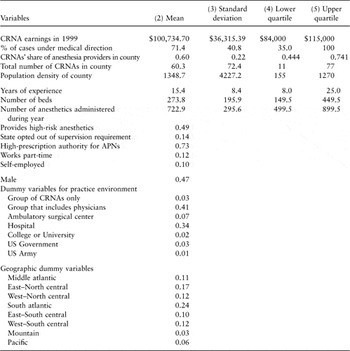
The primary data set we use to analyze the foregoing issues is the AANA Member Survey for the fiscal year 2001, which collected data for the year 1999. The AANAs distributed the survey to all its 25,628 members in August 2000.Footnote 18 It was completed by 15,165 members, for a response rate of 59%.Footnote 19 The survey collected extremely detailed information for 1999 on each individual’s earnings, fringe benefits, the type of the individual’s employment arrangement and practice setting, as well as demographic characteristics such as age, gender and years of anesthesia experience, and location of practice.Footnote 20 We added to this data set various demographic county-level variables from the Area Resource File,Footnote 21 providing information on county population, the number of CRNAs and MDAs in the county, and anesthesia conversion factors (used by Medicare to adjust for geographic differences in provider costs and compensation levels). The means, standard deviations and lower and upper quartiles of the variables used in the estimation are set forth in Table 1.
Descriptive statistics for variables

CRNA = certified registered nurse anesthetists; APN = advanced practice nurse.
Notes:
(i) County population density is total county population divided by the number of square miles.
(ii) ‘Number of beds’ is the number of inpatient beds in the CRNA’s primary practice setting. High-prescription authority = 1 if advanced practice nurses in the CRNA’s State have either level 3 or 4 (the highest levels) of prescription authority, according to the journal Nurse Practitioner. The State opted out variable = 1 if the CRNA’s State officially opted out of the ‘physician supervision’ requirement of federal Medicare regulations by 6 May 2005. ‘Part-time’ = 1 if the CRNA works less than 35 h/week on average, and 0 otherwise. The variable ‘Provides high-risk anesthetics’ = 1 if the CRNA administered any anesthetics in the American Society of Anesthesiologist Class V, and 0 otherwise. ‘Self-employed’ = 1 if more than 50% of earnings is from self-employment, and 0 otherwise.
(iii) The omitted reference category for practice environment is work in an office. The ‘US Government’ variable includes all CRNAs working for the Navy, Air Force, Department of Veterans Affairs and Public Health Service; it does not include those in the Army, who have a separate dummy variable.
(iv) The geographic dummy variables are based on the Divisions used by the Bureau of the Census; the omitted category is the New England Division.
3.2 The econometric model
It is clear that certain variables will affect both (1) the extent to which anesthesia is provided by a team (an MDA working with a CRNA), or instead by either an MDA or a CRNA working alone; and (2) the earnings of CRNAs. Certain of these variables are of special interest: (a) the share of anesthesia providers in the area who are CRNAs, and (b) variables that represent the political power of CRNAs relative to MDAs.
It is also clear that a CRNA’s earnings will be affected by the fraction of her work that is done as part of a team. Under the Medicare rules that became effective in 1998, a CRNA who shared responsibility with an MDA would receive compensation of at most half the amount she would earn if she were the sole anesthesia provider.
We estimate two equations:

and

where μ 1 and μ 2 are each a normally distributed error with a zero mean and constant variance. Note that in equation (2) one of the independent variables is the extent of medical supervision of the CRNA. This specification naturally raises the question whether the medical supervision variable in equation (2) should be treated as endogenous, so that we should apply methods suited for simultaneous equations such as two-stage least squares or estimation by instrumental variables.
To determine whether this variable should be treated as endogenous, we followed the procedure of Wooldridge (Reference Wooldridge2003).Footnote 22 The t-statistic of −0.50 indicated that the medical supervision variable was not endogenous.
3.2.1 Variables for political power
In both equations (1) and (2) there are two variables designed to measure the political power of CRNAs: (1) a classification of States according to the amount of authority to write prescriptions that the State grants to APNs; and (2) a variable indicating whether the State chose to opt out of a Medicare requirement that CRNAs work under the supervision of a physician.
With respect to the first variable, the journal Nurse Practitioner published rankings of State laws for 1999Footnote 23 based on how much prescription authority is granted to APNs – a group that includes not only CRNAs, but also nurse practitioners, certified nurse midwives and clinical nurse specialists. There is considerable variation across States in the prescription authority of APNs. In some States APNs have no authority to write prescriptions, whereas in others they are allowed to prescribe any drugs, including controlled substances, without any supervision by a physician. Our variable assigned a value of 1 to the 42 States (including the District of Columbia) where APNs have a relatively high level of prescription authority, and 0 otherwise.Footnote 24
With respect to the second variable for political power, federal regulations have since 1965 required ‘physician supervision’ of CRNAs who perform anesthesia for Medicare patients in hospitals and ambulatory surgical centers. However, in 2001 another regulation allowed individual States to opt-out of the physician supervision requirement. If a State is one of the 14 States that officially opted out of this requirement, it was assigned a value of 1 for the opt-out variable.
Although both variables involve the political power of CRNAs, they are not measuring the same thing. The variable based on prescription authority applies to all APNs, not just CRNAs. On the other hand, one limitation of the opt-out variable is that States were not able to opt-out until 13 November 2001, two years after the period of our data set (1999), and the years when individual States opted out ranged from 2001 to 2005. Thus one could view the prescription authority variable as a measure of political power existing at the time covered by the data, and the opt-out variable as a measure of latent political power.
3.2.2 Determinants of the mode of practice
Independent variables in the mode of practice equation. Let us now turn to a brief explanation of the other independent variables used in our two-equation model. Recall that the dependent variable in the first equation is the fraction of the CRNA’s cases that are medically directed. We have data on the mode of practice from the AANA member survey for the year 1999, so long as it involves a CRNA as a participant.Footnote 25 Two survey questions ask what percentage of the anesthetics administered by a CRNA involve the participation of an MDA.
We included as independent variables in this regression the proportion of anesthesia providers in the individual’s county who are CRNAs, the square of that proportion, the population density of the county and the number of beds in the CRNA’s primary practice setting.
To ensure that the regression was not unduly influenced by outliers, we included the total number of CRNAs in the county as an explanatory variable. Other independent variables represent the type of practice setting: whether the CRNA practiced in an ambulatory surgical center, a university hospital, or an office; or if the CRNA worked for a group, whether that group included only CRNAs or CRNAs and physicians.Footnote 26 Another variable indicates whether the CRNA was employed by an agency of the federal government, that is, the Navy, Air Force, Department of Veterans Affairs or the Public Health Service. We provided a separate dummy variable for the US Army, as Army regulations specifically require supervision of CRNAs by MDAs in most practice settings.Footnote 27
There is a dummy variable for part-time work, as it seems more likely that a CRNA working part-time would be supervised by an MDA. CRNAs who work part-time are by definition less committed to anesthesia practice than those who work full-time; they may obtain less continuing education, and be less likely to stay abreast of the rapid technological change in the field. Years of experience, and experience squared, are included, as a CRNA with little experience may require supervision or supplemental training. We have a variable representing the complexity or risk of anesthesia administered by the CRNA, to determine whether the probability of supervision by an MDA increases with risk.
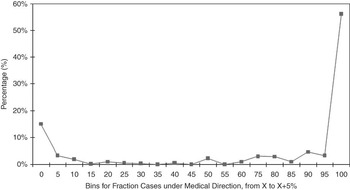
The sample includes full-time and part-time CRNAs, but not those who changed jobs within the last year. Recall that the dependent variable is the fraction of the CRNA’s cases that involve supervision by an MDA.Footnote 28 A histogram of this variable is shown in Figure 1. Accordingly, we estimated a Tobit with a lower limit of 0 and an upper limit of 100, corresponding to the boundary values of medical direction.
Distribution of the Fraction of CRNA Cases under Medical Direction

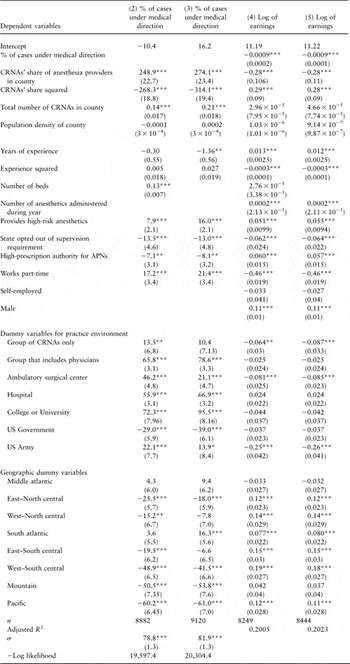
Results of mode of practice equation. We now examine the results of the Tobit on the fraction of the CRNA’s practice that is performed under medical supervision. As noted above, we have two alternative specifications of our model, but the results of both are quite similar.Footnote 29 The variable for the number of beds in the CRNA’s practice setting is included in column 2 of Table 2 but omitted from column 3.
Factors determining compensation and extent of medical supervision

CRNA = certified registered nurse anesthetists; APN = advanced practice nurse.
Notes:
(i) Robust standard errors are in parentheses. (*), (**) and (***) denote statistical significance at the 10, 5 and 1% level, respectively. Columns (2) and (3) present estimates of a Tobit with a lower limit of 0, and an upper limit of 100, for boundary values of medical direction. County population density is total county population divided by the number of square miles.
(ii) ‘Number of beds’ is the number of inpatient beds in the CRNA’s primary practice setting. High-prescription authority = 1 if advanced practice nurses in the CRNA’s State have either level 3 or 4 (the highest levels) of prescription authority, according to the journal Nurse Practitioner. The State opted out variable = 1 if the CRNA’s State officially opted out of the ‘physician supervision’ requirement of federal Medicare regulations by 6 May 2005. ‘Part-time’ = 1 if the CRNA works less than 35 h/week on average, and 0 otherwise. The variable ‘Provides high-risk anesthetics’ = 1 if the CRNA administered any anesthetics in the American Society of Anesthesiologist Class V, and 0 otherwise. ‘Self-employed’ = 1 if more than 50% of earnings is from self-employment, and 0 otherwise.
(iii) The omitted reference category for practice environment is work in an office. The ‘US Government’ variable includes all CRNAs working for the Navy, Air Force, Department of Veterans Affairs and Public Health Service; it does not include those in the Army, who have a separate dummy variable.
(iv) In the specification used in columns (3) and (5), the geographic dummy variables are based on the Divisions used by the Bureau of the Census; the omitted category is the New England Division.
The coefficients for the different practice environments indicate that the incidence of medical supervision is least for those who work for the federal government (except for the Army, which, as previously noted, generally requires MDA supervision), and greatest for (1) those employed by a college or university, who are likely to be in teaching hospitals, (2) those working in a group with physicians and (3) those who work in other hospitals. Medical direction is less prevalent for CRNAs who work in ambulatory surgical centers, and much less so for those in groups consisting of CRNAs only, but is still marginally greater than for those in an office-based practice, the omitted reference category. All these coefficients are very precisely estimated.
The likelihood of team care increases with the size of the facility, measured by the number of beds. As one would expect, medical supervision is more likely for part-time workers and for those doing high-risk procedures (those in ASA class V).Footnote 30 However, experience and experience squared are not significant in column (2). There may be a high rate of depreciation of human capital in anesthesia because of the rate of technical change in this specialty. Thus, a CRNA who has recently completed her training, including the required year of acute care nursing, may be considered just as competent as one who has many years of experience, but who also completed her formal education long ago.Footnote 31 The likelihood of supervision increases with the total number of CRNAs in the county. Thus team care is more likely the larger the absolute size of the local health-care sector, which is a proxy for the technical sophistication and degree of specialization of health care.
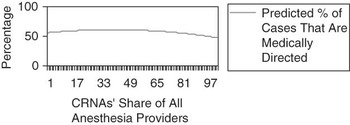
The two variables designed to capture the Statewide political power of CRNAs – the one based on prescription authority, and the opt-out variable, both have a significant negative effect on the likelihood of MDA supervision. It is not surprising that supervision by MDAs is less prevalent in States that eventually opt-out of the physician supervision requirement. Finally, the market shares of CRNAs in the county, and its square, have highly significant effects on the extent of MDA supervision. Figure 2, which is constructed from the results in column 2 of Table 2 shows the effects of the CRNAs’ share of anesthesia providers in the county. In this graph all the variables that affect MDA supervision other than the CRNAs’ market share (and its square) are taken at the mean. Figure 2 indicates that the propensity for team care increases as the market share of CRNAs increases from 0% to 39%, and declines thereafter, and is lowest as the CRNAs’ market share approaches 100% – a logical necessity, as then there are very few MDAs available for team practice.Footnote 32
Relation between CRNAs’ share of providers and extent of supervision by MDAs. CRNA, certified registered nurse anesthetist; MDA, anesthesiologist

3.2.3 Explaining variation in earnings of CRNAs
Data on the earnings of CRNAs in 1999 were obtained from the AANA Member Survey. The survey provided very detailed information on the individual’s earnings and on the different types of fringe benefits.
Independent variables in the earnings equation. Our independent or explanatory variables in the regressions on log earnings include years of experience as an anesthesia provider, sex and the region and population density of the CRNA’s workplace. There are dummy variables indicating whether the individual was self-employed or worked part-time. Other variables indicate whether the CRNA is affiliated with (1) a group that includes physicians, or (2) a group that includes only CRNAs. The motivation for this variable is that a CRNA may have less leverage, and therefore less compensation, if she is in a group that includes physicians.
Other variables indicate whether the CRNA worked in a surgical center, an office, a hospital or university hospital, was an employee of a college or university, or employed by the federal government (except for the Army), or the Army. The specification in column 4 of Table 2 includes a variable for the number of beds in the CRNA’s primary practice setting, on the grounds that this is a proxy for the size of the hospital or other practice facility, its technological sophistication, the number of health-care specialists in the practice setting, and the size of the bureaucracy. It is well established in the literature of labor economics that larger firms pay higher wages.Footnote 33 Column 5, however, does not include this variable.
Another variable represents the number of anesthetics administered by the CRNA during the preceding calendar year. This variable is a proxy for workload or intensity of effort. We also include the variable representing the risk of anesthesia administered by the CRNA; as explained in the appendix, the compensation formula applied by Medicare (and by private health insurers) is partly based on the complexity and difficulty of the procedure.
We again include the two variables designed to capture Statewide political power: one for prescription authority, which can be considered a measure of the political power of APNs existing at the time of the data, and the opt-out variable representing latent political power of CRNAs. We also have variables representing political power at the county level: the CRNAs’ share of anesthesia providers in the county, and the square of that share. The rationale is that MDAs may be less able to achieve a dominant position in anesthesia if they are only a small fraction of providers.Footnote 34 We control for outliers by including as a variable the total number of CRNAs in the county.
Finally, we included the fraction of the CRNA’s cases that are medically directed. We explained above that under the Medicare rules in effect in 1999, a CRNA who shared responsibility with an MDA would receive compensation of at most one-half the amount she would earn as the sole anesthesia provider. This underscores the importance of controlling for the fraction of a CRNA’s cases that are medically directed. As explained above, we followed the procedure of Wooldridge (Reference Wooldridge2003) to determine whether this should be treated as endogenous in the earnings equation, and found that the null hypothesis of exogeneity could not be rejected.
Results of regression on log earnings. The results reported in columns 4 and 5 of Table 2 are quite similar; we will discuss the results in column 4, which includes the variable for the number of beds. As in virtually all occupations, earnings increase with experience, but at a declining rate; these effects, though highly significant, are quite small. At the sample mean the aggregate effect for the first five years of anesthesia experience is only $5985 (6.7% of initial earnings of $89,120), and $10,363 (11.6%) for the first 10 years. The miniscule effect of experience on earnings, and perhaps productivity, is in accord with our previous finding that experience does not affect the likelihood of medical supervision. Given the pace of technical change in anesthesia, the relative inexperience of a recently graduated CRNA is almost entirely offset by the fact that her formal education covers state-of-the-art anesthesia methods.
Male CRNAs, who are 47% of the sample, earn 11.6% more than females. This result is generally consistent with findings of other studies. Researchers have recently found premiums for males of 7.8% and 12%, for registered nurses; 18%, for physicians; 14.2% for obstetrician/gynecologists; between 10% and 30% for audiologists; and 9% for veterinarians.Footnote 35 Relative to work in an office, the omitted reference category, there is a penalty for employment in the US Army. The effect of being self-employed was not significant at conventional levels in either the regressions on total compensation (results not shown), or those on earnings. Earnings increase with the number of anesthetics administered by the CRNA. Although the number of anesthetics measures quantity, the variable indicating whether the CRNA performs high-risk procedures is a proxy for the quality, or duration, of anesthesia procedures, and as expected has a significant positive effect on earnings. Working part-time reduces earnings.
The effects of geographic variables (at the end of Table 2 in Column 4) were large and highly significant for six out of eight regions, showing, for example, that compensation in the East and West South Central divisions is higher than that in the New England division (the omitted reference category) by 16.2% and 20.9%, respectively.Footnote 36 Some of this variation might be attributable to differences in conversion factors for MDAs and CRNAs across geographical regions, but by the same token the conversion factors are designed to reflect local market conditions.Footnote 37
With regard to the variables for Statewide political power, a high level of prescription authority has a significant positive effect, whereas the opt-out variable has a significant negative effect. The positive effect could reflect the fact that when APNs have political clout, it is more likely that CRNAs would have the right of direct reimbursement, and a relatively favorable compensation formula, from private payers, and less likely that they will be employed directly by MDAs. On the other hand, the negative effect could arise because MDAs concerned about the independence of CRNAs may seek to replace them with anesthesia assistants or other substitutes. This negative effect of professional independence is consistent with the literature, and it is noteworthy that this effect comes from the variable that applies specifically to CRNAs.
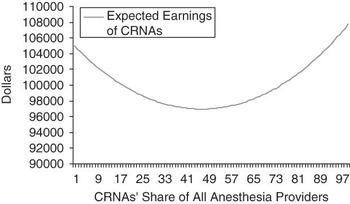
Again the market share of CRNAs and its square are highly significant, with effects that are negative and positive, respectively. In Figure 3, which was constructed from the estimates in Column 4 of Table 2 we see the relation between the CRNAs’ market share and their expected earnings, taking all other variables that affect earnings at their mean value. As the market share of CRNAs increases from zero, their predicted earnings decline, reaching a minimum when the share of CRNAs is 47%. Thereafter, as CRNAs become the dominant majority of providers, their earnings increase along with their market share.Footnote 38
Relation between CRNAs’ share of providers and their expected earnings. CRNA, certified registered nurse anesthetist

An explanation for this relationship is provided by the preceding discussion. As the market share of CRNAs increases from a low value toward 50%, having hospitals and HMOs treat CRNAs as equivalent providers causes more and more damage to MDAs. MDAs can benefit by limiting the competition from CRNAs, whether by requiring them to be supervised by MDAs, or replacing them with anesthesia assistants, or by some other method. However, as the market share of CRNAs increases beyond 50%, the costs of such anticompetitive measures may become too large for MDAs, and the relative status of the two groups again gravitates toward equivalence. Figure 3 shows that, as one would expect, the expected earnings of CRNAs are greatest when they are essentially the only anesthesia providers.
4 Summary and conclusion
To summarize, our objective was to analyze, and attempt to explain, variation in anesthesia practice patterns and in CRNA earnings. To do so, we estimated two equations, in which the dependent variables were (1) the fraction of the CRNA’s cases that were medically directed, and (2) the log of CRNA earnings.
We found that the incidence of medical supervision is greater for part-time workers and for those doing high-risk procedures; also, there is less supervision in States that, by our measure, grant CRNAs a high level of professional independence. With respect to earnings, we found that the effect of experience was small, a result consistent with another finding, that experience does not affect the likelihood of medical supervision. A male CRNA receives a substantial earnings premium, and there is substantial variation of earnings across geographic areas. However, the most striking results involve the relationships among the market shares of CRNAs, the likelihood of medical supervision, and expected CRNA earnings.
Figure 3 indicates that the earnings of CRNAs decline as their market share increases from 0% to 47%. When the market share of CRNAs is small, MDAs may be more likely to accept institutional arrangements that treat these two groups as substitutes. As the CRNAs’ market share increases, the damage from CRNAs’ to MDAs having equal stature increases, and it becomes worthwhile for MDAs to incur the costs of establishing a dominant position in the provision of anesthesia.
Figure 2 shows that as the market share of CRNAs increases, the propensity for team care first increases, but then declines as the market share grows beyond 39%. A comparison of Figures 2 and 3 shows that, roughly speaking, the expected earnings of CRNAs decline as the probability of MDA supervision increases, and vice versa. The inverse relationship between CRNA earnings and team care is consistent with our analysis of federal regulations. Figure 3 also indicates that expected earnings are greatest when CRNAs have a clearly dominant share of the anesthesia market. When the CRNAs become a clear majority of providers, they are less likely to be relegated to a subordinate position in anesthesia services. Under these circumstances MDAs may be less likely to be incurring the costs that would be necessary to maintain anticompetitive measures such as regulations requiring supervision of CRNAs, exclusive contractual arrangements between MDAs and hospitals or HMOs, or rules of private payers granting direct reimbursement to MDAs but not CRNAs. This research has implications for other economic relationships between professions with responsibilities that overlap, but that differ substantially in years of training, such as the relations between opticians and ophthalmologists, or between nurse practitioners and primary care physicians, or certified nurse midwives and obstetrician-gynecologists. Our findings suggest how in these other contexts the earnings of the less educated group, and the frequency of supervision of the less educated by the more educated group, may be affected by the relative numbers of the two groups.
Appendix: Federal government regulation
This section reviews federal regulation of anesthesia services under the Medicare and Medicaid programs. We will see that at different times these regulations had substantial effects on: (1) the incentives for MDAs to provide anesthesia as part of a team, rather than in solo practice; (2) the number of patients that an MDA would want to supervise simultaneously; (3) the desire of hospitals to employ CRNAs directly, or instead have them employed by MDAs who provide anesthesia services to the hospital. This section also indicates the positions on regulatory changes taken by the professional associations representing the MDAs and CRNAs, respectively.
The basic compensation formula
In 1966 Medicare and Medicaid began allowing anesthesiologists (MDAs) to bill the federal government directly, using prices that were ‘usual, customary and reasonable’. Cromwell (Reference Cromwell1999) contends that this regulation was instrumental in causing the rapid growth of earnings of this specialty between 1970 and 1993.
Billing for the services of MDAs is done according to a formula that involves base units, time units, and conversion factors. First, each operation is assigned a number of base units that is designed to quantify the complexity or difficulty involved in performing the anesthesia. The number of base units ranges from 3 points for the simplest operations (e.g. a circumcision) to more than 20 points for the most difficult (e.g. open-heart surgery). Next one adds time units determined by the duration of the anesthesia (it is considered appropriate to compensate the anesthesiologist more for longer operations because he has no control over the duration of the surgery). One time unit is assigned to each interval of fifteen minutes. Finally, the total of base and time units is multiplied by a conversion factor to obtain the total charge for the anesthesiologist’s services. Suppose, for example, there is a coronary bypass operation on a patient that takes four hours. Here there are 20 base units and 20 time units (5 h × 4 time units per hour). If the conversion factor allowed by Medicare is $20, the bill would be 40 × $20 = $800. Conversion factors vary by locality, and are designed to reflect local market conditions.
Changes in incentives for medical direction
Requiring MDAs to do specific tasks
In the early years of the Medicare program, MDAs who directly employed and supervised CRNAs were paid their full allowable charge for each case, no matter how many cases they were supervising at the same time.Footnote 39 The effect of this scheme was to give MDAs a powerful incentive to supervise as many cases as possible. Over the course of time the Health Care Financing Administration (HCFA) became concerned that MDAs who supervised several patients at once were not providing sufficient medical attention to each patient. A regulation adopted in 1983Footnote 40 specified seven tasks the physician would have to perform to receive any payment for a case, including performing the pre-anesthesia examination and evaluation; personally participating in the most demanding procedures, including induction and emergence; and being physically present and available for emergencies. Some, and perhaps all, of these tasks were well within the purview of normal responsibilities of CRNAs.
Medicare’s limit on the number of CRNAs supervised
In support of the requirement that MDAs become more closely involved in the cases they supervised, the 1983 regulations also limited the number of cases they could supervise simultaneously. Specifically, the regulations provided that MDAs could not be reimbursed for the simultaneous supervision of more than four CRNAs.Footnote 41
The ASA had proposed disallowing reimbursement for the direction of more than two CRNAs, and its position was incorporated in the original proposed regulation. It was argued that this regulation was a cartel arrangement, increasing the demand for MDAs by limiting the number of cases they could supervise while at the same time preventing the use of substitute providers, CRNAs, by requiring that they work under MDA supervision. AANA and its members, along with some MDAs, particularly those from the South–East region of the United States, argued for increasing the maximum ratio to 4:1 on the grounds that a 2:1 ratio would increase the costs of providing anesthesia, and these arguments prevailed in the final regulations.
The concern about the quality of care provided by an MDA supervising multiple patients was also reflected in a federal statute enacted in 1987.Footnote 42 One provision of this statute reduced the number of base units by 10% for a second patient, by 25% for a third patient, and 40% for a fourth patient. Thus for four operations that have 20 base units apiece, the total base units obtained by taking successive cases would become 20, 36, 45 and 48.Footnote 43 This provision has been criticized on the ground that the record keeping and reporting requirements imposed by the statute substantially increased the cost of an anesthesiology practice.Footnote 44
Changes in basic rules of compensation for hospitals and anesthesia providers
The Prospective Payment System
Another development of major importance was the enactment of a 1983 statute providing that, as part of the newly established Prospective Payment System (PPS), all payments to hospitals under Part A of Medicare would be bundled into diagnosis-related groupings (DRGs).Footnote 45 This would have required hospitals to pay their CRNA employees from a fixed DRG payment, which would have created a substantial disincentive for hospitals to employ CRNAs. The services of MDAs were not affected. Moreover, none of the CRNA’s compensation was to be deducted from the DRG payment if the CRNA were employed by the MDA rather than by the hospital. Payments made for the services of MDAs and their employees do not reduce the amounts paid to hospitals, as MDAs receive their payment directly from Medicare. A report by the Physician Payment Review Commission observed that in response to the 1983 statute, ‘ … many hospitals attempted to shift employment of CRNAs to MDAs, in order to shift costs onto Medicare Part B’.Footnote 46
The right of CRNAs to direct reimbursement under medicare
The professional association for nurse anesthetistsFootnote 47 responded to this regulation by proposing: (1) an exception to PPS (unbundling), that would allow MDAs to charge for the services of CRNAs they employed under part B of Medicare, for a three-year period; (2) an amendment to the PPS legislation to provide a pass-through of CRNA costs to hospitals, for a three-year period; and (3) legislation that would amend the Social Security Act to provide for direct reimbursement of CRNAs.Footnote 48 Under these proposals the compensation of both hospitals and MDAs paid by Medicare would not be reduced by the cost of the services of CRNAs, giving them an incentive to hire CRNAs.
The first two proposals were adopted, the second in 1984, and the third was enacted in 1986, to take effect in 1989.Footnote 49 This marked the first time any nursing group had been granted the right of direct reimbursement under Medicare. It is, however, important to emphasize that CRNAs were not granted any right of direct reimbursement outside of Medicare (e.g. under private health insurance or Medicaid) by this legislation.
Limiting the compensation of physicians: the Relative Value Scale System
The compensation of MDAs, as well as other physicians, was affected by a 1989 statuteFootnote 50 that created the Resource-based Relative Value Scale system to determine the value of physicians’ services. Under this system, each physician service was assigned a value relative to other services. The ‘relative value’ of each service was determined by the amount of work involved for the physician, the costs of the physician’s practice, and the cost of malpractice insurance. This value was adjusted to reflect geographic differences in the costs of these three components, and then multiplied by a nationally uniform dollar-conversion factor to determine the amount that Medicare would pay for the service.Footnote 51 Under this system, the services of MDAs were found to be overvalued, resulting in reduced conversion factors for them beginning in 1991.
A provision of the Omnibus Budget Reconciliation Act of 1990 provided for annual increases in the CRNA dollar-conversion factor over five years, so that it would equal the conversion factor for MDAs by 1996. Thus as of 1996 CRNAs and MDAs received the same compensation when they were the sole anesthesia provider.Footnote 52 This statute also expressed the intent that the conversion factor of a CRNA under medical direction would be 70% of the conversion factor she would receive if she worked alone.
Another change in incentives for medical direction: the cap on team care
One consequence of the rule allowing direct billing by CRNAs was that hospital cost records often showed an MDA and a CRNA billing for the same operation. Consequently the total payment for a supervised case might be as much as 140% of what an MDA could charge for working on the case alone (Cromwell Reference Cromwell1999).Footnote 53 This state of affairs inevitably drew the attention of program auditors, in particular the General Accounting Office (GAO, 1992). A corrective measure came with a 1993 statuteFootnote 54 that after a transitional period capped the payment for team care in 1998 at 100% of the payment that would be made to an MDA working alone, to be divided 50–50 between the MDA and the CRNA.
It turned out that this cap, combined with another section of the statute, substantially reduced an MDA’s incentives to work with CRNAs. If a CRNA and an MDA worked on a case together, each was to bill the program for one-half the allowed payment. Thus as of 1998, when the 100% cap took effect, an MDA would receive exactly the same compensation for working alone on one case, as he would for supervising CRNAs on two concurrent cases.Footnote 55 The upshot was that this compensation structure removed most if not all the incentive for supervising two cases, as opposed to handling one case alone, unless the CRNAs who would be supervised were employed by the MDA rather than by the hospital. If an MDA was supervising a CRNA employed by him, he could bill for the full amount, and then compensate the CRNA at the market wage, which was typically less than one-half the amount allowed by Medicare. An MDA still had a financial gain from supervising three or four cases, rather than working alone on one case. However, before 1993 team anesthesia had most often involved only two concurrent cases, rather than three or four.Footnote 56
The requirement of ‘physician supervision’
As the Medicare system was established in 1965, federal regulations have required ‘physician supervision’ of CRNAs who perform anesthesia for Medicare patients in hospitals and ambulatory surgical centers. The original regulation provided that
‘If the hospital furnishes anesthesia services, they must be provided … under the direction of a qualified doctor of medicine or osteopathy’, and that anesthesia may be administered by a CRNA ‘who … is under the supervision of the operating practitioner or of an MDA who is immediately available if needed….’Footnote 57 This regulation appears to be largely symbolic, as it clearly allows a CRNA to be the sole anesthesia provider, subject to the relatively meaningless formal requirement that she is under the supervision of the operating physician. Nonetheless, the AANA has for years vigorously lobbied for its repeal. The AANA’s concern is that the rules of Medicare have enormous influence on the terms of private health insurance plans and staffing assignments made by hospitals and HMO’s. For example, MDAs can cite the regulation in support of the argument that an MDA should be in charge of the hospital’s anesthesia department, or that a hospital would be well advised to hire MDAs to minimize potential malpractice liability.Footnote 58
Allowing states to opt-out
In December 1997 HCFA proposed a regulation that would have repealed the federal requirement of physician supervision, and delegated to the States both the authority to determine which professionals are allowed to administer anesthesia, and the degree of supervision required. However, in 2001 this proposed regulation was replaced by another proposed regulation that instead would allow individual States to opt-out of the physician supervision requirement. This regulation was adopted virtually as proposed on 13 November 2001.Footnote 59 As of 1 June 2006, 14 States had chosen to opt-out of the physician supervision requirement.Footnote 60
 ; (2)
 or more but less than 2/3; (3) 2/3 or more but less than
 ; (4)
 or more but less than 1; and (5) 1. These estimates indicated the same type of concave relationship that is depicted in Figure 2.
 ; (2)
 or more but less than 2/3; (3) 2/3 or more but less than
 ; (4)
 or more but less than 1; and (5) 1. These estimates indicated the same type of convex relationship that is depicted in Figure 3.