The rapid expansion after 1800 b.c. of Early Formative villagers throughout a broad region of what later became Maya territory begs investigation of the process by which the highly successful adaptation of these early villagers evolved out of and supplanted the preceding Archaic period adaptations (Neff et al. Reference Neff, Pearsall, Jones, Arroyo, Collins and Freidel2006:288).
At present, models of the Archaic to Formative period transition in Mesoamerica are based on a few sites in which conditions of preservation were unusually favorable. These sites may not be typical of what were probably highly varied routes toward greater sedentism and increased reliance on cultivation of a narrower range of plant foods. The role of fertile lowland riverine environments is especially difficult to investigate, due to the frequency with which sites have been reworked and buried by deposition (Joyce and Henderson Reference Joyce and Henderson2001:21).
INTRODUCTION
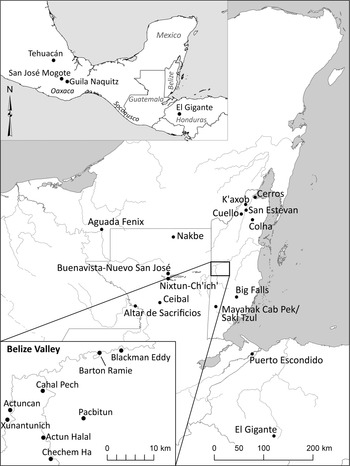
The transition from the Late Archaic (3000 cal b.c.) to the Late Early Formative (1200/1000–900 cal b.c.) period witnessed some of the most profound changes in the prehistory of the Maya lowlands. Despite its cultural significance, however, this transitional phase remains the most poorly known period of Maya prehistory. As Joyce and Henderson (Reference Joyce and Henderson2001:21) lamented, most of what is known about the Archaic to Formative transition is “based on a few sites in which conditions of preservation were unusually favorable.” The few known sites have two things in common. First, almost all are located outside of the Maya lowlands, and second, collectively they provide only limited information on the nature and processes of the changes that unfolded during this time. What little we do know is that it was during this period of transition that Archaic hunter-fisher-foragers gradually adopted more sedentary lifestyles, increased their reliance on agriculture, and eventually began producing pottery. We also know that these changes were neither synchronous nor homogeneous across the Mesoamerican landscape. Rather, and as Joyce and Henderson (Reference Joyce and Henderson2001) and Rosenswig (Reference Rosenswig2015) have suggested, there was a “mosaic of adaptations,” with considerable diversity and variation across Mesoamerican subregions. For example, archaeologists know considerably more about this transitional period for the valleys of Oaxaca (Flannery Reference Flannery and Flannery1976; Flannery and Marcus Reference Flannery and Marcus2005; Flannery et al. Reference Flannery, Marcus and Kowalewski1981) and Tehuacán (MacNeish Reference MacNeish, Ucko, Tringham and Dimbleby1972; MacNeish and Nelken-Terner Reference MacNeish and Nelken-Terner1983a), and for the Soconusco subregion of the Pacific coast (cf., Blake et al. Reference Blake, Clark, Voorhies, Michaels, Love, Pye, Demarest and Arroyo1995; Clark and Blake Reference Clark, Blake, Brumfiel and Fox1994; Clark and Cheetham Reference Clark, Cheetham and Parkinson2002; Kennett Reference Kennett, Nichols and Pool2012; Kennett and Voorhies Reference Kennett and Voorhies1996; Kennett et al. Reference Kennett, Piperno, Jones, Neff, Voorhies, Walsh and Culleton2010; Rosenswig Reference Rosenswig2015; Rosenswig et al. Reference Rosenswig, Pearsall, Masson, Culleton and Kennett2014; Voorhies Reference Voorhies2004). In contrast, few researchers have expended much effort investigating the preceramic to early ceramic phase of development in the Maya lowlands (Figure 1). The few exceptions have been short-term projects that were conducted in the 1980s and early 2000s in northern Belize (Hester et al. Reference Hester, Kelly and Ligabue1981, Reference Hester, Iceland, Hudler and Shafer1996; Iceland Reference Iceland1997, Reference Iceland and Powis2005; MacNeish and Nelken-Terner Reference MacNeish and Nelken-Terner1981, Reference MacNeish and Nelken-Terner1983b; MacNeish et al. Reference MacNeish, Wilkerson and Nelken-Terner1980; Rosenswig Reference Rosenswig2004, Reference Rosenswig2006a, Reference Rosenswig2006b), and more recent, but sporadic, investigations in the Upper Belize Valley (Awe Reference Awe1992; Brown et al. Reference Brown, Jennifer Cochran and Mixter2011; Lohse et al. Reference Lohse, Awe, Griffith, Rosenswig and Valdez2006; Stemp and Awe Reference Stemp and Awe2013) and the Peten province of Guatemala (Inomata Reference Inomata2017a, Reference Inomata, Freidel, Chase, Dowd and Murdock2017b; Inomata et al. Reference Inomata, MacLellan, Triadan, Munson, Burham, Aoyama, Nasu, Pinzón and Yonenobu2015, Reference Inomata, Triadan, Pinzón and Aoyama2019). Current research is also being conducted by Prufer and colleagues in southern Belize (Kennett et al. Reference Kennett, Prufer, Culleton, George, Robinson, Trask, Buckley, Moses, Kate, Harper, O'Donnell, Ray, Hill, Alsgaard, Merriman, Meredith, Edgar, Awe and Gutiérrez2020, Reference Kennett, Lipson, Prufer, Mora-Marín, George, Rohland, Robinson, Trask, Edgar, Hill, Ray, Lynch, Moes, O'Donnell, Harper, Kate, Ramos, Morris, Gutierrez, Ryan, Culleton, Awe and Reich2021; Prufer et al. Reference Prufer, Alsgaard, Robinson, Meredith, Culleton, Dennehy, Magee, Huckell, James Stemp, Awe, Capriles and Kennett2019, Reference Prufer, Robinson and Kennett2021; Reich et al. Reference Reich, Kennett, Lipson, Prufer, Mora-Marin, George, Rohland, Robinson, Trask, Edgar, Hill, Ray, Lynch, Moes, O'Donnell, Harper, Kate, Ramos, Morris, Gutiérrez, Culleton and Awe2020), and by Rosenswig (Reference Rosenswig2021; Rosenswig et al. Reference Rosenswig, Pearsall, Masson, Culleton and Kennett2014) in the Freshwater Creek drainage in northern Belize.
Map of the Maya lowlands with major Preclassic sites. Top inset: Mesoamerican Archaic sites; bottom inset: sites in the Belize Valley mentioned in text. Map by Ebert.

In spite of the commendable efforts of the latter projects, most of which have focused on Belize, even a comprehensive search of the available literature reveals that data on the Archaic to Formative transition in the Maya lowlands remain exceedingly limited. As we hope to demonstrate in this article, however, absence of evidence does not necessarily mean evidence of absence. Indeed, we believe that through a careful and thorough examination of the extant data, it is possible to glean important information about the social and economic transformations that unfolded during this critical period of change in the Upper Belize River Valley, and about broader cultural developments in the Maya lowlands more generally. By examining data related to questions of origins, subsistence, settlement patterns, stone tools, pottery and other tool technologies, trade and exchange, and ideology, we define the nature of the Archaic to Formative transition in the Upper Belize Valley, and provide a foundation on which future research on this important topic can build. Significantly, we also believe that it was during this critical phase of transition in the Upper Belize Valley that several of the cultural traditions that became uniquely lowland Maya were being established.
DATING THE ARCHAIC TO FORMATIVE TRANSITION IN THE UPPER BELIZE VALLEY
In an article published in 2010 in the journal Latin American Antiquity, Jon Lohse provided an excellent review of the extant data on the Archaic to Formative transition in the central Maya lowlands. Lohse (Reference Lohse2010:343) also noted that “the timing of the transition continues to vex research into Maya origins,” particularly because of the paucity of data, as well as “the small sample of available 14C dates.” For this reason, it is of critical importance that we first establish at least a relative time frame within which this transition unfolded in the Upper Belize River Valley. Lohse (Reference Lohse2010:314), for example, previously argued that “the transition from preceramic to early village life took place over a brief interval, between approximately 1100 and 900 or even 800 b.c. in the Central and Northern Lowlands.” Lohse's use of 1100 b.c.to mark the start of the Archaic to Formative transition was based on his review of both radiometric and AMS 14C dates that had been published for Belize up to 2010. The 800 b.c. terminal date for the end of the transitional period was based largely on research at Colha, where preceramic remains were discovered stratigraphically below Middle Preclassic Bolay complex pottery (Iceland Reference Iceland1997; Lohse Reference Lohse2010:340), and because evidence for “the earliest ceramics and sedentary village at [nearby] K'axob did not appear until ca. 800 b.c.” (McAnany Reference McAnany and McAnany2004; McAnany and Lopez Reference McAnany and López Varela1999 in Lohse Reference Lohse2010:343). While acknowledging that Cunil complex ceramics, the earliest ceramic complex documented in the Upper Belize Valley, likely predated Swasey and Bolay complex pottery from northern Belize, Lohse also suggested that the end date for the Archaic in the Upper Belize Valley should be placed no earlier than 1000 b.c. In a more recent publication, Lohse reiterated his position that “the end of the Archaic dates from between 1800 to 800–900 b.c. in different parts of Mesoamerica” (Lohse Reference Lohse2010:342, Reference Lohse and Walker2021).
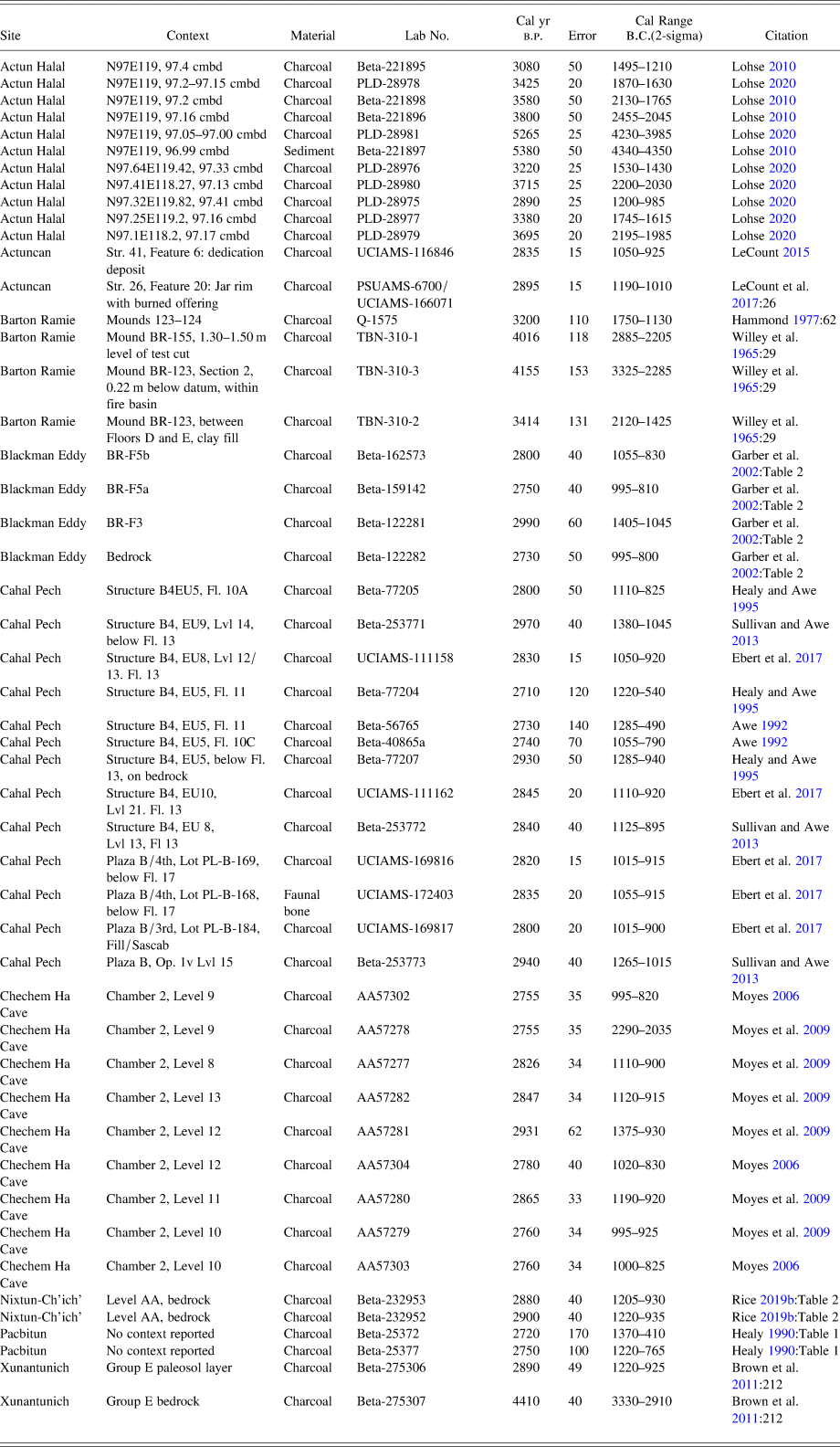
In the decade following the publication of Lohse's Reference Lohse2010 review, several research projects in the Upper Belize Valley and in Peten, Guatemala published new AMS 14C dates (Table 1), which support the appearance of ceramic-producing sedentary communities in this part of the lowlands by or before 1000 b.c. These new data include recently published dates for Actuncan (LeCount et al. Reference LeCount and LeCount2015, Reference LeCount, Mixter, Simova, LeCount and Mixter2016), Cahal Pech (Ebert and Awe Reference Ebert and Awe2020; Ebert et al. Reference Ebert, Hoggarth, Awe, Culleton and Kennett2019a), Xunantunich (Brown et al. Reference Brown, Jennifer Cochran and Mixter2011:211), Nixtun-Ch'ich' (Rice Reference Rice2019b), and Ceibal (Inomata Reference Inomata2017a, Reference Inomata, Freidel, Chase, Dowd and Murdock2017b; Inomata et al. Reference Inomata, Triadan, Pinzón and Aoyama2019). Based on his evaluation of these new 14C data, Lohse (Reference Lohse and Walker2021) now accepts that “the most widespread appearance [of pottery in the Maya lowlands] seems to be sometime around 1000 b.c.” Lohse further notes that “The exception is Inomata's (…) work in Tabasco that has yet to be fully published showing Xe pottery in bedrock middens as early as about 1200 b.c.” (Lohse Reference Lohse and Walker2021; see also Inomata et al. Reference Inomata, Triadan, Vázquez López, Fernández-Díaz, Omori, Bauer, Hernández, Beach, Cagnato, Aoyama and Nasu2020).
Late Archaic and late Early Formative radiocarbon dates for western Belize and adjacent areas. All dates were calibrated in OxCal v. 4.4 using the IntCal 20 calibration curve (Bronk Ramsey Reference Bronk Ramsey2009; Reimer et al. Reference Reimer, Austin, Bard, Bayliss, Blackwell, Bronk Ramsey, Butzin, Cheng, Edwards, Friedrich, Grootes, Guilderson, Hajdas, Heaton, Hogg, Hughen, Kromer, Manning, Muscheler, Palmer, Pearson, van der Plicht, Reimer, Richards, Scott, Southon, Turney, Wacker, Adolphi, Büntgen, Capano, Fahrni, Fogtmann-Schulz, Friedrich, Köhler, Kudsk, Miyake, Olsen, Reinig, Sakamoto, Sookdeo and Talamo2020).

In regions bordering the Maya lowlands, early pottery production, which is generally identified as a diagnostic marker for the end of the Archaic period, has been dated mostly prior to 1200 b.c. This is the case for northwestern Costa Rica, where Hoopes (Reference Hoopes and Fowler1994) dated the Tronadora complex to as early as 2000 b.c.; for the Soconusco region, where researchers place the introduction of Barra ceramics to around 1900–1500 cal b.c. (Rosenswig Reference Rosenswig2006b); and in Oaxaca, specifically at San José Mogote, where Flannery and Marcus (Reference Flannery and Marcus2015:12–13) date the introduction of pottery between 2000 and 1500 b.c. during the Espiridión phase. For regions much closer to the Belize Valley, such as along the Caribbean coast of Honduras, Joyce and Henderson (Reference Joyce and Henderson2001) assigned early ceramic production at Puerto Escondido to the Early Formative Baharona phase (ca. 1600–900 b.c.). Significantly, the Baharona phase overlaps with both the Xe deposits reported by Inomata and colleagues (Reference Inomata, Triadan, Vázquez López, Fernández-Díaz, Omori, Bauer, Hernández, Beach, Cagnato, Aoyama and Nasu2020) at Aguada Fénix in Tabasco, and with the Cunil and Kanocha phases in the Upper Belize Valley (Awe Reference Awe1992; Brown Reference Brown2003; Ebert and Awe Reference Ebert and Awe2020; Ebert et al. Reference Ebert, May, Culleton, Awe and Kennett2017, Reference Ebert, Hoggarth, Awe, Culleton and Kennett2019a, Reference Ebert, Pierce and Awe2019b; Garber et al. Reference Garber, Kathryn Brown, Awe and Hartman2004; Sullivan and Awe Reference Sullivan, Awe and Aimers2013, Reference Sullivan, Awe and Walker2021; Sullivan et al. Reference Sullivan, Awe, Brown, Brown and Bey2018).
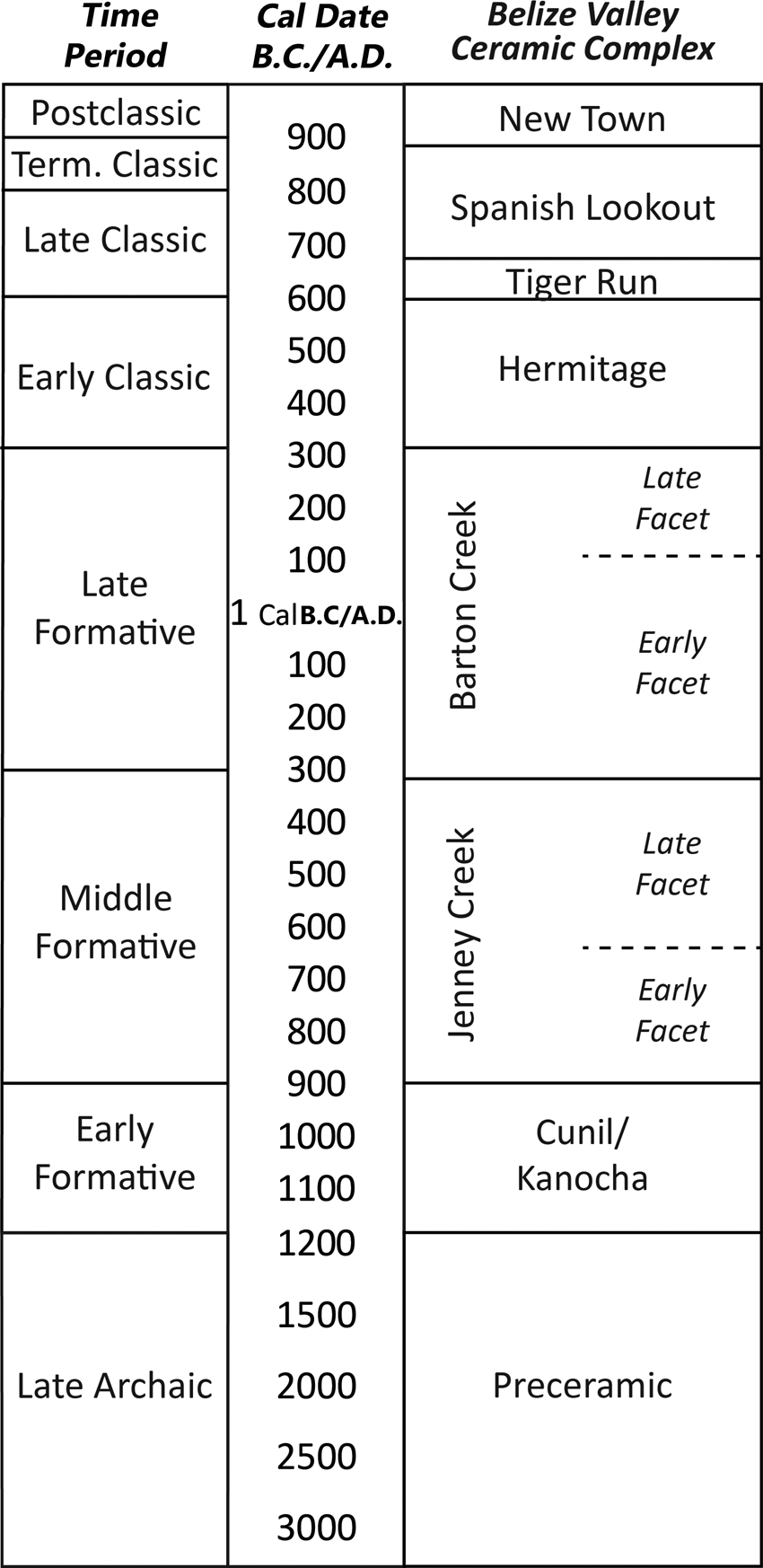
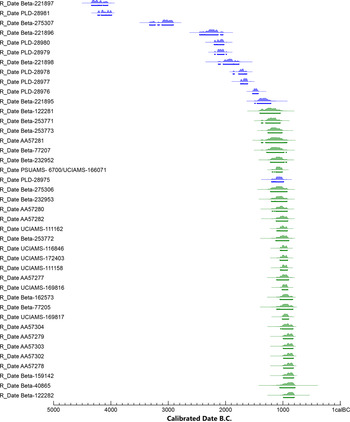
Based on the dates acquired for the Baharona phase at Puerto Escondido, as well as those for the start of early ceramic traditions across Middle and Central America, Joyce and Henderson (Reference Joyce and Henderson2001:5) suggested that the transition to sedentary agricultural communities very likely occurred between 3000 and 1800 b.c. The upper and lower brackets of their suggested time frame expand the transitional period to well over a thousand years. This contrasts significantly with Lohse's (Reference Lohse2010:314) suggestion that the transition occurred relatively rapidly over one to two hundred years. This leaves us with the questions of where we should place the start and end of the Archaic to Formative transitionary period in the Upper Belize Valley, and how long the duration of this transition should be. For the purposes of this article, and particularly given the growing body of chronological data for the Maya lowlands, we prefer to use the period between 2000 and 1200/1000 b.c. (Figure 2). We choose the latter range for several reasons. First, it acknowledges that the data currently available for western Belize (Figure 3) place the establishment of ceramic-producing sedentary communities somewhere around 1200/1000 b.c., a date that is also supported by recently published 14C dates from Nixtun-Ch'ich' in neighboring Guatemala (Rice Reference Rice2019b:473, Table 2). Second, it takes into serious consideration a perspective that has been echoed by several researchers that “[t]he transition out of the Archaic should be viewed as a process rather than an event” (Lohse Reference Lohse and Walker2021; see also Kennett et al. Reference Kennett, Prufer, Culleton, George, Robinson, Trask, Buckley, Moses, Kate, Harper, O'Donnell, Ray, Hill, Alsgaard, Merriman, Meredith, Edgar, Awe and Gutiérrez2020; Prufer et al. Reference Prufer, Alsgaard, Robinson, Meredith, Culleton, Dennehy, Magee, Huckell, James Stemp, Awe, Capriles and Kennett2019; Rosenswig Reference Rosenswig2015). Third, it reflects the point of view that this process was neither sudden nor abbreviated, but instead was gradual, complex, and as diverse in time as it was in space. Fourth, it takes into consideration that only very few Late Archaic and Late Early Formative sites have been documented in Belize, and that exploration of sites in the future, as well as additional AMS 14C dates from previously collected materials, may extend the period of transition further into the past. Fifth, and finally, the 2000–1200/1000 b.c. window corresponds with research across Mesoamerica that suggests the Archaic to Formative transition lasted for at least several centuries. This latter perspective is perhaps best expressed by Arnold (Reference Arnold, Skibo and Feinman1999:157–158), who, in a critique of the Archaic to Formative transition noted that “one would think that Mesoamerican groups became sedentary, took up agriculture, and adopted pottery as soon as they crossed the threshold from one period to the next.” A similar point of view can be deduced from Rosenswig's (Reference Rosenswig2006a:347) summary of the cultural changes that gradually unfolded during the Archaic to Formative period in the Soconusco:
horticulture is documented early in the Archaic period while sedentism increased through the Late Archaic (3000–1800 b.c.) and permanent villages were established by the Locona phase (1450–1350 b.c.) at the latest. Ceramics were adopted during the Barra phase (1600–1450 b.c.), followed by incipient political complexity during the Locona and Ocos phases. During the late Early Formative period (1250–900 b.c.), the degree of sedentism and plant use show no signs of changing but there was a political reorganization of the Mazatan zone. However, it was only in the following centuries that intensified plant production reorganized the economic base of the Soconusco during the Conchas phase (900–800 b.c.).
Timeline for the Belize Valley with calibrated date ranges for ceramic phases. Figure by Ebert and Awe.

Calibrated 14C dates from western Belize for Archaic (blue) and late Early Formative (green) contexts. Dates with error ranges >±100 years are removed, but reported in Table 1. All dates were calibrated in OxCal v. 4.4 using the IntCal 20 calibration curve (Bronk Ramsey Reference Bronk Ramsey2009; Reimer et al. Reference Reimer, Austin, Bard, Bayliss, Blackwell, Bronk Ramsey, Butzin, Cheng, Edwards, Friedrich, Grootes, Guilderson, Hajdas, Heaton, Hogg, Hughen, Kromer, Manning, Muscheler, Palmer, Pearson, van der Plicht, Reimer, Richards, Scott, Southon, Turney, Wacker, Adolphi, Büntgen, Capano, Fahrni, Fogtmann-Schulz, Friedrich, Köhler, Kudsk, Miyake, Olsen, Reinig, Sakamoto, Sookdeo and Talamo2020). Figure by Ebert.

Rosenswig (Reference Rosenswig2006a:339) further emphasized the gradual nature of the transitionary period with his statement that “[t]echnological changes further demonstrate a gradual development from the Archaic to the Early Formative period adaptation rather than an adaptive revolution.”
ORIGINS OF LATE ARCHAIC OCCUPANTS OF THE UPPER BELIZE VALLEY
Almost 30 years ago, Awe (Reference Awe1992:40) noted that “with the exception of MacNeish and colleagues (Reference MacNeish, Wilkerson and Nelken-Terner1980), most archaeologists [had] ignored the role that preceramic people may have played” in the establishment of the first permanent settlements in the Maya lowlands (also see MacNeish and Nelken-Terner Reference MacNeish and Nelken-Terner1981, Reference MacNeish and Nelken-Terner1983a, Reference MacNeish and Nelken-Terner1983b). Awe (Reference Awe1992:40–41) further remarked:
Whether this sin of omission stems simply from a lack of evidence, or whether it reflects a traditional preference for less problematic explanatory paradigms (i.e. diffusion), is difficult to ascertain. Future studies should investigate this issue for if researchers continue to ignore the possible developmental role of preceramic cultures, future students may yet be confounded by our lack of insight and amazed by our ignorance.
Almost in response to Awe's lament, Clark and Cheetham (Reference Clark, Cheetham and Parkinson2002:297–299) eventually suggested that western and northern Belize may have been settled by “tribal units of similar language and culture,” likely associated with proto-Maya people. Clark and Cheetham (Reference Clark, Cheetham and Parkinson2002:298) also argued that based on their reconstruction of neighboring ceramic assemblages, “a clear case cannot be made for late colonization of the Maya lowlands by ceramic-users from either the Guatemalan Highlands to the south or from Chiapas/Tabasco to the west, as speculated by many … because none of the known pottery types from likely donor areas show up in the hypothesized colonized zones.”
Differences between Cunil and Swasey pottery subsequently led Ball and Taschek (Reference Ball and Taschek2003:181–182) to suggest a different place of origin for the earliest settlers of central and northern Belize. They proposed that early Upper Belize Valley settlers were likely Mixe-Zoquean people who migrated into the area by way of Honduras. According to Ball and Taschek (Reference Ball and Taschek2003:182–183), these migrants were responsible for introducing Cunil and Kanocha ceramics into the region. Ball and Taschek's hypothesis reminds us of James Gifford's (Reference Gifford1970) previous suggestion that highland groups from El Salvador were responsible for introducing Middle Formative period ceramics into western Belize. Neither hypothesis, however, considered whether migrants displaced earlier preceramic populations, or whether they intermixed with them. Ball and Taschek (Reference Ball and Taschek2003) further suggested that northern Belize was coevally occupied by a different group of people whose cultural and linguistic affiliation was likely Maya. Later, during the Middle Formative period (after 900 b.c.), the northern Belize “Maya,” or their cultural equivalent from the Peten, moved into the Upper Belize Valley and were responsible for the introduction of Mamom-related pottery (Ball and Taschek Reference Ball and Taschek2003:210).
In an attempt to apply Ball and Taschek's (Reference Ball and Taschek2003) hypothesis to their investigations at Blackman Eddy, Brown and Garber (Reference Brown, Garber, Kathryn Brown and Stanton2003:91–92) suggested that the desecration of the principal Early Middle Formative public structure (Structure B1-4th) at Blackman Eddy may have been the result of possible ethnic conflict between local inhabitants and immigrant Maya groups from the north. This event was seen as contemporaneous with the appearance of “unequivocally Maya pottery” at Blackman Eddy as Mamom pottery first appears at this time (Brown and Garber Reference Brown, Garber, Kathryn Brown and Stanton2003:102). Brown and Garber have subsequently reassessed this position, particularly after additional data collected during the past 20 years from western Belize now indicates that the transition from Pre-Mamom to Mamom pottery does not appear to be sudden and more likely represents a gradual in situ development (M. Kathryn Brown and James F. Garber, personal communication 2021). Ball and Taschek's interpretation was also recently challenged by Peniche May and colleagues (Reference Peniche May, Awe, Ebert and Braswell2021), who argue that the frequency of Mamom pottery is actually limited in the Upper Belize Valley, and that the limited presence of most early Mamom-related types in western Belize is best explained as the result of emulation and trade rather than by invasion or migration.
Clark and Cheetham's (Reference Clark, Cheetham and Parkinson2002) hypothesis, that central and northern Belize were originally occupied by two different proto-Maya groups, has also been called into question by Lohse (Reference Lohse2010:342; see also Iceland Reference Iceland and Powis2005), who notes that the “central Belize Archaic component of that model was not based on actual data when it was published, and new finds continue to indicate just how widespread preceramic occupations were across a diversity of habitats,” including the Belize River Valley (Stemp and Awe Reference Stemp and Awe2013; Stemp et al. Reference Stemp, Awe, Brown, Harrison-Buck, Helmke, Wrobel and Yaeger2018a).
While all these hypotheses represent initial efforts at addressing questions related to the origins of the first ceramic-producing agricultural settlements in the Upper Belize Valley, the one thing they all share in common is that none were based on direct evidence for genetic ancestry. This situation, however, has changed dramatically with the recent research of Prufer and colleagues in southern Belize, in particular their aDNA analysis of radiocarbon-dated human skeletal remains from rockshelters in the Toledo District (Kennett et al. Reference Kennett, Prufer, Culleton, George, Robinson, Trask, Buckley, Moses, Kate, Harper, O'Donnell, Ray, Hill, Alsgaard, Merriman, Meredith, Edgar, Awe and Gutiérrez2020; Prufer et al. Reference Prufer, Alsgaard, Robinson, Meredith, Culleton, Dennehy, Magee, Huckell, James Stemp, Awe, Capriles and Kennett2019, Reference Prufer, Robinson and Kennett2021; Reich et al. Reference Reich, Kennett, Lipson, Prufer, Mora-Marin, George, Rohland, Robinson, Trask, Edgar, Hill, Ray, Lynch, Moes, O'Donnell, Harper, Kate, Ramos, Morris, Gutiérrez, Culleton and Awe2020). Results of these multidisciplinary studies now indicate that between approximately 5500 and 3600 cal b.c. (7300 and 5600 cal b.p.) there was a migration of proto-Chibchan speakers from the Isthmo-Colombian region northward into the Maya lowlands, and that these migrants intermixed with people who were already in Belize. Reich and colleagues (Reference Reich, Kennett, Lipson, Prufer, Mora-Marin, George, Rohland, Robinson, Trask, Edgar, Hill, Ray, Lynch, Moes, O'Donnell, Harper, Kate, Ramos, Morris, Gutiérrez, Culleton and Awe2020; see also Kennett et al. Reference Kennett, Prufer, Culleton, George, Robinson, Trask, Buckley, Moses, Kate, Harper, O'Donnell, Ray, Hill, Alsgaard, Merriman, Meredith, Edgar, Awe and Gutiérrez2020) further note that these immigrants “contributed more than 50 percent of the ancestry of succeeding populations and coincided with the first intensive use of domesticated plants in the region (fully domesticated maize, manioc, chili peppers) by 6500–4700 cal b.p. [4500–2700 cal b.c.]. Much of the ancestry of present-day Maya people can be traced to this early dispersal, demonstrating its lasting effects.”
Given the scientific results of the genetic studies conducted on Archaic period skeletal remains in southern Belize, we can now suggest more confidently that the earliest agricultural settlers in western Belize were likely descendants of mixed populations whose genetic line combined heritage from a proto-Maya group with that of proto-Chibchan speakers from Central America, rather than from Mixe-Zoquean groups moving in from the southeast and west. We now turn to issues concerning subsistence, settlement patterns, technology, trade, and ideology.
SUBSISTENCE ECONOMY
One of the most important events in Mesoamerican prehistory was the adoption of agriculture because of its key role in the origins of settled village life and the emergence of social and political hierarchies. Maize agriculture supported massive populations in the Maya lowlands during the Classic period (a.d. 300–900), yet relatively little is known about farming before the appearance of sedentary villages ~1200/1000 b.c. Nevertheless, researchers working in the Upper Belize Valley and beyond have explored Archaic and Formative period agriculture and subsistence practices for decades (e.g., Carr and Fradkin Reference Carr and Fradkin2008; Castellanos and Foias Reference Castellanos and Foias2017; Flannery Reference Flannery2009; Flannery et al. Reference Flannery, Marcus and Kowalewski1981; Kennett et al. Reference Kennett, Thakar, VanDerwarker, Webster, Culleton, Harper, Kistler, Scheffler and Hirth2017, Reference Kennett, Prufer, Culleton, George, Robinson, Trask, Buckley, Moses, Kate, Harper, O'Donnell, Ray, Hill, Alsgaard, Merriman, Meredith, Edgar, Awe and Gutiérrez2020; Neff et al. Reference Neff, Pearsall, Jones, Arroyo, Collins and Freidel2006; Orsini Reference Orsini2016; Piperno Reference Piperno2011; Piperno and Pearsall Reference Piperno and Pearsall1998; Pohl Reference Pohl1976, Reference Pohl, Leventhal and Kolata1983; Pohl et al. Reference Pohl, Pope, Jones, Jacob, Piperno, deFrance, Lentz, Gifford, Danforth and Josserand1996; Rosenswig Reference Rosenswig2006a, Reference Rosenswig2006b, Reference Rosenswig2015; Rosenswig et al. Reference Rosenswig, Pearsall, Masson, Culleton and Kennett2014; Stanchly and Awe Reference Stanchly and Awe2015; Stanchly and Burke Reference Stanchly and Burke2018; Voorhies Reference Voorhies2004; Wake Reference Wake and Emery2004; Wing and Scudder Reference Wing, Scudder and Hammond1991). Rather than repeating the rich datasets and insightful interpretations contained in these reports, we limit comments here to a few statements that identify potential changes and continuities in the subsistence patterns of Archaic to Formative populations in the Upper Belize Valley.
Archaeologists traditionally view Mesoamerica's Archaic period as the era when maize and other domesticates start to define subsistence economies. Flannery (Reference Flannery2009; see also Rosenswig Reference Rosenswig2015; Zeder Reference Zeder2012) suggested that major environmental shifts at the end of the Archaic period correspond with a significant change in subsistence patterns in Mesoamerica. A decline in hunting of large game was followed by increased reliance on a wide diversity of smaller species of animals and plants, a transition that has been dubbed the “Broad Spectrum Revolution” (Flannery Reference Flannery, Ucko and Dimbleby1969). In Belize, rising sea levels and wetter climatic conditions during this time led to the establishment of bajos (e.g., northern Belize and Peten), which held shallow lakes and perennial wetlands (Beach et al. Reference Beach, Luzzadder-Beach, Dunning, Jones, Lohse, Guderjan, Bozarth, Millspaugh and Bhattacharya2009; Dunning et al. Reference Dunning, Luzzadder-Beach, Beach, Jones, Scarborough and Culbert2002). In these locations, aquatic foods, including freshwater mollusks, turtles, and water birds, would have been important components of the diet (Lohse et al. Reference Lohse, Awe, Griffith, Rosenswig and Valdez2006:210, 216; Rosenswig Reference Rosenswig2015:120–124; Zeder Reference Zeder2012:242–245). The reliance on this broad spectrum of small species, particularly those that proliferated around aquatic habitats, likely influenced reduced mobility and a preference for seasonal rounds, ultimately culminating in settlement along riverine and swampy environments. In western Belize, such areas would be along the river valleys where we have found Archaic period artifacts and campsites, as well as the earliest Cunil/Kanocha phase (1200/1100–900 b.c.) settlements (Awe Reference Awe1992; Brown Reference Brown2003; Brown et al. Reference Brown, Jennifer Cochran and Mixter2011; Ebert and Awe Reference Ebert and Awe2020).
Unquestionably, the most significant subsistence-related change during the Late Archaic to Formative transition was an increased reliance on maize. The presence of maize microfossils, including phytoliths and starch, indicate its dispersal across Mesoamerica by ~5000 cal b.c., along with other domesticates (e.g., Cucurbita sp.; Piperno Reference Piperno2011). In the Maya lowlands, evidence for maize cultivation in the form of microfossils first appears around ca. 4500 b.c. in northern Belize (Rosenswig et al. Reference Rosenswig, Pearsall, Masson, Culleton and Kennett2014), with more intensive agriculture associated with dramatic deforestation and erosion across the lowlands between 2500 and 1500 cal b.c. (Anselmetti et al. Reference Anselmetti, Hodell, Ariztegui, Brenner and Rosenmeier2007; Pohl et al. Reference Pohl, Pope, Jones, Jacob, Piperno, deFrance, Lentz, Gifford, Danforth and Josserand1996). Though direct evidence for maize consumption is limited, Kennett and colleagues’ (Reference Kennett, Prufer, Culleton, George, Robinson, Trask, Buckley, Moses, Kate, Harper, O'Donnell, Ray, Hill, Alsgaard, Merriman, Meredith, Edgar, Awe and Gutiérrez2020) stable isotopic study of radiocarbon-dated human remains from southern Belize indicates that by 2000 cal b.c. maize was the staple crop in parts of the Maya lowlands. These lines of evidence for early farming coincide with the “2200 b.c. event” (i.e., the 4.2k event), when a three-century drought may have encouraged farming as an adaptive response to shifts in tropical biodiversity (Rosenswig Reference Rosenswig2015, Reference Rosenswig and Claire2019). Archaeological evidence also indicates that during the Late Early Formative, slash-and-burn agriculture was practiced in every part of the Maya lowlands by sedentary populations (Clark and Cheetham Reference Clark, Cheetham and Parkinson2002; Ebert et al. Reference Ebert, May, Culleton, Awe and Kennett2017; Lohse Reference Lohse2010). It should be noted that isotopic values reflecting early maize consumption in southern Belize may likely differ for populations in other regions of Mesoamerica (see, e.g., Rosenswig Reference Rosenswig2006a). While no isotopic data are available for the Late Early Formative from other parts of Belize, Middle Preclassic data indicate that a range of domesticated plants, including maize, and wild plants and animals, were consumed in the Upper Belize Valley (Ebert et al. Reference Ebert, Hoggarth, Awe, Culleton and Kennett2019a; Powis et al. Reference Powis, Stanchly, White, Healy, Awe and Longstaffe1999). In northern Belize, stable isotope data suggest less investment in maize, though it was still the major protein component in the diet (Henderson Reference Henderson2003; Tykot et al. Reference Tykot, van der Merwe, Hammond and Orna1996). These data highlight the fact that maize consumption consistently increases throughout the Archaic to Formative transition.
Zooarchaeological and paleoethnobotanical analyses of animal and plant remains at Actun Halal (Lohse Reference Lohse2010), the southern Belize rockshelters (Orsini Reference Orsini2016), and at Cahal Pech and Blackman Eddy (Stanchly and Awe Reference Stanchly and Awe2015; Stanchly and Burke Reference Stanchly and Burke2018) in the Upper Belize Valley confirm that Late Archaic and Late Early Formative settlers practiced what Flannery (Reference Flannery, Ucko and Dimbleby1969) referred to as a broad-spectrum diet—that is, a diet that relied on the exploitation of a variety of plants, animals, the harvesting of aquatic resources, and low-level horticulture. At Mayahac Cab Pek rockshelter in southern Belize, Orsini (Reference Orsini2016) noted less diversity in animal taxa utilization, and an emphasis on larger mammals during the Preceramic period (ca. 9120–3348 cal b.c.). By the onset of the Formative period, the bones of smaller animals, including dog, began to dominate the frequency distribution of animal remains. A similar observation was made by Scheffler (Reference Scheffler2008:139) at El Gigante, where the data reveal a decline of large game through the Archaic. Shells of the freshwater snail (Pachychilus spp.), locally known as jute, occurred in large quantities before, during, and after the transitional period in the southern Belize rockshelters (Orsini Reference Orsini2016), reflecting continuity in the exploitation of freshwater molluscs over time (Healy et al. Reference Healy, Emery and Wright1990).
Cunil phase (1200/1100–900 b.c.) contexts at Cahal Pech contained mostly small mammal remains and thousands of jutes (Pachyhilus spp.), along with smaller numbers of other freshwater molluscs, such as pearly mussel (Nephronaias sp.) and apple snail (Pomacea flagellata; Stanchly and Awe Reference Stanchly and Awe2015; Stanchly and Burke Reference Stanchly and Burke2018). The bones of domesticated dog are also present in almost all Late Early Formative to Late Formative middens in western Belize (Stanchly and Awe Reference Stanchly and Awe2015:230). The common occurrence of dog remains in Formative period contexts in the Upper Belize Valley reflects a pattern seen across Mesoamerica (Flannery Reference Flannery, Evans and Webster2001). This is true in Oaxaca (Flannery Reference Flannery, Evans and Webster2001), as well as at Olmec San Lorenzo, where Wing (Reference Wing, Stark and Voorhies1978) noted that more than 50 percent of dog remains displayed evidence of being consumed. According to Flannery (Reference Flannery, Evans and Webster2001:222), dogs became a significant source of food during the Formative period (ca. 1150–150 b.c.), “when human populations were growing rapidly and a new meat source was needed.” Based on these data, we conclude that there was an increased reliance on dog consumption between the Late Archaic to Formative period, as well as continuity in the utilization of freshwater molluscs in western Belize. Concomitantly, there was also an increasing reliance on smaller mammals and maize in the diets of early settlers along the Belize River, which supplemented maize farming in early agricultural communities.
SETTLEMENT PATTERNS
Three of the most significant changes that unfolded during the Archaic to Formative transition were that people transitioned from mixed, low-level horticulture to agriculture as the primary subsistence focus, they became more sedentary, and they eventually began producing pottery. By the very nature of these changes, and by virtue of the requirements that these changes imposed on the humans who adopted them, people had to alter their relatively mobile way of living. One way to determine potential changes in land use during this period of transition is to examine where it is that we have found Archaic period campsites, and then compare their locations with those of the earliest settlements in the region. This, however, is easier said than done, because few Archaic sites have been documented in the Maya lowlands, and even fewer have been investigated by archaeologists. In western Belize, for example, only three preceramic sites with radiocarbon dates have been documented to date. At Xunantunich, Brown and colleagues (Reference Brown, Jennifer Cochran and Mixter2011:212) uncovered a buried paleosol that provides evidence of preceramic occupation at the site. In the paleosol, which yielded dates between 3325 and 2910 cal b.c., Brown et al. (Reference Brown, Jennifer Cochran and Mixter2011:211–212) discovered “highly patinated lithic materials” and “an intact fire-cracked rock feature.” Horowitz (Reference Horowitz2018) has also excavated early dated construction fill with lithics and ceramics in Structure 4 at Callar Creek; however, there were no reported dates associated with the aceramic paleosol exposed at this site. The most complete understanding of the Archaic comes from the Actun Halal rockshelter, first excavated by the Belize Valley Archaeological Reconnaissance (BVAR) Project (Awe et al. Reference Awe, Helmke, Morton and Helmke2020; Griffith and Helmke Reference Griffith, Helmke and Awe2000), then by Lohse (Lohse et al. Reference Lohse, Awe, Griffith, Rosenswig and Valdez2006). The partial excavation of this site produced important data, notably a constricted biface and other lithics, as well as some faunal and floral remains. Radiocarbon dates from the site also suggest overlap between Archaic populations and the first sedentary Maya communities of the Formative, and the site has the only continuous directly dated primary sequence linking Archaic and Preclassic contexts (Ebert and Awe Reference Ebert and Awe2020; Lohse Reference Lohse and Walker2021). In spite of this information, limited excavation at the site still leaves us with considerably more questions than answers.
As we noted earlier, however, absence of evidence does not equate to evidence of absence, for although few Archaic sites have been discovered or investigated in western Belize, or the Maya lowlands in general, there are at least two methods that we can use to glean information on the spatial distribution of Archaic sites in and around the Upper Belize Valley. The first method is to examine the locations of Archaic period sites in Belize and other regions of Mesoamerica, and then to extrapolate that information to western Belize. Second, by examining the spatial distribution of Archaic period artifacts in western Belize—that is, where we have found these artifacts in terms of landform characteristics—we can develop a list of spatial-landforms criteria for determining the probable locations of other Archaic sites, or at least identify those particular areas which they exploited. We now examine both approaches in turn.
Location of Archaic Period Sites
Three of the most comprehensive studies of non-coastal, Archaic period Mesoamerican sites are those of MacNeish (Reference MacNeish, Ucko, Tringham and Dimbleby1972) in the Tehuacán Valley of southeastern Puebla, Flannery and Marcus's investigations in Oaxaca (Flannery Reference Flannery2009; Flannery et al. Reference Flannery, Marcus and Kowalewski1981), and, closer to Belize, the research conducted at El Gigante rockshelter in Honduras (Figure 1; Kennett et al. Reference Kennett, Thakar, VanDerwarker, Webster, Culleton, Harper, Kistler, Scheffler and Hirth2017; Scheffler Reference Scheffler2008; Scheffler et al. Reference Scheffler, Hirth and Hasemann2012). At Tehuacán, MacNeish documented seasonally occupied Archaic (7000–1500 b.c.) campsites, several of which were in caves and rockshelters overlooking valleys with resource-rich habitats. Archaic period campsites in Oaxaca reflect similarities, but also differences, with those noted for Tehuacán. For example, while some sites are in caves and rockshelters (e.g., Guilá Naquitz), contemporaneous Gheo Shih was an open-air site located on a rise overlooking two arroyos near the Mitla River (Flannery Reference Flannery2009; Flannery et al. Reference Flannery, Marcus and Kowalewski1981; Marcus and Flannery Reference Marcus and Flannery2005). El Gigante Rockshelter in southern Honduras is also located at an elevated location that provided a commanding view of the Estanzuela River. According to Scheffler (Reference Scheffler2008:2), “Potential benefits of this view include the ability to sight animal prey in the valley bottom and its defensive potential.”
The few confirmed Archaic period sites in Belize include the Actun Halal rockshelter along the Macal River Valley (Griffith and Helmke Reference Griffith, Helmke and Awe2000; Lohse et al. Reference Lohse, Awe, Griffith, Rosenswig and Valdez2006); the buried paleosol layer at Early Xunantunich (Brown et al. Reference Brown, Jennifer Cochran and Mixter2011) along the Mopan River Valley; Mayahak Cab Pek, Saki Tzul, and Tzibte Yux rockshelters in southern Belize (Prufer et al. Reference Prufer, Robinson and Kennett2021; see also Kennett et al. Reference Kennett, Prufer, Culleton, George, Robinson, Trask, Buckley, Moses, Kate, Harper, O'Donnell, Ray, Hill, Alsgaard, Merriman, Meredith, Edgar, Awe and Gutiérrez2020; Prufer et al. Reference Prufer, Alsgaard, Robinson, Meredith, Culleton, Dennehy, Magee, Huckell, James Stemp, Awe, Capriles and Kennett2019); and several localities in northern Belize, including Colha, the Kelly site, Pulltrouser Swamp, Crawford Bank, Betz Landing, Caye Coco, the Fred Smith site, Laguna de On island, and other locations in the Freshwater Creek drainage (Iceland Reference Iceland1997, Reference Iceland and Powis2005; Lohse Reference Lohse2010; Rosenswig Reference Rosenswig2004, Reference Rosenswig2006b, Reference Rosenswig2021; Stemp and Harrison-Buck Reference Stemp and Harrison-Buck2019). The Belize Valley sites of Actun Halal and early Xunantunich, and the southern Belize rockshelters are all in elevated locations overlooking resource-rich watersheds. The northern Belize sites are generally in open-air locations near small lakes and streams. While limited in number, the topographic locations of Belize sites reflect the pattern found in Oaxaca, Tehuacán, and Honduras, suggesting that Archaic groups preferred locating their temporary campsites in elevated locations with access to water and its associated resources. The fact that many Archaic campsites are also associated with caves and rockshelters suggests that these features were purposely sought out as temporary shelters because they provided ready-made protection from the elements, and perhaps because they might have been ritually significant.
Twenty years ago, Paleoindian and Archaic period artifacts in Belize had only been recovered in the northeastern part of the country (Iceland Reference Iceland1997; Hester et al. Reference Hester, Kelly and Ligabue1981, Reference Hester, Iceland, Hudler and Shafer1996; Lohse et al. Reference Lohse, Awe, Griffith, Rosenswig and Valdez2006). The one exception was southern Belize, where a single fishtail point had been recovered by a farmer in Big Falls, Toledo District (Lohse et al. Reference Lohse, Awe, Griffith, Rosenswig and Valdez2006; Weintraub Reference Weintraub1994). This situation changed dramatically between 2000 and 2020, when more than 20 Lowe, Sawmill, and Allspice points, plus several constricted unifaces were recovered and recorded in western and central Belize (Stemp and Awe Reference Stemp and Awe2013; Stemp et al. Reference Stemp, Awe, Brown, Harrison-Buck, Helmke, Wrobel and Yaeger2018a). Three of the new western Belize preceramic points were recovered from caves and rockshelters within the Sibun/Caves Branch River watershed. All others, except one found in the construction fill of a Classic period mound at San Lorenzo, Cayo, were surface finds discovered along the valleys of the Belize River and its Macal and Mopan tributaries. In two caves, Actun Migdalia and Cebada, the remains of extinct animals were also documented (Helmke and Ishihara Reference Helmke, Ishihara, Awe and Griffith2002:128–129; Miller and Alvarez Reference Miller and Alvarez2000), but these sites have yet to be excavated to determine whether they contain associated Paleoindian and Archaic period artifacts.
Formative Period Settlements
The location of early agricultural settlements in western and northern Belize reflects both parallels and differences with the location of known Archaic period sites in the region. In the Upper Belize Valley, for example, the earliest known settlements include Cahal Pech, Blackman Eddy, Barton Ramie, Actuncan, and Xunantunich. All these sites are located either on hilltops overlooking their respective river valleys, or on elevated positions adjacent to rivers (e.g., Barton Ramie). Several of these sites have also produced early 14C dates (pre-1200 cal b.c.) associated with aceramic levels possibly representing earlier occupation by Archaic groups. For example, at Xunantunich, one radiocarbon date (3325–2910 cal b.c.) associated with highly patinated lithic artifacts may indicate possible Late Archaic period components at the site (Brown et al. Reference Brown, Jennifer Cochran and Mixter2011:212). Other early contexts at Xunantunich include paleosols that contain only a very small number of sherds with higher concentrations of chert flakes, tools, and freshwater shells, with one other date (1220–1295 cal b.c.) possibly representing transitional Archaic to Preclassic contexts. Chechem Ha cave in the Macal River Valley has also produced early 14C dates that span from Archaic times through the Late Early and Middle Formative periods (Moyes Reference Moyes2006; Moyes et al. Reference Moyes, Awe, Brook and Webster2009, Reference Moyes, Kosakowsky, Ray and Awe2017), though Archaic artifact associations have not been documented. Instead, Moyes and colleagues (Reference Moyes, Kosakowsky, Ray and Awe2017) suggest that use of the site likely began during the Formative, related to ritual activity rather than use of the cave as a temporary campsite.
The location of early agricultural settlements in northern Belize, where the terrain is relatively flat, is similar to that of Barton Ramie in the Upper Belize Valley. Colha, Cuello, and San Estevan, for example, are all situated in relatively elevated areas near to waterways. At Colha, Iceland (Reference Iceland and Powis2005:22) also noted that “there is evidence of close spatial congruence between Preceramic and early Middle Formative occupation and activity areas,” reflected by the fact that some Formative house platforms were constructed directly on top of Preceramic activity areas. The location of Early Formative period settlements on hills overlooking resource-rich aquatic environments has also been noted in other parts of the Maya area, as well as in Honduras, Oaxaca, and the Gulf Coast region of Mexico. In the central Peten Lakes region, for example, the earliest sites recorded near Lakes Yaxha-Sacnab are located on high hills overlooking the lakes (Rice Reference Rice1976:425–445). The same is true of Buenavista-Nuevo San José, which is situated at the summit of a hill overlooking Lake Peten Itza (Castellanos and Foias Reference Castellanos and Foias2017:8). In Honduras, some of the earliest agricultural settlements, like Puerto Escondido, Yarumela, and Los Naranjos are located above river valleys and Lake Yojoa (Joyce and Henderson Reference Joyce and Henderson2001, Reference Joyce and Henderson2010). In the case of Oaxaca, the Early Formative site of San José Mogote is situated on a hill overlooking the Atoyac River (Flannery and Marcus Reference Flannery and Marcus2005, Reference Flannery and Marcus2015), while San Lorenzo in the Gulf Coast sits on a hill about 50 meters above the banks of the Coatzacoalcos River, Veracruz (Coe et al. Reference Coe, Urcid and Koontz2015).
Comparing the Locations of Archaic Sites and Formative Period Settlements
When we compare the locations of the earliest ceramic-producing settlements with those of the Archaic period campsites, continuities and discontinuities in landscape use are apparent. Like their Archaic period predecessors, the first permanent settlers in Belize appear to have preferred locating their sites at the summit of hills overlooking rivers and lakes, or in areas that were elevated above adjacent bottomlands. Lohse (Reference Lohse2010:342) notes: “[c]onsidering that forager-horticulturalists had previously maintained access to a wide range of subsistence resources through residential mobility, perhaps the greatest advantage gained by locating permanent settlements near navigable waterways was access to trade.” We would add that elevated locations adjacent to rivers and lakes provided several other significant advantages for early agricultural communities. The soils along the valleys of the Belize River and its tributaries are among the most fertile in Belize, a condition that was sustained by annual flooding during the rainy season and which would allow continuous cropping with little if any fallow period. Rivers and lakes are also rich in aquatic resources that contributed significant amounts of protein to the diets of early settlers, and most riparian zones were also a good source of raw materials for the production of stone tools (e.g., chert cobbles, granite for manos and metates). Other pragmatic reasons for locating early settlements on hilltops are that these locations are much better drained, they are cooler during the summer months, they are safe from major floods, and they are a major source of limestone for construction purposes. The major discontinuity evident in the spatial use of the landscape by early settlers is reflected by their use of rockshelters and caves. Whereas Archaic groups appear to have gravitated toward the use of the latter features for temporary habitation, the early settlers of the Upper Belize Valley seem to have discontinued their use for this purpose and began to utilize them primarily as sacred landscapes for ritual purposes (Moyes et al. Reference Moyes, Awe, Brook and Webster2009, Reference Moyes, Kosakowsky, Ray and Awe2017). We address this topic in greater detail below, under the subsection ideology.
TECHNOLOGICAL CHANGES
The transition from the Archaic to the Formative in the Upper Belize Valley witnessed important technological changes in a variety of tool industries. Because the chipped stone industry in northern and western Belize has been the focus of several previous publications (Iceland Reference Iceland1997, Reference Iceland and Powis2005; Kelly Reference Kelly1993; Lohse Reference Lohse2010; Lohse et al. Reference Lohse, Awe, Griffith, Rosenswig and Valdez2006; Stemp and Awe Reference Stemp and Awe2013; Stemp et al. Reference Stemp, Awe, Prufer and Helmke2016, Reference Stemp, Awe, Brown and Garber2018b), we provide just a brief discussion of changes in this industry, and refer readers to the more detailed publications cited above. In this section, we also focus more attention on the ground stone, polished stone, ceramic, shell, and weaving industries, which have not received as thorough treatment. Weaving is of particular interest, since Archaic period sites in Mesoamerica have yielded evidence for the production of cordage, sandals, baskets, nets and bags, as well as the use of gourds as receptacles for food and for carrying water (Flannery Reference Flannery2009; Flannery and Marcus Reference Flannery and Marcus1983; MacNeish Reference MacNeish, Ucko, Tringham and Dimbleby1972). Today, the latter practice continues in traditional Maya villages, where bottle gourds, leks, are used as water bottles by farmers. The other objects, however, have yet to be reported in Belize, but this is likely the result of poor preservation in the more humid tropical environment in this part of the lowlands.
The Chipped Stone Industry
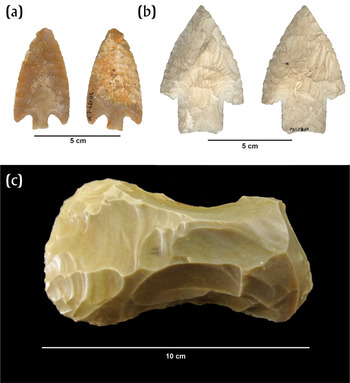
Until quite recently, and based primarily on data from northern Belize, conventional wisdom held that the chert stemmed and barbed Lowe, Sawmill, and Allspice points (Figures 4a and 4b) dated to the Early Preceramic phase (2500–1900 b.c.) of the Late Archaic period (3400–900 b.c.) (Iceland Reference Iceland1997; Kelly Reference Kelly1993; Lohse Reference Lohse2010; Lohse et al. Reference Lohse, Awe, Griffith, Rosenswig and Valdez2006; Stemp et al. Reference Stemp, Awe, Prufer and Helmke2016, Reference Stemp, Awe and Wrobel2021). With the increased investment in and reliance on domesticated crops during the latter half of the Late Archaic (i.e., the Late Preceramic, 1500–900 b.c.; see Kennett et al. Reference Kennett, Prufer, Culleton, George, Robinson, Trask, Buckley, Moses, Kate, Harper, O'Donnell, Ray, Hill, Alsgaard, Merriman, Meredith, Edgar, Awe and Gutiérrez2020; Pohl et al. Reference Pohl, Pope, Jones, Jacob, Piperno, deFrance, Lentz, Gifford, Danforth and Josserand1996; Rosenswig Reference Rosenswig2021), chert constricted unifaces, likely used for wood-working, land clearance, and horticultural activities (Gibson Reference Gibson, Hester and Shafer1991; Iceland Reference Iceland1997), were added to the stone tool repertoire (Figure 4c). Because the date range established for constricted unifaces is 1500–900 b.c., based on associated radiocarbon dates in northern Belize (Iceland Reference Iceland1997; Lohse et al. Reference Lohse, Awe, Griffith, Rosenswig and Valdez2006), it is possible this tool type was used into the Early Middle Preclassic period in western and central Belize. However, there is currently no stratigraphic or radiocarbon evidence supporting this. The only constricted tool with an associated radiocarbon date from western Belize is a constricted biface from Actun Halal dated to the Late Archaic (Lohse Reference Lohse2009, Reference Lohse2010, Reference Lohse, Hutson and Ardren2020). By the beginning of the Early Middle Formative (1000–900 b.c.), the stemmed and barbed Lowe, Sawmill, and Allspice points and constricted unifaces do not appear in the archaeological record in Western Belize. Present evidence indicates a shift in stone tool technology, with a focus on expedient chert and obsidian flakes produced by hard-hammer percussion during the transition to the Early Formative in western Belize (Awe and Healy Reference Awe and Healy1994; Stemp et al. Reference Stemp, Awe, Brown and Garber2018b). The earliest evidence for obsidian blade technology in western Belize occurs in the Late Cunil phase (1000–900 b.c.) at Cahal Pech where a prismatic blade fragment was recovered from Structure B4 (Ebert Reference Ebert2017:135, Table 4.2; Ebert and Awe Reference Ebert and Awe2018:69).
Examples of diagnostic Archaic period lithic artifacts: (a) Sawmill point; (b) Lowe point; and (c) unifacial constricted adze. Photographs by Awe.

In northern Belize, large chert macroblade bifaces, wedge-form adzes, and T-form adzes, as well as macroblades, blades, and burin spall drills were being produced in the Middle Formative period (Potter Reference Potter, Hester and Shafer1991), and stemmed chert macroblades, tranchet-bit bifaces, and large oval bifaces made from chert begin to appear in significant abundance by the Late Formative period (ca. 300–250 b.c.) (Hester and Shafer Reference Hester and Shafer1984; Shafer Reference Shafer, Hester and Shafer1991; Shafer and Hester Reference Shafer and Hester1983). Many of these tool types would be traded to other sites throughout Belize or locally made, including those in western Belize (Stemp et al. Reference Stemp, Awe, Brown and Garber2018b).
The long-held sequence of preceramic and early ceramic period tool types originally established in northern Belize (Iceland Reference Iceland1997; Kelly Reference Kelly1993) was recently challenged by Prufer and colleagues’ (Reference Prufer, Alsgaard, Robinson, Meredith, Culleton, Dennehy, Magee, Huckell, James Stemp, Awe, Capriles and Kennett2019, Reference Prufer, Robinson and Kennett2021) investigations in southern Belize, where, for the first time, Lowe points were found in discrete, in situ, stratified contexts. AMS 14C analysis of the contexts where the Lowe points were discovered dated the points and their associated technology to approximately 8200–7300 cal b.c., indicating a Late Paleoindian/Early Archaic temporal assignment. Prufer and colleagues (Reference Prufer, Alsgaard, Robinson, Meredith, Culleton, Dennehy, Magee, Huckell, James Stemp, Awe, Capriles and Kennett2019:15) note that the shift of Lowe and other stemmed and barbed points from the Late Archaic to Late Paleoindian times “leaves a notable temporal gap with no bifacial technocomplex for CA [Central America] for the Early to Late Archaic (9000–3900 b.p. [~7000–1900 b.c.]).”
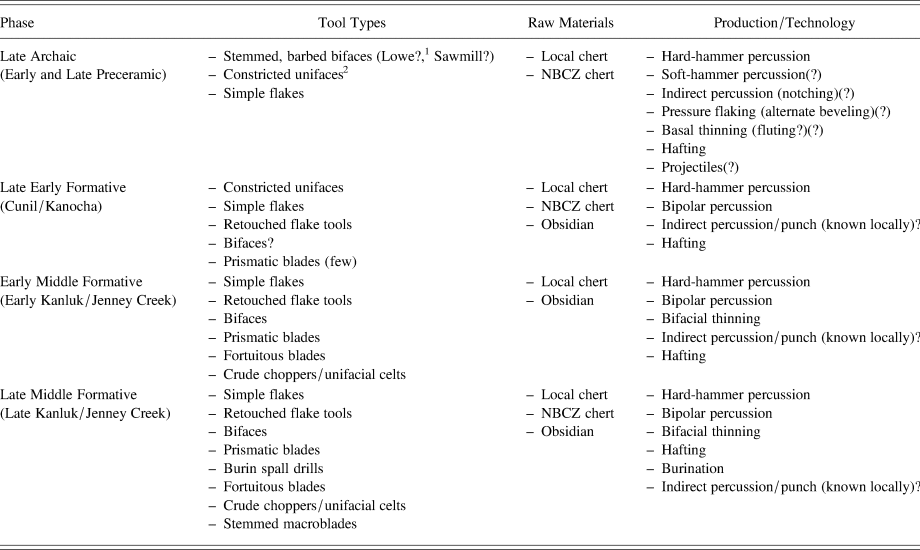
The shift in chronology for Lowe (and, potentially, the related Sawmill and Allspice stemmed points)—that is, their placement in the Late Paleoindian to Early Archaic period—has important implications for the early stone tool sequence in western and central Belize. For example, all three types of preceramic stemmed points (Lowe, Sawmill, and Allspice) have been recovered in western and central Belize, as have constricted unifaces (Stemp and Awe Reference Stemp and Awe2013; Stemp et al. Reference Stemp, Awe, Prufer and Helmke2016, Reference Stemp, Awe and Wrobel2021). The dating of these artifacts to the Late Paleoindian to Early Archaic means that “[h]afted formal tools … and the complex array of manufacturing techniques that characterize preceramic lithic technology” are no longer evident in the Upper Belize River Valley during the transition from the Late Archaic to the Late Early Formative Cunil/Kanocha phase (1200/1100–900 b.c.; Stemp et al. Reference Stemp, Awe, Brown, Harrison-Buck, Helmke, Wrobel and Yaeger2018a:88). Instead, what we have at Cahal Pech and Blackman Eddy are Late Early Formative assemblages consisting of simple flake tools produced by hard-hammer and bipolar percussion and made primarily from local chert and imported obsidian (Table 2). Although hafted constricted unifaces extend from the Late Archaic into the Middle Formative, they are the product of hard-hammer reduction. They lack the more sophisticated soft-hammer, indirect, and pressure flaking observed on preceramic stemmed bifaces (Iceland Reference Iceland1997; Kelly Reference Kelly1993). Local production of obsidian blades appears to be absent in western Belize, and, as noted above, obsidian blade technology does not become evident until the end of the Early Formative period (1000–800 b.c.; Awe and Healy Reference Awe and Healy1994; Ebert Reference Ebert2017:137; Ebert and Awe Reference Ebert and Awe2018). The absence of stemmed and barbed points, and the lack of macroblade and blade technology at Cahal Pech and Blackman Eddy lead us to conclude that it is difficult to argue for technological continuity between preceramic people in western Belize and the first Cunil and Kanocha ceramic-making Maya who appeared there around 1200/1100 b.c. This contrasts with the situation in northern Belize where the presence of blade and macroblade technology at Colha in both Late Archaic and the Early Middle Formative contexts led Iceland (Reference Iceland1997, Reference Iceland and Powis2005) to suggest a technological connection between preceramic people and the early Maya.
Trends in raw material types, tool types, production techniques, and technological features on chipped stone tools from the Late Archaic to the Late Middle Formative in western Belize.

Notes: 1Lowe points are dated to the Late Paleoindian/Early Archaic (cal b.p. 10,223 and 9300) in southern Belize (Prufer et al. Reference Prufer, Alsgaard, Robinson, Meredith, Culleton, Dennehy, Magee, Huckell, James Stemp, Awe, Capriles and Kennett2019).
2 Constricted biface at Actun Halal (Lohse Reference Lohse2010, Reference Lohse, Hutson and Ardren2020).
The sequence of stone tools in southern Belize, and at Puerto Escondido, El Gigante, and Copan in Honduras, as well as at Ceibal and Caobal in Guatemala, largely mirror that recorded in the Upper Belize Valley. At Puerto Escondido, Joyce and Henderson (Reference Joyce and Henderson2001:8) report the presence of “obsidian flakes, produced through percussion” in stratigraphic levels that bridge the Late Archaic to Late Early Formative period, followed by the limited production of obsidian blades. At El Gigante, Scheffler (Reference Scheffler2008:126) indicates that during the Late Archaic to Formative transition, flake tools greatly outnumber formal tools and that obsidian “prismatic blades produced from polyhedral cores do not occur” at the site. Similarly, the earliest stone tools in the Early Preclassic Rayo phase (1400–900 b.c.) at Copan appear in the form of expedient hard-hammer chert and obsidian core and flake technology (Aoyama Reference Aoyama1999:53). At Ceibal and Caobal, Guatemala, in the Real-Xe phase (1000–700 b.c.), the chipped chert tool assemblage was overwhelmingly represented by hard-hammer percussion flakes, flake tools (e.g., denticulates and scrapers), and simple flake cores; however, chert biface and blade technology was present (Aoyama Reference Aoyama2017a:283, Table 4, Reference Aoyama2017b; Aoyama and Munson Reference Aoyama and Munson2012:35). Hard-hammer reduction of obsidian nodules or macroflakes also occurred at Ceibal and Caobal. Beginning in the Early Middle Formative, evidence for prismatic blade technology is present at both Ceibal and Caobal in Guatemala (Aoyama Reference Aoyama2017a, Reference Aoyama2017b:283, Table 4; Aoyama and Munson Reference Aoyama and Munson2012:35).
What can we surmise from the apparent differences in chipped stone tool technology during the Archaic to Formative transition? The sequence in the Upper Belize River Valley clearly reflects a discontinuity in the production of large chert bifaces (Lowe and Sawmill points) and a greater reliance on expedient chert and obsidian flake tools produced by hard-hammer percussion. This represents a significant change in lithic technology during the transitional period, specifically the disappearance of the sophisticated production techniques associated with stemmed bifaces. Almost 30 years ago, and in an effort to explain this very situation, Tom Kelly concluded that:
This typology then begs the questions of what happened to the preceramic users of these [stemmed and barbed] points and what was their relationship to the earliest Maya. A comparison of these preceramic projectile points with Preclassic through Early Postclassic Maya points … clearly shows a sharp discontinuity between preceramic and Maya point types. There are no shared morphological attributes. One can postulate either that the preceramic people were gone before the ceramic-using Maya arrived with an already well-established lithic industry, or that the Maya assimilated and chose not to adopt any of the excellent preceramic lithics. The differences are just too great to believe that Maya lithics evolved from preceramic lithics (Kelly Reference Kelly1993:225).
Because of the results of recent aDNA studies by Reich and colleagues (Reference Reich, Kennett, Lipson, Prufer, Mora-Marin, George, Rohland, Robinson, Trask, Edgar, Hill, Ray, Lynch, Moes, O'Donnell, Harper, Kate, Ramos, Morris, Gutiérrez, Culleton and Awe2020; see also Kennett et al. Reference Kennett, Lipson, Prufer, Mora-Marín, George, Rohland, Robinson, Trask, Edgar, Hill, Ray, Lynch, Moes, O'Donnell, Harper, Kate, Ramos, Morris, Gutierrez, Ryan, Culleton, Awe and Reich2021; Prufer et al. Reference Prufer, Robinson and Kennett2021), we now know that local populations in southern Belize did intermarry with maize farmers who migrated from the southeast. Why their descendants discontinued their use of earlier preceramic lithic technology is not clear, but we do believe that it likely reflects “a decline in the importance of sharp cutting edge tools, generally associated with the procurement and processing of meat, within the subsistence economy” (Scheffler Reference Scheffler2008:125–126). This emphasis may reflect an increasing investment in horticulture and gathering of riverine resources such as freshwater mussels and jute. It is also likely that hunting implements, such as traps, for smaller game may have been fashioned from hardwood and thus are not preserved in the archaeological record.
One new tool type that does appear following the establishment of the earliest settlements in western Belize is the chert microdrill, primarily produced on retouched burin spalls. These small tools were produced in the hundreds and are generally found in association with marine shell debitage and broken perforated shell disks. The latter association indicates that the drills were most likely used in the production of shell beads (Brown Reference Brown2003; Garber et al. Reference Garber, Kathryn Brown, Awe and Hartman2004; Hohmann Reference Hohmann2002; Hohmann et al. Reference Hohmann, Powis, Healy, Kathryn Brown and Bey2018; Stemp et al. Reference Stemp, Awe, Brown and Garber2018b). Similar production of chert microdrills on burin spalls and shell beads is noted in northern Belize in the Middle Formative (Potter Reference Potter, Hester and Shafer1991:24).
The Ground Stone Industry
One of the major changes we see in the toolkit of the earliest Formative period residents of the Upper Belize Valley is an increase in the frequency of ground stone artifacts, particularly oval-shaped manos plus turtle-back and tecomate-shaped metates (Figure 5; Awe Reference Awe1992; Brown Reference Brown2003:103). Rosenswig (Reference Rosenswig2006a:339, Reference Rosenswig2015:148) observed a similar trajectory in both the Soconusco and the Gulf Coast, where he notes that as “the reliance on cultivated food increased … after 1000 cal b.c. … these subsistence changes were accompanied by an increased use of manos and metates.” El Gigante is one site where this sequence seems to differ from most others in Mesoamerica. Scheffler (Reference Scheffler2008:135) reports that, while one would expect “that with the onset of agricultural practices, ground stone artifacts such as [manos and metates] would become more common in the archaeological record,” the opposite appears to be true, despite the presence of fully domesticated maize cobs in the El Gigante assemblage by ~2300 cal b.c. (Kennett et al. Reference Kennett, Thakar, VanDerwarker, Webster, Culleton, Harper, Kistler, Scheffler and Hirth2017). Scheffler does note, however, that this anomaly may likely be the result of “post-depositional mixing,” or because the occupants of the rockshelter moved to the valley below after adopting agriculture. Another possible reason is that, given the durability of grinding stones, these portable tools would likely have been taken by their owners when they discontinued use of the rockshelter and moved to permanent settlements closer to the Estanzuela River.
Tecomate-style metate from Kanocha phase context at Blackman Eddy. Image courtesy of Brown and Garber.

An interesting observation by Scheffler is that in the American Southwest, “[p]remaize ground stone is usually found in the form of one-handed manos used with small simple slab metates.” Following the adoption of maize, there is a change “toward the more common implementation of two-handed manos that are used with larger (in surface area) flat metates” (Scheffler Reference Scheffler2008:136). Interestingly, the smaller, rounded (tecomate-shaped) metates that were likely used with one-hand manos are among the earliest mortars and pestles recorded in northern and western Belize (cf., Brown Reference Brown2003:103, Figure 5.2; Garber et al. Reference Garber, Kathryn Brown, Awe and Hartman2004:18; MacNeish Reference MacNeish and Nelken-Terner1981: Figure 27).
The Polished Stone Industry
One industry that does not demonstrate an Archaic period precedent is polished stone. Indeed, and to our knowledge, no polished stone objects like jadeite beads have been reported in Archaic period contexts in Belize or elsewhere in the Maya area. Polished stone objects therefore seem to be introduced during the Formative period, and they continued to be produced through the rest of Maya prehistory.
The earliest polished stone objects recovered in western Belize include jadeite adornos that were found in Cunil (1200/1100–900 b.c.) contexts at Cahal Pech (Awe Reference Awe1992:305–307). Perforated discoidal jadeite beads appear in the subsequent early Jenney Creek phase (900–750 b.c.). The Cunil phase adornos at Cahal Pech are highly polished on one side, but just ground and smoothed on the opposite side. One of the adornos is in the shape of a fang, while the other is “reminiscent of a stylized flaming brow,” suggesting that they were fragments of a mosaic mask with a wooden backing (Awe Reference Awe1992:307). By the start of the Middle Formative (900–800 b.c.), greenstone triangulates are common across western Belize, and much of the rest of the Maya lowlands (Powis et al. Reference Powis, Horn, Iannone, Healy, Garber, Awe, Skaggs and Howie2016).
The Ceramic Industry
Like almost everywhere in Mesoamerica, the early ceramic industry in the Upper Belize Valley is associated with the first agricultural settlements in the region, and it represents one of the most diagnostic differences with the preceding Late Archaic period. When exactly pottery first appeared in the Upper Belize Valley, however, remains elusive. Current evidence from the sites of Cahal Pech, Blackman Eddy, Actuncan, and Xunantunich indicate that pottery technology was widespread in the region by the Terminal Early Formative Cunil/Kanocha phases, sometime between 1200–1000 b.c. (Awe Reference Awe1992; Brown Reference Brown2003; Ebert and Awe Reference Ebert and Awe2020; Garber et al. Reference Garber, Kathryn Brown, Awe and Hartman2004; LeCount and Yaeger Reference LeCount and Yaeger2008; LeCount et al. Reference LeCount, Mixter, Simova, LeCount and Mixter2016; Strelow and LeCount Reference Strelow and LeCount2001; Sullivan and Awe Reference Sullivan, Awe and Aimers2013; Sullivan et al. Reference Sullivan, Awe, Brown, Brown and Bey2018). This temporal span overlaps with the introduction of pottery at Puerto Escondido, Honduras during the Baharona phase (ca. 1600–900 b.c.; Joyce and Henderson Reference Joyce and Henderson2001:8), but is several centuries later than the established dates for early pottery in other regions of Mesoamerica (cf., Clark and Blake Reference Clark, Blake, Brumfiel and Fox1994; Flannery and Marcus Reference Flannery and Marcus2015; Love Reference Love and Fowler1991; Rosenswig Reference Rosenswig2015).
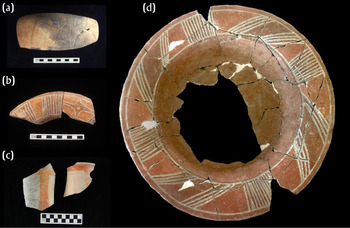
Cunil and Kanocha pottery (Figure 6) from the Upper Belize Valley differs in quality from the first pottery documented in places such as the valleys of Oaxaca and Tehuacán. In Oaxaca, for example, the earliest ceramics of the Espiridión complex are primarily gourd-shaped vessels, and some are very finely made, extremely thin-walled bowls, but all are undecorated (Flannery and Marcus Reference Flannery and Marcus2015). Purrón complex pottery from Tehuacán is relatively crude and undecorated; not until subsequent phases are Espiridión and Purrón pottery replaced by more finely made and decorated ceramics (MacNeish Reference MacNeish, Ucko, Tringham and Dimbleby1972). In contrast, and from its very first appearance, Cunil/Kanocha pottery reflects limited evidence of experimentation, and includes several ceramic types categorized as Belize Valley Dull Wares, which are well-made and decorated with post-slip incised designs and symbols (Awe Reference Awe1992; Sullivan and Awe Reference Sullivan, Awe and Aimers2013, Reference Sullivan, Awe and Walker2021; Sullivan et al. Reference Sullivan, Awe, Brown, Brown and Bey2018). Many of the post-slip incised designs bear resemblance to pan-Mesoamerican iconographic motifs (Awe Reference Awe1992; Garber and Awe Reference Garber and Awe2009), suggesting at least that the movement of these ideas between diverse regions of Mesoamerica was likely before the Late Early Formative of the Upper Belize River Valley.
Examples of Cunil ceramics from Cahal Pech: (a) Kitam Incised; (b) Zotz Zone Incised; (c) Uck Red; and (d) Zotz Zoned Incised. Photographs by Awe and Ebert.

While it is likely that this sophisticated early pottery technology in the Upper Belize Valley was an import, gained through interaction with other early sedentary communities, Cunil/Kanocha ceramic vessels themselves were not. Evidence for the local production of early pottery in the Upper Belize Valley comes from geochemical analyses that document a sophisticated understanding of the technological aspects of pottery production by the beginning of the Late Early Formative. Instrumental neutron activation analysis (INAA) of Cunil pottery from Cahal Pech (n = 47 samples) revealed distinct paste recipes for both utilitarian (coarse wares) and decorated vessels (dull wares) that, when compared to a large database of sherds from Mesoamerica previously analyzed by INAA (>15,000, Archaeometry Lab at the University of Missouri Research Reactor), suggests production and consumption of Cunil/Kanocha pottery within the greater Upper Belize Valley region (Ebert et al. Reference Ebert, Pierce and Awe2019b; Ronald Bishop and Dorie Reents-Budet, personal communication 2021). Notably, several Cunil specimens with ash-temper were included in the study, indicating that an ash-paste tradition for the Late Early Formative and subsequent periods probably originated in western Belize (Ebert et al. Reference Ebert, Pierce and Awe2019b; Sunahara et al. Reference Sunahara, Chartrand, Healy and Awe2018).
The Upper Belize Valley is not the only subregion of Mesoamerica where the earliest pottery does not appear to be experimental. This was also the case at the coeval dated site of Nixtun-Ch'ich' in the central Peten Lakes region (Rice Reference Rice2019b:471–475), and at Puerto Escondido, Honduras, where the earliest pottery from the Baharona phase “consists of finely made, thin-walled vessels in the shape of small open bowls and closed-mouth bowls (tecomates), with elaborate decoration, including incision, dentate-stamping, and painting in red and black” (Joyce and Henderson Reference Joyce and Henderson2001:8). The earliest Barra phase (1900 cal b.c.) pottery in the Soconusco is equally “very finely made and all are decorated or slipped” (Rosenswig Reference Rosenswig2006b:62). Clark and Blake (Reference Clark, Blake, Brumfiel and Fox1994) explain the high quality of Barra phase pottery by suggesting that these early ceramics initially functioned as feasting vessels and prestige goods. The same case has been made for early Cunil and Kanocha phase ceramics in western Belize (Brown et al. Reference Brown, Awe, Garber, Kathryn Brown and Bey2018).
Other Tool Industries and Production Technologies
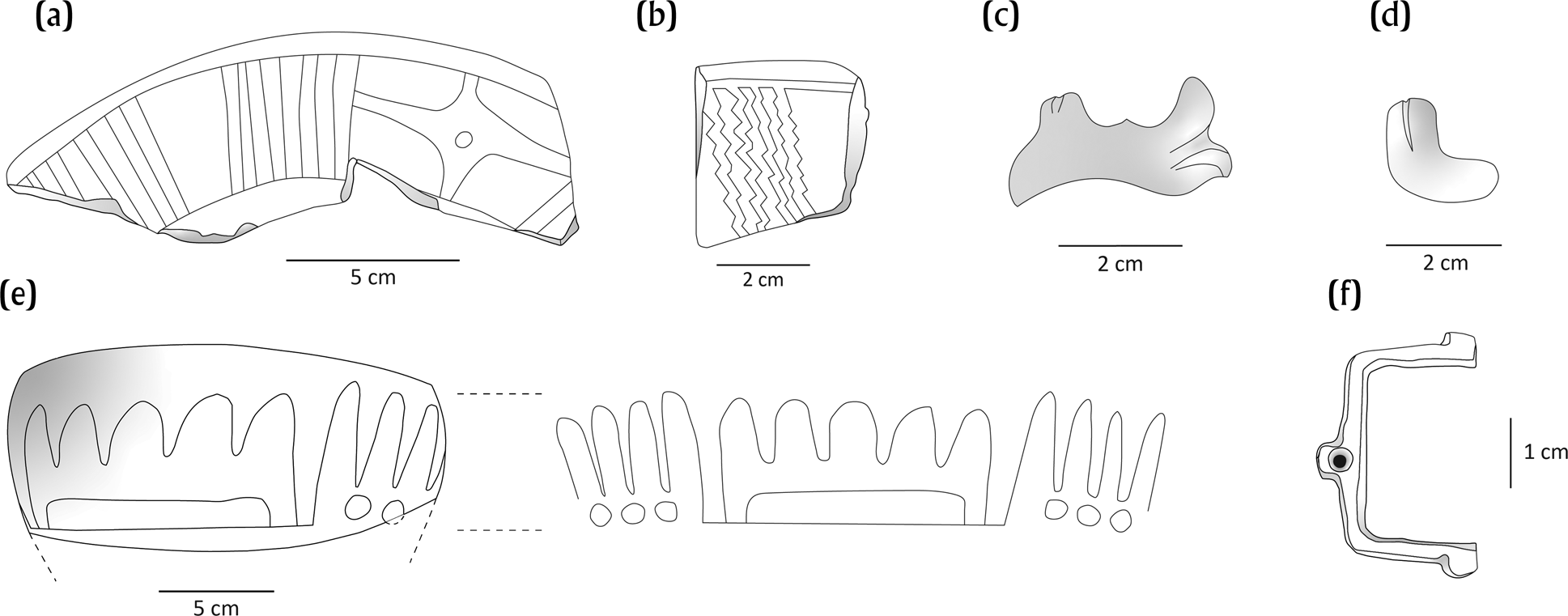
Several other artifact classes recovered in Cunil/Kanocha contexts provide evidence for production techniques and technologies that were introduced during the Archaic to Formative period transition in the Upper Belize Valley. These artifacts include marine shell beads, ceramic colanders, ceramic spindle whorls, and bone implements.
Marine Shell Beads
With regard to marine shell beads, we previously noted (see Chipped Stone Industry above) that small chert drills often occur in association with marine shell debitage, and with broken perforated marine shell discs. Both drills and shells are also found adjacent to house platforms, suggesting that the production of imported marine shell beads was likely a household industry (Awe Reference Awe1992:324–325; Brown Reference Brown2003; Garber et al. Reference Garber, Kathryn Brown, Awe and Hartman2004; Hohmann Reference Hohmann2002; Stemp et al. Reference Stemp, Awe, Brown and Garber2018b). The absence of marine shell debitage associated with shell disc production, as well as the drills, in the few Archaic sites that have been excavated in central, northern, and southern Belize suggests that this industry only emerged in Formative period times.
Ceramic Colanders
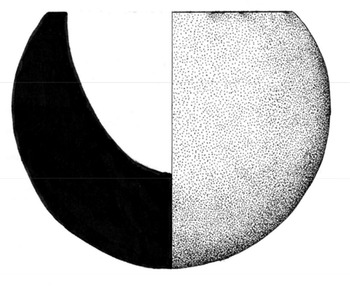
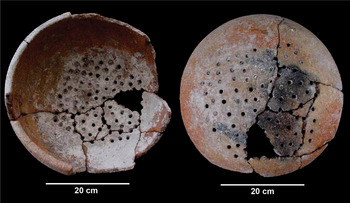
Ceramic colanders are unquestionably a product of the ceramic-producing Formative period settlers of the Upper Belize Valley (Figure 7). A complete specimen of this artifact type was recovered in a Kanocha phase chultun at Blackman Eddy (Brown Reference Brown2003:Figure 5.3), and fragments of similar vessels have been found in Cunil contexts at Cahal Pech and Xunantunich (e.g., Cheetham Reference Cheetham, Staller and Carrasco2010:Figure 6; Strelow and LeCount Reference Strelow and LeCount2001). Ceramic colanders were used to make nixtamal (lime-treated maize), though it is unclear whether the nixtamalization process was introduced during Late Archaic times, or whether it was a Formative development.
Ceramic colander from the Kanocha phase at Blackman Eddy. Photograph by Brown.

In the nixtamalization process, dried kernels of corn are boiled in a solution of water and lime (Green Reference Green, Staller and Carrasco2010), then left soaking overnight. The procedure removes the hard pericarp that covers maize kernels. Colanders are used to drain the softened corn from lime water prior to grinding with manos and metates. Recovered Cunil/Kanocha colanders possess traces of lime at the base and lower walls of the vessels, providing strong evidence that they were essential for the nixtamalization process (Brown Reference Brown2003; Cheetham Reference Cheetham, Staller and Carrasco2010).
Few colander specimens, or evidence for the early practice of nixtamalization, have been reported in other regions of Mesoamerica (Cagnato Reference Cagnato2021; Cheetham Reference Cheetham, Staller and Carrasco2010; Green Reference Green, Staller and Carrasco2010). Three exceptions are the south coast of Guatemala, where “culinary equipment for the nixtamalization process was found archaeologically … [dating] between 1500 and 1200 b.c.” (Green Reference Green, Staller and Carrasco2010:315; see also Coe Reference Coe1994); the central Peten subregion of the Maya lowlands (Cheetham Reference Cheetham, Staller and Carrasco2010); and the Valley of Mexico, where Niederberger (Reference Niederberger1976:41, Plate 41) discovered a colander in contexts dating between 1000 and 800 b.c.
The presence of ceramic colanders in Late Early Formative contexts in the Upper Belize Valley led Cheetham (Reference Cheetham, Staller and Carrasco2010:362) to suggest the possibility that the nixtamalization process “began sometime during the preceding Preceramic period. If so, ceramic colanders may have replaced or supplemented perforated wooden or gourd prototypes.” In Oaxaca, Flannery and Marcus (Reference Flannery and Marcus2015) note that ceramic vessels likely replaced gourds following the introduction of pottery; thus, it is possible that gourds with perforations may have preceded the introduction of ceramic colanders in the Upper Belize Valley. This situation may also have existed in the Soconusco region, where Clark and Gosser (Reference Clark, Gosser, Barnett and Hoopes1995) and Rosenswig (Reference Rosenswig2006a:331) suggest that ceramic-producing Early Formative communities “did not employ subsistence technology that differed markedly from their non-ceramic using predecessors.” No evidence for the nixtamalization process, however, has been documented in the Soconusco, perhaps suggesting that this method for processing corn may have developed earlier in the Maya area (Cheetham Reference Cheetham, Staller and Carrasco2010) or elsewhere. Rosenswig's (Reference Rosenswig2006a) observation that the adoption of full-fledged maize agriculture is not evident until the Conchas phase (900–800 b.c.) in the Soconusco lends support to this possibility.
The late adoption of maize agriculture in the Soconusco stands in stark contrast to recent data from southern Belize, where stable isotopic analyses of human remains indicate that maize formed a significant dietary contribution (>25 percent of total dietary protein) between 2700 and 2000 cal b.c. (Kennett et al. Reference Kennett, Prufer, Culleton, George, Robinson, Trask, Buckley, Moses, Kate, Harper, O'Donnell, Ray, Hill, Alsgaard, Merriman, Meredith, Edgar, Awe and Gutiérrez2020). After 2000 cal b.c., maize became the staple grain of the Maya lowlands, typically contributing over 70 percent of the total dietary protein for most individuals, a pattern which persisted through the Classic period (Kennett et al. Reference Kennett, Prufer, Culleton, George, Robinson, Trask, Buckley, Moses, Kate, Harper, O'Donnell, Ray, Hill, Alsgaard, Merriman, Meredith, Edgar, Awe and Gutiérrez2020). Given the increased reliance on maize in the diets of transitional groups in southern Belize, it is therefore quite possible that the nixtamalization process developed during the Late Archaic (~2000 b.c.), and that the Cunil/Kanocha phase presence of ceramic colanders in western Belize reflects an equally early reliance on maize consumption.
Cotton Textiles
The production of cotton textiles may be another achievement of early settlers during the second to first millennium b.c. Four lines of evidence indicate this possibility in the Upper Belize Valley: cotton pollen, ceramic spindle whorls, bone needles, and evidence for the presence of textiles. Early remains of cotton, and pollen in particular, have been reported in both western (Lohse Reference Lohse2010:321; Wiesen and Lentz Reference Wiesen and Lentz1997) and northern Belize (Jones Reference Jones1994; Piperno and Pearsall Reference Piperno and Pearsall1998:300–303; Pohl et al. Reference Pohl, Pope, Jones, Jacob, Piperno, deFrance, Lentz, Gifford, Danforth and Josserand1996:363). In western Belize, cotton pollen is present in Late Archaic period deposits at Actun Halal (~2200–1380 cal b.c.; Jones and Hallock Reference Jones, Hallock and Lohse2008; Lohse Reference Lohse2010:321), and cotton pollen and a cotton seed were found in Late Early Formative contexts at Cahal Pech and Pacbitun (~1200–1000 cal b.c.; Healy Reference Healy2006:22; Wiesen and Lentz Reference Wiesen and Lentz1997). A fragment of plaster with a textile impression from a Cunil phase context at Cahal Pech was also recovered, which, under high magnification, indicated that “the fabric was constructed of single-ply yarns with a Z-twist” (Lawlor et al. Reference Lawlor, Graham, Fedick, Healy and Awe1995:157).
Bone needles were found within a Cunil/Kanocha phase chultun at Blackman Eddy, indicating cloth production of some nature (Brown Reference Brown2003; Garber et al. Reference Garber, Kathryn Brown, Awe and Hartman2004). Ceramic spindle whorls in Cunil/early Jenney Creek phase contexts at Cahal Pech also provide indirect evidence for early textile production in the Upper Belize Valley. At Cahal Pech, stone spindle whorls first appear in Late Formative times, but ceramic whorls precede them by several centuries (Awe Reference Awe1992:299). The temporal precedence of ceramic whorls was also noted by Willey (Reference Willey and Willey1978:43) at the sites of Ceibal and Altar de Sacrificios, where they were dated to the Middle and Late Formative periods, respectively.
The discovery of a fragment of cotton textile at El Gigante in Honduras provides even stronger evidence for the regional production of textiles during the Formative period (Scheffler Reference Scheffler2008:149, Photo 38). The widespread presence of cotton pollen at sites across Mesoamerica and South America, however, likely suggests that textile production began earlier during the Archaic period (Piperno Reference Piperno2011), and that it continued into Late Early Formative times in places like the Upper Belize River Valley.
TRADE AND EXCHANGE
Lohse (Reference Lohse2010:326) previously noted that “the apparent absence of exotic goods in preceramic deposits is among the most striking differences between the Archaic and Preclassic,” though evidence exists for the exchange of some goods or materials during preceramic times in Belize and other regions of Mesoamerica. The Archaic Chantuto people of the Pacific Coast of southern Mexico, for example, acquired obsidian from both nearby and distant sources (Voorhies Reference Voorhies2004). By 1800–1400 b.c., major obsidian trade networks were established throughout Mesoamerica (Ebert et al. Reference Ebert, Dennison, Hirth, McClure and Kennett2014; Golitko and Feinman Reference Golitko and Feinman2015; Stark et al. Reference Stark, Boxt, Gasco, Lauck, Balkin, Joyce, King, Knight, Kruger, Levine, Lesure, Mendelsohn, Navarro-Castillo, Neff, Ohnersorgen, Pool, Mark Raab, Rosenswig, Venter, Voorhies, Williams and Workinger2016). Voorhies (Reference Voorhies, Lohse) and Silberman2012:343) also reports that in the Tehuacán Valley of Puebla, burials of adults accompanied by the remains of children contained several grave goods, including marine shells. The presence of the marine shells in Archaic deposits at Tehuacán represents one of the earliest examples of incipient trade in Mesoamerica.
In the case of western Belize, evidence for preceramic exchange is very limited, represented by a few stemmed bifaces and constricted unifaces that were produced from chert originating in the northern Belize chert-bearing zone (Lohse Reference Lohse2010:325–326; Stemp and Awe Reference Stemp and Awe2013). Given that northern Belize is relatively close to the Belize River Valley, it is possible that these points could have been brought into the area by mobile preceramic groups. The other alternative is that the bifaces arrived in the Upper Belize Valley by way of down-the-line trade. The exchange of projectile points during the Late Archaic has been suggested for the Oaxaca area by Marcus and Flannery (Reference Marcus and Flannery1996:62). They also note that this practice was typical among hunter-gatherers such as the !Kung of Botswana, where Lee (Reference Lee1979) recorded the exchange of arrows among hunters.
In contrast to their late preceramic precursors, Awe (Reference Awe1992:348) previously reported that “[f]rom the establishment of their initial settlement, the [Late Early Formative] Cunil community at Cahal Pech was involved with long distance exchange and trade.” Evidence for long-distance trade is also present for contemporaneous Kanocha phase occupation downriver at Blackman Eddy (Brown Reference Brown2003; Garber et al. Reference Garber, Kathryn Brown, Awe and Hartman2004). Exotics imported by Cunil communities included obsidian from highland Guatemala, jadeite from the Motagua Valley in southeastern Guatemala, and marine shell, particularly conch (Strombus sp.), from the Caribbean. At Cahal Pech, obsidian nodules and percussion flakes (n = 15) were created from materials imported from the El Chayal source (Awe and Healy Reference Awe and Healy1994; Ebert Reference Ebert2017). Geochemical sourcing data of five artifacts from Blackman Eddy, on the other hand, shows a reliance on obsidian from the San Martín Jilotepeque source during the Late Early Formative/Early Middle Formative (Kersey Reference Kersey and Garber2006).
Greenstone objects in Cunil levels at Cahal Pech represent one of the earliest recorded uses of jadeite in the Maya lowlands. Cunil Phase greenstone objects at this site include irregular-shaped and perforated beads, and the small adornos carved in the shape of a curved fang and “flaming” eyebrow that we previously described in the section Polished Stone Industry. The small jadeite beads were likely used for simple bracelets or necklaces, while the adornos (Figures 8c and 8d) likely served as components for mosaic masks with wooden backing (Awe Reference Awe1992:308). At Nixtun-Ch'ich', Peten, Rice (Reference Rice2019a:20) notes that “[w]ood and pottery masks were likely worn in Formative-period dances, processions and dramas, as they are cross-culturally today.”
Early symbols depicted on Cunil/Kanocha phase artifacts: (a) Kan Cross; (b) lightning; (c) flame eyebrow; (d) fang; (e) Avian Serpent; (f) half quatrefoil (Cave Monster maw). Illustrations by Ebert.

In addition to using jadeite beads, the early settlers of the Upper Belize Valley also produced simple jewelry out of marine shells. These shells were cut into discs and perforated at the center. The large quantities of shell discs, and the association of shell debitage with chert microdrills at Cahal Pech, Blackman Eddy, and Pacbitun suggest that these sites likely were producing shell discs for export to other early inland settlements (Awe Reference Awe1992; Hohmann Reference Hohmann2002; Hohmann et al. Reference Hohmann, Powis, Healy, Kathryn Brown and Bey2018; Peniche May Reference Peniche May2016). At Nakbe, for example, Hansen and colleagues noted that there is little marine shell debitage in the earliest components at the site (early Ox phase, ca. 1000–800 b.c.), and that marine shell discs in completed form were likely “imported possibly via the Belize River Valley” (Hansen et al. Reference Hansen, Forsyth, Woods, Schreiner, Titmus, Brown and Bey2018:153).
Pumice (or other forms of volcanic ash), which was used as temper for Cunil/early Jenney Creek phase pottery, may also have been imported from the Caribbean coast or from other sources in the Maya area. Recent INAA and petrographic analyses of Cunil, and Spanish Lookout phase pottery from western Belize confirm that much of this pottery was tempered with volcanic ash (Ebert and Awe Reference Ebert and Awe2020; Ebert et al. Reference Ebert, Pierce and Awe2019b; Sunahara et al. Reference Sunahara, Chartrand, Healy and Awe2018), and Callaghan et al. (Reference Callaghan, Pierce and Gilstrap2018) report that Formative period ash-tempered pottery was traded from the Upper Belize Valley into the eastern Peten. Pumice has been found in Preclassic contexts at Cuello (Hammond Reference Hammond1991:197) and is available along beaches of the Caribbean coast of Belize. Potential sources of volcanic ash, however, have yet to be determined. Based on this evidence, Lohse's (Reference Lohse2010:342) assertion that “long-distance trade poses one of the most dramatic contrasts between preceramic and early Middle Preclassic [i.e., Late Early Formative] deposits,” continues to remain a valid assessment of the Late Archaic to Late Early Formative period.
IDEOLOGY
More than 30 years ago, Marcus (Reference Marcus, Sharer and Grove1989:148) noted that the nature of Formative period religion is one of the most challenging topics facing students of early Mesoamerican societies. For the lowland Maya area, this problem has remained with us because “there is absolutely no agreed-upon theoretical or methodological framework for dealing with prehistoric religion” (Marcus Reference Marcus1978:172), and for the simple fact that only a few Formative period sites in the region have been intensively investigated (Awe Reference Awe1992:13–16). This situation is even more difficult for the Archaic because there are even fewer sites known for this period, and fewer still that have been excavated and have good preservation. Despite similar limitations in other subregions of Mesoamerica, some scholars (e.g., Flannery Reference Flannery and Flannery1976; Marcus Reference Marcus1978, Reference Marcus, Sharer and Grove1989, Reference Marcus, David C. and Joyce1993:11–12) have demonstrated that temporal changes in rituals and religion can be deduced through a careful study of the contextual distribution and morphology of cultural remains. Marcus also notes that, although Formative rituals cannot be observed, “we can recover the places where rituals were performed and observe the patterning of the ritual artifacts involved” (Marcus Reference Marcus, David C. and Joyce1993:2). Applying this approach, we examine and compare evidence for early symbols and rituals during the Late Archaic to Formative period in western Belize.
Actun Halal in the Upper Belize Valley (Griffith and Helmke Reference Griffith, Helmke and Awe2000; Lohse Reference Lohse2009; Lohse et al. Reference Lohse, Awe, Griffith, Rosenswig and Valdez2006), and the rockshelters investigated by Prufer and colleagues (Reference Prufer, Alsgaard, Robinson, Meredith, Culleton, Dennehy, Magee, Huckell, James Stemp, Awe, Capriles and Kennett2019, Reference Prufer, Robinson and Kennett2021) in southern Belize are presently the only two sites where we can examine Late Archaic ritual behavior in Belize due to good preservation in excavated cave deposits. For Actun Halal, Lohse (Reference Lohse, LeCount, Jones, Beach and Hallock2007:26–27) suggests that, given its hallucinogenic properties and consequent ritual associations in Mesoamerica, the presence of morning glory (Convolvulaceae spp.) at the site may be associated with early ritual activity. In the southern Belize rockshelters, at least two pieces of evidence can be connected to ritual activity: the long continuous sequence of burials, and the secondary use of the freshwater snail jute. Dating of human remains recovered from the rockshelters indicates their use as burial grounds by at least Late Paleoindian times, and that this practice continued well into the Formative period and beyond (Prufer et al. Reference Prufer, Alsgaard, Robinson, Meredith, Culleton, Dennehy, Magee, Huckell, James Stemp, Awe, Capriles and Kennett2019; Reich et al. Reference Reich, Kennett, Lipson, Prufer, Mora-Marin, George, Rohland, Robinson, Trask, Edgar, Hill, Ray, Lynch, Moes, O'Donnell, Harper, Kate, Ramos, Morris, Gutiérrez, Culleton and Awe2020). Thousands of the jute shells were brought up to the rockshelters where they were used to cover remains of the dead, to line the floors of the burials, or to “pave” sections of the rockshelter's floor (Prufer et al. Reference Prufer, Alsgaard, Robinson, Meredith, Culleton, Dennehy, Magee, Huckell, James Stemp, Awe, Capriles and Kennett2019). Investigations of both caves and surface sites in western Belize indicate that the ritual use of jute began in Formative period times, and that it continued unabated into the Terminal Classic period (Awe Reference Awe1992; Halperin Reference Halperin, Prufer and Brady2005; Healy et al. Reference Healy, Emery and Wright1990). Halperin and colleagues (Reference Halperin, Garza, Prufer and Brady2003:216) further note that jute in burials served as food for the dead as they traveled through the underworld.
Moyes’ investigations in Chechem Ha cave, located less than 10 km south of Cahal Pech, revealed that ritual use of caves in the Upper Belize Valley began by at least the end of the Early Formative (Moyes Reference Moyes2006:583–584; Moyes et al. Reference Moyes, Kosakowsky, Ray and Awe2017). She also notes that increasing concentrations of charcoal and the presence of corn in Middle Formative contexts at Chechem Ha were associated with the “development of agricultural rites” and that “[t]he types of rituals occurring at such early dates provide evidence that the cave was used by the earliest settlers as a water and/or agricultural fertility shrine” (Moyes Reference Moyes2006:564; Moyes et al. Reference Moyes, Awe, Brook and Webster2009).
Beyond the Upper Belize River Valley, the early use of caves, both for burials and rituals, has been documented at Gordon cave #3 in Honduras (Brady Reference Brady1995), in Guerrero, Mexico (Coe et al. Reference Coe, Urcid and Koontz2015), and in the Tehuacán Valley (MacNeish Reference MacNeish1967). At Coxcatlán cave in Tehuacán, MacNeish found the remains of several adults as well as two children. One child had been cremated, while “[t]he head of the other child had been severed and roasted, the brains had been removed, and the head had been placed in a basket on the child's chest” (Evans Reference Evans2008:84). Next to the children were several baskets “containing the desiccated remains of plants,” which “suggest that this act of sacrifice occurred at the time of a successful harvest, and may have been part of a ritual thanksgiving” (Flannery and Marcus Reference Flannery and Marcus2015:11). What is particularly significant about the Coxcatlán cave remains is that they strongly suggest that the “belief in ritual reciprocity was already present during the era of hunting, gathering, and incipient agriculture” (Flannery and Marcus Reference Flannery and Marcus2015:11).
Investigations at Cahal Pech indicate that caves were also ritually significant to the earliest settlers of the Upper Belize Valley. For example, a Cunil phase cache contained two small, spherical stones that were subsequently identified as “cave pearls” (Awe Reference Awe1992). Several “cave pearls” were also found in early contexts at Blackman Eddy (Brown Reference Brown2003). These small, spherical stones form in subterranean travertine pools, suggesting that they had to have been removed from a nearby cave and brought to Cahal Pech where they were included in the Cunil phase cache. Another offering in Cunil phase levels included a small shell pendant (Figure 8f) carved in the form of a half quatrefoil motif that may represent an opening to the underworld, or what Garber and Awe (Reference Garber and Awe2009:153–155, Figure 4c) refer to as a “Cave Monster” maw. The Cahal Pech pendant is the earliest representation of the quatrefoil motif in the Maya lowlands, and predates the use of this motif on Monuments 1 and 9 at Chalcatzingo (Grove Reference Grove, Clark and Pye2000) “by at least two or three centuries” (Garber and Awe Reference Garber and Awe2009:155). More significantly, the Cunil phase quatrefoil motif and the cave pearls at Cahal Pech, along with the coeval use of nearby Chechem Ha, provide compelling evidence that caves were already perceived as sacred landscapes during the period of transition from the Late Archaic to the Late Early Formative in the Upper Belize Valley.
Crocodilian remains and imagery, and the use of various motifs carved on Cunil phase pottery and greenstone (Figure 8) provide additional evidence for the formalization of sacred and cosmological symbols and concepts during the early years of settlement in the Upper Belize Valley. The placement of a crocodile mandible beneath the floor and along the north/south axis of a Cunil phase platform at Cahal Pech (Awe Reference Awe1992) indicates that the association of crocodilians with earth may already have been conceived at this early time (Awe Reference Awe, Moyes, Christenson and Sachse2021; see also Rice Reference Rice2019a, Reference Rice2021). Once formally established, this concept continued to play a significant role in ritual activity at Cahal Pech, reflected by the discovery of additional crocodilian imagery in the form of a Middle Formative slate crocodile figurine, and a shell crocodile effigy, both deposited in caches in Structure B4 at the site (Awe Reference Awe, Moyes, Christenson and Sachse2021; Brown et al. Reference Brown, Awe, Garber, Kathryn Brown and Bey2018). Like the quatrefoil motif, crocodilian imagery is present in the iconography of early sites across Mesoamerica (Rice Reference Rice2018, Reference Rice2020). Remains of a crocodile, for example, were recovered in an early platform at Fábrica San José in Oaxaca (Flannery Reference Flannery and Flannery1976:Figure 11.6). Stocker and Armsey (Reference Stocker, Meltzoff and Armsey1980) also report that crocodilian imagery is pervasive in early Olmec art, and Garber and Awe (Reference Garber and Awe2009) note that representations of crocodilians continued to be depicted throughout the Classic and Postclassic periods in the Maya lowlands.
Cunil/Kanocha phase contexts at Cahal Pech and Blackman Eddy contain some of the earliest evidence for the production of hand-modeled figurines, and female effigies are among the earliest forms represented in the early Cahal Pech assemblage (Awe Reference Awe, Moyes, Christenson and Sachse2021). The number of figurines increased exponentially during the ensuing Middle Formative period, then gradually going out of production towards the end of the Late Middle Formative. Studies of Formative period figurines unanimously agree that these small effigies were associated with fertility rites or other ritual purposes (cf., Awe Reference Awe1992; DeLance Reference DeLance2016; DeLance and Awe Reference DeLance, Awe, DeLance and Feinman2021; Grove and Gillespie Reference Grove and Gillespie1984; Halperin Reference Halperin2014; Hammond Reference Hammond1989, Reference Hammond1991; Marcus Reference Marcus1998, Reference Marcus, Halperin, Faust, Taube and Giguet2009; Peniche May et al. Reference May, Nancy and Awe2018; Rice Reference Rice2018, Reference Rice2020). For Oaxaca, Marcus (Reference Marcus, David C. and Joyce1993:4) proposes that prior to the emergence of rank, figurines were simple in form, and predominantly used by women for “invoking the spirits of their ancestors.” Using ethnohistoric and ethnographic analogy, she suggests that women occasionally petitioned ancestors “for guidance,” and that figurines “provided a medium which the spirits of specific ancestors could return to and inhabit during this petitioning” (Marcus Reference Marcus, David C. and Joyce1993:2–6). In Oaxaca, Marcus (Reference Marcus, David C. and Joyce1993) notes that figurines arranged in scenes were a way for ancestors to witness and participate in the ongoing rituals of the household. The discovery of Cunil and early Jenney Creek phase (1200/1100–700 b.c.) figurines, predominantly in household contexts and caches, at Cahal Pech suggests that early settlers in the Upper Belize Valley may have shared these concepts with their Mesoamerican cousins, and that like in Oaxaca, the Soconusco, and elsewhere, these concepts began to be manifested during the initial stages of the Formative period.
One of the diagnostic attributes of “dull ware” Cunil/Kanocha pottery is that several specimens are decorated with post slip carved and incised symbols (Awe Reference Awe1992; Brown Reference Brown2003; Ebert and Awe Reference Ebert and Awe2020; LeCount and Yaeger Reference LeCount and Yaeger2008; Rice Reference Rice2019b; Sullivan and Awe Reference Sullivan, Awe and Aimers2013; Sullivan et al. Reference Sullivan, Awe, Brown, Brown and Bey2018). The most significant motifs (Figures 8a, 8b, and 8e) on Cunil/Kanocha pottery are representations of the Kan Cross, lightning, and the so-called “Avian Serpent” (Garber and Awe Reference Garber and Awe2009). Garber and Awe (Reference Garber and Awe2009:155–157) note that “[t]he Kan Cross is the most basic symbol representing the concept of a quadripartite universe,” and it is “associated with concepts of creation, cyclical completion, cardinal direction, lineages, gods, and colors” (see also Matthews and Garber Reference Matthews and Garber2004). The Avian Serpent, which is synonymous with Joralemon's (Reference Joralemon1971) “Olmec Dragon,” is a composite creature that combines elements of the harpy eagle and crocodilians. Motifs representing the Avian Serpent generally depict only a part of the creature, adhering to the concept of pars pro toto. At Cahal Pech, Blackman Eddy and Xunantunich, the Cunil/Kanocha phase Avian Serpent motifs differ from their Olmec counterpart in that they are predominantly curvilinear and primarily avian in character (Garber and Awe Reference Garber and Awe2009:152). Their Late Early Formative presence in the Upper Belize Valley is also among the earliest expressions of this motif in Mesoamerica, but in a format that appears to be uniquely lowland Maya.
What is perhaps the most significant aspect of the various motifs, symbols, and evidence of rituals in Late Archaic and Cunil/Kanocha phase contexts in western and southern Belize is that they reflect both cultural continuities and innovations. The use and perception of caves as sacred landscapes in Mesoamerica seem to have their origins in Archaic times. In contrast, the representation of symbolically laden motifs on pottery is unquestionably a product of the earliest settlers in the region. Despite these differences, it is hard to imagine that the concepts represented by these motifs appeared, in prima forma, during the Formative period. While speculative, we would argue that most of these concepts likely had their origins in preceramic times, and it was only after Mesoamericans began to live in permanent settlements that they began to be symbolically and formally represented on ceramics and other tangible objects. This perspective concurs with Rice's (Reference Rice2019a:34) observation that “it is not unlikely that certain [concepts] had begun in storytelling before the Preclassic period—perhaps in the late Archaic or the Early Preclassic, or the long Archaic-to-Preclassic transition.”
DISCUSSION AND CONCLUSIONS
In the introduction to this article, we highlighted the fact that few Archaic period sites and Late Early Formative sedentary village sites are presently known in Belize, or the Maya lowlands in general. We further noted that even fewer of these sites have been intensively excavated by archaeologists, thus limiting the data available for examining the changes that unfolded during the Archaic to Formative transition. Despite the paucity of data, we suggest that much can be gleaned about this transitional phase through careful examination of available datasets. By applying a comparative methodology to our study of the Archaic to Formative transition in the Belize River Valley, we are able to identify several significant continuities, discontinuities, and innovations during one of the most dynamic periods of cultural development in western Belize.
In regard to the temporal span of the Archaic to Formative transition, we concur with Arnold's (Reference Arnold, Skibo and Feinman1999:157–158) observation that Mesoamerican people did not become sedentary, take up agriculture, and adopt pottery “as soon as they crossed the threshold from one period to the next.” In essence, we disagree with any suggestion that perceives this time as an abbreviated event rather than as a gradual process. This view is shared by colleagues who have investigated this very question in the valleys of Oaxaca (Flannery and Marcus Reference Flannery and Marcus2015) and Tehuacán, (MacNeish Reference MacNeish1967, Reference MacNeish, Ucko, Tringham and Dimbleby1972), in the Soconusco (Rosenswig Reference Rosenswig2015, Reference Rosenswig and Claire2019), and at sites in Honduras (Joyce and Henderson Reference Joyce and Henderson2001; Scheffler Reference Scheffler2008). We also agree with Rosenswig's (Reference Rosenswig2015) assessment that the Archaic to Formative transition is best described as a “mosaic of adaptations.” This perspective acknowledges that while there were some processes that were shared by early settlers across the Mesoamerican landscape, there was also considerable diversity in their adaptive responses across time and space. In northern Belize, for example, it has been argued that the Late Archaic period continued until approximately 1000–900 b.c., after which we see the establishment of sedentary, ceramic-producing, communities in the Middle Formative period (Lohse Reference Lohse2010; Rosenswig et al. Reference Rosenswig, Pearsall, Masson, Culleton and Kennett2014). In southern Belize, Prufer and colleagues (Reference Prufer, Robinson and Kennett2021; see also Kennett et al. Reference Kennett, Prufer, Culleton, George, Robinson, Trask, Buckley, Moses, Kate, Harper, O'Donnell, Ray, Hill, Alsgaard, Merriman, Meredith, Edgar, Awe and Gutiérrez2020) argue that local populations there adopted maize as a staple crop much earlier, by at least 2050 cal b.c., and that they were using rockshelters as mortuary sites between 7600 and 2000 cal b.c. In the Upper Belize River Valley, present evidence suggests that the first ceramic-producing settlements were established along river valleys between 1200/1100 and 1000 b.c., and that they may have relied on a subsistence strategy that combined horticulture, the consumption of dog and deer, and the exploitation of aquatic resources. In the Peten, archaeologists (Estrada-Belli Reference Estrada-Belli2011; Inomata et al. Reference Inomata, MacLellan, Triadan, Munson, Burham, Aoyama, Nasu, Pinzón and Yonenobu2015) have also identified early ceramic-producing communities at around 1000 b.c., but Inomata and colleagues (Reference Inomata, MacLellan, Triadan, Munson, Burham, Aoyama, Nasu, Pinzón and Yonenobu2015:4268) suggest that some of these sites, such as Ceibal, may have been used by relatively mobile groups “who maintained the traditional lifestyle of the preceramic period.” The transition from the Late Archaic to the Formative period was therefore anything but even across the lowland Maya landscape, and present data indicate that it is perhaps best characterized by spatial and temporal diversity rather than uniformity.
The question concerning the origins of the first farmers in the Maya lowlands has bothered archaeologists for more than half a century. Fifty years ago, Gifford (Reference Gifford1970; see also Sharer and Gifford Reference Sharer and Gifford1970) hypothesized that Middle Formative settlements at the Upper Belize Valley site of Barton Ramie were established by immigrants who originated from the area around Chalchuapa in El Salvador. Following the discovery of Late Early Formative Cunil and Kanocha settlements at Cahal Pech, Blackman Eddy, Actuncan, and Xunantunich, Clark and Cheetham (Reference Clark, Cheetham and Parkinson2002), and, later, Ball and Taschek (Reference Ball and Taschek2003), argued for a proto-Maya or Mixe-Zoquean origin for the ancestors of the Cunil/Kanocha phase Maya. What these hypotheses had in common was that they were both based on comparative studies of cultural remains, rather than on direct evidence for genetic ancestry or geochemical analysis of ceramics.
Fortunately, the ongoing work of Prufer and colleagues (Reference Prufer, Alsgaard, Robinson, Meredith, Culleton, Dennehy, Magee, Huckell, James Stemp, Awe, Capriles and Kennett2019, Reference Prufer, Robinson and Kennett2021; Kennett et al. Reference Kennett, Prufer, Culleton, George, Robinson, Trask, Buckley, Moses, Kate, Harper, O'Donnell, Ray, Hill, Alsgaard, Merriman, Meredith, Edgar, Awe and Gutiérrez2020, Reference Kennett, Lipson, Prufer, Mora-Marín, George, Rohland, Robinson, Trask, Edgar, Hill, Ray, Lynch, Moes, O'Donnell, Harper, Kate, Ramos, Morris, Gutierrez, Ryan, Culleton, Awe and Reich2021; Reich et al. Reference Reich, Kennett, Lipson, Prufer, Mora-Marin, George, Rohland, Robinson, Trask, Edgar, Hill, Ray, Lynch, Moes, O'Donnell, Harper, Kate, Ramos, Morris, Gutiérrez, Culleton and Awe2020) in southern Belize is finally shedding new and more accurate light on the question of origins. What we now know from this new and exciting research is that migrants from the southeast did move into southern Belize sometime between 5300 and 3600 cal b.c., and that they intermarried with local, Archaic period populations in the region. The modern Maya of Belize still “harbor the largest part of their ancestry (~50 percent) from this northward expansion of early farmers” (Reich et al. Reference Reich, Kennett, Lipson, Prufer, Mora-Marin, George, Rohland, Robinson, Trask, Edgar, Hill, Ray, Lynch, Moes, O'Donnell, Harper, Kate, Ramos, Morris, Gutiérrez, Culleton and Awe2020; see also Kennett et al. Reference Kennett, Lipson, Prufer, Mora-Marín, George, Rohland, Robinson, Trask, Edgar, Hill, Ray, Lynch, Moes, O'Donnell, Harper, Kate, Ramos, Morris, Gutierrez, Ryan, Culleton, Awe and Reich2021). Based on the analysis of lake sediments and pollen cores across the Maya lowlands (e.g., Cowgill and Hutchinson Reference Cowgill and Hutchinson1956; Wahl et al. Reference Wahl, Byrne, Schreiner and Hansen2006), it is apparent that this migration coincided with environmental disturbance, likely associated with the introduction of a “package of cultigens” that included productive varieties of maize, as well as manioc and chili peppers (Kennett et al. Reference Kennett, Prufer, Culleton, George, Robinson, Trask, Buckley, Moses, Kate, Harper, O'Donnell, Ray, Hill, Alsgaard, Merriman, Meredith, Edgar, Awe and Gutiérrez2020; Prufer et al. Reference Prufer, Alsgaard, Robinson, Meredith, Culleton, Dennehy, Magee, Huckell, James Stemp, Awe, Capriles and Kennett2019; Reich et al. Reference Reich, Kennett, Lipson, Prufer, Mora-Marin, George, Rohland, Robinson, Trask, Edgar, Hill, Ray, Lynch, Moes, O'Donnell, Harper, Kate, Ramos, Morris, Gutiérrez, Culleton and Awe2020). In spite of the increasing reliance on maize, paleoethnobotanical and zooarchaeological analyses of remains from sites in the Upper Belize Valley suggest that local populations continued to follow a broad spectrum diet that relied significantly on the exploitation of resources along riverine and lacustrine environments until at least the Middle Formative period (Lawlor et al. Reference Lawlor, Graham, Fedick, Healy and Awe1995; Powis et al. Reference Powis, Stanchly, White, Healy, Awe and Longstaffe1999; Stanchly and Awe Reference Stanchly and Awe2015; Stanchly and Burke Reference Stanchly and Burke2018; Wiesen and Lentz Reference Wiesen and Lentz1997).
Shifts in the subsistence patterns of Late Archaic people had several major consequences. Three important and archaeologically visible developments followed. The first was the transition to sedentism. Current evidence in the Upper Belize Valley indicates that the first settlements were established by at least 1200–1000 b.c. on the summits of hills overlooking river valleys. These locations allowed easy access to the rich resources in riverine bottomlands, while at the same time providing settlers with well-drained, cooler, and defensible locations for their communities, and with good building materials for their houses. Proximity to navigable rivers also facilitated opportunities for trade and regional interaction. Once established, Cunil/Kanocha phase settlements appear to have been permanent, for there is clear evidence of sequential construction above the earliest building platforms. This type of early settlement contrasts with that proposed for Ceibal, where Inomata and colleagues (Reference Inomata, MacLellan, Triadan, Munson, Burham, Aoyama, Nasu, Pinzón and Yonenobu2015:4268) suggest that even after the construction of “a formal ceremonial complex … built around 900 b.c. … [m]any residents of Ceibal appear to have remained relatively mobile during the [Early Middle Formative period], living in ephemeral post-in-ground structures and frequently changing their residential localities,” adding that in “other parts of the Pasion region, there may have existed more mobile populations who maintained the traditional lifestyle of the preceramic period.” While this perspective harkens, to some degree, to Thompson's (Reference Thompson1954) early views of empty ceremonial centers, there is presently no solid evidence for this type of settlement pattern at early Cahal Pech, Blackman Eddy, or Xunantunich. In spite of the absence of this evidence, however, it is quite conceivable that mobile horticultural groups existed in the Upper Belize Valley during early transitional times, and that following the establishment of settlements in the Cahal Pech, Blackman Eddy, and Xunantunich site cores, these settlements became permanent, as suggested by sequential construction over the earliest house platforms at Cahal Pech and Blackman Eddy. At the same time, other horticulturalists in the valley may have continued a more semi-sedentary lifestyle akin to that proposed by Inomata and colleagues (Reference Inomata, MacLellan, Triadan, Munson, Burham, Aoyama, Nasu, Pinzón and Yonenobu2015).
The second development in the Upper Belize River Valley consisted of changes in the tool kits of incipient Cunil phase (1200/1100–900 b.c.) agriculturalists, characterized by the disappearance of stemmed bifaces, followed by the appearance of constricted adzes and an increased reliance on expedient flake tools produced by hard-hammer percussion. There are, for example, no stemmed bifaces (Lowe and Sawmill points) found in Cunil/Kanocha (1200/1100–900 b.c.) contexts, and constricted unifaces, which consist of surface finds, are assigned to the Late Preceramic period (1500–900 b.c.) based on radiocarbon dates associated with similar tools recovered from northern Belize (Iceland Reference Iceland1997; Lohse et al. Reference Lohse, Awe, Griffith, Rosenswig and Valdez2006; Pohl et al. Reference Pohl, Pope, Jones, Jacob, Piperno, deFrance, Lentz, Gifford, Danforth and Josserand1996; see Lohse Reference Lohse, Hutson and Ardren2020 for a constricted biface dated to 2200 b.c. from Actun Halal). Hard-hammer bifaces appear during the transition to the early facet Jenney Creek/Kanluk phase (900–650 b.c.). Concurrent with these changes, the Cunil/Kanocha phase witnesses an increase in grinding stones, especially manos and metates, along with increased use of expedient flake tools. Eventually, toward the end of the Early Formative (1000–900 b.c.), obsidian prismatic blades show up in the tool repertoire.
A third major change is the introduction of exotic materials, particularly obsidian, jadeite, and marine shell. The presence of these exotics in Cunil/Kanocha levels at Cahal Pech and Blackman Eddy provide solid evidence for the establishment of inter-regional trade and exchange networks by the end of the Early Formative period. Pumice and/or volcanic ash, for use as temper in Cunil pottery, as well as some chert, also were likely imports into the Upper Belize Valley at this time. In return, the Upper Belize Valley settlements exported finished conch shell beads, pottery, and possibly granite manos and metates to neighboring settlements in the central Peten of Guatemala (Callaghan et al. Reference Callaghan, Pierce and Gilstrap2018; Hansen et al. Reference Hansen, Forsyth, Woods, Schreiner, Titmus, Brown and Bey2018). Other technological innovations, such as the development of pottery technology, led to the production of ceramic vessels that likely began to replace the use of gourds for a variety of purposes, including their use as colanders for processing corn, and as molds for pottery vessels (Flannery and Marcus Reference Flannery and Marcus1983). Ceramic spindle whorls, bone needles, and evidence for the use of cotton at Actun Halal and Cahal Pech indicate that the production of textiles likely expanded at this time.
The manifestation of ideological concepts and the formalization of religious practices and symbols represent equally substantial changes between 3000 and 1000 b.c. In southern Belize, for example, the sequential burial of deceased members of the community in sacred landscapes becomes quite evident by Late Archaic times (Prufer et al. Reference Prufer, Alsgaard, Robinson, Meredith, Culleton, Dennehy, Magee, Huckell, James Stemp, Awe, Capriles and Kennett2019). Also evident is the caching of freshwater snails, and their likely use for representing the watery underworld (Orsini Reference Orsini2016). In western Belize, the use of caves as the loci for agricultural and related rituals also started by the end of the Late Archaic (Moyes Reference Moyes2006; Moyes et al. Reference Moyes, Kosakowsky, Ray and Awe2017). Subsequently, with the introduction of pottery at the end of the Early Formative, symbols that represent early manifestations of the quadripartite division of the universe (Kan Cross), the quatrefoil motif (cave Monster maw), lightning, and the principal bird deity (manifested by the Avian Serpent motif), began to be depicted on ceramic vessels and other portable objects (Awe Reference Awe1992; Brown et al. Reference Brown, Awe, Garber, Kathryn Brown and Bey2018; Garber and Awe Reference Garber and Awe2009).
When we consider all these characteristics in tandem, they demonstrate that the Late Archaic to Late Early Formative period was one of the most dynamic phases of cultural development in the Upper Belize River Valley. It was a period that witnessed truly profound changes to the lifestyles of the early inhabitants of the region. Once adopted, these changes also led to significant consequences, the most consequential of which was the subsequent rise of cultural complexity and the establishment of one of Mesoamerica's most lasting and accomplished societies. The Late Archaic to Late Early Formative period truly encompasses the genesis of lowland Maya civilization.
RESUMEN
La transición del Arcaico tardío al período Formativo temprano tardío fue testigo de profundos cambios en las tierras bajas mayas. Además del establecimiento de los primeros asentamientos y comunidades agrarias, esta fase crítica del desarrollo cultural anunció la introducción de la cerámica, vio cambios en la tecnología lítica, dio lugar al comercio e intercambio interregional y fue testigo de la introducción de un complejo sistema de símbolos expresado en objetos portátiles. En este artículo, sintetizamos los datos recopilados durante las últimas décadas por varios proyectos arqueológicos en el oeste de Belice para proporcionar una descripción general de los cambios culturales que se desarrollaron durante la transición entre los períodos arcaico tardío y formativo temprano tardío en el Valle del Río Belice. También proporcionamos evidencia que sugiere que fue durante esta fase incipiente de evolución cultural que vemos el establecimiento de varias tradiciones culturales que se convirtieron en únicas de las tierras bajas mayas.
ACKNOWLEDGMENTS
Permission to conduct research at Actun Halal, Blackman Eddy, Cahal Pech, Chechem Ha cave, and Xunantunich was graciously granted by the Belize Institute of Archaeology under the direction of Drs. Allan Moore, John Morris, Jaime Awe, and the late Harriot Topsey. Funding for our various research projects was generously provided by the Canadian Commission to UNESCO, the Gordon Childe Fund of the University of London, the Social Sciences and Humanities Research Council of Canada, the Tilden Family Foundation, the National Science Foundation, the Rust Family Foundation, the Belize Ministry of Tourism and Culture, Northern Arizona University, Keene State College, the Pennsylvania State University, the University of Texas at San Antonio, and the BVAR, BVAP, and XAC Projects. We extend our sincere gratitude to all these institutions and foundations, to the many members of our projects, and to the many colleagues who have assisted us during 32 years of investigations in western Belize. Lastly, but certainly not least, we thank Joyce Marcus and Norman Hammond for their very constructive suggestions and comments that served to improve the quality of this article.