

1. INTRODUCTION
The late 19th and early 20th century U.S. political transition from bound to free-labor changed the economic, legal, and social institutions related to health and net nutrition for both African and European Americans. Arnold Plant (1947, pp. 3–16), Woodward (Reference Woodward1951, p. 134), and Tribe (Reference Tribe, Mirowski and Plehwe2009, pp. 80 and 92) propose that lower socioeconomic status whites under free-labor were unable to compete with recently freed slaves and were made worse-off with the transition to free-labor [Donald (Reference Donald1995, p. 24 and 417)]. On the other hand, if whites with the transition illustrated discrimination, blacks would not have made as much economic, legal, and social progress because whites erected barriers to black material progress [Becker (Reference Becker1957, pp. 75–80), Becker (Reference Becker1993, pp. 188–190), Higgs (Reference Higgs1977, pp. 133–134)]. Moreover, free-whites had an institutionalized advantage in their access to legal institutions, property rights, and human capital [Butler et al. (Reference Butler, Heckman, Payner and Galenson1989)]. An extensive research shows how African-American statures compared to European-Americans who were allocated adequate nutrition under bound-labor, which provided them with sufficient nutrition to perform work [Fogel and Engermann (Reference Fogel and Engermann1974, pp. 109–117), Fogel (Reference Fogel1989, pp. 132–142), David et al. (Reference David, Gutman, Sutch, Temin and Wright1976, pp. 178–184), Kahn (Reference Kahn, Fogel and Engerman1992, pp. 525–528), Margo and Steckel (Reference Margo, Steckel, Fogel and Engerman1992, pp. 517–519)]. Under free-labor, conditions were altered, changing the economic opportunities facing both blacks and whites, yet it is unclear how white and black net nutrition varied with the transition to free-labor.Footnote 1 Subsequently, if white discrimination against African-Americans increased with the transition to free-labor, lower socioeconomic white statures would have increased relative to blacks, and black statures would have been worse-off with the transition to free-labor.
A population's average stature reflects the cumulative net difference between calories consumed and calories required for work and to withstand the physical environment, and the use of height data to measure net nutrition is now a well-accepted measure in economic development studies. Stature is related to health and labor market success, and taller individuals have greater access to opportunity and wages [Fogel (Reference Fogel1994, p. 375), Case and Paxon (Reference Case and Paxson2008a), Case and Paxson (Reference Case and Paxson2008b), Hammermesh and Biddle (Reference Hammermesh and Biddle1994), Persico et al. (Reference Persico, Postlewaite and Silverman2004), Gao and Smyth (Reference Gao and Smyth2010), Xiang and An (Reference Xiang and An2015)]. Throughout life, shorter individuals with low body mass have greater mortality risk, and shorter individuals are more likely to die from cardiovascular disease, various cancers, and stroke [Davey-Smith et al. (Reference Davey-Smith, Hart, Upton, Holeb, Gillisb, Wattc and Hawthorned2000), Paajanen et al. (Reference Paajanen, Oksala, Kuukasjärvi and Karhunen2010)]. On the other hand, taller stature is associated with aortic and pulmonary aneurisms [Brakken et al. (Reference Brakken, Burch, Mathiesen, Njostad, Wisgaard and Hansen2010), Miedema et al. (Reference Miedema, Petrone, Arnett, Dodson, Jeffrey Carr, Pankow, Hunt, Province, Kraja, Michael Gaziano and Djousse2014), Emerging Risk Factors Collaboration (2012)]. Height is also related to cognition. With the transition to a free-labor force, black and white height differences varied and reflects how economic well-being changed by race, which reflects access to available resources, mortality risk, and labor market productivity [Persico et al. (Reference Persico, Postlewaite and Silverman2004), Perkins et al. (Reference Perkins, Subramamian, Davey-Smith and Ӧzaltin2016, pp. 152–157)].
It is against this backdrop that this study uses stature as a measure for cumulative net nutrition to assess how late 19th and early 20th century black and white statures varied with the transition to free-labor. Three questions are considered when evaluating the white and black stature transition to free-labor, and a difference-in-decompositions technique is introduced to isolate sources of stature variation between bound and free-labor. First, how did white and black statures vary with the transition to free-labor? White relative to black statures increased with the transition, and white within-group stature returns associated with socioeconomic status increased the most. Second, much has been written regarding black youth stature variation compared to whites under bound-labor. How did white and black youth and adult statures vary by age with the transition to free-labor? Adult age-related black stature loss was less than under free-labor, indicating that although slaves were allocated sufficient calories to perform work under slavery, the transition to free-labor improved the age-related cumulative net nutrition for African-Americans. Third, what were the greatest sources of white and black stature variation with the transition to free-labor, and did white and black statures vary more across or within race categories? On its surface, statures should have varied more across white and black statures; nonetheless, statures varied the most within racial categories, and socioeconomic status and nativity were the greatest source of the white within-group stature increase.
2. DATA
Data for this project is the result of an extensive effort to collect and collate a broad set of physical characteristics from late 19th and early 20th century U.S. prison records. All prisons were contacted on multiple occasions, and available and affordable records were entered into a master data set. These records include Arizona, Colorado, California, Idaho, Illinois, Kentucky, Maryland, Mississippi, Montana, Nebraska, New Mexico, Ohio, Oregon, Pennsylvania, Philadelphia, Tennessee, Texas, Utah, and Washington. Reception dates began as early as 1803 and lasted through 1943. Birth dates begin in the 1730s and reach the 1920s. At the time of incarceration, enumerators recorded a broad set of characteristics, including age, occupations, race, birth period, nativity, and height.
Military and prison records are two sources used to evaluate late 19th and early 20th century stature variation. While plentiful, military statures represent conditions among higher socioeconomic groups and may suffer from an arbitrary truncation point imposed by minimum stature requirements for service [Fogel et al. (Reference Fogel, Engerman, Trussell, Floud, Pope and Wimmer1978); Sokoloff and Villaflor (Reference Sokoloff and Villaflor1982, pp. 456–458)]. Prison records are an alternative to military data and may have the advantage of being drawn from individuals with lower socioeconomic status, that segment of society most vulnerable to economic change. Prison records are, however, not above reproach. For example, inmates did not have sufficient income and wealth at the time of trial to afford legal counsel; therefore, poorer individuals may have been more likely to be incarcerated. On the other hand, prison officials may have judged that taller individuals were more likely to commit crimes because they were in better physical condition, which gave them an advantage in criminal interactions. Subsequently, law enforcement may have been more likely to incarcerate taller individuals.Footnote 2
There has been a recent challenge to the well-established view that statures decreased during the 19th century's second and third quarters that maintains sample selection is responsible for the decrease in statures rather than a genuine decrease in net nutrition [Bodenhorn et al. (Reference Bodenhorn, Guinnane and Mroz2015)]. However, this revised view may itself be the result of sample selection, and is not settled in the literature [Zimran (Reference Zimran2015), Komlos and A'Hearn (Reference Komlos and A'Hearn2016)]. For example, recent criticisms of the antebellum paradox fail to address evidence that urban statures are shorter and decreased with the separation of food consumption from food production, which is observed across disciplinary studies [Zehetmayer (Reference Zehetmayer2011), Haines et al. (Reference Haines, Craig and Weiss2003, pp. 398–407), Davidson et al. (Reference Davidson, Rose, Gutman, Haines, Condron, Condran, Steckel and Rose2002, p. 268), Steckel and Rose (Reference Steckel, Rose, Steckel and Rose2002, p. 575), Carson (Reference Carson2008a, p. 368)]. Statures were also shorter in geographic regions with higher disease rates [Haines et al. (Reference Haines, Craig and Weiss2003, p. 406)], which are established explanations for the antebellum paradox. The difference-in-decompositions presented here helps identify and control sample differences. In sum, it is not clear which segment of society prison records represent; however, it is generally accepted that prison records more likely represent conditions among lower socioeconomic groups.
Because racial classification was a primary means of identifying individuals within prisons, enumerators were thorough when recording inmate complexion. Complexion was also used to identify an inmate if they escaped and were recaptured. Individuals of African descent were classified as black, dark black, brown, chocolate, and various shades of “mulatto.” Individuals of European ancestry born in the United States were classified as white, fair, light, medium, and dark. The European complexion scheme is further supported because inmates claiming European nativity in U.S. prisons were also recorded as white, light, fair, medium, and dark. Until the 1930s, in both U.S. federal censuses and prisons, the term “mulatto” was used to describe persons of mixed African and European ancestry. However, persons of mixed African and European ancestry are recorded as “mixed-race” in the results that follow.Footnote 3 To isolate how economic and social processes were related before and after bound-labor, only black and white males are used in this study [Carson (Reference Carson2009b, Reference Carson2011a, Reference Carson2013a)].
Occupations are an important means of classifying socioeconomic status, and seven occupation categories are used here: white-collar, skilled, farmers, ranchers, farm laborers, unskilled, and workers with no recorded occupation. Bankers, merchants, and physicians are classified as white-collar workers. Blacksmiths, butchers, and tailors are classified as skilled workers. General farmers are classified as farmers, and ranchers and stockmen are classified as ranchers. There are farm and common laborers in the sample. Because farm laborers likely came to maturity under better biological conditions, including them in a single unskilled occupation category downwardly biases farm labor and upwardly biases common unskilled workers’ cumulative net nutrition [Margo and Steckel (Reference Margo, Steckel, Fogel and Engerman1992, pp. 514–517), Carson (Reference Carson2011b, Reference Carson2013b)]. Therefore, common and farm laborers are separated in the results that follow. A seventh category is included for workers with no listed occupations.
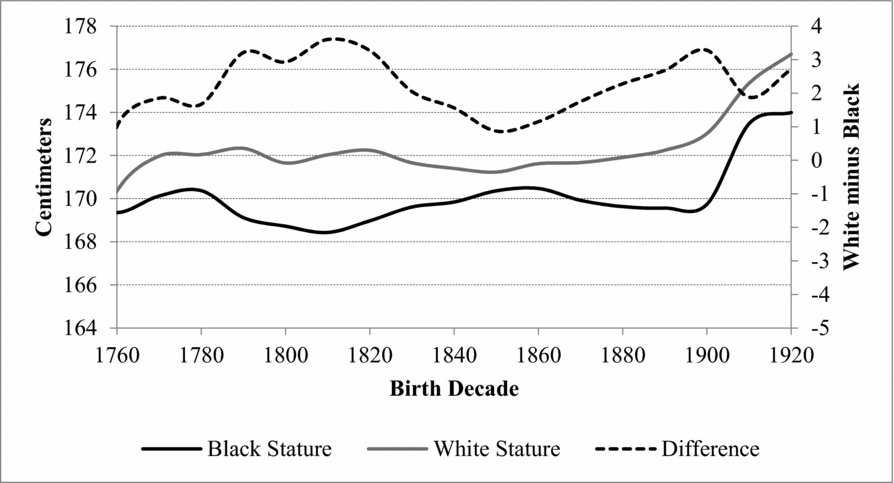
Figure 1 plots average white and black statures for birth between 1760 and 1920. White statures were taller than black statures and conform to the antebellum paradox [Komlos (Reference Komlos1987), Carson (Reference Carson2009c)]. White's greatest cumulative net nutrition advantage was around 1810, when bound-labor was entrenched in U.S. labor markets. On the other hand, average black stature increased relative to whites in the early 19th century and continued through the 1850s, which is consistent with the late antebellum cotton boom that favored black net nutrition [Wright (Reference Wright1978), Rees et al. (Reference Rees, Komlos, Long and Woitek2003), Carson (Reference Carson2009b, p. 824)]. Before 1920, the smallest white-black stature gap was in the 1850s and indicates that average statures were most similar just prior to the Civil War. Given the stature variation in Figure 1, the most reasonable period to specify a change in white and black cumulative U.S. net nutrition is, therefore, the 1865 transition from bound to free-labor.
Late 19th and early 20th century stature variation by birth over time. Source: See Table 1.

White and black statures are partitioned into four groups: whites and blacks born before 1866 and whites and blacks born after 1865. A principle concern in measuring the effect of the transition from bound to free-labor is isolating African-American workers born before 1865 who were born into slavery. The Maryland prison is the only institution which, for at least a time, recorded whether or not an inmate was a slave. However, this variable was only recorded for a short period. For the remaining prisons, no effort was made to record slave status, and we are unable to further distinguish between African-Americans who were born before 1865 born under slavery. However, conditions throughout the United States for lower socioeconomic status blacks before emancipation reflected the disparate slave system, and racial disparity was the norm throughout the antebellum period. Under bound-labor, slave law reflected plantation law, where plantation owners were allowed to punish their slaves on their masters’ plantations to pay their social debt while not withholding slave labor from plantation owners [Komlos and Coclanis (Reference Komlos and Coclanis1997, p. 436), Wahl (Reference Wahl1996, Reference Wahl1997), Friedman (Reference Friedman1993)]. Moreover, the effects of slave birth for young blacks born under slavery lingered into the decade following emancipation.
Given the primary means to identify slave birth for African-Americans is nativity, it is valuable to assess antebellum net nutrition conditions encountered by slaves. Using skeletal remains from Arkansas and Texas, two slave holding states, [Davidson et al. (Reference Davidson, Rose, Gutman, Haines, Condron, Condran, Steckel and Rose2002, pp. 268–273)] demonstrates childhood was marked by anemia, stress, accidents, high mortality, small pox, infectious diseases, cholera, and epidemic diseases were common. Adult slave skeletal remains exhibited high workloads, poor dental health, and accidents; syphilis and tuberculosis were later common. Although conditions were difficult for freed-slaves, like European-Americans, the antebellum Southwest offered free African-American limited opportunity. Alternatively, conditions facing free-blacks in the urban Northeast were better because the institution of slavery was a southern concern [Rathbun and Steckel (Reference Rathbun, Steckel, Steckel and Rose2002, p. 221)].
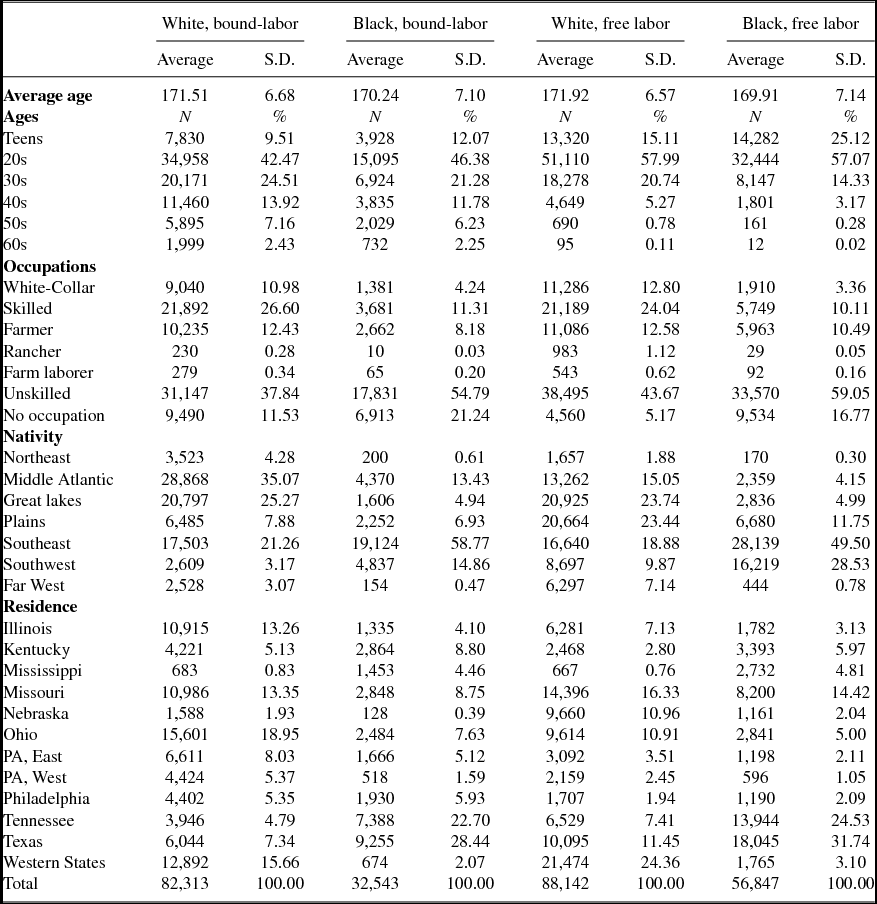
Table 1 illustrates that throughout the late 19th and early 20th centuries that whites were a larger portion of the prison population and more likely to be in white-collar, skilled workers, and agricultural occupations. Blacks were always less likely than whites to be skilled, and the proportion of blacks in skilled occupations was comparable before and after the transition to free-labor. However, with the end of slavery, blacks were more likely to own or tenant land and took up a larger proportion in agricultural occupations for birth after 1865 [Maloney (Reference Maloney2002)]. Blacks were more likely to be unskilled and workers without occupations, and the proportion of unskilled whites increased under free-labor, which is likely related to immigration [Cohn (Reference Cohn2009)]. Nativity from the Northeast, Middle Atlantic, and Southeast decreased over time, while nativity from the Plains, Southwest, and Far West increased. The proportion from the Great Lakes remained about the same throughout the period. While there was a considerable share of immigrants in prison records, to isolate the U.S. labor market transition from bound to free-labor, only U.S. born individuals are considered here. There was a greater share of African-Americans after 1865. Residence distributions indicate the West was the geographic region that had the highest proportion of whites compared to blacks; however, there was a higher proportion of blacks compared to whites in urban Philadelphia. Northern prisons had higher rations of whites to African-Americans, and blacks relative to whites decreased over time. In sum, the prison composition for individuals born under both bound and free-labor was more likely young, unskilled black workers; however, black farmers became more prominent over time.
Average characteristics for blacks and whites bound and free labor

Source: Arizona State Library, Archives and Public Records, 1700 W. Washington, Phoenix, AZ 85007; Colorado State Archives, 1313 Sherman Street, Room 120, Denver, CO 80203; California State Archives, 1020 O Street, Sacramento, CA 954814; Idaho State Archives, 2205 Old Penitentiary Road, Boise, Idaho 83712; Illinois State Archives, Margaret Cross Norton Building, Capital Complex, Springfield, IL 62756; Kentucky Department for Libraries and Archives, 300 Coffee Tree Road, Frankfort, KY 40602; Missouri State Archives, 600 West Main Street, Jefferson City, MO 65102; William F. Winter Archives and History Building, 200 North St., Jackson, MS 39201; Montana State Archives, 225 North Roberts, Helena, MT, 59620; Nebraska State Historical Society, 1500 R Street, Lincoln, Nebraska, 68501; New Mexico State Records and Archives, 1205 Camino Carlos Rey, Santa Fe, NM 87507; Ohio Archives Library, 800 E. 17th Avenue, Columbus, OH43211; Oregon State Archives, 800 Summer Street, Salem, OR 97310; Pennsylvania Historical and Museum Commission, 350 North Street, Harrisburg, PA 17120; Philadelphia City Archives, 3101 Market Street, Philadelphia, PA 19104; Tennessee State Library and Archives, 403 7th Avenue North, Nashville, TN 37243 and Texas State Library and Archives Commission, 1201 Brazos St., Austin TX 78701; Utah State Archives, 346 South Rio Grande Street, Salt Lake City, UT 84101; Washington State Archives, 1129 Washington Street Southeast, Olympia, WA 98504.
3. ECONOMETRIC MODEL
Separating results into treatment and control groups before and after an event is a practical means to isolate variation due to changes in returns to characteristics and changes due to average characteristics [Oaxaca (Reference Oaxaca1973), Lee (Reference Lee2005)]. If there is a measureable difference between returns to characteristics before and after bound-labor with similar average characteristics, the effects of the transition to free-labor is more likely due to the transition. If, however, there is little difference between returns to characteristics before and after bound-labor and a large difference between average characteristics, the effects of the transition are associated with differences in sample compositions.
A popular method to establish causal inference in the quasi-experiment literature is a difference-in-difference estimator, which mimics an experimental research design using observational data. The difference-in-difference estimator also isolates the treatment effect on the response variable by comparing average changes between treatment and control groups.Footnote 4 A Blinder–Oaxaca decomposition is a statistical procedure used to partition the difference between response variables into differences due to characteristic returns and average characteristics [Oaxaca (Reference Oaxaca1973)].
Let Y c and Yt be control and treatment response models.
 $$\begin{equation}
{Y_c} = {\alpha _c} + {\beta _c}{\bar{X}_c}
\end{equation}$$
 $$\begin{equation}
{Y_t} = {\alpha _t} + {\beta _t}{\bar{X}_t}
\end{equation}$$
where αc and αt are the control and treatment group autonomous components. βc and βt are control and treatment stature partial derivatives with respect to characteristics.  ${\bar{X}_c}$ and
 ${\bar{X}_t}$ are control and treatment average characteristic matrices. A decomposition separates the difference between response variables.
 $$\begin{equation}
\Delta Y = {Y_t} - {Y_c} = {\alpha _t} + {\beta _t}{\bar{X}_t} - {\alpha _c} - {\beta _c}{\bar{X}_c}
\end{equation}$$
Adding and subtracting  ${\beta _t}{\bar{X}_c}$ to the right-hand side, and collecting like terms is the decomposition
 $$\begin{equation}
\Delta Y = {Y_t} - {Y_c} = \left( {{\alpha _t} - {\alpha _c}} \right) + \left( {{\beta _t} - {\beta _c}} \right){\bar{X}_c} + \left( {{{\bar{X}}_t} - {{\bar{X}}_c}} \right){\beta _t}
\end{equation}$$
The objective of a difference-in-decompositions is to partition the difference in response variables into percent differences due to returns to characteristics and average characteristics between bound and free-labor. These percent differences-in-decompositions are the differences between how the response variable changes with the transformation to free-labor.Footnote 5
Let white and black bound and free-labor statures be expressed in vectors.
 $$\begin{equation}
S_w^{{\rm{bound}}} & =& \alpha _w^{{\rm{bound}}} + \beta _w^{{\rm{bound}}}\bar{X}_w^{{\rm{bound}}}\\
\end{equation}$$
 $$\begin{equation}
S_b^{{\rm{bound}}} & =& \alpha _b^{{\rm{bound}}} + \beta _b^{{\rm{bound}}}\bar{X}_b^{{\rm{bound}}}\\
\end{equation}$$
 $$\begin{equation}
S_w^{{\rm{free}}} & =& \alpha _w^{{\rm{free}}} + \beta _w^{{\rm{free}}}\bar{X}_w^{{\rm{free}}}\\
\end{equation}$$
 $$\begin{equation}
S_b^{{\rm{free}}} & =& \alpha _b^{{\rm{free}}} + \beta _b^{{\rm{free}}}\bar{X}_b^{{\rm{free}}}
\end{equation}$$
There are two ways to compare the effects of an event between groups: across and within-groups. The across-group decomposition isolates the white-black stature difference between bound and free-labor. The within-group decomposition isolates the difference in response variables within groups between bound and free-labor. It is also noteworthy that, unlike a difference-in-difference estimator, the difference-in-decompositions estimator order varies between across and within estimators. Difference-in-decompositions are first decomposed, and the decompositions are differenced, resulting in differences between across and within group decompositions. The white and black across-group difference-in-decompositions is considered first, followed by a within-group decomposition.
3.1. Across-Groups Decomposition
The across-group decomposition identifies white and black stature differences with the transition to free-labor attributable to returns to characteristics versus average characteristics. To start, the across-group difference-in-decompositions is calculated by taking the white and black stature decompositions under free and bound-labor. For both the free and bound-labor decompositions, white stature is the base stature because whites were, on average, taller than blacks [Carson (Reference Carson2009c)].
 $$\begin{equation}
\Delta {S^{{\rm{free}}}} = \left( {\alpha _w^{{\rm{free}}} - \alpha _b^{{\rm{free}}}} \right) + \left(\left( {\beta _w^{{\rm{free}}} - \beta _b^{{\rm{free}}}} \right)\bar{X}_b^{{\rm{free}}}\right) + \left(\left( {\bar{X}_w^{{\rm{free}}} - \bar{X}_b^{{\rm{free}}}} \right)\beta _w^{{\rm{free}}}\right)
\end{equation}$$
 $$\begin{eqnarray}
\Delta {S^{{\rm{bound}}}} & =& \left( {\alpha _w^{{\rm{bound}}} - \alpha _b^{{\rm{bound}}}} \right) + \left( {\left( {\beta _w^{{\rm{bound}}} - \beta _b^{{\rm{bound}}}} \right)\bar{X}_b^{{\rm{bound}}}} \right)\nonumber\\
&& +\, \left( {\left( {\bar{X}_w^{{\rm{bound}}} - \bar{X}_b^{{\rm{bound}}}} \right)\beta _w^{{\rm{bound}}}} \right)
\end{eqnarray}$$
The difference-in-decompositions is the difference in the free and bound-labor across group decompositions.
 $$\begin{equation}
\begin{array}{@{}l@{}}
\Delta {S_\Delta } = \Delta {S^{{\rm{free}}}} - \Delta {S^{{\rm{bound}}}} = \left( {\alpha _w^{{\rm{free}}} - \alpha _b^{{\rm{free}}}} \right) + \left( {\left( {\beta _w^{{\rm{free}}} - \beta _b^{{\rm{free}}}} \right)\bar{X}_b^{{\rm{free}}}} \right)\\
\quad + \left( {\left( {\bar{X}_w^{{\rm{free}}} - \bar{X}_b^{{\rm{free}}}} \right)\beta _w^{{\rm{free}}}} \right) - \left( {\alpha _w^{{\rm{bound}}} - \alpha _b^{{\rm{bound}}}} \right)\\
\quad - \left( {\left( {\beta _w^{{\rm{bound}}} - \beta _b^{{\rm{bound}}}} \right)\bar{X}_b^{{\rm{bound}}}} \right) - \left( {\left( {\bar{X}_w^{{\rm{bound}}} - \bar{X}_b^{{\rm{bound}}}} \right)\beta _w^{{\rm{bound}}}} \right) \end{array}
\end{equation}$$
 $$\begin{equation}
\begin{array}{@{}l@{}}
\Delta {S_\Delta } = \Delta {S^{{\rm{free}}}} - \Delta {S^{{\rm{bound}}}} = \left( {\alpha _w^{{\rm{free}}} - \alpha _b^{{\rm{free}}}} \right) - \left( {\alpha _w^{{\rm{bound}}} - \alpha _b^{{\rm{bound}}}} \right)\\
\quad + \left( {\left( {\beta _w^{{\rm{free}}} - \beta _b^{{\rm{free}}}} \right)\bar{X}_b^{{\rm{free}}}} \right) - \left( {\left( {\beta _w^{{\rm{bound}}} - \beta _b^{{\rm{bound}}}} \right)\bar{X}_b^{{\rm{bound}}}} \right)\\
\quad + \left( {\left( {\bar{X}_w^{{\rm{free}}} - \bar{X}_b^{{\rm{free}}}} \right)\beta _w^{{\rm{free}}}} \right) - \left( {\left( {\bar{X}_w^{{\rm{bound}}} - \bar{X}_b^{{\rm{bound}}}} \right)\beta _w^{{\rm{bound}}}} \right) \end{array}
\end{equation}$$
Equation (12) is the white–black across-group stature decomposition.
3.2. Within-Group Decomposition
There was also a stature difference within white and black groups with the transition to free-labor, which illustrates how stature returns within racial groups varied with the transition to free-labor. The within-group decomposition is calculated by taking the stature difference within groups before and after bound-labor and illustrates the sources of the within-group changes associated with the transition to free-labor. Free-labor statures are the base structure.
 $$\begin{eqnarray}
\Delta {S_{{\rm{White}}}} & =& \left( {\alpha _w^{{\rm{free}}} - \alpha _w^{{\rm{bound}}}} \right) + \left( {\left( {\beta _w^{{\rm{free}}} - \beta _w^{{\rm{bound}}}} \right)\bar{X}_w^{{\rm{bound}}}} \right)\nonumber\\
&& + \left( {\left( {\bar{X}_w^{{\rm{free}}} - \bar{X}_w^{{\rm{bound}}}} \right)\beta _w^{{\rm{post}}}} \right)
\end{eqnarray}$$
 $$\begin{eqnarray}
\Delta {S_{{\rm{Black}}}} & =& \left( {\alpha _b^{{\rm{free}}} - \alpha _b^{{\rm{bound}}}} \right) + \left( {\left( {\beta _b^{{\rm{free}}} - \beta _b^{{\rm{bound}}}} \right)\bar{X}_b^{{\rm{bound}}}} \right)\nonumber\\
&& + \left( {\left( {\bar{X}_b^{{\rm{free}}} - \bar{X}_b^{{\rm{bound}}}} \right)\beta _b^{{\rm{free}}}} \right)
\end{eqnarray}$$
The within-group difference-in-decompositions is then derived by taking the difference between after and bound-labor.
 $$\begin{equation}
\begin{array}{@{}l@{}}
\Delta {S_\Delta } = \Delta {S_{{\rm{white}}}} - \Delta {S_{{\rm{black}}}} = \left( {\alpha _w^{{\rm{free}}} - \alpha _w^{{\rm{bound}}}} \right) + \left( {\left( {\beta _w^{{\rm{free}}} - \beta _w^{{\rm{bound}}}} \right)\bar{X}_w^{{\rm{bound}}}} \right)\\
\quad + \left( {\left( {\bar{X}_w^{{\rm{free}}} - \bar{X}_w^{{\rm{bound}}}} \right)\beta _w^{{\rm{free}}}} \right)- \left( {\alpha _b^{{\rm{free}}} - \alpha _b^{{\rm{bound}}}} \right)\\
\quad - \left( {\left( {\beta _b^{{\rm{free}}} - \beta _b^{{\rm{bound}}}} \right)\bar{X}_b^{{\rm{bound}}}} \right) - \left( {\left( {\bar{X}_b^{{\rm{free}}} - \bar{X}_b^{{\rm{bound}}}} \right)\beta _b^{{\rm{free}}}} \right) \end{array}
\end{equation}$$
which is written as
 $$\begin{equation}
\begin{array}{@{}l@{}}
\Delta {S_\Delta } = \Delta {S_{{\rm{white}}}} - \Delta {S_{{\rm{black}}}} = \left( {\alpha _w^{{\rm{free}}} - \alpha _w^{{\rm{bound}}}} \right) - \left( {\alpha _b^{{\rm{free}}} - \alpha _b^{{\rm{bound}}}} \right)\\
\quad + \left( {\beta _w^{{\rm{free}}} - \beta _w^{{\rm{bound}}}} \right)\bar{X}_w^{{\rm{bound}}} - \left( {\beta _b^{{\rm{free}}} - \beta _b^{{\rm{bound}}}} \right)\bar{X}_b^{{\rm{bound}}} \\
\quad + \left( {\bar{X}_w^{{\rm{free}}} - \bar{X}_w^{{\rm{bound}}}} \right)\beta _w^{{\rm{free}}} - \left( {\bar{X}_b^{{\rm{free}}} - \bar{X}_b^{{\rm{bound}}}} \right)\beta _b^{{\rm{free}}} \end{array}
\end{equation}$$
Equation (16) is the white-black within-group stature decomposition.
4. BLACK AND WHITE STATURES DURING BOUND AND FREE-LABOR
Nineteenth century black and white statures were related to age, occupations, nativity, and residence. To determine how statures and net nutrition were related by race with the transition to free labor, statures are regressed on demographics, socioeconomic status, nativity at birth, and residence. Four models are presented: whites and blacks born before 1866, and whites and blacks born after 1865.
 $$\begin{eqnarray}
{\rm{Cent}}_i^j &=& \alpha _i^j + \sum\limits_{a = 1}^{15} {{\beta _a}} {\rm{Age}}_{\;i}^{\;j} + \sum\limits_{l = 1}^6 {{\beta _l}{\rm{Occupation}}_{\;i}^{\;j} + } \sum\limits_{n = 1}^6 {\beta _n}{\rm{Nativity}}_{\;i}^{\;j}\nonumber\\
&& + \sum\limits_{r = 1}^6 {{\beta _r}{\rm{Residence}}_i^j + } \varepsilon _i^j
\end{eqnarray}$$
where i is race and j is pre and post 1865 birth. Youth annual age dummy variables are included to account for how statures varied between 12 and 22. Adult age decade dummy variables are included for ages 30 through 60. Occupation dummy variables are included for white-collar, skilled, farmers, ranchers, farm-laborers, and unskilled occupations. To account for net nutrition by nativity, dummy variables are included for birth in Middle Atlantic, Great Lakes, Plains, Southeast, Southwest, and Far West regions. Residence at time of observation accounts for conditions around the time of measurement, such as local conditions that an individual reached adulthood, and in the case slaves, accounts for state-level treatment under bound-labor.
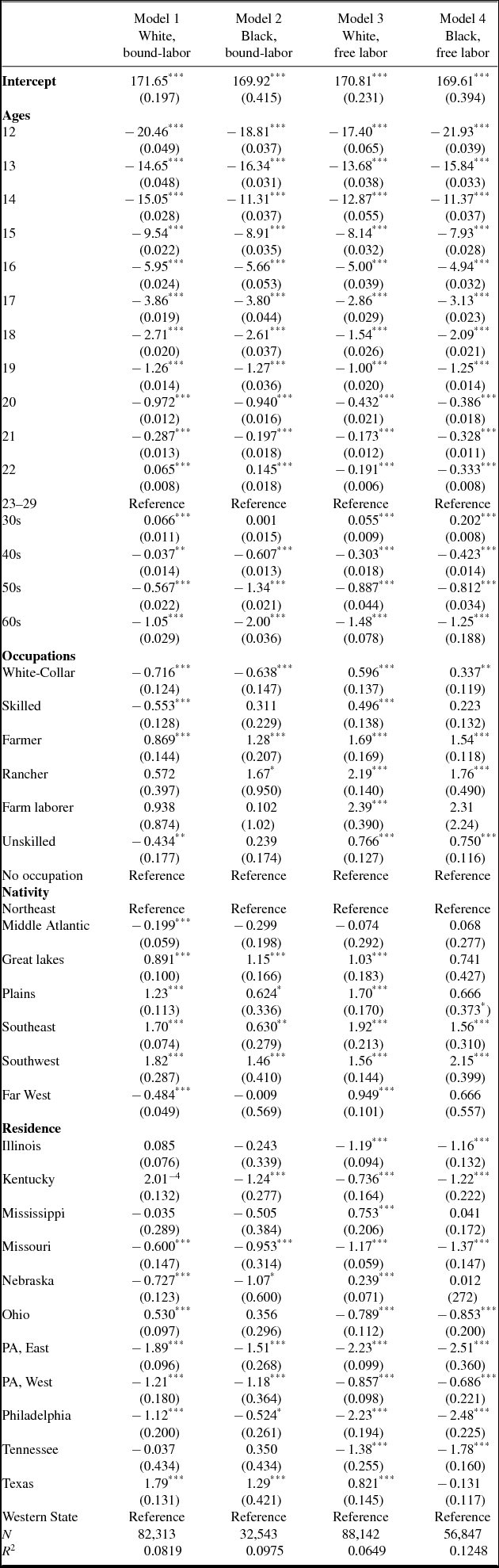
Table 2’s Model 1 is white statures in centimeters as a function of age, occupations, nativity, and residence for birth before 1865. Model 2 does the same for blacks. Model 3 is the white stature model for birth after 1865, and Model 4 does the same for blacks.
Black and white, before and after regression models by demographics and socioeconomic status

Source: See Table 1.
Notes: Robust clustered standard errors on age. ***significant at 0.01; **significant at 0.05; *significant at 0.10.
4.1. Antebellum Period and Bound-Labor
Among the most telling biological relationships that illustrate the effects of the transition from bound to free-labor is the association between stature and age. Catch-up growth is the biological phenomenon where an individual who is deprived of net nutrition during early growth years experiences accelerated stature growth if sufficient net nutrition is restored before stature growth ceases, which allows them to return to their genetically predetermined growth profile [Behrman (Reference Behrman, Komlos and Kelly2016)].Footnote 7 An established pattern in ante-bellum stature studies is that for each age group, young slaves were shorter than whites but experienced greater catch-up growth as they approached adult ages and entered the adult labor force [Steckel (Reference Steckel1986a, p. 724, 1986b), Schneider (Reference Schneider2017)]. For the most part, a significant difference between white and black antebellum youth stature was not present. Komlos (Reference Komlos, Goldin and Rockoff1992, p. 300) indicates slave youth stature recovery among children was weak, and the acceleration in the rate of growth may have been confined to their late teens [Komlos (Reference Komlos, Goldin and Rockoff1992, p. 301, Table 10.2)].
On the other hand, older black stature loss under bound-labor was greater than whites due to years of arduous physical labor associated with age-related degenerative joint disease [Kelly and Angel (Reference Kelly and Angel1987), Rathbun (Reference Rathbun1987, p. 244), Haboubi et al. (Reference Haboubi, Hudson and Pathy1990), Huang et al. (Reference Huang, Lei, Ridder, Strauss and Zhao2013)]. From skeletal remains, blacks under bound-labor exhibited stature loss consistent with high workloads and physical accidents that may not have occurred had older African-Americans been free to choose their occupations and work effort devoted to physical activity throughout life [Davidson et al. (Reference Davidson, Rose, Gutman, Haines, Condron, Condran, Steckel and Rose2002, pp. 267–268), Rathbun (Reference Rathbun1987, pp. 248 and 251), Rathbun and Steckel (Reference Rathbun, Steckel, Steckel and Rose2002, pp. 215–221)]. Moreover, the early onset of degenerative diseases at older ages may be linked to inadequate cellular development in early life [Fogel (Reference Fogel1994, p. 381), Schneider (Reference Schneider2017)]. Subsequently, while black youth stature growth prior to their entry into the adult labor force has been postulated for some time, it is not supported here, and black adult age-related stature loss was greater than whites but decreased with the transition to free-labor.
Under bound-labor, stature variations by occupation results are mixed. White-collar and skilled workers likely received poor net nutrition because of the separation of food production from food consumption [Komlos (Reference Komlos1987), Carson (Reference Carson2008a, pp. 366–368), Dirks (Reference Dirks2016, pp. 39–40 and 60–62)]. Alternatively, white and black general farmers were taller than workers in other occupations, and the occupation–stature relationship for unskilled workers under bound-labor was comparable to workers with no recorded occupation [Carson (Reference Carson2009c, p. 155)]. Under bound-labor, individuals from urbanizing Northeast and Middle Atlantic states were shorter than individuals from elsewhere within the United States, while workers from the Great Lakes and South were taller [Table 2, Model 2; Zehetmayer (Reference Zehetmayer2011 )]. Under bound-labor, slave owners had different incentives to change dietary mixes in response to changes in income and the relative price of food. Southern slave statures were related to efficiency wages, where slave masters and owners had incentives to prevent deterioration in slave nutrition that eroded slave owner wealth [Komlos and Coclanis (Reference Komlos and Coclanis1997, pp. 453–454), Komlos (Reference Komlos1998, pp. 785, 787, and 794)]. Moreover, under bound-labor, the regional advantage that accrued to whites did not extend to blacks native on the Plains, and U.S. born whites in the Far West had lower net nutrition compared to other areas within the United States [Carson (Reference Carson2013b, Reference Carson2015)].
State residence variables account for regional conditions around the time of measurement, and in the case slaves, accounts for state-level treatment. White and black residence under bound-labor on the Plains and Northeast were associated with shorter statures compared to conditions in the Far West and Southwest. Far West bound-labor nativity indicates net nutrition in the Far West was below average during early economic development; however, taller Far West resident statures indicates taller individuals migrated west during bound-labor or encountered better net nutrition after their arrival in the West [Carson (Reference Carson2009c, pp. 152–154)].
4.2. Post Bellum Period and Free-Labor
Black and white stature variation after emancipation is noteworthy and illustrates the cumulative net nutrition changes associated with the transition to free-labor. Under free-labor, adult black age-related stature loss was also lower relative to bound-labor (Table 2, Models 1 and 2). When adult African-Americans were no longer subject to bound-labor, their cumulative net nutrition improved, especially for black men older than 50 [Higgs (Reference Higgs1977, pp. 62–64)].
Under free-labor, the white-black occupational stature relationship improved relative to workers with no occupations [Ransom and Sutch (Reference Ransom and Sutch1977, pp. 31–39)]. Under bound-labor, occupations were not clearly defined, and the majority of workers – whether or not they listed agriculture as their primary occupation – were, in some way, associated with agriculture, if only for transportation and household production [Dimitri et al. (Reference Dimitri, Effland and Conklin2005)]. Under free-labor and early industrialization, labor markets became more specialized, and workers were separated from more nutritious diets associated with agricultural occupations [Rosenbloom (Reference Rosenbloom2002, p. 88)]. Moreover, the cumulative difference in net nutrition increased for white-collar and skilled workers relative to workers under bound-labor, indicating that skilled worker cumulative net nutrition improved with the transition to free-labor [Margo and Steckel (Reference Margo, Steckel, Fogel and Engerman1992, p. 518)]. Higgs (Reference Higgs1977, pp. 33–35) indicates that access to food in urban environments improved under free-labor for poor individuals and access to urban medical care was more readily available. Nonetheless, statures associated with urban residence were more adversely affected than during bound-labor, indicating that urban white-collar and skilled workers did better relative to workers with no occupations under free labor, yet the free-labor effects of urbanization were more acute.
Across the United States, white regional stature returns mostly decreased with the transition to free-labor. After slavery, individuals from the Northeast and Middle Atlantic continued to be shorter than individuals from elsewhere within the United States; Plains workers continued to be taller. However, under free-labor, white and black net nutrition in the Far West experienced a marked improvement, and cumulative net nutrition improved with immigration and the opening of the West [Turner (Reference Turner1893), Carson (Reference Carson2010, Reference Carson2017), Komlos and Carson (Reference Komlos and Carson2017)]. After 1865, immigration increased and new arrivals moved west to take advantage of abundant farm lands in recently settled Plains and Western states [Galloway and Vedder (Reference Galloway and Vedder1971, Reference Galloway and Vedder1980), Cohn (Reference Cohn2009, pp. 173–186), Ferrie (Reference Ferrie1999, pp. 64–70)]. In sum, older black age-related stature loss was greater under bound-labor, and cumulative net nutrition converged to occupations in a developed labor market.
5. BLACK AND WHITE STATURE RETURNS: A DIFFERENCE IN DECOMPOSITIONS APPROACH
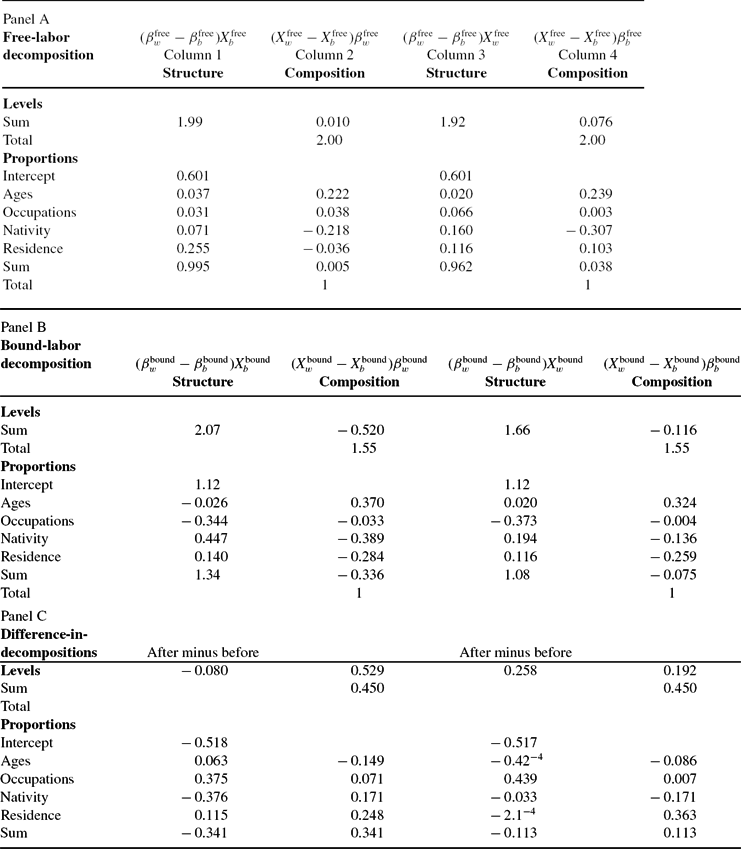
Isolating stature changes across and within racial groups illustrates how comparative net nutrition was related to the transition to free-labor. Table 3’s Panel A is the white-black stature decomposition for individuals born under free-labor (Equation (9)). Panel B is the white-black stature decomposition for individuals born under bound-labor (Equation (10)). Panel C is the across-group difference-in-decompositions, and elements are the stature percent changes across-groups associated with the transition to free-labor (Equation (12)). For example, the intercept difference between free and bound-labor demonstrates how white and black autonomous stature's non-identifiable characteristics varied with the transition to free-labor. If the difference is positive, the white autonomous stature difference increased relative to blacks under free-labor and negative if the white-black difference was greater under bound-labor. From raw means, white statures under bound-labor were 1.43 centimeters taller than blacks. Under free-labor, this advantage increased, and average white statures were 2.01 centimeters taller than blacks (Table 3). The difference-in-decompositions illustrates the source of white and black stature differences associated with the transition to free-labor.

5.1. Across-Group Free-Labor Decomposition
The free-labor across-group decomposition (Table 3, Panel A) demonstrates that white stature returns were positive for unidentified sources in the intercept, age, occupations, nativity, and residence. Under free-labor, white average ages were older than blacks and were a greater source of the age-related stature difference (Table 1). Residence at time of measurement accounted for the greatest white stature advantage. There were also more blacks in the South who had taller average statures because the South was agriculturally more productive than other regions within the United States [Ransom and Sutch (Reference Ransom and Sutch1977, pp. 150–155), Carson (Reference Carson2008b, 2009c)]. Most of the free-labor white–black stature differential was due to differences in stature returns and not average characteristics.
5.2. Across-Group Bound-Labor Decomposition
The across-group bound-labor decomposition demonstrates that white stature returns were greater than blacks for the intercept and residence (Table 3, Panel B, columns 1 and 3). However, blacks had large stature returns by socioeconomic status, and little of the difference was associated with differences in sample compositions, indicating there were large cumulative net nutrition differences by socioeconomic status under bound-labor. The greatest share of the white bound-labor stature advantage was returns to nativity. For example, whites in the Southeast stature returns were over 100% greater than Southeastern black stature returns (Table 2, Models 1 and 2). Nevertheless, under bound-labor, blacks remained in the South, where net nutrition was high [Table 3, Panel B, Columns 1 and 3; Hilliard (Reference Hilliard1972), Carson (Reference Carson2008b, 2009a)]. Most of the white-black bound-labor stature differential was due to returns to characteristics rather than average characteristics.
5.3. Across-Group Difference-in-Decompositions
Table 3, Panel C, illustrates that free and bound-labor percent differences were due to both changes in returns and average characteristics. Arnold Plant (1947, pp. 3–16) and Woodward (Reference Woodward1951, p. 134) propose that after slavery, lower socioeconomic status whites were unable to compete with recently freed slaves and created political barriers to black upward economic mobility through Jim Crow laws and disparate access to human capital [Collins and Margo (Reference Collins, Margo, Hanushek and Welch2006, Tables 1, 2, and 6), Tribe (Reference Tribe, Mirowski and Plehwe2009, pp. 80 and 92)]. By 1896, these white economic and legal advantages were codified throughout the United States under Plessy v. Ferguson when the Supreme Court upheld disparate white and black access to public resources. However, if whites displayed greater discrimination with the transition, blacks would not have made as much net nutritional progress. With the transition to free-labor, the 0.450 centimeters increase in white relative to black statures demonstrates there was an increase in white relative to black net nutrition with the transition to free-labor (Table 3, Panel C).Footnote 8 Subsequently, rather than being worse-off with the transition to free-labor, white net nutrition was better off relative to blacks with the transition to free-labor.
The difference-in-decompositions isolates other sources of the free and bound-labor differences due to characteristics and returns to average characteristics. Whites were taller than blacks under free-labor due to greater stature returns to occupations. For the most part, cumulative net nutrition by nativity in the South before and after slavery was favorable toward blacks. Consequently, the across-group difference-in-decompositions illustrates that white statures increased relative to blacks with the transition to free-labor, and the source of the advantage was greater white stature returns to socioeconomic status under free-labor.
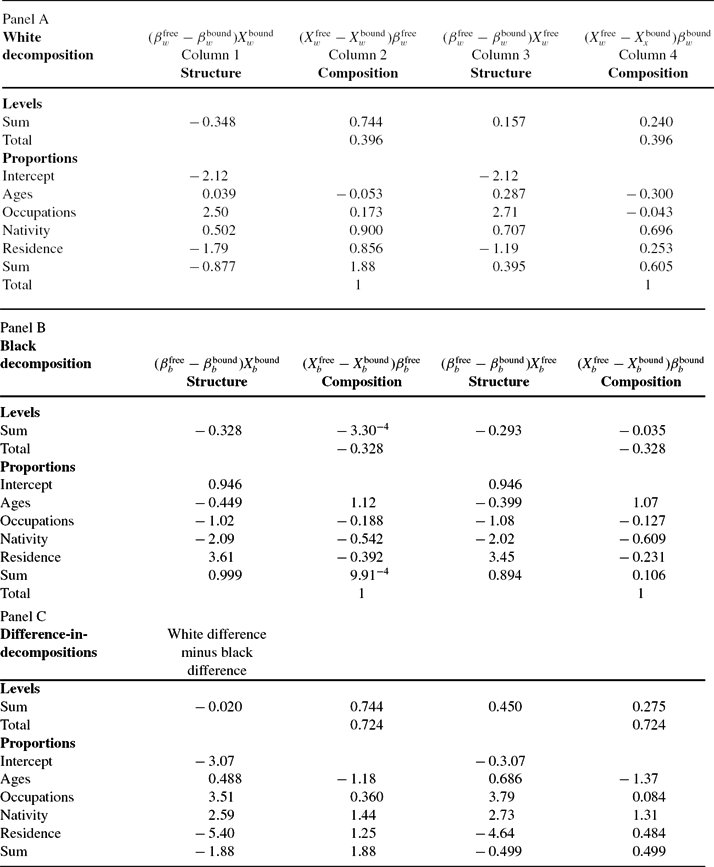
5.4. Within Group Free and Bound Stature Decompositions
Table 4’s Panel A is the white free and bound-labor within-group stature decomposition (Equation (13)). Panel B is the black free and bound-labor within-group stature decomposition (Equation (14)). Panel C is the within-groups difference-in-decompositions between free and bound-labor, which isolates the difference between how white and black statures varied within racial groups with the transition to free-labor (Equation (16)). Panel C elements are the within-group stature percent changes associated with the transition to free-labor. For example, if within-group element differences are positive, white within-group stature differences were greater with the transition to free-labor and negative if the black within-group stature differences were greater with the transition to free-labor.

5.5. White Within-Group Decomposition
Table 4’s Panel A shows that white within-group cumulative net nutrition improved with free-labor, 0.396; however, from the proportion intercept, the autonomous white cumulative net-nutrition was greater under bound-labor, −2.12. Under bound-labor, whites had an institutionalized advantage compared to their free-labor conditions, and the removal of that advantage decreased the net nutrition of whites during free-labor compared to whites during bound-labor. White within-group age returns were greater under free-labor, yet white average age was older under bound-labor. However, with the transition to free-labor, the increase in white returns to socioeconomic status offset the white within-group change in the intercept. For example, labor market development under free-labor more clearly defined occupational categories and increased white relative net nutrition, and socioeconomic status was the primary characteristic associated with improvements in white statures; there were only minor white average occupation differences. White stature returns associated with nativity were greater under free-labor (Table 3, Panel B), yet free-labor nativity also had greater average returns than whites under free-labor (Table 4, Panel A).
5.6. Black Within-Group Decomposition
Stature returns within the African-American cohort with the transition to free-labor were even more pronounced than whites. In aggregate, black statures decreased with the transition to free-labor; however, the source of the variation was important. Blacks received greater cumulative net nutrition under bound-labor due to age, occupation, and nativity (Table 4, Panel B). However, black age returns were comparatively small, and black average age was older under free-labor. The greatest source of the black within-group stature variation was residence, which was considerably higher under free-labor. The average stature difference associated with socioeconomic status, nativity, and residence were larger under bound-labor. There were more blacks in the South under bound-labor, and the South was more agriculturally productive than elsewhere within the United States [Sunstrom (Reference Sunstrum, Whaples and Parker2013, p. 324), Farley and Allen (Reference Farley and Allen1987, pp. 113 and 118), Gregory (Reference Gregory2005)]. Most of the black within-group stature difference between free and bound-labor was due to greater black free-labor returns to characteristics.
5.7. Within-Group Difference-in-Decompositions
Decomposing white and black stature differences within-groups is insightful. Table 4’s Panel C shows that the white within-group free-labor statures increased by 0.724 centimeters relative to blacks; however, the negative within-group stature intercept difference, −3.07, indicates white autonomous stature differences relative to blacks were greater under bound-labor. By ages, white stature returns were greater with the transition to free-labor; however, blacks were older under bound-labor. By occupations, the white relative to black stature gap increased considerably with the transition to free-labor, and there was little difference in occupation compositions, indicating that much of the improvement in white net nutrition was associated with free-labor structural returns to socioeconomic characteristics. There were large net nutrition returns by nativity that favored whites with the transition to free-labor, however, large net nutrition returns to residence that favored whites under bound-labor. In sum, the white within-group stature return variation associated with occupations and socioeconomic status were the primary source of the white within-group stature advantage, followed by nativity and age.
6. CONCLUSION
Plant, Woodward, and Tribe suggest that whites with the transition to free-labor were unable to compete with recently freed blacks. Beyond the Civil War itself, the greatest race related conflagration in U.S. history was the 1863 race riots in lower Manhattan, where lower class whites were unwilling to fight to free African-Americans, in part, because they perceived free-blacks as competing with them for low skilled occupations. However, with the transition to free labor, white cumulative net nutrition improved relative to blacks, and the source of the advantage was due to greater stature returns under free-labor. Whites under free-labor were also better-off across groups relative to blacks and relative to whites under bound-labor. This study compares changes in the cumulative net nutrition of whites and blacks born before and after slavery and finds that black adult age-related stature loss under bound-labor was greater than whites. African-American adult age-related stature loss under bound-labor was likely due to years of arduous labor associated with degenerative joint disease and environmental insults unique to enslaved blacks. By occupations, the across-group difference-in-decompositions illustrates that labor market development and the transition to free-labor benefited whites more than blacks, and Southern white cumulative net nutrition was markedly better than Southern blacks under bound-labor. A priori, disparate net cumulative nutritional conditions across race suggests there should have been greater variation across rather than within groups. However, cumulative net nutrition conditions were greater within-groups, especially by socioeconomic status. Subsequently, with the transition to free-labor, there was greater cumulative net nutrition variation within rather than across-groups and white's cumulative net nutrition improved relative to African-Americans with the transition to free-labor, yet that improvement was associated with free-labor returns to characteristics.