Introduction
Research consistently demonstrates that visit-to-visit blood pressure variability (BPV) elevates the risk for stroke independent of mean systolic BP (Webb et al. Reference Webb2010). A more recent body of work indicates that BPV is associated with cognitive decline (Sabayan et al. Reference Sabayan2013) and dementia (Alperovitch et al. Reference Alperovitch2014) but the clinical relevance of BPV remains controversial (Dolan & O'Brien Reference Dolan and O'Brien2015). Depression is also associated with BPV in the short-term (e.g. beat-to-beat, hourly measures) (Virtanen et al. Reference Virtanen2003; Scuteri et al. Reference Scuteri2009; Symonides et al. Reference Symonides2014) however the effect over longer periods remains unknown (Nagai et al. Reference Nagai2012; Sabayan et al. Reference Sabayan2013; Yano et al. Reference Yano2014; Conway et al. Reference Conway2015). Surprisingly, no previous study has contemporaneously examined the longitudinal effects of BPV on cognitive decline and depression especially in older cohorts.
Among the clinical presentations of depression, late onset depression (LOD) is frequently comorbid with cerebrovascular disease (CVD), and cognitive dysfunction (Naismith et al. Reference Naismith2012) pointing to the possibility of shared mechanisms with BP and its variability. Principal among these comorbidities, periventricular and subcortical white matter lesions (WMLs) shown as hyperintensities [white matter hyperintensity (WMH)] on T2-weighted magnetic resonance imaging (MRI) is considered the hallmark feature of vascular LOD (Sneed et al. Reference Sneed2008; Taylor et al. Reference Taylor, Aizenstein and Alexopoulos2013). The progression of CVD and WMLs are closely related to systolic BP (Qiu et al. Reference Qiu, Winblad and Fratiglioni2005; Tzourio et al. Reference Tzourio, Laurent and Debette2014) and BPV (Havlik et al. Reference Havlik2002; Gunstad et al. Reference Gunstad2005; Brickman et al. Reference Brickman2010), highlighting BPV as a plausible mechanism impinging on cerebrovascular integrity. Specifically, systolic BPV has been linked with global cognitive performance (Nagai et al. Reference Nagai2012; Sabayan et al. Reference Sabayan2013; Conway et al. Reference Conway2015), psychomotor speed and executive function (Yano et al. Reference Yano2014). These emerging findings parallel the cognitive deficits observed in vascular LOD (Pimontel et al. Reference Pimontel2013) from disrupted fronto-striatal circuits (Taylor et al. Reference Taylor, Aizenstein and Alexopoulos2013). Executive dysfunction in LOD might clinically present as difficulties with psychomotor speed and verbal fluency (Alexopoulos Reference Alexopoulos2001). Thus the affected and spared cognitive domains, and cerebral regions, documented in vascular LOD coalesce with the emerging BPV-cognition literature.
The current study extends beyond previous reports by examining BPV in relation to depression and cognitive decline in a prospective cohort of elderly individuals who underwent serial neurological, BP and depression assessments over a 10-year period. We hypothesized that systolic BPV would be significantly associated with LOD but not early onset depression (EOD) or no depression disorder. Secondly, we hypothesized that the interaction between systolic BPV and LOD would be associated with accelerated decline in verbal fluency, psychomotor speed, and executive function over time. In a MRI substudy, we investigated the association between BPV with cognitive decline taking baseline WMH volumes into consideration. We hypothesized that the interaction between BPV with depression and WMH volume would be significantly associated with cognitive decline, and this would be evident with deep WMH more so than periventricular WMH (Sneed et al. Reference Sneed2008).
Methods and materials
Population
The Three-City (3C) Study is a French prospective cohort study investigating the determinants of dementia, CVD and stroke as reported previously (The 3C Study Group, 2003; Alpérovitch et al. Reference Alpérovitch2015; Torres et al. Reference Torres2015). Briefly, 9294 non-institutionalized community dwelling adults aged 65 years or older were sampled from the electoral rolls of Dijon, Bordeaux and Montpellier cities. The current analyses use only participants from Dijon because this site utilized the same cognitive tests across study waves and included a MRI substudy. Participants underwent baseline neurological examinations and serial follow-up was scheduled approximately 2, 4, 7, and 10 years later. Participants from Dijon were eligible for the current study if they did not have dementia or stroke at baseline and completed at least the 4-year follow-up when depression disorders were reassessed, and to provide a sufficient number of clinic visits for estimating BPV (Tully et al. Reference Tully2016a). Persons who developed incident stroke over follow-up were also excluded from the main analysis (n = 58) because clinical strokes abruptly affect cognitive function and may result in lower BPV. Differences between the participating recruitment sites and the excluded participants are reported in the eSupplement. The study protocol was approved by the Ethical Committee of the University Hospital of Kremlin-Bicêtre and each participant provided signed and informed consent.
Primary exposure: BPV
Clinic BP was measured according to a standardized protocol as previously reported (Brindel et al. Reference Brindel2006). Clinic BP was measured three times, separated by 2 min after the subject rested at least 5 min in a seated position. An appropriately sized cuff was placed on the left arm and BP was measured using a validated digital electronic tensiometer OMRON M4 (OMRON Corp., Kyoto, Japan). Three measures were taken at each clinic visit in the first 4 years (up to a maximum of 9 BP readings from baseline, year 2 and year 4). We utilized the coefficient of variation (CV) method to calculate BPV between baseline and year 4 (eSupplement) because of the prognostic association with cerebrovascular outcomes (Tai et al. Reference Tai2015) and its recommended use when estimating longer-term BPV (Parati et al. Reference Parati2013). Systolic and diastolic BPV values were log transformed.
Assessment of depression and depressive symptoms
For depression assessment participants underwent face-to-face interviews with trained clinical psychologists. The MINI International Neuropsychiatric Interview (MINI) (Sheehan et al. Reference Sheehan1998) was used at baseline, 4, 7 and 10-year follow-up. The MINI has established psychometric validity for affective disorders including inter-rater agreement and concurrent validity with other structured clinical interviews (Lecrubier et al. Reference Lecrubier1997). The current study utilized only the major depression and dysthymia MINI modules. Age of depression onset was determined at interview by asking participants the age of onset of their first depression episode, age of onset of the most recent depression episode (if not current), and age of onset of the current depression episode. Ages of 50, 60, and 65 years have been commonly used to determine age of onset (Naismith et al. Reference Naismith2012) and we dichotomized LOD age of onset at age 60 years or older (Tully et al. Reference Tully2016c). Thus, any major depression or dysthymia disorder identified at baseline or during follow-up with an age of onset ⩾60 years was categorized as LOD. Onset age 59 or younger was categorized as EOD. No other clinical data were available regarding lifetime depression, psychiatric history, or inpatient records. Symptomatic depression was assessed at baseline and every follow-up with the Centre for Epidemiological Studies-Depression (CESD) scale and scores ⩾16 are indicative of clinically relevant depressive symptoms (Radloff, Reference Radloff1977). Participants were stratified based on depressive disorder and having two or more CESD measures in the symptomatic range (total score ⩾16). Participants were stratified into one of six groups (dummy coded) based on depressive disorder and having two or more CESD measures in the symptomatic range (total score ⩾16). The categories were; LOD-symptomatic, EOD-symptomatic, no depression disorder-symptomatic, LOD-asymptomatic, EOD-asymptomatic, no depression disorder history, and asymptomatic (reference). The rationale was to discriminate between persons with symptomatic depression, asymptomatic depression, and also account for the duration of depressive illness and severity because individuals with persistent depressive symptoms exhibit more rapid deterioration in brain function and pathology (Riddle et al. Reference Riddlein press).
Assessment of cognitive function
Participants underwent assessments with a battery of validated cognitive tests administered by trained clinical psychologists. The Trail Making Test (TMT) (Armitage, Reference Armitage1946) is a test of visual attention, processing speed, mental flexibility, and broadly representative of executive function. The ratio of time to complete section B divided by the time to complete section A was used as the performance measure because this is shown to measure executive function independent of processing speed and working memory (Sanchez-Cubillo et al. Reference Sanchez-Cubillo2009). TMT scores were multiplied by −1, so that negative β values signify worse performance. Isaac's Set Test (IST) evaluates verbal fluency abilities and speed of verbal production (Isaacs & Kennie, Reference Isaacs and Kennie1973). Respondents have to give a list of words belonging to a specific semantic category in 30 s. Four semantic categories were successively used (cities, fruits, animals, and colors). The Benton Visual Retention Test (BVRT) evaluates immediate visual recognition memory and attention (Benton, Reference Benton1945). After the presentation for 10 s of a stimulus card displaying a geometric figure, respondents are asked to choose the initial figure among four possibilities; 15 figures are successively presented. The Mini Mental State Examination (MMSE) tests global cognitive function (Folstein et al. Reference Folstein, Folstein and McHugh1975). The Finger Tapping Test (FTT) is a test of psychomotor speed and manual dexterity. Participants completed two trials each of 60 s duration with their dominant and non-dominant hand (four trials in total). The average number of taps was the performance measure. TMT was not assessed at the 2-year follow-up, and FTT was only assessed at the 7- and 10-year follow-up. All other tests were completed at baseline and each wave of follow-up. Diagnoses of dementia was made by local neurologists according to DSM-IV criteria and then adjudicated by a panel of independent neurology experts (The 3C Study Group, 2003).
MRI scans
The parameters of the MRI examination in 3C were reported previously (The 3C Study Group, 2003) and described more fully in the eSupplement. The MRI evaluation of WMH excluded participants with brain tumor and unknown stroke history. All brain scans were acquired using the same MRI machine (1.5 T; Siemens, Erlangen) and the same standardized image acquisition protocol. First, a three-dimensional (3D) high-resolution T1-weighted brain volume was acquired using a 3D inversion recovery fast spoiled-gradient echo sequence (3D SPGR; TR, 9.7 ms; TE, 4 ms; TI, 600 ms; coronal acquisition). The axially reoriented 3D volume matrix size was 256 × 192 × 256, with a voxel size of 1.0 × 0.98 × 0.98 mm3. Second, T2-weighted brain volumes were acquired using the same 2D fast spin-echo sequence with two echo times (TR: 4400 ms; TE1: 16 ms; TE2: 98 ms). T2 acquisition consisted of 35 3.5-mm-thick axial slices (with 0.5-mm spacing between slices), having a matrix size of 256 × 256, and an in-plane resolution of 0.98 × 0.98 mm2.
Details of WMH estimation is described more fully elsewhere (Maillard et al. Reference Maillard2008). Fully automatic image processing software was developed to detect, measure, and localize WML using multispectral (T1, T2, PD) segmentation and identifying different classes of WMH voxels. Definitions of the region of interest are provided in the eSupplement. Some false positives corresponded to voxels that were white matter but not hyperintensities, i.e. voxels with a very low intensity but a higher probability of belonging to the WMH than to the white matter category (this may occur because the variance of WMH voxels is larger than that of white matter). Consequently, WMH with a mean T2 signal intensity below that of white matter were excluded.
WML load was expressed as the total volume of WML normalized by the volume of the WM mask, which accounts for both head size and for the T2 image acquisition actual field of view. WMH were classified according to distance to the ventricle as periventricular (<10 mm) or deep, and we did not differentiate juxtaventricular WMH. Periventricular WMH volume and deep WMH volume were estimated by adding up the volumes of all hyperintensities detected in each of these areas. WML volume was log-transformed [natural log of (volume in mL + 1)]. The quantification of WMLs was compared and validated against a neurologist visual rating blinded to covariates (Maillard et al. Reference Maillard2008) using a modified version of the Scheltens scale (Scheltens et al. Reference Scheltens1992), which provides an overall WMH grade; none, mild, moderate, and severe. Parallel imaging and fluid-attenuation inversion recovery (FLAIR) sequences were not acquired in the 3C study.
Assessment of covariates
Reported in the eSupplement.
Statistical analyses
Descriptive comparisons utilized the general linear model, Kruskal–Wallis test, and Mantel–Haenszel test. The first set of analyses established whether BPV was associated with specific depression subtypes. BPV was modeled with curve fitting and maximum-likelihood estimation, which showed that a linear normal-identity distribution provided the most appropriate fit. Two sets of regressions were run to establish the association between BPV and the onset of depression, utilizing independent variables, (1) EOD and LOD (v. no depression), and (2) symptomatic v. asymptomatic LOD and EOD (v. no depression). The regressions entered the depression categories described above into the model with age, sex, education, and mean systolic BP. In the second step, covariates were added; antihypertensive drug use for hypertension, coronary heart disease, arrhythmia, chronic kidney disease (CKD), diabetes, body mass index (BMI), hypercholesterolemia, smoking status, alcohol intake, coffee consumption, apolipoprotein E ε 4 allele (APOE), and psychotropic drug use. These analyses were performed separately for systolic and diastolic BPV.
The relationship between BPV and depression with cognitive decline in each cognitive test was assessed with linear mixed models to estimate within and between subject effects and change over time. As other authors note, mixed models has several advantages for repeated measurements on the same individual are performed including great flexibility to model time effects, and adequately handle missing data (Marijnissen et al. Reference Marijnissen2017). The mixed models specified correlated residuals within subjects and random effects with restricted maximum likelihood function and robust covariance estimation. The data analysis assessed the slope of cognitive function over time, utilizing a random slope and random intercept. In the first instance, we stratified by symptomatic depression and tested interaction terms between time with depression groups and BPV. Separate models were run for systolic and diastolic BPV. All mixed models were adjusted for the abovementioned covariates. A sensitivity analysis was also performed for systolic BPV excluding persons who developed dementia during follow-up to remove any floor-effects in the cognitive tests.
In the MRI substudy, we examined change in cognitive function using repeated measures analysis of variance (ANOVA), adjusted for age, sex, education, APOE, and mean systolic BP. Because of the smaller MRI dataset we were only able to stratify the analyses by depression disorder (LOD, EOD, no disorder) and by symptomatic status over follow-up (symptomatic or asymptomatic on CESD) in two separate analyses. We entered main and interaction effects for time, depression, systolic BPV, and WMH volume. A set of ancillary analyses assessed these main and interaction effects according to deep and periventricular WMH volumes to identify whether WMH in specific brain locations was associated with cognitive decline. All analyses were performed with PASW for Windows® version 22.0, a p value ⩽0.05 was considered as statistically significant.
Results
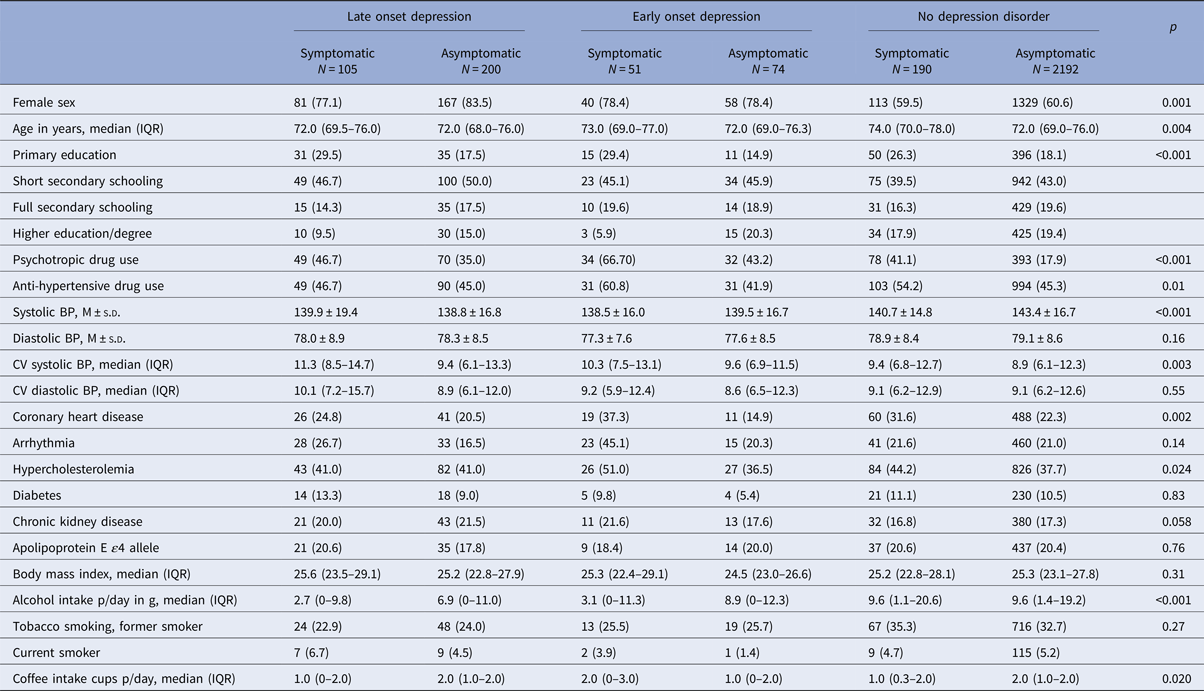
The final sample includes 2812 participants with a median age of 72 years [interquartile range (IQR) 69–76] and was comprised 63.6% females. Classification by depression onset and CESD scores was; 3.7% LOD-symptomatic, 7.1% LOD-asymptomatic, 1.8% EOD-symptomatic, 2.6% EOD-asymptomatic, 6.8% no depression disorder-symptomatic, and 78% no depression disorder-asymptomatic (Table 1). There were differences between depression groups on key variables including median age, sex, education, psychotropic and antihypertensive drug use, systolic and diastolic BP, systolic BPV, coronary heart disease, hypercholesterolemia, alcohol intake, and coffee consumption.
Characteristics of study participants according to depression status (N = 2812)

BP, blood pressure; CV, coefficient of variation; IQR, interquartile range.
Early onset depression, onset age <60 years.
Late onset depression, onset age >60 years.
Symptomatic depression determined as Centre for Epidemiological Studies-Depression scale scores ⩾ 16 on 2 or more assessments.
Association between BPV and depression onset
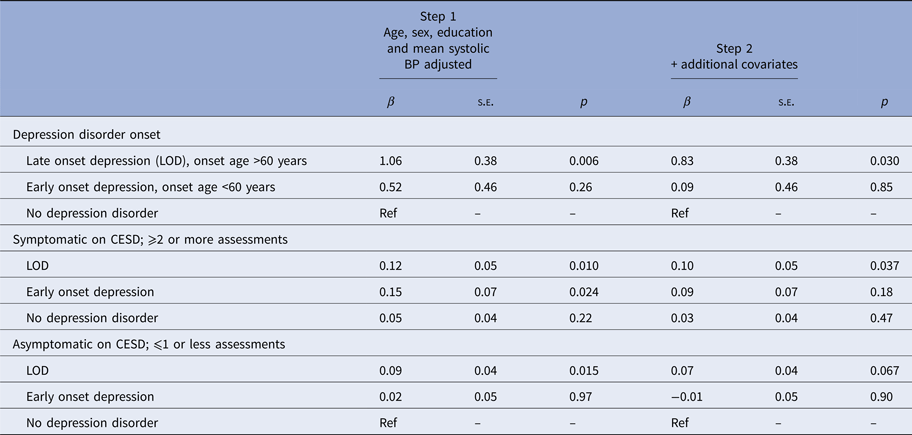
The regressions reporting the association between systolic BPV and depression groups are reported in (Table 2). Mean BPV by depression group is shown in eFig. 2. Higher systolic BPV was significantly associated with LOD after adjustment for covariates (β = 0.83, p = 0.03). Further stratification of LOD and EOD by symptomatic depression on the CESD indicated that systolic BPV was associated with symptomatic LOD (β = 0.10, p = 0.037) in fully adjusted analyses. Systolic BPV was associated with EOD-symptomatic (β = 0.15, p = 0.024) and LOD-asymptomatic (β = 0.09, p = 0.015) in analyses adjusted for age, sex, education and mean systolic BP but not fully adjusted models. Depression groups were not significantly associated with higher diastolic BPV (eSupplement Table 1).
Association between depression and systolic blood pressure variability over 10 years (N = 2812)

APOE, apolipoprotein E ε 4 allele; BMI, body mass index; BP, blood pressure; CESD, Center for Epidemiologic Studies Depression Scale; CHD, coronary heart disease; CKD, chronic kidney disease; s.e., standard error.
Step 1 adjusted for age, sex, education and mean systolic blood pressure.
Step 2 additionally adjusted for antihypertensive drug use for hypertension, CHD, arrhythmia, CKD, diabetes, BMI, hypercholesterolemia, smoking status, alcohol intake, coffee consumption, APOE, cancer, and psychotropic drugs.
Longitudinal association between BPV and depression with cognitive function
Raw cognitive test scores at baseline are provided in the eSupplement Table 2. The results of the mixed model analyses utilizing systolic BPV are reported in Fig. 1. The interaction between systolic BPV, LOD-symptomatic and time was generally associated with cognitive decline. The systolic BPV, LOD-symptomatic and time interaction was associated with verbal fluency (IST: p = 0.040), immediate visual memory (BVRT: p = 0.049), general cognitive function (MMSE: p = 0.007), and psychomotor function (FTT: p = 0.017). The main and interaction terms for systolic BPV, LOD-symptomatic and time was not significant for processing speed (TMTA: p = 0.79) or executive function (TMTB/A: p = 0.23).
Forest plots showing the β and 95% CI for cognitive decline (slope) in mixed models entering depression, systolic BPV and their interaction terms. BPV, blood pressure variability; CI, confidence interval; EOD, early onset depression; LOD, late onset depression; (a) IST, Isaac's Set Test; (b) BVRT, Benton Visual Retention Test; (c) MMSE, Mini Mental State Examination; (d) FTT, finger tapping test; (e) TMT-A, Trail Making Test-Part A multiplied by negative 1; (f) TMT B/A, ratio of time to complete Trail Making Test Part B divided by time to complete Trail Making Test Part A multiplied by negative 1.

The diastolic BPV, depression and time interaction terms were not significant and thus excluded from the final diastolic BPV models (eSupplement Table 3). The mixed model analyses of diastolic BPV showed that LOD-symptomatic was associated with verbal fluency (IST: p = 0.029) and immediate visual memory (BVRT: p = 0.041). Diastolic BPV was associated with visual memory (BVRT: p = 0.001), general cognitive function (MMSE: p = 0.039), and processing speed (TMTA: p = 0.014). Notably, mean systolic and diastolic BP were not significantly associated with cognitive decline in the mixed models.
The sensitivity analysis excluding persons who developed dementia generally corroborated the above findings. The systolic BPV, LOD-symptomatic, and time interaction were associated with verbal fluency [IST: β = −6.15, 95% confidence interval (CI) −10.61 to −1.69, p = 0.007], immediate visual memory (BVRT: β = −1.13, 95% CI −2.11 to −0.15, p = 0.024), general cognitive function (MMSE: β = −1.05, 95% CI −2.01 to −0.08, p = 0.034), psychomotor function (FTT: β = −8.18, 95% CI −15.41 to −0.94, p = 0.027), processing speed (TMTA: β = −1.05, 95% CI −2.01 to −0.08, p = 0.034) but not executive function (TMTB/A: β = −8.03, 95% CI −16.79 to 0.72, p = 0.072).
MRI substudy
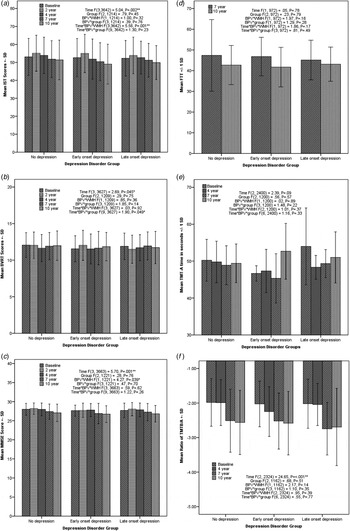
In the MRI substudy, repeated-measures ANOVA analyses showed several interaction effects between systolic BPV, depression and WMH. A scatterplot of WMH volumes and BPV is shown in eFigs 3 and 4. In analyses stratified by depression disorder (Fig. 2), verbal fluency was associated with a three-way time by systolic BPV by WMH volume interaction [IST: F(3, 3642) = 5.56, p = 0.001]. Immediate visual naming was associated with a three-way time by systolic BPV by depression disorder interaction [BVRT: F(9, 3627) = 1.90, p = 0.049]. General cognitive function was associated with systolic BPV by WMH volume interaction [MMSE: F(1, 1221) = 4.27, p = 0.039]. There were no main or interaction effects observed for TMTA, TMTB/A, or FTT. Analysis stratified by symptomatic depression provided the same interaction effects described above with the addition of a systolic BPV by symptomatic depression main effect for immediate visual naming [BVRT: F(2, 1257) = 3.09, p = 0.046].
Forest plots showing the mean and standard deviation for cognitive test scores in repeated measures ANOVA entering depression group, systolic BPV, white matter hyperintensity volume and their interaction terms. BPV, blood pressure variability; (a) IST, Isaac's Set Test; (b) BVRT, Benton Visual Retention Test; (c) MMSE, Mini Mental State Examination; (d) FTT, finger tapping test; (e) TMT-A, Trail Making TestPart A multiplied by negative 1; (f) TMT B/A, ratio of time to complete Trail Making Test Part B divided by time to complete Trail Making Test Part A multiplied by negative 1.

Ancillary analysis
In the MRI substudy, all above interactions were reproduced when stratifying analysis by deep and periventricular WMH suggesting systolic BPV interactions were not specific to the location of WMH. Only general cognitive function was associated with periventricular WMH by systolic BPV interaction [MMSE: F(1, 1221) = 5.07, p = 0.024] and not deep WMH volume by systolic BPV interaction.
Discussion
This study adds to the extant literature by demonstrating a consistent association between systolic BPV with symptomatic depression and cognitive decline. Specifically, systolic BPV was associated with cognitive decline via interactions with symptomatic LOD in the main analysis. This association was evident for all cognitive measures apart from TMTA and TMTB/A, highlighting global cognitive function, visual memory, verbal fluency, and psychomotor speed as affected by systolic BPV and symptomatic LOD. By contrast, diastolic BPV was unrelated to depression, and less consistently associated with cognitive decline. The MRI substudy corroborated that systolic BPV was associated with cognitive decline via interactions with depression and WMH volume, both deep and periventricular.
Here we demonstrated that LOD was associated with higher systolic BPV supporting our first hypothesis. These findings extend the observation that depression disorder is associated with higher BPV over short periods (e.g. beat-to-beat) (Virtanen et al. Reference Virtanen2003; Scuteri et al. Reference Scuteri2009; Symonides et al. Reference Symonides2014), though no previous study discriminated between LOD and EOD. Our second hypothesis was also supported considering that the systolic BPV and symptomatic LOD interaction was associated with cognitive decline in verbal fluency, immediate visual memory, psychomotor speed and general cognitive function in the mixed models. Our findings parallel recent cross-sectional BPV studies showing that higher BPV is associated with psychomotor speed and executive function (Yano et al. Reference Yano2014) and global cognitive performance measured by the MMSE (Nagai et al. Reference Nagai2012; Sabayan et al. Reference Sabayan2013; Conway et al. Reference Conway2015). The MRI substudy corroborated that higher systolic BPV was associated with cognitive decline via interactions with WMH and symptomatic depression. The MRI substudy supports several large longitudinal studies on BPV and higher WMH volume (Havlik et al. Reference Havlik2002; Gunstad et al. Reference Gunstad2005; Brickman et al. Reference Brickman2010). Our findings raise the possibility that cognitive decline is an expression of WMH potentiated by symptomatic depression and systolic BPV. Previously we showed that BPV increased the risk of dementia onset in this sample (Alperovitch et al. Reference Alperovitch2014) that was dependent on antihypertensive drug treatment with non-dihydropyridine calcium channel blockers and loop diuretics (Tully et al. Reference Tully2016a).
The clinical implications of these findings closely relate to depression treatment augmentation with antihypertensive drugs that lower systolic BPV. A large meta-analysis demonstrated that BPV is lowered by calcium channel blockers and non-loop diuretics (Webb et al. Reference Webb2010). This finding parallels clinical recommendations that augmentation of antidepressant regimen with calcium channel blockers was preferential in persons with LOD (Naismith et al. Reference Naismith2012). Supporting this recommendation, a study of fluoxetine augmentation with nimodipine (Taragano et al. Reference Taragano, Bagnatti and Allegri2005) showed significantly improved response on the Hamilton Depression Rating Scale and depression remission (Taragano et al. Reference Taragano, Bagnatti and Allegri2005). Otherwise, the role of calcium channel blockade has been predominantly implicated in bi-polar depression (Casamassima et al. Reference Casamassima2010) and Alzheimer's disease (Amenta et al. Reference Amenta2008). It is less clear whether specific types of antihypertensive drugs can mitigate cognitive decline or progression to dementia (Tully et al. Reference Tully2016b) especially in persons with WMH and concomitant LOD.
This study's strengths include a well defined cohort, comprehensive neurological and cognitive assessment over 10 years, serial BP assessment and use of a structured depression interview. Several limitations temper the conclusions drawn here including that we cannot infer causality between the observational measures and cognitive decline. Other limitations relate to the methodology including that the neuropsychological tests and the MINI were not performed at all follow-up points. Without comparison to normative data, it is difficult to ascertain the pattern and extent to which this sample has cognitive decline. Also, the cognitive test battery did not examine delayed-memory recall, a key cognitive domain that is impaired in Alzheimer's disease. As such, it is possible that persons with mild cognitive impairment and Alzheimer's disease were included in our sample at baseline and not identified by the neurologist panel. Moreover, persons with LOD are especially susceptible to dementia and extensive work indicates that hippocampal volume loss in LOD increases the risk for dementia (O'Brien et al. Reference O'Brien1994; Hickie et al. Reference Hickie2005; Steffens et al. Reference Steffens2011; Jayaweera et al. Reference Jayaweera2016). Depression onset was determined at interview and would be unreliable in persons with memory impairments and is prone to retrospective reporting biases (Sneed et al. Reference Sneed, Roose and Sackeim2006). Also self-reports are less accurate than verified use of psychiatric treatments which could be garnered from psychiatric hospitalizations and outpatient data, which we did not utilize. A related point is that psychotropic drug use is higher in French samples compared with other European and North American samples. Specifically, a French national cohort study among 36 785 persons estimated anxiolytic use at 19.4%, antidepressants use at 11.6%, and hypnotic use at 9.2% (Grolleau et al. Reference Grolleau2008). Another limitation is that we only quantified WMH volumes in a sub-sample of participants at baseline using 1.5 T MRI. A related point is that detection of WMH is commonly performed using FLAIR imaging, which we did not utilize in the 3C Dijon MRI study. Other limitations relate to the measurement of BP. The interval between BP assessments was 2–3 years, which may have less prognostic value than 24-h, diurnal and ambulatory BPV measures. Also, we utilized the CV method and other methodologies may produce different results. Finally, participants who were lost to follow-up were characterized by higher proportion of cardiovascular comorbidities such as arrhythmia that affect cognitive function (Taylor et al. Reference Taylor, Steffens and Krishnan2006). Other important factors such as physical activity level, disability, sleep apnea, and predicted IQ are related to LOD and cognitive function and these were not assessed. As such, control for these important clinical factors would be important in future studies on LOD and cognitive function.
In conclusion, systolic BPV was associated with cognitive decline via interactions with symptomatic depression and WMH over a 10-year period in this elderly cohort. The collective findings support our hypothesis that systolic BPV increases cognitive decline via interactions with symptomatic depression and WMH. Future work might extend these findings by evaluating BPV prospectively with respect to incident ‘vascular depression’ and other depression subtypes.
Supplementary material
The supplementary material for this article can be found at https://doi.org/10.1017/S0033291717002756
Acknowledgements
The Three-City (3C) Study is conducted under a partnership agreement between the Institut National de la Sante et de la Recherche Medicale (INSERM), the Victor Segalen-Bordeaux II University, and Sanofi-Aventis. The Fondation pour la Recherche Medicale funded the preparation and initiation of the study. The Fondation Plan Alzheimer partly funded the follow-up of the study. The 3C Study is also supported by the Caisse Nationale Maladie des Travailleurs Salaries, Direction Generale de la Sante, MGEN, Institut de la Longevite, Conseils Regionaux of Aquitaine and Bourgogne, Fondation de France, la Caisse Nationale de Solidarité et d'Autonomie (CNSA) and the Ministry of Research-INSERM Programme ‘Cohortes et collections de donnees biologiques’. The funding organizations played no role in the design and conduct of the study and were not involved in collection, management, analysis, and interpretation of the data or in preparation, review, or approval of the manuscript. The 3C Study supports are listed on the Study website (www.three-city-study.com).
Declaration of Interest
Dr Tully reports no biomedical financial interests or potential conflicts of interest. Professor Debette reports no biomedical financial interests or potential conflicts of interest. Professor Tzourio reports no biomedical financial interests or potential conflicts of interest.