


The variation in levels of social capital—trust, pro-social norms, and networks (Putnam, Leonardi, and Nanetti Reference Putnam, Leonardi and Nanetti1993)—across states, regime types, and geographic regions raises important questions about how social capital is accumulated. This variation has been explained in research streams that posit different mechanisms: path-dependent models rooted in historical experience and policy-based models that focus on the incentives for social interaction. In democratic contexts, effective policy not only delivers socially valued collective goods but can also generate incentives for the accumulation of social capital and increase political engagement. In this study, we explore whether policy interventions that facilitate societal interaction can produce social capital accumulation and resulting spillover effects in civic and political engagement in authoritarian states.
Our case study of the Moscow Housing Renovation Program explores the effect of policy-induced interactions on social capital accumulation. The Renovation Program, initiated in 2017, proposed the demolition and relocation of residents in a specific class of post-WWII buildings called five-story buildings or khrushchevki. The policy carried significant formal and informal incentives for residents to interact with their neighbors to protect their interests, including a mandatory building-level vote that required two-thirds of the residents to support building inclusion in the program. Because of its magnitude, the Renovation Program was slated to roll out in phases, so that some buildings were excluded in the first round of renovation.
These policy attributes—the phased roll-out and mandatory vote—created the potential for a quasi-experimental design to explore the effect of policy-based incentives on social capital accumulation. We conducted a survey of 1,300 residents drawn from two groups of five-story buildings. The Moscow City Government included the first group in the program, but relegated the second group to future waves of renovation. Within these two groups, we selected buildings based on a matched-pair sampling strategy that accounted factors that were independent of existing levels of social capital. Our balance tests reveal that these buildings are similar on key variables that might determine pre-treatment social capital endowments, including education, class, and length of residence in the building.
Our results show that policy-focused interactions among residents prompted the formation of pro-social norms, trust, and volunteerism. The analysis also shows that policy-driven engagement created spillover effects on activism against an unpopular pension reform policy, political participation in subsequent local elections, and engagement in political discussions. These findings enrich previous studies to show that even in autocratic states, policy interactions can influence the accumulation of social capital and have spillover effects on the other types of collective action and political engagement.
The research has important implications beyond our case. Existing studies show that contemporary autocracies increasingly rely on effective governance to legitimize their regimes, win social support, and mitigate the cost of repression. Good governance relies on bottom-up societal engagement and increased interactions between the state and society. When these interactions lead to social capital accumulation, they create the potential for tensions that can spill over into civic and political engagement. In short, effective policy solutions and authoritarian policy responsiveness demand that contemporary autocratic regimes continuously manage societal development to stave off political challenges.
GOVERNMENT POLICY AS A MECHANISM FOR SOCIAL CAPITAL ACCUMULATION
Theories of social capital accumulation are divided along three overlapping dimensions: the role of the state versus civic associations, the relative importance of economic and political causal factors, and short-term versus long-term processes. A prominent set of studies emphasizes the role of historical experiences such as the slave trade (Nunn and Wantchekon Reference Nunn and Wantchekon2011), the emergence of free city-states (Guiso, Sapienza, and Zingales Reference Guiso, Sapienza and Zingales2016), repression (Xue Reference Xue2021), illiteracy (Tabellini Reference Tabellini2010), or the variability of climate (Buggle and Durante Reference Buggle and Durante2021). For these scholars, the causal argument runs from economic development or societal-level interactions to institutions that have a reciprocal effect on social capital accumulation. A complementary set of historical development studies focus on civic interactions within state institutions over a long period (Fukuyama Reference Fukuyama1996; Putnam, Leonardi, and Nanetti Reference Putnam, Leonardi and Nanetti1993; Putnam Reference Putnam2000; Rose Reference Rose, Dasgupta and Serageldin2000). Yet, as Bowles and Gintis (Reference Bowles and Gintis1998) argue, these arguments cannot account for the variance in norms within communities or the rapid changes that occur despite historical legacies. Historical studies also cannot account for varying levels of social capital across the democratic-authoritarian regime divide (Uslaner Reference Uslaner and Warren1999).
To address these gaps, subsequent research focused on how policy initiatives—or more broadly, responsive governance—might create incentives for societal interactions that generate trust, norms, and civic networks. The research not only defined the state, or some parts of the state, as a key actor in social capital accumulation, but also stressed the importance of interactions among social forces and between the state and society as the catalyst for social capital accumulation (Hooghe and Stolle Reference Hooghe and Stolle2003; Maloney, Smith, and Stoker Reference Maloney, Smith and Stoker2000). Rothstein (Reference Rothstein1998) demonstrated that universal welfare policies restructured social interactions to build new pro-social norms across Scandinavia (see also Kumlin and Rothstein Reference Kumlin and Rothstein2005). In a complementary analysis, Andersen (Reference Andersen2018) confirmed these findings using different data. Related studies showed that policies that created equality of opportunity, bolstered universalism in public education and healthcare access, and gender equality, shaped social trust by creating common cause across social groups (Rothstein and Uslaner Reference Rothstein and Uslaner2005; Uslaner Reference Uslaner and Warren1999).
A separate stream of studies began to identify the types of interactions that support the accumulation of social capital. Ostrom and her coauthors (Ostrom Reference Ostrom1990; Poteete and Ostrom Reference Poteete and Ostrom2008) stressed the importance of low-cost information and transparency for cooperation. Experience with compliance also increases the accumulation of social trust (Brehm and Rahn Reference Brehm and Rahn1997; Levi Reference Levi, Braithwaite and Levi1998). Similarly, Fischbacher, Gächter, and Fehr (Reference Fischbacher, Gächter and Fehr2001) showed that individuals stop cooperating when they observe others free riding, highlighting the critical role that institutional sanctions play in promoting cooperation (Gibson, Williams, and Ostrom Reference Gibson, Williams and Ostrom2005). Experimental studies echo this stream of work, suggesting that sanctioning mechanisms (Kosfeld, Okada, and Riedl Reference Kosfeld, Okada and Riedl2009) are key for individual norm accumulation.
Can the same mechanisms drive social capital accumulation in autocratic settings? The evidence is mixed. Ostrom (Reference Ostrom1990) and Ostrom and Ahn (Reference Ostrom, Ahn, Svendsen and Svendsen2009) identified the critical role that interactions within self-governing institutions play in shaping norms and trust essential to manage common pool resources across regime types. This work suggests that within the context of illiberal politics, some policy initiatives will foster social capital accumulation as an unintended consequence of policy-induced interactions among social forces and between the state and society. The intuition is confirmed by growing evidence of the accumulation of social capital, linked to specific policies such as housing (Borisova, Polishchuk, and Peresetsky Reference Borisova, Polishchuk and Peresetsky2014; Zhelnina Reference Zhelnina2020) or environmental protection (Teets Reference Teets2018). The intuition also holds across different authoritarian contexts. Radnitz, Wheatley, and Zürcher (Reference Radnitz, Wheatley and Zürcher2009) demonstrated that regime responsiveness is an important factor in generating social trust in contemporary Central Asian states. Buggle (Reference Buggle2016) finds that legal institutions defined in Code Napoleon sustained higher levels of prosocial behavior. Fabbri (Reference Fabbri2021) outlined conditions under which property rights institutions might create new norms.
Other studies find more limited effects, in terms of the level or type of capital produced by policy interventions. Mishler and Rose (Reference Mishler and Rose2001) found much weaker effects of these interactions in transitional post-Communist cases. Tsai (Reference Tsai2007) showed that the accumulation of social capital in China depends on the type of civic groups involved in the interactions between the state and society. Finally, most field studies of the effect of community-driven programs designed to foster interaction yielded few positive results in terms of norms of reciprocity, trust, or cooperation (Avdeenko and Gilligan Reference Avdeenko and Gilligan2015; Feigenberg et al. Reference Feigenberg, Field, Pande, Rigol and Sarkar2014; Hooghe and Stolle Reference Hooghe and Stolle2003).
Scholars have developed three approaches to explain why authoritarian context may not lead to social capital accumulation. First, both the frequency and quality of policy-based interactions are likely to be lower under authoritarian rule for several reasons. Most authoritarian contexts begin with low initial levels of social capital that constrain interactions among citizens (Mishler and Rose Reference Mishler and Rose2001). In addition, authoritarian states adopt weak and biased formal political institutions (Offe Reference Offe1999), that foster inequality (Rothstein and Uslaner Reference Rothstein and Uslaner2005) as well as social and economic insecurity (Bahry and Kozyreva Reference Bahry and Kozyreva2018). Policy-based interactions are also embedded in existing hierarchical governance structures, or lack attributes known to increase social capital (Casey Reference Casey2018; Casey, Glennerster, and Miguel Reference Casey, Glennerster and Miguel2012; Humphreys, de la Sierra, and van der Windt Reference Humphreys, de la Sierra and van der Windt2012).
Second, studies show that autocratic regimes adopt mechanisms to channel or limit interactions between social actors to constrain information about social preferences or networks that enable societal cooperation or link state and society (Smyth Reference Smyth2020; Truex Reference Truex2017; Tsai Reference Tsai2007). Disinformation, a staple of contemporary autocratic regime management, has been shown to undermine the social ties and networks at the heart of social capital (Asmolov Reference Asmolov2018). State repression can also undermine the effects of policy interactions by creating incentives for preference falsification and undermining existing group capacity to mobilize, by disrupting existing networks and diminishing skills and resources (Rozenas Reference Rozenas2020). Repression also causes political disengagement that counters policy-based incentives for social interaction (Xue Reference Xue2021; Zhukov and Talibova Reference Zhukov and Talibova2018). Similarly, high levels of corruption (Ledeneva Reference Ledeneva1998) undermine trust, pro-social norms, and direct engagement.
Third, there is emerging evidence that autocratic regimes work to disconnect social capital from political processes or channel it toward a narrow set of state-sanctioned outcomes. Recent studies underscore that autocratic legitimacy is increasingly based in effective governance: the promulgation and implementation of policies that demand sustained interaction among individuals and social groups and between state and society (Gueorguiev Reference Gueorguiev2021; Whiting Reference Whiting2017; Wu and Meng Reference Wu and Meng2023). Yet, there is also evidence that autocratic regimes worry that this engagement can lead to popular mobilization (Truex Reference Truex2011). To avoid this possibility, the Chinese government channels these interactions by developing auxiliary incentives to contain spillovers. Both Teets (Reference Teets2013) and Truex (Reference Truex2011) demonstrated that social groups are able to organize and interact with local government, but are constrained by state mechanisms to focus exclusively on the co-production of public goods and not the formation of social ties that could lead to disruption. Teets et al. (Reference Teets, Hasmath, Hildebrandt, Hsu and Hsu2022) showed that the activists themselves rarely reach out to build social trust among broader populations. Similarly, Wu (Reference Wu2020) demonstrated that the Chinese Communist Party has been able to undermine the formation of common knowledge or shared ideology that enables collective action.
An important caveat to this research is that policy-based incentives are more likely to work on a local level regardless of regime type (Fox Reference Fox1996; Hooghe and Stolle Reference Hooghe and Stolle2003). Ostrom’s (Reference Ostrom1998; Reference Ostrom1999; Reference Ostrom2000; Reference Ostrom, Boyd, Gintis, Bowles and Fehr2005) body of work demonstrated that policies developed closer to the community, rather than imposed from above, are more likely to support pro-social behavior (Frey and Jegen Reference Frey and Jegen2001; Ostrom Reference Ostrom, Boyd, Gintis, Bowles and Fehr2005). Relying on evidence from field studies in India, Krishna (Reference Krishna2007) supported Ostrom’s (Reference Ostrom, Boyd, Gintis, Bowles and Fehr2005) claim that local policy initiatives are much more likely to be effective in generating norms than externally driven projects. Similarly, Tsai (Reference Tsai2007) argued that the high level of aggregation in most studies obscures the accumulation of social capital on the local or regional levels, a problem that can be even more pronounced in the authoritarian context due to data limitations.
Local initiatives have also been shown to generate spillover effects from increased social capital to political engagement (Hooghe and Stolle Reference Hooghe and Stolle2003; Warner Reference Warner2001), especially when there are state actors who encourage this participation (Fox Reference Fox1996). A more recent version of this argument stresses that policy designs can generate norms of reciprocity that increase individual predisposition toward civic engagement (Mettler Reference Mettler2002). Nguyen and Rieger (Reference Nguyen and Rieger2017) demonstrate that even residents who do not participate in providing collective goods perceive an increased salience of locally elected officials.
As the discussion illustrates, spillover effects are observed across regime types, although as our review underscores they are primarily studied in Russia and China. Case-study evidence has shown that increased societal capacity can lead to participation in local activism across a range of policies (Morris, Semenov, and Smyth Reference Morris, Semenov and Smyth2023). Social capital can also foster societal resistance to draconian state policies, such as the expropriation of food by the Chinese government during the great famine (Cao, Yiqing, and Zhang Reference Cao, Yiqing and Zhang2022). Pro-social norms and networks have also been tied to changes in political attitudes and protest participation (Bursztyn et al. Reference Bursztyn, Cantoni, Yang, Yuchtman and Zhang2021; Pop-Eleches, Robertson, and Rosenfeld Reference Pop-Eleches, Robertson and Rosenfeld2022; Smyth Reference Smyth2020). Finally, He and Warren (Reference He and Warren2011) showed that engagement in policy-based deliberation increases participation in voting in party elections, even when state incentives circumscribe deliberation.
Before turning to the details of the policy at the center of our case study, we note an important alternative explanation to our policy-based interaction theory. Olson (Reference Olson1965) argued that collective action is easier to achieve within smaller groups, arguing that it is not policy incentives but the relative costs and benefits of cooperation that drive social interactions. This theory suggests that policy intervention might influence collective action by lowering the relative costs of participation and that this mechanism can create spillovers into other types of collective action as the benefits of participation increase (Avdeenko and Gilligan Reference Avdeenko and Gilligan2015; Casey, Glennerster, and Miguel Reference Casey, Glennerster and Miguel2012). Some field studies mitigate these costs by providing subsidies and other support that reduces the fixed costs of policy engagement although these steps generally do not increase the emergence of new norms (Casey, Glennerster, and Miguel Reference Casey, Glennerster and Miguel2012).
In the next section of this article, we consider the incentives embedded in the Moscow Housing Renovation Program (Housing Program) in the context of this literature to derive concrete predictions. To illustrate the nature of the program, we rely on supplementary data from eight focus groups conducted simultaneously with our survey data (see Appendix C of the Supplementary Material).
MOSCOW HOUSING RENOVATION PROGRAM
The origin of the 2017 Moscow Housing Renovation Program is rooted in decisions made three generations ago. Faced with post-war demands to rebuild the Soviet economy, Premier Nikita Khrushchev launched a design competition to produce inexpensive and easily constructed housing across the USSR and its satellite states (Attwood Reference Attwood2004; Reid Reference Reid and Staub2018). The regime’s goal was to produce temporary structures, aimed to last only 25 years, until economic revitalization permitted replacement (Snopek Reference Snopek2013). The result was a class of apartment buildings constructed across the former Soviet Union and Eastern Europe, commonly referred to as five-story buildings, or khrushchevki.
By 2017, many of these buildings were in poor condition, contributing to persistent popular demands for state-funded renovation. In February 2017, Moscow Mayor Sergei Sobyanin met with President Putin in a televised session and announced his intention to demolish and reconstruct eight thousand Khrushchev-era apartment buildings across the city.Footnote 1 The Renovation project is planned to unfold in three stages between 2017 and 2032, and will directly affect one in every ten Muscovites. In May 2017, city officials designated a list of 4,566 buildings for inclusion in the first stage of the project. Due to residents’ appeals and petitions by construction companies, the number of included buildings increased to over 5,100 buildings.
The policy provided two types of incentives for residents to interact with each other and with state institutions. The first was a mandatory vote in which two-thirds of residents had to support their building’s inclusion in the program. The second set of incentives arose from the policy process and the need to resolve uncertainty about the precise nature of benefits and residents’ legal protections. As was increasingly common across Russian social policy initiatives, the early legal framework for the Renovation Program was vague (Starodubtsev Reference Starodubtsev2018). The provisions failed to address key issues in the relocation such as parking, proximity to public transport, and housing quality. Initial legal recourse for residents cheated by the program was almost non-existent.
Uncertainty, the need for regime transparency, and the externalities threatening neighborhood quality of life created a mosaic of popular responses. Initial polls showed strong support for the program that was framed as part of a broader urban modernization effort. Many residents saw it as a singular opportunity to escape deteriorating conditions. One young woman in our focus group joined a chorus of support: “I see a lot of advantages for this program. People receive housing in modern houses, apartments with a larger area, and modern renovation from modern materials.” A young man in the same discussion argued: “I am for it. First, because the appearance of the city is changing. Second, people can get new housing, in nearby areas. Plus, I think that in the future there is an option to sell the new apartment and generate profit.” These hopes shaped the broad social support observed early in the policy process.
Despite clear benefits for some residents, opposition emerged over time. Residents’ concerns took two forms (Smyth, McCann, and Hitchock Reference Smyth, McCann and Hitchock2023). Many residents supported the policy but insisted on significant changes before agreeing to relocate, generating even more interaction among residents. They also demanded assurance that they would be given choice over their new homes, allowing them to make trade-offs across size, amenities, location, and access to transport. In our focus groups, many respondents requested legal protections citing well-known problems faced by suburban (New Moscow), including poor construction, lack of services, and inadequate transport. As one of the respondents in our focus-group study argued:
You know, if you look at the renovation from the point of view of an owner, for example, of one of the khrushchevki, I would think that they would see it as simply a gift from God – how lucky we are to move into a new apartment… but I need some guarantees from the state about where my home will be, what kind of quality it will be, what apartment I will receive… Furthermore, I am categorically against Moscow becoming an anthill. There is this perception that the apartments… will end up being up to 15 stories tall.
Focus-group participants also engaged in extensive discussions of the persistent lack of government responsiveness to citizens’ concerns and the high levels of corruption that might undermine the programs’ outcomes.
Outright opposition originated from those who did not want to leave their homes or have their neighborhood transformed by increased housing density (Zhelnina Reference Zhelnina2020). Many of the focus group respondents expressed concern about state provision of new neighborhood schools and clinics, and increased trash collection and snow removal services. They were also skeptical about the regime’s ability to see the program through to the end.
Resolving these concerns prompted interactions among neighbors and between citizens and officials at all levels of government. In addition to contentious debate at house meetings, and informal residents’ meetings, homeowners organized into groups. Our analysis of local press and social media sources identified at least 178 separate citizens’ groups that either formed or took up the cause of housing in the period prior to the May 2017 house-level vote. These groups staged street protests, mounted court claims, drafted petitions, and held informational meetings with local officials.
In response, the state structured meetings to provide information, and held regulatory hearings, wrote new decrees, and conducted online polls that facilitated interaction. A detailed timeline of the period between the announcement of the policy and the voting period catalogs no fewer than 33 meetings of legislative committees, executive branch departments, and regulatory bodies at all levels of government. City and national officials released a comparable number of statements regarding policy amendments on their social media accounts and in interviews. In addition, the city government founded several new institutions to oversee the renovation process, including regulatory oversight, two financial structures, and the city-level Headquarters for the Realization of the Renovation Program of Five-Story Buildings. Much of this activity relied on the city portal Active Citizen which was designed to monitor citizens’ complaints.
New state structures defined extensive interactions among citizens and between state representatives and those affected by the policy. Program legislation was amended between readings. City and municipal deputies and bureaucrats discussed the project in face-to-face meetings in apartment houses and offices, creating significant opportunities to participate in the policy process. Provisions of the law governing the range of eligible buildings, residents’ choices over their new homes, the allowable distance for relocation, and limits on infill construction continued to be adjudicated even after the residents’ voting period. Late additions to the legal framework guaranteed residents in communal apartments new private flats after the renovation process and safeguarded parking access.
As a result of these extensive patterns of interaction among residents and between the state and society, we expect that the consultative structure of the policy should promote the development of social capital.
Hypothesis 1a: The level of interactions specific to the renovation policy should be higher for residents of included buildings relative to residents in comparable buildings that were not included in the program.
Hypothesis 1b: The level of social capital should be higher for residents of included buildings relative to residents in comparable buildings that were not included in the program.
Hypothesis 2: The effect of a building’s inclusion in the program on social capital should be higher for residents who were more deeply engaged in the consultation process related to the Renovation Program.
Our third prediction is about the heterogeneity of the effect. Collective action is more difficult in larger groups. As a result, we expect that the participation in the renovation program will have a smaller effect on policy-specific interactions and on social capital accumulation in buildings with the larger number of apartments where the costs of collective action are higher (Olson Reference Olson1965).
Hypothesis 3a: The effect of a building’s inclusion in the program on policy-specific interactions should be higher in smaller buildings.
Hypothesis 3b: The effect of a building’s inclusion in the program on social capital should be higher in smaller buildings.
Given the theory of spillovers on political engagement, we also expect that the strong role that local government played in the process will increase political engagement—participation in local elections and a general interest in politics.
Hypothesis 4a: Political engagement (vote in 2018 Mayoral election and discussion of politics) should be higher for residents of included buildings relative to residents in comparable buildings that were not included in the program.
Our data also allow a final test of the range of spillover that might emerge from new types of social capital. Just months after the implementation of the Housing Program, the regime announced a draconian pension reform program, that would raise the retirement age for both men and women. Given the successful activism around the housing program, we expect to see some effect on political participation to contest the pension reform.
Hypothesis 4b: Participation in collective action against the pension reform should be higher for residents of included buildings relative to residents in comparable buildings that were not included in the program.
The spillover effects should be higher for those residents that actively participated in the consultative processes related to the renovation program:
Hypothesis 5a. The effect of building inclusion on political engagement should be higher for residents who were more deeply engaged in the consultation process related to the Renovation Program.
Hypothesis 5b. The effect of building inclusion on participation in collective action against the pension reform should be higher for residents who were more engaged in the consultation process related to the Renovation Program.
Finally, we hypothesize that the spillover effects of participation in the renovation program should be lower in larger buildings where organizing was more difficult:
Hypothesis 6a. The effect of building inclusion on political engagement should be higher in smaller buildings.
Hypothesis 6b. The effect of building inclusion on participation in collective action against the pension reform should be higher in smaller buildings.
In the next section, we elaborate our sampling strategy based on matched pairs of buildings that accounts for both alternative explanations for our findings and the potential for endogeneity in the relationship between policy engagement and social capital. The resulting data are used to test these hypotheses.
RESEARCH DESIGN AND METHODOLOGY
To test these propositions and explore the mechanisms that link policy-based interaction to social capital accumulation, we collected original survey data (see Appendix A of the Supplementary Material for question wording). The state selection of individual buildings for inclusion in the program constituted the first step in policy implementation. This decision guided our research design. We identified and surveyed two groups of Moscow residents all of whom lived in five-story buildings targeted for renovation. The first group included residents of five-story buildings selected for inclusion and obliged to participate in a house-level vote to consent to be relocated. These residents faced strong incentives for policy-based interactions throughout the selection and voting period and into the relocation process. The second group of residents lived in buildings that were eligible for the program but were not selected for inclusion in the first round. As a result, they did not participate in the voting process or face the same policy incentives for interaction with their neighbors.
The state selection of buildings raised the potential that our results might be endogenous to initial social capital endowments and not the result of policy-based interactions. While it seems unlikely that they would choose to include buildings with a higher capacity to resist the initiative or press demands for expensive amendments on the government, it is possible that the selection was made on factors linked to higher levels of social capital such as education or class. To address this possibility, we produced a matched pair sample based on factors not related to preexisting levels of social capital.Footnote 2
We first identified all five-story buildings of standard design constructed between 1958 and 1980. The designs relied on two different materials: concrete which had deteriorated over time and brick which had held up well. This step identified 1,466 brick and 2,808 concrete buildings for inclusion in the survey sample.
We then considered the political preferences of residents, that have been shown to influence building inclusion in other studies (Norton Reference Norton2023). The finest level of voting information available is at the electoral precinct level, generally consisting of 2,000–2,500 registered voters. This voting population would include 8–10 five-story buildings of average (80 apartment) size. We accounted for political preferences by compiling a list of all precincts that contained at least one brick building in the May 2017 list, and at least one building not on the list, identified pairs that were less than 500 meters apart. From every precinct, we selected the most physically proximate pair. If extra buildings were available, we selected no more than one backup building of each type, so from each precinct, we selected a group of two-to-four buildings. This strategy addressed the potential challenge that government-designated buildings based on the observable criteria of political support might also be correlated with the capacity for collective action.
We repeated this procedure for concrete buildings, reaching approximately 75% of our intended sample size of 1,400 respondents with the quota being 12 adult homeowners per 80-apartment building. We supplemented the sample with groups of buildings from different electoral precincts (but within the same administrative district) that were physically proximate and had similar precinct-level results in the 2016 State Duma election.Footnote 3 The Levada Center conducted a street survey in late 2018.Footnote 4 The final sample included 1,342 respondents from 123 buildings, drawn from 41 matched groups.
In Table 1, we report the results of a balance test for several building-level attributes, comparing buildings not included in the May 2017 list (column 1) with the buildings that were included on this list (column 2). As noted above, state-owned district companies managed the same percentage of buildings included and not included into the program. This indicator controls for endogeneity as there is a substantial collective effort needed to shift to a more effective privately owned company to manage the building (Borisova, Polishchuk, and Peresetsky Reference Borisova, Polishchuk and Peresetsky2014).
Balance Test of Building-Level Covariates

Note: Average values for building-level covariates, depending on inclusion in the 2017 list.
Factors such as price (real-estate prices in 2016 available for a subset of buildings) and location (distance to the nearest metro station) that contribute to apartment values indicate the material status of the residents and control for the class or economic well-being of our respondents. These factors also do not differ across samples. The year of construction and the overall condition of the building are also the same in included and non-included buildings. The average number of apartments in both types of buildings is also the same. This element is crucial because existing studies show that collective action is more difficult to organize in larger groups (Ostrom and Ahn Reference Ostrom, Ahn, Svendsen and Svendsen2009) and thus preexisting social capital is lower in larger buildings. The only variable that differed across subsamples was a measure of private versus state-owned ownership of the land beneath the buildings. We use this variable as a control in all our analyses because it is an indicator of past building-level coordination to secure collective goods.
In Table 2, we report the balance tests for individual-level variables.
Balance Test of Individual-Level Covariates
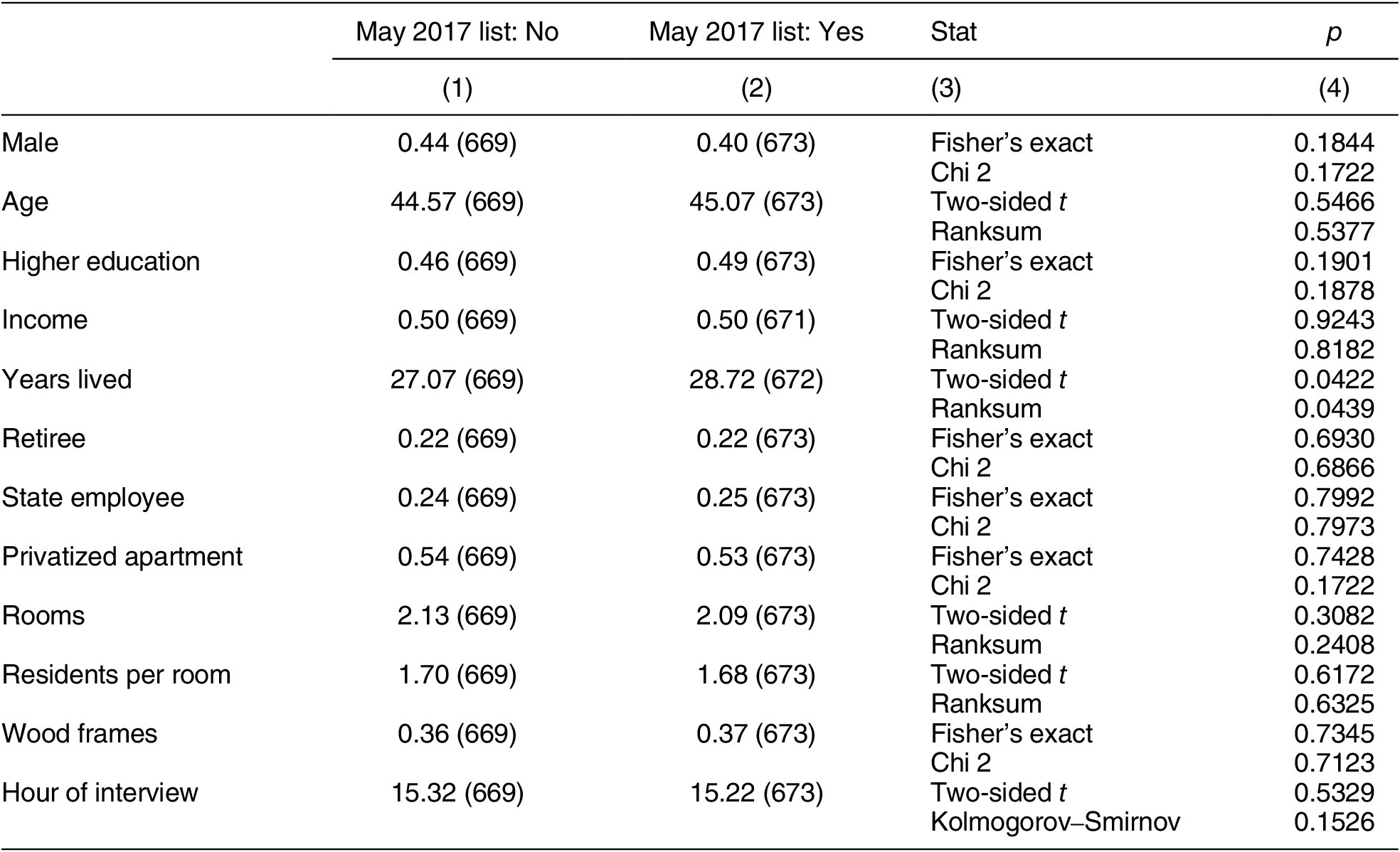
Note: Average values for individual-level covariates, depending on inclusion in the 2017 list. Number of observations in parentheses.
Generally, we did not find that there were differences between the respondents living in the two groups of buildings. In particular, the share of people with higher education is the same in the two groups, with education being a strong correlate of social capital (Helliwell and Putnam Reference Helliwell and Putnam2007; Huang, van den Brink, and Groot Reference Huang, van den Brink and Groot2009). The only variable that might influence our results that differed between the two groups was the number of years the respondent lived in the building. We include this variable as a control in all our regressions.
ANALYSIS
We rely on the resulting survey data to test the core propositions outlined in Hypotheses 1a and 1b: that residents in included buildings should have higher levels of social capital than residents in similar excluded buildings. The main dependent variables in our study are the two social capital indices, which we label generic and house-specific (Borisova, Polishchuk, and Peresetsky Reference Borisova, Polishchuk and Peresetsky2014). Generic social capital captures interactions between neighbors that are not related to building management. This type includes actions that benefit neighbors such as holding onto keys or bringing food, medicine, or household items. We capture these norms using five variables that reflect one’s beliefs about reliance on neighbors as well as actions between neighbors.
House-specific social capital captures residents’ collective decision-making regarding the quality and upkeep of common spaces such as cleaning entrances or caring for shared green space in building courtyards. Our measure includes four voluntary actions that indicate participation in house improvements and related production of public goods for residents. We describe the relationship among these two groups of attributes, using first principal component factor analysis. We present the factor loadings in Tables 3 and 4 (Appendix A of the Supplementary Material provides the question wording for each element of the scales).
Components of Generic Social Capital Index
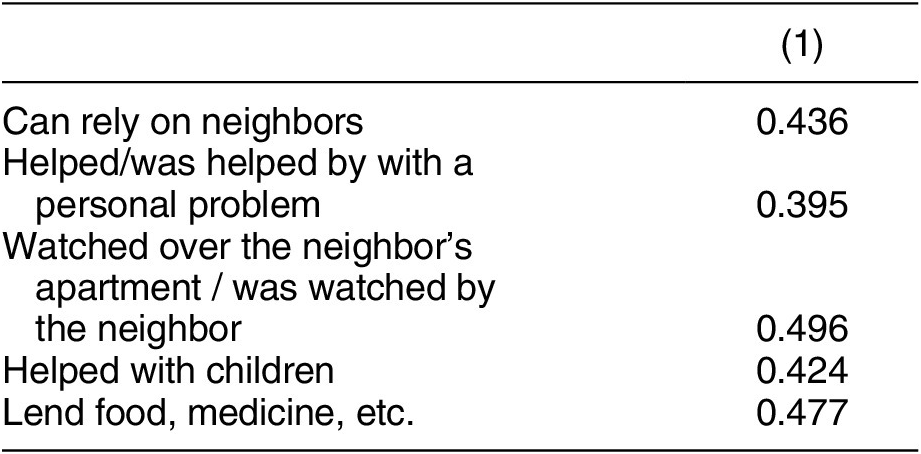
Note: Values show factor loadings for the first principal component. Eigenvector for the first principal component is 1.807; 0.361 of variance is explained.
Components of House-Specific Social Capital Index

Note: Values show factor loadings for the first principal component. Eigenvector for the first principal component is 1.304; 0.326 of variance is explained.
Consistent with the theory, we hypothesize that the effect of state policy on social capital is determined by interaction related to the policy process. To capture this effect, we construct a measure of policy-specific interactions, that summarize whether an individual signed petitions, participated in rallies, discussed the issue on social networks, talked to a neighbor, met with an elected deputy, or participated in an initiative group. These actions span the range of potential actions that residents might engage in to gather information or contest specific elements of the policy provisions. The factor loadings of this policy-based activity scale are reported in Table 5.
Components of the Policy-Specific Interactions Index
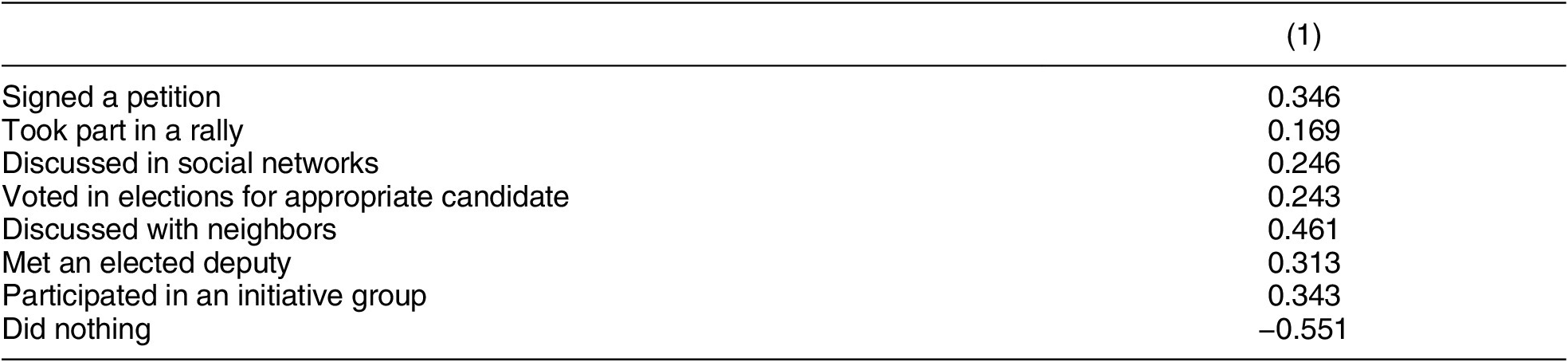
Note: Values show factor loadings for the first principal component. Eigenvector for the first principal component is 2.506; 0.313 of variance is explained.
As a first step in understanding the effects of policy-based interactions on the accumulation of different types of social capital, we look at the effect of treatment on individual components of social capital indices and of the index of policy-specific interactions. These results are reported in Tables 6–8. The first two columns in each table report the variable means for the two subgroups of respondents, and the third column reports p-values for a two-tailed t-test. We find that all five components of the generic social capital index are larger for the respondents living in the buildings in the May 2017 list. This difference is only significant for one element of the scale: reliance on neighbors. For this component, the difference between residents in included and excluded buildings is significant at conventional levels (
 $ p=0.034 $
for two-tailed t-test). For the index of house-specific social capital, the differences are significant for two components, taking part in community improvements and collecting cash contributions (
 $ p=0.038 $
and
 $ p=0.064 $
, respectively). Both indices of generic and house-specific social capital are also larger for the respondents living in the buildings in the May 2017 list (
 $ p=0.041 $
and
 $ p=0.02 $
, respectively).
Generic Social Capital Depending on Treatment

Note: Columns 1 and 2 are the mean values in buildings off and in the May 2017 list (number of observations in parentheses). Column 3 is the p-value for the two-tailed t-test comparing the means in columns 1 and 2. *p < 0.10, **p < 0.05, ***p < 0.01.
House-Specific Social Capital Depending on Treatment

Note: Columns 1 and 2 are the mean values in buildings off and in the May 2017 list (number of observations in parentheses). Column 3 is the p-value for the two-tailed t-test comparing the means in columns 1 and 2. *p < 0.10, **p < 0.05, ***p < 0.01.
Policy-Specific Interactions Depending on Treatment

Note: Columns 1 and 2 are the mean values in buildings off and in the May 2017 list (number of observations in parentheses). Column 3 is the p-value for the two-tailed t-test comparing the means in columns 1 and 2. *p < 0.10, **p < 0.05, ***p < 0.01.
The effects are larger for the components of the index of policy-specific interactions reported in Table 8, all differences are significant, and all but one are significant at
 $ p\le 0.001 $
. These results strongly support Hypotheses 1a and 1b: inclusion in the program increased both the likelihood of engagement in policy interactions and the levels of generic and building-level social capital.
As a robustness check, we analyze the effect of program inclusion on our variables of interest by estimating the following models:
 $$ \begin{array}{rl}{Z}_i& ={A}_1+{B}_1{T}_i+{D}_1{X}_i+{G}_i+{E}_{1i},\end{array} $$
 $$ \begin{array}{rl}{Y}_i& ={A}_2+{B}_2{T}_i+{D}_2{X}_i+{G}_i+{E}_{2i},\end{array} $$
where
 $ {Z}_i $
is the policy-related behavior,
 $ {Y}_i $
is building-related or generic social capital,
 $ {T}_i $
is the dummy variable indicating whether the respondent’s building was included in the May 2017 list,
 $ {X}_i $
is the vector of individual-level and building-level covariates, and
 $ {G}_i $
are the building group fixed effects. Hypothesis H1a will be supported if the coefficient
 $ {B}_1 $
is positive and significant, and Hypothesis H1b will be supported if the coefficient
 $ {B}_2 $
is positive and significant.
In our analysis, we use a number of individual-level and building-level covariates as controls. Some of these are posited as alternative explanations for the behavior that we observe. For instance, to address the potential for competing incentives embedded in property rights regimes, we measure ownership directly with a question that asks whether the apartment was privatized by the respondent or their relatives (meaning that it was originally received from the state in the Soviet period).
A second alternative explanation of policy engagement is rooted in self-interest that would not be likely to produce social benefits. We measure self-interest by looking at the different factors that would shape the need for state assistance to secure better housing: the construction material (brick or cement slab), the quality of the respondents’ apartment buildings and individual apartments, and apartment size and density of inhabitants. We also include a specific measure of apartment renovation: window material. Apartments that have been renovated have replaced leaky wood window frames with more durable plastic.
Other control variables tap into Russia-specific factors that capture state influence and control that might drive attitudes and behavior. Studies of Russian political behavior show the influence the state exerts over state employees and those dependent on state benefits (Forrat Reference Forrat2018; Rosenfeld Reference Rosenfeld2020). To control for these factors, we include variables to capture state employees and pensioners.
Finally, to address the potential that these results are endogenous to initial resource endowments prior to the treatment, we include the two building-level variables. The first measure captures whether the building is managed by a state-owned company or by a private company or homeowners association. Historically, changing a management company from the default state-owned requires substantial collective action despite the significant benefits that can be secured by using a private company or homeowners association (Borisova, Polishchuk, and Peresetsky Reference Borisova, Polishchuk and Peresetsky2014). The second measure has a similar logic but focuses on the state ownership of the land beneath the building. By default, the lot on which an apartment building stands is not owned by the residents, and privatization requires significant collective effort.
Main Results
The results of Equations 1 and 2 are reported in columns 1, 2, and 4 of Table 9. Consistent with Hypothesis 1a, the effect of inclusion in the May 2017 list on policy-specific interactions is positive and highly significant at
 $ p<0.001 $
; a one-standard-deviation increase in the treatment is associated with a 0.263-standard-deviation increase in policy-specific interactions, which is much larger than the largest corresponding value for any of the controls (0.15).
The Effect of Inclusion into the Program on Policy-Specific Interactions and Social Capital
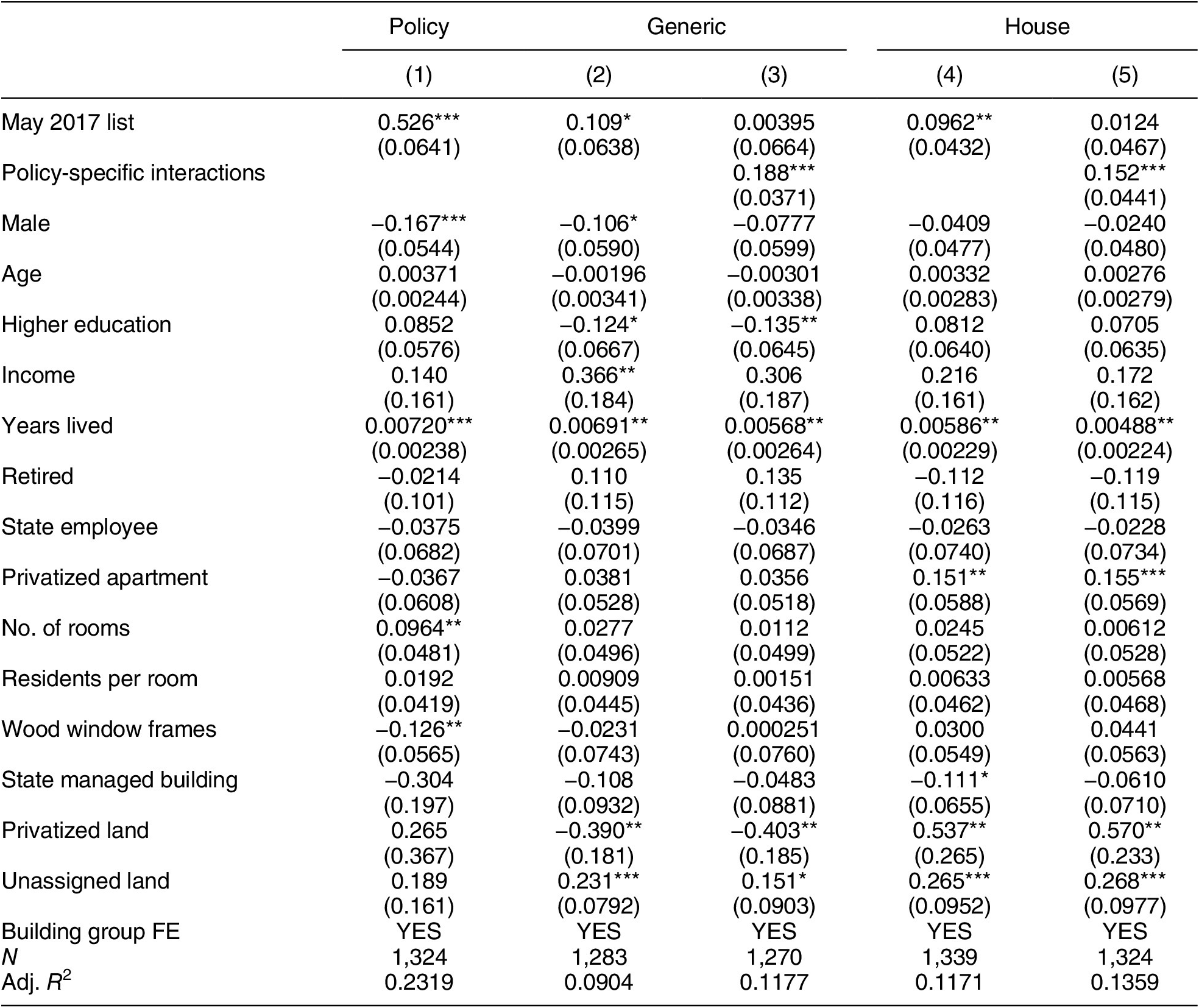
Note: OLS regressions. SEs are clustered at the building level. Column 1 DV is the index of policy-specific interactions. Column 2 and 3 DV is the index of generic social capital. Columns 4 and 5 DV is the house-specific social capital index. *
 $ p<0.10 $
, **
 $ p<0.05 $
, ***
 $ p<0.01 $
.
Both our measures of social capital are also positively and significantly related to the building’s inclusion in the May 2017 list, confirming Hypothesis 1b. In particular, generic social capital increased by 0.054 standard deviations with a one-standard-deviation increase in treatment. This effect is significant at
 $ p=0.091 $
and is comparable in magnitude with the other controls that are significant, including higher education (0.062), income (0.064), length of residence (0.103), building land in private property (0.078), and unassigned land (0.087). House-specific social capital increases by 0.048 standard deviations with a one-standard-deviation increase in treatment (
 $ p=0.077 $
). This effect is slightly smaller than other significant controls: length of residence (0.087), privatized apartment (0.075), building land in private property (0.107), and unassigned land (0.099).
To establish the causal relationships between policy-based activity and social capital accumulation, and further address the potential issue of endogeneity caused by pre-Renovation social capital, we evaluate the mediating effect of policy-specific interactions on building-specific and generic social capital, running the following regression:
 $$ \begin{array}{rl}{Y}_i={A}_3+{B}_3{T}_i+C{Z}_i+{D}_3{X}_i+{G}_i+{E}_{3i},& \end{array} $$
where
 $ {Z}_i $
is the index of program-specific interactions and
 $ {Y}_i $
is a measure of social capital (either building-specific or generic). Estimation results for Equation 3 are reported in columns 3 (for generic social capital) and 5 (for house-specific social capital) of Table 9.
Hypothesis 2 implies that policy-specific interactions mediate the effect of state policy on social capital. If this expectation holds, in addition the positive effects of program inclusion on policy interactions, the estimation of Equation 3 should produce two results. First, the coefficient
 $ {B}_3 $
should equal zero, indicating that the treatment does not have a direct effect on the outcome variable. This is the case for both generic and house-specific social capital; the coefficient for treatment is not significant when the mediator variable is included in the regression equation.
Second, the coefficient C should be positive and significant. This is also true: a one-standard-deviation increase in policy-specific interactions is associated with a 0.188 (
 $ p<0.001 $
) and 0.152 (
 $ p<0.001 $
) standard deviation increase in generic and house-specific social capital, respectively. This implies that a one-standard-deviation increase in treatment results in 0.05- and 0.04-standard-deviation mediated effects on generic and house-specific social capital. Our analysis suggests that even at the margin of existing indicators of social capital within the building, policy-specific interactions provide a channel through which participation in the renovation program impacted the accumulation of trust and pro-social norms.
Mediation analysis requires that there are no pre-treatment confounders (Bullock, Green, and Ha Reference Bullock, Green and Ha2010). In other words, unobserved factors that affect social capital also should not affect policy-specific interactions, conditional on treatment and controls. If this assumption holds, the error terms
 $ {E}_{1i} $
and
 $ {E}_{3i} $
will not be correlated.
We cannot guarantee the absence of pre-treatment confounders, although the various control variables that we use are meant to capture both the preexisting tendency to participate in policy interactions and the preexisting social capital. To address this problem, we use an MCMC (Markov chain Monte-Carlo) procedure described in Imai, Keele, and Yamamoto (Reference Imai, Keele and Yamamoto2010) and implemented using the medsens package in Stata to both estimate the 95% confidence intervals for the mediated treatment effects, and evaluate how robust these estimates are with respect to the presence of correlation between the error terms
 $ {E}_{1i} $
and
 $ {E}_{3i} $
. This procedure first fits models (1) and (3), then repeatedly simulates values of model parameters from the sampling distribution. For each vector of model parameters, the procedure then simulates variables Y and Z under treatment and no treatment and computes the mediation effect as the difference between the outcome variables when the mediator is under treatment or not. The output of the procedure is reported in Table 10.
The Effect of Inclusion into the Program on Policy-Specific Interactions and Social Capital: 95% Confidence Intervals and Sensitivity Analysis

For both dependent variables, this average causal mediation effect is significant at a 95% level. The effect is also robust with respect to the presence of correlation between the error terms in (1) and (3). In order for the average causal mediation effect to be equal to zero, the correlation
 $ \rho $
has to be as large as 0.167 and 0.137 for generic and house-specific social capital, respectively. These are large values: in our analysis, the correlation between generic social capital and the treatment is 0.057, whereas the absolute value of the correlation between generic social capital and any of the control variables in Table 9 does not exceed 0.0782; the corresponding numbers for house-specific social capital are both equal to 0.0635.
In the results presented in both Tables 9 and 10, we find that the accumulation of social capital from participation in the government-provided social program is mediated by policy-specific interactions. We also believe that the other condition for mediation analysis is satisfied—that there are no unobserved mediators that are correlated with our observed mediator or the policy-specific interactions. Conditional on this, we interpret the evidence as supporting Hypothesis 2.Footnote 5
Heterogeneous Effects
Next, we examine whether the intensity of policy-specific interactions is associated with the preferences of the residents for or against the renovation program. This question is relevant in the authoritarian setting, as residents might be reluctant to interact or organize to oppose a government-sponsored program. The preferences of the residents are captured using the house-level vote on renovation. Table 11 reports the results of this analysis for residents of buildings in the May 2017 list using the same set of controls as in Table 9. We find that residents’ interactions were not associated with the building-level vote in favor of the program (columns 1 and 3), or with the building-level turnout (columns 2 and 3). These results suggest that both supporters and opponents of the Renovation Program were mobilized and participated in the consultative process, trying to persuade neighbors to support their preferred outcome. In 2017, both sides engaged in contestation despite the authoritarian setting. However, we expect that as autocratic rule becomes harsher and opposition to government-sponsored programs becomes more costly, repression will cause a more partisan effect that favors regime supporters.
Policy-Specific Interactions and Renovation Vote

Note: OLS regressions. SEs are clustered at the building level. DV is the index of policy-specific interactions. *
 $ p<0.10 $
, **
 $ p<0.05 $
, ***
 $ p<0.01 $
.
Our next goal is to evaluate whether the effect of housing policy on social capital accumulation is moderated by the number of apartments in the building.Footnote 6 In Table 12, we estimate models (1) and (2), introducing the term for the number of apartments as well as the interaction term between the number of apartments in the building and inclusion in the May 2017 list.
The Effect of House Size on Social Capital Accumulation

Note: OLS regressions. SEs are clustered at the building level. Column 1 DV is the index of policy-specific interactions. Column 2 DV is the index of generic social capital. Column 3 DV is the house-specific social capital index. *
 $ p<0.10 $
, **
 $ p<0.05 $
, ***
 $ p<0.01 $
.
Our predictions were that the interaction between inclusion and size should be negative for all three dependent variables. For policy-specific interactions, the term is negative but not significant, and, hence, Hypothesis 3a is not supported. At the same time, for generic and building-level social capital, the term is negative and significant at, respectively,
 $ p=0.002 $
and
 $ p=0.006 $
, supporting Hypothesis 3b.
In Figure 1, we show the marginal effects of the program inclusion calculated for common sizes of apartment buildings—60, 80, 100, and 120 apartments (corresponding to three-to-six standard apartment blocks). For policy-specific interactions, the effect of program inclusion is significant for all building sizes; at the same time, the effect of program inclusion on generic and building-level social capital is positive only in smaller buildings.
The Effects of Program Inclusion on Social Capital Accumulation, Depending on Building Size
Note: The figure reports marginal effects of the May 2017 variable in Table 12, calculated for different building sizes, with 95% CIs.

We believe that the disparity between Hypotheses 3a and 3b results from the fact that some of the policy-specific interactions were organized by the state in a top-down process. As result, both large and small builds were equally affected and, therefore, present in both larger and smaller buildings; yet only those interactions that were a result of collective action mattered for social capital accumulation.
Spillover Effects: Increased Political Engagement and Collective Action against Pension Reform
Our research design allows for a test of potential spillover effects of the renovation program-related interactions on other types of political engagement not related to housing issues: (1) on two types of political engagement: voting in the 2018 Mayoral elections and the frequency of the discussion of politics and (2) involvement in collective action related to pension reform.
Consistent with studies that identify spillovers between social capital accumulation and political engagement, we look at the effects of increased policy-based interactions on voter turnout and political discussion. In Table 13, the dependent variables are the dummy for voting for any of the candidates in the 2018 Mayoral elections (columns 1–3) and discussion of politics at home or with friends or colleagues in the past year (columns 4–6). Columns 1 and 4 of Table 13 indicate that being included in the program affected both of these variables (
 $ p<0.001 $
and
 $ p=0.089, $
respectively), supporting Hypothesis 4a.
The Effect of Program Inclusion on Turnout in 2018 Mayoral Elections and Discussion of Politics
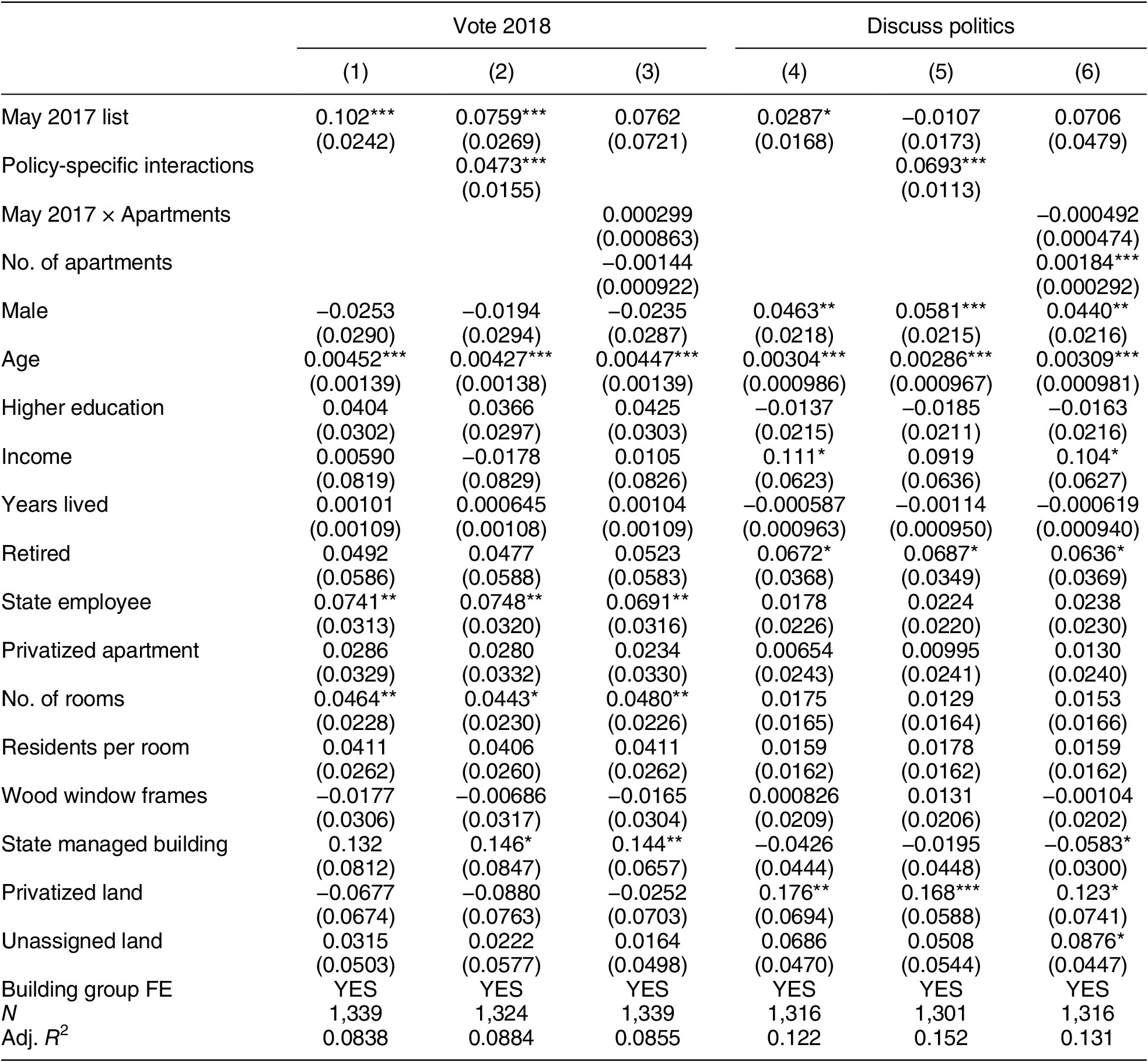
Note: OLS regressions. SEs are clustered at the building level. Columns 1–3 DV is whether the individual voted in 2018 Mayoral elections. Columns 4–6 DV is how often one discusses politics (0–1). *
 $ p<0.10 $
, **
 $ p<0.05 $
, ***
 $ p<0.01 $
.
This effect goes through policy-specific interactions as follows from columns 2 and 5. For turnout in the 2018 Mayoral race, this effect is partial, suggesting that the increase may reflect both the indirect effect of policy interactions and the perceptions of the increased salience of local government due to the importance of housing reform in popular opinion. The MCMC procedure also shows both mediation effects to be significant at the 95% level, and be robust to potential confounders, as reported in Table 14; thus, Hypothesis 5a is partially supported for turnout in the Mayoral election and supported for discussion of politics.
The Effect of Program Inclusion on Policy-Specific Interactions, Vote in 2018 Mayoral Elections, and Discussion of Politics: 95% Confidence Intervals and Sensitivity Analysis

We do not find that magnitude of the effect of program inclusion on either the 2018 Mayoral vote or political discussion depends on the number of apartments in the building (columns 3 and 6); hence, Hypothesis 6a is not supported.
Our interpretation of this result is that it is a reflection of electoral malfeasance. The regime’s increasing reliance on electoral manipulation, and in particular, mandatory turnout for state workers and those dependent on the state budget increase turnout rates regardless of the building size. More generally, building size influences the outcomes that emerge from purely bottom-up interactions, but in the two cases where regime interests lead to top-down state intervention, this effect is not significant.
Finally, the proximity of the pension reform policy to the Housing Program allows us to test whether the interactions related to housing policy produced social capital that also increased engagement with the pension reform program. While both reforms were extremely salient, the latter reform was very different from housing policy in two important ways that should affect social capital stocks. First, the pension reform contained no incentives for policy-based interactions or state-society consultation. Second, it was also extremely unpopular and presented losing outcomes to all citizens, except the military personnel exempted from the policy (Smyth and Sokhey Reference Smyth and Sokhey2021). As a result, we do not expect the pension reform to yield new social capital, but we do expect the effects of the housing policy to spill over into the new policy arena.
To explore the effects of accumulated social capital on engagement with the policy, we repeat the analysis but substitute a similarly constructed index of interactions related to Russia’s pension reform for the index of policy-specific interactions. Table 15 reports the results of this analysis. In column 1, we regress the pension reform interactions on the treatment; the effect was positive but not statistically significant. In column 2, we repeat the analysis including the number of apartments in the building as a moderating variable. Our results suggest that interactions related to housing policy spilled over into pension reform activism and political engagement, boosting capital accumulation at the margin of the initial policy for a subset of residents—those residing in smaller buildings. Thus, Hypotheses 4b and 5b are both not supported, and Hypothesis 6b is supported (with
 $ p=0.007 $
for the corresponding interaction term).
Interactions Related to Pension Reform

Note: OLS regressions. SEs are clustered at the building level. DV is the index of interactions specific to pension reform. *
 $ p<0.10 $
, **
 $ p<0.05 $
, ***
 $ p<0.01 $
.
In Figure 2, we report the effect of program inclusion on pension reform interactions for buildings of different sizes. This effect is significant at the 95% level for buildings with 60 or 80 apartments and is not significant for larger building sizes (100, 120, etc.).
The Effects of Program Inclusion on Social Interactions Related to Pension Reform, Depending on Building Size
Note: The figure reports marginal effects of the May 2017 variable in Table 15, calculated for different building sizes, with 95% CIs.

DISCUSSION
The core finding of our statistical analysis is that the Renovation Program’s incentives for residents interact to secure benefits by voting and participating in meetings, consultation, and other outreach did lead to the accumulation of social capital despite the authoritarian context in which the policy process unfolded. Residents of apartment buildings included in the program demonstrated higher levels of social capital than residents of buildings that were not included. The analysis shows that this effect influences a wide range of individual norms and practices that define relations among neighbors and residents’ propensities to engage in the provision of collective goods such as maintenance of common spaces. Importantly, the results demonstrate that it is not just the inclusion or exclusion of apartment houses from the program that matters, but the interaction among residents and between the state and society that produces these effects.
These effects hold even when we control for levels of existing capacity prior to the introduction of the housing policy allaying concerns about endogeneity based on original social capital endowments in buildings included in the sample. Existing social capital is controlled for in our research design and also by the inclusion of two measures highly correlated with building-level social capital: the nature of collective management and the disposition of the land that the apartment building occupies. The reliance on state building management diminishes the need for cooperation to maintain the common areas of the building. Conversely, securing resident ownership of the land below the apartment demands sustained cooperation.
The results also reveal interesting variations in the effect of building size on both political engagement and social capital accumulation. These results demand more investigation, but our preliminary explanation for this variation is rooted in the autocratic tools that the regime relies on to secure favorable political outcomes and evade the negative effects of social capital accumulation. Consistent with Olson’s hypothesis, the large building effect is significant in outcomes that are predominantly bottom-up processes that emerge from social interactions. The effect is clear in both the mediation analysis and the regression analysis. This factor is not significant in cases such as policy-specific interactions or electoral turnout where the city government took a role in shaping interactions and outcomes by mobilizing state workers and dependents. This mechanism of state intervention shaping participation complements the emerging work on the ways in which the Chinese government works to limit the political effect of social capital accumulation.
The evidence of spillover effects from interactions to vote turnout also points to a second area of future research. The prominence of regularly scheduled elections at all levels of the Russian government creates a distinct set of challenges for the regime. This challenge increases as the regime stresses governance and responsiveness tools to maintain stability. The Housing Program not only increased participation in city-wide elections, but it also spawned new political candidates and organized efforts to register and train candidates to organize campaigns (Gorokhovskaia Reference Gorokhovskaia2018; Zhelnina Reference Zhelnina2023). This produced significant unexpected losses in local elections and created models that could be used to challenge regime control in other regions (Norton Reference Norton2023). As a result, the regime was forced to increase both interventions in electoral processes and rely on repression to stifle opposition organizations (Smyth Reference Smyth2020).
Before concluding, we turn to the focus group discussions that provide some substantive understanding of the mechanism at the heart of our hypotheses: the role that interactions rooted in the Housing Program played in building new forms of social capital. Consistent with Hypotheses 1a and 1b, participants in our focus groups reported meetings with neighbors, discussing the program, and seeking advice from other residents in order to understand policy provisions and to collaborate to protect their interests. One focus group member summarized this effect:
[I am acquainted with about] 60 percent [of my neighbors]. Moreover, this 60 percent was stretched in connection with the renovation. I have seen so many new faces. I have not seen people so activated before. One person comes to you, then a second comes concerning the vote, then everybody gathers in the yard. That’s the period when, in fact, we met each other.
Many other respondents indicated that the program provoked the same kinds of broader discussion within their apartment blocks. These ties transmitted information and revealed preferences about the program, shaping both transparency and the potential for sanctions. One respondent who was an opponent of the program in a house that was slated for inclusion argued:
Uncle Zhora, who lived under us, came to my house and asked about the renovation program. He did not ask from the point of view of the agitator, but from the point of view of a person who did not understand what is happening. I showed him several social media clips on this topic. He watched with me, then we went through the house and realized that almost all the apartments at our entrance would vote against this program…
This new communication within houses was a by-product of the policy process that required a two-third majority vote to secure new housing. Residents needed to ensure that others would support their preferred outcome and many focus group respondents reported changing their minds through discussion of neighbors. Yet, not all of these interactions produced social capital. Zhelnina (Reference Zhelnina2023) reports that in some cases, this disagreement caused significant acrimony among neighbors. In our group discussions, consistent with the statistical results, many of our respondents reported increased communication with neighbors and better relations after these interactions. Two respondents in the same focus group discussed their experiences with house-level organizers who formed a coalition to influence the house-level vote. The first speaker reported:
We had an initiative group in the house itself, which went to all the apartments and explained the facts to those who were gullible and thought that now they would give them luxurious housing. They explained how everything will be after the fact, and so, yes, this group influenced the outcome of the vote.
The second speaker described her learning process as these interactions continued. The need for information and to correct misinformation drove a great deal of the interactions but was conflated with a desire to resist the program or conversely to convince opponents. Many respondents spoke about the importance of precise, local information provided by civic initiatives. As one young woman noted:
I know, Snos5, the site, and there is a forum, organized by districts. Everyone is discussing what exactly is going on in the district, what is planned; what has been built; where they have been moved; and what rumors they hear.
The discussions also shed some light on the mechanisms that drove spillover effects: information and efficacy. Focus group respondents comprised of residents included in the Renovation Program were also more informed about opposition efforts such as petitions and social mobilization against the Renovation Program. While respondents who were not part of the project said that they knew little about the protest, the residents in included buildings spoke of their size and impact. A number of respondents talked about attending large demonstrations. Others spoke of informal actions, “There were also local protests. Not protests per se, but people gathered around the Council and said: “Here’s the thing ….”” In each case, they attended with other residents in their apartment bloc.
Respondents held mixed ideas about the government’s response to their participation in these events. As one resident argued, “It [protest] showed that there are many citizens against the renovation. Showed yes, but whether it affected anything is a good question.” Another respondent in the group immediately responded, “It seems to me that it simply became connected with the elections.” Others spoke of their surprise that the government had responded to popular demands and made several important innovations to the legal framework guiding the outcomes.
The focus group evidence supports the findings from the survey data. The mechanism is clear in respondents’ statements: residents acted from the need to forge a building super-majority in the house-level vote by interacting with each other and with state representatives. Interactions yielded new networks and trust among residents and prompted spillover into political discussion and electoral participation.
CONCLUSION
This study responds to Ostrom and Ahn’s (Reference Ostrom, Ahn, Svendsen and Svendsen2009) call for more fine-grained empirical work on specific policy areas and across different social, political, and economic contexts to understand the relationship between policy and the emergence of social capital. By including a formal building-level vote to secure new housing, the policy created strong incentives for social interaction to resolve uncertainty through information sharing, demand additional benefits through consultation, and protect residents’ rights through amendments to the legal framework. This bottom-up organization complemented state-organized initiatives and meetings that increased interactions at governmental hearings and meetings. This cooperation resulted in state responsiveness: new protections were included in the policy and new benefits were added to the relocation package. Yet, the uncertainty about the successful implementation of these policies remained.
Resident interactions linked to the Housing Program also produced spillover effects beyond this specific policy domain, increasing residents’ participation in opposition to pension reform as well as voting in local elections. Our results also suggest that the social interactions related to the Housing Program countered other influences in authoritarian rule such as repression and disinformation that foster social disengagement from politics. Residents living in buildings included in the Renovation Program were more likely to discuss politics, defining a path through which formerly disengaged citizens re-engage to secure benefits and hold authoritarian leaders accountable.
These societal developments have the potential to challenge existing state strategies to constrain social demands and ensure regime stability. Similarly, our finding that policy interactions increased electoral participation highlights how the variation in authoritarian regime types presents different potential challenges and demands different regime solutions. As a whole, this research illustrates how reliance on good governance to win social support requires autocratic regimes to constantly innovate to contain the resulting societal capacity to self-organize.
SUPPLEMENTARY MATERIAL
To view supplementary material for this article, please visit https://doi.org/10.1017/S0003055423000941.
DATA AVAILABILITY STATEMENT
Research documentation and data that support the findings of this study are openly available at the American Political Science Review Dataverse: https://doi.org/10.7910/DVN/HOMED8.
ACKNOWLEDGMENTS
Ekaterina Borisova has benefited from the support of the Région Hauts-de-France, through the program STARS. While working on an article Ekaterina Borisova was an Associate Fellow at the International Center for the Study of Institutions and Development (ICSID) at HSE University (Moscow, Russia), and this article was prepared within the framework of the HSE University Basic Research Program. The project benefited from discussions at the 51th Annual Convention of the Association for Slavic, East European, and Eurasian Studies (ASEEES) 2019, the “Quality of Governance and the Legacy of Socialism” workshop in Bremen in 2019, the “Political Economy of Redistribution and Institutional Change” conference in Moscow in 2019, the University of Oxford seminar, the Woodrow Willson Center Scholars’ Speakers Series, the Center for Russian and East European Studies at the University of Wisconsin, IU’s Ostrom Workshop, and the Silvaplana 31st Workshop on Political Economy 2022. Finally, we are grateful to Jessica Steinberg, Andrew Womack, Jason Wu, and to three anonymous referees for their comments that improved the manuscript.
FUNDING STATEMENT
The data collection was supported by the Indiana University Bloomington (project “Housing Policy, Political Participation, and Regime Support: Moscow 2018”) and the Basic Research Program at HSE University in Moscow, Russia.
CONFLICT OF INTEREST
The authors declare no ethical issues or conflicts of interest in this research.
ETHICAL STANDARDS
The authors declare the human subjects research in this article was reviewed and approved by IRB at Indiana University (details provided in Appendix D of the Supplementary Material). The authors affirm that this article adheres to the APSA’s Principles and Guidance on Human Subject Research.




Comments
No Comments have been published for this article.