U.S. President Donald Trump's announcement on 6 December 2017 recognizing Jerusalem as the capital of Israel was made in as public a manner as possible, as was the Israeli Knesset's passing of the Nation State Law that followed it and which confirmed in Article 3 that Jerusalem, complete and united, is the capital of Israel. How different it was when Israel, fifty-one years earlier, carried out the most daring and crucial step towards making a reality of Jerusalem as its capital. On 27 June 1967, twenty days after the Israeli army occupied the West Bank – including Eastern Jerusalem and the Gaza Strip – steps were taken to extend Israeli law to the Eastern part of the city that had been for the past nineteen years under Jordanian rule, thereby annexing it to Israel. The Israeli cabinet voted on what euphemistically was referred to as “a declaration regarding the expansion of the jurisdictional area of the Jerusalem municipality.”Footnote 2 The annexation was all done quietly, almost surreptitiously, in the dead of night without pomp or ceremony, and without once mentioning the word “annexation.” The world woke up one morning to find that Israel had taken a major step in imposing its claim over the whole of the city of Jerusalem where over a third of the residents were non-Jews and non-Israelis.
The usefulness of concentrating on Jerusalem and describing how it came to be the capital of Israel is because it set the tone for later actions. In this essay I will describe how the annexation of Jerusalem presages the trajectory of slow annexation of the rest of the West Bank.
Throughout this period those of us active in human rights work continued to report on Israeli actions in violation of international law. We hoped that by exposing these we would deter the Israeli authorities from continuing with them. It all proved to be in vain. In this essay I will reflect on the nature of the work of Al-Haq, the organization I helped establish and which I co-directed for many years and propose why its work proved ineffective in influencing the course of political developments.
***
The effect of this initially quiet annexation of the Eastern part of the city, even though it proceeded slowly and in stages, on the lives of the Palestinian inhabitants was decisive. It meant that the Palestinians in Jerusalem were subject to taxation without representation by Israel and to discriminatory Israeli laws.
Not only did this establish Israel's modus operandi but also that of the Palestine Liberation Organization (PLO). The decision was taken by the leadership to refuse to take part in the municipal elections on the grounds that doing so would be tantamount to a recognition of the annexation. Unfortunately, there was never a reconsideration of that initial position. The Palestinian residents of the city were left to fend for themselves.
After the annexation of the city in 1967, Israel proceeded gradually to apply its laws over the disenfranchised population. Initially it was tolerant of Palestinian institutions and continued to apply Jordanian laws then still in force in the Occupied Territories, such as the Labor Law that remained in use by many of the large institutions in the Eastern section of the city until the early nineties. The schools also continued to teach the Jordanian and later the Palestinian curriculum (with some changes imposed by Israel), the same as in West Bank schools. Israeli authorities were also tolerant of institutions that failed to fulfill the requirements of certain payments on behalf of their employees, such as Israeli national and health insurances. But then, in the early nineties, this began to change. Both Augusta Victoria and Makassid hospitals on the Mount of Olives came close to bankruptcy as they were required to pay large amounts in arrears that had accumulated over the years.
As Israeli law became more entrenched in Eastern Jerusalem, the Palestinian residents had to live under a severe matrix of control that proceeded to deprive them of planning permits to build more homes and develop their part of the city. After the Oslo Accords were signed in 1993–95, nearby Ramallah overtook Arab Jerusalem as the economic and cultural center of the West Bank.
***
When negotiations first began in Washington D.C. in 1991 and later, secretly, in Oslo, the PLO insisted on including negotiations over the status of Jerusalem in the talks. Israel, however, managed to keep the issue out of the resulting agreement. When Prime Minister Yitzhak Rabin's legal advisor Joel Singer joined the Israeli negotiation team in Oslo in May 1993, he made sure, not only through verbal promises but also in writing, that Jerusalem would be outside the purview of the Interim Agreement. This he achieved by appending to the Declaration of Principles of 1993 “Agreed Minutes” that left no doubt that Jerusalem would not be under the jurisdiction of the Palestinian Authority and that deciding the future of the city would be postponed until the permanent status negotiations. A quarter of a century later, these are yet to take place.
By 2018, there was no doubt that Israel's grip over Jerusalem was complete. Earlier in 1980, the Israeli Knesset had already passed Basic Law: Jerusalem, Capital of Israel, which declared the city to be the “complete and united” capital of Israel. So, one may ask: why did Israel decide to change the initial strategy of quiet action? Why did it decide in 2017 to go public with what was effectively a done deal? The only possible answer is because it felt that it could. The right-wing factions that controlled the government felt strong enough to do it and calculated that the backlash would be negligible. They were proven right.
***
In extending its authority over the rest of the West Bank, Israel did not begin by declaring outright annexation as was the case in Jerusalem. With the exception of those parts that were included in the annexation of Eastern Jerusalem in 1967 and afterwards, the rest of the West Bank remains to this day formally outside Israeli sovereignty. But whereas the West Bank was not formally annexed to Israel neither did Israel recognize it as occupied territory. Thus, it can be seen that the process that Israel followed in the West Bank was in the reverse order to that followed in Jerusalem. It began with changes on the ground, mainly building Israeli settlements and extending Israeli law to them, and will at some future point most likely end in a declaration that would retroactively confirm the actions taken by Israel over the years that have rendered the area part of Israel in a de facto manner. What were some of these actions?
When the occupation began on 7 June 1967, Israel passed Military Order Number 3 in which reference was made in Article 35 to the applicability of the 4th Geneva Convention to the proceedings of the military courts. Four months later, this article was deleted.
The refusal of Israel to accept the applicability of the Convention was also evident in its rejection of the legal advice provided by Theodor Meron, the legal counsel to the Israeli Foreign Ministry who was asked in September 1967 by Prime Minister Levi Eshkol whether building new settlements in the Occupied Territories would violate the Convention. He confirmed that it would, but the government disregarded his advice and proceeded to establish settlements.
When the separation wall (often termed the apartheid wall by Palestinians) was built between the West Bank and Israel, its route did not follow the Green Line (the border between Israel and Jordan delineated by the Armistice Agreement of 1949) and instead proceeded to effectively annex about 13.5 percent of the West Bank to Israel. In the 2004 opinion of the International Court at the Hague: “The construction of the wall being built by Israel, the occupying Power in the Occupied Palestinian Territory, including and around Eastern Jerusalem and its associated regime, are contrary to international law.”Footnote 3
Yet without formally annexing the West Bank, the Israeli state could not encourage its citizens to settle in the West Bank and be subject to the same restrictive military laws it imposed on the Palestinian residents of this area. How then did it succeed in extending Israeli laws when the area was not formally annexed?
To ensure that Israeli citizens living in the illegal settlements in the occupied territories would continue to abide by Israeli laws and pay taxes, the Israeli Knesset extended some of its laws outside its own territories. Under the Israeli Law and Administration Ordinance of 1948 (referenced earlier), the prime minister, or any other minister, has the power to make emergency regulations “as may be expedient in the interests of the defense of the state, public security and the maintenance of supplies and essential services” (section 9(a)) following a public declaration of a state of emergency. Immediately following the 1967 war, the minister of justice introduced regulations entitled Emergency Regulations (Areas held by the Defense Army of Israel-Criminal Jurisdiction and legal Assistance).
Prior to the signing of the Oslo Accords, the Israeli Commander of the West Bank issued military orders that rendered the Jewish settlers living in the Occupied Territories immune from the restrictive laws applicable to the Palestinian residents. Thus, through Israeli military orders, the two communities came to be subject to different local government units, different courts, and eventually different administrations. This last step took place in 1981 when the Israeli military commanders of the West Bank and the Gaza Strip establishedFootnote 4 what they called a Civil Administration for the Palestinians, headed by an Israeli army colonel charged with administering the affairs of the Palestinian inhabitants. The arrangement placed Jewish inhabitants of the settlements in the West Bank and the Gaza Strip under the umbrella of Israeli laws and Israel's direct rule. The significance of the distinction between military and civilian affairs, both of which were administered by Israel until the establishment of the Palestinian Authority, became more apparent when the Oslo Accords were negotiated and civilian affairs (pertaining to the Palestinian inhabitants of the Occupied Territories) were transferred to the newly created Authority. A further objective behind this move was to separate the civilian affairs of the Palestinian inhabitants from those of the Israeli Jews living in the West Bank, thereby creating a form of apartheid: different laws applicable to different groups with different and unequal distribution of resources and opportunities for development.
In a lengthy 1982 article, Joel Singer defended Israel's establishment of the Civil Administration, denying that it had any prospective political objective.Footnote 5 He argued that it was intended to facilitate better rule of Palestinians in the areas he referred to as the “territories administered by Israel.” Twelve years later when the Oslo Accords were drafted with Singer's help, a number of civilian powers over the Palestinian inhabitants of the area were transferred to the Palestinian Authority, expanding the apartheid structure established in 1981.
Taking a page out of its playbook in Eastern Jerusalem, Israel undertook a number of infrastructure projects in the West Bank mainly involving zoning, roads and water. Similar to what was achieved in Jerusalem these enhanced the connection between the territory and Israel. Among these massive projects was Road Plan Number 50 of 1984, a comprehensive reorganization of roads in the West Bank aimed at linking Israeli settlements, already built or planned, to each other and to Israel, bypassing Palestinian towns and villages. This was followed by hundreds of land-use planning schemes for both Palestinian towns and for Israeli settlements designed to enable the future expansion of the latter and restrict that of the former.
Throughout the 1980s and early 1990s, as all this was happening, Al-Haq documented and analyzed Israel's various settlement strategies and published its findings, hoping that exposure would deter Israel from pursuing more legal changes and instituting facts on the ground that went contrary to the powers of an occupier under international law.Footnote 6 The organization also brought these changes to the attention of the PLO leadership outside the Occupied Territories.
On 15 November 1988 at its meeting in Algiers, the Palestine National Council declared the establishment of a Palestinian state in the 1967 Occupied Territories. The Council recognized “the necessity of convening the effective international conference on the issue of the Middle East and its core, the question of Palestine.” Among the main aims that they desired for this notional international conference to achieve was “the annulment of all measures of annexation and appropriation and the removal of settlements established by Israel in the Palestinian and Arab territories since 1967.”Footnote 7 Tragically for Palestinian nationalists, the PLO made its declaration at a time when Israel was already taking extensive action on the ground to forestall the goals of Palestinian statehood from being met.
Only three years after the 1988 meeting in Algiers, the PLO accepted a letter of invitation from the International Peace Conference in Madrid. This letter, expressing the aim of the conference, set the terms of reference for all subsequent negotiations:
With respect to negotiations between Israel and the Palestinians … negotiations will be conducted in phases, beginning with the talks on interim self-government arrangements. These talks will be conducted with the objective of reaching agreement within one year. Once agreed, the interim self-government arrangements will last for a period of five years; beginning the third year of the period of interim self-government arrangements, negotiations will take place on permanent status. These permanent status negotiations, and the negotiations between Israel and the Arab states, will take place on the basis of resolution 242 and 338.Footnote 8
Clearly, then, by defining the negotiations as mere “talks,” restricting them to making “arrangements” for self-government while deferring the permanent status negotiations, Israel was ensuring that no negotiations could take place on “the annulment of all measures of annexation and appropriation and the removal of settlements.” The PLO had envisaged the latter in its 1988 Algeria meeting as the ideal outcome of any international conference on the question of Palestine. The negotiations that followed confirmed that the PLO had no vision as to how to achieve this aim through the limited scope of these terms. The resulting Declaration of Principles signed in 1993 and the Interim Agreement signed in 1995 restricted the jurisdiction of the Palestinian Authority to civilian matters pertaining to the Palestinians living in the West Bank and the Gaza Strip and not in Eastern Jerusalem, thereby leaving intact not only all the settlements, but also all the changes in the laws and on the land that enabled them to be built in the first place. The PLO failed to achieve the main aim of the Palestine National Council resolution of 1988. The changes in the law and administration of the West Bank that Israel had wrought proved more complicated and intricate than the decision-making structure of the PLO was competent to grasp, let alone unravel. It also became apparent that the policy advice of Al-Haq and other human rights organizations that had documented and analyzed the changes in the laws and administrative structures in the West Bank, seeking to limit the annexation of Eastern Jerusalem and Israeli settlements established in the Palestinian areas, would not be followed.
On the Israeli side, many of the same people involved in setting up apartheid governance structures in the West Bank also participated in the international negotiations. The negotiating team in Washington D.C included, for example, Colonel David Yahav, deputy military advocate general of the IDF Military Advocate's General's Command. As he wrote in the introduction to “Israel, the ‘Intifada’ and the Rule of Law,”Footnote 9 a book he edited:
Those of us involved professionally, on a day-to-day basis, with the legal aspects of the Israeli Administration in Judea and Samaria (the West Bank) and the Gaza Strip are aware that Israel's Administration of the territories meets both the second standard – the standard of international law and lawful conduct – as well as the first, that of comparative historical precedent. Unfortunately this reality is not widely appreciated.
In a candid explanation of the logic behind Israel's policies in the West Bank and in negotiations over the political fate of Palestine, he continues:
If Israel were to admit itself to be a belligerent occupant of Judea, Samaria and the Gaza Strip, it would be prima facie, admitting that the Fourth Geneva Convention of 1949 relative to the Protection of Civilian Persons in Time of War applies to Judea and Samaria and the Gaza Strip as “Occupied Territories.” This then could conceivably be interpreted as a renunciation of sovereign rights by Israel to the areas. After all, one does not “occupy” one's own territory, and one most certainly is not bound by the international law of Belligerent Occupation.Footnote 10
He then complains about the “disruptive” role of human rights organizations:
Thus, at a key moment in Middle East history, when our energies ought to have been concentrated solely on ensuring that those standards of conduct are maintained, we have found ourselves spending an inordinate amount of time and energy explaining to the world that Israel has, in fact, been acting lawfully in attempting to grapple with the uprising known as the Intifada. Hundreds if not thousands of man-hours have been spent briefing foreign politicians, diplomats, academic researchers, human rights workers and journalists. Papers on various legal aspects of the Israeli military administration have been drafted and circulated.
All this effort was to help explain how Israel “administers” the territories in accordance with the humanitarian principles of international law without admitting that they are occupied territories.
There can be no doubt then that the work of Al-Haq and other human rights organizations was heard not only by the international community, but also by Israeli officials. And yet these efforts neither prompted Israel to amend its policies toward the Occupied Territories, nor effected a change in course where it mattered most: among those in the PLO involved in the negotiations that began in 1991.
At the talks in Oslo, the PLO struggled to bring Israel to agree to a cessation of all settlement activities. But when Israel made it clear that all it was willing to do was transfer civil jurisdiction over Palestinians to the nascent Palestinian Authority, the negotiations nearly reached a breaking point. We are told it was at that point that Israel's offer to recognize the PLO shifted the balance. In justifying its decision to accept Israel's offer, the PLO puffed up the importance of the recognition. As Abu Ala, the chief negotiator at Oslo, said: “Israeli recognition of the PLO as the representative of the Palestinian people would also mean Israeli acceptance of the PLO's political agenda, including the right of the Palestinian people to self-determination, and their right to establish an independent Palestinian state.”Footnote 11 Lacking any true basis, his statement was proven false by future events as settlement expansion gradually tripled the number of settlers living in the West Bank, pushing the prospect of a Palestinian state further away from reality than ever.
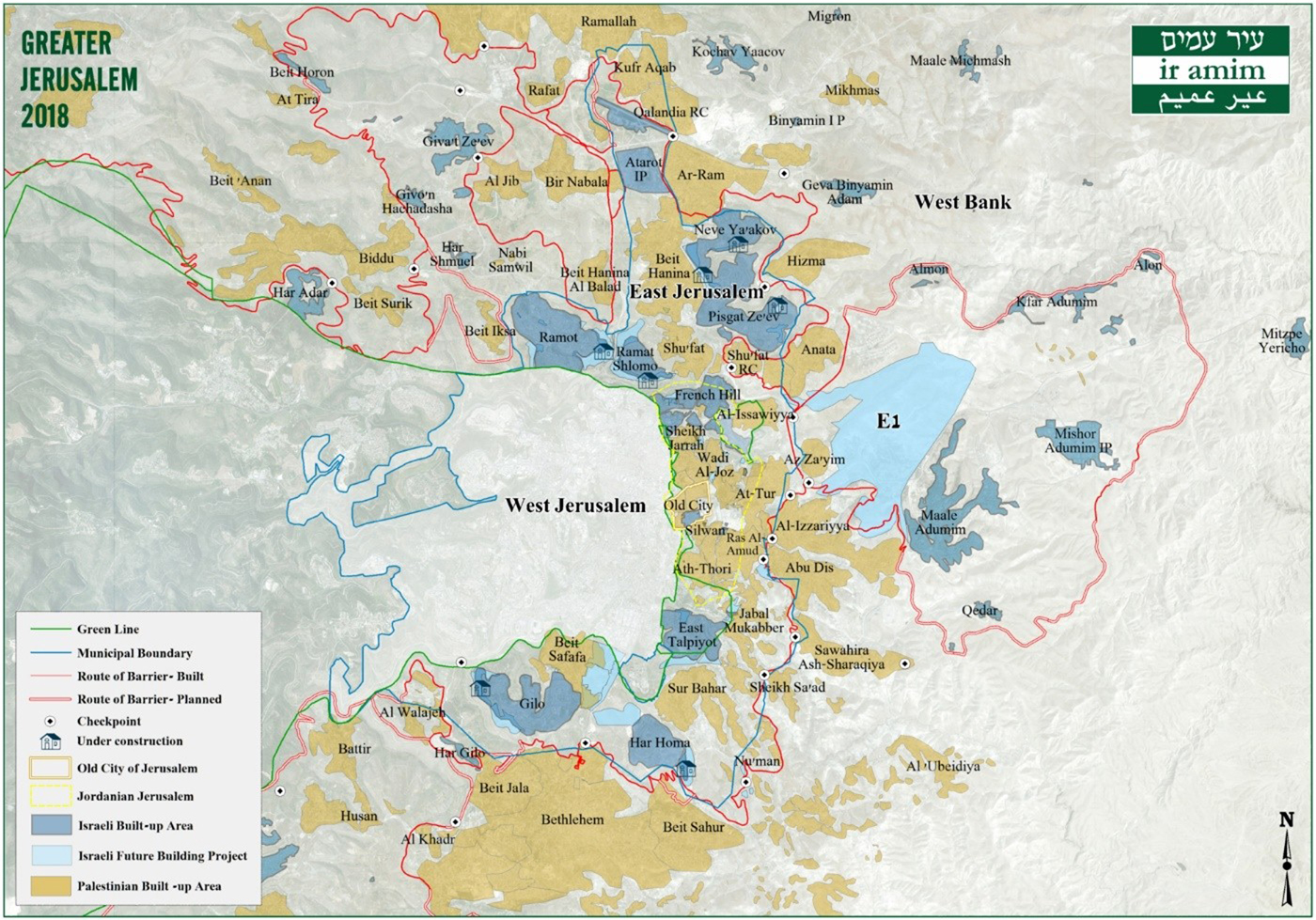
By looking at the map of the West Bank, it becomes evident that many of the settlements surrounding Jerusalem were placed there with the strategic aim of achieving a greater territorial connection between the city, now the capital of Israel, and the rest of the country. Prior to 1967, Jerusalem lay somewhat vulnerably disconnected from the rest of the country, with only one road connecting it to the coastal region. Several new highways now link the city to the coastal heart of the country and traverse the West Bank at various points with a number of the illegal Jewish settlements established along the way.
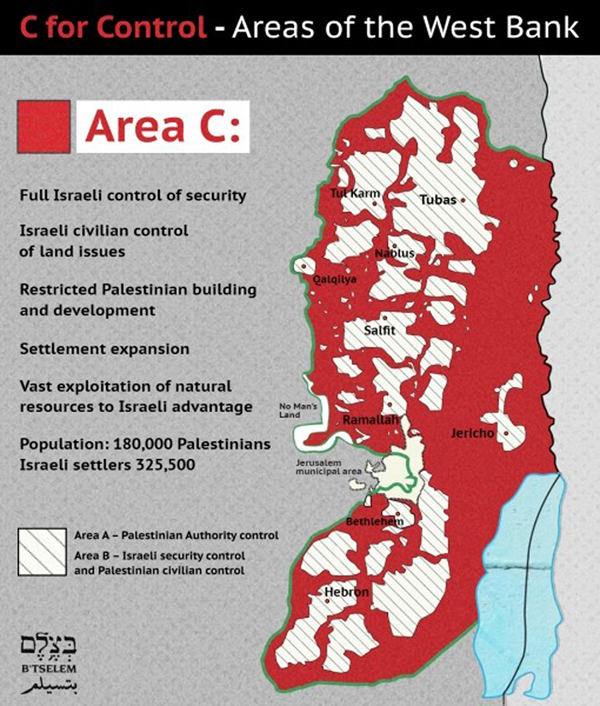
But the annexation of expanded Jerusalem has also served another strategic aim by further fragmenting the West Bank. The latest decision by Israel to demolish Al-Khan al-Ahmar,Footnote 12 situated in Area CFootnote 13 [Figure 1] and serving as the gateway to what is known as Area E1 [Figure 2] – the large swath of land, also in Area C, between Jerusalem and Jericho, which Israel wants to annex – would result in cutting the West Bank in two, separating its north from the south. This would make the possibility of establishing a Palestinian state there more remote than ever. The Israeli political establishment exercised greater moderation in 1967, as is evident in a discussion on the demarcation of Jerusalem's boundaries in which Defense Minister Moshe Dayan argued against the army's maximalist approach, saying: “You are going too far. Why do you come with such a big appetite? I know the Jews’ appetite. It is possible to take the entire West Bank, but we are talking about the annexation of East Jerusalem … I am not in favor of annexing ten additional villages with 20,000 inhabitants and cutting off the northern from the southern West Bank.”Footnote 14
Area C, shown in solid red (2013).

Observe details of Jerusalem and the West Bank, especially E1 on the right (2018).
After fifty-one years the Israeli occupation of the Palestinian territories is the longest occupation in modern history and the most extensively observed and studied. For many years local and international human rights organizations have documented the activities of the occupying government and intervened in an attempt to restrain its excesses. And yet the Palestinian leadership did not succeed in utilizing the law to support its case. Nor have the 190 state parties to Fourth Geneva Convention acted on their responsibility to enforce the convention, which requires them, as the High Contracting Parties, “to ensure respect for the present convention in all circumstances.”Footnote 15 This has meant that Jewish settlements have been illegally established throughout the fifty-one years of the occupation.
Our work in human rights at Al-Haq, until the signing of the Oslo Accords, had its own peculiarity. It was like no other. We were consumed by investigating the project of the occupier, seeking to fathom and resist it. Much of this work was descriptive of the transformation of the land that was beginning to appear foreign to us, the original inhabitants. We called it human rights work, but it was more than that. We were overwhelmed by the need to understand how the Israeli authorities were conducting this total transformation. It was like having the rug being pulled from under your feet, causing you to topple over. We never thought we alone could halt this process but firmly believed that exposing it might succeed in holding it back. At a minimum we believed that communicating this vital information to the Palestinian political leadership would influence the course of the negotiations. This did not happen. Where we succeeded was in keeping a record of how the transformation took place, thus removing any pretense that it was done for the benefit of the local population, which was aware of and resisted these illegal maneuvers. In this way we helped defeat the initial claim made by the occupier that theirs was the most benevolent occupation in history.
***
At a meeting with French President Emmanuel Macron in Paris on 10 December 2017, Israeli Prime Minister Benjamin Netanyahu declared that before coming to the negotiating table, the Palestinians must recognize the historic reality of Jerusalem as the capital of Israel. As evidence for this, he turned to the Bible. “Jerusalem,” he said, “has been the capital of Israel for 3,000 years, it's been the capital of the Jewish state for 70 years. We respect your history and your choices, and we know that as friends you respect ours.” The prime minister of a state that for over half a century rejected the secular law of nations, the Fourth Geneva Convention of 1949, was preaching to the Palestinians that they should accept a “fact” based on a biblical reality as a prerequisite to entering into negotiations.
On 6 December 2017 the U.S. President Donald Trump recognized Jerusalem as the capital of Israel. As he signed the memorandum, his vice president, Mike Pence, an evangelist, stood reverentially behind him with Christmas decorations prominent in the background. President Trump announced his declaration with a flourish of self-satisfaction. Again “reality” justified political decisions using the Bible. However, whatever name it comes with or whatever source it's derived from, power will be the determining factor in the struggle over Palestine for the foreseeable future, not law.
As we have seen, the process of annexing the Eastern part of Jerusalem has moved from deception to flagrance. It started with Israel quietly violating international law and ended with Israel doing it flagrantly with the open support of its U.S. ally. The same is happening in the rest of the West Bank. On 9 October 2018 the Atlantic magazine reported that Naftali Bennett, minister of education and the head of the Jewish Home Party, and Ayelet Shaked, minister of justice, were trying to advance a plan to formally incorporate into Israel Area C, the part of the West Bank (about 64 percent) that is under Israeli control, which would require extending citizenship to the Palestinians who live there. “‘We can definitely take in 100,000 Palestinian citizens,’” Shaked told the magazine. “‘These processes take time to ripen. At the moment, the annexation plan looks like science fiction, but I think that slowly, gradually, people will see what's going on in the Middle East and realize that it really could happen.’”Footnote 16
In June 1967, the West Bank, including eastern Jerusalem, had no Israeli residents. Now over half a million Israeli Jews live under Israeli law in settlements with an infrastructure firmly connected to that of Israel. As their numbers increase the calls for the annexation of their areas to Israel are likely to become more strident. When Israel finally takes the next step of formally annexing the West Bank or large parts of it, international law would have finally and conclusively been defeated. Not only would Israel have shown how the acquisition of territory through belligerent activity can be achieved but that it can be carried out with impunity. The loss will not only be that of the Palestinians but of the entire world. This is not only because of the centrality of Jerusalem to the Muslim and Christian worlds and the violation of the important prohibition against the acquisition of territory through belligerent aggression but also because a world ruled by law and human rights principles is the better world to live in than one where the reality of brute power acts as the lone arbiter of conflict.