Introduction
Dormancy can be broadly defined as any adaptive state of developmental arrest encompassing both quiescence, an immediate response to a decline in an environmentally limiting factor and diapause a profound endogenously mediated interruption of morphogenesis (Koštál, Reference Koštál2006). Dormancy evolves chiefly as an ecological adaptation to cope with environmental variability, both seasonal and unseasonal (Tauber et al., Reference Tauber, Tauber and Masaki1986; Danks, Reference Danks1987). There is a wide range of ways in which development can be modified (Danks, Reference Danks2002), with some strategies evolving at greater frequency than others depending on severity, extent, variability and predictability of environmental change (Sinclair et al., Reference Sinclair, Vernon, Klok and Chown2003; Danks, Reference Danks2006).
The genus Rhagoletis (Diptera: Tephritidae) is currently composed of more than 65 species of Nearctic, Oriental, Palearctic and Neotropical distribution (Smith & Bush, Reference Smith, Bush, Aluja and Norrbom1999). Most species in the genus are monophagous or stenophagous, univoltine and undergo pupal diapause (Boller & Prokopy, Reference Boller and Prokopy1976; Prokopy & Papaj, Reference Prokopy, Papaj, Aluja and Norrbom2000). Host plant phenology has in some cases been demonstrated to play a key role in differentiation and maintenance of genetic integrity of host races, sibling species and species (Smith, Reference Smith1988; Feder & Filchak, Reference Feder and Filchak1999; Berlocher, Reference Berlocher2000; Filchak et al., Reference Filchak, Roethele and Feder2000; Powell et al., Reference Powell, Forbes, Hood and Feder2014; Tadeo et al., Reference Tadeo, Feder, Egan, Schuler, Aluja and Rull2015).
Most studies characterizing duration, nature and regulation of dormancy in Rhagoletis have been performed on species and populations inhabiting temperate areas of North America and Europe, several of which are of economic importance (Prokopy, Reference Prokopy1968; Baker & Miller, Reference Baker and Miller1978; Vankirk & AliNiazee, Reference Vankirk and AliNiazee1982; Kasana & AliNiazee, Reference Kasana and AliNiazee1994; Feder et al., Reference Feder, Hunt and Bush1993, Reference Feder, Stolz, Lewis, Perry, Roethele and Rogers1997; Teixeira & Polavarapu, Reference Teixeira and Polavarapu2005a ; Chen et al., Reference Chen, Opp, Berlocher and Roderick2006). In general, duration and intensity (low-temperature) of pre-winter and winter, as well as duration of photoperiod have been found to influence duration of diapause and proportion of adult eclosion (Prokopy, Reference Prokopy1968; Vankirk & AliNiazee, Reference Vankirk and AliNiazee1982; Feder et al., Reference Feder, Stolz, Lewis, Perry, Roethele and Rogers1997, Reference Feder, Powell, Filchak and Leung2010; Filchak et al., Reference Filchak, Roethele and Feder2000). Additionally, heat-induced quiescence has been documented for Rhagoletis mendax (Curran) adults (Teixeira & Polavarapu, Reference Teixeira and Polavarapu2005b ), and it has been demonstrated in some cases that within populations, different environmental conditions favor survival of flies possessing particular genotypes, suggesting that climatic variability results in maintenance of genetic diversity in life-history regulation (Feder & Filchak, Reference Feder and Filchak2000). Nonetheless, Chen et al. (Reference Chen, Opp, Berlocher and Roderick2006) concluded that invasive Rhagoletis completa (Cresson) from Eastern USA successfully adapted to California's climatic conditions by means of a general-purpose genotype producing phenotypic variation in diapause length. Finally, flies exploiting Solanaceaous plants such as Rhagoletis solanophaga (Hernández & Frias), Rhagoletis nova (Schiner) and Rhagoletis tomatis (Foote) in Mexico and Chile are multivoltine, non-dipausing (Hernández-Ortiz & Frias, Reference Hernández-Ortiz and Frias1999) or partially diapausing (Frías, Reference Frías1986; Frías et al., Reference Frías, Capetillo and Leppe1991).
Northern populations of flies in the genus Rhagoletis took refuge in Mexico during Pleistocenic glaciations (Feder et al., Reference Feder, Berlocher, Roethele, Dambroski, Smith, Perry, Garvrilovic, Filchak, Rull and Aluja2003a , Reference Feder, Xie, Rull, Velez, Forbes, Leung, Dambroski, Filchak and Aluja2005) and underwent successive periods of isolation and gene flow resulting in significant differentiation with respect to North American populations that re-expanded their distributional range (Feder et al., Reference Feder, Berlocher, Roethele, Dambroski, Smith, Perry, Garvrilovic, Filchak, Rull and Aluja2003a ; Michel et al., Reference Michel, Rull, Aluja and Feder2007; Xie et al., Reference Xie, Hou and Zhang2008; Rull et al., Reference Rull, Aluja and Feder2011, Reference Rull, Aluje, Tadeo, Guillen, Scott, Glover and Feder2013). In the case of Rhagoletis pomonella (Walsh), three genetically differentiated populations exploiting plants within the genus Crataegus have been discovered (Rull et al., Reference Rull, Aluja, Feder and Berlocher2006; Michel et al., Reference Michel, Rull, Aluja and Feder2007). Such incipient species exhibit some degree of reproductive isolation (Rull et al., Reference Rull, Aluja and Feder2010) which is partly driven by adaptation to early and late fruiting phenology of their respective host plants (Rull et al., Reference Rull, Aluja, Feder and Berlocher2006). Fruiting phenology and environmental variation have also led to differentiation of flies in the cingulata and suavis species groups (Rull et al., Reference Rull, Aluja and Feder2011; Tadeo et al., Reference Tadeo, Feder, Egan, Schuler, Aluja and Rull2015). In general, winter in high-elevation areas of Mexico is milder, shorter and dryer than in Northern latitudes and also less variable in terms of day-length. As a consequence, environmental cues regulating duration of dormancy could differ among Mexican and North American taxa within the genus Rhagoletis. Comparing response of highland subtropical populations of R. pomonella to environmental cues such as winter length, which have been documented in detail for northern populations (Feder et al., Reference Feder, Stolz, Lewis, Perry, Roethele and Rogers1997), may contribute in understanding the effect of local adaptation on evolution of life-history strategies.
Rhagoletis pomonella, Rhagoletis zoqui (Bush), Rhagoletis turpiniae (Hernández) and R. solanophaga are four fly species associated with plants in the genera Crataegus, Juglans, Turpinia and Solanum respectively in the state of Veracruz. Rhagoletis zoqui, R. turpiniae and R. solanophaga are sympatric in the Xalapa area of central Veracruz, while R. pomonella occurs at slightly higher elevation than the former three species. While Crataegus rosei (Eggl), Juglans pyriformis (Liebm) and Turpinia insignis (Kunth) have a single discrete fruiting periods from June to October, September to November and June to early August, respectively. Solanum appendiculatum (Dunal) produces fruit almost all year round. Climatic patterns in Xalapa, Ver. are characterized by a mild winter (>9°C minimal temperature) (Nov–Feb) with substantially less precipitation than during the summer. Peak maximal temperatures are reached during the spring, in April, which is the driest month of the year, followed by the start of the rainy season where high levels of precipitation (>1400 mm) and a slight drop in maximal temperatures ensues from May to October (Comisión Nacional del Agua, 2015).
Both R. pomonella and R. zoqui are of economic importance in Mexico. While R. pomonella is not an important pest of apples, as in the USA (Yee et al., Reference Yee, Nash, Goughnour, Cha, Linn and Feder2014), it is one of the most important pests of hawthorn, which is commercially produced for Christmas celebration and increasingly exported to the Latin market in the USA. In high-elevation areas of the Mexican Altiplano, R. zoqui is an important pest of cultivated walnuts (Rull et al., Reference Rull, Aluje, Tadeo, Guillen, Scott, Glover and Feder2013: Moral et al., Reference Moral, Peña, Dzul-Cauich and Hernández-Ortiz2015). Identifying factors that regulate duration of dormancy and characterizing fly response is therefore important to develop research related to these species. Additionally, the development of artificial rearing methods for Rhagoletis (Köppler et al., Reference Köppler, Kaffer and Vogt2009) may allow development of environmentally friendly area-wide methods such as the Sterile Insect Technique and/or innundative releases of biological control agents. In this sense, it has been reported that some potential biocontrol agents for R. pomonella, such as Utetes canaliculatus (Gahan) and Diachasmimorpha mellea (Gahan), exhibit post-winter eclosion schedules matching the phenology of their fly host (Rull et al., Reference Rull, Wharton, Feder, Guillen, Sivinski, Forbes and Aluja2009). Nevertheless, the response of Mexican populations of these and other Braconid wasps to varying environmental conditions has not been evaluated. Finally, R. turpiniae and R. solanophaga are interesting because they belong in different species groups, exploit plants with marked differences in fruiting phenology, and are fully sympatric with R. zoqui, these features are ideal for comparative studies that may contribute to the understanding of the evolution of dormancy in the group.
Here, we explore the effects of winter length on survival and duration of dormancy on four species of Rhagoletis. Additionally, we report on our initial attempts at colonizing a non-diapausing strain of R. pomonella and compare our results with preexisting literature on life-cycle regulation for species in the genus inhabiting more northern latitudes.
Materials and methods
Biological material
Infested C. rosei subsp. parrayana was collected under the canopy of several trees in the localities of Progreso Morelos Chiconquiaco (19.44.40N; 96.49.42W; 2068 m a.s.l.) on August 14th and Landero y Coss (19.43.34N; 96.51.14W; 1970 m a.s.l.) on August 22nd 2014 on the eastern slope of the Sierra Madre Oriental. Infested T. insignis fruits were collected on the grounds of the Instituto de Ecología A.C. (INECOL), and the Clavijero Botanical garden (CBG), on the old Xalapa-Coatepec road (19.30.45,N: 96.56.40W; 1334 m a.s.l.) from August 14th to August 18th 2014. Infested S. appendiculatum was collected on the grounds of INECOL, CBG and the Santuario de Bosque de Niebla from September 2nd to 22nd. Infested walnut fruits, J. pyriformis, were collected under the canopy of several trees in the CBG on August 22nd.
In all cases, fruits were immediately taken to the laboratory and handled as described by Rull et al. (Reference Rull, Aluja, Feder and Berlocher2006) to recover pupae. Pupae were removed from trays every other day, placed in transparent plastic 200 ml cups containing 2 cm of moist vermiculite (such pupae were in consequence 0–1 day old), capped with a mesh covered lid, and taken to a laboratory under controlled environmental conditions at 24°C, 65% RH and 13/11 h L/D photoperiod. As a consequence, regardless of collection date, all pupae were aged 1–2 days old when submitted to controlled temperature treatments. In all cases vermiculite was moistened with a 2% (wt/vol.) sodium benzoate solution twice a week during the entire experimental period. Pupae remained under pre-winter conditions for exactly 40 days and were transferred to a conventional refrigerator at 5°C for durations described below. It has been reported that under particular environmental conditions (long photoperiods) 75% of non-dormant R. pomonella eclose as adults ca. 30 days after pupation (Prokopy, Reference Prokopy1968) while non-dipausing species in the same genus have been reported to do so in ca. 25 days (Frías, Reference Frías1986). We therefore considered that a 40-day pre-winter period would allow us to detect the proportion of non-dormant flies in the population before winter trreatments. During this pre-winter period, date of emergence and sex of individual flies and parasitoids were recorded. Adults recovered <40 days after pupation were considered to be non-dormant.
Temperature regimes
Rhagoletis pomonella
In the case of R. pomonella 3184 pupae were recovered and separated in individual plastic containers. Three sets of 100 pupae per cups were subjected to periods of different lengths at 5°C. One three-plastic cup set was left at constant 24°C temperature for the entire experimental period and the remaining sets were placed at artificial 5°C ‘winter’ periods for 2, 4, 6, 8, 10, 12, 14, 16, 18 and 20 weeks, after which they were returned to laboratory conditions as described for the pre-winter period. Adult fly and parasitoid emergence were recorded for all treatments until emergence of all adults (June 17th, 2015). In a few instances, we were unable to recover enough pupae to prepare three 100 pupae sets and sample size was reduced; at 20 weeks (20W) one cup had 43 pupae (N = 43), at 14W one cup had 98 pupae (N = 98), at 4W one cup had 63 pupae (N = 63), and at constant temperature one cup had 80 pupae (N = 80). In sum, unless otherwise specified above, there were 300 R. pomonella pupae (placed in three cups with 100 pupae each) for each one of the 10 5°C ‘winter’ periods and the constant temperature control.
Rhagoletis turpiniae
For R. turpiniae a total of 647 pupae were recovered and placed in individual plastic cups according to pupation date. A total of ten cups containing 100 pupae or less were set and subjected to a 40-day pre-winter period as described above and then subjected to 5°C artificial winter periods considering different simple sizes in terms of number of pupae; 2W (N = 30), 4W (N = 30), 6W (N = 101), 8W (N = 51), 10 (N = 100), 12W (N = 55), 14W (N = 80), 16W (N = 100), 18W (N = 100). In the case of the 4 weeks period, two cups were included in the treatment to increase sample size (N = 18 and N = 12). As for R. pomonella, cups were returned to constant 24°C after the winter treatment and adult fly and parasitoid emergence recorded.
Rhagoletis zoqui
A total of 1002 pupae were divided into 12 lots. One lot (N = 69) was left at constant temperature, one lot (N = 49) was subjected to a 40-day prewinter treatment followed by a 12W winter period, two lots (N = 31; and N = 53) were subjected to a 40-day prewinter treatment followed by a 10W period at 5°C, and two 100 pupae lots subjected to a 40-day prewinter treatment followed by a 2W, 4W, 6W or 8W period at 5°C. At the end of the artificial winter period cups were returned to pre-winter conditions and adult emergence recorded.
Rhagoletis solanophaga
A total of 354 pupae were separated into eleven lots and treated as described above. One lot (N = 27) was left at constant 24°C, two lots were subjected to a 40-day prewinter and transferred at 5°C for 2 (N = 77, N = 42), 4 (N = 23, N = 53), 6 (N = 12, N = 20) and 8 (N = 40, N = 15) and 10 (N = 18, N = 27) weeks artificial winter period. Cups were then returned to 24°C and emergence recorded.
All pupae were inspected on daily basis from pupation until June 30th (pupae in the refrigerator were not inspected daily, but no adults were observed to emerge during weekly moistening of vermiculite) (282–321 days).
Selection of a non-diapausing R. pomonella strain
Adults eclosing within 40 days of pupation, six males and two females, were placed in a 3 l plastic cage and exposed to Golden delicious apples bought in a supermarket. Apples were left in cages for a week and replaced by new ones weekly to recover pupae. F1 pupae were separated, counted and left at 24°C, 65% RH, and a 13/11 L/D photoperiod for 40 days in an attempt to recover an F2 non-diapausing strain.
Statistical analyses
Cumulative percent post-winter adult eclosion for R. pomonella, was compared among temperature regimes by means of a GLM with normal distribution (Kolmogorov–Smirnov d = 0.083), followed by Tukey's HSD mean comparisons. Due to the fact that it was not possible to recover similar numbers of pupae for all species, given that host plants occur at different densities and yield different amounts of infested fruit, the experiment carried out with R. pomonella could not be replicated with R. turpiniae, R. zoqui and R. solanaphaga. In such cases, winter length treatments could not encompass the entire range (0–20 weeks) applied to R. pomonella, only two replicates of different sample size were performed, and several sets of pupae contained less than 100 individuals. As a consequence results had to be analyzed using different methods. Cumulative percent eclosion for R. turpiniae and R. zoqui was compared among treatments by means of Chi-square (χ2) tests of observed proportions vs. expected proportions according to a uniform distribution of percent eclosion. The length of time from the end of artificial winter to adult eclosion of dormant individuals (including flies held at constant temperatures eclosing after 40 days) was compared among treatments and sex and among male and female R. pomonella and U. canaliculatus by means of GLMs with normal distribution (Kolmogorov–Smirnov d = 0.149) (time in days to adult eclosion corrected for winter length) was compared between male and female R. zoqui by means of a paired t-test. Time to R. zoqui adult eclosion (pooled sexes) was compared among temperature treatments by means of a χ2 test of observed vs. expected proportions according to a uniform distribution of length of dormancy. All analyses were performed using Statistica® v7 software (Dell Statistica, Tulsa, Oklahoma).
Results
Percent eclosion of non-dormant flies and parasitoids
A very small proportion of R. pomonella adults, (0.24 ± 0.56% (mean ± SD; N = 33, 100-pupae cups)), emerged during the 40-day prewinter period without becoming dormant (six males and two females). The developmental period for such adults, lasted from pupation to adult eclosion were 33.6 ± 1.7 (mean ± SD) days. A total of 117 adults of the egg-parasitoid U. canaliculatus (3.59 ± 3.41%) and 30 D. mellea (0.99 ± 1.93%), emerged without becoming dormant. The developmental period for non-dormant adults of such braconids lasted on average 25.6 ± 4.2 (mean ± SD) and 27.9 ± 4.1 (mean ± SD) days, respectively.
Similarly, only 0.83 ± 1.11 (mean ± SD) % of R. turpiniae adults emerged during the 40-day prewinter period (two males and three females) and did so at an average of 31 ± 2 (mean ± SD) days after pupation. Twenty-two adults, 5.04 ± 4.16 (mean ± SD) %, of an unidentified species of braconid parasitoid emerged without becoming dormant at 31.4 ± 7.4 (mean ± SD) days after pupation.
In the case of R. zoqui, no flies emerged without becoming dormant and only one braconid parasitoid emerged 16 days after pupation without entering dormancy.
By contrast, 143 R. solanophaga adults (45.13 ± 23.7%) emerged without becoming dormant at 30.6 ± 1.44 (mean ± SD) days after pupation. Fifteen parasitoids, 3.02 ± 5.33% (mean ± SD) (three red braconids, 11 black braconids and one black ichneumonid) emerged without becoming dormant at 21.5 ± 7.9 (mean ± SD) days after pupation.
Dormant flies
Percent eclosion according to winter length
There were significant differences in the overall percent of adult eclosion among 100 R. pomonella pupae lots subjected to periods at 5°C of different lengths (F = 7.51; df = 10,22; P < 0.001). The highest proportion of eclosed adults (56%) was achieved by placing pupae at 5°C for 4 weeks, while the lowest (13.6%) was observed for lots left for 12 weeks at 5°C (fig. 1a). A small proportion of parasitoids emerged after ‘winter’ periods of different duration (overall 1.48 ± 1.62%, 48 U. canaliculatus and one D. mellea).
Mean percent (±SD) adult eclosion (survival) of (a) Rhagoletis pomonella, (b) R. turpiniae, (c) R. zoqui and (d) R. solanophaga pupae subjected to 24°C for 40 days (pre-winter) and different time periods (weeks) at 5°C (winter). For (a), different letters above columns are statistically different after ANOVA. For (b) and (c) an asterisk above columns yielded greater proportions of surviving adults than those expected from a uniform distribution of survival across treatments (χ2). For R. solanophaga (d), 95% of adults eclosed without becoming dormant (within 40 days of pupation) regardless of treatment. The black portion of the bar represents eclosion of dormant individuals.

In the case of R. turpiniae small proportions, 2.8 ± 4.6% (mean ± SD), of adults emerged after different periods at 5°C. No adults emerged for pupae exposed to 5°C for 2, 4, 8 and 14 weeks, and highest percent cumulative eclosion (11%) was obtained when exposing pupae to a 10 and 12 weeks period at 5°C (χ2 = 96.2; df = 8; P < 0.001) (fig. 1b). Overall, parasitoids accounted for 5.38 ± 4.21% of the total (10.51 ± 9.92%) emergence, and of those only five individuals became dormant.
For R. zoqui, as for R. pomonella, best results (greatest adult eclosion) were obtained when exposing pupae to 5°C for 4 weeks (33%) (χ2 = 58.44; df = 6; P < 0.001) (fig. 1c) and no parasitoids were recovered from pupae exposed to time periods at 5°C of different lengths.
Finally, in the case of R. solanophaga a small proportion of adults, 2.57 ± 2.75% (mean ± SD), became dormant, out of which (eight individuals) one was a parasitoid (1 D).
Duration of dormancy
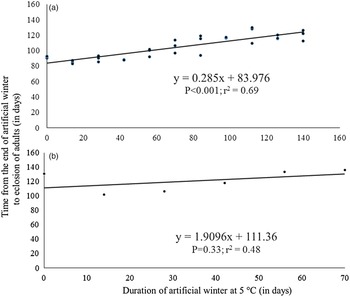
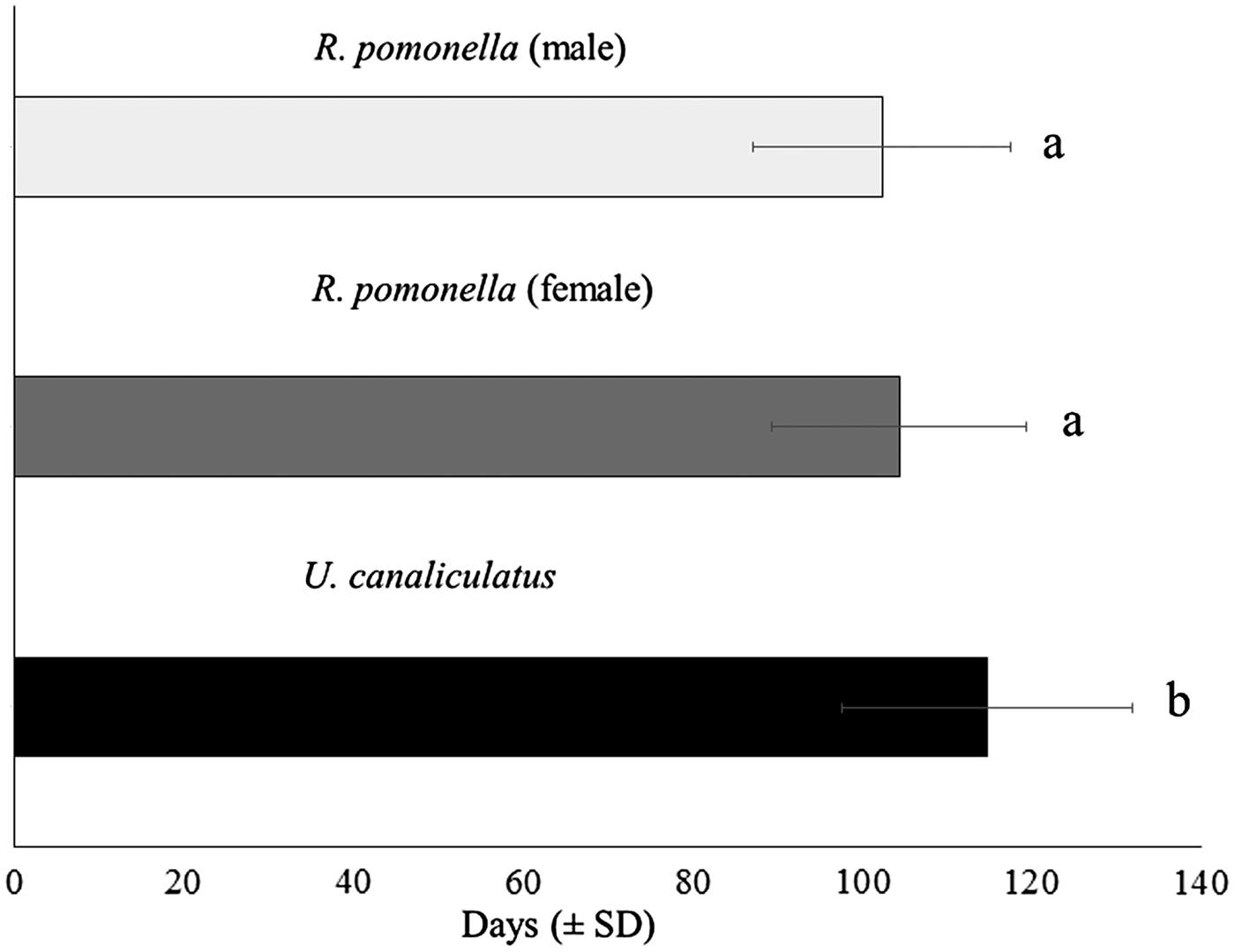
Rhagoletis pomonella pupae subjected to artificial winter periods of different lengths, eclosed at significantly different time intervals (after correcting for winter length) (F = 21.86; df = 10,42; P < 0.001), although no statistical differences were observed in time to adult eclosion between sexes (F = 0.44; df = 1,42; P < 0.507), and the interaction between sex and winter length was not significant (F 10,42 = 1.51; df = 10,42; P < 0.169). There was a strong positive correlation (F 1,62 = 141.7; df = 1,62; P < 0.001; r = 0.69) between winter length and time to adult eclosion (corrected for total duration of the artificial winter period) (fig. 2a). Utetes canaliculatus entering dormancy eclosed significantly later than male and female R. pomonella (F = 4.87; df = 2;80; P = 0.01) (fig. 3).
Correlation between winter length (in days) and time to adult eclosion (corrected for winter length) for (a) R. pomonella and (b) R. zoqui pupae subjected to 24°C for 40 days (pre-winter) and different time periods at 5°C (winter).

Mean number of days (±SD) from pupation to adult eclosion for R. pomonella females (light gray bar), male (dark gray bar) and the egg parasitoid U. canaliculatus (black bars) corrected for winter length.

In the case of R. turpiniae individuals entering dormancy, after correcting for winter duration (subtracting the number of days under 5°C temperatures) males emerged 105 ± 11 (mean ± SD) and females emerged 101 ± 7 (mean ± SD) days after winter, and parasitoids did so after 135 ± 19.7 (mean ± SD) days.
In the case of R. zoqui, there was no difference in the length of time it took males and females to eclose after winter (t = 1.8; df = 5; P = 0.13) and after pooling sexes, there was no difference among treatments (χ2 = 8.99; df = 5; P = 0.10) in the length of time it took males and females to eclose after winter. On average, R. zoqui adults, eclosed 120.9 ± 14.74 (mean ± SD) days after winter. There was no relationship between winter length and time to eclosion of R. zoqui adults (F 1,4 = 1.22; df = 1,4; P = 0.33; r = 0.48) (fig. 2b).
For R. solanophaga adults that became dormant (N = 7), after correcting for winter length, adults eclosed 103.1 ± 22.5 days after pupation.
Sample size, proportion of non-diapausing flies, percent overall survival (eclosion), average time from pupation to adult eclosion for different species of Rhagoletis is summarized in table 1.
Sample size, proportion of non-dormant flies (emerging within 40 days of pupation), mean number of days from pupation to adult eclosion of non-dormant flies, percent overall survival and mean number of days to adult eclosion of dormant flies (corrected for winter length) for four sympatric species of Rhagoletis from the Mexican highlands.

Selection of a non-diapausing R. pomonella strain
A total of 46 F1 pupae were recovered from apples exposed to non-dormant flies (six males and two females), of these 8.69% (four females) eclosed within 40 days without becoming dormant, the remaining adults (four males and three females) eclosed within 55–92 days after pupation. Since all recovered non-diapausing adults were females, these were crossed with males that had eclosed after 40 days but had been held at constant temperatures. Nevertheless, out of 155 F2 pupae recovered from these cross, we failed to recover any non-diapuasing F2 adults.
Discussion
The effect of winter length on survival and duration of dormancy was found to be different among four species of fruit flies in the genus Rhagoletis (three of them sympatric) exploiting different hosts. At 24°C, a very small proportion (<1%) of R. pomonella, R. turpiniae and R. zoqui completed development without becoming dormant, while in the case of R. solanophaga the majority of the population emerged after completing development 30–40 days after pupation. A larger proportion of braconid parasitoids infesting Rhagoletis eggs and larvae (1–5% of the total) emerged as adults without becoming dormant. Greatest survival of adults after artificial winter was obtained for R. pomonella and R. zoqui after 4 weeks at 5°C, while R. turpiniae, experienced low adult emergence and highest survival was recorded for flies exposed to 5°C during 10 and 12 weeks. For R. pomonella, there was a strong positive relationship between winter length and time to post-winter adult eclosion that was not observed for R. zoqui. Eight non-diapausing F0 adults of R. pomonella (<1%) produced 46 F1 pupae out of which four non-diapausing females (ca. 9%) and seven diapausing adults emerged. However, out of 155 pupae stemming from the cross of non-dipausing females and diapausing males, no non-diapausing F2 adults could be recovered.
A proportion of non-diapausing flies have been reported for several species in the genus Rhagoletis in temperate zones, where proportion ranges varied between 3 and 100% depending on the environmental conditions (Prokopy, Reference Prokopy1968; Dambroski & Feder, Reference Dambroski and Feder2007; Lyons-Sobaski & Berlocher, Reference Lyons-Sobaski and Berlocher2009). However, it is currently unknown if such non-diapausing condition is genetically determined. While Haisch & Boller (Reference Haisch, Boller and Self1971) suggested that non-diapausing individuals of the European Cherry Fruit Fly, Rhagoletis cerasi L., could be selected to establish a non-diapausing strain, Prokopy (Reference Prokopy1968) was able to obtain non-diapausing individuals forcing R. pomonella to develop from egg to adult, within 24–64 days, by exposing individuals to 28°C at a 17 : 7 or 19 : 5 L:D photoperiod. However, Dambroski & Feder (Reference Dambroski and Feder2007) found significant differences in the relative proportion of non-diapausing and chill-dependent flies between apple and hawthorn races of R. pomonella as well as among populations across a latitudinal gradient. In summary, earlier fruiting apples and warmer southern latitudes appear to select for flies better able to withstand longer periods of warm temperature before winter than flies exploiting late fruiting hosts and inhabiting northern latitudes (Dambroski & Feder, Reference Dambroski and Feder2007), while Egan et al. (Reference Egan, Ragland, Assour, Powell, Hood, Emrich, Nosil and Feder2015) show strong genetic associations with selection for diapause initiation. Our results are consistent with this reported trend, at the southern extreme of its range, a very small proportion of R. pomonella completes development within 35 days without becoming dormant.
While this pattern was also discovered for R. turpiniae and R. zoqui, most individuals of R. solanaphaga that eclosed as adults, did so within 35 days after pupation. In this case, as it has been reported for other species of Rhagoletis exploiting Solanaceous hosts, most of the population does not become dormant (Frías, Reference Frías1986; Frías et al., Reference Frías, Capetillo and Leppe1991, Hernández-Ortiz & Frias, Reference Hernández-Ortiz and Frias1999). As opposed to other host plants used by members of the genus, fruit of S. appendiculatum can be found almost all year round. Rhagoletis solanophaga is closely related to Rhagoletis striatella (Wulp), a fly species exploiting Physalys (Solanaceae) from Canada to the highlands of Central Mexico (Hernández-Ortiz & Frias, Reference Hernández-Ortiz and Frias1999). It would be interesting to examine dormancy and host-plant fruiting phenology of Northern and Southern populations of R. striatella which will most likely exhibit diapause. If R. solanophaga and R. striatella derive from a common ancestor, it could be a species for which diapause was lost, perhaps driven by climate and host-plant phenology.
Out of a total of 165 adult U. canaliculatus emerging from R. pomonella pupae, 70.9% emerged without becoming dormant. Such parasitoids developed within 26 days, suggesting that at least, a second parasitoid generation is able to exploit host larvae developing in fruit infested late in the growing season. Such a pattern, coupled with the fact that these parasitoids are parthenogenic, may allow selection of a non-diapausing strain for biological control purposes. As previously reported by Rull et al. (Reference Rull, Wharton, Feder, Guillen, Sivinski, Forbes and Aluja2009), diapausing individuals of this species undergo longer periods of post-winter dormancy than their fly hosts, which results in 2–3 weeks temporal lags between adult fly and adult parasitoid post-winter emergence. Such a delay, may allow emergence of overwintering R. pomonella, sexual maturation, mating and egg-laying and synchronizing occurrence of first adult parasitoids with infested host fruit. These temporal patterns were also observed in our study for an undescribed species of braconid emerging from R. turpiniae pupae, and have been reported for several species of parasitoids exploiting Rhagoletis (Ovruski et al., Reference Ovruski, Wharton, Rull and Guillén2007; Rull et al., Reference Rull, Wharton, Feder, Guillen, Sivinski, Forbes and Aluja2009), including R. zoqui (Rull et al., Reference Rull, Aluje, Tadeo, Guillen, Scott, Glover and Feder2013), where we found surprisingly low levels of parasitism (one individual) on ca. 1000 collected pupae.
The effect of winter length on overwintering survival of the Mexican R. pomonella population differs from previous reports for North American populations for this species. In northern latitudes, survival is greatest after a 13–19-week chilling period at 4°C (Feder et al., Reference Feder, Stolz, Lewis, Perry, Roethele and Rogers1997). In the case of European populations of R. cerasi, greatest adult eclosion is achieved after 5 months at 5°C (Moraiti et al., Reference Moraiti, Nakas and Papadopoulos2012). In the case of the Mexican population of Veracruz only 4 weeks at 5°C appear to be sufficient to break diapause. Minimal temperatures in the highlands of Veracruz, between 1800 and 2000 m a.s.l., only reach 5°C during a few cold days in December and January with the lowest mean temperature in the year dropping only to 13.6°C in January (26 years of data from the Servicio Meteorológico Nacional (National Weather Service) of the Comisión Nacional del Agua (National Commission of Water, Mexico)). These temperatures are likely to be slightly higher in the soil where pupae overwinter (Chen et al., Reference Chen, Opp, Berlocher and Roderick2006). Four weeks under 5°C also resulted in highest overwintering survival for R. zoqui, which at its peak only reached 33%. While peak survival for overwintering Mexican R. pomonella is within figures previously reported for the species (Feder et al., Reference Feder, Stolz, Lewis, Perry, Roethele and Rogers1997) low recovery of R. zoqui and R. turpiniae may indicate that temperature thresholds are different for these species, possibly higher, or that other cues such as humidity, pre-wintering conditions or host-plant-derived cues, alone or in combination, may play a more important role than temperature for regulation of dormancy. Additionally, it has to be kept in mind that we handled pupae by subjecting them to constant temperature regimes, which may not mimic adequately enough highly variable environmental conditions experienced under natural conditions. Finally, it has been documented that certain environmental cues trigger multiyear diapause in flies in the genus Rhagoletis (Moraiti et al., Reference Moraiti, Nakas and Papadopoulos2012) most likely to cope with environmental uncertainty. Walnuts are known for seasonal masting followed by sharp drops in fruit production a feature that may select for variability in lifecycle duration (Menu & Desouhant, Reference Menu and Desouhant2002). In this sense, it has to be considered that an unknown proportion of non-eclosed pupae of all species in our study may have entered prolonged diapause instead of dying from exhaustion of energy reserves. Future studies should quantify such proportion in order to yield more accurate estimates of the proportion of surviving adults.
Powell et al. (Reference Powell, Forbes, Hood and Feder2014) reported that different lengths and temperatures of pre-winter and different lengths of winter conditions, resulted in different eclosion times for US R. pomonella pupae. In their studies, differential survival of flies possessing particular alleles, according to environmental conditions, suggested a gene × environment interaction. For the Veracruz population, we found a strong positive linear relationship between winter length and duration of dormancy. In our study, pre-winter length and temperature were the same for all winter length treatments, and variation in winter length produced variable outcomes in timing of adult eclosion. Feder et al. (Reference Feder, Stolz, Lewis, Perry, Roethele and Rogers1997) found a similar trend for US populations of R. pomonella, and concluded that longer periods of cold storage select against allozyme markers associated with faster rates of development. Genes affecting diapause traits involved in host race formation of R. pomonella reside within large complexes of rearranged genes (inversions) (Feder et al., Reference Feder, Roethele, Filchak, Niedbalski and Romero-Severson2003b ). Such inversions, the source of diapause life-history variation, originated in the Mexican Altiplano (Feder et al., Reference Feder, Berlocher, Roethele, Dambroski, Smith, Perry, Garvrilovic, Filchak, Rull and Aluja2003a ) and introgressed into US populations, contributing to sympatric host race formation and speciation of the entire R. pomonella sibling species complex exploiting host plants differing in fruiting phenology (Berlocher, Reference Berlocher2000; Feder et al., Reference Feder, Xie, Rull, Velez, Forbes, Leung, Dambroski, Filchak and Aluja2005; Xie et al., Reference Xie, Hou and Zhang2008). In Mexico, three distinct populations of R. pomonella exploit early fruiting hawthorns (June–September) along the Sierra Madre Oriental and late fruiting hawthorns (October–January) across the Volcanic Transmexican belt and the highlands of Chiapas (Rull et al., Reference Rull, Aluja, Feder and Berlocher2006; Michel et al., Reference Michel, Rull, Aluja and Feder2007). Additionally, the mountainous nature of the country and latitude produce a span of environmental conditions that affect fruiting phenology. Finally, early and late fruiting hawthorn species commonly interbreed and produce hybrids with intermediate phenology (Phipps, Reference Phipps1997). Taken together, genetic architecture, environmental variation and fruiting phenology may have selected for, and maintained high life-history variability within Mexican R. pomonella. As concluded by Feder et al. (Reference Feder, Stolz, Lewis, Perry, Roethele and Rogers1997) life history of Mexican R. pomonella is the result of an interplay between insect development, host-plant phenology, and local climatic conditions. In the case of the walnut exploiting R. zoqui, we did not find such a similar relationship between winter length and timing of adult eclosion, perhaps because Juglans inhabits a narrower altitudinal range than Crataegus, does not exhibit such a wide variation in fruiting phenology, and there is much less spatial overlap among different species of walnuts (Stone et al., Reference Stone, Oh, Tripp, Ríos and Manos2009).
Selection of a non-dormant R. pomonella strain, coupled with the fact that significant progress has been made on artificial rearing of other members of the genus Rhagoletis (Köppler et al., Reference Köppler, Kaffer and Vogt2009), may allow production of this species both for experimental purposes, for Sterile Insect Technique development (Boller et al., Reference Boller, Haisch, Prokopy and Self1971) or for innoculative/augmentative biological control programs. Although we failed to select a non-diapausing strain, this may have been due to the unexpectedly low numbers of non-dormant individuals found among Mexican populations of R. pomonella. Nevertheless, we obtained a substantially higher proportion of non-dormant flies in the F1 generation but the trait was lost in the F2. Perhaps a larger initial fruit collection could produce better results. Once this is achieved, our results indicate that non-diapausing strains of the egg parasitoid U. canaliculatus and the larval parasitoid D. mellea may be selected for with greater ease. We also generated valuable information to manage field collected Rhagoletis of several species that might aid researchers working with Mexican populations in this interesting genus.
Overall, we can conclude that winter length had a significant influence on regulation of dormancy of R. pomonella and appears to be of secondary importance for R. zoqui, R. turpiniae and R. solanaphaga. Exploring other factors, such as pre-winter length, different winter temperatures, humidity and host-plant-derived cues may aid in reaching a better understanding of life history regulation in mid- and high-elevation areas in the tropics and contribute in conducting research on the genus and developing rational management tools for those species of economic importance.
Acknowledgements
Funding was provided by the International Atomic Energy Agency (IAEA Research Contract No: 18331/R0), the Mexican Campaña Nacional contra Moscas de la Fruta (SAGARPA-CONACOFI-INECOL) and the Instituto de Ecología A.C.