Introduction
Longer active life expectancy has expanded the world of possible activities post-retirement. Identifying those features of lifestyle activities that substantially delay and reduce one's risk for functional and cognitive decline and dementia has great clinical and public health import for a burgeoning society of aging adults. Targeting and developing opportunities for the most health-promoting behaviors is particularly important, given the limited treatment options for reversing functional disability and dementia. Numerous observational studies have demonstrated the cognitive and broader health benefits associated with engaging in intellectual lifestyle activities, such as reading, doing crossword puzzles, and taking courses in later life (Arbuckle, Maag, Pushkar, & Chaikelson, Reference Arbuckle, Maag, Pushkar and Chaikelson1998; Pushkar et al., Reference Pushkar, Etezadi, Andres, Arbuckle, Schwartzman and Chaikelson1999; Pushkar-Gold, Arbuckle, Conway, Chaikelson, & Maag, Reference Pushkar-Gold, Arbuckle, Conway, Chaikelson and Maag1997; Wang, Karp, Winblad, & Fratiglioni, Reference Wang, Karp, Winblad and Fratiglioni2002; Wilson & Bennett, Reference Wilson and Bennett2003; Wilson et al., Reference Wilson, Bennett, Beckett, Morris, Gilley, Bienias and Evans1999, Reference Wilson, Mendes de Leon, Barnes, Schreider, Bienias, Evans and Bennett2002), although other studies have failed to demonstrate these relationships (Aartsen, Smits, van Tilberg, Knipscheer, & Deeg, Reference Aartsen, Smits, van Tilberg, Knipscheer and Deeg2002; Hambrick, Salthouse, & Meinz, Reference Hambrick, Salthouse and Meinz1999; Mackinnon, Christensen, Hofer, Korten, & Jorm, Reference Mackinnon, Christensen, Hofer, Korten and Jorm2003; Newson & Kemps, Reference Newson and Kemps2006; Salthouse, Berish, & Miles, Reference Salthouse, Berish and Miles2002). The inconsistency in findings may be attributed, in part, to variations in the definition and measurement of cognitive activity.
Hultsch, Hertzog, Small, and Dixon (Reference Hultsch, Hertzog, Small and Dixon1999) have proposed under the engagement hypothesis that the more time one spends in high relative to low cognitive intensity activity, the greater the expected cognitive benefit. Greater cognitive activity has traditionally been characterized by increased frequency of participation in stimulating activity over relative intensity and variety of participation across cognitively enriching activities (e.g., Crowe, Andel, Pedersen, Johansson, & Gatz, Reference Crowe, Andel, Pedersen, Johansson and Gatz2003; Hultsch, Hammer, & Small, Reference Hultsch, Hammer and Small1993; Hultsch et al., Reference Hultsch, Hertzog, Small and Dixon1999; Lennartsson & Silverstein, Reference Lennartsson and Silverstein2001). The engagement hypothesis requires further evaluation as activities are time-delimited and more frequent participation in one activity necessarily limits the amount of time that can be devoted to other stimulating activities. For example, one individual may read daily while another may read and play cards on alternate weekdays. While the former individual would achieve a higher overall frequency score, the latter individual may derive equivalent or greater cognitive benefits as a result of exposure to a more enriched or complex environment. This viewpoint is analogous to that of “cross training” in the exercise literature whereby an individual exercises multiple muscle groups (e.g., alternates between running, biking, and swimming) rather than isolating one (swimming every day). We similarly hypothesized that participation in a variety of lifestyle activities may exercise numerous abilities and associated neurobiological pathways, including the organizational skills required to flexibly schedule and shift across these activities. This idea is consolidated from behavioral, clinical, and neurobiological evidence concerning the importance of environmental complexity to maintaining brain plasticity and cognitive reserve in both animal models and human models of cognitive aging and dementia (Baltes & Willis, Reference Baltes and Willis1982; Friedland et al., Reference Friedland, Fritsch, Smyth, Koss, Lerner, Hsiun and Debannes2001; Greenough, Cohen, & Juraska, Reference Greenough, Cohen and Juraska1999; Karp et al., Reference Karp, Paillard-Borg, Wang, Silverstein, Winblad and Fratiglioni2006; Scarmeas, Levy, Tang, Manly, & Stern, Reference Scarmeas, Levy, Tang, Manly and Stern2001; Schooler & Mulatu, Reference Schooler and Mulatu2001; Stern, Albert, Tang, & Tsai, Reference Stern, Albert, Tang and Tsai1999; van Praag, Kempermann, & Gage, Reference van Praag, Kempermann and Gage1999; Wilson et al., Reference Wilson, Bennett, Beckett, Morris, Gilley, Bienias and Evans1999, Reference Wilson, Mendes de Leon, Barnes, Schreider, Bienias, Evans and Bennett2002). We thus propose, under the engagement hypothesis, that the complexity and level of enrichment in one's life can be further assessed by the variety of participation in cognitively stimulating activity, regardless of frequency.
The Lifestyle Activities Questionnaire (LAQ), reported here, was developed from focus groups with older adults and surveys lifestyle activities that many older adults reported valuing and performing. It was designed and implemented in the Women's Health and Aging Study (WHAS) II shortly after study inception and is similar to other questionnaires since developed to survey frequency of participation across a range of activities (Hultsch et al., Reference Hultsch, Hertzog, Small and Dixon1999; Schinka et al., Reference Schinka, McBride, Vanderploeg, Tennyson, Borenstein and Mortimer2005; Wilson et al., Reference Wilson, Bennett, Beckett, Morris, Gilley, Bienias and Evans1999). While estimation of cognitive energy expenditure during complex, lifestyle activities is difficult to quantify due to methodological challenges and individual differences, similar issues apply to the assessment of physical activity, where average estimates of activity intensity have proven quite useful in determining levels of effort needed to derive health benefits in older adults (US Department of Health and Human Services, 2008). Therefore, to characterize cognitive intensity, we applied an approach conceptually parallel to standard approaches used to assess physical activity and health by dividing lifestyle activities according to relative level of cognitive stimulation.
Furthermore, using cognitive aging experts’ and older adults’ relative rankings of cognitive intensity in conjunction with epidemiologic definitions of activity patterns allows us to identify those activities that older adults elect to do and that appear to be efficacious over the long term as these activities are the most likely to be adhered to in sufficient doses to be beneficial. The value of such an approach is exemplified by the limited evidence-based options currently available to physicians, who often prescribe crossword puzzles to boost and maintain cognitive function. Such a prescription may be difficult to adhere to, and offers limited short- and long-term health rewards (for recent exception, see Pillai et al., 2011). Existing literature suggests that targeting individual activities, such as this, does not necessarily yield durable cognitive benefits (Hambrick et al., Reference Hambrick, Salthouse and Meinz1999) and does not generalize to a broader range of cognitive abilities or to independent function.
Moreover, the importance of identifying age-appropriate measures of stimulating activity is particularly relevant among older women, who live approximately 6 years longer than men and who are at elevated risk of cognitive and related physical disability. Where gender differences have been studied, cognitively stimulating activity has been less prevalent among women (Wilson et al., Reference Wilson, Bennett, Beckett, Morris, Gilley, Bienias and Evans1999). One postulate for this trend is that women, who traditionally maintain care-taking and domestic roles into retirement (Smyke, Reference Smyke1991), may have less access to or may limit the amount of time spent in challenging activities outside of the home.
This study characterized baseline levels of lifestyle activity in a population-based sample of healthy older women to determine whether those activities traditionally viewed as most cognitively stimulating (e.g., crossword puzzles, reading) were uniquely associated with reduced risk of clinical cognitive impairment on measures of memory and executive function or whether endorsement of numerous activities varying in level of cognitive stimulation may serve as a better surrogate of environmental enrichment. We hypothesized that variety of activity may be analogous to “cross training” by exercising multiple skill sets, and thus lead to more generalized cognitive benefits relative to frequent participation in a restricted set of highly intellectual activities.
Methods
Sample
The Women's Health and Aging Study (WHAS) II is a prospective study of physical functioning in a cohort of 436 older women recruited from the least disabled two-thirds of 70- to 79-year-old, community-dwelling women in eastern Baltimore. Sampling and recruitment are described in detail elsewhere (Carlson et al., Reference Carlson, Fried, Xue, Zeger and Brandt1999; Fried, Bandeen-Roche, Chaves, & Johnson, Reference Fried, Bandeen-Roche, Chaves and Johnson2000). Each participant completed tests and questionnaires, which included a medical history assessing history of physician diagnosis of 14 chronic conditions or diseases (hypertension, myocardial infarction, congestive heart failure, heart disease, angina, stroke, diabetes, arthritis, cancer, lung disease, a fractured hip, Parkinson's disease, and vision or hearing difficulties), and a 30-min cognitive exam (described below), as part of a 1-day evaluation at the Johns Hopkins Functional Status Laboratory. This study was approved by the Johns Hopkins IRB and each participant gave informed, written consent before completing a standardized interview at each exam. These exams starting at baseline were re-administered over five successive follow-up visits at 18-month intervals, with the exception of a 3-year interval between Exams 3 and 4, and spanned an average 9.5-year period.
At Exam 2, a total of 340 individuals completed the Lifestyle Activities Questionnaire (LAQ) as part of their clinic visit. For an additional 59 participants who did not complete the questionnaire at Exam 2, we imputed available LAQ scores from Exam 3 for a total of 399 participants. Among the 399 participants, 20 were removed from analysis because of cognitive impairment at baseline or Exam 2 (n = 6) on all outcome measures or follow-up cognitive data were unavailable after Exam 2 (n = 14). These participants were more often African-American, less healthy by self-report, and had fewer years of education than the larger sample (p's < .05). The total sample available for analyses consisted of 379 individuals.
Measures
Lifestyle Activity Questionnaire (LAQ)
The LAQ assessed lifestyle activity by asking participants to rate on a 6-point scale how often over the prior year they participated in each of 23 activities, with ratings ranging from “never or less than once a month” (0) to “every day” (5). We then weighted the 6-point scale according to a 30-day scale, ranging from “not at all” (0), to “once a month” (1), to “2 to 3 times a month” (2.5), to “once a week” (4), to “2 to 3 times a week” (10) to “every day” (30).
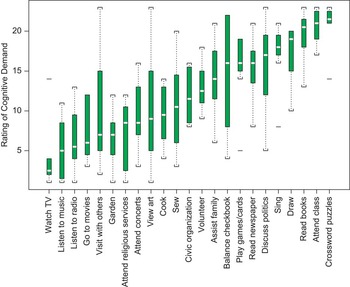
The relative level of cognitive stimulation posed by each of 23 everyday activities on the LAQ was independently rank-ordered by a panel of nine cognitive psychologists at different US academic institutions. The panel's rank-ordered activities are presented via boxplots with 75% interquartile ranges in order of least stimulating or challenging (watching television) to most challenging (crossword puzzles) (see Figure 1). Spearman rank-order correlations showed that inter-rater agreement among psychologists was moderate to high (0.31–0.92) on most activities, with three exceptions: balancing checkbook, looking at art, and visiting with others. These three items were excluded from subsequent analysis due to low inter-rater reliability. Rankings agreed with ratings among a convenience sample of 31 older adults. Furthermore, these estimates of cognitively stimulating (e.g., reading, taking courses) and less-stimulating (e.g., watching television, listening to radio) activity generally agreed with a priori determinations reported in the cognitive activity literature (Arbuckle, Pushkar Gold, Chaikelson, & Lapidus, Reference Arbuckle, Pushkar Gold, Chaikelson and Lapidus1994; Hultsch et al., Reference Hultsch, Hertzog, Small and Dixon1999), and thus provide additional validation for these estimates.
Box plots of 23 everyday activities rank-ordered by a panel of cognitive psychologists according to relative level of cognitive demand, from least (left) to most (right) demanding.

A global measure of stimulating activity was then derived by multiplying the median rank-ordered intensity of a given activity by the reported monthly frequency of that activity and summing across all 20 activities. Based on the rank ordering of all 20 activities (see Figure 1), we then divided these activities into three tertiles of high (crossword puzzles, taking courses, drawing, singing or playing music, talking about local/national issues, reading books, reading newspapers), moderate (discussing politics, playing cards/games, assisting family or friends, volunteer work, participating in church/club/organizations, sewing/mending/fixing/decorating/building, cooking), and low (watching television, gardening, attending religious services, going to plays or concerts, going to movies, listening to radio, listening to music) cognitive demand, and calculated the corresponding frequency scores. The frequency scores for each intensity level were standardized to facilitate comparison across levels of cognitive demand. In addition, we considered the total number of the 20 activities endorsed once a month or more as a measure of variety, yielding a possible range of 0–20. As with frequency, we divided these activities into high, moderate, and low intensity activity tertiles.
Cognitive assessment
Cognitive testing by a trained technician consisted of a global cognitive screen, the Mini-Mental State Exam (MMSE; Folstein, Folstein, & McHugh, Reference Folstein, Folstein and McHugh1975) followed by standardized neuropsychological tests to evaluate psychomotor speed, executive attention, and verbal memory. The Trail Making Test (TMT; Reitan, Reference Reitan1958) is a pencil-and-paper test assessing psychomotor and simple visual search speed (TMT Part A) and planning and attentional flexibility (TMT Part B) (see Spreen & Strauss, Reference Spreen and Strauss1998). Part A required one to connect a randomly distributed array of numbers sequentially from 1 to 25 as quickly as possible. Part B required one to connect randomly distributed numbers and letters in an ascending alpha-numeric sequence. Participants were allotted a maximum time of 240 s on Part A and 420 s on Part B. The Hopkins Verbal Learning Test-Revised (HVLT-R; Benedict, Schretlen, Groninger, & Brandt, Reference Benedict, Schretlen, Groninger and Brandt1998; Brandt, Reference Brandt1991) assessed both immediate learning and delayed recall. The HVLT-R is composed of 12 common nouns that are read to participants and recalled over three learning trials. Learning represents the total number of words correctly recalled in any order over all three trials (maximum = 36). After a filled, 15-min interval, the participant tried to recall as many of the 12 words as possible in any order.
Clinical endpoints used to define cognitive impairment on a given task were conservatively set to the 5th percentile based on age-matched normative data (Benedict et al., Reference Benedict, Schretlen, Groninger and Brandt1998; Ivnik, Malec, Smith, Tangalos, & Petersen, Reference Ivnik, Malec, Smith, Tangalos and Petersen1996) and are reported elsewhere (Carlson et al., Reference Carlson, Erickson, Kramer, Voss, Bolea, Mielke and Fried2009). Specific clinical endpoints were: TMT, Part A ≥81 s; TMT, Part B ≥225 s; HVLT Immediate recall ≤16 words; HVLT Delayed recall ≤4 words; and MMSE score ≤23.
Statistical Analyses
Frequency distributions, means, and standard deviations of activity predictors and outcomes were examined to describe baseline characteristics of the study population. Due to the repeated measurements available over a 9-year interval, we employed discrete-time Cox's proportional hazard models to examine whether frequency and variety of activity predicted time to cognitive impairment on each of the four cognitive outcomes: TMT A, TMT B, HVLT immediate, and HVLT delayed recall, as well as global cognition (MMSE). This modeling approach allowed us to examine the percent reduction in incidence of impairment for each additional day of activity (frequency) or each additional type of activity (variety) endorsed. For each domain-specific analysis, participants were excluded if they demonstrated prevalent impairment, as defined in the preceding section. The number of participants removed due to impairment at baseline or Exam 2 on the TMT A or B was 42 and 69, respectively; and for HVLT immediate and delayed recall, 70 and 56, respectively. Only seven participants had prevalent impairment on the MMSE. Results of models are presented as hazard ratios (HRs) with 95% confidence intervals (CIs), where the HR described the independent effect of the predictor on the hazard or risk of time to incident impairment.
Separate models for frequency and variety were conducted for each outcome to examine total activity, as well as the independent association of each cognitive intensity level (high, moderate, low) on incident cognitive impairment. All models covaried for age, education, race, and number of chronic diseases at baseline (Carlson et al., Reference Carlson, Fried, Xue, Zeger and Brandt1999; Fried, Kasper, Guralnik, & Simonsick, Reference Fried, Kasper, Guralnik and Simonsick1995). The log-linearity assumption was checked confirming the lack of nonlinear associations between activity measures and hazard functions in all models. The log-log of survival plots and Wald tests were used to examine the proportional hazard assumption of models. Discrete-time proportional hazard model fitting was conducted using the PROC LOGISTIC command with a complementary log-log link function in SAS version 9.2.
Results
Participant Characteristics
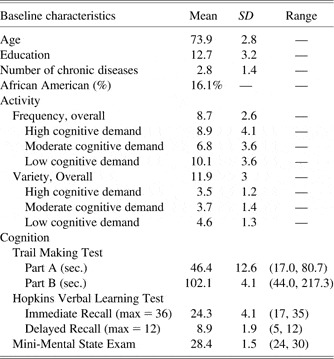
Baseline demographics and health characteristics of the sample (N = 379) are presented in Table 1. This cohort of older women averaged 74 years of age at baseline, achieved a high school education (M = 12.7 years; SD = 3.2), and 16.1% were African-American. The majority of participants were in relatively good physical health (as indicated by number of chronic health conditions: M = 2.8; SD = 1.4) and did not show signs of dementia (as indicated by scores greater than 23 on the MMSE: M = 28.4; SD = 1.5). Additionally, comparison of mean performance with available normative data indicated that this cohort was performing within normal limits on all cognitive tasks (TMT, Part A; TMT, Part B, HVLT immediate and delayed recall, and MMSE) at baseline (Benedict et al., Reference Benedict, Schretlen, Groninger and Brandt1998; Ivnik et al., Reference Ivnik, Malec, Smith, Tangalos and Petersen1996). Over the 9.5-year interval, the percentages of incident events were 22.7% for HVLT delayed recall, 24.1% for HVLT immediate recall, and 19.6% for TMT, Part A. Incident impairment was most common on TMT, Part B (30.3%) and least common on the MMSE (19.2%).
Demographic and health characteristics of WHAS II participants (N = 379) at study baseline

Frequency of Activities
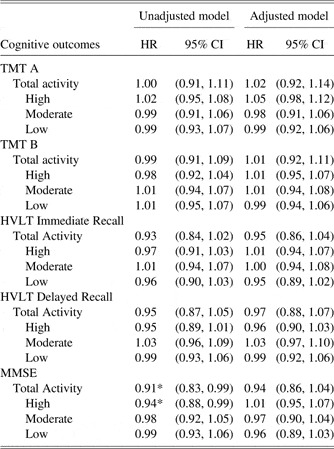
As shown in Table 2, findings from unadjusted models showed that more frequent participation in total, and specifically, high, cognitively demanding activities predicted reduced risk of incident impairment only on the MMSE. Specifically, each additional day per month of participation in highly demanding activities was associated with 6% decreased risk of impairment on the MMSE. After models adjusted for age, education, race, and number of chronic diseases, high cognitive demand activities no longer predicted significant risk reduction for impairment on any of the cognitive outcomes.
Discrete time Cox proportional hazard models examining the associations between frequency of activities and incident cognitive impairments

Note. TMT = Trail Making Test; HVLT = Hopkins Verbal Learning Test; MMSE = Mini-Mental State Exam. Adjusted models included covariates for age, education, race, and number of chronic diseases at baseline.
*p < .05.
Variety of Activities
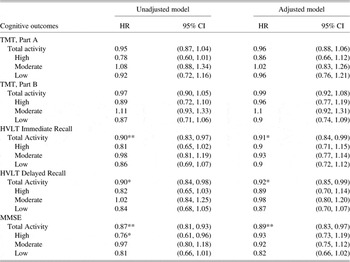
Unadjusted models showed that variety of total, and specifically, high, cognitively demanding activities was associated with reduced risk of impairment on the HVLT immediate recall, HVLT delayed recall, and MMSE (Table 3). After adjusting for the above-mentioned covariates, greater participation in total variety of activities, regardless of cognitive demand, remained significantly associated with reduced risk of impairment for all of these cognitive outcomes. Specifically, each additional activity per month endorsed reduced the risk of incident impairment by 9% on HVLT immediate recall, by 8% on HVLT delayed recall, and by 11% on the MMSE.
Discrete time Cox proportional hazard models examining the associations between variety of activities and incident cognitive impairments

Note. TMT = Trail Making Test; HVLT = Hopkins Verbal Learning Test; MMSE = Mini-Mental State Exam. Adjusted models included covariates for age, education, race, and number of chronic diseases at baseline.
*p < .05; **p < .01.
In a more rigorous examination of the independent predictive utility of total variety of activity, we ran multivariable regression models, including total frequency as a covariate along with the aforementioned covariates. Despite the fact that total frequency and total variety were moderately correlated across activity levels (r's = 0.53–0.58), total variety remained a significant protective risk factor against incident impairments in HVLT Delay (HR = 0.90; CI 0.82, 0.99), and MMSE (HR = 0.88; CI 0.80–0.98), becoming marginal for HVLT immediate recall (HR = 0.91; CI, 0.82–1.00) (results not presented).
Discussion
This study examined the effectiveness of intensity and variety metrics of cognitively enriching lifestyle activity on risk reduction in psychomotor speed, executive function, and verbal episodic memory over a 9.5-year interval in initially high-functioning older women, screened to be free of cognitive impairment at baseline. Participation in a variety of activities was more predictive than frequency or cognitive intensity for measuring clinically significant reductions in risk of incident impairment in immediate and delayed verbal memory and global cognition, outcomes sensitive to dementia risk. Specifically, for each additional activity endorsed regardless of frequency, participants’ risk for incident memory and global cognitive impairment was reduced by 8–11%. Our data suggest that increasing the frequency of cognitively challenging activities per month may not be as essential as increasing the total number, or variety, of activities to help maintain cognitive health. These findings support the expansion of methods by which to evaluate the engagement hypothesis (Hultsch et al., Reference Hultsch, Hertzog, Small and Dixon1999) by suggesting that exposure to lifestyle activities varying in levels of cognitive stimulation may serve as a surrogate measure of environmental enrichment and complexity in later life.
How might participation in a variety of lifestyle activities, regardless of frequency, promote the maintenance of cognitive function? We hypothesized that participation in a variety of activities may exercise several abilities and associated neurobiological pathways, including the organizational skills required to flexibly schedule and shift across these activities. Considerable behavioral, clinical, and neurobiological evidence highlights the importance of environmental complexity to maintaining brain plasticity and cognitive reserve in both human and animal models (Baltes & Willis, Reference Baltes and Willis1982; Gould, Beylin, Tanapat, Reeves, & Shors, Reference Gould, Beylin, Tanapat, Reeves and Shors1999; Greenough et al., Reference Greenough, Cohen and Juraska1999; Gribbin, Schaie, & Parham, Reference Gribbin, Schaie and Parham1980; Schooler & Mulatu, Reference Schooler and Mulatu2001; Schooler, Mulatu, & Oates, Reference Schooler, Mulatu and Oates1999; Stern et al., Reference Stern, Albert, Tang and Tsai1999; van Praag et al., Reference van Praag, Kempermann and Gage1999; Verhaeghen, Marcoen, & Goossens, Reference Verhaeghen, Marcoen and Goossens1992; Wilson et al., Reference Wilson, Bennett, Beckett, Morris, Gilley, Bienias and Evans1999). Additional support for participating in a variety of stimulating activities comes from recent studies of risk for dementia and Alzheimer's disease (Friedland et al., Reference Friedland, Fritsch, Smyth, Koss, Lerner, Hsiun and Debannes2001; Karp et al., Reference Karp, Paillard-Borg, Wang, Silverstein, Winblad and Fratiglioni2006; Scarmeas et al., Reference Scarmeas, Levy, Tang, Manly and Stern2001; Wang et al., Reference Wang, Karp, Winblad and Fratiglioni2002; Wilson et al., Reference Wilson, Mendes de Leon, Barnes, Schreider, Bienias, Evans and Bennett2002) and from promising short-term results of an ‘everyday’ activity intervention on brain plasticity in high-risk older adults (Carlson et al., Reference Carlson, Saczynski, Rebok, Seeman, Glass, McGill and Fried2008, Reference Carlson, Erickson, Kramer, Voss, Bolea, Mielke and Fried2009). Similarly, in the physical activity literature, we have reported that variety of exercise activity appears to be protective of cognitive decline when frequency is not (Podewils et al., Reference Podewils, Guallar, Kuller, Fried, Lopez, Carlson and Lyketsos2005). These converging lines of evidence, combined with our observations, suggest that variety of activity may provide an important source of environmental complexity and enrichment at older as well as younger ages.
Furthermore, the engagement hypothesis does not specify how exposure to high cognitive intensity activity is to be derived and thus allows for the possibility that, generally speaking, one may choose frequent exposure to a relatively circumscribed subset of activities, nominal or moderate exposure to a broad range of stimulating activities, or some combination thereof. With increased age, individuals may attempt to maintain cognitive reserve capacity in the face of declining cognitive and physical resources by reducing their frequency of exposure to any one activity, selecting more moderate levels of exposure to a broader array of stimulating activities. Therefore, as one ages, it becomes more important to have a broad repertoire of activities that one can draw upon to select new or replace previous activities.
This method of compensation may amplify cognitive benefits in two ways. First, expanding one's range of interactions with a greater number and types of environments naturally increases the level of environmental complexity. Individuals who remember and coordinate among and across multiple activities and environments likely have good memory and organizational skills, and may continue to exercise and maintain these cognitive abilities through activity. Second, lifestyle activities often involve some combination of physical, cognitive, and social activity, the combined benefits of which are being increasingly valued, even at moderate levels (Carlson et al., Reference Carlson, Saczynski, Rebok, Seeman, Glass, McGill and Fried2008, Reference Carlson, Erickson, Kramer, Voss, Bolea, Mielke and Fried2009; Colcombe et al., Reference Colcombe, Kramer, Erickson, Scalf, McAuley, Cohen and Elavsky2004). As such, the whole activity set, as measured by variety, may be greater than the sum of its parts.
This latter notion is consistent with the idea of elective (i.e., motivated) selection proposed by Baltes and colleagues (Baltes, Lindenberger, & Staudinger, Reference Baltes, Lindenberger and Staudinger1997) where an individual chooses cognitive (as well as physical and social) activities, either actively or passively, from a population of opportunities. Engaging in a variety of well-chosen, meaningful activities should help maintain the older adult's cognitive reserve capacity (Baltes et al., Reference Baltes, Lindenberger and Staudinger1997; Staudinger, Marsiske, & Baltes, Reference Staudinger, Marsiske and Baltes1995), as well as enhance an individual's quality of life (Mobily, Lemke, & Gisin, Reference Mobily, Lemke and Gisin1991).
Measuring variety of activity offers insight into intervention design and advantages to the study of cognitive activity. First, the magnitude and consistency of associations between a variety of activities and cognition, particularly in the domain of memory, holds potential promise for effective cognitive interventions in aging adults (see Jobe et al., Reference Jobe, Smith, Ball, Tennstedt, Marsiske, Willis and Kleinman2001 for similar arguments). Specifically, these findings suggest that older adults may benefit from some nominal or moderate level of exposure to several stimulating activities. As such, cognitive interventions that are designed to train multiple cognitive systems in a variety of contexts may ultimately offer a greater cognitive boost. The second benefit associated with measurement of variety is practical. Surveying variety of activity simply requires a “yes/no” endorsement across a range of activities and is subject to fewer recall errors than is the assessment of frequency. Lastly, from a measurement perspective, variety provides information about the diversity or richness of activities in which older adults are engaged. As participation in a variety of activities may influence cognition quite apart from the frequency of participation (see also Friedland et al., Reference Friedland, Fritsch, Smyth, Koss, Lerner, Hsiun and Debannes2001; Herzog, Franks, Markus, & Holmberg, Reference Herzog, Franks, Markus and Holmberg1998; Parisi, Reference Parisi2007); considering the diversity of activities may better help us to better understand engagement-cognition relations.
Three limitations of the study are considered. The first limitation lies in the generalizability of findings to older men. The activity questionnaire used in the WHAS II has now been adapted to assess more gender-neutral activities (e.g., computer use) along with activities that older men are more likely than older women to participate in (e.g., camping, hunting). This expanded version is now being administered to two large national cognitive intervention trials of older men and women to determine whether the relationships observed here between indices of cognitive activity and cognitive function persist. A second limitation regards the potential for reverse causality. Our observational study design acknowledges the likelihood of circular associations between activity and ability; namely, that those who are unable to perform an activity, as a result of cognitive, physical, medical, or psychosocial limitations, will not have the same access to a range of activities as will higher-functioning individuals. We sought to minimize the potential for such circularity in several ways. First, by examining a cohort screened to be physically and cognitively high functioning at baseline, we were able to more accurately assess stable activity lifestyles that were relatively unrestricted by disability and impairment (see Herzog, House, & Morgan, Reference Herzog, House and Morgan1991). Second, to detect incident impairments in each cognitive outcome, we excluded those with impairments at baseline. Third, we adjusted for mental and medical health status factors that may impact rates of activity as well as cognition. A further limitation of our data regards the lack of self-report reliability data on this questionnaire. While we do not view 18-month change data as a substitute, we were encouraged by the stability of activity patterns over this interval, with the only changes across activities noted for watching TV and listening to the radio (both increased significantly), and for gardening and cooking (both modestly decreased).
In conclusion, participation in a variety of activities, regardless of frequency, was beneficially associated with the maintenance of cognitive health in late life. These findings offer new perspectives in promoting a diverse repertoire of activities to mitigate age-related cognitive declines in ways that may be more readily sustained through later life. Further research is warranted to determine the mechanisms by which variety of activities may target and maximally strengthen cognitive reserves, particularly in those at greatest risk of cognitive impairment.
Acknowledgments
This work was supported by a grant from the American Federation for Aging Research and by the National Institute on Aging Grants R03AG18559. The WHAS II Cognitive Pathways study was supported by National Institute on Aging Grant RO1 AG11703-01A1. Dr. Parisi was supported by a National Institute of Mental Health Prevention Research Training Grant (T-32 MH018834) (Nicholas Ialongo, Principal Investigator).