


Introduction
A number of systematic reviews and meta-analyses (Wykes, Steel, Everitt and Tarrier, Reference Wykes, Steel, Everitt and Tarrier2008; Zimmermann, Favrod, Trieu and Pomini, Reference Zimmermann, Favrod, Trieu and Pomini2005) have concluded that cognitive behaviour therapy (CBT) is effective in treating people with psychoses. Most of this research was, however, conducted in the West. In our search we found limited literature on CBT for psychosis in English language from low or middle income countries. We found only two studies of psychological interventions for schizophrenia from Pakistan (Farooq et al., Reference Farooq, Nazar, Irfan, Akhter, Gul and Irfan2011; Nasr and Kausar, Reference Nasr and Kausar2009).
The NICE (National Institute for Health and Care Excellence) guidelines suggest that “cognitive behavioural therapy (CBT) should be offered to people with schizophrenia. This can be started either during the acute phase or later, including inpatient settings” (NICE, 2009). Providing psychological treatment during the inpatient phase might offer improved opportunities, especially in a developing country; this is especially important because the distance from health care facility was reported to be one of the major barriers to receiving therapy regularly (since in Pakistan most patients and their carers travel long distances to see therapists in psychiatric centres, which are mainly in large urban areas) (Naeem, Gobbi, Ayub and Kingdon, Reference Naeem, Gobbi, Ayub and Kingdon2010). Only a few studies have investigated CBT for treating inpatients with psychosis. One such RCT with inpatients (Dury, Birchwood, Cochrane and MacMillan; Reference Dury, Birchwood, Cochrane and MacMillan1996) compared routine care plus group and individual CBT with routine care plus recreational activities. Patients receiving CBT showed superior change on positive symptom measures and faster rates of improvement at the end of the therapy. However, another study, which compared individual CBT to supportive counselling/psycho-education among inpatients, found no difference between the two groups. Two-year follow-up showed no significant differences between the groups (Haddock, Tarrier et al., Reference Haddock, Tarrier, Morrison, Hopkins, Drake and Lewis1999). Psychotic symptom continued to improve on 18-month follow-up (Tarrier et al., Reference Tarrier, Lewis, Haddock, Bentall, Drake and Kinderman2004). Lewis et al. (Reference Lewis, Tarrier, Haddock, Bentall, Kinderman and Kingdon2002) compared routine care plus CBT for 5 weeks to routine care alone, and routine care plus supportive counselling. They found routine care plus CBT to be effective. Similarly, more recently, acceptance-based treatment (Acceptance and Commitment Therapy; ACT), which teaches patients to accept unavoidable private events, to identify and focus on actions directed toward valued goals, and to defuse from odd cognition, just noticing thoughts rather than treating them as either true or false (Bach and Hayes, Reference Bach and Hayes2001), has been tried in inpatient settings with promising results (Gaudiano and Herbert, Reference Gaudiano and Herbert2006).
It has been suggested that cultural differences can influence the process of CBT, and therefore therapy might need adapting to the cultural needs of a given culture (Hays and Iwamasa, Reference Hays and Iwamasa2006; Hofmann, Reference Hofmann2006;.). Our group has adapted CBT for depression in Pakistan (Naeem, Ayub, Gobbi and Kingdon, Reference Naeem, Ayub, Gobbi and Kingdon2009; Naeem, Gobbi, Ayub and Kingdon, Reference Naeem, Gobbi, Ayub and Kingdon2009; Naeem et al., Reference Naeem, Gobbi, Ayub and Kingdon2010; Naeem, Ayub, Kingdon and Gobbi, Reference Naeem, Ayub, Kingdon and Gobbi2012;), which was found to be effective in a small trial (Naeem, Waheed, Gobbi, Ayub and Kingdon, Reference Naeem, Waheed, Gobbi, Ayub and Kingdon2011). We used the same methodology to adapt CBT for schizophrenia for local use (Naeem et al., Reference Naeem, Habib, Gul, Khalid, Saeed and Farooq2013). This paper describes a pilot study reporting on a preliminary evaluation of culturally adapted CBT for psychosis (CaCBTp) in Pakistan.
Aims and Method
The aim of this study was to test CaCBTp against Treatment As Usual in an inpatient setting in Pakistan and to collect outcome data to calculate sample size for a later definitive trial.
Study area and population
Study participants were recruited from acute inpatient psychiatry units of three hospitals in Lahore, Pakistan; Sir Ganga Ram Hospital, Fountain House and Punjab Institute of Mental Health. Hospital admissions are not per catchment area and therefore patients come from distant areas. This study was conducted from July 2009 to March 2011.
Sample
A total of 42 participants were recruited mainly from three hospitals in Lahore, Pakistan. The inclusion criteria were: being able to engage with a therapist, being an inpatient and with a diagnosis of schizophrenia according to the DSM-IV-TR (American Psychiatric Association, 2000), age 18 to 65 years, and with at least 5 years of education of the patient or a carer at school level. The exclusion criteria were: co-morbid alcohol or substance dependence, organic brain syndrome or learning disability, and high levels of disturbed behaviour, or high risk of suicide or homicide based on clinical impression.
Procedure
The mental health professionals from participating hospitals were approached and the purpose of the study was explained to them. Patients referred by them received information about the study. After taking informed consent participants were assessed by blind assessors who were psychology graduates and had received one day training in using assessment tools. After completion of the assessment, participants were randomly assigned to either CBTp (n = 21) or Treatment As Usual group (TAU, n = 21). Randomization was performed using (www.randomization.com). The Ethics Committee of Pakistan Association of Cognitive Therapists (PACT) granted approval (PACT/EC/0723/0309). Because the literacy rate is very low in Pakistan, informed consent was obtained by reading the consent form to the participants. If the individual agreed to participate in the trial the interviewer and one of the staff members at the practice signed the form as a witness. All participants gave informed consent for screening and separate consent for random assignment.
Measures
Data regarding demographic characteristics were collected using a data collection form. Psychopathology was measured using the PANSS (Positive and Negative Syndrome Scale of Schizophrenia), PSYRATS (Psychotic Symptom Rating Scales), and the Insight Scale. The above scales were translated into Urdu using standard methodology (Ahmer, Faruqui and Aijaz, Reference Ahmer, Faruqui and Aijaz2007). Raters who were psychology graduates received training in the use of these instruments.
Positive and Negative Syndrome Scale of Schizophrenia (PANSS; Kay, Fiszbein and Opfer, Reference Kay, Fiszbein and Opfer1987) is a widely used, well established and comprehensive symptom rating scale measuring mental state. It has 30 items, each measured on a 7-point rating instrument. There are three sub-scales (Positive Symptoms, Negative Symptoms, and General Psychopathology) along with a total score. The test-retest reliability of PANSS is 0.88 and Criterion related validity is 0.62. The Structured Clinical Interview for PANSS (SCI-PANSS; Kay, Reference Kay1991) was used in this study.
Psychotic Symptom Rating Scales (PSYRATS; Haddock, McCarron, Tarrier and Faragher, 1999) is a 17-item interviewer scored instrument that consist of two subscales (PSYRATS Voice, PSYRAT Delusion) that measure the severity of a number of dimensions of auditory hallucinations and delusions including the amount and intensity of distress associated with these symptoms. The 11-item hallucination sub-scale consists of items such as frequency, duration, loudness, negative content, intensity of distress and degree of disruption. The 6-item delusion sub-scale (PSYRATS delusion) consists of items such as amount of preoccupation, degree of conviction, intensity of distress and disruption. All items are rated on a 5-point scale of increasing severity (0 = No problem to 4 = Maximum severity). The PSYRATS has demonstrated good interrater reliability (intra class correlation (ICCS) for most items >.90), test re test reliability (ICCS for both subscales = .70), concurrent validity, and sensitivity to change in patients diagnosed with schizophrenia.
Insight was rated using the Schedule for Assessment of Insight (SAI; David, Buchanan, Reed and Almeida, Reference David, Buchanan, Reed and Almeida1992). The SAI rates three dimensions of insight: Treatment Adherence (SAI–TA), Recognition of Illness (SAI–RI) and Symptom Relabelling (SAI–SR). Symptom Relabelling involves the recognition of a psychotic symptom and the understanding that it is a pathological event. Each dimension comprises two or three questions that are scored on a 3-point scale from 0 (no insight) to 2 (good insight), with a maximum total score of 24. The sub-scale totals are summed for a total insight score.
Intervention (CaCBTp)
The CaCBTp intervention consisted of 16 sessions lasting approximately one hour (using a manual and over 4 to 6 months as per NICE guidelines (NICE, 2009)). Therapy was provided according to a manualized treatment protocol (Kingdon and Turkington, Reference Kingdon and Turkington1994). A flexible approach was used and initially patients were provided twice weekly sessions. Those who attended less than 8 sessions were considered as drop-outs from the therapy. In our preliminary work we observed that family members are involved actively in patient care in Pakistan, and therefore we involved the family members in the treatment plan from the beginning. Therapy started with the family's involvement and they shared the information to which the patient agreed, as well as being given the chance to ask questions. During the same session a key carer was identified with whom the therapist worked closely. The carer attended the sessions with the patient's consent and helped in therapy (e.g. with homework if required). CBT was provided by a psychologist with a post-graduate diploma (NH) who had received training in CBTp and ongoing supervision by FN.
Cultural adaptation of CBTp
Therapy was delivered using guidelines developed for cultural adaptation in Pakistan. These guidelines were developed in our preliminary work, in which CBTp was adapted using a series of qualitative studies. The project consisted of qualitative methods and used methods similar to those we used for cultural adaptation of CBT for depression (Naeem, Ayub et al., Reference Naeem, Gobbi, Ayub and Kingdon2009; Naeem, Gobbi et al., Reference Naeem, Ayub, Gobbi and Kingdon2009; Naeem et al., Reference Naeem, Gobbi, Ayub and Kingdon2010, Reference Naeem, Waheed, Gobbi, Ayub and Kingdon2011, Reference Naeem, Ayub, Kingdon and Gobbi2012). During this preliminary work to adapt CBTp for use in Pakistan, we conducted a series of qualitative studies to explore the views of patients, their carers and the health professionals in this area. A total of 92 interviews were conducted by 3 psychologists. We conducted qualitative interviews with mental health professionals (n = 29) and patients (n = 33) and their carers (n = 30). Interviews were conducted in three psychiatry departments in Lahore, Pakistan. The results of these studies highlighted the barriers in therapy (e.g. lack of awareness of therapy, family's involvement, travelling distance and expenses, and uncooperative family caregivers) as well as strengths while working with this patient group. Patients and their carers in Pakistan use a bio-psycho-spiritual-social model of illness. They seek help from various sources, including faith healers. Therapists make minor adjustments in therapy. Findings from these studies have been described in a separate paper (Naeem et al., Reference Naeem, Habib, Gul, Khalid, Saeed and Farooq2013).
TAU group
The Treatment As Usual (TAU) group received only antipsychotic medication as prescribed by the psychiatrist, and nursing care. At the completion of the research the participants who had been assigned to the TAU group were given the option of receiving CBTp.
Statistical analyses
Both parametric and nonparametric tests were carried out. Initially data were examined for errors in input. The analysis was carried out on Intention To Treat basis using SPSS version 16.0. Initial analyses to compare the two groups were carried out using t test and χ2 test. A linear regression analysis was used, with end of therapy as the dependent variable and group allocation as the independent variable. In order to see the effect of baseline differences in pretreatment scores on effect of therapy a second analysis was carried out with baseline scores entered as independent variables in addition to treatment groups (i.e. dependent variable posttreatment scores, independent variable treatment group, and pretreatment scores).
Results
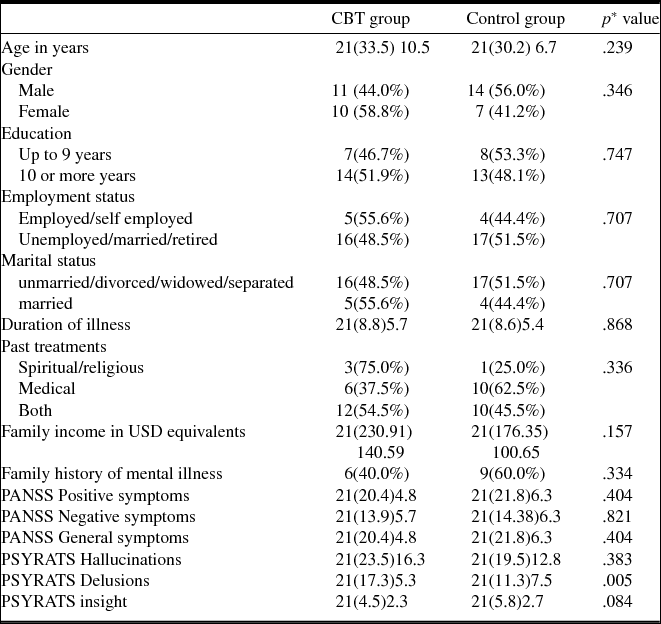
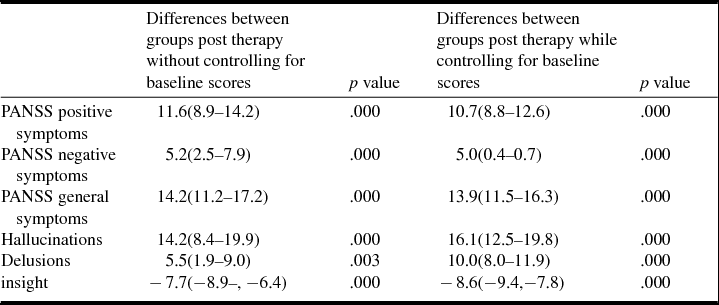
Most patients received 12–14 sessions (n = 13), while a smaller number received 12–16 sessions (n = 3) and another group received 10–12 sessions (n = 5). There were no differences between demographic variables or psychopathology at the baseline (see Table 1). When comparisons were made between the therapy and control group at the end of the therapy, controlled for the baseline differences in scores, final outcome assessment at the end of the therapy showed a statistically significant reduction in psychotic symptoms and improvement in insight in the therapy group as compared to the control group (see Table 2).
Socio demographic and psychopathological differences between the treatment and control groups at baseline, where all variables are number(mean)standard deviation except gender, education, occupation, marital status, past treatment and family history of mental illness, where it is number (%age)

*p values using t test, except for gender, education, occupation, marital status, past treatment and family history of mental illness, where p values were calculated using Chi Square test
Results of linear regression to show the difference between two groups at the end of therapy, while taking into consideration the effect of treatment (group x treatment interaction). For all variables reduction in scores indicates improvement expect for insight where increase in scores indicates improvement. Figures are mean difference (Confidence Interval)
Discussion
In this preliminary trial, Culturally adapted Cognitive Behaviour Therapy for psychosis (Ca-CBTp) was found to be effective in reducing psychotic symptoms and in improving insight. Ca-CBTp was delivered using guidelines developed through preliminary qualitative work. Our qualitative work showed that although most patients and carers related illness to stress, their model of illness was what can be called “bio-pscyho-social-spiritual”. It is therefore not surprising that they consult healers from more than one system, for example, faith/spiritual healers and traditional healers as well as consulting doctors. It is also interesting that even those who believed in physical causes contacted different traditional healers, for example faith healers or spiritual healers. Some traditional healers (for example Hakims) use a mixture of Indian, Greek and Chinese medicines. One of the patients in our study said that his illness was because of excess of phlegm (Greek concept), while another believed his illness was due to excessive heat in liver (Chinese concept). It was suggested that poor patients were more likely to consult non-medical healers prior to visiting doctors. Therapy therefore included spiritual factors in formulation and understanding of locally held beliefs related to health, religion and culture. A family member was involved in all cases. These findings have been described in detail elsewhere (Naeem et al., Reference Naeem, Habib, Gul, Khalid, Saeed and Farooq2013).
The study highlights the need for using qualitative methods to explore the local beliefs in developing countries about mental illness and barriers in therapy to adapt and further inform interventions developed in the West. According to Kirmayer (Reference Kirmayer2006) “Advances in cognitive science and discursive psychology offer ways to approach psychopathology as shaped by discourse and emergent from interpersonal interactions with family and community”. This paper also highlights the problems associated with importing a western model of the illness. It is therefore important that local models of illness should be taken into consideration when adapting therapy. Consideration of spirituality and religion (which has enormous impact on cause and effect model in any given society), family involvement, differing patterns of communications (for example concept of assertiveness outside the West), and the barriers in therapy due to therapy concepts or the health system should be important in adapting therapy for local clients in Pakistan. This also leads to some very important issues, for example how do we interpret modern psychopathology in an old culture and how should we measure the change. This is an area that needs more research using qualitative methodology.
The qualitative work also revealed the importance of health system, delivery of care and patient's awareness of non-pharmacological treatments. It was therefore decided to conduct this trial in inpatient settings, to control for the service issues (for example, distance from the health facility). Further research needs to assess cost-effectiveness, quality of life, disability, and patient's satisfaction with culturally adapted CBTp.
Limitations
This preliminary pilot trial has many limitations. We did not calculate sample size and the effect size as the data from this study will be used to calculate sample size for a future definitive trial. Although it is a double blind randomized controlled trial, the analyses were not carried out by a statistician blind to the allocations. Similarly, we used existing scales to measure psychopathology instead of locally developed measures of abnormal experiences and satisfaction with the treatment. For example, use of insight can understandably be criticized, but again it was initial work and it is essential that in future we develop and use measures led by local service users.
Conclusions
This was a pilot project in which aspects, including the variables that could potentially influence therapy, were not studied; detailed analyses were also not carried out due to the small sample size. The study was conducted in in-patient settings. Future studies need to focus on methodological issues as well as the barriers to overcome in therapy; improved power calculations are necessary and the local client's models of illness and the satisfaction of clients and their families with therapy should be taken into consideration. This study, however, not only shows that CBTp might be adjusted to use in a developing country but also that modern multimedia facilities (e.g. e-mail and skype) can be used to provide supervision and support of research and psychotherapy in a developing country.



Comments
No Comments have been published for this article.