Marine record
False killer whales, Pseudorca crassidens (Owen 1846), are widely distributed in tropical to warm-temperate waters, usually occurring offshore but occasionally approaching coastal areas (Stacey et al., Reference Stacey, Leatherwood and Baird1994; Zaeschmar, Reference Zaeschmar2014; Baird, Reference Baird2018). In Brazil, most records are based on strandings, with relatively few reports from onboard sightings (Andrade et al., Reference Andrade, Pinedo and Barreto2001; Alves et al., Reference Alves, Meirelles, Barros, Silva and Campos2002; Santos et al., Reference Santos, Siciliano, Vicente, Alvarenga, Zampirolli, Souza and Maranho2010; ICMBio, 2025). This species is highly social, typically forming groups of 20–100 individuals with strong social bonds (Baird et al., Reference Baird, Gorgone, McSweeney, Webster, Salden, Deakos, Ligon, Schorr, Barlow and Mahaffy2008), and may associate with other odontocetes, particularly bottlenose dolphins (Tursiops truncatus) (Flores et al., Reference Flores, Moraga, Perez, Hanshing and Olavarria2003; San Martin et al., Reference San Martin, Paso Viola, Tartaglia Gamarra, Ordoñez, Asplanato, Torres, Dellabianca, Becker, Bergagna, Dellabianca and Riccialdelli2023), possibly to enhance foraging efficiency and protection (Zaeschmar, Reference Zaeschmar2014). Their diet is composed mainly of cephalopods and pelagic fishes (Odell and McClune, Reference Odell, McClune, Ridgway and Harrison1999), and they are known to forage cooperatively (Acevedo-Gutierrez et al., Reference Acevedo-Gutierrez, Brennan, Rodriguez and Thomas1997; Baird, Reference Baird, Perin, Wursig and Thewissen2009).
The Indo-Pacific sailfish, Istiophorus platypterus (Shaw 1792), is an epipelagic predator inhabiting tropical and subtropical waters worldwide (Collette and Graves, Reference Collette and Graves2019). In the Atlantic Ocean, its distribution extends from 40° N to 50° N in the western and eastern North Atlantic, respectively, and to 40° S in the western and eastern South Atlantic (Beardsley et al., Reference Beardsley, Merrett, Richards, Shomura and Williams1975; Nakamura, Reference Nakamura1985). Satellite-tagging studies in southeastern Brazil indicate a preference for surface waters (Mourato et al., Reference Mourato, Carvalho, Musyl, Amorim, Pacheco, Hazin and Hazin2014). Billfishes capture prey using rapid slashing movements of their elongated bill, aided by their large dorsal fin, which improves manoeuvrability and bill control during hunting (Domenici et al., Reference Domenici, Batty, Simila and Ogam2000, Reference Domenici, Wilson, Kurvers, Marras, Herbert-Read, Steffensen, Krause, Viblanc, Couillaud and Krause2014; Oliver et al., Reference Oliver, Turner, Gann, Silvosa and D’Urban2013). Although often recognised among the fastest marine predators, their feeding success depends primarily on these specialised hunting behaviours rather than speed alone (Domenici et al., Reference Domenici, Wilson, Kurvers, Marras, Herbert-Read, Steffensen, Krause, Viblanc, Couillaud and Krause2014).
The ecological niches of false killer whale and Indo-Pacific sailfish overlap considerably, as both species exploit epipelagic habitats and may target similar prey resources. Isotopic analyses suggest dietary overlap between false killer whales and billfishes (Ortega-Ortiz et al., Reference Ortega-Ortiz, Elorriaga-Verplancken, Olivos-Ortiz, Linan-Cabello and Vargas-Bravo2014), and their distributions may coincide in tropical and subtropical waters (Santana-Hernandez et al., Reference Santana-Hernandez, Valdez-Flores and Gomez-Humaran2009; Ortega-Ortiz et al., Reference Ortega-Ortiz, Elorriaga-Verplancken, Olivos-Ortiz, Linan-Cabello and Vargas-Bravo2014). Interactions between cetaceans and billfishes have occasionally been documented, including records of billfish rostra embedded in the jaws of Antarctic minke whales (Balaenoptera bonaerensis) off the coast of Wilkes Land, Antarctica, in the Southern Ocean (Ohsumi, Reference Ohsumi1973), aggressive encounters between unidentified whale and billfish species near Oahu, in the Hawaiian Archipelago (Major, Reference Major1979) and, more recently, a false killer whale with a billfish beak fragment embedded in its back in the Mexican Central Pacific (Ortega-Ortiz et al., Reference Ortega-Ortiz, Elorriaga-Verplancken, Olivos-Ortiz, Linan-Cabello and Vargas-Bravo2014). Although such events remain poorly understood, all these cases were interpreted as attacks by billfishes.
This study aims to report the stranding of a false killer whale in northeastern Brazil, because of a fatal encounter with an Indo-Pacific sailfish. The false killer whale was a newborn female measuring 163 cm in total length and weighing 49.9 kg (specimen Aquasis 02C1612-975) (Figure 1), and it was found dead on December 12, 2021, at Canoa Quebrada Beach, Aracati, Ceará (4°31’4.80”S; 37°42’35.66”W) (Figure 2). The presence of rostral vibrissae, foetal folds, a partially open umbilicus, and a flexible, laterally positioned dorsal fin suggested that the specimen was a newborn.
Newborn female of a false killer whale, Pseudorca crassidens, stranded at Canoa Quebrada Beach, Aracati, Ceará, Brazil, on December 12, 2021. Specimen Aquasis 02C1612-975. A flexible, laterally positioned dorsal fin was observed, consistent with a newborn.

Figure 1 Long description
Photograph of a newborn female false killer whale in profile against a white background. Body is elongated and dark, showing a flexible, laterally positioned dorsal fin, consistent with a newborn. A linear scale bar is included below.
Map showing the stranding locality for the false killer whale, Pseudorca crassidens, and combined probability of co-occurrence between P. crassidens and the Indo-Pacific sailfish bill, Istiophorus platypterus, across the western Atlantic Ocean. The star marks the position of the stranded false killer whale. Warmer colours indicate a higher likelihood of simultaneous occurrence of both species.

Figure 2 Long description
Map of the Southwestern Atlantic Ocean with warmer colors showing higher co-occurrence probability, peaking along the northeastern Brazilian continental shelf. A star marks the specific stranding location of the false killer whale.
A penetrating injury was observed in the caudal portion of the left mandible (Figure 3), with a pointed structure protruding near the right ear (Figure 4a). Necropsy revealed a hematoma in the mandibular region, with local perforation caused by the foreign body, which affected the pterygoid and occipital bones and caused multiple fractures in the right periotic-tympanic complex (Figures 4a, 4b). The cause of death was attributed to cranial trauma associated with a foreign object. Other pathological findings included brownish fluid within the stomach, which was not suggestive of milk, oedematous content in the trachea and bronchi, and haemorrhagic pulmonary parenchyma. The heart was friable and showed diffuse congestion. Regarding the central nervous system, the brain was autolysed, the meninges exhibited diffuse congestion, and the spinal cord was haemorrhagic. The remaining organs and internal tissues showed post-mortem alterations.
Left lateral view of the head of false killer whale Pseudorca crassidens, highlighting the entry point of the bill (yellow circle). Specimen Aquasis 02C1612-975.

Figure 3 Long description
Left lateral view photograph of the head against a white background. A yellow circle highlights the entry point of an Indo-Pacific sailfish bill into the caudal left mandible. A linear scale bar is included below.
(a) Ventral view of the head of the false killer whale, Pseudorca crassidens, after dissection and with the foreign structure crossing the skull (yellow circles). (b) Penetration hole in the left mandibular ramus made by the foreign structure (yellow circle).

Figure 4 Long description
Close-up of the penetration hole in the left mandibular ramus. Both images feature a white background, scale bars, and yellow circles.
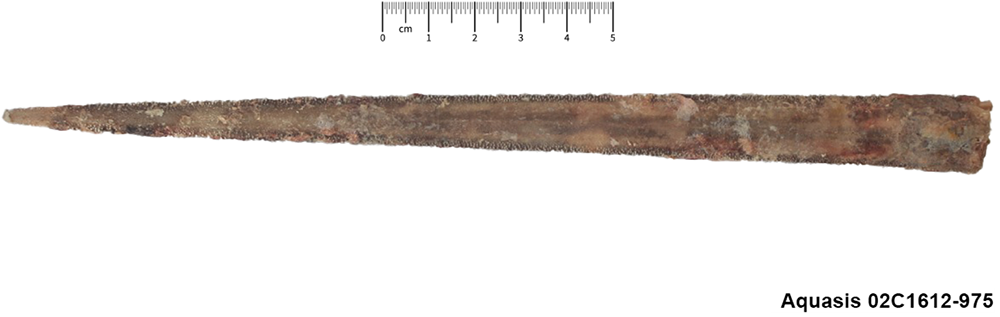
During necropsy, the penetrating foreign body of animal origin was recovered from the skull, and a 1 cm3 bone fragment was preserved in absolute ethanol at –20 °C for genetic analysis. DNA was extracted using the Qiagen DNAeasy Blood & Tissue Kit, after which cytochrome c oxidase subunit I (coxI) was amplified following Ward et al. (Reference Ward, Zemlak, Innes, Last and Hebert2005). The 610 bp sequence obtained (GenBank accession PZ025216) matched 23 sequences assigned to an Indo-Pacific sailfish (I. platypterus, Perciformes: Istiophoridae) in the BOLD Systems database (Barcode of Life Data System; https://www.boldsystems.org), seven of which had a high percent identity of 99.84% (GBAAY43711-24, GBAAY43713-24, GBAAY43717-24, GBAAY43718-24, GBAAY43737-24, GBAAY43751-24, and GBMTG4710-16 [BOLD:ABZ5149]). The sequence was also analysed using the Basic Local Alignment Search Tool (BLAST) in GenBank (Altschul et al., Reference Altschul, Gish, Miller, Myers and Lipman1990; BLASTn: https://blast.ncbi.nlm.nih.gov/Blast.cgi). This resulted in a total of 100 matches, all assigned to Indo-Pacific sailfish, with the highest percent identity value of 99.84% observed in 25 DNA matches (KR067401.1, NC 022478.1, OP404092.1–OP404106.1, OP404108.1, OP404110.1, OP404112.1, OP404114.1, OP404118.1, OP404120.1, OP404122.1, and OP404123.1). All BLASTn matches had an E-value of 0.0, indicating that the probability of random alignment is negligible. Notably, both databases yielded the same maximum identity value (99.84%). The assigned species identity obtained in both DNA-based analyses is in accordance with the available morphological evidence, as the rostrum fragment obtained (Figure 5) is compatible with that of an Indo-Pacific sailfish specimen (e.g., Häge et al., Reference Häge, Hansen, Pacher, Dhellemmes, Domenici, Steffensen, Breuker, Krause, Hildebrandt, Fritsch, Bach, Sabarros, Zaslansky, Mahlow, Schauer, Muller and Krause2022). Therefore, the available evidence suggests that the unidentified rostrum fragment belongs to Indo-Pacific sailfish. To our knowledge, this represents the first report of an interaction between Indo-Pacific sailfish and false killer whale on the Brazilian coast.
Foreign structure removed from the head of the false killer whale, Pseudorca crassidens. It was genetically identified (cytochrome c oxidase subunit I gene) as belonging to the bill of an Indo-Pacific sailfish, Istiophorus platypterus.

Figure 5 Long description
Photograph of the removed foreign structure, genetically identified as an Indo-Pacific sailfish (Istiophorus platypterus) bill, against a white background. A linear scale bar is included.
Aggressive interactions between swordfish (Xiphiidae) and istiophorid billfishes (Istiophoridae) with cetaceans in general, including Risso’s dolphin (Grampus griseus), Cuvier’s beaked whale (Ziphius cavirostris), Antarctic minke whales (B. bonaerensis), and false killer whale (P. crassidens) have been documented (Ohsumi, Reference Ohsumi1973; Major, Reference Major1979; Ortega-Ortiz et al., Reference Ortega-Ortiz, Elorriaga-Verplancken, Olivos-Ortiz, Linan-Cabello and Vargas-Bravo2014; Rosso et al., Reference Rosso, Tepsich, Azzolin and Mo2019), therefore such behaviour cannot be ruled out in the present case. However, we speculate that this fatal encounter between a false killer whale newborn and an Indo-Pacific sailfish was accidental, occurring during foraging when both species targeted the same prey. The newborn may have accompanied its mother into a school of fish, leading to an incidental collision with Indo-Pacific sailfish amid the frenzy of hunting. Still, we cannot dismiss the possibility that the mother was chasing the sailfish, since this species is prey to false killer whales (Baird, Reference Baird2018). In this case, the sailfish accidentally collided with the calf. Any of the potential scenarios implies an accidental collision that killed the newborn, given that Indo-Pacific sailfish can reach 68–70 mph (110–113 km/h) in short hunting bursts, which places the sailfish among the fastest known marine predators (Logan et al., Reference Logan, Luongo, Vaudo, Wetherbee and Shivji2023).
To investigate the probability of such interactions, we utilised AquaMaps, a global species distribution modelling framework (Ready et al., Reference Ready, Kaschner, South, Eastwood, Rees, Rius, Agbayani, Kullander and Froese2010), which generates probability maps of species occurrence by combining environmental suitability models with known occurrence records. AquaMaps incorporates environmental parameters such as water temperature, salinity, depth, primary productivity, and associations with sea ice or coastal zones to predict suitable habitats at a global scale. Pixel-wise correlation analysis of the predicted occurrence layers revealed a significant positive relationship between both species (Pearson’s r = 0.51, p < 0.001), indicating that suitable habitats tend to coincide. The mean probability of co-occurrence was 0.36 ± 0.25, suggesting moderate spatial overlap, particularly along the northeastern Brazilian continental shelf. These results are illustrated by the probability of co-occurrence across the Southwestern Atlantic Ocean (Figure 2, with a colour gradient highlighting regions of higher and lower likelihood of overlap). Overall, the findings suggest that potential interactions, such as competition for prey or opportunistic predation, may be more frequent in this region due to higher ecological overlap and a narrower shelf environment, highlighting areas where monitoring and conservation efforts could be prioritised.
This case represents the first record of an interaction between a false killer whale and an Indo-Pacific sailfish in Brazil, documented over three decades of stranding monitoring in the region. This study reinforces the importance of long-term monitoring studies based on beach surveys as valuable tools for understanding the biology of marine species. It provides an opportunity to examine the interspecific behaviour that led to the accident, death, and stranding of false killer whales, thereby contributing to the knowledge of the species’ ecology.
Acknowledgements
Samples were collected under the Potiguar Basin Beach Monitoring Program (PMP-BP), an environmental licensing requirement coordinated by IBAMA for Petrobras’ activities. We thank Mika Holanda for assistance with image editing.
Author contributions
All authors contributed to the study conception and design. Necropsy procedures were performed by V.L.C. and D.R.M. Material preparation, data collection, and analysis were performed by D.R.M., V.L.C., B.Q., V.V.F., L.S., and L.R.O. The first draft of the manuscript was written by B.Q., V.V.F., and L.R.O. All authors reviewed previous versions of the manuscript, and all read and approved the final manuscript.
Declaration of interest
The authors declare that they have no conflict of interest.
Data availability statement
The data for specimen Aquasis 02C1612-975 are publicly available at the SIMBA database (https://simba.petrobras.com.br/simba/web/sistema/) under the identifier AQSXX20211210i000001. The mitochondrial DNA sequence is deposited in GenBank under accession number PZ025216 (https://www.ncbi.nlm.nih.gov/nuccore/PZ025216).
Ethics and approach
The study was based on a voucher specimen deposited in the scientific collection of the Associação de Pesquisa e Preservação de Ecossistemas Aquáticos (Aquasis). The DNA sample used for this research was derived from a bone fragment in the skull of a stranded and naturally dead animal. No animal was intentionally caught or killed during the research summarised here. The sampling permit issued by local authorities in Brazil (Brazilian Biodiversity Authorization and Information System SISBIO no. 72894-13) attests that the authors did not violate any ethical rules for collecting the animal samples.
Funding statement
No direct funding was received for the conduct of this research. Nevertheless, Beatriz Queiroz is supported by a PhD scholarship from the Coordenação de Aperfeiçoamento de Pessoal de Nível Superior (CAPES), under Funding Code 001 (PROSUC). Additionally, Larissa Rosa de Oliveira holds a Research Productivity Fellowship from the Conselho Nacional de Desenvolvimento Científico e Tecnológico (CNPq), grant number 307850/2025-0.