The COVID–19 pandemic is a severe health threat (Wang, Horby, et al., Reference Wang, Horby, Hayden and Gao2020). Its gravity and the lockdown policies followed by several countries also entail challenging psychological conditions, leading to high levels of confusion and anger, and even to develop posttraumatic stress symptoms after quarantine (Brooks et al., Reference Brooks, Webster, Smith, Woodland, Wessely, Greenberg and Rubin2020). In a multitudinous survey conducted in China during the COVID–19 outbreak, in which most participants spent 20–24 hours per day at home, 53.8% reported severe levels of psychological impact, and a relevant proportion of the sample reported moderate to severe levels of depression, anxiety and stress (Wang, Pan, et al., Reference Wang, Pan, Wan, Tan, Xu, Ho and Ho2020). These results have been replicated in Italy and Spain (Cellini et al., Reference Cellini, Canale, Mioni and Costa2020; Odriozola-González et al., Reference Odriozola-González, Planchuelo-Gómez, Irurtia-Muñiz and de Luis-García2020).
In this study, we explore whether the challenging psychological conditions experienced during the COVID–19 pandemic are affecting decision-making processes. This is a relevant issue, as the situational context requires that many decisions must be made under stress. More concretely, we focus our analysis on the potential effect that the psychological impact (an index related to posttraumatic stress) suffered during the first weeks of lockdown in Spain due to the COVID–19 pandemic could have on decision-making. To the best of our knowledge, only a limited number of studies have explored the potential link between the psychological impact suffered after experiencing traumatic events and decision-making. For instance, in risk and ambiguity experimental decision-making tasks, in which participants have to choose between sure gains/losses and risky or ambiguous chances of gaining/losing variable amounts, participants diagnosed with posttraumatic stress disorder (PTSD) usually exhibit ambiguity and risk aversion, but only when making choices associated with losses (May & Wisco, Reference May and Wisco2020; Ruderman et al., Reference Ruderman, Ehrlich, Roy, Pietrzak, Harpaz-Rotem and Levy2016). Moreover, participants diagnosed with PTSD who have had the most exposure to traumatic events are the ones who exhibit stronger aversion to ambiguous losses (Ruderman et al., Reference Ruderman, Ehrlich, Roy, Pietrzak, Harpaz-Rotem and Levy2016). Taken together, these results suggest that the high levels of psychological impact experienced by patients diagnosed with PTSD make them avoid losses when making decisions (May & Wisco, Reference May and Wisco2020).
On the other hand, there is a large amount of evidence supporting the assumption that other types of stress affect decision-making, both from laboratory studies using acute stress induction and from studies measuring the association between naturally occurring stress and decision-making (Starcke & Brand, Reference Starcke and Brand2012). For instance, a laboratory study in which stress was induced through a social evaluation condition led participants to give more money to a fictitious participant in the dictator game (Hasegawa et al., Reference Hasegawa, Ikeda and Takahashi2007). In this game, participants are allocated with a sum of money, and have to decide whether to share or not some of this money with a stranger (Forsythe et al., Reference Forsythe, Horowitz, Savin and Sefton1994). Nevertheless, in personal dilemmas offering egoistic and altruistic alternatives, participants who were induced with acute stress made more egoistic decisions than unstressed participants (Starcke et al., Reference Starcke, Polzer, Wolf and Brand2011). The inconsistency between the results of these studies is congruent with previous meta-analyses and reviews on dual-process approaches and decision-making in tasks measuring altruistic decisions, which suggest that promoting “intuitive” (vs. “deliberative”) responses has a null effect on participants’ decisions (Capraro, Reference Capraro2019; Fromell et al., Reference Fromell, Nosenzo and Owens2020; Rand et al., Reference Rand, Brescoll, Everett, Capraro and Barcelo2016). In the dual-process approach, System 1 promotes rapid and autonomous processes, and System 2 higher order reasoning processes which rely on thinking and working memory (e.g., Evans & Stanovich, Reference Evans and Stanovich2013). Thus, although stress might facilitate responses from System 1 (due to reduced activity in the prefrontal executive control brain regions, and increased activity in subcortical reactive emotion areas; Yu, Reference Yu2016), that may not be enough to affect people’s decision-making in these types of task.
The framing effect (i.e., information being processed differently depending on the context of presentation) has also been used when studying how stress can induce changes in decision-making processes. In the classic framing problems (Kahneman & Tversky, Reference Kahneman and Tversky1979), participants usually prefer safe alternatives when problems are framed in terms of gains, and riskier alternatives when framed in terms of losses. Research on decision-making under stress has shown that participants who are under stress present increased response biases, making more conservative decisions (i.e., more safe responses) when problems are framed in terms of gains, but riskier decisions when framed in terms of losses (Porcelli & Delgado, Reference Porcelli and Delgado2009). These observations may be interpreted in light of the dual-process approach (Kahneman, Reference Kahneman2003), with stress facilitating rapid and automatic responses from System 1 (heuristic- and association-based processes) and hampering more controlled responses from System 2 (effortful, rule-based processes).
Furthermore, stress alters moral decision-making in classic utilitarian/deontological moral dilemmas (Youssef et al., Reference Youssef, Dookeeram, Basdeo, Francis, Doman, Mamed, Maloo, Degannes, Dobo, Disthotlo and Legall2012). In these dilemmas, utilitarian alternatives allow participants to sacrifice one person in order to save several lives, hence maximizing the overall benefit. In a laboratory study, participants under stress made fewer utilitarian judgments compared with the unstressed participants, but only in the more personal dilemmas (where participants must take direct action to sacrifice a person) (Youssef et al., Reference Youssef, Dookeeram, Basdeo, Francis, Doman, Mamed, Maloo, Degannes, Dobo, Disthotlo and Legall2012). Authors suggested that this observation supported the dual-process approach, with acute stress giving preference to the “automatic” emotional system (System 1) (Greene, Reference Greene2007; Youssef et al., Reference Youssef, Dookeeram, Basdeo, Francis, Doman, Mamed, Maloo, Degannes, Dobo, Disthotlo and Legall2012).
Therefore, stress (either posttraumatic, acute, or naturally occurring stress) seems to alter the underlying mechanisms of decision-making. The lack of balance between automatic responses and controlled information processing under stress may be attributed to an exacerbated reliance on rapid and automatic (System 1) tendencies, thus hampering controlled cognitive processes (Starcke & Brand, Reference Starcke and Brand2012). In addition, and as pointed out above, the psychological impact associated with posttraumatic stress seems to increase loss aversion in decision-making tasks (Ruderman et al., Reference Ruderman, Ehrlich, Roy, Pietrzak, Harpaz-Rotem and Levy2016; May & Wisco, Reference May and Wisco2020). However, we still do not know whether these response patterns are replicable in real-world situations, as well as the implications they might have in conditions outside the laboratory. Exploring this issue is particularly relevant, as understanding how psychological impact may affect decision-making processes during a real-life crisis (such as the COVID–19 pandemic) could be very beneficial in terms of setting up global action strategies.
In this study, we examined whether participants’ decision-making processes were modulated by the psychological impact of the COVID–19 pandemic (as a specific form of stress experienced after a traumatic event). In addition, we also measured participants’ general stress levels to control that the results could not be explained by this more general factor. Moreover, we took measurements of participants’ levels of depression and anxiety, as these could also be variables that might potentially affect their decision-making (Cella et al., Reference Cella, Dymond and Cooper2010; Sailer et al., Reference Sailer, Robinson, Fischmeister, König, Oppenauer, Lueger-Schuster, Moser, Kryspin-Exner and Bauer2008). In an online study that took place during the early stages of the lockdown in Spain, participants were presented with four decision-making tasks: The dictator game, framing problems, utilitarian/deontological moral dilemmas, and altruistic/egoistic moral dilemmas. They also completed a survey on mental health status and experiences, concerns, behaviors and beliefs related to the COVID–19 pandemic (we conducted exploratory analyses to check whether these factors also modulated decision-making). Based on previous literature, we expected participants suffering with higher levels of psychological impact to present augmented biases in the framing problems (Porcelli & Delgado, Reference Porcelli and Delgado2009), and, more concretely, to avoid losses in this task (Ruderman et al., Reference Ruderman, Ehrlich, Roy, Pietrzak, Harpaz-Rotem and Levy2016; May & Wisco, Reference May and Wisco2020). We also expected that these participants would make fewer utilitarian choices in personal utilitarian/deontological moral dilemmas (Youssef et al., Reference Youssef, Dookeeram, Basdeo, Francis, Doman, Mamed, Maloo, Degannes, Dobo, Disthotlo and Legall2012). Regarding the dictator game and the altruistic/egoistic moral dilemmas, predictions were more difficult to establish, as some studies suggest that stress promotes altruistic responses (Hasegawa et al., Reference Hasegawa, Ikeda and Takahashi2007), while others propose the contrary (Starcke et al., Reference Starcke and Brand2012).
Method
Participants
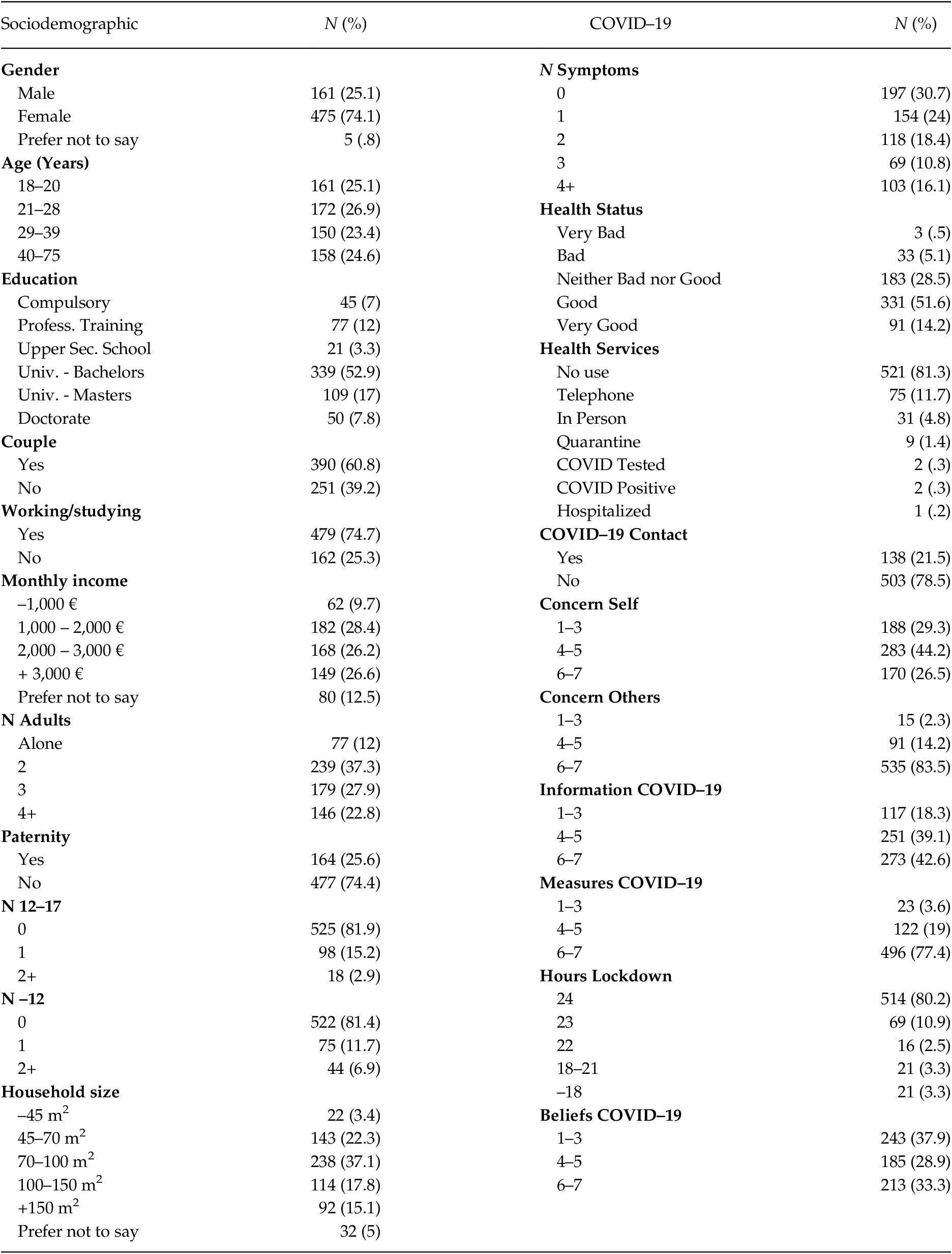
A snowball sampling strategy was used in order to recruit as many responses as possible from people living in all Spanish regions. We received 685 responses to the study, from March 25th to April 5th 2020 (that is, from the 10th to the 21st day of lockdown in Spain). Eventually, we included 641 participants (475 female; M age = 31.63, range = 18–75; see Table 1 for full disclosure of sociodemographic characteristics and responses to COVID–19 variables) (22 participants were not included because they left some questionnaires unanswered; 9 because they were living in a country other than Spain; 8 because they responded twice; and 5 because they were diagnosed with learning or intellectual disabilities that could affect their responses).
Descriptive Statistics for the Sociodemographic and COVID-19 Variables

Note. Age, N Adults = number of adults living together in the residential location; N 12–17 = number of adolescents aged 12–17 living with the respondent; N –12 number of children aged –12 living with the respondent; N Symptoms = number of experienced symptoms related to the COVID–19; Concern Self = respondents’ concern about contracting the COVID–19; Concern Others = respondents’ concerns about their loved ones contracting the COVID–19; Information COVID–19 = amount of information related to the COVID–19 seek by respondents; Measures COVID–19 = how much respondents were following the pre-emptive measures; and Beliefs COVID–19 = how much respondents thought there was too much concern about the pandemic; were introduced as continuous variables in the analyses, but are presented blocked here for the sake of brevity.
The final sample included participants from all the regions of Spain. Based on the data offered daily by the Spanish Government, data regarding participants’ regions were ordered from the least affected by COVID–19 on the day the survey was closed (Ceuta and Melilla, coded “1” in the dataset) to the most affected (the Autonomous Community of Madrid, coded “18” in the dataset).
Materials
The study was structured following previous literature on the psychological effects of COVID–19 (Wang, Pan, et al., Reference Wang, Pan, Wan, Tan, Xu, Ho and Ho2020). Participants had to fill in the following information: (1) Sociodemographic data; (2) symptoms and health status, contact history with patients, and concerns, behaviors and beliefs about the COVID–19; (3) the PANAS scale (measuring positive and negative affect; López-Gómez et al., Reference López-Gómez, Hervás and Vázquez2015; Watson et al., Reference Watson, Clark and Tellegen1988); (4) the DASS–21 scale (measuring depression, anxiety and stress levels; Bados et al., Reference Bados, Solanas and Andrés2005; Lovibond & Lovibond, Reference Lovibond and Lovibond1995); (5) the MSE scale (measuring cognitive, affective, and compassionate state empathy; Powell & Roberts, Reference Powell and Roberts2017); (6) the IES-R scale (measuring psychological impact; Creamer et al., Reference Creamer, Bell and Failla2003; Báguena Puigcerver et al., Reference Báguena Puigcerver, Soler, Mateo, Badia and Reig2001); (7) the dictator game task; (8) the framing problems; (9) the utilitarian/deontological moral dilemmas; and (10) the altruistic/egoistic moral dilemmas.
Sociodemographic Data and COVID–19 Variables
Sociodemographic data were collected on gender, age, education, residential location during lockdown, marital status (later recoded to whether participants had a romantic partner or not), employment status (later recoded to whether participants were actively working/studying during the lockdown or not), monthly income, number of adults living together in the residential location, parental status, number of adolescents aged 12–17 living with the respondent in the residential location, number of children aged below 12 living with the respondent in the residential location, and household size. COVID–19 related symptoms included fever, chills, headache, myalgia, cough, difficulty in breathing, dizziness, coryza, sore throat, and fever. Participants were also asked to rate their physical health status (from 1 = Very bad, to 5 = Very good), and to state any history of chronic medical illness (including physical, mental, neurodevelopmental and/or neurodegenerative illnesses). Health service utilization in the past 14 days included consultation via telephone, consultation with a doctor in the clinic, being quarantined by a health authority, being tested for COVID–19, positive test on COVID–19, and admission to the hospital. Contact history included direct and/or indirect contact with a confirmed COVID–19 individual. Concern about COVID–19 variables included concern about respondents and other family members/close friends contracting COVID–19 (from 1 = Not at all to 7 = A lot). Participants were also asked how much information they seek about the COVID–19, and how much they were following the pre-emptive measures (e.g., washing their hands repeatedly, covering their mouth when coughing, etc.) against COVID–19 established by the Spanish Government (from 1 = Not at all to 7 = A lot). Finally, participants were asked how many hours per day (on average) they stayed at home during lockdown, and whether they thought that there was too much concern about the COVID–19 pandemic or not (from 1 = Not at all to 7 = A lot).
Positive and Negative Affect Schedule
Positive and negative affect were measured using the Positive and Negative Affect Schedule (PANAS) (López-Gómez et al., Reference López-Gómez, Hervás and Vázquez2015; Watson et al., Reference Watson, Clark and Tellegen1988). This scale is widely used in the literature on emotion evaluation, and it presents two sub-scales with 10 items each, one for positive affect (e.g., Excited), and another one for negative affect (e.g., Upset). Scores for each item range from 1 to 5, and from 10 to 50 for each sub-scale. Participants were asked to evaluate their affect during the last week, including the day in which they filled the survey. Cronbach’s alpha for the positive and negative affect sub-scales were .88 and .87, respectively.
Depression, Anxiety and Stress Scale
Mental health status was measured using the short form of the Depression, Anxiety and Stress Scale (DASS–21) (Bados et al., Reference Bados, Solanas and Andrés2005; Lovibond & Lovibond, Reference Lovibond and Lovibond1995). This questionnaire contains 21 items, 7 for each sub-scale: Depression (e.g., I couldn’t seem to experience any positive feeling at al l), anxiety (e.g., I was aware of dryness in my mouth), and stress (e.g., I found it hard to wind down). Scores for each item and sub-scale ranged from 0 = Did not apply to me at all to 3 = Applied to me very much, or most of the time. Participants were asked to answer by choosing the most applicable option to them during the last week, including the day they filled the survey.
Measure of State Empathy
State empathy was measured using the Measure of State Empathy (MSE) (Powell & Roberts, Reference Powell and Roberts2017) scale. This is a 9-item scale containing three 3-item 7-point Likert sub-scales (0 = Not at all, 6 = Entirely) to measure state levels of cognitive (“understanding how someone is feeling, but not necessarily also feeling it”), affective (“physically feeling the same way as another person is feeling”), and compassionate empathy (“in-the-moment feelings of compassion, sympathy or concern”) (Ekman, Reference Ekman2003). As there is no Spanish translation for the scale, items were translated by a bilingual researcher, and back-translated by another bilingual researcher for comparability (Brislin, Reference Brislin1970). Scores may range from 0 to 18 for each sub-scale. Participants were asked to evaluate how they felt about the people they have interacted with during the last week, including the day they filled the survey. Cronbach’s alpha for the cognitive, affective, and compassionate state empathy sub-scales were .84, .82, and .66, respectively.
Impact of Event Scale-Revised
The psychological impact of COVID–19 was measured using the Impact of Event Scale-Revised (IES-R) (Báguena Puigcerver et al., Reference Báguena Puigcerver, Soler, Mateo, Badia and Reig2001; Creamer et al., Reference Creamer, Bell and Failla2003). This questionnaire measures avoidance (e.g., “I tried not to think about it”), intrusion (e.g., “Any reminders brought back feelings about it”) and hyper-arousal (e.g., “I felt irritable and angry”) after being exposed to a traumatic event. Scores for each item and for the scale range from 0 = Not at all to 4 = Often. Participants were asked to answer to the items by choosing the most applicable option to them during the last week, including the day they filled the survey. Cronbach’s alpha for the IES-R was .93.
Decision-Making Tasks
We also presented participants with four decision-making tasks, which were completed in the same order by all participants (the dictator game, framing problems, utilitarian/deontological moral dilemmas and altruistic/egoistic moral dilemmas). In the dictator game, participants were asked to imagine that they entered a room together with a fictitious stranger. There, participants would be allocated with 100 euros, and the stranger would not receive any money. They were told that they might give the stranger any sum of money, from 0 to 100 euros, and that the stranger would have to accept any offer.
In the framing problems, participants were randomly allocated to one out of four possible conditions: the Asian disease problem-Gain frame, the Asian disease problem-Loss frame, the Financial crisis problem-Gain frame, and the Financial crisis problem-Loss frame. Randomization was implemented by adding a question to the questionnaire in which participants had to choose the first answer (e.g., “Choose the first option from the following: @, #, $, %”); the order in which the answers appeared was also random for each participant, where each of these answers led to a different problem/frame. Presenting participants with only one version/frame of these dilemmas is the usual procedure in this type of task (e.g., Tversky & Kahneman, Reference Tversky and Kahneman1981), since providing them with the different frames would make them detect the manipulation that produce different biases. In the Asian disease problem (Tversky & Kahneman, Reference Tversky and Kahneman1981), participants had to choose between medicines A and B. In the Gain frame, if they chose medicine A, 200,000 (out of 600,000) people would be saved, and if they chose medicine B, there was a 33.3% chance that 600,000 people would be saved and a 66.6% chance that no one would be saved. In the Loss frame, if they chose medicine A, 400,000 (out of 600,000) people would die, and if they chose medicine B, there was a 33.3% chance that no one would die and a 66.6% chance that 600,000 would die. In the Financial crisis problem (Costa, Foucart, Arnon, et al., Reference Costa, Foucart, Arnon, Aparici and Apesteguia2014), participants had to choose between actions A and B. The wording of the Gain and Loss frames were similar to that of the Asian disease problem, but the participants made decisions about gains/losses of euros, rather than lives. In all cases, medicine/action A was considered the safe option, and medicine/action B the risky option.
In the utilitarian/deontological moral dilemmas, participants were randomly presented with either the Switch or Footbridge dilemma (Foot, Reference Foot1978; Thomson, Reference Thomson1985). Randomization was implemented in the same way as with the framing problems, and the decision to present participants with only one version of these dilemmas was based on the same reasoning explained above for the framing problems. In these dilemmas, an on-coming train is about to kill five people, and the only way to stop it is by killing an innocent bystander. In the Switch dilemma (the less personal dilemma) participants choose whether to flip a switch or not to move the train to another track where it would only kill one man. In the Footbridge dilemma (the more personal and emotional dilemma; Greene et al., Reference Greene, Sommerville, Nystrom, Darley and Cohen2001) participants decide whether to push or not a man off a footbridge in front of the train in order to save the other people. Additionally, we added the alternative option of self-sacrifice to both dilemmas (Kahane et al., Reference Kahane, Everett, Earp, Farias and Savulescu2015). Therefore, in the Switch dilemma, three options were available for participants: 1) Do nothing; 2) Flip the switch to the right (“Sacrifice-other”); and 3) Flip the switch to the left (“Self-sacrifice”). In the main text of this dilemma, it was made clear that flipping the switch to the right would make the train to kill an innocent bystander, and that flipping the switch to the left would make the train to kill the participant. In the Footbridge dilemma, three options were available: 1) Do nothing; 2) Push the stranger onto the track (“Sacrifice-other”); and 3) Jump onto the track (“Self-sacrifice”).
Finally, we presented participants with 20 altruistic/egoistic moral dilemmas (Starcke et al., Reference Starcke, Polzer, Wolf and Brand2011). Each of the 20 dilemmas offered a more altruistic and a more egoistic alternative. Participants had to answer with “yes” or “no” (e.g., “Your partner is suicidal and you feel uncomfortable in this relationship. Would you leave your partner?”; “You have slightly scratched another car while parking. It is dark and nobody has seen you. Would you leave a message for the owner of the car?”). For the purpose of analysis, the percentage of altruistic decisions for the 20 dilemmas was calculated.
Procedure
Participants completed the study through Google Forms. The research conformed to the principles of the Declaration of Helsinki and the code of ethics of the General Council of Psychology of Spain. All respondents provided informed consent and were reminded that they may exit the study at any point if they wanted to. Also, it was made explicit that in case they were uncomfortable at some point, they may exit the study and were invited to call the psychological assistance number provided by their regional health institutions.
Statistical Analyses
Descriptive statistics were calculated for the different variables using IBM SPSS version 26. Then, we used boosted regression trees (BRT; an advanced form of regression analysis based on machine learning and boosting algorithms) for analyzing participants’ responses to the decision-making tasks, using the ‘dismo’ R package (Elith et al., Reference Elith, Leathwick and Hastie2008; Elith & Leathwick, Reference Elith and Leathwickn.d.). Unlike traditional regression methods, BRT combine large numbers of simple tree models to optimize predictive performance, aiming to improve the performance by fitting many models and combining them for predicting the dependent variable. Also, whilst traditional regression methods start model fitting by setting up a model and later estimate parameters for the model from the data, BRT use an algorithm to learn the relationship between responses and predictors. In other words, BRT assume that data are complex and that the potential links with the predictors are unknown, and therefore try to learn by processing inputs and responses and finding dominant patterns. Also, in the code of BRT the type of distribution (e.g., Gaussian, Bernoulli, Poisson) that follows the data (i.e., continuous, categorical) can be specified, and there are no p values to index the significance of models and coefficients, but BRT use other model fitting indexes, such as the Area Under the Curve (AUC), the % of deviance explained by the fitted model using cross-validation (CV) results as evaluation data, or the relative contribution (RC) of the predictor variables that are included in the model.
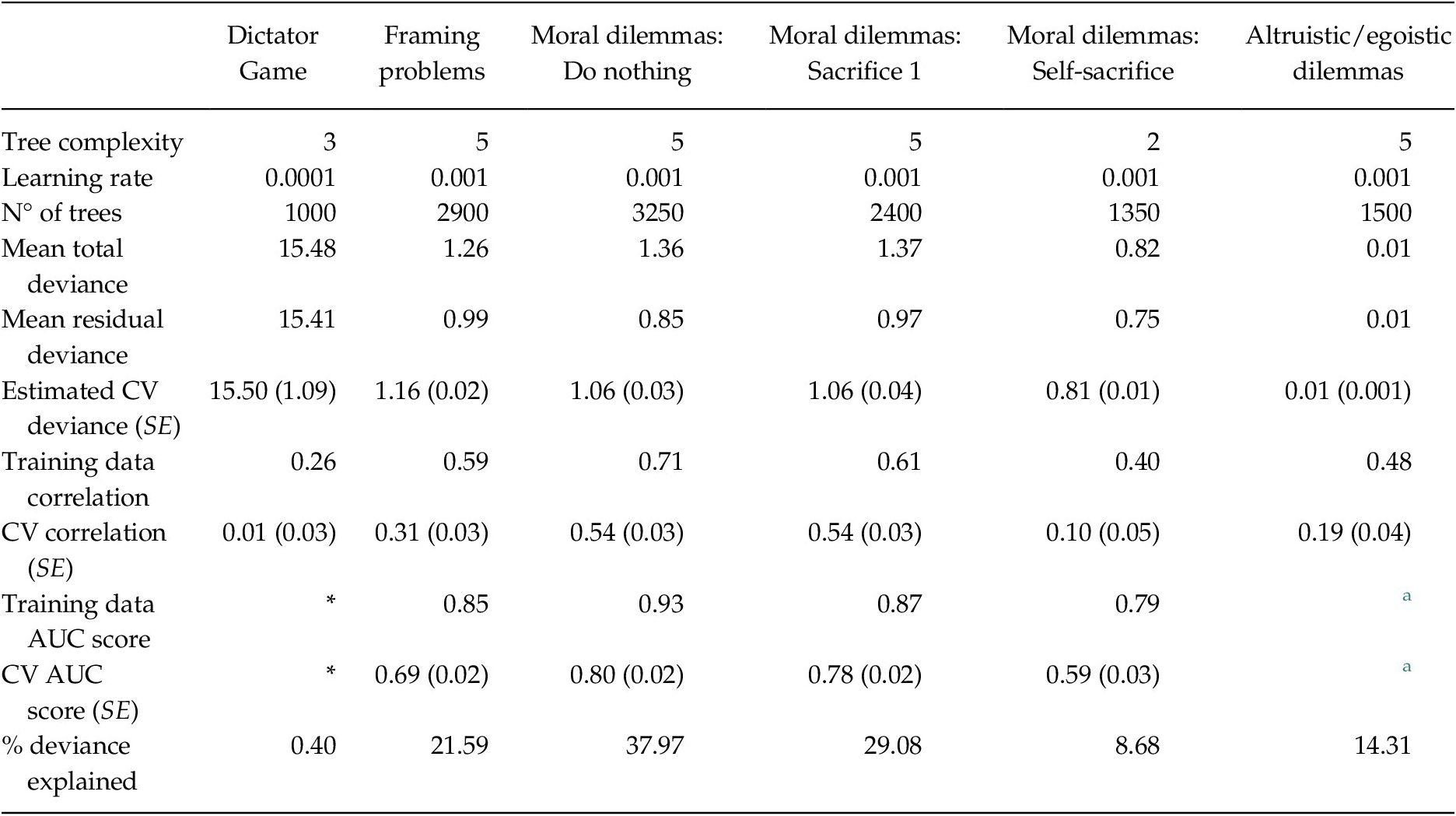
Following Elith et al. (Reference Elith, Leathwick and Hastie2008) and Elith and Leathwick (Reference Elith and Leathwickn.d.) guidelines, we first fitted a model for each dependent variable, including all predictors. At this step, we used a tree complexity of 5, a learning rate of 0.001, and a bag fraction of 0.5 (except for the analysis of the responses to the dictator game, where we used a tree complexity of 3 and a learning rate of 0.0001 in order to obtain at least 1000 trees; this decision was based on the fact that decreasing tree complexity and learning rate increases the number of trees required, and usually larger number of trees are preferable; Elith et al., Reference Elith, Leathwick and Hastie2008). Later, we simplified the models by dropping predictors until the average change in predictive deviance exceeded their original standard error (and, in some cases, tree complexity and learning rate had to be changed in order to obtain at least 1,000 trees). Performance of the simplified models can be seen in Table 2, and the variables that were finally included in each simplified model can be seen in Table 3 (highlighted in bold font). In the results section, we report the RC of the predictor variables that were left in the simplified models for each dependent variable.
Performance of BRT Models

Note. CV = cross-validation; AUC = Area under the receiver operating characteristics curve.
a BRT models that did not follow a Bernoulli distribution did not provide AUC scores.
Summary of the Relative Contributions (%) of Predictor Variables for Boosted Regression Tree Models

Note. Predictors in bold font are the ones that remained in the simplified models; percentages between brackets correspond to the simplified models.
Results
Descriptive Statistics
Overall, participants presented higher levels of positive (M = 26.85, SD = 7.41) than negative affect (M = 21.74, SD = 7.22; t(640) = 10.43, p < .001), measured using the PANAS scale. Respondents’ depression, anxiety and stress levels, measured using the DASS–21 scale, had sample mean scores of .81 (SD = .70), .47 (SD = .52), and .86 (SD = .58), respectively.
In addition, participants presented normal to high levels of cognitive (M = 14.07, SD = 3.04), affective (M = 11.36, SD = 4.01), and compassionate state empathy (M = 13.92, SD = 3.25), measured using the MSE scale. Finally, the psychological impact of the COVID–19 outbreak and lockdown, measured using the IES-R scale, revealed a sample mean score of 1.58 (SD = .94). Of all respondents, 47.7% reported normal psychological impact, and 52.3% reported a significant psychological impact (scores higher than 1.5 might be identified as complying with some features of the categorical diagnosis for posttraumatic stress disorder; Creamer et al., Reference Creamer, Bell and Failla2003).
Decision-Making Tasks
Dictator Game
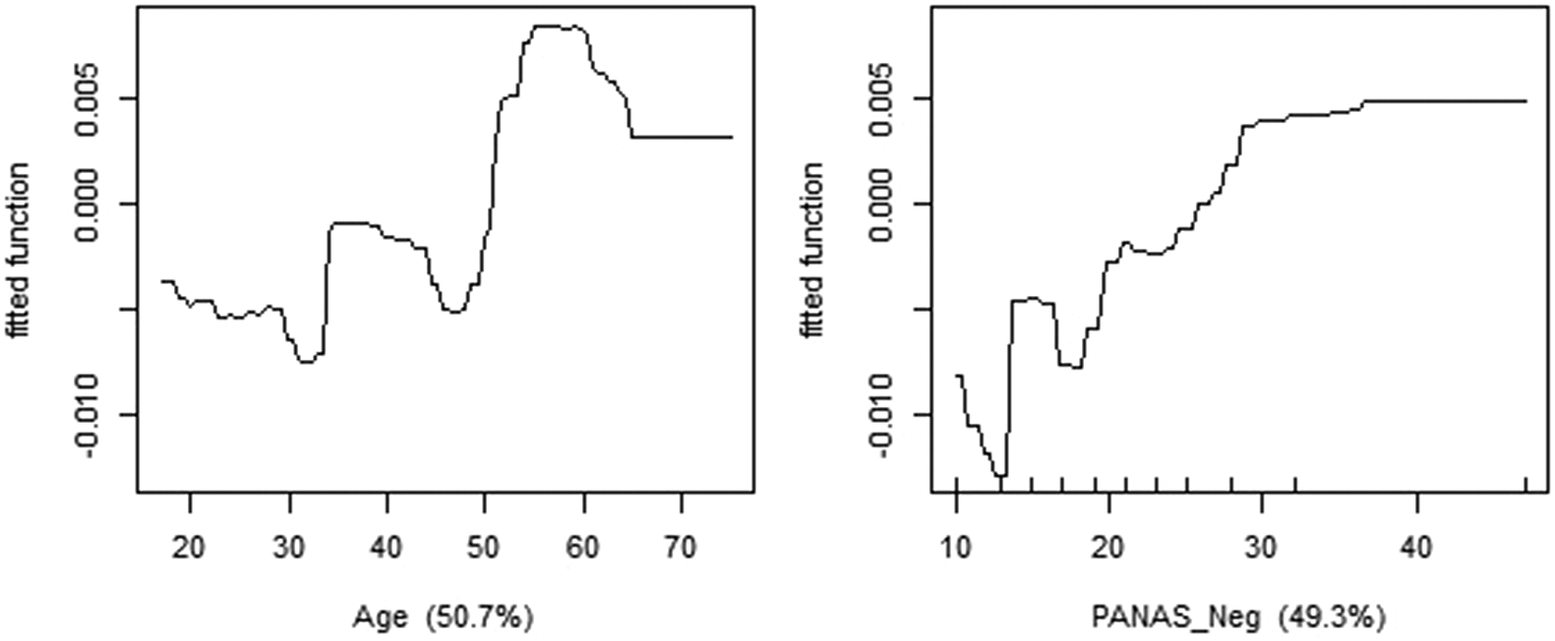
In the dictator game, 66.1% of participants chose to share 50 of the 100 euros they were allocated with, 14.7% did not share any money, 16.5% shared an amount between 5–45 euros, and 2.7% shared an amount between 59–100 euros (M = 40.08, SD = 19.84). Importantly, the main predictor of the study, the psychological impact suffered by the participants, did not enter the simplified model, as its relative contribution to explain the results of this task was very low. The simplified BRT model only left two secondary predictors: age (RC = 50.7%) and negative affect (RC = 49.3%; measured using the PANAS scale). The older participants were, and the higher levels of negative affect they had, the more money they were willing to share in the dictator game (Figure 1). However, this model only explained a very low proportion of deviance (0.40%).
Partial Dependence Plots for the Variables included in the Simplified BRT Model Predicting Responses to the Dictator Game.

Framing Problems
In the framing problems, participants presented with the Financial crisis problem were more prompt to provide safe responses (77.6%) than participants presented with the Asian disease problem (60.6%), χ2 (1, N = 641) = 20.67, p < .001, V = .18. Also, participants presented with the Gain frame were more prompt to provide safe responses (78.5%) than participants presented with the Loss frame (55.5%), χ2 (1, N = 641) = 38.79, p < .001, V = .25.
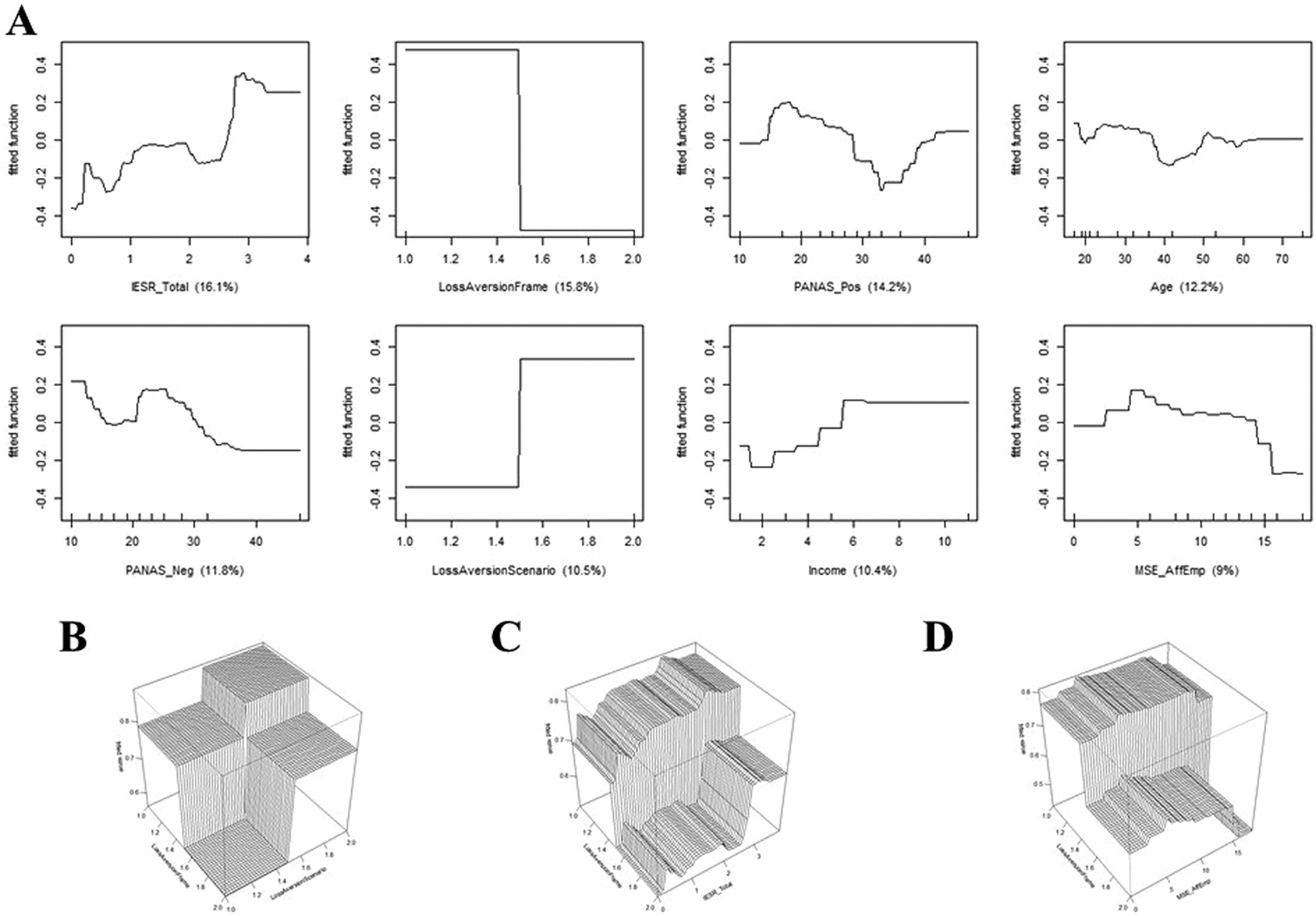
The simplified BRT model left the following predictors: The main predictor variable of the study, psychological impact (RC = 16.1%; measured using the IES-R scale; the more psychological impact, the safer participants’ responses); and secondary predictors: frame (RC = 15.8%; safer responses in the gain than loss frame), positive affect (RC = 14.2%: a non-linear relationship), age (RC = 12.2%; a non-linear relationship), negative affect (RC = 11.8%; the more negative affect, the riskier participants’ responses), scenario (RC = 10.5%; safer responses in the Financial crisis than Asian disease problem), income (RC = 10.4%; the more income participants had, the safer their responses), and affective empathy (RC = 9%; measured using the MSE scale; the higher affective empathy, the riskier participants’ responses) (see Figure 2A).
Framing Problems
Note. A: Partial dependence plots for the variables included in the simplified BRT model predicting responses to the framing problems. B: Interaction between frame (Y axis) and scenario (X axis). C: Interaction between frame (Y axis) and psychological impact (measured using the IES-R scale; X axis). D: Interaction between frame (Y axis) and affective empathy (measured using the MSE scale; X axis). The Z axis indexes the fitted value in all interactions’ representations.

In addition, three interactions had an interaction size (IS) > 5: frame * scenario (IS = 13.47; showing that the decrease of safe responses in the loss frame was more apparent in the Asian disease problem); frame * psychological impact (IS = 8.65; showing that the positive relationship between psychological impact and proportion of safe responses was more apparent in the loss frame); and frame * affective empathy (IS = 6.74; showing that safe responses decreased dramatically when participants had high values of affective empathy, and more so in when they were presented with the loss frame) (see Figure 2B–D).
The model accounted for a relevant proportion of deviance (21.59%).
Utilitarian/Deontological Moral Dilemmas
In the utilitarian/deontological moral dilemmas, responses varied significantly depending on the dilemma participants were presented with, χ2 (2, N = 641) = 213.03, p < .001, V = .58. Participants were more prompt to choose the “Do nothing” alternative in the Footbridge (74.3%) than in the Switch (20.1%) dilemma (p < .001); on the contrary, they were more prompt to choose the “Sacrifice-other” response in the Switch (65.7%) than in the Footbridge (11.6%) dilemma (p < .001). No differences between dilemmas were found for the “Self-sacrifice” response (14.2% of responses in both dilemmas). For BRT, we conducted separate analyses for each possible response (i.e., “Do nothing”, “Sacrifice-other”, and “Self-sacrifice”), which were coded as dummy variables (e.g., in the analysis of “Do nothing” responses, “Do nothing” were coded as 1, and “Sacrifice-other” and “Self-Sacrifice” were coded as 0).
Regarding “Do nothing responses”, the simplified BRT model dropped 11 predictors. The main predictor variable of the study, psychological impact, only had a small RC (3.7%). Regarding the secondary variables, the one with the highest RC was scenario (42.2%), with participants presented with the footbridge dilemma being more prompt to choose this response than those presented with the switch dilemma. The other predictors had a moderate/small RC (ranging from 5.4 to 1.6%). Furthermore, two interactions had an interaction size (IS) > 5: scenario * number of symptoms (IS = 7.73; showing that the pattern of responses of participants who had a low number of symptoms varied depending on whether they were presented with the switch or footbridge dilemma); and scenario * depression (measured with the DASS scale; IS = 5.38; showing that the pattern of responses of participants who had low levels of depression varied depending on whether they were presented with one dilemma or the other). The model accounted for a relevant proportion of deviance (37.97%).
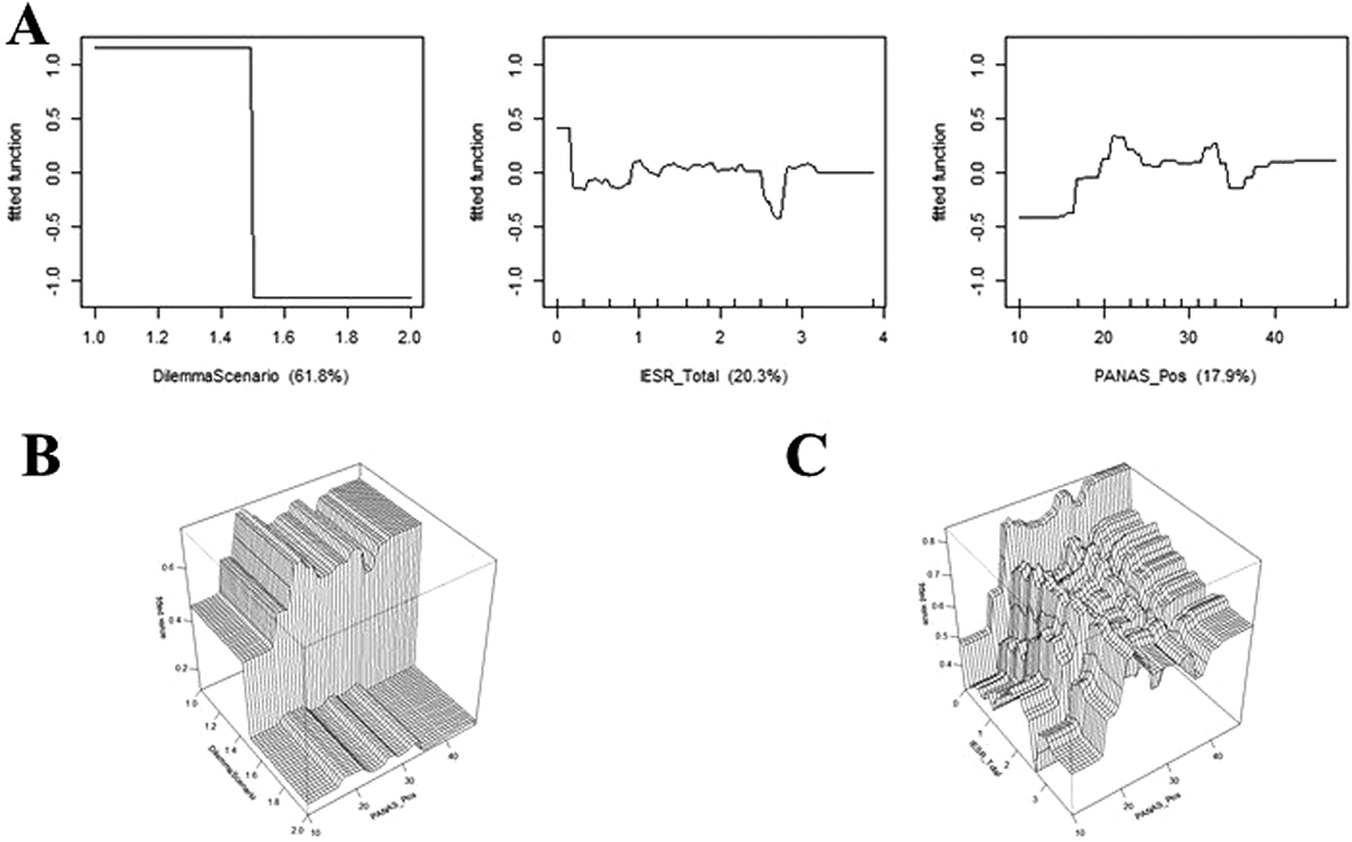
As for “Sacrifice-other” responses, the simplified BRT model only left three predictors: The main predictor variable of the study, psychological impact (RC = 20.3%; with utilitarian responses decreasing as psychological impact increased); and two secondary predictors, scenario (RC = 61.8%; being this response more frequent in the switch than footbridge dilemma), and positive affect (RC = 17.9%; the more positive affect, the more willing were participants to sacrifice a person) (see Figure 3A). Additionally, two interactions had an interaction size (IS) > 5: scenario * positive affect (IS = 48.14; showing that positive affect only affected participants’ responses when they were presented with the switch dilemma); and psychological impact * positive affect (IS = 20.31; showing that there was more variability in participants’ responses the lower were their scores in both scales, and that the relationship between psychological impact and “Sacrifice-other” responses was clearer when participants had medium or high scores for positive affect) (see Figure 3B–C). This model also accounted for a relevant proportion of deviance (29.08%).
Utilitarian/Deontological Moral Dilemmas
Note. A: Partial dependence plots for the variables included in the simplified BRT model predicting “Sacrifice-other” responses to the utilitarian/deontological moral dilemmas. B: Interaction between scenario (Y axis) and positive affect (X axis). C: Interaction between psychological impact (Y axis) and positive affect (X axis). The Z axis indexes the fitted value in both interactions’ representations.

For “Self-sacrifice” responses, the simplified BRT model only dropped 7 predictors. The main predictor variable of the study, psychological impact, had a small RC (4.5%). Regarding the secondary variables, the one with the highest RC was positive affect (15.8%), showing that participants with high levels of positive affect were not willing to sacrifice themselves. The other secondary predictors had a moderate/small RC (ranging from 9 to 0.6%). No interaction had an IS > 5, and the model only explained a low proportion of deviance (8.68%).
Altruistic/Egoistic Moral Dilemmas
Finally, in the altruistic/egoistic moral dilemmas, most participants responded in an altruistic way (responses ranging from .55 to .90; 54.6% of participants), 28.7% responded mostly in an egoistic way (responses ranging from .15 to .45), and 16.7% did not have an altruistic or egoistic tendency (.50) (M = .54, SD = .12).
The simplified BRT model left the following predictors: The main predictor variable of the study, psychological impact (RC = 13.8%; the more psychological impact, the more altruistic responses); and the secondary variables compassionate empathy (RC = 15.6%; the more compassionate empathy, the more altruistic responses), affective empathy (RC = 14%; the more affective empathy, the more altruistic responses), age (RC = 10.8%; older participants provided more altruistic responses), self-concern (RC = 10.2%; the more concerned participants were about getting infected, the more altruistic their responses), household size (RC = 9.9%; the larger the household size, the more altruistic responses), positive affect (RC = 9.5%; the more positive affect, the less altruistic responses), cognitive empathy (RC = 8.7%; a non-linear relationship), and income (RC = 7.5%; with participants earning the lowest incomes providing more egoistic responses) (see Figure 4). No interaction had an IS > 5, and the model explained a moderate proportion of deviance (14.31%).
Partial Dependence Plots for the Variables Included in the Simplified BRT Model Predicting Responses to the Altruistic/Egoistic Moral Dilemmas.

Discussion
In this study, we explored whether the psychological impact of the COVID–19 crisis affected decision-making processes. Our main result was that psychological impact predicted participants’ responses to the framing problems and utilitarian/deontological and altruistic/egoistic moral dilemmas (but not to the dictator game). More concretely, the more psychological impact participants suffered, the more they were willing to choose the safest response in the framing problems, and the more deontological/altruistic were their responses to moral dilemmas.
Results from the dictator game task are at odds with previous studies showing that stress increases altruistic behavior (Hasegawa et al., Reference Hasegawa, Ikeda and Takahashi2007), but agree with the meta-analyses and reviews indicating that promoting intuitive vs. deliberative responses (as with stress; Yu, Reference Yu2016) does not modify decision-making processes in this task (Capraro, Reference Capraro2019; Fromell et al., Reference Fromell, Nosenzo and Owens2020; Rand et al., Reference Rand, Brescoll, Everett, Capraro and Barcelo2016). Furthermore, although we found that both age and positive affect predicted altruistic behavior in the dictator game, the model that included these factors had a low predictive capacity, so the results are inconclusive.
As for the framing problems, we found that the most important predictor of participants’ responses was psychological impact (i.e., the more psychological impact participants suffered, the safer their responses were in the framing problems), which even exceeded the framing effect. Our results are congruent with those of previous studies showing that PTSD is related to ambiguity and risk aversion, and more so when making choices associated with losses (May & Wisco, Reference May and Wisco2020; Ruderman et al., Reference Ruderman, Ehrlich, Roy, Pietrzak, Harpaz-Rotem and Levy2016). In addition, the results partially support previous studies suggesting that stress exacerbates response biases (Porcelli & Delgado, Reference Porcelli and Delgado2009), as we observed that higher levels of psychological impact (i.e., posttraumatic stress) predicted safe responses both in the gain and loss frames (and that the relationship between psychological impact and the increased tendency to choose the safe alternative was stronger in the loss frame). These observations suggest that, in the context of a global pandemic, response biases may be more oriented towards safe decision-making, and more so when presented with loss frames.
We also observed that both positive and negative affect predicted responses to the framing problems, with high levels of negative affect predicting riskier responses, and high (vs. medium) values of positive affect predicting safer responses (and more so in the loss frame). These results are consistent with previous literature showing a strong relationship between negative affect and risky responses in decision-making tasks (van Gelder et al., Reference van Gelder, de Vries and van Der Pligt2009). Moreover, high levels of affective empathy predicted risky responses to the framing problems (and more so in the loss frame), which is also consistent with studies suggesting that empathetic traits are significant predictors of ethical decision-making (e.g., Brown et al., Reference Brown, Sautter, Littvay, Sautter and Bearnes2010). Hence, high levels of empathy could lead participants to choose the risky alternative, where potentially more people/resources might be saved, and this trend would be even more pronounced in the loss frame.
Regarding the utilitarian/deontological moral dilemmas, our results were consistent with literature on the topic showing that utilitarian responses are more frequent in the less personal (i.e., the switch) dilemma (e.g., Costa, Foucart, Hayakawa, et al., Reference Costa, Foucart, Hayakawa, Aparici, Apesteguia, Heafner and Keysar2014). Furthermore, the psychological impact of the COVID–19 pandemic was the second most relevant predictor of utilitarian responses, with participants presenting very low levels of psychological impact choosing the utilitarian alternative more frequently than participants who had low-to-high levels of psychological impact. This result is congruent with the observation that participants diagnosed with PTSD avoid getting involved in decisions where the outcomes may be more or less negative (but never positive), possibly because they predict that they would be negatively impacted by the losses (May & Wisco, Reference May and Wisco2020). Furthermore, the result extends previous observations pointing out that stress prompts response biases when dealing with these moral dilemmas (Youssef et al., Reference Youssef, Dookeeram, Basdeo, Francis, Doman, Mamed, Maloo, Degannes, Dobo, Disthotlo and Legall2012). However, whilst Youssef et al. (Reference Youssef, Dookeeram, Basdeo, Francis, Doman, Mamed, Maloo, Degannes, Dobo, Disthotlo and Legall2012) only observed an effect of acute stress on the more personal (i.e., the footbridge) dilemma, we observed a general effect of psychological impact, which may indicate that the challenging psychological conditions caused by the pandemic might have a more robust effect on the reliance on automatic responses.
Additionally, we observed that positive affect predicted utilitarian responses in the switch dilemma. This is consistent with literature showing that positive feelings at the time of judgment reduce the aversion of moral violations and therefore increase utilitarian responses (Valdesolo & DeSteno, Reference Valdesolo and DeSteno2006). Nonetheless, the simplified BRT model for “Self-sacrifice” responses only explained a low proportion of deviance, and the different predictors that were left in the model had moderate or low RCs. A tentative explanation would be that self-sacrifice is mainly motivated by factors not included in our study, such as identity fusion (“a visceral sense of oneness with the group”; Whitehouse, Reference Whitehouse2018), and cognitive style (with people more inclined toward intuition being more likely to sacrifice themselves for the greater good; Stagnaro, Reference Stagnaro, Littman and Rand2018). Thus, the tendency to self-sacrifice should be further explored in future studies by considering these factors.
Finally, responses to the altruistic/egoistic moral dilemmas were mainly driven by empathy and psychological impact. Regarding the relationship between empathy and responses to these dilemmas, this is congruent with previous research supporting a strong link between empathy and altruism (Batson, Reference Batson, Batson, Slingsby, Harrell, Peekna and Todd1991). As for the relationship between psychological impact and responses to the altruistic/egoistic moral dilemmas, our results are at odds with previous studies suggesting that high levels of stress predict more egoistic responses (Starcke et al., Reference Starcke, Polzer, Wolf and Brand2011). Whilst Starcke et al. (Reference Starcke, Polzer, Wolf and Brand2011) induced acute stress by using the Trier Social Stress Test (a laboratory procedure), we measured the relationship between the stress naturally produced by the COVID–19 pandemic and responses to the altruistic/egoistic moral dilemmas. Therefore, acting altruistically may have been primed by the social context caused by the pandemic (e.g., repeated messages insisting on staying at home, and on wearing a mask when out on the street so as not to infect others). This explanation would be congruent with studies showing that high levels of psychological impact correlate with the increased activation of System 1 (i.e., automatic processes during decision-making) brain areas (Yu, Reference Yu2016), which might facilitate this pattern of altruistic responses. In any case, future studies on the effect of psychological impact on altruistic responses should further explore this potential relationship before reaching a firm conclusion.
Before concluding, we must acknowledge some potential limitations of the study. First, the four decision-making tasks were completed in the same order by all participants. This might have caused some effects of the performance in some tasks on the performance in the subsequent ones. However, a posteriori analyses showed that the only two tasks that correlated were the dictator game and the altruistic/egoistic moral dilemmas (in the expected direction: Participants who shared more in the dictator game were also more altruistic in the altruistic/egoistic moral dilemmas), but all other comparisons were far from significantFootnote 1. Therefore, we believe that the order in which the tasks were presented did not influence participants’ responses. Secondly, although we found a pattern of results consistent with the dual-process approach (i.e., psychological impact, as a specific form of stress, promoted System 1 responses to the framing problems, and utilitarian/deontological and altruistic/egoistic moral dilemmas), we did not directly manipulate levels of activation of System 1 vs. System 2. Previous studies on the dual-process approach and decision-making have used time constraints or cognitive load, for instance (see Capraro, Reference Capraro2019, for a review), to experimentally manipulate the activation of the two systems, and future research on how psychological impact affects automatic vs. deliberate responses may continue doing so to isolate the relative contribution of each system on decision-making.
On the other hand, the results of this study were also consistent with previous literature on the effects of posttraumatic stress on decision-making (May & Wisco, Reference May and Wisco2020; Ruderman et al., Reference Ruderman, Ehrlich, Roy, Pietrzak, Harpaz-Rotem and Levy2016). We found that high levels of psychological impact predicted risk aversion in the framing problems (and more particularly when the dilemmas were framed in terms of losses). Moreover, we observed that high levels of psychological impact predicted taking no action in the utilitarian/deontological moral dilemmas, where outcomes were always negative. These findings might have important practical implications: People suffering with high levels of psychological impact during a real crisis may tend to avoid losses when making decisions (including those circumstances in which that could translate into worse long-term results), or even taking no action when their decisions involve choosing between harming more or less people. Finally, the observation that altruistic behaviors might be predicted by the levels of psychological impact suffered by the population during a real crisis may also have relevant implications (such as the choice of the emotional burden of the messages addressed to the population for behavior control during the crisis).
To conclude, it is important to emphasize that we found a relationship between decision-making and psychological impact (as measured by the IES-R), but not between decision-making and general stress levels (as measured by the stress sub-scale of the DASS–21). Hence, our observations suggest that subclinical PTSD levels, but not the general effects of stress, might be one of the most important predictors of decision-making processes during real life crises. Future studies on this topic should further explore whether psychological impact and general stress produce different responses on the brain areas responsible for decision-making. In addition, it would be interesting to investigate whether interventions focused on reducing high levels of psychological impact during a crisis could also reduce the response biases we observed in this study.
We found that the psychological impact of the COVID–19 crisis was the most relevant predictor of responses to the framing problems, and one of the most relevant predictors of responses to utilitarian/deontological and altruistic/egoistic dilemmas. High levels of psychological impact led to increased ratios of safe responses to the framing problems and altruistic responses to the altruistic/egoistic moral dilemmas, as well as decreased odds of utilitarian responses to the utilitarian/deontological moral dilemmas. Taken together, the results of this study indicate that decision-making might be affected during the COVID–19 pandemic.