BACKGROUND
Radiotherapy is a highly effective and essential tool for managing patients with advanced cancer.Reference Hoegler1 Palliative radiotherapy (PRT) often constitutes 30–50% of radiotherapy treatment courses delivered at cancer centres.Reference Stevens and Firth2,Reference Williams, James, Summers, Barrett and Ash3 Traditionally simpler approaches such as fluoroscopic simulation and treatment on a cobalt unit have been very successful with 60–80% of patients noting improvement in symptoms with relatively little toxicity.Reference Hoegler1,Reference Konski, Feigenberg and Chow4
However, there have been significant advances in the technology used to simulate and treat patients over the past two decades.Reference Purdy5,Reference Smith, Heron, Huq and Yue6 Intensity-modulated radiotherapy (IMRT) and imaged-guided (IG) approaches are now available at most modern cancer centres in order to make radiotherapy more precise and effective.Reference Nijkamp, Pos, Nuver, de Jong, Remeijer, Sonke and Lebesque7,Reference Woodford, Yartsev, Dar, Bauman and Van Dyk8 Much of the literature for the use of these modern techniques involves high-dose radiotherapy with curative intent.Reference Nijkamp, Pos, Nuver, de Jong, Remeijer, Sonke and Lebesque7–Reference James, Scrase and Poynter10 There has been much less emphasis for using high-tech approaches in the palliative setting.Reference Konski, Feigenberg and Chow4,Reference Samant, Gerig, Montgomery, Macrae, Fox, Nyiri, Carty and Macpherson11 Nevertheless, there is emerging evidence to support using IMRT and IG techniques for palliationReference Baisden, Benedict, Sheng, Read and Larner12–Reference Wright, Lovelock, Bilsky, Toner, Zatcky and Yamada15 and this is an area that should be further evaluated.Reference Samant, Gerig, Montgomery, Macrae, Fox, Nyiri, Carty and Macpherson11
At our institution, we have acquired a helical tomotherapy unit capable of delivering IG-IMRT. We have shown that it is feasible for the delivery of short course PRTReference Samant, Gerig, Montgomery, Macrae, Fox, Nyiri, Carty and Macpherson11 and, in fact, patients can be scanned, planned and treated in one session.Reference MacPherson, Montgomery, Fox, Carty, Gerig, MacRae, Grimard, Clark and Samant16 However, it remains uncertain if this can be done as efficiently as other more conventional simulation-and-treatment approaches. We therefore decided to conduct a structured time and motion study to compare our one-session IG-IMRT protocol with conventional fluoroscopic and CT-simulation-based approaches. We called our protocol Tomo-PAL (Tomotherapy–Planning and Administration Linked) and our goal was to see if this approach could be used for patients requiring urgent PRT, especially a single-fraction treatment. This study was approved by our local research ethics board.
METHODS
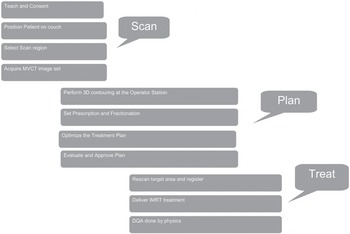
Between December 2006 and May 2008, Radiation Oncologists at our centre approached patients requiring urgent PRT to determine whether they would undergo the Tomo-PAL protocol. These patients were asked whether they would be interested in having radiotherapy treatment using an IMRT protocol that the department was evaluating. They were deemed to be clinically stable and able to be in the treatment room for 1–2 hours. They underwent single-session megavoltage computed tomography (MV-CT) simulation, IMRT treatment planning, treatment position verification and delivery of the first fraction of radiotherapy on a helical tomotherapy unit using the newly developed Stat RT® software (provided by TomoTherapy® Incorporated). This has been described in greater detail earlier.Reference MacPherson, Montgomery, Fox, Carty, Gerig, MacRae, Grimard, Clark and Samant16 The time required to complete each step of the scanning, planning and treatment process was recorded along with the overall time spent in the treatment room. The steps in the work flow process for Tomo-PAL are shown in Figure 1. This was done similarly for a random sample of 27 patients treated during the same time period with more conventional simulation-and-treatment approaches, either with fluoroscopic simulation or CT simulation (the steps required and time needed to complete each of the steps were also recorded). These patients were also being simulated, planned and treated on the same day. The total times required for simulating, planning and treating patients with these three approaches were measured and compared. Also, the distributions obtained with the IG-IMRT approach were evaluated and compared with more traditional distributions with the simpler approaches.
IG-IMRT workflow for integrated one-session CT simulation, IMRT treatment planning, position verification and delivery of the first faction of radiotherapy.

RESULTS
There were a total of 28 patients entered on the Tomo-PAL protocol and this time and motion study with the median age being 72 years, 61% men and 39% women. The primary sites of cancers were prostate (4), breast (3), lung (4), colorectal (4) and other (13). The majority (75%) were treated for painful bone or soft tissue metastasis, 14% were treated with bleeding lesions and 11% for other reasons. The areas treated include the hip and/or pelvis in 42% of cases, the spine in 36% of cases and 21% other sites. The most commonly used PRT dose fractionation regime was 20 Gy in five fractions, with a range of 5–25 Gy in 1–5 fractions. Ten patients received a single fraction of PRT. All patients were able to have their treatment as planned. Delivery quality assurance (DQA) was performed using a cylindrical solid water phantom after the fist treatment for all patients and it consisted of one or more dose measurements with an ion chamber and film measurements in at least one plane through the high-dose region.Reference MacPherson, Montgomery, Fox, Carty, Gerig, MacRae, Grimard, Clark and Samant16 Our DQA performed following the first fraction of each radiotherapy course demonstrated good agreement between the planned and delivered doses and this lead to the increased use of single-fraction radiotherapy for this protocol.
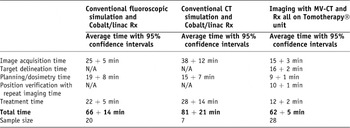
Table 1 shows the average times for the various processes required for Tomo-PAL patients as well a sample of patients treated with conventional approaches either fluoroscopic or CT simulation. Overall, it required an average of 62 minutes to scan, plan and treat patients with Tomo-PAL approach. This compares to ∼66 minutes and 88 minutes using fluoroscopic simulation and or conventional CT simulation, respectively. It should be pointed out that with the Tomo-PAL protocol, there was no waiting between processes or moving of patients between simulation-and-treatment rooms. The transfer process and waiting times between simulation and treatment were noted but were not specifically included in the comparison analysis (since they were quite variable and not necessarily a reflection of the radiotherapy processes themselves). For example, in order to allow for possible unforeseen delays that can occur on the simulator and treatment machines, often 1–2 hour gaps are automatically created between these two processes so patients do not miss their scheduled treatment times. Adding these waiting times would have made our conventional approaches seem much longer than they really need to be.
Summary of processes and times required to various single-session simulation-and-treatment approaches

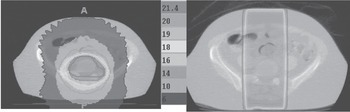
Figure 2 shows a sample comparison of the treatment plan distributions with our Tomo-PAL IG-IMRT approach versus a simpler parallel-opposed-pair (POP) treatment on a megavoltage unit. Although dose–volume histogram analyses were not recorded for this study, qualitative assessment of the IMRT distributions delivered suggested very homogenous dose coverage around the tumour and much lower doses to adjacent normal tissues compared to non-IMRT approaches, and there were also much smaller and far fewer hot spots with the Tomo-PAL plans.
Treatment of sacrum with IG-IMRT as compared with traditional fields, showing significant reduction of high-dose region and hotspots.

DISCUSSION
Our study indicates that it is possible to efficiently scan, plan and deliver IG-IMRT routinely in approximately 1 hour for patients requiring urgent PRT if radiotherapy processes are carefully developed, streamlined and integrated. This is extremely convenient for patients since they remain on the treatment couch and in one room for the entire time, rather than being moved from the simulation area to the waiting area and then from the waiting area to the treatment room. Our Tomo-PAL protocol for delivering IG-IMRT compared very favourably with the more traditional approaches. Even without adding waiting times or transfer times between rooms, it was clearly not any more time consuming for patients. In fact, on average, it was the fastest of the three approaches evaluated. It should be noted that the longer times for conventional simulation are likely to be related to staff having to decide on field placement immediately and to escort patients out of the room afterwards. Also, the relatively longer treatment times are a result of having to bring the patients into the treatment unit rooms and try to reproduce the positioning done during the simulation process, and, at our centre, often this involves staff not present during simulation.
However, we acknowledge that a limitation of this analysis is that it was not a compar-ison of randomly assigned patients since the Tomo-PAL protocol patients were specifically deemed to be stable enough to remain in the treatment room for over 1 hour. However, the main purpose of our study was to determine whether the one-session scan-plan-treat approach was efficient and we believe this has been demonstrated. For our traditional urgent same-day simulation-and-treatment patients, we allow a minimum of 30 minutes for the simulation portion and 30 minutes for the treatment, so 1 hour is an appropriate minimum baseline with which to compare Tomo-PAL. As we use this one-session IG-IMRT approach on a more routine basis and on a broader group of patients, we will have to assess whether the 1 hour time-frame is still adequate for the majority of patients. It should also be noted that although patients remain in the room for 1 hour, they do not need to be lying on the treatment couch for the entire time. Some patients did choose to sit up while waiting to be re-scanned and treated but this did not require any additional set-up time.
Because patients with advanced cancer often have significant symptoms including pain, minimising patient transfers and overall time spent at a cancer centre are all very important. It also seems logical that if we can provide more precise and tailored radiotherapy then theoretically it should improve treatment effectiveness and reduce toxicity.Reference Nijkamp, Pos, Nuver, de Jong, Remeijer, Sonke and Lebesque7 However, this remains to be proven and is an area for future clinical research. In our experience, for example, reducing the volume of bowel receiving the full prescribed dose of PRT could lead to less nausea and vomiting. There is also the possibility of dose escalation to the tumour in order to improve symptom response rates (both the rates of symptom improvement and the duration of response).
It makes intuitive and practical sense to have the same staff involved in the simulation-and-treatment processes to reduce potential errors or inaccuracies in set-up, and to have a better understanding of the patients’ situation and needs. Anecdotally, patients who have gone through both our conventional and Tomo-PAL processes have commented that the latter approach seemed more practical and convenient but this requires formal evaluation and is another area for further research.
The IMRT distributions are, at least qualitatively, superior to the traditional distribution obtained with simpler approaches, such as POP fields. Although this was a study evaluating process efficiency rather than patient outcomes, we did not have any patients who were unable to complete their treatment, and no significant or unforeseen toxicity was noted following radiotherapy. The published literatureReference Driver, Drzymala, Dobbs, Faulkner and Harris17–Reference McJury, Fisher, Pledge, Brown, Anthony, Hatton, Conway and Robinson19 indicates that improvements in radiotherapy technology lead to more accurate and precise treatment, and IG-IMRT fits very well into this philosophy. There appears to be increasing support to utilise modern radiotherapy equipment and resources to improve PRT,Reference Lorenz, Lynn, Dy, Shugarman, Wilkinson, Mularski, Morton, Hughes, Hilton, Maglione, Rhodes, Rolon, Sun and Shekelle20 and other centres have recently reported using IG-IMRT for palliation with good success in terms of clinically meaningful results.Reference Hein, Gladstone, Bellerive and Hug13–Reference Wright, Lovelock, Bilsky, Toner, Zatcky and Yamada15 Although some may view this as very sophisticated treatment that is not necessary for palliative situations, we believe that if resources are available for PRT such as IG-IMRT, they should be fully utilised. Our Tomo-PAL protocol appears well suited for single-fraction radiotherapy and we were satisfied with our DQA measurements that this is an entirely safe approach. One-session simulation-and-treatment clinics have been established for delivering single-fraction radiotherapy for patients requiring urgent PRT,Reference Danjoux, Chow, Drossos, Holden, Hayter, Tsao, Barnes, Sinclair and Farhadian21 and IG-IMRT approaches can also be adapted in a similar fashion.
CONCLUSIONS
One-session scanning, planning and treatment for palliation with IG-IMRT is an efficient, practical and convenient option for patients with advanced cancer. It shows great promise for the future and could be especially useful for single-fraction radiotherapy.
Acknowledgements
This research was presented at the 50th Annual Meeting of ASTRO in Boston (21–25 September 2008). Funding for the study was generously provided by the Ottawa Regional Cancer Foundation. The authors do not have any conflicts of interest related to the contents of this manuscript but it should be noted that three of the authors (L.G., L.M., M.M.) have in the past received travel grants from TomoTherapy® Inc.