Introduction
The stress associated with caring for a loved one with dementia has been found to increase the risk of developing adverse physical and psychological health problems, including clinical depression, anxiety and physical strain (Schulz et al., Reference Schulz, O'Brien, Bookwala and Fleissner1995; Ory et al., Reference Ory, Hoffman, Yee, Tennstedt and Schulz1999). In addition, sleep disturbance is a common health consequence frequently reported by dementia caregivers (McKibbin et al., Reference McKibbin2005). The ramifications for impaired sleep in caregivers can be profound. For example, studies have shown that perturbed sleep in caregivers of people with Alzheimer's disease (AD) is associated with increased inflammation activity, as measured by circulatory activity of Interleukin-6 (IL-6) and C-reactive protein (CRP), both of which are indicative of future atherosclerotic risk (von Kanel et al., Reference von Kanel2010). In addition to increasing inflammation risk, disrupted sleep is a factor that may lead caregivers to place persons with dementia into long-term care (Hope et al., Reference Hope, Keene, Gedling, Fairburn and Jacoby1998).
Although changes in sleep patterns are characteristic of normal aging, not all older adults, including dementia caregivers, develop sleep disturbances (McCurry et al., Reference McCurry, Logsdon, Teri and Vitiello2007). Poor sleep and other sleep-related problems are not an attribute of normal aging per se, but may be due to or exacerbated by a number of environmental, physiological and psychological factors (Neikrug and Ancoli-Israel, Reference Neikrug and Ancoli-Israel2010). Indeed, environmental stressors such as care recipient behavior problems, and psychological factors such as depressive symptoms, may influence sleep quality in caregivers (McCurry et al., Reference McCurry, Logsdon, Teri and Vitiello2007).
However, although environmental factors likely influence caregiver sleep disturbance, intermediary behavioral and cognitive factors may also be associated with poorer sleep among caregivers. Two potential cognitive and behavioral factors that may impact caregiver sleep are activity restriction and engagement in pleasurable activities. These constructs have been previously examined in caregivers with respect to psychological outcomes such as depression. For example, Williamson and Shaffer (Reference Williamson, Shaffer, Williamson, Schafer and Parmelee2000) have proposed an “Activity Restriction Model of Depressed Affect”, which suggests that environmental stressors, such as having a medical illness or providing care for a disabled spouse, increase one's perception that he or she cannot engage in social and recreational activities, which in turn results in poorer mental health outcomes, including greater depressive symptoms. In this Activity Restriction model, an individual's level of perceived activity restriction is a mediator between environmental stressors and psychological well-being. Support for this activity restriction model has been demonstrated in AD caregivers (Mausbach et al., Reference Mausbach, Patterson and Grant2008). Specifically, caregivers displayed both increased depressive symptoms and increased levels of activity restriction compared to non-caregiving controls, and activity restriction mediated the relationship between caregiving status and depressive symptoms. Alternatively, behavioral models or “pleasant events” models of depression posit that engagement in pleasurable or reinforcing activities is necessary for maintaining low levels of depression (Lewinsohn, Reference Lewinsohn, Friedman and Katz1974; Reference Lewinsohn1975; Lewinsohn and Amenson, Reference Lewinsohn and Amenson1978). Increasing engagement in pleasant activities (i.e. behavioral activation) is a commonly employed treatment technique shown to be effective for reducing depressive symptoms in adults (Jacobson et al., Reference Jacobson1996; Reference Jacobson, Martell and Dimidjian2001; Mazzucchelli et al., Reference Mazzucchelli, Kane and Rees2009), including caregivers (Coon et al., Reference Coon, Thompson, Steffen, Sorocco and Gallagher-Thompson2003; Gallagher-Thompson and Coon, Reference Gallagher-Thompson and Coon2007).
Engagement in pleasant events can be measured by observable behaviors, whereas activity restriction refers to a cognitive appraisal that an individual is prevented from engaging in activities to the extent that he or she desires. Thus, engagement in pleasant events and perceived activity restriction represent distinct behavioral and cognitive constructs. Theoretically, both of these constructs are important for predicting psychological well-being. For example, assessment of only pleasant events may ignore that some individuals perceive a given level of pleasant activities as sufficient whereas other individuals engage in the same level of activities but feel highly restricted. Recently, Mausbach and colleagues (Mausbach et al., Reference Mausbach, Roepke, Depp, Moore, Patterson and Grant2011) proposed a new theoretical model merging the pleasant events and activity restriction models. This new model, termed the “Pleasant Events, Activity Restriction” (PEAR) model, suggests that assessment of both participation in pleasant events (PE) and level of perceived activity restriction (AR) should allow for the best prediction of outcomes, such that individuals engaging in more PE and reporting low AR should be maximally differentiated from those who engage in fewer PE with high AR. Indeed, preliminary testing of the PEAR model in dementia caregivers found that caregivers with a combination of low PE and high AR had worse psychological outcomes (e.g. more depressive symptoms, higher negative and lower positive affect, decreased personal mastery and self-efficacy, and increased use of negative coping strategies) as compared to caregivers reporting high PE and low AR (Mausbach et al., Reference Mausbach, Roepke, Depp, Moore, Patterson and Grant2011). Importantly, for many of these outcomes, including depressive symptoms and affect, participants with both low PE and high AR had significantly worse outcomes than participants with a deficit in only PE or AR (i.e. participants with low PE but also low perceived AR; participants with high AR but also high PE). This finding supports the utility of an integrated PEAR model assessing both PE and AR, as opposed to assessing either construct in isolation.
The PEAR model has previously been used to incorporate both engagement in pleasant events and perceived activity restriction in predicting psychological outcomes such as depressive symptoms in dementia caregivers. However, given the demonstrated bidirectional associations between mood disorders such as depression and sleep disturbances (Benca et al., Reference Benca, Obermeyer, Thisted and Gillin1992; Buysse et al., Reference Buysse1994; Ohayon and Roth, Reference Ohayon and Roth2001; Cole and Dendukuri, Reference Cole and Dendukuri2003; Perlis et al., Reference Perlis2006) it is possible that PE and AR may be related to sleep outcomes in caregivers, in addition to their association with mood and other psychological outcomes. Indeed, McCurry and colleagues (2007) have suggested that behavioral theories are not only useful for explaining depressive symptoms, but may also explain changes in caregiver sleep quality. Specifically, daytime social activity helps maintain regular sleep routines and circadian rhythms, and an absence of regular recreational or social events may contribute to sleep disturbances (McCurry et al., Reference McCurry, Logsdon, Teri and Vitiello2007). In fact, original analyses using the PEAR model to predict outcomes in caregivers (Mausbach et al., Reference Mausbach, Roepke, Depp, Moore, Patterson and Grant2011) found a significant main effect of the PEAR model on overall sleep quality. These preliminary results add further support to the theoretical relevance of PE and AR for predicting sleep outcomes, and suggest that using the PEAR model to assess both engagement in PE and perceived AR may aid in predicting sleep-related outcomes in caregivers.
The purpose of the present study was to conduct follow up analyses to the original PEAR model investigation by examining the usefulness of the PEAR model for explaining a variety of specific self-reported sleep outcomes, namely (1) subjective sleep quality (subjective rating of quality of sleep via self-report); (2) sleep latency (amount of time it takes to fall asleep); (3) sleep duration (total sleep time from sleep onset to final awakening); (4) habitual sleep efficiency (ratio of total sleep time to time in bed); (5) sleep disturbance (amount of external and internal factors disrupting sleep); and (6) daytime dysfunction (ability to stay awake during daily activities and attitude throughout the day). Multiple sleep-related outcomes were examined in order to obtain a more accurate portrayal of caregivers’ sleep and to define separate important aspects of sleep that may be impacted by the chronic stress associated with caregiving responsibilities.
The present study investigated the role of both PE and AR in determining sleep-related outcomes in dementia caregivers. Specifically, we tested the relationship between the newly developed PEAR model and subjective sleep characteristics in a sample of spousal dementia caregivers currently residing with the care recipient. We hypothesized that dementia caregivers experiencing high pleasure and low activity restriction (HPLR) would report significantly better sleep outcomes than those experiencing low pleasure and low restriction (LPLR) or all other combinations of pleasure and activity restriction.
Methods
Participants
The participants comprised 125 spousal caregivers of individuals with AD enrolled in the Alzheimer's Caregiver Project at the University of California, San Diego (UCSD). The participants were recruited via referral from the UCSD Alzheimer's Disease Research Center (ADRC), presentations at local caregiver support groups and health fairs, and at the recommendation of existing participants (i.e. snowball method). To be eligible, caregivers were required to be in generally good health, at least 55 years of age, and providing in-home care for a spouse with a diagnosis of AD. Because one focus of the project was to examine physical outcomes in stressed caregivers (e.g. biomarkers), participants were excluded if they reported a severe or chronic physical (e.g. cancer requiring treatment) or mental illness (e.g. psychosis) that could confound these outcomes, had severe hypertension (i.e. 200/120 mm Hg), or were receiving treatment with anticoagulant medication. All participants provided written consent before enrolling in the studies, and the research was approved by the UCSD Institutional Review Board (IRB).
Measures
Assessments were completed in a single visit at the caregivers’ homes. Participants completed a structured interview with a research assistant that included measures of demographic and descriptive information (including participant age, gender, educational history, and years of caregiving), mood/stress, sleep, coping and resource variables, and health factors. Measures relevant to the present study are described below.
Sleep outcomes
Caregiver sleep was evaluated using the Pittsburgh Sleep Quality Index (PSQI) (Buysse et al., Reference Buysse, Reynolds, Monk, Berman and Kupfer1989). This 19-item self-report questionnaire assesses sleep quality over the past month in seven domains: (1) subjective sleep quality, (2) sleep latency, (3) sleep duration, (4) habitual sleep efficiency, (5) sleep disturbances, (6) use of sleep medication, and (7) daytime dysfunction. Each of the seven components is scored on a scale of 0–3, with higher scores indicating worse sleep quality. In addition, an overall score is created by summing the seven domains (range = 0–21). Overall scores greater than five are considered to indicate disturbed sleep. Overall reliability (Cronbach's α) for the PSQI is 0.83, and test-retest coefficients for the component scores range from 0.65 to 0.84.
Pleasant events
Caregivers’ engagement in pleasant events was assessed using a modified version of the Pleasant Events Schedule – AD (PES-AD) (Logsdon and Teri, Reference Logsdon and Teri1997). The PES-AD is a 20-item self-report measure that assesses how much participants engaged in 20 activities (e.g. “going on outings,” “reading or listening to stories,” “shopping or buying things”) over the past month. Response options include 0 = “not at all,” 1 = “a few times (1–6 times),” and 2 = “often (7 or more times).” Item scores are added together to create a summary score, with higher scores indicating greater engagement in pleasant activities. Coefficient α for the pleasant events scale was 0.80.
Activity restriction
Caregiver activity restriction was assessed using the Activity Restriction Scale (ARS) (Williamson and Schulz, Reference Williamson and Schulz1992). This scale consists of nine activities and asks participants to indicate how much, in general, they felt restricted from doing each activity over the past month. The activities include: (1) “caring for yourself,” (2) “caring for others,” (3) “doing household chores,” (4) “going shopping,” (5) “visiting friends,” (6) “working on hobbies,” (7) “sports and recreation,” (8) “going to work,” and (9) “maintaining friendships.” Response options range from 0 = “never or seldom did this” to 4 = “greatly restricted.” Items are summed to create an overall score, with higher scores indicating greater activity restriction. Coefficient α for the activity restriction scale was 0.78.
Care recipient functioning
The dementia severity of the care recipient was assessed using the Clinical Dementia Rating scale (CDR; Morris, Reference Morris1993). Caregivers reported on their spouse's level of functioning in six behavioral and cognitive domains: memory, orientation, judgment and problem solving, community affairs, home and hobbies, and personal care. Scores on these six domains were then used to create a total score ranging from 0 to 3, with higher scores indicating more severe dementia. Coefficient α for the CDR scale was 0.77.
Caregivers also rated how much their care recipient depends on them to complete seven activities of daily living (ADLs) (e.g. eating, bathing, going to the bathroom) (Katz et al., Reference Katz, Ford, Moscowitz, Jackson and Jaffee1963) and eight instrumental activities of daily living (IADLs; e.g. handling money, taking medications) (Lawton and Brody, Reference Lawton and Brody1969) using a Likert scale ranging from 1 = “not at all” to 4 = “completely.” The total number of ADLs and IADLs for which the care recipient required any amount of help was summed to create a total score (range = 0–15). Cronbach's α for the ADL/IADL scale was 0.91.
Data analysis
Using the same method previously described by our team (Mausbach et al., Reference Mausbach, Roepke, Depp, Moore, Patterson and Grant2011), three groups were created reflecting participants’ engagement in pleasant events and activity restriction. Specifically, median splits were used to code participants as high vs. low in both pleasant events (high > 30) and activity restriction (high >16). From these scores, participants were categorized into three groups based on the following criteria: HPLR = high pleasant events and low activity restriction (N = 38); HPHR/LPLR = either high in pleasant events and high in activity restriction (N = 30) or low in pleasant events and low in activity restriction (N = 22; Total N = 52); and LPHR = low pleasant events and high activity restriction (N = 25).
Using the three-group categorization as our primary independent variable, we ran a MANOVA using Wilks’ criterion to test whether these groups significantly differed on the following outcome domains: (1) subjective sleep quality, (2) sleep latency, (3) sleep duration, (4) habitual sleep efficiency, (5) sleep disturbance, (6) use of sleep medication, and (7) daytime dysfunction. All seven variables were hypothesized to be different, so the critical value for α was set at 0.05. To test our hypothesis that a combination of low pleasant events with high activity restriction would result in worse sleep outcomes, significant omnibus tests were followed by post hoc individual ANOVAs for each variable with planned comparisons of the LPHR group to our other two group categories. A significance value of .05 was set for these ANOVAs and planned comparisons.
Results
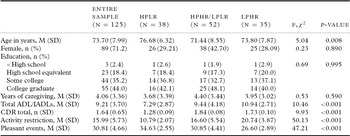
Table 1 shows descriptive characteristics of the sample. Differences between groups on these characteristics were made using analysis of variance (ANOVA) for linear variables and χ2 statistics for categorical variables. As seen in the table, caregivers were primarily female and well educated, with slightly more than half (54.4%) being 75 years of age or older. The groups differed significantly with regard to mean age and total ADL/IADLs. As expected, significant differences were also found for our three groups on activity restriction and pleasant events scores.
Characteristics of the sample

HPLR = High Pleasant Events + Low Activity Restriction; HPHR/LPLR = either High Pleasant Events + High Activity Restriction or Low Pleasant Events + Low Activity Restriction; LPHR = Low Pleasant Events + High Activity Restriction. ADL = Activities of Daily Living; IADL = Instrumental Activities of Daily Living.
Primary analysis
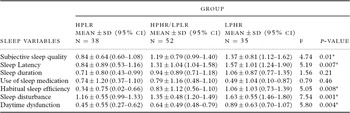
We conducted our MANOVA analysis using the three-group categorization to test group differences in the six sleep domains. Results of this analysis indicated a significant main effect of group (F 12, 214 = 2.56, P = 0.003). Univariate ANOVA analyses for group differences in the individual dependent variables are presented in Table 2, and effect sizes are presented in Table 3. As seen in Table 2, ANOVAs for five of the seven variables were significant: (1) subjective sleep quality (p = 0.010), (2) sleep latency (p = 0.007), (3) habitual sleep efficiency (p = 0.021), (4) sleep disturbance (p = 0.001), and (5) daytime dysfunction (p = 0.004). Sleep duration (p = 0.214) and use of sleep medication (p = 0.46) was not significant.
Univariate tests comparing three groups on primary outcomes

HPLR = High Pleasant Events + Low Activity Restriction; HPHR/LPLR = Either High Pleasant Events + High Activity Restriction or Low Pleasant Events + Low Activity Restriction; LPHR = Low Pleasant Events + High Activity Restriction.
* = significance at p < 0.05.
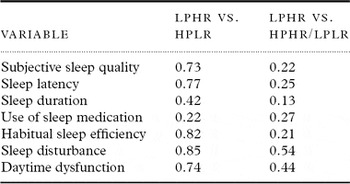
Cohen's d effect sizes between groups

HPLR = High Pleasant Events + Low Activity Restriction; HPHR/LPLR = either High Pleasant Events + High Activity Restriction or Low Pleasant Events + Low Activity Restriction; LPHR = Low Pleasant Events + High Activity Restriction.
Post hoc analyses
Results of our planned comparisons indicated that the LPHR group reported significantly worse sleep compared to the HPLR group in all five domains. Specifically, LPHR participants had significantly worse sleep quality (p = 0.003), sleep latency (p = 0.002), habitual sleep efficiency (p = 0.007), sleep disturbance (p < 0.001), and daytime dysfunction (p = 0.001). In addition, LPHR participants were significantly worse than HPHR/LPLR participants in three sleep domains, including sleep quality (p = 0.031), sleep latency (p = 0.029), and habitual sleep efficiency (p = 0.047). As seen in Table 3, effect size differences between the LPHR and HPLR were medium-to-large on all six sleep measures, while small-to-medium effect size differences were found between the LPHR vs. HPHR/LPLR groups.
Confirmation of results after controlling for potential confounding factors
Because our three groups differed significantly from each other in age, ADL/IADLs, and CDR scores, we conducted additional ANCOVAs for each of our sleep measures which controlled for these potentially confounding factors. Results indicated that all significant group differences were maintained except for sleep efficiency (p = 0.070). Yet, the sleep efficiency effect size for the difference between our HPLR and LPHR groups was still 0.57, suggesting a moderate effect size even when controlling for confounding factors.
Discussion
The present study provides broad support for the PEAR model and its association with various sleep outcomes. Prior research has demonstrated an association between the PEAR model and overall subjective sleep quality (Mausbach et al., Reference Mausbach, Roepke, Depp, Moore, Patterson and Grant2011). However, the current study expands upon existing research by examining how the PEAR model is associated with specific aspects of sleep. In particular, the present study adds support to the PEAR model by demonstrating that a combination of low engagement in pleasant events and high perceived activity restriction is a better indicator of sleep quality, sleep latency, habitual sleep efficiency, sleep disturbance, and daytime dysfunction than consideration of only pleasant events or activity restriction alone.
These findings have important implications for the treatment of sleep disturbances in dementia caregivers. Caregivers in need of medical care most typically approach their primary care providers seeking help with stress, mood, or physical health difficulties, but less often for sleep difficulties. Thus, specific interventions for sleep are rarely prescribed for caregivers. Traditional behavioral interventions targeting use of leisure time (i.e. pleasant events and perceived activity restriction) have already been indicated for caregivers for improving depressive symptoms (Coon et al., Reference Coon, Thompson, Steffen, Sorocco and Gallagher-Thompson2003; Gallagher-Thompson and Coon, Reference Gallagher-Thompson and Coon2007). Previous research suggests that such pleasant-events-based interventions that focus on increasing engagement in pleasant events and reducing activity restriction may improve both problems with mood and sleep simultaneously (McCurry et al., Reference McCurry, Logsdon, Teri and Vitiello2007). The results of the present study add further support to the notion that behavioral interventions focused on increasing leisure activities (e.g. behavioral activation) may have secondary benefits for improving sleep outcomes. These behavioral interventions may be particularly advantageous for improving sleep in caregivers because they do not require extensive training in order to be delivered by therapists and are likely to be cost-effective and easy to implement in community settings.
Inconsistent with our hypothesis, a significant relationship did not emerge between sleep duration and the PEAR model, although the relationship was in the proposed direction. Duration of sleep does not target problems with sleep disruption. For example, a total sleep time of 7 hours might be 7 consecutive hours, or 7 hours which were disrupted 15 times. In addition, short sleep durations and long sleep durations are associated with worse consequences. Therefore, sleep duration without a measure of sleep efficiency or fragmentation is a less sensitive sleep variable. In addition, non-behavioral factors, including but not limited to age and physiology, physical health, BMI, restless leg syndrome (RLS), sleep apnea, and medication use affect sleep duration more strongly than sleep quality (Faubel et al., Reference Faubel2009).
Also inconsistent with our hypothesis, use of sleep medications and the PEAR model did not produce a significant relationship, although this relationship was also in the proposed direction. These results are not surprising, as there is considerable variability in the medical reasons about why people take medications in order to sleep. This variability exists not only in caregivers but also in the general population.
There are some limitations to the present study that should be acknowledged. First, the data were cross-sectional in nature, which precludes any inferences of causality and it is possible that poor sleep resulted in less pleasure and more restricted activity. Further research may want to address this limitation by using longitudinal designs to measure how changes in the constructs of the PEAR model predict changes in sleep outcomes over time. Also, clinical trials of behavioral interventions for caregivers may wish to examine directly whether changes in pleasant events and activity restriction might be associated with greater improvements in overall sleep quality when compared to traditional behavioral or pharmacological treatments.
Another limitation of the present study is that only spousal AD caregivers were assessed, and the findings may not generalize to other AD caregivers (e.g. children, siblings), or other caregiver populations. One of the major differences between sleep in spousal caregivers versus sleep in non-spousal caregivers is that spousal caregivers often share a bed with the care recipient, which may have an impact on the caregiver's sleep, although prior research suggests no significant differences in subjective sleep quality between AD caregivers who shared a room with the care recipient and those who slept in separate bedrooms (Creese et al., Reference Creese, Bedard, Brazil and Chambers2008).
Another limitation is the fact that there were significant differences in age, ADL/IADL, and CDR scores between the groups which might have been eliminated if the individual group sample sizes were larger. However, regarding the age disparities, it is important to note that while we did find significant age differences between groups 1 and 2, the differences between groups 1 and 3 (HPLR and LPHR respectively) which were of particular importance to us were not found to be statistically significant. In contrast, we did find that all three groups (including groups 1 and 3) showed significant differences on ADL/IADL and CDR scores. Given the fact that group 1 (HPLR) had the lowest CDR and ADL/IADL scores, it may be that caregivers are more likely to engage in pleasant events and have less activity restriction when the care recipient requires less care, which in turn could influence sleep outcomes. Thus, we acknowledge that there is a possibility that the differences in dementia severity among the groups could have confounding effects on the results of our study.
A recently published review article by Hawkley et al. (Reference Hawkley, Preacher and Cacioppo2010) demonstrated that a relationship exists between loneliness (as defined as perceived social isolation), sleep problems and daytime dysfunction in a population-based sample. The current study did not include a measure of loneliness. Further studies may benefit from examining this construct in relation to engagement in pleasant events and activity restriction in caregivers.
Finally, sleep outcomes were assessed based on self-report responses as opposed to more objective measures of sleep. Subjective self-report measures of sleep quality such as the PSQI are correlated with mood and thus reflect an individual's affective state in addition to their sleep quality (Carter, Reference Carter2006; Bower et al., Reference Bower, Bylsma, Morris and Rottenberg2010; Hayashino et al., Reference Hayashino, Yamazaki, Takegami, Nakayama, Sokejima and Fukuhara2010). Indeed, the correlation between the global PSQI score and a measure of depression (CESD-10) in our sample was highly significant (r = 0.45, p < 0.001). Additionally, previous research from our laboratory found that while spousal caregivers reported more sleep complaints compared to non-caregiving older adults, sleep impairments across multiple domains were not observed when measured objectively with one night of polysomnography (McKibbin et al., Reference McKibbin2005). Thus, our results should be replicated with objective measures of sleep quality such as polysomnography.
In summary, the present study provides further support for the PEAR model by demonstrating its utility in identifying spousal dementia caregivers with sleep disturbances. Caregivers with both high PE and low AR had better subjective sleep quality, sleep latency, habitual sleep efficiency, sleep disturbance and daytime dysfunction than caregivers in the other groups. Although these results require replication with objective (i.e. non self-report) measures of sleep as well as replication in studies with longitudinal designs, these findings suggest that behavioral interventions for caregivers aimed at increasing engagement in social and recreational activities may also improve caregivers’ sleep quality.
Conflict of interest
None.
Description of authors' roles
R. Moore carried out the statistical analyses and wrote the paper. A. Harmell collected the data and assisted with writing the paper. E. Chattillion assisted with writing the paper. S. Ancoli-Israel helped conceptualize the design and supervised the data collection and assisted with writing the paper. I. Grant helped supervised the data collection and conceptualized the design and assisted with writing the paper. B. Mausbach was responsible for the statistical design of the study, supervised data collection and statistical analyses, and assisted with writing the paper.
Acknowledgments
Primary research support was provided via funding from the National Institute on Aging (NIA) through award R01 AG15301. Additional support was provided by the NIA through awards R01 AG031090 and AG08415.