Much effort has been put into the early identification and management of persons at clinical high-risk (CHR) for psychosis in the last few decades (Yung et al., Reference Yung, McGorry, McFarlane, Jackson, Patton and Rakkar1996). The CHR period is important because it offers a temporal window for potential early intervention targeted at reducing the risk of conversion to psychosis, and improving symptoms and function (Fusar-Poli et al., Reference Fusar-Poli, Borgwardt, Bechdolf, Addington, Riecher-Rossler, Schultze-Lutter and Yung2013) before the onset of psychosis. Therefore, there is a substantial body of research on predicting the onset of psychosis in CHR individuals based on both clinical (Cannon et al., Reference Cannon, Cadenhead, Cornblatt, Woods, Addington, Walker and Heinssen2008) and biological (Collin et al., Reference Collin, Seidman, Keshavan, Stone, Qi, Zhang and Whitfield-Gabrieli2018) knowledge, using either clinical-learning (Cannon et al., Reference Cannon, Yu, Addington, Bearden, Cadenhead, Cornblatt and Kattan2016; Zhang et al., Reference Zhang, Xu, Tang, Cui, Wei, Wang and Wang2018, Reference Zhang, Xu, Tang, Cui, Tang, Wei and Wang2019a, Reference Zhang, Xu, Tang, Li, Tang and Cui2019b) or machine-learning methods (Fusar-Poli et al., Reference Fusar-Poli, Stringer, M S Durieux, Rutigliano, Bonoldi, De Micheli and Stahl2019). However, the heterogeneity of this population (Fusar-Poli et al., Reference Fusar-Poli, Cappucciati, Borgwardt, Woods, Addington, Nelson and McGuire2016; Fusar-Poli, Borgwardt, & Valmaggia, Reference Fusar-Poli, Borgwardt and Valmaggia2008) limits the application of the prediction model. The predictors identified from various studies are somewhat inconsistent. Since the CHR population generally covers the ages between 14 and 25 years (Zhang et al., Reference Zhang, Li, Woodberry, Seidman, Zheng, Li and Wang2014; Zhang et al., Reference Zhang, Li, Woodberry, Xu, Tang, Guo and Wang2017), and are at various stages (adolescent and early adult) of their development. It is a well-accepted assumption that the onset age of psychosis is one of the major confounders leading to the variation in prediction models. Previous studies (Hollis, Reference Hollis2003; Lay, Blanz, Hartmann, & Schmidt, Reference Lay, Blanz, Hartmann and Schmidt2000; Schimmelmann, Conus, Cotton, McGorry, & Lambert, Reference Schimmelmann, Conus, Cotton, McGorry and Lambert2007) have demonstrated that the psychosis developmental trajectory differs based on the onset age, such as childhood-onset (Driver, Thomas, Gogtay, & Rapoport, Reference Driver, Thomas, Gogtay and Rapoport2020), early-onset (adolescent and early adult) (Schimmelmann et al., Reference Schimmelmann, Conus, Cotton, McGorry and Lambert2007), or late-onset (Suen et al., Reference Suen, Wong, Hui, Chan, Lee, Chang and Chen2019), in terms of clinical presentation and outcomes.
It is widespread assumption that psychosis in adolescents is very different from adult-onset psychosis, and is associated with more common and severe negative symptoms, substance use (Pencer, Addington, & Addington, Reference Pencer, Addington and Addington2005), neurological soft signs (Biswas, Malhotra, Malhotra, & Gupta, Reference Biswas, Malhotra, Malhotra and Gupta2007), neuropsychological deficits (White, Ho, Ward, O'Leary, & Andreasen, Reference White, Ho, Ward, O'Leary and Andreasen2006), and functional impairments (Ballageer, Malla, Manchanda, Takhar, & Haricharan, Reference Ballageer, Malla, Manchanda, Takhar and Haricharan2005), compared to adult-onset. However, to date, little is known about the age-related differences in the premorbid phase of psychosis, such as CHR state. Furthermore, traditionally, the existing prediction models for CHR individuals treat adolescents and adults in the same way, assuming both groups have shared common predictors of conversion to psychosis. This study addresses these issues by examining differences in demographic features, clinical presentation, and general functions at baseline between adolescents (age <18 years) and adult CHR individuals. Moreover, the potential usefulness of clinical predictors for conversion to psychosis was explored by a 3-year follow up which further compared adolescent and adult CHR groups.
Methods
Sample and procedures
The Research Ethics Committee at the Shanghai Mental Health Center (SMHC) approved the study in 2011, 2012, and 2016. The 517 participants with CHR included in this study were part of the ShangHai At Risk for Psychosis (SHARP) program. CHR status was confirmed by the face-to-face interview. This observational study sample was obtained from the SMHC, which is China's largest outpatient medication-management and psychotherapy-providing mental health clinic. Participants from all over China were identified from those who were looking for psychological help and professional suggestions on improving their mental health. They were recruited after we obtained written consent. Those younger than 18 years of age were enrolled for the study by their parents, who provided consent. Participants had to fulfill at least one of the prodromal syndrome criteria: (1) brief intermittent psychotic syndrome (BIPS), (2) attenuated positive symptom syndrome (APSS), or (3) genetic risk and deterioration syndrome (GRDS). Inclusion criteria were: (i) under age of 45 years old; (ii) individuals younger than 18 years old had to be accompanied by either a parent or legal guardian; (iii) capacity to provide informed consent or assent if under 18; (iv) must have completed at least 6 years of primary education; and (v) psychotropically naïve. Exclusion criteria were: (i) severe somatic diseases, for example, pneumonia, cancer or heart failure, (ii) intellectual disability, or (iii) had a history of drug (such as methamphetamine) abuse or dependence. Zhang and colleagues (Zhang et al., Reference Zhang, Li, Woodberry, Seidman, Zheng, Li and Wang2014, Reference Zhang, Li, Woodberry, Seidman, Chow, Xiao and Wang2015; Zheng et al., Reference Zheng, Wang, Zhang, Li, Li and Jiang2012) provide further details regarding the SHARP methodology.
The research procedure was independent of the routine clinical treatment procedure at the SMHC. All participants who completed the baseline assessment were followed up every 6 months. With the exception of those who desired no further contact (or were lost; n = 82), individuals were re-assessed by telephone or by face-to-face interview every 6 months using the structured interview for prodromal syndromes (SIPS). The outcome determination was based mainly on the face-to-face (n = 231) or telephone interviews (n = 204), depending on the wishes of the individuals.
Measurement
The SIPS (Miller et al., Reference Miller, McGlashan, Rosen, Cadenhead, Cannon, Ventura and Woods2003) was used to identify individuals with CHR. This consists of 19 items that assess four symptom domains: positive symptoms (scales P1–P5: P1 unusual thought content; P2 suspiciousness; P3 grandiosity; P4 perceptual abnormalities; and P5 disorganized communication), negative symptoms (scales N1–N6: N1 social anhedonia; N2 avolition; N3 expression of emotion; N4 experience of emotions and self; N5 ideational richness; and N6 occupational functioning), disorganized symptoms (scales D1–D4: D1 odd behavior or appearance; D2 bizarre thinking; D3 trouble with focus and attention; and D4 impaired personal hygiene), and general symptoms (scales G1–G4: G1 sleep disturbance; G2 dysphoric mood; G3 motor disturbances; and G4 impaired tolerance to normal stress). During the SIPS interview, global assessment of function (GAF) was used to measure the participants' global psychological, social, and occupational functioning. The drop in GAF scores was used for assessing the functional deterioration (i.e. the GAF score relative to 12 months prior) in the SIPS interview.
In our previous studies (Zhang et al., Reference Zhang, Li, Woodberry, Seidman, Zheng, Li and Wang2014, Reference Zhang, Li, Woodberry, Xu, Tang, Guo and Wang2017), the Chinese version of SIPS (Zheng et al., Reference Zheng, Wang, Zhang, Li, Li and Jiang2012), which was developed by the SHARP team, also demonstrated good inter-rater reliability (intraclass correlation coefficient: r = 0.96, p < 0.01 for SIPS total score) and validity (26.4% of the subjects converted to psychosis in the following 2 years) in China. The first author of the present study received SIPS certification in Yale University-sponsored SIPS training and has extensive experience of Chinese CHR research projects.
Conversion to psychosis
Of the total 435 CHR individuals, 107 (24.6%) converted to full psychosis at 3 years of follow-up. Conversion to psychosis was defined using the POPS (presence of psychotic symptoms in SIPS) (McGlashan, Walsh, & Woods, Reference McGlashan, Walsh and Woods2010) criteria. The conversion was defined as the development of at least one psychotic level symptom (rated ‘6’ on the SIPS positive symptoms scale) with either sufficient frequency or duration.
Statistical analysis
Individuals with CHR were first divided into two groups: adolescent CHR (9–17 years of age) and adult CHR (18–45 years of age). Demographic and baseline clinical features are presented separately. Quantitative variables are expressed as mean ± s.d., while qualitative variables are presented as frequencies (%). The two groups were compared using χ2 tests for comparisons of categorical variables and independent t tests for comparisons of continuous variables. Next, comparisons between converters and non-converters were conducted in the adolescent and adult CHR groups, separately. Effect sizes were calculated with Cohen's d for mean comparisons between converters and non-converters. Based on our previous findings (Zhang et al., Reference Zhang, Xu, Tang, Cui, Wei, Wang and Wang2018; Zhang et al., Reference Zhang, Xu, Tang, Cui, Tang, Wei and Wang2019a) and considering the impact of duration of untreated prodromal symptoms (DUPrS) on clinical performance and outcomes (Zhang et al., Reference Zhang, Li, Woodberry, Xu, Tang, Guo and Wang2017), DUPrS was controlled for using multivariate analysis of variance (MANOVA). Clinical profiles of the two age groups are shown with marginal means from mixed models, standardized with the means and standard deviations (s.d.) of non-converters. To compare the predictors of conversion to psychosis in adolescent and adult CHR individuals, Cox regression analysis was conducted separately by a group.
Results
Sample characteristics
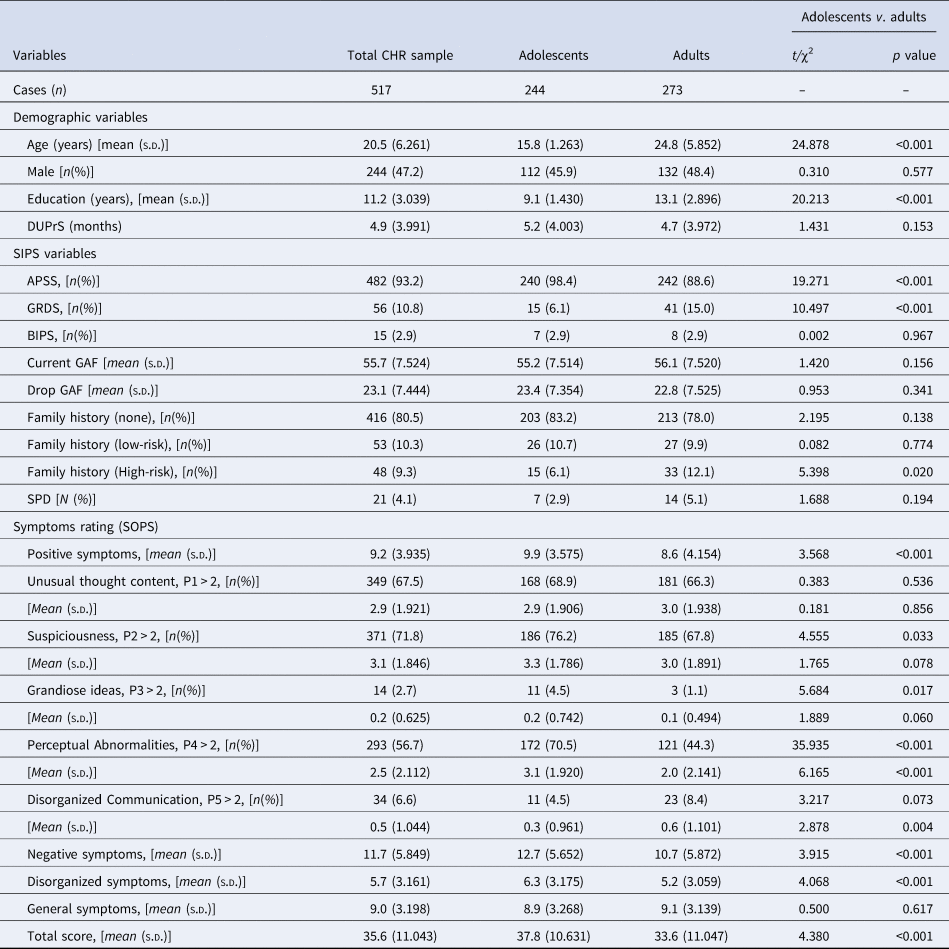
Of the 517 CHR individuals, 244 (47.2%) were adolescent. Adolescent CHR individuals had a significantly lower level of education than adults and there were significant clinical differences at baseline between the two groups. Adolescent CHR individuals were significantly more likely than adults to meet the criteria of APSS, but less likely to meet the criteria of GRDS, less likely to have a family history of psychosis (in at least one first-degree relative). The total scores of SOPS positive, negative, and disorganized symptoms were higher for the adolescent group at baseline (Table 1).
Baseline demographic and SIPS variables, comparison between adolescents and adults

GAF drop, GAF score current from highest in past year; low-risk family history, having any family members with mental disorders or a first-degree relative with non-psychotic disorders; high-risk family history, having at least one first-degree relative with psychosis; APSS, attenuated positive symptom syndrome; GRDS, genetic risk and deterioration syndrome; BIPS, brief intermittent psychotic syndrome; SPD, schizotypal personality disorder; DUPrS, duration of untreated prodromal symptoms.
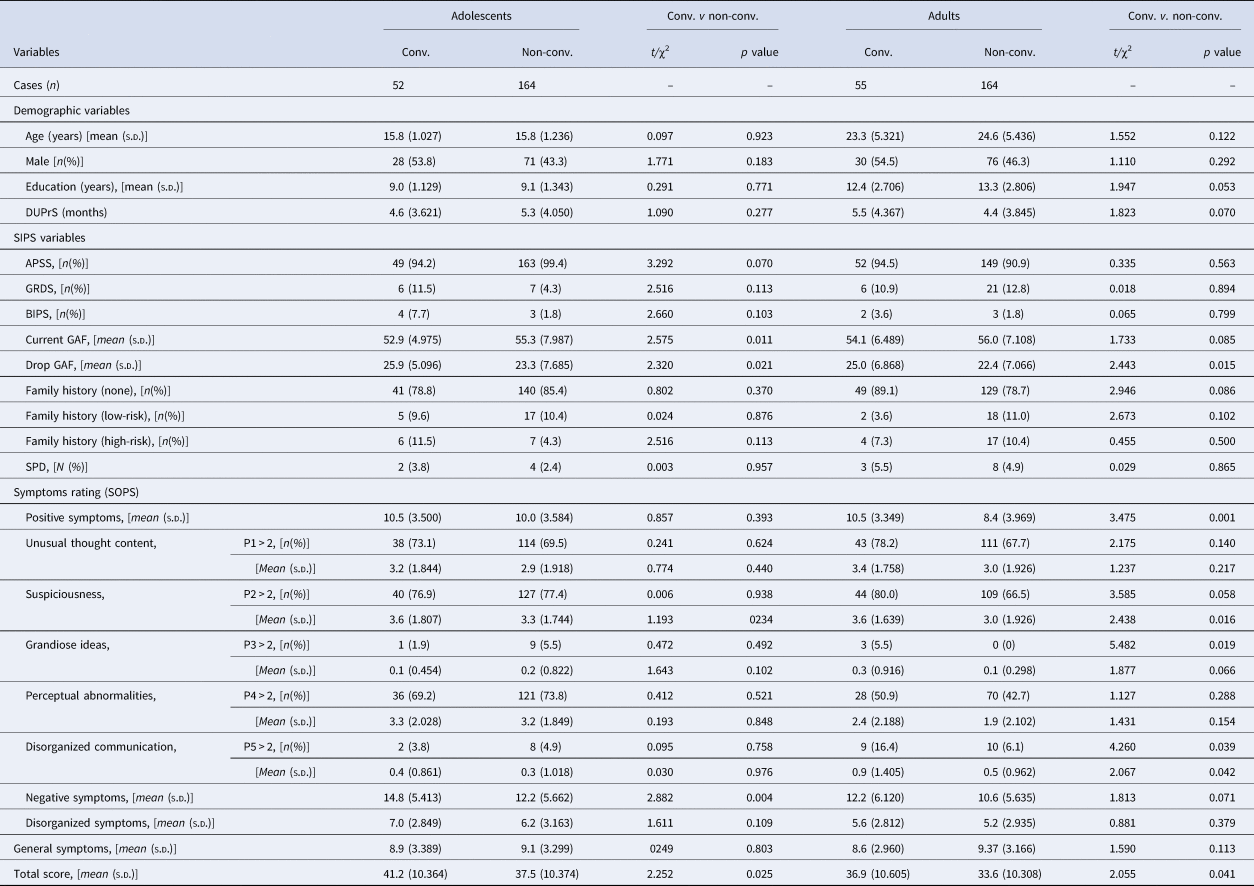
In CHR adolescents, when converter and non-converter baseline characteristics were compared, significant differences were found in GAF scores (current GAF score and drop in GAF score), and total SOPS negative symptom scores. However, in CHR adults, significant differences were found in drop in GAF scores and total SOPS positive symptom scores, specific to suspiciousness, grandiose ideas, and disorganized communication (Table 2).
Baseline demographic and SIPS variables, comparison between converters and non-converters

GAF drop, GAF score current from highest in past year; low-risk family history, having any family members with mental disorders or a first-degree relative with non-psychotic disorders; high-risk family history, having at least one first-degree relative with psychosis; APSS, attenuated positive symptom syndrome; GRDS, genetic risk and deterioration syndrome; BIPS, brief intermittent psychotic syndrome; SPD, schizotypal personality disorder; DUPrS, duration of untreated prodromal symptoms.
Among the 107 converters, the majority (n = 85, 79.4%) were diagnosed with schizophrenia. Specifically, there were 39 (75.0%) out of 52 adolescent converters and 46 (83.6%) out of 55 adult converters who were diagnosed with schizophrenia. Besides, 17 (nine adolescents and eight adults) were diagnosed with bipolar disorder with psychotic symptoms, four (three adolescents and one adult) were diagnosed with major depressive disorder with psychotic symptoms, and one (adolescent) was diagnosed with obsessive compulsive disorder with psychotic symptoms. There were no significant differences in the diagnosis of schizophrenia between the adolescent and adult groups (χ2 = 1.221, p = 0.269).
Attrition
In total, 82 (15.9%) did not complete the 3-year follow-up assessment. Participants with complete follow-up compared to those lost to attrition had significant differences in age (followed v. lost, 20.0 v. 23.1 years, t = 3.351, p = 0.001), year of education (followed v. lost, 11.1 v. 12.0 years, t = 2.620, p = 0.009), current GAF score (followed v. lost, 55.1 v. 58.6, t = 3.878, p < 0.001), GAF drop (followed v. lost, 23.5 v. 21.0, t = 2.411, p = 0.018), total score of positive symptoms (followed v. lost, 9.5 v. 7.7, t = 3.542, p = 0.001), total score of negative symptoms (followed v. lost, 11.9 v. 10.5, t = 2.056, p = 0.039), or total score of disorganized symptoms (followed v. lost, 9.1 v. 8.4, t = 2.056, p = 0.039). There were no significant differences in gender (χ2 = 0.005, p = 0.942), DUPrS (t = 0.361, p = 0.718), or total score of general symptoms (t = 1.851, p = 0.065). In general, those lost to attrition had a relatively low level of severity in baseline symptoms and functional impairments, reflecting the difficulty in follow-ups with participants in a mild CHR state.
Converter and non-converter group comparisons
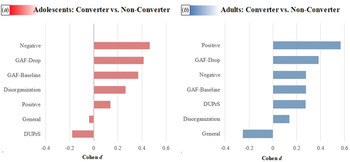
In CHR adolescents, converters had a relatively high level of negative symptoms with the largest effect sizes (Cohen's d = 0.46), followed by general function (Cohen's d = 0.41), which was more likely to have significantly decreased in the year preceding baseline. In comparison, for CHR adults, the largest effect size was from positive symptoms (Cohen's d = 0.57). It is also worth mentioning that the DUPrS showed the opposite pattern in adolescents and adults when comparing converter and non-converter groups (Fig. 1).
Effect sizes (Cohen d) for baseline clinical and functional variables for clinical high risk in adolescents [converter v. non-converter(A)] and adults [converter v. non-converter(B)].
Note. Effect sizes are rank ordered from largest to smallest. GAF: global assessment of functioning; GAF drop is the GAF score baseline from highest in the past year; positive/negative/disorganization/general: total SIPS positive/negative/disorganization/general symptom score; DUPrS: duration of untreated prodromal symptoms

Adolescent and adult group comparisons
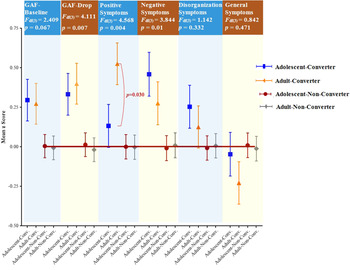
In the MANOVA controlling for DUPrS, the converter groups showed significant differences in drop in the GAF score, total SIPS positive symptom score, and total SIPS negative symptom score (Fig. 2). The total score of SIPS positive symptoms was higher for the adult-converter group at baseline; however, the total score of SIPS negative symptoms was higher in the adolescent-converter group.
Clinical and functional profile by adolescent and adult groups adjusted for DUPrS.
Note. GAF: global assessment of functioning; Marginal means from mixed models were standardized with CHR non-converters' means (s.d.s) to convert to z score.

Prediction analyses
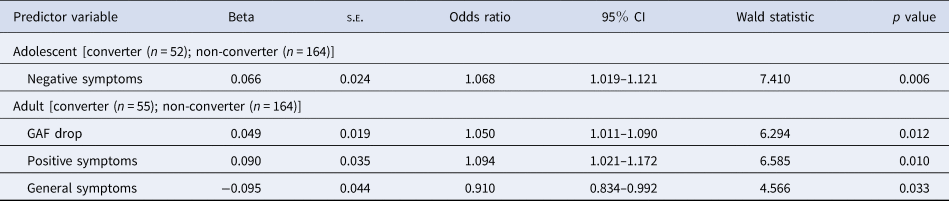
Cox regression was applied to evaluate the effect of demographic and clinical variables on conversion risk in adolescents and adults, including sex, education, SIPS items (total score of positive, negative, disorganization, and general symptoms), DUPrS, SPD, family history, GAF baseline, and drop. Consistently, only negative symptoms were found to significantly predict conversion to psychosis in CHR adolescents. GAF drop, positive, and general symptoms were all found to be significant predictors in CHR adults (Table 3).
Cox regression for predicting the conversion to psychosis in adolescent and adult

Notes: Beta is the regression coefficient. s.e. is the standard error. 95% CI is the estimated 95% confidence interval for the corresponding parameter. Odds ratio is the standardized regression coefficient. GAF drop is the GAF score baseline from highest in the past year.
Discussion
Understanding age differences in the trajectory of psychotic presentation is considered crucial for a better understanding of their risks. Although it is well known that adolescent-onset differs from adult-onset psychosis, there is relatively little evidence as to whether adolescent-CHR differs from adult-CHR in their risk prediction models. The results of current comparative analyses are in line with the original hypothesis of the present study, in that predictors of conversion to psychosis differ between adolescents and adults in the CHR state. The conversion outcome was best predicted by negative symptoms compared to other clinical variables in CHR adolescents. In contrast, positive symptoms better predicted conversion in CHR adults. The results of the present study indicate that the 3-year conversion outcome in adolescents is generally similar to that of adults. The robust differences were baseline predictors. To the best of our knowledge, this is the first study aimed at comparing predictors of psychosis in CHR adolescent and adult individuals.
The most striking finding was that predictors of psychosis vary between adolescent and adult CHR individuals. In particular, we found that the most robust predictor of conversion in adolescent CHR individuals was the severity of negative symptoms at baseline. In fact, many risk calculators developed for the overall CHR population do not include negative symptoms as a predictor (Cannon et al., Reference Cannon, Yu, Addington, Bearden, Cadenhead, Cornblatt and Kattan2016), which would obviously reduce the accuracy when applied to adolescent CHR. Largely in line with previous studies (Ballageer et al., Reference Ballageer, Malla, Manchanda, Takhar and Haricharan2005; Pencer et al., Reference Pencer, Addington and Addington2005), negative symptoms were more pronounced in patients with adolescent-onset psychosis than in those with adult-onset. It is recognized that negative symptoms are commonly present at the pre-morbid phase of psychosis and are frequently associated with poor functional outcome (Gomes, Rincon-Cortes, & Grace, Reference Gomes, Rincon-Cortes and Grace2016; Kahn et al., Reference Kahn, Sommer, Murray, Meyer-Lindenberg, Weinberger, Cannon and Insel2015). Unfortunately, in contrast to positive symptoms which can be managed by antipsychotics, these early-onset negative symptoms remain largely unaddressed medically (Kahn et al., Reference Kahn, Sommer, Murray, Meyer-Lindenberg, Weinberger, Cannon and Insel2015).
There were no significant differences between the adolescent and adult CHR groups in terms of conversion rates. Our 3-year follow-up revealed that 24.6% of the whole sample converted to psychosis, while about 24.1% of adolescents and 25.1% of adults were converters. These proportions are similar to those found in both our and others' previous CHR studies (Fusar-Poli et al., Reference Fusar-Poli, Bonoldi, Yung, Borgwardt, Kempton, Valmaggia and McGuire2012; Zhang et al., Reference Zhang, Li, Woodberry, Seidman, Zheng, Li and Wang2014, Reference Zhang, Li, Woodberry, Xu, Tang, Guo and Wang2017). Therefore, adolescent CHR individuals did not appear to be any more vulnerable to psychosis than the adult CHR group. Our findings confirm that the CHR phenotype carries a similar and predictable risk for the future onset of psychosis in both the adolescent and adult population. Given the overall differences in predictive patterns between age groups, this finding has major implications for not only the importance of psychosis prevention, but also highlights the requirement for a different approach to early identification and treatment. For example, more effective methods for reducing negative symptoms will need to be applied for adolescent CHR (Ballageer et al., Reference Ballageer, Malla, Manchanda, Takhar and Haricharan2005).
Our finding that individuals with more severe positive symptoms (in adult CHR) and decline in functioning were more likely to convert to psychosis is broadly in line with our previous findings (Li et al., Reference Li, Zhang, Xu, Tang, Cui, Wei and Wang2018; Zhang et al., Reference Zhang, Yang, Xu, Tang, Wei, Cui and Wang2019c) and those of other studies (Addington et al., Reference Addington, Cadenhead, Cannon, Cornblatt, McGlashan, Perkins and Heinssen2007, Reference Addington, Cornblatt, Cadenhead, Cannon, McGlashan, Perkins and Heinssen2011; Cannon et al., Reference Cannon, Cadenhead, Cornblatt, Woods, Addington, Walker and Heinssen2008; Lemos-Giraldez et al., Reference Lemos-Giraldez, Vallina-Fernandez, Fernandez-Iglesias, Vallejo-Seco, Fonseca-Pedrero, Paino-Pineiro and Ortega-Ferrandez2009; Velthorst et al., Reference Velthorst, Nieman, Becker, van de Fliert, Dingemans, Klaassen and Linszen2009; Yung, Phillips, Yuen, & McGorry, Reference Yung, Phillips, Yuen and McGorry2004). Specifically, these factors were identified as potential predictors of psychosis in many well known cohorts such as NAPLS (Cannon et al., Reference Cannon, Cadenhead, Cornblatt, Woods, Addington, Walker and Heinssen2008), PACE (Thompson, Nelson, & Yung, Reference Thompson, Nelson and Yung2011), and SHARP (Zhang et al., Reference Zhang, Xu, Tang, Li, Tang and Cui2019b). Considering our findings that those predictors were more suitable for adult CHR individuals, clinicians may need to be particularly vigilant when applying these risk calculators for the prediction of psychosis in CHR individuals during adolescence.
Consistently, in the adolescent-specific prediction model, only the negative symptoms contributed significantly to the prediction of conversion. However, in the adult-specific prediction model, positive symptoms, functional impairments, and general symptoms contributed significantly to the prediction of conversion. What is surprising is that the prediction factors of the two age groups are quite different and without overlap. Overall, the prediction algorithm classified converters less well in adolescents than in adults, possibly indicating that the prediction of psychosis is more complex in adolescents. As negative symptoms have been clearly associated with outcomes, physicians may need to be particularly vigilant about the higher risk of psychosis during adolescence, especially for those with significant negative symptoms. More effective and specific treatment of negative symptoms will need to be applied more rigorously to adolescents at CHR.
There are two possible explanations for negative symptoms predicting transition in the adolescent group, while positive symptoms were the main predictors in the adult group. First, psychosis, especially in the CHR stage, was highly heterogeneous. Individuals at CHR whose psychotic symptoms initiated during adolescence may be a different subtype from individuals whose symptoms initiated during adulthood. In our sample, the adolescent CHR group showed indications of more-severe psychopathology (Table 1), especially for negative symptoms. This may represent a more severe form of the CHR subtype than that seen in adults at CHR. In this severe subgroup, negative symptoms emerge during the early phase of psychosis and patients exhibit more central and persistent symptoms than positive symptoms. In line with this hypothesis, previous studies (Ballageer et al., Reference Ballageer, Malla, Manchanda, Takhar and Haricharan2005; Petruzzelli et al., Reference Petruzzelli, Margari, Bosco, Craig, Palumbi and Margari2018) have shown that patients with earlier-onset psychosis had more severe and complex clinical symptoms, suggesting a worse prognosis. Second, it could be argued that negative symptoms in adolescent individuals at CHR may have a greater effect on the progression of psychosis than in adult individuals at CHR. Age is positively correlated with the adaptive coping strategy (Jalbrzikowski et al., Reference Jalbrzikowski, Sugar, Zinberg, Bachman, Cannon and Bearden2014), which is related to the ability to deal with attenuated positive symptoms. Therefore, negative symptoms in adolescent individuals at CHR may lead to less effective coping strategies. However, this needs to be further investigated in future studies.
Strengths and limitations
Our study has several strengths and limitations. The first strength is that this naturalistic and prospective study had the largest sample size to date from an ongoing program (SHARP), which compared adolescent and adult CHR baseline clinical symptoms and their contribution to prediction of psychosis. Second, the relative long-term follow-up time of 3 years offers a more reliable estimation of CHR individuals' outcome. Third, the current SHARP sample was recruited by one team from one catchment area, which may have advantages in terms of homogeneity.
One of the limitations of our study concerns the generalizability of our results, since the sample was recruited from a single site only, although the SMHC is one of the largest mental health services in China with almost 1 million outpatient visits per year, our results may not be applicable to CHR in other countries. Second, our participants were psychotropically naïve when they entered the study, with no history of drug abuse or dependence. This may limit the generalizability of our findings to individuals at CHR with a history of drug abuse or prior psychotropic medication use. Third, our sample received naturalistic treatment such as various medications, with different compliance, and this may have confounded the results. Third, the drop in GAF at baseline was assessed based on retrospective ratings, which may have caused recall bias. Finally, our sample consisted of CHR individuals who voluntarily sought mental health services, and must be considered to represent only a fraction of the clinical population at risk of developing psychosis, thus, our results may not be applicable to the general population.
Conclusion
The present findings provide supporting evidence for the proposal to take age differences in psychosis prediction into account. This will not only help improve the accuracy of psychosis prediction but also deepen our understanding of age-related differences in psychosis trajectories, which in turn would support more tailored intervention and prevention in CHR adolescents.
Acknowledgments
This study was supported by the Ministry of Science and Technology of China, National Key R&D Program of China (2016YFC1306800), National Natural Science Foundation of China (81671329, 81671332, 81901832), Shanghai Key Laboratory of Psychotic Disorders (13dz2260500), Science and Technology Commission of Shanghai Municipality (19ZR1477800, 19|ZR1445200, 19441907800, 17411953100), Shanghai Jiao Tong University Foundation (ZH2018ZDB03, ZH2018QNB19, YG2016QN42), The Clinical Research Center at Shanghai Mental Health Center (CRC2018ZD01, CRC2018ZD04, CRC2018YB01 and CRC2019ZD02), and Shanghai Clinical Research Center for Mental Health (19MC1911100).
Conflict of interest
None.