Introduction
Stapes surgery is mainly used to treat conductive hearing loss such as that associated with otosclerosis, congenital stapes fixation and ossicular malformation. The hearing results are good and stable.Reference House, Hansen, Al Dakhail and House1 However, stapes surgery for tympanosclerosis, chronic otitis media with cholesteatoma and adhesive otitis media has been believed to be ineffective because the ossicular fixation involves not only the stapes but other ossicles as well. Furthermore, there is the possibility of post-operative complications, such as facial nerve injury, damage to the inner ear, and refixation of the stapes, leading to failed hearing. Another problem is that tympanic and mastoid pneumatisation in these inflammatory disorders is not good in many cases. It eventually results in deteriorated hearing even if hearing had been recovered shortly after surgery. Therefore, we must carefully evaluate the indications for stapes surgery in patients who have inflammatory disorders with stapes fixation.
In the present study, we investigated the post-operative hearing results and various factors influencing them in patients with tympanosclerosis. Analysis was focused on the relation of pre-operative computed tomography (CT) findings and the reconstructive materials to the post-operative rate of success. The conductive hearing loss associated with tympanosclerosis is caused by calcification and new bone formation in fibrotic tissue that is a late effect of chronic infection of the middle ear. Stapes fixation was evaluated by hand manipulation during the operation.
Materials and methods
Between 2001 and 2009, stapes surgery was performed on 13 ears in 12 patients (1 male patient and 11 female patients; ages 11–65 years, mean 43.5 ± 5.7 years) who had tympanosclerosis with a fixed stapes footplate. These patients had no retraction, no perforation and no adhesion of the tympanic membrane pre-operatively – one of the criteria for surgery. We performed a staged operation on ears with poor pneumatisation in the middle ear and mastoid. Ten ears had tympanosclerosis alone, and three had tympanosclerosis with cholesteatoma. Seven ears had previously undergone middle-ear surgery.
The success of the operation was individually estimated according to the tympanoplasty criteria proposed by The Japan Otological Society in 2010.Reference Kakigi, Takeda, Nakatani, Kozakura, Sawada and Nishioka2
The operation was deemed successful when one of the following goals was achieved: post-operative air–bone gap (ABG) ≤15 dB; hearing gain ≥15 dB; or a threshold of post-operative air conduction ≤30 dB. The criteria also require at least six months of post-operative follow up. The patients were followed up post-operatively for 6–66 months. Clinical records and audiological data were analysed retrospectively. We also examined pre-operative CT images (10 ears were available) regarding tympanic and mastoid pneumatisation, which is considered to affect the post-operative hearing results. We classified the tympanic cavity as the epitympanum, mesotympanum or hypotympanum and the mastoid as the mastoid antrum and surrounding mastoid air cells. The pneumatisation in each part was analysed to determine if there was a relation between the level of pre-operative pneumatisation and the post-operative hearing result.
Statistical analysis
The results were analysed with a paired t-test by StatView 5.0J software for Windows (SAS Institute, Inc., Cary, North Carolina, USA). A value of p < 0.05 was accepted as statistically significant.
Results
Post-operative hearing results of stapes surgery
The averaged pre-operative pure tone audiometry (PTA) (averages at frequencies of 500, 1000 and 2000 Hz) values for 13 ears are as follows: air-conduction level 68.8 ± 4.5 dB, bone-conduction level 30.1 ± 3.4 dB and ABG 38.7 ± 2.7 dB.
Twelve ears were available for follow up at six months after surgery. The average air-conduction level was 42.8 ± 3.5 dB, bone-conduction level was 22.8 ± 1.8 dB and ABG was 15.2 ± 4.1 dB (Table I). The post-operative ABG is the post-operative air-conduction level minus the pre-operative bone-conduction level. We estimated hearing results at six months after surgery according to the tympanoplasty criteria proposed by The Japan otological Society in 2010.Reference Kakigi, Takeda, Nakatani, Kozakura, Sawada and Nishioka2 An ABG of ≤15 dB was achieved in six ears (6/12), hearing gain ≥15 dB in nine ears (9/12) and air-conduction level threshold ≤ 30 dB in two ears (2/12). The success rate at six months after surgery was 75 per cent.
The results of pure tone audiometry (average at 500–1000–2000 Hz frequencies)*

AC = air-conducted level of pure tone audiometry; BC = bone-conducted level of pure tone audiometry. All data were presented as mean ± standard error of the mean
†p < 0.05 vs pre-operative air-conducted pure tone audiometry (PTA). ‡p > 0.05 vs pre-operative bone conducted PTA.
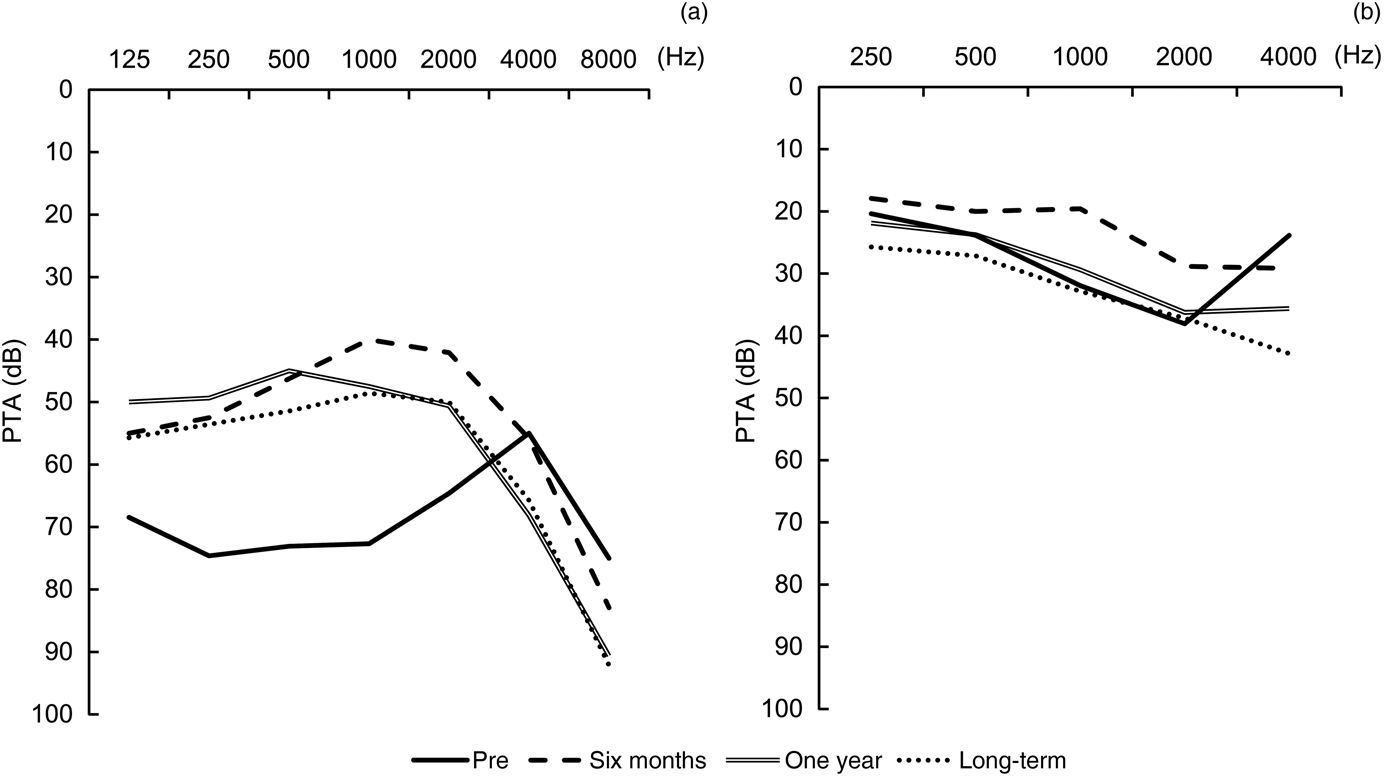
The long-term results (>1 year) are shown in Table I and Figure 1. Eight ears at one year post-operatively and seven ears in an even longer term were available for follow up. The results showed slight deteriorations in the hearing levels: 7.2 dB in air-conduction level and 9.6 dB in bone-conduction level on average. Significant sensorineural hearing loss (SNHL) was not found after surgery.
The results of averaged pure tone audiometry (PTA). Pre-operative and post-operative (six months, one year and long-term after the operation) air-conduction level (a) and bone-conduction level (b).
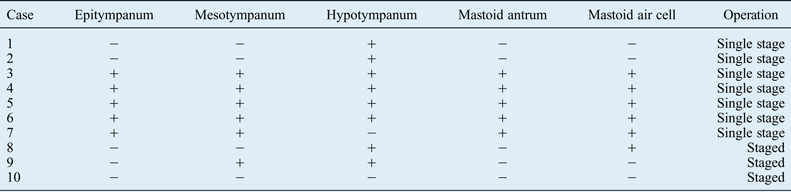
Pneumatisation in pre-operative CT*
* CT = computed tomography; + = pneumatisation positive; − = pneumatisation negative
Success rate according to reconstruction materials
The success rate at six months was 80 per cent (4/5) when using auricular cartilage, 67 per cent (2/3) when using incus, 100 per cent (2/2) when using a Teflon® piston for the stapes prosthesis and 50 per cent (1/2) when using a ceramic total ossicular replacement prosthesis.
Surgery-specific success rates
One of our criteria for the stapes surgery was that there was no retraction, perforation or adhesion in the tympanic membrane. If the conditions did not meet this criterion, then we performed the staged operation. Four ears underwent the staged operation (all were stapedectomies), nine ears underwent a single-stage operation (stapedectomy was performed in eight ears and stapedotomy in one ear). The success rates for these operations at six months were 75 per cent (3/4) and 75 per cent (6/8), respectively.
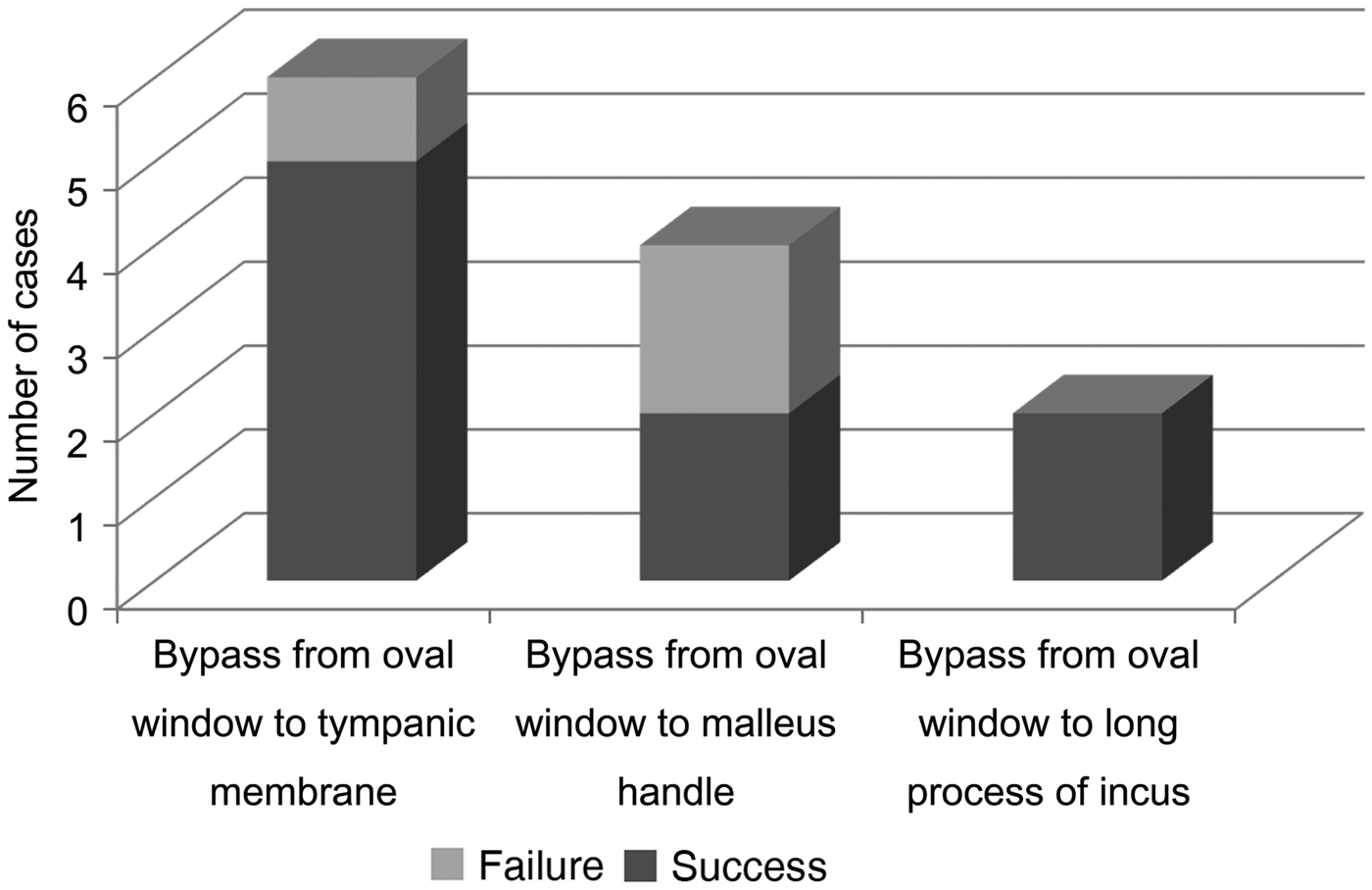
Technically, three bypass methods were used: bypass from the oval window to the tympanic membrane, to the malleus handle, and to the long process of the incus. The success rates for these three methods at six months were 83 per cent (5/6), 50 per cent (2/4) and 100 per cent (2/2), respectively (Figure 2).
Success rate in three types of surgical methods at six months after the operation.
Pre-operative findings of CT images and hearing results
We were able to obtain pre-operative CT images of ten ears to evaluate pneumatisation in the mesotympanum, hypotympanum, epitympanum, mastoid antrum and mastoid air cells (Table II). The patients with poor pneumatisation (according to pre-operative CT images) had successful results only when staged surgery was performed. In contrast, ears with good aeration (according to pre-operative CT images) had good hearing results even with the single-stage operation. The poorly aerated ears that underwent staged surgery showed significant improvement in the ABG.
Improvement in ABG in the long term
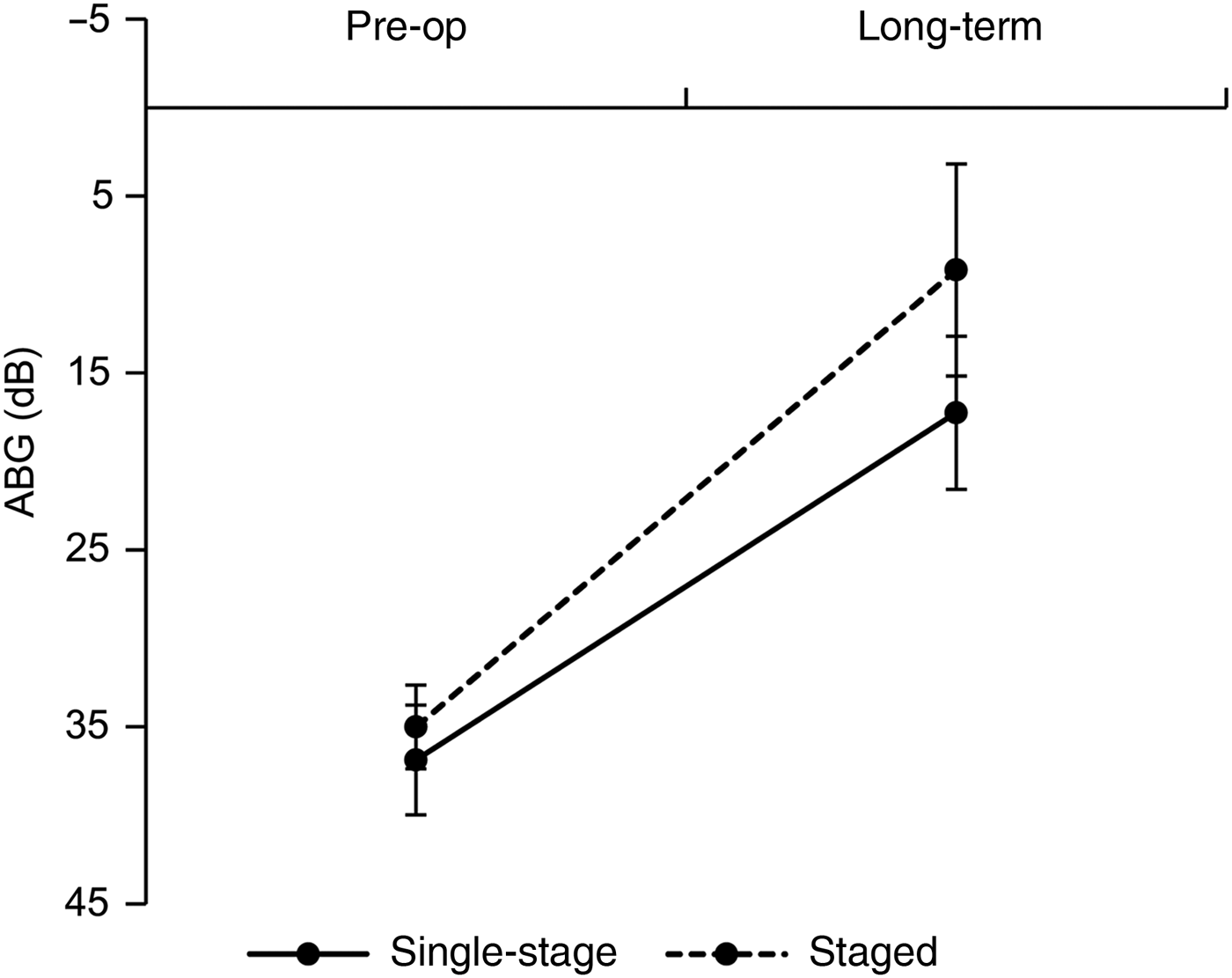
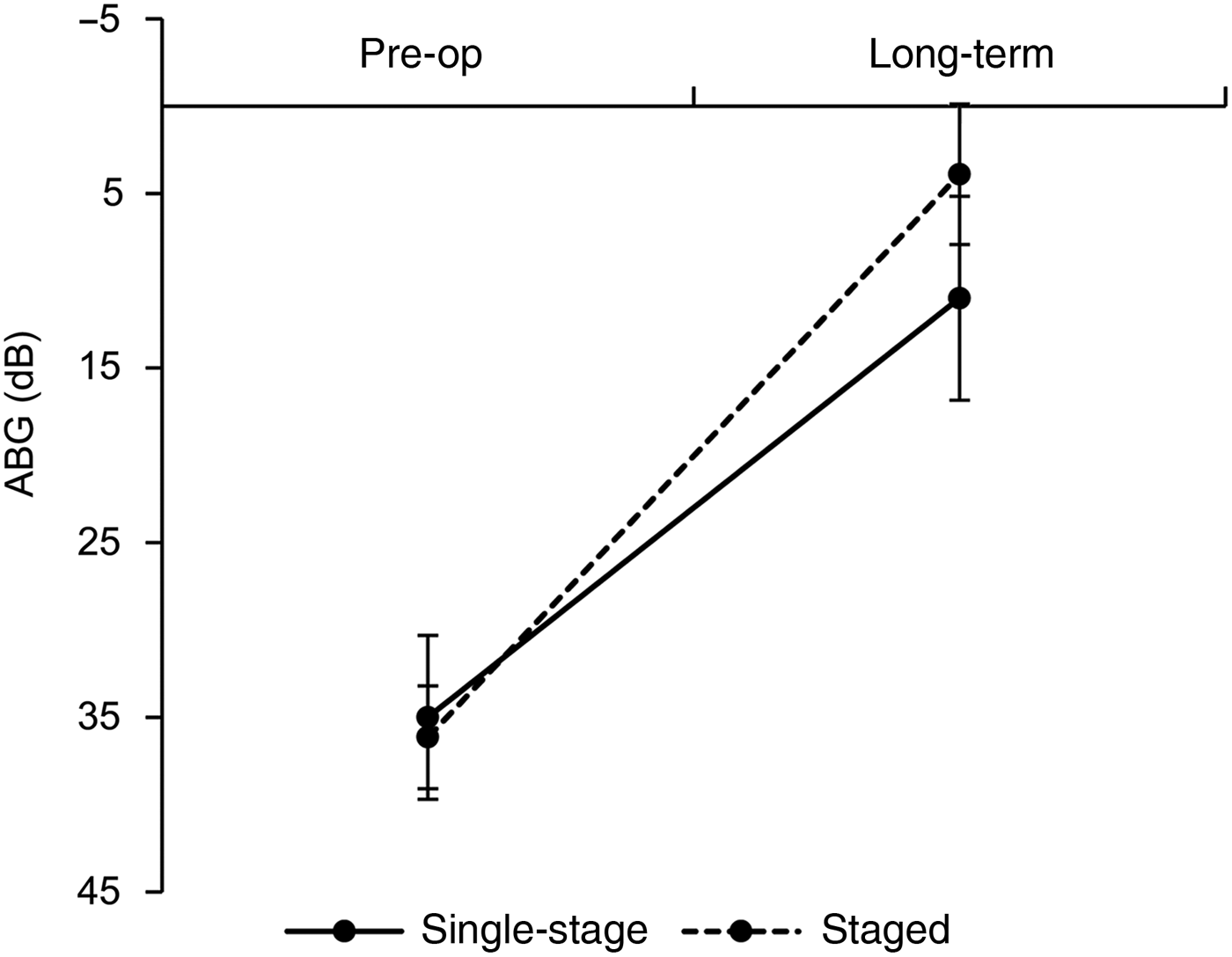
We compared the average ABG for ears that underwent single-stage surgery (n = 9) with those with staged surgery (n = 4). The pre-operative ABGs were 36.9 and 35.0 dB for the single-staged and staged operations, respectively (Figure 3). The corresponding post-operative ABGs were 17.2 and 9.2 dB, respectively (Figure 3). Especially in the ears that underwent staged surgery, there was significant improvement in the ABG (Figure 3). The pre-operative ABGs in well-aerated ears that underwent the single-staged operation and poorly pneumatised ears with staged surgery were 36.1 and 35.0 dB, respectively (Figure 4). The corresponding post-operative ABGs were 11.0 and 3.9 dB, respectively (Figure 4).
The long-term hearing results of air–bone gap (ABG) in single-stage operation (n = 9) and staged operation (n = 4). The data represent the mean ± standard error of the mean.
The long-term hearing results of air–bone gap (ABG) in the well aerated ears with single-stage operation (n = 5) and the ears with poor pneumatisation with staged operation (n = 3). The data represent the mean ± standard error of the mean.
Discussion
Surgical intervention is still controversial when the stapes is fixed in inflammatory middle-ear disorders such as tympanosclerosis, chronic otitis media with cholesteatoma or adhesive otitis media. The controversy is based on the risks of facial nerve and inner-ear complications and of refixation that might lead to failed hearing improvement. There are only a few reports concerning these surgical issues, however, and the results are still controversial only among some authors.
To avoid the risks, for our decision-making process of whether to perform stapes surgery, we have included the criteria that (1) there is no retraction, perforation or adhesion in the tympanic membrane; and (2) the tympanic cavity has been aerated for >1 year. Once the patients met those criteria, we performed staged tympanoplasty on three patients with poor pneumatisation especially in the tympanic space (as evaluated by CT) or with cholesteatoma. Single-stage tympanoplasty was performed on two poorly pneumatised ears (two are cases 1 and 2 in Table II).
In case 1 (Table II), there were calcification-like shadows in the epitympanum and mesotympanum on the pre-operative CT image, but intra-operatively they were found to be well aerated and without perforation in the tympanic membrane. Case 2 (Table II) had undergone type III tympanoplasty for chronic otitis media but with no hearing improvement. Revision surgery was performed one year after the first operation. There was fixation in the stapes footplate. The middle ear was well aerated during the surgery, and stapedectomy was performed. The surgery was unsuccessful in both cases. According to the findings of the tympanic membrane and CT images after surgery, the surgery was unsuccessful in these two ears because the pistons might have been too short or not placed properly. In general, if pneumatisation is poor, a piston could be pushed into the oval window or out of alignment after surgery, leading to the possibility of complications such as hearing loss and deterioration of the inner ear. Our interest here was mainly focused on the relation of the operative success rate and the pre-operative findings of pneumatisation, especially of the tympanum.
The long-term hearing results showed significant improvement in the ABG in well-aerated ears after a single-stage operation and in the ears of poorly pneumatised ears that have undergone staged surgery (Figure 4).
Recently, it has been reported that stapedectomy is a reliable, and successful surgical method in cases where the stapes is fixed by tympanosclerosis.Reference Vincent, Oates and Sperling3 Vincent et al. Reference Vincent, Oates and Sperling3 reported that they performed stapedotomy in 68 ears with tympanosclerotic stapes fixation. Staged operations were performed on 28 per cent (19/68) of the ears. The authors made a point that no significant SNHL occurred and that stapedectomy was safe and successful. This is because stapedectomy was generally reserved for cases in which mobilisation was unsuccessful or the footplate was dislocated. They noted that when stapedectomy was applied only in ears with severe tympanosclerosis of the oval window as staged surgery, surgical treatment of the stapes in patients with tympanosclerosis was a safe procedure in experienced hands.
Albu et al. Reference Albu, Babighian and Trabalzini4 reported a series of 65 cases of stapes fixation in 115 patients with tympanosclerosis. They performed stapes mobilisation in 30 ears and stapedectomy in 35 ears. All of the stapedectomies were performed by staged surgery. The final post-operative hearing results were better after stapedectomy than after mobilisation, although the difference was not statistically significant. However, they pointed out a tendency for the ABG to deteriorate over time (9 dB mean ABG at one year to 18.23 dB after two to five years).
GormleyReference Gormley5 reported the outcomes of 67 tympanosclerotic ears (61 total stapedectomies and 6 stapedotomies). They noted that 72 per cent of the cases were followed up for ≥5 years. There were three dead ears. At one year, ABG closure was <10 dB in 30 per cent of patients and <20 dB in 58 per cent. However, he reported considerable deterioration in hearing thresholds five years post-operatively. He also noted that ABG closure was <10 dB in 13 per cent of patients and <20 dB in 50 per cent. Not all of Gormley's patients underwent staged surgery, although it was performed in appropriate cases.
Celik et al. Reference Celik, Aslan Felek, Islam, Safak, Arslan and Gocmen6 reported 25 tympanosclerotic ears that underwent stapedectomy (all performed as staged surgery). They reported that the decrease in ABG values below 10 dB was 28 per cent at six months, 36 per cent during the second year and 57 per cent during the tenth year after the second operation. The decreases in post-operative ABG values below 20 dB were 48 per cent, 64 per cent and 71.4 per cent, respectively.
Yetiser et al. Reference Yetiser, Hidir, Karatas and Karapinar7 reported 16 tympanosclerotic ears that were subjected to either stapedectomy or stapes mobilisation with a prosthesis. None was performed as a second procedure. The result was that the decrease in ABG values <10 dB was 21.4 per cent and <20 dB 42.7 per cent in the long term. They noted that their less favourable results than were reported in previous studies could be due to more extensive disease being present or not understanding how much mobilisation was achieved during the procedure. None of their patients underwent staged surgery. Perhaps staged operations would have provided a clearer situation for ossiculoplasty.
Another article of importance about staged surgery was offered by Bayazit et al.,Reference Bayazit, Ozer, Kara, Gökpinar, Kanikama and Mumbuç8 who analysed single-stage tympanoplasty for tympanosclerosis. They described 42 patients operated on by the same surgeon. They considered that ABG closure to within 20 dB was a successful hearing result. Their success rate was 33 per cent. They concluded that single-stage surgery does not result in satisfactory hearing results in most patients with tympanosclerosis. Only one-third of the patients, most of whom had a mobile stapes, had satisfactory hearing results. They also reported that mobilisation of a fixed stapes was not an effective option for hearing restoration. Staged surgery for stapedectomy and placement of a prosthesis-like piston or total prosthesis should be considered to obtain better hearing results in patients with tympanosclerosis.
• Stapes surgery with stapes fixation is effective in patients with an inflammatory ear disease when they meet criteria of operative indication; no retraction, no perforation and no adhesion of the tympanic membrane pre-operatively
• Staged surgery should be considered in cases with poorly pneumatised ears
As already noted, the efficacy of stapes surgery in patients with inflammatory diseases with stapes fixation is still controversial. Stapes surgery is mainly applied for conductive hearing loss caused by otosclerosis, congenital stapes fixation and ossicular malformation. We should not employ stapes surgery routinely in patients with stapes fixation associated with inflammatory diseases such as tympanosclerosis. For better results, we think that it is important to establish criteria for stapes surgery. They should state, at the very least, that: (1) there must be no retraction, no perforation and no adhesion in the tympanic membranes; and (2) the tympanum must have been aerated >1 year. Other criteria can be added. We also believe it is important to obtain pre-operative CT images and intra-operative findings to examine the extent of pneumatisation in the tympanum.
Conclusions
The long-term hearing results we obtained were good, and there were no severe complications. Thus, if the pneumatisation conditions in the tympanum meet our set requirements for that parameter and if we perform staged (rather than single stage) surgery on poorly pneumatised ears, stapes surgery is a highly effective tool to obtain better hearing results in patients with an inflammatory middle-ear disease with stapes fixation, such as tympanosclerosis.
Acknowledgement
The authors declare no conflict of interest.