Introduction
In many countries cannabis is the most widely used illicit drug (Copeland & Swift, Reference Copeland and Swift2009). In the USA, cross-sectional studies suggest that adolescence and early adulthood are particularly critical developmental periods for the initiation of cannabis use and the development of cannabis use disorders (CUDs; defined as a diagnosis of cannabis abuse or dependence disorders). Findings from the 2012 Monitoring the Future Survey (Johnston et al. Reference Johnston, O'Malley, Bachman and Schulenberg2013), for example, indicated that 15% and 45% of 8th- and 12th-grade youth in the USA, respectively, have used cannabis. The National Survey on Drug Use and Health (Substance Abuse and Mental Health Services Administration, 2012) documented that in 2011, 2.6 million US residents aged 12 years or older initiated cannabis use, with most initiates (57.7%) younger than the age of 18 years. There were an estimated 18.1 million past-year cannabis users aged 12 years or older during 2011, or about 7% of the general US population. In this same year, 1.6% of the US population (4.2 million persons) was estimated to have met criteria for cannabis abuse or dependence. Despite indications that rates of frequent cannabis users among US adolescents are among the highest worldwide (ter Bogt et al. Reference ter Bogt, Schmid, Gabhainn, Fotiou and Vollebergh2006), relatively little is known about the natural development and course of CUDs in the USA.
Limited international and domestic longitudinal research with community samples indicates that cannabis initiation, experimentation, frequent use and CUD emergence are most likely between the ages of 15 and 24 years (Cohen et al. Reference Cohen, Cohen, Kasen, Velez, Hartmark, Johnson, Rojas, Brook and Streuning1993; Chen & Kandel, Reference Chen and Kandel1995; Brook et al. Reference Brook, Kessler and Cohen1999; Poulton et al. Reference Poulton, Moffitt, Harrington, Milne and Caspi2001; Boden et al. Reference Boden, Fergusson and Horwood2006; Perkonigg et al. Reference Perkonigg, Goodwin, Fiedler, Behrendt, Beesdo, Lieb and Wittchen2008; Roxburgh et al. Reference Roxburgh, Hall, Degenhardt, McLaren, Black, Copeland and Mattick2010). Most individuals who try cannabis, however, either cease use altogether within a short period following initiation or remain occasional users (Flory et al. Reference Flory, Lynam, Milich, Leukefeld and Clayton2004; Windle & Wiesner, Reference Windle and Wiesner2004; Lynskey et al. Reference Lynskey, Grant, Nelson, Bucholz, Madden, Statham, Martin and Heath2006; Perkonigg et al. Reference Perkonigg, Goodwin, Fiedler, Behrendt, Beesdo, Lieb and Wittchen2008; Brook et al. Reference Brook, Zhang and Brook2011b ). Others, however, increase their usage with age or maintain frequent or heavy use (Newcomb et al. Reference Newcomb, Galaif and Locke2001; Perkonigg et al. Reference Perkonigg, Goodwin, Fiedler, Behrendt, Beesdo, Lieb and Wittchen2008; Calabria et al. Reference Calabria, Degenhardt, Briegleb, Vos, Hall, Lynskey, Callaghan, Rana and McLaren2010; Brook et al. Reference Brook, Zhang and Brook2011b ). Estimates from community-based prospective samples from Australasia and Europe suggest that 13% to 21% of adolescents are at risk for developing a CUD by early adulthood (Boden et al. Reference Boden, Fergusson and Horwood2006; Perkonigg et al. Reference Perkonigg, Goodwin, Fiedler, Behrendt, Beesdo, Lieb and Wittchen2008; Moffitt et al. Reference Moffitt, Caspi, Kokaua, Milne, Polanczyk and Poulton2010), although actual percentages are probably higher given the reluctance of some individuals to answer questions about illicit drug use (Perkonigg et al. Reference Perkonigg, Goodwin, Fiedler, Behrendt, Beesdo, Lieb and Wittchen2008). Findings reported from different geographical regions are mixed as to whether CUD prevalence rates decline or remain stable between late adolescence and the mid-20s (Poulton et al. Reference Poulton, Moffitt, Harrington, Milne and Caspi2001; Newcomb et al. Reference Newcomb, Galaif and Locke2001; Perkonigg et al. Reference Perkonigg, Goodwin, Fiedler, Behrendt, Beesdo, Lieb and Wittchen2008; Calabria et al. Reference Calabria, Degenhardt, Briegleb, Vos, Hall, Lynskey, Callaghan, Rana and McLaren2010).
Despite the importance of CUDs as a public health concern, important gaps in knowledge remain concerning the development and course of CUDs in the general population. To address these gaps, the present research provides descriptive data on the natural course of CUDs based on data collected as part of the Oregon Adolescent Depression Project (OADP; Lewinsohn et al. Reference Lewinsohn, Hops, Roberts, Seeley and Andrews1993), a longitudinal study of a community-based cohort. Specifically, we report the first incidence and prevalence (point, period and lifetime) of CUDs from childhood to age 30.0 years, which encompasses the developmental periods within which cannabis initiation, problematic use and cessation of problematic use are most common (Chen & Kandel, Reference Chen and Kandel1995). We also report data on time to recovery from the index CUD episode and time to CUD recurrence. Outcomes from these analyses are expected to highlight developmental periods within which the risk for CUD onset and recurrence are especially high, as well as threshold points by which initial recovery is likely to be sustained. Because gender differences in cannabis use, abuse and dependence often emerge during late adolescence and early adulthood, with males tending to use more frequently than females (Brook et al. Reference Brook, Kessler and Cohen1999; Kandel & Chen, Reference Kandel and Chen2000; Poulton et al. Reference Poulton, Moffitt, Harrington, Milne and Caspi2001; Coffey et al. Reference Coffey, Carlin, Lynskey, Li and Patton2003; Perkonigg et al. Reference Perkonigg, Goodwin, Fiedler, Behrendt, Beesdo, Lieb and Wittchen2008; Griffith-Lendering et al. Reference Griffith-Lendering, Wigman, Prince van Leeuwen, Huijbregts, Huizink, Ormel, Verhulst, van Os, Swaab and Vollebergh2012), we also evaluate possible gender differences in onset, recovery and recurrence functions.
Method
Participants
Current and past Diagnostic and Statistical Manual of Mental Disorders (DSM)-defined cannabis abuse or dependence and other psychiatric diagnostic categories were assessed with OADP probands on four occasions between the ages of 16 and 30 years (T1 to T4). The T1 sample (initiated between 1987 and 1989; n = 1709; mean age = 16.6 years, s.d. = 1.2 years) was randomly drawn from nine high schools in two urban and three rural communities in western Oregon, and subsequently found to be representative of the regional population from which it was drawn (Lewinsohn et al. Reference Lewinsohn, Hops, Roberts, Seeley and Andrews1993). At 1 year following T1, T2 was initiated, and 1507 (88%) probands were reassessed.
At T3, which was initiated about 7 years after T2, a stratified sampling procedure was implemented whereby eligible participants included all persons with a positive history of a substance abuse or psychiatric diagnosis by T2 (n = 644) and a randomly selected subset of never mentally ill (NMI) probands (457 of 863 persons). Of these 1101 eligible persons, 941 (85%) completed T3. Comparisons between the T3 NMI participants who were randomly selected for further participation with unselected NMI probands revealed no significant differences with respect to T2 data. Of the 941 T3 probands, 816 (87%) participated in T4 about 6 years after T3 (59% female, 89% white, 53% married).
In our recent analysis of proband attrition across waves (Farmer et al. Reference Farmer, Kosty, Seeley, Olino and Lewinsohn2013), we compared the T4 panel with those who dropped out from the study after T1 with respect to psychiatric history (i.e. any lifetime DSM-defined disorder diagnosis) and the cumulative number of lifetime psychiatric disorders at T1. The T4 panel was not statistically different from the attrition group with respect to positive psychiatric histories (p = 0.96) or the cumulative number of lifetime disorders (p = 0.23) at T1. Similarly, when we performed an attrition analysis based exclusively on CUDs for this report, those in the attrition group, when compared with the T4 panel, did not have significantly higher rates of CUDs at T1 [8% v. 7%, respectively; Pearson χ 2 (1, n = 1299) = 0.39, p = 0.532]. Wave-to-wave analyses, however, revealed one significant difference: discontinuation from T3 to T4 was more common among those with a history of a CUD by T3 (18% for discontinuation group v. 12% for those who participated in T4, p = 0.03). Given the sample stratification procedures implemented at T3, the relatively modest attrition over successive waves, and evidence that analyses based on T3 and T4 panels produced highly similar outcomesFootnote 1 Footnote †, results presented in the following section are based on the T4 panel (n = 816).
Assessment of CUDs
During T1, T2 and T3, participants were interviewed with a version of the Schedule for Affective Disorders and Schizophrenia for School-Age Children (K-SADS) that combined features of the Epidemiologic and Present Episode versions (Orvaschel et al. Reference Orvaschel, Puig-Antich, Chambers, Tabrizi and Johnson1982; Chambers et al. Reference Chambers, Puig-Antich, Hirsch, Paez, Ambrosini, Tabrizi and Davies1985). Follow-up psychiatric disorder assessments at T2 and T3 also involved the joint administration of the Longitudinal Interval Follow-Up Evaluation (LIFE; Keller et al. Reference Keller, Lavori, Friedman, Nielsen, Endicott and McDonald-Scott1987) that, in conjunction with the K-SADS, provided detailed information related to the presence and course of disorders since participation in the previous diagnostic interview. The T4 assessment included administration of the LIFE and the Structured Clinical Interview for Axis I DSM-IV Disorders–Non-Patient Edition (SCID-NP; First et al. Reference First, Spitzer, Gibbon and Williams1994). Symptom reports related to cannabis use were evaluated in accordance with DSM-III-R diagnostic criteria (APA, 1987) at T1 and T2 and DSM-IV diagnostic criteria (APA, 1994) at T3 and T4.
DSM-III-R and DSM-IV hierarchically arrange substance use disorders into abuse and dependence categories, whereby dependence takes precedence over abuse when criteria for both conditions are satisfied. This hierarchical taxonomic approach has been challenged by data that fail to support the cannabis abuse/dependence distinction as operationalized in DSM (Langenbucher et al. Reference Langenbucher, Labouvie, Martin, Sanjuan, Bavly, Kirisci and Chung2004; Blanco et al. Reference Blanco, Harford, Nunes, Grant and Hasin2007; Hartman et al. Reference Hartman, Gelhorn, Crowley, Sakai, Stallings, Young, Rhee, Corley, Hewitt and Hopfer2008; Beseler & Hasin, Reference Beseler and Hasin2010). This hierarchical organization has also been discontinued in DSM-5 (APA, 2013) in favor of a single ‘use disorder’ category. Consequently, for the analyses described below, we combine cannabis abuse and dependence diagnoses into a single category (CUDs) to indicate problematic cannabis use that has resulted in a symptomatic presentation coupled with significant impairment in functioning that rises to the threshold of diagnosis and, consequently, warrants clinical attention.
All interviews were recorded and randomly selected for reliability assessments by a second interviewer. Inter-rater reliability was indexed by κ. Diagnostic agreement among raters for CUD diagnoses since the previous interview was good to excellent (κ's: T1 = 0.72, T2 = 0.93, T3 = 0.83, T4 = 0.82).
CUD recovery and recurrence
Definitions of recovery and recurrence in the present research are informed by previous conceptualizations of these concepts (Frank et al. Reference Frank, Prien, Jarrett, Keller, Kupfer, Lavori, Rush and Weissman1991; Chung & Maisto, Reference Chung and Maisto2006), LIFE interview naming conventions (Keller et al. Reference Keller, Lavori, Friedman, Nielsen, Endicott and McDonald-Scott1987) and by guidelines provided in DSM-IV (APA, 1994). Given our emphasis on the natural course of disorders rather than symptoms, and the elimination of the abuse/dependence distinction with respect to CUDs in DSM-5 (APA, 2013), we applied the following definitions regardless as to whether the index episode was cannabis abuse or cannabis dependence. ‘Remission’ as used here refers to offset of an initial CUD episode lasting at least 1 full month but less than 12 months during which the individual no longer meets diagnostic criteria for the index CUD episode but may continue to use cannabis at subthreshold levels. The re-emergence of an index CUD episode during the remission period is regarded as a continuation of the index episode (i.e. a ‘relapse’). The resolution of the index episode, defined as a period of uninterrupted remission lasting at least 12 months, is regarded as a ‘recovery’ from the index episode. Recovery is only achieved after a 12-month period following the sustained offset of the index CUD episode, during which there is no relapse of the index episode. A ‘recurrence’ is regarded as a new CUD episode after a period of recovery.
Statistical analyses
Because of the unequal stratified sampling strategy implemented at T3, weighting procedures were used to estimate prevalence rates, incidence rates and odds ratios (ORs). Time-to-event analyses were implemented using SUDAAN statistical software (RTI International, USA), and standard errors were estimated using the Taylor series linearization method to appropriately account for the unequal stratified sampling procedure implemented at T3. In the analyses that follow, rate, ratio and proportion values are based on weighted data.
Potential gender moderation of the time-to-event functions was tested using Cox proportional hazards (PH) models. An assumption of Cox PH models is the absence of a significant time × predictor interaction. Consistent with recommendations (Singer & Willett, Reference Singer and Willett1991), we initially included a time × gender interaction term in the model. Subsequent findings indicated that in no instance was the interaction term statistically significant. Given that this assumption of the PH model was met, the interaction term was removed and the models rerun, with data from these analyses reported. Hazard ratio (HR) estimates, which index differences in onset curves as a function of gender, were calculated along with 95% confidence intervals (CIs). Cumulative hazard functions were used to describe CUD onset, recovery and recurrence functions in the presence of censorship (i.e. participants who did not experience a CUD onset, recovery or recurrence during the observation period). Time-to-event was measured in months. In instances where the cumulative hazard functions exceeded 0.5, the median survival time was reported to facilitate data interpretation. The demarcation of age ranges in the reporting of first incidence and period prevalence rates was based on a developmental framework outlined by Arnett (Reference Arnett2007). Within this framework, developmental periods analysed were childhood to emerging adolescence (childhood to age 13.9 years), adolescence (14.0–17.9 years), adolescence transitioning to emerging adulthood (18.0–24.9 years) and emerging adulthood transitioning into young adulthood (25.0–30.0 years).
Results
Prevalence rates, incidence rates and age of onset for index CUD episodes
Prevalence and incidence rates
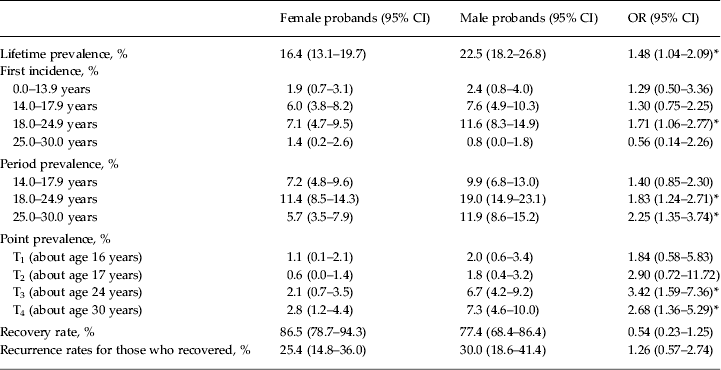
The weighted lifetime prevalence of CUD from childhood to age 30.0 years in the OADP sample was 19.1%. Men (22.5% of T4 male proband sample) were more likely than women (16.4% of T4 female proband sample) to be diagnosed with a lifetime CUD [likelihood ratio (LR) χ 2 (1, n = 816) = 4.74, p = 0.030, OR 1.48, 95% CI 1.04–2.09].
Weighted first incidence and period prevalence rates, presented in Table 1, highlight age ranges during which CUD risk is greatest. Findings presented in this table highlight the significance of ages 14.0 to 24.9 years as a period of exceptional risk for initial CUD onset. This risk, however, is substantially diminished after the age of 25 years. Ages 18.0 to 24.9 years additionally correspond to a period where the prevalence of CUDs reaches its peak.
Natural course of cannabis use disorders from childhood to age 30 years: gender comparisons a

CI, Confidence interval; OR, odds ratio.
a All summary statistics account for sample weighting.
* Statistically significant (p < 0.05).
Table 1 also includes ORs to illustrate how first incidence and prevalence rates for CUDs differ by gender. First incidence rates significantly differed by gender within the 18.0 to 24.9 years period only [11.6% of males compared with 7.1% of females; LR χ 2 (1, n = 816) = 4.84, p = 0.024, OR 1.71, 95% CI 1.06–2.77]. Period prevalence rates also significantly differed by gender within the 18.0 to 24.9 years developmental period [19.0% of males compared with 11.4% of females; LR χ 2 (1, n = 816) = 9.34, p = 0.002, OR 1.83, 95% CI 1.24–2.71], and within the 25.0 to 30.0 years period as well [11.9% of males compared with 5.7% of females; LR χ 2 (1, n = 816) = 10.14, p = 0.001, OR 2.25, 95% CI 1.35–3.74]. Similarly, point prevalence rates significantly differed by gender at T3 [6.7% of males compared with 2.1% of females; LR χ 2 (1, n = 816) = 11.09, p < 0.001, OR 3.42, 95% CI 1.59–7.36] and T4 [7.3% of males compared with 2.8% of females; LR χ 2 (1, n = 816) = 8.66, p = 0.003, OR 2.68, 95% CI 1.36–5.29].
Time to CUD onset
For those with a lifetime CUD diagnosis, the average age of onset for the first episode was 18.6 years (s.d. = 4.2 years), which did not differ by gender (observed mean values: males = 18.6, s.d. = 4.1 years; females = 18.7, s.d. = 4.3 years; t 153 = 0.13, p = 0.901). Cumulative hazard functions for CUD onset for the combined sample and separately by gender are presented in Fig. 1. The cumulative hazard functions significantly differed by gender (HR 1.42, 95% CI = 1.03–1.95, p = 0.033).
Cumulative hazard functions for cannabis use disorder (CUD) onset by age in years.

Recovery following the index CUD episode
Rates of recovery
Among the persons with a lifetime CUD, 81.8% experienced recovery from the index CUD episode by the age of 30 years. Rates of recovery did not differ by gender [77.4% of males and 86.5% of females recovered; LR χ 2 (1, n = 155) = 2.17, p = 0.141, OR 0.54, 95% CI 0.23–1.25].
Time to recovery
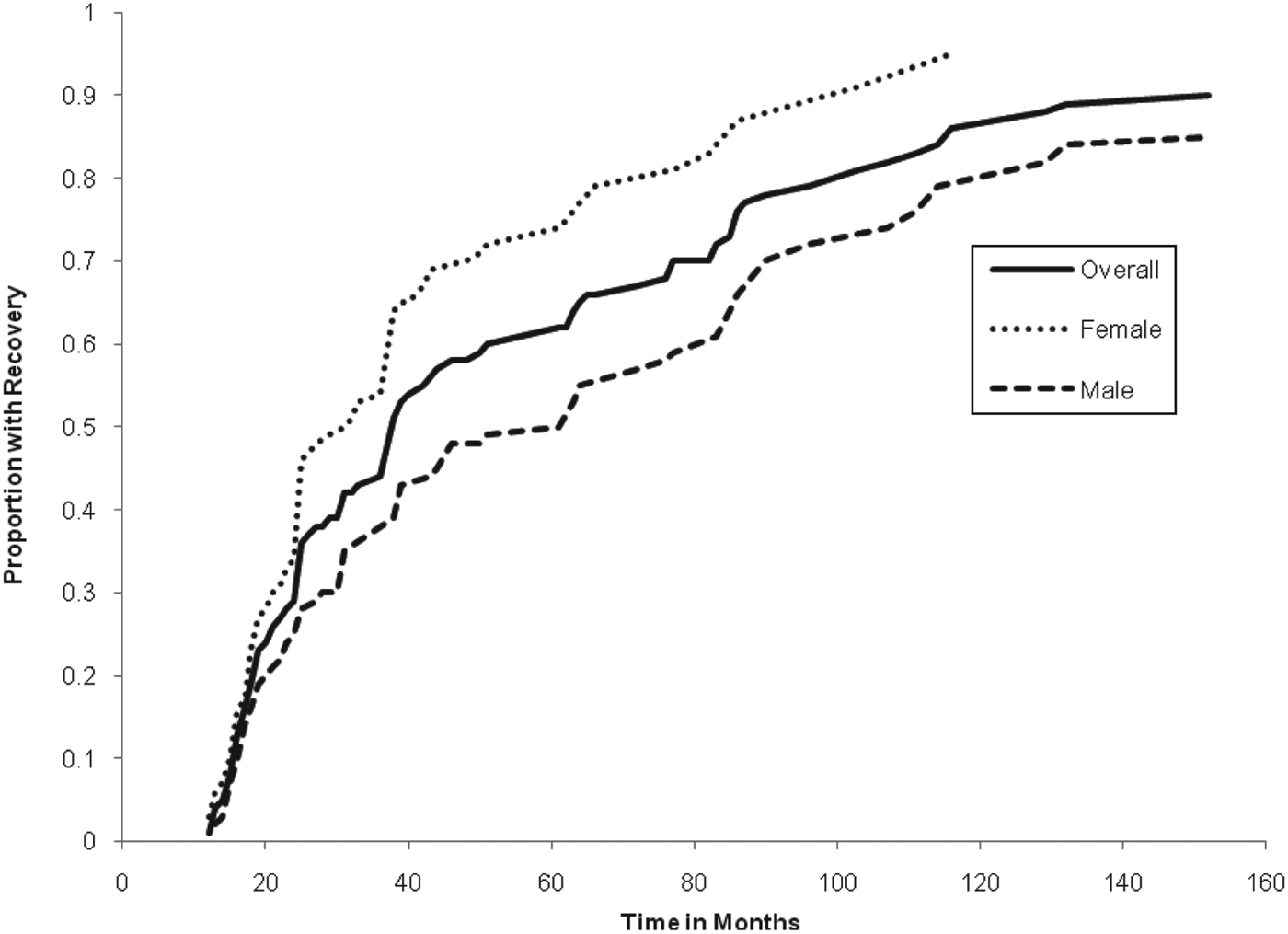
Among those who recovered from the index CUD episode, the mean duration of the index CUD episode was 32.5 months (s.d. = 35.6 months), which significantly differed with respect to gender (males = 41.2, s.d. = 42.7 months; females = 24.2, s.d. = 24.8 months; t 125 = −2.77, p = 0.006). Time to recovery is based on the full duration of the index CUD episode plus a 12-month period of sustained remission following episode offset, during which CUD symptomatology does not again rise to the level of diagnosis. If, for example, an individual met CUD criteria for 14 consecutive months and did not again meet criteria for a CUD in the 12 months following the offset of the index episode, the time to recovery would be 26 months. Participants that did not experience 12 months of sustained remission for their index CUD episode prior to the T4 diagnostic interview were right censored from the survival analysis. Cumulative hazard functions for recovery from a CUD episode for the complete subsample with a lifetime diagnosis and separately by gender are presented in Fig. 2. Hazard rates were estimated for recovery in 1-month intervals commencing with the onset of the first CUD episode. The cumulative hazard functions that assessed time to recovery from the initial CUD episode significantly differed by gender (HR 0.57, 95% CI 0.39–0.82, p = 0.003). The median recovery time (i.e. survival time) was 61 months for males and 31 months for females.
Cumulative hazard functions for cannabis use disorder recovery by time since disorder onset.

Recurrence following the first CUD episode
Recurrence rates following a period of recovery
Of the participants who recovered from their index CUD episode, 27.7% developed another CUD episode before the age of 30 years. Recurrence rates were not significantly different between male and female probands [30.0% of males, 25.4% of females; LR χ 2 (1, n = 127) = 0.33, p = 0.564, OR 1.26, 95% CI 0.57–2.74].
Time to recurrence
Among those with a second CUD, the mean time to recurrence was 46.1 months (s.d. = 35.6 months), which did not significantly differ with respect to gender (males = 51.9, s.d. = 39.0 months; females = 40.1, s.d. = 31.6 months; t 35 = −1.00, p = 0.326). Cumulative hazard functions for recurrence for the complete subsample with CUD recovery and separately by gender are presented in Fig. 3. Hazard rates were estimated for recurrence in 1-month intervals, with recurrence defined as a second CUD episode occurring after a period of at least 12 months of remission from the index CUD episode. The cumulative hazard functions that assessed time to recurrence did not differ by gender (HR 1.21, 95% CI 0.66–2.22, p = 0.539). Data presented in Fig. 3 indicate that the highest rates of recurrence occurred within 24 months after recovery. CUD recurrence for females is rare after the 60th consecutive month since offset of the initial episode. For males, however, there is no clear recovery threshold evident within the interval surveyed. Overall, there is little support from Fig. 3 that a disorder-free period of 12 months is an optimal threshold for denoting recovery from CUDs.
Cumulative hazard functions for cannabis use disorder recurrence by time since initial disorder offset.

Discussion
Although prevalence of cannabis initiation and frequency of use have been well documented in adolescent and young adult samples (e.g. Johnston et al. Reference Johnston, O'Malley, Bachman and Schulenberg2013), comparatively little is known about the course of prolonged cannabis use that rises to the threshold of a CUD diagnosis. Previous research indicates that the progression from cannabis experimentation or use to CUD is comparatively rare (Chen et al. Reference Chen, O'Brien and Anthony2005; Wittchen et al. Reference Wittchen, Fröhlich, Behrendt, Günther, Lieb, Perkonigg, Rehm and Zimmermann2007). In the current study, the weighted lifetime prevalence of a CUD from childhood to the age of 30 years was 19.1%. Consistent with findings from other prospective community samples (Coffey et al. Reference Coffey, Carlin, Lynskey, Li and Patton2003; Perkonigg et al. Reference Perkonigg, Goodwin, Fiedler, Behrendt, Beesdo, Lieb and Wittchen2008), men were 1.5 times more likely than women to be diagnosed with a lifetime CUD. Findings further indicate that initial CUD incidence and period prevalence rates peaked between the ages of 18 and 25 years for both men and women, and declined sharply thereafter. Point prevalence rates, however, were highest at T4 (about age 30 years), and mostly influenced by individuals who exhibited a more chronic course.
Although cannabis use appears to be quite stable during the adolescent, emerging adulthood and young adulthood developmental periods (Perkonigg et al. Reference Perkonigg, Goodwin, Fiedler, Behrendt, Beesdo, Lieb and Wittchen2008), data presented here indicate that there are moderate rates of both cessation and persistence of CUDs across these same periods. Whereas 54% of those with an index CUD episode fully recovered without a subsequent recurrence by the age of 30 years, the remaining 46% never recovered, remitted less than 12 months prior to the end of the study, or recovered only to experience a subsequent recurrence. When lifetime CUD rates for female and male probands (16.4% and 22.5%, respectively) are compared with CUD point prevalence rates at T4 (about age 30 years; 2.8% and 7.3%, respectively), however, it is apparent that a majority of individuals, especially women, who develop CUDs during the developmental periods studied recovered by the age of 30 years. Rather than a chronic and relapsing condition, CUDs for many appear to be developmentally limited (see also Flory et al. Reference Flory, Lynam, Milich, Leukefeld and Clayton2004; Windle & Wiesner, Reference Windle and Wiesner2004; Lynskey et al. Reference Lynskey, Grant, Nelson, Bucholz, Madden, Statham, Martin and Heath2006).
Although total recovery rates did not significantly differ between men and women, time to CUD recovery was significantly more rapid for women than men. In DSM-5 (APA, 2013), the ‘recovery’ course specifier is not used. Instead, the interval following CUD offset is specified as ‘early remission’ or ‘sustained remission’, with the main distinction being the time-frame within which CUD-defining criteria are absent after disorder offset (>3 months but <12 months v. ⩾12 months, respectively). Sustained remission in DSM-5 is analogous with the concept of recovery used in the present research, with the main difference being the emphasis placed on the absence of all CUD-defining criteria except craving (DSM-5) v. the absence of a symptom presentation that rises to the threshold of diagnosis (present study). Remission and recovery functions in the current research did not reveal abrupt discontinuities or sudden shifts in hazard functions over time; therefore, at the CUD disorder-level of specification, a continuum of behavior change processes rather than distinct recovery stages also appears to be evident. Future refinements in the terminology used to describe the course of CUDs should jointly consider not only disorder thresholds and time since disorder offset, but also the degree of subthreshold symptomatology evident during the remission and recovery periods, the frequency or quantity of cannabis use, and the associated level of functional impairment (cf. Rush et al. Reference Rush, Kraemer, Sackeim, Fava, Trivedi, Frank, Ninan, Thase, Gelenberg, Kupfer, Regier, Rosenbaum, Ray and Schatzberg2006).
Rates of recurrence did not significantly differ by gender, and were relatively uncommon following the offset of the index CUD episode, occurring in slightly more than one-quarter of participants with CUD who recovered. Recurrences, when observed, were most likely to occur within 36 months following offset of the first CUD episode, and were relatively rare after 60 months. Based on their comprehensive review of the natural recovery literature, Sobell et al. (Reference Sobell, Ellingstad and Sobell2000) recommended a period of at least 5 years as the minimal threshold for a recovery designation given accumulated findings which indicate that recovery processes usually stabilize by this time and that subsequent recurrence is uncommon. Findings from the present research are consistent with this recommendation.
Although the incidence and point prevalence of CUDs peak during the emerging adulthood period, developmental pathways for CUDs and other forms of substance abuse probably emerge long before problematic cannabis use begins (Clark, Reference Clark2004; Zucker et al. Reference Zucker, Donovan, Masten, Mattson and Moss2008). Furthermore, significantly lower lifetime prevalence rates of CUDs for women compared with men, coupled with significantly quicker times to recovery among women, suggest possible gender-related risk mechanisms associated with CUD onset and offset. Cannabis use and CUDs are heritable (Agrawal & Lynskey, Reference Agrawal and Lynskey2006), and associated with latent liabilities for externalizing disorders (which include attention-deficit hyperactivity disorder, oppositional defiant disorder, conduct disorder, adult antisocial behavior and other substance use disorders; see Krueger & Markon, Reference Krueger and Markon2006; Farmer et al. Reference Farmer, Seeley, Kosty and Lewinsohn2009). Externalizing disorders and associated liabilities are also more commonly observed among males (e.g. Kessler et al. Reference Kessler, Berglund, Demler, Jin, Merikangas and Walters2005; Hicks et al. Reference Hicks, Blonigen, Kramer, Krueger, Patrick, Iacono and McGue2007) and are heritable (Young et al. Reference Young, Stallings, Corley, Krauter and Hewitt2000; Hicks et al. Reference Hicks, Krueger, Iacono, McGue and Patrick2004). The extent to which transmitted risk factors are specific to CUDs v. broad temperamental factors inclusive of CUDs, or the extent to which these mechanisms are gender-related, requires additional study.
There are a few noteworthy study limitations that must be considered in conjunction with findings from this research. First, the ethnic diversity of the OADP sample, although representative of the ethnic distribution of western Oregon, is limited. A majority of the sample (89%) was Caucasian. Some studies (e.g. Brook et al. Reference Brook, Lee, Finch, Koppel and Brook2011a ) suggest that rates of CUDs might vary considerably as a joint function of race and gender. Second, this research was conducted with a community sample of western Oregon youth. Cannabis is probably more readily available in the Pacific Northwest region compared with other US regions, and cannabis availability has been associated with an increased risk for cannabis initiation and abuse (Gillespie et al. Reference Gillespie, Neale and Kendler2009). The lifetime prevalence rates of CUDs reported here, however, are generally consistent with findings reported in international prospective samples (Boden et al. Reference Boden, Fergusson and Horwood2006; Perkonigg et al. Reference Perkonigg, Goodwin, Fiedler, Behrendt, Beesdo, Lieb and Wittchen2008; Moffitt et al. Reference Moffitt, Caspi, Kokaua, Milne, Polanczyk and Poulton2010). Third, there was sample attrition across assessment waves, and it is possible that this attrition may have biased some findings. Analyses to determine whether distributions of CUDs at T1 differed between the attrition group and the reference sample revealed no evidence of selective bias based on adolescent CUD history. Wave-to-wave attrition analyses, however, indicated a significantly higher rate of attrition between T3 and T4 for those with a CUD history by T3. Parallel analyses to those reported here were conducted with the T3 panel, and few differences were noted in the findings observed (see Note 1). Fourth, data collection and diagnostic coding procedures adopted for this study precluded us from estimating CUD course transition rates (i.e. recovery and recurrence rates) for time intervals less than those specified (e.g. rate comparisons when recovery was defined as an uninterrupted remission lasting at least 6 months v. 12 months). Cumulative hazard functions (Figs. 2 and 3), however, provide information about the implications for rate data when recovery and recurrence transition points are extended beyond this study's definitional parameters.
To illuminate possible mechanisms that underlie CUD onset, maintenance, recovery and recurrence processes, future research might examine the predictive value of proximal and distal factors associated with each of these events. Additionally, as suggested by limited longitudinal research (Kandel & Chen, Reference Kandel and Chen2000; Flory et al. Reference Flory, Lynam, Milich, Leukefeld and Clayton2004; Windle & Wiesner, Reference Windle and Wiesner2004, Wittchen et al. Reference Wittchen, Behrendt, Höfler, Perkonigg, Rehm, Lieb and Beesdo2009; Brook et al. Reference Brook, Zhang and Brook2011b ), individuals who currently or historically met criteria for a CUD might be quite heterogeneous along a number of important dimensions. To clarify the heterogeneity among those with CUDs, future research might attempt to identify distinct developmental trajectories based on patterns of cannabis use or abuse over time, and evaluate the extent to which the resultant trajectories overlap with those associated with other forms of substance use (e.g. alcohol use, abuse of other illicit drugs). Although each substance appears to have a unique developmental trajectory (Rohde & Andrews, Reference Rohde, Andrews and Essau2006), it might be that the distinctiveness of trajectories associated with different substances is diminished among more problematic users.
Acknowledgements
National Institutes of Health (NIH) grants no. MH40501, MH50522 and DA12951 to P.M.L. and no. DA032659 to R.F.F. and J.R.S. supported this research. The content is solely the responsibility of the authors and does not necessarily represent the official views of the NIH.
Declaration of Interest
None.