What shapes individuals' attitudes towards procedural rules? Procedural rules do not concern the outcomes of government decision making, but rather the processes by which decisions are made; they include constraints on executive power, bipartisanship, impartiality and transparency. Public attitudes towards such rules are crucial elements of democratic institutions, particularly when constraints depend not purely on formal rules, but also on informal norms (Christenson and Kriner Reference Christenson and Kriner2017; Levitsky and Ziblatt Reference Levitsky and Ziblatt2018; Schmitter and Karl Reference Schmitter and Karl1991).
This letter argues that such procedural values are fundamentally contextual – a function of which party is in power. Procedural rules have differential consequences for political parties: they create winners and losers. Fewer constraints on executive authority benefit the party that controls the executive, while greater constraints benefit those that do not. Partisanship in turn leads supporters of the party in power to prefer fewer procedural constraints, and opposition supporters to prefer more constraints. This approach further predicts that when the party in power switches, partisans will also shift their procedural values to match the new political context.
This letter offers a unique test of this approach – American attitudes towards presidential secrecy before and after the November 2016 election – using data from the Cooperative Congressional Election Survey. Respondents were asked, in both pre- and post-election waves, if they thought it should be ‘easier or harder for the president to keep documents secret from the public’. The panel nature of the study enables a stronger test than in previous work, making it possible to track the responses of the same individuals following a real-world shift in political context.
I find evidence of a partisan ‘flip’ in attitudes following the election: Republicans became less likely (and Democrats more likely) to prefer additional constraints on presidential secrecy. Assessing the role of political knowledge, I find the partisan ‘flip’ in attitudes present only among higher-knowledge respondents; all lower-knowledge respondents shifted towards preferring less presidential secrecy, across Republicans, Independents and Democrats.
To be clear, I did not expect this approach to provide such a powerful test of the role of political context. I originally planned to leverage evidence from a shift between two conditions: an expected (though uncertain) Clinton victory, and a realized Clinton victory. The unexpected (see, for example, CNN 2016) Trump victory instead yielded evidence of a much starker shift: between an expected Clinton victory and a realized Trump victory.
By demonstrating the political logic of procedural attitudes in the case of presidential secrecy, this study suggests both optimistic and pessimistic implications for scholarship on procedural norms. Optimistically, these results suggest that democratic systems can effectively generate their own ever-shifting constituencies for procedural values. More pessimistically, the finding that partisan effects are conditional on political knowledge suggests that the most powerful potential constituency for procedural constraints may be those who are normally least politically engaged. And conversely, that the least consistent support for procedural constraints comes from those who are the most politically sophisticated, and thus most used to interpreting the political world through partisan information processing.
Partisan Bias and Procedural Values
Research in American politics has long found that partisan considerations shape public attitudes (for example, Bartels Reference Bartels2002; Campbell et al. Reference Campbell1960; Zaller Reference Zaller1992). Recent work has also generally found that such partisan biases are present to a greater degree among those with higher, rather than lower, levels of political knowledge (Taber and Lodge Reference Taber and Lodge2006). Gaines et al. (Reference Gaines2007, 957) suggest that this is because they ‘more effectively used interpretations to buttress their existing partisan views’, while Jerit and Barabas (Reference Jerit and Barabas2012, 672) attribute it to both ‘the supply of information as well as psychological processes’. However, some have found the opposite. For example, Anduiza, Gallego and Munoz (Reference Anduiza, Gallego and Munoz2013, 1664) find that partisan bias in corruption evaluations in Spain ‘disappears when political awareness is high’.
This study extends this focus beyond attitudes to factual evaluations and high-profile issues clearly linked to partisan positions – to procedural rules pertaining to the powers of (and constraints on) the executive. Partisanship and ideology do not offer a clear cue on positions on secrecy that is consistent over time.
I instead argue that attitudes towards secrecy and transparency are crucially shaped by their context-dependent political consequences. Any shift that creates greater transparency or constraints on secrecy will have differential consequences across the political landscape: higher costs for individuals and groups currently in power, and greater benefits for those in opposition. Limitations on secrecy confront those in power with new risks of unwanted disclosures, adverse media attention and new constraints on policy-making discretion (Berliner Reference Berliner2014; Berliner et al. Reference BerlinerForthcoming). For these reasons, as well as for reasons of perceived policy efficacy and organizational culture, executives and their administrations generally prefer secrecy and resist attempts to reduce or constrain it (Pasquier and Villeneuve Reference Pasquier and Villeneuve2007; Roberts Reference Roberts2006).
Individuals with partisan attachments – whether psychological, social or ideological – interpret these consequences through the lens of their partisanship. Procedural rules can either benefit or threaten (Mason Reference Mason2016) the groups with which partisans identify, depending on which group is in power and is thus disproportionately affected.
However, the empirical evidence on the role of partisanship in procedural attitudes has been mixed. Reeves and Rogowski (Reference Reeves and Rogowski2015, Reference Reeves and Rogowski2016) do find partisan differences in support for presidential powers, including executive privilege. Christenson and Kriner (Reference Christenson and Kriner2017) find differences in partisan support for unilateral presidential action depending on whether the survey prompts referenced President Bush or President Obama. Others find evidence of partisan effects on procedural values in other contexts (for example, Ahlquist et al. Reference Ahlquist2018; Anduiza, Gallego and Munoz Reference Anduiza, Gallego and Munoz2013; Goren Reference Goren2005; Park and Smith Reference Park and Smith2016). Yet several other studies find no evidence of partisan effects (for example, Doherty and Wolak Reference Doherty and Wolak2012; Gibson Reference Gibson2007; Reeves and Rogowski Reference Reeves and Rogowski2018), even on support for presidential powers in a survey experiment varying the hypothetical identity of the president (Reeves et al. Reference Reeves2017).
One potential explanation for these mixed findings is the difficulty associated with studying real-world changes of the party in power (and thus which group benefits or is threatened). The existing evidence overwhelmingly comes from either associations in general population surveys at a given point in time, or from the effects of researcher-manipulated vignette treatments in survey experiments. Neither of these, however, can recreate the conditions necessary to fully understand the true effect of interest: what happens to attitudes when national-level political control itself changes. Indeed, Christenson and Kriner (Reference Christenson and Kriner2017, 341) note that ‘comparing across presidents…is no easy task’. No prior studies on procedural values incorporate such real-world changes in political context, with the important exceptions of Smith and Park (Reference Smith and Park2013), who survey a panel of respondents before and after the intensification of the Senate health care debate in 2009–10, and Bartels and Kramon's (Reference Bartels and Kramon2020) study of attitudes towards judicial power in Ghana, using repeated cross-sections across presidential elections.
I build on this literature by examining changes in procedural attitudes following a major shift in political context, similar to Gerber and Huber's (Reference Gerber and Huber2010) study of economic evaluations, and thus avoid the ‘captive audience assumption’ (Druckman, Fein and Leeper Reference Druckman, Fein and Leeper2012) of studies using survey-based information treatments.
Previous research on attitudes towards secrecy and transparency has not focused on contextual factors that change depending on political configurations. Such studies have mainly focused on individual and institutional factors that remain largely constant over time. Partisanship and ideology have often emerged as important findings. For example, Piotrowski and Van Ryzin (Reference Piotrowski and Van Ryzin2007) find that several factors are associated with citizen demand for government transparency, including political ideology, although in different directions for different dimensions of transparency. Cuillier (Reference Cuillier2008) finds some evidence that political conservatism is associated with less support for press access to government records. Cuillier and Pinkleton (Reference Cuillier and Pinkleton2011, 227) focus on ‘psychographic factors’, including liberalism, in explaining support for government transparency. However, none of these studies is able to disentangle the partisanship of individual respondents from broader political configurations, meaning that findings relating ideology or partisanship to procedural values could be a function of time-bound political context.
In sum, past research offers conflicting expectations. Previous studies of attitudes towards transparency and secrecy suggest leading roles for individual characteristics and constant (rather than context-specific) ideological patterns. Some studies of procedural attitudes have identified partisan biases, yet others have found none. And while many scholars of public opinion have found that political knowledge accentuates, rather than dampens, partisan biases, few have extended this to attitudes towards procedural values, and one study of attitudes towards responsibility for corruption even found the reverse.
Data and Model
The data in this study come from the Arizona State University Team Module (Hoekstra Reference Hoekstra2019) of the 2016 Cooperative Congressional Election Survey, an online panel survey conducted by YouGov before and after the election (Ansolabehere and Schaffner Reference Ansolabehere and Schaffner2017). The pre-election surveys for this module were administered in the field from 28 September 2016 to 3 November 2016, and the post-election surveys were administered in the field from 9 November 2016 to 12 December 2016. This study's questions were asked in a module of 1,000 respondents. Of these, 789 took the post-election survey and responded to the outcome question in both rounds.
To measure support for constraints on presidential secrecy, respondents were presented with the following prompt, and a visual scale running from ‘Much harder’ to ‘Much easier’: ‘Do you think it should be easier or harder for the President to keep documents secret from the public? Please choose a point along the scale.’
The direction of this scale has been flipped in this analysis, for ease of interpretation, such that a value of 0 represents ‘much easier’ and 100 ‘much harder’. Higher values on this scale reflect a greater demand for constraints on secrecy and thus greater transparency. Respondents answered this question twice, once in the pre-election wave and once in the post-election wave.
Four points are worthy of note. First, the question uses simple language to explicitly assess views toward constraints on presidential power – whether secrecy should be more or less constrained. Secondly, the wording of this question sidesteps potential knowledge differences of the precise status quo policy on presidential secrecy, instead capturing only preferred changes. This approach is similar to studies of thermostatic public opinion that capture responses ‘anchored to the actual (or perceived) level of current spending, the policy status quo’ (Wlezien Reference Wlezien1995, 984).
Thirdly, the timing of the post-election wave is also important, in terms of what had not yet taken place. Trump had not yet taken office and so was not yet president. There were not yet any top-down political party cues regarding constraints on secrecy that might offer heuristics on how to respond. Finally, elite opinion among Republicans had not yet consolidated around support for the soon-to-be president; many Republican public figures were still expressing high-profile concerns. All of these factors would produce a priori expectations against a strong partisan shift in attitudes towards constraints on presidential secrecy.
While the average response shifted only slightly (see Appendix) from the first to the second wave, this masks substantial heterogeneity as different individuals shifted in different directions. The within-individual correlation between pre-election and post-election responses is only 0.29. A full 64 per cent of respondents shifted by ten or more points in either direction, and 32.6 per cent crossed the midpoint in one direction or the other – either from below 50 to above, or vice versa.
I measure the outcome variable in three ways. First, I use a dichotomous indicator of whether respondents shifted towards preferring greater constraints on secrecy. Secondly, I employ a more restrictive indicator for respondents who shifted ten or more points in that direction. Finally, I use a continuous measure of the raw within-individual changes. Given the complexity of the outcome variable, consistency across these approaches ensures that the results are not dependent on a single measure. By only modelling within-individual changes, these approaches automatically difference out any individual-specific omitted variables that might be correlated with either initial or post-election attitudes in levels. However, I include control variables in some models to ensure that the effect of partisanship on within-individual changes is not confounded by some other factor.
I measure partisanship by aggregating respondents' pre-election seven-point party identification into Republicans, Independents and Democrats, coding ‘leaners’ as partisans. Primary models omit Independents in order to directly compare Republicans to Democrats, although this choice is varied in robustness checks along with alternate measures of partisanship or vote intention. I measure political knowledge using how many of eight items respondents could correctly answer about party control of the House, Senate, state legislative houses, their governor, senators and representative. Some models include controls for gender, age, race (dummy variable for white), military family (if respondent or any family member currently or ever served), education (0 to 5 scale) and income (0 to 1 scale with separate dummy for non-response). Both logistic and linear regressions are estimated using the survey package in R, employ module survey weights and cluster standard errors by state.Footnote 1
Results
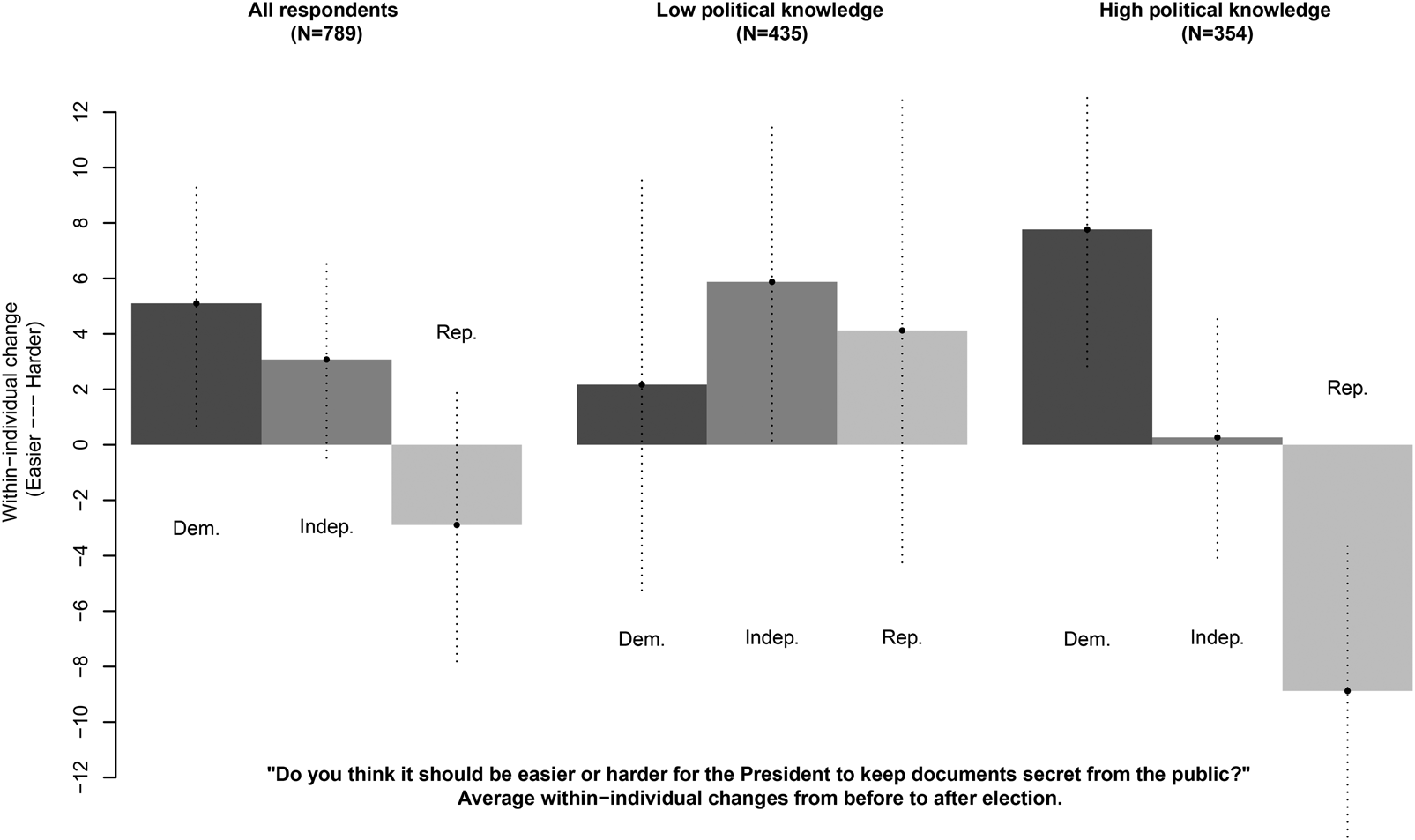
Figure 1 shows the average within-person change in support for constraints on presidential secrecy (with survey weights), separately by partisanship, giving an initial indication of large partisan effects. The first panel shows that Democrats shifted to prefer greater constraints on presidential secrecy, Republicans to prefer fewer and Independents shifted more similarly to Democrats. The second and third panels repeat this in sub-samples split at the mean political knowledge. Even this illustration of the raw responses makes the main findings starkly clear: the partisan ‘flip’ takes place only among individuals with high levels of political knowledge. I next model these shifts in order to confirm that they are statistically meaningful and not an artifact of some other factor.
Average within-person change in support for constraints on presidential secrecy, by partisanship and political knowledge
Note: Figure shows average within-person changes in support for constraints on presidential secrecy (100-point scale), moving from the pre-election survey wave to the post-election survey wave. The first panel includes all individuals, the second individuals below mean political knowledge, and the third those above. Dotted lines show 90 per cent confidence intervals.

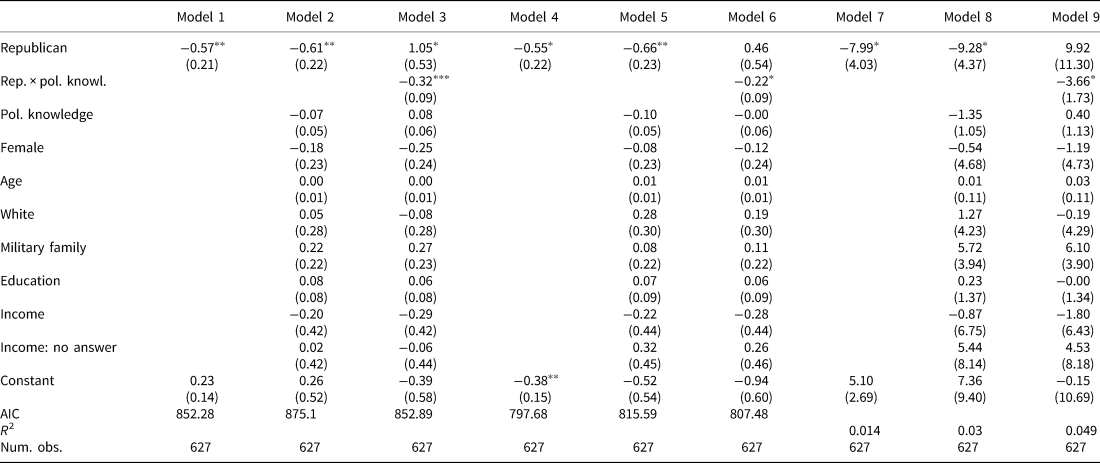
The results (reported in Table 1) confirm a large and statistically significant ‘partisan flip’ in attitudes. Republicans are less likely (and Democrats more likely) to shift attitudes in the direction of preferring greater constraints on presidential secrecy. These findings hold with or without control variables, and using either the less or more restrictive outcome indicator. Modeling the raw change in response shows that Republicans shift on average 9.28 points more than Democrats in the direction of preferring fewer constraints on secrecy after the election.
Main results

***p < 0.001, **p < 0.01, *p < 0.05
Note: Models 1–3 employ logistic regressions of an indicator for positive within-individual change (reflecting shift towards supporting greater constraints on secrecy) in response from pre-election to post-election survey wave. Models 4–6 employ logistic regressions of an indicator for only those within-individual changes of 10 points or greater. Models 7–9 employ linear models of raw within-individual changes in response. Independents omitted from all samples. Standard errors clustered by state.
The results including interaction terms between partisanship and political knowledge find significant interactive effects, with larger partisan effects among those with greater political knowledge. Appendix Figure A2 shows the marginal effects plots of these results, which demonstrate that the differences in individual changes in attitudes across Republicans and Democrats are statistically insignificant at low levels of knowledge, but significant and very substantial at high levels. Among the most politically knowledgeable, the probability of a shift in attitudes towards greater constraints on secrecy is 0.35 lower for Republicans than for Democrats, while the average within-individual shift in raw score is 19.4 further in a negative direction for Republicans than for Democrats. This finding suggests that such individuals more readily link questions such as these to their anticipated political consequences – either because they are more aware of such consequences, or care more about them.
Additional results reported in the Appendix demonstrate the robustness of the main findings. The main results of interest are highly similar across models that employ alternate measures in place of partisanship, additional control variables and include independents in the sample. No other interaction term with partisanship is significant, aside from an alternate proxy for political sophistication. Finally, as identification depends on the assumption that no other event aside from the shift in presidential partisan context affected partisan attitudes during this period, I employ a placebo test measuring changing attitudes towards secrecy by state governors, rather than the president. Partisanship is insignificant in explaining changing attitudes towards gubernatorial secrecy, emphasizing the prime role played by the change in the national party of the president.
Conclusion
Recent political developments have renewed concerns over the sources and survival of both formal and informal democratic norms (for example, Levitsky and Ziblatt Reference Levitsky and Ziblatt2018; Nyhan Reference Nyhan2017). Whereas formal rules may be inscribed in constitutions and laws, informal norms also depend on the values of elites and, potentially, mass publics. This makes public attitudes towards procedural rules a highly relevant topic for contemporary study. Many democratic norms pertain to procedural values, such as values related to participation, deliberation, checks and balances, and bipartisanship. Transparency and secrecy, the focus of this study, are similar: they pertain to decision-making processes rather than outcomes.
A long tradition of research sees the potential for the logic of partisan competition itself to lead to such procedural rules, including constraints in the House of Representatives (Binder Reference Binder1996), new accountability and oversight institutions (Grzymala-Busse Reference Grzymala-Busse2006), and the adoption of transparency laws (Berliner and Erlich Reference Berliner and Erlich2015; Michener Reference Michener2015). All of these procedural values create differential consequences across political configurations: they are constraining and costly for those in power, and offer protection and potential benefits for those out of power. Transparency not only constrains but also creates new risks of adverse media attention for those in power – risks that greater secrecy can ameliorate.
It is precisely these consequences that have been used to argue that democratic norms can originate in, and draw sustenance from, the ‘enlightened self-interest’ of partisan actors who recognize the wisdom of trading short-term and particularistic constraints for long-term and broadly shared benefits. Yet there is no guarantee that this will always be the case. The very political logic suggests that the strongest constituency for upholding such norms will always lie precisely where the actual political power to do so is weakest.
This study finds that this driving role of political context extends beyond political elites themselves, to the public at large. The power of partisanship (Bartels Reference Bartels2002; Huddy, Mason and Aarøe Reference Huddy, Mason and Aarøe2015) is such that individuals shift their attitudes towards constraints on presidential secrecy depending on their political alignment with the current president and party in power. However, these shifts are strongest among more politically sophisticated respondents. This finding suggests stark limits to how ‘enlightened self-interest’ might yield partisan restraint among mass publics.
Of course, these findings may not generalize to a more ‘ordinary’ political transition, particularly with a more conventional Republican candidate. While this study cannot evaluate this possibility with certainty, there are reasons to expect the political effects to be even stronger in more ordinary circumstances where partisans are more internally unified. Similarly, as this study's primary outcome variable of interest pertains only to secrecy and transparency, and not to other procedural values, it remains a possibility that these results may not generalize further. However, this setting also offers a particularly hard test of the partisan bias hypothesis, as secrecy is a more obscure issue than other, higher-profile values that have received greater scholarly attention. Additionally, the question wording in this study asks respondents not about support for the exercise of presidential power itself, but rather for constraints on it. Future research should investigate attitudes towards different procedural rules across multiple settings.
Supplementary material
Data replication sets are available in Harvard Dataverse at: https://doi.org/10.7910/DVN/WJPSJ2 and online appendices at: https://doi.org/10.1017/S0007123420000265.
Acknowledgements
The author thanks Valerie Hoekstra, Cameron Thies, and the Arizona State University School of Politics and Global Studies, for making possible the ASU CCES module. For feedback on earlier versions of this project, thanks to Mark Ramirez, Sara Hobolt, Thomas Leeper, Joachim Wehner, Milli Lake, and participants in panels or presentations at the 2017 CCES Conference, the University College London Department of Political Science Research Seminar, the Rutgers University School of Public Affairs and Administration Research Colloquium, and the 2018 APSA Annual Meeting.