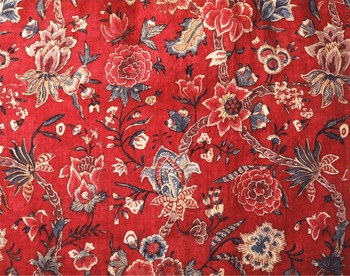


The Englishman John Ovington, during his travels to Surat in 1689, noted how ‘In some things the artists of India out-do all the ingenuity of Europe, viz., the painting of chintes or callicoes, which in Europe cannot be paralleled, either in their brightness and life of colour or in their continuance upon the cloth.’Footnote 1 Like Ovington, many other Europeans were impressed by the bright colours of Indian cottons and admired the precision of their design.Footnote 2 Another mid-seventeenth-century traveller, the Frenchman Boullaye-Le-Gouz, explained that ‘Hitherto it is not known how the natives apply so successfully the colours to the “foyes” and “toiles peintes” in such a way that they lose nothing in the washing’, adding that he ‘showed some in France to several dyers, who were filled with admiration at them, assuring me that the dyes of India are pure and quite simple, whereas those of Europe are inferior’ (Figure 1).Footnote 3
Painted cotton textiles used for a banyan garment (informal robe worn in Europe). Textile produced in the Coromandel Coast, India, c.1750. The brilliant colours and sophisticated design of Indian cotton textiles appealed to European consumers. Victoria and Albert Museum, T.215–1992.

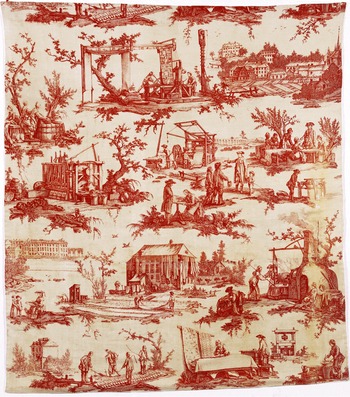
Three generations later, Ovington and Boullaye-Le-Gouz’s statements would have appeared mere exaggerations to European readers. The very idea that Asia, or more precisely India, possessed – or had possessed in the past – skills and knowledge unknown to Europeans on how to produce printed cotton textiles was by this time considered blatantly false. An artefact such as the celebrated toile ‘Les travaux de la manufacture’ (produced in 1783 by the French calico printer Christophe-Philippe Oberkampf in his print works in Jouy-en-Josas) shows in a series of vignettes the accomplishment that this branch of textile finishing had achieved in Europe (Figure 2). Craftsmanship and industrial organization are woven together in a design that is at the same time a narrative of industrial achievement and the demonstration of the unparalleled quality of European printed textiles.
‘Les travaux de la manufacture’, 1783. Vignettes represent the process of production of toiles by Oberkampf in his print works in Jouy-en-Josas. © Musée de l’Impression sur Étoffes, Mulhouse, n. 219.

The success of European cotton textile production was not just the result of major technological breakthroughs in spinning and weaving. By the late eighteenth century, Europeans were able to produce cotton textiles that could rival high-quality Indian goods. How this phenomenon came about is still a matter of debate. Under review are complex analyses of Europe’s technical knowledge, technological receptivity, and innovation, with particular attention paid to textile dyeing and printing, in which Europe had never excelled before the late seventeenth century. This article investigates the ways in which a branch of textile finishing emerged and developed in Europe between the second half of the seventeenth and the mid eighteenth century. Such an issue has been considered by a generation of historians, mostly by investigating the internal mechanisms by which a profitable new manufacturing sector established itself across the continent. In contrast, little has been said on how and how much Europe’s success in textile printing – both on linen and cotton – was heavily dependent on Asian knowledge and skills.
This article is a case study of the global remit of recent debates over the nature of ‘useful and reliable knowledge’ and ‘import substitution’ in eighteenth-century processes of industrialization and economic divergence. The examination of the reasons why knowledge on dyeing and printing was far inferior in Europe compared to several parts of Asia, and in particular the Indian subcontinent, is followed by a brief summary of the recent literature on the concepts of ‘import substitution’ and ‘useful and reliable knowledge’. The core of the article considers in what ways the European ‘epistemic base’ of this productive process was expanded thanks to knowledge from both India and the Middle East. It argues that, from the early eighteenth century, European knowledge and practices of textile printing markedly differentiated themselves from their Asian counterparts, and concludes by briefly outlining the ways in which, later in the eighteenth century, such European distinctiveness was taken to be a form of superior understanding and knowledge.
World textiles traditions: substitution and knowledge
Why was European knowledge of printing and painting on textiles inferior to that of Asia? The main reason springs from the fact that Europe and Asia specialized in the manufacturing of different fibres. Until the early modern period, cottons were not widely produced in Europe (with the exception of mixed cotton and linen, called fustians), while they were the most common textiles manufactured in Asia. By contrast, Europe specialized in the production of woollen textiles, a product that was known in Asia but only produced in ecological niches.
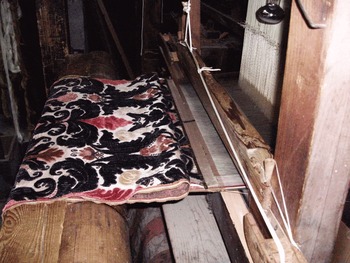
This fibre specialization had repercussions on the ways in which design on textiles was created and decoration was ‘fashioned’. In Europe, not only woollens but also silks and velvets were patterned on the loom and their design was the result of complex methods of weaving and finishing. From the later Middle Ages, European textile producers could dye both yarn and cloth pieces but had little familiarity with printing on textiles. Rudimentary engraved wooden blocks were used to print simple designs on linens and woollens, but this specialized industry never expanded beyond the Rhenish provinces of Germany.Footnote 4 The ‘fashioning’ of textiles in Europe relied mainly on weaving and embroidery (see Figure 3). Before printed cottons were introduced into Europe, textile design was created through the weaving of the yarn, the mixing of fibres, and the use of different colours. The articulation of design came to life in the process of making (Figure 4). To set up a loom was an expensive and long activity that could take months. This explains why the abundance of colour and design on a textile was an indicator of its value. Any change in textile design was expensive because it implied weeks, if not months, of work in setting up the loom.
The ‘fashioning’ of textiles in Eurasia.

Production of silken velvet using an eighteenth-century European loom. Manifattura Bevilacqua, Venice, 2009. In Europe, textile design was created through the medium of weaving and the setting up of looms was a long and costly procedure. Photo by the author.

By contrast, Asia (and India in particular) had developed a variety of processes that can be roughly distinguished into the three broad categories of dyeing, painting, and printing (see Figure 3). Although textile historians long believed that most Indian cottons were painted,Footnote 5 in many areas (such as Masulipatam, Nizampatam, Narasapur, Armagaon, and Madras) both painting and printing techniques were in use.Footnote 6 There is now clear evidence that calico printing was already well developed in several parts of the Indian subcontinent by the tenth century.Footnote 7 In the western part of the subcontinent, Gujarat, but also in parts of the Malabar Coast, wood blocks were in common use.Footnote 8 On the Coromandel Coast, however, painting was the most common technique for decorating cottons, and the region was already famous for its colourful cotton textiles during the time of Marco Polo.Footnote 9
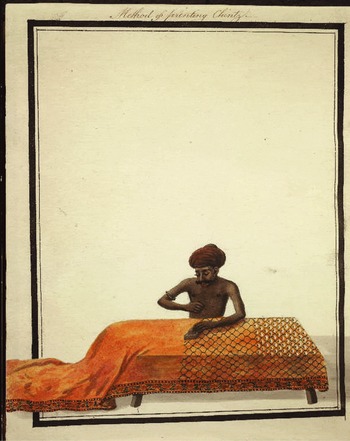
It would be incorrect, however, to conceptualize printing and painting as distinct and separate, since each comprised a series of different processes, probably characterized by local specializations. In West India and Gujarat, for instance, chintzes were printed with wooden blocks by using one or more of the various techniques that included ‘direct printing’, ‘bleach printing’ (bleaching the design on an already dyed cloth), ‘mordant printing’ (printing with mordants and then bleaching the unmordanted areas), or ‘resist printing’ (printing a viscous substance, followed by dyeing, followed by the cleansing of the substance). The enormous variety of processes, combined with the local availability of good-quality dyes and the ability to use mordants, made Indian textile production extremely articulated when compared to its European counterpart (Figures 5 and 6).Footnote 10 Several sources confirm that there was also a high degree of division of labour in calico printing and that the process could involve as many as a dozen separate dye transfers to the cloth.Footnote 11
Printing chintz. Watercolour, c.1820. In India, printing was one of the main ways of patterning cloth. This was a speedy activity based on several stages. Courtesy of the British Library, Add. Or. 5110.

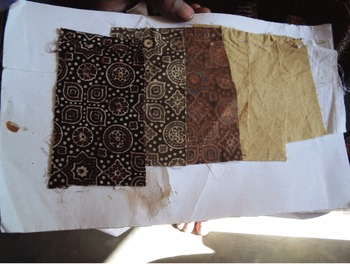
Cloth swatches of traditional cotton cloth produced with vegetable dyes by the Khatri brothers in Gujarat by using different mordant processes, 2005. Different colours and designs can be obtained by varying the use of dyes and mordants, but without changing the wooden block. Photo by the author.

Cotton was a fibre more suitable than flax, hemp, wool, or silk for absorbing dyes and being printed. This partially explains why the processes of printing and painting were adopted in other areas of Asia where cotton textile manufacturing was well underway by 1000 CE. In China, woven cotton textiles were at the high end of the market, but dyed and printed fabrics (yaobanbu) produced by using stencilling, resist dyeing, and block printing were already popular in the Southern Song (1127–1279), and were patterned with towers and pavilions, human figures, and flowers. These were traded on the market, in contrast to cheaper varieties of coarse cloth produced for household consumption.Footnote 12 Southeast Asia combined two different traditions in textile finishing: ikat and batik. Ikat was based on the weaving of previously dyed yarn by knotting it, thus creating complex patterns through simple weaving, a technique already present in the eighth century.Footnote 13 Batik was based instead on the use of wax to prevent the dye from penetrating the cloth. This technique was widespread by the eleventh century, although it is not clear if it originated locally or came from other parts of Asia.Footnote 14 Printing was adopted in Japan only during the Edo period (1603–1868), but names such as bengara(-jima or -gôshi) (striped or checked cloth from Bengal), santome(-jima) (striped cloth from São Thomé), and matafû(-jima) (striped cloth from Madras) suggest a possible knowledge transfer from the Indian subcontinent.Footnote 15
Europe had little knowledge not only of the techniques of printing and painting but also of fast colours – that is to say, colours generated by mixing dyes and mordants to produce textiles that did not fade if exposed to light, and whose colours did not run when washed. These were the qualities that made Indian calicoes and pintados imported into Europe by the East India companies after 1600 (and before that by the Portuguese Careira da India and Levantine merchants) so popular. But why did European textile producers want to rival their Indian counterparts and compete in a sector in which they had little knowledge, rather than simply buying these textiles? Maxine Berg, in her studies of the importing of ‘exotic’ products from India, China, and Japan in the seventeenth and eighteenth centuries, has argued for a European drive towards imitation of imported commodities. The goods themselves, with their visual and tactile attributes, stimulated desires that in turn produced attempts (often supported by mercantilist measures) to replace them with European-made products. This extended well beyond textiles, as so many of the commodities initially imported from the East were eventually produced in Europe. Such commodities were partially adapted to suit European tastes and consumer expectations.Footnote 16
This type of narrative is indeed very fitting for the case of cotton textiles. In the sixteenth century, European textile producers had already attempted to imitate Indian textiles by painting linen with oil and water colours.Footnote 17 The influence of Indian motifs and the use of floral designs suggest that these ‘oilcloths’ were produced to imitate Indian examples. Incentives to develop a European textile-printing industry were already present in the early seventeenth century: in 1619, a certain George Wood was granted a twenty-one-year patent for the printing and staining of linen cloth in England and Wales.Footnote 18 However, results must have been disappointing: these early printed linen cloths were very coarse and their colours were far from permanent.Footnote 19 Alum, a key mordant, was still scarce in Europe in the seventeenth century, and the use of other mordants remained as primitive as that of printing blocks. The final product was a cloth in one colour without patterns or shades, very far from the bright complex designs of Indian textiles.Footnote 20
It has been argued that the drive to imitate Asian goods rarely relied on the original technologies used in Asia.Footnote 21 While Europeans were keen to ‘appropriate’ the products that they saw in markets and bazaars, they did not take back to Europe the technologies and practical expertise needed to produce such items. One of the possible explanations is that the immediacy of artefacts was not matched by a substantial European engagement with Asia in terms of any coherent understanding of how productive processes were carried out.Footnote 22 The case of cotton textiles is, however, an exception to the rule: the rest of this article will show how much calico printing developed in Europe thanks to the acquisition of knowledge from India and the Middle East.
By investigating the global ramifications of knowledge transfer, this article also contributes to recent debates on the importance of ‘useful and reliable knowledge’ in explaining divergence. My analysis cannot prove or disprove Mokyr’s hypothesis that ‘accumulation of knowledge’ was quintessentially a Western phenomenon and a key factor explaining the economic divergence of Europe in the eighteenth century.Footnote 23 It contributes instead by expanding Mokyr’s original formulation to include the connections between European and Asian knowledge.Footnote 24 It shows in particular that useful knowledge developed from both codified and tacit knowledge, a point recently emphasized by Liliane Pérez.Footnote 25
Knowledge transmission: accounts and artisans
Many of the diaries of European travellers to late sixteenth- and seventeenth-century India describe printing and dyeing techniques in the subcontinent. Local productive techniques and regional specialization of production were recorded with great care, but overall these writings had little impact on the way that Europeans understood cotton textile-producing processes as performed in India.Footnote 26 Historians have argued that limited access to the areas of spinning, weaving, and printing by Europeans travellers and merchants might have been a barrier to the gathering of basic information. In the specific case of cotton painting and printing, it seems unlikely that Europeans could rely on any substantial locally codified knowledge. Texts such as Mir’āt ul istelah by Anand Ram Mukhlis (an eighteenth-century lexicon with entries on dyeing and tie-dyeing) or the Nuskha khulāsatul majarrebāt (transcribed c.1766, an anonymous medical treatise that dedicates a full chapter to dyeing and printing) were never widely circulated.Footnote 27 Even though there does not seem to have been any degree of secrecy exercised by the Indian craftsmen, calico printing remained to the eyes of Europeans a rather mysterious process because – in the words of Helenus Scott – Indian ‘knowledge of the arts is never communicated by writing nor printing nor their experience reduced to general laws by theory’.Footnote 28 The lack of recipes was a major problem, as quantification and precision were crucial in the successful replication of the process.
Until the third quarter of the seventeenth century, the European understanding of the Indian calico-printing process was patchy and confined mostly to the references to be found in the travelogues by the Portuguese Duarte Barbosa and the Frenchman François Bernier.Footnote 29 In the last decades of the seventeenth century, however, increasing quantities of printed and painted cotton textiles entering Europe may have sparked a new interest in understanding their productive process. If the product provided, as Berg has argued, the initial incentive for product innovation and import substitution, it was also clear that European knowledge of dyes and of textile printing was not sufficiently developed to produce any immediate breakthrough.
The argument for producing cotton textiles in Europe that could rival their Asian competitors was in line with European mercantilist ideas. From the late seventeenth century, most European governments started taxing and, in many cases, completely banning the import and use of Indian cottons. They complained that Indian and Chinese cotton and silk textiles caused a haemorrhage of bullion from Europe to Asia. Under the pressure of national silk- and wool-manufacturing lobbies, the majority of European governments – with the interesting exception of the Dutch Republic – enacted protective measures within their national textile markets, while encouraging the re-export of Indian cottons and the local manufacturing of substitutes in the form of mixed linen and cotton textiles.Footnote 30
Historians have argued that such mercantilist measures fostered the development of a European textile-printing industry.Footnote 31 They also coincided with an increasing European interest in gathering ‘useful and reliable knowledge’ on Indian cotton printing and dyeing. Such interest is best exemplified in the work of three Frenchmen over a period spanning the last quarter of the seventeenth century to the mid eighteenth century, a period that coincides chronologically with the ban on Indian textiles in France and with the creation of a European textile-printing industry.Footnote 32 Between 1678 and 1680, Georges Roques wrote a 333-page manuscript containing a detailed analysis of the production of textiles in Ahmedabad, Burhanpur, and Sironj. The French East India Company’s Lieutenant Antoine Georges Nicolas de Beaulieu (1692–1764) was the author of a second manuscript, probably compiled around 1734.Footnote 33 Finally, the third document was produced as a series of letters by Père Coeurdoux, a missionary from the Society of Jesus, who lived in India between 1742 and 1747.Footnote 34
In 1966, the Roques manuscript was unearthed at the Archives de la Bibliothèque Nationale in Paris.Footnote 35 Although Roques’ account includes several parts on matters not related to textiles, it has been studied mostly for cotton printing and dyeing.Footnote 36 The centrality of the subject can be gathered from the very opening of Roques’ description:
There can be no doubt that it would be most harmful to the State were we to neglect our own production of light silken and woollen materials in favour of Persian and Indian cottons. It can, however, only be a good thing to know how these people set about applying the colours to their cotton cloths, which not only do not run or fade when washed but emerge more beautiful than before. Everyone can see for himself how useful this would be when he envisages what the possibilities could be for our cotton, linen and hemp cloth.Footnote 37
Roques’ text is representative of a type of early modern ‘commercial’ account of the ‘East’, interested in providing information concerning the quality and price of merchandise, business competition, the seasonality of production, and so forth.Footnote 38 However, his manuscript includes an in-depth explanation of the processes of dyeing and printing as performed in Ahmedabad and is a key source of knowledge on how mordant block printing was carried out in eighteenth-century India.Footnote 39
The Beaulieu manuscript, written in 1734, was perhaps the most successful of these late seventeenth and eighteenth-century accounts of Indian calico printing.Footnote 40 Paul Schwartz suggests that de Beaulieu had been asked by Charles François de Cisternay du Fay to pursue the study of cotton printing in India. Du Fay was not only the official inspector of dye works and mines, and inspector of the Parisian botanical gardens, but also one of the most famous chemists of his time.Footnote 41 It could be the case that a thorough analysis of the process became possible thanks to Du Fay’s precise instructions based on observation and evidence. Unlike previous accounts, the Beaulieu manuscript concentrates entirely on the production of chintzes in Pondicherry. It also follows a ‘scientific’ style of analysing the manufacturing process based on the description of each productive stage, after which a piece of cloth was taken and attached to the manuscript.
It is not just the thoroughness of Beaulieu’s analysis that makes the account so important. It also appears that the manuscript was widely circulated in Europe. It was used by the Chevalier de Quérelle in his Traité sur les toiles peintes of 1760, and by the Basel calico printer Jean Rhyner in his 1766 Matériaux pour la coloration des étoffes (only published in 1865).Footnote 42 In both cases, the authors argued that Beaulieu had produced a vade mecum of printing that, when properly followed, allowed Europeans to achieve results comparable to those obtained in Asia. The relatively obscure Antoine de Beaulieu was thus in all probability a vehicle for European scientists and technologists to gather information about productive processes and natural and technical knowledge in a remote but key area of the globe. In this way, the French East India Company gained and transmitted Indian knowledge to the West.Footnote 43
More than any of the previous travellers and industrial spies, the Jesuit Coeurdoux was aware of the importance of Indian knowledge and the contribution that his letters might make to the development of European calico printing. By the time that Coeurdoux was writing in the 1740s, European ambitions had moved on from the acquisition of commercial advantages in Eurasian textile trade. He saw that ‘knowledge is to be acquired here which, if transmitted to Europe, would possibly contribute to the progress of science or to the perfection of art’.Footnote 44 Coeurdoux, like de Beaulieu and Roques before him, strongly believed in the economic value of Indian knowledge of calico printing. The mission of all three was to codify the processes of production into clear descriptions that could subsequently be applied in Europe. As the de Beaulieu case suggests, descriptions of productive processes provided a small group of proto-scientists with inputs for theories that eventually came to influence the development of textile printing and dyeing from an organic/mechanical art to a chemical/synthetic industry.
This line of interpretation has, however, been questioned. There is no certain proof that attempts to learn the ‘secrets’ of Indian cotton printing, especially in the 1730s and 1740s, meant either that Europeans were unable to replicate fast colours before that date or that they constituted a fundamental knowledge transfer from India to Europe. Paul Schwartz, the great scholar of cotton textiles, suggested in the 1960s that the European ability to produce fast colours depended on the transmission of workshop practices from the Near East (in particular from present-day Turkey), and not on the gaining of Indian knowledge.Footnote 45 Thus the role of Roques, de Beaulieu, and Coeurdoux was to improve rather than establish European cotton printing and dyeing. One might wish to see the European learning of the process as cumulative, tentative, and rather incomplete. It was based on the careful consideration of original products, but at the same time found support in the technical expertise of large communities of producers active in present-day Turkey, especially Armenian craftsmen, who excelled in the copying of Indian textiles that they sold in the Ottoman Empire, and from there reached Europe, especially through the port of Marseilles. These Armenian printers explain not just how knowledge was transferred to Europe but also the specific geography and conformation of the new industry in the Old Continent.
One of the most important centres of cotton textile printing in the Middle East was the city of Diyarbékir. Two thirds of the city’s population were Armenians, and it was famous for its production of chafarcanis (a red or purple chintz with white flowers), probably an imitation of the jafracani produced in Sironj and Ahmedabad in India.Footnote 46 Armenian traders sold cotton cloths printed in Diyarbékir and other nearby centres, such as Malatia and Celebi, to the Near East, France and eastern Europe, particularly Poland. They also traded in the ‘original’ goods produced in Gujarat that they sold in Persia, Bantan, and Manila.Footnote 47 Their wide-ranging trade relied on the commercial and financial services offered by the Armenian trading communities present in Europe and Asia. After the destruction of Julfa (in present-day Azerbaijan) in 1605, Armenian traders migrated to Mesopotamia, India, and Indonesia, but also to Venice, Livorno, and Amsterdam.Footnote 48
The extent and ramification of the Armenian trading communities has been well studied in the case of silk. In the seventeenth and eighteenth centuries, Armenians did not just control production of Iranian silk but traded it in the Ottoman Empire, India, Russia, and central Eurasia.Footnote 49 Recent studies by Raveux for Marseilles, Cataldi Gallo for Genoa, and Homburg for Amsterdam suggest that the early development of cotton printing in all these European cities relied heavily on the presence of Armenian workmen. In the mid seventeenth century, Marseilles already had a consistent Armenian merchant colony, some members of which came from Italy, especially Livorno. They specialized in the trade in silk, and paved the way for cotton’s success in the city. In 1672, it was two Armenians who set up a workshop for the ‘painting of calicoes as done in the Levant and Persia’ in partnership with two local craftsmen.Footnote 50 Six years later, an Armenian from the city of Celebi established a calico-printing shop at Amersfoort in the central Netherlands, in association with two merchants from Amsterdam.Footnote 51 Calico printing was introduced in Genoa in 1690 by an Armenian workman, who was not only allowed to exercise his trade outside the guild system but was also granted the monopoly of the activity for ten years.Footnote 52 In Livorno, too, the birth of calico printing is similarly attributed to two Armenians.Footnote 53 In Amsterdam, as in many other cities, Armenians were employed to ‘draw and colour or dye all kinds of East Indian cottons, which has never before … been practiced’.Footnote 54
It is not surprising that the geography of calico printing in Europe overlapped significantly with that of trade and finance for the Armenian community.Footnote 55 In cities such as Genoa, Livorno, Marseilles, Nantes, Le Havre, and Amsterdam, Armenians had already been granted protective laws and privileges, which were in due course extended from the commercial to the manufacturing sphere.Footnote 56 It is also clear that what these Armenian entrepreneurs brought with them was not just commercial connections and the access to capital but an in-depth knowledge of the productive processes, a knowledge that was still lacking in Europe.
The role of Armenians as conveyors of useful knowledge between Europe and Asia can be gathered from other pieces of evidence. Baker, for instance, argued that the Turkish-red process was introduced into France by an Armenian.Footnote 57 In 1677, in Orange, the first calico-printing shop opened was expressly for the production of toiles persiennes, rather than indiennes, a possible reference to the fact that the model was not Indian but Ottoman and Persian printed cottons.
Overall, there is sufficient evidence to argue that Armenian workmen were key to the establishment of a number of European centres of calico printing, which in turn generated further knowledge of the productive process across the continent. This happened not so much through the action of Armenians but through mobile European workmen.Footnote 58 A calico-printing business was opened in Rome in 1677 by two merchants, possibly from Marseilles. French printers were also to be found in Berlin in 1686 and Geneva in 1688.Footnote 59 The role of refugees is often mentioned in the history of calico printing. Edward Baines believed that the Frenchman René Grillet, who set up a calico-printing workshop at Richmond, near London, in 1690, was a Huguenot refugee, though others thought him to be Catholic.Footnote 60 Clearly the industry emerged in the proximity of London thanks to the expertise of foreign workmen, mostly French, who had been employed in similar establishments in the Netherlands. It was said that one of the early calico printers in the British Isles, the Frenchman Daniel Vasserot, learned his trade in Holland.Footnote 61 Vasserot was later to become the most prominent calico printer in Geneva.Footnote 62 Still, we should not exaggerate the numerical relevance of these foreign workmen. Wadsworth and Mann, for instance, underline how, in an early petition by London calico printers of 1696, only four out of forty-nine can be identified as either French or Dutch, although the names of others might have been anglicized.Footnote 63
The spread of calico printing in late seventeenth- and early eighteenth-century Europe was phenomenal.Footnote 64 In England, William Sherwin of West Ham, near London, took out a patent in 1676 ‘for invention of a new and speedy way for producing broad calico, which being the only true way of the East India printing and stayning such kind of goods’.Footnote 65 The Rhyners, the famous family of calico printers, were originally from Holland but moved to Basel in the late seventeenth century. From Basel, calico printing spread to Mulhouse and Neuchâtel. In France, during the long ban lasting from 1689 to 1759, production was confined to those cities and small areas that were not directly administered by the central government and enjoyed autonomous jurisdiction, such as Marseilles, and only later did production develop in centres such as the Arsenal in Paris (1746), Angers (1753), Rouen (1755), and Nantes (1758). By the 1740s, there were more than 100 textile-printing shops in Holland, 80 of which were in Amsterdam.Footnote 66 By this time, calico printing gave work to more than 12,000 workers in Spain.Footnote 67 In the late 1750s, the Fabrique-Neuve near Neuchâtel in Switzerland employed more than 300 workers.Footnote 68
The transfer of knowledge of colouring agents and printing processes from India and through Ottoman Armenians did not, however, guarantee that European cottons could rival either their Indian or their Middle Eastern competitors. Peter Floud, who studied the early calico-printing businesses around London, concluded that, until 1715, the productive methods remained rather primitive (Figure 7).Footnote 69 Until the 1740s, even the highly developed printing works in Marseilles, using the most advanced Anatolian techniques, could only manufacture products of low quality, such as Guinea Blue cloth for slaves, and other cheap textiles printed in just two colours.Footnote 70 It was over the following two decades that the European centres of calico printing constructed their own distinctive specialization and increased the quality of their products.
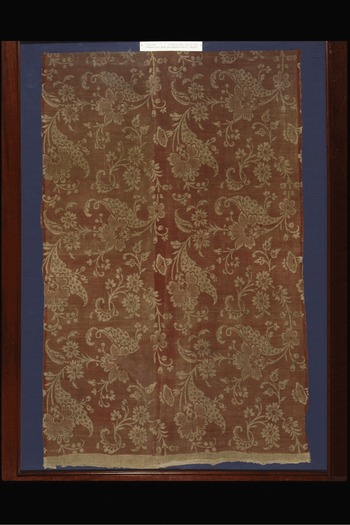
Block-printed cotton, possibly English or Dutch, c.1690–1700. At the end of the seventeenth century, Europeans could only produce dull-coloured and semi-fast printed textiles. Victoria and Albert Museum, 12A-1884.

Knowledge reinterpretation: global colours
The development of a European cotton-printing industry was not just based on knowledge of the processes of production. It involved experimentation with mordants and new dyes, in particular with two basic colours: madder or Turkey red, and indigo blue. George Souza has convincingly argued that the global trade in colouring agents and dyes was integral to the first phase of ‘globalization’ characterizing the early modern world economy. Red was produced from a variety of substances such as kermes, cochineal, madder, brazilwood, sappanwood, and lac, which were widely traded across the early modern world. Since the Middle Ages, sappanwood had reached Europe from as far afield as Thailand and Sumbawa and its trade was later monopolized by the Dutch East India Company.Footnote 71 Cochineal was widely exported from the New World both to Europe and Asia, and the profitable indigo trade was in the hands of Armenian traders based in Gujarat, much to the annoyance of the European East Indian companies.Footnote 72 Alum, used as a mordant, was imported from the Middle East and the isle of Chios, before the discovery of European deposits at Tolfa, near Rome.
Early European printed cottons were therefore the result of Asian knowledge, dyes imported from both Asia and the Americas, and plain cotton textiles and design models borrowed from India. This section reflects on how these global influences came to be reinterpreted during the second and third quarters of the eighteenth century, generating a cotton industry that was widely perceived as European in nature, well before the classic ‘cotton revolution’ of the late eighteenth century. I here consider briefly the European technological development in four areas of cotton finishing: the use of mordants; the production of indigo blue and madder red; and the shift from block to copper-plate printing.
Mordants
European expertise in the use of mordants had been confined to dyeing rather than printing. Alum and iron mordants could be used for printing only if they were mixed with suitable thickeners to form a viscous substance that did not spread beyond the area to be printed. Once mordants had been printed, the viscous substance had to be removed in order to allow the madder or indigo dyes to fix.Footnote 73 Although Indian experience provided invaluable expertise for both mordants and the process of dyeing, it was probably less useful for the use of thickeners. Ruth Barnes has uncovered mordant-printed textiles from Gujarat and excavated in Egypt and Indonesia, dated c.1500.Footnote 74 There is no contemporary evidence showing any use of thickeners in Indian calico and chintz production and the process was probably done by painting the mordant rather than printing it. Historians of textiles and science question whether mordant printing was truly a European invention or if its first adoption in Marseilles in the mid seventeenth century came from the Middle East.Footnote 75 What remains certain is that mordant printing allowed for much higher productivity than hand painting. Mordants were also important in the development of calico printing in Europe because they allowed colours that were resistant to light and washing, something that the non-fast dyes used in Europe could not achieve. The able mixing of mordants and dyes allowed for colour and design effects on a palette and of a quality previously achievable only on expensive silk textiles. The dyeing of fast colours relied mostly on ‘exotic’ substances such as cochineal, quercitron, walnut, madder, and, most important of all, indigo.
Blue
The use of indigo in Europe is a good reminder that the Old Continent was not necessarily open to productive innovations. Different varieties of indigo plants were cultivated in several areas of Asia, with Gujarat being one of the major world suppliers. Here indigo was harvested and transformed into small blocks of pulverized substance that were exported to Baghdad and Aleppo, and from there to Europe. Indigo was a luxury dye that allowed the production of deeper shades of blue than those obtained by the European-grown woad.Footnote 76 For woad growers, the potential competition from indigo was already considered to be a threat by the sixteenth century. Its use was banned, for instance, in France from 1598 until 1737. In Britain, indigo was denounced as the ‘food of the devil’ and its use was allowed only in conjunction with woad.Footnote 77 Along with cotton fibres, indigo began to be produced on plantations in the West Indies in the early seventeenth century, and became available in larger quantities and at cheaper prices.Footnote 78
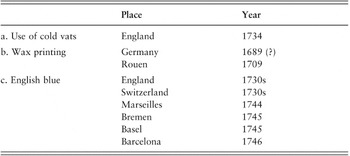
In India, indigo dyeing was used in resist-dyeing processes based on the waxing of the area of the cloth to remain undyed. This was a labour-intensive process that allowed ‘white designs on blue backgrounds’ rather than ‘blue designs on white backgrounds’, which would have meant the waxing of most of the cloth.Footnote 79 During the last quarter of the seventeenth century, European calico finishers had mastered indigo resist-dyeing processes as done in India with tepid indigo fermentation at 115 °F (46 °C). By the early eighteenth century, however, they were already experimenting with techniques unknown in Asia. The most important of these was the use of cold vats (or cuve à froid), obtained by dissolving indigo in iron sulphate (couperose). This process, perfected in England in 1734, quickly replaced the hot fermentation of indigo, which damaged the reserve (those parts that were waxed and to remain undyed) (see Table 1).Footnote 80
Indigo dyeing and printing in eighteenth-century Europe

Sources: Thomson, ‘Technology transfer’, pp. 250–2. Additional data has been found in Little, ‘Cotton printing’, p. 15; Floud, ‘English contribution’, pp. 344–9; idem, ‘The English contribution to the development of copper-plate printing’, Journal of the Society of Dyers and Colourists, 76, 1960, pp. 425–34; Chassagne, ‘Calico printing’, p. 524; and Raveux, ‘Espaces’, p. 157.
Two further innovations characterized the European use of indigo. Wax printing was probably first adopted in the late seventeenth century, and it allowed for substantial labour savings compared to the traditional techniques of painting (with a brush) or pencilling (with a small wooden tool) wax on the cloth as done in India and other parts of Asia (see Table 1). Another innovation was the discovery of a method for printing indigo – rather than dyeing it – by using potash, quicklime, and orpiment. This technique was called ‘English blue’ (‘Englischblau’ or ‘bleu d’Angleterre’), suggesting that it originated in England (see Table 1).Footnote 81
The elaboration of the knowledge of dyes acquired in Asia should be contextualized. It was based on continuous experimentation rather than pure research, as dyeing was considered to be both a mechanical and a chemical process. Moreover, it clearly expressed synergies with other areas of European manufacturing. The preference given to textile printing, instead of pencilling, was in line with the European engagement with printing and engraving on paper. Finally, the result was cotton textiles with white backgrounds (normally multicoloured), which were preferred by European consumers to the darker textiles imported from Asia.Footnote 82
Olivier Raveux’s analysis of Marseilles cotton printing between 1720 and 1755 shows the dialectic relationship between extra-European knowledge and the innovations generated in Europe in the manipulation of dyes and mordants. In Marseilles, the influence of Ottoman technical knowledge remained central to the city’s success in cotton printing and dyeing. As for other European cities, the first manufacture ‘pour teindre des toiles propes à la fabrication des vannes d’indianes’ (‘for the dying of cloths as bedspreads’) was set up by two Armenian workmen.Footnote 83 After 1720, however, Marseilles was receptive to a new wave of innovations, this time from northern Europe. The ‘bleu Anglais’ (locally known as ‘bleu au pinceau’) was introduced to Marseilles by an English workman employed by the Swiss-born entrepreneur Wetter in 1744.Footnote 84 The mobility of ‘experts’ and the swiftness in adopting these new productive processes in the numerous calico-printing centres of Europe are remarkable. The existence of areas of ‘open technique’, which, according to Liliane Pérez and Anne-Françoise Garçon, characterized several sectors of eighteenth-century European manufacturing, was in the case of cotton printing based on the mobility of networks of specialized workmen across the entire continent, from London to the Netherlands, from Switzerland to Marseilles and Barcelona.Footnote 85 The professionalization of colour makers and colourists, as well as the constant participation of technicians and entrepreneurs in discussions over calico printing and dyeing, were key elements in creating a self-sustaining relationship between human capital and innovation. The success in the use of blue indigo created a series of opportunities for experimentation with several dyeing substances, including those producing the colour red, traditionally a difficult and expensive tint to obtain.
Red
The demand for good red-dyed cloth had been traditionally high, but European dyeing methods had never produced totally satisfactory results. Early attempts at producing Turkey red were made in the Netherlands in the 1670s, and then in Switzerland in the 1680s. The process was also adopted in the German states and the Hanseatic towns.Footnote 86 However, improvements were slow to come. In the 1740s, France still imported 5,000–6,000 bales of red cloth from the Levant each year. It even sent part of its home production of cottons and woollens to be dyed in Turkey, where the madder-red ‘Turkey’ process was performed with great success. It is not surprising that attempts were made to set up madder-red dye houses on French soil by bringing Greek and Turkish dyers from the Levant. Madder, much more than indigo, was a specialization of Turkey, and the Levant, rather than India, was instrumental in providing precise knowledge about its use and commercial exploitation.Footnote 87 Turkey red was first successfully manufactured in France in the late 1740s (where it was renamed ‘Adrianople’ red), and became commercially viable in the following decade, through a process that combined dyeing, mordanting, and bleaching.
Liliane Pérez has recently examined the life of Claude Flachat, a traveller, entrepreneur, and innovator who was instrumental in learning the properties of madder and in replicating Middle Eastern dyeing and printing techniques in Europe.Footnote 88 Flachat spent several years in the Levant and returned to France in 1756, where he set up a Turkey-red dye works at Saint-Chamond, not far from Lyon. He employed a Turkish master dyer, two dyers from Adrianople, two tin-smiths from Constantinople, a Persian spinner, a Smyrna thrummer (for the bowing of cotton), and two Armenian vitriol makers.Footnote 89 Flachat was not just a careful observer of productive processes and market opportunities. He also combined an in-depth understanding of the great variety of productive specializations with business acumen, thus becoming one of the best known manufacturiers-innovateurs in eighteenth-century textile manufacturing.Footnote 90
Turkey red was gradually introduced into other parts of Europe, partly through Levantine workers. In 1768, for instance, two Amsterdam merchants opened a Turkey-red dye works in partnership with a Turkish master living in Holland.Footnote 91 However, the technique was mainly learned from France. Johann Zeller of Zurich opened the first Turkey-red dye house in Switzerland in the early 1760s, after spending some years working in Nîmes.Footnote 92 John Holker, the English spy, entrepreneur, and official of the French government, was with all probability one of the earliest and most trusted sources of information about madder-red dyeing in England. Although he is famous for transferring British technology into France, he was also heavily involved in the dyeing business, setting up the first Adrianople dye house in Rouen.Footnote 93
Printing
One of the areas in which European manufacturers most differentiated their products from Indian and other Asian printed textiles was in the use of mechanical tools. Textile printing was widely used in India but did not gain the omnipresence that it achieved in Europe. Europe’s reliance on printing rather than painting spurred on efforts to find a process that was not only faster but could also produce better-quality textiles. Book printing and engraving had reached new heights by the early eighteenth century. Techniques had been perfected to reproduce paintings in the form of etchings and popular prints. Similarly, printing on textiles underwent a series of major technical changes in the second half of the eighteenth century, all of which were closely tied to the technology of artistic production on paper.
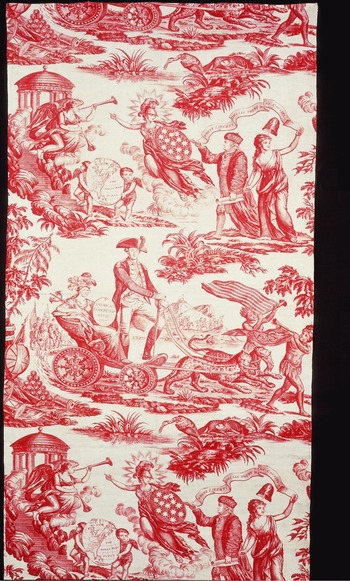
The first major innovation used copper plates, instead of the traditional wooden blocks, and was first applied by Francis Nixon of Drumcondra near Dublin in 1754.Footnote 94 The use of copper plates was not simply another process innovation. Its main aim was to improve the quality of the product, and it allowed for precise replication on textiles of complex designs and, more commonly, of scenes from fables, representations of the countryside, commemorative battles, and famous individuals (Figure 8). The visual ‘language’ of European cotton textiles dramatically diverged from its Indian and Middle Eastern models, thanks to the use of copper plates. The process was quickly adopted throughout Europe, first in England and later in France, Germany, and Switzerland.Footnote 95 Oberkampf, who started calico printing with copper plates only in 1773, became in just a few years the best-known producer of toiles in Europe.Footnote 96 The success of copper-plate printing was so great that, in the 1770s, the English East India Company was already thinking of a scheme ‘for exporting to India Metal Plates and Machines for working them, Blocks, and other Utensils used in the Business of [calico] Printing’, together with English workmen.Footnote 97
Plate-printed cotton and linen representing George Washington. England, c.1780–90. Victoria and Albert Museum, CIRC.93–1960.

The second innovation was the invention of the rotary printing machine patented by the Scotsman Thomas Bell in 1783. Attempts to perfect a printing machine had started at the very beginning of the century, when a wooden printing roller was used in Moravia, and the Englishmen Keen and Platt had invented a three-colour roller press in 1743.Footnote 98 However, the real leap forward came only in 1783 when Bell (who worked at Livesey, Hargreaves Hall and Co. in Preston) patented a method of printing from engraved cylinders. Two years later, he was printing in six colours.Footnote 99 Roller printing must have appeared revolutionary compared with Indian painting: according to Beaulieu, it took an Indian craftsman two weeks to paint a calico seven metres long;Footnote 100 it was calculated that in 1851 the average calico print works could print six pieces (equal to 168 yards (154 metres), at 28 yards a piece) per day, and machine printing allowed the printing of between 200 and 500 pieces a day (5,600–14,000 yards, or 5,120–12,800 metres), an increase of productivity of thirty to eighty times.Footnote 101 The European path was different from the Indian one not just in terms of productivity, for the use of copper plates and rotary printing made the productive processes highly capital intensive. Although productivity of a roller was at least twenty times higher than that of a wooden block, profits could only be made by printing on a large scale, because each roller cost more than £7 to carve.Footnote 102
Theoretical conceptualization: the invention of European superiority
As we have seen with the case of Oberkampf’s toile, by the third quarter of the eighteenth century, European textile printers could pride themselves on producing textiles that were better than those of their Indian competitors. The process of ‘distancing’ European printed textiles from their original Asian source was firstly material: the use of copper plates and new processes allowed for the production of textiles that looked significantly different from Indian fabrics. But European ‘distinctiveness’ was also fostered by a sense of superiority that entailed the denial of any Asian legacy; it emphasized instead a European tradition of calico printing based on science and experimentation.
Voices critical of Indian practices were already present in the late seventeenth century. The Dutch physician and botanist Daniel Havart dismissed Indian textile production by writing of ‘the chintzen, which are painted at Calicot, after the designs which are given to the painters, which they imitate well, for the natives are so stupid that they are unable to produce anything original; but they can imitate and produce a perfect copy’,Footnote 103 adding that ‘this painting of chintzes goes on very slowly, like snails which creep on and appear not to advance’.Footnote 104 A couple of generations later, the French abbé Guillaume Raynal was equally derogatory when he wrote that calico painting done by Indians owed ‘more to the antiquity of the art than to the fertility of their genius. There is one thing apparent in the conjecture, and it is that they have not advanced a single step in the art for many years’.Footnote 105 Baines, too, thought that Indian manufacturers fared well thanks to ‘hereditary practices’, notwithstanding the fact that they had ‘little aid from science, and [were] in an almost barbarous stage of the mechanical arts’.Footnote 106
These and other writings made it clear that science, based upon research into the abstract principles of mechanical workings and chemical reactions, distinguished European calico printing and dyeing from its Indian and Levantine origins. A century after the early practical experimentations with exotic dyes and mordants, European scientists could provide comprehensive explanations not only on how productive processes had to be performed but also on why such processes followed precise scientific rules. In the 1730s, for instance, the concept of colour fastness became part of the realm of precise measurement, when Du Fay systematically tested all known dyes, thus providing a general scale of fastness. This in turn allowed Claude-Louis Berthollet to provide the first chemical explanation of mordants.Footnote 107
Edward Bancroft, the author of the celebrated Experimental researches (1794), admitted that the merit of Indian dyers had been their capacity to precipitate indigo into a semi-solid form.Footnote 108 However, he pointed out that ‘the operations of calico printing, as practised by the people of India … are in many respects highly inconvenient, and incumbered with useless parts which a little chymical knowledge would have taught them to reject, as indeed they were rejected by the people of Europe’.Footnote 109 The success of European calico printing was, according to Bancroft, more a matter of experimental validation, rather than accidental discovery. India had provided a set of useful but not entirely reliable practices, which Europeans had improved thanks to their chemical knowledge. The result was the acquisition of industrial efficacy in cutting out useless stages of production. The prolific writer Charles O’Brien agreed that the Indian tradition had developed for centuries along the lines of Bancroft’s ‘accidental discoveries’ and that the only merit of India was the purity of its water.Footnote 110 Indeed, this is the only reference that O’Brien ever made to Indian calico printing in his voluminous writings on cotton textiles.
Notwithstanding the self-promoting agenda of much European technical and scientific literature, practices across Europe remained varied, and relied on workmen’s knowledge as much as on increasing chemical analysis.Footnote 111 Codification of information was instrumental in the advancement of calico printing in three ways. First, it provided a minimal knowledge upon which to experiment. Secondly, it facilitated the discovery and application of best practices. Finally, it connected the practice of calico printing with theory-based explanations and instructions.
Codification had already started in the form of manuscripts. Beaulieu and Coeurdoux’s manuscripts, for instance, were the starting points for the construction of a systematic analysis of calico printing as a technical and chemical activity. Coeurdoux’s letters were widely used by several eighteenth-century writers, including Bancroft himself. On a practical level, Oberkampf put this body of knowledge to use as he carefully followed Coeurdoux’s descriptions to produce fast-dyed chintzes.Footnote 112 Codification allowed for the spread of ‘best practices’ in the sector. Flachat combined practical applications of what he had learned in Anatolia with the publication of a treatise on Turkey red, which was widely used by entrepreneurs such as the Swiss merchant Peter who set up his Adrianople-red dye works in Strasbourg by following Flachat’s account.Footnote 113
Codification was important because it facilitated both the repetition of the process and also its subsequent verification. Jean Hellot’s Théorie chimique de la teinture des étoffes, the result of a visit to Persia in 1737, was originally published in the Mémoires de l’Académie des Sciences in 1740–41. Although Hellot’s theories were mostly based on a mechanical understanding of chemical processes, his book (as did many other Mémoires) acted as a way of storing relevant information that could eventually be disseminated, verified, or disproved. These constituted the foundations on which Maquer and Le Pileur d’Apligny were able to codify knowledge on dyeing in the second half of the century.Footnote 114 Later works, such as Berthollet’s Essays on the new method of bleaching (1790), aptly connected theoretical understanding and knowledge of the practices of major calico producers such as Oberkampf.Footnote 115
The epistemological basis of textile printing did not simply grow thanks to the interests of professional chemists. The economic significance of textiles made research a matter of strategic importance for economic as well as political reasons, at both local and national levels.Footnote 116 Several scholars of textile printing in France, including du Fay, Hellot, and Pierre-Joseph Macquer were connected to the hierarchies of public administration.Footnote 117 Economic historians have recently underlined the relevance of institutions in the great divergence paradigm, and have suggested that European mercantilism might have been an important factor characterizing Europe’s industrialization.Footnote 118 The eighteenth-century world of textiles was also an arena of intense intra-European competition. Cardon reminds us that spying, copying, and continuous attempts to produce better and cheaper goods were common tactics in what he defines as an ‘economic war’.Footnote 119 In this ‘war’, institutional, economic, and scientific motives converged towards a creative effort for the improvement of production and the enhancement of competitiveness.
Conclusion
As Tirthankar Roy has recently observed, ‘Industrialization cannot automatically follow from knowledge of more productive techniques alone, but also requires favourable factor endowments, efficient markets, and appropriate institutions.’Footnote 120 Roy suggests that European institutions for training (both tacit and formal) had more open access than those in India and possibly other parts of Asia. This article shows that this was the case for the European calico printing sector, though similar studies are missing for the case of India. What it emphasizes instead is that the degree of European ‘openness’ did not just concern intra-continental knowledge. Calico printing was a sector characterized by artisanal mobility, scientific enquiry, and cross-fertilization with other European sectors, such as printing on paper or playing-card making, as in the case of Marseilles.Footnote 121 It was also a sector whose development in Europe can be understood only by referring to two sets of global contexts. The first is knowledge transfer from both India and the Middle East. One might wish to force the argument and argue that it was the mediation between formal (based on codification and de-codification) and shop-floor artisanal practices that formed a unique combination allowing the increase of the epistemic base that facilitated the sector’s development in Europe. Secondly, one should consider the cultural context of reception: this allowed not just for the reinterpretation, expansion, and validation of knowledge received from Asia but also for its eventual dismissal, thus forming an important episode in the construction of European exceptionalism, a paradigm that remains an unresolved problem in global history.