


The Reed Rules of 1890 are the historic backbone of today's U.S. House procedure—in large part because they have given to the House majority a surprising degree of control over both the chamber's agenda and its policy outcomes.Footnote 1 Given the Reed Rules' influence on—and in—the legislative–executive process, many have asked: why did the Reed Rules come into existence?
I offer a new answer to this question. Both the rich literature on the making of the Reed Rules and the growing subfield of congressional development have neglected a significant piece of this procedural innovation's formative politics.Footnote 2 No one has fully investigated, as I do below, the coupling of the Reed Rules in 1890, during the Fifty-first Congress, with a bold Republican plan to federally regulate Southern House elections. Factors specific to the House, such as the prior development of majoritarian attitudes (predisposing members of the House to support procedural change)Footnote 3 and Reed's own reformist vision and great skill as a leaderFootnote 4 certainly played important roles. However, this pivotal development within Congress originated, to a degree that has not yet been appreciated, in a grand strategy of Republican party building. My finding thus has implications for better appreciating the role of party building as a source of congressional development.
Before the Fifty-first Congress assembled in December 1889, Republican politicians throughout the United States, that is governors, President-Elect Benjamin Harrison, state legislators, and incoming members of Congress, anticipated a statute likely to increase Republican and African American electoral strength in Southern House elections. To manage intense Democratic opposition to the Federal Elections Bill, strong new procedures were necessary. Recasting House rules was an essential prerequisite for restructuring party competition in the South.
In one of the great “formative acts” of American history, Thomas Brackett Reed (R-ME), the Speaker of the House, met this prerequisite by quasi-formally changing the House rules through “general parliamentary law” in late January and early February 1890. During this period he altered the quorum requirements of the House and suppressed dilatory motions from the minority.Footnote 5 When the House debated the formal choice of a full set of new rules in mid-February 1890, several Republicans spoke for their adoption on the ground that they would permit the House to pass the Federal Election Bill of 1890. David Henderson (R-IA) (a future Speaker) was particularly emphatic:
Elections laws; yes, God knows we need them. These are the underlying questions of this mighty struggle … I shall relax no effort that will make it impossible for the minority to throttle the expressed wishes of the majority in this country. The Constitution is my warrant, and I shall fight for the rules reported to this House. [Loud applause on the Republican side.]Footnote 6
No previous secondary account of the Reed Rules treats David Henderson's speech, much less treats the other speeches, which said the same thing, namely that the point of the Reed Rules was to permit the enactment of the Federal Elections Bill.Footnote 7 These speeches, however, acquire meaning when seen in their full historical context. A significant motive behind the Reed Rules was indeed rebuilding the Republican Party in Southern House elections through new “elections laws.” It was not, by any means, the sole purpose for the Reed Rules. However, electoral regulatory and party-building goals were more important than have been recognized.
The attempt to restore national Republican dominance was more than simply instrumental. Republicans believed, and the Supreme Court agreed, that they had a warrant in Article 1, Section 4 of the Constitution:
The Times, Places and Manner of holding Elections for Senators and Representatives, shall be prescribed in each State by the Legislature thereof; but the Congress may at any time by Law make or alter such Regulations, except as to the Places of choosing Senators.
Republicans were startled by—as we will see, they effectively mounted investigations into—the continuing violence of Southern elections. They pictured this element of American politics as deeply politically corrosive and as requiring a full, constitutional response based on both Article 1, Section 4 and a consequential series of highly nationalist Supreme Court decisions.
Fusing both instrumental, party-building goals and a normative constitutional vision that was often inflected with full-throated support for African American citizenship, national Republican leaders sought to institutionally re-entrench their party in the region from which it had been gradually driven out by the Democratic Party, namely, the ex-Confederacy. Republican members of the House not only had preferences over the internal governance of the House; they also simultaneously had preferences over the structure of the party system. They, the president, and most of the Senate Republican Party believed that the rules of party contestation were stacked against them in the South in ways that were both constitutionally disturbing and politically costly.
As becomes clear, Republicans came close to unleashing a far-reaching change in federal elections administration. They did not succeed; their plan failed by one vote in the Senate. Otherwise sectional conflict and the civic status of African Americans might well have returned to the forefront of American politics, stalling or altering the drive toward black disenfranchisement in the South. Although the analysis below is primarily about institutional innovation in Congress and its origins in party strategy and not about the final collapse of Reconstruction, the contingency of Reconstruction's reversal is evident at several points.
AN “OBSERVABLE IMPLICATIONS” APPROACH
To fully develop my account of the connections between congressional rules change and partisan contestation, I deploy the “observable implications” technique formulated by qualitative methodologists.Footnote 8 As Barbara Geddes notes, “Figuring out the implications of an argument involves repeatedly asking, ‘If this argument were true, what would I see in the real world?’ … [O]ne can, through tests of multiple implications, build support for a particular causal explanation …”Footnote 9
What should one expect to find in such historical materials as manuscript collections, Supreme Court cases, and congressional documents, as well as in relevant quantitative evidence? There are eight observable implications (labeled later as OI.1, OI.2, and so forth) that range from the Republican Party's collective interest in trying to mount a grand strategy of restructuring the party system to what kinds of dynamics one would expect to see in the Senate. Consider a detailed formulation:
Partisan Interests and Plausibility
(1) If the Republican Party possessed an interest in recasting Southern elections, then one should expect to see both (a) signs of Republican electoral activity in Southern House elections and (b) evidence that it had real partisan stakes in how these elections turned out.
(2) Apart from whether federal electoral regulation actually aided partisan goals, there is the inherent feasibility of the policy. Federal election regulation had to be genuinely plausible—and thus worth fighting for. If it was in fact plausible, and worth the fight, then it was likely to face Democratic opposition, requiring in turn tight procedural control. Was federal election regulation in fact plausible—something that the Democrats actually had reason to worry about—and if so why?
Moving Toward Conflict
(3) If Republicans considered electoral-regulatory policy plausible, then one would expect to see the idea of such policy coming on the national policy agenda before and then after the 1888 elections when Republicans achieved unified control of the national government. Did that process happen and, if so, how?
Connection of House Procedural Reform and Federal Election Regulation Before the 51st Congress
(4) If the Republicans possessed an electoral-regulatory plan, then one would expect discussion among Republicans before the 51st Congress about changing procedure. There was considerable time for such discussion to surface in public, as well, because thirteen months elapsed between elections and the first session. Before the assembly of the 51st Congress, did any important Republican figure openly make the connection between procedural reform and the prospective Elections Bill, either in correspondence or in public?
Procedure and Bill Politics
(5) If rules reform and the enactment of controversial electoral-regulatory policy were connected, then one should of course see that these processes actually coincided during the 51st Congress after it convened. Did they? How?
(6) The Reed Rules were not formally adopted until mid-February 1890. (Before their adoption, Reed informally seized and defined key prerogatives and was supported in that by his party.) When the Reed Rules were adopted, did anyone explicitly connect their design and adoption, on the one hand, and the prospect of a Federal Elections Bill, on the other?
Reed on the Reed Rules
(7) Did Reed ever himself connect his eponymous rules and the Federal Elections Bill? If they were connected, then one would expect Reed himself to have said so.
The Commitment of Senate Republicans to Party Building
(8) The House struggle—if it was about highly contentious party-rebuilding—must have triggered comparable Senate dynamics. Senate Republicans must have also pressed for a new electoral-regulatory framework and for similar procedural change. To be sure, the great party-building plan failed in the Senate, and it did not, in the end, revise its procedure. The observable implication, however, is not that there should have been matching outcomes, which would have dramatically altered American history, but that there, instead, should have been comparable outcomes. Were there?
Bottom-Line Results From the Methodology
To sum up, this article probes a set of observable implications that cumulatively and strongly test the claim that I make. The claim, to be clear, is this: Reed's recasting of House procedure was meant, more than we have known, to fulfill an electoral-regulatory policy that would otherwise, under the old rules, have been successfully resisted by Democrats. Such electoral-regulatory policy would recast the dynamics of the party system. Thus, the Reed Rules and party building went together.
The bottom line? The first six of the eight observable implications testing the claim are fulfilled; the seventh is partly fulfilled; and the eighth, concerning the Senate, is fulfilled.
Senate Republicans cooperated with House Republicans, as we will see, more than has been recognized.
My overall “score” for the tests of my claim is therefore 93.8 percent (seven fulfilled, one half-fulfilled.) Fulfillment I code at 100 percent, but I code partial fulfillment at 50 percent.
The score's precise weight cannot be known because there is no literature on scoring observable implications. It is essential to note, however, that this article's methodology yields “smoking gun” evidence that has never been noticed before. When the House formally adopted the Reed Rules, there were explicit, in fact fiery, claims by Republicans—met each time by loud Republican applause, according to the Congressional Record—that the most significant motivation behind the Reed Rules was very much the Republican Party aim of a federal elections bill. No other study of the Reed Rules has reported this prominent element of the debate over adoption of the Reed Rules.
In addition, the test of the half-fulfilled observable implication, the seventh implication, yields fresh evidence. Reed, to be sure, never verbally connected procedural control of the House with the Elections Bill. In fact, the Reed Rules literature has stressed, correctly, that Reed seemed particularly devoted to the larger task of reforming the House. In the 52nd and 53rd Congresses, he repeatedly argued for adoption of his eponymous rules to the Democratic majority and eventually won that concession from Democrats in the 53rd Congress.Footnote 10
However, the events of the 52nd and 53rd Congress have, in retrospect, obscured significant actions by Reed during the 51st Congress. Reed was anything but neutral about the Elections Bill in the 51st Congress. He connected the two—procedure and party-building plan—through his own extensive participation in the politics of the Federal Elections Bill. As we will see, Reed possessed and acted on strong preferences over the bill's precise design. This article is the first study to report that.
ARTICLE OUTLINE
Testing Observable Implications: I turn next to working through the observable implications that I have identified. Each is labeled OI.1, OI.2, and so forth. Then, I summarize the results of the tests.
Implications for Reed Rules Literature: After summarizing the tests, I contrast my claims with the existing literature on the Reed Rules and assess the areas of agreement and disagreement.
Case Generalizability: I conclude with observations on the generalizability of the case. This case can illuminate linkages between, on the one hand, party building—not just partisanship but conscious party building—and, on the other hand, procedural change in other periods. Here I explore, by way of illustration, the case of procedural reforms enacted by Speaker Jim Wright (1987–1989). The common denominator in both periods is a mix of party polarization and partisan balance. When this mix appears in American political development, it motivates a majority search both for policies that will build the congressional majority as a party and for procedures that permit those policies to be enacted over the objections of the congressional minority opposition.
OI.1. Federal Election Regulation and the Republican Party
The first observable implication of my proposed account is that a federal elections bill resolved a real problem for the Republican Party. However, this presumes that the Republican Party competed in, and therefore leading Republicans cared about, Southern House elections. Did the party actually have stakes in Southern House elections?
The standard “solid South after 1877” and “retreat from Reconstruction” views of American political development suggest not.Footnote 11 However, as both Jenkins and Green have shown, Republicans cared enough about Southern House elections to vigorously process contested election cases from the South when they controlled the House and thus to grow their majority for that Congress by seating Southern Republicans or third-party allies. Contested elections cases in the House required, in fact, strong enough activity “on the ground” to meet the requirements of federal election law governing contested elections.Footnote 12
Besides contested elections, other sorts of evidence of continuing Republican involvement in Southern House elections can be seen in Table 1. The data there suggest not only steady involvement after the Compromise of 1877, but also a renewal in 1888 of the party's vigor in Southern House elections, over a decade after the Compromise. In 1878, about half of the competitive contests in the South featured Republican candidates. By 1888, however, the percentage of competitive contests had grown to 92 percent and of these, 86 percent had Republican candidates. By the 50th Congress, there appears to have been a successful, if small, core of Republican office holders.
House Races in the Former Confederacy (1878–1888)
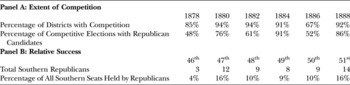
Sources: Congressional Quarterly's Guide to U.S. Elections (Panel A); Jeffery A. Jenkins, “Partisanship and Contested Election Cases in the House of Representatives, 1789–2002,” Studies in American Political Development 18 (Fall 2004): 112–135, Table 11: “Election Contests and Republican Seats in the Former-Confederate South, 1867–1911.” (Panel B)
Note: States are: Alabama, Arkansas, Florida, Georgia, Louisiana, Mississippi, North Carolina, South Carolina, Tennessee, Texas, and Virginia.
Also, if there had been a retreat from the party's investment in Southern politics, one would hardly have expected national Republicans to raise the issue of Southern elections to a constitutional level, but that stance was adopted for a good reason. About 42—or nearly 50 percent—of ex-Confederate House districts in the mid-1880s were either demographically majority or largely African American.
During Reconstruction black adult males became the core voting constituency of the Republican Party in the South. Table 2 lists the forty-two Southern districts from that era that had a majority or near-majority African American population. Demography is of course an imperfect proxy for the correct measure, which would be percentage of voting-age black adult male voters by district—a quite difficult measure to derive that was not, in any case, available to members of Congress in the 1880s. Taking population percentage nonetheless as a useful indicator, one can appreciate the full extent of the problem that gave rise to Republican concern by simply reading down the two columns in Table 2 out loud to oneself, checking the racial demography of each House district as one goes along and noting which party controlled the district in 1889, the year in which the 51st Congress assembled.
Southern House Districts With Black Population Majorities or Near Majorities (1883–1889)
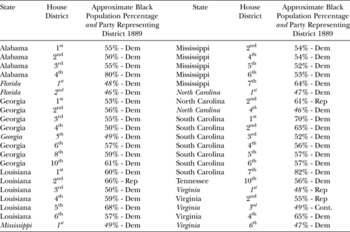
Source: Paul Frymer, Uneasy Alliances: Race and Party Competition in America (Princeton University Press, 1999), Table 3.1, 76. Frymer included the Maryland 5th District (near majority) to get a total of 43, but I do not because it was not an ex-Confederate state.
Note: Near-majority districts are listed in italics.
All of the available evidence about African American partisan identity in the Gilded Age suggests that at the mass level, African Americans were fiercely Republican.Footnote 13 What Table 2 shows is almost complete non-representation of that partisan preference. There was, in fact, a huge problem of political representation in the House.
As Figure 1 shows, these were districts that had seen somewhat vigorous Republican electoral efforts early in the 1880s. The left-most bar for each election cycle, in black polka dot, indexes the number of these districts with no political competition during that cycle. The next bar over, in white polka dot, indexes the number that saw “token contestation,” ranging from 5 percent to 30 percent of the reported vote. “Modest contestation”—that is, the Republican candidates are able to garner between 31 percent and 44 percent of the vote—is the densely dotted black polka dot column that is third from the left. The next column, in densely dotted white polka dot, indexes the number “nearly won” by Republicans in that cycle. The dark cross-hatch column, second from the right, indexes the number of districts that Republicans won by a narrow margin, 51 perccent to 55 percent. The right-most column, lightly cross-hatched, indexes the number in that cycle that Republicans won easily, that is, at margins ranging from 55 percent and more (to 94 percent in one case in 1882).
Types of Republican Competition in Black or Near Black Majority Districts.
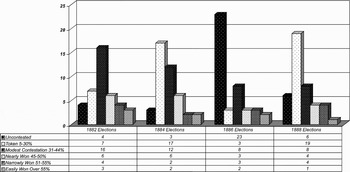
Surveying the cycles from right to left, one sees large increases in the “token contestation” category during the presidential election years, 1884 and 1888. The very tall left-most dark polka dot column for 1886 shows, in contrast, that the Republican Party's level of exertion crashed in the 1886 elections relative to 1882. Furthermore, from 1882 through 1888, the small number of districts that easily elected Republicans shrank. In general, there was a shift over the entire period from somewhat strong contestation to fairly weak.
Nevertheless, the considerable resurgence of activity in the “token contestation” category in 1888 suggests that Republican politicians on the ground were hopeful and perhaps laying preparations for a second run in 1890. Paralleling the evidence in Table One, Republican ambition and office seeking in Southern House elections apparently expanded. However, there was a great distance to go before that expansion of ambition would generate victories.
Republicans did not believe, however, their prospects were futile. Instead they thought about what they could do to fix their problem. As Senator John Sherman (R-OH) wrote in July 1890 to a constituent who warned that the Republican Party's promotion of a federal election bill would renew sectional conflict,
… it is alleged and apparently admitted that more than a million of lawful voters are substantially disfranchised by the Democratic party where their votes would change the result …; that in this way gross inequality of representation in Congress is made in favor of the South, so that the vote of one Democrat in the South is equal to two or three Republicans in the North. Now is it strange that we should feel this is an injustice that ought not to be inflicted by the South or tolerated by the North, that we ought if possible to secure a free and fair election of members of Congress [emphasis added], so that all citizens may have an equal vote and have their votes counted?Footnote 14
Exactly how much would re-intervention in Southern federal elections correct “the gross inequality of representation”? Useful perspective on this question comes from Figure 2. The bottom line in the plot shows (a) the actual Republican percentage of the U.S. House (counting friendly third-party representatives, such as Virginia Readjusters) by Congress, and the second line shows (b) a “maximum counterfactual” trend that includes 36 additional seats. (That number is chosen because in the 1882 elections 6 of the black or near-black majority districts went Republican without the need for a contest in the House; 42, as seen in Table 2, minus 6 is 36.) In two of the three Congresses before the 51st Congress, having all of these “missing” Southern House seats would have made a large difference in the percentage of the House controlled by the Republican Party.
Actual Vs. Possible Republican Percentages, 48th-50th Congress.
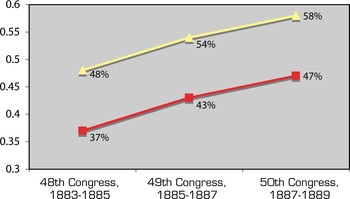
No doubt the prospect of getting all of the majority African American seats in the South was hardly seriously entertained among Republicans. Republicans appear to have understood, though, that they were in effect leaving money on the table. Thus, during the debate over adoption of the Reed Rules, Edward Allen (R-MI) pointed out that “ … instead of having sixteen or seventeen contested election seats here suppose we had one hundred and sixty-five; that is about the number we ought to have had during the last five Congresses if justice had been done.”Footnote 15 Doing something about the “gross inequality of representation” would help Republicans as a party more than reliance on contested elections to bolster House majorities.
However, was doing something about the “injustice … inflicted by the South,” as called for by Sherman, among others, institutionally feasible? Southern Democrats had fiercely, effectively resisted national electoral regulation from the very beginning of congressional reconstruction. Supporters of federal electoral regulation in fact conceded the likelihood of trouble. Senator Sherman obliquely referred to the costs of re-intervening in Southern elections in the same letter in which he defended electoral regulation: “… I dislike to vote for any measure that may … tend to renew sectional excitement …”
White Southern Democratic resistance to both Republican party building in the South and African American voting was extremely fierce. White Democratic Southern intransigence led, as well, to the semi-military electioneering in 1875 and 1876 in the black majority states Louisiana, Mississippi, and South Carolina, which set the stage for the great stand-off between the two parties in the 1876 presidential election. Finally, after the Compromise of 1877 there was a drop, as James and Lawson have shown, in criminal prosecution under those federal elections statutes, which had been specifically framed during the first term of Ulysses S. Grant for addressing voting rights violations in the South. Both the Hayes and Arthur administrations were internally conflicted about Southern elections policy.Footnote 16
So what made the calculus of renewed intervention worth careful consideration? Let me turn next to describing little-known institutional principles that pointed toward a new kind of federal electoral regulation in the South. They framed a limited, but still potent, kind of re-intervention in Southern elections as quite plausible, despite the history of implacable Southern Democratic opposition.
OI.2. Plausibility of Federal Election Regulation
The key to understanding the credibility of renewed federal electoral regulation is understanding the clear regulatory possibilities framed by a currently little-known but then well-tested Northern regulatory system. Reconstruction encompassed not just the South and the border states but also the North. The Northern Reconstruction featured, significantly, just as much electoral regulation as the Southern Reconstruction. Its electoral-regulatory provisions rested not on the Fourteenth and Fifteenth Amendments, as did the Southern system. They rested instead on the original Constitution of 1787, Article 1, Section 4:
The Times, Places and Manner of holding Elections for Senators and Representatives, shall be prescribed in each State by the Legislature thereof; but the Congress may at any time by Law make or alter such Regulations, except as to the Places of choosing Senators.Footnote 17
That Northern system of electoral regulation could be made to cover not just Northern jurisdictions but Southern jurisdictions as well. As Pamela Brandwein will show in forthcoming work, federal officials understood this as early as 1876. In the national elections of 1876, Attorney General Alphonso Taft deployed thousands of federal marshals in Southern states under the direct authority of Article 1, Section 4 of the Constitution.Footnote 18
Northern electoral regulation on the basis of Article 1, Section 4 had begun well before Taft deployed federal marshals. Reacting in 1870 to the largest fraud ever devised in American electoral history—the production by Tammany Hall of 60,000 naturalization papers one month before the 1868 elections in New York state, which tainted 16 percent of the state's presidential voteFootnote 19—a Republican Congress placed federal elections administration in cities under direct national control with the 1870 Naturalization Act. It criminalized fraud in the naturalization and citizenship process. Under this statute, federal judges could also, in response to citizen petition, provide, in cities with upward of 20,000 inhabitants, for bipartisan temporary federal supervision of elections to the House. In such cities, furthermore, Congress authorized the U.S. marshal for the district in which the city was located “to appoint as many special deputies as may be necessary to preserve order at any election at which representatives in Congress are to be chosen … to preserve order … and to arrest for any offense or breach of the peace committed in their view.”Footnote 20
Then, in the 1871 Federal Elections Act, Congress further elaborated the new regulatory scheme. Any two citizens of a city with population in excess of 20,000 could petition a federal judicial circuit for special bipartisan supervision of the House election in the district within which the city was located. The federal supervisors were authorized to assure that no eligible person was omitted from the rolls and to strike the names of unauthorized voters. They were also permitted to assemble and maintain their own registration lists. On election day they and their deputies, as appointed by a United States Marshal, physically surveilled the polling places from the time they opened until they closed and could personally inspect and count ballots as they chose. Anyone caught interfering with any voter's right to vote could be brought immediately before a federal judge or commissioner.Footnote 21
In about two years, then, midway through Reconstruction, Congress established an electoral-regulatory structure for U.S. House elections in urbanized districts. It did not operate everywhere; it affected, at most, about 14 percent of U.S. House districts.Footnote 22 In presidential election years, it was predominantly targeted on New York City, as David Quigley has shown.Footnote 23
With the 1872 Civil Appropriation Act, Congress subsequently extended the urban regulatory scheme to rural House districts, but only in part. Under Chapter 1425 of the Civil Appropriation Act of June 1872, any ten citizens of any congressional district could petition for federal observers (as opposed to the supervisors provided by the first two statutes of 1870 and 1871.)Footnote 24 As shown in Figure 3, “Fiscal Growth of the Federal Electoral Regulatory System,” spending on federal election regulation grew briskly after its establishment.
Fiscal Size of Northern Electoral-Regulatory System.
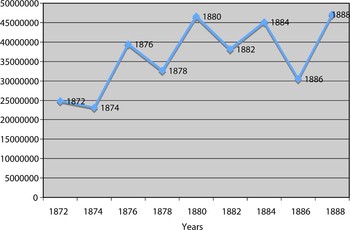
In the 1872 presidential election, expenditures on three categories of United States elections officials—chief supervisors, supervisors, and deputy marshals—totaled $222,343.00 in nominal dollars, or as seen in the plot in Figure Three, about $25 million in 2006 dollars. By 1888, before the assembly of the 51st Congress, the program had grown to $407,226.00 in nominal terms, or as shown in the figure, to about $47 million (using the most conservative conversion equivalent, the “unskilled wage” equivalent.)Footnote 25
It would have been surprising if this non-Southern system had never generated litigation, but it did. Of the many federal and Supreme Court cases it triggered, two were particularly important: one from Baltimore and another from Cincinnati. The results of these cases showed to Republicans that the Article 1, Section 4 system enjoyed extraordinary (and today rarely remarked) backing from the Supreme Court.Footnote 26 The Supreme Court's strong signals enhanced the plausibility of counterattacking against the Democratic Party in the ex-Confederacy through some new form of federal election regulation.
Court Approval of the Election Regulation System
In Ex parte Siebold 100 U.S. 371 (1879), the Court dealt with a case in which Baltimore elections officials physically prevented federal supervision of the federal elections in Baltimore in fall, 1878. In Ex parte Clarke 100 U.S. 399 (1879), a companion to Siebold, the Court dealt with the prosecution of a Cincinnati city councilman who flagrantly mishandled ballots in violation of both Ohio and U.S. law during these federal elections. What the Court did was stunning: it denied writs of habeas corpus in both cases. The regulatory jailing of state and local elections officials was perfectly constitutional.
To accomplish this result, the Court rested these seven–two decisions on a centralizing and muscular reading of Article 1, Section 4 of the Constitution. (Recall that Article 1, Section 4 states, “the Congress may at any time by law make or alter” the regulations for the “times, places, and manner of holding elections for Senators and Representatives.”) In the Court majority's view, the Enforcement Act of 31 May 1870 and the supplement passed 28 February 1871 regulated “elections of members of the House of Representatives, and were an assertion, on the part of Congress, of a power to pass laws for regulating and superintending said elections, and for securing the purity thereof, and the rights of citizens to vote thereat peaceably and without molestation.” In violating these statutes, the petitioners violated the Constitution.
Article 1, Section 4 had a “natural sense.” Congress could legislate to control national elections as it saw fit. As for the prosecution of state and local elections officials, the United States had a constitutional interest in “the faithful performance … of their respective duties. This necessarily follows from the mixed character of the transaction, State and national. A violation of duty is an offence against the United States, for which the offender is justly amenable to that government. No official position can shelter him from this responsibility.” The opinion for the Court in Siebold ended on a strongly nationalist note: “The true doctrine … is this, that whilst the States are really sovereign as to all matters which have not been granted to the jurisdiction and control of the United States, the Constitution and the constitutional laws of the latter are … the supreme law of the land; and when they conflict with the laws of the States, they are of paramount authority and obligation.”Footnote 27
Of course, both Clarke and Siebold were Northern decisions. Recall that Sherman was thinking, however, about the South. Was there any indication from the Supreme Court about the South that would, in turn, nicely frame the plan of nationalizing the Article 1 system as a plausible idea?
The missing link is the remarkable 1884 case, Ex parte Yarbrough, 110 U.S. 651, which had been initially prosecuted for the United States by Emory Speer, a former Independent Democrat congressman from Georgia and later appointed to the federal bench in Georgia.Footnote 28 The case facts were unhappily familiar. Yarbrough, several kin, and other white males were involved in a klan-like conspiracy to intimidate black voters in a U.S. House election in Georgia. Their defense argued that there was no valid indictment or process under two former pieces of the federal elections acts (by then placed in the Revised Statutes, per the code revision of 1874). One section criminalized any conspiracy against a citizen's enjoyment of any right under the Constitution; the other criminalized conspiracy to obstruct voting in national elections. These sections of the code, the defense claimed, were simply unconstitutional.Footnote 29
A unanimous Court emphatically disagreed. Speaking for it, Justice Miller began by clearly focusing on the right to vote in a House election: “the offense charged in this indictment [is] that the defendants conspired to intimidate Berry Saunders, a citizen of African descent, in the exercise of his right to vote for a member of the congress of the United States …” He then marveled at the temerity of the defense argument. Miller asked, “Can it be doubted that Congress can, by law, protect the act of voting, the place where it is done, and the man who votes from personal violence or intimidation, and the election itself from corruption or fraud?”
After treating congressional protection of federal officers and federal elections, Miller focused on whether the individual right to vote should be federally protected. This was an obvious and necessary move for Miller to make; after all, the Constitution placed the power to set suffrage qualifications in the states. However, Miller emphasized that matters had changed. “The fifteenth amendment … by its limitation on the power of the states in the exercise of their right to prescribe the qualifications of voters in their own elections, and by its limitation of the power of the United States over that subject, clearly shows that the right of suffrage was considered to be of supreme importance to the national government, and was not intended to be left within the exclusive control of the states.” He then quoted the entire amendment, including Section 2, which reads “The Congress shall have power to enforce this article by appropriate legislation.”
Miller then suggested that the Fifteenth Amendment was part of a general pattern of growing and appropriate federal control, which dated to the United States' response to the nullification ordinance. Miller agreed that the amendment “gives no affirmative right to the colored man to vote” but then announced that “it is easy to see that under some circumstances it may operate as the immediate source of a right to vote.” After giving an illustration involving Delaware, where the Fifteenth Amendment automatically invalidated the state's constitutional “whites only” restriction, Miller held that “[i]n such cases this fifteenth article of amendment does, proprio vigore [with its own force], substantially confer on the negro the right to vote, and congress has the power to protect and enforce that right.”
Furthermore, the Fifteenth Amendment affected all national electoral processes. “This new constitutional right was mainly designed for citizens of African descent. The principle, however, that the protection of the exercise of this right is within the power of Congress, is as necessary to the right of other citizens to vote as to the colored citizen, and the right to vote in general as to the right to be protected against discrimination.” [Emphasis added.] Miller ended by writing, “The rule to show cause in this case is discharged, and the writ of habeas corpus denied.”Footnote 30
It is essential to step back and fully recognize the result: a unanimous Court ruled that in order to protect the electoral processes that made it a national representative assembly, Congress could protect the right to vote of any citizen, black or white.Footnote 31 Congress could in fact directly criminalize any individual behavior—not just the state and local official behavior of Siebold and Clarke—that tainted the integrity of national elections. To enforce such criminal law, the United States could constitutionally deploy and protect federal officials in the states and localities.
Putting the Siebold-Clarke doctrine together with Yarbrough, a contemporary Democrat or Republican could plausibly foresee that under a new federal elections statute, national supervisory officials in the South would have the authority to inhibit and sanction behavior by private citizens that attacked black voters as they exercised Fifteenth Amendment rights. Not only would the federal supervisors be immune from arrest or interference by state and local officials, they could also themselves arrest and process private individuals who operated in Southern congressional elections to intimidate black and white voters before, on, or after election day.
Furthermore, there was a telling difference from the Court's review in 1876 of the elections statutes that Congress wrote during the first Grant administration to manage elections in the South. The Grant administration implemented those statutes for several years in the South before the Supreme Court reviewed them. When the time finally came for Court review, the decisions were cryptic—so much so that today they are often seen, albeit incorrectly, as evidence of the Court's hostility to black voting rights.Footnote 32
Clarke, Siebold, and Yarbrough, however, set up a different relationship between the Supreme Court and federal-electoral regulation. New Article 1 federal elections regulation that protected black Southern voters in U.S. House elections came “pre-approved,” as it were. Congress would enact it after the Court had already reviewed and had approved the plan's essential components.
What remained open was the actual design of the plan. As we will see, two options were eventually sharply debated among Republicans: (a) use the petition trigger of the 1871 Federal Supervisory Act, which would subject only Southern districts to federal supervision or (b) administer all U.S. House elections without a petition trigger. However, before policy design became an intra-party issue, there was an inter-party politics of making a national issue out of the corruption of Southern House elections.
OI.3. Moving Toward Conflict
In the wake of such positive signals from the Supreme Court, Republicans actively showcased the Southern elections problem. In the Senate, where they held sway, they pursued during the 49th and 50th Congresses a major congressional investigation via the Committee on Privileges and Elections. Also, they highlighted the issue in the 1888 presidential platform. In his letter of acceptance of his nomination for the presidency, Benjamin Harrison discussed the need for federal control of elections. Harrison then pursued the policy question in detail both in his inaugural address and in his first annual message (issued on assembly of the 51st Congress in December of 1889.) The Republican Party prepared itself, in short, for a fight with the Democratic Party.
The Washington County, Texas Investigation
Events in Washington County, Texas (between Austin and Houston in southeastern Texas) in 1886 and afterward created a crisis that several Senate Republicans worked hard to publicize. (There were other crises in Louisiana and Mississippi, but they got less Senate attention.) From 1869 to 1884, Washington County was a Republican stronghold. In 1886, however, the Democrats who gained control of the county in 1884 blocked a Republican comeback with gunfire, lynching, and assassination, including the assassination of one of the witnesses who appeared before a Senate investigation. A vigorous effort by the United States to try the leaders of the various interlocking conspiracies eventually ended with federal juries finding the defendants not guilty.Footnote 33
The events in Texas handed the Republican-controlled Senate Committee on Privileges and Elections a rich opportunity for publicity and position taking. Senator George Frisbie Hoar (R-MA), a protégé of Charles Sumner and one of the country's leading experts in election law, chaired the committee.Footnote 34 Several of his Republican colleagues on the committee were equally well versed in election law about the crisis that the party faced in Southern elections administration. To dramatize the events in Texas, they brought sixteen witnesses to Washington in 1888, at a cost of about $1,179,000 (in 2006 dollars), and they eventually issued, in February 1889, an enormously detailed report that ran over 800 pages.Footnote 35
The conclusion of the report of the Committee on Privileges and Elections framed the events in Texas as more than an isolated incident: “… the committee has thought … that the actual case presented not unfairly the features that illustrate the political disorders which afflict portions of our country where the population is … nearly divided between white and colored citizens …” The committee majority then obliquely recognized the prosecutorial effort by the local United States Attorney (a Democratic appointment) by referring to “the difficult province of regulating Federal elections where the constitutional rights of voters are not acceptable to the general sense and interests of the communities.” However, the future prospect of the “the absence of such efforts, or a languid prosecution of them” led the committee to recommend “careful revision of the existing laws regulating elections of members of Congress … with the view of providing for a more complete protection of the exercise of the elective franchise by act of Congress, and more efficient provisions for the punishment of offenses against it.”Footnote 36 [Emphasis added.]
Senate Democrats objected strongly to the Senate's consideration in early 1889 of the report on the Washington County investigation. Through a filibuster they prevented the Senate from taking up the report. The filibuster, however, only conceded the point: federal electoral regulation was now on the national agenda.Footnote 37
The 1888 Republican Platform
By the time the Senate deadlocked over the Washington County report in February 1889, the Republican Party had elected a new president, ex-Civil War general and former Indiana Senator Benjamin Harrison. The platform that he ran on prominently featured the Southern elections issue. It began with a call for “effective legislation to secure the integrity and purity of elections. … We charge that the present Administration [the Cleveland administration] and the Democratic majority in Congress [that is. the House] owe their existence to the suppression of the ballot by a criminal nullification of the Constitution and laws of the United States.”Footnote 38 Given the history and rhetoric of sectional conflict in American history, the platform phrase “criminal nullification” was strong wording.
Benjamin Harrison's Agenda Setting
In accepting the Republican nomination, Harrison published a formal letter of acceptance for the fall campaign detailing all of his policy views, including a discussion of Southern elections regulations. Harrison denounced the “evil results of election frauds” and called for a “free ballot … honestly counted … Every constitutional power should be used to make this right secure and punish frauds upon the ballot.”
Our colored people do not ask for special legislation in their interest, but only to be made secure in the common rights of American citizenship. They will, however, naturally mistrust … those party leaders who appeal to their race for support only in those localities where the suffrage is free and election results doubtful, and compass their disfranchisement where their votes would be controlling …Footnote 39
Harrison's inaugural address, given just two weeks after the Senate report on Washington County, covered the elections policy problem in some detail as he closed his address. Harrison found it “very gratifying to observe the general interest now being manifested in the reform of our election laws.” Alluding to the then-leading policy idea among Republicans, Harrison added “The National Congress has not as yet taken control of elections in that case over which the Constitution gives it jurisdiction.” However, (and here he referred to Article 1, Section 4), “It was clearly … in the contemplation of the framers of the Constitution that such an exigency might arise, and provision was wisely made for it. The freedom of the ballot is a condition of our national life, and no power vested in Congress or in the Executive to secure or perpetuate it should remained unused upon occasion.”Footnote 40
As the 51st Congress assembled in Washington in December 1889, Harrison sent his first annual message. By then, and in contrast to the stance that Harrison took in the inaugural address, the president sided with one of the two options that had come to be discussed by Republicans. One was regular and automatic federal administration of House elections, which Harrison appeared to endorse in the inaugural address. The other was building upon the existing Clarke–Siebold machinery, based on citizen petition to trigger federal supervision.
… in many parts of our country where the colored population is large the people of that race are by various devices deprived of any effective exercise of their political rights … I earnestly invoke the attention of Congress to the consideration of such measures within its well-defined constitutional powers as will secure to all our people a free exercise of the right of suffrage … under the Constitution and laws of the United States. … The power to take the whole direction and control of the election of members of the House of Representatives is clearly given to the General Government. A partial and qualified supervision of these elections is now provided for by law, and in my opinion this law may be so strengthened and extended as to secure on the whole better results than can be attained by a law taking all the processes of such election into Federal control. [Emphasis added.]Footnote 41
The Prospect of Conflict
In short, Republicans agitated the Southern elections problems in 1888 and 1889. They considered whether the United States should automatically administer federal elections, or whether, instead, federal officers should co-supervise federal elections upon citizen petition. As Republicans brought the issue onto the national policy agenda, the prospect of inter-party conflict clearly came into view.
All over Dixie, Republican and independent parties called for fair elections during the 1888 state conventions. In Mississippi, for instance, Republicans ran a state-wide ticket in 1888, their first since 1875, with former Confederate General James Chalmers running for governor. The party ran on a platform attacking the “present state government” for relying on a “fraudulent and violent suppression of free suffrage.” The ticket functioned, at least partially, until violence forced its cessation. The party then issued a statement that “our candidates are not safely allowed to discuss or protest. We refer not only to such well-known slaughters as Kemper and Copiah … Yazoo City and Leflore, but the nameless killing by creek and bayou.” Mississippi Republicans thus urged a federal elections statute.Footnote 42
The Alabama Republican Party called for a “national law to regulate the election of members of Congress and presidential electors;” the Arkansas Union Labor Party, representing the Agricultural Wheel, the National Farmers Alliance, and the Knights of Labor, fused with the state Republican Party and called for the “consolidation of the elections, State and national;” the North Carolina Republican Party called for protective state legislation that would assure “free and just exercise of the elective franchise;” the South Carolina Republican Party asked “Congress to enact such legislation as shall secure a fair election at least for members of Congress and presidential electors;” and the Waco gathering that fused the State Alliance, Knights of Labor, Union Labor, Prohibition, and Republican Parties of Texas called for a “free ballot and a fair count.”
However, Republicans could not have doubted—the Washington County events and the killings in Mississippi suggested as much—that Democrats intended to fiercely fight any effort in Congress to pass a statute that would bring federal control into Southern election administration. What Republicans had in mind was rolling back electoral and political gains that Democrats had made in the ex-Confederacy in the wake of the Compromise of 1877.
Federal election regulation was zero-sum: one side won, the other lost. To use Lowi's classic policy typology, the federal election plan was both redistributive and regulatory. The idea foretold fierce party conflict.Footnote 43
OI.4. Private or Public Drawing of Connections Before the 51st Congress
How could Republicans hope to develop the policy at all? In the House of Representatives the Republicans would enter the 51st Congress with a “razor-thin majority of only three members.”Footnote 44 If the two parties were squaring off for a major battle, the governability of the House needed to be secured.
The 51st Congress would not meet for its first session until thirteen months later in December 1889. This was enough time for making a connection between House rules and an elections bill. One would expect to find leading Republicans saying—in print, confidential correspondence, or both—that the House Republicans would be sure to use or devise legislative procedures that in turn would meet Democratic opposition to an elections statute.
In a piece titled “The Coming Congress” for the September 1889 issue of The North American Review, Henry Cabot Lodge (R-MA), who authored the Federal Election Bill of 1890 in the House, clearly predicted that rules reform would be necessary before the House could pass election legislation. Lodge's statement was probably widely read: the North American Review had a circulation of 79,000.Footnote 45
Lodge began his preview of the 51st Congress and its agenda by remarking on the return of fully unified Republican control for “the first time in fifteen years.” He then, however, complained that the prospect of “effective legislative action” was blocked by a “radical evil which is destroying the life of the Lower House, and which for some time has made all majorities powerless … the rules of the House have been developed into an ingenious contrivance for stopping all legislative action which does not receive a unanimous vote. … The American House of Representatives to-day [sic] is a complete travesty upon … government by the majority … nobody governs and nothing is done.”
Lodge continued,
This question of restoring movement to the House of Representatives is that which will confront the Fifty-First Congress at the threshold of its existence … The contest over the rules is the first thing with which the Fifty-first Congress will be called on to deal, and until it is settled nothing else, practically, can be done. When this is settled,—and it must be settled rightly, or else the Fifty-first Congress will never do anything except wrangle over the rules,—the time will come for dealing with other measures of a widely different character from a set of parliamentary regulations upon which the legislative machine revolves.
Lodge thought that the first question to be taken up would probably be the tariff issue, which had been quite prominent in the 1888 campaign. After calling for the resolution of that policy question “upon the protective principle,” Lodge then launched into an equally extended treatment of election legislation:
There is another matter, more important than any tariff can ever be, which is certain to receive the careful consideration of Congress, although it played but a slight part in the last campaign … a fair ballot throughout the length and breadth of the land. … If an election law properly drawn is passed by Congress, it will be enforced, and although it may not put a stop to all the evils which exist, it will so greatly improve the condition of things … that the only wonder will be that we have gone so long without it.Footnote 46
In short, Lodge foresaw that the “contest over the rules,” when “settled,” would yield “a set of parliamentary regulations upon which the legislative machine revolves.” The resulting legislation from that “machine” was certain to include the tariff, but also a “matter more important than any tariff could ever be … a fair ballot throughout the length and breadth of the land.” Procedural and policy change appear in Lodge's mind to have been a package, and he pointed that out to America's educated elites.
OI.5-OI.6. Reed's Rules and the Federal Elections Bill in the House
How, though, did procedural politics and the politics of the Federal Elections Bill actually overlap? Recall that the observable implications of interest at this point are:
• confluence of rules reform and elections bill politics
• explicit connection in House debate between rules change and an elections bill
These items take us from January to March of 1890.
The best-known part of those months in the life of the 51st Congress is Reed's legendary display of parliamentary cunning. He quite cleverly generated the innovative elements of his eponymous rules and his caucus' support for his parliamentary inventions before Republicans formally adopted them in mid-February 1890. As he did this, a House select committee also developed the Federal Elections Bill that eventually passed the House in mid-summer 1890.
These two pincers came together in early 1890. The first pincer has been described many times; the description here will add nothing new (except interesting detail, in a footnote, concerning the clerk of the House.) However, the second pincer that closed on the first—the activity of the select committee—has not been previously described. The discussion below is based on the minute book of the select committee.
Also, no analysis until now has pointed out that several Republicans openly connected the Reed Rules and the Elections Bill during the days of debate that preceded formal adoption by the House of the Reed Rules. Below I sketch the debate and quote from previously unremarked passages in the Congressional Record.
Reed's Parliamentary Cunning
The 51st Congress opened with five widely known facts. They hardly bode well for any legislative activity, much less the controversial Elections Bill.Footnote 47 First, the quorum size for a roll-call in the 51st Congress was then 165. Second, Republicans at the outset had only three more votes than this number. Third, in this context a disappearing quorum was devastating.
A quick aside on the disappearing quorum is essential here. By the 51st Congress, the quorum requirement in Article 1 of the Constitution (namely, a majority of the entire House) had metamorphosed into a tool of minority obstruction. On some days the minority in the chamber outnumbered the actual majority also in attendance. However, relying on the view that Article 1 referred to the partisan majority, the entire minority would refuse, despite their physical presence, to answer to a roll-call. Business came to a stop until, for example, the Sergeant at Arms located more members of the majority. Reed dubbed this “the invisibility of the visible.”Footnote 48 He thought that it had made “the House of Representatives the most unwieldy parliamentary body in the world.”Footnote 49
Consequently (and fourth), if the Democrats staged a disappearing quorum on a day when at least four Republican members were absent from the chamber, due to illness or some other reason, then Republicans could apparently do nothing until they assembled a roll-call quorum.
Fifth, there was, however, a reserve from which the Republicans could eventually grow themselves a larger roll-call quorum. This was the unusually large number of election contests. There were seventeen election contests in all on the docket of the standing Committee on Elections.Footnote 50
Several of these contests could be resolved in favor of the Republicans in, say, January and February. That would take time, yes, and quite a bit of party discipline, particularly because the old Radical Republican William Kelley of Pennsylvania died 9 January 1890, cutting the majority to two. However, with enough hard work and a vigorous Sergeant-at-Arms, a Republican caucus large enough to vote any new rules would in time emerge, and the House would then focus, it was expected, on the regulation of dilatory motions. Perhaps then Republicans would develop legislation. The opening test of the only seemingly feasible solution to the Republican quorum dilemma came in a vote on a contest from a West Virginia district on 29 January 1890. The inter-party skirmish appeared to painfully demonstrate Republican impotence. Even though 165 Democrats were in the chamber, they refused to answer to a roll-call. There were Republicans in the chamber answering to a roll-call, but only 162. Three were missing. Evidently Reed was less of a skillful leader than it seemed; he had proceeded to the first step in the election contest resolution of his quorum problem without even having a quorum!
It was then that Reed did the utterly unexpected—and his move was all the more consequential because no member of the House knew that it was coming. In all likelihood, Reed's plans were known to the clerk, Edward McPherson,Footnote 51 but Reed's intended tactics were not known to any member of the House.Footnote 52
Reed began to name Democrats who had not voted as answering to a roll-call, coolly instructing the clerk to record each name as he read it out loud. The clock ticked by; as it did, the chamber turned to bedlam. Never losing control, though, Reed worked his way to an address on the need for legislative efficacy. He ended the day's drama by officially ruling that a quorum was present. Two days later a quorum-sized Republican rank-and-file unanimously supported Reed's ruling in a vote, rejecting the Democratic appeal from his ruling that the Speaker could count a quorum.
By February 1890 Reed acquired the power to run the House—he had been proceeding under “general parliamentary law” up to this time—despite the narrowness of his majority and without having to wait for the election contest process to bring in more Republicans. When Democrats moved to adjourn the House on the heels of his quorum ruling victory, Reed ruled that that was a dilatory motion and that it was out of order—a ruling which was promptly sustained by Reed's rank-and-file. Both of these highly contentious innovations, the Speaker's right to count a quorum and the Speaker's right to unilaterally quash dilatory motions, would soon be incorporated into what became known as the Reed Rules.
Lodge's Select Committee on Elections
Even as Reed was plotting his extraordinary coup of 29 January 1890, a select committee on elections, chaired by Henry Cabot Lodge, had opened for business. It was the Committee on the Election of President and Vice-President and Representatives in Congress. [emphasis added]Footnote 53 The committee first met as a whole on 9 January 1890, at which time it selected a clerk and apprised itself of the various bills and joint resolutions that had been referred to it. It also voted to receive a “committee representing the Conference of Colored Voters which was held at Richmond, VA, Dec. 17. 1889 …” That meeting happened on Saturday morning, 25 January 1890, and the committee then voted to hear testimony from two Mississippi Republican leaders in early February “in relation to election methods in that state.” The Mississippi testimony occurred at two separate meetings of the committee, and at the second was accompanied by testimony from witnesses out of Alabama and Virginia.Footnote 54
A dramatic turn in the hearings came in March 1890 with the appearance in Washington of Albion Tourgee. Tourgee was a prolific novelist and a former Reconstruction-era carpetbagger circuit judge in North Carolina. He was then “without a doubt the nation's leading white advocate of racial justice and equality.” (Tourgee later served as lead counsel in the ill-fated anti-segregation test case Plessy v. Ferguson.)Footnote 55
Tourgee traveled to Washington to lobby for one of the two ideas for an elections bill, namely, automatic federal administration of the elections process. Initially advocated by John Sherman, this was the plan that President Harrison supported in his inaugural address but then (in his first annual message) rejected in favor of building on the existing Article 1, Section 4 machinery. Tourgee, however, had written a House bill embodying the 100 percent federal control proposal and found a sponsor for it in Representative Harrison Kelley of Kansas who introduced it as HR 8286.
It soon developed that Reed himself supported regular and automatic federal administration and that he and Tourgee had found kindred spirits in each other. While in Washington to testify before Lodge's committee, Tourgee “lunched with the President, from whom he sought a judgeship.” He also “conferred for hours with the Speaker of the House, Thomas B. Reed.”Footnote 56
In short, the select committee did what it was supposed to do: set the House agenda.Footnote 57 This effect was endogenous; it was planned by Reed and by Lodge whom Reed had appointed to chair the committee. “General parliamentary law,” however, would hardly be enough to put through such a controversial measure. Formal adoption of a new procedure would be necessary.
The Floor Debate on Adoption of the Reed Rules
By the time Tourgee met with Speaker Reed to discuss the elections bill, Republicans had in fact explicitly tied their adoption of the Reed Rules with their plan for a federal elections bill. On 7 February 1890, Joseph Cannon (R-IL) (later Speaker himself) introduced the report of the Committee on Rules. For the next several legislative days (and for a week in actual calendar time, until 14 February 1890) the House was in the grip of an epic debate.Footnote 58
Republicans offered four separate speeches, which stated that the point of the new rules was to pass a federal elections bill. One of these placed the elections bill within a larger portfolio of policy proposals. The others tightly connected the proposed rules change to the elections bill.Footnote 59
David Henderson of Iowa (another future Speaker) delivered an especially frank and sarcastic speech (part of which was quoted at the beginning of this article.)Footnote 60 In outraged invective, he analogized the Democratic attacks on Reed to the clubbing of Charles Sumner on the Senate floor by a Southern congressman. He turned to what he dubbed the “real question” in the debate over whether to adopt the Reed Rules:
The real question is not that which is now attracting the attention of the bright intellects on the floor. Not by any means. What is the issue? I will give you my answer. It is this: Shall the election methods in certain states of the Union now boasted of by men high in recognized power be brought into this House of Representatives and be here protected and enjoyed? That is the real issue. Election cases and proposed election laws. Ah yes; they are the trouble. These disturb you. Gentlemen, understand this here and now: If there is a member on this floor entitled to his seat, this side of the House will stand by him … but if there is a man on this floor who holds his seat by black-hearted fraud or red-handed murder we will unseat him if we have the power. [Loud applause on the Republican side.]
As has already been noted, Henderson then announced:
Elections laws; yes, God knows we need them. These are the underlying questions of this mighty struggle … I shall relax no effort that will make it impossible for the minority to throttle the expressed wishes of the majority in this country. The Constitution is my warrant, and I shall fight for the rules reported to this House. [Empasis added] [Loud applause on the Republican side.]Footnote 61
A later defense of the proposed rules during the debate on the rules was incendiary. Harrison Kelley of Kansas, whose national control elections bill was supported by Albion Tourgee (and as we shall see by Reed himself), delivered it on 13 February 1890. Kelley denounced the Democrats as a party that systematically practiced political murder in the South: “Political murder seems to be a pastime and a ‘nigger-hunt’ … a sport. …” All that the personal attacks on Reed lacked in order for the Democratic caucus to resemble “a typical Democratic election mob of Mississippi” was Democrats arriving for congressional debate with rifles and pistols.
With the adoption of these rules, Mr. Speaker, I believe we will be able to pass some law, in spite of the opposition of the Democratic party, that will protect the citizens of this great country from the Democratic assassins in the South. [Emphasis added] … I hope we shall be able to enact a law which will secure what we so justly desire. … [Applause on the Republican side.] [Here the hammer fell.]Footnote 62
Small wonder, of course, that “the hammer fell.” Led by a talented legislative strategist, House Republicans were telling Democrats in the chamber that they meant to use the new rules of the House to pass a federal elections bill. That bill would involve the federal government in directly controlling the South's violent electoral processes. It was also certain to weaken the Democratic Party as it rebuilt the Republican Party. Democrats, however, deserved such weakening: their party harbored “assassins.”
What did Democrats have to say? Democrats dwelt at length on the alleged unconstitutionality of the Reed Rules, Reed's high-handedness, the valuable uses of the disappearing quorum as a worthy tactic for blocking bad legislation, the adequacy of the rules as they were before the Reed Rules, and the implications of the proposed rules for committee power and for the individual legislator's ability to stand out in the legislative process.
However, there was also direct response to the issue. For example, on the last day of debate, 14 February 1890, Judson Clements (D-GA) attacked the proposed rules and stirred up the House by singling out David Henderson's “real question” speech, saying:
The Republican party has habitually claimed a great deal more from the colored people than that party is entitled to … No election law you can pass with reference to reclaiming to your party a solid colored vote will accomplish that result …Footnote 63
Evidently Clements caused a commotion because “the hammer fell” to cut him off.
One Democrat was, moreover, quite explicit about the connection between the Reed Rules and the plan to pass new electoral law. Here is Benjamin Enloe of Tennessee, speaking on 13 February 1890:
We are told by the majority that this Draconian code … is necessary to prevent filibustering and to enable the majority to proceed with public business. The plea of necessity is correct, but the character of that necessity … is a political necessity. The Republican party finds itself with such a narrow majority in the House that it is unable to carry out the schemes of infamy to which it committed, without resorting to revolutionary methods to increase that majority … It sees power slipping from its grasp … all over this Union, and something must be done to stay its failing fortunes or all is lost. Federal election laws must be passed, race disturbances must be fomented, reconstructions and robbery must be reinaugurated to save the falling fortunes of this desperate political organization …Footnote 64
In effect, Enloe said that the party was using the Reed Rules to pass an election law that would help the party rebuild itself.
To summarize, the mid-February 1890 House debate over adoption of the Reed Rules saw candid and often heated recognition, on both sides of the aisle, that procedural innovation would permit new federal regulation of elections and, in turn, restructure party politics. As a Kentucky Democrat noted on 12 February 1890, prefiguring Enloe's analysis:
Reckless appropriations … Federal election schemes with a horde of salaried officers, a tariff bill … are some of the iniquities that will soon come from the Republican Pandora box. I believe the despotic and revolutionary code of rules … is the first movement in a grand plan, originated by the Republican leaders, for the purpose of perpetuating their power and their control of the Government [Emphasis added]…Footnote 65
OI.7. Reed on the Meaning of the Reed Rules
The bitterness of the struggle in the House soon worsened, in large part, because Reed himself was very strongly committed to a federal elections bill. All of the various pieces have not been put together before, but when one does, the picture is clear enough.
Reed never said that his eponymous rules were connected to the elections bill. Reed's statements about what he did always emphasized that they were about making the House and American government work better. However, Reed did connect his reforms to the elections bill through his own leading role in the House politics of the Federal Elections Bill.
Reed was a racial liberal, someone who could talk comfortably “for hours” with Albion Tourgee. His DW-NOMINATE scores are striking. His “second dimension” score for the 50th Congress is very large: -.482.Footnote 66 (Such “second dimension” scores tap non-economic ideology, for example racial liberalism or conservatism.) Remarkably, the “second dimension” scores of Thaddeus Stevens – for the 39th and 40th Congresses are smaller: -.338 and -.297 respectively. Such scores are, to be sure, estimates generated by algorithmic data reduction, not anything “real,” but they illuminate the surprising extent of Reed's racial liberalism.Footnote 67
After meeting with Tourgee, Reed went public with his support for the idea of automatic and regular federal control of House elections. It was one of the two policy options kicking around inside the Republican Party. Recall that President Harrison initially backed it before he switched to the alternative of building on the Northern electoral-regulatory system, which was described earlier.
Republicans were split over policy design. Some, including Reed, wanted regular and nationwide federal administration of federal elections. Others, such as Henry Cabot Lodge, wanted a targeted approach of extending the Northern system with its petition trigger below the Mason-Dixon line.
Reed backed the option of full federal administration with a speech that he gave in Pittsburgh, 27 April 1890, to the American Republican Club on the occasion of the late Ulysses S. Grant's sixty-eighth birthday:
… speaking for myself, it seems to me that the only wise course is to take into federal hands the federal elections. Let us cut loose from the state elections, do our own registration, our own counting and our own certification … Against this course no constitutional objection can be urged. The Yarbrough case, a decision of the Supreme Court, covers it all over. … Then, as the constitution of the United States and the principles of our American system always intended, the voter, whether white or black, will contribute his share to the government of all, and the hopes which were at the foundation of all of our great sacrifices will be finally and completely fulfilled. [Emphasis added]Footnote 68
The lines inside the party, however, were still being drawn. Only a few days later Reed received a long memorandum from the Senate's other leading Republican election lawyer besides Hoar. This was Senator William E. Chandler (R-NH) who had been pushing for new federal electoral regulation in the South since arriving in the Senate (after service as Secretary of the Navy during the Arthur administration.)Footnote 69
Chandler tried to persuade Reed to abandon his preference for full federal control. He told Reed that he had tried drafting a “universal law” but that “[i]t would be impossible to frame a bill by which the United States should pay the expenses of registration and election in each of the 325 Congressional Districts, which would not incur a cost … of at least tens of millions of dollars.” (For perspective, $10 million in 1890 translates into about $4 billion in 2006).Footnote 70 Chandler predicted that the prospect of such expense would generate a backlash among Republicans. “The alternative to a universal law is one which can be invoked in a particular Congressional District where it is needed.” Referring to the work of Senator George Frisbie Hoar (R-MA) underway in the Senate, Chandler pointed out that Senator Hoar's bill “… contemplates the extension of the present Supervisors' law to all districts where a sufficient number of voters may request its enforcement, with the addition of a federal canvassing-board, also to be established when specially called for. This bill … has this merit; —that it provides for the extension of an existing system which has been tried and tested; and … has the practical merit of being the method upon which we are most likely to secure an agreement of Republicans …”
Chandler ended by urging action, whatever the differences in approach: “… I do not see why the House may not, if the Republicans therein see fit to do so, pass a more radical law. As the case now stands, the House will undoubtedly pass a bill before the Senate passes one. Then the Senate can accept it, or … amend it; and then we shall reconcile all conflicting views in a Committee of Conference.”Footnote 71
We do not know what Reed thought of Chandler's offer. We do know that in June 1890, Reed continued his push for the national solution. He published in the North American Review a lengthy analysis of Southern elections and their impact on national government. It began with the same note that John Sherman struck in his correspondence: “No form of government can be based on systematic injustice; least of all a republic.” He turned quickly to possible objections to any new electoral-regulatory scheme. Evidently one of these was Northern hypocrisy. But pressure placed by factory owners on wage earners in “manufacturing districts” to vote a certain way could not be equated with “shot-guns and mobs.” As for the objection that each state was responsible for its own electoral affairs:
… so far as Federal elections are concerned, this appeal is founded on no fact whatever … The object of assembling the Congress together is to declare the will of the people of the United States. How can that will be declared if there be more than twenty men returned to the House who never were elected, whose very presence is a violation of the Constitution of the United States and of the law of the land? Still less will the will of the people be declared if those twenty men shift the control of the House from one party to the other … If, then, fraud changes the very principles on which a country can be governed, how can it be justified?
Reed went on to dramatize evidence from several Southern contested elections. The majority of the contested elections cases facing the 51st Congress—70 percent—were from the ex-Confederacy, and Reed made full use of the facts produced by the contest process.Footnote 72 Writing as if he were addressing Southern readers, he wrote, “You think negro domination unbearable. We think fraudulent domination a crime.” In any case the Constitution trumped: “So far as the election of members of Congress was concerned, the Constitution provides for the very condition in which we find ourselves.” Congress could even directly alter state regulations for the election of members of Congress “with its own will. It may alter them by providing for Federal supervision, or it may make make such new regulations as will assume the entire election from registration to certification.”
Which approach was best? Reed worried that “Federal supervision” (that is, the Hoar-Chandler approach) would be seen as deploying “watchers over the State officials … a kind of dual control liable to all manner of friction.” Though Reed did not of course name Chandler, he apparently was responding to Chandler's memo. Precisely what Chandler liked he, Reed, disliked because of the prospect of “friction.”
Also, Reed worried about the operation of the citizens' triggering petition. The citizen petitioners invoking federal supervision in a district had to make their names public. In North Carolina or Virginia that action would not be dangerous, but in certain states, signing the petition trigger “would be assuming a terrible responsibility.” The solution, Reed thought, was top-down and regular national control: “Let the country at once assume at least the count and return of its own elections.”Footnote 73
In short, in Spring and early Summer, 1890 Reed was firmly, and thoughtfully, pushing one of the two approaches to the federal elections problem, the top-down, nationwide option, with no citizen petition required to generate federal administration and supervision. Senator Sherman, Albion Tourgee, Representative Harrison Kelley, and for a brief time President Harrison, had developed or endorsed it. The idea indeed dated to Senator Sherman's 50th Congress bill for federal election regulation.Footnote 74 Reed still liked it despite what he had learned from Chandler.
However, the bill that Henry Cabot Lodge wrote, and that the House passed in early July, instead matched the Hoar-Chandler view of how to extend Article 1, Section 4 regulation to Southern House elections. The select committee met at length on 18 June 1890 to consider H.R. 10958, printed four days earlier, and extensively marked up a detailed seventy-six page bill.Footnote 75 It announced “that the chief supervisors of elections now in office … shall be charged … with the enforcement of the national election laws and with the prevention of frauds and irregularities therein.” The bill would go into effect immediately. The petition trigger for U.S. supervision of a House election was set at 100 persons in cities or towns and 50 in rural areas. Citizen petition empowered an elections supervisor to proceed to the United States Circuit Court, a judge of which was then required to appoint specific elections supervisors for the House election who would be “declared to be election officers of the United States” entitled to specific compensation. Their duties required acting, if state and local elections officials did not act, to process voters and accept their ballots. The two sets of officers then counted ballots separately and forwarded them to the circuit court. The judge then appointed a three-person “United States board of canvassers” who were entitled to a clerk, a seal, and expenses. They could inspect and perfect the counts, and their determination of the winner would be officially sent to that candidate, to the clerk of the House, and to the chief supervisor of elections operating in that House district. The clerk was then required to place on the roll of the House the winner as determined by the board of canvassers if it differed from the certification of the state.Footnote 76
The Caucus Fight And Its Aftermath
This bill from Lodge faced a hard fight in the Republican House caucus in mid-June. In fact Lodge's bill barely won the caucus vote, which was carried by a margin of one. This seemingly deep division in the caucus has often been taken as evidence of significant internal Republican opposition to a federal elections bill. There is a somewhat Beardian tendency, in fact, to interpret this division as stemming from the influence of Northern industrialists who preferred to avoid sectional conflict. They wanted, on this view, to cut African Americans loose from the party and achieve sectional reconciliation—and those in favor of sectional peace lost by just one vote.
The problem with this analysis is that industrialists needed unified Republican government to achieve tariff legislation, and the best way to get that was to rebuild the party in the South. Moreover, there is no direct evidence from the caucus fight to support the sectional peace interpretation of the division because the proceedings were and remain secret. It makes obvious sense to read the oft-remarked one-vote margin as instead related to disagreement over which regulatory approach to adopt. After all, the Speaker of the House had a clear preference for an alternative to the design, which Lodge's committee reported to the caucus.Footnote 77
However, having lost the internal fight over policy design, Reed unified the party between the report of Lodge's select committee on 19 June 1890 and the floor vote. Harrison Kelley had predicted to Tourgee that Reed would assure an elections bill, whatever its form: “… there is no longer any doubt in my mind about the passage of a Federal Election law, that is settled. Reed is using all his powers to that end, and you know what his ideas are.” Reed and the Rules Committee produced a special order that brought the bill to a vote within a week. The caucus supported the rule on a party line vote to the “applause of the colored delegation in the gallery.”Footnote 78
The committee report made available to members before the floor vote and prepared by Lodge began by emphasizing the bill's foundation in Article 1, Section 4 of the Constitution. After reviewing evidence about the founders' intentions from the constitutional convention of 1787, Lodge proceeded to lengthy exposition of Ex parte Siebold and Ex parte Yarbrough. He concluded that there were three things that Congress was constitutionally permitted to do: run all House elections by itself, co-supervise House elections, or let the states run them. It always retained all three of these options. The bill reported to the Committee of the Whole House on the State of the Union (now H.R. 11045) represented therefore “only a partial exercise of the plenary power of Congress in regard to the election of Representatives.” It was necessary, however: “… in many districts of the country elections are tainted and their results perverted by fraud, violence, or corruption …”Footnote 79
The floor debate was heated and at times tumultuous. On 26 June 1890, Lodge repeated and embellished the constitutional argument of the committee report, again emphasizing Supreme Court approval for “legislation of which this is an extension and improvement”—the “enactment of the legislation of 1870 and 1871.” He also underscored the sharp quantitative disparity between the vote for seats in the South and seats elsewhere in the country: “… there were one hundred and fifty-one Congressional districts in each of which the total vote returned in 1886 exceeded the aggregate vote returned from the ten Congressional districts of the State of Georgia … “—a pattern that he also sketched for 1888. He then shrewdly pointed out the difference in “weight in legislation … that is implied in these figures,” namely a disproportionate Southern hold on committee leaderships, which he proceeded to catalogue at length. Moving on from these considerations, Lodge turned to the national obligation to African American citizens, suggesting that failure to live up to the promise of the Reconstruction Amendments would bring “punishment” to the nation. Quoting from Lincon's somber second inaugural address, he intoned, “If we fail as a people to deal with this question rightly we shall pay for it, just as we paid the debt of slavery of which all this is part.” To applause from the floor and the galleries, Lodge ended with an apt quote from Byron's Don Juan:
Let us secure to all men the freeedom which is the corner-stone of our Government.
I wish men to be free As much from mobs as kings; from you as me. Footnote 80The final floor vote occurred on 2 July 1890. Eleven procedural skirmishes preceded it: two crippling amendments on 1 July 1890 were defeated, and then on 2 July 1890 there were nine roll-calls on, variously, motions to recommit, to kill by amendment, to adjourn, and the like. Throughout the day three Republicans regularly defected, but on many votes their defection was offset by one or two Democrats coming over to join the Republicans. Luckily for the Republicans, a Union Labor congressman from Arkansas whom the House had seated after he contested his election loss, consistently supported the bill.Footnote 81 Every Democrat voted against the Federal Election Bill, joined by the three consistent Republican defectors. The final vote was 155 to 149—an extremely close margin.Footnote 82
By this point Speaker Reed had done several important things to promote the Federal Elections Bill. He picked Henry Cabot Lodge to run the Committee on the Election of President and Vice-President and Representatives in Congress. He consulted with leading experts and developed a thoughtful and public position on the bill. He appears to have pushed for his preferred policy design in caucus. He evidently accepted the caucus decision and must have helped to unite the caucus. He assured a decisive vote for a rule and took up the bill exactly on schedule. He marshalled his caucus through a dozen more votes after that.
Reed also continued to play a role in the Federal Election Bill's politics in the House after the vote. Apparently worried that the Senate would recess without passing its own federal elections bill, Reed suggested in early August that he might keep the House in session (preventing the Senate recess) until the Senate passed an elections bill. The point was getting the Senate to act before its lame-duck session.
Whether Reed was actually serious about preventing a congressional recess—and backed down (as he eventually did) only because he thought that he had to—is impossible to know. However, there was a strong incentive for Reed to push the Senate. If the Senate passed the bill then federal election regulation would go into effect during the 1890 off-year elections. The House in fact assured appropriations for deputy marshals in the congressional elections in two votes on 8 August 1890.Footnote 83
Would the Senate act? The eighth and final observable implication of the claim made by this article concerns the Senate. If party rebuilding in the South was a collective interest of both wings of the congressional Republican Party, then one would also expect a linkage between procedural change and the Elections Bill in a Senate that was also controlled by the Republican Party—where there might also be intense resistance from the Democratic minority, which could only be overcome by sweeping procedural change. Did political and procedural dynamics, which are comparable to those in the House, emerge in the Senate? Let us turn to that matter now.
OI.8. Comparable Dynamics in the Senate
It is a great irony that the Federal Elections Bill eventually died in the Senate in late January 1891, during the second (“lame-duck”) session of the 51st Congress. The contradiction lies in the Senate's previous receptivity to Republican agitation of the Southern elections issue. (Recall here the Washington County, Texas investigation.) The Senate nonetheless came remarkably close to matching the House's paired outcome of (a) procedural change coupled with (b) enactment of federal election regulation.
Initially, there was little pressure among Senate Republicans to develop new procedures that would, like the Reed Rules, diminish minority obstruction. If the party division in the Senate had been, at the outset, as close as it was in the House, then perhaps Senate Republicans might have acted sooner than they did. Instead Senate Republicans opened the 51st Congress with a forty-seven to thirty-seven advantage. There was also the clear prospect of growing that advantage by seating four more Republican senators after Wyoming and Idaho were admitted into the Union.Footnote 84
The pressure to develop new Senate procedures grew, however, in response to the very efficiency of the new House procedures. Their results presented the Senate Republicans with the difficult problem of having to rank-order their legislative goals. In July 1890, with the clock of the first session running out (to release members of Congress to campaign in the Fall 1890 elections), the Senate suddenly had on its agenda three items: a tariff bill, an elections bill, and a silver purchase bill that did not, however, contain the key priority of the Silver Republicans, namely, “free coinage” of silver dollars. However, neither the Senate's rules nor the time remaining in the first session of the Congress allowed orderly, rapid processing of all three of the major legislative goals among the majority's members.Footnote 85
Some factionalism within the Republican Party was therefore likely because everyone knew that the Elections Bill would consume so much time that it would endanger the other two legislative priorities of Senate Republicans that now also seemed within reach. Conscious of this, the Election Bill's supporters pushed strongly inside the caucus for immediate enactment of new rules. The proposal was to copy the Reed Rules.Footnote 86
The Senate Republicans chose not to copy the House Republicans. Perhaps they thought that the arrival of four more Republican senators from the newly admitted states of Idaho and Wyoming (which were admitted to the Union in 1890 on 3 July 1890 and 10 July 1890, respectively) gave them a cushion. Nonetheless an initial step toward House–Senate convergence had been taken.
September 1890 saw, moreover, a second step toward inter-chamber convergence in procedure. In August, Senate Republicans broke into their first open, internal disagreement over the relative priority of the Federal Elections Bill. Despite a strong public plea from Senator George Frisbie Hoar (R-MA), Senator Matthew Quay (R-PA) persuaded Senate Republicans to enact the McKinley Tariff Bill, and Quay also pushed for an adjournment that would permit campaigning on the tariff for the 1890 elections.
But Senator Hoar gave way to Quay only after securing a formal, written agreement from every Republican senator (except one) to take up the Elections Bill as the first order of business at the second session, in December 1890. In other words, when the precise size of the pro-Elections Bill coalition within the Senate Republican Party abruptly became uncertain, Senator Hoar, the leader of the Elections Bill coalition, then devised an informal intra-party procedure for floor control.Footnote 87
The size of the Elections Bill coalition shrank even further, in early January 1891, during the second session, after weeks of debate on the Elections Bill. When that happened, the Elections Bill coalition in the Senate acted to formally seek actual abolition of the filibuster and to instead establish a firm procedural framework for enactment of the statute.
The Senate's “Silver Republican” bloc returned to the second session of the 51st Congress disgruntled by the silver purchase legislation of the first session. They thought that it fell short of commitments made in the 1888 Republican presidential platform to bimetallism. Conniving with the Democratic minority, and taking advantage of the parliamentary ineptitude of Vice President Levi Parsons Morton (who had absented himself from the chamber to take lunch and had given the gavel to a Democrat), Silver Republicans abruptly wrested control of the Senate on 5 January 1891. They and the Democrats then enacted a second silver purchase bill to send to the House, delaying the Elections Bill. (The silver purchase bill was futile; it simply died in the House.)Footnote 88
By 15 January 1891, however, the Elections Bill coalition regained control of the Senate floor. The Silver Republican defection had given weight to a growing conviction within the Republican caucus that the Senate's rules would require sweeping revision.Footnote 89 On 16 January 1891, Vice President Morton
ruled that a motion to table an original amendment carried with it an amendment to the amendment. When the decision was appealed by the Democrats, a Republican moved to table the appeal. Morton's decision firmly established the feasibility of using a tabling motion to forestall obstruction of a ruling that debate could be closed by a majority vote.Footnote 90
On 20 January 1891, Morton ruled that a senator could not yield possession of the floor except by unanimous consent. Thus, a senator needed to speak in obstruction until he was exhausted. He could not be relieved by a collaborating senator until he regained his strength. Morton then made two additional rulings that cleared the way for full consideration of a resolution by Senator Nelson Aldrich (R-RI) that would permit the imposition of cloture and immediate majority vote on a pending question.Footnote 91
By this time, in expectation of Senate passage of the Federal Elections Bill and abolition of the filibuster, battle lines in the House had re-formed. In the House, on 19 January 1891, William Springer (D-IL) denounced Speaker Reed's “conduct.” The 1890 election results, which produced a huge Republican defeat, required that Reed relinquish procedural control. Those results represented a popular rejection of the McKinley tariff “and especially … the elections bill …” that had been “practically submitted to the people for their judgment.” However, the Speaker “and his party are now defying the voice of the people and endeavoring to force that bill upon us in the closing hours of a Congress which has been repudiated …”Footnote 92 William McKinley (R-OH) charged, in response, that the Democrats were reviving obstructionism: “… the whole purpose of their filibustering tactics has been to make it impossible, if the Senate should send us the election bill, to give us the opportunity to pass it through the House of Representatives. [Applause on the Republican side.]”Footnote 93
In other words, in the House both sides of the aisle were keenly aware—on 19 and 20 January 1891—of the impending convergence of House and Senate outcomes. To stop that, Democrats fought to strip Reed of his hard-won authority.
Matters came to a head in the Senate on Monday, 26 January 1891. This was still technically the legislative day of 22 January 1891 (that is, the previous Thursday; the Elections Bill coalition had prevented the formal recess of the Senate on 22 January 1891.) On Monday one of the Silver Republicans, noting the absence of several regular Republicans from the chamber, abruptly moved to displace the Aldrich Resolution (that abolished the filibuster) and to immediately proceed to consideration of an apportionment act. This vote, shockingly, carried thirty-five to thirty-four, as six Republicans voted with the Democrats—four Silver Republicans but also two regular Republicans.
Keeping cool, Senator Aldrich pivoted toward rescuing his resolution and the Elections Bill. He sharply disputed the claim by a leading Silver Republican, William Stewart of Nevada, that an absent Senator Leland Stanford (R-CA) was paired against the cloture resolution, despite Stewart's assertion that Stanford was. If Stanford was instead paired for the Aldrich Resolution, against consideration of the apportionment act, then the vice president would break a tie, and the Senate would thereby (a) abolish the filibuster, (b) permit motion on the previous question on a simple majority vote, and (c) bring the Elections Bill up for a simple majority vote. The Elections Bill might fail, of course, but the vote would become subject to the full pressure of the Harrison administration, which had been forcefully lobbying for the bill since the opening of the second session.Footnote 94
However, the dispute between Aldrich and Stewart—over which coalition got Stanford's vote, and thus which got the vice president's tie-breaking vote or not—was unresolvable at that moment. Stanford was in New York. A winter storm on the East Coast prevented contact between Washington and New York by telegraph.
Both of the senators seeking Stanford's vote rushed by train overnight to New York. Stewart succeeded in reaching Stanford's New York residence shortly before Aldrich and persuaded Stanford to pair against the Aldrich Resolution some minutes before Aldrich arrived at the residence. At that moment the Elections Bill—and the drive to create a new procedure that would match the innovation in the House—expired in the lobby of Leland Stanford's Manhattan home.Footnote 95
To sum up, Senate and House dynamics grew increasingly congruent over the course of the 51st Congress. This was, and remains, the only instance in congressional development of such movement in both chambers to dramatically centralize authority in each chamber in order to then enact a policy that would change the rules of the party game.
To be sure, Binder, Madonna, and Smith, among others, have stressed the historic inertia of Senate procedures.Footnote 96 Also, pointing to the Senate Republican factionalism over the Federal Elections Bill, Wawro and Schickler have forcefully argued (as have other accounts) that there was no Republican majority in that chamber quite large enough to enact either the Elections Bill or the Aldrich Resolution.Footnote 97
Both of these analyses, however, frame the matter as a question of why the Senate did not match the House. In retrospect, the lack of a cross-chamber match can of course be explained. What is instructive with regard to my claim, however, is the increasing convergence between patterns in the Senate and the House, halted suddenly by a dramatic collapse of that movement in late January 1891.
Only one vote, in all likelihood, separated convergence and matching outcomes. Certainly Senator Aldrich rushed to New York City in the belief that he would return in triumph to Washington to accomplish both the Elections Bill and sweeping change in Senate rules. Had he succeeded in his quest we might today be seeking to explain the simultaneous institution of both the Aldrich Rules and the Reed Rules. We would be comparing the daring creativity of two men, Nelson Aldrich and Thomas Brackett Reed.
REVIEWING THE OBSERVABLE IMPLICATIONS
To recapitulate, the claim of this article is that a significant (and so far unrecognized) motivation behind the Reed Rules was rebuilding the Republican Party in the South by federally regulating Southern House elections. The policy was so zero-sum, and so likely to generate minority obstruction, that Republicans understood they needed new procedures to enact it, and they devised those procedures in considerable part for that legislative purpose.
With the tests of the claim's observable implications in hand, it is essential at this point to review them. Table 3 offers a checklist of the eight observable implications that have been tested. Of these, seven are confirmed, but one is not—namely, whether Reed himself ever stated that he reformed the procedures of the House with policy goals in mind, including passage of the Federal Elections Bill of 1890. If one counts Reed's extensive role in the elections bill politics as evidence that he must have understood that the rules and the elections bill were closely connected, and thus scores the seventh observable implication as half fulfilled, then the net score for the tests of this article's claim is 93.8 percent (seven fulfilled, one half-fulfilled; fulfillment is coded at 100 percent and partial fulfillment at 50 percent).
Checklist of Observable Implications of Reed Rules/Party Rebuilding Claim
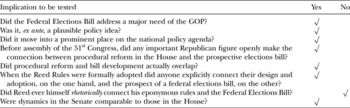
It is essential at this point to observe that this article's methodology has found a “smoking gun” that has gone unobserved until now. The Reed Rules, we have seen, were formally adopted amid assertions by both Republicans and Democrats that the whole point of the procedural change was a federal elections bill that would rebuild the Republican Party. This prominent feature of the contest over the Reed Rules is presented here for the first time.
Also, my test of the half-fulfilled observable implication—the seventh—shines new light on Speaker Reed. Though Reed never verbally connected his eponymous rules with the Elections Bill, he very much linked them via his own extensive participation in the bill's politics. He harbored, and he acted on, firm views concerning the bill's particular form.
THE LITERATURE ON THE REED RULES
This article's new findings of course raise a question: what lessons have previous studies of the Reed Rules sought to find in the case? My contribution builds, it happens, on a particularly rich literature. Reviewing it shows that the Reed Rules have preoccupied many scholars of congressional development.
Sarah Binder argues cogently, for instance, that certain types of discontinuity in majority strength within the House have cumulatively generated its procedural infrastructure. Binder thus traces how the Reed Rules capped off a series of gradual increments in majority prerogatives. Majorities eventually believed themselves to have rights that required protection, and this was a crucial precondition of the step taken during the 51st Congress.Footnote 98
In Ronald Peters's account, the Reed Rules resulted more from the kind of party politics that characterized the Gilded Age. Peters's focus on the relationship between the nature of the party system and the internal workings of Congress is of course broadly consistent with my own account.Footnote 99
Douglas Dion finds yet another lesson in the case. He emphasizes instead the singularity of high intraparty cohesion, pent-up policy demand, and very narrow majority control in the 51st Congress. For Dion, the Reed Rules came from a majority that closely approximated the theoretical ideal of a “minimum winning coalition.” Dion's account elegantly frames the polarization of the two parties during the introduction of the Reed Rules and the enormous ambition of the majority that developed the new procedure—factors that I also underscore.Footnote 100
Forgette offers a similar account to Dion but emphasizes the conjunctural origins of the Reed Rules, as well as pictures Reed as the agent of his caucus. Forgette offers in effect a variant on David Rohde's well-known theory of conditional party government. Forgette sees the Republican caucus—in fact both sides of the aisle—as steeped in long-standing discussion and awareness of the difficulties that majorities faced. Unless the caucus empowered Reed, it would blunder through a singularly unproductive Congress. Faced with a choice between impotence and a “huge partisan powerplay,” the caucus authorized the latter when Reed placed it on offer. As has already become clear above, I share Forgette's belief that the caucus had articulate policy preferences.Footnote 101
There is, additionally, an approach to congressional development that emphasizes sectionalism and race. This article demonstrates its application to the Reed Rules. Zelizer has applied the general approach with particular success to congressional development in the twentieth century. I pull it back in time to illuminate the 51st Congress. King and Smith propose that this sort of emphasis on racialized regional conflict makes sense out of the Reed Rules—and their guess turns out to be quite shrewd.Footnote 102
The one piece of the Reed Rules literature from which my article deviates noticeably is the entrepreneurial school. Schickler, Strahan, and Wolf all emphasize that Reed really made the Reed Rules. They suggest that the Republican rank-and-file possessed only fairly inchoate views about procedure. The lack of specific preferences over procedure opened the way, these analysts suggest, for Reed to have enormous, top-down influence. This claim places the entrepreneurialists at odds with the Binder analysis, it is worth noting.Footnote 103
The portrait of Reed sketched by the entrepreneurial school has seemed, however, particularly plausible because Reed pushed the Democrats so persistently after the 51st Congress to accept his eponymous rules. Given the use of the Reed Rules for party rebuilding, the Reed Rules were anathema to Democrats when they became the majority after their huge victory over Republicans in the 1890 elections. Reed nonetheless eventually changed minds across the aisle. Why Democrats acquiesced has not been fully explained, but Reed certainly played a key role, underscoring his agency and leadership.
Nevertheless, there is a problem with the entrepreneurial account. It has been offered without taking into account evidence that Reed himself clearly and effectively participated in the politics of the Elections Bill. For him, the Reed Rules were not just about reform of the House; they were also about paving the way for a reconstruction of the Republican Party in Southern elections. Later the Reed Rules became a purely institutional cause for Reed.
The entrepreneurial view of Reed also does not take into account the “smoking gun” evidence from House debate, which shows that, far from having inchoate preferences over procedure, the Republican rank-and-file in the 51st Congress clearly and explicitly wanted the Reed Rules in order to pass the Elections Bill. As we have seen, there was an articulate understanding among Republicans, and among Democrats too, that the Reed Rules would soon be put to forceful partisan use to pass the Elections Bill. That way of grasping the matter was expressed many times over the course of a week in mid-February 1890.
In summary, existing views of the Reed Rules and of congressional development yield a rich menu of consequential factors: growing majoritarianism, party cohesion, policy demand, caucus awareness, Reed's great skill as a leader, and racial-sectional conflict. My contribution embeds these factors within both the partisan grand strategy of the Gilded Age and the quest among Republicans to rebuild their party as a cross-sectional and national party. Such a major turning point in the evolution of the House originated—considerably more than the Reed Rules literature has so far suggested—in the jockeying for national dominance by the major parties.
Indeed, my claim may be of broader use for illuminating other historical periods. As we have seen, the making of the Reed Rules is comparable to at least one other case, the contemporaneous Senate dynamics of the 51st Congress. Can one see a linkage, however, between party building and procedural innovation at other moments in congressional development? Looking at the case of the 100th Congress (1987–1989) would suggest, yes. That case does not involve party building through electoral regulatory control, but rather party building through the creation of a platform for nationalizing congressional elections. However, the general combination of party building through policy, on the one hand, and procedural innovation to achieve the policies, on the other, are there to see. Let us turn therefore to a matter that rounds out and closes this article's discussion: case generalizability.
CASE GENERALIZABILITY
This article “cases” the making of the Reed Rules as a “case of” a strong connection between, on the one hand, party building (not just partisanship but overt party building) and, on the other hand, centralizing, legislative procedural innovation. It also deepens this case classification through comparison with the Senate during the 51st Congress.
The basic properties of the linkage between procedural innovation and party building in the 51st Congress are: (a) a perceived need within (b) a once-dominant political party seeking (c) to reconstitute its electoral base.
Also, the members of the party need (d) policies that will allow them to achieve the reconstitution. Those policies will be blocked, however, inside the legislature, which the once-dominant party controls, unless the party leverages its majority control (e) to establish legislative procedures that permit the policy enactments. House Republicans of the 51st Congress understood all of this very early in the Congress; Senate Republicans came to a similar understanding during the second session of the Congress.
A Congress similar enough for suggestive comparison along these dimensions is the 100th Congress (1987–1989). Congressional Democrats faced a popular and effective president in Ronald Reagan and a resurgent Republican Party. However, with the end of Reagan's second term in sight, a new Speaker of the House, former Majority Leader Jim Wright (D-TX) determined to build a legislative record on which members of Congress could run in 1988—and to thereby also re-energize the Democratic Party more generally going into a presidential election.
To enact that agenda, however, required adapting and applying existing procedures in a forceful enough way as to qualify, cumulatively, as procedural innovation. Table 4 lists key elements of the Wright legislative agenda, President Reagan's position on each of these House Democratic priorities, and the centralizing adaptations of floor control rules that went with the statutory enactments. Procedural change thus made possible a platform for nationalizing the 1988 House elections. Doing that would help to rebuild the House Democratic Party. A comparison between the House in the 100th Congress and the House and the Senate in the 51st Congress suggests, in short, the possibility of a set of comparable cases. If there are at least three cases, then there may be more.Footnote 104
Nationalizing the 1988 Elections Through Forceful Procedure: U.S. House, 100th Congress
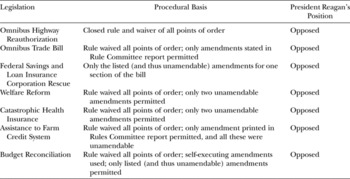
Source: David W. Rohde, Parties and Leaders in the Postreform House (Chicago: University of Chicago Press, 1991), Table 4.2, 110.
Two other cases can in fact be found in the 39th Congress in 1866. The Republicans of both the Senate and the House built themselves as a party in the face of a serious challenge to their dominant status by President Andrew Johnson by running on the Fourteenth Amendment. They produced the Fourteenth Amendment as a platform through a special and temporary centralizing institution, the Joint Committee on Reconstruction.Footnote 105
These several cases—the House during the 51st Congress, the Senate during the 51st Congress, the House during the 100th Congress, and both the Senate and the House in the 39th Congress—differ from (as well as resemble) each other. This suggests that (a) the strength and (b) the precise character of the connections among party building, procedural change, and policy would probably vary within a larger set of cases of congressional procedural innovation paired with majority party building.
Party building through a legislative platform seems to require, for example, an interlocking set of forceful adaptations of existing procedure. Using a constitutional amendment to build a party seems to demand, in contrast, some cross-chamber institution for both wings of a majority party to come to agreement on the amendment. As the detailed exploration of this article shows, one big sweeping procedural reform is plainly necessary in order for a majority to make zero-sum electoral-regulatory policy. In summary, within this set of five cases that have been explored, sketched, or mentioned, one sees comparable configurations rather than isomorphic and identical cases. This suggests that in an N > 5 study, there may be a typology of policy–procedure configurations to be identified.
Should such a study be developed? The answer would seem to be, yes. At a minimum, it seems clear from the set of cases that are identified here that procedural innovation inside Congress has been linked to party building often enough to merit further investigation of this linkage over time.
SUMMARY AND CONCLUSION
Cox and McCubbins have argued, in detail, “that the Reed rules [sic] permanently and significantly changed voting behavior and policy outcomes in the House … After Reed's system of agenda control had been constructed, with its decisive advantage for the majority party, subsequent rules never pushed the playing field in the House back to anything close to what it had been …”Footnote 106 In short, a major turning point in congressional development occurred.
What explains the making of the Reed Rules? Other factors certainly played important roles, as we have seen in the Reed Rules literature review, but party building was basic to the making of the Reed Rules. Before the 51st Congress gathered in Washington, Republicans expected that the Congress would enact a statute that would, in turn, grow Republican and African American electoral strength in Southern House districts. In order to contain and defeat fierce Democratic resistance in the House, which would otherwise be successful given how slight the Republican majority was, truly robust new procedures for controlling the House floor were essential. Reforming House rules, such as alteration of quorum requirements and suppression of dilatory motions, formed the vital precondition for restructuring Southern and national party politics.
Thus, when the membership of the House disputed the formal adoption of the Reed Rules in mid-February 1890, both Democrats and Republicans linked them very clearly to the Federal Elections Bill. Benjamin Enloe, Democrat of Tennessee, speaking on 13 February 1891, said:
We are told by the majority that this Draconian code … is necessary to prevent filibustering and to enable the majority to proceed with public business. The plea of necessity is correct, but the character of that necessity … is a political necessity. The Republican party … sees power slipping from its grasp … all over this Union, and something must be done to stay its failing fortunes or all is lost. Federal election laws must be passed, race disturbances must be fomented, reconstructions and robbery must be reinaugurated to save the falling fortunes of this desperate political organization …Footnote 107
Here was future Speaker David Henderson of Iowa:
Elections laws; yes, God knows we need them. These are the underlying questions of this mighty struggle … I shall relax no effort that will make it impossible for the minority to throttle the expressed wishes of the majority in this country. The Constitution is my warrant, and I shall fight for the rules reported to this House. [Loud applause on the Republican side.]Footnote 108
A major purpose behind the Reed Rules was indeed revitalizing the Republican Party in Southern House elections through “elections laws”—a guiding rationale far more important than has been previously understood.



