Significant outcomes
∙ No changes in the serum sortilin level was observed following 12 weeks of antidepressant treatment.
∙ The serum sortilin level was not correlated with the Montgomery–Åsberg Depression Rating Scale (MADRS) and response to treatment was not predicted by the change in sortilin levels.
Limitation
∙ The study was limited by the relatively small sample size and especially few non-responders.
Introduction
The identification of biomarkers for depression is of great clinical relevance. Depression is a common mental disorder caused by genetic and environmental factors and it is estimated by the World Health Organization to affect ~350 million individuals worldwide (Reference Sullivan, Neale and Kendler1). In a Danish nationwide study, the lifetime risk of depression is estimated to be 9.07% for males and 15.50% for females (Reference Pedersen, Mors and Bertelsen2).
Components of pathways such as the neurotrophic, the inflammatory, and the hypothalamic–pituitary–adrenal axis have been studied and suggested as potential biomarkers for depression as reviewed by Bilello (Reference Bilello3). However, at present, no single biomarker has sufficient sensitivity and specificity to be used for diagnosing depression and/or treatment response; thus, further studies are warranted. Several lines of evidence support a neurotrophic hypothesis of depression and one of the most studied factors is the brain-derived neurotrophic factor (BDNF) (Reference Molendijk, Spinhoven and Polak4). Sortilin has an important role in the regulation of BDNF activity (Reference Teng, Teng and Lee5,Reference Vaegter, Jansen and Fjorback6). The sortilin family consists of five receptors, and their main binding partners are related to lipid metabolism and neurotrophic signalling (Reference Glerup, Nykjaer and Vaegter7). Furthermore, members of the sortilin family have been identified as potential neuronal disease genes (Reference Alemany, Ribases and Vilor-Tejedor8–Reference Lambert, Ibrahim-Verbaas and Harold11). Interestingly, we recently found a significantly increased mean serum sortilin level in depressed individuals compared with controls and this finding is supported by another study (Reference Buttenschon, Demontis and Kaas12,Reference Zhou, Xiong and Lim13). In addition, two small studies have observed a change in serum sortilin level and sortilin mRNA expression following treatment of depression (Reference Stelzhammer, Guest and Rothermundt14,Reference Belzeaux, Formisano-Treziny and Loundou15).
Based on these findings, sortilin may be a potential biomarker for depression. To further investigate this, the aim of the current study was to study sortilin in response to antidepressant treatment. We thus measured serum levels of sortilin at baseline and after 12 weeks of antidepressant treatment in 56 depressed individuals from the Danish contribution to the Genome-Based Therapeutic Drugs for Depression (GENDEP) project.
Materials and methods
Clinical sample
The GENDEP trial was a 12-week study of depression with two active pharmacological treatment arms. Subjects were allocated to either escitalopram or nortriptyline (Reference Uher, Maier and Hauser16). MADRS (Reference Montgomery and Asberg17) was used as the primary depression outcome measure in this study, and depression scores were obtained at baseline and week 12 (W12). Response to treatment was defined as 50% reduction in MADRS score from baseline to W12 and remission as an MADRS score of 10 or less at W12 (Reference Uher, Maier and Hauser16). Improvements of MADRS depression scores were calculated as the depression score at baseline minus the depression score at W12. All subjects were diagnosed with unipolar major depression of at least moderate severity established in the Schedules for Clinical Assessment in Neuropsychiatry interview (18). A detailed description of the combined GENDEP sample is available elsewhere (Reference Uher, Maier and Hauser16).
We included 56 individuals from the Danish contribution to the GENDEP trial of which 25 were allocated to escitalopram and 31 to nortriptyline; 34 individuals (64%) were drug naïve at study entry. Furthermore, information on gender, age, age at onset, body mass index (BMI), marital status, occupation, length of education, and number of children was available and included in the study.
The study was approved by the ethics boards.
Serum assessment
Serum was stored in aliquots at −80°C and available at baseline and at W12 for all 56 individuals.
Serum sortilin levels were measured by sortilin-specific enzyme-linked immunosorbent assay. This assay specifically detects sortilin and not the related receptors SorCS2 and SorLA as previously shown (Reference Buttenschon, Demontis and Kaas12). In brief, 96-well plates (Nunc MaxiSorp; Thermo Scientific, Roskilde, Denmark) were coated with 10 μg/ml rabbit anti-sortilin (5438) diluted in 100 mM NaHCO3, pH 9.8. Wells were blocked in 2% bovine serum albumin, and samples were diluted in phosphate-buffered saline containing 0.05% Tween 20 and 1% bovine serum albumin. Purified sortilin extracellular domain was used for standard dilution series. Mouse anti-human sortilin monoclonal F11 was used for detection (1 μg/ml) followed by horseradish peroxidase-conjugated rabbit anti-mouse secondary antibody (1 : 1000, P0260; Dako, Glostrup, Denmark).
The samples were diluted 10 times to be within the range of the standard curve ranging from 8 to 0.625 ng/ml. To ensure plate-to-plate consistency, two internal control serum samples in two different dilutions (5× and 20×) were included on each plate. The inter-assay coefficient of variance for the present study was 8.5%. In general, serum from baseline and W12 from one individual was included on the same plate and measured in duplicate. Samples with an intra-assay variance above 5% were determined again another day, and the non-reliable measure discarded. The mean value of the duplicates was used in the statistical analyses.
Statistics
All statistical analyses were performed using Stata 13 (StataCorp., College Station, TX, USA). A p-value<0.05 was considered to be statistically significant.
Natural logarithmic transformation was used to normalise the distribution of the sortilin levels. Generalised linear models were used to assess independent determinants of the serum sortilin level and when analysing the effect of serum sortilin level on depression score and in response to treatment. Testing was performed using likelihood ratio statistics.
Demographic and clinical characteristics are described in terms of mean±SD if quantitative, or in terms of proportions. Differences between gender, responder versus non-responders, and allocated drug in socio-demographic data, depression scores, and serum measurements were evaluated with the Wilcoxon’s two-sample rank-sum test for continuous variables and χ2 or Fisher’s exact test for categorical variables. Differences in serum sortilin levels from baseline to W12 were evaluated using the Wilcoxon’s matched-pairs signed-rank test. Correlations between serum sortilin levels and MADRS scores were calculated using the Spearman’s rank correlation coefficient. Unless otherwise specified the analyses included all individuals.
Results
Sample characteristics
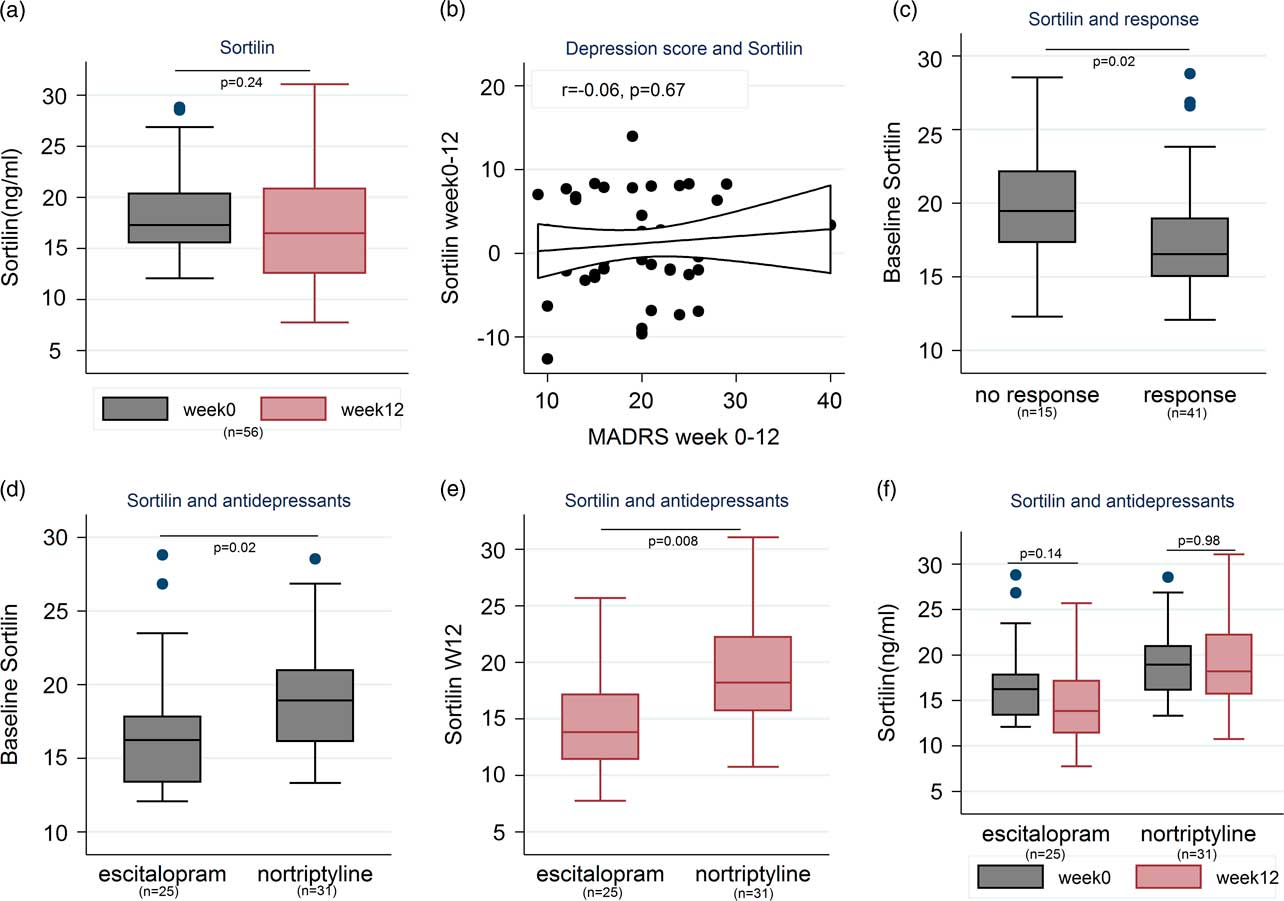
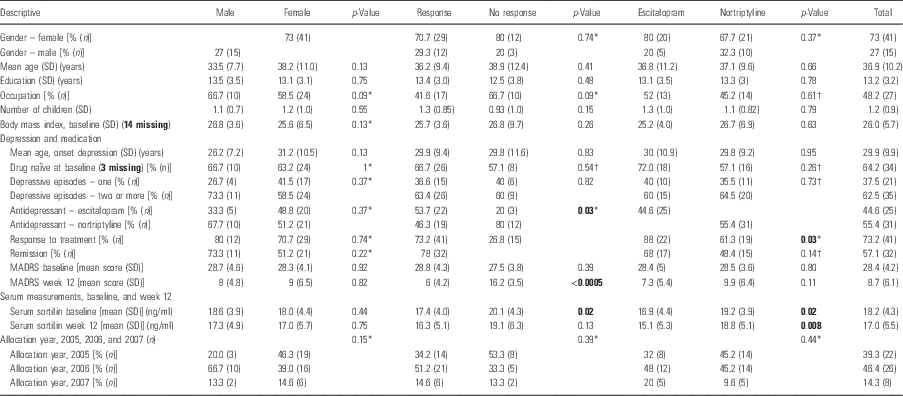
The 56 Danish individuals included in the present study comprise 15 males and 41 females with an average age of 36.9 (SD=10.2) years and an average age at onset of 29.9 (SD=9.9) years. The median serum sortilin level (lower–upper quartiles) was 17.3 (15.6–20.4) ng/ml at baseline and 16.5 (12.6–20.8) ng/ml at W12. The median (lower–upper quartiles) MADRS score at baseline and W12 was 28.5 (25.5–31) and 7.5 (3–13), respectively. The mean decrease in MADRS depression scores from baseline to W12 was 20.1 (SD=6.7). 41 individuals (73.2%) responded to treatment, and 32 individuals (57.14%) were in remission at W12. We observed no significant differences between males and females in socio-demographic data, depression scores, or serum measurements (Table 1). Individuals allocated to escitalopram responded significantly more to treatment compared with individuals allocated to nortriptyline (p=0.03, Table 1). Furthermore, the baseline and W12 serum sortilin levels were significantly higher in individuals allocated to nortriptyline compared with escitalopram (p=0.02 and 0.008, respectively, Figs 1d and e). We observed no differences between responders and non-responders in socio-demographic data or allocation year. Likewise, no between-drug differences were observed in socio-demographic data, depression scores, or allocation year.
(a) No difference in serum sortilin levels between baseline and week 12 (W12). (b) No correlation between the difference in Montgomery–Åsberg Depression Rating Scale (MADRS) depression score from baseline to W12 and the difference in serum sortilin level from baseline to W12. (c) The baseline serum sortilin level is lower in responders compared with non-responders. (d) The baseline serum sortilin level is significantly lower in individuals allocated to escitalopram compared with nortriptyline. (e) The serum sortilin level at W12 is significantly lower in individuals allocated to escitalopram compared with nortriptyline. (f) No difference in serum sortilin levels after 12 weeks of antidepressant treatment in the subgroup of individuals allocated to escitalopram or nortriptyline.

Sample characteristics (n=56)

MADRS, Montgomery–Åsberg Depression Rating Scale.
Number of missing individuals are listed in bold parenthesis in the first column. Unless otherwise specified Wilcoxon’s two-sample ranked-sum test (Mann–Whitney test) was used.
* Fisher’s exact test.
† χ2 Test.
Main results
Regression analyses showed that the baseline serum sortilin levels did not predict the improvement in depression score or the MADRS depression score after 12 weeks of treatment (p=0.14 and 0.55, respectively, not shown) and that response to treatment was not predicted by the change in serum sortilin level (p=0.95, not shown). The Wilcoxon’s signed-rank test showed no significant change in serum sortilin levels following 12 weeks of antidepressant treatment (p=0.24, Fig. 1a). Furthermore, the baseline severity of depression was not correlated to the baseline level of sortilin, and the change in depression score was not correlated to the change in sortilin levels as illustrated in Fig. 1b. However, Wilcoxon’s rank-sum test showed that the baseline sortilin level was significantly higher among 15 non-responders compared with 41 responders (p=0.02, Fig. 1c, Table 1), and the serum sortilin level at W12 tended to be higher among non-responders (p=0.1, Table 1). To further investigate these findings, we used the Wilcoxon’s signed-rank test to analyse the change in serum sortilin levels from baseline to W12 in the subgroups of 41 responders and 15 non-responders, but observed no significant change (p=0.39 and 0.43, respectively, Supplementary Fig. 1). Likewise, regression analyses showed that the baseline serum sortilin levels did not predict the improvement in depression score or the MADRS depression score after 12 weeks of treatment in the subgroups of responders and non-responders (not shown). As shown from the Wilcoxon’s ranked-sum test, the baseline serum sortilin level was significantly higher among 25 individuals allocated to nortriptyline compared with 31 individuals allocated to escitalopram (p=0.02, Fig. 1d). However, the Wilcoxon’s signed-rank test showed no significant changes in serum sortilin levels from baseline to W12 in the subgroups of individuals allocated to escitalopram or nortriptyline (p=0.14 and 0.98, respectively, Fig. 1f).
Using regression analyses, we also investigated the influence of different socio-demographic determinants and health indicators on the baseline serum sortilin level (Supplementary Table 1). Besides the association with response to treatment and allocated drug, the baseline serum sortilin level was positively associated with the baseline BMI level. Further inspection of the association between BMI and sortilin indicate that the association primarily was driven by two outliers. The baseline sortilin level was not associated with age, age at onset, remission, sex, education, occupation, allocation year, baseline MADRS score, MADRS score at W12, or change in MADRS score.
Discussion
In summary, the serum sortilin level in 56 depressed individuals of at least moderate severity did not change following 12 weeks of antidepressant treatment. Furthermore, the response to treatment was not predicted by the change in sortilin levels following 12 weeks of treatment and the baseline level of sortilin did not predict the improvement in depression score.
Only a few studies have previously investigated serum sortilin levels in depression (Reference Buttenschon, Demontis and Kaas12–Reference Stelzhammer, Guest and Rothermundt14). We recently showed a significantly higher serum sortilin level in 152 individuals with depression compared with 216 controls (p=0.0002) (Reference Buttenschon, Demontis and Kaas12). Zhou et al. (Reference Zhou, Xiong and Lim13) also observed a significantly higher serum sortilin level in 40 depressed individuals compared with 50 controls (p<0.05). The current study investigated the potential of sortilin as a state-dependent biomarker. A state-dependent biomarker is usually defined as characteristic of the clinical status, and may serve as an objective biomarker of treatment response, whereas a trait marker is present before clinical manifestation and related to the pathophysiology. The results from our study do not point towards sortilin as a state-dependent biomarker. Other studies have also investigated sortilin levels following treatment. The mean serum sortilin level in 12 depressed individuals was significantly reduced after acute electroconvulsive therapy (ECT) (Reference Stelzhammer, Guest and Rothermundt14). Another study investigated the sortilin mRNA expression in 11 individuals with depression and reported a significant downregulation of SORT1 after treatment for 8 weeks with different types of antidepressants and ECT (Reference Belzeaux, Formisano-Treziny and Loundou15). In contrast, a recent study that investigated the propeptide of sortilin (PE) observed a decrease in the serum concentration of PE in depressed individuals compared with controls and an increase of PE following pharmacological treatment. This study included 37 individuals with depression and 49 controls (Reference Devader, Roulot and Moreno19). Our study included more individuals than the studies by Stelzhammer et al. (Reference Stelzhammer, Guest and Rothermundt14), Belzeaux et al. (Reference Belzeaux, Formisano-Treziny and Loundou15), and Devader et al. (Reference Devader, Roulot and Moreno19), and the experimental study designs differ; thus, they are difficult to compare. Further studies with a longer follow-up period and more observations are warranted to clarify the potential role of sortilin as a state-dependent biomarker for depression.
In contrast to the study by Zhou et al. (Reference Zhou, Xiong and Lim13), we observed no correlation between the depression score and the serum sortilin level. A correlation between the depression score and sortilin could increase the possibility of the usefulness as a state-dependent biomarker.
We observed a significantly higher baseline level of sortilin in non-responders compared with responders, but we also observed a significantly higher baseline sortilin level in individuals allocated to nortriptyline compared with escitalopram. Potentially, these results are not independent as significantly more non-responders in this subset of GENDEP individuals were allocated to nortriptyline.
Several factors have shown to affect the serum sortilin level. We previously showed that sortilin increased significantly with increasing age and BMI (Reference Buttenschon, Demontis and Kaas12). In the current study, we also observed a significant association with increasing BMI, however this finding seemed to be driven by two outliers. The association between BMI and sortilin is plausible as sortilin is expressed in adipose tissue and involved in lipid metabolism (Reference Glerup, Nykjaer and Vaegter7). In contrast to our previous study, we observed no association with increasing age.
The current study should however be viewed in the light of the relatively small sample size and no corrections for multiple testing. The study was limited by the number of individuals and thus no power calculations were performed before initiation of the study.
To our knowledge, this is one of the first studies to investigate sortilin levels in response to antidepressant treatment, and we point out the importance to investigate the longitudinal relationship between depression and potential biomarkers. Our results do not indicate sortilin as a state-dependent biomarker for treatment response, but further investigation of sortilin in depression is warranted.
Acknowledgements
The authors thank Helle Buch, Anne Stamp, Lisbeth Jorgensen, Erik Larsen, and Claus Munck Petersen for their contributions. Authors’ Contributions: H.N.B.: designed the study, managed the literature searches, analysed and interpreted the data; in addition, H.N.B. wrote the first draft of the paper and the final version of the manuscript; M.N.: measured the serum sortilin levels and analysed the data; S.G.: contributed to the first draft of the paper, interpretation of the data, and provided funding; O.M.: contributed to the acquisition of data and provided funding for the acquisition of data. All co-authors also contributed to the design of the study, revised the manuscript, and approved the final version of the manuscript.
Financial Support
The GENDEP study was funded by a European Commission Framework 6 grant, EC Contract Ref.: LSHB-CT-2003-503428. Lundbeck provided both nortriptyline and escitalopram free of charge for the GENDEP study. S.G. was supported by the Lundbeck Foundation and the Danish Council of Independent Research Sapere Aude starting grant (grant number DFF 4183-00604).
Conflicts of Interest
None.