

1. Introduction
Partial equilibrium models have been used extensively by policy makers to prospectively determine how government programs may affect consumer incomes or prices (Wohlgenant, Reference Wohlgenant, Lusk, Roosen and Shogren2011). Such models, however, have not previously been used to analyze government programs that inform consumers. Policy makers need a method for prospectively evaluating the consequences of informational programs if they want to assess their benefits and costs prior to implementation. This need is clearly demonstrated by the coronavirus pandemic, where policy makers must consider how to effectively communicate and promote public health measures, such as vaccination and mask-wearing, to mitigate the spread of COVID-19.
Our model combines Bayesian learning with the utility-maximization of consumer choice; with parameter estimates obtained from the published literature and expert elicitation, the model can generate prospective quantitative estimates of policy impacts. This paper fills a gap in the literature by developing a partial equilibrium model that can be used by policy makers or their staff to prospectively analyze the impacts of informational policies. For instance, during the COVID-19 pandemic, the Centers for Disease Control and Prevention (CDC) communicated the importance of handwashing and hand sanitizer use through myriad medias, including the CDC website,Footnote 1 social media posts,Footnote 2 and weekly reports.Footnote 3 This model could help CDC staffers communicate with the public more effectively by providing a straightforward way to prospectively compare the impact of different communication channels (e.g., social media, point of sale, and product label) on the price and quantity sold of hand sanitizer.
The usefulness of this model depends on its ability to accurately predict how new health information will lead to new equilibrium outcomes (e.g., if CDC recommends routine mask wearing, how many additional U.S. consumers will actually purchase a mask). One way to assess the potential accuracy of this model is to identify a previous government education campaign and to see whether the predictions of the model match the actual outcomes of the campaign.
We conducted a thorough literature review to identify a government education campaign that could be used to test the predictions of the model and identified a 2008 folic acid educational campaign conducted in North Dakota. Folic acid is a B vitamin that helps the body generate new cells. In early pregnancy, folic acid helps form the fetus’s neural tube. This campaign educated women of childbearing age about the importance of taking a 400 μg folic acid supplement each day to lower the risk of certain birth defects of the brain and spine (Centers for Disease Control and Prevention, 2020a). Although the campaign was conducted 13 years ago in a relatively small state, we chose this health information campaign to validate the model for two reasons. First, the action women were being encouraged to take was simple (i.e., consume a folic acid supplement each day) with narrow and well-defined benefits (i.e., lowers the risk of certain birth defects). This made the intervention straight forward to capture in the partial equilibrium model we developed. Second, the effects of educational campaign on consumer behavior were already quantified in a previous study. As a result, it is straight forward to compare our simulated predictions to the real-world scenario.Footnote 4
Our study is not the first to investigate how government dissemination of new health information influences consumer behavior. However, the vast majority of previous studies have been retrospective in nature. For example, the dissemination of information through product labeling has generated a large literature, much of it devoted to responses to food labels (Teisl & Roe, Reference Rutherford1998; Golan et al., Reference Golan, Kuchler, Mitchell, Greene and Jessup2001; Shimshack et al., Reference Smith, Desvousges, Johnson and Fisher2007). Extensive work has also been done on the effects of U.S. Food & Drug Administration (FDA) risk communications on health behaviors (Du et al., Reference Du, Zhou, Goldsmith, Nardinelli and Hammad2012; Dusetzina et al., Reference Dusetzina, Higashi, Dorsey, Conti, Huskamp, Zhu, Garfield and Alexander2012) and the effects of EPA risk communications (Smith et al., Reference Teisl and Roe1990). However, none of these papers have developed an analytical framework that could prospectively predict the consequences of government policies before they are implemented. Further, while there is a large body of literature on the impact of advertising on consumer behavior (see Bagwell, Reference Bagwell2007 for a review), those studies do not address the impact of the policy tools considered here.
Two previous papers have attempted to prospectively model the impact of health information on consumer behavior, and our paper expands on both to provide policy makers with a more flexible tool for their analysis. First, Choi and Jensen (Reference Choi, Jensen and Caswell1991) modeled whether information on the health risk of certain foods altered demands for these foods. Their model estimated only the direction of the policy impact (whether demand would increase or decrease) in response to new health information; our model expands on this to estimate both the direction and the size of the effect. Second, Chang and Just (Reference Chang and Just2007) combined a generalized Bayesian learning model with a utility-maximizing model of consumer choice to analyze how consumers responded to new health information about fresh eggs. Their model was limited in that it only considered health information falling within discrete categories (i.e., having a negative impact, or negligible impact, on health). We expand the model to be able to prospectively estimate how consumers would respond to more nuanced types of health information (e.g., Dietary Guidelines recommend that if adults of legal drinking age consume alcohol, it should be in moderation – up to one drink per day for women and up to two drinks per day for men (Centers for Disease Control and Prevention, 2016).
To the best of our knowledge, we provide the first method for generating prospective estimates of consumer responses to a wide variety of communications of health information. Our approach translates changes in risk beliefs into their equivalent price effects using estimates on how people value health effects. With empirical estimates of how consumers respond to market prices, we infer changes in consumption based on changes in the implicit price of consuming a health-related good, with the health information translated into implicit price changes. The information can be combined with the valuation of health effects to develop benchmark benefits and costs of health communications.
The remainder of this paper is organized as follows. First, we derive the basic theoretical model. Second, we operationalize the theoretical model by obtaining estimates for each relevant parameter of the model from either the published literature or through expert elicitation. Third, we discuss the assumptions and limitations associated with the operationalized model. We then use the model to simulate the consequences of risk communications that have already been studied to see if our simulated results match the observed impacts of the communications. Finally, we discuss current applications of the model and conclude with thoughts about future areas of research.
2. Theoretical model
Our partial equilibrium model includes three components to translate the release of new health information to changes in market outcomes. The first component captures how consumers update their risk beliefs in response to new health information. The second component of the model translates the change in risk beliefs to a change in consumer willingness to pay (WTP). The third component uses a partial equilibrium framework to analyze how this shift in demand causes the market price and quantity demanded to adjust to a new equilibrium. We discuss each component in more detail below.
2.1. Consumers update risk beliefs
A government or advisory group may release new health information for consumers when the known health risks associated with a product change. For example, an advisory may notify the public that consuming a particular product is riskier than previously believed. If consumers fully absorbed this new information, they would update their risk beliefs completely to reflect the new information. More likely, however, is that consumers may partially update their risk beliefs, depending on how confident they are in the new health information.
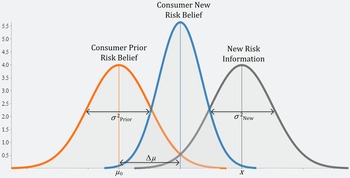
To formally describe this updating process, we use a Bayesian learning model following Gerber and Green (Reference Gerber and Green1999). In this model, we assume consumer risk beliefs prior to receiving the new information are normally distributed (represented by the orange distribution in Figure 1). The most likely perceived risk per unit is captured by the mean of the prior distribution, μ0, while uncertainty surrounding that belief is captured by the variance,
 $ {\sigma}_{\mathrm{PRIOR}}^2 $
. We assume that the new health risks being communicated are also normally distributed, with the most likely risk estimated per unit represented by the mean, x, and the uncertainty surrounding that estimate represented by the variance,
 $ {\sigma}_{\mathrm{NEW}}^2 $
(represented by the gray distribution in Figure 1). After receiving the new risk information, we assume that consumers update their risk beliefs according to Bayes’ theorem. The consumer’s posterior risk beliefs are represented by the blue distribution in Figure 1. In response to the new health information, the consumer’s perceived most likely risk changes by Δμ, where Δμ is described by Equation (1):
 $$ \Delta \mu \hskip1.5pt =\hskip1.5pt \left(x-{\mu}_0\right)\bullet \left(\frac{\sigma_{\mathrm{PRIOR}}^2}{\sigma_{\mathrm{PRIOR}}^2+{\sigma}_{\mathrm{NEW}}^2}\right). $$
Illustration of Bayesian learning model.

2.2. Estimate subsequent shift in WTP
When a consumer’s beliefs about the health risks associated with a product change, the marginal WTP for the product will also change. Intuitively, we would expect the change in WTP to be equal to the change in the consumer’s perceived most likely risk multiplied by the discounted value of the health status associated with that risk. We derive this change in WTP more formally in the first section of Supplementary Appendix A; it can be expressed mathematically as:
 $$ \Delta \left(\frac{\mathrm{WTP}}{q}\right)\hskip1.5pt =\hskip1.5pt \left(\Delta \mu \times \delta H\right), $$
where
-
•
 $ \Delta \left(\frac{\mathrm{WTP}}{q}\right) $
= Change in WTP.
-
•
$ \delta \hskip1.5pt =\hskip1.5pt $
the discount rate. -
•
$ H\hskip1.5pt =\hskip1.5pt $
the monetary cost or benefit associated with the alternative health status (where H < 0 denotes a poorer health status that results in less income).


Dividing Equation (2) by the price of the product prior to the new health information yields an equation for the percentage change in WTP. Substituting the equation for Δμ from the Bayesian learning model above (Equation (1)) into the model of consumer choice (Equation (2)), we obtain the following equation for a consumer’s percentage change in WTP:
 $$ \%\Delta \left(\frac{\mathrm{WTP}}{q}\right)\hskip1.5pt =\hskip1.5pt \left(\frac{\left(x-{\mu}_0\right)\bullet \delta H}{P_0}\right)\bullet \left(\frac{\sigma_{PRIOR}^2}{\sigma_{PRIOR}^2+{\sigma}_{NEW}^2}\right). $$
The first term in parentheses on the right side of Equation (3) represents the maximum proportional change in WTP,
 $ \%\Delta {\left(\frac{\mathrm{WTP}}{q}\right)}^{MAX} $
, the change that would be observed if the consumer fully internalizes the new risk information. We define the second term as the information absorption factor (IAF), which quantifies the extent to which consumers will update their risk beliefs in response to the new information. If a consumer fully updates her risk beliefs such that the posterior distribution (blue line in Figure 1) is the same as the distribution of the new risk information (gray line in Figure 1), the IAF will equal 1. On the other hand, if the consumer does not change their risk beliefs at all in response to the new risk information, the IAF will equal zero.
The model described above calculates the percentage change in WTP for consumers who receive the new health information. We assume that consumers do not respond to information they do not receive, so the percentage change in WTP among those who are not exposed to the new information is zero. It is possible that policy makers may wish to target the new health information to specific groups of consumers. In this case, the model we have developed above would apply to consumers in the target audience who receive the new health information. We assume that the percentage change in WTP of exposed consumers in the non-target audience is proportional to the percentage change in WTP of exposed consumers in the target audience, where the proportion is given by the spillover parameter
 $ S $
. Let
 $ E $
be the fraction of all consumers exposed to the new health information; among the fraction exposed, let
 $ T $
be the fraction belonging to target audience. The exogenous relative change in market demand,
 $ \omega $
, can be expressed as:
 $$ \omega \hskip1.5pt =\hskip1.5pt \left[\left(\%\Delta {\left(\frac{\mathrm{WTP}}{q}\right)}^{MAX}\bullet \mathrm{IAF}\right)\bullet T+\left(S\bullet \%\Delta {\left(\frac{\mathrm{WTP}}{q}\right)}^{MAX}\bullet \mathrm{IAF}\right)\bullet \left(1-T\right)\right]\bullet E. $$
We use this equation to estimate the shift in demand, where
 $ \omega <0 $
denotes a vertical downward shift.
2.3. Incorporate market response
We use a partial equilibrium model to estimate how a shift in demand (
 $ \omega $
) will lead the market to adjust from an initial market equilibrium price and quantity (P
0 and Q
0) to a new equilibrium price and quantity (P
1 and Q
1) after the new health information is released. The details of the model are described by Wohlgenant (Reference Wohlgenant, Lusk, Roosen and Shogren2011) and in the second section of Supplementary Appendix A. With no exogenous relative change in supply, the relative changes in equilibrium price (
 $ {P}^{\ast } $
) and quantity (
 $ {Q}^{\ast } $
) are functions of the own-price elasticity of demand,
 $ {\varepsilon}^D $
, own-price elasticity of supply,
 $ {\varepsilon}^S $
, and
 $ \omega $
.
3. Implementing the theoretical model
To operationalize the theoretical model described above, we need estimates for each component of Equation (4) and each component of the market response model described in Section 2.3. Some components are parameters that can be easily obtained from secondary sources. Baseline quantity and prices can be estimated for packaged products using data sources like consumer surveys and scanner data.Footnote 5 Estimates for the elasticity of supply and elasticity of demand can be obtained for many different products from the literature. For model parameters that are not available from secondary sources, we have estimated them ourselves. In this section, we describe how we estimate the maximum change in WTP, the IAF, and the spillover effect. In addition, we also discuss how to incorporate uncertainty surrounding model parameters into our analysis.
3.1. Estimating maximum change in WTP
The best method for estimating the maximum change in WTP will depend on the risk communication and the type of information being conveyed. One way that governments may communicate risk information is by providing consumers with explicit measures of the risk associated with some product. For example, the lifetime risk of lung cancer is 1.8 % for men who have never smoked and 14.8 % for current smokers (Bruder et al., Reference Bruder, Bulliard, Germann, Konzelmann, Bochud, Leyvraz and Chiolero2018). When there is risk information communicated in this fashion, we can calculate the maximum percentage change in WTP per unit based on the risk information included in the information treatment:
 $$ \%\Delta {\left(\hat{\frac{WTP}{q}}\right)}_{RISK}^{MAX}\hskip1.5pt =\hskip1.5pt \left(\left({\hat{\pi}}_1-{\hat{\pi}}_0\right)\bullet \sum \limits_{t\hskip1.5pt =\hskip1.5pt {t}_1+1}^{t_N}\frac{\hat{H}}{{\left(1+r\right)}^{\mathrm{t}}}\right)\bullet \frac{1}{\hat{q}}\bullet \frac{1}{\hat{P_0}}, $$
where
 $ {\hat{\pi}}_1 $
is the new estimate of the lifetime probability of facing a health effect from regularly consuming a product,
 $ \hskip0.24em {\hat{\pi}}_0 $
is what consumers believe the total probability to be before receiving a risk communication,
 $ \hat{H} $
reflects the magnitude of the health effect measured in dollars (the value of a statistical case),
 $ \hat{q} $
is the discounted number of units of the health related good consumed,Footnote
6
 $ \hat{P_0} $
is an estimate of the initial price of the product,
 $ {t}_1 $
is when the health effect starts,
 $ {t}_N $
is when the shock ends, and r is the discount rate.Footnote
7
This formula, based on Viscusi and Hersch (Reference Viscusi and Hersch2008), has an intuitive interpretation. The first component (in parentheses) calculates how the expected value of health effects associated with consuming a product changes when risk beliefs change. Dividing by the discounted number of units consumed, we obtain the change in expected per-unit health costs associated with consuming the product. If a consumer is risk neutral, this change reflects how much she would be willing to pay to gain or avoid the health effect and therefore measures the change in her WTP for the product. We put the change in percentage terms by dividing by the original price of the product.
Another way governments may communicate risk information is by providing quantity recommendations (e.g., recommending the minimum or maximum amount of a good an individual should consume). Examples include recommendations to eat at least five servings per day of fruit and vegetables or take a low-dose aspirin each day. A quantity recommendation is based on underlying risk information, but it can be given alone or with the underlying risk information. Instead of solely disseminating risk information, the information provider attempts to solve for the optimal quantity on behalf of the consumer. While quantity leads to a simple, understandable recommendation, solving a consumer’s optimization problem is more difficult. To calculate the maximum change in WTP using information from a quantity recommendation, we can use the elasticity of demand to determine the price change that would correspond to the recommended change in quantity. This is given by the following formula:
 $$ \%\Delta {\left(\hat{\frac{\mathrm{WTP}}{q}}\right)}_{Q- REC}^{MAX}\hskip1.5pt =\hskip1.5pt \left(\frac{\left[{q}_{REC}-\overline{q}\right]}{\overline{q}}\right)\frac{1}{\left|\hat{\varepsilon^D}\right|}, $$
where
 $ {q}_{\mathrm{REC}} $
is the quantity recommendation,
 $ \overline{q} $
is the mean quantity of the product consumed per person in the target group in the period before the new information is released, and
 $ \hat{\varepsilon^D} $
is an estimate of the elasticity of demand for the product. In our demonstration, we will compare predictions from both approaches.
3.2. Estimating the IAF
In the learning model above, we use the IAF to capture how much someone internalizes and acts upon new information. To quantify this model parameter, we convened an expert panel of social scientists and health communication experts in May 2016. We asked these experts to complete two tasks. First, we asked them to come to a consensus on which characteristics of the risk communication influence information absorption and how important each characteristic is for information absorption. Second, we asked the experts to come to a consensus on which characteristics of the target audience influence information absorption and how important each characteristic is for information absorption.
For the first task, these experts identified 11 types of risk communication characteristics that can influence information absorption (listed in Supplementary Appendix Table B1). These characteristics were divided into two groups: (a) how the risk communication is delivered and (b) the contents of the risk communication.Footnote 8 For example, a delivery characteristic of the risk communication would be the communication channel used to relay the new health information to the public (e.g., TV or radio). Similarly, a content characteristic of the risk communication would be how the information is framed (e.g., whether the information is presented as gains to the consumer or losses).
Each characteristic was defined by a finite number of values it could take, called “attributes”. For example, the attributes of the “channel of communication” characteristic are TV, radio, newspaper, magazine, social media, or product label. To quantify the importance of each characteristic-attribute, the experts were asked to assign each characteristic-attribute an “information absorption score” ranging from 1 (for extremely low absorption) to 9 (for extremely high absorption). The attribute with the highest mean absorption score for each characteristic is reported in Table 1. Similarly, the attribute with the lowest mean absorption score for each characteristic is reported in Table 2. Details on how these absorption scores are combined to estimate an IAF for a given risk communication are provided in Supplementary Appendix B.
Risk communication characteristics that yield the highest-level total absorption score.

Source: Supplementary Appendix Table B2.
Risk communication characteristics that yield the lowest total absorption score.

Source: Supplementary Appendix Table B2.
For the second task, the expert panel was asked to identify the characteristics of the target audience that would influence the response to health communications. The expert panel identified seven target audience characteristics likely to influence the size of the IAF (listed in Supplementary Appendix Table B3). The seven characteristics are divided into three groups: demographic characteristics (age, education level, gender, race, and ethnicity), the intended user of the information (end consumer or types of caregivers), and membership in a vulnerable population (pregnant women, the elderly, and immunocompromised individuals). Again, each audience characteristic was defined by a finite number of values it could take, which were called “attributes.” For example, the attributes of the education characteristic are (a) did not complete high school, (b) high school, and (c) some college or above. The experts assigned scores to each target audience characteristic to indicate how the information absorption would differ from that of the “average” person. These scores range from −4 for extremely below average absorption to +4 for extremely above average absorption.Footnote 9 The attribute with the highest mean absorption score for each characteristic is reported in Table 3. The attribute with the lowest mean absorption score for each characteristic is reported in Table 4. Details on how these absorption scores are combined to modify an IAF for a given target audience are provided in Supplementary Appendix B.
Demographic characteristics that yield the largest audience absorption score.

Source: Supplementary Appendix Table B3.
Demographic characteristics that yield the lowest audience absorption score.

Source: Supplementary Appendix Table B3.
3.3. Estimating spillover effects
From our expert elicitation, we obtained estimates of the size of spillovers for different demographic groups. We asked the expert panel to suppose that the target group of an information treatment identified with a demographic characteristic or membership in a vulnerable population (pregnant women, the elderly, and immunocompromised individuals). Based on their experience and knowledge, they gave the expected size of the spillover effect for consumers not in that target audience, expressed as a proportion of the change in WTP for the target group. Supplementary Appendix Table B4 reports the consensus minimum, most likely, and maximum estimates of spillover effect by target audience. The experts concluded that for a target audience defined by multiple demographic characteristics, the best way to approximate the spillover effect would be to take a simple average of the spillovers for the individual target populations.
3.4. Incorporating uncertainty in parameter estimates
Uncertainty surrounds the true value of the parameters used in this model. To account for uncertainty, we conduct a Monte Carlo simulation rather than using a single set of parameter estimates into the model equations. In the simulation, we specify a subjective probability distribution for each uncertain parameter, with the triangular distribution as our default for most parameters, requiring estimates of the minimum, maximum, and most likely values. We use a Beta-PERT distribution for the IAF because the most extreme values (near 0 and 1) should be very rare events and receive less weight than they would receive in the triangular distribution.Footnote 10
4. Model application: North Dakota folic acid educational campaign
Above, we derived a theoretical model for predicting how consumers will respond to new health information and discussed how this model can be used to prospectively evaluate policies. We use results from an expert elicitation and market data to implement the theoretical model. Here, we assess the predictive accuracy of the model by using it to simulate the impact of a folic acid educational campaign that was conducted in North Dakota and compare the model predictions to published results estimating the impact of the campaign.
4.1. Description of the North Dakota folic acid educational campaign
Folic acid, a B vitamin, has been shown to significantly reduce the risk of certain birth defects of the brain and spinal cord. As a result, CDC and other public health organizations recommend that women who could become pregnant should take 400 μg of folic acid per day (Centers for Disease Control and Prevention, 2020a). While there was a declining trend in the national rates of neural tube birth defects following the folic acid awareness campaigns in the 1990s, North Dakota experienced relatively higher rates of certain conditions, such as anencephaly and spina bifida. In 2008, North Dakota conducted an educational campaign to disseminate this information. This campaign was conducted from 1 October 2008 to 1 April 2009 and used a multi-pronged approach, including printed material (such as brochures available at pharmacies and clinics) and other media (such as radio ads), to instruct women between ages 18 and 45 that consuming 400 μg of folic acid per day can reduce the prevalence of neural tube birth defects such as spina bifida (North Dakota State University Extension Service, 2008). Although we could not obtain a copy of the materials used in the North Dakota Educational Campaign, we can plausibly assume it echoed the campaign previously conducted by the CDC, on which it was based. The CDC campaign contained both numeric risk information and a quantity recommendation, as shown in this excerpt from a campaign brochure:
The U.S. Public Health Service recommends that all women who could possibly become pregnant get 400 μg of folic acid every day. This could prevent up to 70 % of some types of serious birth defects. But to do this, women need folic acid before they get pregnant. That’s why you should always get enough folic acid every day even if you are not thinking about a baby anytime soon.
(Centers for Disease Control and Prevention, 2009, p. 2, para. 2)Garden-Robinson and Beauchamp (Reference Garden‐Robinson and Beauchamp2011) studied the impact of the North Dakota Folic Acid Educational Campaign by conducting a survey of 430 women of childbearing age before the educational campaign began and a second survey of 329 women after the campaign ended. They found that 40 % of women took a folic acid supplement before the educational campaign, the same as the national average (Centers for Disease Control and Prevention, 2008). After the educational campaign, the proportion of women taking a daily folic acid supplement increased to 60 %, with a 90 % confidence interval ranging from 55 to 64 % (Garden‐Robinson & Beauchamp, Reference Garden‐Robinson and Beauchamp2011).Footnote 11
4.2. Simulation of effects of the North Dakota campaign
4.2.1. Baseline quantity and price
The inputs in our model are national estimates but the educational campaign was specific to North Dakota. We account for this difference in scope by modeling the U.S. market for folic acid among women of childbearing age and adjusting the exposure rates to only include women living in North Dakota. According to the 2010 Census, there were 56,076,919 women in the USA between 18 and 44 years old (U.S. Census Bureau, 2016). If 40 % of these women take a daily folic acid supplement, 22,430,768 supplements will be purchased per day, or 8,187,230,174 per year. We took a brief survey of products being sold on Amazon.com in late 2017 and found the average price per 400 mcg of folic acid to be approximately $0.02.
4.2.2. Maximum change in WTP
Because the educational materials present both numerical risk information and a quantity recommendation, we test the model using both methods described in Section 3.1.First, we use Equation (5) to calculate the maximum change in WTP using the information that consuming 400 μg of folic acid per day can reduce the risk of neural tube birth defects by 70 %. We do not have an estimate from before the campaign of what the average woman believed was the probability that she would have a child with neural tube birth defects while taking a daily folic acid supplement; we do know that many women did not know how much folic acid they needed to take. Garden-Robinson and Beauchamp (Reference Garden‐Robinson and Beauchamp2011) found that before the educational campaign, only 27.7 % of women knew how much folic acid to take. Women may have thought that a lack of folic acid was a rare problem, mainly affecting malnourished women; further, they may have believed that most women receive enough as part of their regular diet and that taking a daily supplement would not reduce the risk to their child below the national average. In this case,
 $ {\hat{\pi}}_0 $
would simply be the probability that the average woman would have a child with a neural tube birth defect and the new risk,
 $ {\hat{\pi}}_{\mathrm{NEW}} $
, would be that probability reduced by 70 %.
To calculate the baseline probability that the average woman will have a child with a neural tube birth defect, we multiply the probability she will give birth over the next year (the fertility rate) by the proportion of children with such birth defects born every year. The population-weighted average fertility rate for North Dakota in 2010 was 70.5 per 1,000 women of childbearing age, or 7.05 % (Martin et al., Reference Martin, Hamilton, Ventura, Osterman, Wilson and Mathews2012). According to the CDC, 1 in 4,859 births are affected by anencephaly, and 1 per 2,858 live births are affected by spina bifida without anencephaly in the USA (Centers for Disease Control and Prevention, 2017), so the probability of at least one happening is the sum (0.056 %) and the baseline risk of giving birth to a child with a neural tube birth defect is 0.0039 % (7.05 % × 0.056 %). The North Dakota educational campaign suggests that this baseline risk can be reduced by 70 to 0.0012 %. The maximum change in beliefs about the annual risk of having a child with a neural tube defect (
 $ {\hat{\pi}}_{\mathrm{NEW}} $
−
 $ {\hat{\pi}}_0 $
) would therefore be 0.0012
 $ - $
0.0039 %.
To estimate the maximum WTP per unit of the good, we need an estimate of the value of a statistical case for neural tube defects. No such estimate exists, but a recent European study estimates the value of the prevention of a statistical case of major internal birth defects at €128,200 in 2012 euros (European Chemicals Agency, 2016; Ščasný & Zvěřinová, Reference Shimshack, Ward and Beatty2016). To translate the statistical value of a healthy child from the European Union to the USA, we follow the benefit transfer method described by Ščasný and Zvěřinová (Reference Shimshack, Ward and Beatty2016). First, we adjust for income differences between the EU and the USA.Footnote
12 This results in a value of €166,965
 $ . $
Second, to convert 2012 euros to 2012 U.S. dollars, we use the average 2012 exchange rate of 0.809 euros per dollar (Internal Revenue Service, 2018), resulting in a value of $206,384. Third, to convert 2012 U.S. dollars to 2014 U.S. dollars, we use the Consumer Price Index values for 2012 and 2014, 229.594 and 236.736 (Bureau of Labor Statistics, 2018), resulting in a final value of the health effect,
 $ \hat{H} $
, of $212,804. We have no other estimate for the value of a statistical case but note that the estimates in our simulation are highly sensitive to that value. The value estimated appears to be low, given that neural tube defects include spina bifida (a serious birth defect that can lead to some paralysis) and anencephaly (almost all babies born with anencephaly die shortly after birth). If we include the probability of death and value it using recent work on value of statistical life for children, the maximum WTP would rise by more than an order of magnitude.
The potential health risk is immediately relevant for any woman of childbearing age, so t1 is 0 years. The population-weighted average age of women ages 18–44 in North Dakota is approximately 30 (calculations based on U.S. Census Bureau, 2016), so the average woman in North Dakota has 14 remaining childbearing years during which she faces the possibility of having a child with birth defect, for a total length of the health risk (tN − t1) of 14 years. Finally, we use a discount rate (r) of 3 %. Mean consumption (
 $ \overline{q} $
) is assumed to be the recommended one dose per day: 365 doses per year.
Entering this information into Equation (5) generates an estimated maximum change in WTP of 78.71 %:
 $$ \mathbf{78.71}\%\hskip1.5pt =\hskip1.5pt \left(\left(-\mathbf{0.0027}\%\right)\bullet {\sum}_{t\hskip1.5pt =\hskip1.5pt 1}^{14}\frac{-\$\mathrm{212,804}}{{\left(\mathbf{1}+\mathbf{0.03}\right)}^{\mathbf{t}}}\right)\bullet \frac{\mathbf{1}}{{\sum \limits}_{t\hskip1.5pt =\hskip1.5pt 1}^{14}\frac{\mathbf{365}}{{\left(\mathbf{1}+\mathbf{0.03}\right)}^{\mathbf{t}}}}\bullet \frac{\mathbf{1}}{\$\mathbf{0.02}} $$
We also calculate the maximum change in WTP using the quantity recommendation, as described by Equation (6). The brochure stated that every woman of childbearing age should take a folic acid supplement containing 400 μg every day, regardless of whether she is planning on becoming pregnant, so the recommended annual consumption for women of childbearing age (
 $ \overline{q_{\mathrm{REC}}} $
) is 365 doses. According to Garden-Robinson and Beauchamp (Reference Garden‐Robinson and Beauchamp2011), 40 % of women of childbearing age in North Dakota consumed a folic acid supplement every day before the education campaign; the average annual consumption (
 $ \overline{q} $
) was therefore 146 doses (40 % × 365 doses + 60 % × 0 doses). Finally, to estimate the elasticity of demand for a folic acid supplements (
 $ {\varepsilon}^D $
), we use the estimate from Muhammad et al. (Reference Muhammad, Seale, Meade and Regmi2011) of −0.9 for medical and health products.
With these inputs, the estimated maximum change in WTP following Equation (6) is 166.67 %:
 $$ \mathbf{166.67}\%=\left(\frac{[\mathbf{365}-\mathbf{146}]}{\mathbf{1}\mathbf{46}}\right)\bullet \frac{\mathbf{1}}{|-\mathbf{0.9}|}\bullet \mathbf{100}. $$
4.2.3. The information absorption factor
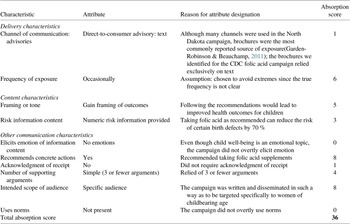
We use characteristics of the educational campaign and the target audience to estimate the IAF with Supplementary Equation (B.1). Table 5 shows the characteristic and attribute designations we made for the folic acid campaign, the reasoning behind the designations, and the associated absorption scores. The total absorption score associated with these characteristics is 36, which generates an unadjusted IAF of 0.5:
 $$ \mathbf{0.5}=\left(\frac{\mathbf{36}-\mathbf{7}}{\mathbf{65}-\mathbf{7}}\right) $$
Risk communication characteristics of the folic acid campaign.

Source: Supplementary Appendix Table B2.
Table 6 shows the audience absorption scores associated with the demographic characteristics of the target audience folic acid campaign. The target audience consists of women of childbearing age (roughly coinciding with the 18–44 age bracket) of all racial and ethnic categories and education levels. The total audience score associated with these characteristics is 3.33, which generates a target audience adjustment factor of 0.056:
 $$ \mathbf{0.056}=\left(\frac{\mathbf{3}.\mathbf{3}}{\mathbf{1}\mathbf{0}}\right)\bullet \left(\frac{\mathbf{1}}{\mathbf{3}}\right)\bullet (\mathbf{1}-\mathbf{0.5}). $$
Demographic characteristics for the folic acid campaign.

Source: Calculations based on “Targeted” absorption scores reported in Supplementary Appendix Table B3. When the target audience includes of multiple attribute groups for a given demographic characteristic (e.g., ages 18–44 years and 45–64 years), we use the simple average of the scores.
Summing the unadjusted IAF and the target audience adjustment yields a most likely estimate for the IAF of 0.56 (= 0.5 + 0.06). However, because the IAF is highly uncertain, we allow it to vary from a minimum of 0 to a maximum of 1.
4.2.4. Exposure, target audience, and spillovers
While every woman surveyed by Garden-Robinson and Beauchamp indicated being exposed to educational campaign materials, we would expect some sampling error. We also do not know how many of the women exposed to the written brochures read them. We assume the exposure rate has minimum, most likely, and maximum values of 75, 86, and 100 %, where the most likely value corresponds to the literacy rate in the USA (Baer et al., Reference Baer, Kutner, Sabatini and White2009).
Because the educational campaign was only conducted in North Dakota, we adjust the exposure rates to reflect that the campaign only covered 0.208 % of U.S. women of childbearing age (116,819 such women in North Dakota/56,076,919 in the USA). Multiplying the default exposure rates by 0.208 % results in estimated exposure rates of 0.156 % for minimum, 0.179 % for most likely, and 0.208 % for maximum.
We do not estimate spillover effects; we assume 100 % of the people exposed to the message belong to the target audience and that the spillover parameter is 0. We do this for two reasons. First, we wish to compare our estimated effects to the observed effect on the target audience and the effects on other individuals are irrelevant for that purpose.Footnote 13 Second, due to the targeted nature of this message directed to women of childbearing age in North Dakota, it is difficult to estimate what the spillovers to other geographic areas and demographic groups would be.
4.2.5. Demand and supply elasticities for folic acid
We were unable to obtain demand and supply elasticity estimates for folic acid supplements directly from the literature. As described above, the most likely estimate of the elasticity of demand for folic acid supplements is provided by the demand elasticity for medical and health products estimated by Muhammad et al. (Reference Muhammad, Seale, Meade and Regmi2011), −0.902. Because Muhammed et al. do not report a standard error, we use estimates from the literature to specify a triangular distribution around the elasticity of demand. We assume the minimum elasticity of demand minimum is −0.1 (Goldman et al., Reference Goldman, Joyce, Escarce, Pace, Solomon, Laouri, Landsman and Teutsch2004), the smallest estimate we identified in the literature. We assume the maximum elasticity of demand is −1.49 (Kowalski), the largest estimate we identified in the literature.
We estimate the short-run supply elasticity using the calibration method described by Rutherford (Reference Ščasný and Zvěřinová1998), which allows one to estimate an industry’s elasticity of supply using data on the share of capital in value and estimates of the elasticity of substitution between capital and labor. The method assumes capital is fixed and production is described by a constant elasticity production function. Using data from the 2012 Economic Census for the North American Industry Classification System (NAICS) (U.S. Census Bureau, 2015) and the U.S. KLEMS database (Jorgenson et al., Reference Jorgenson, Ho and Samuels2012), we calculate a low estimate for the supply elasticity of 0.599 and a high estimate for the supply elasticity of 1.886.Footnote 14 Therefore, we use 0.599 as our minimum estimate and 1.866 as our maximum estimate. We use the midpoint of these two values (1.243) as our most likely estimate.
We run a Monte Carlo simulation to incorporate the full distributions of uncertain parameters and report the resulting 5th percentile, mean, and 95th percentile effects of the folic acid campaign. We assume a triangular distribution for most uncertain inputs, except we use a PERT distribution for the IAF.
4.3. Comparison of simulated and actual effects
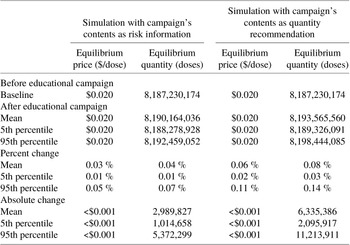
Table 7 reports the simulated effects of the health information on the equilibrium price and quantity of folic acid. The size of the simulated impact is larger when using the educational campaign’s quantity recommendation (based on Equation (6)) than when using the risk information (based on Equation (5)). Because we assume no spillovers, we attribute the full quantity change to women of childbearing age in North Dakota. We assume that both the original and new consumers take a daily dose. Table 8 shows what the simulation results imply for folic acid supplementation by women in North Dakota and compares the simulated outcome with the actual results as estimated by Garden‐Robinson and Beauchamp (Reference Garden‐Robinson and Beauchamp2011).
National simulation results for North Dakota folic acid educational campaign.

Source: Authors’ simulation results and calculations.
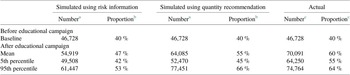
Number and proportion of women of childbearing age taking folic acid in North Dakota: comparison of simulated outcome to actual outcome.

Source: Authors’ simulation results and calculations and Garden‐Robinson and Beauchamp (Reference Garden‐Robinson and Beauchamp2011).
a The number of women of childbearing age taking folic acid supplements after the educational campaign is calculated as the sum of the baseline number of doses (17,055,574) and the absolute change in equilibrium number of doses from Table 7, divided by 365 doses per year. That is, we assume everyone takes a daily dose.
b The proportion of women of childbearing age taking folic acid supplements after the educational campaign is calculated as the total number taking folic acid supplements divided by the number of women of childbearing age in North Dakota, 116,819.
c Garden‐Robinson and Beauchamp (Reference Garden‐Robinson and Beauchamp2011) report the proportion. We calculate the 90 % confidence interval for the proportion using the standard formula
 $ \hat{p}\pm 1.63\sqrt{\hat{p}\bullet \left(1-\hat{p}\right)\div n} $
. We calculate the number by multiplying the proportion by the number of women of childbearing age in North Dakota, 116,819.
Using risk information, we estimate that the number of women taking folic acid would increase to 54,919, representing 47 % of the 116,819 women of childbearing age in North Dakota. Using the results for the 5th percentile and 95th percentiles, we calculate the 90 % prediction interval to range from 42 to 53 %, a prediction interval is slightly lower than the confidence interval ranging from 55 to 64 % implied by Garden-Robinson and Beauchamp’s results.
Using the quantity recommendation, we estimate that the number of women taking folic acid would increase to 64,085 women, representing 55 % of the 116,819 women of childbearing age in North Dakota. Using the results for the 5th percentile and 95th percentiles, we calculate the 90 % prediction interval to range from 45 to 66 %. This prediction interval overlaps with the 90 % confidence interval implied by Garden-Robinson and Beauchamp’s results.
The quality of our model’s predictions depends in part on the quality and completeness of the inputs. For example, by selecting text-only direct-to-consumer advisory as the channel of communication, we may underestimate the IAF (see Table 5 and Supplementary Appendix Table B2); in the actual campaign, although brochures were the most commonly reported sources of exposure, a variety of channels were used (Garden‐Robinson & Beauchamp, Reference Garden‐Robinson and Beauchamp2011). The estimates are highly sensitive to the value of a statistical case and to the price elasticity of demand for folic acid supplements. We lack direct estimates of the costs (or WTP) associated with having a child born with neural tube birth defects and therefore used a more general estimate of WTP to avoid internal birth defects from the secondary literature. Our simulation inputs were easier to obtain for the quantity recommendation than for the risk information. For that reason – and because the health information took the form of a quantity recommendation – we have more confidence in the simulation based on the quantity model.
5. Discussion and conclusion
We have presented a model to predict how consumers will respond to new health information, discussed how it can be implemented, and validated the approach by simulating the impact of a historical educational campaign. Our simulation’s predictions are close to the observed effects of the educational campaign. The magnitude of our prediction is most accurate when modeling the health communication as a quantity recommendation; when we model the health communication as providing risk information, we underestimate the impact. Differences between the two approaches may reflect the quality of the inputs used.
If a federal, state, or local agency wants to communicate health information to a targeted audience, how can it be designed to be most effective and impactful? Our folic acid simulation demonstrates that the model can provide a useful benchmark for policy makers seeking to predict the effectiveness of a proposed risk communication on consumer response. The approach can be applied broadly to a variety of types of health information, ways of communicating health information, target audiences, and product markets. For example, in April 2020, the CDC created an informational poster to help prevent COVID-19 during air travel. The infographic, seen in Figure 2, recommends travelers “Avoid close contact with others, wear a cloth face covering, and wash your hands often with soap and water for at least 20 seconds or use an alcohol-based hand sanitizer….” (Centers for Disease Control and Prevention, 2020b). The CDC could use the model to decide the tone of the informational poster (e.g., framing as a positive outcome, recommending concrete actions).
CDC infographic: prevent COVID-19 during air travel.

Additionally, state level government agencies could use this model to help determine which channel of communication (e.g., social media, newspaper, and product label) would be most effective at changing market outcomes, and thus behavior, to help prevent the spread of COVID-19. Our model predicts that the information in the CDC poster above would be equally absorbed, leading consumers to change their risk beliefs about hand sanitizer usage during air travel, regardless of whether the poster was distributed through social media, a product label, or displayed at the point of sale. Therefore, all else being equal, the CDC would do best to choose the communication channel with the highest rate of exposure (i.e., the exposure rate, E, in Equation (4) above). Our model predicts that the impact of this poster on consumer behavior would be almost 50 % greater if it were displayed on social media than if it were displayed at the point of sale or as a label on the product. As this exercise illustrates, CDC staffers could propose adding an audio or visual component to the informational poster when posted on social media, thus increasing the likelihood of using hand sanitizer during air travel.
Our approach has limitations. We make two major assumptions regarding the effect of new health information. First, we assume that once a person’s risk beliefs change, they change forever; however, research suggests that if new information is not routinely communicated to consumers, they can unlearn this information (Chang & Just, Reference Chang and Just2007). Second, we do not consider the possibility that providing a consumer with additional information could tax her cognitive resources. Previous research suggests that consumers can be overloaded with information and make poorer choices as a result (Jacoby et al., Reference Jacoby, Speller and Kohn1974).
The way we estimate the IAF mitigates some of these problems. For example, we asked the experts participating in the expert elicitation to tell us how characteristics of the information treatment and the target audience influence responsiveness to information. The experts based their answers to our questions on their understandings of how real people behave, which would incorporate common biases people may have even though we do not explicitly include such cognitive biases in our theoretical model.
Although we do not separately identify the effect of cognitive biases and information overload, our modeling approach implicitly reflects those behavioral aspects as captured in demand elasticities and the IAF. Limitations of our model of information processing suggest avenues for future research, including modeling the intertemporal effects of new health information and empirically estimating the IAF for different risk communications in various settings using observational or experimental data. In addition, future iterations could incorporate direct modeling of spillover effects or effects on related goods.
Our model provides a valuable tool for predicting how consumers will respond to new health information and the resulting impact on the markets for consumption goods. For example, the method described in this paper could be extended to predict the effectiveness of public health campaigns encouraging COVID-19 vaccination. The model can accommodate many consumption goods and therefore can serve as a versatile tool for policymakers or researchers seeking to understand how information influences behavior.
Acknowledgments
We thank J. E. Brophy, M. C. Coglaiti, and C. Rains for their significant contributions in helping to collect data for parameterizing the model, including helping to organize and conduct the expert elicitation. We thank L. Zwanziger and R. Lutter for valuable input and comments. We thank conference participants at the annual meetings of the Society for Risk Analysis and the Society for Benefit–Cost Analysis, seminar participants at the U.S. Department of Labor, and participants of the Benefit Cost Analysis: Advancing Analysis Workshop (co-sponsored by the U.S Department of Agriculture and Society for Benefit–Cost Analysis) for valuable comments. All errors are our own.
Supplementary Materials
To view supplementary material for this article, please visit http://doi.org/10.1017/bca.2022.1.
Disclaimer
The views expressed here are those of the authors and do not necessarily reflect the views of the U.S. Food & Drug Administration (FDA) or the U.S. Federal Aviation Administration (FAA).
Funding
D.W.W., S.A.K., and M.K.M. acknowledge that RTI International received contract funding from the Food and Drug Administration for the work associated with this project. R.L.S., N.L., C.N., J.G.P., and C.W. did not receive any funding for this project.