




No CrossRef data available.
The Relevance of Political Science to the WorldBank
Published online by Cambridge University Press: 13 February 2006
Extract
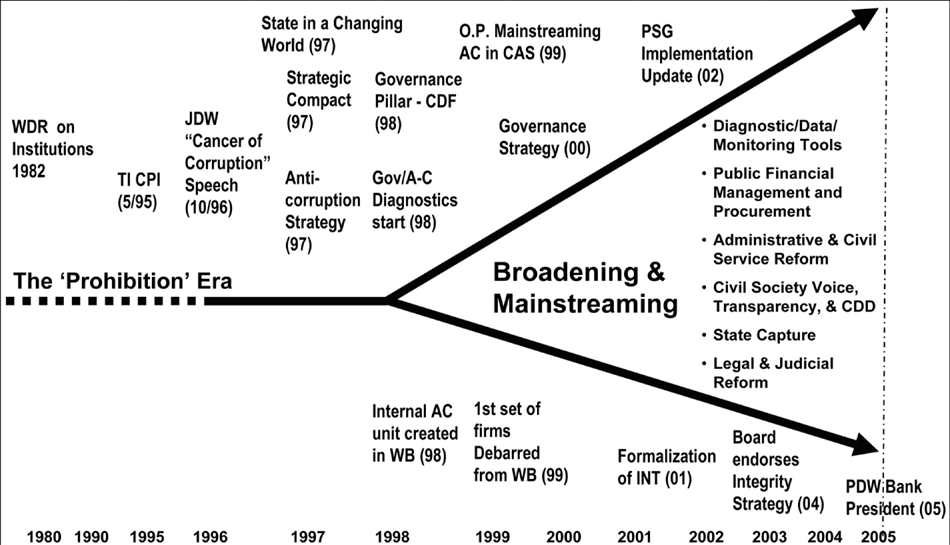
By the mid 1990s, scholars, practitioners, and policy makers alikehad begun to recognize the critical importance of good governancefor growth and poverty reduction. Yet corruption, its mirror image,remained “taboo” at the World Bank up until the historic “cancer ofcorruption” speech in 1996 of then-Bank President James Wolfensohnthat formally brought governance and anticorruption into theforefront of the Bank's agenda (see Figure 1). In 1997, the WorldDevelopment Report: The State in a Changing World broke new groundwithin the Bank, taking stock of the erstwhile work on governanceand addressing what the institution could do to enhance its abilityto help client countries improve governance and reducecorruption.The presentation wasmade at the APSA 2005 meeting, “Panel on Politics andDevelopment Programs: APSA and World Bank Collaboration.” Panelparticipants included: Margaret Levi (APSA President 2004–2005),Ashutosh Varshney, Anna Grzymala-Busse (University of Michiganat Ann Arbor), Daniel N. Posner (University of California LosAngeles), and Timothy Frye (Ohio State University) from APSA;and Sanjay Pradhan, Edgardo Campos, Richard Messick, and MaksKobonbaev from the World Bank Public Sector GovernanceUnit.
Information
- Type
- INTERNATIONAL
- Information
- Copyright
- © 2006 The American Political Science Association
The Governance Agenda
By the mid 1990s, scholars, practitioners, and policy makers alike had begun to recognize the critical importance of good governance for growth and poverty reduction. Yet corruption, its mirror image, remained “taboo” at the World Bank up until the historic “cancer of corruption” speech in 1996 of then-Bank President James Wolfensohn that formally brought governance and anticorruption into the forefront of the Bank's agenda (see Figure 1). In 1997, the World Development Report: The State in a Changing World broke new ground within the Bank, taking stock of the erstwhile work on governance and addressing what the institution could do to enhance its ability to help client countries improve governance and reduce corruption.
Since then, the Bank has promoted many programs within the broad theme of governance, covering key areas including in particular administrative and civil service reform, decentralization, public financial management, tax policy, anticorruption, and legal and judicial reform (Figure 1). These programs have been mainstreamed into Country Assistance Strategies (CAS) and lending operations to help address governance and corruption concerns. In parallel, the Bank has supported and encouraged empirical research on governance and corruption, developing extensive data bases and diagnostic tools. In combination with scholarly research grounded largely on the new institutional economics, this has led to the general acceptance by both the academic and development community of the significant impact that the quality of governance institutions has on the welfare of citizens and thus the urgent need to address poor governance.

The Governance Agenda: Birth…Growth
Analytical Frameworks Help Guide the Design of Governance and Anti-Corruption Programs
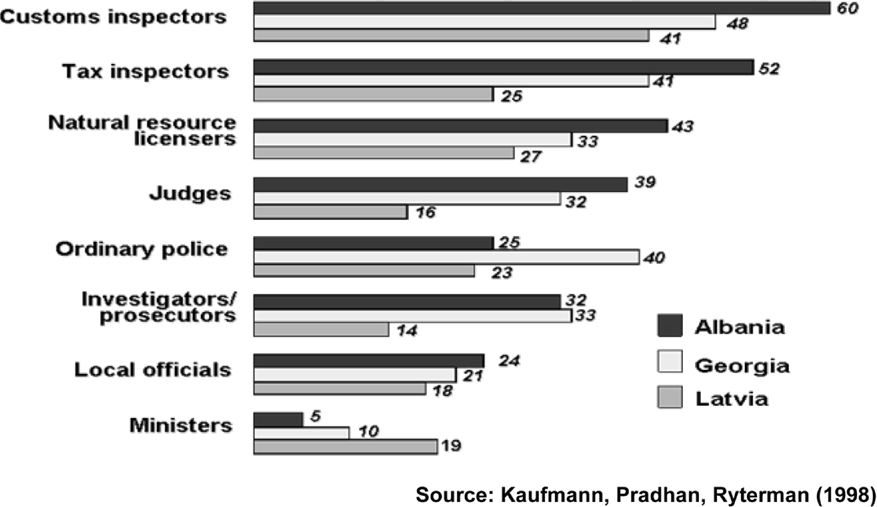
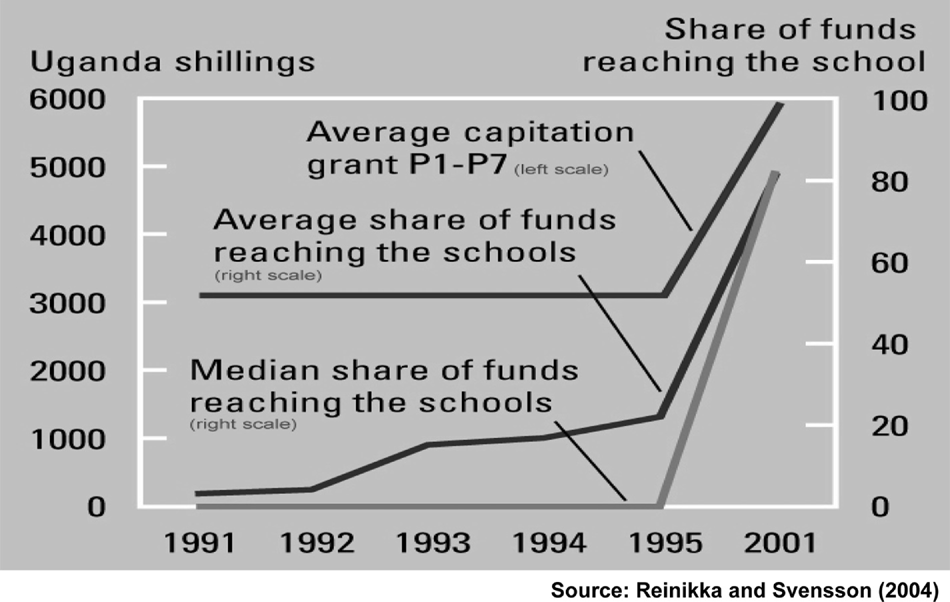
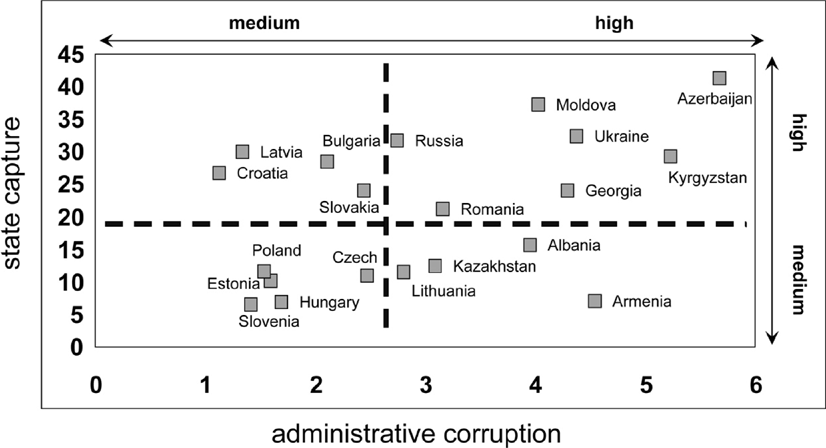
The Bank has developed a wide variety of governance diagnostic tools to unpack governance and guide the design of its interventions in different country contexts. These include: aggregate indicators for different aspects of governance; surveys of households, firms, and public officials to identify key areas of vulnerability; measures of state capture and administrative corruption; and public expenditure tracking surveys (see Figures 2a and 2b and http://info.worldbank.org/governance/kkz2004/). For instance, a careful analysis of the Business Environment and Enterprise Performance Surveys (BEEPS) conducted for transitional economies led to a typology of corruption based on extent of state capture vs. administrative corruption that helped identify different entry points and governance reform strategies for countries in the region (see Figure 3).

Purchasing of public positions

Public expenditure tracking in Uganda

Country Typology: From Governance Outcomes to Strategy
APSA scholars can deepen and enrich the understanding of different types of governance dysfunctions and reform pathways. For instance, it would be useful to unpack different types of governance challenges in African countries (e.g., based on clientelistic vs. developmental leadership, capacity, presence of extractive industries), with different implications for reform strategies.
How Can Political Scientists Contribute to the Governance Agenda?
Public sector governance is often defined as the manner in which the state exercises the authority to provide and manage public goods and services. But not only is it important to understand the manner in which public officials and public institutions manage and provide public goods but also the manner in which they acquire the authority to do so in the first place (Campos and Lateef 2005). The acquisition of authority/power is invariably about politics and thus the subject matter proper of political science. The World Bank does not and cannot support any political activities.1
The Bank has the mandate to address governance and corruption as a development issue within its Articles of Agreement. However, the Bank's work should be based solely on economic considerations and not be influenced by political concerns in keeping with its Articles of Agreement.
The Use of Political Analysis in Formulating Strategy
There is a growing recognition within the World Bank of the importance of understanding the social, political, and institutional context within which reforms evolve, and, correspondingly, the need for better political and institutional analysis to inform the design of programs and the formulation of strategies. The Bank has begun to employ political stakeholder analysis to help clarify who the potential winners and losers of a particular reform might be and the extent to which each might be capable of influencing the outcome. The approach is based upon rational actor decision theories and focuses on identifying stakeholders and their preferences to establish the form and shape a reform might take to be politically feasible and/or acceptable. For example, in East Asia, stakeholder analysis revealed potential winners and losers and how coalitions could change as a consequence of World Bank recommended reforms. In Nicaragua, a surprising convergence emerged among contending parties, suggesting that the World Bank should focus on cross-stakeholder coalition-building. The benefits of this tool in assessing the political feasibility of reforms are significant. But there are likely other tools or methodologies that political scientists have developed or perhaps could develop that could complement or deepen the approach. Understanding the politics of a country is indispensable in formulating good strategy and thus in enhancing the chances of successfully implementing a reform.
Emerging Issues
Understanding the pathways and politics of change
As noted earlier, the World Bank has developed useful diagnostic tools to help its staff better understand the nature of corruption and governance in a particular country. However, the Bank seeks to move beyond an identification of symptoms toward a deeper understanding of the underlying causes of poor governance and lack of “political will” for progressive change. In this regard, political analysis helps understand the vested interests that result in the status quo. But it is important to go beyond this to identify and support drivers of change. Political scientists can potentially help the World Bank provide guidance on how to manage the politics of change.
Strengthening demand side pressures for reform in clientelistic states
The World Bank has increasingly recognized the importance of country ownership and commitment for sustaining governance reforms. Not surprisingly, the strongest demand for governance reforms comes mainly from “developmental” states, in which leaders are willing to change the status quo and govern justly. By contrast, the demand from countries with more clientelistic leadership has been substantially weaker. Addressing governance in such countries is crucial to the World Bank as they tend to be among the poorest as well. But this presents formidable challenges. While research in political economy has provided reasonable explanations for the persistence of poor governance in clientelistic states, it has done little to improve our understanding of how to generate demand for governance reforms or how to identify major points of entry for Bank or other development assistance programs in such countries. Research in this direction would be mutually beneficial for both the World Bank and political scientists interested in clientelistic political systems.
Measuring governance
As other panel presenters have rightly highlighted, the issue of measurement is at the core of evaluating the success or failure of governance and institutional reforms. So far, the World Bank has employed aggregate measures such as the World Bank Institute's governance indicators, Transparency International's Corruption Perception Index, political risk indicators from the International Country Risk Guide, etc. Though such data allow the examination of general patterns and trends over time, they are subject to a number of potentially serious measurement issues. Furthermore, based on such indicators, it is hard to assess the impact of the World Bank programs—the trends in these indicators cannot be easily attributed to Bank assistance because there are typically many more factors that affect them and are beyond the control of the Bank. Moreover, in many countries, Bank lending for governance constitutes a very small portion of public expenditures. The World Bank is very much interested in cutting-edge and innovative ways of measuring the quality of governance using policy relevant actionable indicators. Research in political science on measuring governance can significantly improve the assessment of the real impact of Bank interventions.
The World Bank-APSA collaboration is a promising and mutually beneficial endeavor. It can help the Bank better understand and manage the political dynamics of reform for stronger results on the ground, and it can provide APSA scholars with a valuable laboratory for rich, policy-oriented research. The participants of this panel can take the collaboration forward, using the APSA meetings for annual consultations between the Bank and APSA on mutual areas of interest and potential research priorities.
References
Anticorruption in Transition: A Contribution to the
Policy Debate. 2000.
Washington, D.C.: The World Bank
Publication.Google Scholar
Campos, Edgardo, and
Sarwar
Lateef. 2005.
“Improving Public Sector Governance: The Grand
Challenge?” In Economic Growth in the 1990s:
Learning from a Decade of Reform. Washington,
D.C.: The World Bank Publication.Google Scholar
Kaufmann, Daniel,
Aart
Kraay, and Massimo
Mastruzzi. 2005.
“Governance Matters IV: Governance Indicators for
1996–2004.” Washington, D.C.: The World
Bank Institute.Google Scholar
Kaufmann, Daniel,
Sanjay
Pradhan, and Randi
Ryterman. 1998.
“New Frontiers in Diagnosing and Combating
Corruption.” PREM Note No. 7
(October).Google Scholar
Reinikka, Ritva, and
Jakob
Svensson. 2004. “Local Capture: Evidence from a Central
Government Transfer Program in Uganda.” Quarterly
Journal of Economics
119 (2): 679–705.Google Scholar
The Governance Agenda: Birth…Growth
Purchasing of public positions
Public expenditure tracking in Uganda
Country Typology: From Governance Outcomes to Strategy
 You have Access