Introduction
The diversity and temporal distribution of marsupials during the late Paleogene (late Eocene through Oligocene) of North America was recently reviewed and revised (Korth, Reference Korth2018). Assessment of the marsupial fauna during the Whitneyan North American Land Mammal Age (NALMA: 32.0–30.0 Ma; Prothero and Emry, Reference Prothero, Emry and Woodburne2004) in that study was based on specimens from two well-described faunae from southwestern South Dakota: the Cedar Pass local fauna and an assemblage from the Harris Ranch paleontological locality. Four taxa were recognized from the Whitneyan NALMA (Korth, Reference Korth2018, fig. 16); however, given that data were only available from two sites within a geographically restricted region, it is possible that additional Whitneyan marsupial diversity remained undetected in that study.
Recent study of rodent fossils collected from stratigraphically constrained sampling intervals from the Fitterer Ranch and Obritsch Ranch paleontological localities in the Little Badlands area of North Dakota revealed that much of the Brule Formation in that area preserves a Whitneyan fauna (Korth et al., Reference Korth, Emry, Boyd and Person2019a, Reference Korth, Boyd and Personb). Even though marsupials were never previously reported from the Brule Formation in North Dakota (e.g., Murphy et al., Reference Murphy, Hoganson and Forsman1993), extensive collection efforts at those localities by multiple institutions resulted in the collection of numerous marsupial specimens, largely in the form of isolated teeth recovered via screen washing. Those specimens comprise a third (Fitterer Ranch) and fourth (Obritsch Ranch) Whitneyan marsupial assemblage that provides further insight into the marsupial fauna in North America during the Whitneyan.
Materials and methods
Sampling methods
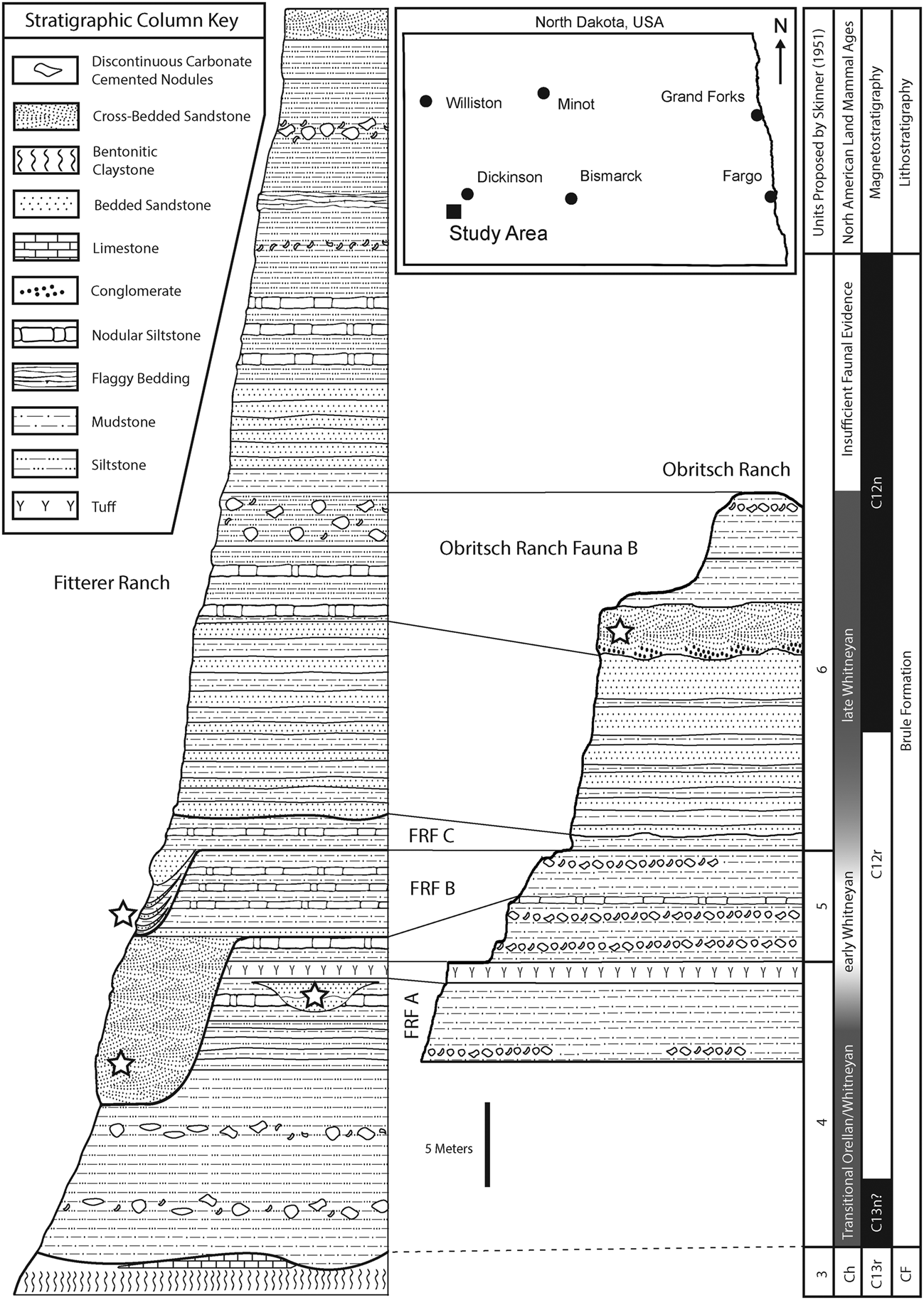
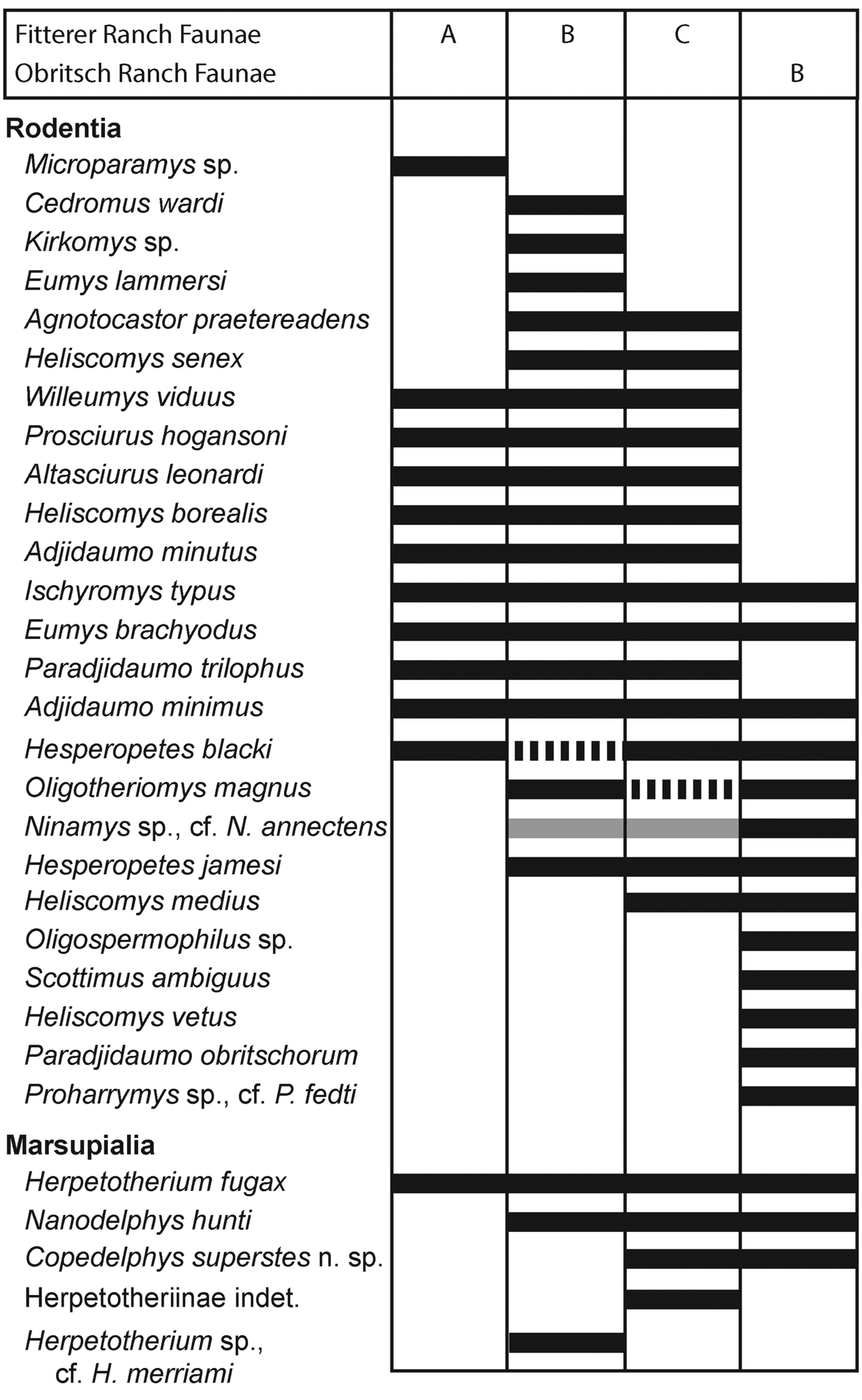
This study focuses on specimens collected from rocks of the Brule Formation exposed at the Fitterer Ranch and Obritsch Ranch paleontological localities, both of which are located along the southern border of the area known as the Little Badlands in Stark County, North Dakota (Fig. 1). Skinner (Reference Skinner and Bump1951) subdivided the Brule Formation at Fitterer Ranch into six units, each with multiple subunits, and provided detailed descriptions of each subunit. That work allowed fossils collected at Fitterer Ranch and other nearby locations to be associated with clear stratigraphic information. Korth et al. (Reference Korth, Emry, Boyd and Person2019a) used those data to divide fossilized rodent specimens recovered from the Brule Formation at Fitterer Ranch between seven sampling intervals so that trends in the rodent fauna through time could be studied. Similar collection practices were also employed at the nearby Obritsch Ranch, although at that location fossils are less abundant and thus only three sampling intervals were recognized (Korth et al., Reference Korth, Boyd and Person2019b). It should be noted that these sampling intervals were defined based on ease of recognition in the field and ability to collect from rocks of one sampling interval with minimal risk of contamination by fossils of the other sampling intervals and do not necessarily correspond to lithosomes or discrete sedimentary packages in all cases. Based on the composition of the rodents present in each sampling interval (Korth et al., Reference Korth, Emry, Boyd and Person2019a, Reference Korth, Boyd and Personb), the collections at these two locations can be divided into four faunae (Fig. 2), which are summarized below. It should be noted that sampling intervals 3 and 7 at Fitterer Ranch and sampling interval 1 at Obritsch Ranch are not included in the following faunae because few rodents were obtained from those intervals. Additionally, no marsupial specimens are currently known from those sampling intervals.
Correlated stratigraphic sections of the Brule Formation rocks exposed in the study area at the Fitterer Ranch and Obritsch Ranch paleontological localities within Stark County, North Dakota. Stratigraphic data derived from personal observations of the authors, unpublished field notes of Dr. Richard Tedford (provided courtesy of the American Museum of Natural History), and published data (Skinner, Reference Skinner and Bump1951; Stone, Reference Stone1973; Murphy et al., Reference Murphy, Hoganson and Forsman1993). On the right-hand side of the stratigraphic columns the following data are presented from left to right: unit numbers defined by Skinner (Reference Skinner and Bump1951), the inferred North American Land Mammal Ages (NALMAs) based on the studies of Korth et al. (Reference Korth, Emry, Boyd and Person2019a, Reference Korth, Boyd and Personb), the magnetostratigraphic data of Prothero (Reference Prothero, Prothero and Emry1996, fig. 5), and the lithostratigraphic boundaries. Gradual shading for the biostratigraphic data reflects uncertainty in the exact position of the transitions between NALMAs. Geographic location of the study area shown in upper right inset map. A key to lithologies and sedimentary structures is provided at the upper left. Stars indicate the stratigraphic placement of the screen-washed localities that produced most of the specimens included in this study. Abbreviations: C, Chron; CF, Chadron Formation; Ch, Chadronian NALMA; FRF, Fitterer Ranch Fauna; n, normal polarity; r, reverse polarity.

Rodent and marsupial faunae from the Brule Formation of southwestern North Dakota. Data from Korth et al. (Reference Korth, Emry, Boyd and Person2019a, Reference Korth, Boyd and Personb). Older faunae are on the left, younger faunae on the right.

Fitterer Ranch fauna A
This fauna is composed of all specimens collected from sampling intervals 1 and 2 of Korth et al. (Reference Korth, Emry, Boyd and Person2019a), which corresponds to subunits 4A to 4C of Skinner (Reference Skinner and Bump1951). The rodents collected from those sampling intervals indicate either a transitional Orellan/Whitneyan fauna, or an early Whitneyan fauna based on the presence of the cricetid Eumys brachyodus Wood, Reference Wood1937 (Fig. 2; Korth et al., Reference Korth, Emry, Boyd and Person2019a). All marsupial specimens assigned to this fauna in this study were obtained via screen washing of rocks from a single location that preserves a channel-sandstone deposit.
Fitterer Ranch fauna B
This fauna is composed of all specimens collected from sampling intervals 4 and 5 of Korth et al. (Reference Korth, Emry, Boyd and Person2019a), which corresponds to subunit 5B through the lower portion of subunit 5E of Skinner (Reference Skinner and Bump1951). The rodents collected from those sampling intervals indicate a Whitneyan fauna, based on the co-occurrence of the cricetid Eumys brachyodus and the castorid Agnotocastor praetereadens Stirton, Reference Stirton1935 (Fig. 2; Korth et al., Reference Korth, Emry, Boyd and Person2019a). Marsupial specimens assigned to this fauna in this study were obtained by a combination of surface collection and screen washing of rocks from a single location that preserves a channel sandstone deposit.
Fitterer Ranch fauna C
This fauna is composed of all specimens collected from sampling interval 6 of Korth et al. (Reference Korth, Emry, Boyd and Person2019a). Again, the rodents collected from this sampling interval indicate a Whitneyan fauna, based on the co-occurrence of the cricetid Eumys brachyodus and the castorid Agnotocastor praetereadens (Fig. 2; Korth et al., Reference Korth, Emry, Boyd and Person2019a). Additionally, the presence of the heliscomyid Heliscomys medius Korth, 2007 and the sciurid Hesperopetes jamesi Emry and Korth, Reference Emry and Korth2007, which are otherwise known from the Blue Ash local fauna in southwestern South Dakota (Korth, Reference Korth2010), may indicate that Fauna C is from the late Whitneyan. Marsupial specimens here assigned to Fauna C were collected via extensive screen washing of a thin sandstone bed within an abandoned channel that experienced occasional reactivation. That channel cuts down into older rocks of the Brule Formation, making it difficult to determine the stratigraphic placement of that channel relative to the subunits described by Skinner (Reference Skinner and Bump1951). Korth et al. (Reference Korth, Emry, Boyd and Person2019a, Reference Korth, Boyd and Personb) interpreted the placement of that channel as within the upper portion of subunit 5E; however, Skinner (Reference Skinner and Bump1951) showed this local channel as the base of his unit 6A, but we interpret it as cutting down from within Skinner's unit 5E. The only discrepancy between these alternative interpretations is whether the upper part of subunit 5E and subunit 5F predate or postdate this local channel, which is a channel fill within a channel fill, and the temporal difference is insignificant. Whichever placement is correct, the faunal interpretations made by Korth et al. (Reference Korth, Emry, Boyd and Person2019a, Reference Korth, Boyd and Personb) and in this study are not affected because the specimens collected from this local channel are definitively younger than those from Fitterer Ranch Fauna B based on superposition.
Obritsch Ranch fauna B
This fauna is composed of all specimens collected from sampling intervals 2 and 3 at Obritsch Ranch (Korth et al., Reference Korth, Boyd and Person2019b), which corresponds to the upper portion of subunit 6A and all of subunit 6B of Skinner (Reference Skinner and Bump1951). Magnetostratigraphic analysis of correlative rocks at Fitterer Ranch reveals these rocks were deposited during Chron C12n (31.0–30.6 Ma; Prothero, Reference Prothero, Prothero and Emry1996; Ogg, Reference Ogg, Gradstein, Ogg, Schmitz and Ogg2012), which is entirely contained within the late Whitneyan NALMA (31.4–30.0 Ma; Prothero and Emry, Reference Prothero, Emry and Woodburne2004). Evidence from the rodents collected from these sampling intervals agrees with a late Whitneyan “age,” most closely matching the rodent fauna from the late Whitneyan Blue Ash local fauna in southwestern South Dakota (Fig. 2; Korth, Reference Korth2010; Korth et al., Reference Korth, Boyd and Person2019b). All the marsupial specimens assigned to this fauna in this study were collected via screen washing rocks from a channel sandstone within sampling interval 2.
Potential biases
Compared to the other three faunae, Fitterer Ranch Fauna A had few marsupial specimens available for inclusion in this study. Thus, that fauna should not be considered as well sampled as the others and the absence of any taxa that are present in the other intervals should be interpreted cautiously.
Abbreviations for measurements
L, maximum anteroposterior length; W, maximum transverse width.
Repositories and institutional abbreviations
NDGS, North Dakota State Fossil Collection, North Dakota Geological Survey; USNM PAL, US National Museum of Natural History, Smithsonian Institution.
Systematic paleontology
Order Marsupicarnivora Ride, Reference Ride1964
Family Herpetotheriidae Trouessart, Reference Trouessart1879
Genus Herpetotherium Cope, Reference Cope1873a
Type species
Herpetotherium fugax Cope, Reference Cope1873a.
Herpetotherium fugax Cope, Reference Cope1873a
Figure 3.1–3.6; Tables 1, 2
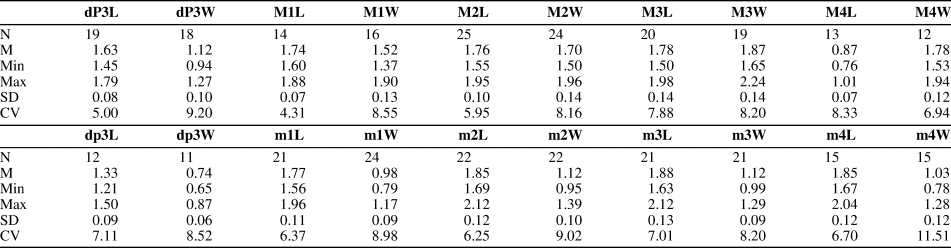
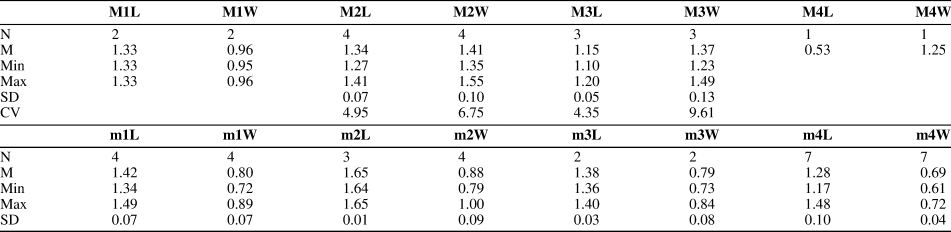
Dental measurements of Herpetotherium fugax from Fitterer Ranch. Abbreviations: CV, coefficient of variation; d, deciduous tooth; L, anteroposterior length; M, mean; Max, maximum measurement; Min, minimum measurement; N, number of specimens; SD, standard deviation; W, transverse width. Measurements in mm.

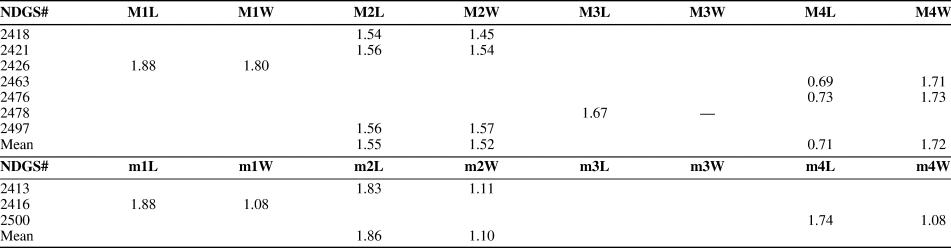
Dental measurements of Herpetotherium fugax from Obritsch Ranch. Abbreviations: L, anteroposterior length; W, transverse width; —, indicates that measurement could not be made. Measurements in mm.

Type specimen
AMNH 5254, partial denary with right m1–m4.
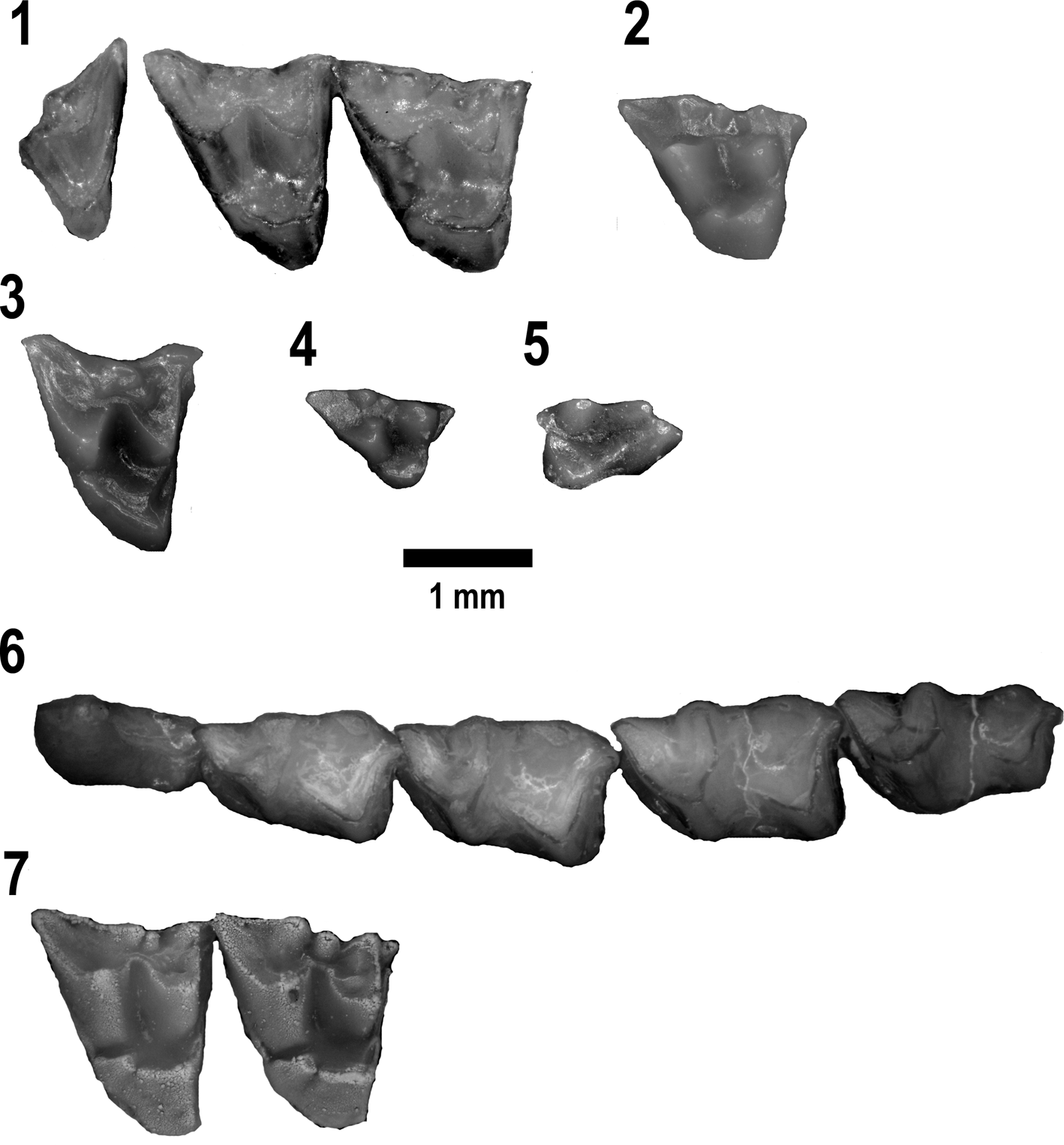
Dentition of Herpetotherium fugax (1–6) and H. cf. H. merriami (7) from Fitterer Ranch. (1) NDGS 2966, right M2–M4; (2) USNM 643489, right M1; (3) USNM 643497, right M3; (4) USNM 643525, right dP3; (5) USNM 706575, right dp3; (6) NDGS 4030, left p3–m4; (7) NDGS 4349, fragment of maxilla with right M2–M3. Anterior to right in (1–5, 7), to left in (6).

Occurrence
Holotype from Cedar Creek beds, White River Formation, Logan County, Colorado; specimens referred here from Fitterer Ranch Faunae A, B, and C; Obritsch Ranch Fauna B.
Description
The dentition of H. fugax is described in detail elsewhere (Fox, Reference Fox1983; Korth, Reference Korth1994, Reference Korth2018; Hayes, Reference Hayes2005). The following description is focused on observed variations from those descriptions and the morphology of previously undescribed deciduous premolars.
DP3 is triangular in occlusal outline with the posterobuccal corner being elongated posteriorly (Fig. 3.4). The length is ~1.5 times that of the width. Stylar cusp A is present on three-quarters of the specimens and is a large cusp on a few of the specimens. Cusp A is never as large as the remaining stylar cusps on any of the premolars. Cusp B is only rarely present, and if so, is very small. Cusp C is present on 58% of the specimens and is small in all but one specimen. Cusp D is present on all specimens and the largest stylar cusp on two-thirds of the specimens.
M1 is as previously described (Korth, Reference Korth1994, Reference Korth2018), being slightly longer than wide. Stylar cusps B and D are present on nearly all specimens (92% and 85%, respectively) and are the largest of the stylar cusps (Fig. 3.2). Cusp C occurs on 77% of the M1s, but is generally smaller than cusp D (54%) and frequently linked directly to it. If present, cusps A and E are minute.
M2 is approximately equal in length and width, averaging only ~3% longer than wide. The dominant stylar cusps are B and D, which are large on nearly all specimens (Fig. 3.1). Cusp C is present on most specimens (70%), but generally smaller than cusps B and D and frequently fused to cusp D. On one specimen, USNM 643490, cusp C is twinned, but both cusps are minute.
M3 is wider than long with a deep ectoflexus (Fig. 3.1, 3.3). The dominant stylar cusp is C at the center of the buccal edge of the tooth and is present on all specimens. It is the largest stylar cusp, but cusp B is nearly as large on half of the specimens, and cusp D is also large on 29% of the specimens, but lacking on all others. Like M2, a single specimen has a twinned, but minute cusp C (USNM 643493).
All the stylar cusps on M4 are generally small and limited almost entirely to cusps A and C (Fig. 3.1).
Of the lower cheek teeth, only dp3 has not yet been described. It is smaller than m1, near the size of p3. Unlike p3, which has a single main cusp at its anterior end and a short, shallow talonid on the posterior half, dp3 has a distinguishable trigonid and talonid as in the molars (Fig. 3.5 versus 3.6). It is much narrower anteriorly than posteriorly and the paraconid forms a distinct point at the anterior end of the tooth, which widens posteriorly. Both the protoconid and metaconid are present. The protoconid is the largest of the trigonid cusps and is closely appressed to the metaconid, but the apex is slightly anterior to it, forming a very broad angle for the trigonid, opening lingually. The entoconid and hypoconid are similar to that of the molars. The hypoconid is the largest cusp and crescentic in shape. The entoconid is an anteroposteriorly elongated oval along the lingual margin of the tooth. The hypoconulid is posterior and slightly buccal to the entoconid and expands posteriorly as in the molars.
Materials
Fitterer Ranch: USNM 643457, partial maxilla with M3–M4; NDGS 2966, maxilla with M2–M4; NDGS 2105, partial maxilla with M1–M2; USNM 643459, 643460, 643511, 643512, 643514–643516, 643523–643530, NDGS 2097, 2114, 2115, 2271, dP3; UNSM 643450, 643452, 643454, 643466, 643483, 643485, 643488, 643489, 643501, 643504, 643507, NDGS 2096, 2099, 2107, 2113, 2265, 2969, M1; USNM 643449, 643464, 643469, 643475, 643476, 643484, 643486, 643490, 643491, 643496, 643498, 643499, 643500, 643503, 643508, 643510, 643513, 643522, NDGS 2098, 2134, 2267, 4024, 4025, M2; USNM 643453, 643455, 643456, 643462, 643463, 643465, 643467, 643468, 643471, 643473, 643487, 643493–643495, 643497, 643509, NDGS 2095, 2100, 2130, 4350, M3; USNM 643458, 643474, 643477, 643478, 643505, 643520, NDGS 2094, 2101, 2111, 2112, 2132, M4; NDGS 4029, 4030, dentary with p3–m4; USNM 643441, dentary with p3–m2; USNM 643446, NDGS 2967, dentary with m3–m4; NDGS 4021, dentary with m1–m3; NDGS 4020, dentary with m1, m3–m4; NDGS 2972, dentary with m2-m4; NDGS 2970, dentary with m2-m3; USNM 706529, 706538, 706560, 706561, 706567, 706574, 706575, NDGS 2103, 2269, dp3; USNM 706526, 706527, 706541, 706544, 706551, 706559, 706568, 706570, 706573, 706577, 706582, 706583, NDGS 2116–2119, 2121, 2123, 2127, 2129, 2137, 2968, m1; USNM 706522, 706523, 706525, 706542, 706543, 706546, 706547, 706549, 706553, 706554, 706558, 706580, NDGS 2122, 2133, 4022, 4031, m2; USNM 706545, 706548, 706552, 706556, NDGS 2266, m3; USNM 643448, 706550, 706557, NDGS 2106, 2124, 2260, 2261, m4. Obritsch Ranch: NDGS 2426, M1; NDGS 2418, 2421, 2497, M2; NDGS 2176, 2478, M3; NDGS 2463, 2476, M4; NDGS 2174, 2416, 2424, m1; NDGS 2413, m2; NDGS 2500, m4.
Remarks
The arrangement of the stylar cusps on the upper molars of the sample of H. fugax from Fitterer Ranch does not differ markedly from that reported from elsewhere (Fox, Reference Fox1983; Korth, Reference Korth1994, Reference Korth2018; Hayes, Reference Hayes2005). In size (Tables 1, 2), the cheek teeth are closest to the later-occurring samples of H. fugax from the Whitneyan (Korth, Reference Korth2018, supplementary tables 7, 8) and Arikareean (Hayes, Reference Hayes2005, table 1) and smaller than the Orellan samples (Korth, Reference Korth1994, table 4). It has been noted that through time, the overall size of the dentition of H. fugax decreased from the Orellan through the Arikareean (Korth, Reference Korth1994, Reference Korth2018; Hayes, Reference Hayes2005). This suggests that the Fitterer Ranch sample is closer to these later-occurring populations rather than the typical Orellan samples that are larger (Korth, Reference Korth1994, fig. 2).
Herpetotherium merriami (Stock and Furlong, Reference Stock and Furlong1922)
Type specimen
UCMP 24240, partial skull and dentary with all cheek teeth.
Occurrence
John Day Formation, Logan Butte, Crook County, Oregon.
Remarks
This species has only been definitely reported from the Arikareean John Day Formation of Oregon (Stock and Furlong, Reference Stock and Furlong1922; Korth, Reference Korth2018).
Herpetotherium sp., cf. H. merriami (Stock and Furlong, Reference Stock and Furlong1922)
Figure 3.7
Occurrence
Fitterer Ranch Fauna B.
Description
In general occlusal morphology, the two molars follow the pattern of other species of the genus. They are triangular in occlusal outline with a dilambdodont paracone and metacone. The only conule present on either tooth is a small, circular metaconule, lingual to the metacone. On M2, stylar cusp A is minute and positioned at the anterobuccal corner of the tooth. Stylar cusps B, C, and D are distinct and large, cusp C is only slightly smaller than the other two, and cusp D is the largest. All three of these cusps are closely positioned together along the buccal edge of the tooth near its center. On M3, cusp A is minute and cusps B, C, and D are larger. However, they are not closely packed together as in M2. Cusp B is markedly smaller than on M2 and is separated from the other stylar cusps. Cusp D is the largest and is anteroposteriorly elongated with a smaller cusp C fused to its anterior slope. Midway between cusp D and the posterobuccal corner of the tooth is a minute accessory cusp (cusp E+ of Korth and Cavin, Reference Korth and Cavin2016).
Materials
NDGS 4349, fragment of maxilla with right M2–M3.
Measurements
M2: length = 1.88 mm, width = 1.94 mm; M3: length = 1.93 mm, width = 2.12 mm.
Remarks
In size, the molars of NDGS 4349 are within the range of specimens of H. fugax from Fitterer Ranch (Table 1) and other localities (summarized in Korth, Reference Korth2015, table 2). However, it is also within the range of the usually later-occurring H. merriami (Korth and Cavin, Reference Korth and Cavin2016, table 2; Korth, Reference Korth2018, supplementary table 10). The most distinctive morphology of the upper molars of NDGS 4349 is the relatively large stylar cusps B, C, and D on both M2 and M3, as well as the distinctive stylar cusp E+, on the M3, previously only known on specimens of H. merriami and considered diagnostic for that species (Korth and Cavin, Reference Korth and Cavin2016). The specimen cannot be definitely referred to H. merriami because it lacks the accessory stylar cusp on M2, and the cusp on M3 is distinctively smaller than in the typotypic H. merriami specimens (Korth and Cavin, Reference Korth and Cavin2016, fig. 4).
Recently, Korth (Reference Korth2018) referred a specimen from the Arikareean of Montana to H. cf. merriami that is nearly identical in size to the Fitterer Ranch specimen (Korth, Reference Korth2018, fig. 9c, supplementary table 10) and also has a small stylar cusp E+ on the upper molars. However, the stylar cusp E+ on the Montana specimen is present on M1, M2, and M3, but only on the M3 of NDGS 4349, where it is even smaller than in the Montana specimen. All previously identified specimens of H. merriami (including H. cf. merriami) are from the Arikareean (Korth, Reference Korth, Janis, Scott and Jacobs2008), whereas the Fitterer Ranch specimen is earlier, from the Whitneyan. Thus, the Fitterer Ranch specimen may represent the sampling of an older portion of the H. merriami lineage, though more specimens are needed to determine if the presence of stylar cusp E+ only on M3 in this specimen is consistent across specimens of H. cf. merriami from Fitterer Ranch.
Genus Copedelphys Korth, Reference Korth1994
Type species
Peratherium titanelix Matthew, Reference Matthew1903.
Copedelphys superstes new species
Figure 4; Tables 3–5
Dental measurements of Copedelphys superstes n. sp. from Fitterer Ranch. Abbreviations: CV, coefficient of variation; L, anteroposterior length; M, mean; Max, maximum measurement; Min, minimum measurement; N, number of specimens; SD, standard deviation; W, transverse width. Measurements in mm.

Dental measurements of Copedelphys superstes n. sp. from Obritsch Ranch. Abbreviations: d, deciduous tooth; L, anteroposterior length; W, transverse width; —, indicates that measurement could not be made. Measurements in mm.


Type specimen
USNM 706528, right m1.
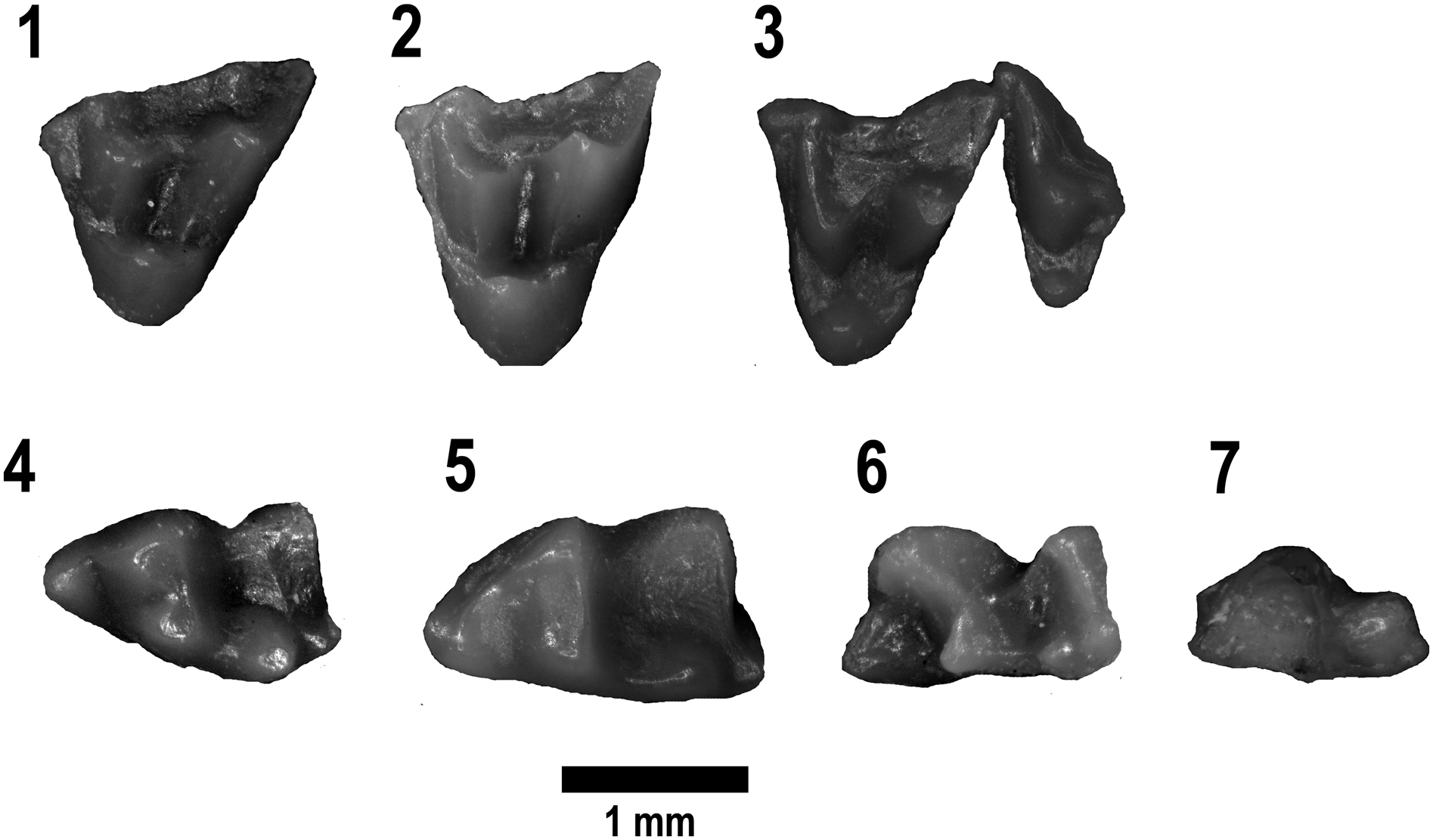
Molars of Copedelphys superstes n. sp. from Fitterer Ranch. (1) USNM 706519 left M1; (2) USNM 643481, left M2; (3) USNM 706518, right M3–M4 (reversed); (4) USNM 706528, right m1 (holotype); (5) USNM 706537, right m2; (6) USNM 706569, left m3 (reversed); (7) NDGS 2268, right m4. Anterior to the left.

Diagnosis
Larger than all other species; lower molars wider relative to length as in C. titanelix.
Occurrence
Fitterer Ranch Fauna C; Obritsch Ranch Fauna B.
Description
Stylar cusps on upper molars are typical for Copedelphys; they are dilambdodont with stylar cusps B, C, and D subequal in size and distinctly separated from one another. Similarly, the morphology of the lower molars is also that of Copedelphys, with a posteriorly extending hypoconulid on the talonid (as in other herpetotheriines) and a more widely open trigonid on m1 than in Herpetotherium.
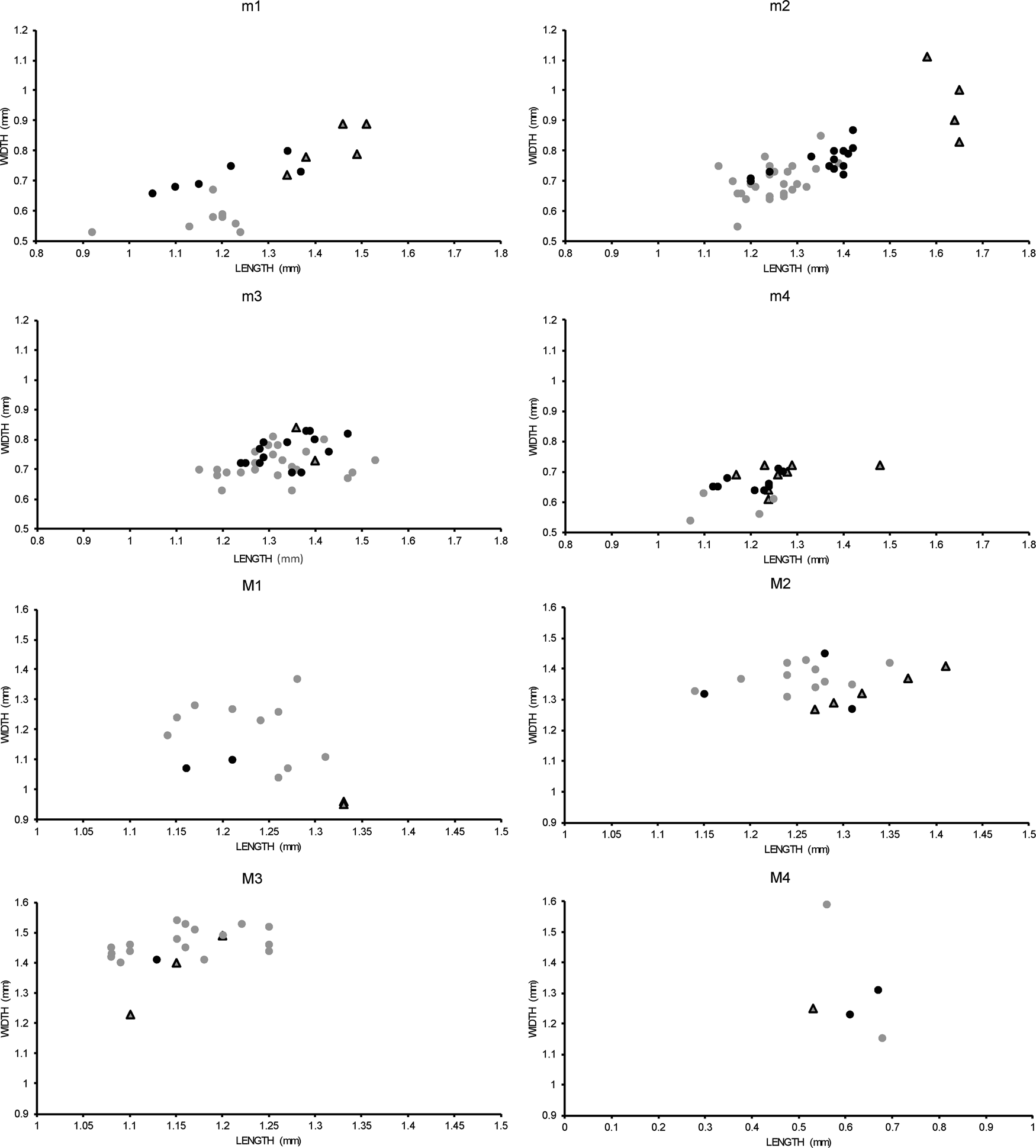
In the lower dentition, m1 is relatively large, overlapping the upper end of the reported range of C. titanelix (Fig. 5). All known m2s are much larger than reported in other species of Copedelphys (Fig. 5, Tables 3, 4). Alternatively, the posterior two lower molars fall well within the reported size range of C. stevensoni and C. titanelix, except for one relatively large m4 (NDGS 2126). Thus, C. superstes n. sp. is distinguished by the presence of enlarged m1s and m2s relative to the m3s and m4s.
Measurements of the molars of Copedelphys. Black circles represent Copedelphys titanelix, gray circles represent Copedelphys stevensoni, and black-edged triangles represent Copedelphys superstes n.sp. Data from this study and Korth (Reference Korth2018).

The upper dentition is generally similar in size and morphology to both C. stevensoni and C. titanelix (Fig. 5). The main exception is that M1 is anteroposteriorly longer and transversely narrower than observed in the other species. A similar, though less-pronounced pattern is seen in M2, which is transversely narrower relative to anteroposterior length than in most specimens of C. stevensoni and C. titanelix, but the difference is less pronounced than in M1. As in the lower dentition, the overall size and proportions of the posterior two upper molars fall within the reported range for Copedelphys.
Etymology
Latin, superstes, survivor; intended to note the late occurrence of the species.
Materials
Fitterer Ranch: USNM 706518, right maxillary fragment with M3–M4; USNM 643479, 706519, M1; USNM 643481, 643482, 643506, 643519, M2; USNM 643480, 706520 M3; USNM 706532, 706564, NDGS 2262, m1; USNM 706536, 706537, 706579, 706581, m2; USNM 706531, 706569, m3; USNM 643443, 706534, 706535, 706578, NDGS 2126, 2136, 2268, m4. Obritsch Ranch: NDGS 2423, dP3; NDGS 2472, M2; NDGS 2417, dp3; NDGS 2415, m1; NDGS 2459, m2, NDGS 2471, m4.
Remarks
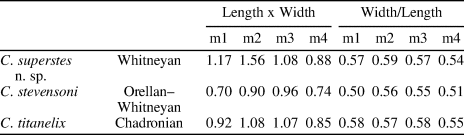
The molars referred here to C. superstes n. sp. do not differ markedly in gross morphology from those of other species of Copedelphys (Korth, Reference Korth1994, Reference Korth2018). The most distinguishing features of this species are the enlarged m1s and m2s relative to the m3s and m4s, and the slightly larger and transversely narrower M1s and M2s (Fig. 5, Tables 3, 4). Overall, C. superstes n. sp. is more similar to the Chadronian C. titanelix than to the Orellan and Whitneyan C. stevensoni in both overall size and proportions of the molars (wider relative to length: Table 5). All of the reported occurrences of C. stevensoni are from northcentral Wyoming (Cedar Ridge), northwest Nebraska (Toadstool Park), and southwestern South Dakota (Cedar Pass), whereas both C. titanelix and C. superstes n. sp. are from more northern localities; southwestern Montana (Pipestone Springs) and southwestern North Dakota (Fitterer Ranch; see Korth, Reference Korth1994, Reference Korth2018 for list of occurrences). This suggests that the larger-sized species (C. titanelix and C. superstes n. sp.) are from higher latitudes than smaller C. stevensoni, possibly indicating two separate clades of Copedelphys that developed independently due to geographic separation.
Herpetotheriinae(?) indeterminate
Figure 6
Occurrence
Fitterer Ranch Fauna C.
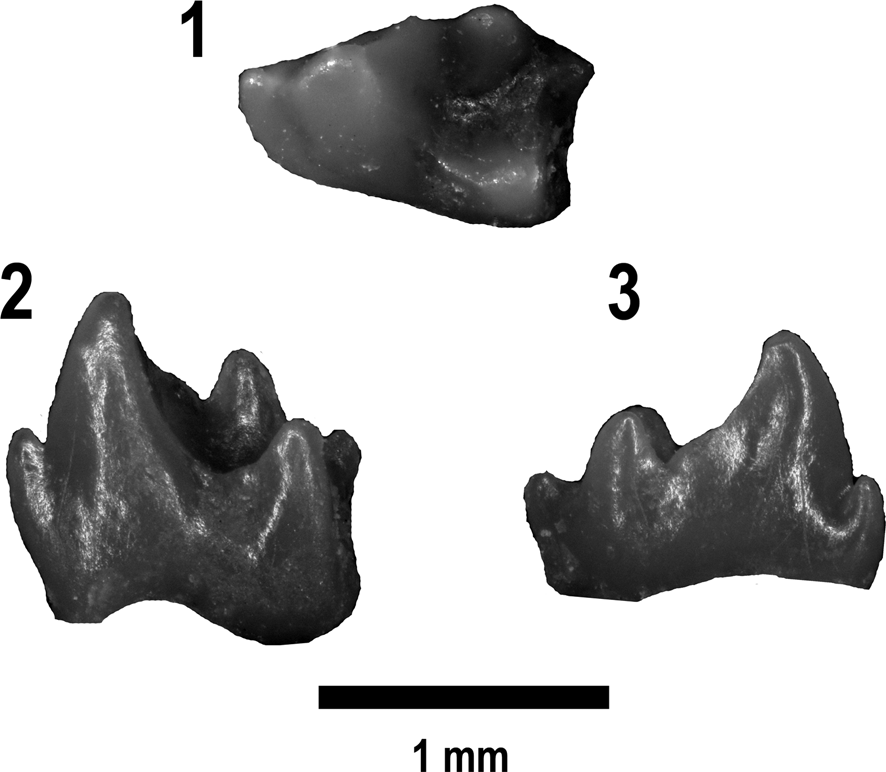
Herpetotheriinae(?) indeterminate, USNM 706563, left m1(?). (1) occlusal view; (2) buccal view; (3) lingual view.

Description
These specimens are either unworn or minimally worn. Distinct roots are present on USNM 706563. In occlusal outline they are elongated triangles that taper anteriorly to a point and are more than one and a half times longer than wide (Fig. 6). There is a minute anterior cusp at the anterior point of the tooth (=paraconid?). Directly posterior to it is a larger central cusp that is taller than any of the other cusps. A ridge runs posteromedially from the apex of this cusp to the lingual margin of the tooth, and then turns directly posteriorly, connecting to the entoconid at the posterolingual corner of the tooth. At the bend in the ridge, there is minute swelling on USNM 706563 (=metaconid?; Fig. 6.1). This cusp is slightly larger on USNM 706566. There is a valley separating the entoconid from the ridge and cuspule. The buccal side of the main anterior cusp is steeper than the lingual with a very faint ridge extending down the slope of the cusp. The talonid is typical of the molars of Heperotherium. The entoconid is a small conical cusp and the hypoconulid projects posteriorly along the posterior border of the tooth, just posterior and slightly buccal to the entoconid. The hypoconid is at the posterobuccal corner of the tooth and V-shaped, continuous with the cristid obliqua and posterior wall of the talonid. There is a minute posterior cingulid posterior to the hypoconid at the base of the tooth.
Materials
USNM 706563, left m1(?); USNM 706566, right m1(?).
Measurements
USNM 706563, anteroposterior length = 1.08 mm; transverse width = 0.68 mm. USNM 706566, anteroposterior length = 1.28 mm; transverse width = 0.77 mm.
Remarks
The specimens cited here cannot be assigned to any of the species recognized from Fitterer Ranch, nor can they be assigned to a particular tooth position in the jaw with confidence, so are questionably identified as m1. They are clearly lower cheek teeth because of the structure of the talonid and they are two-rooted, but have a unique anterior half of the tooth; a combination that is unlike any previously described lower molars or premolars. These specimens are clearly not premolars, although they are dominated by a single anterior cusp of the trigonid, because premolars have a minute talonid with only a single, central, posterior cuspule and are oval in occlusal outline (no developed talonid; Fig. 6). These specimens differ from recognized deciduous premolars because of the absence of a well-developed trigonid. Although the metaconid is smaller and closely appressed to the protoconid on dp3 of Herpetotherium, the metaconid is a distinct cusp and the paraconid is larger and more lingually situated, making the trigonid widely open lingually (see above description; Fig. 3.5). The well-developed roots on USNM 706563 also suggest that this was not a deciduous premolar. The morphology of the talonid and hypoconulid are as in herpetotheriines rather than as in peradectids. In size, these specimens most closely approach the size of m1 of Nanodelphys and the dp3 of Herpetotherium, but differ markedly from both these teeth in morphology.
These two specimens were referred to a herpetotheriine because of the structure of the talonid. The posteriorly projecting hypoconulid closely appressed to the entoconid and the shape of the cristid obliqua are identical to those of the lower molars of Herpetotherium and other didelphines.
Family Peradectidae Crochet, Reference Crochet1979
Genus Nanodelphys McGrew, Reference McGrew1937
Type species
Nanodelphys hunti (Cope, Reference Cope1873b).
Nanodelphys hunti (Cope, Reference Cope1873b)
Figure 7; Table 6
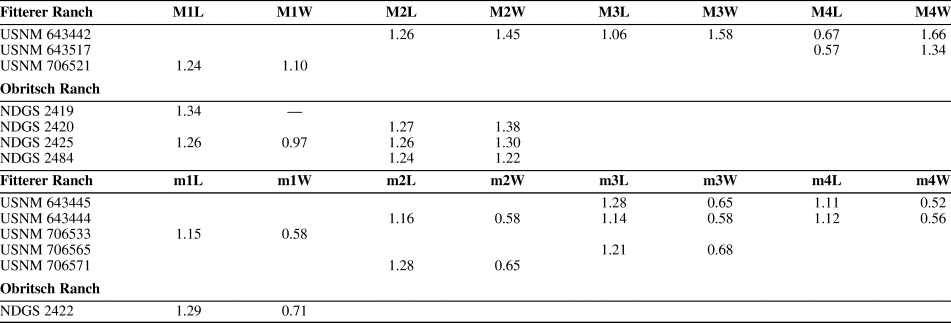
Dental measurements of Nanodelphys hunti from the Fitterer Ranch and Obritsch Ranch paleontological localities. Abbreviations: L, anteroposterior length; W, transverse width; —, indicates that measurement could not be made. Measurements in mm.

Type specimen
AMNH 5266, partial dentary with left m2–m4.
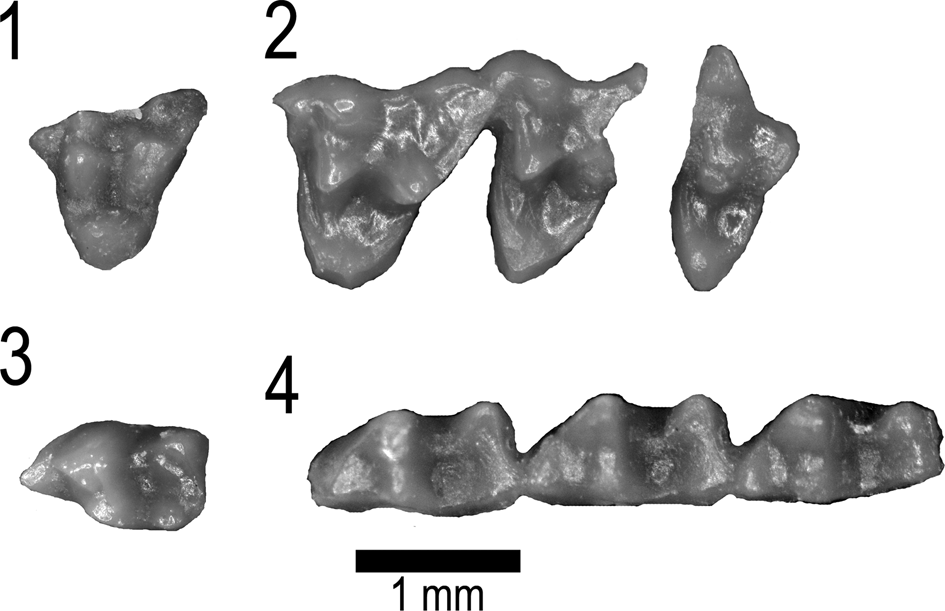
Molars of Nanodelphys hunti from Fitterer Ranch. (1) USNM 706521, left M1; (2) USNM 643442, left M2–M4 (M3 partially broken and distorted); (3) USNM 706533, right m1; (4) USNM 643444, right m2–m4. Anterior to left.

Occurrence
Holotype from Cedar Creek beds, Logan County, Colorado; specimens referred here from Fitterer Ranch Faunae B and C, Obritsch Ranch Fauna B.
Materials
Fitterer Ranch: USNM 643442, left maxilla with M2–M4; USNM 706521, M1; USNM 643517, left M4; USNM 643444, partial dentary with right m2–m4; USNM 643445, partial denary with left m3–m4; USNM 706533, right m1; USNM 706571, left m2; USNM 706565, left m3. Obritsch Ranch: NDGS 2425, partial maxilla with M1–M2; NDGS 2419, M1; NDGS 2420, 2484, M2; NDGS 2422, m1.
Measurements
Comparisons of dental measurements of Nanodelphys hunti from different horizons (*), mean measurements of N. hunti from other ages and localities (compiled from Korth, Reference Korth2018, supplementary table 18). Abbreviations: F/O, combined measurements from the Fitterer Ranch and Obritsch Ranch paleontological localities; L, anteroposterior length; W, transverse width. Measurements in mm.

Remarks
The specimens here referred to N. hunti do not differ from those described elsewhere (Korth, Reference Korth2018). The specimens are smaller than any of the other species of marsupials from Fitterer Ranch and Obritsch Ranch and have the distinctive peradectine morphology of the molars (upper molars—wide stylar shelf; stylar cusp B the largest, all others small; cusps less dilambdodont; and wider relative to length: lower molars—hypoconulid not projecting posteriorly) (see McGrew, Reference McGrew1937, Reference McGrew1939; Korth, Reference Korth1994, Reference Korth2018). In dental dimensions, the sample from North Dakota is similar to other collections of N. hunti from Orellan, Whitneyan, and Arikareean localities (Table 7) and cannot be shown to be statistically different.
Conclusions
At first glance there appears to be some pattern to the stratigraphic distribution of marsupial taxa from the Brule Formation of North Dakota (Fig. 2). However, it is important to consider that the most extensive sampling was conducted at a screen-washing locality within Fitterer Ranch Fauna C (sampling interval 6; Korth et al., Reference Korth, Emry, Boyd and Person2019a), which likely contributed to the increased diversity of marsupial taxa recognized in that fauna. By comparison, only three marsupial specimens from Fitterer Ranch Fauna A (sampling interval 2; Korth et al., Reference Korth, Emry, Boyd and Person2019a) were available for this study, which was only sufficient to identify the presence of the most common taxon, H. fugax. Twenty-three specimens were recovered from the screen-washed site in Obritsch Ranch Fauna B (sampling interval 2; Korth et al., Reference Korth, Boyd and Person2019b), resulting in the recognition of three species in roughly a 2:1:1 ratio of referred specimens (13 for H. fugax; 6 for C. superstes n. sp.; 5 for N. hunti). Similar numbers of total specimens were recovered from Fitterer Ranch Fauna B (sampling intervals 4 and 5; Korth et al., Reference Korth, Emry, Boyd and Person2019a) via a combination of surface collection and screen washing, but C. superstes n. sp. was not identified within that sample. Given these data, it is possible that C. superstes n. sp. makes a local first appearance in the Brule Formation of North Dakota within Fitterer Ranch Fauna C. Alternatively, it is possible that the relative abundance of C. superstes n. sp. was much lower in Fitterer Ranch Fauna B than in Obritsch Ranch Fauna B and more specimens need to be collected in order to detect its presence.
Overall, the marsupial assemblage from the Fitterer Ranch and Obritsch Ranch paleontological localities are very similar to those from other Orellan and Whitneyan faunas from the Great Plains (Korth, Reference Korth1994, Reference Korth2018). Four marsupial taxa are present in Fitterer Ranch Fauna C, making it the most diverse Whitneyan marsupial fauna yet described. Two of the marsupial species here identified from the Brule Formation of North Dakota, H. fugax and N. hunti, are also known from the only other well-sampled Whitneyan marsupial faunae: the Cedar Pass and Blue Ash local faunas of southwestern South Dakota (see Korth, Reference Korth2018). Copedelphys stevensoni is also recorded from the Cedar Pass local fauna, while an unnamed second species of Herpetotherium that is distinguished by its large size is present in the Blue Ash local fauna (Korth, Reference Korth2015, Reference Korth2018). Thus, marsupial diversity is generally similar between different Whitneyan faunae, with each including at least two herpetotheriids and one peradectid. Copedelphys is absent from the Blue Ash local fauna, which is considered a transitional Whitneyan/Arikareean fauna (Korth, Reference Korth2010) and thus younger than any of the other described Whitneyan marsupial faunae. Thus, the last appearance of Copedelphys is currently within the Obritsch Ranch Fauna B. A minimum of one peradectid and five herpetotheriid taxa are now recognized from the Whitneyan of the Great Plains region of North America, matching the diversity of the Chadronian (four herpetotheriids and two peradectids) and surpassing the Orellan and early early Arikareean NALMAs (three herpetotheriids and one peradectid present in both: Korth, Reference Korth2018). Thus, marsupial diversity remained relatively constant during the late Paleogene until the late early Arikareean NALMA, when only a single species, Herpetotherium merriami, remained and persisted into the Miocene (Korth, Reference Korth2018).
The presence of apparently five different species of “mouse possum” from these faunas is similar to the kind of diversity of Recent species from Central and South America (Voss et al., Reference Voss, Gutierrez, Solari, Rossi and Jansa2014). This amount of diversity in the Recent species is due to ecological separation due to time of activity and stratum within the forest that the different species occupy. It is likely that this type of separation was also present during the Oligocene in North Dakota.
Acknowledgments
We thank the Fitterer and Obritsch families for their continued access to the outcrops on their property and for donating specimens to public repositories for study. Many individuals assisted in the picking and sorting of marsupials from screen-washed concentrate at NDGS, particularly T. Ford and P. Monaco. Most of the USNM specimens were recovered from blocks of carbonate-cemented sandstone that were processed in dilute formic acid by F. Grady. For photography of USNM specimens, special thanks to P. Kroehler of the USNM Vertebrate Paleontology Preparation Lab, and to A. Telfer of FossiLab and four of her volunteers, L. Bruce, T. Chan, H. Cochard, and J. Taylor. Additional photographs used in the figures were taken by J. Person of NDGS and G. McIntosh of the Rochester Museum and Science Center. Laboratory space was provided for WWK by the Department of Chemistry and Biochemistry, Nazareth College (Rochester, NY). Preliminary sorting and measuring of specimens was assisted by J. Sullivan.