INTRODUCTION
Amphipods are the most abundant taxa in the unique endemic fauna of the world's deepest freshwater lake, Lake Baikal. The number of amphipod species is estimated at several hundred (Morino et al., Reference Morino, Kamaltynov, Nakai and Mashiko2000; Takhteev, Reference Takhteev2000).
The amphipod Gmelinoides fasciatus Stebbing, 1899 (Amphipoda, Crustacea) from Lake Baikal is of particular interest as a eurybiotic species with high ecological plasticity (Panov & Berezina, Reference Panov, Berezina, Leppäkoski, Gollasch and Olenin2002). Deliberate introduction of this species as a food resource into different water bodies enabled it to spread widely outside Baikal (Ioffe, Reference Ioffe1968, Reference Ioffe1974; Zadoenko et al., Reference Zadoenko, Leis and Grigoryev1985; Schletterer & Kuzovlev, Reference Schletterer and Kuzovlev2012; Fedoseeva & Stom, Reference Fedoseeva and Stom2015). Interest in this species has been attributed to its successful adaptation, as well as to the question of the mechanisms underlying coevolution of the host amphipod and its microsporidian microsymbionts (Kuzmenkova et al., Reference Kuzmenkova, Sherbakov and Smith2008). In the 1970s, G. fasciatus was similarly introduced to water bodies in North-west Russia (Barbashova et al., Reference Barbashova, Malavin and Kurashov2013). At a certain point, it was recorded as the most abundant species in the littoral zone of Lake Onega (Berezina & Panov, Reference Berezina and Panov2003), and it can also be found in Lake Ladoga (Panov, Reference Panov, Simola, Viljanen, Slepukhina and Murthy1996; Barkov & Kurashov, Reference Barkov and Kurashov2011), as well as in the coastal zone of the Gulf of Finland in the Baltic Sea (Berezina et al., Reference Berezina, Razinkovas-Baziukas and Tiunov2017). The species has adapted well to its new habitats (Panov & Berezina, Reference Panov, Berezina, Leppäkoski, Gollasch and Olenin2002), and has had a negative influence on the abundance and biomass of native benthic invertebrates (including Gammarus lacustris and Asellus aquaticus in Lake Ladoga) (Berezina & Strelnikova, Reference Berezina and Strelnikova2010). It has even displaced the other amphipod species Gammarus lacustris from many water bodies of Russia (Berezina, Reference Berezina2009). This fact shows that anthropogenic invasions, as well as natural ones, significantly influence different ecosystems. In a number of cases negative biological consequences (‘biological pollution’) resulting from invasion of new species are comparable to, or even bigger than, the negative impact of all the other anthropogenic factors (Panov & Berezina, Reference Panov, Berezina, Leppäkoski, Gollasch and Olenin2002; Alimov et al., Reference Alimov, Bogutskaya, Orlova, Paevsky, Reznik, Kravchenko, Geltman, Alimov and Bogutskaya2004). This serious issue has direct relevance to water bodies of North-west Russia (Panov & Berezina, Reference Panov, Berezina, Leppäkoski, Gollasch and Olenin2002; Berezina, Reference Berezina2005; Berezina & Petryashev, Reference Berezina and Petryashev2012). The problem makes the clarification of mechanisms underlying successful adaptation of alien species to new environments an important aspect of studying such species. Mechanisms of adaptation require multiple changes in living organisms, such as biochemical, physiological, behavioural and many others (Hochachka & Somero, Reference Hochachka and Somero1973), and the genetic component plays an important, if not the most important, role in the process of adaptation.
Wide spreading of the Baikal amphipod G. fasciatus therefore enables us to suggest that genetic variation might underlie the adaptation mechanism, adjusting this species to the new conditions it faced upon migration to the water bodies in North-west Russia.
There are known examples of single mutation events making organisms resistant to negative environmental factors and thus gaining advantage for further development (Fedorov & Yablokov, Reference Fedorov and Yablokov1999). Major genome reorganization could, for example, be associated with the transition from seawater to a freshwater life cycle, as in the case of species belonging to the genus Corbicula which attain an almost worldwide distribution and inhabit estuaries, lakes and rivers. In Japan, three endemic Corbicula species are reproductively and developmentally heterogeneous. Although C. leana (3n = 54) and C. sandai (2n = 36) appear in fresh waters only in Japan, C. japonica (2n = 38), the best-known bivalve, inhabits seawaters throughout eastern Asia (Mito et al., Reference Mito, Tanaka and Aranishi2014 and references therein). In the case of the Baikal amphipod G. fasciatus transition from fresh waters to the Gulf of Finland with moderate levels of salinity might also lead to changes at the level of chromosome sets, although a low rate of karyotypical evolution was recorded in some amphipod taxa, their karyotypes being generally characterized by high symmetry and having almost exclusively bi-armed chromosomes (Libertini & Rampin, Reference Libertini and Rampin2009 and references therein). Fluorescence in situ hybridization (FISH) which allows the localization of specific DNA sequences on chromosomes is widely used to identify peculiar patterns of karyotypical evolution, even in the taxa characterized by highly conservative karyotypes (Libertini & Rampin, Reference Libertini and Rampin2009).
The association between genotypic changes in response to selection pressures has been well demonstrated in crustaceans and other species by means of sequencing parts of the genome in order to establish levels of diversity among different closely related populations. For example, it was hypothesized and tested on clonal lineages of Daphnia pulex, derived from a single female and subjected to divergent selection on weight–specific fecundity (WSF), that variation in the intergenic spacer (IGS) of rDNA has considerable developmental, evolutionary and ecological significance through effects on growth rate and resulting from the role of the IGS in production of rRNA. As a result of selection, WSF diverged rapidly, with significant reductions within two generations. Among some other effects, an increased predominance of long IGS variants was observed in lineages with elevated juvenile growth rate and low WSF. These results strongly supported the hypothesized relationships, and indicated a genetic mechanism for the evolution of such associations (Gorokhova et al., Reference Gorokhova, Dowling, Weider, Crease and Elser2002).
Sequencing of mitochondrial DNA (mtDNA) has been extensively used for both population genetic and systematic genetic studies on various taxonomic levels. The mtDNA cytochrome c oxidase subunit I (COI) gene has often been adopted as a tool for determining the genetic diversity and assignment of analysed specimens to the studied taxa (Mito et al., Reference Mito, Tanaka and Aranishi2014; Nirchio et al., Reference Nirchio, Oliveira, Siccha-Ramirez, de Sene, Sola, Milana and Rossi2017). Molecular genetic and cytogenetic approaches should also be helpful in case of G. fasciatus adaptation studies and as a component of the overall ecological monitoring.
The North-west of Russia is known to be a part of the well-developed industrial zone of the country. This circumstance leads to higher anthropogenic load on ecosystems. Constant ecological monitoring is essential to detect and assess negative consequences of environmental pollution. One of the useful approaches to such monitoring is determination of the dynamic biological parameters in species that are affected by environmental factors in their natural habitats. We had earlier developed and tested a cytogenetic method on a number of water and terrestrial crustacean species. This approach was proven to be effective in monitoring environmental conditions, like pollution brought about along with sea port construction, household surfactant pollution and so on, by the frequency of mitotic abnormalities. Sampling nearest to construction site freshwater reservoirs showed a wedge-shaped change of mitotic disturbance (MD) frequency, dependent on the distance from the site, with the centre of the construction area showing the highest degree of MD (Daev & Dukelskaya, Reference Daev and Dukelskaya2011; Daev et al., Reference Daev, Dukelskaya and Barabanova2015). The considerable similarity of the crustacean life cycle, and the presence of a large number of actively dividing mitotic cells at the embryonic stage should enable application of the cytogenetic method to G. fasciatus.
As the Baikal amphipod G. fasciatus has been introduced all over the North-west of Russia, it would be an ideal experimental set-up because the same species could be used to examine the influence of differing environments. Moreover, it has already been proposed as an indicator species to be used in long-term complex monitoring of the state of environmental conditions in the Gulf of Finland and other water bodies in the region. The lysosomal membrane stability, induction of micronuclei, and the frequency of embryo aberrations are used as criteria for testing the degree of anthropogenic load on the ecosystem (Strode et al., Reference Strode, Golubkov, Berezina, Balode and Lehtonen2013; Lehtonen et al., Reference Lehtonen, Sundelin, Lang and Strand2014). As to the application of genetic and cytogenetic methods, G. fasciatus has not yet been studied. Obtaining this information is crucial for ecological genetic research. This implies two independent sets of experiments. First, to assess the role of the genetic mechanisms in adaptation to new conditions. This involves studying changes in the genome of the species in response to its introduction into a new ecosystem, and successful adaptation to the new conditions, and also to the diverse environmental factors. In addition, comparison of karyotypes of individuals in local and invasive populations, as well as the frequency of cell division abnormalities, will enable an assessment of the reaction of the genome to these events. Second, a comparison of the cytogenetic parameters in the invasive populations, collected from a relatively clean vs a polluted habitat will allow for conclusions on the utility of G. fasciatus as an indicator species in integrative environmental assessment.
Therefore, the main aim of this study is to determine the frequency of chromosomal aberrations (ChA) at anaphase and telophase stages of mitosis in dividing cells of G. fasciatus embryos from six natural populations in Lake Baikal and two invasive populations from the Gulf of Finland, at sites which are thought to be devoid of significant environmental pressure differences (particularly anthropogenic pollution). We also present information about G. fasciatus chromosome number and constitution.
MATERIALS AND METHODS
Study area
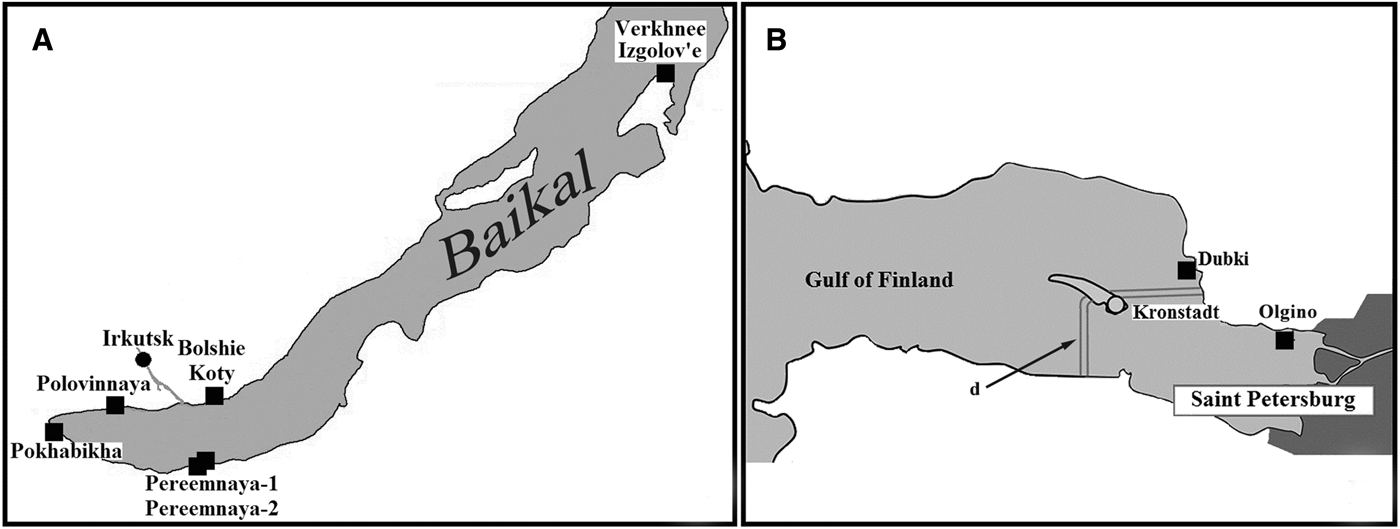
Sample collection was performed during the summer (June–August) of 2015 and 2016 in the coastal zones of Lake Baikal (Figure 1A) and the Gulf of Finland in the Baltic Sea (Figure 1B).
Scheme of sampling sites (black squares) of Gmelinoides fasciatus in Lake Baikal (A) and the Gulf of Finland (B).

The characteristics of the sample collection sites with respect to temperature conditions and salinity in 2015–2016 were as follows: in the south-western part of Lake Baikal – Bolshie Koty, Polovinnaya, Pokhabiha, Pereemnaya-1, Pereemnaya-2, and in the north-eastern Verhnee Izgolov'e – salinity is 0.01‰, temperature of the coastal zones in June–August was 16–17°C and in the Gulf of Finland Dubki – salinity was 0.33‰, t = 22.7°C; Olgino – salinity was 0.09‰, t = 23.0°C.
One of the suburbs of Saint-Petersburg, Olgino, is the site located within the dam protecting the city from floods, while the resort Park Dubki is outside the dam (see Figure 1). A more detailed description of the sample collection point in the Gulf of Finland can be found elsewhere (Berezina et al., Reference Berezina, Razinkovas-Baziukas and Tiunov2017) and Dubki Park would correspond to Site 2 therein.
The geographic coordinates of the sample collection sites are: in Lake Baikal – 53868′29″N 109812′74″E (Verhnee Izgolov’e), 51890′33″N 105806′93″E (Bolshie Koty), 51879′75″N 104835′37″E (Polovinnaya), 51867′21″N 103871′05″E (Pokhabiha), 51858′37″N 105830′35″E (Pereemnaya-1), 51848′95″N 104860′60″E (Pereemnaya-2), and in the Gulf of Finland – 60805′37″N 29855′19″E (Dubki), 60800′00″N 30808′24″E (Olgino).
Materials and methods
SPECIMEN COLLECTION
Specimens of Gmelinoides fasciatus were collected manually by taking handfuls of bunches of algae growing in water close to the coastal line at a maximum depth of 60 cm. The bunches of algae were then shaken in a bowl of native water, and as the amphipods swam out they were caught and accumulated in a small container of water. The collected animals were fixed immediately on the spot in freshly prepared ethanol/glacial acetic acid fixative (3:1). Excess of water prior to fixation was removed with filter paper. The fixative was changed twice after every 45 min. The fixed material was stored in the last portion of fixative at 4°C. The fixed animals were checked under the dissecting microscope, their species identity was confirmed and gender identified. About 100 egg-bearing females were used for the present study, with about 10–15 animals per sampling site. This number of animals is enough to get sufficient material for the cytogenetic analysis to characterize the investigated sites (Daev et al., 2011). Material from each sampling site was combined into a corresponding experimental group.
SLIDE PREPARATION AND ANALYSIS
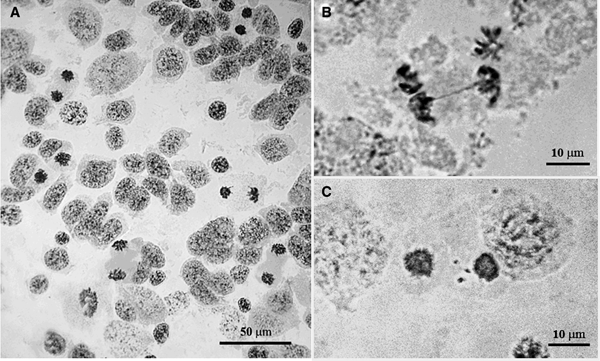
For chromosome analysis, the early developing embryos were removed from the brood chambers with dissection needles and stained in 100–300 μl of 4% aceto-orcein solution on the preparation slide. Time of staining was determined empirically and was equal to 15–40 min. Four to five stained embryos were squashed under a coverslip on one preparation slide and subjected to the ana-telophase method (Daev & Dukelskaya, 2011) whereby samples of 100 cells at anaphase and telophase of mitosis are scored (hence the method designation), and the frequency of abnormal cells is calculated. Cells with bridges, fragments, delayed chromosomes and with multiple disturbances were considered as abnormal (Figure 2). Slide preparation for FISH, probe labelling, hybridization procedures and DAPI staining were performed as outlined elsewhere (Libertini et al., Reference Libertini, Colomba and Vitturi2000; Krapp et al., Reference Krapp, Rampin and Libertini2008; Libertini & Rampin, Reference Libertini and Rampin2009). Conventional analysis was carried out with a Jenaval microscope (Carl Zeiss Jena, Germany) under ×500 or ×1250 magnification. Fluorescence microscopy was performed using Leica DM4000B (Leica Microsystems CMS, GmbH) epifluorescence microscope, equipped with a black and white CCD camera and appropriate filters for DAPI and 6-FAM (6-carboxyfluorescein). The fluorescent images were captured using LAS AF software (Leica Microsystems CMS, GmbH) and processed in Adobe Photoshop CS5.1 (Adobe Systems, Inc, USA). For FISH oligonucleotide TTAGG-negative probe (5′-TAA(CCTAA)5) was generated using an ASM-800 DNA/RNA synthesizer (Biosset, Russia) and directly labelled with 6-FAM (Beagle, Russia) as described previously (Stepakov et al., Reference Stepakov, Galkina, Bogomaz, Gaginskaya and Saifitdinova2015).
Mitotically dividing embryonic cells of G. fasciatus. General view (A) and examples of ChA (B, C): ‘bridge’ (B), ‘multiple fragments’ (C).

STATISTICAL ANALYSIS
Homogeneity of the samples within groups, and differences between groups, were estimated using the non-parametric Сhi-squared criterion (Wayne, Reference Wayne1999). Intragroup homogeneity permitted merging of individual data and calculation of the average frequency of chromosomal aberrations (ChA) and standard error of the mean (±SEM) for each site.
RESULTS
Six points for sampling Gmelinoides fasciatus were chosen in Lake Baikal (Figure 1A). These points had minor environmental differences in substrates, namely stones, sand, pebbles, Ulothrix algae and Potamogeton sp. No pronounced anthropogenic pressure such as oil spills, organic waste or industrial pollution was detected (Martin, Reference Martin1994; Bogutskaya & Hales, Reference Bogutskaya and Hale2008; personal observations).
In the Gulf of Finland, samples were collected at two points (Figure 1B). The first site is in the Saint-Petersburg resort of Dubki Park in Sestroretsk. This site was considered to be ‘clean’, as it is located at some distance from industrial or other economic human activities, and is presumed to have a low degree of pollution. The second site is located in Olgino, closer to Saint-Petersburg, but still in the same recreational area. Amphipods G. fasciatus are usually associated with vegetated shallow littoral areas (depths of 0–3 m) over the whole ice-free season, from May to October.
Cytogenetic analysis showed that the number of dividing cells in developing G. fasciatus embryos is sufficient to find all stages of mitosis (Figure 2), and the sufficiency of cells at anaphase/telophase stages of mitosis (Figure 2A) allowed us to employ the ana-telophase method. This method also proved to be instrumental in assessing frequency of various chromosomal aberrations (ChA, Figure 2B, C).
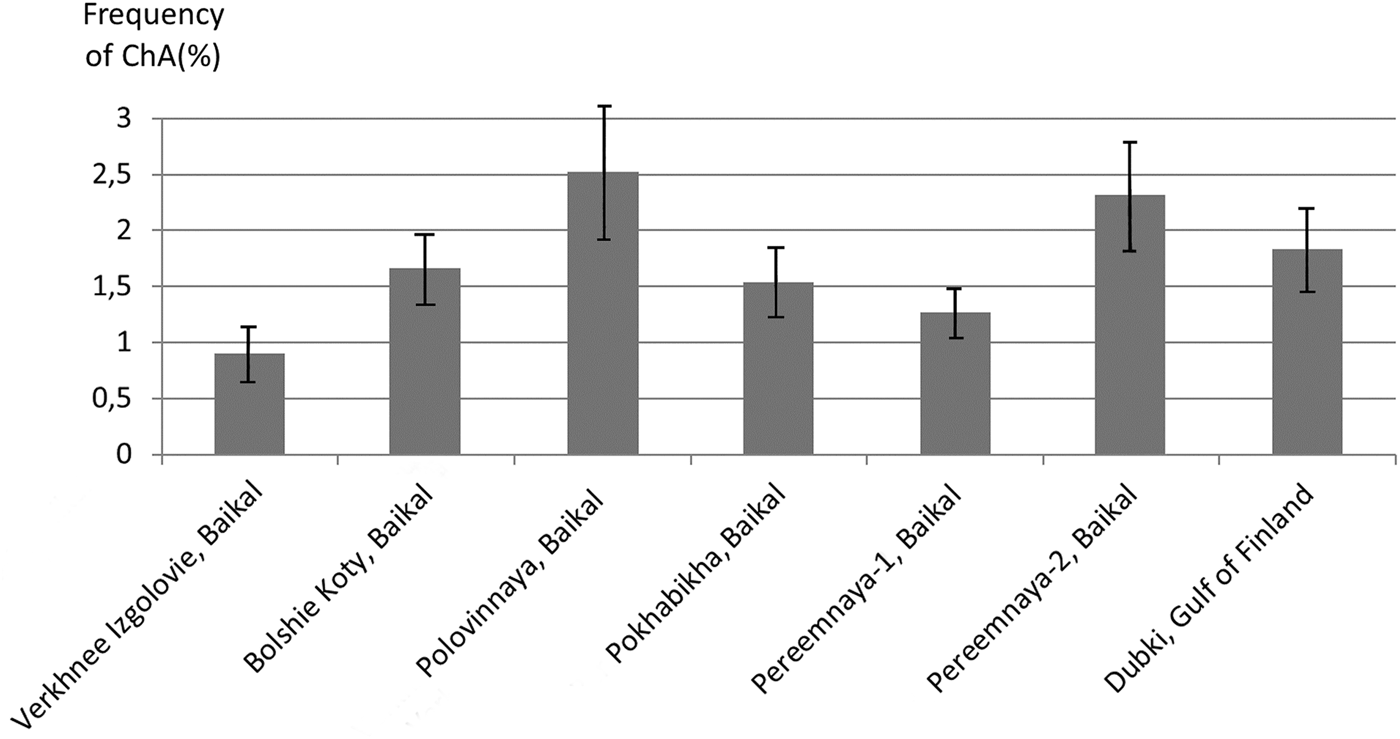
The data on detected abnormalities at anaphase and telophase of mitosis were used to estimate the frequency of ChA in dividing cells of embryos collected in 2015 from different habitats in Baikal and the Gulf of Finland (Figure 3).
The frequency of chromosomal aberrations (ChA, %) in populations of G. fasciatus of Lake Baikal and the Gulf of Finland in 2015. Bars indicate percentage error.

The analysis of ChA frequency (Figure 3) in six sites of Lake Baikal showed that the level in G. fasciatus embryos varied between 0.95–2.5% in the samples collected in summer of 2015, with the highest average values of 2.5% at Polovinnaya and 2.3% at Pereemnaya-2 (Figure 1). The lowest average frequency (0.95%) of ChA was detected at the site Verkhnee Izgolovie, and differed statistically from the Polovinnaya and Pereemnaya-2 sites, judging by χ2-criterion (P < 0.05).
In the areas located closer to populated localities, namely the South-western part of Lake Baikal, ana-telophase analysis showed slightly elevated frequencies of ChA in embryos (Figure 3, all sites, except Verkhnee Izgolovie, Baikal).
The average ChA frequency detected at the site Dubki, Gulf of Finland (1.8 ± 0.4%), was at the same level as in the South-western coastal areas of Lake Baikal. In order to confirm these tendencies, an increase of sampling size and regular annual monitoring is needed.
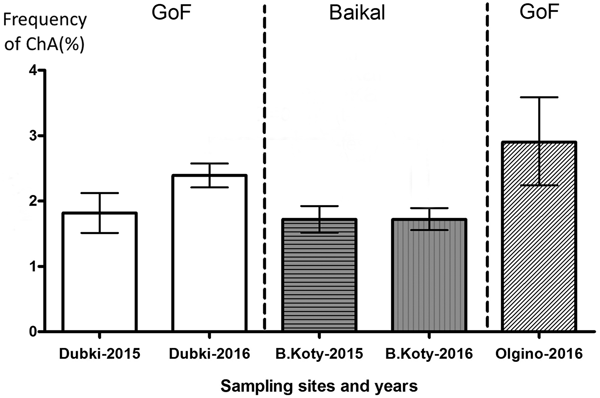
Samples collected in 2016 at one site of Lake Baikal (Bolshiye Koty, Figure 1) and one site of the Gulf of Finland (Dubki, Figure 1) were scored for ChA at ana-telophase stages of mitosis and compared with the data obtained in 2015 using χ2-criterion (Figure 4). In addition, in 2016 the frequency of ChA was analysed in the embryos of G. fasciatus collected at the new site of Olgino. The frequencies of ChA, site Dubki, remained at the same level in 2016 compared with 2015 (varied between 1.5 and 2.6%). Variation of this parameter detected in samples collected at Bolshiye Koty, Baikal in 2015 and in 2016 (Figures 3 and 4) did not differ either. The frequencies of ChA in embryos varied within 1.4–2.0% (average 1.7 ± 0.3%) in the 2015 population (Figure 3), while in 2016 frequencies varied between 1.6 and 1.8% (average 1.7 ± 0.1%). This result, obtained for the Baikal population in 2016 differed statistically from the characteristics of the samples collected at Dubki (2.4 ± 0.2%) in 2016, as well as from those collected at Olgino (χ2-criterion, P < 0.05). The latter demonstrated the highest average level of ChA frequency, 2.9 ± 0.6% (although not very high in absolute value), observed in all other populations studied in both years (Figures 3 and 4).
The frequency of chromosomal abberations (ChA, %) in embryonic cells of G. fasciatus from different habitats in 2015–2016 (M ± SEM, %).

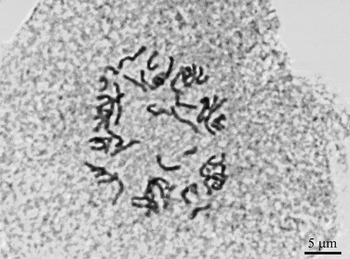
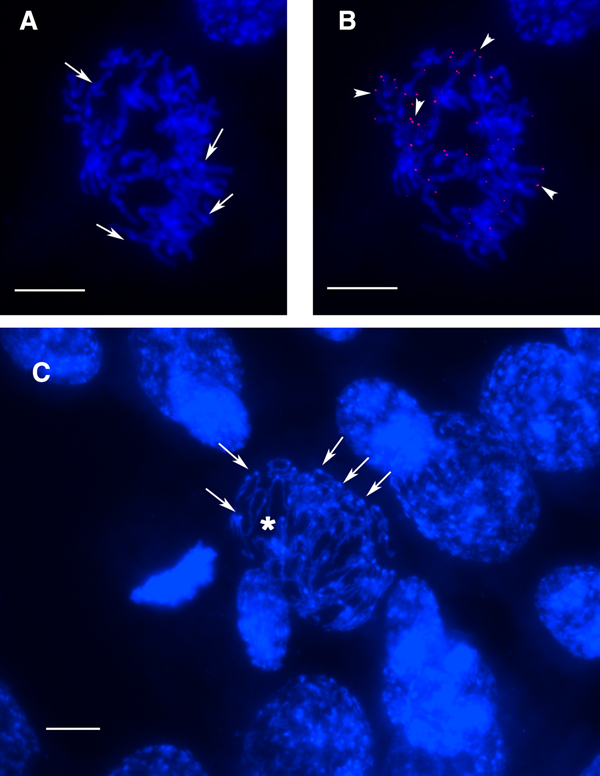
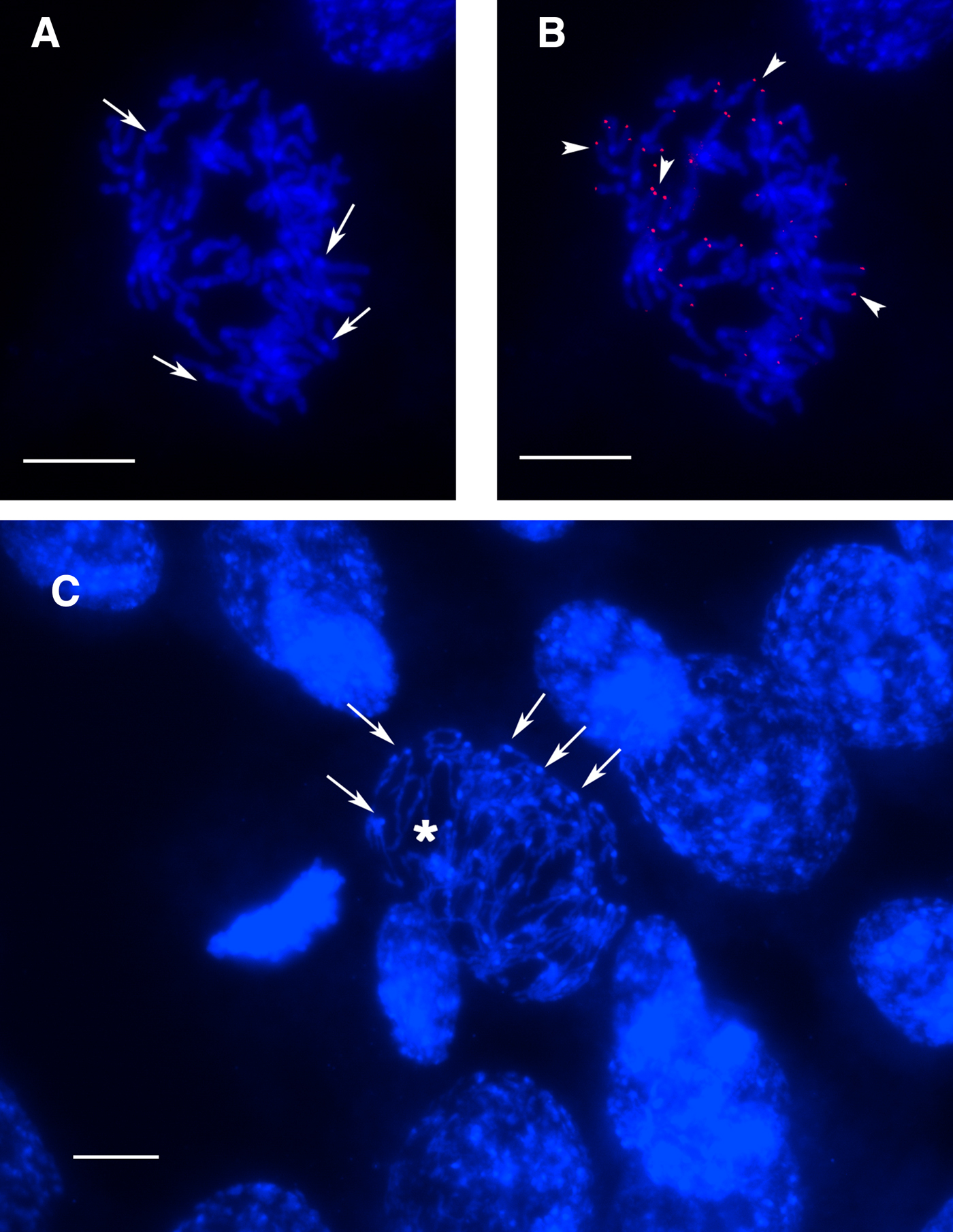
Apart from estimates of chromosomal aberration frequency in G. fasciatus embryos at the anaphase-telophase stage of mitosis, images of prometaphase (Figure 5) and metaphase (Figure 6A, B) plates were also obtained. Fluorescence in situ hybridization (FISH) of telomeric repeats (TTAGG)n to chromosomes of G. fasciatus at metaphase allowed highlighting of chromosome ends (Figure 6B), while DAPI staining revealed bright fluorescing A-T rich pericentromeric regions (Figure 6A). Chromosome analysis using conventional cytology (Figure 5), DAPI stained mitotic metaphases (Figure 6A) and prophase nuclei (Figure 6C), allowed estimation of the chromosome number to be 2n = 52.
Dividing embryonic cell of Gmelinoides fasciatus. Prometaphase stage.

Chromosomes of G. fasciatus at metaphase (A, B) and prophase (C) of mitosis. DAPI bright A-T rich bands are indicated by arrows (A, C), prophase nucleus by asterisk (C), and (TTAGG)n hybridization sites are delimited by arrowheads (B). The green 6-FAM signal is false coloured red (B). Scale bar = 10 µm.
DISCUSSION
Our cytogenetic analysis shows that developing G. fasciatus embryos are a convenient model to study different cell division abnormalities. As a first step, the abnormally dividing cells (Figure 2B, C) were used to obtain initial information about the frequency of chromosomal aberrations in dividing cells of embryos collected in different habitats of Lake Baikal and the Gulf of Finland (Figures 3 and 4). Comparison of the chromosomal aberration frequencies performed in this study did reveal one significant difference between sampling sites in Lake Baikal in 2015 and two sites in the Gulf of Finland, and certain tendencies were brought to light. The South-western part of Lake Baikal, where all the sample collection sites are located except Verkhnee Izgolovie, drains its waters into the Angara River, which in turn flows through to the city of Irkutsk with its large source of anthropogenic pollution. The Angara therefore connects Baikal to Irkutsk, and in spite of the direction of flow contamination can still be introduced into the South-western part of Baikal as a result of the contraflow of river traffic. This allowed us to consider the site Verkhnee Izgolovye as a true control for further monitoring by means of the ana-telophase method pursued in G. fasciatus. In spite of certain variation, the frequencies of chromosomal aberrations were close to those obtained earlier for other crustacean species from habitats considered to be ecologically clean (Daev et al., Reference Daev, Dukelskaya and Barabanova2015). The absence of large chromosomal aberrations proves that the species introduced more than 50 years ago has successfully adapted to the conditions in the new region. The expanding area being occupied by the species also proves this idea.
Studies from our group examining other crustacean species in pollution-free habitats for similar chromosome aberrations, found a baseline level similar to that for G. fasciatus (Table 1). In addition, we found in those species that pollution levels can have significant effects on the frequency of chromosomal aberrations. We plan to evaluate the near-ubiquitous G. fasciatus under similar environmental challenges (Barabanova et al., Reference Barabanova, Dukelskaja, Daev, Rumyantcev and Trifonova2007, Reference Barabanova, Daev, Dukelskaya, Rumyantcev and Trifonova2011) to see if they also have detectable genotypic responses.
The frequency of chromosomal aberrations (M ± SEM, %) in mitotic cells of different crustacean species in clean and anthropogenic polluted areas.

*Difference is significant (χ2-criterion, P ≪ 0.005). –, absence of data.
The frequency of chromosomal aberrations in mitosis is a dynamic parameter which increases if environmental factors change abruptly (Table 1) and returns to normal levels upon adaptation to new conditions (Barabanova et al., Reference Barabanova, Daev, Dukelskaya, Rumyantcev and Trifonova2011). A slight increase in the level of such aberrations can persist for some time, mostly due to balanced rearrangements (Daev & Dukelskaya, Reference Daev and Dukelskaya2011).
However, the traces of the adaptation process can remain as diverse micro-changes in the DNA (single nucleotide substitutions, micro-deletions, inversions, transpositions, etc.). We plan to test this hypothesis by comparing the genomes of G. fasciatus from Lake Baikal, the Baltic Sea, Lake Ladoga and Lake Onega populations using rDNA and the mtDNA cytochrome c oxidase subunit I (COI) gene as first targets for sequencing (Gorokhova et al., Reference Gorokhova, Dowling, Weider, Crease and Elser2002). These methods have been successfully used to solve a number of questions in population genetics (Gomanenko et al., Reference Gomanenko, Kamaltynov, Kuzmenkova, Berenos and Sherbakov2005). 18S rRNA gene fragment was earlier characterized as a sequence, which contains slow and fast evolving sites (Sherbakov et al., Reference Sherbakov, Kamaltynov, Ogarkov and Verheyen1998). Further sequencing of the same gene fragment, amplified using DNA of crustaceans from the initial Baikal population and that of the non-native species from the Gulf of Finland, could give an idea of whether ecological specialization took place along with the invasion process.
The diverse group Crustacea still remains poorly studied in terms of karyotypes of particular species. There are only limited reports on the number and structure of chromosomes of some species (Coleman, Reference Coleman1994; Lecher et al., Reference Lecher, Defaye and Noel1995; Libertini et al., Reference Libertini, Colomba and Vitturi2000; Krapp et al., Reference Krapp, Rampin and Libertini2008, Libertini & Rampin, Reference Libertini and Rampin2009). For comparison of karyotypes of individuals from local and invasive populations of G. fasciatus the traditional method implies analysis of metaphase chromosome sets. This requires additional hypotonic and colchicine pretreatments of the living material which could disturb chromosome structure, as well as nuclear and cell divisions. Those procedures were omitted in this study firstly because in many cases we had to deal with fixed material (samples collected in Lake Baikal region were easier to transport in fixed condition), and secondly because we wanted to prevent any artefacts due to preparation. In general, examination of anaphase and telophase stages of mitosis is faster and simpler compared with metaphase analysis, and so better corresponds to our aims for a rapid and sensitive method that can detect high levels of genome integrity disturbances; and is one of the key reasons for the use of the ana-telophase method (Daev & Dukelskaya Reference Daev and Dukelskaya2011).
However, even without pretreatments of living material with spindle drugs prior to fixation aimed at subsequent ana-telophase analysis, prometaphase plates of sufficient quality can be obtained (Figure 5) in embryos at slightly earlier stages of development. Such preparations can be subjected to molecular cytogenetic techniques, which we plan to use in our future experiments.
Our results on chromosome localization of telomeric repeats (TTAGG)n in G. fasciatus population from the Gulf of Finland, by means of fluorescence in situ hybridization (FISH), sheds new light on amphipod chromosome organization. These repeats mainly hybridized to chromosome ends, although some interstitial locations were also observed. This finding needs further investigation. DAPI staining revealed bright fluorescing A–T rich pericentromeric regions (Figure 6A, C). Our chromosome counts in G. fasciatus confirmed the diploid number as 2n = 52, which is consistent with results obtained for type-species of gammarids and of all amphipods as well (Timoshkin et al., Reference Timoshkin, Sitnikova, Rusinek, Pronin, Proviz, Melnik, Kamaltynov, Mazepova, Adov, Anokhin, Arov, Baldanova, Biserov, Bondarenko, Burdukovskaya, Grygier, Danilov, Dzuba, Dubeshko, Dugarov, Dudichev, Evstigneeva, Efremova, Zhil'tsova, Kawakatsu, Korgina, Korobkova, Kritskaya, Kutikova, Lyamkin, Natyaganova, Naumova, Nekrasov, Novikova, Obolkina, Okuneva, Podtyazhkina, Pomazkova, Popov, Pronina, Rozhkova, Sanzhieva, Semernoy, Sideleva, Slugina, Starobogatov, Stepanjants, Tanichev, Tuzovsky, Khamnueva, Tsalolikhin, Sheveleva, Shibanova, Shirokaya, Shoshin and Timoshkin2001; Libertini & Rampin, Reference Libertini and Rampin2009).
Karyotyping with currently available cytogenetic methods will not only enable researchers to upgrade karyotypes of the species of interest, but also to attempt to characterize possible changes in the number and structure of chromosomes during adaptation.
CONCLUSIONS
The amphipod species G. fasciatus is a well-known alien species successfully adapted to water bodies in North-west Russia, and this makes it interesting in regard to its fast adaptation and successful competition with local crustacean species. However, G. fasciatus is poorly characterized from the genetic point of view. A cytogenetic analysis on this species enables us to expand the range of models to study possible mechanisms of biological adaptation, and at the same time to suggest G. fasciatus as a natural bioindicator of the environmental state.
ACKNOWLEDGEMENTS
The authors are grateful to Nadezhda Berezina, Zhanna Petunina and Oleg Tarasov for sample collection, to Maria Vishnevskaya for providing the telomeric probe, to Anna Dukelskaya and Eugene Daev for their invaluable contribution to this study. Fluorescence in situ hybridization procedures and microscopy was performed at the Research park of St. Petersburg State University ‘Chromas’. The authors also thank the two anonymous reviewers for their valuable comments.
FINANCIAL SUPPORT
The research was supported by RFBR grant 15-29-02526, grant of the President of the Russian Federation in support of Leading Scientific Schools 9513.2016.4.