Mammals have an important impact on plant communities as agents of seed dispersal and predation. While some terrestrial mammals may prey upon seeds encountered under adult trees, others may transport seeds away from reproductive adults (scatter hoarding), thus increasing seed survival (Asquith et al. Reference ASQUITH, WRIGHT and CLAUSS1997). Seed removal varies with animal guild, as well as with body size and food availability. Large frugivores that remove and deposit several thousands of seeds in a day are better seed dispersers quantitatively than many smaller frugivores (Howe & Smallwood Reference HOWE and SMALLWOOD1982). Additionally, dense food patches may suffer from disproportionately higher removal rates since they are more profitable for foragers (Sánchez-Cordero & Martínez-Gallardo Reference SÁNCHEZ-CORDERO and MARTÍNEZ-GALLARDO1998). Any changes in the role played by mammals can significantly alter removal and predation patterns.
Burgeoning human populations in rural tropical regions accelerate fragmentation of natural forests, severely affecting mammal communities (Turner Reference TURNER1996). This is the case for the Los Tuxtlas forest, where the absence or low occurrence of large- to medium-sized mammals has classified this area as a severely defaunated site (Dirzo et al. Reference DIRZO, MENDOZA and ORTÍZ2007, Estrada et al. Reference ESTRADA, COATES-ESTRADA and MERITT1994). Small-rodent seed predators, particularly Heteromys desmarestianus and Peromyscus mexicanus, remain common in this forest (Sánchez-Cordero & Martínez-Gallardo Reference SÁNCHEZ-CORDERO and MARTÍNEZ-GALLARDO1998) and may even experience an ecological release, turning them into main food consumers (Dirzo et al. Reference DIRZO, MENDOZA and ORTÍZ2007). If this is the case, then future composition of forest fragments will depend on food choice and avoidance by small rodents. Alternatively, the remaining fauna might well compensate for the missing animal species, resulting in equivalent or nearly equivalent removal rates (Sethi & Howe Reference SETHI and HOWE2009), especially for plant species that offer food to a wide range of animals. This might be the case of Poulsenia armata that attracts several frugivorous mammal species. The wide variety of mammal species that eat P. armata make it a candidate for the evaluation of the general impact of defaunation on fruit removal and seed predation.
It is reasonable to expect that forest fragments lacking medium- to large-bodied mammalian frugivores will affect seed predation and fruit removal of P. armata at Los Tuxtlas. We hypothesize that absence of these mammals in forest fragments leads to significant changes in the fate of fallen fruits and seeds. To address this issue we compare fruit removal and seed predation patterns of P. armata, in forest fragments and a continuous forest (LTBS). We first test whether decreased fruit removal occurs in forest fragments. Secondly, we question whether ecological release of small mammals results in increased seed predation (eaten in situ). Thirdly, we test for a density-dependent effect, with low fruit removal and seed predation when fruits or seeds are encountered in dense or sparse patches, with disperser satiation a possible cause.
The study was conducted in continuous forest and nearby forest fragments at the Los Tuxtlas forest in Veracruz, south-eastern Mexico (18º30′N, 95º04′W). The Los Tuxtlas Biological Station (LTBS) is a 640-ha reserve of high evergreen rain forest. This site was chosen as the continuous forest since it forms part of a continuum of protected forest (~9000 ha) of the northern part of the Los Tuxtlas Biosphere Reserve. Today the landscape is dotted with forest fragments ranging in size from <1 ha to >300 ha under private or community ownership.
Fruits of Poulsenia armata (Miq.) Standl. are produced during May–June and October–November. Fruits hold seeds within a thin, smooth coating. Seeds are 7–9 mm long and 5–8 mm wide, and weigh (mean ± SD) 0.146 ± 0.017 g. The brownish P. armata fruit of moderate size produces a fermented odour that appeals to a variety of mammals. At Los Tuxtlas forest, fruits and seeds of P. armata are eaten by a variety of animals, with the howler monkey (Alouatta palliata) as an important arboreal consumer of the fruits and dispersal agent for seeds of this tree (Estrada & Coates-Estrada Reference ESTRADA and COATES-ESTRADA1984). Other potential dispersal agents are a bat (Artibeus jamaicensis; Vázquez-Yanes et al. Reference VÁZQUEZ-YANES, OROZCO, FRANÇOIS and TREJO1975) and a fruit-eating bird (Psilorhinus morio; Trejo-Pérez Reference TREJO-PÉREZ, Gomez-Pompa and Vázquez -Yanes1976). Seed predators in Los Tuxtlas include small rodents (Heteromys demarestianus; Martínez-Gallardo & Sánchez-Cordero Reference MARTÍNEZ-GALLARDO and SÁNCHEZ-CORDERO1993, Sánchez-Cordero & Martínez-Gallardo Reference SÁNCHEZ-CORDERO and MARTÍNEZ-GALLARDO1998), two ground-dwelling doves, the ruddy quail-dove (Geotrygon montana) and the grey-fronted dove (Leptotila plumbeiceps) (R. Coates, pers. comm.) and large terrestrial mammals such as peccary (Pecari tajacu) (Martínez-Gallardo & Sánchez-Cordero Reference MARTÍNEZ-GALLARDO, SÁNCHEZ-CORDERO, Gonzalez, Dirzo and Vogt1997).
In 2010, eight permanent 1-ha vegetation plots were established. Four sites were selected within the LTBS, and four were established in four forest fragments ranging in area from 19.4 to 40 ha, separated by more than 2 km (Zambrano et al. Reference ZAMBRANO, COATES and HOWE2014). We collected freshly fallen fruits from the forest floor during the fruiting period of May 2010. At each site we divided each 1-ha plot into four 50 × 50-m subplots, where we placed experimental stations representing high seed density (120 seeds) and low seed density (12 seeds), and high fruit density (20 fruits) and low fruit density (2 fruits). We randomly set up high- and low-density stations by assigning letters (A–D) to each 2500-m2 subplot. To distinguish seed dispersal from seed predation we used durable nylon lines (50 cm) glued to the seed integument, with a thin metal label at the end of the line to individually number each seed. We recorded the number of seeds and fruits left intact, eaten in situ or removed from the experimental stations. We recorded dispersal if seeds were found intact at a distance within 50 m from the original location. Each experimental station was checked weekly for 8 wk.
Rodent censuses were conducted in June 2010 and 2011. We live-trapped each plot 1 wk after the fruit and seed experiment ended to estimate the number of individuals and species of small rodent present. We set up 40 Sherman traps for three nights at each plot at 5-m intervals along a 95-m transect. Each individual captured was identified to species, marked using a fur-clipping technique and immediately released.
In June 2011, we set up four camera traps to record other animals that could be consumers of fruits and seeds of P. armata. A pile of 20–30 fruits was placed at a random location in each 1-ha plot. The camera traps (Bushnell Trophy Cam, model 119405) were attached to tree trunks 1 m from the fruit piles. Cameras were operated 24 h each day and were recovered after 7 d at each plot. The delay between pictures was set to 30 s and the sensitivity of the infrared sensor was set to high. The data excluded images of the same species at the same plot within a period of 60 min to assure independence of the events (Tobler et al. Reference TOBLER, CARRILLO-PERCASTEGUI, LEITE, MARES and POWELL2008). We identified the animals and calculated the relative frequency of a given species as the number of photos per week as a measure of animal activity in the LTBS and forest fragments.
To test for differences in animal activity in the continuous- and fragmented-forest sites, we used relative frequencies recorded by camera traps. We used a two-way analysis of variance with habitat (with two levels, LTBS and forest fragments) and animal guild (with two levels, predator and disperser) included as independent factors and relative frequency as the dependent variable. Additionally, we applied a Fisher Exact Test to compare the number of individuals caught by Sherman traps in the LTBS and forest fragments in the years of 2010 and 2011.
Differences in fruit fate and seed fate were tested with generalized linear mixed-effects models (GLMM). Models were fitted with Poisson distribution and the logarithmic link function to meet model assumptions. We included habitat type (LTBS/forest fragments), density (high/low) and fate (intact, eaten in situ, removed) as fixed effects and subplot as a random effect nested within location. We selected the best models using a biased-corrected version of the Aikake Information Criterion (AICc) to compare models including all fixed and random effects and their interactions, against more simplified models. Then, we used a Wald-Z test to determine the significance of fixed effects. Estimates of scatter hoarding were unavailable, as we were unable to recover lost seeds, however, we considered seeds that were absent from the experimental stations to have been removed. All analyses used the R package (v. 2.15.3, R Development Core Team, Vienna, Austria).
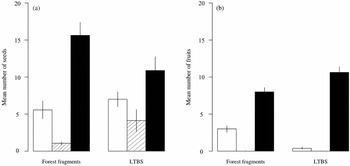
Seed predation did not differ between habitat types. Number of seeds eaten in situ in forest fragments did not differ (Figure 1a; Z = −1.03, P = 0.30) with the number of seeds eaten in the LTBS. Additionally, significantly more seeds were removed (Z = 18.6, P < 0.001) and fewer were left intact (Z = 0.50, P < 0.01) in forest fragments when compared with the LTBS. In the design used, seed density had no effect on seed fate (Z = 0.002, P = 0.99). Moreover, as expected, fruit removal differed between habitats. The number of fruits removed was significantly higher in the LTBS (Z = −0.52, P < 0.01) than in forest fragments (Figure 1b). Fruit density had no effect on fruit fate (Z = 0.002, P = 0.98).
Mean (± SD) number of seeds (a) and fruits (b) of Poulsenia armata eaten in situ (open bars), left intact (hatched bars) and removed (black bars) from the experimental stations in the continuous forest (LTBS) and forest fragments of Los Tuxtlas, Mexico, in 2010.

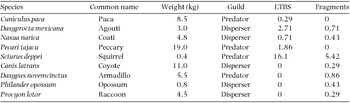
Detection frequencies by camera traps (mean ± SD) differed considerably between animal guild (F2, 18 = 173, P < 0.001), with more seed predators recorded (4.57 ± 0.78 photos wk−1), than dispersers (1.57 ± 0.26). Additionally, we found a significant interaction between animal guild and habitat (F2, 18 = 191, P < 0.001), with considerably fewer seed dispersers in forest fragments (mean = 0.43 ± 0.02) than in the LTBS (mean = 0.68 ± 0.05). Fruits of P. armata attracted several mammal species (Table 1). We observed coyote (Canis latrans) faeces with intact seeds of P. armata indicating a dispersal role. The coyote was detected only in forest fragments.
Mammal activity recorded by camera traps sorted by animal species and guild (predator or disperser) in continuous (LTBS) and forest fragments sites at Los Tuxtlas. Values represent mean relative frequencies (photos wk−1). Species nomenclature follows Wilson & Reeder (Reference WILSON and REEDER1993) and weights were taken from Dirzo et al. (2007) and Reid (Reference REID1997).

The number of overall trapped rodent individuals did not differ between habitats (P = 0.16). Trapped individuals in the LTBS were mainly Heteromys desmarestianus (n = 6) as well as in forest fragments (n = 4). We trapped four Peromyscus mexicanus in the LTBS and two in the forest fragments. Peromyscus leucopus and Tylomys nudicaudus were trapped only in the LTBS, but were rare with only one capture each. Although this is not a comprehensive sample, we believe it is enough to determine which main players are present at both habitats. None of the individuals marked was recaptured.
Forests around the globe are experiencing unprecedented rates of fragmentation with significant impact on the remaining mammalian fauna. Our results confirm significant differences in the mammalian fauna composition of the LTBS and forest fragments. We show that Poulsenia armata appeals to a variety of mammals in the LTBS and in forest fragments, indicating a redundant disperser assemblage. Differences in the composition of seed predators and dispersers of P. armata were reflected by differences in fruit removal.
Here, we confirm the presence of animal species (agouti, peccary) previously thought to be absent from the LTBS (Dirzo et al. Reference DIRZO, MENDOZA and ORTÍZ2007). Terrestrial fruit-eating species, such as the white-lipped peccary (Pecari tayacu), have been absent in the LBTS for many years forest due to illegal hunting. However, the study by Flores et al. (Reference FLORES, COATES, SÁNCHEZ-CORDERO and MENDIETA2014) clearly indicates that other terrestrial fruit-eating animals are present, and even abundant in the LTBS. Several species reported in this study are important seed predators or dispersers. The peccary has been described as an important seed predator in Neotropical forests (Asquith et al. Reference ASQUITH, WRIGHT and CLAUSS1997). Mexican agouti (Dasyprocta mexicana) and congeners are important agents of seed dispersal for other Neotropical trees (Asquith et al. Reference ASQUITH, TERBORGH, ARNOLD and RIVEROS1999, Forget Reference FORGET1990). Once thought to occur at very low density, the agouti is abundant in the LTBS (Flores et al. Reference FLORES, COATES, SÁNCHEZ-CORDERO and MENDIETA2014). The coati (Nasua narica) is also an important seed disperser in anthropogenic landscapes, as it is less affected by habitat fragmentation than many other species (Estrada et al. Reference ESTRADA, COATES-ESTRADA and MERITT1994). In our study P. armata fruits were consumed by opportunistic frugivores such as armadillo, opossum and raccoon in forest fragments, but were not recorded in the LTBS where they might have other food choices. Opossum and raccoon are highly frugivorous and consume fleshy fruits of several plant species and disperse their seeds (Cypher & Cypher Reference CYPHER and CYPHER1999, Medellin Reference MEDELLIN1994). The coyote (Canis latrans) is adventive and now widespread in Los Tuxtlas (Flores et al. Reference FLORES, COATES, SÁNCHEZ-CORDERO and MENDIETA2014) and is a significant agent of seed dispersal in temperate North America (Willson Reference WILLSON1993).
Opportunistic frugivores almost certainly affect tree regeneration in large forest fragments, where they act as seed predators and seed dispersers. An apparent lack of density dependence could be the result of a high preference for this food source by many generalist consumers. It is possible that seed and fruit densities selected for this study were too low. Another possibility is that other characteristics such as shape, texture and odour may be affecting food consumption rates. It is important to highlight the fact that the proportion of seeds removed from the ground is significantly higher in fragments, which indicates redundancy in the secondary disperser assemblage. Removal of fruits in forest fragments is not as complete as in the LTBS where arboreal mammals play a major role. Indeed fruits are taken and seeds dispersed in forest fragments, but not as effectively as in the LTBS. A caveat when interpreting our results of rodent surveys and camera trapping is the small sample size, however our observations are consistent with previous studies of P. armata at Los Tuxtlas forest. Imperfect dispersal is consistent with field observations of denser aggregations of P. armata seedlings close to reproductive adult trees in forest fragments (Zambrano et al. Reference ZAMBRANO, COATES and HOWE2014).
In this study, we found no evidence of more small rodents or higher seed predation in forest fragments than in the LTBS. The remaining mammal community of the fragments remains diverse enough to have great conservation value in the Los Tuxtlas region and should be an integral part of management plans.
ACKNOWLEDGEMENTS
We thank K. Vulinec, C. Whelan and the Howe laboratory. Fieldwork was supported by grants from the Rufford Foundation, Idea Wild, Sygma Xi and a Hadley Award.