INTRODUCTION
Recently, there has been a growing interest in the role of overhearing in language acquisition (Akhtar, Reference Akhtar2005; Akhtar, Jipson & Callanan, Reference Akhtar, Jipson and Callanan2001; Floor & Akhtar, Reference Floor and Akhtar2006; Gampe, Liebal & Tomasello, Reference Gampe, Liebal and Tomasello2012), based on the knowledge that at least some language features cannot be learned through addressed speech only. Moreover, addressed speech may not be sufficient to explain the rapid language growth of children (Akhtar et al., Reference Akhtar, Jipson and Callanan2001; Bloom, Reference Bloom, Kuhn, Siegler and Damon1998). One of the first studies that dealt with the learning of novel words by non-addressed speech was executed by Oshima-Takane (Reference Oshima-Takane1988). Her study focused on personal pronouns. She set up an experimental study with English-speaking children who had hardly used personal pronouns before. Their parents functioned as experimenters and had to use pointing actions while pronouncing the personal pronouns. The results showed that children who were given the opportunity to overhear during the treatment used the personal pronouns significantly more correctly than children who were exclusively exposed to speech directed to them. In a follow-up study, Oshima-Takane, Goodz, and Deverensky (Reference Oshima-Takane, Goodz and Derevensky1996) found that second-born children tended to have an advantage over first-born children in learning the personal pronouns, which may indicate that the overhearing of conversations between caregivers and older siblings plays an important role in the acquisition of at least some grammatical features. From 2000 onwards, researchers started to investigate learning by overhearing of referential terms in young European American middle-class children. Akhtar et al. (Reference Akhtar, Jipson and Callanan2001) developed a method by which various research questions relating to learning by overhearing were investigated in the following decade. Their method consisted of the use of a finding game with four buckets, in which three non-target objects and one target object were hidden and then made to appear by a researcher. In one condition, the objects were presented directly to the child (Addressee), and in the other, the objects were shown to a research assistant within earshot of the child (Overhearer). The researchers demonstrated that children aged 2;6 showed comprehension of the novel words in both conditions. However, children aged 2;1 seemed to learn the object label by overhearing only.
Some studies show that infants around two years of age are able to learn new vocabulary in more challenging environments as well. For example, in Akhtar (Reference Akhtar2005), it turned out that two-year-olds in an overhearing condition were also able to learn the target label when given a distracting toy, and when the word was embedded in a directive statement (e.g. “Can you put the toma in here?”) instead of a labeling statement (e.g. “I'm going to show you the toma”). Floor and Akhtar (Reference Floor and Akhtar2006) showed that even younger infants aged 1;6 were able to learn the novel object label through overhearing while playing with another toy.
The studies reviewed above led to new research questions with respect to language input and to the circumstances in which novel words are introduced. Martinez-Sussmann, Akhtar, Diesendruck, and Markson (Reference Martinez-Sussmann, Akhtar, Diesendruck and Markson2011), for example, hypothesized that in previous studies the target objects may have attracted more attention compared to the non-target objects. Indeed, in the aforementioned studies, the three non-target objects were introduced each time with a neutral statement (e.g. “I'm going to show you the one that's in here”), whereas in the introduction of the target object a novel word was used (e.g. “I'm going to show you the toma”). To test this hypothesis, novel objects were introduced by four different statements in their study. These included a statement containing a novel (target) label, a neutral label, a novel fact, and a neutral phrase. Remarkably, the two-year-old children were able to learn the novel label in these conditions as well.
Gampe et al. (Reference Gampe, Liebal and Tomasello2012) focused instead on the effect of the interaction situation in which the language input was provided. They hypothesized that the overhearing situation in previous studies may actually have been more dyadic than intended. Indeed, the procedure in earlier studies consisted of a familiarization phase taking place just before the treatment, possibly giving the children in the overhearing condition the impression of being involved to some extent. Nevertheless, it appeared that even without social interaction before the experimental manipulation, infants aged 1;6 learned equally well in the Addressed and in the Overhearing condition. Foster and Hund (Reference Foster and Hund2012) studied grammatical features, and found that children aged four and five years old used the spatial terms between and middle more frequently after overhearing conversations between two adults using the target words.
In sum, these studies seem to suggest that toddlers learn novel words equally well in direct interaction as in overhearing. This seems to be the case for referential terms (object and action labels) and (at least) for some grammatical features. Moreover, the studies indicate that children can learn novel words through overhearing in more complex language environments as well.
These experiments leave at least two issues unresolved, however. First, most attention in the field of overhearing has been devoted to the language acquisition of infants around two years old (for an exception, see Foster & Hund, Reference Foster and Hund2012). This interest may be rooted in a general tendency to concentrate on language acquisition in infancy and early childhood (for a historical overview of the emphasis on early childhood in language acquisition, see Nippold, Reference Nippold2006). In addition, some studies concentrated on looking for the earliest age at which children can learn through overhearing (Akhtar et al., Reference Akhtar, Jipson and Callanan2001; Floor & Akhtar, Reference Floor and Akhtar2006), thereby implicitly assuming that learning through overhearing comes later in development. Although some evidence for that assumption has been found in previous research (Akhtar et al., Reference Akhtar, Jipson and Callanan2001), we argue that it may also be important to investigate learning through overhearing in older children. Indeed, learning language is a process that covers the lifespan of individuals (Nippold, Reference Nippold2006). Examining learning through overhearing in older children may provide us with a more complete picture of the language acquisition of this age group in general.
A second issue is that most experimental studies have concentrated on children overhearing two adult (female) experimenters. However, there is a broad range of other types of overhearing situations one can think of which children are exposed to in their daily lives. Older children are frequently exposed to overhearing of classroom interactions in the context of education. A specific classroom practice in which children regularly have the opportunity to overhear these kinds of interactions is the division of the children into smaller groups with a different task assignment (for a detailed documentation of classroom practices, see Cazden, Reference Cazden2001; Mehan, Reference Mehan1979). During group work, the teacher may address individual children or a particular group, which means that the other children have the ability to overhear. We are convinced that the examination of how children learn from these types of interactions is of crucial importance in order to gain more comprehensive insight into how children make use of multiple sources of language input in the diverse range of day-to-day interactions in which they are involved.
In the current study, we investigated the language learning of six-year-old children in the final year of kindergarten in Flanders, the Dutch-speaking part of Belgium. Specifically for this target group, we developed a methodology to investigate their learning of novel words from a more complex and elaborate type of language input. In four story-telling sessions (with a total of 80 minutes of language input), children were exposed to twelve novel words embedded in the story. The day after the training period, the children were extensively tested on their knowledge of the novel words. We sought to investigate three aspects of language learning: conceptual knowledge of the objects and actions, and comprehension and production of the novel words.
The story was told in three different input conditions. Two conditions aimed to approximate those used in previous studies. In one condition, children were directly addressed to listen to the story (Addressed). In a second condition, children were assigned to a certain task (for example, coloring a picture during the first story-telling session), meanwhile having the opportunity to overhear the story told by one adult experimenter addressing a research assistant (Overhearing Two Adults). The third condition aimed to approximate the overhearing situation children regularly experience in kindergarten, that is, the overhearing of classroom interactions. The interaction situation consisted of one adult talking to a group of children, whilst another group was assigned to a certain task (the same one as in the second condition). Meanwhile, the children had the ability to overhear (Overhearing Classroom).
In order to make the Overhearing Classroom condition credible, all conditions took place in the children's regular schools, in a separate classroom that was reorganized as a laboratory room. The female experimenters who carried out the story-telling sessions introduced themselves as ‘new teachers’ who were going to perform various activities with the children. The experimental groups consisted of twelve children. The combination of the elaborate treatment (four story-telling sessions distributed over several days) and small experimental groups made the data collection time-consuming. However, we considered it crucial that the twelve novel words were offered several times, and that the group sizes were equal each time in order to assure comparable circumstances with respect to quiet and order in the classroom.
The conditions Addressed and Overhearing Classroom took place at the same time in the same classroom. Half of the children were randomly assigned to listen to the story directly, whereas the other half were assigned to a task. Meanwhile, they were able (but not instructed) to overhear. In the third condition (Overhearing Two Adults), all children in the classroom were assigned to the same task as in Overhearing Classroom. After a while, the experimenter started to tell the story to a research assistant, addressing her exclusively and ignoring the presence of the children.
METHOD
Participants and data collection
The data were collected from September 2011 until September 2014 as part of a larger research project investigating the effect of social and cultural factors on language acquisition. One of the research aims in this project is to gain more insight into the language acquisition of children with a low socio-economic background. Therefore, only children whose mothers had no degree in higher education participated in the study. The children were recruited in ten schools in the southeast of Antwerp, a province situated in Flanders, the Dutch-speaking part of Belgium.
We made use of a purposive sample in which both the schools and the children had to meet some criteria to participate in the study. With respect to population, the study required that at least twelve children with both parents of Flemish origin were enrolled in the last year of kindergarten. The children had to have Dutch as their native language and use it with all members of their social network. Further, these children also needed to meet the criterion of having a low socio-economic background. Because in a number of schools it turned out that it was hard to meet both criteria, we often ran the experiments with only five or six eligible participants, complemented with other children not accepted for analysis in this study.
With respect to infrastructure, one separate spare room on the days of the training and two separate spare rooms on the day of the testing needed to be available. As many schools in Belgium struggle with lack of space, some schools were not able to participate because they could not offer us free rooms that could be turned into a laboratory setting.
In total, thirty-two schools were contacted, of which ten met all the requirements and were willing to participate. After the selection of schools, the TAL-K, a pretest of language proficiency in Dutch (Cucchiarini & Jaspaert, Reference Cucchiarini and Jaspaert1996), was administered. Only children who achieved more than half the maximum score of 30 were included in the experimental groups to make sure that all children had sufficient language proficiency in Dutch to understand the language input provided.
In the final sample, there were fifty-three children in the final year of kindergarten (M age = 5·6 years old, SD = 0·59; twenty-two boys and thirty-one girls). Eleven additional children participated in the experiment but were excluded from analysis because they were absent on the second day of the treatment (N = 7) or on the day of the post-test (N = 4). Mean score on the TAL-K test was 27·06 (SD = 2·9). One child scored 17, all other children's scores ranged from 20 to 30. Information about family composition was collected for each participant as well. There were thirty-one first-born and twenty-two later-born children. None of the participants’ mothers had a higher education degree (university or college). The majority completed secondary education (thirty-eight mothers), twelve finished lower secondary education (for Belgium, this means that these mothers have typically been to school until 14 years of age), and three mothers had only completed primary education.
Materials
We developed a fantasy story in which twelve nonwords were incorporated. The story was about princess Praline who discovered a kameut, a little man with a tomato head. The story was designed differently for two different addressees: in the Addressed Speech and Overhearing Classroom condition the addressees were children; in Overhearing Two Adults the addressee was another adult. In both formats the story was told in exactly the same order and the novel words occurred with the same frequency. In the conditions with children as addressees the experimenter asked questions to the children occasionally to make them involved in the story, but avoided questions that required them to use the novel words actively. In the Overhearing Two Adults condition the adult addressee behaved as an active listener who asked questions about the continuation of the story and reacted to the events. Excerpts from the story in the different story-telling conditions are presented in ‘Appendix 1’.
The narrative was divided into four story-telling sessions of twenty minutes each. The target objects (see ‘Appendix 2’) were a doll with a tomato head, a candy, a head massager, a glitter bouncy ball, a furry bird, and a big cake made with gruesome ingredients such as frog's eyes and horsehair. The novel object labels each had two syllables and consisted of five sounds (kameut, kikoon, piefan, tassat, viddon, baloep).
The novel actions (see ‘Appendix 3’) were performing dance steps to medieval music, trampling on the ingredients of the big cake, making noise by clashing pots and pans together, balancing on a teeter with a ball on the head, jumping while rotating at the same time, and doing three subsequent actions with the glitter bouncy ball. The novel action labels had four sounds in the stem each time (stak, timb, bast, kuimp, spoek, must). They ended on -elen or -eren, two non-frequent verb endings in Dutch. All target words occurred with a natural frequency in the story, ranging from twenty (the action words) to one hundred twenty (kameut, who was the main character in the story).
The use of several stage-props and the performance of actions made the story-telling activity highly dynamic in nature. It required that the story-teller walked around, moved objects, and performed different roles. For a full understanding of the meaning of the story and the novel words, it may have been important for the children not only to listen to it but also to watch what was happening. Actually, it is safe to say that the story fell in the middle ground between story-telling and play performance.
In order to approach the way in which teachers commonly communicate and read stories with young children, the novel words were embedded in the story in two basic ways. Half of the words (three object and three action labels) were given an explanation shortly after the first time they were used. The story-teller used the word functionally in the story first, then addressed the children or the adult addressee and asked whether they knew what the particular object or action was. After a negative response, the word was explained. In the rest of the story, these words were exclusively used functionally and not explained.
The other half of the words were exclusively used functionally in the story and not explained anywhere. The only way for the children to understand their meanings was thus to deduce them from the story context. In Table 1, examples are given for the use of novel object words.
Use and introduction of novel object labels during storytelling

Testing materials. Children's knowledge of the target words was tested in a number of ways. The test battery consisted of two subtests with respect to content (Conceptual Knowledge test for both Novel Objects and Actions), and four subtests with respect to language (Production and Comprehension test for both Novel Object and Action labels).
The Conceptual Knowledge test aimed to draw attention to the (target) objects and actions specifically, and examined whether the children had some basic information about them. Because we considered the children too young to ask for definitions (which would imply the use of more abstract, metalinguistic terms), we asked two purposive, more concrete questions about the use of the novel objects and actions throughout the story. The first question asked for what purpose a particular object or action was used or performed. The child was given an object and asked: “What was this object used for in the story?” In the case of the piefan, for example, the correct answer was that the object could spit fireballs. Then, the child was asked which characters used the objects or performed the actions throughout the story. The piefan, for example, was used by the little man with the tomato head. There were nine questions about the objects, and eleven questions about the actions. The emphasis during the Conceptual Knowledge test was put on the content and purpose of the target objects and actions, and not on the words themselves. That means that the children did not have to use the target labels in their answers to the questions. They could also use a description, point to the object, or perform a particular action. The test administrator encouraged the child to do so when she noticed that the child hesitated to give an answer because of not knowing the correct labels.
The Production test examined whether the children could produce the novel object and action labels. All children were given three opportunities to show productive knowledge. The first opportunity was during the Conceptual Knowledge test, in which it was possible that the children used the target labels spontaneously in their answers to the questions. In case the children did not use the target labels spontaneously, an explicit method was used to elicit production. In order to test the production of the novel object labels in an explicit way, the children were given the target objects and asked what they were called in the story. In order to test the production of the novel action labels, the test administrator demonstrated the different actions and asked what she was doing was called. In case the previous methods did not elicit production, or when the children indicated that they did not know the answer, they were offered the first two sound segments. The test administrator acted as if she had suddenly found a hint on her paper and said: “Oh, I see I have the first two sounds on my paper here. The first two sounds are ta… . This is a ta… .” The administrator pronounced this with rising intonation, inviting the child to produce the word. By giving the children three opportunities, we aimed to obtain a differentiated idea of children's productive skills.
The Comprehension test examined whether the children understood the meaning of the novel labels. For the novel object labels, the child was asked to point to the target object from ten objects (six target objects and four distractors). To test comprehension of the novel action labels, the child was asked to perform the six target actions successively. The experimenter asked: “Could you [target action label] a bit? Could you do that for me?” In case the child did not respond, the experimenter asked in a helpful manner what was needed to perform the action. If the child indicated the right action props and their associated character, he or she was encouraged to explain how the action had to be accomplished. In this way, children who knew the meaning of the target word, but were perhaps too shy to perform the action, still had the chance to show comprehension of the action words.
Design
The children were randomly assigned to one of three conditions: Addressed Speech (N = 18), Overhearing Classroom (N = 19), and Overhearing Two Adults (N = 16). In the experimental groups in the Addressed Speech condition, six children were seated in one row on chairs facing the experimenter and the stage-props. In the Overhearing Classroom condition, six children were sitting at desks just behind the children of the Addressed condition. The condition Overhearing Two Adults took place in a separate classroom in which twelve children were seated at desks in one row. That way, all experimental sessions were conducted with an equal number of children in the classroom.
In Addressed Speech, the children were addressed to listen to the story. In both overhearing conditions, the children received a distracting task. They were able to watch and overhear the adult experimenter telling the story to an associate (Overhearing Two Adults) or to the children's peers (Overhearing Classroom). However, their participation in the story-telling event was not encouraged.
Following best practice in audience design (see, for example, Clark & Schaefer, Reference Clark, Schaefer and Clark1992) and other overhearing studies (see, for example, Akhtar et al., Reference Akhtar, Jipson and Callanan2001), the main difference between addressees and overhearers was created by the intentions of the speaker. The children in the Addressed condition were the intended addressees who fully benefited from the conversational responsibilities a speaker holds towards addressees, for example, by making sure that addressees can follow the conversation (Clark & Schaefer, Reference Clark, Schaefer and Clark1992). The children in both overhearing conditions had access to what the speakers were saying and their presence was fully recognized, but they did not benefit from the same conversational responsibilities. In the ‘Procedure’ section below, more information will be given about the operationalization of the three conditions.
Procedure
One week before the start of the experiment, all children had to complete the TAL-K. Children who scored above the set threshold of the TAL-K and met the other requirements were selected for the study. Random assignment appears to have been successful; the children's mean scores of the TAL-K in the three conditions did not differ significantly from one another (M = 26·95 in Addressed, M = 27·05 in Overhearing Classroom, and M = 27·19 in Overhearing Two Adults; F(2,51) = 0·03, p = ·970). The four story-telling sessions took place on two consecutive days, always before and after the children's morning break.
Before classes started, a separate classroom was prepared and arranged as a laboratory room. When the room was a multi-functional room sometimes used by several teachers, the staff were asked not to enter it during the experiment. Arrangements for the experiment included setting the desks in the right position, making space for story-telling, and preparing the stage-props.
The materials intended for the children in the Overhearing condition were put on the desks. Just before the first story-telling session each time, the same female experimenter went to the regular classroom of the children. The experimenter introduced herself as a ‘new teacher’ who was going to perform several activities with the children. Then, she called the twelve children selected for the experiment and accompanied them to the classroom in which the experiment was going to take place.
Addressed and Overhearing Classroom conditions. After entering the room, the children were asked to wait until they were seated. The Overhearing Classroom children were given a seat on the second row, and the Addressed children one on the first row. The experimenter explained the activity for the children in the Overhearing condition first. The activities were the same for each story-telling session and were always performed in the same order. The children were asked to color a picture (session 1), solve a puzzle (session 2), make a pearl necklace (session 3), and decorate a picture with wool after having colored it (session 4). After the instruction was given, the children could start their task. The experimenter assisted them for a few minutes, and then switched to the activity for the children in the Addressed condition.
The experimenter addressed the children in the first row directly by inviting them to listen to a story. Before she began to tell the story, she made sure that the children were facing her. When a child was distracted during story-telling and turned his or her head for a longer time away from the instructional center, the experimenter called the child by his or her name and motivated him or her to pay attention in a friendly manner. In this way, it was ensured that addressed speech and joint attention were established throughout the whole experimental session.
Importantly, the experimenter never alluded to the fact that novel words were going to be used or that children's knowledge was going to be tested afterwards. Immediately after inviting the children to listen, she started to tell the story in an expressive way, following a script to make sure that the story was told in the same way each time.
During story-telling, no eye-contact was made with the children in the second row (Overhearing Classroom). In contrast to the children in the Addressed condition, no attempts were made to ensure that children stayed focused on their task. Indeed, it was exactly the aim to investigate the extent to which children made use of and learned from overhearing opportunities spontaneously. When they needed help, the experimenter stepped out of the story and briefly assisted them in a friendly manner before continuing with the story. After the story-telling session, the children in the Overhearing Classroom condition were given special attention. The experimenter looked at the results of their work, gave feedback, and complimented them.
Overhearing two adults. The same female experimenter as in the two other conditions, accompanied by a female research assistant, conducted the study in this condition. The participants were given a seat next to each other in the same row in the experimental classroom. The research assistant was introduced as a ‘new teacher’ as well. The activities were explained first and were the same as in the Overhearing Classroom condition. Both experimenters helped the children for a few minutes, and afterwards the experimenter started talking to the research assistant. She said she wanted to tell her a story that she heard the day before. Subsequently, she told the same story as in the Addressed and Overhearing Classroom conditions, this time addressing the research assistant instead of the children.
From the beginning of the story, no eye-contact was made with the children. The plot was told by the experimenter while the research assistant functioned as an active listener who asked questions about the story or gave comments (see also ‘Appendix 1’). In cases of interruption of the story by the children, they were briefly assisted or given other materials. After these short breaks, the experimenter told the children that she had to continue talking with the other teacher (research assistant).
Testing procedure
The day after the two experimental days, the post-test was administered, in which the children participated individually in a single half-hour visit. All sessions were conducted by two female experimenters, and were videotaped. The tests were organized in two separate rooms. In the first room, one administrator assessed children's conceptual knowledge of novel objects and production of novel object labels. In the second room, the conceptual knowledge of novel actions, production of novel action labels, and comprehension of both object and action labels was assessed by another administrator.
The subtests were always administered in the same order: the production test always preceded the tests aimed at measuring comprehension. Indeed, during the comprehension test, it was necessary for the experimenter to use the target words herself. Starting with the comprehension test would thus possibly stimulate and influence children's productive knowledge of the words. More information about the different subtests is given in the section ‘Materials’ – ‘Testing materials’.
Scoring procedure
Conceptual Knowledge test. The children received one mark when they could denote the function of the novel object or action correctly, and one mark when they gave a correct answer with respect to the characters. The function and character questions were added for objects and actions separately. As there were nine questions in total about the objects and eleven questions in total about the actions, the maximum score for the Conceptual Knowledge test of novel objects and actions was nine and eleven, respectively.
Production test. The scoring procedure of the production test was conducted in three steps. In the first step the spontaneous and prompted production of the novel words were scored separately on a ratio-scale. A particular production of a word received more marks depending on the number of sounds that were produced correctly. As the maximum number of sounds was different for the spontaneous and prompted productions, the scores were in a second step transformed into two binary scores. The spontaneous production of a novel object word received one mark when at least three out of five sounds were produced correctly. The prompted production of a novel object word received one mark when at least two out of the three sounds to be provided were correct.
In order to reduce the effect of guesswork with respect to the novel action labels, only the sounds of the stem were taken into consideration. Indeed, the sound combinations in the stem were unique and differed completely from each other, whereas verb endings in Dutch resemble each other to a great extent. The spontaneous production of a novel action word received one mark when three out of four sounds of the stem were produced correctly. The prompted production of a novel action word received one mark when at least one out of the two sounds to be provided were correct. We have to note that it might have been easier for the children to receive a mark for the completion of a novel action word compared to the completion of a novel object word. Because of this, the effect of condition on the knowledge of the novel words will be examined for object and action words separately.
A preliminary analysis revealed that the spontaneous production scores were generally very low. The children correctly produced on average one out of the six novel object words spontaneously (M = 1·04; SD = 1·29). Apparently four story-telling sessions with a rather passive exposure to novel words were not sufficient to master productive skills. For the spontaneous production of novel action words the same results emerged. Similarly, the children produced on average one out of the six novel action words spontaneously (M = 0·94, SD = 1·00).
In addition to the novel object words that were already correctly produced spontaneously, the children were on average able to complete one word more when two sound cues were given (M = 1·04, SD = 1·14). With respect to the novel action words, the children were on average able to complete a bit less than two words (M = 1·81, SD = 1·28). In order to avoid a floor effect, we created a third variable in which a word was considered as correct when the child was able to produce the word spontaneously or in case of a correct completion after being prompted with two sound cues. In our interpretation of the results, we thus should take into consideration that the production outcomes were scored in a very lax way. After we had taken into account both the spontaneous and prompted scores, the children were able to produce on average two out of six novel object words correctly (M = 2·00, SD = 1·75) and a bit less than three novel action words (M = 2·74, SD = 1·69).
Comprehension test. An item on the comprehension test of novel object words received one mark if the child was able to indicate the correct corresponding object on the table. In the comprehension test of novel action words, in which children had to demonstrate the actions, a rather mild scoring procedure was used. As some children were too shy to demonstrate the actions, an item was also considered correct when the child was able to verbally explain the meaning of the word. Some action words referred to more complex actions in which, for example, three subsequent actions had to be performed. In those cases, the answers were also considered correct when the child described or performed the subsequent actions partially. Similar to the production test, the maximum score for each of the word types (object and action words) was six.
RESULTS
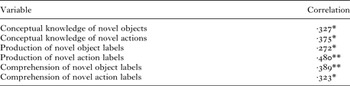
Preliminary analyses revealed that family composition (having younger or older siblings), age in months, and educational level of the children's mothers all had no effect on children's word learning, so subsequent analyses collapsed across these measures. There was a significant effect of gender in the comprehension test of novel object labels and conceptual knowledge of novel actions, so gender was included as an independent variable in the analyses concerned. There was also a significant effect of children's performances on the pretest of language proficiency in all conditions, with more proficient children performing better compared to less proficient children in all test scores (see Table 2). There were no significant interactions between children's initial language proficiency in Dutch and condition. As we were interested in the effect of condition on children's knowledge of the novel words independent of their initial language proficiency in Dutch, we used ANCOVAs in which the scores on the TAL-K, the pretest of language proficiency in Dutch, were inserted as a covariate in order to control for initial language proficiency.
Correlations between initial language proficiency in Dutch and the different conceptual and linguistic variables (* p < ·05; ** p < ·01)

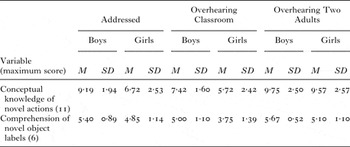
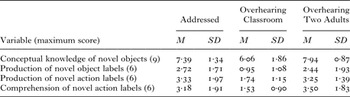
To examine the effect of condition on the several outcomes, six analyses of covariance (ANCOVAs) were conducted with condition as a between-subjects factor, outcomes on the pretest of language proficiency in Dutch as a covariate, and children's performances on the conceptual, production, and comprehension tests as dependent variables. In the comprehension test of novel object labels and conceptual knowledge test of novel actions, gender was included as a between-subjects factor as well. As explained in the ‘Procedure’ section, the analyses were run for the object and action labels separately. The mean scores and standard deviations in each condition (not controlled for initial language proficiency in Dutch) are presented in Tables 3 and 4. The descriptive statistics are broken down by condition and gender for the test scores in which a significant effect of gender has been found (Table 3). Below, the ANCOVAs in the final models are discussed under separate headings.
Mean scores and standard deviations by condition and gender

Mean scores and standard deviations by condition

Conceptual and linguistic knowledge of novel objects
Conceptual knowledge of novel objects. An ANCOVA with condition as a between-subjects factor, outcomes on the pretest of language proficiency as a covariate, and children's performances on the Conceptual Knowledge test as a dependent variable, revealed a main effect of condition (F(2,43) = 7·65, p = ·001, partial η 2 = ·26). Post-hoc Bonferroni analysis indicated that children in the Addressed Speech (M = 7·41) and Overhearing Two Adults conditions (M = 7·94) performed equally well (p = ·991). Both children in the Addressed (M = 7·41) and Overhearing Two Adults conditions (M = 7·94) had significantly higher conceptual knowledge achievement scores, controlling for their performances on the pretest, than children in Overhearing Classroom condition (M = 6·04; p = ·014 for Addressed – Overhearing Classroom and p = ·003 for Overhearing Two Adults – Overhearing Classroom).
Production of novel object labels. An ANCOVA with condition as a between-subjects factor, outcomes on the pretest of language proficiency as a covariate, and outcomes on the Production test as a dependent variable, showed a main effect of condition (F(2,49) = 7·21, p = ·002, partial η 2 = ·23). Post-hoc Bonferroni analysis indicated that children in the Addressed speech (M = 2·74) and Overhearing Two Adults conditions (M = 2·42) performed equally well (p = 1·00). Children in Addressed (M = 2·74) and Overhearing Two Adults conditions (M = 2·42) had significantly higher production scores, controlling for their performances on the pretest, than children in the Overhearing Classroom condition (M = 0·95; p = ·002 for Addressed – Overhearing Classroom and p = ·020 for Overhearing Two Adults – Overhearing Classroom).
Comprehension of novel object labels. Preliminary analyses had shown a significant effect of gender. Therefore, gender, as well as condition, was included as a between-subjects factor in the ANCOVA. The ANCOVA with condition and gender as between-subjects factors, outcomes on the pretest of language proficiency as a covariate, and children's performances on the Comprehension test revealed a main effect of condition (F(2,46) = 4·43, p = ·017, partial η 2 = ·16). Post-hoc Bonferroni analysis indicated that the scores of the children in the Addressed Speech condition (M = 5·10) did not differ significantly from the scores of the children in the Overhearing Two Adults (M = 5·36, p = 1·00) nor from the scores of the children in the Overhearing Classroom conditions (M = 4·37, p = ·135). The children in the Overhearing Two Adults condition (M = 5·36) had significantly higher comprehension scores (p = ·020), controlling for their performances on the pretest, than children in the Overhearing Classroom condition (M = 4·37).
The ANCOVA also revealed a main effect of gender (F(1,46) = 6·36, p = ·015, partial η 2 = ·12). The results showed that boys outperformed girls in all conditions (M = 5·31 for boys and M = 4·58 for girls).
Summarizing the effect of condition on conceptual and linguistic knowledge of novel objects, it is shown that condition had a significant effect in all subskills. Both with respect to conceptual knowledge, and comprehension and production, children showed equal control of the words in the Addressed and Overhearing Two Adults conditions. In contrast, children in the Overhearing Classroom condition performed at significantly lower levels compared to children in the Overhearing Two Adults condition in all test scores. They also performed less well compared to children in the Addressed condition, with significant differences in the conceptual knowledge and production tests. Interestingly, the comprehension test showed a gender effect as well, with boys outperforming girls.
Conceptual and linguistic knowledge of novel actions
Conceptual knowledge of novel actions. Preliminary analyses had shown a significant effect of gender. Therefore, analogous to the analysis for the Comprehension test of Novel Object labels, gender was included as a between-subjects factor in the ANCOVA as well. The ANCOVA with condition and gender as between-subjects factors, outcomes on the pretest of language proficiency as a covariate, and children's performances on the Conceptual Knowledge test as a dependent variable, revealed a main effect of condition (F(2,39) = 7·54, p = ·002, partial η 2 = ·28). Post-hoc Bonferroni analysis indicated that the scores of the children in the Addressed condition (M = 7·94) did not differ significantly from the scores of the children in the Overhearing Two Adults condition (M = 9·71, p = ·141), nor from the scores of the children in the Overhearing Classroom condition (M = 6·52, p = ·196). The children in the Overhearing Two Adults condition (M = 9·71) had significantly higher conceptual knowledge achievement scores (p = ·001), controlling for their performances on the pretest, than children in the Overhearing Classroom condition (M = 6·52).
The ANCOVA also showed a main effect of gender (F(1,39) = 4·92, p = ·032, partial η 2 = ·11). The results showed that boys outperformed girls in all conditions (M = 8·79 for boys and M = 7·32 for girls).
Production of novel action labels. An ANCOVA with condition as a between-subjects factor, outcomes on the pretest of language proficiency as a covariate, and outcomes on the Production test as a dependent variable, showed a main effect of condition (F(2,48) = 7·84, p = ·001, partial η 2 = ·25). Post-hoc Bonferroni analysis indicated that children in the Addressed (M = 3·35) and Overhearing Two Adults conditions (M = 3·20) performed equally well (p = 1·00). Children in both conditions had significantly higher production scores, controlling for their performances on the pretest, than children in the Overhearing Classroom condition (M = 1·76; p = ·002 for Addressed – Overhearing Classroom and p = ·008 for Overhearing Two Adults – Overhearing Classroom).
Comprehension of novel action labels. An ANCOVA with condition as a between-subjects factor, outcomes on the pretest of language proficiency as a covariate, and outcomes on the comprehension of novel action labels as a dependent variable revealed a main effect of condition (F(2,48) = 8·61, p = ·001, partial η 2 = ·26). Post-hoc Bonferroni analysis indicated that children in the Addressed (M = 3·15) and Overhearing Two Adults conditions (M = 3·50) performed equally well (p = 1·00). Children in both conditions had significantly higher comprehension scores, controlling for their performances on the pretest, than children in the Overhearing Classroom condition (M = 1·55; p = ·007 for Addressed – Overhearing Classroom and p = ·001 for Overhearing Two Adults – Overhearing Classroom).
Summarizing the effect of condition on conceptual and linguistic knowledge of novel actions, it is shown that condition had a significant effect in all test scores. In every subskill, children showed equal control of the words in the Addressed and Overhearing Two Adults conditions. In contrast, children in the Overhearing Classroom condition performed significantly less well compared to children in the Overhearing Two Adults condition in all test scores. They also performed less well compared to children in the Addressed condition, with significant differences in the production and comprehension test. Interestingly, the conceptual knowledge test of novel actions showed a gender effect as well. Analogous to the comprehension test of novel object labels, boys outperformed girls.
DISCUSSION
Previous research has shown that two-year-old infants learn a novel word, introduced or used in a finding game, equally well when they are directly addressed as when they overhear two adult experimenters (Akhtar, Reference Akhtar2005; Akhtar et al., Reference Akhtar, Jipson and Callanan2001; Floor & Akhtar, Reference Floor and Akhtar2006; Shneidman, Buresh, Shimpi, Knight-Schwarz & Woodward, Reference Shneidman, Buresh, Shimpi, Knight-Schwarz and Woodward2009). However, to our knowledge there is no information on how older children make use of, and learn from, overhearing opportunities (for an exception, see Foster & Hund, 2011). Moreover, most studies focused on learning through overhearing from two adult experimenters exclusively, thereby ignoring how children learn from other types of interaction situations.
In the current study, we addressed these issues by focusing on six-year-old children in the final year of kindergarten. We developed a methodology especially designed for this target group. A story was created in which six target objects and six target actions with novel labels were actively used, and which was told in three input conditions.
In one condition, children were directly addressed by one adult (Addressed condition). In the second, children were performing a distracting activity within earshot of the children in the Addressed condition (Overhearing Classroom). In the third, all children in the classroom were performing the same distracting activity, while one adult told the story to another adult (Overhearing Two Adults).
Results show that six-year-old children learned novel words equally well when being directly addressed as when overhearing interactions between two adults. This was the case for both word types (object and action labels). Moreover, children in these two conditions performed similarly across every subskill (conceptual knowledge, production, and comprehension). A remarkable finding, however, was that children learned significantly fewer words in the condition in which they had the opportunity to overhear classroom interactions in comparison with the two other conditions. The condition effect was detected both in word types and in all subskills.
The observed performance gap underscores the need to investigate different kinds of interaction situations in learning through overhearing. Apparently not every interaction situation is equally beneficial for children to pick up and learn novel language elements. A critical question is then how the performance gap between the language acquisition results in the Overhearing Classroom condition compared to the two other conditions might be explained. A first important observation is that the results of the Addressed and Overhearing Two Adults conditions are entirely in line with previous work in overhearing (Akhtar, Reference Akhtar2005; Akhtar et al., Reference Akhtar, Jipson and Callanan2001; Floor & Akhtar, Reference Floor and Akhtar2006; Gampe et al., Reference Gampe, Liebal and Tomasello2012; Martínez-Susmann et al., Reference Martinez-Sussmann, Akhtar, Diesendruck and Markson2011; Shneidman et al., Reference Shneidman, Buresh, Shimpi, Knight-Schwarz and Woodward2009). Indeed, these studies revealed that children learned novel words equally well by being addressed directly as by overhearing a finding game between two adult experimenters. The two-year-old infants did so in various contexts, such as when the child in the overhearing condition was playing with a distracting toy (Akhtar, Reference Akhtar2005), when there was no familiarization phase before the treatment (Gampe et al., Reference Gampe, Liebal and Tomasello2012), or when the target label was introduced less explicitly (Akhtar, Reference Akhtar2005; Martínez-Susmann et al., Reference Martinez-Sussmann, Akhtar, Diesendruck and Markson2011). It is interesting to note that, in spite of essential differences in operationalization and target group, the current study yielded the same results.
One additional overhearing condition was added to the present study: the overhearing of classroom interactions. Remarkably, this condition turned out to be considerably less effective compared to the two other conditions. As children have far more opportunities to overhear classroom interactions compared to adult-to-adult interactions within the context of education, it is of vital importance to explore the differences between the two overhearing conditions in more detail. In both conditions the story was told by the same female experimenter in the children's regular school setting. A first important difference between conditions is the exact nature of the addressee: in the first case the addressees were children, in the second case the addressee was an adult. A possibility is that it might be more interesting or attractive for children to overhear an adult addressing another adult compared to the overhearing of an adult talking to a group of children, so that the children were more inclined to listen.
Interesting in that respect is research that shows that children prefer to learn from adults compared to children. Jaswal and Neely (Reference Jaswal and Neely2006), for example, found that three- and four-year-olds were commonly more inclined to learn novel labels provided by an adult compared to labels provided by a peer. However, when the adults had shown themselves as less reliable informants by mislabeling four objects just before the test trial, the preference difference did not emerge. Talyor, Cartwright, and Bowden (Reference Taylor, Cartwright and Bowden1991) found that four-year-olds expect that an unfamiliar adult, but not necessarily an unfamiliar child, knows the meaning of the word hypochondriac. The studies of Lampinen and Smith (Reference Lampinen and Smith1995) and Bruck and Ceci (Reference Bruck and Ceci1999) showed that children are commonly willing to accept what an adult says, sometimes even when it contradicts their first-hand observation, but not when the misleading information is provided by a child. It is an intriguing question whether social information about the addressee, such as his or her age, also has an influence on the extent to which children make use of, and learn from, overhearing opportunities.
A second hypothesis is that the observed performance gap between conditions is not so much related to the persona of the addressee but to the setting and the role the experimenter plays in that setting. Although the study took place in the same setting (i.e. the children's regular school) and the experimenter introduced herself as a teacher in the same way in both conditions, we contend that the context of the classroom and the experimenter's role as a teacher was more prominent in the condition in which the children had the opportunity to overhear the interactions between the teacher (experimenter) and their fellow pupils. By the division of the children into two groups, in which each group was assigned to a different task, the typical social organizational form of Western education may have emerged more strongly in the Overhearing Classroom than in the Overhearing Two Adults condition.
Ethnographic research has pointed out that the social organization of teaching and learning in Western education is vertical and hierarchic, in which an adult directs the roles and responsibilities of children, “often in a dyadic structure even though others are present” (Chavajay & Rogoff, Reference Chavajay and Rogoff2002, p. 56). Philips talks about a “switchboard participant structure” and emphasizes that it is usually the teacher who decides which pupils participate in which classroom activities, when, and for how long (Philips, Reference Philips, Cazden, John and Hymes1972, Reference Philips1983). The hierarchic division of labor contrasts sharply with the rather horizontal and cooperative social organizational forms in many non-Western communities, such as indigenous communities in North and Central America (see, amongst others, Chavajay & Rogoff, Reference Chavajay and Rogoff2002). The horizontal form of organization implies “shared multi-party engagements among several group members, with mutual and fluid negotiation of roles and responsibilities and consensus-based decision making” (Correa-Chavez & Rogoff, 2002, p. 55).
In the Overhearing Classroom condition, in which the “switchboard participant structure” was overtly present, it might very well be the case that processes of school socialization meant that children were less inclined to overhear in that condition. In his compelling sociological micro-analysis of classroom interactions, Mehan (Reference Mehan1979) points out that children, by repeatedly participating in particular classroom activities, gradually know how to behave and what they should do in order to be judged as a competent member in the eyes of the other members of the community, the teacher in particular. The hierarchic division of labor usually implies that children have to be engaged in their own task and not in the task the other children have been given. The children are also generally asked to display knowledge of, or competence for, their own task after or during task completion, and not of others’ tasks, and they can additionally be rewarded for their knowledge or realizations. Conversely, they are usually not rewarded for knowledge about or competence for others’ tasks, and moreover they may be evaluated negatively when they ‘interfere’ in others’ affairs. By the age of six years, it might very well be the case that children have learned this interactionally appropriate behavior and show the same behavior when they are put in comparable situations. We hypothesize that children's (tacit) knowledge of classroom routines and assumed appropriate behavior during these practices might have meant that children were less inclined to overhear, and consequently learned fewer words through overhearing in the Classroom condition.
Conversely, it might be argued that the normal classroom routine was broken down in the Overhearing Two Adults condition as soon as the experimenters got engaged in a lively, elaborate conversation with each other, addressing each other exclusively and hardly paying attention to the children. By the interruption of the classroom routine, the children probably knew less about what role was expected of them. Consequently, they were more inclined to overhear and learned more words through overhearing.
An investigation of children's attention management during the story-telling sessions might be helpful in examining whether the children indeed made more use of overhearing opportunities in the Overhearing Two Adults condition. A detailed, systematic analysis of the videotapes was beyond the scope of this study. However, in order to attain some knowledge about children's behavior during the experimental sessions, a qualitative analysis was performed on every first session. In total, twelve videotapes of twenty minutes (six videotapes in each overhearing condition) were carefully watched and children's behavior was described by two independent raters in terms of the attention they paid to the story-telling event. Behaviors that were categorized as signaling attention were, amongst others, eye-gaze to the story-telling event, an attentive body posture directed towards the story-teller, and reactions (smiling, laughing) in reply to what was told. It turned out from the observers’ qualitative summary that the children in the Overhearing Two Adults condition seemed to show more sustained attention to the story-telling compared to the children in the Overhearing Classroom condition. The raters noted in general that the children's eye-gaze was directed to the story-teller more frequently in the first condition, that the children took a more interested and concentrated body posture, and that they seemed to be more involved in the story.
In the Overhearing Classroom condition, however, the raters noted that many children hardly seemed to be involved in the story-telling event. They pointed out that the children were painting diligently throughout the whole story-telling session, and that their eye-gaze was almost exclusively directed to the painting. They also noted that children's body posture or behavior did not give the impression they were listening. In addition, they noted that other children in this condition seemed to show a more alternating pattern of attention management. Their eye-gaze was alternately directed towards their own task and the story-telling event.
The results of the qualitative analysis seem to suggest a relation between visual attention and word learning through overhearing, for which there is some evidence from previous research. Shneidman and colleagues (Reference Shneidman, Buresh, Shimpi, Knight-Schwarz and Woodward2009) investigated the learning of a novel object by twenty-month-old infants in an Overhearing Two Adults condition. The children showed equal visual attention to the interaction situation as a whole. However, there were significant differences in the amount of attention directed towards the experimenters compared to attention directed towards the novel object introduced in the interaction. The amount of attention to the experimenters was positively correlated to word learning: infants who paid more attention to the experimenters during the teaching phase were more likely to learn the novel word compared to infants who paid more attention to the novel object. The authors relate that finding to the potential need to keenly observe the speakers’ behavioral cues to figure out the interlocutors’ attentional focus, and to make sense of what is being said. A more detailed, quantitative analysis of children's attention management in the current study should provide more insight into the relation between visual attention and word learning through overhearing.
A third hypothesis for the explanation of differences between the Overhearing Classroom and Overhearing Two Adults conditions is that the question and answer format used by the two adults might have enhanced children's word learning. Indeed, in the Overhearing Classroom condition the addressees were children who themselves asked few questions and were in practice fairly quiet during story-telling. In the Overhearing Two Adults condition the addressee was an adult who was a more active listener, asking questions, anticipating and reacting to the events in the story, and thus giving the story-telling a more dialogic nature compared to the Overhearing Classroom condition (see ‘Appendix 1’).
The study of Fox Tree (Reference Fox Tree1999) found some evidence for the idea that dialogues might be easier to follow than monologues. She found that native English university students were better able to follow the instructions of a speaker in a condition with oral feedback by an addressee compared to a condition without feedback. The author argued that the greater number of discourse markers in dialogues helps overhearers to follow speech, and also that the perspective of several interlocutors is more informative than one perspective. In order to examine whether the issue of monologue compared to dialogue played a role in the current study as well, the Overhearing Two Adults condition might be replicated in a format with a more passive listener.
However, in Fox Tree (Reference Fox Tree1999) the participants got the explicit task to overhear, so they attended to the speech anyway. In the current study, the participants got no explicit task to overhear. The results of the qualitative analysis showed that many children in the Overhearing Classroom condition were more focused on their task, were painting diligently during the whole story-telling session, and even showed no efforts to follow the speech. We argue that children's inattention to the story-telling event might indicate that other factors, such as social features of the addressee or effects of classroom socialization, are more important. It is a challenge for future research to disentangle the possible influencing factors proposed above and to further explain the relative success of the Overhearing Two Adults compared to the Overhearing Classroom condition.
Another important, and rather unexpected finding of this research is that boys outperformed girls on some tests. This was the case for conceptual knowledge of novel actions, and comprehension of novel object labels. Moreover, boys outpaced girls in every condition. This finding is rather surprising since most studies report a female advantage with respect to educational outcomes in general (Voyer & Voyer, Reference Voyer and Voyer2014), and for language acquisition and linguistic tasks specifically (see Huttenlocher, Haight, Bryk, Seltzer & Lyons, Reference Huttenlocher, Haight, Bryk, Seltzer and Lyons1991, for vocabulary growth rates in young children; and Kramer, Delis, Kaplan, O'Donnell & Prifitera, Reference Kramer, Delis, Kaplan, O'Donnell and Prifitera1997, for verbal learning tests; Kaushanskaya, Gross & Buac, Reference Kaushanskaya, Gross and Buac2013; Kaushanskaya, Marian & Yoo, Reference Kaushanskaya, Marian and Yoo2011; Rojas & Iglesias, Reference Rojas and Iglesias2013; Ullman, Miranda & Travers, Reference Ullman, Miranda, Travers, Becker, Berkley, Geary, Hampson, Herman and Young2008, for a neurolinguistic, theoretical framework of gender differences in language learning; and Voyer & Voyer, Reference Voyer and Voyer2014, for their meta-analysis on differences in educational language outcomes).
One hypothesis is that the strong language acquisition results of boys in this study might be related to the manner of story-telling and gender differences in temperamental traits. Important for the current study is evidence for significant sex differences in children's activity level. Sex differences in activity level have been shown to emerge in infancy, and increase gradually through childhood (Eaton & Enns, Reference Eaton and Enns1986; Else-quest, Hyde, Goldsmith & Hulle, Reference Else-quest, Hyde, Goldsmith and Hulle2006; Maccoby & Jacklin, Reference Maccoby and Jacklin1974). Most studies have demonstrated that boys tend to have higher motor activity levels than girls (Eaton & Enns, Reference Eaton and Enns1986; Else-Quest et al., Reference Else-quest, Hyde, Goldsmith and Hulle2006; Maccoby & Jacklin, Reference Maccoby and Jacklin1974). Characteristic in this study was that the story-telling sessions were highly dynamic and energetic in nature, as the story-teller walked around, used different props, and performed several actions. It might be that the dynamic character of the story-telling made the story especially appealing for boys, thereby enhancing their interest in the story and their learning of novel words. A follow-up study in which children's learning from dynamic ways of story-telling is compared with more ‘static’ or traditional ways of story-telling (for example, story-telling by means of picture books) is needed in order to examine that hypothesis and to provide additional explanations.
To conclude, overhearing has been suggested to be a strong language acquisition mechanism, equivalent to learning by directed speech. The current study indicates that this seems to be indeed at least partly the case. Confirming previous research in two-year-old infants, six-year-old children appear to learn new vocabulary equally well through being directly addressed as through overhearing two adults.
However, children learned significantly fewer words in the condition in which they had the opportunity to overhear classroom interactions. This finding confirms the need to extend the research to overhearing to other situations with which children are regularly confronted. The performance gap between Addressed speech and Overhearing Two Adults on the one hand, and Overhearing Classroom interactions on the other hand, demonstrates the significance of the specific interactional configuration on learning novel words through overhearing.
The present study advances our insights into language learning in six-year-old children, but many challenges remain. First, we need to disentangle which factor makes the Overhearing Two Adults condition especially successful. We have to examine whether children are more inclined to overhear adults interacting with each other compared to an adult interacting with a group of children, apart from the effects of school socialization. A second interesting issue is how children from other socio-cultural backgrounds might learn novel words in the different interaction conditions. In the current study, participants were Flemish-heritage (western-European) children from a lower socio-economic background. It might be that a replication of the study with children from other socio-cultural backgrounds yields different results.
For example, a substantial amount of research shows that teachers focus more on control and discipline in children with a lower socio-economic background compared to children with a higher socio-economic background (for an overview, see Van Houtte, Reference Van Houtte, Van den Branden, Van Avermaet and Van Houtte2011). It might be possible that children from higher socio-economic backgrounds are less sensitive to effects of school socialization. The same might be true for children growing up in communities with predominantly horizontal social organizational forms and with little experience in Western education (for examples, see Chavajay & Rogoff, Reference Chavajay and Rogoff2002). Future research with varying participants should provide more insight into the potentially diverse ways in which children from different socio-cultural backgrounds make use of and learn from overhearing opportunities.
A third issue that warrants closer examination is the issue of gender differences in learning novel words through a story performance. A comparative study in which the activity level of story-telling is varied is necessary to get an insight into the possible beneficial effect of the genre story performance on boys’ word learning.
The quasi-experimental nature of the current study could be considered a limitation. Indeed, the study took place in the children's schools, making use of different classrooms instead of a laboratory room. However, we considered the use of children's natural school environment crucial in order to examine children's ordinary behavior when being able to overhear classroom interactions. We made a big effort to reduce potential influencing factors related to the classroom environment to a minimum. For example, the school staff were warned not to enter the room during the experimental sessions, the classrooms were organized each time in exactly the same way, and there was an equal number of children present in every session. That way, we aimed at reducing outside factors while at the same time leaving children in their trusted surroundings. Future research in both laboratories and in natural environments such as the children's homes may further broaden our understanding of word learning through addressed speech and overhearing.
APPENDIX 1: EXCERPT FROM THE STORY IN THE DIFFERENT STORY-TELLING CONDITIONS

APPENDIX 2: TARGET OBJECTS AND NOVEL OBJECT LABELS

APPENDIX 3: TARGET ACTIONS AND NOVEL ACTION LABELS