

Introduction
Antimicrobial resistance (AMR) has been recognized since Reference Abraham and Chain1940, before antibiotics were used on patients (Abraham and Chain Reference Abraham and Chain1940; Bud Reference Bud2007). However, it was several decades later that AMR emerged as a major threat to human health, and it is only in recent years that AMR has become an issue that tops the agendas of organizations such as the UN and WHO.Footnote 1 In relation to AMR, Sweden stands out owing to its comparatively low degree of antibiotic resistance and low consumption of antibiotics (European Centre for Disease Prevention and Control 2014, 2015). Since the 1990s, human consumption of antibiotics has decreased drastically in Sweden, and the Swedish approach to tackling resistance has been described as successful (Podolsky Reference Podolsky2015; Bonk 2015; Mölstad et al. Reference Mölstad, Löfmark, Carlin and Erntell2017). But how did this success come about? What actors and processes made addressing AMR a priority in Sweden?
This article examines how AMR emerged as a matter of public concern in Sweden, in conjunction with the development of an inter-professional organization called Strama (The Strategy Group for Rational Use of Antibiotics and Reduced Antibiotic Resistance). Strama's aim is rational consumption of antibiotics. The organization has repeatedly been described as a key actor in the Swedish approach to tackling AMR and in placing AMR on the public and political agenda (ibid.; Folkhälsomyndigheten 2014). Today, Strama's national steering group is incorporated into the Public Health Agency, and both the organization and AMR prevention are well established in Sweden (cf. Socialdepartementet 2016, 4). However, when Strama was founded in 1995, it was neither a political nor a governmental initiative. During its first four years, the organization was not funded by any public body at all.Footnote 2 It was not until 1999 that the first governmental report on AMR and human medicine was published in Sweden (Socialstyrelsen 2000), and it took a further five years for the Swedish Parliament to pass, in 2005, a strategy to address antibiotic resistance (Socialdepartementet 2005). This implies that the processes that constituted AMR as a matter of public concern, which the present article describes, have taken place outside the realm of formal politics. However, these processes appear to have been the starting point for the contemporary way of understanding and managing AMR in Sweden: as a threat to everyone, as a matter of (over)consumption of antibiotics in health care and so an issue of concern for all doctors who prescribe antibiotics, and as the responsibility of health officers in their efforts to control the spread of disease.
Science and Technology Studies (STS) are centrally concerned with how knowledge is distributed and gains universal status and how scientific insights are transformed into more general matters of concern (cf. Latour Reference Latour, Knorr-Cetina and Mulkay1983, Reference Latour1987, Reference Latour1993; Law and Mol Reference Law and Mol2001). The present article draws on a strand of STS research that focuses on the emergence of matters, or “issues,” into the public sphere (Marres Reference Marres, Latour and Weibel2005a, Reference Marres2005b, Reference Marres2007; Latour Reference Latour, Latour and Weibel2005a, Reference Latour2007; Asdal Reference Asdal2008, Reference Asdal2014, Reference Asdal2015; Asdal and Marres Reference Asdal and Marres2014). While previous research has not explicitly discussed in what ways specific events trigger such processes, this article focuses on this topic, arguing that the concept “transformative events” facilitates analysis of issues’ trajectories.
I argue that an outbreak of antibiotic-resistant pneumococci in southern Sweden in the mid-1990s functioned as such a transformative event, in that it created a new set of conditions for how AMR was constituted from that point onwards. As a consequence of this outbreak AMR was framed as an urgent public threat, caused by over-consumption of antibiotics in human health care, and as a matter of disease control, which meant that AMR could be connected to a well-established Swedish public health apparatus.
Tracing Trajectories of Public Matters of Concern
AMR would seem to be the perfect illustration of the STS claim that scientific knowledge never spreads in and of itself (cf. Latour Reference Latour1993). How then did knowledge of AMR in Sweden spread from bacteriological laboratories and specific medical specialists to the public and political sphere, where AMR emerged as a public threat in need of extensive action?
In addressing this question, I build on a strand of STS research that focuses on public matters of concern, or public issues. A public issue is “opened up” for involvement and constituted as a matter of widespread concern, thereby mobilizing previously disconnected actors (Marres Reference Marres2005b, 135; cf. Marres Reference Marres, Latour and Weibel2005a; Latour Reference Latour, Latour and Weibel2005a). When an issue becomes public, it appears urgent and unsettled, and accordingly as not yet sufficiently managed by existing institutions. As Marres (Reference Marres, Latour and Weibel2005a, Reference Marres2005b) points out, an issue always assembles or “sparks into being” (Marres Reference Marres, Latour and Weibel2005a) a specific public.
However, an issue is only public for a limited period of time. According to Latour (Reference Latour2007, 818), “To make a thing public is only a moment in the life of an issue, an intense and uncertain episode to be sure, but neither its first nor its most final.” Issues shift in their trajectories; they become more or less articulated as public problems, more or less possible to question, and more or less “taken care of” by established institutions. That means that an issue's trajectory might include not only being opened up for public involvement, but also becoming closed down and settled (Latour Reference Latour2007; Marres Reference Marres2005b; Asdal Reference Asdal2015).
In several studies that trace the trajectories and transformations of issues into the public and political sphere, specific events or objects appear to be essential to these processes. For example, Asdal (Reference Asdal2015) showed that an aluminium smelter was crucial to the constitution of “the pollution issue” in Norway. The smelter was essential in establishing when and where pollution should be managed, to whom this issue “belonged” (cf. Marres Reference Marres2005b, Reference Marres2007), and what was performed as being at risk owing to the issue. In a similar way, it can be argued that the “the pasteurization of France” (Latour Reference Latour1993) would not have happened as it did or been as effective as it was without anthrax and the anthrax vaccine. The literature on issues has emphasized the importance of attending to “events in which issues are articulated as objects of potentially widespread concern” (Marres Reference Marres2007, 776), but this literature has not focused explicitly on how such events should be understood and conceptualized. Here, I argue that the concept “transformative event” is a productive way to make sense of such instances.
Transformative events and public matters of concern never emerge from out of nowhere. Already existing networks or infrastructures establish the conditions in which issues take their form and enter or do not enter the public sphere (cf. Bowker and Slota Reference Bowker, Slota, Felt, Fouché, Miller and Smith-Doerr2017). Timmermans and Berg (Reference Timmermans and Berg1997, 295) argue, for example, that Louis Pasteur's anthrax vaccine “was able to change the world through an extension – and importantly, a transformation – of networks already firmly in place” (ibid., 274). In this article, I show how AMR's development as a matter of public concern built on, extended, and transformed already existing infrastructures connected to the Swedish welfare state.
To trace the development of AMR as a matter of public concern in Sweden, I draw on data from a variety of domains (cf. Lindskog and Sundqvist Reference Lindskog, Sundqvist, Lindskog and Sundqvist2011; Jasanoff Reference Jasanoff2004), including medical journals, newspaper articles, and the archives of government agencies. In particular, I used Strama's own archival material (archived at the Public Health Agency of Sweden) and old issues of the Swedish medical journal Läkartidningen (The Doctor's Journal).Footnote 3 I also interviewed nine people who played key roles in the development of Strama, including eight medical doctors with different specialities and one veterinarian. When new questions emerged, I conducted follow-up interviews.Footnote 4
To identify the transformations of AMR as a public issue, I searched for evidence on how AMR was constituted as an issue and how this constitution changed over time. I found that AMR was discussed in Swedish medical journals and newspapers much more in 1994 and 1995 than in any other period and that Strama developed during these same two years. Accordingly, my analysis focuses on this period of time. Drawing on the research described above, my analysis focused on where AMR was discussed and by whom, who was depicted as concerned by this issue, and how and by whom it should be tackled.
The Emergence of AMR as a Matter of Public Concern in Sweden
In January 1995, a meeting took place at the Medical Products Agency [Läkemedelsverket] in Stockholm under the title, “Would a change in the pattern of prescribing antibiotics decrease the development of resistance in Sweden?” Invited participants included doctors with different specialities and representatives from Apoteket AB (the state-owned pharmaceutical retailer), the Swedish Institute for Infectious Disease Control, the National Board of Health and Welfare, the Swedish Organization of Health Officers (responsible for organizing disease-control efforts in the 24 county council districts), and the National Veterinary Institute, among other organizations.Footnote 5 In retrospect, this meeting has been seen as the beginning of Strama, The Strategy Group for Rational Use of Antibiotics and Reduced Antibiotic Resistance.
Before 1994: AMR in Sweden as a Dispersed Issue for Medical Specialists
There were warnings about AMR and overuse of antibiotics in Sweden long before the 1990s. First, consumption of antibiotics was discussed in the medical journal Läkartidningen in terms of a general overuse and abuse of drugs (cf. Bäck and Niklasson Reference Bäck and Niklasson1972).Footnote 6 These discussions particularly identified the use of antibiotics and tranquilizers as problematic. As early as the 1960s, concerns about overuse of drugs led to the establishment of specific drug and therapeutic committees in Swedish hospitals with the objective of promoting the rational use of pharmaceuticals (Sjöqvist et al. Reference Sjöqvist, Dahl, Gustafsson and Hensjö2002).Footnote 7
Second, there were early warnings specifically about AMR and overuse of antibiotics. In Reference Ericsson1960, the Swedish microbiologist Hans Ericsson published his dissertation, “The Rational Use of Antibiotics in Hospitals,” in which he warned about antibiotics overuse (Ericsson Reference Ericsson1960; cf. Kveim Lie Reference Kveim2014). Ericsson would devote his career to the development of standardized antibiotic susceptibility testing, which he understood as a prerequisite for the rational use of antibiotics; he was active both in Sweden and internationally. Ericsson's work is an example of the early discussions about AMR and its relationship to human consumption of antibiotics that were taking place within certain medical specialties – namely among microbiologists and infection specialists.Footnote 8 A similar process of historical development took place in the United States. Podolsky (Reference Podolsky2015) traces the American history of rational therapeutics to microbiologists and infection specialists who warned about antibiotic overuse in the mid-1900s. In Sweden, AMR was an issue in these same specialized areas, as evidenced by articles published in the national medical journal Läkartidningen in the 1970s and 80s. During these decades, microbiologists and infection specialists repeatedly warned about AMR due to overuse of antibiotics. Human consumption of antibiotics in Sweden was constantly increasing at the time, and these specialists described this trend as problematic (cf. Bäck and Niklasson Reference Bäck and Niklasson1972; Hartvig and Nordbring Reference Hartvig and Nordbring1979; Jonsson et al. Reference Jonsson, Rutberg and Tunevall1972; Kallings Reference Kallings1982; Norrby Reference Norrby1985). The consumption of antibiotics has been traceable since Reference Nordbring1975, through data from Apoteket AB – Sweden's state-owned pharmaceutical retailer (Folkhälsomyndigheten 2014).
Several of the authors who were warning their colleagues about AMR in the 1970s and 80s were members of the “Swedish Reference Group for Antibiotics” (SRGA), founded in 1976 as a panel within the Swedish Society of Medicine. This panel sought to create a system for standardized antimicrobial susceptibility testing in Sweden. Until 1994, most of its members were infection specialists and microbiologists, which confirms that matters regarding antibiotics primarily concerned specialists in these areas. Members of SRGA were active in publishing warnings in Läkartidningen about antibiotic consumption and its connection to AMR, but before 1994, the group did not explicitly focus on antibiotics policy and reduction of antibiotics consumption.Footnote 9
One of the founders of Strama was Otto Cars, an infection specialist. Cars states that AMR existed as a practical problem for him and his colleagues in the 1970s and 1980s, but that they understood it primarily as a matter of changing medication.
[And] then you kind of lost your respect, during the 80s when macrolides and cephalosporin came in different versions. . . . But resistance as a phenomenon in society, and maybe not in the hospitals either, it was not an issue. Rather, it was mainly pharmaceuticals that were discussed – what works and what doesn't – but you didn't see that it was the problem of resistance that caused the loss of pharmaceuticals one by one. You saw it as an issue of pharmaceuticals: “Well, it's sad that this one doesn't work any more, so you have to use something else.” [Interview with Otto Cars, 31 October 2016]
A number of new antibiotic compounds emerged and were heavily marketed in Sweden during this period. This likely confirmed the notion that there was and would continue to be a supply of new and effective antibiotics, which made it possible to frame AMR as a matter of changing medication. For this reason, AMR only concerned doctors who were managing outbreaks of resistant bacteria on hospital wards in patients who did not heal. By contrast, later developments led AMR to become a concern for all doctors who prescribe antibiotics.
Before 1994, AMR appears to have been a dispersed matter in Sweden that concerned a rather narrow set of actors. In this sense, the Swedish development of this issue resonates with international accounts (Bud Reference Bud2007; Podolsky Reference Podolsky2015; Wood Reference Wood1998). Nevertheless, also long before 1994, there were infrastructures and practices that enabled later developments of the issue. Concerns about overuse and abuse of drugs in general had existed for a long time, and microbiologists and infection specialists had been discussing the (over)use of antibiotics and AMR since the 1960s. An expert group on antibiotics (SRGA) had issued warnings about the overuse of antibiotics, and antibiotics consumption was traceable owing to statistics available from the state-owned pharmaceutical retailer. Although these infrastructures were not in themselves enough to cause AMR to emerge as a public issue, they did create the conditions for AMR's trajectory into the public sphere. This development did not take place, however, until a transformative event occurred in the form of an outbreak of antibiotic-resistant pneumococci.
Summer 1994: Warnings about Antibiotic-Resistant Pneumococci
It was in 1994 and 1995 that AMR rapidly transformed into a public matter of concern in Sweden. On one hand, this development appears to have taken place without any direct connection to or collaboration with international initiatives against AMR.Footnote 10 On the other hand, scholars have described the 1990s in general, and 1994 and 1995 in particular, as crucial years for AMR's movement into the public sphere outside Sweden too. According to Bud (Reference Bud2007, 192), for example, AMR became a public and political issue in the Western world during the late twentieth century (cf. Wood Reference Wood1998). Podolsky (Reference Podolsky2015, 1) describes 1994 in particular as crucial to AMR's position in the United States, arguing that this was the year that the AMR “crisis” came to the attention of both experts and the media.
This international development was evident to some extent in the Swedish public sphere as well. The number of articles about AMR in the Swedish newspapers before 1994 had been limited, but during the first half of 1994 several articles were published describing AMR as a public threat connected to human overconsumption of antibiotics. For example, the tabloid Aftonbladet published the article “Everyday bacteria might become lethal” (Aftonbladet 3 March), which reported on warnings about AMR issued by American researchers. Another example is a major article in the large newspaper Dagens Nyheter that described the AMR situation in the United States and Europe, saying, “Soon nothing will work. . .bygone diseases as deadly threats again” (Dagens Nyheter 5 June 1994).Footnote 11 News articles included interviews with Swedish doctors and representatives from the national Institute for Infectious Disease Control, who expressed concerns about the effects of AMR on health care in the future. Thus, already in the first half of 1994, AMR had started to make its way into the public sphere as a matter for media attention and as a potential public threat. As I will show, however, in the developments that followed, AMR would be positioned not as an abstract threat taking place abroad or sometime in the future, but instead as concrete and present and therefore also as more urgent for newspapers to report on.
In Läkartidningen, articles about AMR began to increase during the summer of 1994. Unlike the reports in the newspapers that discussed AMR in general, the articles in Läkartidningen focused on a specific bacterium, namely pneumococcus (streptococcus pneumoniae). Pneumococci cause infections such as pneumonia, otitis, sepsis, and meningitis. Because the bacterium can develop into rapidly progressing lethal infections, infections caused by pneumococci were not an unusual cause of death before the era of antibiotics.Footnote 12 In June 1994, Läkartidningen published three articles on antibiotic-resistant pneumococci, including one written by the infection specialist, professor, and SRGA member Ragnar Norrby, titled “Pneumococci infections. Are we back in the pre-antibiotic age?” Norrby observed:
In this context it is important that pneumococcus is one of the most important bacterial pathogens for all ages. . . . We now have to ask ourselves whether there is a risk that we are returning to the pre-antibiotic era, e.g., that a common pneumonia contracted in society by an otherwise healthy patient will again be life threatening because we lack effective treatments. (Norrby Reference Norrby1994, 2215)
The observation that pneumococci have the potential to afflict previously healthy people and that they spread in “society” (see also Kalin Reference Kalin1994, 2219) illustrates their divergence from various other antibiotic-resistant bacteria, for example staphylococci, which primarily spread in hospitals and afflict people who are already weak. It appears that the specific characteristics of pneumococci – including their history as killers, threatening the young and healthy – led to worries that these bacteria would become resistant to antibiotics. Furthermore, statements in several articles claimed that Sweden was at risk of ending up in a situation like the one Iceland faced in the early nineties, when a penicillin-resistant pneumococci clone had spread among children and caused a substantial number of ear inflammations that required intravenous antibiotic treatment at hospitals (Christensson et al. Reference Christenson, Ryd and Axelsson1994; Kalin Reference Kalin1994; Kamme and Mölstad Reference Kamme and Mölstad1994).
While some articles warned of an increased proportion of resistant pneumococci in the future, several stated that there were already reports of rising penicillin resistance among pneumococciFootnote 13 in the county of Skåne in southern Sweden. Kalin (Reference Kalin1994), for example, referred to “observations” in Skåne that indicated that such pneumococci strains were increasing in this area.Footnote 14 In these articles, the threat of AMR was positioned not merely in the future, but as already present.
These articles emphasized that the resistant pneumococci had the potential to spread outside hospitals and that the key site for spread was day-care centers. An article by Christenssen et al. (Reference Christenson, Ryd and Axelsson1994) contained photos of children playing in day-care centers with the caption, “Day-care centres are excellent places to meet new acquaintances. Unfortunately undesirable guests flourish there as well, such as penicillin-resistant pneumococcus” (see also Kalin Reference Kalin1994, 2222). Day-care centers, places that people expect children to be able to safely spend their days, were now at risk, on one hand, and increasing the threat, on the other.
Läkartidningen’s accounts of the spread of antibiotic-resistant pneumococci in society and especially at day-care centers created a new “public” defined by its concern about AMR (Marres Reference Marres, Latour and Weibel2005a, Reference Marres2005b). This way of framing AMR assembled the population in general and children at day-care centers in particular, and AMR appeared as a concrete threat that was currently not being taken care of. Läkartidningen's position as a general medical journal targeting all kinds of medical doctors made AMR appear to be a concern for all medical specialists and not only a matter for microbiologists and infection specialists. I argue that the attention given to pneumococci in the medical debate was the beginning of the transformative event through which AMR was constituted as a public matter of concern in Sweden. The continuing development of this issue, however, required additional elements. Intense reporting in the newspapers on the antibiotic resistant pneumococci together with national monitoring of these bacteria would further contribute to framing AMR as a concrete public threat in need of management.
Before 1994: Lack of National AMR Monitoring
In the summer of 1994, not only were there reports of antibiotic-resistant pneumococci in the county of Skåne; statistics on drug retailing also showed greater antibiotic consumption in general in Skåne than in the rest of Sweden (cf. Kamme and Mölstad Reference Kamme and Mölstad1994, 4366). But at this time, there was no standardized national monitoring of antibiotic-resistant pneumococci, and the measurements from Skåne were not comparable with data on these bacteria from other parts of Sweden. Instead, local reports from laboratories and measurements presented in different scientific journals and other disconnected sources were the only available data.Footnote 15 When he was asked in an interview about these reports, Otto Cars said, “It became very, very messy, you know. No one really knew what the numbers represented, who was responsible for measuring them.”Footnote 16 As a result, it was unclear what the observations actually meant and how the situation in Skåne related to the rest of the country.
In 1986, a subdivision of SRGA – SRGA-M (SRGA's method group) – had been established to continue working toward SRGA's initial goal of developing a system for standardized antimicrobial susceptibility testing in Sweden. SRGA-M's specific task was to develop a system that would harmonize methods of susceptibility testing and make measurements from different laboratories comparable. SRGA-M involved all Swedish microbiological laboratories in this effort and developed a system for standardizing methods and measurements across these laboratories; it also developed a system for national surveillance of antibiotic resistance. The first national surveillance program (ResNet) began its work as soon as SRGA-M considered standardization efforts to be adequate.Footnote 17 However, the work of standardizing measurements and monitoring was not finished until 1992 and, for some bacteria (for example antibiotic-resistant pneumococci), the end of 1994.Footnote 18
Before SRGA-M had initiated its work with standardization and national monitoring, several necessary conditions were already in place. SRGA-M was able to draw on a long history of standardization of antimicrobial susceptibility testing (microbiologist Hans Ericsson was a key actor; cf. Kveim Lie Reference Kveim2014). In addition, the way healthcare was organized in Sweden was crucial for SRGA-M's work. The healthcare system consisted of publicly run healthcare centers, hospitals, and laboratories pursuing non-commercial health care with the goal of equal access (cf. Magnussen et al. Reference Magnussen, Vrangbaek, Richard, Martinussen, Magnussen, Vrangbaek and Saltman2009). This had several important consequences for AMR's development as an issue. Swedish hospitals had established practices for testing and culturing bacteria and generally performed cultures before prescribing intravenous antibiotics (Folkhälsomyndigheten 2014). Long before 1994, there were also publicly run and well-equipped laboratories with well-educated personnel in all county council districts (Hambraeus et al. Reference Hambraeus, Kahlmeter, Malmborg and Nyström2007). All these aspects were necessary for SRGA-M's system of standardized national monitoring of antibiotic resistance to work. In other words, the preconditions for (standardized) national antibiotic resistance surveillance existed long before the 1990s and depended on the welfare state and the related public health care system (cf. Esping-Andersen Reference Esping-Andersen1990; Kveim Lie Reference Kveim2014).
However, until 1992, and for pneumococci as late as December 1994, there existed no national “map” of AMR in Sweden. It seems that the lack of standardization and national monitoring contributed to the dispersed character of AMR in general and antibiotic-resistant pneumococci in particular.Footnote 19 Antibiotic-resistant pneumococci had trouble moving between and connecting different local sites and laboratories (cf. Latour Reference Latour1993; O'Conell 1993). The pneumococci outbreak could only serve as a transformative event for AMR in Sweden in the context of standardized national surveillance of resistant pneumococci. But before this national surveillance existed, the reports on these bacteria enabled the initial mobilization of a new set of actors who gathered to work against AMR. Shortly after the first articles in Läkartidningen, the resistant pneumococci began to be covered by newspapers, and soon after that, the National Board of Health and Welfare became engaged in combating these bacteria. In this way AMR became more and more strongly positioned as an urgent threat to public health that was relevant outside the medical sphere.
Late 1994: An Epidemic Is on Its Way! Mobilization of Public Authorities and Newspapers
At the end of October and the beginning of November 1994, a few months after the initial reports in Läkartidningen, Swedish newspapers published several articles about the penicillin-resistant pneumococci in Skåne. These articles depicted these specific bacteria and AMR in general as urgent problems that were not being sufficiently handled (cf. Marres Reference Marres, Dean, Anderson and Lovink2006, 7). Several newspaper articles reported that the development of the pneumococci had been caused by overuse of antibiotics. One article, for example, included an interview with microbiologist Carl Kamme, who said, “We take way too many antibiotics. And it is worst in Skåne” (Aftonbladet, 5 November 1994).Footnote 20
Another article, “The super bacterium is already here,” contained pictures from day-care centers with the caption, “The best day-care centres in the world might become the most dangerous” (Expressen, 31 October 1994). The newspapers seem to have picked up the very same stories about the pneumococci as Läkartidningen did, and to some extent the same medical experts were referred to in both arenas. However, the reports in the newspapers were generally more alarmist than those in Läkartidningen. For example, an article headlined “Three children infected by the super bacterium” that described the resistant pneumococci, stated, “There have been several deaths.” In the actual article it was specified that the deaths had been caused by another antibiotic-resistant bacterium, namely staphylococcus (Aftonbladet 5 Nov. 1994).
Due to the lack of national monitoring, there was still no “map” of antibiotic-resistant pneumococci at this time. However, the early reports on these bacteria from Skåne appear to have laid essential groundwork for the formation of Strama and the emergence of AMR as a public issue. Peet Tüll, former head of the Department for Disease Control at Sweden's National Board of Health and Welfare, states, “That was the first [time] . . . it became obvious. That is, we have a problem in Sweden with something spreading outside of hospitals too. Before, this was more of a hospital-related issue. . .” [Interview with Peet Tüll, 19 Octrober 2016] Sigvard Mölstad, general practitioner and one of the founders of Strama, similarly noted, “In the mid-90s, this epidemic with resistant pneumococci emerged, and then the National Board of Health and Welfare took action, how we should handle it. Practically speaking. With day-care centres” [Interview with Sigvard Mölstad, 11 October 2016].
In the first articles on antibiotic-resistant pneumococci in Läkartidningen, Christensen et al. (Reference Christenson, Ryd and Axelsson1994) had written that children who had been contaminated with the bacteria should be treated as afflicted by a disease that posed a danger to public health. As a result, the pneumococci were categorized in the same way as other infections in need of disease-control measures, such as HIV, salmonella, and rabies. In this way, the pneumococci bacteria were connected to Sweden's longstanding disease-control apparatus (cf. Sundin Reference Sundin, Högstedt, Lindberg and Moberg2005).
In November 1994, when the pneumococci had been in the newspapers for about a month, a public authority became involved in the management of these bacteria. Peet Tüll from the National Board of Health and Welfare formed an expert panel called “the pneumococci group.” Tüll directed this group to evaluate the incidence of the resistant pneumococci in Skåne and to devise a plan for managing the outbreak (Socialstyrelsen 1997; Persson Reference Persson2005; see also Wilhelmsson Reference Wilhelmson1994).
Reports on antibiotic-resistant pneumococci moved from Läkartidningen to the newspapers to the National Board of Health and Welfare. Along the way, they generated concerns about not only these specific bacteria, but also AMR and its relationship to over-consumption of antibiotics. The movement of this issue between news media, the medical sphere, and government agencies confirms earlier insights that the boundaries between these spheres are unstable (Hiltgartner Reference Hilgartner2000; Lindskog and Sundqvist Reference Lindskog, Sundqvist, Lindskog and Sundqvist2011; Jasanoff Reference Jasanoff2004). The intense media attention to the resistant pneumococci strengthened their position as a public threat that was not currently taken care of and thus as a matter in need of new forms of management. At this point, however, a crucial element for the outbreak's status as a transformative event was still lacking: Because there were only observations and no comparable measurements of the resistant pneumococci from different parts of Sweden, the threat was still vague.
December 1994 – Early 1995: National Monitoring and the Formation of Strama
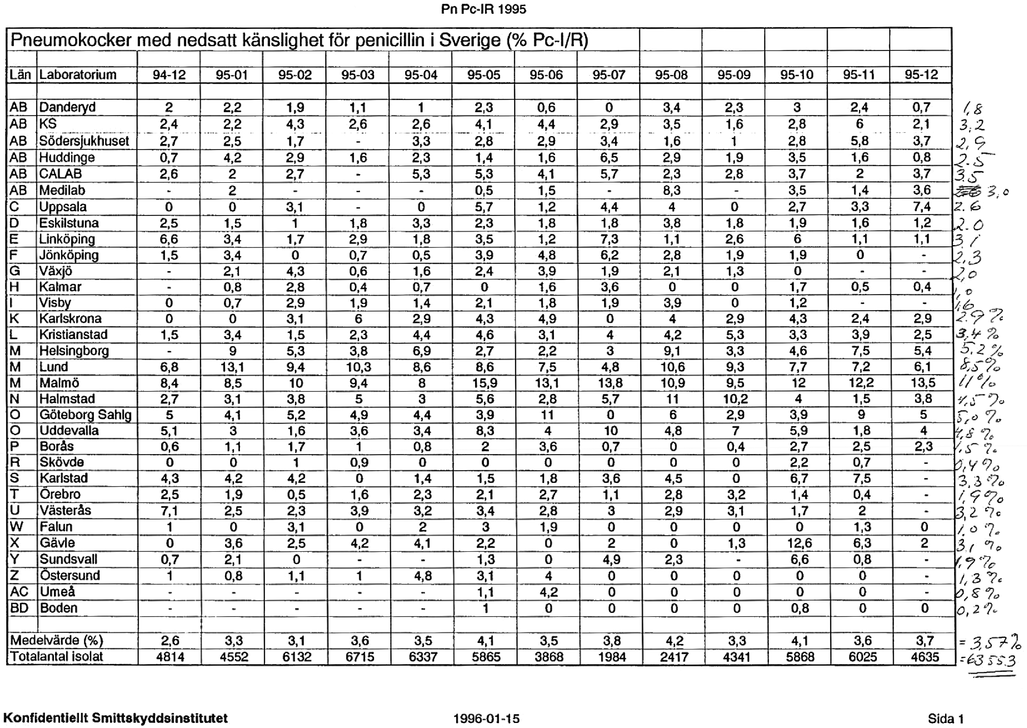
In December 1994 and January 1995, the pneumococci group examined the antibiotic-resistant pneumococci in Skåne using SRGA-M's system for national monitoring of resistance and its system of standardized measurements. This was the first time that comparable measurements of antibiotic-resistant pneumococci were collected from all of Sweden's microbiological laboratories. As a consequence, a national “map” of the resistant pneumococci was produced (Persson Reference Persson2005, 13; see fig. 1). The figures for Malmö in the south of Sweden were generally higher than those from the other county councils. Based on these measurements, the antibiotic-resistant pneumococci's ability to move between and connect sites was strengthened (cf. Latour Reference Latour1987; Bowker and Slota Reference Bowker, Slota, Felt, Fouché, Miller and Smith-Doerr2017; Law and Mol Reference Law and Mol2001). AMR was no longer a vague phenomenon, but a confirmed threat, evident in numbers. I argue that the results of the national surveillance further contributed to AMR's transformation into a public matter of concern: the numbers confirmed an outbreak of resistant pneumococci in Skåne and established the need to take action.
At Sweden's Annual General Meeting for Physicians in December 1994, infection specialist Otto Cars and general practitioner Sigvard Mölstad chaired a symposium where AMR was discussed as a public threat. Participants at the symposium, entitled “Do we need all new antibiotics?” (Programme, Riksstämman 1994) discussed how to organize more broadly to tackle AMR. The symposium included microbiologist Gunnar Kahlmeter (the chair of SRGA-M) and Peet Tüll at the National Board of Health and Welfare, as well as representatives from the Medical Products Agency [Läkemedelsverket].
Chart comparing numbers of Pneumococci with reduced sensitivity to penicillin (in percent) in laboratories in counties in Sweden. It shows that Pneumococci with reduced sensitivity to penicillin in Malmö is in general higher than in other counties.
In addition, Otto Cars established contact with the National Veterinary Institute. Long before coordinated work targeting AMR in relation to human antibiotic consumption existed, such work had already been established in relation to animal husbandry. In these circles, (over-)use of antibiotics and AMR were mainly discussed in terms of animal welfare and unnatural animal keeping (cf. Soller Reference Soller1971). Footnote 21 Connecting to veterinary medicine meant forming relations with well-established and institutionalized efforts to reduce antibiotic consumption by animals.
In January 1995, following conversations with Otto Cars, Bo Aronsson at the Medical Products Agency hosted a meeting described as the starting point of Strama. Aronsson invited representatives of several important organizations, who together decided that the network should be divided into two parts: a broad advisory group and local groups that would primarily reach out directly to prescribers of antibiotics, but also to the broader public. Strama members decided at an early stage that the organization should be independent of the pharmaceutical industry and counter-balance the pharmaceutical industry's information on antibiotics. Related goals were to encourage prescribers of antibiotics to strive for rational use of the drug and improve surveillance of antibiotic consumption and resistance. In this way, Strama members constituted AMR as an issue that excluded the corporations selling antibiotics from being a part of the public concernedFootnote 22 (cf. Marres Reference Marres, Latour and Weibel2005a, Reference Marres2005b, Asdal Reference Asdal2015). Although this move of cutting the pharmaceutical industry off from discussions of AMR was new, it connected to a long history in the Nordic countries of scepticism towards and extensive regulation of the pharmaceutical industry (Kveim Lie Reference Kveim2014; Hobæk and Kveim Lie, forthcoming). In summary, the outbreak of resistant pneumococci appears to have been a crucial motivator of Strama's first meeting. At this meeting, a broad set of actors mobilized around AMR as a matter of rational prescription of antibiotics. This meeting constituted AMR as a concern for doctors with different specialities and as a public threat in need of involvement from several government agencies.
1995: The Outbreak in Skåne Grows Together with Strama and AMR as a Matter of Public Concern
The resistant pneumococci in Skåne were a recurring topic on Strama's agenda during the organization's first few years. The minutes of the initial meetings indicate that the group discussed whether the outbreak was caused by the county's relatively large consumption of antibiotics. Some participants suggested that the outbreak might instead be linked to a specific clone of pneumococci whose spread was unrelated to antibiotic consumption.Footnote 23 Two other aspects of the outbreak were contested in Läkartidningen. These concerned the breaking points that were used to define the resistant pneumococci and the practice of suspending children afflicted by the bacterium from day-care centers (see Alestig et al. Reference Alestig, Borres, Ek and Fredlund1996). In the public discussion, however, it appeared to be certain both that the high consumption of antibiotics in Skåne was the cause of the outbreak and that the management of children who carried the bacterium were correct. In the public sphere, AMR's constitution seems to have become settled: AMR was a public threat caused by over-consumption of antibiotics and should be managed through disease control measures.Footnote 24
Parallel to the discussions of the penicillin-resistant pneumococci in Strama's meetings, the management of these bacteria continued in healthcare as well as in the news media. Thus, a picture emerges in which the resistant pneumococci in Skåne, Strama, and AMR as a public matter of concern grew together. The vast majority of patients afflicted by the resistant bacteria were small children, and the bacteria primarily caused ear inflammation that sometimes did not heal with penicillin and occasionally required the use of other antibiotics. Most patients, however, could be treated within primary care, which was contrary to the worst fears expressed in the early articles in Läkartidningen. Footnote 25 The official recommendation was that children should be tested for the bacterium if they had recurring ear inflammations or if initial treatment for their ear inflammation had failed (Ekdahl et al. Reference Ekdahl, Hansson, Mölstad, Söderström, Walder and Persson1998). Between March 1995 and March 1997, 66,500 cultures were obtained in Skåne (ibid.). This meant that many more cultures were performed than before the outbreak.Footnote 26 In all probability, this increase in the number of cultures increased the proportion of antibiotic-resistant pneumococci reported in the area compared with reports from other counties where healthcare providers were not actively searching for the bacteria.Footnote 27 Since the resistant bacteria were often identified in healthy carriers without clinical symptoms, active measures were required to identify the outbreak. In addition to clinical disease, intense testing and culturing, as well as statistical comparisons of data from other counties, made the epidemic come into being. Thus, the activity of the resistant pneumococci was created together and in a mutual process with the humans culturing it (cf. Latour Reference Latour1999, 138).
As stated above, the antibiotic-resistant pneumococci were discussed early on as a danger to the public, and it appears that the outbreak was hooked into an already established machinery of disease control. When resistant pneumococci were identified, contact tracing was performed. Preschool children carrying the bacterium were denied attendance at day care until two cultures had shown negative results (Ekdahl et al. Reference Ekdahl, Hansson, Mölstad, Söderström, Walder and Persson1998). In March 1995, it was reported that the County of Malmöhus (in Skåne) had formally classified the bacteria as a danger to society and a danger to public health [samhällsfarlig sjukdom] (Aftonbladet 8 March 1995). In 1996, the resistant pneumococci would be classified in this manner at the national level (Wilhelmsson Reference Wilhelmson1997a).
The newspapers continued to report on the “epidemic” and representatives from Strama continued to invite reporters to press conferences where Strama representatives provided information on the current situation concerning the resistant pneumococci as well as the consumption of antibiotics. The media kept referring to the resistant pneumococci as “the super bacterium” and describing it as “dangerous.”Footnote 28 In the newspaper reports, the local high consumption of antibiotics continued to be framed as the cause of the outbreak. For example, one article stated: “The doctors in Skåne are making children sick. By prescribing so much penicillin that it is no longer effective, they have caused nothing less than an epidemic” (Expressen 26 September 1995). These reports appear to have been working towards the same goal as Strama: to halt the increasing consumption of antibiotics.
To sum up, the outbreak of resistant pneumococci was crucial for the initial formation of Strama, and the organization continued to assemble to discuss this outbreak throughout its initial years. Through this outbreak, AMR took a specific form as an urgent public threat which was 1) of interest to the newspapers, 2) caused by human (over)consumption of antibiotics, 3) an issue of concern for all doctors who prescribed antibiotics, and 4) not sufficiently managed by existing institutions. In this manner, the outbreak created a “concerned and unsettled public” (Latour Reference Latour2007, 816; cf. Marres Reference Marres, Latour and Weibel2005a, 209). However, the outbreak was also crucial to AMR's transformation into another type of issue: one that was more or less settled and taken care of. This transformation required mobilizing the organization for disease control.
AMR as the Responsibility of Health Officers and as a Matter of Disease Control
Strama's initial goal was to encourage prescribers of antibiotics to strive for the “rational” use of antibiotics. To realize this goal, the organization needed a strategy for reaching out to the prescribers of antibiotics. Early on, Peet Tüll came up with the idea of using the existing organization of health officers who were responsible for disease control in the county councils. In 1995, there were 25 health officers in SwedenFootnote 29 – one in each county. The health officers were (and are still today) supposed to lead efforts to protect the people in their county from contagious diseases. They had (and have) the status of government agencies, which means they have the authority to carry out coercive measures. All health officers were organized in a network that met regularly to discuss common strategies and had established channels to doctors both in hospitals and in primary care.
Even though the actual organization of health officers was not established until 1989, disease control is tied to the long history of Swedish public health policy. However, before the development described here, health officers had no responsibility for AMR in general nor for promoting rational antibiotic prescription in particular. Traditional domains of disease control were instead epidemics, vaccinations, sudden outbreaks of diseases such as salmonella and hepatitis, and sexually transmitted diseases (cf. Lennholm Reference Lennholm1993).
Rolf Asterlund, then chair of the health officers’ organization, was invited to the very first Strama meeting. Asterlund took it upon himself to convince the health officers to become key actors in the county councils’ work against AMR.Footnote 30 In addition, Otto Cars and Peet Tüll attended a health officers’ meeting, as Cars told me, “to promote the idea of seeing AMR as a matter of national disease control.” [Interview with Otto Cars 31 October 2016]
Rolf Asterlund states that, initially, not all health officers were convinced that AMR was “their” issue. So to mobilize the health officers, Strama needed to convince them that work to combat AMR – and specifically to reduce antibiotic consumption – was in their interest and was also their responsibility (cf. Callon Reference Callon1984). This means that AMR had to be framed as a threat to the public and as a matter of disease control. As shown above, this is not how AMR had previously been understood; for decades it had been framed as a matter of concern only for microbiologists and infection specialists. The outbreak of antibiotic-resistant pneumococci had changed things. Health officer Hans Fredlund, who was engaged in Strama at an early stage, says, “The pneumococci in child-care centres were the first that, yes, that took hold of the health officers, so to speak.” Although some health officers initially hesitated to see AMR and rational prescribing of antibiotics as “their” concern, Asterlund, Cars, and Tüll all state that mobilizing the health officer organization was not particularly difficult. By May 1996, local Strama groups, most often with a health officer as a chair, had been established in 21 of Sweden's 24 counties.Footnote 31
Strama managed to mobilize Sweden's existing organization for disease control to spread its message about rational prescription of antibiotics as a way to prevent AMR. The outbreak of resistant pneumococci was crucial for this development. Both AMR and the outbreak were constituted as having been caused by high levels of antibiotic consumption in Skåne and as an urgent matter – a threat to everyone – that necessitated disease-control measures. The outbreak of resistant pneumococci was also crucial for the next transformation of AMR as a public issue: with the mobilization of the health officers and the continued development and establishment of Strama, AMR gradually became a matter that was settled and “taken care of” by an official machinery (cf. Latour Reference Latour2007).
Discussion: AMR as an Issue and Transformative Events
This article has examined how antimicrobial resistance (AMR) came to be constituted as a matter of public concern in Sweden in conjunction with the development of the organization Strama. In tracing the trajectory of AMR in Sweden, it is evident that an outbreak of antibiotic-resistant pneumococci in Skåne was crucial for both the formation of Strama and AMR's trajectory and constitution as a public issue. As a result of this outbreak, AMR was transformed from a dispersed phenomenon concerning a limited set of medical specialists into an urgent public threat which was eventually taken care of by the organization for disease control.
A number of components were essential for the developments described. Not only human actors, but also non-humans – for example specific bacteria – influenced how the development unfolded. In this sense, my findings confirm Landecker's argument that contemporary political rationalities of AMR, such as the Swedish approach to preventing AMR, are not only the products of certain knowledge regimes, but also the effects of interrelated biological and political change (Landecker Reference Landecker2016, 25). As a result of the outbreak, already-established infrastructures – including drug-retailing statistics, disease-control practices, efforts for standardized national monitoring of AMR, and a long history of medical experts warning about resistance – were brought together with other influential factors, including a bacterium with a lethal history, intense media coverage, and endangered children at day-care centers. This specific and complex assemblage of elements formed AMR's trajectory into Sweden's public sphere.
In 1994, the medical journal Läkartidningen reported the existence of penicillin-resistant pneumococci in the south of Sweden and tied these bacteria to the area's high levels of antibiotic consumption. Because pneumococci are potentially dangerous and spread outside hospitals in ordinary society, these antibiotic-resistant bacteria were framed as a threat to the public that required disease-control measures. After the reports in Läkartidningen, the resistant pneumococci became a subject for newspapers, which published dramatic accounts describing the bacteria as dangerous, in particular for children in day-care.
At this stage, the Swedish National Board of Health and Welfare became engaged in responding to the outbreak, and in connection with this, national standardized measurements of resistant pneumococci were produced for the first time in Sweden. Since these measures confirmed the outbreak, AMR's status as a concrete threat was also confirmed. As a result of these interrelated elements, the organization Strama took form. During the organization's first years, it continued to assemble around the outbreak of resistant pneumococci, and the outbreak enabled Strama to mobilize Sweden's health officers to promote the rational use of antibiotics among prescribers of antibiotics. Thus, as a consequence of this outbreak of penicillin-resistant pneumococci, the issue of AMR rapidly transformed and took a specific form. The outbreak made AMR emerge as an urgent public threat, caused by overconsumption of antibiotics and in need of disease control measures. Through it, AMR was constituted as a concern for all doctors who prescribe antibiotics, and promotion of rational prescription of antibiotics became the responsibility of the health officers, while the pharmaceutical industry was excluded from the issue.
I argue that the outbreak of resistant pneumococci can be conceptualized as a “transformative event” and that this concept can help make sense of the trajectories of issues. In this sense, this article can be understood as an answer to Marres's call for examinations of “events in which . . . issues get articulated as objects of potentially widespread concern” (Marres Reference Marres2005b, 134). As shown in relation to the outbreak of resistant pneumococci, transformative events are constituted in and through a number of elements and connections. They never exist in and by themselves, and they always involve uncertainties. Despite this, they can be analytically distinguished as separate occurrences. What defines transformative events is that they make issues and related risks concrete and urgent and for this reason have crucial influence over how an issue is constituted as a matter of public concern. A transformative event is an assembling and transformative force that accelerates and directs the process through which an issue becomes public. Accordingly, through the specific assemblage of actors involved in the event, a transformative event steers an issue's trajectory in a certain direction. In this way, it brings a specific public into being and accelerates an issue's development into a matter of public concern.
Transformative events enable infrastructures, actors, and practices already in place to connect in new ways. In the case described, many of these already established infrastructures were tied to the Swedish welfare state – for example, an extensive, publicly run healthcare organization based on non-commercial care, including well-equipped laboratories with well-educated personnel, monitoring of drug consumption, health authorities, and an organization for disease control with health officers and established channels to doctors in hospitals and primary care. The trajectory of AMR as a matter of public concern relied on all these already-existing infrastructures and so cannot be separated from the specific national context in which it emerged. Through the outbreak of the resistant pneumococci, these already-existing infrastructures were rapidly mobilized and re-connected, and in response they were able to change and form new relationships with one another.
To conclude, the outbreak of pneumococci was crucial for AMR's trajectory as an issue in two closely related but slightly different ways. First, AMR emerged as something urgent, as a public threat that was not sufficiently managed. The outbreak created intensity and uncertainty, and opened up AMR to public involvement (Latour Reference Latour2007; Marres Reference Marres, Latour and Weibel2005a, Reference Marres2005b, Reference Marres2007). This is especially evident in the news media's framing of the resistant pneumococci as a general public threat fueled by irresponsible doctors who had made the population sick instead of curing it. The outbreak was also crucial to a second transformation in the trajectory of the AMR issue, namely its development into a more or less settled, normalized problem that was being taken care of by an official machinery, in this case Swedish health officers’ organization. I argue that the transformative event was a key to AMR's current status in Sweden, where the rational prescription of antibiotics is a “part of the daily routine of administration and management” of AMR (Latour Reference Latour2007, 817).
Transformative events can transform issues into public matters of concern in different but related ways. They may contribute to the emergence of issues as urgent and insufficiently managed by existing institutions. But because they trigger transformations in which issues become public, they may also be crucial to an issue's settlement and normalization. The current study calls for further investigation of transformative events, including their forms and functions, to better understand the complex processes and various ways that phenomena enter the public and political spheres and transform the agendas within these spheres.



