INTRODUCTION
Praziquantel (PZQ) is the drug of choice against trematode and cestode infections, most notably schistosomiasis, a devastating parasitic disease affecting over 200 million people worldwide (Chitsulo et al. Reference Chitsulo, Loverde and Engels2004). The mechanism of action of PZQ is still unclear. It is known that exposure of schistosomes to the drug is associated with massive calcium influx, probably through L-type calcium channels (Kohn et al. Reference Kohn, Roberts-Misterly, Anderson, Khan and Greenberg2003); this indicates that ion channels may be the possible target, although binding of PZQ to calcium channel β subunits has not been demonstrated (Greenberg, Reference Greenberg2005). Alternatively, the target of PZQ might be any of the several factors that control intracellular calcium concentration (Redman et al. Reference Redman, Robertson, Fallon, Modha, Kusel, Doenhoff and Martin1996; Greenberg, Reference Greenberg2005). Since PZQ requires a relatively long time to kill the worms in vitro, it may also be responsible for a sustained metabolic imbalance (discussed by Cioli et al. Reference Cioli, Pica-Mattoccia and Archer1995); this would explain the histological damage induced by PZQ, whose origin is still unclear. Thus there is possibly more in the effect of PZQ than calcium influx per se can justify.
PZQ was initially developed (and subsequently discarded) in a search for anti-anxiety drugs, and its chemical structure bears some resemblance to benzodiazepines; conversely some of these drugs have anti-schistosomal activity (Bennett, Reference Bennett1980). Although the primary target of benzodiazepines is the GABA receptor (Rowlett et al. Reference Rowlett, Rowlett, Platt, Lelas, Atack and Dawson2005), these drugs also interfere with adenosine uptake or re-uptake (Swanson and Green, Reference Swanson and Green1986; Stone, Reference Stone1999; Listos et al. Reference Listos, Malec and Fidecka2005) and share some binding sites with adenosine (Seubert et al. Reference Seubert, Morey, Martynyuk, Cucchiara and Dennis2000). The benzodiazepines Ro 11-3128 and clonazepam induce in the worm anatomo-physiological effects similar to those of PZQ, albeit with some relevant differences in specificity (e.g. Ro 11-3128 is inactive against Schistosoma japonicum, but active against PZQ resistant juvenile forms of Schistosoma mansoni) (Bennett, Reference Bennett1980; Cioli et al. Reference Cioli, Pica-Mattoccia and Archer1995).
In addition, it is known that PZQ is active against trematodes (e.g schistosomes) and cestodes (e.g. Echinococcus multilocularis, Taenia saginata, etc.) (Cioli and Pica-Mattoccia, Reference Cioli and Pica Mattoccia2003) but not against nematodes (Jeziorsky and Greenberg, Reference Jeziorski and Greenberg2006). This is relevant because the former two lack the biochemical pathway for purine biosynthesis and thus depend on the host for their supply (Jaffe et al. Reference Jaffe, Meymarian and Doremus1971; Suchail et al. Reference Suchail, Sarciron and Petavy1998), while the latter (e.g. Metastrongylus apri, Angiostrongylus cantonensis) are fully equipped with the relevant machinery (Wong and Ko, Reference Wong and Ko1979; Wong and Yeung, Reference Wong and Yeung1981).
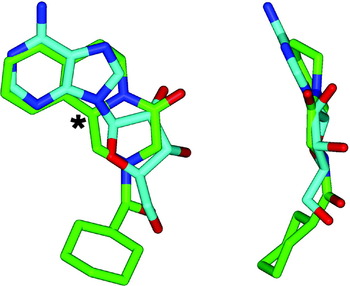
These considerations prompted us to investigate whether PZQ and Ro 11-3128 may be somehow related to adenosine uptake and/or signalling. Our results show that this is indeed the case since (i) a computer-aided superimposition of PZQ and adenosine demonstrates that the active levo-R(−) isomer of PZQ shares some important structural similarities with adenosine (Fig. 1), (ii) PZQ and Ro 11-3128 compete with the uptake of radioactively labelled nucleosides by schistosomes and (iii) the calcium antagonist nifedipine, that partially protects schistosomes from PZQ lethal effects (Pica-Mattoccia et al. Reference Pica-Mattoccia, Valle, Basso, Troiani, Vigorosi, Liberti, Festucci and Cioli2007), inhibits adenosine uptake.
Superimposition of adenosine and praziquantel. The 4-ringed molecule of R(−) PZQ (green) is overlapped with adenosine (light blue). Superimposition of the first 2 rings of PZQ with adenine causes the 2 carbonyls of PZQ to come in close proximity of the hydroxyls in C2′ and C5′of the ribose. The chiral carbon atom of PZQ is indicated by an asterisk.

MATERIALS AND METHODS
Parasites and hosts
A Puerto Rican strain of S. mansoni was used throughout this study. An albino strain of Biomphalaria glabrata served as the intermediate host, while CB6F1 hybrid mice were used for mammalian stages.
Drugs and chemicals
A pure preparation of racemic PZQ powder was the kind gift of Shin Poong Pharmaceutical Co., Korea (batch PRAZG 00029). Ro 11-3128 was the kind gift of Roche Co. The radioactive 3H-nucleosides or 35S-methionine were purchased from Amersham Biosciences, all other chemicals (nifedipine, adenosine agonists, etc.) were purchased from Sigma. All the chemicals were dissolved in DMSO and diluted to the desired final concentration in the culture medium.
In vitro cultures
Ten S. mansoni adult worms, obtained from single-sex male infections, were distributed in tissue-culture dishes (3·5 cm) in Dulbecco-modified Eagle's medium plus 20% newborn calf serum, 100 μg ml−1 streptomycin, 100 U ml−1 penicillin and 0·5 μg ml−1 amphotericin B. Worms were kept in culture at 37°C in an atmosphere of 5% CO2 in air and were observed daily for 7–10 days under a Leica MZ12.5 stereomicroscope. Cultures were exposed overnight to drugs and the next morning worms were washed thrice and transferred to new dishes with drug-free medium. Every 2 days medium was changed. At the end of the observation period, worms were defined as ‘dead’ if they remained contracted, acquired an opaque appearance and did not resume movements.
3H-nucleoside/35S-methionine uptake determination
S. mansoni adult worms kept in culture were incubated with different drugs in the presence of 1 μCi/ml of either 3H-adenosine or 3H-uridine. Duplicate or triplicate specimens of 5–8 adult male worms were collected at various time-intervals after addition of drugs, washed thrice with cold saline, sonicated and tested for radioactivity, to follow the time-course of uptake.
35S-methionine was employed as a control, to obtain indication of the overall impairment of nutrient uptake due to the toxic effect of the drugs.
RESULTS
PZQ and benzodiazepines inhibit nucleoside uptake in S. mansoni
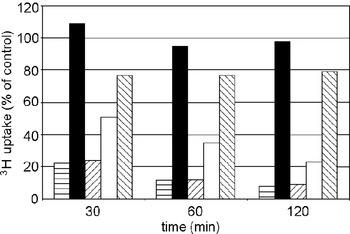
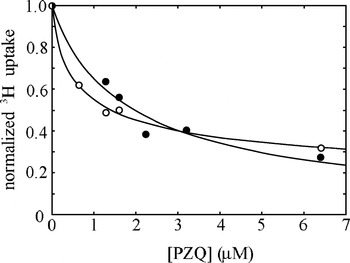
The observation of an overall structural similarity between PZQ and adenosine, as shown in Fig. 1, prompted us to test whether the drug would interfere with adenosine uptake. The results of our measurements are listed in Table 1. In living schistosomes, PZQ specifically inhibited the uptake of nucleosides to a much greater extent than the uptake of methionine used to quantitate the non-specific consequences to PZQ exposure. Inhibition of nucleoside uptake was observed also at lower concentrations than the LC50 (corresponding to 2·4 μm for the racemic PZQ mixture in vitro, see Pica-Mattoccia and Cioli, Reference Pica-Mattoccia and Cioli2004), and is specific to schistosomes, since it is not observed in murine myoblasts, which actively uptake adenosine (see Table 1). The inhibition of adenosine uptake after exposure of schistosomes to PZQ as a function of incubation time is reported in Fig. 2. An effect was already detectable at the earliest incubation time tested (2 min, not shown). The IC50 for the inhibition of adenosine uptake by PZQ, after 30 min incubation, was 1·5 μm (with a standard deviation of 0·7 μm); the difference between this value and the LC50 of PZQ was not statistically significant. The IC50 for the inhibition of uridine uptake was 0·9 μm (with a standard deviation of 0·5 μm) (see Fig. 3). The considerable standard deviation of the IC50 values likely reflects some of the uncontrolled parameters of the system in the repeated determinations (worm heterogeneity, worm age, time in culture), and is much greater than the error intrinsic to the measurement. It was not possible to measure the PZQ IC50 for methionine uptake since the effect was small or absent at sublethal doses and poorly correlated with incubation time and concentration in the lethal range.
Time-course of uptake of 3H adenosine in PZQ-treated Schistosoma mansoni. The values are reported as percentage incorporation of radioactivity by untreated control worms. Incubation of the worms with the different chemicals was as follows: [ ]: 3H adenosine plus 3·20 μm levo PZQ; [■]: 3H adenosine plus 3·20 μm dextro PZQ; []: 3H adenosine plus 3·20 μm destro PZQ plus 3·20 μm levo PZQ; [□]: 3H adenosine plus 1·60 μm of commercial (racemic) PZQ; []: 35S methionine plus 6·40 μm of commercial (racemic) PZQ. Other conditions as given in Table 1.

Dose-response curve for the effect of PZQ on the uptake of adenosine and uridine by Schistosoma mansoni worms. The experimental points for adenosine (closed circles) and uridine (open circles) were obtained as described in the Materials and Methods section. Continuous lines were drawn according to the Hill equation for the binding of small ligands to macromolecules: Y=1−[Imax [PZQ]n/(K+[PZQ]n)], where Y is the calculated fraction of uptake, and the fitted parameters are: Imax, the maximal estimated effect of the drug; K, the overall apparent dissociation constant of the drug target(s); and n, the apparent positive or negative cooperativity of the process. The Hill coefficients obtained were lower than unity (i.e. n=0·9 for adenosine and n=0·7 for uridine), suggesting heterogeneity of the nucleoside binding sites. This finding may reflect both the presence of multiple nucleoside transporters in each single worm and/or the genetic variability among different worms.

Effect of (racemic) PZQ and Ro 11-3128 on the uptake by schistosomes of radioactive adenosine, uridine and methionine, after 30′ incubation
(Cpm data for the incorporation of selected radioactive metabolites by control and PZQ-treated worms or mammalian cells, expressed as percentage of the control +/− 1 standard deviation. The LC50 of PZQ for schistosomes in vitro is about 2·4 μm. The differences between controls and the values indicated with an asterisk are significant to P<0·005 (t-test on the means). The total number of separate determinations for each experimental condition is given in parentheses. Each determination was carried out on a sample of 5–8 male adult worms and the counts normalized for the number of worms.)

Two additional experiments were carried out to further demonstrate the specificity of the effects reported in Table 1. Incubation of the schistosomes with very low doses of the drug (0·64 μm) had a measurable effect, i.e. it decreased the uptake of adenosine and uridine to approximately 75% of the control after incubation for 2 min. However, after longer times, the uptake of the nucleosides was restored to control levels, possibly indicating that compensatory mechanisms were activated by the schistosome. The effect on adenosine and uridine uptake at 0·64 μm PZQ is significant to P<0·005, in spite of the marginal schistomicidal effect at this dosage. At the same low concentration of PZQ, again no effect was observed on methionine uptake, independent of incubation time.
Commercially available PZQ is a 50:50 racemic mixture of the levo(−), R and dextro(+), S enantiomers. Since only the former is schistomicidal (Gonnert and Andrews, Reference Gonnert and Andrews1977), we tested the effect of each purified enantiomer on the uptake of adenosine. Data show that only the active levo isomer is capable of inhibiting adenosine uptake, while the effect on methionine uptake is again marginal (Fig. 2). The IC50 for nucleoside uptake of the active isomer corresponds within the experimental error to half the values for the PZQ racemic mixture, whereas the IC50 of the inactive dextro isomer are too high to be reliably determined.
Some benzodiazepines possess anti-schistosomal activity, and indeed PZQ was developed in a search for benzodiazepine-like anti-anxiety drugs; moreover in mammalian cells, benzodiazepines compete with adenosine uptake (Swanson and Green, Reference Swanson and Green1986; Schaufele et al. Reference Schaufele, Schumacher, Acevedo and Contreras1995; Stone, Reference Stone1999; Seubert et al. Reference Seubert, Morey, Martynyuk, Cucchiara and Dennis2000; Listos et al. Reference Listos, Malec and Fidecka2005). Thus, we were interested in determining whether benzodiazepines having anti-schistosomal activity also interfere with nucleoside uptake by schistosomes. The experiments carried out with the schistomicidal benzodiazepine Ro 11-3128 and reported in Table 1 confirm that this drug selectively inhibits the uptake of adenosine and uridine, with the same IC of 14 μm (standard deviation 5 μm, measured after 30 min treatment), which is almost half its LC50 (25 μm, Pica-Mattoccia et al. unpublished observations).
Although we cannot provide a simple explanation for the inhibition of uridine uptake by PZQ, given that the two molecules do not share obvious structural similarities, we remark that S. mansoni possesses at least five different transporters for nucleosides, with different specificities (Levy and Read, Reference Levy and Read1975). At least one of these has no specificity for purine or pyrimidine nucleosides, and thus its inhibition by PZQ would depress the uptake of both adenosine and uridine.
Effects of selective and non-selective adenosine receptor agonists and nifedipine
Adenosine is necessary as a precursor of nucleotides and nucleic acids and as well as a neuro-modulator (Stone, Reference Stone1999). Since in some vertebrate tissues adenosine receptors are among the modulators of L-type calcium channels (Zapata et al. Reference Zapata, Navarro, Canela, Franco, Lluis and Mallol1997; Ralevic and Burnstock, Reference Ralevic and Burnstock1998; Oliveira et al. Reference Oliveira, Timoteo and Correia-de-Sa2004), the putative target of PZQ in schistosomes (Kohn et al. Reference Kohn, Roberts-Misterly, Anderson, Khan and Greenberg2003), it seemed worthwhile to assess whether the worm possesses adenosine receptors and whether their blockade interferes with adenosine uptake. Selective agonists of adenosine receptors (Jacobson and Gao, Reference Jacobson and Gao2006) were used in 2 different experiments. They were tested alone or in combination to assess their toxicity and ability to inhibit the uptake of radio-isotope labelled adenosine in intact adult worms; moreover they were tested in combination with a lethal dose (3·2 μm) of PZQ to assess their possible protective activity.
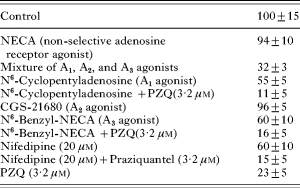
The selective agonists of A1 and A3 adenosine receptors inhibited the uptake of adenosine to approximately 50% (see the data in Table 2); on the other hand the non-specific agonist NECA and the selective A2 agonist CGS 21680 had no effect. In vitro experiments showed that worms were not killed nor observably harmed when exposed to adenosine receptor agonists at a concentration of 50 μm, the latter being very high compared to the affinity for this class of receptors (Ralevic and Burnstock, Reference Ralevic and Burnstock1998). Since the classification of adenosine receptors by selective agonists is available for mammalian cells (Ralevic and Burnstock, Reference Ralevic and Burnstock1998; Jacobson and Gao, Reference Jacobson and Gao2006), our results are compatible with the hypothesis that S. mansoni has A1- and A3-type adenosine receptors, but do not exclude other possibilities, i.e. that schistosomes have only one receptor with broader specificity, and perhaps other receptors that are poorly or not at all recognized by the agonists employed in the test. Actually, the latter hypothesis is consistent with the observation that upon incubation with the mixture of all agonists, adenosine uptake was still significant (to approximately 30% of the untreated controls; Table 2).
Since PZQ and A1 and A3 adenosine receptor agonists interfere with adenosine uptake, an obvious possibility is that they share at least some binding sites and may thus compete or act synergistically. The effects of PZQ and adenosine agonists on the uptake of adenosine were additive (Table 2), at least in the concentration range explored. A more interesting issue is whether adenosine and its agonists protect the worm from the toxicity of PZQ. However, no protection against PZQ was afforded by adenosine nor by its agonists, whose presence in the culture medium did not change the LC50 of the drug.
Effect on adenosine uptake of adenosine receptor agonists (all at 50 μm) and nifedipine (20 μm) after treatment of Schistosoma mansoni worms for 1 h
(Data are given as percentage uptake relative to control, as obtained from 6 or 9 independent determinations. Each determination was carried out on a specimen of 5 male adult worms and the counts normalized for the number of worms. Competition of adenosine agonists and nifedipine against PZQ was assessed after incubation of schistosomes for 1 h with the relative agonist or nifedipine, prior to incubation (1 h) with 3H-adenosine and PZQ.)
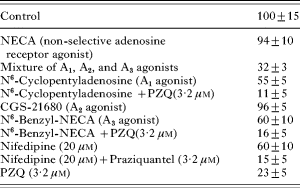
Since PZQ causes a massive calcium influx in schistosomes, a relevant question is whether calcium antagonists do offer some protection. In a recent paper Pica-Mattoccia et al. (Reference Pica-Mattoccia, Valle, Basso, Troiani, Vigorosi, Liberti, Festucci and Cioli2007) addressed this issue and found that nifedipine and nicardipine partially protected the worms from PZQ whereas other calcium channel antagonists (Bepidril, verapamil, methoxy-verapamil and dilthiazem) did not. A literature search revealed that nifedipine and nicardipine, but not the other drugs tested, interfere with adenosine receptors (Swanson and Green, Reference Swanson and Green1986; Hu et al. Reference Hu, Lindgren, Jacobson and Fredholm1987; Van Rhee et al. Reference Van Rhee, Jiang, Melman, Olah, Stiles and Jacobson1996). Thus the ability to interact with both calcium and adenosine signalling seems to be the key property of calcium antagonists that protect schistosomes from PZQ. It is also worth noting that adenosine receptor antagonists were developed by modifying the 1,4-dihydropyridine structure of nifedipine and nicardipine (Van Rhee et al. Reference Van Rhee, Jiang, Melman, Olah, Stiles and Jacobson1996). We tested nifedipine for its ability to inhibit adenosine uptake in schistosomes, and found that it was active to the same extent as the agonists of mammalian adenosine receptors (and at lower dose, see Table 2).
DISCUSSION
Schistosomiasis affects over 200 million people worldwide and, due to its pathological consequences, is ranked second only to malaria among parasitic diseases (Chitsulo et al. Reference Chitsulo, Loverde and Engels2004). The only drug of common usage to treat the disease is PZQ, whose action is most likely linked to calcium signalling. Our data conclusively demonstrate that PZQ, Ro 11-3128 and nifedipine, like selective agonists of adenosine receptors A1 and A3, inhibit adenosine uptake. We therefore assign to PZQ a previously unrecognized, potentially relevant effect given that, besides causing calcium influx, it inhibits adenosine uptake. These two effects are the only ones known to occur immediately after exposure to the drug (i.e. within 2–5 min.). The direct demonstration that PZQ interferes with the uptake of adenosine, a molecule that schistosomes cannot synthesize, has potential pharmacological implications. Indeed this may suggest useful chemical modifications to improve the drug's efficacy and/or to overcome resistance, a problem that may arise in the near future since some schistosome strains displaying higher PZQ LD50 have been identified (Cioli and Pica-Mattoccia, Reference Cioli and Pica Mattoccia2003).
At present the actual mechanism of the schistomicidal effects of PZQ is still incompletely understood (Jeziorski and Greenberg, Reference Jeziorski and Greenberg2006). The strong spastic paralysis induced by PZQ may detach the parasite from the vessel walls and facilitate its destruction inside the bloodstream of its definitive host, but it may not be the major or exclusive cause of death in vitro, since the worms fully recover from paralysis and survive if the treatment lasts for just a few hours instead of the standard overnight period. What is the relevance of adenosine uptake inhibition? Even though we do not have a conclusive answer, two points may be raised, i.e. the metabolic imbalance and the possible relationship between adenosine receptors and calcium channels. The first point is more straightforward: schistosomes utilize nucleosides from their host and inhibition of the uptake of these essential metabolites is likely to impair their survival.
The relationship between adenosine signalling and calcium is plausible, but hypothetical. It rests on two assumptions, i.e. that the inhibition of adenosine uptake may indicate competition also at the level of adenosine receptors, and that the information available for adenosine receptors in mammals can be extended to schistosomes (where it is unavailable). Indeed, in some vertebrate tissues activated adenosine receptors act as calcium channel blockers (Zapata et al. Reference Zapata, Navarro, Canela, Franco, Lluis and Mallol1997; Ralevic and Burnstock, Reference Ralevic and Burnstock1998), and in Taenia (a PZQ-sensitive parasite) stimulation of an extracellular P1-purino receptor by adenosine increases an internal store of calcium, which contributes to the relaxation of the worm (Frischknecht and Ferrero, Reference Frischknecht and Ferrero1985). It has been suggested that the effect of PZQ on the calcium currents of the schistosome may be indirect and mediated by the binding of the drug to a receptor that controls the channels (Greenberg, Reference Greenberg2005). This observation offers indirect support to the hypothesis that the two effects of PZQ on the worm are correlated. Further indications for a relationship between adenosine receptors and PZQ come from studies on the effects of caffeine (an adenosine analogue; Jacobson and Gao, Reference Jacobson and Gao2006) and PZQ on the muscular tissue from Lymnaea stagnalis (Gardner and Brezden, Reference Gardner and Brezden1984). We may therefore suggest, as a working hypothesis, that in the schistosome adenosine might be a calcium channel blocker (as in mammals) and that PZQ might be an adenosine antagonist. This hypothesis suggests that adenosine agonists should offer some protection against PZQ, but this seems not to be the case, perhaps because the affinity of adenosine (and its agonists) for the receptors is too low to displace PZQ.
The puzzling observation that schistosomicidal benzodiazepines cause in the worms symptoms similar to those induced by PZQ is consistent with the above hypothesis, since these drugs are known to interfere with adenosine signalling in mammalian cells. Indeed these drugs compete with adenosine for some binding sites or receptors (Seubert et al. Reference Seubert, Morey, Martynyuk, Cucchiara and Dennis2000; Listos et al. Reference Listos, Malec and Fidecka2005), most notably in the smooth muscle, where they interfere with calcium channels (Schaufele et al. Reference Schaufele, Schumacher, Acevedo and Contreras1995).
Nifedipine offers further information in support of our hypothesis, since this calcium antagonist is able to inhibit adenosine uptake by schistosomes, almost as effectively as the agonists of mammalian purino receptors and partially protects the parasite from PZQ (Pica-Mattoccia et al. Reference Pica-Mattoccia, Valle, Basso, Troiani, Vigorosi, Liberti, Festucci and Cioli2007). A relationship between nifedipine and adenosine exists also in mammals: the drug seems to exert part of its clinical effects through a direct interaction with adenosine receptors and displaces the adenosine receptor ligands N-6 cyclohexyladenosine and 1,3- diethyl 8-phenylxanthine from brain membranes (Swanson and Green, Reference Swanson and Green1986).
In conclusion, the results presented above indicate unequivocally that PZQ inhibits adenosine and uridine uptake in adult schistosomes, a hitherto unknown effect of this drug. Moreover, our data suggest, but do not demonstrate, that the effect of PZQ on calcium influx may involve the activation of purine receptors. All the experiments carried out to ascertain whether inhibition of adenosine uptake precedes or follows calcium influx (low concentration of the drug, short incubation time) gave no definitive answer: the two effects always occurred together (as judged by the contraction of the worms' musculature, and the incorporation of radioactivity). To date, inhibition of adenosine uptake is the only effect occurring in the same time range as calcium influx, and at the same drug dosage; moreover it is observed already at sublethal concentrations and only with the active stereoisomer of PZQ. Further work is required to test this hypothesis.
The authors gratefully acknowledge the valuable advice given by Professor D. Cioli, Professor P. Liberti and Dr. V. Morea, and the assistance of Drs A. E. Miele and L. J. Gourlay. This work was supported by the Progetto di Ateneo (University of Rome “Sapienza” to M. B.), the Consorzio Interuniversitario Biotecnologie (CIB, Urbino, Italy); the Italian Ministry of Research and University, FIRB 2003 ‘Biologia Strutturale post-Genomica: sviluppo di infrastrutture per la cristallografia di proteine’ and FIRB 2001 ‘Basi molecolari della farmaco resistenza al Praziquantel’; and the Fondazione Ivo De Carneri.