INTRODUCTION
A business is not defined by its name, statutes or articles of incorporation. It is defined by the business mission. Only a clear definition of the mission and purpose of the organization makes possible clear and realistic business objectives.
Peter Drucker (Reference Drucker1973).
Mission statements have traditionally been defined as a written declaration that communicates the purpose of an organisation (Bart & Hupfer, Reference Bart, Bontis and Taggar2004; Macedo, Pinho, & Silva, Reference Macedo, Pinho and Silva2016). According to the annual report of Bain & Co. (Rigby & Bilodeau, Reference Rigby and Bilodeau2015), the mission statement is one of the most widely used managerial tools worldwide. It became popular in the early 1980s, and since then it has received considerable attention from managers and academics. In the last decades, different interrogates have been addressed in the literature concerning mission statements: What is a mission statement? Is there any advantage for organisations to explicitly define their company’s mission statement? Is the mission statement really a useful managerial tool? Do managers actually refer to the mission statement and use it as a guidance for their strategic decisions? What components should a mission statement include, and which ones should it not? In this article, we examine this 35-year-long body of research on mission statements. The ultimate goal is to provide a comprehensive view of published academic research on mission statements and based on this, put forward directions for future research on this field.
Using a systematic review process, we identified 53 academic articles that specifically deal with mission statements. The main themes can be grouped into four categories: (i) mission statement development, (ii) mission statement components, (iii) mission impact on employees, and (iv) mission impact on organisational performance. We describe in detail each of these groups and identify research gaps and avenues for future research. Surprisingly, although the mission statement is one of the most commonly used managerial tools, and despite more than 30 years of research, studies in the area of mission statements have a predominant practical orientation and very limited theoretical development.
RESEARCH METHODS
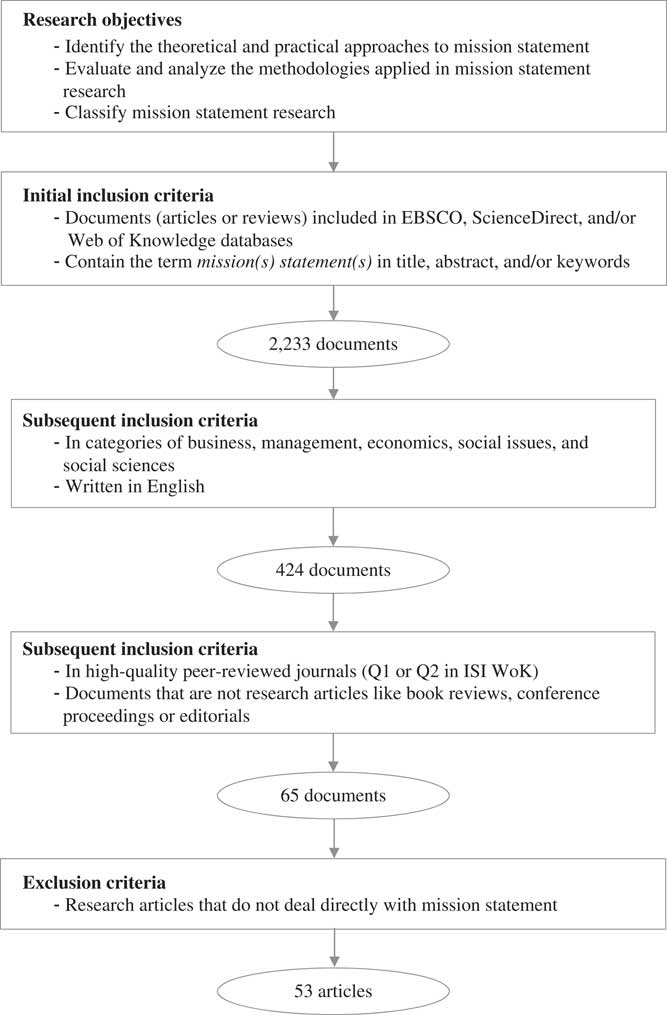
Following the systematic literature review process suggested by Tranfield, Denyer, and Smart (Reference Tranfield, Denyer and Smart2003), we began by defining the research objectives. In our case the objective was to do a thorough review of all aspects concerning mission statements. To that end, we searched for all articles containing the specific term mission statement and mission statements in three databases: EBSCO, ScienceDirect, and ISI Web of Knowledge. We believe these databases contain most relevant publications in the area of business and management. As depicted in Figure 1, we first searched for any document in the aforementioned databases that contained the term mission/s statement/s in the abstract, the title, or the keywords. This search returned 2,233 documents.
Summary of the systematic literature review search
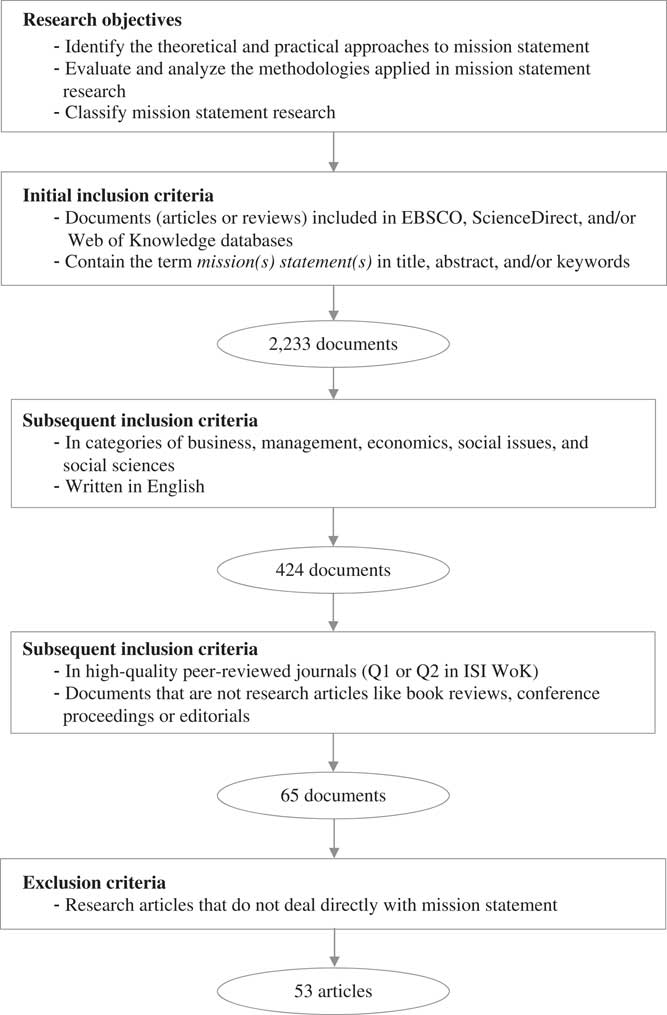
We then restricted the search to documents written in English in the areas of management, business, economics, social issues, and the social sciences. After these restrictions, we were left with 424 documents. Then, we narrowed the search to high-quality peer-reviewed journals. To decide on the quality of the journals, we used as a guide the Journal Citation Report (JCR) index as reported in the ISI Web of Knowledge. The JCR is computed annually by the Web of Knowledge based on several indicators of journal citations. Ordered by JCR index, journals can be ranked and divided into quartiles. Journals in the first quartile (Q1) are the 25% of total journals in that category with a higher JCR index and are therefore considered more prestigious and with a better reputation and quality in the journal category. In general, high-quality journals according to the JCR index coincide with those with a rating of 3, 4, or 4* in the ABS ranking and/or the first or second quartile in the Scimago ranking. To focus on high-quality journals, we decided to restrict the search to high-quality journals in either the Q1 or Q2 JCR index. Following that rule, we moved from 424 documents to 65. We then reviewed each article one by one to check whether they really addressed mission statement, and we discarded those that did not directly deal with the mission statement but just mention the term for other reasons. In that way, we were left with 53 research articles from high-quality journals in the areas of management, business, economics, social issues, and the social sciences that were written in English and that deal specifically with mission statement.
We did not put any restriction on the search in terms of time period. This was done on purpose to identify all articles since the topic originated. The first article we found was from 1984, and, as the search was done in December 2015, the last article was from 2014.
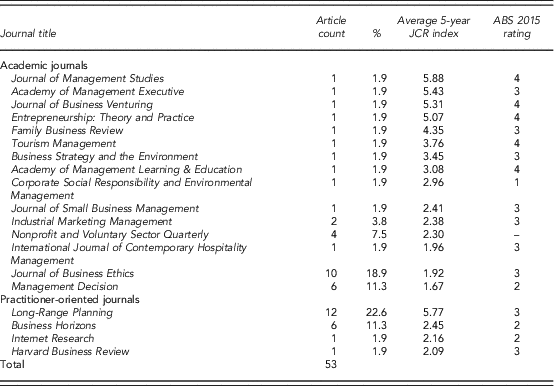
The 53 articles were published in 19 journals from a variety of management disciplines, including entrepreneurship, like Journal of Business Venturing or Entrepreneurship: Theory and Practice; social issues and nonprofit, such as Nonprofit and Voluntary Sector Quarterly; and general management journals, like Management Decision or Journal of Management Studies. Table 1 offers a comprehensive list of all journals, the number of articles in each of them, and their respective ranking in both the JCR and ABS ratings.
List of journals of the literature review, journal ranking, and articles per journal

STATUS OF MISSION STATEMENT RESEARCH
The systematic review of the literature on mission statements highlights several interesting facts. First, interest in mission statements was initiated in the practitioner world rather than in academia; most publications in the initial years (1984–1999) are from practitioner-oriented journals such Harvard Business Review or Long Range Planning, which constitute 37% of the total sample of articles and 70% of the articles published before 1999. Progressively, research moved from being published in practitioner journals to being published in regular research-oriented academic journals. However, although the mission statement is one of the most widespread strategic tools, academic research on mission statements has not been largely published in top general management and strategy journals but has been confined mainly to the field of ethics, corporate social responsibility, and nonprofits. In total, 45% of the articles published after 1999 have been published in the ethics domain.
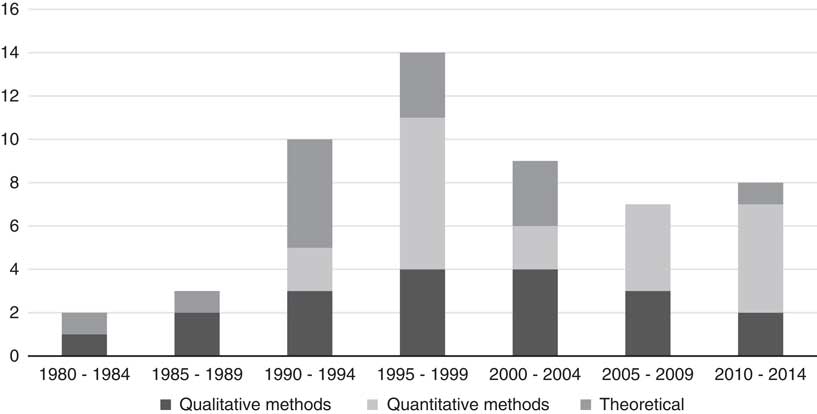
Second, quantitative research is scarce. Most published articles are case-based or purely descriptive as depicted in Figure 2. Of the 53 articles analysed, 13 are conceptual articles that define the concept or discuss advantages and disadvantages without any empirical analysis. In all, 12 articles are case-based, whereas five contain only some descriptive statistics. A significant proportion of works, 10 out of 53, analyse the content of the mission statement, identifying the most common terms and other patterns in a collection of mission statements from different types of organisations. The remaining studies reviewed use surveys (four articles), structural equation modelling (one articles), or regression analysis (seven articles).
Number of publications per year and research method used

Finally, research on mission statements has a clear US focus, with 13 articles in which the empirical setting is US based, three articles based on European firms, and three based on Asian firms (Taiwan and Japan). The rest of the articles do not specify the location of the setting; do not have any particular setting, like conceptual articles; or are based elsewhere, like one study from New Zealand.
CONTENT
After carefully reading and labelling all articles with information about author, title, publication year, journal, journal’s ranking, research method employed, and research setting; the question that arises is which is the best way to synthesise and classify this body of research. Several options are valid. One potential classification could be to follow a chronological path and explain in an ordered way the evolution of the mission statement literature. Mission statement popularity emerged as a consequence of the planning school and decayed when other alternatives for strategy formulation gained popularity over the traditional planning school of management (e.g., Inkpen & Choudhury, Reference Inkpen and Choudhury1995). Another option was to classify the selected articles by research setting and draw conclusions for each of the different types of organisations under study such as nonprofits, for-profits or education centres. We discarded this option as many of the conclusions drawn for a certain type of organisation are also applicable in other settings. We finally decided to classify the articles in groups depending on their main focus.
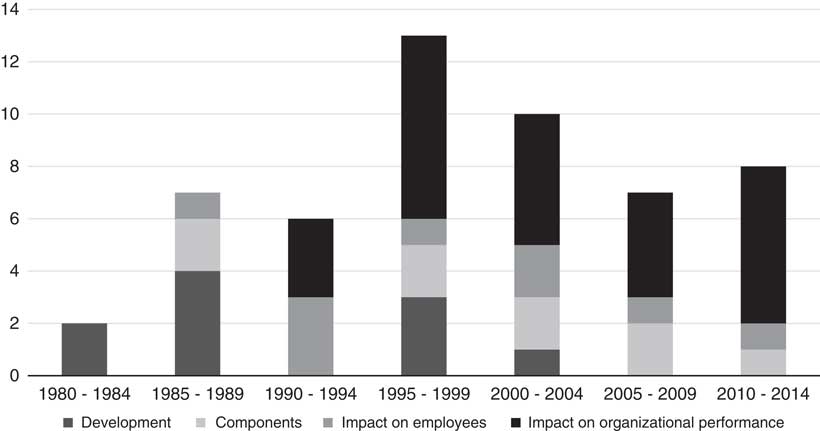
After carefully reading all articles, each author proposed a set of themes in which to classify them. A consensus was finally reached identifying four main themes covering different aspects of mission statement research and approximately fitting into a certain time frame. As such, we distinguish: (i) a group of articles concerning mission statement development, that is, the definition, creation, and implementation of a mission statement. Those works were mostly written in the 1980s and early 1990s, when the concept of mission statement first appeared. These articles discuss the concept of mission statement, their role and their potential benefits for those companies that implement it. At that time, only few companies had created a mission statement, and most researchers tried to answer the question: how is a mission statement formulated? What stakeholders should be involved in the mission formulation? Which process should be followed to successfully formulate a mission statement? What should be the process to spread the mission throughout the organisation? (ii) A second group of studies takes an observational approach and uses mainly content analysis to identify the words more frequently cited in organisational mission statements and draw conclusions based on that. Which is the best way to define and write an effective mission statement? Which stakeholders are cited in the mission statements? Is the mission statement more internally focussed, mentioning employees, for example, or more externally focussed, mentioning customer satisfaction? (iii and iv). The third and fourth groups both explore the impact of the mission statement on organisational outcomes. There is an important differentiation though, as some studies focus on the impact of the mission statement on employees and employees’ behaviour and ethics (group iii), whereas other studies concentrate on the impact that having a mission statement has on organisational performance (group iv). Thus, the third group answers questions such as if the mission statement is really a guidance for strategy formulation. Is the mission useful, after all? Those articles mainly focus on internal organisational elements like the effect of the mission to strengthen organisational culture, improve relations among the different stakeholders, or enhance ethical behaviour. Finally, the fourth group tries to answer a similar question, that of the usefulness of the mission, from an external perspective. Do companies that have a clear mission statement perform better? Do companies with mission statements have better results than those that do not have a stated mission? A graphical representation of the number of publications per theme over time is represented in Figure 3.
Number of publications per theme, over time

Mission statement development
It was not until the early 1980s that academics, managers, and consultants recognised the need of explicitly formulating a mission statement in organisations. At the zenith of the planning school, Lundberg (Reference Lundberg1984) acknowledges that although ‘everyone agrees that they are necessary, mission statements do not even exist in many organisations and are inadequate in others’. Responding to that call, a group of researchers in the 1980s and early 1990s published several articles dedicated to how to formulate a good mission statement. At that time, the common approach to mission statement formulation was for top management to delegate the initial drafting to their subordinates and then review subsequent drafts until the CEO was satisfied. This method was time-consuming and did not provide the involvement necessary to permeate the mission throughout the organisation and obtain the benefits a good mission statement promised, such as enhanced motivation, improved organisational climate, and organisational alignment. Lundberg (Reference Lundberg1984) proposes a technique called zero-in, in which all managers responsible for major functions and activities of the organisation are involved in a series of meetings and planned activities with the objective of formulating a shared organisational mission statement. Along the same line, Medley (Reference Medley1992) describes the process by which a new mission statement was developed in World Wide Fund for Nature in the United Kingdom. The organisation had some difficulties after a rapid expansion, and the exercise of formulating a clear mission statement helped clarify roles and functions at the management level and lead to a decrease in tensions and an increase in internal organisation and effectiveness. Davies and Glaister (Reference Davies and Glaister1997) studied mission statements in business schools in the period 1987–1993 and claimed that most mission statements are designed top-down and do not have much involvement from the different organisational stakeholders.
Overall, articles in this early group stress the importance of having a clearly stated mission statement that has been created with the involvement of different stakeholders so that it reflects the real organisational mission, not only the view of the CEO, which in some cases might not be comprehensive. These articles are written in the 1980s and 1990s, just before Mintzberg’s critique of the planning and the design schools of management in 1989. The planning school of thought lead by Ansoff (Reference Ansoff1965) suggests companies to have a written plan that helps guide its decisions. Ansoff’s work was highly influential (Moussetis, Reference Moussetis2011) in all management areas, including research on mission statement. The main critique of this group of articles is precisely its strong reliance on the mission statement as nearly the only tool to summarise the goal of the organisation. Nowadays, but also then, mission statements are only one way to convey organisational objectives. In addition, mission statements might be too static in today’s dynamic environment. This problem is noticed by more recent researchers such as Koch, Galaskiewicz, and Pierson (Reference Koch, Galaskiewicz and Pierson2015) that precisely say that mission statements should evolve over time to adapt to environmental and company changes.
Mission statement components
In order to help companies define a proper mission statement and guide them in its development, researchers considered appropriate to study which components a mission statement should include. The seminal work of Pearce and David published in the Academy of Management Executive in 1987 proposes the first classification of the key components of mission statements, which they divide into eight categories: (1) the specification of target customers and markets; (2) the identification of principal products and services; (3) the specification of the geographic domain; (4) the identification of the core technologies; (5) the expression of commitment to survival, growth, and profitability; (6) the specification of key elements in the company philosophy; (7) the identification of the company self-concept; and (8) the identification of the firm’s desired public image. In the same vein, David (Reference David1989) performed a content analysis of 75 manufacturing and service firms to provide some guidelines in developing useful mission statements. In addition to the eight components of Pearce and David (Reference Pearce and David1987), he proposes a ninth component related to (9) concern for the employees. One of the main conclusions of their studies is that higher performing firms have comparatively more comprehensive mission statements.
O’Gorman and Doran (Reference O’Gorman and Doran1999) used Irish small and medium enterprises (SMEs) to replicate Pearce and David’s (Reference Pearce and David1987) landmark study of mission statements’ components in large organisations. The analysis of 64 mission statements suggested that firms emphasise ‘concern for survival (77%)’, their ‘product or service (72%)’, and their ‘concern for the customer (64%). They show that high-growth SMEs do not have more comprehensive mission statements than low-growth SMEs.
Bart (Reference Bart1997a), a leading researcher in this field, examines the specific content characteristics of mission statements in industrial firms. He involved a sample of CEOs and presidents from 44 industrial corporations, identifying 25 components but only 11 being used to a high degree: (1) organisational purpose or raison d’être; (2) statement of values/beliefs/philosophy; (3) distinctive competence/strength of the organisation; (4) desired competitive position; (5) relevant/critical stakeholders identified; (6) statement of general corporate aims/goals; (7) one clear and compelling goal; (8) specific customers/markets served; (9) concern for employees; (10) concern for shareholders; and (11) a statement of vision. Bart’s findings indicate that some elements of mission seem to have a higher impact on performance and on employee behaviour than others.
More recently, there is some research focusing on the content of mission statements in different industries or countries. For example, Kemp and Dwyer (Reference Kemp and Dwyer2003) studied the role of mission statements in the tourism and hospitality sector according to Pearce and David’s (Reference Pearce and David1987) classification. Similarly, Markman, Phan, Balkin, and Gianiodis (Reference Markman, Phan, Balkin and Gianiodis2005) studied which university technology transfer office structure and licensing strategies are most helpful to new company creation depending on their mission statement components. In addition, Biloslavo and Lynn (Reference Biloslavo and Lynn2007) provide an analysis of the differences in the mission statement content in Slovene and US companies according to stakeholder emphasis and by the mission’s component, and Brabet and Klemm (Reference Brabet and Klemm1994) studied differences between Britain and France. Comparing firms from different regions (Europe, Japan, and United States), Bartkus, Glassman, and McAfee (Reference Bartkus and Glassman2006) assessed the quality of firms’ mission statements using a triple criteria: (1) focus on the stakeholders; (2) the components included in the mission statement; and (3) mission statement’s purpose or objectives. It is also noteworthy the work of Moss, Short, Payne, and Lumpkin (Reference Moss, Short, Payne and Lumpkin2011) that explored the dual identity of the mission statement in social companies and compared them with high-performance enterprises. Their results show that these kinds of organisations possess a double identity: a utilitarian organisational identity (economic rationale) and a normative organisational identity (social purpose). Finally, Morris (Reference Morris1996) studied how to write an effective mission statement in a diversified company. The process to create a mission statement requires the identification of distinctive competencies, but they depend on the market of your products and services. So, it seems hard to define a single mission statement for a highly diversified company. Results suggest that, depending on the level of diversification, there are differences in the components of mission statements between companies.
All these studies used a content analysis methodology that works in the following way. First, they identified the mission statements of several companies and classified them according to a previous classification, such as that of Pearce and David (Reference Pearce and David1987). They used several independent researchers to code if each of the mission components is present. Some researchers such as Moss et al. (Reference Moss, Short, Payne and Lumpkin2011) used computer-aided content analysis when coding venture mission statements in order to avoid human bias. In a second stage, researchers confirmed the consistency and accuracy of the ratings (e.g., inter-rater reliability). Finally, different comparisons by descriptive statistics (such as t-test) and correlations were used. Regression analysis was performed to relate components with outcomes such as business performance indicators.
In summary, this group of articles cut the mission statement into different components and assess the presence of each of the components usually in a descriptive manner. Some of these studies try to relate the different components to organisational performance. Two critiques arise by reading those articles. First, researchers assume that what is stated in the mission statement corresponds to the real organisational behaviour and beliefs. Notwithstanding, those studies do not verify that companies really do what they say. Companies might have a mission statement that is not really implemented. Second, by breaking mission statements into components solely taking into account the written statement, the researcher is giving the same weight to all the components which might not be true. For instance, if a company mentions different stakeholders such as customers and suppliers in the organisational mission, it does not necessarily mean that both stakeholders are equally important. To overcome that problem, further information collected through interviews or surveys should complement the original data. Finally, this type of studies seems to convey the idea that the more components the mission statement has, the better. However, the objective is not to add as many components as possible, but to include only those that are relevant.
Mission impact on employees
Mission statements very quickly gained popularity. Klemm, Sanderson, and Luffman (Reference Klemm, Sanderson and Luffman1991) conducted a survey among top companies, and 70% of the respondents stated that they have formulated their mission statement within the last 4 years. In the academic arena, the discussion moves from that of the early 1990s on how to formulate a mission statement to asking whether a mission statement is really a useful management tool – and, most importantly, useful for what?
Klemm, Sanderson, and Luffman (Reference Klemm, Sanderson and Luffman1991) make an important distinction when specifying that mission statements can be used for either internal or external purposes. Internal purposes imply using the mission statement to motivate employees and to align staff objectives, whereas external purposes are served when the mission statement is used to enhance company image and promote external relations. Research findings suggested that mission statements are seen by managers to have a more important role internally than externally. This finding is in line with the fact that many companies do not publicise their mission outside of the company, neither on their webpage (Bart, Bontis, & Taggar, Reference Bart and Hupfer2001) nor in their annual reports (Leuthesser & Kohli, Reference Leuthesser and Kohli2015).
Once the main role of the mission statement was identified, that of shaping corporate identity (Leuthesser & Kohli, Reference Leuthesser and Kohli2015) and improving employee motivation, some researchers investigated how effective the mission statement was in achieving this goal. Their conclusion was that the mission statement can only accomplish its goal if it is well formulated (Ireland, Hitt, & Williams, Reference Ireland, Hitt and Williams1992) and properly used. That is, if the mission statement has top management commitment, identifies and communicates the key concepts, involves all functional areas, and sets specific targets (Mullane, Reference Mullane2002). In addition, companies’ performance should be measured not only in economic terms but also on how good companies accomplish their mission (Bagnoli & Megali, Reference Bagnoli and Megali2011), as their mission statement contains the self-imposed rules of the organisation.
In this sense, and to some extent, the mission can act as cultural ‘glue’ that permits an organisation to work as a collective unity. It consists of robust norms and values that impact on the way in which people perform in order to achieve the purpose of the company. The definition of the mission within a company acts as a philosophy that enables employees to understand the daily activities and actions in the same way and also to speak a common language. According to Campbell and Yeung (Reference Campbell and Yeung1991), despite the variety of views about mission statement, one can differentiate two points of view to describe the mission: in terms of business strategy and/or in terms of philosophy and ethics.
Based on the premise that mission statements promote the setting of employees’ behaviour standards, help them to identify with the organisation, and create shared values, there is a first subgroup of studies suggesting that well-developed mission statements directly impact on the behavioural performance of a company. Following this rationale, some scholars such as Demb, Chouet, Lossius, and Neubauer (Reference Demb, Chouet, Lossius and Neubauer1989) and Lin (Reference Lin2012) argued that once the mission statement is well stabilised, individuals accept it as their values and goals until the point that their behaviour changes. Both articles highlight the fact that without a common goal or purpose (mission statement), all groups are subject to unconscious behavioural tendencies. The seminal works of Bart (Reference Bart1997a, Reference Bart1997b) gives support to this argument. In the airline context, Lin (Reference Lin2012) pointed out the importance of the safety mission statement, which was found to be an effective tool for building commitment and enthusiasm among employees (flight crew). However, results revealed that the safety mission statement had a negative direct effect on the pilot’s safety behaviour. The author interpreted these findings by concluding that knowledge management within the organisation is complex because the brokering of knowledge is based on individual interpretation, cognition, and behaviour. Following Williams, Smythe, Hadjistavropoulos, Malloy, and Martin (Reference Williams, Smythe, Hadjistavropoulos, Malloy and Martin2005) and Rolls, Kowal, Elliott, and Burrell (Reference Rolls, Kowal, Elliott and Burrell2008), the effectiveness of a mission statement relies on the extent to which it is communicated to the organisation’s members. Accordingly, knowledge brokering is a key element hidden behind the establishment of mission statements.
In a second subgroup of studies, some researchers focus on how mission statements are related to ethical and moral issues. In this vein, Ostapski and Isaacs (Reference Ostapski and Isaacs1992) argue that the mission statement, together with the code of ethics, plays an important role in defining an institutional context that supports the self-assessment process in business ethics. They propose the creation of a Moral Audit Committee, an internal control tool, so that companies consciously work on their moral responsibility. Again, relating mission statement with ethics, Blodgett, Dumas, and Zanzi (Reference Blodgett, Dumas and Zanzi2011) discover that US-based family businesses state more frequently their ethical values in the mission statement than their nonfamily corporate and international counterparts. Their findings suggest that the family business mission statement serves to provide ethical direction for the business. The emerging family business values identified in their sample will further impact global business success and promote ethical sustainability worldwide. Another topic related to mission and ethics are business codes. Business ethical codes differ somewhat from professional codes and mission statements, yet the concepts are commonly interchanged by managers and sometimes misunderstood in the literature (Pearce & David, Reference Pearce and David1987). However, business codes are largely studied. For example, Stevens (Reference Stevens1994) studied the content and effectiveness of codes and how business codes are communicated and interiorised by workers, as well as how they influence workers’ behaviour. More recently, Kaptein (Reference Kaptein2004) analysed the business codes of the largest corporations in the world.
Finally, it is worth mentioning the creation and development of ethics programmes within an academic context. Weber (Reference Weber2006) suggests the business school’s attention to mission statements, curriculum development, ethics policy, and programme oversight and outcome assessment. An ethical culture and daily workplace environment begin with a solid commitment in the corporate mission.
The aforementioned articles hypothesise that a clear and shared mission statement enhances employee motivation and promotes ethical behaviour. However, the extent to which external forces, such as economic conditions and competition, together with internal forces, such as organisational culture, human resource practices, organisational structure, and technology, mediate the relationship between the mission statement and performance or the mission statement and employee motivation deserves more attention. Furthermore, if the mission statement is considered a critical internal communication tool, it is important to study how effective this communication is. Are companies with a clear mission statement perceived as more transparent, open, fair, or legitimate by its employees? This is a stream of research that can also contribute to the literature on mission statements and that has already been pointed out by the research on mission in practice, which differentiates between espoused mission versus real mission (Cardona & Rey, Reference Cardona and Rey2008). Another critique concerning those articles that understand the mission statement as a tool for ethical reinforcement, is that they should acknowledge that companies have also developed other methods such as corporate principles, codes of conduct or triple bottom line reporting to help managers articulate more comprehensively the firm’s activity taking into account the ethical perspective.
Mission impact on organisational performance
This fourth group contains articles that examine the effect of mission statements on companies’ performance. Mixed results are reported in this literature. There is a subset of studies that concentrates on whether customers are mentioned in the mission statement and tries to establish a connection between this component and firm performance. The work of Germain and Cooper (Reference Germain and Cooper1990) illustrates this research line. Particularly, the authors investigated how having a written customer-service mission statement generates an advantage in the face of competitors. Using data of customer mission statements from 475 firms (including different sectors, such as manufacturing, industrial services, and costumer services) provided by the International Customer Service Association, the authors concluded that firms with a customer-service mission statement monitor a larger total number of customer-service performance-related activities. This result translates into saying that when mission statements include a customer-service orientation, the firm has internalised the key role of the customer, and thus, their activities are intentionally customer oriented. The natural consequence of following this strategy is a direct and positive impact on the performance of the company.
Another subgroup of studies conceptualises the performance of the firm as financial performance. For instance, Bart and Baetz (Reference Bart and Baetz1998) investigated whether there is a specific content of a mission statement that correlates with firm performance. To shed some light on this issue, 136 executives from 500 large Canadian organisations were surveyed. The authors found that firms with a formal written mission statement had a significantly higher return on sales (ROS) but a low percentage of change in profits and sales. Metrics about the financial performance of the firm were found to be significantly higher for those firms that clearly articulate organisational values, identify financial goals, and recognise the organisation’s purpose(s) in their mission statement. The authors also tested a series of correlations between financial performance metrics and employee behaviour in the development process of the mission statement. Their findings suggested that the higher the involvement of internal stakeholder in the mission development process, the higher the ROS. Similarly, in those firms in which employees displayed satisfaction concerning the mission development process, the financial performance (return on assets [ROA] and increase in sales) was greater. Another key finding was that when the mission statement was highly aligned with its firm’s performance evaluation system, the result was a much more focussed resource allocation process in which the firm’s efforts were concentrated and its resources efficiently distributed and consumed.
Aiming at complementing the pioneering work of Bart and Baetz (Reference Bart and Baetz1998), Bart, Bontis, and Taggar (Reference Bart and Hupfer2001) proposed a new model suggesting that several mediating elements interfere in the relationship between mission statement rationale and firm performance. In their study, firm performance is operationalised via three indicators: ROA, ROS, and managers’ satisfaction with the overall financial performance of the firm (using a 10-point Linkert scale). A survey was designed and sent to 83 of the largest corporations in North America (including the United States and Canada). Using structural equation modelling, the authors validated that mission statements do affect employee behaviour, a construct that, in turn, has the most direct relationship with financial performance.
The recent work of Williams, Morrell, and Mullane (Reference Williams, Morrell and Mullane2014) also examines the moderation effect of a set of factors. This theoretical article proposes that top management commitment moderates the relationship between mission statements and performance. Particularly, the authors focus on how each of the component actions relating to top management commitment (identify and communicate key concepts, involve all management levels and functional areas, set specific targets related to the mission, and review and revise the mission periodically) impacts on this relationship.
Firm performance has also been understood as the ability to address stakeholders’ issues. In the work of Bartkus and Glassman (Reference Bartkus, Glassman and McAfee2008), the authors investigated mission content alignment with firms’ actions. Using mission statements collected from the top 100 firms listed in the Fortune 500 (2001 edition), they observed that some content areas of missions were based on institutional pressures, some others on policy decisions, while others were related to actions. Said differently, not all firms practice what they preach in their mission.
Based on these results, one might question whether mission statements really matter. If firms’ actions are not aligned with the mission of the firm, why do many firms dedicate so much time and resources to defining their mission statements? This paradigm is the starting point for the work of Hirota, Kubo, Miyajima, Hong, and Park (Reference Hirota, Kubo, Miyajima, Hong and Park2010). Using data on mission statements from 128 large Japanese firms, the study found empirical evidence that mission statements have a significant impact on corporate policies and outcomes. However, this only applies to what the authors call ‘strong-mission firms’, that is, those companies in which norms and values are widely shared and intensely held throughout the organisation. A set of different metrics is used to assess the economic performance of the firm, including financial ratios such as ROA, market value of the total assets, and debt–asset ratio. Results confirmed that strong-mission firms performed better than weak-mission firms.
Although the vast majority of studies concentrate on top firms operating in international markets, there are several works that investigate the impact of mission statements in other sectors. For instance, in the context of education, Palmer and Short (Reference Palmer and Short2008) analysed the relationship between the content of mission statements from 408 US colleges of business and measures of business school characteristics, including performance. Drawing on Kaplan and Norton’s (Reference Kaplan and Norton1992) balance score card approach and measuring performance as the operating budget per full-time faculty, undergraduate and graduate rankings, and percentage of faculty holding a PhD, they found a significant association between the vector of eight mission components of Pearce and David (Reference Pearce and David1987) and performance. Also remarkable is the study of Sufi and Lyons (Reference Sufi and Lyons2003), which evaluated mission statements of 30 top hospitality enterprises and tested them for correlation with three financial performance indicators: annual turnover, net profit margin, and return on equity. The findings revealed a statistically significant correlation between the mission statements and the annual turnover; however, there was no support for a significant correlation with the other two financial metrics.
Mission statements have also been studied in the family business literature. Prior research advocates that the process of formulating and implementing business strategy (e.g., mission statements) is influenced by the need to ensure the health of the business (Chandler, Reference Chandler1962) and by the health of the family (Ward, Reference Ward1987; Harris, Martinez, & Ward, Reference Harris, Martinez and Ward1994). Succession is used as a part of the business strategy by family businesses, becoming one of the most important and problematic issues for family business survival (Handler, Reference Handler1994). Aiming at shedding new light on this issue, Leon‐Guerrero, McCann, and Haley (Reference Leon‐Guerrero, McCann and Haley1998) surveyed 1,000 family businesses in Washington State, examining if the use of mission statements for the business, family, and individual varies across the stages of the family firm’s development. The authors observed that as the number of family generations increased, utilisation levels of family mission statements increased significantly. As for the impact of mission statements on firm performance, the analysis revealed that gross revenues were linked to how the mission was articulated. Therefore, they concluded that having a mission statement is becoming more important not only for big enterprises but also for family businesses.
Another viewpoint in our literature review is that some nonprofit organisations develop new mission statements as their activities and partners change. A recent study of Koch, Galaskiewicz, and Pierson (Reference Koch, Galaskiewicz and Pierson2015) examined the effects of nonprofit organisations’ resource streams and network ties on changes to the services provided and clientele served as specified in the mission statements. The authors confirmed that activities in the mission statement of a nonprofit organisation matched the activities performed in which the organisation was engaged. They also observed that nonprofit organisations likely change the activities and beneficiaries defined in their mission statements to mirror those of organisations with whom they have network ties. That is, nonprofit organisations might perform differently depending on the partner. Consequently, their mission statements might evolve over time, reflecting these variations in the activities performed. In conclusion, the way enterprises use their mission statement can change over time in different ways: by strengthening the use of mission statements along generations or by changing the mission statement as its performance changes.
Although articles that fall within this research stream are comprehensive, research results are inconclusive (Green & Medlin, Reference Green and Medlin2003; Atrill, Omran, & Pointon, Reference Atrill, Omran and Pointon2005). There are several factors that contribute to this diversity of results. First, studies in this area have been conducted in various environments and have employed numerous performance measures. One of the main difficulties researchers face when dealing with this topic involves how to measure the ‘performance’ of the firm. From the studies surveyed, business performance has been operationalised through a variety of metrics, ranging from the satisfaction and behaviour of key stakeholders (i.e., employees or top management) to the financial performance of the company. Should performance be limited to how well a firm can use assets from its primary mode of business and generate revenues? Or should performance embrace all the different facets of the firm (employee commitment, customer satisfaction, economic strength, etc.)? The difficulty in obtaining homogenous data for all companies in the analysis might limit the way performance is currently measured. Second, there are important inconsistencies with what many organisations call a mission statement. There is a frequent overlap between what is referred to as a mission statement versus a vision statement (Khalifa, Reference Khalifa2011). Third, some authors argue that rather than the existence of a direct association between mission statement and performance, there are several intermediary outputs that mediate between these two constructs (Williams, Morrell, & Mullane, Reference Williams, Morrell and Mullane2014). Finally, it is worth questioning whether the effects of this relationship are the same across sectors. Firms operate in a variety of contexts that entail substantial differences in how the mission impacts on the business and among the various stakeholders. The studies reviewed mirror this diversity, signalling that it is difficult to converge in a one-way directional and positive effect.
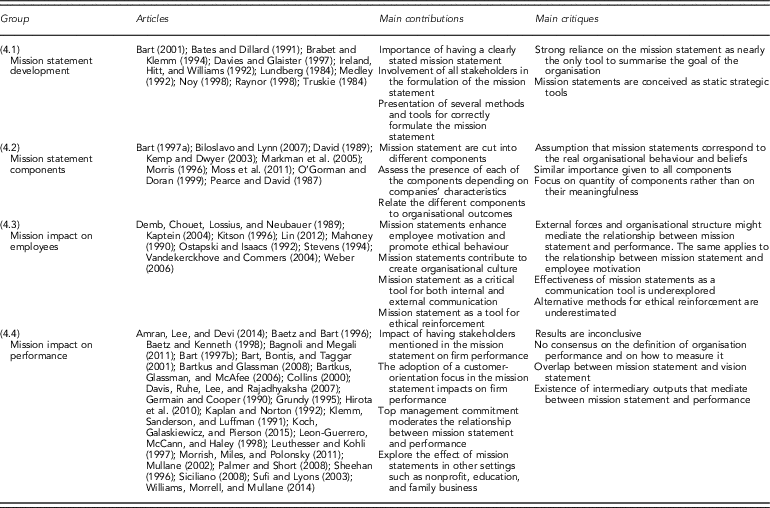
Table 2 summarises the above discussion by providing a comprehensive list of the articles included in each of the groups, their contributions and main critiques.
Summary of the main contributions and critiques

DIRECTIONS FOR FUTURE RESEARCH
Literature on mission statements has ample room for further development. Besides the particular critiques of each group of papers outlined above and summarised in Table 2, there are also some general comments that provide opportunities for further research on the topic of mission statements that apply to all the articles reviewed.
We have identified three major opportunities for development: theoretical framework, research methods and scope. Research on mission statements has mainly followed a practitioner’s perspective. To a great extent, the majority of the works published have reviewed mission statements from top companies (primarily located in the United States and Canada) and then, based on the information collected, analysed which are the main components and how the different stakeholders were involved in the definitional process of the mission of the company. Although all these studies provide interesting insights than can be used by practitioners to improve their missions and reinforce customer’s and employees’ commitment to the firm, one of the main gaps this literature presents is the lack of a theoretical corpus in which to be grounded. Precisely this practical orientation has prevented management and strategic journals from publishing this type of research. The explanation is threefold. First, mission statements are a managerial tool and as such, it offers limited potential for theory building, something required by most relevant strategy and general management journals. Second, the definition, applicability and usefulness of mission statements has been relatively stable across time. The lack of innovative and new approaches on mission statements has reduced research on this area as researchers have prioritised other type of studies. Finally, there is always the question mark on whether the company does what it says it does. As a consequence, some researchers have undervalued the importance of mission statement and have preferred to focus on the concrete practices and beliefs that the company actively holds. Correspondingly, a clear avenue for future research is to reinforce the theoretical framework related to mission statement research. Theoretical perspectives that can contribute to and be expanded by research on mission statements are diverse and can be applied either at the organisational level or at the individual level. At the organisational level, literature on institutional stakeholders’ perspectives and corporate governance could contribute to the mission statement literature. Following Suchman (Reference Suchman1995) and Freeman and Reed (Reference Freeman and Reed1983), a potential research question could be: what is the effect of the organisational mission statement on organisational legitimacy? Theories related to organisational identity and social capital (Kreuter & Lezin, Reference Kreuter and Lezin2002) could also be a lens to look at the role of the mission statement. At the micro-level, focusing on how mission statements affect employee beliefs and behaviours, goal-framing theory (Lindenberg & Steg, Reference Lindenberg and Steg2013) or self-efficacy theory (Maddux, Reference Maddux1995) could also be successfully applied to mission statement research.
In addition to strengthening the theoretical background, a lot can be improved in the methods that have been used until now. Studies in this area mainly rely on descriptive statistics, lacking empirically robust models to test the hypotheses. A big proportion of the studies use case studies that are not appropriately justified. Why study that issue in that particular company? Why is this company especially relevant to illustrate that fact? In addition, case studies fall frequently into the generalisability problem, leading to results that are illustrative for the company under study but rarely applicable to other settings and contexts. In the quantitative studies, the statistical analysis used in most of the articles reviewed is restricted to very basic descriptive statistics and mean comparison t-tests. In addition, the articles analyse cross-sectional data, making the observation of cause–effect relationships difficult. Answering questions such as the effect of mission statements on performance indicators will improve with the use of longitudinal analysis. Furthermore, quantitative studies sometimes sacrifice breadth by depth (Galvin & Arndt, Reference Galvin and Arndt2014). The number of mission statements and companies analysed might be considerable but it is difficult to figure the extent to which these mission statements are fully implemented. Likewise, in quantitative studies it is difficult to gather additional relevant information such as how the mission statement was constructed, who uses it and how. To address this shortcoming, more situated qualitative studies which take into account contextual factors should be conducted.
Finally, it is important to emphasise that mission statements should not be relegated to the fields of ethics and nonprofit management (O’Shannassy, Reference O’Shannassy2017), as all type of companies can profit from a good and clear mission statement that clarifies organisational purposes and sets directions. Strategic management research has a crucial role in fostering the well-being of society and organisations (O’Shannassy, Reference O’Shannassy2015).The current review has shown that mission statements influence organisational culture and performance, as well as improve internal and external communication. If all these virtues are true, one might wonder why research on mission statements is not in the core of strategic management research and has been mainly published in the area of ethics, social responsibility and alike. We argue here that the requirements of academic journals for each and every article to make a theoretical contribution (Galvin & Arndt, Reference Galvin and Arndt2014) prevent the publication of this type of studies. Mission statements are an instrument, a tool that serves to present organisational objectives in a succinct and clear manner. As a tool, the focus is very practical and it is challenging, if not impossible, to develop a theory based on a tool.
CONCLUDING REMARKS
The purpose of this article has been twofold. First, to provide a comprehensive and critical review of scholarly research on mission statements. Second, to put forward directions for future research on this area. To do this, we have reviewed 53 academic published articles focussed on the role of the mission statement in organisations. We have analysed the articles from different perspectives, reviewing the journals that publish this type of research, the most popular countries, and the most common methods used. We have grouped these articles according to four thematic areas, and we have outlined several avenues for future research.
As it can be inferred from the analysis, we conclude that mission statements are widely used in practice. Research on mission statements started in the 1980s, so it has been around for more than 35 years. However, most articles in the area take a very managerial phenomenon-based strand and are published in practitioner oriented journals. The absence of a theoretical framework, though, should not deter researchers from conducting new studies in this area. Other strategic managerial tools such as the balance score card have received considerable attention among academics despite its practical nature. Therefore, we encourage scholars to further explore the antecedents and consequences of mission statements for organisations and strategic management.
Mission statements, if well created and implemented, can have an impact on employee motivation and behaviour, organisational ethics and values, organisational performance, and the relationship with stakeholders when used as a communication tool. Therefore, the mission statement has a clear impact on the functioning of an organisation. Given its wide impact on different organisational outcomes and constituencies, several areas of management could profit from a deeper theoretical approach. Areas range from organisational psychology to institutional theory and organisational identity.
Acknowledgements
The authors would like to thank the two anonymous reviewers and the editor for their thorough and constructive guidance.
FINANCIAL SUPPORT
This work was financially supported by the Universitat Internacional de Catalunya (research project: QIIQ – Assessing Quality on Social Enterprises) in 2016–2017.