

Introduction
The Chinese population is expected to increase to 1.3 billion by 2050 (Worldbank, 2016) placing significant pressures on the Chinese agricultural system (Jiyun and Cheng, Reference Jiyun and Cheng2002). Chinese agriculture has therefore relied heavily on fertilizers with usage increasing 4% annually, amounting to one third of global fertilizer usage (Xan et al., Reference Xan, Jin, He and Liang2008), with significant environmental consequences (Ma et al., Reference Ma, Feng, Reidsma, Qu and Heerink2014). Precision agriculture (PA) is presented as a solution to reduce agro-chemical inputs, and reducing negative agricultural environmental impacts. PA has three fundamental benefits for farmers; first, economic benefits through reductions in farm expenditure via the controlled application of agricultural inputs; second, increased yields due to targeted management of in-field variability (Napier et al., Reference Napier, Robinson and Tucker2000); third, environmental benefits through the precise application of agro-chemical applications increasing compliance with national environmental legislation (Ma et al., Reference Ma, Feng, Reidsma, Qu and Heerink2014). However, uptake in China has lagged behind the US, Europe, South America and Australasia (Robert, Reference Robert2002), in part because the Chinese agricultural system is characterised by small scale family run farms (known as the ‘family responsibility system’), associated with different levels of mechanisation, production scale and farmer education (Jiyun and Cheng, Reference Jiyun and Cheng2002). The economic and environmental benefits of PA have been demonstrated in China (inter alia Jiyun and Cheng, Reference Jiyun and Cheng2002; Liu et al., Reference Liu, Zhang, Zhang, Ficklin and Wang2009). However, to our knowledge, no such research has been conducted in China to assess end-users’ attitudes and perceptions of PA. Limited research focuses on the adoption experiences of European and North American farmers (Kutter et al., Reference Kutter, Tiemann, Siebert and Fountas2009; Daberkow and McBride, Reference Daberkow and McBride2003). Barriers to adoption at the farm level including; the cost, (Plant, Reference Plant2001), end-user characteristics (Daberkow and McBride, Reference Daberkow and McBride2003), lack of perceived benefits (Adrian et al., Reference Adrian, Norwood and Mask2005), the skills required, and data security fears (Reichardt and Jurgens, Reference Reichardt and Jürgens2009). It cannot be assumed that the same factors influencing farmer adoption in Europe and North America apply in China. Understanding the structure of Chinese agricultural systems and exploring how this may impact upon Chinese farmer’s awareness, understanding, attitudes and perceptions towards PA is essential. This will aid understanding of the relevance of PA technology for Chinese farmers, inform future technological developments and provide targeted technological solutions relevant to local agronomic needs.
It is widely recognised that technological innovations, including those in the agri-food domain, can be met with societal resistance (Frewer et al., Reference Frewer, van der Lans, Fischer, Reinders, Menozzi, Zhang and van den Berg2013). Aligning innovation with the values, needs and expectations of society is crucial to ensure the support the introduction of technologies that address socially sensitive issues (Asveld et al., Reference Asveld, Ganzevles and Osseweijer2015) and represents the central premise of responsible research and innovation (RRI; Coles et al., Reference Coles, Rawcliffe and Freweraccepted). RRI provides a framework for the identification of stakeholder, end-user, and public concerns in an open, transparent way throughout the development and introduction process, and aims to ‘foster the design of inclusive and sustainable research and innovation’ (European Commission, 2015). Coles et al. (Reference Coles, Rawcliffe and Freweraccepted) provide a framework for understanding how RRI may be incorporated into agricultural innovations including; societal and economic impacts, equitable access to free markets and the benefits of innovation, gender inclusivity, inclusivity of potentially excluded groups (e.g. rural populations, poor, disabled, specific ethnic groups), public engagement, dissemination of scientific findings, ethics and science education. This approach has been advocated within the domain of PA (Lamb et al., Reference Lamb, Frazier and Adams2008). Consultation with a broad cross-section of potential users and stakeholders in the design and evaluation stages of new PA technologies is necessary to ensure relevance and compatibility with the target market, especially as the introduction of new agricultural systems and practices potentially impacts the dynamics and socio-economic functioning of rural communities. Therefore, this research aimed to explore expert and end-user understandings, attitudes and perceptions towards PA technology, including perceived barriers to adoption and the possible factors that may facilitate future using a RRI framework.
Methods
Research design
A qualitative approach was taken to provide exploratory insights into stakeholder perceptions of PA, and to provide the basis for future research. Interviews were conducted with two primary stakeholders of PA technologies in China; Chinese agriculture experts (i.e. academics, researchers, and industry representatives) and Chinese farmers and farm workers. Each expert interview lasted approximately 45 minutes and was digitally recorded to aid verbatim transcription and subsequent data analysis. An interview discussion guide was developed, based on the RRI framework developed by Coles et al. (Reference Coles, Rawcliffe and Freweraccepted). The discussion guide aimed at exploring; 1) penetration of PA in China, 2) perceptions of PA technologies and techniques, 3) motivation and barriers to the adoption of these, 4) information, training and support for Chinese farmers (including the needs of agronomic advisers) to facilitate PA adoption. The interview discussion guide was translated into Mandarin and provided to participants prior to interview. Interview participants were informed of the purpose of the research and asked for their informed consent. Interviews were conducted in English and simultaneously translated into Mandarin. A second discussion guide was developed for farmers and intended end-users of PA, informed by the results of the expert interviews and existing literature. The guide was divided into 6 sections that aimed to explore, 1) farmers land, 2) potential changes to rural communities and agricultural practices which following introduction of PA technologies, 3) current practices of PA, 4) awareness of PA, and 5) motivation and barriers to the adoption of PA. Interviews were conducted in Mandarin, following informed participant consent. All interviews were digitally recorded to assist with data analysis. Each interview was designed to last approximately one hour. Copies of both discussion guides can be obtained by contacting the corresponding author.
Sample
Ten expert interviews were conducted at the Joint International Conference on Intelligent Agriculture in Beijing, China, in September 2015. Four experts were working in Chinese academic institutions, 4 were working in private research institutions and organisations, 1 worked for a national research centre and 1 for an academic institution and a government ministry.34 in-depth interviews were conducted with family farmers and potential end-users of PA technology across 3 Chinese agricultural regions between January and February 2016, Shixiang village, Changge city in Henan province, Xiaotangshan; Beijing precision agriculture research and demonstration base in Beijing city and Zhaodong farm in Zhaodong city, Heilongjiang province. The sample comprised of 25 males and 8 females, the majority of the participants were aged between 51 and 60 (38.2%) reflecting the ageing demographic of Chinese agriculture. Farm size ranged from 0.1–1,000 hectares. Few farmers owned the land they farmed and it was common practice to rent fields. Farmers reported having between 1 month and 20 years’ farming experience.
Data analysis
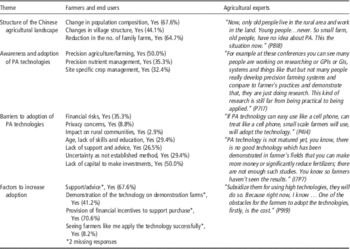
Data collected from the expert interviews were analysed using QSR Nvivo 11 and followed a three stage process. First, transcripts were open coded using an inductive, grounded approach (Glaser and Strauss, Reference Glaser and Strauss1967). Key, emerging concepts from the transcripts were used to develop an initial coding framework. This framework was then refined by coding a subsample of transcripts against the framework and amending or adding codes where appropriate. Once the coding framework was finalised the full data set was coded against it. Given the structured approach to the farmer interviews, data was analysed using SPSS 21 with descriptive statistics reported in Table 1.
A summary of themes from the expert interviews and results from the farmer and end user interviews

Results
Expert interviews
Four themes emerged; these related to the structure of the Chinese agricultural landscape, farmers’ awareness and adoption of PA technologies, barriers to adoption of PA technologies and factors to increase adoption. Experts identified the Chinese agricultural landscape as highly fragmented and characterised by small non-commercial family plots, which employ traditional farming methods. Directives from the Chinese government supported consolidation of family farms into small-medium sized commercial farms, which had led to increased field variation. PA technologies were considered to play an important role in supporting these emerging agronomic structures and the merger of smaller farms was considered to support the adoption of PA. From the family farm perspective, leasing land to others maintained income without having to farm the land, and allowed for engagement with additional employment outside of farming. Although scientific research has been conducted to develop and refine PA technologies for application within the Chinese context, it was recognised that this body of knowledge had not translated well into practical solutions for adoption by farmers. Awareness of the benefits and applications of PA was confined to larger nationally owned farms, with very limited knowledge about PA technologies associated with smaller family farms. PA technologies were considered unsuitable and unnecessary, with increased emphasis on mechanisation and reduced labor. Adoption of PA technologies was perceived to be crop (maize, wheat, rice and cotton) and geographically restricted, with farms located in North Eastern China being primary adopters, reflecting promotion by the Chinese government within the country’s agricultural heartland where large economically developed farms are located.
Farm scale was noted as the most significant barrier to PA adoption. Experts associated a number of problems with PA transfer from other global regions to China, including; the need to adapt the technology for small farms, the appreciation that PA technologies are complex for famers to learn to utilise, and that data outputs are difficult to interpret without explicit training. The financial risks associated with PA technology investment were a significant barrier to adoption, with associated costs thought to be better suited to larger farms and prohibiting adoption by small farms. Although benefits of PA technologies on small to medium sized farms were considered as unproven and difficult to quantify, experts identified a number of perceived benefits including; environmental (improved fertilizers and pesticide efficiency); economic (increased yields), improved farm management and reduced labour costs. However, immediate benefits were perceived to apply only to large farms.
Significant changes to the age demographic of rural communities, as influenced by rural-urban migration trends, were thought to compound the low rates of awareness and adoption of PA, with many small farms anecdotally noted to be managed by older farmers, with limited formal education, who relied on experiential knowledge of the land to guide farming practice and who did not have the requisite skills to adopt PA technologies. By comparison, mangers of larger farms were noted as younger and more highly educated (degree level) with the required skills and training to facilitate adoption. In addition to tailoring technologies to meet the requirements of variation across the agricultural landscape in China, a number of factors to help increase the adoption of PA technologies were identified. These included the physical demonstration of the tangible benefits of PA (both via demonstration farms and farmers’ fields), the provision of financial incentives to farmers from the Chinese government, and support for farmers whilst using the technology and interpreting the data, including the need for education and training. This could be delivered through government or industry stakeholders. A gap in the market for independent agronomy extension services to ensure knowledge transfer and dissemination of research findings to farmers was identified.
Farmer and end-user interviews (Table 1)
The most significant change to rural communities identified was the change in population composition as a consequence of rural-urban migration, and the associated reduction in family farms as part of the government’s promotion of the consolidation of these into larger management zones (62% of participants). Increased investment and support for rural communities by government was thought to result in significant improvements to infrastructure (62% of participants), including improved access to schools, healthcare and transport. Significant farming challenges identified included weather unpredictability (59%), a shortage of skilled workers (32%) and the potential for disasters, including plant diseases, pests and extreme weather causing draughts and floods (32.4%). Field and yield variability were considered less significant challenges, possibly influenced by the small scale of farms and the high levels of experiential farming knowledge. Low levels of engagement with farming technology by farmers on small to medium farms were reported, with the most frequently cited being tractors and other forms of mechanisation (88%) and irrigation systems (77%). A far lower percentage of farmers reported using computers and/or smartphones (29%), or GPS systems (18%). Participants were asked whether they were familiar with three terms; 1) PA/farming, 2) precision nutrient management, and 3) site-specific crop management. Consistent with expert opinion, levels of awareness for each was low. For those that had reported to be familiar with PA, information had been received primarily from demonstration farms.
The most prominent barriers to adoption related to the financial risks and affordability of PA technologies (35%), the lack of skills and educational opportunities to learn new farming skills and operate complex technologies (29%) and the perceived uncertainty of PA benefits (29%). 70% of participants identified the need for financial incentives to support the purchase of PA technologies. In situ support and advice for farmers in selecting the appropriate technology and interpreting data outputs was also identified as relevant. However, farmers struggled to articulate what they perceived the risks and benefits associated with PA technology adoption to be. Example benefits proposed included reduced investment in agricultural inputs, improvements to yields and returns, reduced environmental impacts of farming practices and labour efficiencies. The majority of participants were unable to identify associated risks. When articulated, primary risks related to the significant upfront investment required and cost.
Discussion
This research sought to explore the factors influencing the adoption of PA technologies in China from the perspective of two groups of key stakeholders, agricultural experts and farmers and end-users. Guided by the principles of RRI, 10 expert and 34 farmer exploratory end-user interviews were conducted. PA holds considerable potential to improve Chinese agriculture. However, this research highlights limited awareness and adoption of PA technologies on family farms in China. Consensus among experts indicated that PA technologies currently only hold relevance for larger farms (Daberkow and McBride, Reference Daberkow and McBride2003; Adrian et al., Reference Adrian, Norwood and Mask2005). The limited insights gained from farmers with respect to their knowledge and understanding of PA reflects the perceived lack of current relevance of PA. A number of factors emerged as influencing the adoption of PA technologies. The most prominent was the current lack of suitability of the technology to address the challenges of small land management zones, supporting the argument that, at present, PA technologies are focused on improving agronomic production on large farms (Adrian et al., Reference Adrian, Norwood and Mask2005; Reichardt and Jurgens, Reference Reichardt and Jürgens2009). This highlights the need to adapt technologies for different farming landscapes and scales, and the difficulties of transferring technologies developed in Europe, North America and Australia to the Chinese agronomic and cultural context (Jiyun and Cheng, Reference Jiyun and Cheng2002). The suitability of PA technologies for large farms was underpinned by greater in-field variability and thus there was a need for the PA approach to adapt to this variation. Larger farms were perceived as having the requisite capital to invest in expensive PA technologies (Plant, Reference Plant2001; Kutter et al., Reference Kutter, Tiemann, Siebert and Fountas2009). End-users within larger farms were thought to be younger with higher educational levels, increasing willingness and ability to engage with novel and often complex PA technologies (Robert, Reference Robert2002, Daberkow and McBride, Reference Daberkow and McBride2003, Adrian et al., Reference Adrian, Norwood and Mask2005). Farmers themselves suggested that they lacked the skills and motivation to learn new farming and agricultural practices. Lack of motivation to adopt PA technologies was identified as particularly problematic in small to medium farms. The immediate benefits of PA technologies were thought to be difficult to evaluate and quantify (see also Reichardt and Jurgens, Reference Reichardt and Jürgens2009, Adrian et al., Reference Adrian, Norwood and Mask2005). Although PA technologies were regarded as a significant scientific advance in farming practice, they were not perceived to be relevant to the agronomic and socio-economic conditions on small to medium farms. For farmers, one of the primary benefits of integrating farming technology was to address the labour deficiencies associated with rural-urban migration trends. However, the high capital costs of PA technologies were considered prohibitive and outweighed any perceived benefits. Farmers recognised a need for financial incentives to accommodate high capital investment costs.
However, experts recognised the fundamental need for simplified and affordable PA technologies to be developed, that were better suited to the Chinese agricultural landscape, particularly in relation to small to medium farms with greater agronomic variation over smaller areas. Active demonstration of simplified PA technologies was encouraged. Experts advocated research and engagement activities within rural communities in order to co-construct technological solutions to farming challenges and improve farmer’s relational engagement with the technologies they were expected to adopt. The need for support and impartial advice was voiced from farmers, with experts identifying a gap for independent agronomy services.
Higher order risks such as the consequences of the adoption of PA technologies on rural communities and issues associated with data privacy have been noted in other cultural contexts (Daberkow and McBride, Reference Daberkow and McBride2003; Kutter et al., Reference Kutter, Tiemann, Siebert and Fountas2009). However, these concerns did not emerge from this study. Farmers did not consider the risks of PA technology, probably attributable to very low levels of awareness of PA technologies. Experts believed that awareness was so limited risks were not yet being considered by farmers in the target population, although this could change if rates of adoption increased. Despite this result, the consideration of risks and risk perceptions is essential in developing strategies to ensure adoption of new technologies, and so should be addressed within the future strategic development of PA technologies within China.
This research has provided valuable insights regarding factors influencing, the adoption of PA technologies in China amongst farmers and end-users of this technology, in particular in the small to medium farming sector. These views will be central to the development of effective strategic implementation strategies associated with adoption and diffusion of PA. However, this research is not without limitations, as it is exploratory and conducted with a small convenience sample of experts and farmers and so is not representative of all stakeholders involved in Chinese agriculture within the relevant agronomic sector within China. It does however, provide a solid basis for future research with a more diverse range of stakeholders, and provides a useful foundation upon which to develop future PA implementation policies, including the need to develop effective educational platforms and targeted demonstration activities.