Introduction
Aquaculture has been experiencing continuous expansion in many countries worldwide and provides a livelihood for 8% of the world's population (540 million people) (FAO, 2014). It is estimated that world aquaculture production doubled from 32.4 million tonnes in 2000 to 66.6 million tonnes in 2012 (FAO, 2014). The fastest annual growth rate in production was observed in Africa (11.7%) and Latin America and the Caribbean (LAC) (10%). For LAC, the economic contribution of aquaculture has grown substantially in the past 10 years, with employment of more than 200,000 people directly, and about 500,000 indirectly (FIS México, 2016). While Chile, Brazil, Ecuador and Mexico account for more than 80% of the regional aquaculture volume, this activity occurs on different scales in almost every country of Latin America. With the exception of Penaeus vannamei in Mexico, most of the species under aquaculture conditions in LAC are exotic: salmonids (trout and salmon) in nine countries of the region, marine shrimp in 18 countries and tilapia in 20 countries (FAO, 2014).
An important limitation to the development of commercial aquaculture in LAC in recent decades has been the emergence of infectious diseases. Diseases of bacterial (Streptococcus iniae, Pseudomonas sp., Aeromonas sp.) and viral (Iridoviridae, Orthomixoviridae, Rhabdoviridae, Alloherpesviridae) origin are widely distributed and cause high mortalities, producing serious economic losses in aquaculture (Conroy, Reference Conroy2004; OIE, 2015). For example, the bacterium Francisella sp. in cultured tilapia has caused losses of US$2.5 million in Costa Rica and is currently present in Mexico, Brazil and Guatemala, with mortality of up to 85% in juveniles (Conroy, Reference Conroy2004). Likewise, parasites are often associated with important economic losses in aquaculture. For example, Bothriocephalus acheilognathi is a pathogenic helminth that causes serious mortalities among juvenile fish in culture conditions and in wild populations (Salgado-Maldonado et al., Reference Salgado-Maldonado, Guillen-Hernández and Osorio-Sarabia1986; Salgado-Maldonado & Pineda-López, Reference Salgado-Maldonado and Pineda-López2003); in fact, due to its pathogenicity it is considered a threat to endemic fish in Mexico (Velázquez-Velázquez et al., Reference Velázquez-Velázquez, González-Solis and Salgado-Maldonado2011).
Helminths are frequently neglected as causative agents of fish diseases. Indeed, several fish farmers frequently believed that these parasites are harmless (Paredes-Trujillo et al., Reference Paredes-Trujillo, Velázquez-Abunader, Torres-Irineo, Romero and Vidal-Martínez2016a). However, under aquaculture conditions such as low water quality, high fish density and extreme environmental variables (e.g. high ammonia concentration, high temperature) these parasites can cause disease (e.g. Gonzáles-Fernández, Reference Gonzáles-Fernández2012a; Paredes-Trujillo et al., Reference Paredes-Trujillo, Velázquez-Abunader, Torres-Irineo, Romero and Vidal-Martínez2016a). The spread and establishment of parasitic helminths may have detrimental health consequences when present in high numbers within a cultured population with deficient management practices and a lack of biosecurity plans. Therefore, knowledge of the potential risks that helminths represent to farmed fish can be useful for designing appropriate contingency plans and management strategies (Bondad-Reantaso et al., Reference Bondad-Reantaso, Subasinghe, Arthur, Ogawa, Chinabut, Adlard, Tan and Shariff2005).
In this review, our main objective has been to present the extant information on helminths producing negative effects (e.g. histological or physiological) in finfish under aquaculture conditions. However, we have also included helminths that are apparently harmless, but that we consider potentially dangerous in view of the intensive aquaculture conditions that will be developed in the near future in LAC. For this purpose, this article is divided into five groups of cultured fish arranged according to their economic importance in LAC (salmonids, tilapia, carp, native fish and ornamental fish).
Salmonids
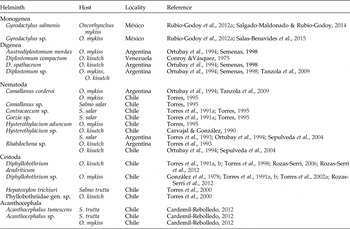
In Latin America, salmonid production is one of the most important aquaculture activities, with a sustained economic growth (586,289 tonnes in 2004) and is highly profitable (Rojas & Wadsworth, Reference Rojas, Wadsworth, Halwart, Soto and Arthur2005). Studies on parasites of salmonids have focused primarily on those that produce diseases in commercial fish. Most of the diseases in salmonids have a viral origin in Latin America (www.oie.int/es/). Consequently, it is difficult to determine the relative impact of helminth infections on salmonid farming (Shinn et al., Reference Shinn, Pratoomyot, Bron, Paladini, Brooker and Brooker2015). Probable reasons for the scarcity of information on helminths include the difficulties in identifying parasites accurately at the farm level and poor record keeping. Table 1 shows the helminth species recorded from salmonid species farmed in Latin America.
Helminth species recorded from salmonid species farmed in Latin America.

Monogeneans
There are records of Gyrodactylus sp. in Oncorhynchus mykiss for Mexico and Colombia with relatively high infection parameters (mean abundance 100 ± 87 parasites/host) (Salas-Benavides et al., Reference Salas-Benavides, López-Macías, Ortega-Salas and Gómez-Nieves2015). The clinical signs of Gyrodactylus sp. included irritation, bleeding and erosion of the gill tissue. These reports correspond to isolated findings and were not associated with mortality of farmed fish. However, further research is required to understand the presence of these metazoan parasites in farmed salmonids. Gyrodactylus salmonis was reported by Rubio-Godoy et al. (Reference Rubio-Godoy, Paladini, Freeman, García-Vásquez and Shinn2012a) from O. mykiss in Veracruz, Mexico. However, there are no reports of fish morbidity or mortality associated with gyrodactylid infection in rainbow trout farms in Veracruz, which would suggest a stable host–parasite interaction (Rubio-Godoy et al., Reference Rubio-Godoy, Paladini, Freeman, García-Vásquez and Shinn2012a).
Digeneans
Larval forms of diplostomids affecting the brain (Austrodiplostomum mordax) and eyes (Diplostomum sp.) have been reported in salmonids in LAC. Records in Argentina and Colombia indicate that diplostomiasis is widely distributed in natural environments (Semenas, Reference Semenas1998; Salas-Benavides et al., Reference Salas-Benavides, López-Macías, Ortega-Salas and Gómez-Nieves2015). The larval genus Diplostomum includes metacercariae in the tegument, which generates black spots on the skin, but the most common infections are caused by mesocercariae in the lens, causing oedema, congestion, leucocyte infiltration and bleeding. This damage affects the choroid and iris, causing muscular and retinal necrosis, and finally partial or total blindness of the eye, which forces fish to swim near the surface, making them easy prey for predatory birds.
Nematodes
Hysterothylacium is a nematode genus that has been suggested to affect the health of salmonids in production systems. This genus was first reported in marine cage farms of Chilean salmonids by Carvajal & González (Reference Carvajal and González1990). This anisakid nematode was present in the digestive tract of several native fishes (Fernández, Reference Fernández1985) and has been transmitted to the salmonids introduced in Chile for commercial aquaculture. Larvae and adults of Hysterothylacium aduncum have been recorded in Oncorhynchus kisutch, O. mykiss, Salmo salar and Oncorhynchus tshawytscha reared in floating cages in Chile and Argentina (Carvajal & Gonzalez, Reference Carvajal and González1995) and in S. salar from localities close to Puerto Montt (Sepulveda et al., Reference Sepulveda, Marin and Carvajala2004). The effect of Hysterothylacium spp. on salmonids has been poorly investigated, but published records indicate that H. aduncum causes mortality in juvenile fish (Balbuena et al., Reference Balbuena, Karlsbakk and Kvenseth2000) and heavy Hysterothylacium bidentatum infections induce digestive tract obstruction (Molnár et al., Reference Molnár, Buchmann, Székely and Molnár2006). It has also been reported that H. aduncum represents a zoonotic risk, due to reports of human infection in Japan (Yagi et al., Reference Yagi, Nagasawa, Ishikura, Nakagawa, Sato and Kikuchi1996).
Cestodes
Diphyllobothrium sp. plerocercoids have been isolated from the viscera of one specimen of O. mykiss reared in the south of Chile (Torres et al., Reference Torres, Gesche, Montefuso, Miranda, Dietz and Huijse1998). Since most salmonid production is undertaken in floating cages, some of these parasites are particularly important helminth species because of their zoonotic risk. Additionally, since these parasites complete their life cycles in natural environments, it would be expected that under aquaculture conditions, due to the high fish density in floating cages, the prevalence and abundance of this parasite would be higher. The tapeworm Diphyllobothrium denditricum has been detected in wild salmonids (Salmon coho and O. kisutch) introduced into Chile (Torres et al., Reference Torres, Gesche, Montefuso, Miranda, Dietz and Huijse1998). Previous research suggests that diphyllobothriasis and other parasitic infestations in wild fish are potential risks to salmon farming in Chile (Torres et al., Reference Torres, Gesche, Montefuso, Miranda, Dietz and Huijse1998), as proven in the northern hemisphere (Rahkonen et al., Reference Rahkonen, Aalto, Koski, Särkkä and Juntunen1996; Karasev et al., Reference Karasev, Mitenev and Kalinina1997). Furthermore, the larval stages of the tapeworm D. dendriticum and the nematode Contracaecum sp. are considered to be of zoonotic importance, since the consumption of salmon meat is the entry route to humans (Von Bonsdorff, Reference Von Bonsdorff1977).
Tilapia
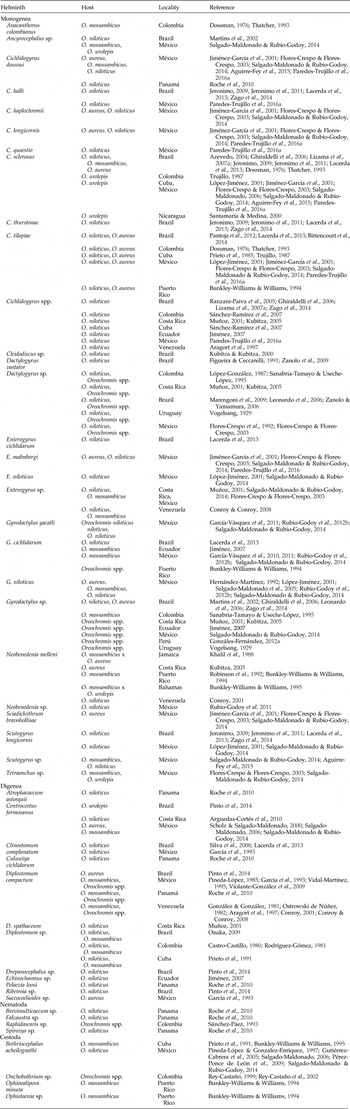
The state of development of aquaculture in LAC suggests that several countries (Brazil, Colombia, Costa Rica, Ecuador and Mexico) predominate in the aquaculture of these African cichlids (FAO, 2014), with Jamaica being one of the largest producers of high-quality red tilapia (FAO, 2014). In many Latin American countries, tilapia was introduced during the 1960s, but this biotechnology was not developed as a commercial activity until the 1980s. Commercial production began in Jamaica in 1983, spread to Colombia, and shortly after to Costa Rica, Brazil, Ecuador, Honduras, Nicaragua and Venezuela (Castillo-Campo, Reference Castillo-Campo, Contreras-Sánchez and Fitzsimmons2006). Currently, tilapia is cultured in 20 out of 26 Latin America countries. With the intensification of tilapia farming, parasitic diseases began to appear, posing important limitations to the development of aquaculture in LAC. Table 2 shows the helminth species recorded from tilapia species farmed in LAC.
Helminth species recorded from farmed tilapia species in Latin America.

Monogeneans
Members of the families Gyrodactylidae and Dactylogyridae are the most important parasites in tilapia aquaculture. Species of the family Capsalidae are also important parasites on tilapia cultured in seawater (Conroy & Conroy, Reference Conroy and Conroy2008; Rubio-Godoy et al. Reference Rubio-Godoy, Montiel-Leyva and Martínez-Hernández2011; Shinn et al., Reference Shinn, Pratoomyot, Bron, Paladini, Brooker and Brooker2015). Several authors have shown that the main helminth species affecting fish health in intensive closed-system culture are monogeneans. These helminths are often present in the sex-reversal process, where their infestation is favoured by their direct life cycle at high fish densities (Conroy, Reference Conroy2001). For example, in Brazil, Martins et al. (Reference Ghiraldelli, Martins, Yamashita and Jeronimo2006) suggested that monogeneans are the ectoparasites responsible for the most important parasitic disease among farmed tilapia.
Overall, gyrodactylids are known to be very aggressive, tending to be extremely pathogenic to tilapia, especially to larvae and small fish at high population densities and intensive culture conditions. Infestations occur mainly on the body, rarely on the gills, and produce excessive secretion of mucus and epithelial cell proliferation. This leads to erosion of the skin surface and the possibility of secondary infections caused by bacteria and fungi. Due to their viviparous reproductive strategy, gyrodactylids are able to achieve high infestation levels in very short periods of time (Flores-Crespo & Flores-Crespo, Reference Flores-Crespo and Flores-Crespo2003; Conroy & Conroy, Reference Conroy and Conroy2008). Gyrodactylus cichlidarum is widely distributed in Latin America (Brazil, Colombia, Ecuador, Honduras, Mexico, Puerto Rico) and has been detected in Nile tilapia (Oreochromis niloticus), blue tilapia (O. aureus), Mozambique tilapia (O. mossambicus) and hybrid red tilapia (O. mossambicus × O. urolepis) (Bunkley-Williams & Williams, Reference Bunkley-Williams and Williams1994; Conroy, Reference Conroy2001; Jiménez, Reference Jiménez2007; García-Vásquez et al., Reference García-Vásquez, Hansen, Christison, Bron and Shinn2011; Lacerda et al., Reference Lacerda, Yamada, Antonucci, Tavares-Dias, Pavanelli, Takemoto and Eiras2013; Salgado-Maldonado & Rubio-Godoy, Reference Salgado-Maldonado and Rubio-Godoy2014; Paredes-Trujillo et al., Reference Paredes-Trujillo, Velázquez-Abunader, Torres-Irineo, Romero and Vidal-Martínez2016a). Gyrodactylus cichlidarum is especially harmful to tilapia kept in ponds, attacking mainly the skin and fins (García-Vázquez et al., Reference Rubio-Godoy, Montiel-Leyva and Martínez-Hernández2011; Paredes-Trujillo et al., Reference Paredes-Trujillo, Velázquez-Abunader, Torres-Irineo, Romero and Vidal-Martínez2016a). Gyrodactylus niloticus has been recorded from Mexico on O. aureus, O. mossambicus and O. niloticus (Hernández-Martínez, Reference Hernández-Martínez1992; López-Jiménez, Reference López-Jiménez2001; Salgado-Maldonado et al., Reference Salgado-Maldonado, Pineda-López, García-Magaña, López-Jiménez, Vidal-Martínez, Aguirre-Macedo, Bueno-Soria, Santiago-Fragoso and Álvarez2005). However, García-Vásquez et al. (Reference García-Vásquez, Hansen, Christison, Rubio-Godoy, Bron and Shinn2010) considered G. niloticus to be synonymous with G. cichlidarum. Gyrodactylus yacatli was originally described by García-Vásquez et al. (Reference García-Vásquez, Hansen, Christison, Bron and Shinn2011) from O. niloticus and, for LAC, this species has only been reported from Mexico (García-Vásquez et al., Reference García-Vásquez, Hansen, Christison, Bron and Shinn2011; Salgado-Maldonado & Rubio-Godoy, Reference Salgado-Maldonado and Rubio-Godoy2014).
Dactylogyrids are highly pathogenic to their tilapia hosts, especially when they are present in high amounts. Infestations are mainly on the gills, where they give rise to marked hyperplasia and other proliferative changes in the epithelium, which leads to respiratory problems and mortality (Del Río-Zaragoza et al., Reference Del Río-Zaragoza, Fajer-Ávila and Almazán-Rueda2010). The genus Cichlidogyrus was first described by Paperna (Reference Paperna1960), with the type species Cichlidogyrus arthracanthus collected in Israel from the wild host species Tilapia zillii. This genus was reported from cultured tilapia in Africa by Douëllou (Reference Douëllou1993). Cichlidogyrus spp. were introduced into America from Africa along with their host in the early 1980s (Kritsky & Thatcher, Reference Kritsky and Thatcher1974; Arredondo-Figueroa, Reference Arredondo-Figueroa1983; Lazaro-Chávez, Reference Lazaro-Chávez1985; Prieto et al., Reference Prieto, Fajer and Vinjoy1985; Kritsky et al., Reference Kritsky, Vidal-Martínez and Rodríguez-Canul1994). In Cuba and Colombia massive infections of cultured tilapia by Cichlidogyrus spp. have been reported (Sánchez-Ramirez et al., Reference Sánchez-Ramirez, Vidal-Martínez, Aguirre-Macedo, Rodriguez-Canul and Gold-Bouchot2007). In Mexico, members of this genus have been reported with high prevalence in O. niloticus and O. mossambicus in Campeche, Veracruz and Yucatán (Vidal-Martínez et al., Reference Jiménez-García, Vidal-Martínez and López-Jiménez2001; Aguirre-Fey et al., Reference Aguirre-Fey, Benítez-Villa, Pérez-Ponce de León and Rubio-Godoy2015; Paredes-Trujillo et al., Reference Paredes-Trujillo, Velázquez-Abunader, Torres-Irineo, Romero and Vidal-Martínez2016a). Little is known about the biology of Cichlidogyrus, but apparently there is a link between poor water quality and high prevalence of this monogenean in aquaculture conditions.
The most widely distributed species of Cichlidogyrus in Latin America are Cichlidogyrus sclerosus and C. tilapiae, first recorded in Colombia, Mexico (Kritsky & Thatcher, Reference Kritsky and Thatcher1974; Kritsky et al., Reference Kritsky, Vidal-Martínez and Rodríguez-Canul1994) and Cuba (Prieto et al., Reference Prieto, Fajer and Vinjoy1985). These species have been recorded infecting various species of tilapia and their hybrids, including blue tilapia (O. aureus), Mozambique tilapia (O. mossambicus), Nile tilapia (O. niloticus) and red tilapia (O. urolepis) (Bunkley-Williams & Williams, Reference Bunkley-Williams and Williams1994; Santamaría & Medina, Reference Santamaría and Medina2000; Jiménez-García et al., Reference Jiménez-García, Vidal-Martínez and López-Jiménez2001; Flores-Crespo & Flores-Crespo, Reference Flores-Crespo and Flores-Crespo2003; Ghiraldelli et al., Reference Martins, Ghiraldelli, Azevedo and Silva-Souza2006; Salgado-Maldonado, Reference Salgado-Maldonado2006; Lizama et al., Reference Lizama, Takemoto, Rizani-Paiva, Ayroza and Pavanelli2007a; Jeronimo et al., Reference Jeronimo, Speck, Cechinel, Gonçalves and Martins2011; Pantoja et al., Reference Pantoja, Neves, Dias, Marinho, Montagner and Tavares-Dias2012; Lacerda et al., Reference Lacerda, Yamada, Antonucci, Tavares-Dias, Pavanelli, Takemoto and Eiras2013; Bittencourt et al., Reference Bittencourt, Pinheiro, Cárdenas, Fernandes and Tavares-Dias2014; Salgado-Maldonado & Rubio-Godoy, Reference Salgado-Maldonado and Rubio-Godoy2014; Aguirre-Fey et al., Reference Aguirre-Fey, Benítez-Villa, Pérez-Ponce de León and Rubio-Godoy2015; Paredes-Trujillo et al., Reference Paredes-Trujillo, Velázquez-Abunader, Torres-Irineo, Romero and Vidal-Martínez2016a). Infections with C. sclerosus have an important effect on the growth rate and relative condition factor of their hosts, which could have an economic effect on tilapia farmers (Sandoval-Gío et al., Reference Sandoval-Gío, Rodríguez-Canul and Vidal-Martínez2008; Le Roux, Reference Le Roux2010; Paredes-Trujillo et al., Reference Paredes-Trujillo, Velázquez-Abunader, Torres-Irineo, Romero and Vidal-Martínez2016a). Sánchez-Ramirez et al. (Reference Sánchez-Ramirez, Vidal-Martínez, Aguirre-Macedo, Rodriguez-Canul and Gold-Bouchot2007) reported outbreaks of C. sclerosus during the winter months in O. niloticus under experimental culture in Yucatán, Mexico; apparently, the fish had a weak immune response in cold weather, which in turn favoured a high prevalence of this monogenean. The same epizootic pattern was reported by Aguirre-Fey et al. (Reference Aguirre-Fey, Benítez-Villa, Pérez-Ponce de León and Rubio-Godoy2015), who found a significant negative correlation between water temperature and parasite abundance. Pantoja et al. (Reference Pantoja, Neves, Dias, Marinho, Montagner and Tavares-Dias2012) recorded a prevalence of C. tilapiae of more than 90% in Nile tilapia farms in Amapá State, Brazil. Likewise, Salgado-Maldonado & Rubio-Godoy (Reference Salgado-Maldonado and Rubio-Godoy2014) considered that C. sclerosus is the most common monogenean in tilapia cultured in Mexico, and it has also been identified in different species of native cichlid fishes (Jiménez-García et al., Reference Jiménez-García, Vidal-Martínez and López-Jiménez2001).
In a study of farmed O. niloticus from the Chavantes reservoir in Brazil, Martins (Reference Martins1998) showed that the dactylogyrids Cichlidogyrus halli and Scutogyrus longicornis were the most abundant monogeneans in the gills of this fish species. In cases of high infection intensity, these monogeneans can cause mortalities, especially in small fish (Jeronimo, Reference Jeronimo2009). Cichlidogyrus dossoui has been recorded from Oreochromis spp. cultured in Mexico, and has detrimental effects on the host (Aguirre-Fey et al., Reference Aguirre-Fey, Benítez-Villa, Pérez-Ponce de León and Rubio-Godoy2015; Paredes-Trujillo et al., Reference Paredes-Trujillo, Velázquez-Abunader, Torres-Irineo, Romero and Vidal-Martínez2016a). In addition, Roche et al. (Reference Roche, Leung, Franco and Torchin2010) reported the presence of C. dossoui on wild O. niloticus collected in Panama.
Jiménez-García et al. (Reference Jiménez-García, Vidal-Martínez and López-Jiménez2001) first documented that O. aureus is also parasitized by the native monogenean Sciadicleithrum bravohollisae. This species was previously considered to be specific to American cichlids (Kritsky et al., Reference Kritsky, Vidal-Martínez and Rodríguez-Canul1994; Salgado-Maldonado et al., Reference Salgado-Maldonado, Pineda-López, Vidal-Martínez and Kennedy1997). The lack of a co-evolutionary history may often render invasive species non-competent hosts, and thus acquisition of native parasite species may not take place. However, this does not seem to be the case here, because both introduced tilapia and American native cichlids are phylogenetically related (Cichlidae) and thus direct transmission of this monogenean to the non-native hosts is the most probable explanation for this transfer.
Neobenedenia melleni has a negative impact on tilapia aquaculture in both brackish and marine waters. Khalil et al. (Reference Khalil, Robertson and Hall1988) and Robinson et al. (Reference Robinson, Khalil, Hall and Steele1992) reported problems caused by ‘Benedenia sp.’ (= N. melleni) in coastal marine aquaculture involving hybrid red tilapia (O. mossambicus × O. aureus) in southern Jamaica. Bunkley-Williams & Williams (1995) also found large amounts of N. melleni in blue tilapia (O. aureus), Mozambique tilapia (O. mossambicus) and hybrid red tilapia (O. mossambicus × O. urolepis) cultured in Puerto Rico and other areas of the Caribbean. They suggested that, as exotic species, these fishes do not have natural resistance against this monogenean species. High mortalities can occur in a very short time after the initial infestation. This was verified experimentally by Rubio-Godoy et al. (Reference Rubio-Godoy, Montiel-Leyva and Martínez-Hernández2011), who exposed O. mossambicus and Pargo-UNAM (a synthetic hybrid whose genetic composition is 50% Florida red tilapia, 25% Rocky Mountain tilapia, and 25% red variant O. niloticus) to seawater collected at Veracruz on the Gulf of Mexico. Both tilapia types became infected by Neobenedenia sp., and most of the fish died within a fortnight following exposure. Kaneko et al. (Reference Kaneko, Yamada, Brock and Nakamura1988) reported serious infections of N. melleni in Mozambique tilapia (O. mossambicus) cultured in floating cages in the coastal area of Hawaii.
Digeneans
The species of the genus Diplostomum causing problems in cultured tilapia include D. compactum and D. spathaceum. However, both species are extremely difficult to distinguish from each other morphologically (Aguirre-Macedo, pers. com.). Nevertheless, since D. compactum is the most frequently reported species in Latin America (Conroy & Conroy, Reference Conroy and Conroy2008), we will focus on it from now on. Metacercariae of D. compactum have been reported from the lens, retina, brain and vitreous humour, producing a condition known as ‘eye fluke’, ‘cataract’ or ‘parasitic blindness’ (Ostrowski de Núñez, Reference Ostrowski de Núñez1982). Fish infected with D. compactum have impaired vision, which decreases their capacity to look for food normally and consequently they do not grow properly. These infected fish also tend to swim near the water surface, which is an ideal situation for predators such as fish-eating birds (Conroy & Conroy, Reference Conroy and Conroy2008).
Diplostomosis is widely distributed in cichlids and other native fish species in fresh waters in Mexico and Central and South America and has been reported to cause disease problems in some native species (Jiménez-García et al., Reference Jiménez-García, Vidal-Martínez and López-Jiménez2001). García et al. (Reference García, Osorio-Sarabia and Constantino1993) described the histological alterations caused by D. compactum in the ocular globes, vitreous humour and brain of O. aureus and O. mossambicus, including corneal and conjuctival lesions, optic neuritis, iridocyclitis, eosinophilic infiltration, front and rear uveitis and cataracts. In the brain, histological lesions include multifocal gliosis, eosinophilic meningitis, spongiosis and parasitic cyst in the telencephalon. Pineda-López (Reference Pineda-López1985) reported significant mortalities in farmed tilapia in Chiapas, Mexico as a result of diplostomatosis caused by D. compactum; they also mentioned that in most fish metacercariae were present in both eyes. González & González (Reference González and González1981) studied the effects of D. compactum metacercariae in native and introduced species of cichlids in Lake Valencia, Venezuela, finding between one and six metacercariae in each eye. Diplostomum compactum has been described by several authors as a native species of Latin America (Ostrowski de Núñez, Reference Ostrowski de Núñez1982; García et al., Reference García, Osorio-Sarabia and Constantino1993; Conroy, Reference Conroy2001), and for this reason tilapia farmers should consider the mechanical removal of the first intermediate host, Biomphalaria cf. havanensis (Violante-González et al., Reference Violante-González, García-Varela, Rojas-Herrera and Guerrero2009).
Another important larval trematode in tilapia farming is Clinostomum complanatum. This species is present in fish as metacercariae, using them as a second intermediate host (Thatcher, Reference Thatcher1981, Eiras et al., Reference Eiras, Dias, Pavanelli and Machado1999; Sutili et al., Reference Sutili, Gressler and Vilani de Pelegrini2014). The presence of this trematode has been described by several authors in different parts of the world and in different host species (Salgado-Maldonado, Reference Salgado-Maldonado2006), demonstrating that it is a cosmopolitan parasite. Salgado-Maldonado (Reference Salgado-Maldonado2006) generated a helminth parasite checklist in 194 native and 18 introduced freshwater fish species from 30 families from Mexico, and reported that the metacercariae of C. complanatum are present in 12 families and 49 species. These metacercariae, often referred to as ‘yellow grub’ or ‘the yellow spot disease’, infect the skin, muscle, fins, head, viscera and intestine, causing pathologies and changes in the host's behaviour and feeding habits, leading to poor body weight gain and loss of fecundity, and may culminate in death, with economic losses in fish farms (Eiras, Reference Eiras1994; Mitchell et al., Reference Mitchell, Goodwin, Salmon and Brandt2002; Pavanelli et al., Reference Pavanelli, Eiras and Takemoto2002; Vianna et al., Reference Mitchell, Overstreet, Goodwin and Brandt2005; Silva et al., Reference Silva, Monteiro, Doyle, Pedron, Filipetto and Radunz-Neto2008; Sutili et al., Reference Sutili, Gressler and Vilani de Pelegrini2014). In Brazil, C. complanatum has been a subject of study due to the economic losses caused by the poor appearance for fish marketing, due to the presence of yellow cysts under the skin (Thatcher, Reference Thatcher1981; Eiras et al., Reference Eiras, Dias, Pavanelli and Machado1999). García et al. (Reference García, Osorio-Sarabia and Constantino1993) found that the histological alterations produced by the metacercariae of C. complanatum encysted in the epidermis and dorsal fin caused an inflammatory reaction with eosinophilic infiltration in the skin of parasitized fish. In addition to the negative effect of the presence of C. complanatum in aquacultured fish, these metacercariae are potentially transmissible to humans (Dzikowski et al., Reference Dzikowski, Levy, Poore, Flowers and Paperna2004).
Centrocestus formosanus is an intestinal heterophyid trematode of Asian origin reported in birds and mammals, including humans (Scholz & Salgado-Maldonado, Reference Scholz and Salgado-Maldonado2000). The metacercariae cysts in gills produce asphyxia and mortality, as well as delayed development, which in turn cause damage to fish farming (Mitchell et al., Reference Mitchell, Overstreet, Goodwin and Brandt2005). The histopathological severity of the effect of the larval stages of C. formosanus on the gills of the fish host depends on the number of individuals infecting each host. However, from field data, it is evident that in many cases thousands of parasites are infecting individual fish hosts, with mortality occurring more frequently in juvenile fish less than 30 days old (Paperna, Reference Paperna1996; Pironet & Jones, Reference Pironet and Jones2000; Salgado-Maldonado & Rubio-Godoy, Reference Salgado-Maldonado and Rubio-Godoy2014). Vogelbein & Overstreet (Reference Vogelbein and Overstreet1988) noted that C. formosanus induces an inflammatory response characterized by an unusual proliferation of fibroblasts, forming a continuous encapsulation around the parasite, which eventually destroys the gill tissue. Arguedas-Cortés et al. (Reference Arguedas-Cortés, Dolz, Romero-Zúñiga, Jiménez-Rocha and León-Alán2010), in an effort to identify the species of trematode pathogens for tilapia fry in Costa Rica, made the first records of the presence of metacercariae of C. formosanus. These authors reported intensities of between 1018 and 1027 metacercariae per parasitized fish in experimental infections, and a high fry mortality. Recently, Pinto et al. (Reference Pinto, Mati and Melo2014) reported that C. formosanus reached high prevalence (31%) and mean intensity of infection (3.42 (1–4.2)) in O. niloticus collected in an urban reservoir from Brazil, followed by the diplostomid D. compactum (29.5% and 1.27 (1–2)) recovered from eyes. The metacercariae of Drepanocephalus sp. and Ribeiroia sp. have also been found in the oral cavity of the fish but at low prevalence (8.2% and 1.6%, respectively) and intensities of infection (only one metacercaria of each species per fish). Records of these trematode species were reported for the first time by Pinto et al. (Reference Pinto, Mati and Melo2014) in O. niloticus from South America.
Cestodes
Bothriocephalus acheilognathi was found in tilapia under intensive aquaculture conditions in Cuba (Prieto et al., Reference Prieto, Fajer and Vinjoy1991). The parasite causes mechanical damage and inflammation of the intestinal mucosa, anorexia, weight loss, abdominal distension, anaemia and a tendency to swim at the surface of the water (Prieto et al., Reference Prieto, Fajer and Vinjoy1991; Pineda-López & González-Enríquez, Reference Salgado-Maldonado, Pineda-López, Vidal-Martínez and Kennedy1997; Gutiérrez-Cabrera et al., Reference Gutiérrez-Cabrera, Pulido-Flores, Monks and Gaytán-Oyarzún2005; Salgado-Maldonado, Reference Salgado-Maldonado2006; Pérez-Ponce de León et al., Reference Pérez-Ponce de León, Rosas-Valdez, Mendoza-Garfias, Aguilar-Aguilar, Falcón-Ordaz, Garrido-Olvera and Pérez-Rodríguez2009; Salgado-Maldonado & Rubio-Godoy, Reference Salgado-Maldonado and Rubio-Godoy2014).
Salgado-Maldonado & Rubio-Godoy (Reference Salgado-Maldonado and Rubio-Godoy2014) demonstrated that C. formosanus and B. acheilognathi are extremely invasive helminths, currently found in virtually all of Mexico and characterized by very low host specificity, thus infecting native fishes belonging to several families and genera.
Carp
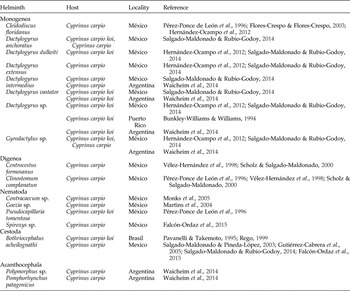
Carp are cultivated in several Latin American countries, mainly in extensive and semi-intensive aquaculture. In 2004, the production of carp in LAC reached 59,105 tonnes, behind only salmon and tilapia (FAO, 2014). Table 3 shows the helminth species recorded from farmed carp in Latin America and the Caribbean.
Helminth species recorded from carp species farmed in Latin America.

Monogeneans
Among Dactylogyrus species found on carp introduced into Latin America, Dactylogyrus extensus and Dactylogyrus vastator need special attention, due to their low host specificity and high pathogenicity (Ozer, Reference Ozer2002; Salgado-Maldonado & Rubio-Godoy, Reference Salgado-Maldonado and Rubio-Godoy2014). Several species of Dactylogyrus have been reported for cultured carp in Mexico (table 3); however, D. extensus is the most prevalent and abundant species in carp in this country (Salgado-Maldonado & Rubio-Godoy, Reference Salgado-Maldonado and Rubio-Godoy2014). In Peru, D. vastator was found in wild carp, presumably released from aquaculture facilities (Jara & Escalante, Reference Jara and Escalante1983), while in Argentina, D. extensus was found in both cultured and wild carp. There is little information on the histological damage caused by these monogeneans, or whether they produce heavy mortality in LAC. This is partially due to the low market price of carp and to the fact that they are normally released in natural waterbodies for extensive aquaculture. However, Buchmann et al. (Reference Buchmann, Lindenstrøm, Bresciani, Wiegertjes and Flik2004) emphasized the damage produced by D. vastator in the gill epithelium of carp, hindering or preventing breathing. Golovina & Golovin (Reference Golovina and Golovin1988) showed that infection by D. extensus and D. vastator can lead to pathological changes in blood cells (gradual reduction in the number of lymphocytes).
Digeneans
The metarcercariae of the highly pathogenic non-native digenean C. formosanus have been reported in Cyprinus carpio in LAC. In Mexico, C. formosanus has been detected in several states in the country (Michoacán, Morelos, Veracruz, Tabasco, Jalisco, Hidalgo, Sonora, Tamaulipas and San Luis Potosí) (Aguilar-Aguilar et al., Reference Aguilar-Aguilar, Salgado-Maldonado, Contreras-Medina and Martínez-Aquino2008). However, the spread of this parasite to other states is highly probable (Salgado-Maldonado & Rubio-Godoy, Reference Salgado-Maldonado and Rubio-Godoy2014). Nevertheless, there are very few data on the pathogenicity of C. formosanus in fish hosts in Mexico. López-Jiménez (Reference López-Jiménez1987) reported that these metacercariae may cause severe pathological problems, decreasing the fish respiratory capacity and, in heavy infections, may lead to fry mortality. Vélez-Hernández et al. (Reference Vélez-Hernández, Constantino-Casas, García-Márquez and Osorio-Sarabia1998) demonstrated the presence of moderate to severe hyperplasia of the primary lamellae of cartilage due to C. formosanus. Other histological findings included mild hyperplasia of the lymphoid tissue in the gills, epithelial hyperplasia of lamellae, gill hyperaemia and congestion (Mitchell et al., Reference Mitchell, Salmon, Huffman and Brandt2000).
Clinostomun complanatum is another digenean that has been reported to infect farmed carp in Rio Grande do Sul, southern Brazil. This digenean has been reported to occur in wild fishes as well as in cultured carp, namely Rhamdia quelen, O. niloticus, Salminus brasiliensis, Ctenopharyngodon idella and C. carpio (Vélez-Hernández et al., Reference Vélez-Hernández, Constantino-Casas, García-Márquez and Osorio-Sarabia1998; Scholz & Salgado-Maldonado, Reference Scholz and Salgado-Maldonado2000). Dias et al. (Reference Dias, Eiras, Machado, Souza and Pavanelli2003) reported cysts in the eyes that did not cause complete blindness, but which certainly could impair fish vision, thereby facilitating predation by birds.
Cestodes
The Asian tapeworm B. acheilognathi, which may cause mortality in young carp, has successfully colonized many places in the world in which carp have been introduced (Scholz, Reference Scholz1999). The rapid spread of this parasite has been aided by fish trading for a variety of purposes, including aquaculture (Lafferty et al., Reference Lafferty, Harvell, Conrad, Carolyn, Friedman, Kent, Kuris, Powell, Rondeau and Saksida2014). In South America, this endoparasite was first introduced into Brazil together with C. carpio. The first record of this non-native cestode was in the 1990s, in carp grown in the state of Paraná, southern Brazil (Rego, Reference Rego1999). Mexican workers have documented carp losses associated with the presence of this parasite in official carp farms (Salgado-Maldonado & Rubio-Godoy, Reference Salgado-Maldonado and Rubio-Godoy2014). Bothriocephalus acheilognathi is widely distributed in practically all the states of Mexico, and it is present in several environments, including rivers, sinkholes, lakes and carp farms (Salgado-Maldonado & Rubio-Godoy, Reference Salgado-Maldonado and Rubio-Godoy2014). The pathology of the tapeworm in the fish gut includes intestinal blockage, flaking and erosion of the intestinal epithelium, and bowel perforation (Salgado-Maldonado & Pineda-López, Reference Salgado-Maldonado and Pineda-López2003). Although there are few reports from other Latin American countries, in Brazil and Argentina B. acheilognathi has been identified in cultured carp without apparent mortalities.
Cultured native species
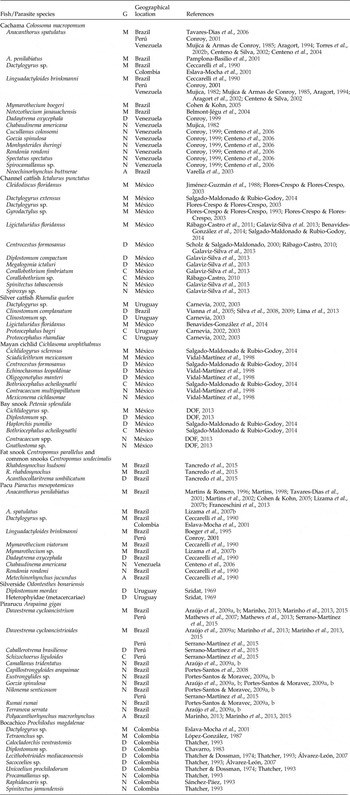
In most Latin American countries there is incipient aquaculture of native species in both freshwater and marine environments. Among the species under experimental or low-scale freshwater aquaculture are tambaqui or cachama (Colossoma macropomum), channel catfish (Ictalurus punctatus), silver catfish (Rhamdia quelen), Mayan cichlid (Cichlasoma urophthalmus), bay snook (Petenia splendida), fat snook (Centropomus parallelus), common snook (Centropomus undecimalis), pacu (Piaractus mesopotamicus), Argentinian silverside (Odonthestes bonariensis), pirarucu (Arapaima gigas) and bocachico (Prochilodus magdalenae). For seawater aquaculture, the species involved are Pacific bluefin tuna (Thunnus thynnus), yellowtail kingfish (Seriola lalandi), spotted red snapper (Lutjanus guttatus), sea bass (Dicentrarchus labrax) and snowy grouper (Epinephelus niveatus). There is no doubt that Latin American aquaculture will face serious problems with helminth parasites in the near future, with the increase in fish density in all kinds of facilities such as floating cages, earth or concrete ponds, raceways, etc. (Mujica & Armas de Conroy, Reference Mujica and Armas de Conroy1985; Aragort & Moreno, Reference Aragort and Moreno1997). Helminths with direct life cycles, such as monogeneans, are the ones that will probably appear under aquaculture conditions, especially in floating cages. Table 4 shows the helminth species recorded from freshwater native fish species farmed in Latin America.
Helminth species recorded from freshwater native fish species farmed in Latin America. G = groups of parasites, as follows: M = Monogenea, D = Digenea, N = Nematode, C = Cestode, A = Acanthocephala, H = Hirudinea.

Colossoma macropomum is the main native fish species cultured commercially in Brazil, Colombia, Cuba, Peru and Venezuela. In this fish species the most important monogenean species due to their high prevalence and mean abundance values are: Dactylogyrus sp., Anacanthorus spatulatus, Linguadactyloides brinkmanni, Mymarothecium boegeri and Notozothecium janauachensis (Ceccarelli et al., Reference Ceccarelli, Figueira, Ferraz-Lima and Oliveira1990; Belmont-Jégu et al., Reference Belmont-Jégu, Domingues and Martins2004; Centeno et al., Reference Centeno, Silva-Acuña, Silva-Acuña and Pérez2004; Cohen & Kohn, Reference Cohen and Kohn2005; Tavares-Dias et al., Reference Centeno, Altuve, Gil, Matute, Pérez, Lunar and Urbaneja2006; Dias et al., Reference Dias, Neves, Marinho and Tavares-Dias2015a). However, A. spatulatus is considered to be the main gill ectoparasite on cachama cultivated in LAC (Conroy & Conroy, Reference Conroy and Conroy1998; Torres et al., Reference Torres, Castillo, Cortez, Bravo and Fortine2002b; Dias et al., Reference Dias, Neves, Marinho and Tavares-Dias2015a), being able to reach prevalence values of 98–100% in outbreaks in cultured cachama (Aragort, Reference Aragort1994; Torres et al., Reference Torres, Castillo, Cortez, Bravo and Fortine2002b). Moreover, A. spatulatus and L. brinkmanni have also been recorded in the gills of cachama reared in Peru (Conroy, Reference Conroy2001) and Venezuela (Mujica, Reference Mujica1982; Urquia, Reference Urquia1997), causing high mortality in both juveniles and adults (Mujica & Armas de Conroy, Reference Mujica and Armas de Conroy1985; Urquia, Reference Urquia1997). Furthermore, Centeno et al. (Reference Centeno, Silva-Acuña, Silva-Acuña and Pérez2004) also reported A. spatulatus in the gills of the hybrid ‘cachama’ × ‘morocoto’ (C. macropomum × Piaractus brachypomus), with prevalence rates of above 70%. Likewise, Silva et al. (Reference Silva, Tavares-Dias, Maycon, Dias and Marinho2013) and Dias et al. (Reference Dias, Neves, Marinho and Tavares-Dias2015a) investigated the parasitic fauna infesting the hybrid tambacu (C. macropomum × P. mesopotamicus) and tambatinga (C. macropomum × P. brachypomus) at fish farms in northern Brazil. Silva et al. (Reference Silva, Tavares-Dias, Maycon, Dias and Marinho2013) reported prevalences above 77% for A. spatulatus, N. janauachensis and Mymarothecium viatorum in tambacu. Dias et al. (Reference Dias, Neves, Marinho and Tavares-Dias2015a) found infections by L. brinkmanni and M. boegeri in tambatinga. With respect to the histological lesions caused by these monogeneans in the gills of C. macropomum, Aragort et al. (Reference Aragort, Morales, León, Pino, Guillén and Silva2002) found that the affected fish showed a significant reduction in haematocrit counts and severe hyperplasia associated with mixed infections of A. spatulatus and L. brinkmanni. Similarly, Mujica (Reference Mujica1982) reported that the main histological alterations caused by L. brinkmanni in the gill tissues of cachama were severe hyperplasia and hypertrophy.
With respect to digeneans, Paramphistomidae such as Dadaytrema oxycephala have been reported as parasites of cachama (Conroy, Reference Conroy1999). Regarding nematodes, Mujica (Reference Mujica1982) reported Chabaudinema americana in the gut of C. macropomum broodstock kept in tanks in Venezuela. Cucullanus colossomi, Procamallanus inopinatus (Nematoda), Proteocephalidae larvae (Cestoda) and Neoechinorhynchus buttnerae (Acanthocephala) have been reported by Silva et al. (Reference Silva, Tavares-Dias, Maycon, Dias and Marinho2013) and Dias et al. (Reference Dias, Neves, Marinho and Tavares-Dias2015a) from the hybrids tambacu and tambatinga in fish farms in Brazil.
Channel catfish, I. punctatus, is one of the most important fish species under intensive culture in LAC. In Mexico, the production of cultured channel catfish in 2008 was 970 tonnes (Comisión Nacional de Acuacultura y Pesca, 2008). However, there are few studies about the helminth species affecting the production of channel catfish (Rábago-Castro, Reference Rábago-Castro2010; Rábago-Castro et al., Reference Rábago-Castro, Sánchez-Martínez and Loredo-Osti2011; Galaviz-Silva et al., Reference Galaviz-Silva, Molina-Garza, Escobar-González and Iruegas-Buentello2013; Benavides-González et al., Reference Benavides-González, Gomez-Flores, Sánchez-Martinez, Rábago-Castro and Montelongo-Alfaro2014). Recently, Galaviz-Silva et al. (Reference Galaviz-Silva, Molina-Garza, Escobar-González and Iruegas-Buentello2013) provided new data on the prevalence and abundance of the parasitic fauna on I. punctatus in Mexico. These authors demonstrated a great diversity of helminth parasites, including Ligictaluridus floridanus and Corallobothrium fimbriatum, and new locality records for Megalogonia ictaluri, Centrocestus formosanus, Diplostomum compactum and Spiroxys sp. They also reported a new host and distribution record for Spinitectus tabascoensis, originally described from Ictalurus furcatus from Tabasco, southern Mexico. In total, 12 helminth species have been reported from I. punctatus (Jiménez-Guzmán et al., Reference Jiménez-Guzmán, Galaviz-Silva, Segovia-Salinas, Garza-Fernández and Wesche-Ebeling1988; Flores-Crespo & Flores-Crespo, Reference Flores-Crespo and Flores-Crespo1993, Reference Flores-Crespo and Flores-Crespo2003; Scholz & Salgado-Maldonado, Reference Scholz and Salgado-Maldonado2000; Rábago-Castro, Reference Rábago-Castro2010; Rábago-Castro et al., Reference Rábago-Castro, Sánchez-Martínez and Loredo-Osti2011; Galaviz-Silva et al., Reference Galaviz-Silva, Molina-Garza, Escobar-González and Iruegas-Buentello2013; Benavides-González et al., Reference Benavides-González, Gomez-Flores, Sánchez-Martinez, Rábago-Castro and Montelongo-Alfaro2014; Salgado-Maldonado & Rubio-Godoy, Reference Salgado-Maldonado and Rubio-Godoy2014). Rábago-Castro et al. (Reference Rábago-Castro, Sánchez-Martínez and Loredo-Osti2011) reported, for first time, the prevalence and mean intensitiesy of ectoparasites of cage-cultured channel catfish in an annual cycle. The results showed peaks of prevalence of L. floridanus in early autumn. However, the presence of L. floridanus was not associated with any fish mortality. In contrast, Benavides-González et al. (Reference Benavides-González, Gomez-Flores, Sánchez-Martinez, Rábago-Castro and Montelongo-Alfaro2014) showed that the gill monogenean L. floridanus is the most common parasite of cultured channel catfish, affecting fish growth and possibly promoting secondary infections.
With the exception of the papers of Vidal-Martínez et al. (Reference Vidal-Martínez, Kennedy and Aquirre-Macedo1998), there are no records of parasites or diseases of C. urophthalmus under aquaculture conditions in Mexico. Vidal-Martínez et al. (Reference Vidal-Martínez, Kennedy and Aquirre-Macedo1998) showed that the parasites that colonized caged C. urophthalmus were species with an active colonization strategy. This was the case for the monogenean Sciadicleithrum mexicanum, the larval digeneans Echinochasmus leopoldinae and Oligogonotylus manteri, and the nematodes Mexiconema cichlasomae and Contracaecum multipapillatum. Of these parasites, the most relevant for aquaculture is the monogenean S. mexicanum, due to its direct life cycle. This monogenean is also able to infect the Nile tilapia O. niloticus under experimental conditions (Jiménez-García et al., Reference Jiménez-García, Vidal-Martínez and López-Jiménez2001).
For bay snook P. splendida, the official statistics suggest the presence of several parasite species, such as Cichlidogyrus sp., Contracaecum spp., Diplostomum sp. and Gnathostoma sp. (DOF, 2013), the last being an emerging public health problem in Mexico, with several thousand cases reported (Herman & Chiodini, Reference Herman and Chiodini2009; Diaz, Reference Diaz2015). However, these records need to be re-examined. For example, Cichlidogyrus is a very specific monogenean genus of African cichlids (e.g. tilapia). If the identification is correct, then this would be a new record of an African monogenean infecting a native Mexican cichlid fish. Therefore, we consider it necessary to evaluate further the parasitological material deposited in proper museum collections. Recently, Tancredo et al. (Reference Tancredo, Marchiori, Roumbedakis, Cerqueira, Tavares-Dias and Martins2015) investigated the metazoan parasite fauna of C. parallelus and C. undecimalis, bred in southern Brazil, and its influence on the condition factor of hosts. The monogeneans Rhabdosynochus rhabdosynochus and Rhabdosynochus hudsoni were recorded in the gills of both species, and the digenean Acanthocollaritrema umbilicatum was reported from their digestive tracts. Prevalence of Rhabdosynochus spp. was high (100%) in both species. In contrast, mean intensity and abundance were higher in C. parallelus. A negative correlation was found between monogenean abundance and condition factor in C. parallelus, suggesting that gill monogeneans do alter fish welfare. There was no correlation between abundance of A. umbilicatum and length or weight of either C. parallelus or C. undecimalis.
Piaractus mesopotamicus is cultured in several countries in LAC, including Brazil (Lizama et al., Reference Lizama, Takemoto, Ranzani-Paiva, Silva-Ayroza and Pavanelli2007b). In Argentina, native pacu covers at least 30% of the domestic market demands (Macchi, Reference Macchi2004). Several species of monogeneans (Anacanthorus penilabiatus, A. spatulatus, L. brinkmanni, Mymarothecium viatorum, Dactylogyrus sp.) have been reported in aquaculture conditions (Ceccarelli et al., Reference Ceccarelli, Figueira, Ferraz-Lima and Oliveira1990; Boeger et al., Reference Boeger, Husak and Martins1995; Martins, Reference Martins1998; Conroy, Reference Conroy2001; Tavares-Dias et al., Reference Tavares-Dias, Moraes, Martins and Kronka2001; Martins et al., Reference Martins, Onaka, Moraes, Bozzo, Paiva and Goncalves2002; Cohen & Kohn, Reference Cohen and Kohn2005; Lizama et al., Reference Lizama, Takemoto, Ranzani-Paiva, Silva-Ayroza and Pavanelli2007b). However, A. penilabiatus and A. spatulatus have been registered as the most important gill parasites in the aquaculture of P. mesopotamicus in Bolivia, Cuba, Peru, Venezuela and Brazil (Conroy & Conroy, Reference Conroy and Conroy1998; Del Pozo, Reference Del Pozo2000; Tavares-Dias et al., Reference Tavares-Dias, Moraes, Martins and Kronka2001). With respect to the histopathological damage caused by A. penilabiatus in cultured P. mesopotamicus, Martins & Romero (Reference Martins and Romero1996) found an inflammatory reaction and moderate hyperplasia of epithelial cells in the gills. In the same study, the authors pointed out that the damage produced by this monogenean was not extensive in low to moderate infections (<33 parasites/host). However, in heavy infections (>33 parasites/host) the parasite caused considerable changes in primary and secondary lamellae, associated with multiple sites of bleeding, detachment of respiratory tissue and numerous necrotic foci. Lizama et al. (Reference Lizama, Takemoto, Ranzani-Paiva, Silva-Ayroza and Pavanelli2007b) also showed a negative correlation between the abundance of A. penilabiatus and the condition factor of farmed P. mesopotamicus in Brazil.
Knowledge on the helminth parasites infecting A. gigas under aquaculture conditions is scarce. Recently, Marinho et al. (Reference Silva, Tavares-Dias, Maycon, Dias and Marinho2013) found in Brazil that the host condition factor was negatively correlated with the number of Dawestrema cycloancistrium and Dawestrema cycloancistrioides, which demonstrates the pathogenicity of these parasites in gills of farmed A. gigas. Araújo et al. (Reference Araújo, Gomes, Tavares-Dias, Raújo, Andrade, Belem-Costa, Borges, Queiroz and Barbosa2009a, Reference Araújo, Tavares-Dias, Gomes, Andrade, Lemos, Oliveira, Cruz, Affonso and Tavares-Diasb) and Mathews et al. (Reference Mathews, Mathews and Ismiño2013) recorded the infection by D. cycloancistrium and D. cycloancistrioides as the most prevalent helminths parasitizing cultured A. gigas (100% and 85%, respectively). Aquaria, a specialized variant of aquaculture enterprises, have serious problems due to monogenean infections in A. gigas in LAC. This fish species experiences severe morbidity and heavy mortality due to D. cycloancistrium (Mathews et al., Reference Mathews, Chu-Koo, Tello, Malta, Varella and Gomes2007) in aquaria. In addition, infections by the nematodes Goezia spinulosa (Caldas-Menezes et al., Reference Caldas-Menezes, Cursino dos Santos, Ceccarelli, Tavares, Tortelly and Luque2011), Terranova serrata and Camallanus tridentatus have also been reported from A. gigas in aquaria (Araújo et al., Reference Araújo, Gomes, Tavares-Dias, Raújo, Andrade, Belem-Costa, Borges, Queiroz and Barbosa2009a, Reference Araújo, Tavares-Dias, Gomes, Andrade, Lemos, Oliveira, Cruz, Affonso and Tavares-Diasb). However, with the exception of monogeneans, the nematodes will eventually be lost in aquaria if the intermediate hosts needed to complete the life cycle are not present. A single report exists of the digenean Caballerotrema brasiliense in A. gigas from farms of the Peruvian Amazon (Serrano-Martínez et al., Reference Serrano-Martínez, Tantaleán, Leguía, Quispe and Casas2015).
The bocachico, P. magdalenae, is a native of Colombia's Magdalena region and the fourth most frequently cultivated species in Colombia. This fish has been cultivated for several years in ponds (Sarmiento & Rodríguez, Reference Sarmiento and Rodríguez2013), and several helminth species have been recorded infesting farmed P. magdalenae, including Dactylogyrus sp., Tetraonchus sp., Calocladorchis ventrastomis, Diplostomum sp., Lecithobotrioides mediacanoensis, Sacocoelios sp., Unicoeliun prochilodorum, Procamallanus sp., Raphidascaris sp. and Spinitectus jamundensis (Nickol & Thatcher, Reference Nickol and Thatcher1971; Thatcher & Dossman, Reference Thatcher and Dossman1974, Reference Thatcher and Dossman1975; Thatcher & Padilha, Reference Thatcher and Padilha1977; Chavarro, Reference Chavarro1983; López-González, Reference López-González1987; Sánchez-Páez, Reference Sánchez-Páez1993; Thatcher, Reference Thatcher1993; Eslava-Mocha et al., Reference Eslava-Mocha, Verján and Iregui-Castro2001; Álvarez-León, Reference Álvarez-León2007). However, so far, there are apparently no specific records of diseases caused by helminths in cultivated bocachicos.
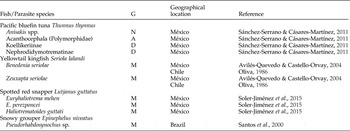
Mariculture enterprises may also be hampered by severe parasitic helminth infections. Table 5 presents the helminth species recorded from native seawater species farmed in Latin America.
Helminth species recorded from seawater native fish species farmed in Latin America. Groups of parasites (G) were as follows: M = Monogenea, D = Digenea, N = Nematode, C = Cestode, A = Acanthocephala.

Marine aquaculture of bluefin tuna is based on fattening wild juveniles. Consequently, it makes sense to consider the parasites and diseases that these juveniles bring into floating cages. Sánchez-Serrano & Cásares-Martínez (Reference Sánchez-Serrano and Cásares-Martínez2011) reported nematodes of the genus Anisakis spp., trematodes of the subfamilies Nephrodidymotrematinae and Koellikeriinae, and acanthocephalans of the family Polymorphidae. The nematodes of the Anisakis genus are accidental parasites of humans, producing the disease known as anisakiasis. Consequently, sanitary measures should be adopted to avoid the presence of these parasites in tuna fillets. In the case of caged yellowtail (Seriola lalandi) in Mexico, the infections by the monogeneans Benedenia sp. and Heteraxine sp. are considered important because they produce decreases in feeding rate, anaemia, weakness and mortality (Avilés-Quevedo & Castello-Orvay, Reference Avilés-Quevedo and Castello-Orvay2004). In Chile, S. lalandi is one of the most important candidates for commercial aquaculture. In sea cages in northern Chile, S. lalandi is parasitized by the monogenean Benedenia seriolae (Capsalidae) on the body surface and by Zeuxapta seriolae (Heteraxinidae) as a sanguineous gill fluke (Oliva, Reference Oliva1986).
In official statistics, Neobenedenia has been reported infecting Lutjanus guttatus in aquaculture conditions in Mexico (DOF, 2013). However, we found no published records on this parasitic association. Other ectoparasites reported infecting L. guttatus in floating cages in Mexico were the monogeneans Euryhaliotrema perezponcei, Euryhaliotrema mehen and Haliotrematoides guttati (Soler-Jiménez et al., Reference Soler-Jiménez, Morales-Serna and Fajer-Ávila2015). The authors stressed that even under the juvenile fish densities studied (789/m3) no mortality was found, and a high number of E. perezponcei was reached (prevalence = 100%; mean intensity = 154–296 parasites per infected host) during 9 months of exposure. The authors concluded that the infection should be monitored over time to prevent outbreaks and mortality, especially under intensive aquaculture conditions. In fact, sublethal effects of the dactylogyrid monogeneans infecting cultured L. guttatus should also be considered carefully, since Del Río-Zaragoza et al. (Reference Del Río-Zaragoza, Fajer-Ávila and Almazán-Rueda2010) found that a high level of infection (≥100 monogeneans per fish) caused changes in the number of blood cells and histological alterations in gill tissue.
Cultured ornamental species
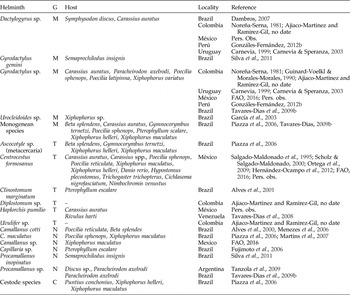
Ornamental fish export has emerged as an important activity, generating foreign exchange, for several Latin American countries (e.g. Brazil, Colombia, Mexico, Peru and Uruguay) (Carnevia, Reference Carnevia1999; Carnevia & Speranza, Reference Carnevia2003; Tavares-Dias et al., Reference Araújo, Gomes, Tavares-Dias, Raújo, Andrade, Belem-Costa, Borges, Queiroz and Barbosa2009a). For example, from 2006 to 2007 the revenue of the south-east region of Brazil included US$418,572 from sales of freshwater ornamental fish. In 2007, sales of freshwater ornamental fish increased 100% (Tavares-Dias et al., Reference Tavares-Dias, Lemos, Martins, Jeronimo and Tavares-Dias2009a). However, most of the income came from sales of ornamental fish captured from natural environments (principally the Amazonian basin) and only a small amount was generated from sales of fish from fish farms. Despite this, the demand for cultured ornamental fish is increasing, and consequently parasitic infections can be one of the most important problems for cultured fish in the region. However, few studies regarding parasitic infection of cultured ornamental fish have been published for LAC. Piazza et al. (Reference Piazza, Martins, Guiraldelli and Yamashita2006), Martins et al. (Reference Martins, García, Piazza and Ghiraldelli2007) and Tavares-Dias et al. (Reference Araújo, Gomes, Tavares-Dias, Raújo, Andrade, Belem-Costa, Borges, Queiroz and Barbosa2009a) recorded high prevalence rates of metazoan parasites, such as monogeneans and nematodes, from cultured ornamental fish farms or pet shops in Brazil. In table 6 we present the helminth species recorded from cultured ornamental fish in LAC.
Helminth species recorded from ornamental fish species farmed in Latin America. G = groups of parasites, as follows: M = Monogenea, D = Digenea, N = Nematode, C = Cestode, A = Acanthocephala.

Ornamental fish in intensive culture are continuously affected by management practices such as handling, crowding, transport and poor water quality that provoke stress to fish, rendering them susceptible to a variety of parasites. For LAC, there are several records of helminths affecting ornamental fish cultivated mainly in Brazil and Mexico. However, there are a few records of catastrophic negative impacts where a helminth is involved as a causative agent. For example, mixed infections by monogeneans such as Gyrodactylus sp. and Dactylogyrus sp. on gills and skin have been responsible for high mortality rates (60–70%) within a few days among golden carp, Carassius auratus, in aquarium fish in Peru (Gonzáles-Fernández, Reference Gonzáles-Fernández2012b). In this case, the pathology described was increased mucus in the gills, as well as a strong detachment of the epidermis and the loss of the caudal fin. Likewise, in Brazil, Alves et al. (Reference Alves, Luque, Paraguassu and Marques2000) reported high mortalities of Poecilia reticulata in fish farms due to infection with the nematode Camallanus cotti. This mortality was due to the pathology caused by C. cotti, with haemorrhage, congestion, oedema and extensive areas of eroded mucosa in the intestine and rectum (Menezes et al., Reference Menezes, Tortelly, Tortelly-Neto, Noronha and Pinto2006). Ortega et al. (Reference Ortega, Fajardo and Enríquez2009) found gill infections by Centrocestus formosanus metacercarie in 11 out of 25 species of ornamental fish cultured in Mexico, where the most affected species was goldfish, C. auratus. The negative effect of C. formosanus on farmed fish was confirmed in moribund individuals that manifested respiratory abnormality and, histologically, showed severe branchial lesions caused by metacercariae (Ortega et al., Reference Ortega, Fajardo and Enríquez2009). These authors stressed the low host specificity of C. formosanus, which is the main reason for a great variety of fish being infected with different degrees of prevalence and severity (Scholz & Salgado-Maldonado, Reference Scholz and Salgado-Maldonado2000; Vidal-Martínez et al., Reference Vidal-Martínez, Aguirre-Macedo, Scholz, González-Solís and Mendoza-Franco2001).
Discussion
The present contribution shows that more than 90% of the helminth parasites affecting finfish in aquaculture conditions in LAC are non-native. For example, 40 species of helminths have been introduced to Mexico, among which 33 are monogeneans (Salgado-Maldonado & Rubio-Godoy, Reference Salgado-Maldonado and Rubio-Godoy2014). This means that most of these helminths have been introduced with their hosts by commercial trade, suggesting an almost complete lack of application of biosecurity measures in LAC countries. However, there is a general trend among the aquaculture farm owners of the region to consider helminth parasites as non-pathogenic, because many of them do not produce significant mortalities or visible pathologies. The authors consider that this assumption is a mistake because helminth parasites can become harmful under the challenging environmental circumstances typical of fish farms (e.g. high temperature and productivity, low water exchange rate and high fish density) (Paredes-Trujillo et al., Reference Paredes-Trujillo, Velázquez-Abunader, Torres-Irineo, Romero and Vidal-Martínez2016a). This is especially true for monogeneans, which are recognized as the most common, abundant and aggressive helminths affecting farmed fish (Whittington et al., Reference Whittington, Corneillie, Talbot, Morgan and Adlard2001; Ernst et al., Reference Ernst, Whittington, Corneille and Talbot2002; Whittington, Reference Whittington and Rohde2005; Soler-Jiménez et al., Reference Soler-Jiménez, Morales-Serna and Fajer-Ávila2015).
In LAC, there are several anecdotal reports of high mortalities of farmed fish caused by helminths, especially monogeneans, representing severe economic losses (Mujica & Armas de Conroy, Reference Mujica and Armas de Conroy1985; Kaneko et al., Reference Kaneko, Yamada, Brock and Nakamura1988; Conroy, Reference Conroy2001; García-Vásquez et al., Reference García-Vásquez, Hansen, Christison, Bron and Shinn2011). For example, infections with C. sclerosus have important effects on the growth rates and relative condition factors of their hosts, which in turn affects tilapia farmers economically (Sandoval-Gío et al., Reference Sandoval-Gío, Rodríguez-Canul and Vidal-Martínez2008; Le Roux, Reference Le Roux2010; Paredes-Trujillo et al., Reference Paredes-Trujillo, Velázquez-Abunader, Torres-Irineo, Romero and Vidal-Martínez2016a). Moreover, other helminth species, such as the ‘yellow grub’, are argued to produce economic losses due to the poor appearance that they produce in farmed fish (Mitchell et al., Reference Mitchell, Goodwin, Salmon and Brandt2002; Pavanelli et al., Reference Pavanelli, Eiras and Takemoto2002; Vianna et al., Reference Mitchell, Overstreet, Goodwin and Brandt2005; Silva et al., Reference Silva, Monteiro, Doyle, Pedron, Filipetto and Radunz-Neto2008; Sutili et al., Reference Sutili, Gressler and Vilani de Pelegrini2014). Unfortunately, none of these studies has included a bioeconomic analysis to determine the financial resources lost due to the presence of helminths in fish cultured in LAC. Such analyses are urgently needed.
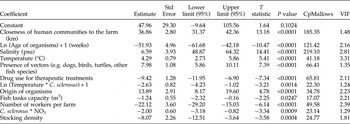
It is difficult to calculate the economic costs attributable to helminth infections due to the complex interplay of numerous environmental and management factors that vary among individual fish farms at the global level. Similar concerns have been expressed by Shinn et al. (Reference Shinn, Pratoomyot, Bron, Paladini, Brooker and Brooker2015) with respect to salmonid diseases in temperate latitudes, and complexity is even more extreme in LAC, partly due to the reluctance of the farm owners to share information on the causes of fish mortality. As a notable exception, Paredes-Trujillo et al. (Reference Paredes-Trujillo, Velázquez-Abunader and Vidal-Martínez2016b) were able to obtain information on the mortality, environmental and management variables of 21 tilapia farms in Yucatan, Mexico, thanks to the kind collaboration of their owners. Using this dataset, a multivariate regression analysis was undertaken using the percentage of mortality as a dependent variable and 12 environmental and management variables (out of 45 variables), including the abundance of all the parasite species found per individual fish as an independent variable (table 7). The results of this analysis suggest that helminths can contribute to fish mortality, but only in synergy with other environmental and management variables. For the 21 tilapia farms in Yucatan, the mean percentage of mortality (± standard deviation) due to all those variables (including abundance of helminths) was 36 ± 43% (table 7). Considering the price of a kilogram of whole tilapia, between US$3 and 5 (https://www.alibaba.com/products/F0/tilapia_wholesale_price), the economic cost produced by mortality was between US$7821 ± 21,991 and US$13,034 ± 36,652 per year per farm. When an analysis was made considering only the effects of helminth parasites on fish mortality, the result was not significant (ANOVA with linear regression; F 1,396 = 0.76; P = 0.49). However, it is still possible that helminth parasites do not kill the fish, but that they produce a subtle and important debilitating effect on the condition factor of the tilapia at farms in Yucatan (Paredes-Trujillo et al., Reference Paredes-Trujillo, Velázquez-Abunader and Vidal-Martínez2016b). This generalized debilitation should be considered as part of the synergy mentioned above. The authors were not able to obtain datasets for salmonids or carp, similar to the one for tilapia, to quantify the economic cost of helminth infections. However, it is considered that the tilapia farms in Yucatan are a good model when trying to understand the sanitary circumstances of finfish aquaculture in LAC, with the results obtained here applying to rural areas of most countries where tilapia and other freshwater or marine fishes are farmed. The reason for the large values of the standard deviation of the percentage of mortality is associated with the fact that LAC farmers often lack the technical expertise in proper sanitary management at farm level. Very often, when disease occurs in the farm, chemotherapeutic treatments are applied, without strict dose control. However, the most important side-effects of the use and misapplication of chemical products (e.g. antibiotics, disinfectants) are microbial and parasite resistance, chemical toxicity and persistence of chemical residues (Chávez-Sánchez & Montoya-Rodríguez, Reference Chávez-Sánchez and Montoya-Rodríguez2004). Without a doubt, aquaculture in LAC needs appropriate biosecurity measures, including risk analysis, surveillance and monitoring, as well as planning to respond effectively to outbreaks of diseases in aquatic animals (Bondad-Reantaso et al., Reference Bondad-Reantaso, Subasinghe, Arthur, Ogawa, Chinabut, Adlard, Tan and Shariff2005). To reach this level of development in LAC, basic and applied research on specific sanitary problems of farmed aquatic animals is necessary, as well as institutional strengthening and human resource development (good extension programmes, education for both aquaculture farm owners and technicians, as well as training for aquatic animal health experts).
Multivariate regression analysis using the percentage of mortality as a dependent variable, and the best 12 environmental and management independent variables (out of 45 variables) (see supplementary table S1) selected by a stepwise procedure. The coefficient of determination of this model was R 2 = 0.71 for N = 399. The best regression model was chosen based on the lowest values of the CpMallows (model selection method) and variance inflation factor (VIF) statistics. The maximum P value for each variable to entry the model was 0.01, and the maximum value for retention of the variable was 0.05. The normality of all variables was verified using Wilk–Shapiro rankit plots (WS), and if normality was not attained (WS > 0.8), then the variables were transformed to natural logarithms + 1.

Therefore, preventive and control measures should be implemented to limit the size of the helminth populations in cultured fish and to minimize the probability of potential diseases. A successful helminth control programme consists of the selection of fish free of helminth parasites from the place of origin, proper quarantine, good husbandry practices, prophylactic measures, correct diagnosis and, if necessary, therapeutic treatment (Abayomi et al., Reference Abayomi, Balogun, Omonona and Yusuf2013). Preventive measures in fish parasite control (including helminths), such as effective quarantine, are often ignored, resulting in a much higher economic expenditure to eliminate imported pathogenic parasites. It must be emphasized that prevention is the key and therapeutic treatment should be seen as the last alternative.
Nowadays, avoiding the entry of new helminth species to the region is one of the main challenges that aquaculture is facing in LAC. This is a very important topic because, in the same way that viral diseases have been translocated into LAC (e.g. white spot in shrimps in Mexico and infectious salmon anaemia (ISA) in salmonid fishes in Chile) (http://www.oie.int/en/), other harmful helminth parasites could be translocated into LAC. Unfortunately, it must be recognized that surveillance programmes for aquatic diseases in many LAC regions are weak. In addition, their implementation presents many problems: (1) the lack of standardization of diagnostic tests; (2) socio-economic factors and the lack of technological development in many regions in LAC; (3) the diversity of cultivated species, range and complexity of the environment; and (4) the intensity of practice, variety of farming systems and management types (Bondad-Reantaso et al., Reference Bondad-Reantaso, Subasinghe, Arthur, Ogawa, Chinabut, Adlard, Tan and Shariff2005). Moreover, it is important to realize that one of the most important current challenges in LAC is the lack of capacity to diagnose accurately and report diseases in aquatic animals. Vidal-Martínez (Reference Vidal-Martínez2012) reviewed the capacity of countries within LAC to diagnose and report selected World Organization for Animal Health (OIE)-listed diseases of aquatic animals, based on 16 years of data available in the OIE databases. This author found that diagnosis performance and reporting of OIE-listed diseases were significantly associated with aquaculture production in the countries. Three groups of countries were determined. The first group included countries with aquaculture production >200,000 tonnes/year, which had maintained their diagnostic capacities for 15 years (e.g. Brazil, Chile and the USA). The second group included countries with less than 200,000 tonnes of aquaculture production per year, which had maintained their diagnostic capacities for 10–15 years (e.g. Canada, Colombia and Mexico). The third group included countries that had been unable to maintain consistent diagnostic reporting for more than 5 years for OIE diseases (73% of the analysed countries in LAC). Countries in the third group are unprotected against the potential introduction of OIE-listed diseases and other kinds of important helminth parasites in aquaculture. Clearly, there is an urgent need to develop sound biosecurity programmes in these countries, as well as the physical and human capacity to deal with the proper diagnosis of these diseases and parasites (including helminths). Therefore, it is necessary to propose strategies to address transboundary diseases affecting the sector of Latin American aquaculture, including compliance with the international codes established by the World Organisation for Animal Health (OIE, 2015).
Vidal-Martínez (Reference Vidal-Martínez2012) proposed two strategic lines that should be considered for the development of the sanitary aspects of aquaculture in LAC in the near future. First, due to the incipient development of the diagnostic capacity for OIE-listed diseases and helminth parasitic diseases affecting aquaculture in LAC, there is a need for more experts in diseases of fish in the region. The freshwater and marine aquaculture producers need the support of experts, in view of the imminent development of the market in the region (see FAO, 2015). Second, academic institutions throughout the whole region need to be in touch with the producers, to generate the kind of experts needed to warrant the sanitary development of aquaculture in LAC. In addition, awareness at all levels (managers, officers, employees) of the correct application of sanitary measures, is one of the most important challenges that LAC faces to reduce the spread of diseases (FAO, 2016).
Therefore, the importance of health standards, surveillance and monitoring programmes suggested by international organizations (e.g. FAO, OIE) and enforced by national authorities, which guarantee and certify the quality of aquatic products that are distributed inside and outside each country, is evident. While these are not carried out properly, the future of sustainable aquaculture in LAC is uncertain.
Supplementary material
To view supplementary material for this article, please visit https://doi.org/10.1017/S0022149X16000833
Acknowledgements
The authors thank C. Vivas-Rodríguez, N. Herrera Castillo and A. Centeno-Chalé of CINVESTAV-Mérida for support with the field and laboratory work, and to M.A. Soler-Jiménez and L.F. Sauma-Castillo for support in the literature search.
Financial support
This work was supported by grant No. 201441 ‘Plataformas de observación oceanográfica, línea base, modelos de simulación y escenarios de la capacidad natural de respuesta ante derrames de gran escala en el Golfo de México’ of the Sectorial Hidrocarbon Fund Consejo Nacional de Ciencia y Tecnología (México)–Secretaría de Energía (CONACYT-SENER) to the Consorcio de Investigación del Golfo de Mexico (CIGoM) in which L.C.S.J. and V.M.V.M. participate.
Conflict of interest
None.