Introduction
Prehospital patient assessment is different compared to assessments provided in hospitals. Often, the ambulance personnel are sent to medical emergencies with very little background information. The person who initiates the call for help sometimes is not able to describe the situation, and therefore, the ambulance personnel have difficulties preparing themselves for the task. The ambulance personnel’s work situation has been described as “extreme”. “They have routinely required working in environments of extreme and constant uncertainty.”Reference Shaban, Wyatt Smith and Cumming1 These environmental factors lead to great strain on the prehospital caregiver’s ability when assessing patients. In addition, there have been very few randomized controlled trials (RTC) that have evaluated prehospital care.Reference Brazier, Murphy, Lynch and Bury2 When 14 ambulance nurses in Sweden were asked about factors that influence their decision-making, several factors that were crucial for the decision were elicited. Important factors included: (1) time of day; (2) season and weather; (3) amount of time before other resources could arrive to the scene; (4) if there was threat of security; (5) stress; (6) environment; (7) diagnosis and; (8) type of patient assessed.Reference Gunnarsson and Warrén Stomberg3 A qualitative study by Wireklint Sundström described the need of an “open mind” in the performance of prehospital assessments, and noted that prehospital caregivers must put their preconceived ideas aside when they meet and assess patients.Reference Wireklint Sundström4 As assessments and treatments of patients in prehospital emergency medical care are becoming more advanced and complex, prehospital emergency care is on the eve of a new and emerging role.Reference Cooper and Grant5 Many organizations are searching for alternatives to Accident and Emergency (A&E) treatments,Reference Schmidt, Atcherson and Federiuk6 but according to a recent systematic review, prehospital personnel’s preparedness for this task is poor.Reference Brown, Hubble and Cone7 Another future task will include “clinical pathways”. Clinical pathways help to reduce the number and severity of in-hospital complications.Reference Rotter, Kinsman and James8 If the prehospital care becomes a part of clinical pathways, it will impose many demands on prehospital personnel to make correct assessments. This indicates that decision support tools (DST) probably will be required in the future. A decision-support tool often is defined as electronic or non-electronic active knowledge systems that use at least two objects of patient data to generate case-specific advice designed to support clinical decision-making. Decision support can be defined as protocols, guidelines, and different triage systems. The function of the decision-support data is to create individual patient assessments or recommendations that support all level of prehospital medical personnel.
Using a Delphi consultation, the question, “What are the highest priorities for research in prehospital care?” was studies, with one of the research issues being the DST.Reference Snooks, Evans and Wells9 Several systematic reviews have evaluated the efficacy of the use of the DST in primary health care and in hospital settings,Reference Garg, Adhikari and McDonald10–Reference Shojania Kaveh, Jennings and Mayhew14 which demonstrated that use of DSTs can improve the performance of health workers, but its effects on patient outcomes still was unclear. There has been no published review that has evaluated effects of the use of the DST in prehospital emergency care. The aim of this systematic review is to investigate the DST’s impact on prehospital patient assessment.
Methods
Selection Criteria
Type of Studies—Randomized controlled trials that compared the use of a DST with usual care were included in this systematic review. Included studies may have used patients, prehospital personnel, hospitals, or ambulance stations/organizations as the unit of randomization.
Evidence of interventional studies depends on whether the study was randomized or not. Studies have suggested that non-randomized, controlled trials are associated with selection bias, and should not be included in systematic reviews of interventions.Reference Deeks, Dinnes and D’Amico15
In this review, the SIGN50 checklist was used as a rating tool for quality assessment of included studies.16 In a study that evaluated different kinds of quality assessment instruments, the conclusion was that this checklist is the best for evaluating assessments of randomized, controlled trials.Reference Shukla17 To be included in the review, a study must be rated as a “+” or “++”. To be rated as “++”, the studies must have met all or most of the criteria, and the conclusion from the study was unlikely to change. The rating “+” indicated that some of the criteria are fulfilled, but those criteria not fulfilled were unlikely to have altered the conclusion.
Types of Participants—Studies in which prehospital personnel assess patients with an acute illness or injuries in and out of the hospital setting are eligible.
Types of Interventions—Decision support can be both electronic and non-electronic. One definition of an electronic DST is, “active knowledge systems which use two or more items of patient data to generate case-specific advice”.Reference Wyatt and Spiegelhalter18 Perreault and Metzgerlist used four key functions listed below:Reference Perreault19
1 Administrative—Supporting clinical coding and documentation, authorization of procedures, and referrals;
2 Managing Clinical Complexity and Details—Keeping patients on research and chemotherapy protocols; tracking orders, follow-up of referrals, and preventive care;
3 Cost Control—Monitoring medication orders; avoiding duplicate or unnecessary tests; and
4 Decision Support—Supporting clinical diagnosis and treatment plan processes, and promoting use of best practices, condition-specific guidelines, and population-based management.”
To be eligible for this review, the studies had to fulfill criteria #4.
For this review, the inclusion criteria were studies comparing the use of an electronic or non-electronic DST (where patient-specific assessments or recommendations were given to ambulance personnel) with usual care in a clinical setting. Decision support can be protocols, guidelines, triage systems, and computer based DSTs. Triage systems without decision support were excluded. For example, if a triage system only gave the patient a color, number, or letter to use in the emergency department to prioritize the patient, it did not qualify as a DST. If the triage system also gave the care provider in the ambulance a suggestion of further examination and treatment, it could be qualified as a DST. In cases in which it was not possible to determine if the DST or the interventions (i.e., medical treatment or education), had influenced the outcome, the study was excluded.
Types of Outcome Measures
Primary Outcomes
Diagnostic Accuracy—Can the use of a DST improve the ambulance personnel’s ability to correctly diagnose a prehospital patient? Diagnostic ability is important to give the patient sufficient treatment and transport to which he/she had the right level of care. Studies that evaluated a DST’s impact on diagnostic ability were eligible.
Compliance with Recommended Practice—Compliance with guidelines has importance to patient outcome.Reference Peterson, Roe and Mulgund20 This review attempted to establish if a DST increased the ambulance personnel’s adjustment to guidelines.
Time to Definitive Care—Many patients may have been objects of “clinical pathways” or “fast tracks” when they are transported to different types of treatment centrals. Examples of definitive care include emergency rooms, stroke units (SUs), primary percutaneous coronary intervention (PCI) centers, or trauma centers. This review includes studies that evaluated the impact of the DST on the time from call to definitive care.
Patient Outcomes—Studies that compared the impact of the DST with usual care on the patient’s outcome were included. Patient outcome may have been measures of morbidity or mortality.
Secondary Outcomes
1 Patient Satisfaction—Studies that evaluated the patient’s satisfaction with the assessments and treatments with a DST were eligible; and
2 Personnel Satisfaction: Studies that evaluated the satisfaction of prehospital personnel with DSTs were eligible.
Search Methods
Electronic Searches—Searches were performed in the following databases from January until April 2010: (1) Cochrane Reviews (up to January 2010); (2) Cochrane Controlled Clinical Trials (1979 to January 2010); (3) Cinahl (1986 to January 2010); and (4) Pubmed/Medline (1926 to January 2010). There was no restriction of language or year of publication. The search strategy was pilot tested and adjusted before performance of the final search. The combination of the following terms was used in the search:
1 MeSh Terms: emergency medical services, emergency medical technicians, emergency treatment, emergency medicine, ambulances, air ambulances, first aid, military medicine, emergency medical service communication systems, decision support systems (clinical), decision making (clinical), decision support techniques, decision making, computerized patient record, decision making (patient), clinical protocols, and emergency treatment.
2 Text Terms: prehospital, pre-hospital, paramedic, ambulance, out-of-hospital, out of hospital, EMS, EMT, emergency services, emergency medical service, emergency technician, emergency practitioner, emergency dispatch, first responder, emergency rescue, emergency triage, patient assessment.
Searching Other Resources—In addition to searching medical databases, a hand search was performed in 18 relevant magazines: Emergency Medicine Journal (March 1984 to January 2010), Emergency Nurse (February 2002 to December 2009), Medical Informatics & the Internet in Medicine (January 1999 to December 2009), Military Medicine (January 2003 to January 2010), Medical Decision Making (January 1981 to January 2010), BMC Medical Informatics And Decision Making (January 2001 to January 2010), Journal of Telemedicine and Telecare (January 1996 to January 2010) Air Medical Journal (January 1993 to January 2010), Australian Journal of Emergency Management (January 1998 to January 2010), Canadian Journal of Emergency Medicine (January 1999 to January 2010), Emergency Medicine Australasia (January 1999 to 2010), Journal of Emergency Primary Health Care (January 2003 to January 2010), Emergency Medical Services Magazine (January 2003 to January 2010), Journal of Air Medical Transport (January 1989 to January 1992), Prehospital and Disaster Medicine (January 2002 to January 2009), Prehospital Emergency Care (January 1997 to January 2010), Pre-Hospital Immediate Care (January 2000 to December 2000), IEEE Transactions on information Technology in Biomedicine (January 1997 to January 2010).
Nine prehospital home pages were searched: Australian Directory of Prehospital Research (February 2010), National Association of EMS Physicians (February 2010), National Association of EMS Educators (February 2010), AMBEX (UK) (February 2010), Australasian College of Ambulance (February 2010), World Congress on Disaster and Emergency Medicine (February 2010), Society for Academic Emergency Medicine (February 2010), Canadian Association of Emergency Physicians (February 2010), American College of Emergency Physicians (ACEP) Meeting (February 2010).
In addition, searches were conducted in two databases for conference abstracts: Biological Abstracts/RRM (February 2010), British Library Inside (February 2010), fifteen databases for present clinical trials: The Australian New Zealand Clinical Trials Registry (February 2010), CenterWatch Clinical Trials Listing Service (February 2010), ClinicalTrials.gov register (February 2010), Community Research & Development Information Service (of the European Union) (trials and other research) (February 2010), Current Controlled Trials metaRegister of Controlled Trials (mRCT) - active registers (February 2010), European Medicines Agency (February 2010), WHO International Clinical Trials Registry (February 2010), Hong Kong clinical trials register (February 2010), Indian clinical trials registry - Clinical Trials Registry-India (February 2010), Netherlands trial register (February 2010), South African National Clinical Trial Register (February 2010), UK Clinical Research Network Portfolio Database (February 2010), University hospital Medical Information Network (UMIN) Clinical Trials Registry (for Japan) - UMIN CTR (February 2010), three databases for grey literature: Open single database (up to January 2010), The National Technical Information Sevice database (1962 to January 2010), PsykEXTRA database (up to January 2010) and three databases for theses: Dissertations & Theses (1975 to January 2010), DIVA (up to January 2010), Index to Theses (up to January 2010). The reference list of relevant studies was also searched.
Selection of Studies—In the first step, one investigator screened titles and abstracts for eligible studies. Abstracts of interest were downloaded to a reference manager and full text copies were retrieved. In the second step, full text articles were assessed for eligibility by two independent investigators. Studies that did not fulfil the inclusion criteria were excluded. In the last step, the SIGN 50 checklists for RCTs was used for methodological quality assessment. Disagreement on screening results was resolved by discussion. Data was extracted and handled by a data abstraction form specially developed for this review.
Results
Results of the Search
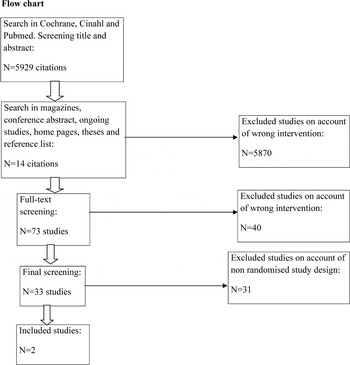
The database search initially identified 5,929 citations. After excluding studies in the first screening and removing duplicates, 59 citations remained. The search in magazines, conference abstracts, ongoing studies, home pages, theses and reference lists provided an additional 14 citations. Full text screening was performed for 73 articles. Of those, 33 studies were eligible for final screening, and 31 studies were excluded because of study design (Figure 1). One ongoing trial of the prehospital application of DST was found (Snooks, TRIAL REGISTRATION: ISRCTN10538608.),Reference Peterson, Roe and Mulgund20 but no data were available at the time of writing. Two trials fulfilled the inclusion criteria.Reference De Luca, Toni and Lauria21,Reference Woollard, Hayward and Taylor22 Due to differences in the types of statistical methods reported in the trials, a meta-analysis was not possible. Instead, the data were reported in tabular and narrative format.
Flow diagram of included and excluded studies

Excluded Studies
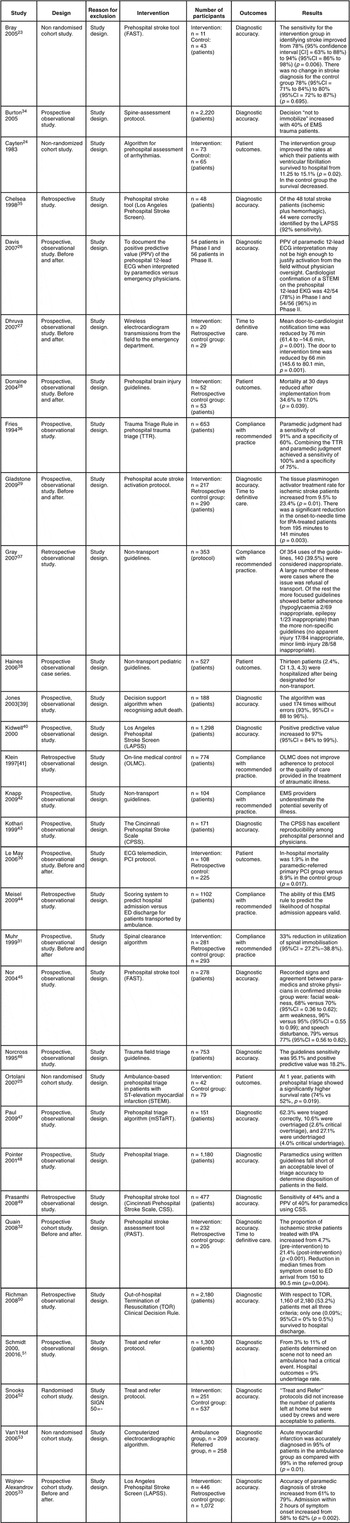
Among the excluded studies (Table 1) included in this review were several interesting cohort studies. There were three studies that compared the intervention with a prospective control group.Reference Bray, Martin and Cooper23–Reference Ortolani, Marzocchi and Marrozzini25 They all demonstrated a positive result that favored the intervention, but the risk of bias was large. If the intervention group consisted of volunteers who were compared to non-volunteers in the control group, it was difficult to establish which factors influenced the outcome due to the chance of selection bias. There could have been a risk that the volunteer group consisted of more interested and qualified personnel, and this may have influenced the results. In eight other studies,Reference Davis, Graydon and Stein26–Reference Wojner-Alexandrov, Alexandrov and Rodriguez33 the intervention was compared with a retrospective control group. They all also demonstrated a significant favor toward the intervention group, but it is difficult to determine if the two compared groups were homogeneous enough to draw any conclusions.
Study characteristics of excluded studies of prehospital decision support

Effects of DST
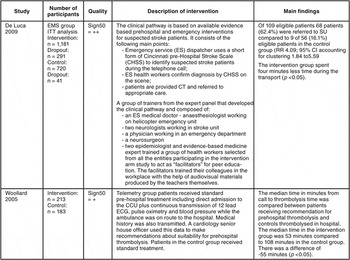
Diagnostic Accuracy—There was one eligible study (Table 2) that presented data that described the DST impact on diagnostic accuracy.Reference De Luca, Toni and Lauria21 The aim of the trial was to assess the impact of an Emergency Clinical Pathway (ECP) for acute stroke patients. The study involved both emergency medical services (EMS) and emergency departments. The EMS group used the Cincinnati prehospital Stroke Scale (CSS) as a DST. This review uses data from the EMS group. The number of eligible patients being appropriately referred to the stroke unit (SU) by the EMS group was an outcome. In the intention to treat analysis there was a statistically significant favor for the intervention group. Of 109 eligible patients 68 patients (62.4%) were referred to the SU compared to 9 of 56 (16.1%) eligible patients in the control group (RR = 4.09; 95%CI = 1.84 to 5.59). The study also provided data of how many eligible stroke patients were receiving thrombolysis at the SU. In the intervention group 8 of 44 (18.2%) were receiving thrombolysis, and in the control group 0 of 22 (0%) were thrombolysed (p < 0.05). The study also evaluated the number of confirmed strokes in the two groups. The control group had a higher proportion of confirmed strokes (71.8% vs. 63.6% (p < 0.05). The results suggest that there is a high level of over-diagnosing in the intervention group and that could be a dis- advantage with the use of a DST.
Study characteristics and main findings of randomised controlled trials of prehospital decision support.

Time to Definitive Care—In a study with the aim to evaluate if a DST involving use of a continuous telemetry system and decision support by text message from a senior cardiologist could reduce the call-to-thrombolysis time.Reference Woollard, Hayward and Taylor22 The median time in minutes (mins) from call to thrombolysis time was compared between patients receiving a recommendation for prehospital thrombolysis and controls thrombolysed in hospital. The median time in the intervention group was 53 minutes compared to 108 minutes in the control group. There was a difference of −55 minutes (p < 0.05). However, the control group had no possibilities to receive prehospital thrombolysis and the transport time to the hospital was an advantage for the intervention group. An interesting result was that the intervention group spent more “time on route” (+10 minutes, p < 0.05), and according to “median call to door time” the control group was 19 minutes faster (p < 0.05), but “median door to thrombolysis time” favored the intervention group by −11 minutes. The difference was not statistically significant (p = 0.730), but it gives a hint about the DSTs impact on the time spent in hospital before definitive care.
In the ECP study, the outcome of interest was time from call-to-hospital for EMS suspected stroke patients.Reference De Luca, Toni and Lauria21 This analysis used data from the “metropolitan area” where the distance to the hospital did not differ much. The intervention group spent four minutes less time during the transport (p < 0.05).
No study presented outcome data of compliance with recommended care, outcomes, patient or personnel satisfaction.
Discussion
A DST in prehospital care may have the possibility to decrease the “time to definitive care” and improve “diagnostic accuracy” provided by prehospital personnel. But more RCTs are needed.
It is important that only one of the included studies was aimed primarily at evaluating a DST.Reference Woollard, Hayward and Taylor22 The ECP study included DSTs and this review selected data that supported the use of DSTs for prehospital decision making.Reference De Luca, Toni and Lauria21
The data from the included studies suggested that even if the use of a DST increases the prehospital time, it has the potential to decrease the time to definitive care. Factors that contribute to the latter could be that the prehospital assessment with a DST is more exhaustive in compared to assessment without support of a DST and the prehospital diagnosis more precise and this, in turn, may mean a shorter management in the hospital. However, there also is a risk that technical difficulties could increase the time spent outside the hospital. In some emergencies, the prehospital time can be crucial for the patient’s outcome. For example, decreasing prehospital time matters in cases of serious trauma,Reference Gonzalez, Cummings and Phelan54 acute ischemic heart disease,Reference Boersma, Maas, Deckers and Simoons55 and stroke.Reference Toni, Chamorro and Kaste56 Therefore, it is of importance that the DST has a large amount of usability.
None of the included studies evaluated the use of the DTS’s impact on “compliance with recommended care”.Reference De Luca, Toni and Lauria21,Reference Woollard, Hayward and Taylor22 In-hospital care rates of compliance with evidence-based treatment guidelines commonly are used to evaluate quality of care. One study has demonstrated that compliance with guidelines improved outcomes for patients with acute coronary syndromes.Reference Peterson, Roe and Mulgund20 There also are indications that patients with acute coronary syndromes who are transported in ambulances have a better outcome than do patients who arrive to emergency care in other ways.Reference Bettencourt, Mateus and Dias57 However, there are several studies that indicate that compliance with recommended care sometimes is poor in prehospital care. In a recent study where the compliance with recommended care for patients with chest pain who were treated by paramedics, was evaluated, the results showed the compliance with the comprehensive metric was poor.Reference Colwell, Mehler and Harper58 Other studies that compared prehospital treatment of men and women showed that women got less aspirin, nitroglycerin, and pain relief than did men.Reference Meisel, Armstrong and Mechem59 These findings are supported by additional studies.Reference Rittenberger, Beck and Paris60,Reference Woollard, Smith and Elwood61 In addition, one study aimed to evaluate if paramedics could be helpful in determining if patients required emergency care showed paramedics failed to predict which patients do and do not require ED care.Reference Silvestri, Rothrock and Kennedy62
One of the main findings is the lack of RCTs in evaluation of DSTs in prehospital care. It is very surprising that many studies are well conducted but not randomized. Different kinds of DST for hospital and primary care have been well investigated with RCTs, Dexheimer included 61 RCTs in their systematic review over reminders in preventive care.Reference Snooks, Cheung, Close, Dale, Gaze and Humphreys64 In another systematic review, Kawamoto identified 88 eligible RCTs in an analysis of electronic and non-electronic decision system designed to aid directly in clinical decision.Reference Kawamoto, Houlihan, Balas and Lobach11 The review indicated that compliance with recommended care increased with the use of a DST particularly if the DST is computer-based and automatically gives decision support as part of clinician workflow. Shojania reviewed the effect of on screen reminders and included 28 RCTs and quasi-randomized trials.Reference Shojania Kaveh, Jennings and Mayhew14 Future research in prehospital decision support should concentrate on development and evaluation of computer-based decision support with the most important endpoint being patient outcome.
The excluded studies pinpointed areas of interest for the prehospital setting even if they didn’t fulfill the criteria for RCT studies. Among those studies, nine evaluated the impact of different kinds of “stroke assessment tools”.Reference Bray, Martin and Cooper23,Reference Gladstone, Rodan and Sahlas29,Reference Quain, Parsons and Loudfoot32,Reference Wojner-Alexandrov, Alexandrov and Rodriguez33,Reference Kidwell, Saver and Schubert35,Reference Kidwell, Starkman and Eckstein40,Reference Kothari, Pancioli and Liu43,Reference Nor, McAllister and Louw45,Reference Ramanujan, Guluma and Castillo49 Another frequent research issue among the excluded studies are treat and refer protocols (protocol and guidelines with the purpose to support prehospital personnel in the decision for level of care).Reference Gray and Wardrope37,Reference Haines, Lutes, Blaser and Christopher38,Reference Knapp, Tsuchitani and Cheele42,Reference Schmidt, Atcheson and Federiuk51,Reference Snooks, Kearsley and Dale52 Six studies evaluated prehospital triage tools.Reference Ortolani, Marzocchi and Marrozzini25,Reference Wojner-Alexandrov, Alexandrov and Rodriguez33,Reference Fries, McCalla, Levitt and Cordova36,Reference Paul, Kay and Huppertz47,Reference Pointer, Levitt and Young48,Reference Hof, Rasoul and Wetering53 Interventions of prehospital cardiac care were evaluated in five studies, and three studies investigated the impact of prehospital 12-lead electrocardiograms (ECGs).Reference Davis, Graydon and Stein26,Reference Dhruva, Abdelhadi and Anis27,Reference Le May, Davies and Dionne30 One study investigated prehospital AMI diagnosis,Reference Hof, Rasoul and Wetering53 and a study evaluate protocol for percutaneous coronary intervention (PCI) bypass.Reference Le May, Davies and Dionne30 The majority of these studies demonstrate a positive correlation between DST and impact on patient assessment.
Potential Biases in the Review Process
The search process was systematic. Studies that were missed in the medical database search were detected in the hand search of the 18 magazines. The search process involved searching of the “grey literature”. In a systematic review with an aim to investigate the impact of the grey literature using meta-analyses,Reference Hopewell, McDonald, Clarke and Egger63 the result showed that published studies showed an overall greater treatment effect than grey trials. Searching for grey literature can be difficult and it is a risk that studies not published in medical literature have been missed in the search.
To evaluate the impact of DST on prehospital care, the researcher must be clear about what characterizes a DST. This review used Perreault and Metzger’s definition as a guide, “Supporting clinical diagnosis and treatment plan processes; and promoting use of best practices, condition-specific guidelines, and population-based management.”Reference Perreault19 It still can be difficult to determine the nature of a decision support. For example, in the PHT study the finally decision support to the prehospital personnel is given by a cardiologist at the nearby hospital via text message.Reference Woollard, Hayward and Taylor22 It can be argued whether this is a DST. This review classified it as a DST because the cardiologist is part of a system involving 12-lead ECGs, study protocol and a thrombolysis eligibility questionnaire.
Another potential bias is difficulty in determining which factors in the intervention influenced the outcomes. When a prehospital organisation introduces a new DST, it usually is preceded by some sort of educational program. In the PHT study, the paramedic in the intervention group received 18 hours of training in 12-lead ECG recording, the telemetry equipment, the study protocol and the thrombolysis eligibility questionnaire.Reference Woollard, Hayward and Taylor22 The personnel in the ECP study received a very thorough training performed in two steps.Reference De Luca, Toni and Lauria21 In the first step, interviews to identify the learning needs were conducted. In the second step, on-site training was conducted in small groups. The training focused on teaching the participants to identify stroke symptoms by the CSS. In these two studies, it was difficult to determine if it is the DST or the educational intervention that influenced the outcome and to what degree.
Conclusions
The dataset in this review is too small to be able to draw any reliable conclusions about the impact of DSTs on prehospital care. The search in this review indicates that there are very few RCTs that evaluate DSTs in prehospital care. Before different types of DSTs are introduced into the prehospital setting, the effects should be closely evaluated in well conducted RCTs.
Abbreviations:
DST: Decision Support Tool
ECP: Emergency Clinical Pathway
EMS: Emergency Medical Services
RCT: Randomized Controlled Trial