Introduction
Disasters have the potential for devastating social, medical, and public health consequences.Reference Guba-Sapir, Femke, Below and Ponserre1 In the early stages of a disaster there is an emphasis on saving lives, while in later stages there is attention to mid- and long-term health consequences of disasters including psychological, physical, and behavior problems.Reference North2-Reference Leon7 Promotion and maintenance of health in the mid- and long-term periods of disasters are essential. Health systems should be prepared to deliver not only lifesaving services but also to provide effective services to combat the long-lasting effects of disasters, preventing “disaster after disaster.” Community recovery is intertwined with individual and family recovery, and planned and organized long-term recovery and rehabilitation services should be provided to help victims become socially integrated, economically self-sufficient, and psychologically fit.Reference Dhameja8, Reference Coppola9
Disaster recovery and rehabilitation is little studied, poorly organized and haphazardly performed;Reference Coppola9, Reference Phillips10 with few exceptions, communities have paid little attention to disaster recovery planning.Reference Phillips10
Despite the 2003 establishment of an organized Iranian disaster program, there is no comprehensive model to define recovery and rehabilitation processes and services. When provided, these services have been delivered without planning.Reference Ardalan, Masoomi and Goya11-13 For instance, during the Bam earthquake, there was no recovery and rehabilitation plan for the injured, chronically ill or disabled.Reference Khankeh, Khorasani-Zavareh, Johanson, Mohammadi, Ahmadi and Mohammadi14, Reference Djalali, Khankeh, Öhlén, Castrén and Kurland15
To understand the intricacies of the disaster recovery and rehabilitation process and to initiate a recovery process, all stakeholders must share an understanding of what happened and what is expected to happen during the recovery phase. The process needs to be explored in more depth;Reference Phillips10 however literature is scarce on recovery and rehabilitation issues in disaster situations. Qualitative studies carried out in this area have not investigated the recovery phase, including Khankeh et al, who discussed health disaster managementReference Khankeh, Khorasani-Zavareh, Johanson, Mohammadi, Ahmadi and Mohammadi14 and Djalali, who focused on prehospital care in disasters.Reference Djalali, Khankeh, Öhlén, Castrén and Kurland15
This study evaluated the factors involved for rehabilitation professionals to implement services. The experience and perception of disaster survivors, their families, and experts regarding recovery and how professionals responded to their needs also were evaluated.
Methods
This was part of a study using grounded theory to explore the process of rehabilitation in disaster. Study design was based on qualitative content analysis, which is a suitable method when new areas are to be investigated in an exploratory manner, or if it has been decided to explore a known area from a fresh perspective.Reference Strauss and Corbin16, Reference Polit and Beck17 The research team intended to explore the rehabilitation process from the perspective of the participants.
Study Participants
Purposeful sampling based on the research question was used.Reference Polit and Beck17 Inclusion criteria were experience and knowledge in disaster medicine. As such, the interviewees included managers and professionals in the field of health; rehabilitation specialists; rehabilitation care providers; Iranian victims of recent incidents and their families. Study participants included 18 individuals (eight male and ten female). Ages of participants ranged from 22-69 years (Table 1). Participants also were selected based on the following inclusion criteria:
Number and Positions of Participants (n = 18)
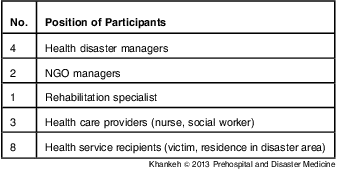
Abbreviations: NGO, nongovernmental organization
• willingness and readiness to participate in the study;
• ability to communicate with the interviewer;
• experience of receiving or providing health services in disasters.
Data Collection Method
The main strategy for data collection was in-depth and semi-structured interviews beginning with general questions, gradually progressing to more specific ones. This kind of interview was appropriate because it permitted flexibility and depth for qualitative research.Reference Polit and Beck17, Reference Streubert and Carpenter18 Each interview of a disaster-affected person began with a broad question such as: “Could you explain your experiences regarding rehabilitation care after the earthquake?” or “Tell me about what happened after that incident for you as an injured person.” For policy makers and health care providers, interviews began with questions such as: “Could you describe if there was any problem for delivering effective rehabilitation care?” and “Which issues were experienced by affected people to be socially integrated after disaster?”
Probing was performed according to the reflections of each participant concerning prior experiences of the disaster; perception about rehabilitative services and their needs; facilitators and barriers of providing services; role of managers; and organization of disaster recovery.
The interviews lasted 45-60 minutes. Time and place of interviews were determined by agreement of the parties. The number of participants was determined based on saturation principles,Reference Polit and Beck17 meaning the sample size, according to the process of qualitative studies, was determined during the study, and sampling continued until data saturation was achieved. Data saturation was achieved when the researcher concluded that collected data was repeated, a new code was not developed or an existing code does not extend.
Data Management and Analysis
All interviews were transcribed and compared with the recorded digital files for accuracy. Content analysis was performed on the data based on qualitative (latent) content analysis. Meaningful segments of data were identified and coded with appropriate labels on the transcribed text. The various codes were compared based on differences and similarities and afterwards sorted by categories and subcategories. Categories were discussed within the research team and appropriate themes were extracted.Reference Graneheim and Lundman19
Data Integrity
Credibility was established through field notes and memo writing, prolonged engagement with the participants, the participants’ revisions using member check, and peer check. Triangulation of researchers in the research team helped to take into account different perspectives when analyzing the data. The findings and interpretations of this study were reviewed by the research team as an expert check. Maximum variation of sampling also confirmed the conformability and credibility of the data.Reference Streubert and Carpenter18 As a further validity check, peer check on some transcripts was performed by two other researchers.
To confirm the fit of the results, they were checked with experts in health care and rehabilitation who did not participate in the research.
Ethical Considerations
Informed consent was obtained through explaining the aim and process of the study orally and in writing. The participants then signed informed consent or gave a verbal consent to participating in the study. The study was approved by the University of Social Welfare & Rehabilitation (USWR) Research Committee and Ethics Committee in Iran. Information was confidential and participants’ identities were made anonymous for use in this article. Participants had the right to withdraw at each stage of the research.
Results
This study explored three main themes regarding recovery and rehabilitation after disaster: 1) needs for health recovery; 2) intent to delegate responsibility; and 3) desire for a wide scope of social support.
Needs for Health Recovery
Study participants indicated that to provide comprehensive recovery services some important basic needs should be considered. These included: need for physical rehabilitation, social rehabilitation and livelihood health; the need for continuity of mental health care; and the need for family re-unification services.
Need for Physical Rehabilitation after Disaster
Participants believed that in disasters meeting the immediate needs of those directly affected is a high priority. They felt disaster victims were abandoned after initial emergency medical services. After search and rescue, treatment, and discharge from health facilities, there was no physical health care follow up and caregivers did not ask victims to complete their treatments. As a result, essential complementary care was delayed.
“When disaster strikes everything happens around the emergency and relief. Health care providers said we evacuated injured people, tried to save their life and established temporary shelters, that's all … Whilst we didn't think these persons needs anything else, … For example three months after Bam earthquake an old man came for eyeglasses, when we asked him if he had had glasses before or needed them only now. He answered: “I used to but I lost them it in the earthquake. During three months we didn't think about this important issue, nor was the old man referred to us to ask for glasses” (Participant No. 2; rehabilitation specialist).
“It was hard time when I was discharged and we wanted to come back to our place. We had a tent, there was no facilities, I was always in bed, if I wanted to sit in a wheelchair two person had to help me, I couldn't do it by myself. I couldn't do all those things that I always did in my personal life. I had a lot of problems but I didn't think I could get more treatment at all, we had never heard of physiotherapy, and we didn't know what a spinal cord injury is …” (Participant No. 11; victim, spinal cord injury).
The injured had many problems due to the cost of and access to rehabilitation services. Furthermore, the affected people experienced physical and livelihood problems after the disaster. This situation caused a lack of priority for completing physical care and following rehabilitation treatment protocols. This could have resulted in complications, disabilities, and handicaps.
“After I was discharged from the hospital I went to my family place. I had so much problems, I had urinary incontinence, I had problems with mobility, toileting, bathing … I had to go to Bam to see a doctor and because it was far from my place I had to rent a car, renting was expensive …you need a lot of money that my family couldn't afford” (Participant No 10; victim, spinal cord injury).
“I was upset, I was always at home, nobody trained me, I lost my daughter so I was completely depressed and I didn't like to do anything… I didn't go to physiotherapy, it was difficult for me, there was some stairs and somebody should take me there” (Participant No 9; victim, spinal cord injury).
With time, governmental agencies or nongovernmental organizations (NGOs) gradually began to identify injured people. During home visits they found many cases of patients who had received improper care resulting in poor physical health. Patients were found with bed sores and completely immobilized. While treatment and follow-up was belatedly instituted, these physical problems caused long recovery processes.
“We set up a mobile team that screened cases, people didn't accept the team, they didn't trust. Victims were in a turmoil state, imagine; in the summer with 45°C temperature and some person lived in a metal temporary house..” (Participant No. 17; NGO manager).
Since the most culturally important concern for victims was the inability to carry out usual activities of daily living, they did their best to be independent in their lives. Thus, providing needed materials and assistive devices could help them to achieve this important rehabilitation goal.
“I want to have my own place and to be able to take care of myself … right now I can go out in a wheelchair; I can shopping … I always pray that I wouldn't be needy of anybody” (Participant No. 14; victim, spinal cord injury).
Need for Continuity of Mental Health Care
In the field of mental health, participants indicated that emotional and psychological damage was not addressed. There were common and extensive mental health problems in survivors which were not addressed. The participants believed that this group of problems was obvious, even in the next generation and youth.
Survivors did not like to participate in public celebrations like wedding ceremonies because of their hopelessness and sadness due to the loss of loved ones. Interesting issues for young people were a lack of motivation to take care of themselves. Self-harming behaviors like smoking showed a lack of care for self. There was a belief that there was no future.
Some victims felt faithlessness immediately after the disaster. Later, however, victims tried to forget bitter memories of the incident by seeking solace through religious beliefs. Victims tried to cope with the conditions of life by seeking expert psychotherapy and counseling rather than psychiatry and medicine.
“I need someone who knows what she/he should tell me, listen to me and help me by her/his expertise counseling. Now when I came to a psychologist, he/she prescribes medication quickly, I don't need medication I need an expert counselor who listens to me and guides me…Otherwise I have to talk to acquaintances, friends and so on ….” (Participant No. 13; victim with amputated leg)
Family Reunification
Families were influenced by pre-, peri- and post-disaster complexities. After the initial disaster event, multiple changes affected all aspects of family functions. Families were separated due to death and hospitalization. Another issue was mental problems such as depression which caused lack of interest in being with family members.
“After I was injured, I lost everything and I had to go to hospice for one year, because there was no bathroom in tents and our house was ruined… there was nobody with me, no mother, no sister, and there was some things that I was embarrassed to say to my husband. Because of this I was away one year from my home and my life…In hospice they tried to do their best but there is no place better than home. This happened to all my family members and there was no family anymore” (Participant No. 11; victim, spinal cord injury).
“When I was injured I was very upset, I didn't like to see my husband at all… when my husband came home I said: “Go out, what do you want here”… I hated him” (Participant No. 15; victim, spinal cord injury).
Conflicts happened within families because of lack of support from husbands. In the case of wives’ injury or disability, noted responses were husbands’ addiction, husbands’ remarriage after spouses’ disability, and/or intention of taking a mother's children. These conflicts led to family disintegration and formation of new family structures which were accompanied by new expectations and new relationships.
“Now my husband remarried to have his own children… At home I have a great sorrow because of co-wife and husband's behaviors. Just I come to work and finish the day … I want to have a home for myself to be independent, I like to hold a party, I want to have a peaceful life and be happy without any conflicts” (Participant No. 14; victim, spinal cord injury).
“I have problems with my husband, we are not divorced but we live apart…My husband was addicted, because I was damaged and we lived separated for a long time so we got trouble” (Participant No. 10; victim, spinal cord injury).
This issue is more challenging for women who feel unsupported by husbands, and lack a sense of belonging in their homes, especially in the case of a husband's remarriage. Culturally, participants want to be cared for by family members.
Social Rehabilitation and Livelihood Health
Study results showed that as disaster event news disappeared from the front pages of the media, there was no sensitivity to the affected residents’ problems, despite the prevalence of disaster-related problems. After the response phase, and difficult living conditions in tents then in the temporary houses (Connex), victims’ most urgent request was to be settled in their own permanent homes. Because of administrative bureaucracy and lack of organizational planning, reconstruction was delayed.
“I would like to be in my own place. The city has not returned to previous state at all, although some houses are reconstructed to some extent, but I always say in other cities trees are real trees, streets are real streets but in our town streets aren't yet streets… I say when I step out on the street I don't like to see collapse or ruined buildings, temporary house or Connex, I want to see a clean street, I want to see my friend who is happy and I smile and say hello… Although Bam is alive right now but it is not happy” (Participant No. 8; Bam resident).
Study participants wanted to reconstruct their life again and get back to their previous situations. They were trying to reconstruct their place and find the right job to be confident about their future. It was very difficult to do that because of disability and economic problems after the disaster event.
The participants believed that the community viewed the victims negatively; unaffected people considered the disability of the injured ones as a punishment. Disaster-affected people, like all others, have the right to be employed and treated respectfully.
“I think this disability is not our main concern. Acquaintances, family, clan or tribe are more annoying … People's view to disables is really bad… for example: we hear from family ask why their kids are disabled in the earthquake but our children aren't injured” (Participant No. 13; victim with amputated leg).
Intent to Delegate Responsibility
Study participants believed that disaster relief and rehabilitation needed active involvement of all related organizations including governmental and nongovernmental; indeed government cannot do it alone. In general, the goal of rehabilitation is to help people regain the best possible independent level of functioning. In this study, participants focused on the role of disaster recovery to help people get back to their normal lives and restore their individual capabilities. To achieve this goal, professional rehabilitation services are essential. Gradually, local authorities can coordinate all activities for returning the community to its pre-disaster status. As the responsibility of self-care and management is delegated to affected people and the community, the affected should be empowered to achieve independence.
“Imagine a city has been destroyed and people have lost their whole lives. In that situation they needed to be supplied with all necessities of life … people were in tents and they were crying and wailing; they did not do anything else … they could do nothing except mourning for their losses … well later life gradually became routine. People were settled and they obtained their facilities by themselves, they needed to get help to rebuild their lives and stand on their feet … it cannot be relied on pension from social welfare forever… At first we felt we need professional help because we were injured and upset, but after a while we tried to manage ourselves. We would like to be independent because we used to be” (Participant No. 16; local social worker).
Desire for a Wide Scope of Social Support
Study participants experienced the disaster event as leaving survivors with special needs. These vulnerable groups included homeless and street children, physically injured and spinal cord injured, and self-attendant women. Participants believed it is the responsibility of social welfare agencies to manage these special needs groups. Usually, these vulnerable groups are marginalized by professional rehabilitation services.
“During relief operations we were faced with some mental retards [sic] and unaccompanied children. We didn't have any plan for them; we didn't know what we should do with them so we referred them to Welfare organizations …” (Participant No. 18; care provider).
“After the event we had a lot of mentally retarded persons that their whole families were lost and they lived for example with neighbors … we tried to identify these cases and orphans and refer them to welfare organization” (Participant No. 16, local social worker).
Participants indicated that welfare organizations must be accountable in providing assistive devices, supplies like diapers and urinary catheters, follow up care, and complementary treatments for injuries.
Discussion
This study found that because of political and emotional priorities, disaster resources were deployed for relief activities only, with long term problems and follow up care ignored. After an initial influx of humanitarian relief, it became necessary to manage survivors’ ongoing health related problems. The ultimate goal of disaster relief and recovery is to help the affected population return to a normal, independent life. It is therefore proper to match services for disaster victims in a fully integrated manner that meets their physical, psychological, and social needs on a long term basis.
This paper focused on human factors following disasters to form a clear picture of recovery and rehabilitation processes after disaster. The key elements explored by this study were recovery needs and rehabilitation services planning.
It was found that for physical problems caused by disaster, there was not a holistic and systematic protocol or guidelines to achieve long term care for victims. This represents a lack of continuity of care and increased risk for handicap and disability in terms of physical, psychological, and social health.
Consistent with other studies, participants reported problems regarding accessibility and affordability of appropriate health and mental health care. Livelihood issues were also found to hinder their medical care.Reference Coppola9, Reference Priebe20 Lack of holistic care and treatment produced adverse consequences for individuals, families, and communities affected by the disaster which included long lasting handicap, disability, and lack of social reintegration .Reference Coppola9, Reference Priebe20-Reference Gosney23
Local health care providers and family members played an important role in the care of study participants. Education of local health providers and families was essential throughout the victim's hospitalization and rehabilitation to minimize the complications and maximize rehabilitation potential. This finding was confirmed by the other studies.Reference Priebe20, Reference Rathore, Farooq, Muzammil, New, Ahmad and Haig22 This study shows that not only should injury victims be sensitive to completing their care, but that the health care system should launch a plan which is comprehensive to help victims achieve their maximum recovery potential. After recent disasters, health systems have not had comprehensive plans to trace the injured; Raissi reported shortcomings in accurate data collection and identification of those with spinal cord injuries and their conditions after Bam earthquake.Reference Raissi24 These shortages were also documented in the Pakistan disasters.Reference Rathore, Farooq, Muzammil, New, Ahmad and Haig22
The study findings also implied a persistence of psychological issues until years after an incident. There was a wide range of psychological symptoms that people experienced after major incidents.Reference North2, Reference Katz, Pellegrino, Pandya, Ng and DeLisi4, Reference Leon7, Reference Cultman-Smith25 Disaster victims exhibited several forms of psychological distress that remained over time and that have been less studied.Reference North2, Reference Briere and Elliott5, Reference Leon7, Reference Cultman-Smith25-Reference Chakrabhan, Chandra and Levav28 Sadness and unwillingness to attend celebrations such as wedding ceremonies; reduction of the incentives to conform with behavioral norms; and opium dependency have been addressed in this study. These important problems may require interventions long after the acute disaster.
Study results showed that victims try to deal with these unusual conditions by seeking appropriate psychological care. Based on the study participants, psychological rehabilitation such as counseling was in demand and it is recommended that at the local level these services be affordable and accessible for affected people.Reference Madrid, Sinclair and Bankston29, Reference Maheshwari, Yadav and Singh30
Traumatic events can enhance religious beliefs or alternatively can cause weakening or even abandonment of religious behaviors.Reference Hussain, Weisaeth and Heir31-Reference Drescher and Foy33 Interestingly, participants mentioned this paradox in their transition through the disaster continuum. Accordingly, because of a strong religious base in Iran, spiritual care and support may help survivors cope with these difficult conditions. The religiosity of Iran may be a helpful factor in mental and social recovery programs.Reference Phillips10, Reference Hackney and Sanders34-Reference Koenig and Larson36
This study indicated that several factors disrupted family cohesion including death of loved ones, separation of family members due to transportation to a referral hospital, and hospitalization.Reference Dasgupta37, Reference Broughton, Allen, Hannemann and Petrikin38 Other studies have stated that parental support and family functioning are predictors of not only parental health behaviors but also of children's mental health. Post-disaster health care must strive to address family needs, and support cohesion and solidarity of families.Reference Dasgupta37-Reference Hafstad, Gil-Rivas, Kilmer and Raeder44 For the population evaluated in this study, formation of new intra-familial relationships after remarriage required communication skills that must be considered in the mental health care process.
Disaster-injured people expect to be treated respectfully in the community, as has been stated in rehabilitation principles.Reference Jester45 Study results showed that survivors were actively involved in re stabilizing their lives. They tried to rebuild their homes, attain economic stability, and gain independence, which are prerequisites for sustained and holistic recovery.Reference Phillips10, Reference Eadie46
Victims seeking to reconstruct their homes experienced monetary constraints and bureaucratic legislation that made the process slow and disappointing. This process is usually difficult and time consuming everywhere in the world and community participation can be the key for successful reconstruction.Reference Chang, Wilkinson, Potangaroa and Seville47, Reference Choguill48 No disaster rehabilitation plan can achieve its objectives unless stakeholders engage actively in problem and solution identification and in turn, become empowered by community member participation.Reference Dhameja8, Reference Phillips10, Reference Dasgupta37, Reference Choguill48 The issue of how much the community should be involved in different recovery projects is situation based. One suggested model is the “ladder of community” proposed by Arnstein and Choguill in which participation is possible on different levels from informing and consultation to empowering.Reference Choguill48
Recovery and rehabilitation services should reintegrate disaster survivors into society; these services must cover survivors’ diverse needs through institutional programs, and be coordinated by governmental and nongovernmental organizations.
In Iran, the Ministry of Health and Medical Sciences, Committee Emdad Imam Khomeini (a national organization to help poor people, unique to Iran and supported by the government and by public contributions) and Behzisti (the government welfare organization in Iran) are the main organizations involved in the management of people with special needs. While these organizations are available to provide for disaster victims, there are still gaps in providing long-term rehabilitation care for disaster-affected people.Reference Bazeghi and Baradaran49
Providing effective rehabilitation care for disaster victims requires a clear picture of this process on different levels of the community. Involving a wide range of those most likely to be affected by the process helps provide a plan that is comprehensive, continuous, culturally sensitive, and family centered.
Limitations
This qualitative study focused on the individual opinions of the participants. This study is one of the few studies on recovery and rehabilitation process that has employed this approach. However, data were collected from a limited sample of individuals using purposeful sampling and the findings cannot be generalized to other locations that do not have similar environmental, cultural, and economic characteristics.
Conclusion
Disaster recovery is a long, arduous, multidimensional process and communities may not fully recover if not provided proper rehabilitation assistance. The findings of this study indicated that the recovery process requires physical rehabilitation follow up through a systematic approach, continued mental health monitoring and rehabilitation care (even in the next generation and youth), and includes the process of family re-unification. Providing appropriate livelihood conditions and social activation can help affected people reintegrate into the community. To design and deliver these culturally-sensitive services, involved organizations should consider different groups in the community. There is a need for further investigation of the results of this study to develop strategies for improving disaster response systems.
Acknowledgments
This study was supported by the University of Social Welfare and Rehabilitation Sciences, Disaster Rehabilitation Research Center, and Disaster and Emergency Management Center of Ministry of Health & Medical Education. The authors wish to thank all participants for their support and involvement in this study. The authors also express deep appreciation to the people in the recently earthquake-affected areas including Bam, Zarand and Lorestan for their contributions to this study.