Introduction
A higher number of various traumatic experiences over the lifespan and posttraumatic stress disorder (PTSD) are associated with poorer general physical health and more chronic medical conditions (Krause et al., Reference Krause, Shaw and Cairney2004; Sledjeski et al., Reference Sledjeski, Speisman and Dierker2008). Especially traumatic and adverse experiences in childhood are associated with greater impairment in older age compared to traumatic experiences in other developmental stages such as, for example, adulthood (Ogle et al., Reference Ogle, Rubin and Siegler2013). In addition to this, the type of trauma, the severity and the development of posttraumatic symptoms are associated with negative cognitions towards the trauma or oneself, which emerge after or during the event (cf. Lapp et al., Reference Lapp, Agbokou and Ferreri2011). As a consequence elderly persons who experienced WWII during childhood report a higher current PTSD prevalence (e.g. Spitzer et al., Reference Spitzer, Barnow, Volzke, John, Freyberger and Grabe2008) compared to elderlies from countries without a history of WWII (Maercker and Pielmaier, Reference Maercker and Pielmaier2010). These WWII survivors display various impairing effects in older age, such as more cognitive impairment and different mental and physical health problems (e.g. Kuwert et al., Reference Kuwert, Brähler, Glaesmer, Freyberger and Decker2009; Glück et al., Reference Glück, Tran and Lueger-Schuster2012; Alastalo et al., Reference Alastalo2013).
However, there is also research that shows that not all persons affected by trauma develop mental health problems in the direct aftermath or later in life (cf. Rutter, Reference Rutter2007). There have been a few studies that investigated resilience (e.g. Kuwert et al., Reference Kuwert, Brähler, Glaesmer, Freyberger and Decker2009; Tran et al., Reference Tran, Glück and Lueger-Schuster2013) and other related factors of positive adaptation such as posttraumatic growth and SOC in now adult survivors of WWII (Kuwert et al., Reference Kuwert, Spitzer, Dudeck, Vogel, Freyberger and Ermann2008; Forstmeier et al., Reference Forstmeier, Kuwert, Spitzer, Freyberger and Maercker2009).
In particular SOC was reported a protective factor against the development and/or exacerbation of posttraumatic symptoms related to different kinds of lifetime traumas – war-related (e.g Kuwert et al., Reference Kuwert, Spitzer, Dudeck, Vogel, Freyberger and Ermann2008) and non-war-related (e.g. Streb et al., Reference Streb, Häller and Michael2014). Antonovsky (Reference Antonovsky1996) proposed SOC as a cognitively, behaviorally and motivationally expressed orientation toward the world that enables the individual to perceive it as comprehensible, manageable, and meaningful. This orientation facilitates health (Antonovsky, Reference Antonovsky1987). However, the specific mechanisms through which SOC exerts its beneficial effect and potentially mediating factors that influence this effect are still subject to investigation. One of these mediating factors could be mindfulness.
In the past years, there has been a growing number of studies on mindfulness and mental health. Mindfulness can be defined as the ability to focus attention on the experiences and actions of the present moment in a non-judging, open and curious manner that involves detaching from the identification with these experiences – such as psychological or somatic symptoms or negative emotions (Bishop et al., Reference Bishop2004). Many psychological symptoms, such as distress or depression and anxiety, are inversely related to mindfulness (Baer et al., Reference Baer, Smith, Hopkins, Krietemeyer and Toney2006). In the context of trauma and posttraumatic symptoms, mindfulness and acceptance seem to influence the development and maintenance of symptoms positively (Thompson and Waltz, Reference Thompson and Waltz2010; Thompson et al., Reference Thompson, Arnkoff and Glass2011). The positive influence of mindfulness on symptoms of anxiety and depression could be attributed to its facets Acting with awareness and Non-judging (e.g. Tran et al., Reference Tran2014). These facets also seem to influence posttraumatic symptoms positively, albeit with a likely smaller effect size (Vujanovic et al., Reference Vujanovic, Youngwirth, Johnson and Zvolensky2009).
Results from studies on the stress buffering and health-promoting effects of mindfulness interventions also suggested that mindfulness may influence SOC positively (e.g. Gimpel et al., Reference Gimpel2014). SOC and mindfulness have both been placed in the broader context of resilience (cf. Almedom, Reference Almedom2005; Thompson et al., Reference Thompson, Arnkoff and Glass2011) that buffers against negative outcome after adversity (Rutter, Reference Rutter2007), but mindfulness should still be considered a distinct psychological aspect (Bishop et al., Reference Bishop2004). It may contribute to the effects of SOC in the sense that it gives individuals a feeling of control and meaning independent of the circumstances: the individual controls the allocation of attention and on how to react to ensuing experiences (Bishop et al., Reference Bishop2004). Yet, it remains unclear how SOC and mindfulness influence one another.
The identification of health-maintaining aspects in elderly persons is particularly important for improving care, and maintaining and fostering health in older age. To our knowledge, no previous study has investigated the relationship and mechanisms of SOC and mindfulness on posttraumatic symptoms and cognitions in the context of lifetime trauma in a sample of elderly WWII survivors before. In this study, we investigated how SOC and mindfulness influence posttraumatic symptoms and cognitions. We expected that both SOC and mindfulness would predict fewer PTSD symptoms and cognitions. We also expected that mindfulness would mediate the effects of SOC on posttraumatic symptoms and cognitions and investigated to what extent this was the case.
Methods
Participants and procedure
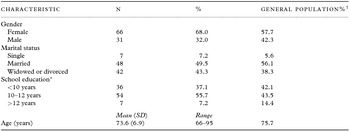
For this study, a non-clinical sample of elderly Austrians (N = 97; see Table 1) born before 1945 was recruited between February and May 2011 by contacting organizations and residences for the elderly and through further word of mouth advertising within these organizations. All had experienced WWII and the subsequent time of occupation in Austria as children or adolescents. Participants were tested for cognitive impairment with the MMSE (exclusion cut-off 25 >; Folstein et al., Reference Folstein, Folstein, McHugh and Fanjiang2000). Only data of persons scoring above the cut-off of 25 were included in this study. Participants filled in questionnaires regarding mental health problems, posttraumatic stress symptoms, traumatic lifetime experiences (war-related and general lifetime events), SOC and mindfulness. A trained master student of clinical psychology administered the questionnaires and was present at all sessions to support the participants and answer questions. All participants provided written informed consent before they filled in the questionnaires. We expected to find a medium effect of the main measures in the data with a power of 0.80 and p = 0.05 and calculated a sample size of at least N = 85. The study was conducted according to the regulations and legal standards for non-invasive clinical research in Austria and the European Union and adhered to the ethical principles of APA and the ethical guidelines of the University of Vienna.
Sociodemographic characteristics (N = 97)

Note.* N = 97. †According to Statistik Austria (2014), with regard to all persons of 65 years of age and older living in Austria.
Measures
Essen Trauma – Inventory (ETI)
The ETI (Tagay et al., Reference Tagay, Erim, Möllering, Stoelk, Mewes and Senf2006) measures different kinds of criterion A traumatic events and assesses symptoms of PTSD in the past month according to DSM-IV criteria. It can also be used to screen the severity of posttraumatic symptoms. The 27 items of the scale measures the 5 re-experiencing symptoms (criterion B), 7 avoidance symptoms (criterion C), and 5 arousal symptoms (criterion D). Additionally, persons report physiological symptoms related to the traumatic experience and the duration and onset of symptoms. These symptoms are rated on a 4-point-scale from “not at all” (0) to “very often” (3). Cronbach α for this study was α = 0.93.
Posttraumatic Cognitions Inventory (PTCI)
The PTCI is a 33 item self-rating scale that assesses on a 7-point Likert scale (1 = totally disagree to 7 = totally agree) cognitions that influence posttraumatic psychopathology negatively (Foa et al., Reference Foa, Ehlers, Clark, Tolin and Orsillo1999). It assesses three kinds of cognitions that can occur after the experience of a traumatic event: (1) negative cognitions about self, (2) negative cognitions about the world, and (3) self-blame. All subscales predict the severity of posttraumatic symptoms, anxiety, and depression in traumatized individuals. Cronbach α for this study was α = 0.95.
Brief Symptom Inventory–18 item version (BSI-18)
The BSI-18 measures psychological symptoms of anxiety, depression, and somatization on a 5-point scale (0 = not at all to 4 = extremely) and also allows the computation of a global measure of symptom distress (Derogatis, Reference Derogatis2001). Cronbach α for this study was α = 0.93.
Sense of Coherence Scale (SOC-13)
The SOC-13 is a widely used questionnaire to assess how people manage stressful situations and stay well. It measures the three aspects of the concept of SOC: (1) comprehensible, (2) manageable, and (3) meaningful with 13 items on a 7-point scale with different responses (Antonovsky, Reference Antonovsky1987). Cronbach α for this study was α = 0.82.
Five Facet Mindfulness Questionnaire (FFMQ)
The FFMQ (Baer et al., Reference Baer, Smith, Hopkins, Krietemeyer and Toney2006) is one of the most utilized mindfulness questionnaires. It was factor analytically derived from five different mindfulness questionnaires resulting in a 39-item questionnaire with a five factorial structure loading on a higher-order general factor of mindfulness. It incorporates both state-like and trait-like aspects of mindfulness. Its five facets, measured on a 5-point scale (1 = never or very rarely true to 5 = very often or always true), are: (1) Observing of internal and external sensations, thoughts and experiences, (2) verbally Describing these experiences, (3) the Non-judging of occurring thoughts, feelings and experiences, (4) the Non-reactivity towards these experiences, and (5) Acting with Awareness in the present moment. Cronbach α of the subscales were α = 0.76–0.85 and α = 0.84 for the total scale.
Data analysis
Two path models were fitted to the data. In the first model, the saturated model, SOC scores were used as the exogenous variable, mindfulness as a mediator and posttraumatic cognitions and symptoms as endogenous variables, which were allowed to correlate. This model tested the mediating effect of mindfulness, simultaneously with regards to the associations of SOC with posttraumatic cognitions and symptoms. In the second model, the two-stage mediation model, posttraumatic cognitions served as a second mediator for the effects of SOC and mindfulness on posttraumatic symptoms. Both SOC and mindfulness had direct paths to posttraumatic cognitions, but only SOC had also a direct path to posttraumatic symptoms. Mediation analyses were cross-sectional and did not investigate the temporal relationships of the investigated variables. Mplus 6.11 was used for the path analyses, using the robust maximum likelihood estimator (MLR) that allows and corrects for non-normality and provides robust standard errors. Model fit was evaluated, utilizing widely-used benchmarks, with the comparative fit index (CFI), the Tucker–Lewis index (TLI; CFI and TLI: good fit: >0.95, acceptable fit: >0.90), and the root mean square error of approximation (RMSEA; good fit: <0.06, acceptable fit: <0.08). Ninety percent confidence intervals of the RMSEA are also reported.
Results
The participants’ sociodemographic characteristics were comparable to those found in the Austrian general population of elderly (see Table 1). Of N = 97 persons, 91 (88.3%) who reported at least one specific traumatic event in their lifetime were included in the analysis. The mean number of these lifetime traumas was 2.42 (SD = 1.33; range = 1–5). Despite having experienced WWII and the subsequent time of occupation during their childhood or adolescence, participants experienced various kinds of specific lifetime trauma. The most distressing experiences reported were the traumatic death of a loved one, e.g. by an accident, crime or other unnatural causes of sudden death (30.8%), illnesses (27.5%), and accidents (18.7%) followed by childhood abuse (7.7%; physical, sexual, and neglect), more specific WWII-related traumas during childhood and adolescence, e.g. witnessing shooting or atrocities (6.6%), violence in adulthood, stalking/mobbing, and natural disasters (all 2.2%). One person reported a suicide attempt in young adulthood and one person did not indicate a single worst event.
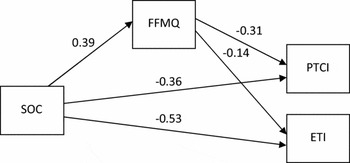
Table 2 displays descriptive statistics and intercorrelations of the investigated variables. Standardized path coefficients in the saturated mediation model are depicted in Figure 1. SOC had large direct effects on both posttraumatic cognitions and PTSD symptoms. Mindfulness mediated part of the effect of SOC on posttraumatic cognitions, but not on PTSD symptoms. The total standardized effect of SOC on posttraumatic cognitions was −0.48 (p < 0.001), of which −0.12 (p = 0.002) was mediated through mindfulness. The direct effect of SOC on PTSD symptoms was −0.53 (p < 0.001). In the model, SOC and mindfulness explained 31% of the variance of posttraumatic cognitions, and 35% of PTSD symptoms.
Intercorrelations and descriptive statistics

Note. n = 91. SOC = Sense of Coherence, FFMQ = Mindfulness, ETI = PTSD symptoms, PTCI = posttraumatic cognitions. All ps ≤ 0.001.
Saturated mediation model. SOC = Sense of Coherence; FFMQ = Five Facet Mindfulness Questionnaire total score; PTCI = Posttraumatic Cognitions Inventory; ETI = PTSD symptoms. Numbers are standardized path coefficients. PTCI and ETI were allowed to correlate, r = 0.51. All ps < 0.001, except for the path of mindfulness to ETI, p = 0.149.

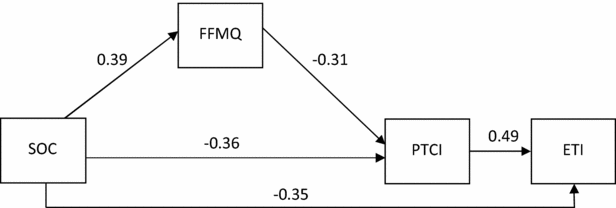
Figure 2 depicts a two-stage mediation model, wherein posttraumatic cognitions were modeled as a further mediator of posttraumatic symptoms (cf. Foa et al., Reference Foa, Ehlers, Clark, Tolin and Orsillo1999). Building on the previous results, which showed that the path of mindfulness to PTSD symptoms was not significant, this model included no direct path of mindfulness to PTSD symptoms. The two-stage mediation model had a very good fit on the data (Satorra–Bentler χ2(1) = 0.05, p = 0.830, CFI = 1.000, TLI = 1.000, RMSEA = 0.000 [0.000–0.165]). The total standardized effect of SOC on posttraumatic cognitions, and its mediation through mindfulness, remained unchanged, compared to the saturated mediation model. The direct effect of SOC on PTSD symptoms was now −0.35 (p < 0.001), the indirect effect of SOC on PTSD symptoms, mediated through the posttraumatic cognitions, was −0.23 (p < 0.001). The indirect effect of mindfulness on PTSD symptoms, mediated through the posttraumatic cognitions, was −0.15 (p = 0.004). This model explained 31% of the variance of posttraumatic cognitions, but 52% of PTSD symptoms (compared to 35%, above).
Two–stage mediation model. SOC = Sense of Coherence; FFMQ = Five Facet Mindfulness Questionnaire total score; PTCI = Posttraumatic Cognitions Inventory; ETI = PTSD symptoms. Numbers are standardized path coefficients. All ps < 0.001.

When the total FFMQ score in the two-stage mediation model was substituted by scale scores of either Acting with Awareness or Non-judging, overall model fit and parameter estimates remained broadly unchanged. However, the indirect effect of mindfulness on PTSD symptoms was slightly decreased, using Acting with Awareness, −0.12 (p = 0.009), and slightly increased using Non-judging, −0.16 (p = 0.006).
Discussion
In our ageing societies, the study of health promoting and sustaining factors is of importance to improve psychosocial care and treatment for the elderly. We found that in a sample of elderly Austrians mindfulness partially mediated the association of SOC scores with posttraumatic cognitions, but not with posttraumatic symptoms. Moreover, mindfulness significantly predicted posttraumatic symptoms via its effects on posttraumatic cognitions. All persons included in the analyses had experienced WWII and/or the subsequent time of occupation as children or adolescents and reported at least one traumatic experience in their lifetime.
In our sample, more than 88% of the participants reported to have experienced at least one traumatic event in their lifetime. This rate is comparable to another study on trauma in Austria's elderly (Glück et al., Reference Glück, Tran and Lueger-Schuster2012), but far higher than the 55% reported for a representative community sample of German elderly (Spitzer et al., Reference Spitzer, Barnow, Volzke, John, Freyberger and Grabe2008). The average number of traumatic lifetime events in our study was also higher than in the representative German sample, but similar to a number reported for a sample of US elderly (Krause et al., Reference Krause, Shaw and Cairney2004). The intercorrelations and means of the main measures reported in Table 2 were comparable to results reported in other studies (cf. Foa et al., Reference Foa, Ehlers, Clark, Tolin and Orsillo1999; Baer et al., Reference Baer, Smith, Hopkins, Krietemeyer and Toney2006; Tagay et al., Reference Tagay, Erim, Möllering, Stoelk, Mewes and Senf2006; Kuwert et al., Reference Kuwert, Spitzer, Dudeck, Vogel, Freyberger and Ermann2008; Thompson and Waltz, Reference Thompson and Waltz2010). SOC showed a medium-large correlation with mindfulness (cf. Gimpel et al., Reference Gimpel2014)
In the saturated mediation model (Figure 1), SOC had, as expected, large effects on both posttraumatic symptoms and cognitions; however, mindfulness mediated only part of the effect of SOC on posttraumatic cognitions and not on the symptoms. Still, the model explained a large proportion of the variance on both symptoms and cognitions. In our sample, mindfulness had no independent effect on posttraumatic symptoms. However, prior research in the context of PTSD and trauma (e.g. Vujanovic et al., Reference Vujanovic, Youngwirth, Johnson and Zvolensky2009; Thompson and Waltz, Reference Thompson and Waltz2010) and on the effects of mindfulness interventions for posttraumatic symptoms (e.g. Thompson et al., Reference Thompson, Arnkoff and Glass2011) suggested that such an effect might exist. In the framework of both mindfulness and SOC, it is assumed that the successful coping and dealing with the stressor, and not the stressor itself, is important for a beneficial outcome and the facilitating of health (cf. Richardson, Reference Richardson2005; Thompson et al., Reference Thompson, Arnkoff and Glass2011).
Fitting the notion that the way one actually deals with cognitions and appraisals of a situation is particularly important for mental health, we found that posttraumatic cognitions mediated posttraumatic symptoms, as was suggested by Foa et al. (Reference Foa, Ehlers, Clark, Tolin and Orsillo1999). Mindfulness indirectly affected posttraumatic symptoms via its effects on posttraumatic cognitions. Thus, the effect of mindfulness interventions for posttraumatic symptoms (cf. Thompson et al., Reference Thompson, Arnkoff and Glass2011) may be rather indirect, than direct. Although the indirect effect of mindfulness on posttraumatic symptoms was not overly large, the explained variance of posttraumatic symptoms increased by almost 20% including also mindfulness into the model. SOC and mindfulness together explained over 50% of the variance in posttraumatic symptoms in our sample. Studies showed that mindfulness interventions also increase SOC in participants (e.g. Gimpel et al., Reference Gimpel2014) and it seems promising to focus on fostering these two aspects when working with elderly persons negatively affected by trauma.
Unlike previous research, we found no strong indication of a differential effect of the facets Non-judging and Acting with Awareness with respect to mental health and posttraumatic symptoms (Vujanovic et al., Reference Vujanovic, Youngwirth, Johnson and Zvolensky2009; Thompson and Waltz, Reference Thompson and Waltz2010; Tran et al., Reference Tran2014), compared to overall mindfulness scores. This means that in our data, no single facet of mindfulness explained more symptom variance than overall mindfulness itself, suggesting that in the development of interventions for fostering mindfulness in elderly persons with a history of trauma no focus on specific facets of mindfulness needs to be set.
Limitations and future directions
The reliance on data from a rather small convenience sample may limit the generalizability of our findings. However, the sample showed representative sociodemographic characteristics compared to the general population of Austria's elderly. Due to the limited sample size and thus lack of power, statistical analyses including all facets of SOC, mindfulness and posttraumatic cognitions, respectively, were not possible. Although all participants reported to have experienced WWII and the subsequent time of occupation as children or adolescents, more specific war-related and other more general traumatic experiences reported over the lifespan were quite heterogeneous. However, this may also be perceived as a strength of this study as it allows generalizing results to various traumatic events found in the general population of elderly Austrians. The data is cross-sectional and thus no conclusions on dynamic effects of mindfulness on SOC and/or posttraumatic symptoms and cognitions may be drawn and what levels of both may have developed over time.
Future research should investigate in larger samples which specific facets of posttraumatic cognitions and symptoms in elderly are primarily affected by mindfulness and which mindfulness-related mechanisms underlie the improvements in SOC. This would also include the investigation to what extent mindfulness and SOC can be developed over the life span. This would be of primary interest for intervention studies. Future research should also focus clinical samples of elderly PTSD patients, in order to elucidate the influence of mindfulness and SOC in the presence of psychopathology on outcome. Finally, effects of different trauma types and developmental aspects of trauma need to be considered.
Conclusion
We present novel data on the mechanisms of how SOC positively influences posttraumatic symptoms among the elderly. We found that mindfulness partially mediated the association of SOC scores with posttraumatic cognitions, but not with posttraumatic symptoms. Taking into account the ameliorating effect of posttraumatic cognitions on posttraumatic symptoms, mindfulness had also a small but significant effect on posttraumatic symptoms. In this model, SOC and mindfulness explained more than half of the posttraumatic symptoms variance. These findings suggest a promising role of mindfulness in improving SOC and especially posttraumatic cognitions and suggest the utility of mindfulness-based interventions for traumatized elderly persons.
Conflict of interest
None
Description of authors roles
T. M. Glück and S. Raninger designed the study. T. M. Glück and U. S. Tran drafted and wrote the paper. U. S. Tran and T. M. Glück developed and carried out the statistical analyses. S. Raninger coordinated and conducted the data collection. B. Lueger-Schuster supervised the data collection and assisted with writing the paper.