Non-technical Summary
Trilobites collected from the Madison Group of Montana include a collection that suggests that the fauna was unlike that from the United States. The taxa are more characteristic of Europe than of American Midcontinent or Appalachian Basin. The specimens recovered are assignable to 17 species, with 11 recognized as new, and one new genus.
Introduction
During the early years of the Carnegie Museum of Natural History’s existence, collections were largely based on the efforts of museum staff collecting specimens first-hand. Thus in 1905, a expedition was executed by the Museum to expand its paleontological collections from the western United States. The effort was led by then-Curator of Invertebrate Fossils, Percy Raymond, and a museum field assistant, Earl Douglass. The specimens that they retrieved served as a foundation for the new museum’s invertebrate and vertebrate collections. The Mississippian fossils that their effort recovered came primarily from the Madison Limestone of Montana. Review of those accessioned specimens completed by the author during the 1980s yielded a small, but taxonomically unique, assemblage of taxa unknown from the United States at that time. The uniqueness of that small collection prompted a search of other notable North American natural history museums with the hope to recover additional specimens. After review of tens of thousands of Carboniferous specimens previously collected from the western United States, it was determined that no complementary collections were in existence. This perplexing lack of additional specimens prompted a collecting trip in 1991 to several Montana Mississippian stratigraphic sections recommended to the author by U.S. Geological Survey paleontologist William J. Sando. Over a dozen years, repeated trips produced a modest number of additional trilobites to supplement the century-old collections of Raymond and Douglass. This paper describes these assemblages and endeavors to present the importance of those fossil specimens.
Previous study
Although trilobites have been known from the Early Mississippian rocks of the northern Cordilleran since the work of Hall and Whitfield (Reference Hall and Whitfield1877), they have received little study when compared to those of contemporary Midcontinental units (see, e.g., Branson and Andrews, Reference Branson, Andrews and Branson1938; Brezinski, Reference Brezinski2007). Most discussions and illustrations of Carboniferous trilobites from the Rocky Mountain region are framed within the distribution of those specimens as minor components of larger Mississippian faunas. Thus, their significance pales to the broader stratigraphic or paleontological importance of the fauna as a whole (Girty, Reference Girty, Hague, Iddings, Weed, Walcott, Girty, Stanton and Knowlton1899, Reference Girty and Ransome1903; Butler et al., Reference Butler, Loughlin and Heikes1920). It was not until the work of Chamberlain (Reference Chamberlain1969) that the systematics and biostratigraphic distribution of Carboniferous trilobites of the northern intermontane West were studied as a separate and distinct fauna.
Material and methods
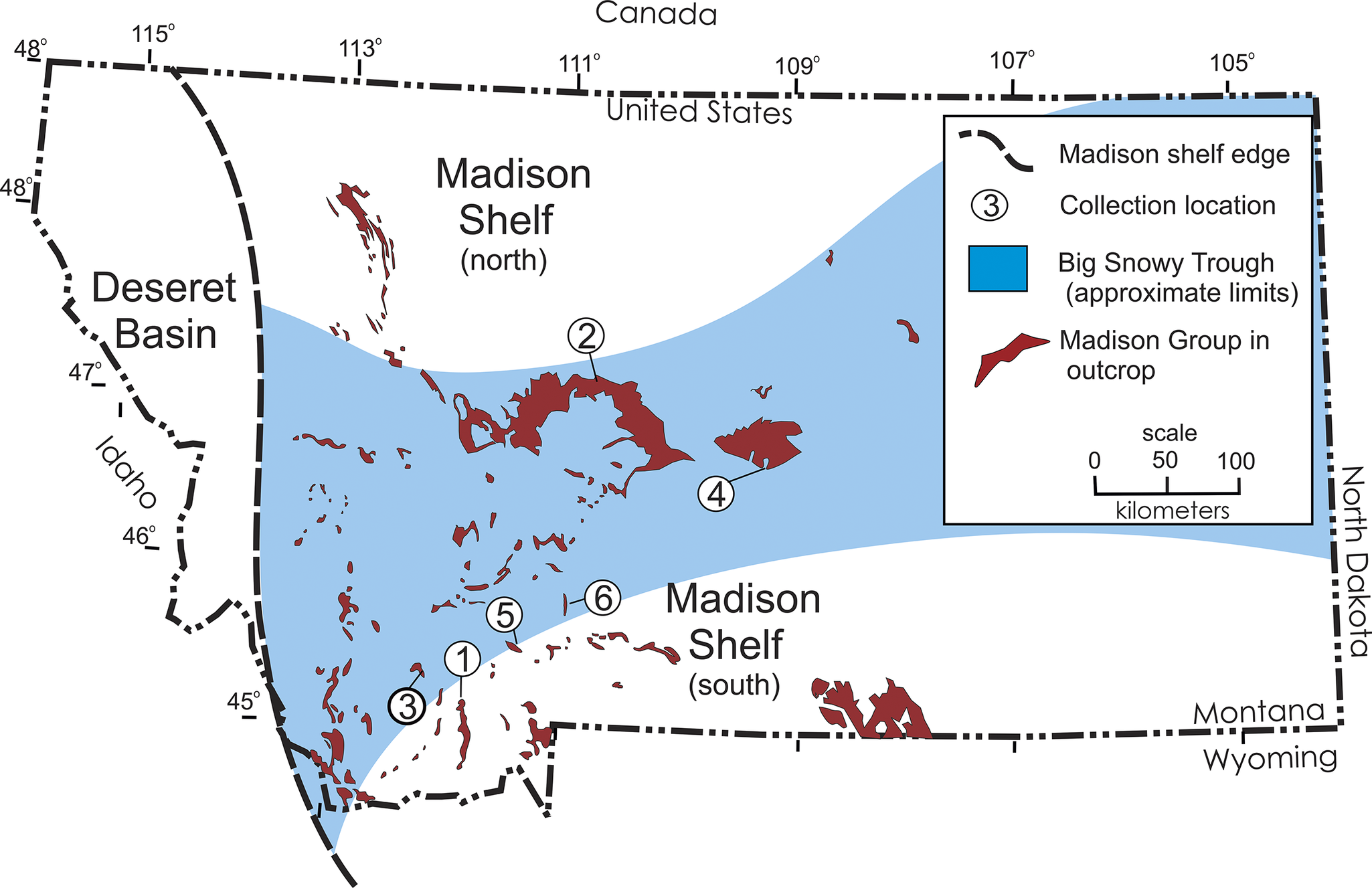
The bulk of the collections upon which this study is based was made between 1991 and 1999 from six locations of the Madison Group of central and western Montana (Fig. 1). These collections were augmented by a small collection made in 1905 by Percy Raymond and Earl Douglass from two of the six locales (see Appendix).
The Madison Group exposure in Montana illustrating the distribution of collecting locations (circled numbers) in relationship to outcrop areas. See Appendix for more precise location data. Blue area bifurcating southern and northern Madison shelf areas represents approximate extent of the Big Snowy Trough of Smith and Gilmour (Reference Smith and Gilmour1979).

Figure 1. Long description
A geological map of Montana and surrounding borders with Canada to the North, North Dakota to the East, Wyoming to the South, and Idaho to the West.
* Boundaries and Regions: A dashed line marks the Madison shelf edge. The Deseret Basin is located in the West. The Madison Shelf is divided into north and south regions by a large blue area representing the Big Snowy Trough, which spans horizontally across the center of the state.
* Geological Features: Dark red irregular shapes represent the Madison Group in outcrop. These are concentrated primarily within the blue Big Snowy Trough and along the southern shelf area.
* Collection Locations: Circled numbers indicate specific sites.
- Number 2 is located in the North-Central part of the trough.
- Number 4 is in the East-Central part of the trough.
- Numbers 3, 1, 5, and 6 are clustered in a diagonal line from Southwest to Northeast along the southern boundary of the trough.
* Map Details: Latitude lines are marked from 45 degrees to 48 degrees North. Longitude lines are marked from 105 degrees to 115 degrees West. A scale bar in the Northeast quadrant indicates 0 to 100 kilometers.
All descriptive terminology is consistent with recommendations of Whittington (Reference Whittington and Kaesler1997) in addition to detailed morphological nomenclature for Carboniferous phillipsids suggested by Richter and Richter (Reference Richter and Richter1951). Specimens photographically presented in the figures have been coated with a film of ammonium chloride to aid in surface feature illumination.
Repositories and institutional abbreviations
Type materials, illustrated specimens, and all other reference material collected for this study are housed at the Section of Invertebrate Paleontology, Carnegie Museum of Natural History, Pittsburgh, Pennsylvania (CM). Other reference materials are housed at the National Museum of Natural History, Washington, DC (USNM).
Systematic paleontology
Order Proetida Fortey and Owens, Reference Fortey, Owens and Martinsson1975
Family Brachymetopidae Prantl and Pribyl, Reference Prantl and Pribyl1950
Genus Proetides Walter, Reference Walter1924
Type species
Phillipsia insignis Winchell, Reference Winchell1863 from the Prospect Hill Sandstone, Burlington, Iowa, subsequently designated by Walter (Reference Walter1924).
Proetides raymondi new species
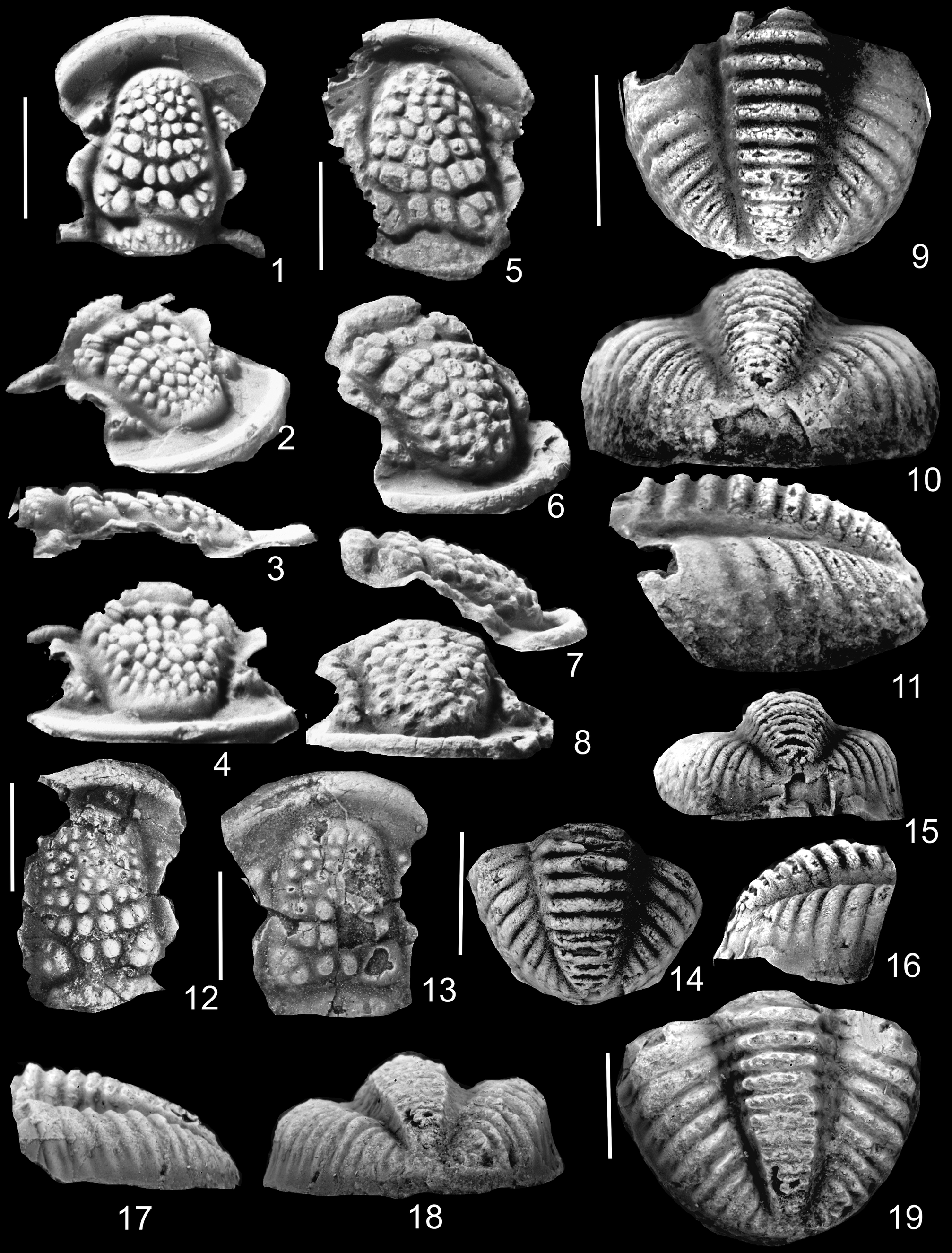
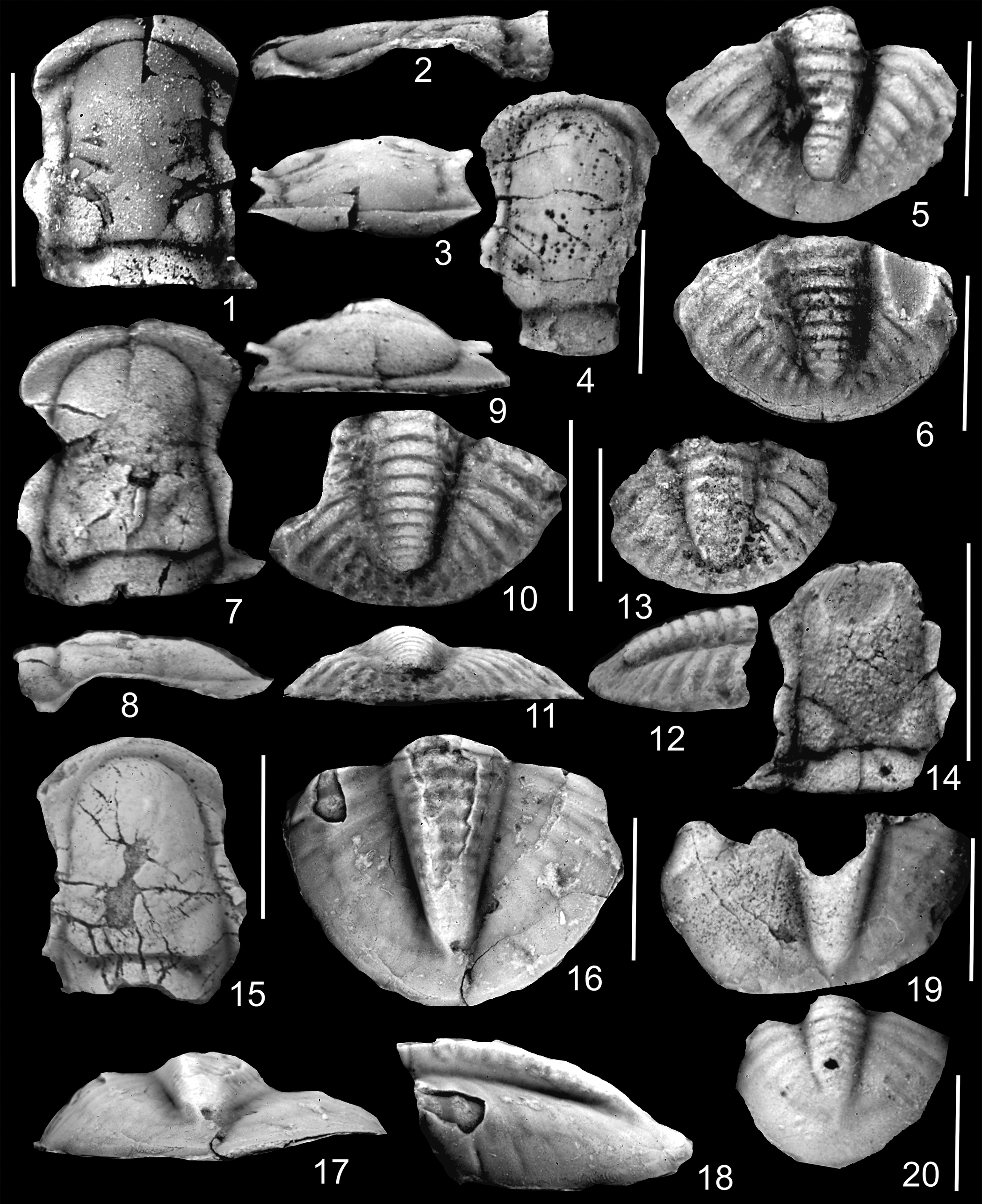
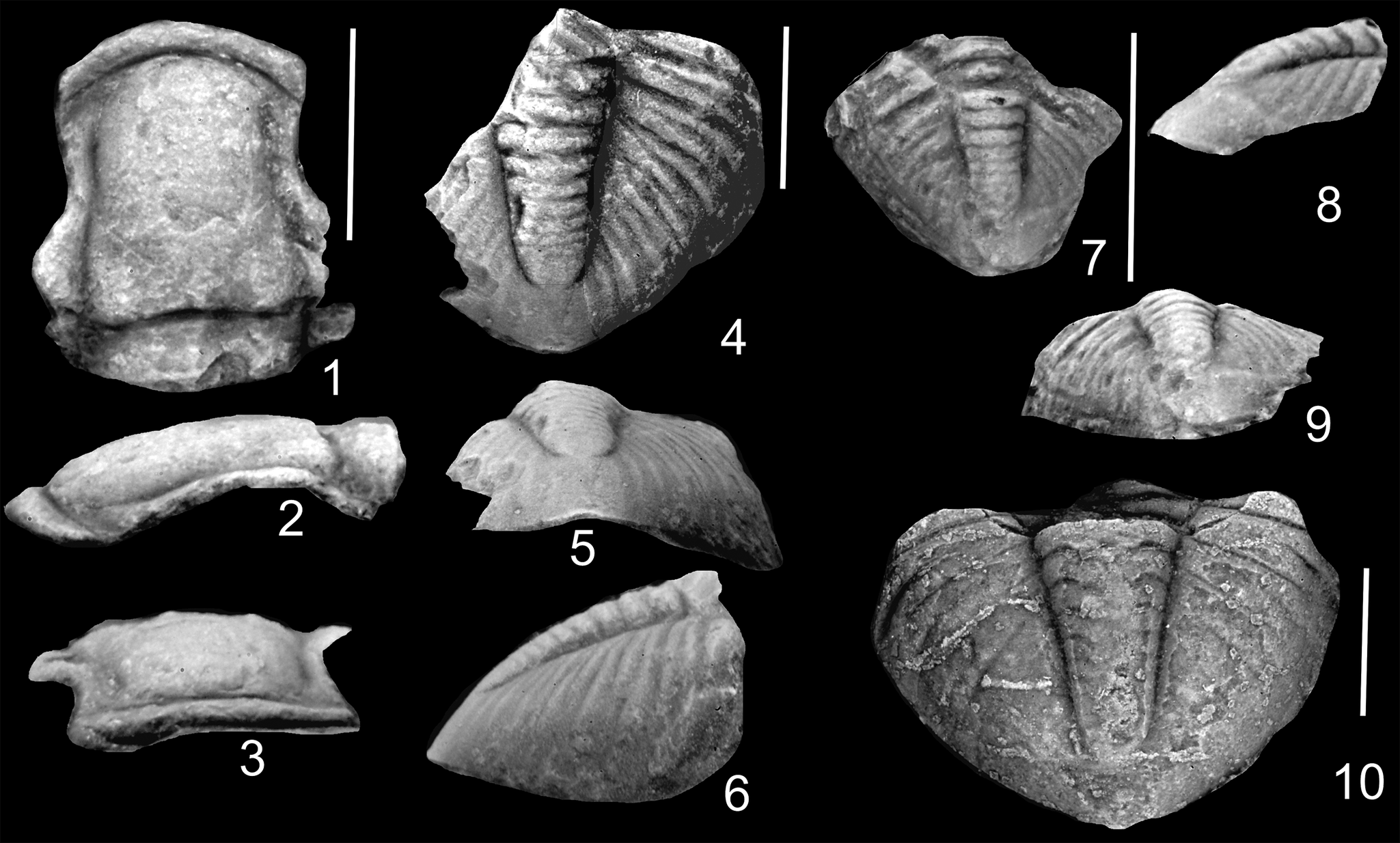
Proetides from the Madison Group of Montana. (1–16) Proetides raymondi n. sp.: (1–4) CM 64528, holotype, testate cranidium, Woodhurst Member, Location 1, dorsal (1), oblique (2), lateral (3), and anterior (4) views; (5–8) CM 64529, paratype, partial cranidium, Woodhurst Member, Location 1, dorsal (5), oblique (6), lateral (7), and anterior (8) views; (9–11) CM 64530, paratype, testate pygidium, upper Woodhurst Member, Location 3, dorsal (9), posterior (10), and lateral (11) views; (12) CM 64531, paratype, partial testate cranidium, Woodhurst Member, Location 2, dorsal view; (13) CM 64532, paratype, partial testate cranidium, Woodhurst Member, Location 1, dorsal view; (14–16) CM 64533, paratype, testate pygidium, Woodhurst Member, Location 1, dorsal (14), posterior (15), and lateral (16) views. (17–19) Proetides sp. indet., CM 64534, partial weathered pygidium, Woodhurst Member of the Lodgepole Limestone, Location 2, lateral (17), posterior (18), and dorsal (19) views. Scale bars = 5 mm.

Figure 2. Long description
The figure contains 19 panels of trilobite fossils with vertical 5 mm scale bars.
* Panels 1 through 4 show the holotype cranidium of Proetides raymondi (C M 64528) in dorsal, oblique, lateral, and anterior views. The glabella is covered in distinct, rounded tubercles.
* Panels 5 through 8 display a paratype partial cranidium (C M 64529) in dorsal, oblique, lateral, and anterior views, showing similar tuberculate texture.
* Panels 9 through 11 show a paratype pygidium (C M 64530) in dorsal, posterior, and lateral views. The pygidium features a prominent, segmented axis and ribbed pleural fields.
* Panel 12 is a dorsal view of a partial cranidium (C M 64531).
* Panel 13 is a dorsal view of another partial cranidium (C M 64532).
* Panels 14 through 16 show a paratype pygidium (C M 64533) in dorsal, posterior, and lateral views, highlighting the convex shape and segmentation.
* Panels 17 through 19 show a weathered pygidium of Proetides species indet. (C M 64534) in lateral, posterior, and dorsal views. This specimen appears more eroded than the others but retains the characteristic segmented structure.
Type specimens
Holotype, testate cranidium (Fig. 2.1–2.4; CM 64528), Woodhurst Member of the Lodgepole Formation, Locality 1. Paratypes (5): an incomplete testate cranidium (Fig. 2.5–2.8; CM 64529), same locality as the holotype; a testate pygidum (Fig. 2.9–2.11; CM 64530), Location 3; an incomplete testate cranidium (Fig. 2.12; CM 64531), Woodhurst Member, Location 2; an incomplete testate cranidium (Fig. 2.13; CM 64532), Woodhurst Member, Location 1; a complete testate pygidium (Fig. 2.14–2.16; CM 64533), Woodhurst Member, Location 1.
Diagnosis
Large, tuberculate exoskeleton. Glabella covered by coarse tubercles; deeply incised glabellar and axial furrows, and with anterior fixigenae bearing two or three tubercles located immediately posterior to the marginal furrow trough. Pygidium highly vaulted with pleural fields sharply arched in transverse profile. The types are silicified, and bear elevated axial rings with a row of elevated nodes or tubercles that are evident along the crest of each anterior ring.
Occurrence
Present in the Woodhurst Member of the Lodgepole Formation, and lower Mission Canyon Limestone.
Description
Cranidium of low to moderate vaulting, high in relief. Glabella conical in outline, ~ 0.6 times total cranidial length, 1.2 times longer than wide. Sides of glabella subvertical (transv.). Three pairs of glabellar furrows indistinct, demarcated by separation in rows of coarse, posteriorly elongated nodes that tend to decrease in size toward anterior. L1 suboval in outline, covered by four or five nodes that tend to be smaller toward dorsal furrow. L2 subrectangular in outline, covered by row of three or four interlocking nodes. L3 indistinct mainly because of coarseness of prosopon. Tubercles anterior to 3p furrows appearing randomly arranged. Preglabellar field broad, smooth, concave. Anterior margin sharply crested, robustly rounded, acutely curved to vertical at margin front. Palpebral lobes crescentic, relatively long, marked at highest point by row of small tubercles, located at ~ 0.4 of glabellar length. Anterior track of facial sutures strongly diverging, curved from γ to β, sharply rounded at β. Fixigenae immediately anterior to γ exhibiting row of two to four coarse tubercles. Dorsal furrow sinuous, distinct, deepest between eyes. Occipital furrow broad, sinuous, deep, with anterior edge convex, medially overhung by L1. Occipital lobe equal to width of posterior glabella, ornamented by small tubercles.
Pygidium 1.25 times wider than long, semicircular in outline. Axis broad, strongly vaulted, 0.43 times anterior pygidial width, consisting of 11 or 12 rings. Axis 0.9 times total pygidial length, strongly arched in longitudinal profile, semicircular in transverse profile, with vertical sides. Ring furrows deep and broad in front, becoming narrower and shallower to rear. Each forward ring straight, ornamented by what appears to be single row of small tubercles in front, not evident in rear. Sides of axis straight, converging gently posteriorly to approximate midline, then converging more strongly to broadly rounded terminus. Pleural fields moderately arched in longitudinal profile, strongly arched in transverse profile, meeting margin vertically. Each pleural field composed of eight or nine posteriorly recurved ribs. Ribs of subequal width separated by narrow, shallow interpleural furrow, ornamented by row of fine pustules on crest. Ribs not extending behind axis. Axial furrow narrow, shallow, curved (abaxial).
Etymology
Named in honor of Percy Raymond, co-collector of the holotype.
Remarks
Proetides raymondi n. sp. is almost identical to Proetides insignis in nearly all cranidial characteristics. Each displays a robust anterior margin, moderately wide, flat, preglabellar field, and node-like prosopon. Cranidia of Proetides raymondi n. sp. can be readily distinguished from those of Proetides insignis by the presence on the former of two or three coarse tubercles on the anterior fixigenae immediately anterior to γ. The pygidium of Proetides raymondi n. sp. is semicircular in outline like that of Proetides insignis, but the axis of Proetides raymondi n. sp. is rounded in transverse profile and lacks the coarse node-like prosopon that adorns the axial rings of Proetides insignis. On Proetides insignis, the vaulted axial rings display a row of posterodorsally directed pustules or nodes. These axial ring nodes are also a feature that characterizes Proetides colemani Hessler, Reference Hessler1962. The cranidium of Brachymetopus nodosus Wilson, Reference Wilson1979 was assigned to Proetides by Hahn and Hahn (Reference Hahn and Hahn1996), but that reassignment appears to be incorrect. This species is clearly a member of Brachymetopus McCoy, Reference McCoy1847, and as such is not comparable to Proetides raymondi n. sp.
Proetides sp. indet.
Description
Pygidium parabolic in outline, 1.10 times wider than long. Axis 0.37 times anterior pygidial width, moderately vaulted, consisting of > 12 rings, 0.8 of total pygidial length, mildly arched in longitudinal profile, distinctly tapering to rear, acutely terminating. Ring furrows deep, straight. Forward ring ornamented by single row of tubercles that gives subtrapezoidal profile. Dorsal furrow narrow, deep, straight. Pleural fields strongly arched in transverse profile, mildly arched in longitudinal profile. Pleural field composed of 11 slightly posteriorly recurved ribs. Ribs of subequal width, separated by broad, shallow interpleural furrow. Ribs appearing to extend behind axis.
Remarks
Proetides sp. indet. is a single specimen from the upper Paine Member of the Lodgepole Formation and is distinct from Proetides raymondi n. sp., Proetides insignis, and Proetides colemani by its parabolic outline; a longer, narrower axis that is sharply rounded at its terminus; a deep, broad, dorsal furrow; and a strongly arched pleural field (transv.).
Genus Brachymetopus McCoy, Reference McCoy1847
Type species
Phillipsia maccoyi Portlock, Reference Portlock1843, Mississippian of County Kildare, Ireland, subsequently designated by Vogdes (Reference Vogdes1890).
Brachymetopus swimmingwomanensis new species
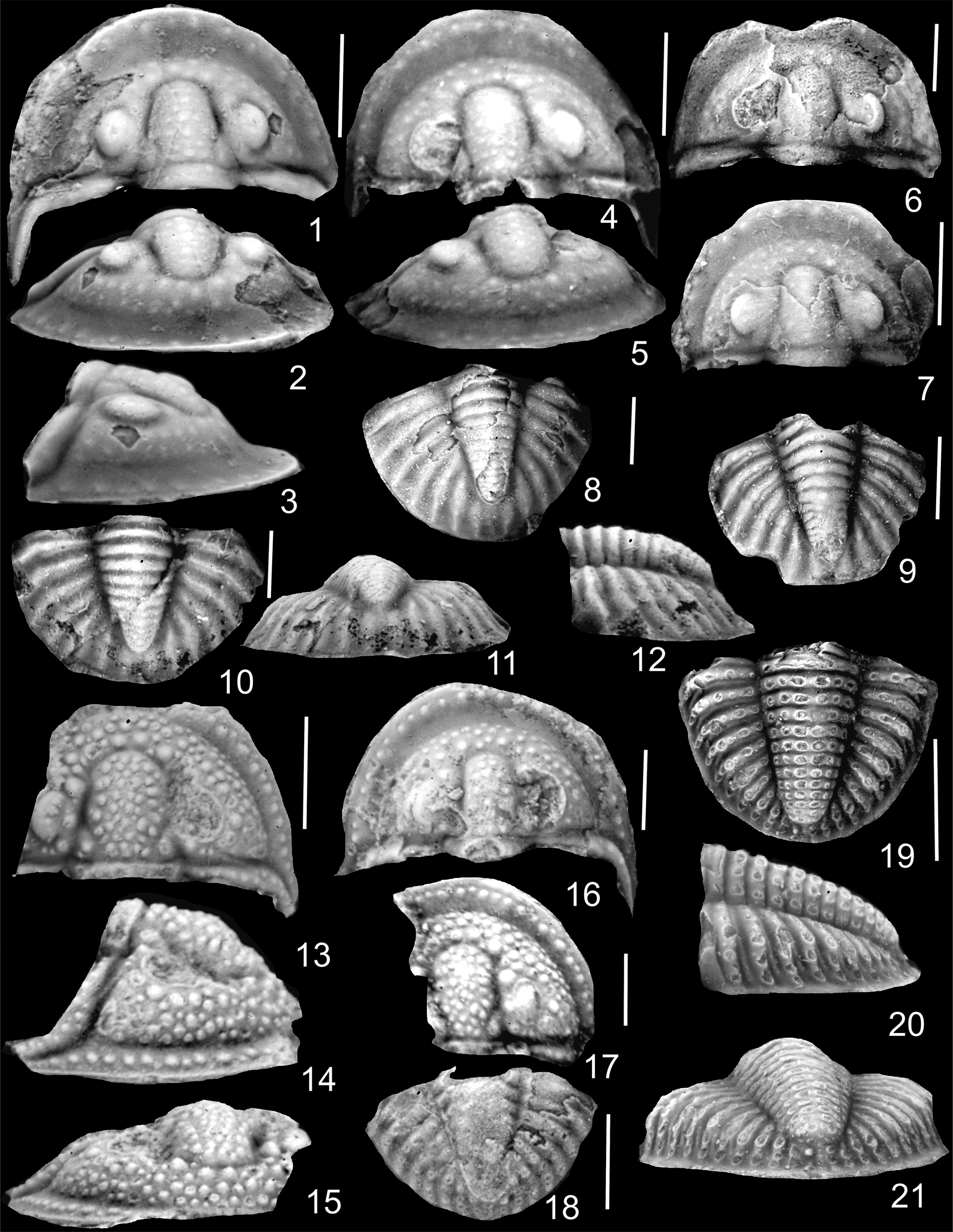
Brachymetopus from the Lodgepole Limestone. (1–12) Brachymetopus swimmingwomanensis n. sp., all specimens from the Paine Member, Location 4: (1–3) CM 64535, holotype, testate cephalon, dorsal (1), anterior (2), and lateral (3) views; (4, 5) CM 64536, paratype, testate cephalon, dorsal (4) and anterior (5) views; (6) CM 64537, partial testate cephalon, dorsal view; (7) CM 64538, paratype, testate cephalon, dorsal view; (8) CM 64539, testate pygidium, dorsal view; (9) CM 64540, paratype, incomplete testate pygidium, dorsal view; (10–12) CM 64541, paratype, testate pygidium, dorsal (10), posterior (11), and lateral (12) views. (13–18) Brachymetopus indianwellsensis Brezinski, Reference Brezinski2000a: (13–15) CM 64542, partial testate cephalon, Paine Member, Location 4, dorsal (13), lateral (14), and anterior (15) views; (16) CM 64543, testate cephalon, Paine Member, Location 4, dorsal view; (17) CM 64544, partial testate cephalon, Paine Member, Location 4, dorsal view; (18) CM 64545, partial testate pygidium, Paine Member, Location 4, dorsal view. (19–21) Brachymetopus sp. indet., CM 64546, testate pygidium, upper Paine Member, Location 4, dorsal (19), lateral (20), and posterior (21) views. Scale bars = 2 mm.

Figure 3. Long description
A collection of 21 fossil photographs, each with a 2 mm scale bar.
Panels 1 through 12 show Brachymetopus swimmingwomanensis n. sp.
- 1 to 3: Holotype cephalon in dorsal, anterior, and lateral views, showing a smooth, rounded glabella and prominent eyes.
- 4 and 5: Paratype cephalon in dorsal and anterior views.
- 6 and 7: Partial and paratype cephalons in dorsal views.
- 8 and 9: Dorsal views of a testate pygidium and an incomplete paratype pygidium, showing distinct segmented ribs.
- 10 to 12: Paratype pygidium in dorsal, posterior, and lateral views, highlighting the convex shape and pleural furrows.
Panels 13 through 18 show Brachymetopus indianwellsensis.
- 13 to 15: Partial cephalon in dorsal, lateral, and anterior views, featuring a highly tuberculated or bumpy surface texture.
- 16 and 17: Dorsal views of a testate cephalon and a partial cephalon, both showing dense tuberculation.
- 18: Dorsal view of a partial pygidium with similar bumpy texture.
Panels 19 through 21 show Brachymetopus sp. indet.
- 19 to 21: Pygidium in dorsal, lateral, and posterior views. This specimen exhibits a very high density of tubercles across the axis and pleural ribs, with a distinct row of nodes along the axial rings.
Type specimens
Holotype, a partially exfoliated cephalic shield (Fig. 3.1–3.3; CM 64535), Paine Member of the Lodgepole Formation within basal reef facies, Locality 4. Paratypes (6): an incomplete testate cephalon (Fig. 3.4, 3.5; CM 64536); two incomplete, partially testate cephalons (Fig. 3.6, 3.7; CM 64537, 64538); three testate pygidia (Fig. 3.8–3.12; CM 64539–64541), all from the same location as the holotype.
Diagnosis
Cephalon semicircular in outline, moderately vaulted, exhibiting poorly defined pustules. Glabella short, subtrapezoidal in outline. Border furrow broad, smooth, flat. Cephalon with subdued pustular prosopon. Pygidium parabolic in outline, moderately vaulted. Axis straight-sided, narrow, sharply tapering to posterior.
Occurrence
Present in the Waulsortian facies of the Paine Member of the Lodgepole Formation. Known only from the type locality.
Description
Cephalon semicircular in outline, strongly vaulted. Glabella mildly elevated above surrounding cephalon, evenly rounded in both longitudinal and transverse profiles; 0.45 of total cephalic length; 0.31 of cephalic width; tapering forward, rounded anteriorly, straight-sided, subtrapezoidal in outline, covered by subdued to indistinct pustules. L1 small, oval in outline. S1 shallow, arcuate. 2p obsolete. Dorsal furrow straight, narrow, shallowest where intersected by S1; deepest immediately anterior to that furrow. Occipital furrow shallow, straight, narrow. Occipital lobe narrow, moderately arched (transv.), rounded in longitudinal profile. Preglabellar field convex, descending steeply from dorsal furrow into broad, shallow marginal furrow, and covered by weakly defined pustules. Palpebral areas marked by separation of dorsal furrow from eyes. Convex portion of field exhibiting low-relief pustules. Border broad, flat, sharply underturned at margin, marked by line of subdued pustules. Eyes large, hemispherical, separated from dorsal furrow by narrow, elevated area, overhanging indistinct ocular platform. Posterior border furrow narrow, deep, widening into posterior border furrow. Genal spine of moderate length, tapering sharply posteriorly.
Pygidium parabolic in outline, moderately to highly vaulted, 0.80 times as long as wide. Axis 0.36 of maximum anterior pygidial width, 0.83 of total pygidial length, narrow, straight-sided, tapering posteriorly to sharply rounded terminus, composed of 13–15 rings. Rings semicircular in transverse profile, smooth. Ring furrows straight, shallow, narrowing, deepening abaxially. Pleural field strongly arched (transv.), composed of seven smooth, posteriorly recurved ribs. Pleural furrows shallow, becoming broader posteriorly, extending posterolaterally to margin. Interpleural furrows indistinct anteriorly, obsolete to posterior. Ribs recurved posteriorly to rear (abaxial), extending to margin.
Etymology
Named for Swimming Woman Canyon of the Big Snowy Range, Fergus County, Montana, from which all type material was recovered.
Remarks
Brachymetopus swimmingwomanensis n. sp. is most similar to Brachymetopus? elegans (Girty, Reference Girty1915) that Brezinski (Reference Brezinski1986) erroneously assigned to Australosutura Campbell and Goldring in Amos, Campbell, and Goldring, Reference Amos, Campbell and Goldring1960, and that is herein reassigned to its original generic designation. The differences are that the latter species is much less vaulted, possesses a distinct, narrow border furrow, and the prosopon is present along the border flange. Also, Brachymetopus elegans exhibits a distinct granulated ornament to the pygidial ribs. Both species are found within Waulsortian reef facies of the USA.
Brachymetopus swimmingwomanensis n. sp. is assignable to the Brachymetopus maccoyi group of Hahn and Hahn (Reference Hahn and Hahn1996). The assertion of Hahn and Hahn (Reference Hahn and Hahn1996) that Brachymetopus maccoyi (Portlock, Reference Portlock1843) species group provides binominal relief to the Brachymetopus problem is in question, and one that could be resolved with cladistics. As such, Brachymetopus swimmingwomanensis n. sp. is maintained as a stand-alone species.
Brachymetopus indianwellsensis Brezinski, Reference Brezinski2000a
Reference Brezinski2000a Brachymetopus indianwellsensis Brezinski, p. 1049, figs. 12–17, 26.
Holotype
A partial cephalic shield (CM 45728), Caballero Formation of New Mexico (Brezinski, Reference Brezinski2000a, p. 1049, figs. 13, 16, 17).
Diagnosis
See Brezinski (Reference Brezinski2000a, p. 1049).
Occurrence
Known from the Paine Member of the Lodgepole Formation of Montana, and the Caballero Formation of New Mexico.
Emended description
Cephalic shield highly vaulted, outline semicircular. Glabella subtrapezoidal in outline, straight-sided, ornamented with abundant pustules, moderately arched in both transverse and longitudinal profiles, markedly elevated above dorsal furrow. Preglabellar field arched (sag.) descending from dorsal furrow, and then steeply inclined onto preglabellar field that descends into shallow border furrow that is broadly rounded at base. S1 shallow, short; L1 very small, triangular in outline, ornamented by one or two nodes. Occipital furrow shallow, narrow, distinct, straight. Occipital lobe narrow, of equal width, ornamented by row of pustules, largest along sagittal line. Dorsal furrow moderately shallow, demarcated (exsag.) by row of coarse pustules, deepest between eyes. Proximal areas of cephalic shield ornamented with pustules that become smaller into border furrow. Eyes medium-sized, located posteriorly on cephalic shield. Border furrow narrow, deep. Border wide, sharply flattened at edge, ornamented with single row of pustules. Posterior border furrow deep, curved onto genal spine, ornamented by row of fine pustules or nodes. Genal spine present, but length in question.
Pygidium short, outline subhyperbolic, moderately vaulted. Pleural fields of eight ribs, exhibiting enlarged posterior band and subdued anterior band. Posterior ribs becoming increasingly posteriorly recurved so that rearmost ribs extend behind axis.
Montana material
Three incomplete cephalic shields (Fig. 3.13–3.17; CM 64542–64545), Paine Member of the Lodgepole Formation from Location 2; an incomplete pygidium (Fig. 3.18; CM 64545), middle Paine Member of the Lodgepole Formation, Location 2.
Remarks
Brachymetopus indianwellsensis from the Paine Member of the Lodgepole Formation demonstrates unmistakable similarities to the type material from New Mexico (see Brezinski, Reference Brezinski2000a, fig. 2.12–2.17, 2.28). It is markedly different from Brachymetopus swimmingwomanensis n. sp. in exhibiting higher elevation to the glabella, and having cephalic nodes and pustules that are distinctly elevated and pronounced. Brachymetopus indianwellsensis is similar to Brachymetopus woodwardi Whidborne, Reference Whidborne1896 from the Tournaisian of England (see Owens, Reference Owens1986, pl. 7, figs. 13, 14) in that each displays a narrow, deep border furrow and subtriangular pygidial outline. The latter species, however, displays a conical rather than trapezoidal outline to the glabella. Some of the subspecies of Brachymetopus maccoyi also show superficial similarity to Brachymetopus indianwellsensis (see Hahn and Hahn, Reference Hahn and Hahn1996, figs. 137–144). The type species of the genus is characterized by a deep, narrow cephalic border furrow, a relatively narrow border that is rounded on top, large eyes, and a parabolic outline to the pygidium. Brachymetopus maccoyi also exhibits similar cephalic sculpture and furrowing that is more pronounced than in Brachymetopus indianwellsensis.
Brachymetopus ? sp. indet.
Description
Spinose pygidium with parabolic outline, high relief, moderate vaulting. Axis long, mildly tapering posteriorly, rounded at terminus, evenly rounded in transverse profile. Nearly straight in longitudinal profile, composed of 12 rings separated by narrow, deep ring furrows. Crest of each ring exposing row of spine bases, six on anterior rings and four to posterior. Pleural fields mildly arched in longitudinal profile, flat (abaxial) in transverse profile, becoming strongly arched, then vertical at margin, composed of 11 robust ribs separated by deep, wide interpleural furrow. Posteriormost ribs present, in alignment with axial furrow. Border narrow, of equal width around entire periphery.
Remarks
Brachymetopus? sp. indet. differs from most other species assigned to this genus in having a U-shaped outline and modest tapering to the axis. The abundant broken pustules suggest that they represent the bases of spines. These characters are similar to those of Brachymetopus (Eometopus Hahn and Hahn, Reference Hahn and Hahn1996) hahnus Özdikmen, Reference Özdikmen2009 from the upper Visean of Belgium. No other representative of this genus displays these differing characters. These characteristics also are displayed by some species of Australosutura, e.g., A. lodiensis (Meek, Reference Meek1875) (see Brezinski, Reference Brezinski1988b, fig. 2.14, 2.20, 2.23, 2.24), but the strongly tapering axis of Australosutura spp. differs significantly from that of Brachymetopus? sp. indet.
Family Proetidae Salter, Reference Salter1864
Genus Eoameura new genus
Type species
Eoameura kollari new genus new species, by original designation.
Other species
Eoameura ameuroides (Hessler, Reference Hessler1965).
Diagnosis
Cranidium large, of moderate relief. Glabella distinctly widest between eyes. Palpebral lobes semicircular in outline. Frontal lobe parallel-sided to very slightly laterally expanded. S1 deepest at occipital furrow, distinctly shallowing and becoming shallower laterally, meeting dorsal furrow at midpoint of eyes. Pygidium parabolic, with broad border, even-width, and shallowing to rear. Axis vaulted, narrow, rounded in transverse profile.
Etymology
Name implying an early or primeval version of the late Carboniferous and Permian genus Ameura Weller, Reference Weller1936.
Remarks
Ameura is a widespread Pennsylvanian and Permian trilobite genus known mainly from the USA (Chamberlain, Reference Chamberlain1969; Pabian and Fagerstrom, Reference Pabian and Fagerstrom1972; Brezinski, Reference Brezinski1988a). Its taxonomic position has long presented a conundrum for Carboniferous trilobite taxonomists. The oldest representative of the Ameura clade was considered Moscovian (Early Pennsylvanian) (Brezinski et al., Reference Brezinski, Sturgeon and Hoare1989). Weller (Reference Weller1936) suggested that its Early Mississippian ancestry might be related to Phillipsia Portlock, Reference Portlock1843. Hahn and Hahn (Reference Hahn, Hahn and Westphal1972) assigned species of this genus to the Cummingellinae, whereas Owens (Reference Owens1983, Reference Owens, Lane, Siveter and Fortey2003) designated them to the Ditomopyginae. Brezinski (Reference Brezinski2025) postulated Dechenella Kayser, Reference Kayser1880 as a sister group for Ameura. The recovery of a primitive ancestor to this clade bolsters this interpretation. The identification of an interpreted Early Mississippian predecessor to the Pennsylvanian Ameura lineage should provide helpful insights into the lineage’s possible ancestral relations. The material from the Paine Member of the Lodgepole Formation of Montana can be interpreted as representing a precursor and inferred ancestor to this lineage previously restricted to the Pennsylvanian and early Permian.
Eoameura kollari n. gen. n. sp. differs from most species of Carboniferous trilobites by possessing an S1 that originates and is deepest at the occipital furrow, shallowing obliquely forward, intersecting the dorsal furrow at the midpoint of the palpebral lobes. Although this characteristic is unknown in genera typically assigned to the Phillipsiidae, it is common in some Proetidae species, e.g., those assigned to Monodechenella Stumm, Reference Stumm1953 (Lieberman, Reference Lieberman1994, fig. 36.9), Dechenella (Bignon and Cronier, Reference Bignon and Cronier2010, fig. 5n), Conophillipsia Roberts, Reference Roberts1963 (Engel and Morris, Reference Engel and Morris1984, fig. 5B), and Drevermannia Richter, Reference Richter1909 (Hahn et al., Reference Hahn, Hahn and Müller1997, figs. 4, 5). Thus, although this character is atypical of the Phillipsiidae, it is sometimes common in Late Devonian Proetidae. Furthermore, some species of Dechenella (see Bignon and Cronier, Reference Bignon and Cronier2010, figs. 4Q, 5I, 5K) possess the similarly large, posteriorly located, palpebral lobes, and triangular pygidium that characterize Eoameura and Ameura. This is especially true of Dechenella verneuili (Barrande, Reference Barrande1852), which has a subtriangular pygidium exhibiting a posteriorly elongated border that is identical to that of Ameura (see Lieberman, Reference Lieberman1994, fig. 33.9, 33.12). The identification of an Early Mississippian representative to this lineage, as well as the convergent morphologies among Ameura, Eoameura, and some Late Devonian groups, support a closer common ancestry to the Proetidae than to the Phillipsiidae.
Thigriffides ameuroides (Hessler, Reference Hessler1965) is herein assigned to this genus insofar as its outline and the structure of its axial rings and pleural ribs are consistent with those shown to characterize the type material of Eoameura. Furthermore, the holotype of Eoameura ameuroides is known from the Chouteau Limestone of Missouri and has an age compatible with that of the Madison species.
Eoameura kollari new genus new species
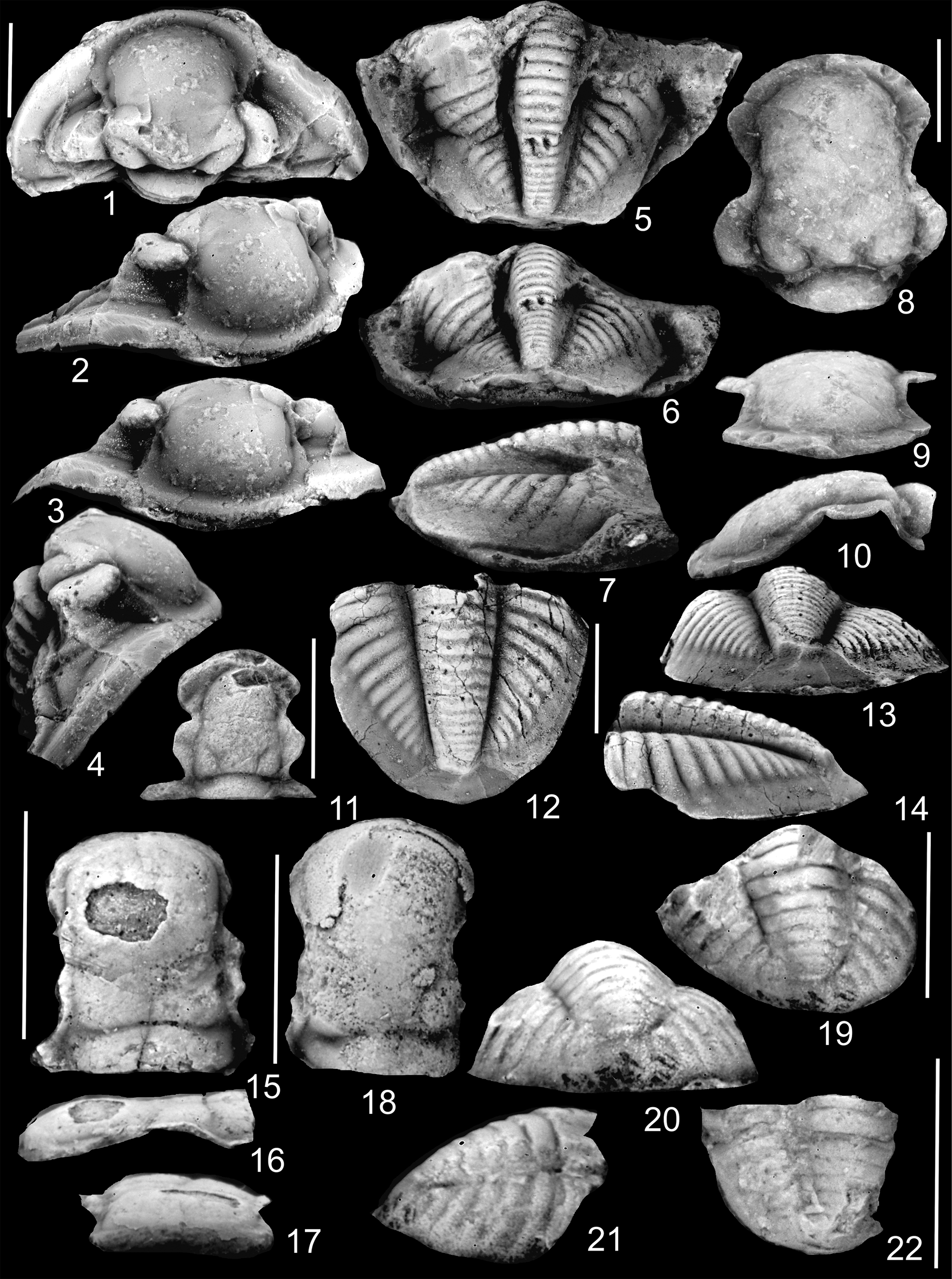
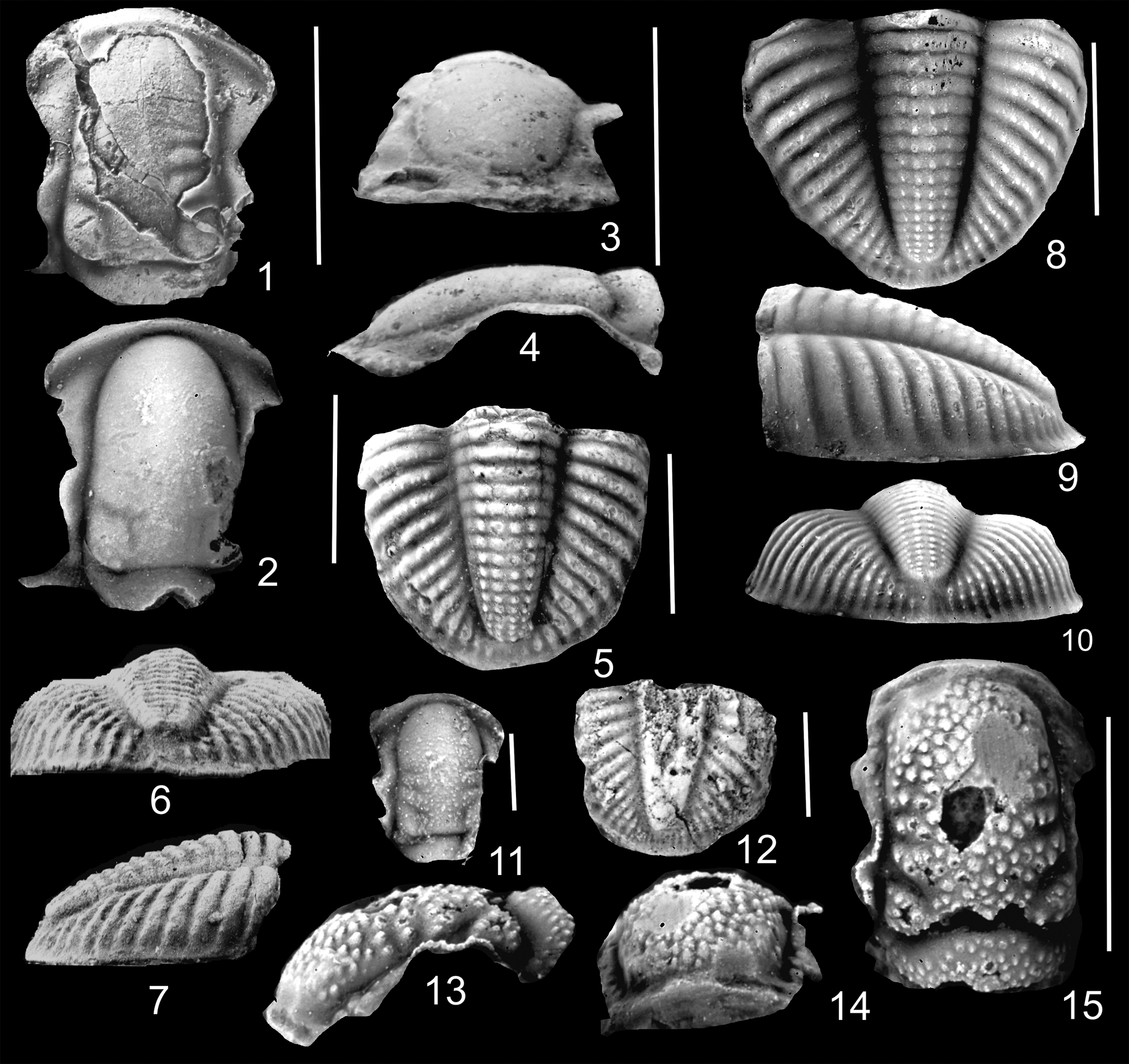
(1–14) Eoameura kollari n. gen. n. sp.: (1–7) CM 64547, holotype, partially crushed testate specimen, upper Paine Member, Location 6, dorsal (1), oblique (2), anterior (3), lateral (4), dorsal pygidial (5), posteriopygidial (6), and lateral (7) views; (8–10) CM 64548, paratype, testate cranidium, Woodhurst Member, Location 1, dorsal (8), anterior (9), and lateral (10) views; (11) CM 64549, paratype, small testate holaspid cranidium, upper Paine Member of the Lodgepole, Location 2, unexfoliated dorsal view; (12–14) CM 64550, testate pygidium, Woodhurst Member, Location 1, dorsal (12), posterior (13), and lateral (14) views. (15–22) Liobolina montanaensis n. sp.: (15–17) CM 64551, holotype, partial testate cranidium, lower Paine Member of the Lodgepole Limestone, Location 2, dorsal (15), lateral (16), and anterior (17) views; (18) CM 64552, paratype, exfoliated partial cranidium, same location as holotype, dorsal view; (19–21) CM 64553, paratype, pygidium, same location as holotype, dorsal (19), posterior (20), and lateral (21) views; (22) CM 64554, paratype, incomplete pygidium, same location as holotype, dorsal view. Scale bars = 5 mm.

Figure 4. Long description
The image contains 22 numbered panels of fossil specimens.
Panels 1 through 7 show Eoameura kollari n. gen. n. sp. (C M 64547):
* 1: Dorsal view of a partially crushed testate specimen.
* 2: Oblique view.
* 3: Anterior view.
* 4: Lateral view.
* 5: Dorsal pygidial view showing a segmented central axis and ribbed pleural fields.
* 6: Posteriopygidial view.
* 7: Lateral view of the pygidium.
Panels 8 through 10 show Eoameura kollari (C M 64548):
* 8: Dorsal view of a testate cranidium.
* 9: Anterior view.
* 10: Lateral view.
Panel 11: Dorsal view of a small testate holaspid cranidium (C M 64549).
Panels 12 through 14 show Eoameura kollari (C M 64550):
* 12: Dorsal view of a testate pygidium with a distinct vertical scale bar to the right.
* 13: Posterior view.
* 14: Lateral view.
Panels 15 through 17 show Liobolina montanaensis n. sp. (C M 64551):
* 15: Dorsal view of a partial testate cranidium with a scale bar to the left.
* 16: Lateral view.
* 17: Anterior view.
Panel 18: Dorsal view of an exfoliated partial cranidium (C M 64552).
Panels 19 through 21 show Liobolina montanaensis (C M 64553):
* 19: Dorsal view of a pygidium.
* 20: Posterior view.
* 21: Lateral view.
Panel 22: Dorsal view of an incomplete pygidium (C M 64554).
Vertical scale bars representing 5 mm are placed next to panels 1, 8, 11, 12, 15, 18, 19, and 22.
Type specimens
Holotype, a deformed, enrolled, testate specimen (Fig. 4.1–4.7; CM 64547), upper Paine Member of the Lodgepole Formation, Location 6. Paratypes (3): a testate cranidium (Fig. 4.8–4.10; CM 64548), Location 3; a testate cranidium (Fig. 4.11; CM 64549), upper Paine Member of the Lodgepole Formation, Location 2; a complete testate pygidium (Fig. 4.12–4.14; CM 64550), basal Woodhurst Member of the Lodgepole Formation, Location 1.
Diagnosis
Glabella widest between eyes; palpebral lobes large, semicircular in outline, very posteriorly located. Glabellar frontal lobe parallel-sided to very slightly laterally expanded. S1 trace diagonal, deepest at occipital furrow, shallowing and broadening anteriorly, intersecting dorsal furrow at middle of palpebral lobe. Pygidium subtriangular in outline, with broad posterior border and long, narrow, vaulted, rounded axis.
Occurrence
Present in the upper Paine Member and lower Woodhurst Member of the Lodgepole Formation of Montana.
Description
Cephalon smooth, low to moderate in vaulting and relief, parabolic in outline. Glabella distinctly widest between palpebral lobes; frontal lobe quadrate in outline, parallel-sided to barely perceptibly widening anterior to γ, exhibiting low to moderate inflation, evenly arched in both longitudinal and transverse profile. Frontal glabellar lobe bluntly rounded anteriorly, intersecting narrow, shallow, anterior border furrow, evenly rounded in transverse and longitudinal profiles. Dorsal furrow narrow, sinuous, deepest between palpebral lobes, with pair of fossulae near γ. S1 widest and deepest at occipital furrow, with arcuate trace that shallows anterolaterally, failing to meet dorsal furrow. L1 suboval in outline, moderately inflated, posteriorly overhanging occipital furrow. Palpebral lobes large, semicircular in outline, gently downsloping into dorsal furrow, located very posteriorly with midline equal to widest part of glabella. S2 shallow and faint; S3 indistinct. Occipital ring of medium width and lower in elevation than posterior terminus of glabella, narrowing laterally. Occipital furrow deep, broad, sinuous. Facial sutures wider at δ than β, acutely curved at ε, mildly divergent in front with straight section between γ and β, sharply rounded at β. Eyes large, reniform. Ocular platform flat, very narrow. Border furrow narrow, close to eye. Border broad, flat on top, sharply rounded at margin. Posterior border furrow narrow, deep, extending onto what appears to be a robust genal spine.
Pygidium of medium vaulting, subtriangular in outline, 1.20 times as wide as long. Axis moderately vaulted above pleural fields, 0.35 of anterior pygidial width, 0.85 of total pygidial length, composed of 15–17 rings, each evenly convex in transverse profile, being slightly shouldered in front, evenly rounded to rear. Ring furrows narrow, shallow. Rings, wide, evenly rounded in longitudinal profile. Pleural fields evenly convex in transverse profile, nearly flat at dorsal furrow and meeting border at ~ 45° degees, composed of 9 or 10 posteriorly recurved ribs, of approximate even width. Pleural furrows narrow, slightly recurved, deeper in distal extent. Two anteriormost ribs extending slightly onto border. Border distinct, wide, broadening behind axis, straight-sided, downsloping and extending to margin. On larger individuals, border widening noticeably posteriorly.
Etymology
Named in memory of Albert D. Kollar of Carnegie Museum of Natural History, who assisted in Madison Group field collecting.
Remarks
The differences in gross morphology between Eoameura kollari n. gen. n. sp. and Ameura missouriensis (Shumard, Reference Shumard, Shumard and Swallow1858) are subtle but distinct. These include more divergent anterior facial sutures that are sharply rounded at β, a more parabolic outline to the pygidium, and larger, more semicircular palpebral lobes on the Mississippian species as well as a more distinctly triangular pygidium with a posterior elongation to the border on the Pennsylvanian species. The geometry Eoameura’s L1 furrows, the broadening of the glabella in front, and the lack of posterior extension to the pygidium suggest a difference that warrants erection of a new genus. Plus, the > 50 Myr separating the Madison species and the type of Ameura suggest that a new genus is warranted. The stratigraphic and temporal difference between these two species is marked. Eoameura is currently known only from Tournaisian strata, whereas the earliest occurrence of Ameura is Westphalian, Early Pennsylvanian. This suggests that there is nearly a 50 Myr gap to this lineage.
Family Phillipsiidae Oehlert, Reference Oehlert1886
Genus Liobolina Richter and Richter, Reference Richter and Richter1951
Type species
Liobolina nebulosa Richter and Richter, Reference Richter and Richter1951, Tournaisian, Rhenish Slate Mountains, Westphalia, Germany, by original designation.
Liobolina montanaensis new species
Type specimens
Holotype, a nearly complete cranidium (Fig. 4.15–4.17; CM 64551), lower Paine Member of the Lodgepole Formation, Location 2. Paratypes (3): an exfoliated partial cranidium (Fig. 4.18; CM 64552), same location as the holotype; two pygidia (Fig. 4.19–4.22; CM 64553, 64554), same locality as the holotype.
Diagnosis
Cranidium low in relief and vaulting. Glabella cylindrical, dorsally flattened; palpebral lobes small, narrow, medially located; posterior facial suture with long, divergent section. Frontal lobe meeting narrow border. Anterior fixigenae following closely to outline of frontal lobes. Pygidium semicircular, axis broad, furrowing shallow, extending onto indistinct border that widens posteriorly.
Occurrence
Present in the lower Paine Member of the Lodgepole Formation at Locality 2.
Description
Cranidium of very low relief and vaulting. Glabella cylindrical in outline, faintly constricted at γ; frontal lobe bluntly rounded in front, intersecting faint border furrow at margin. S1 shallow, arcuate; L1 subtriangular. Longitudinal profile of glabella gently arched, highest in frontal lobe. Transverse profile flattened with gentle arch. Palpebral lobes narrow, medially located; dorsal furrow shallow, straight, narrow. Anterior facial sutures faintly divergent, rounded at β, following frontal glabellar lobe. Posterior facial sutures with long, curved, divergent section from ε to ζ. Occipital furrow shallow, sinuous, narrow, dorsally shallowing. Occiptial ring wide, flattened, equal in height to posterior of glabella.
Pygidium parabolic in outline, moderately vaulted, low in relief. Axis broad, sharply tapering posteriorly, acutely round in rear, composed of nine distinct rings, evenly rounded in transverse profile, moderately arched in longitudinal profile. Ring furrows narrow, shallow. Posterior extension of axis projecting onto border behind axis. Pleural fields arched in transverse profile, very mildly arched in longitudinal profile, composed of eight ribs, only the first two or three discernable and extending onto wide, inclined border. Border widening posteriorly; elongated in that direction in smaller specimens.
Etymology
Named for the state of Montana, where the type material originated.
Remarks
Liobolina montanaensis n. sp. is the first documentation of this genus in the USA. Its recovery from the lower Paine Member mirrors ecological inferences to other members of this genus in Europe (Hahn, Reference Hahn1990). Richter and Richter (Reference Richter and Richter1951), Osmolska (Reference Osmolska1962), and Hahn et al. (Reference Hahn, Hahn and Müller2004) documented multiple species of Liobolina within deep-water Kulm facies of the Lower Mississippian of central Europe.
Liobolina montanaensis n. sp. has a pygidium that is similar to that of Liobolina submonstrans Richter and Richter, Reference Richter and Richter1951 in that both species display shallow cranidial furrowing, and a short, robust axis with an indistinct pygidial border. The Montana species is also similar to Liobolina praevia Osmolska, Reference Osmolska1962 in that both species have pygidia that are low in relief, but Liobolina praevia differs by having a cranidium with a wider anterior border and in lacking palpebral lobes. The Madison species of Liobolina is also similar to Liobolina pemphredro Hahn, Hahn, and Müller, Reference Hahn, Hahn and Müller2004 and Liobolina enyo Hahn, Hahn, and Miller, Reference Hahn, Hahn and Müller2004 in having narrow, weakly discernable palpebral lobes, and although all three species exhibit an effaced pygidium, Liobolina montanaensis n. sp. possesses an axial lobe that is subconical in outline and a glabella that is faintly medially constricted and bluntly rounded posteriorly.
The arched pygidial profile of Liobolina montanaensis n. sp. helps discern it from Phillibole planucauda (Brezinski, Reference Brezinski1998), in that the latter species has a flattened profile and more distinct segmentation both to the axis and pleurae.
Genus Belgibole Hahn, Reference Hahn1963
Type species
Belgibole belgica Hahn, Reference Hahn1963, Lower Viséan of Belgium, by original designation.
Remarks
The two species assigned to the genus Belgibole are from the Lodgepole Limestone. The North American species possess a much more tapered axis to the pygidium than other taxa currently assigned to the genus. The moderate relief that is characteristic of Belgibole is absent from the Madison species, and closer to Erdbachaspis Müller and Hahn, Reference Müller and Hahn2018. The Cordilleran species described here possess an axis that is narrow like that of Belgibole, plus the low vaulting character to the cranidium of Erdbachapsis.
Belgibole complanata new species
(1–6) Belgibole complanata n. sp., lower Paine Member of the Lodgepole Formation, Location 2: (1–3) CM 64555, holotype, testate cranidium, dorsal (1), lateral (2), and anterior (3) views; (4) CM 64556, partial testate cranidium, dorsal view; (5) CM 64557, paratype, pygidium, unexfoliated dorsal view; (6) CM 64558, paratype, testate pygidium, dorsal view. (7–15) Belgibole? madisonensis n. sp.: (7–9) CM 64559, holotype, testate cranidium, upper Paine Member, Location 1, dorsal (7), lateral (8), and anterior (9) views; (10–12) CM 64560, paratype, testate pygidium, upper Paine Member, Location 1, dorsal (10), posterior (11), and lateral (12) views; (13) CM 64561, paratype, pygidium, upper Paine Member, Location 1, dorsal view; (14) CM 64562, paratype, exfoliated cranidium, upper Paine Member, Location 3, dorsal view; (15) CM 64563, paratype, partial testate cranidium, upper Paine Member, Location 1, dorsal view. (16–20) Phillibole? acutis n. sp., lower Paine Member of the Lodgepole Limestone, Location 2: (16–18) CM 64564, holotype, pygidium, dorsal (16), posterior (17), and lateral (18) views; (19) CM 64565, incomplete testate pygidium, dorsal view; (20) CM 64566, cast of paratype, small pygidium, dorsal view. Scale bars = 5 mm (1–18, 20), 2 mm (19).

Figure 5. Long description
The plate contains 20 numbered photographs of trilobite fossils against a black background.
* Panels 1 through 6 show Belgibole complanata. 1 is a dorsal view of a cranidium with a vertical scale bar on the left. 2 is a lateral view and 3 is an anterior view of the same specimen. 4 is a dorsal view of a partial cranidium with a vertical scale bar. 5 and 6 are dorsal views of pygidia, each with a vertical scale bar on the right.
* Panels 7 through 15 show Belgibole? madisonensis. 7 is a dorsal view of a cranidium. 8 is a lateral view and 9 is an anterior view. 10 is a dorsal view of a pygidium with two vertical scale bars to its right. 11 is a posterior view and 12 is a lateral view. 13 is a dorsal view of a smaller pygidium. 14 is a dorsal view of an exfoliated cranidium with a vertical scale bar. 15 is a dorsal view of a partial cranidium with a vertical scale bar.
* Panels 16 through 20 show Phillibole? acutis. 16 is a dorsal view of a pygidium with a vertical scale bar. 17 is a posterior view and 18 is a lateral view. 19 is a dorsal view of an incomplete pygidium. 20 is a dorsal view of a small pygidium with a vertical scale bar on the right.
Scale bars indicate 5 mm for most specimens, except for panel 19 which is 2 mm.
Type specimens
Holotype, a testate cranidium (Fig. 5.1–5.3; CM 64555), lower Paine Member, Location 2. Paratypes (3): a partial, exfoliated, weathered cranidium (Fig. 5.4; CM 64556); two incomplete testate pygidia (Fig. 5.5, 5.6, CM 64557, 64558, respectively), all from the same location as the holotype.
Diagnosis
Cranidium of low relief and vaulting; glabella cylindrical, with three pairs of distinct furrows. Anterior and posterior facial sutures parallel to one another. Anterior border inflated. Pygidium short, semicircular in outline; axis narrow; postaxial spur present.
Occurrence
Present in the lower Paine Member of the Lodgepole Formation.
Description
Cranidium of low relief and vaulting. Glabella subcylindrical, widest between palpebral lobes. Frontal lobe bluntly rounded in front, intersecting narrow border furrow at inflated margin. S1 shallow, arcuate, extending from dorsal to occipital furrow. L1 semicircular in outline. Longitudinal profile of glabella almost imperceptibly arched, highest in frontal lobe. Transverse profile flattened, weakly arched. Palpebral lobes narrow, located nearly 0.33 of cranidium length, at or slightly higher than elevation of adjacent glabella as viewed in profile. Dorsal furrow shallow, narrow, nearly straight. Anterior facial sutures slightly anteriorly divergent, sharply rounded at β. Posterior facial sutures with long, parallel section, then divergent from ε to ζ. Occipital furrow shallow, narrow, sagitally flattened. Occipital ring wide, flattened, equal in height to posterior of glabella.
Pygidium semicircular in outline, with low vaulting and relief. Axis narrow, low in height, 0.30 of total anterior width, 0.80 of total length, sharply posteriorly tapering, composed of 10 narrow rings separated by narrow, shallow ring furrows; terminating in short postaxial spur. Pleural field nearly flat, triangular in outline, composed of seven or eight ribs that do not extend behind axis. Ribs composed of wide anterior band and narrow posterior band. Pleural furrows faintly passing onto border of equal width. Border widest in front.
Etymology
Based on the Latin complanatus, meaning flattened, referring to the character of the exoskeleton.
Remarks
Cranidia of Belgibole complanata n. sp. are similar to that of the type species Belgibole belgica Hahn, Reference Hahn1963 in that both have subcylindrical glabellae with three well-incised pairs of furrows, low relief, and narrow, forwardly-located palpebral lobes. The Montana species, however, possesses wider, shorter, palpebral lobes, more acutely rounded anterior sutures at β, and a longer, narrower pygidial axis, which suggest that it is assignabile to Belgibole. Belgibole belgica has a robust, shorter pygidium.
Belgibole ? madisonensis new species
Type specimens
Holotype, a nearly complete testate cranidium (Fig. 5.7–5.9; CM 64559), upper Paine Member of the Lodgepole Formation, Location 1. Paratypes (4): two nearly complete testate pygidia (Fig. 5.10–5.12, 5.13; CM 64560, CM 64561, respectively), same location as the holotype; a fragmentary exfoliated cranidium (Fig. 5.14; CM 64562), upper Paine, Location 3; a fragmentary cranidium (Fig. 5.15; CM 64563), same location as the holotype.
Diagnosis
Glabella subconical, faintly constricted medially; palpebral lobes narrow, depressed in elevation below level of glabella; anterior sutures straight, moderately diverging; posterior suture curved, diverging. Pygidium semicircular, furrowing deep and distinct; ribs extending behind axis.
Occurrence
Present in the upper Paine Member of the Lodgepole Formation.
Description
Cranidium of low relief and vaulting. Glabella smooth, low in elevation, subconical in outline, faintly constricted near γ, evenly rounded in outline and transverse profile in frontal lobe. S1 shallow, broad, arcuate, intersecting dorsal furrow near anterior end of palpebral lobes. S2 and S3 faint to indistinct. L1 oval, slightly overhanging occipital furrow at rear. Dorsal furrow shallow, sinuous. Palpebral lobes long, narrow, crescentic, lower in elevation than adjacent glabella. Anterior facial sutures straight from γ to β, sharply rounded at β. Anterior fixigenae narrow; border rounded. Posterior facial sutures long, curved, diverging from ε. Occipital furrow deep with faint development of branch furrows. Occipital ring broad, inflated at intersection with dorsal furrow.
Pygidium semicircular in outline, of low vaulting and moderate relief. Axis 0.40 of maximum anterior width, 0.75 of total length, of moderate elevation, composed of 9–11 wide, straight, smooth rings, separated by narrow furrows, ending posteriorly at round terminus. Pleural fields low in relief and vaulting, mildly arched in transverse and longitudinal profile, composed of nine smooth ribs that extend behind axis. Ribs broad, recurved posteriorly, extending onto broad border even behind axis. Interpleural furrows narrow, deep in front, shallow to rear.
Etymology
Named for the Madison Group of Montana.
Remarks
The cranidium of Belgibole? madisonensis n. sp. shows many cranidial features that are typical of Phillibole Richter and Richter, Reference Richter and Richter1937, including the conical glabella and the long, narrow palpebral lobes that are forwardly located. The cranidium is very similar to that of Phillibole nitida (Holzapfel, Reference Holzapfel1889) (see Richter and Richter, Reference Richter and Richter1949, pl. 2, figs. 17, 18), except that Phillibole nitida has much more forwardly located palpebral lobes, and less broadly divergent anterior facial sutures. Based on the furrow depth, the pygidial character of Belgibole? madisonensis n. sp. differs substantially from most recognized species of Phillibole. The well-incised axial and pleural furrowing, the latter of which extends behind the axis, is not typical of species of Phillibole. Furthermore, the shape of Belgibole? madisonensis n. sp. is semicircular and typical species of the genus Phillibole are parabolic. Such pygidial segmentation and shape are more consistent with Belgibole and Semiproetus Reed, Reference Reed1943 (see Hahn, Reference Hahn1963; Archinal, Reference Archinal1992). The Montana species also shows no evidence of a postaxial ridge. Typically, Phillibole exhibits a parabolic pygidium with shallowly incised ribs and rings in the front that diminish to the rear, whereas in other species, the pygidium is completely effaced. The character of the pygidium suggests that this species is assignable to Belgibole. The conundrum of the cranidium and pygidium gives pause to the assignment of this species to a genus.
Genus Phillibole Richter and Richter, Reference Richter and Richter1937
Type species
Phillibole aprathensis Richter and Richter, Reference Richter and Richter1937, Viséan of the Rhenish Slate Mountains, Germany, by original designation.
Remarks
Since erection of this genus (Richter and Richter, Reference Richter and Richter1937), the bauplan of the genus Phillibole has taken on a broader meaning. It is now considered by some authors to be a subgenus of Archegonus Burmeister, Reference Burmeister1843 (Archinal, Reference Archinal1991, Reference Archinal1992). Many of the diagnostic criteria noted by Archinal (Reference Archinal1991) and employed to separate subgenera of Archegonus do not clearly segregate the different subcategories of the genus and are somewhat intergradational. Therefore, until a more comprehensive phylogenetic evaluation can be conducted on the numerous species assigned to both genera, Phillibole will herein be considered to be a genus-level taxon.
Phillibole ? acutis new species
Type specimens
Holotype, a complete testate pygidium (Fig. 5.16–5.18; CM 65464), lower Paine Member of the Lodgepole Formation at Location 2. Paratypes (3): an incomplete testate pygidium (Fig. 5.19; CM 64565); an external mold of a complete smaller holaspid pygidium (Fig. 5.20; CM 64566); a partial pleural field of a fragmentary pygidium (not illustrated; CM 64567), all from the same location as the holotype.
Diagnosis
Pygidium of low vaulting and relief, parabolic in outline, furrowing indistinct, axis acutely triangular, terminating sharply at extension posteriorly, border wide, elongated posteriorly especially in smaller specimens.
Occurrence
Present in the lower Paine Member of the Lodgepole Formation at Location 2.
Description
Pygidium parabolic in outline, of low relief and vaulting, faintly segmented to front and effaced to rear. Axis 0.35 of anterior pygidial width, 0.8 of maximum length, sharply tapering posteriorly, acutely terminated at rear, made of as many as nine indistinct rings, evenly rounded in transverse profile, moderately arched in longitudinal profile. Posterior of axis projecting onto border behind axis into postaxial spur. Ring furrows narrow, shallow in front, indistinct to rear. Pleural fields flattened in transverse profile, very mildly arched in longitudinal profile, composed of up to eight ribs, only first two or three discernable as they extend onto wide, flat border. Border widening posteriorly; elongated in posterior direction and in smaller specimens.
Etymology
Based on the Latin acutus, meaning sharp or pointed, referring to the pointed terminus of the pygidial axis.
Remarks
This species is tentatively assigned to Phillibole based on its overall set of effaced pygidial characters. However, these pygidia are grossly similar to those of Liobole glabroides (Richter and Richter, Reference Richter and Richter1949) (also see Müller and Hahn, Reference Müller and Hahn2018, pl. 4, figs. 7, 8) from Germany. Without a cranidium to verify its generic assignment, this species is maintained tentatively within Phillibole.
Phillibole? acutis n. sp. is distinct from all other species of the genus by exhibiting a sharply narrowing, acutely rounded axis to the pygidium. Most species of this genus display a robust, broadly rounded axis. The pygidial character of Phillibole? acutis n. sp. resembles that of Phillibole planucauda, however, the latter species has more distinct segmentation both to the axis and pleurae, and the interpleural furrows extend onto the broad border.
Genus Phillipsia Portlock, Reference Portlock1843
Type species
Phillipsia kellii Portlock, Reference Portlock1843, Tournaisian of County Kildare, Ireland, subsequently designated by Vogdes (Reference Vogdes1890).
Phillipsia peroccidens (Hall and Whitfield, Reference Hall and Whitfield1877)
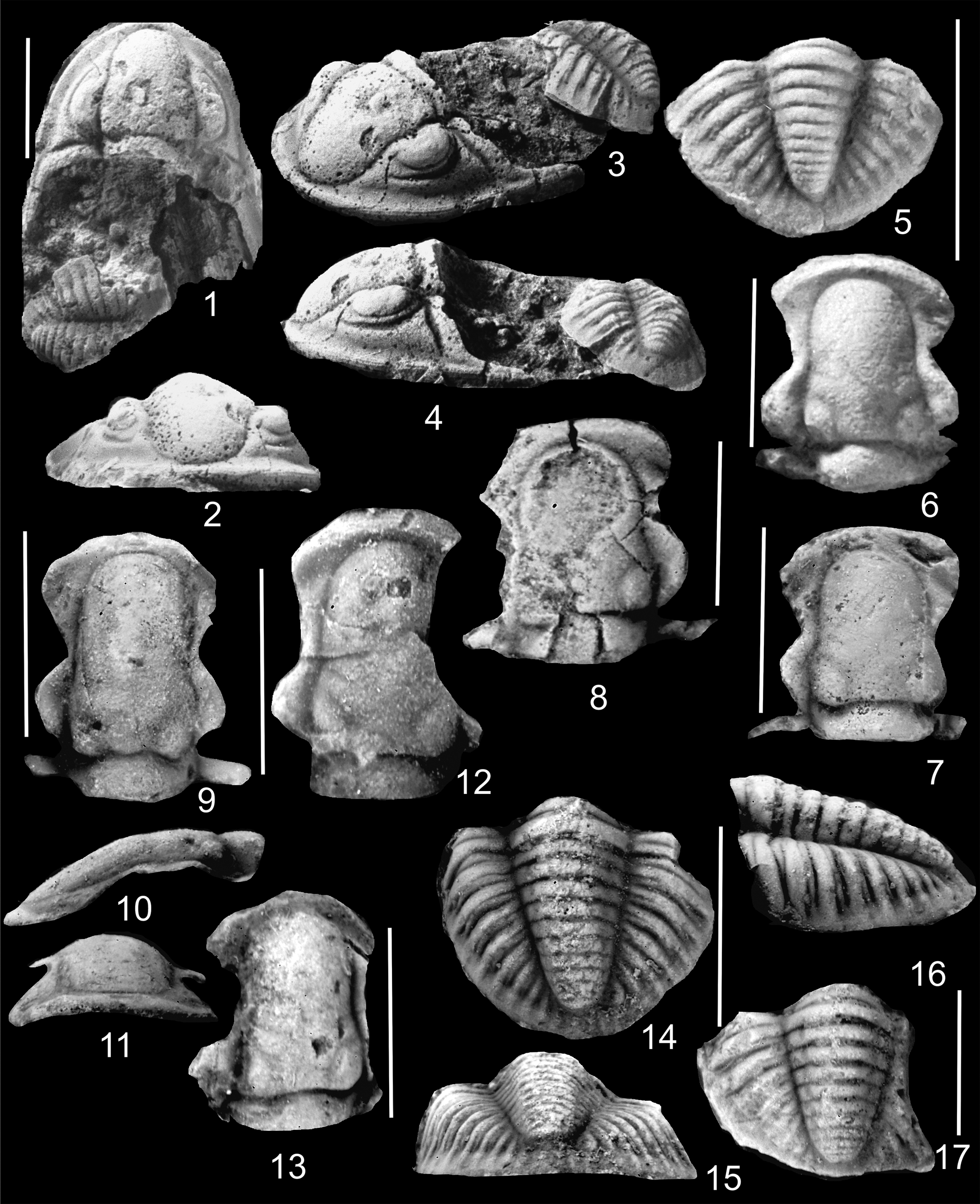
(1–12) Phillipsia peroccidens (Hall and Whitfield, Reference Hall and Whitfield1877): (1) USNM 14242, neotype, partially exfoliated cranidium, Yellowstone National Park, Girty Collection, exfoliated dorsal view; (2–4) CM 64568, partial cranidium, upper Paine Member, Location 4, dorsal (2), anterior (3), and lateral (4) views; (5–7) CM 64569, nearly complete specimen, Location 1, dorsal (5), posterior (6), and lateral (7) views; (8–10) CM 64570, testate pygidium, upper Paine Member, Location 4, dorsal (8), lateral (9), and posterior (10) views; (11) CM 64571, small testate cranidium, Location 2, dorsal view; (12) CM 64572, weathered small testate pygidium, upper Paine Member, Location 2, dorsal view. (13–15) Ameropiltonia perplexa Brezinski, Reference Brezinski2000a, CM 64573, partial testate specimen, lower Paine Member, Location 2, lateral (13), anterior (14), and dorsal (15) views. Scale bars = 5 mm (1, 2, 5, 8); 2 mm (11, 12, 15).

Figure 6. Long description
The plate consists of 15 individual photographs of trilobite fossils against a black background, labeled with white numbers and accompanied by vertical scale bars.
* Panel 1: A dorsal view of a partially exfoliated cranidium of Phillipsia peroccidens, showing a large glabella.
* Panels 2 through 4: Three views of a partial cranidium (C M 64568). Panel 2 is dorsal, panel 3 is anterior showing the curvature of the glabella, and panel 4 is a lateral profile.
* Panels 5 through 7: A nearly complete specimen (C M 64569). Panel 5 is a dorsal view of the pygidium showing distinct pleural ribs and a tapered axis. Panel 6 is a posterior view, and panel 7 is a lateral view.
* Panels 8 through 10: A testate pygidium (C M 64570). Panel 8 is a dorsal view showing fine surface texture. Panel 9 is a lateral view, and panel 10 is a posterior view showing the convex shape.
* Panel 11: A dorsal view of a small testate cranidium (C M 64571).
* Panel 12: A dorsal view of a weathered small testate pygidium (C M 64572).
* Panels 13 through 15: Three views of Ameropiltonia perplexa (C M 64573). Panel 13 is a lateral view, panel 14 is an anterior view, and panel 15 is a dorsal view. These specimens exhibit a highly pustulose or bumpy surface texture compared to the Phillipsia specimens.
Scale bars indicate 5 mm for panels 1, 2, 5, and 8, and 2 mm for panels 11, 12, and 15.
Reference Hall and Whitfield1877 Proetus peroccidens Hall and Whitfield, p. 262, pl. 4, figs. 28–32.
Reference Vogdes1897 Proetus peroccidens; Vogdes, p. 79.
Reference Girty, Hague, Iddings, Weed, Walcott, Girty, Stanton and Knowlton1899 Proetus peroccidens; Girty, p. 576, pl. 71, fig. 14a, b.
Reference Girty and Ransome1903 Phillipsia peroccidens; Girty, p. 49, pl. 10, fig. 22.
Reference Grabau and Shimer1910 Proetus peroccidens; Grabau and Shimer, Reference Grabau and Shimer1910, p. 302.
Reference Butler, Loughlin and Heikes1920 Proetus peroccidens; Butler et al., p. 325, pl. 54, fig. 10.
non Reference Hessler1963 Phillipsia tuberculata Hessler, pl. 61, fig. 3-3.
non Reference Chamberlain1969 Phillipsia tuberculata; Chamberlain, p. 47, pl. 11, figs. 20–23.
non Reference Hahn and Hahn2016 Phillipsia tuberculata; Hahn and Hahn, p. 195.
Reference Brezinski2017 Phillipsia peroccidens; Brezinski, p. 169, fig. 3.
Neotype
No holotype was originally designated by Hall and Whitfield (Reference Hall and Whitfield1877) for this species. The specimen noted by Girty (Reference Girty, Hague, Iddings, Weed, Walcott, Girty, Stanton and Knowlton1899) and housed at the National Museum of Natural History (USNM 14242) is consistent with the species description and is here designated as the neotype.
Diagnosis
Cranidium long; glabella cylindrical; S1 angular. Palpebral lobes short, narrow. Pygidium parabolic in outline. Rings straight, evenly rounded in transverse profile, exhibiting four tubercles; ring furrows deep, wide. Pleural fields strongly arched in transverse profile.
Occurrence
Present in the upper Paine and Woodhurst members of the Lodgepole Formation of Montana, Redwall Limestone of Arizona, and the Gardison Limestone of Utah.
Description
Cranidium long; lacking ornament, vaulting moderate. Glabella elongate, smooth, cylindrical in outline; frontal lobe evenly rounded, straight-sided, narrowing forward. Glabella l.5 times as long as wide, evenly rounded in longitudinal profile. S1 shallow, with angular bend. L1 suboval in outline, overhanging occipital furrow. Palpebral lobes crescentic, short, narrow (transv.), inclined into dorsal furrow. Dorsal furrow deep, straight. L2 and L3 indistinct on larger holaspid specimens, distinctly subrectangular on smaller specimens. Border narrow, sharply bent and vertical on outside. Anterior sutures straight, divergent from γ to β, sharply rounded at α. Fixigenae broad, smooth, gently inclined into anterior furrow. Posterior sutures with long, curved section. Occipital ring widest sagitally, slightly higher than posterior glabella. Occipital furrow deepest behind L1, shallowing medially. Anterior facial sutures straight, diverge moderately from γ to β, sharply rounded at α. Posterior sutures with long, parallel straight section.
Pygidium outline parabolic, vaulting and relief moderate. Axis composed of 15 or 16 narrow rings, 0.35 of maximum anterior pygidial width, evenly rounded in transverse profile, arched in longitudinal profile, straight-sided, mildly posteriorly tapering, terminus evenly rounded. Rings of nearly equal width, separated by narrow, shallow, straight furrows. Posterior rings with row of four tubercles along crest. Anteriormost rings with subdued tubercles. Axial furrow straight, deep. Pleural fields composed of 12–14 ribs, strongly arched in both transverse and longitudinal profiles, extending behind axis. Longitudinal profile flat in front, strongly arched near posterior terminus. Ribs relatively straight, rounded in longitudinal profile, ornamented with row of pustules. Interpleural furrows wide, deep, distinct along entire field. Border narrow, smooth, slightly upturned.
Illustrated Montana specimens
A nearly complete, partially exfoliated cranidium (Fig. 6.1; USNM 14242), Madison Limestone of Yellowstone National Park, studied and illustrated by Girty (Reference Girty, Hague, Iddings, Weed, Walcott, Girty, Stanton and Knowlton1899); a nearly complete cranidium (Fig. 6.2–6.4; CM 64568), upper Paine Member, Locality 4; a complete pygidium (Fig. 6.5–6.7; CM 64569), Woodhurst Member, Location 3; a complete testate pygidum (Fig. 6.8–6.10; CM 64570), upper Paine Member, Location 4; an incomplete, small holaspid cranidium (Fig. 6.11; CM 64571), upper Paine Member, Location 2; an incomplete weathered small holaspid pygidium (Fig. 6.12; CM 64572), Woodhurst Member, Location 2.
Remarks
Phillipsia peroccidens is a species based on the sketches from collections made in Utah. The repository of these specimens is unknown. Girty (Reference Girty, Hague, Iddings, Weed, Walcott, Girty, Stanton and Knowlton1899) assigned material from the Madison of Yellowstone National Park to this species based on similarities to the original sketches. Girty’s (Reference Girty, Hague, Iddings, Weed, Walcott, Girty, Stanton and Knowlton1899) illustrations are based on material preserved at the USNM (Fig. 6.1). This species was originally assigned to Proetus Steininger, Reference Steininger1831, but Girty (Reference Girty, Hague, Iddings, Weed, Walcott, Girty, Stanton and Knowlton1899) reassigned it to Phillipsia. Subsequently, Hessler (Reference Hessler1963), Chamberlain (Reference Chamberlain1969), and Hahn and Hahn (Reference Hahn, Hahn and Westphal1972) lumped most similar looking pygidia of the USA into Phillipsia tuberculata (see Meek and Worthen, Reference Meek and Worthen1870). Hahn and Hahn (Reference Hahn, Hahn and Westphal1972, Reference Hahn and Hahn2016) subsequently moved Phillipsia tuberculata to Piltonia Goldring, Reference Goldring1955, further contributing to the confusion surrounding this taxon. It is clear from Hessler’s (Reference Hessler1963) illustrations of Phillipsia tuberculata, which show tubercules on both the head and tail, are different from true Phillipsia, which possess a smooth cranidium and tuberculate pygidium (Owens, Reference Owens2000; Hahn and Hahn, Reference Hahn and Hahn2016). Therefore, Hahn and Hahn’s (Reference Hahn, Hahn and Westphal1972) transfer of Phillipsia tuberculata to Piltonia appears to be correct.
The collections made for this study contain a considerable number of tuberculate pygidia associated with smooth cranidia. The best of these collections was from the upper Paine Member of Location 4. These associations tend to verify Girty’s (Reference Girty, Hague, Iddings, Weed, Walcott, Girty, Stanton and Knowlton1899) suggestion that the smooth, elongate cranidium was associated with the tuberculate, parabolic pygidium. This species is the only unquestionable occurrence of this genus in the USA. All other species that were previously assigned to this genus are most likely assignable to Piltonia, Ameropiltonia Brezinski, Reference Brezinski2000a, or Breviphillipsia Hessler, Reference Hessler1963 (Hessler, Reference Hessler1963; Brezinski, Reference Brezinski2000a, b, 2007).
Phillipsia peroccidens appears to be a relatively widespread species in the US Cordillera. In Montana, this species is common in the upper Paine and Woodhurst members of the Lodgepole Formation. This species is also identified within the Mississippian Gardison Limestone of Utah (Chamberlain, Reference Chamberlain1969), the Escabrosa and Redwall limestones of Arizona (Hessler, Reference Hessler1963, pl. 61, figs. 3–5; Brezinski, Reference Brezinski2017), as well as the Madison Group of Montana.
Genus Ameropiltonia Brezinski, Reference Brezinski2000a
Type species
Ameropiltonia lauradanae Brezinski, Reference Brezinski2000b, Chouteau Limestone, Boone County, Missouri, by original designation.
Ameropiltonia perplexa Brezinski, Reference Brezinski2000b
Reference Branson, Andrews and Branson1938 Phillipsia sampsoni Branson and Andrews, p. 116, pl. 15, figs. 1, 5, 10.
Reference Shimer and Shrock1944 Phillipsia sampsoni; Shimer and Shrock, pl. 276, figs. 1, 3.
Reference Hessler1963 Breviphillipsia sampsoni; Hessler, p. 556, pl. 61, figs. 13, 19, 20, 22, 23, 28, pl. 62, fig. 1
Reference Brezinski1986 Breviphillipsia sampsoni; Brezinski, fig. 2.2, 2.6.
Reference Brezinski2000b Ameropiltonia perplexa Brezinski, p. 1053, fig. 7.1–7.6.
Holotype
A nearly complete exoskeleton (CM 45749), Caballero Formation.
Diagnosis
Glabella cylindrical in outline; frontal lobe overhanging anterior border furrow; cranidial deeply furrowing. Palpebral lobes narrow, short. Posterior facial sutures long, divergent.
Occurrence
Known from the Paine Member of the Lodgepole Formation of Montana, the Caballero Formation (Kinderhookian) of New Mexico, and the Chouteau Formation (Kinderhookian) of Missouri.
Description
See Brezinski (Reference Brezinski2000a, p. 1053).
Montana material
A testate cranidium (Fig. 6.13–6.15; CM 64573), lower Paine Member of the Lodgepole Formation, Location 2.
Remarks
This species is attributed to a single incomplete cranidium from the lower Paine Member of the Lodgepole Formation at Location 2. It can be shown to be similar to the type material by the diagnostic shape of the glabella, deeply incised cranidial furrowing, nearly subparallel anterior facial sutures, and narrow palpebral lobe. Its recovery from the lower Paine Member places it at a stratigraphic level consistent with that of the southern Cordillera (Brezinski, Reference Brezinski2000a) and US Midcontinent (Brezinski, Reference Brezinski2007).
Genus Piltonia Goldring, Reference Goldring1955
Type species
Piltonia salteri Goldring, Reference Goldring1955, upper Tournaisian, Pilton beds, North Devon, England, by original designation.
Remarks
Hahn and Hahn (Reference Hahn and Hahn2016) noted that as many as 24 species worldwide have been assigned to the genus Piltonia. In examining this compendium, it is clear that numerous different genera have been lumped into Piltonia. The main reason for this is the tendency for workers to lump all highly tuberculate species together regardless of other skeletal characters. Key elements of Goldring’s (Reference Goldring1955) diagnosis of this genus are the overhang of the anterior border by a highly inflated frontal glabellar lobe; the subcylindrical outline of the glabella; large, posteriorly located palpebral lobes; and a nearly borderless pygidium. A number of taxa assigned to Piltonia clearly do not comply with this diagnosis (see Hahn and Hahn, Reference Hahn and Hahn2016). Representatives assigned to this genus herein are considered to bear many if not all of the diagnostic characteristics presented for the genus by Goldring (Reference Goldring1955). Others, e.g., Piltonia guangxiensis Yuan and Li, Reference Yuan and Li1993, display a glabella that is constricted medially and a pygidium with a well-defined pygidial border. Yuan and Li’s (Reference Yuan and Li1993) taxon is almost certainly more closely related to Palaeophillipsia Sugiyama and Okano, Reference Sugiyama and Okana1944 than it is to Piltonia. Another example is Piltonia kassini (Weber, Reference Weber1937), which has a wide preglabellar field and distinct border; it should likely be considered a member of the Linguaphillipsiinae.
Piltonia sandoi new species
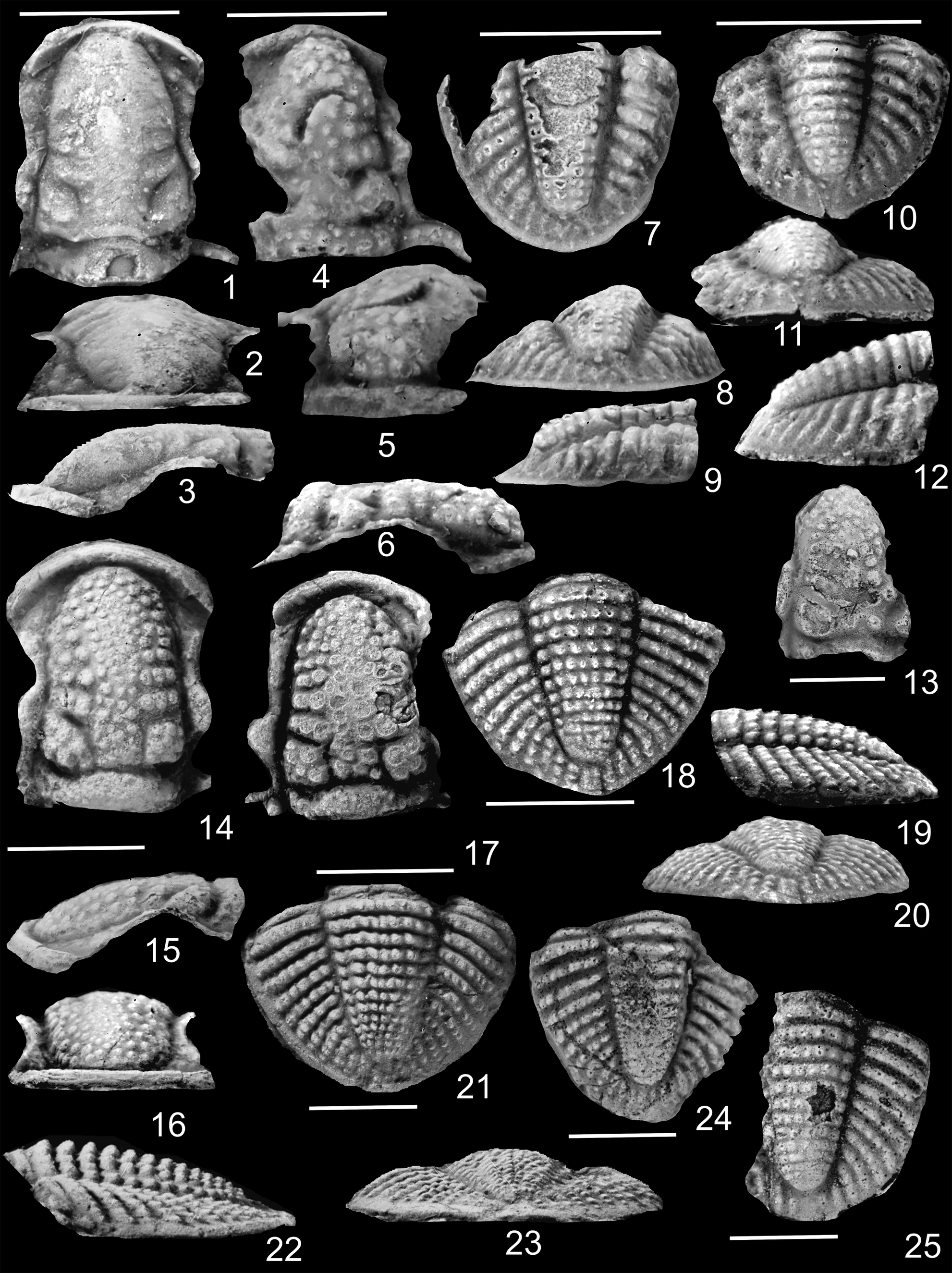
Piltonia spp., Madison Group: (1–13) Piltonia sandoi n. sp.: (1–3) CM 64574, holotype, cranidium, lower Paine Member, Location 2, dorsal (1), anterior (2), and lateral (3) views; (4–6) CM 64575, paratype, partial testate cranidium, lower Paine Member, Location 2, dorsal (4), anterior (5), and lateral (6) views; (7–9) CM 64576, paratype, pygidium, lower Paine Member, Location 2, dorsal (7), posterior (8), and lateral (9) views; (10–12) CM 64577, paratype, partial testate pygidium, Location 2, dorsal (10), posterior (11), and lateral (12) views; (13) CM 64578, paratype, partial cranidium, Paine Member, Location 2, dorsal view. (14–25) Piltonia douglassi n. sp.: (14–16) CM 64579, holotype, testate cranidium, Mission Canyon Limestone, Location 2, dorsal (14), lateral (15), and anterior (16) views; (17) CM 64580, paratype, incomplete cranidium, Mission Canyon Limestone, Location 2, dorsal view; (18–20) CM 64581, paratype, testate pygidium, upper Woodhurst Member, Location 2, dorsal (18), posterior (19), and lateral (20) views; (21–23) CM 64582, paratype, testate pygidium, upper Woodhurst Member, Location 3, dorsal (21), lateral (22), and posterior (23) views; (24) CM 64583, paratype, smaller incomplete pygidium, upper Woodhurst Member, Location 3, dorsal view; (25) CM 64584, paratype, fragmentary testate pygidium, Woodhurst Member, Location 2, dorsal view. Scale bars = 5 mm.

Figure 7. Long description
The figure contains 25 individual photographs of trilobite fossils, each labeled with a number. Scale bars representing 5 mm are placed throughout the panels.
* Panels 1 through 3: Holotype cranidium of Piltonia sandoi in dorsal (1), anterior (2), and lateral (3) views. The dorsal view shows a smooth, elongated glabella.
* Panels 4 through 6: Paratype partial testate cranidium of P. sandoi in dorsal (4), anterior (5), and lateral (6) views, showing a more textured surface.
* Panels 7 through 9: Paratype pygidium of P. sandoi in dorsal (7), posterior (8), and lateral (9) views. The dorsal view shows a semi-circular shape with distinct axial rings.
* Panels 10 through 12: Paratype partial testate pygidium of P. sandoi in dorsal (10), posterior (11), and lateral (12) views.
* Panel 13: Paratype partial cranidium of P. sandoi in dorsal view.
* Panels 14 through 16: Holotype testate cranidium of Piltonia douglassi in dorsal (14), lateral (15), and anterior (16) views. The glabella is highly tuberculated.
* Panel 17: Paratype incomplete cranidium of P. douglassi in dorsal view.
* Panels 18 through 20: Paratype testate pygidium of P. douglassi in dorsal (18), posterior (19), and lateral (20) views. The surface is covered in fine granules.
* Panels 21 through 23: Paratype testate pygidium of P. douglassi in dorsal (21), lateral (22), and posterior (23) views.
* Panel 24: Paratype smaller incomplete pygidium of P. douglassi in dorsal view.
* Panel 25: Paratype fragmentary testate pygidium of P. douglassi in dorsal view.
Type specimens
Holotype, a testate, incomplete cranidium (Fig. 7.1–7.3; CM 64574), Paine Member of the Lodgepole Formation, Location 2. Paratypes (4): an incomplete cranidium (Fig. 7.4–7.6; CM 64575), lower Paine Member, Location 2; an incomplete pygidium (Fig. 7.7–7.9; CM 64576), lower Paine Member, Location 2; a testate pygidium (Fig. 7.10–7.12; CM 64577), lower Paine Member, Location 2; a fragmental cranidium (Fig. 7.13; CM 64578), lower Paine Member, Location 2.
Diagnosis
Glabella long, forward-tapering, slightly constricted near γ, sharply rounded at front, reaching to overhanging narrow border furrow, border sharply underturned at rim. Palpebral lobes short, narrow (exsag.), crescentic in outline. Pygidium outline parabolic, arched in transverse profile, with eight or nine ribs, and 10 or 11 rings.
Occurrence
Known only from the Paine Member of the Lodgepole Formation.
Description
Relatively large trilobite with moderate vaulting and high relief, coarsely pustulose. Glabella forward-tapering, subtriangular in outline, slightly constricted at γ, sharply rounded in frontal lobe that overhangs border anteriorly, evenly rounded in transverse profile, flattened at rear and rounded in frontal lobe in longitudinal profile. S0 sinuous, deepest between palpebral lobes. L1 oval; S1 deepest at its inflection point, shallowing toward dorsal and occipital furrows; S2 shallow, intersecting deep, sinuous, dorsal furrow near γ. L2 subrectangular, ornamented by single row of small pustules that decrease in size (exsag.). L3 distinct, trapezoidal in outline; S3 shallow, intersecting dorsal furrow at right angle, marked by row of small pustules. Occipital lobe narrow, slightly wider at axial line; occipital furrow narrow, shallow, slightly sinuous. Palpebral lobes short, narrow, crescentic, flattened abaxially, ornamented by row of small pustules. Anterior fixigenae narrow. Facial suture sinuous, very near dorsal furrow at γ and ε, diverging only slightly from γ, with straight section from γ to β and at ε. Border furrow widening laterally, becoming deeper, narrow toward sagittal line. Border sharply crested, with lipped outer surface nearly underturned. Posterior border furrow deep, relatively wide.
Pygidium outline parabolic, vaulting medium. Axis broad, composed of 12 or 13 rings, 0.33 of total pygidial width, rounded in transverse profile, nearly straight, flat in longitudinal profile, modestly tapering, broadly rounded at terminus. Rings of nearly equal width along entire rachis, ornamented by single row of tubercles along crest. Ring furrows narrow, deep, distinct. Dorsal furrow slightly curved (sag.). Pleural fields composed of 11 or 12 ribs, mildly arched in both transverse and longitudinal profile. Transverse profile nearly flattened in front, descending into narrow, distinct dorsal furrow. Anterior ribs slightly recurved posteriorly, becoming more strongly bent toward rear, extending behind axis. Each rib rounded in longitudinal profile, ornamented with row of pustules. Interpleural furrows narrow, deep, distinct along entire field. Ribs extending to pygidial margin.
Etymology
Named in honor of William J. Sando of the U.S. Geological Survey.
Remarks
Piltonia sandoi n. sp. occurs in the lower Paine Member, making it the earliest known Piltonia species in North America. Piltonia sandoi is morphologically most similar to Piltonia salteri, the type species of the genus. Both species have the strongly converging frontal lobe of the glabella that is sharply rounded in front and overhangs the anterior border. Both species have small palpebral lobes, but those of Piltonia sandoi are shorter, narrower, and more forwardly located than in the type species.
Piltonia douglassi new species
Type specimens
Holotype, a testate, nearly complete cranidium (Fig. 7.14–7.16; CM 64579), Mission Canyon Limestone, Location 2. Paratypes (5): a large, incomplete testate cranidium (Fig. 7.17; CM 64580), Mission Canyon Limestone, Location 2; a testate pygidium (Fig. 7.18–7.20; CM 64581), Woodhurst Member of the Lodgepole Formation, Location 2; a testate pygidium (Fig. 7.21–7.23; CM 64582), upper Woodhurst Member of the Lodgepole Formation, Location 3; an incomplete testate pygidium (Fig. 7.24; CM 64583), Woodhurst Member of the Lodgepole Formation, Location 3; a fragmentary pygidium (Fig. 7.25; CM 64584), Woodhurst Member, Location 2.
Diagnosis
Glabella long, forward-tapering, straight-sided, broadly rounded anteriorly. Frontal lobe with low, even arching in longitudinal and transverse profiles, intersecting border furrow. Pygidium outline subparabolic, axis broad, vaulting low, composed of 11 or 12 ribs, and 11–13 rings. Pleural fields nearly flat (transv.)
Occurrence
Present in the Woodhurst Member of the Lodgepole Formation and Mission Canyon Limestone of the Madison Group.
Description
Large tuberculate trilobite with low to moderate vaulting, moderately high relief. Glabellar inflation low, outline forward-tapering, straight-sided, rounded in front, overhanging narrow border furrow. Mildly, evenly arched in transverse and longitudinal profiles. In longitudinal profile, rear of glabella with subdued arching, becoming strongly arched in frontal lobe. S0 straight, deepest between palpebral lobes. S1 highly angular, deep, anteriorly reaching dorsal furrow at palpebral midline, extending at near right angle to occipital furrow. L1 subrectangular in outline. S2 shallow, intersecting dorsal furrow near γ. L2 and L3 demarcated by row of smaller (exsag.) pustules. S3 shallow, indistinct. Occipital lobe narrow, slightly wider at axial line; occipital furrow relatively shallow, slightly sinuous, deepening laterally. Palpebral lobes short, narrow, crescentic, flattened abaxially. Facial suture sinuous, moderately forwardly diverging from γ to β, with long, curved section posterior of ε. Border furrow widening laterally, becoming shallow and narrow toward sagittal line. Border sharply rounded at crest, with lipped outer surface nearly vertical on inner surface. Posterior border furrow deep, relatively wide.
Pygidium outline subparabolic to subtriangular, vaulting low, relief high. Axis broad, composed of 11–13 rings, 0.42–0.45 of total pygidial anterior width, 0.85 of total length, evenly rounded in transverse profile, mildly arched in longitudinal profile, nearly straight-sided, strongly posteriorly tapering, broadly rounded at terminus. Rings of nearly equal width, ornamented with single row of tubercles along crest. Ring furrows narrow, deep, distinct, even on posterior segments. Dorsal furrow straight, narrow, distinct. Pleural fields composed of 11–13 narrow ribs that extend behind axis, mildly arched in both transverse and longitudinal profiles. Interpleural furrows narrow, deep, distinct along entire field. Longitudinal profile mildly arched in front, flattened near posterior terminus. Anterior ribs nearly straight, only slightly curved posterolaterally, becoming more strongly recurved to rear, ornamented by single row of pustules. Ribs extending to pygidial margin.
Etymology
Named for Earl Douglass, early field collector for Carnegie Museum of Natural History.
Remarks
Piltonia douglassi n. sp. differs from Piltonia sandoi in that the former species has a glabella that has straight, forwardly converging sides, and a pygidium that can be subtriangular in outline. The latter species has a distinct constriction of the glabella at γ, and a pygidium with a parabolic outline. Both species lack a preglabellar field documented in several other Piltonia species (e.g., Piltonia balor Hahn, Hahn, and Brauckmann, Reference Hahn, Hahn and Brauckmann1987; Piltonia kassini; Piltonia paucita Tilsley, Reference Tilsley1988). Piltonia sandoi is most similar to Piltonia kuehnei Hahn, 1964 in that both species have a forwardly tapering (subtrapezoidal) glabella that reaches the anterior margin, and a short, broad pygidium that approaches subtriangular in outline, with a robust, broad axis.
Genus Perexigupyge Brezinski, Reference Brezinski1988b
Type species
Perexigupyge hodgesi Brezinski, Reference Brezinski1988b, Kinderhookian, Gilmore City Limestone of Iowa, by original designation.
Remarks
Although Brezinski (Reference Brezinski1988b) suggested that Perexigupyge had many cranidial characters typical of the Cummingellinae, the posteriorly located palpebral lobes and faint constriction to the glabella near γ appeared to show closer common ancestry to the Linguaphillipsiinae. Indeed, Perexigupyge exhibits many shared cranidial characters with Weberiphillipsia Osmolska, Reference Osmolska1970. Unfortunately, the diagnosis of Weberiphillipsia has been blurred by the suggestions of Engel and Morris (Reference Engel and Morris1983) that the type species, W. kirgisica (Weber, Reference Weber1937), is congeneric with a number of Australian species. Although the Australian species exhibit several congruent characters, including a glabella that is widest between the palpebral lobes and a strongly tapering frontal lobe with the type species, the Australian species tend to have a long pygidium with spines or pustulose border. Thus, those species could share a subfamily designation, but are unlikely congeneric with the type of Weberiphillipsia of Russia as illustrated by Osmolska (Reference Osmolska1970).
Chamberlain (Reference Chamberlain1969) assigned Proetus loganensis Hall and Whitfield, Reference Hall and Whitfield1877 to Richterella Hessler, Reference Hessler1965 because both genera tend to exhibit a slight medial constriction to the glabella. However, Brezinski (Reference Brezinski1988b) assigned this species to his new genus Perexigupyge. The new material provided by the current study confirms that Perexigupyge shares a close ancestral history with the type species of Weberiphillipsia.
Perexigupyge loganensis (Hall and Whitfield, Reference Hall and Whitfield1877)
(1–17) Perexigupyge spp., Lodgepole Limestone: (1–8) Perexigupyge loganensis (Hall and Whitfield, Reference Hall and Whitfield1877): (1–4) CM 64585, neotype, partially exfoliated cephalon and partial pygidium, Woodhurst Member, Location 3, dorsal (1), anterior (2), oblique (3), and lateral (4) views; (5) CM 64586, testate pygidium, Woodhurst Member, Location 3, dorsal view; (6–8) CM 64587 (6), 64588 (7), and 64589 (8), representative cranidia of species collected from the Woodhurst Member, dorsal views. (9–17) Perexigupyge angusticapitalis n. sp.: (9–11) CM 64590, holotype, testate cranidium, Woodhurst Member, Location 3, dorsal (9), lateral (10), and anterior (11) views; (12) CM 64591, paratype, partial cranidium, Woodhurst Member, Location 3, dorsal view; (13) CM 64592, paratype, incomplete testate cranidium, Woodhurst Member, Location 2, dorsal view; (14–16) CM 64593, paratype, testate pygidium, Woodhurst Member, Location 1, dorsal (14), posterior (15), and lateral (16) views; (17) CM 64594, paratype, incomplete pygidium, Woodhurst Member, Location 4, dorsal view. Scale bars = 5 mm.

Figure 8. Long description
The plate contains 17 numbered photographs of trilobite fossils, each accompanied by a 5 mm scale bar.
Panels 1 through 8 show Perexigupyge loganensis:
- 1: Dorsal view of a partially exfoliated cephalon and partial pygidium.
- 2: Anterior view of the same specimen.
- 3: Oblique view of the same specimen.
- 4: Lateral view of the same specimen.
- 5: Dorsal view of a testate pygidium showing a segmented central axis and ribbed pleural fields.
- 6, 7, and 8: Dorsal views of three representative cranidia showing the central glabella and fixed cheeks.
Panels 9 through 17 show Perexigupyge angusticapitalis new species:
- 9, 10, and 11: Dorsal, lateral, and anterior views of a testate cranidium holotype.
- 12: Dorsal view of a partial cranidium paratype.
- 13: Dorsal view of an incomplete testate cranidium paratype.
- 14, 15, and 16: Dorsal, posterior, and lateral views of a testate pygidium paratype, showing a highly convex profile and distinct segmentation.
- 17: Dorsal view of an incomplete pygidium paratype.
Reference Hall and Whitfield1877 Proetus loganensis Hall and Whitfield, p. 264, pl. 4, fig. 33.
Reference Weller1898 Proetus loganensis; Weller, p. 503.
Reference Girty, Hague, Iddings, Weed, Walcott, Girty, Stanton and Knowlton1899 Proetus loganensis; Girty, p. 577, pl. 71, fig. 15.
Reference Girty and Ransome1903 Proetus loganensis; p. 315.
Reference Butler, Loughlin and Heikes1920 Proetus loganensis; Butler et al., p. 55, fig. 11.
Reference Hessler1965 Proetus loganensis; Hessler, p. 263.
Reference Chamberlain1969 Richterella loganensis; Chamberlain, p. 49, pl. 11, fig. 13.
Reference Brezinski1988b Perexigupyge loganensis; Brezinski, p. 242.
Neotype
Hall and Whitfield (Reference Hall and Whitfield1877) did not designate a holotype for this species, and the collections have been lost. A cephalon with adjacent incomplete pygidium (Fig. 8.1–8.4; CM 64585; Woodhurst Member of the Lodgepole Formation, Location 3) bears close resemblance to that of the type (see Chamberlain, Reference Chamberlain1969) and is designated as neotype herein.
Diagnosis
Glabella widest between palpebral lobes, forwardly tapering, slightly constricted at γ, reaching anterior border furrow as bluntly rounded frontal lobe. L1 small, oval, depressed. Pygidium short, with interpleural furrows extending onto indistinct border.
Occurrence
Found in the upper Lodgepole Formation of Montana, and the Gardison Limestone of Utah.
Description
Cranidium of moderate vaulting and medium relief. Glabella widest between eyes, smooth to finely granular, strongly tapering to bluntly rounded front, with faint constriction near γ, 1.25 times as long as wide. Dorsal furrow shallow, sinuous. Glabella moderately, evenly arched in longitudinal profile, anteriorly descending into shallow border furrow. S1 shallow, arcuate, intersecting both occipital and dorsal furrows. L1 outline oval, slightly overhanging occipital furrow. Palpebral lobes large, long, crescentic to semicircular in outline, posteriorly located. Occipital furrow narrow, arcuate, moderately deep. Occipital ring evenly wide, of approximately same height as posterior terminus of glabella. Anterior facial sutures diverging strongly from γ to β, broadly rounded at β; posterior suture sharply curved. Border furrow shallow, broad, rounded. Eyes hemispherical, descending vertically onto narrow ocular platform and narrow furrow. Lateral border shallow, broad; border rounded.
Pygidium hyperbolic in outline, medium in vaulting and relief, 1.15 times as wide as long. Axis 0.42 of anterior width of pygidium, composed of 10 or 11 even-width rings, terminating near posterior border. Axis 0.85 of total pygidial length, mildly arched in longitudinal profile, descending posteriorly onto poorly defined border. Dorsal furrow straight, broad, shallow. Pleural fields of eight ribs composed of broad anterior and narrow posterior bands. Pleural field moderately arched, horizontal near dorsal furrow, decending at ~ 45° angle onto border. Pleural furrow distinctly extending onto border flange. Border flange widening to rear, inclined to margin.
Montana material illustrated
A small testate pygidium (Fig. 8.5; CM 64586), Woodhurst Member, Location 3; two testate cranidia (Fig. 8.6, 8.7; CM 64587, 64588), Woodhurst Member, Location 3; a partially exfoliated incomplete cranidium (Fig. 8.8; CM 64589), Woodhurst Member at Location 6.
Remarks
Brezinski (Reference Brezinski1988b) assigned Perexigupyge loganensis to his new genus Perexigupyge based on its similarity to the type species Perexigupyge hodgesi. Both species share the broad, but forward-tapering glabella that is modestly constricted at γ, posteriorly located palpebral lobes, and the short, hyperbola-shaped pygidium. The increased availability of material from the Madison Group suggests that this generic attribution is correct. Even so, Perexigupyge loganensis differs from the type species by exhibiting a more strongly forward-tapering glabella and larger, almost semicircular, palpebral lobes.
Because Perexigupyge loganensis was initially described from disarticulated tergites that were associated with fragments of Phillipsia peroccidens, Girty (Reference Girty, Hague, Iddings, Weed, Walcott, Girty, Stanton and Knowlton1899) was unclear as to which pygidia and cranidia were related. The specimen illustrated in Figure 8.1–8.4 appears to verify that the shorter, broader pygidium is associated with the cranidium typifying Perexigupyge loganensis. Chamberlain (Reference Chamberlain1969) found the two species associated together near the type locality and separated them as distinct species.
Perexigupyge angusticapitalis new species
Type specimens
Holotype, a testate cranidium (Fig. 8.9–8.11; CM 64590) from the upper Paine Member of the Lodgepole Formation, Location 2. Paratypes (4): an incomplete testate cranidium (Fig. 8.12; CM 64591), upper Paine Member of the Lodgepole Formation, Location 3; a nearly complete, testate cranidium (Fig. 8.13; CM 64592), Woodhurst Member of the Lodgepole Formation, Location 2; a complete testate pygidium (Fig. 8.14–8.16; CM 64593), upper Paine Member, Location 1; an incomplete testate pygidium (Fig. 8.17; CM 64594), upper Paine Member, Location 6.
Diagnosis
Glabella long, narrow, mildly forward-tapering to approximately γ, then parallel-sided in frontal lobe, bluntly rounded at shallow border furrow; border rounded. Anterior facial sutures with long, straight section from γ to β. Palpebral lobes large, semicircular in outline, posteriorly located. Pygidium vaulting moderate, relief high, outline parabolic; interpleural furrows extending onto indistinct border.
Occurrence
Present in the upper Paine Member of the Lodgepole Formation.
Description
Cranidium of low vaulting and relief. Glabella widest between eyes, smooth, tapering forward to γ then parallel-sided to front, bluntly rounded at front, 1.5–1.6 times as long as wide. Dorsal furrow curved to rear, straight in front, deepest at palpebral lobes. Longitudinal profile of glabella mildly arched, anteriorly meeting shallow border furrow. Frontal lobe evenly arched in transverse profile. S1 shallow, broad, indistinct, intersecting both occipital and dorsal furrow. L1 outline oval, slightly overhanging the occipital furrow, depressed relative to posterior areas of glabella. Palpebral lobes large, long, crescentic in outline, posteriorly located. Occipital furrow deep, sinuous. Occipital ring evenly wide, of approximately same height as posterior terminus of glabella. Anterior facial sutures diverging strongly from posteriorly located γ to β, with straight section, broadly rounded at β; posterior suture acutely rounded.
Pygidium parabolic in outline, medium in vaulting and relief, 1.11 times as wide as long. Axis broad, 0.45 of anterior width of pygidium, composed of 10 or l1 even-width rings, bluntly rounded at posterior. Rings smooth, wide; ring furrows narrow, deep, straight. Axis 0.88 of total pygidial length, moderately arched in transverse profile, weakly arched in longitudinal profile, descending posteriorly onto poorly defined border. Dorsal furrow nearly straight, broad, shallow. Pleural fields consisting of 8 ribs composed of broad anterior band and slightly narrower posterior band. Pleural field horizontal near dorsal furrow, moderately arched, descending at ~ 60° angle onto border. Pleural furrow distinct, deep, extending onto border. Border flange-like, widening to rear, inclined to margin.
Etymology
Based on the Latin angustus + capitellum, meaning narrow headed, referring to the long, strongly tapering glabella.
Remarks
Cranidia of Perexigupyge angusticapitalis n. sp. differ from those of other members of the genus by possessing a long, mildly tapering glabella that is noticeably wider between the eyes. The type species of the genus possesses a nearly identical pygidium to Perexigupyge angusticapitalis n. sp., save for the new species possessing a broader axis. But, in addition to the glabellar length on the new species, the palpebral lobes and the front fixigenae are much wider. The cranidium of Weberiphillipsia spp. possess the broader fixigenae that is characteristic of Perexigupyge angusticapitalis n. sp. but the glabella is much longer. Likewise, the pygidium on Weberphillipsia spp. has a much broader pleural field than does that of Perexigupyge angusticapitalis n. sp.
Genus Thigriffides Hessler, Reference Hessler1965
Type species
Thigriffides roundyi (Girty, Reference Girty, Roundy, Girty and Goldman1926) from the Chappel Limestone (Tournaisian), San Saba, Texas, subsequently designated by Hessler (Reference Hessler1965).
Remarks
Although the type species of Thigriffides, T. roundyi, exhibits a rounded outline to the frontal lobe of the glabella that is forwardly expanded, only one other species assigned to this genus shares that characteristic, i.e., T. triangulatus Brezinski, Reference Brezinski2000a. In contrast, T. hinensis Kobayashi and Hamada, Reference Kobayashi and Hamada1978 and T. wiprinsi (Gandl, Reference Gandl1973) display a forward-tapering glabellar frontal lobe. Additional features that define the genus include large, posteriorly located, palpebral lobes; a depressed L1 with a shallow, almost imperceptible, S1; and a pygidium that is subtriangular in outline, with a narrow, sharply posteriorly axis. All assigned representatives of currently known species are from middle to late Tournaisian rocks.
Thigriffides ? andersoni new species
Thigriffides? andersoni n. sp.: (1–3) CM 64595, holotype, incomplete testate cranidium, Woodhurst Member, Location 2, dorsal (1), lateral (2), and anterior (3) views; (4–6) CM 64596, paratype, incomplete testate pygidium, Woodhurst Member, Location 3, dorsal (4), posterior (5), and lateral (6) views; (7–9) CM 64597, paratype, testate pygidium, upper Paine Member, Location 2, dorsal (7), lateral (8), and posterior (9) views; (10) CM 64598, paratype, weathered, partially testate pygidium, Woodhurst Member, Location 3, dorsal view. Scale bars = 5 mm.

Figure 9. Long description
A multi-panel plate containing ten photographs of Thigriffides andersoni fossil specimens against a black background.
Panels 1 through 3 show the holotype cranidium (C M 64595).
- 1: Dorsal view showing a rounded, smooth glabella with a vertical 5 mm scale bar to the right.
- 2: Lateral view showing the convex profile.
- 3: Anterior view showing the frontal curvature.
Panels 4 through 6 show a paratype pygidium (C M 64596).
- 4: Dorsal view of an incomplete specimen with a segmented axis and pleural ribs, accompanied by a 5 mm scale bar.
- 5: Posterior view showing the elevation of the axis.
- 6: Lateral view showing the downward slope of the pleural field.
Panels 7 through 9 show a second paratype pygidium (C M 64597).
- 7: Dorsal view of a more complete, triangular pygidium with a 5 mm scale bar.
- 8: Lateral view showing a slender profile.
- 9: Posterior view showing the arched axis.
Panel 10 shows a third paratype pygidium (C M 64598).
- 10: Dorsal view of a weathered, partially testate specimen with a prominent tapered axis and a 5 mm scale bar to the right.
Type specimens
Holotype, a single, testate cranidium (Fig. 9.1–9.3; CM 64595), lower Woodhurst Member of the Lodgepole Limestone, Location 2. Paratypes (3): an incomplete testate pygidium (Fig. 9.4–9.6; CM 64596), Woodhurst Member of the Lodgepole Formation, Location 3; an incomplete pygidium (Fig. 9.7–9.9; CM 64597), lower Woodhurst Member, Location 2; a weathered pygidium (Fig. 9.10; CM 64598), Woodhurst Member, Location 3.
Diagnosis
Low-relief cranidium with glabella that slightly tapers forward. Pygidium subtriangular in outline, sharply curved behind axis. Axis narrow, low in relief with axial furrow that is curved inwardly (abaxial).
Occurrence
Known only from the lower Woodhurst Member of the Lodgepole Formation of Montana.
Description
Cranidium of low vaulting and relief. Glabella forward-tapering, widest between palpebral lobes, rounded in front. Anterior border sharply rounded; furrow narrow, deep. L1 faint, suboval. S1 shallow, broad, arcuate. Anterior border flat, sharply underturned. Anterior facial sutures straight, faintly divergent from γ to β, sharply rounded at β. Posterior facial sutures sharply rounded at ε. Palpebral lobes large, crescentic in outline, posteriorly located. Dorsal furrow relatively straight, distinct. Occipital ring wide. Occipital furrow deep, wide.
Pygidium outline subtriangular, vaulting moderate, strongly arched in transverse profile, low in relief. Axis short, 0.72 of total pygidium length, and narrow, 0.26 of maximum pygidial width, low in height and relief, rounded in transverse profile, mildly arched in longitudinal profile, strongly posteriorly tapering, composed of 8 discernable, rounded rings, and possessing triangular terminal segment. Ring furrows narrow, straight, shallow, becoming deeper (abaxial). Dorsal furrow shallow, curved inwardly (adaxially). Pleural fields strongly arched in transverse profile, reaching margin nearly vertically, composed of five or six ribs, each possessing wide anterior and posterior bands. Pleural furrows shallow, distinct, extending and shallowing to margin. Border very narrow in front, becoming elongated, sharply rounded, behind axis.
Etymology
Named in honor of Dr. Thomas H. Anderson.
Remarks
Thigriffides? andersoni n. sp. is characterized by a forward-tapering glabella; a subtriangular outline to the pygidium; a sharply tapering, low-relief axis; and a dorsal furrow that is curved inwardly. Although there is little question that the Lodgepole specimens are previously undescribed, their generic assignment is less certain. The holotype cranidium exhibits large, nearly semicircular, posteriorly located palpebral lobes, shallow S1, and depressed L1, all features that typify Thigriffides. However, the lack of a forwardly expanded frontal glabellar lobe is unlike the type species. The Montana species does show comparable cranidial features to T. wiprinsi from the Tournaisian of Spain, including a narrow, sharply tapering pygidial axis, a subtriangular outline to the pygidium, and a subcylindrical outline to the glabella. Thigriffides hinenis exhibits many of the same cranidial features displayed by T.? andersoni n. sp. but has a pygidium that possesses a distinct border similar to that present in the type species.
The somewhat incongruent set of morphological features that define this species could indicate that its assignment to Thigriffides is questionable. The forwardly tapering glabella and posteriorly located palpebral lobes are also seen in Angustibole Hahn, Reference Hahn1965 (see Hahn, Reference Hahn1966, figs. 17–20, 23, 27), however, the latter genus lacks the subtriangular pygidium displayed by T.? andersoni n. sp.
The pygidial shape and segmentation of Thigriffides? andersoni n. sp. are unlike nearly all other Carboniferous phillipsids. The pleural separation of ribs into equal width anterior and posterior bands is similar to that seen in Carbonocoryphe Richter and Richter, Reference Richter and Richter1951, however, the distinct, narrow border that characterizes species of the latter genus is all but lacking in the Montana species. Archinal (Reference Archinal1991, fig. 8) illustrated a pygidium of Macrobole drewerensis (Richter and Richter, Reference Richter and Richter1951) that superficially resembles the Montana species, however, the cranidium of that species has well-incised furrowing and narrow palpebral lobes that are located forward on the cranidium. Consequently, the disparate morphological features displayed by T.? andersoni n. sp. present a conundrum as to the precise generic assignment. Thus, until more material can be presented to help resolve this problem, the generic assignment must remain tentative.
Stratigraphy/biostratigraphy
The Madison Group of Montana consists of the Lodgepole, Mission Canyon, and Charles formations, in ascending order. The Lodgepole Formation is comprised of the Cottonwood Canyon, Paine, and Woodhurst members. The Cottonwood Canyon Member is a thin and localized unit at the formation’s base and is distributed throughout southern Montana and western Wyoming. It is a unit that spans the Devonian-Mississippian boundary and lies at the formation’s lower boundary (Sandberg and Klapper, Reference Sandberg and Klapper1967). The overlying Paine Member consists of rhythmically bedded, dense, dark gray, fine-grained, argillaceous limestone and brittle, calcareous shale. This unit is up to 90 m thick in central Montana, but thins to the south and north onto the Wyoming and Alberta shelves, respectively. This member has its thickest development through central Montana where it was deposited in deepwater environments of the Big Snowy Trough (Smith and Gilmour, Reference Smith and Gilmour1979) (Fig. 1). This trough trends generally east-west, connecting the Williston Basin to the east with the Antler Foreland Basin to the west (Elrick and Read, Reference Elrick and Read1991; Batt et al., Reference Batt, Pope, Isaacson, Montanez, Abplanalp, Lukasik and Simo2008). In the center of the trough, Waulsortian reefs have been described near the base of the member (Cotter, Reference Cotter1965; Stone, Reference Stone1972).
The Paine Member grades upsection into a succession of interbedded, medium-bedded, light gray, crinoidal packstone to grainstone, and calcareous shale of the Woodhurst Member at the top of the Lodgepole Formation. The Woodhurst Member is distinct from the underlying Paine by exhibiting medium- to thick-bedded, siliceous limestone that alternates with recessive intervals of gray shale and shaly carbonate. The Woodhurst Member is thicker and more widespread than the Paine and is distributed across the Wyoming and Alberta shelf areas as well as filling the Big Snowy Trough with as much as 200 m of carbonate (Smith and Gilmour, Reference Smith and Gilmour1979).
According to Sando (Reference Sando1985), the Lodgepole Formation was deposited during the Siphonodella crenulata to Siphonodella isosticha conodont biozones. Conodont genera have shown that the Woodhurst Member extends into the Gnathodus typicus biozone (Fig. 10). This would make this interval contemporaneous with the Chouteau and Burlington formations of the type Mississippian area of the Midcontinent (Brezinski, Reference Brezinski2007) and the Caballero and Lake Valley formations of the Lake Valley shelf of New Mexico (Brezinski, Reference Brezinski2000a).
Stratigraphy and generalized trilobite species ranges for the Madison Group of Montana. Chronostratigraphic equivalence from Sando (Reference Sando1985) and Quinton et al. (Reference Quinton, Rygel and Bombard2023).

Figure 10. Long description
The chart is organized into three main vertical sections.
1. Lithostratigraphy: On the left, the Madison Group is divided into the Lodgepole Limestone and Mission Canyon Limestone. The Lodgepole Limestone includes the Cottonwood Cyn Mbr at the base, followed by the Paine Mbr and Woodhurst Mbr. A vertical column shows rock patterns: brown at the base, dark blue for Paine Mbr, and light blue for Woodhurst and Mission Canyon.
2. Trilobite Biostratigraphy: The central section plots the vertical ranges of 17 trilobite species as black bars. From bottom-left to top-right, species include Brachymetopus indianwellsensis, Brachymetopus acutis new species, Phillibole? montanaensis new species, Liobolina complanata new species, Belgibole sandoi new species, Piltonia perplexa, Ameropiltonia swimmingwomanensis new species, Brachymetopus sp. indet., Phillipsia peroccidens, Brachymetopus sp. indet., Proetides sp. indet., Belgibole? madisonensis new species, Perexigupye loganensis, Eoameura kollari new species, Perexigupye angusticapitalis new species, Thigriffides? andersoni new species, Proetides raymondi new species, and Piltonia douglassi new species.
3. Chronostratigraphy: The rightmost columns list biozones and stages. Biozones include Siphonodella crenulata, S. isosticha, Gnathodus typicus, Dolignathus latus, Scaliognathus anchoralis, and Gnathodus texanus. These correspond to the Kinderhookian, Osagean, and Meram. stages, within the Tournaisian and Visean series.
The Woodhurst Member of the Lodgepole Formation is conformably overlain by the massive, cliff-forming Mission Canyon Limestone. The Mission Canyon Limestone is characterized by light gray, almost white, massive limestone interbedded with tan to light gray dolomite, and white beds and lenses of chert. The Mission Canyon Limestone thickens into the Big Snowy Trough where it is as much as 300 m thick. The massive carbonate intervals of the formation are punctuated by several intervals of void-bearing solution breccias. These breccia intervals are interpreted as representing periods of Early Mississippian exposure and emergences that produced intervals of paleokarst (Sando and Dutro, Reference Sando and Dutro1974). The Mission Canyon Limestone was deposited during the upper Gnathodus typicus zone through the Gnathodus texanus conodont biozone (Sando, Reference Sando1985; Quinton et al., Reference Quinton, Rygel and Bombard2023).
In the eastern parts of the Big Snowy Trough, and mainly in the subsurface, the Mission Canyon Limestone is overlain by the Charles Formation. This unit name is typically applied to an interval of interbedded limestone, shale, and evaporite, especially well developed in the Williston Basin of eastern Montana. No trilobites for this study were recovered from this interval.
The biostratigraphic distribution of trilobites from the Madison Group of Montana does not show as clear a segregation of genera correlative with and equivalent to contemporaneous rocks of the US Midcontinent (Brezinski, Reference Brezinski2007). The main reason for this is that many of the genera found in the Madison are known from either the Cordilleran region of the USA or, alternatively, western Europe. However, the limited number of specimens recovered for this study do provide weak correlation potential with collections known from the southern or central USA.
Many of the specimens recovered from the Kinderhookian part of the Paine Member are not known from elsewhere in the USA. Two exceptions are Brachymetopus indianwellsensis and Ameropiltonia perplexa. Both of these species are known from the Kinderhookian Caballero Formation of New Mexico (Brezinski, Reference Brezinski2000a). However, Ameropiltonia perplexa is known from both the Caballero Formation and the Chouteau Formation of Missouri (Brezinski, Reference Brezinski2007). This likely makes the lower Paine species contemporaries of the Comptonaspis swallowi fauna of Brezinski (Reference Brezinski2007).
A second indistinct fauna is present in the middle to upper Paine Member and contains Perexigupyge loganensis and Perexigupyge angusticapitalis n. sp. These species are interpreted as being found in the Gnathodus typicus zone similar to their congenitors, Perexigupyge hodgesi and Perexigupyge gerki Brezinski, Reference Brezinski1988b, in the Gilmore City Limestone of Iowa (Brezinski, Reference Brezinski1988b). The Iowa species co-occur along with an indeterminate species of Proetides. These forms appear to be correlative to the Proetides insignis-Perexigupyge fauna of the Midcontinent.
Trilobite diversity appears to wane in the upper Woodhurst Member of the Lodgepole and into the Mission Canyon Limestone, with only three species—Perexigupyge loganensis, Proetides raymondi n. sp., and Piltonia douglassi n. sp.—ranging into these stratigraphic intervals. Consequently, it is not possible to correlate these intervals into the US Midcontinent based on these taxa alone.
Paleoenvironmental distribution of trilobites
The Madison Group was deposited on an extensive carbonate shelf that extended across much of Wyoming, Montana, and adjacent Canada (Sando and Bamber, Reference Sando and Bamber1985; Elrick and Read, Reference Elrick and Read1991). This expanse of shallow-water carbonate environments was created during a single second-order depositional sequence that itself was composed of several shorter subsequences (Smith et al., Reference Smith, Eberli, Sonnenfeld, Grammer, Harris and Eberli2004). The regional depositional facies patterns suggest that Mississippian strata of the northern US Cordillera were deposited on a carbonate ramp inclined westward toward deep waters (Sando and Bamber, Reference Sando and Bamber1985, fig. 8; Elrick and Read, Reference Elrick and Read1991; Smith et al., Reference Smith, Eberli, Sonnenfeld, Grammer, Harris and Eberli2004; Batt et al., Reference Batt, Pope, Isaacson, Montanez, Abplanalp, Lukasik and Simo2008; Quinton et al., Reference Quinton, Rygel and Bombard2023). The interpreted ramp foundered in the Antler foreland of the Deseret Trough in eastern Idaho (Figs. 1, 11). The deepwater carbonate facies of Idaho shallowed eastward and upward into interlayered shallow subtidal to peritidal deposits of the Woodhurst Member of the Lodgepole Formation and the Mission Canyon Limestone. In central Montana ramp-shelf facies were split by an east-west-trending trough that is termed the Big Snowy Trough (Smith and Gilmour, Reference Smith and Gilmour1979).
Generalized environmental interpretation of the Madison Group of Montana, modified from Quinton et al. (Reference Quinton, Rygel and Bombard2023) and Brown (Reference Brown2021) and relative environmental range of trilobite species on that ramp.

Figure 11. Long description
A stratigraphic cross-section illustrates a carbonate ramp dipping from right to left. At the base, from left to right, are the McGowan Creek F m (Idaho), the Lodgepole Formation (comprising the Paine M b r and Woodhurst M b r), and the Mission Canyon Formation. The lithology transitions from tan-colored distal sediments on the left to blue-shaded limestone with brick-like patterns in the center, and light-blue interbedded layers on the right.
Above the geological profile, horizontal black bars indicate the relative environmental ranges of fourteen trilobite species. From bottom to top, the species and their ranges are:
* Phillibole? acutis n. sp. (distal Paine M b r)
* Belgibole complanata n. sp. (distal Paine M b r)
* Liobolina montanaensis n. sp. (distal Paine M b r)
* Piltonia sandoi n. sp. (spanning Paine M b r)
* Brachymetopus indianwellsensis (proximal Paine M b r)
* Brachymetopus swimmingwomanensis n. sp. (proximal Paine M b r)
* Phillipsia peroccidens (spanning Woodhurst M b r)
* Eoameura kollari n. gen. n. sp. (distal Woodhurst M b r)
* Belgibole? madisonensis n. sp. (distal Woodhurst M b r)
* Thigriffides? andersoni n. sp. (distal Woodhurst M b r)
* Perexigupyge angusticapitalis n. sp. (distal Woodhurst M b r)
* Perexigupyge loganensis (spanning Woodhurst M b r to Mission Canyon Formation)
* Proetides raymondi n. sp. (Mission Canyon Formation)
* Piltonia douglassi n. sp. (Mission Canyon Formation)
The vertical arrangement of lithologic facies within the Madison Group reflects a vertical progression of deep- to shallow-water deposition. This vertical succession has been interpreted to signify deposition on a westward-inclined carbonate ramp (Elrick and Read, Reference Elrick and Read1991; Smith et al., Reference Smith, Eberli, Sonnenfeld, Grammer, Harris and Eberli2004; Brown, Reference Brown2021). Within this depositional scenario, the Paine Member of the Lodgepole Limestone was formed in a deep-ramp setting that progressively shallowed up stratigraphic section. In this depositional scheme, the Woodhurst Member of the Lodgepole Limestone was deposited in a subtidal setting whereas the interbedded dolomites in the massive Mission Canyon Limestone appear to suggest formation in a combination of subtidal and intertidal regimes.
The trilobite assemblages identified in the Madison Group of Montana are taxonomically anomalous compared to those of the eastern and central USA (Brezinski, Reference Brezinski1986, Reference Brezinski1988a, Reference Brezinski1998, Reference Brezinski2000a). Lower Mississippian faunas of the USA are typified by high levels of endemism and ecological specificity (Brezinski, Reference Brezinski1986, Reference Brezinski2023). The Madison taxa exhibit a taxonomic composition that more closely resembles that of the Lower Mississippian of central and western Europe (Hahn, Reference Hahn1990; Brezinski, Reference Brezinski2023). Furthermore, when the Madison faunas are considered with respect to their purported paleoenvironmental distribution, they show a distribution that parallels that described by Hahn and Hahn (Reference Hahn and Hahn1988) for generic distributions in western Europe. The Madison faunas, therefore, are atypical of previously described North American trilobite assemblages.
Perhaps the most unusual group of species was recovered from the lower Paine Member of the Lodgepole Formation. This part of the formation consists of dark gray, thin-bedded, argillaceous limestone that is interbedded with brittle, calcareous shale. This part of the formation is interpreted as having been formed in the deepest portions of the Madison ramp as well as deepwater environments of the Big Snowy Trough. The lower Madison species consist of Liobolina, Piltonia, Belgibole, and Phillibole. Liobolina and Belgibole have not previously been known from North America, and Phillibole has been described from starved basin deposits of the southern USA (Brezinski, Reference Brezinski1998, Reference Brezinski2000a). Liobolina and Phillibole are well-known from the Lower Mississippian of the Kulm basinal facies of central Europe (Hahn and Hahn, Reference Hahn and Hahn1988; Hahn et al., Reference Hahn, Hahn and Brauckmann1988). This association of genera has been interpreted to occur in basinal shale facies. A similar relationship has been identified for the lowest Carboniferous of China (Yuan and Xiang, Reference Yuan and Xiang1998, table 5). These authors showed that Liobolina and Phillibole occurred within shaly strata interpreted as lower slope to basinal in origin. This paleoecological relationship appears to have persisted into the Late Mississippian when Carbonocoryphe inhabited the Kulm-like facies of the Deseret Basin (Hahn et al., Reference Hahn, Paull and Chamberlain1980).
Another facies character of the Madison and Lower Mississippian trilobite faunas of western Europe is the fauna found in Waulsortian reefal facies. In the Madison, these buildups are known from the Big Snowy and Bridger ranges (Cotter, Reference Cotter1965; Stone, Reference Stone1972). These features are present in the Paine Member in areas located within the Big Snowy Trough. The Swimming Woman reef was sampled (Location 4, Fig. 1) for this study. This location yielded modest numbers of specimens assignable to two species of Brachymetopus. Hahn and Hahn (Reference Hahn and Hahn1988) found that Waulsortian facies of Belgium were dominated by species of Brachymetopus as well. Likewise, Tilsley (Reference Tilsley1977) collected a diverse assemblage of trilobites from a Waulsortian buildup of Derbyshire, but even though that association had as many as nine species, the fauna was dominated by a single species of Brachymetopus, which made up > 50% of the collection.
A third association of trilobites is recognizable in the upper Woodhurst Member of the Lodgepole Formation in addition to the overlying Mission Canyon Limestone. This assemblage of species is dominated by Proetides raymondi n. sp., Perexigupyge loganensis, Piltonia douglassi n. sp., and Phillipsia peroccidens. This interval consists of medium- to thick-bedded skeletal mudstone to packstone that are interpreted as having formed in upper-ramp to peritidal-shelf environments (Elrick and Read, Reference Elrick and Read1991). Hahn and Hahn (Reference Hahn and Hahn1988, text-figs. 8–11) found a somewhat similar fauna in Belgium and interpreted the taxa as having inhabited the shelf environments. That Belgian fauna consisted of Piltonia, Phillipsia, and Cummingella Reed, Reference Reed1942. In contrast, the Madison shelf fauna consists of Piltonia, Phillipsia, and Perexigupyge.
In conclusion, the trilobites of the Madison Group of Montana exhibit similarities, in both generic composition and paleoenvironmental distribution, to Lower Mississippian trilobites of central and western Europe and southern China. In contrast, the Madison trilobites are compositionally different and paleoecologically distinct from Lower Mississippian trilobite faunas of the central USA (Brezinski, Reference Brezinski1986, Reference Brezinski2023).
Acknowledgments
I would like to acknowledge the field collecting efforts and assistance of A.D. Kollar of the Section of Invertebrate Paleontology of the Carnegie Museum of Natural History. This study was partially made possible by collecting grants made through J.L. Carter and the Section of Invertebrate Paleontology of Carnegie Museum of Natural History that helped defray field expenses of several collecting forays. I would also like to acknowledge the encouragement of W.J. Sando, of the U.S. Geological Survey, who provided information on collecting locations as well as helpful literature on the Madison stratigraphy of Wyoming and Montana. F. Claypole of Alder, Montana provided information on access to Spring Canyon (Location 3) in the Ruby Range. Reviews by C.A. Kertis, E. Mychko, and an unidentified reviewer improved earlier drafts of the text.
Competing interests
The author declares none.
Appendix
Locality data for six localities sampled between 1991 and 1999 in the Madison Group of central and western Montana. See Figure 1.
-
Location 1. Section of the upper Paine and Woodhurst member of the Lodgepole Formation at northern end of Gravelly Range, and head of Alder Gulch, Beaverhead National Forest, Madison County, Montana. 43.194042N; -111.953768W.
-
Location 2. Sections near mouth of Currie Coulee, 3.3 km east of Monarch, Little Belt Mountains, Lewis and Clark National Forest, Cascade County, Montana. See Sando and Dutro (Reference Sando and Dutro1979a, p. 34–36, fig. 11) for section description and illustration. 45.096905N; -110.793210W.
-
Location 3. Section along northern wall of Spring Canyon, Ruby Range, 5.8 km west of Alder, Beaverhead National Forest, Madison County, Montana. 43.312239N; 112.167848W.
-
Location 4. Section within reefs and adjacent flanking facies at mouth of Swimming Woman Canyon along Creek Snowy Range, Lewis and Clark National Forest, Fergus County, Montana. 44.720922N; -109.340955W.
-
Location 5. Section exposed in dry gulch along the northern side of the Gallatin River, Logan, Gallatin National Forrest, Gallatin County, Montana. Section described and illustrated by Sando and Dutro (Reference Sando and Dutro1979b, p. 39–42). 43.893064N; -111.409410W.
-
Location 6. Section along northwestern wall of cirque, 1 km west of Fairy Lake and 0.45 km east of Sacagawea Pass, Bridger Range, Gallatin National Forest, Gallatin County, Montana. 43.902183N; -110.971910W.