


During election campaigns, parties typically formulate many campaign promises or pledges across many policy areas, which they bundle in a manifesto or platform and present strategically in press releases throughout the election campaign. After the election, the elected governing parties then seek to enact their policies, which often requires legislation. Yet, the extent to which these two consequential phases of government mandates relate to one another in democratic countries has only been the subject of limited research. Do governments switch gears after election campaigns to focus on other issues, or do they stick to enacting their pledges in legislation? What kinds of election pledges become public bills, and what kinds of public bills emerge from other policy agenda dynamics? When do governments introduce these public bills during their mandate? Finally, are pledge-related public bills more likely than non-pledge-related public bills to receive royal assent, or to die on the order paper?
This study relies on a rich dataset comprising two decades of data about Canadian federal public bills, pledge fulfillment by Canadian governments, and extensive qualitative coding by expert coders to assess the links between pledges and legislation. All 686 public bills and 959 pledges made over the course of six mandates by the Canadian Liberal and Conservative parties between 2000 and 2019 are analyzed. Building on Mansbridge, Rehfeld and others, we divide the mandate into two components: an explicit mandate to keep election pledges, and an implicit mandate to govern responsibly regarding all matters that were not the subject of election pledges. While some matters not covered by explicit pledges may be technical, non-partisan ones, others may require value adjudication. In these cases, the implicit mandate legitimizes governing in accordance with the broad ideological leanings laid out by governing parties during the election campaign. We then analyze the pledge-driven component of legislative activity and the component determined by other agenda-setting dynamics, and we compare the legislative success rates for pledge-linked and non-pledge-linked public bills.
Our results suggest that the implicit mandate dominates Canadian governments’ legislative action. While most pledges in our dataset were fully or partially kept, most election pledges did not become public bills, and most public bills did not concern any pledge. However, when a public bill concerns a pledge, it is more likely to receive royal assent than a non-pledge-related public bill. Our results highlight the dual mandate that Canadian governments try to enact and suggest that pledges are an important but not a dominant feature of government legislative action, with pledge-related legislation more common in the first part of the mandate.
Pledges and Types of Representation
What do governing parties do during their term of office between two elections in democratic countries? How do they perceive and act upon their democratic mandate, and how do they relate to voters? Various theories of representation formulate different expectations about how voters and their representatives behave and expect each other to behave under various circumstances. These theories propose different explanations of the motives behind the policy decisions and actions of elected representatives. These explanations include the (absence of) fear of punishment by voters, representatives’ own assumptions about voter preferences and behaviour, and their own understanding of their representation function—notably, whether they should prioritize implementing election pledges or governing for the common good using their own judgement. Mansbridge (Reference Mansbridge2003, Reference Mansbridge2011) and Rehfeld (Reference Rehfeld2009) distinguish between, on the one hand, induced representation, in which representatives are responsive to sanctions such as voter dissatisfaction and the prospect of future electoral loss, and on the other hand, gyroscopic representation, in which representatives are not responsive to such sanctions. The actions of representatives in the gyroscopic model are internally determined by legislators themselves, while the actions of representatives in the induced model are always a reaction to pressures by outside actors such as voters or interest groups. Mansbridge (Reference Mansbridge2011) further argues that representatives in the gyroscopic model usually rely on their own judgment to determine whether a law or regulation will achieve their aims, while representatives in the induced model usually rely on the judgment of others—typically their own constituents.
In induced representation, Mansbridge (Reference Mansbridge2011) distinguishes between two types of dynamics between voters and representatives: anticipatory and promissory representation. In anticipatory representation, governing parties and coalitions execute their mandates in anticipation of voter preferences at the following election, expecting voters to act like prospective voters who base their decisions on expectations of future performance. In promissory representation, the actions of governing parties and coalitions are coherent with the electoral campaign they led, and more specifically, with the manifesto they presented during that campaign (Hofferbert and Budge, Reference Hofferbert and Budge1992). Here, governments’ expectations are that voters act like retrospective voters who sanction or reward past governmental performance.
Similarly to induced representation’s two branches of anticipatory and promissory representation, two subdivisions of gyroscopic representation can be defined. Representatives in the gyroscopic model may decide to prioritize keeping pledges for internal reasons related to their ideological beliefs, principles and preferences (pledge-focused gyroscopic representation), while they may pursue new policy goals for similar reasons (non-pledge-focused gyroscopic representation) as new issues arise.
For the purposes of this study, mandates are composed of two core components—an explicit mandate to fulfill campaign pledges and an implicit mandate to govern by managing all public affairs about which it did not make pledges and that arise during the mandate. While some of these public affairs may have a non-partisan, technical nature, others are subject to competing partisan views, in which case the government decides according to its ideology and values as laid out during the election campaign—or according to other kinds of pressures which may not align with the government’s ideology, such as voters’ appetite for a specific policy. The explicit mandate can be fulfilled by applying the logics of promissory representation (or pledge-focused gyroscopic representation), while the implicit mandate can be fulfilled by applying the logics of anticipatory representation (or non-pledge focused gyroscopic representation).
Mandates as Principal–Agent Contracts
Mandate theories of democracy typically assume that there is a principal–agent contract made between governing parties and voters. Campaign manifestos are the most explicit elements of this contract. They also indicate the contents of the implicit governance contract. Manifesto pledges constitute reliable indicators of the party’s ideological orientation and normative stance (Pétry et al., Reference Pétry, Duval, Birch, Crête, Daigneault and Pétry2017). Specific pledges, therefore, provide voters with concrete examples of how a party translates its values and vision into policy proposals, which enables them to anticipate the way a party will assume its duties for matters not addressed by explicit pledges. When parties draft their manifestos, they make strategic decisions about which policy areas to emphasize and which specific pledges to include in their campaign communications. For example, the three Harper Conservative governments pledged to deliver a pure conservative, blue brand combining laissez-faire capitalism, fiscal conservatism and downsized, decentralized federalism (Marland et al., Reference Marland, Giasson and Esselment2017). In contrast, the 2015–2019 Trudeau Liberal government pledged to move Canada forward by recentring Canadian policy around liberal themes of diversity and inclusion, Indigenous reconciliation, the green economy and the needs of the middle class as well as vulnerable Canadians.
Recent work supports the idea that manifestos play a different role during and after election campaigns (Harmel, Reference Harmel2018; Harmel et al., Reference Harmel, Tan, Janda and Smith2018). During campaigns, pledges are indirect communication and mobilization tools that reach voters (the principals) and organized interest groups via the media, but also direct mobilization tools for party members and sympathizers who are needed to get out the vote on election day. Although voters do not typically read election manifestos directly, they are exposed to information about pledges through conventional and social media platforms before, during and after elections. This helps them, as principals, to distinguish between political parties vying for government (the agents), both in terms of their explicit and implicit mandate. Duval and Pétry (Reference Duval and Pétry2024) show that between 4 per cent and 49 per cent of voters could accurately associate six promises with one of the Canadian political parties that actually made them, which suggests about half of voters are aware of at least some election pledges. Following the elections, manifestos establish the priorities of the newly elected government and help it steer the bureaucracy in a new direction.
Beyond party pledges, the fulfillment of the principal–agent contract between the government and voters depends on other variables, and retrospective voters may judge the government on its past non-pledge-related actions rather than pledge fulfillment. In two separate studies, Werner (Reference Werner2019a, Reference Werner2019b) asks whether voters care more about parties enacting policies which are supported by (1) the public, (2) experts or the common good, and (3) the governing party’s manifesto. She finds voters are much more likely to support a policy which they believe is aimed at the common good, supported by experts and by the public. When a policy is part of the governing party’s manifesto, there is higher support for it being enacted, but to a lower degree than either experts’ or public support. Dassonneville et al. (Reference Dassonneville, Blais, Sevi and Daoust2021) also test experimentally whether citizens want governments to keep their promises, follow their own opinion or act according to the majority view in their constituency, finding more support for the latest of these three views. What all these studies show is that citizens seem to care about both the implicit and explicit mandates, but more so the former; keeping promises is not citizens’ most central concern, although it is important for party members and supporters.
From Pledges to Legislation
Some empirical studies seem to indicate that the explicit mandate most accurately characterizes governments’ actions. First, governments tend to keep more election pledges than they break in most contexts (Carson et al., Reference Carson, Gibbons and Martin2019; Costello et al., Reference Costello, O’Neill, Thomson, Gallagher and Marsh2016; Duval, Reference Duval2018; Naurin et al., Reference Naurin, Royed and Thomson2019; Pétry and Duval, Reference Pétry and Duval2015, Reference Pétry and Duval2017, Reference Pétry and Duval2018; Praprotnik, Reference Praprotnik2017; Thomson et al., Reference Thomson, Royed, Naurin, Artés, Costello, Ennser-Jedenastik, Ferguson, Kostadinova, Moury, Pétry and Praprotnik2017; Thomson and Costello, Reference Thomson and Costello2016). This suggests that an important part of the government’s actions are aimed at fulfilling election pledges made during the previous campaign.
Second and most importantly, available data have yielded positive results about the influence of pledges and manifestos on the legislative agenda, with recent analyses of pledge-to-legislative agenda linkages in the USA (Fagan, Reference Fagan2018), Canada (Birch et al., Reference Birch, Jacob, Baby-Bouchard, Birch and Pétry2019; Jacob et al., Reference Jacob, Birch, Pétry, Baby-Bouchard, Pétry and Birch2018), France (Brouard et al., Reference Brouard, Grossman, Guinaudeau, Persico and Froio2018), Germany (Guinaudeau and Guinaudeau, Reference Guinaudeau and Guinaudeau2023), and Turkey (Taşkiran, Reference Taşkiran2022) showing that governments’ legislative agendas are in good part driven by election pledges. The bills that are put forward by governments are often meant to enact pledges made on the campaign trail, which suggests continuity between what was said during the campaign and where legislative attention is put during the mandate.
Several studies have inquired about the extent to which what parties pledge during election campaigns becomes legislation. In the British context, Froio et al. (Reference Froio, Bevan and Jennings2017) find that government manifestos have a small effect on Acts of Parliament, but that external pressures such as public opinion have a larger effect. Brouard et al. (Reference Brouard, Grossman, Guinaudeau, Persico and Froio2018) suggest that issue attention in French governing parties’ manifestos leads to legislative action in the following mandate in general. Fagan (Reference Fagan2018) finds similar results in the United States context, with legislative activity in the US Congress matching issue attention in the previous party manifesto from the president’s party. Grossman and Guinaudeau (Reference Grossman, Guinaudeau, Grossman and Guinaudeau2021) similarly find that, in four out of five countries, campaign manifestos lead to legislative action—especially for pledges that are salient during the campaign. Even in the competitive autocratic context of Turkey, Taşkiran (Reference Taşkiran2022) finds a positive correlation between election pledges and legislative outputs. Guinaudeau and Guinaudeau (Reference Guinaudeau and Guinaudeau2023) concur, showing that, in Germany, “an increase of 5 per cent in issue attention in governing parties’ platforms is associated with an average of seven additional laws over the term” (p. 1229). In Canada too, recent case studies using content analysis of all public bills introduced during a mandate have found positive, though variable relationships between the election pledges in a governing party’s manifesto and legislative activity in the subsequent mandate. Birch et al. (Reference Birch, Jacob, Baby-Bouchard, Birch and Pétry2019) find that 43 per cent of the 2015–2019 Trudeau government’s introduced public bills are directly related to campaign pledges, while in Quebec (Canada), Jacob et al. (Reference Jacob, Birch, Pétry, Baby-Bouchard, Pétry and Birch2018) find that a lower 26 per cent of the Couillard government’s introduced public bills were related to its pledges. These findings about pledge-to-policy linkages seem to apply to other aspects of candidates’ campaign communications than manifestos, with Sulkin (Reference Sulkin2009) showing that general appeals about an issue in elected candidates’ campaign advertising predict their future legislative activity in the United States Congress.
The relationship between campaign manifestos and subsequent legislative activity is dynamic and depends on several factors. Brouard et al. (Reference Brouard, Grossman, Guinaudeau, Persico and Froio2018) suggest that pledge-to-policy linkages depend on governing parties’ capacity for implementing policies as well as their incentives to do so. Past research also indicates that pledges tend to be fulfilled early in a mandate. Fagan (Reference Fagan2018) shows that the influence of the president’s party manifesto on legislative agenda fades as the mandate progresses and even becomes negative in some instances. Similarly, Borghetto and Belchior (Reference Borghetto and Belchior2020) find that Portuguese governments tend to focus their attention on election pledges in the first part of their mandate before switching to new and unforeseen problems as the mandate progresses, a result echoed by Duval and Pétry (Reference Duval and Pétry2019) in the Canadian context, which suggests that the explicit mandate to keep pledges dominates the first half of the mandate while the implicit mandate to govern dominates the latter half. Birch et al. (Reference Birch, Jacob, Baby-Bouchard, Birch and Pétry2019) and Jacob et al. (Reference Jacob, Birch, Pétry, Baby-Bouchard, Pétry and Birch2018) strike a discordant note here, with their results suggesting no particular time trend in the introduction of pledge-related public bills compared to pledge-unrelated public bills. While these two chapters are case studies, the fact that both take place in the Canadian context suggests that the relationship between time and pledge-to-policy linkages may work differently in Canada than it does in other countries.
Hypotheses
Considering the existing literature, we seek to address five questions about the links between pledges and public bills. We also make five related hypotheses. First, we take note of the scholarly literature about the extent to which legislation is tied to election pledges. We therefore seek to determine both whether most election pledges generate public bills in Canada and whether legislative action mostly stems from pledges as opposed to other policy dynamics. Hypothesis 1 suggests, similar to findings from Guinaudeau and Guinaudeau (Reference Guinaudeau and Guinaudeau2023) and others, that election pledges generate a substantial amount of public bills but a majority of public bills remain unrelated to pledges, as per Birch et al. (Reference Birch, Jacob, Baby-Bouchard, Birch and Pétry2019) and Jacob et al. (Reference Jacob, Birch, Pétry, Baby-Bouchard, Pétry and Birch2018). This is consistent with Dassonneville et al. (Reference Dassonneville, Blais, Sevi and Daoust2021) and Werner (Reference Werner2019b), who contend that election pledges are not voters’ main concern.
Second, we seek to determine whether pledges from some public policy domains generate more legislative activity than pledges from other policy domains. Hypothesis 2 suggests that pledges related to law and order, such as those related to the Criminal Code, anti-hate and anti-bullying, or gun control, more often lead to public bills. These promises often require new legislation or the modification of existing laws to be addressed, rather than executive decisions, regulations and bureaucratic processes.
Third, we wish to understand how the emphasis on the implicit and explicit mandate evolve during a mandate. As Duval and Pétry (Reference Duval and Pétry2019), Borghetto and Belchior (Reference Borghetto and Belchior2020), and others find, governments typically fulfill pledges in the first half of a mandate. They may feel a stronger urge to address questions not mentioned in their manifesto as the mandate progresses. Hypothesis 3 accordingly suggests that the explicit mandate dominates government-sponsored legislation for the first half of the mandate but that the implicit mandate slowly takes precedence as the mandate evolves, as more and more bills are unrelated to pledges.
Fourth, we note that several reasons can lead a government to formulate public bills that are unrelated to campaign pledges, including administrative-technocratic issues, a government-led desire for policy modernization, but also potentially pressure from other actors that was unforeseen at the time of the campaign. Hypothesis 4 suggests that this latter route is correct—public bills unrelated to pledges typically originate from pressure from provinces, courts, Indigenous groups and international actors, as these developments occur over the course of a mandate and may require swift action.
Finally, we seek to understand whether public bills from the implicit mandate are more or less likely to receive royal assent and become law than public bills from the explicit mandate. Hypothesis 5 suggests that public bills are more likely to become law when they are related to at least one election pledge, as governments seek to fulfill their pledge commitments in the spirit of promissory representation.
Data and Methods
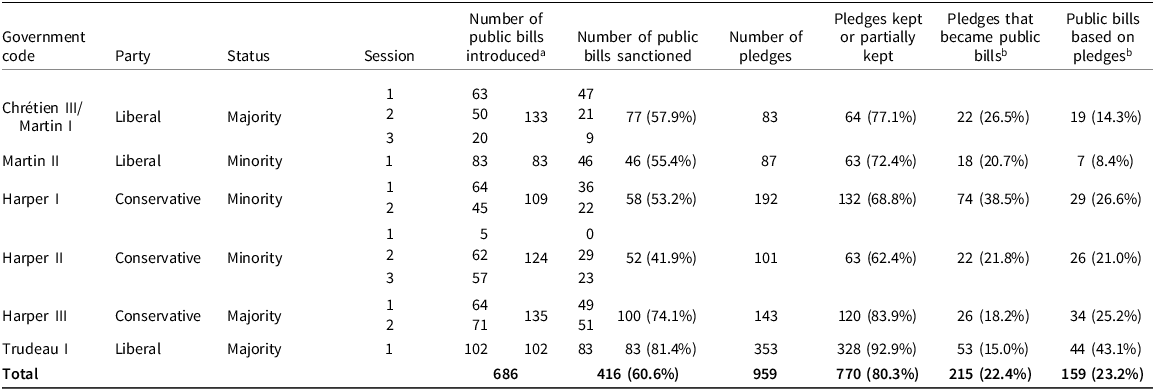
Our sample of election pledges and federal government bills covers six mandates, with a mix of Liberal and Conservative governments, including two partisan transitions—the Harper Conservatives in 2006 and the Trudeau Liberals in 2015—and a mix of majority and minority governments. Table A1 in the Appendix presents information about each of the six legislatures (see Table 1). We retained these legislatures given that there are variations in government ideology, length of tenure and economic conditions, all of which are variables known to influence pledge fulfillment. Additionally, we had complete pledge data for these governments, which was a necessary precondition to enable coding government bills as pledge-related or not.
Pledges and Public Bills by Legislature

Table 1. Long description
The table presents data on election pledges and public bills for six Canadian federal governments, detailing the number of public bills introduced and sanctioned, the number of pledges, and the fulfillment of these pledges. The table includes columns for government code, party, status, session, number of public bills introduced, number of public bills sanctioned, number of pledges, pledges kept or partially kept, pledges that became public bills, and public bills based on pledges. The data is organized by different governments and sessions, providing a comprehensive overview of pledge fulfillment and legislative activity. Row 1: Chrétien III/Martin I, Liberal, Majority, Session 1, 63 public bills introduced, 133 public bills sanctioned, 47 pledges, 77 pledges kept or partially kept, 83 pledges that became public bills, 64 public bills based on pledges, 22 public bills based on pledges. Row 2: Martin II, Liberal, Minority, Session 1, 83 public bills introduced, 83 public bills sanctioned, 46 pledges, 46 pledges kept or partially kept, 87 pledges that became public bills, 63 public bills based on pledges, 18 public bills based on pledges. Row 3: Harper I, Conservative, Minority, Session 1, 64 public bills introduced, 109 public bills sanctioned, 36 pledges, 58 pledges kept or partially kept, 192 pledges that became public bills, 132 public bills based on pledges, 74 public bills based on pledges. Row 4: Harper II, Conservative, Minority, Session 1, 5 public bills introduced, 124 public bills sanctioned, 0 pledges, 52 pledges kept or partially kept, 101 pledges that became public bills, 63 public bills based on pledges, 22 public bills based on pledges. Row 5: Harper III, Conservative, Majority, Session 1, 64 public bills introduced, 135 public bills sanctioned, 49 pledges, 100 pledges kept or partially kept, 143 pledges that became public bills, 120 public bills based on pledges, 26 public bills based on pledges. Row 6: Trudeau I, Liberal, Majority, Session 1, 102 public bills introduced, 102 public bills sanctioned, 83 pledges, 83 pledges kept or partially kept, 353 pledges that became public bills, 328 public bills based on pledges, 53 public bills based on pledges. Row 7: Total, 686 public bills introduced, 416 public bills sanctioned, 959 pledges, 770 pledges kept or partially kept, 215 pledges that became public bills, 159 public bills based on pledges.
a Bills reintroduced between sessions for the same legislation without major changes were removed.
b This data includes all pledges—fulfilled or not—and all introduced public bills—sanctioned or not.
Source: Compiled by authors.
To generate our dataset for analysis, we conducted qualitative content analysis of all federal government bills compared to election pledges from 2000 to 2019. First, we reorganized a dataset of all federal government election pledges for the 2000–2019 period. We relied on the Center for Public Policy Analysis (CAPP)’s Polimeter pledge dataset, which consists of information about all pledges made by current and past Canadian governments since 1993, as well as their public policy domain and their fulfillment status (Duval and Pétry, Reference Duval and Pétry2019; Pétry and Duval, Reference Pétry and Duval2018). In accordance with international studies about pledge fulfillment, we define a pledge as a statement which commits a party to a certain action or outcome that is measurable (Naurin et al., Reference Naurin, Royed and Thomson2019). Both broad and narrow pledges are included—when a promise could be accomplished by more than one action or outcome, it is still included. We also classify pledges as either kept, partially kept, or broken. For the purposes of our analyses, we often aggregate the first two categories—kept and partially kept—to compare them to the proportion of broken pledges. Election pledges considered here are were found in one of three sources: (1) the governing party’s campaign platform or manifesto; (2) press releases made by that party during the campaign period; (3) documents sent by the party to the Parliamentary Budget Officer during campaign period to detail the estimated costs linked with this pledge’s eventual implementation.
Second, we created a second dataset of all public bills for each of the six legislatures. We used web scraping to get access to publicly available data from the Parliament of Canada’s website (LEGISinfo, 2024) and identify 743 public bills that were introduced during one of the six mandates.Footnote 1 Of that number, we identified 57 public bills that were reintroduced without major changes between sessions and made sure these bills were not counted twice.Footnote 2 This left us with a dataset of 686 public bills to conduct our analyses.
Third, we initiated a coding process to link the two datasets together. Two coders familiarized themselves with governing parties’ election manifestos and pledges, the context of each election, and the list of public bills introduced in each legislature. They systematically reviewed each bill to assign a policy domain and note the presence or absence of a direct link to election pledges. In cases of pledge-to-bill links, coders noted the specific pledges and the specific passages in the bill justifying the classification. We avoid a potential caveat identified by Birch et al. (Reference Birch, Jacob, Baby-Bouchard, Birch and Pétry2019) by allowing for multiple pledges to be linked to a single bill, which is particularly helpful in the case of budgets. Many pledges are not linked to any public bill, since they do not require legislative action to be fulfilled, and can instead be kept through executive decisions, administrative or regulatory changes, the achievement of a certain outcome that may have little to do with government action, or even through the status quo. We allow multiple bills to be linked to a single pledge, which can be the case for complex-to-achieve pledges.
Fourth, for a comparative analysis of pledges, public bills and mandates, we reviewed each public bill’s legislative summary,Footnote 3 ministerial documents associated with each bill, associated reading lists, and parliamentary discourses at the first and second readings of the bill. We used this contextual policy information to classify these public bills relative to the general legislative cycle – that is, oaths of office bills –, the budgetary cycle – that is, budget bills or appropriation bills—and to the longer policy cycle according to the main justification of the bill—for which we developed seven categories, ranging from bills to implement international treaties (for example, free trade agreements) to those responding to court decisions.Footnote 4 With regards to the policy cycle, we also distinguished between public bills that received royal assent and thus represent the legislative output of a government, and those that died on the order paper.
Fifth, we computed regression models to study the links between pledge-to-bill linkages and sanctioned public bills. Since pledges and public bills are both clustered in mandates which differ from each other on specific characteristics, multilevel regressions are used, with mandate fixed effects. For regressions involving our pledge database, we relied on multilevel logit regressions, where the outcome variable is whether a pledge is linked to at least one public bill or not. For regressions involving our pledge database, we mostly relied on multilevel logit regressions, where the outcome variable is either whether a public bill is linked to at least one pledge, or whether it received royal assent and therefore became law.
Variables included in analyses
A first series of variables we analyzed include characteristics of the mandate ahead of which pledges were made. Party in Power is a dichotomous variable, as the Liberal Party of Canada and the Conservative Party of Canada are the only two parties that formed government during the period studied. Minority Government indicates whether the party won a minority government as opposed to a majority government. Incumbent Party Re-Elected indicates whether the party in power in the previous mandate was re-elected or whether a new government was sworn in. Number of Sittings in the Mandate represents the overall number of days in which the legislature sat during the mandate. A squared term is used to test for exponential effects of this variable. Average Quarterly Growth Rate During Mandate indicates the Canadian economy’s average monthly GDP growth rate during the mandate, expressed as a percentage. Again, a squared term is used to test for exponential effects of this variable. This variable is a proxy for economic conditions during the mandate. Harsher economic conditions can create hurdles to the fulfillment of election pledges, especially those that involve large sums of money.
A second series of variables relate to information about the public bill itself. Number of Days Since Election When Bill Was Introduced indicates how early the bill was first introduced in the mandate. Growth Rate of Trimester Prior to Bill Introduction, Growth Rate of Two Trimesters Prior to Bill Introduction and Growth Rate of Year Prior to Bill Introduction are three ways of measuring the economic context at the time of the bill’s introduction. A difficult economic context could create hurdles that would make it more difficult for legislation to get through the steps of the legislative process. Usual Business indicates if the bill is an appropriation bill or oath of office bill—two types of bill that do not initiate new public policy actions—or if it initiates new legislation. Sanctioned Bill indicates whether the bill received royal assent before the end of the mandate. Time Between Bill Introduction and Sanction calculates the number of days spent between the bill’s introduction and its sanction, only for bills that did receive royal assent. Mandate indicates in which of the six mandates the bill was introduced. Link With at Least one Pledge is a dichotomous variable that indicates whether the bill is linked to at least one pledge in the previous campaign manifesto of the current government. Public Policy Domain assesses, for bills other than usual business bills and budgets, which of the 12 public policy domains traditionally defined by the CAPP–Polimeter better corresponds to the bill: Arts and Culture, Economy and Employability, Education and Research, Environment, Families, Government and Democracy, Health and Social Services, Identity and Nationalism, International Affairs and Defence, Law and Order, Minorities, or Regions and Agriculture (Center for Public Policy Analysis, 2021).
Finally, the last series of variables relates to information about a pledge. Mandate indicates for which of the six mandates the pledge was made. Link with at Least one Bill is a dichotomous variable that indicates whether a pledge made by a winning party is linked to at least one public bill introduced in the following government’s mandate. Public Policy Domain assesses which of the 12 public policy domains better corresponds to the pledge.
Results
Table 1 presents statistics about election pledges as well as public bills introduced and sanctioned in all six legislatures. In each individual mandate, most pledges were either kept (66.2% overall) or partially kept (14.1% overall), with an overall percentage of 19.7 per cent of broken pledges, smaller than what past studies have found in most other countries (Thomson et al., Reference Thomson, Royed, Naurin, Artés, Costello, Ennser-Jedenastik, Ferguson, Kostadinova, Moury, Pétry and Praprotnik2017). Except for Harper II, most public bills introduced were sanctioned in each legislature, with an average of 60.6 per cent of introduced bills being sanctioned over the 19-year span. The percentages of sanctioned public bills and of kept or partially kept pledges were the highest for the Trudeau I government.
Table 1 shows the extent to which pledges were linked with public bills. Overall, during the 2000–2019 period, 22.4 per cent of election pledges made by governments led to at least one public bill, or between 15 per cent and 38.5 per cent depending on the mandate. Viewed from the legislature, a similar percentage of 23.2 per cent of public bills introduced were directly linked to at least one election pledge, but that percentage varied substantially between mandates, from only 8.4 per cent in Martin II to 43.1 per cent in Trudeau I. Hypothesis 1 is therefore confirmed, as several public bills refer to election pledges, but most of them do not reference any pledge. In 26 cases, a single bill fulfilled more than one pledge. All these results attest to the importance of the governing party’s implicit mandate, with most public bills not originating from election pledges and most pledges not leading to legislative action.
Figures 1 and 2 show the public policy domains of government pledges and public bills during the six mandates. For government pledges, Figure 1 shows contrasting priorities depending on the government. The Chrétien III/Martin I and Martin II governments focused their pledges on health and social services, at a time of reinvestment in that sector after the budget cuts of the previous decade. The Harper I government focused its election campaign and party manifesto on accountability, which translates to a plurality of pledges about government and democracy. The Harper II government mostly focused its pledges on law and order, while the Harper III government gave equal attention in its manifesto to pledges about economy and employability, government and democracy, and law and order. The Trudeau I government made more pledges about government and democracy, a pattern that also characterizes the other successful government transition, from Paul Martin to Stephen Harper. For public bills, Figure 2 shows a more consistent pattern: excluding oaths of office (N = 12), budget (N = 31), omnibus (N = 3) and appropriation (N = 82) bills, which address multiple issues at once, a plurality of public bills are about law and order in all mandates, with the exception of Trudeau I, in which more government and democracy bills were introduced, while law and order is still a close second. Law and order pledges may be by definition more amenable to legislation rather than executive action, which could explain this cross-partisan consistency, with legislation about the Criminal Code, anti-hate and anti-bullying, or gun control all included within this category. On the other hand, domains such as health and social services, education and research, and government and democracy are associated with a higher proportion of pledges than public bills. These findings support expectations from Hypothesis 2, according to which law and order pledges proportionately lead to more public bills than other issue categories.
Percentage of Government Pledges by Policy Domain by Mandate.
Source: Compiled by authors.

Percentage of Public Bills Introduced by Policy Domain by Mandate.
Source: Compiled by authors.

Figure 3 assesses the relative importance of the implicit and explicit components of each mandate by year. The explicit mandate is represented by the lightest shading, and includes all public bills related to pledges; the implicit mandate is represented by the darkest shading and includes all public bills unrelated to pledges; a third “usual business” category includes appropriation bills and oaths of office bills, which do not initiate public policy actions. For any given year except 2017, most introduced public bills do not refer to the explicit mandate but rather aim to fulfill parts of the implicit mandate as well as appropriation bills and oaths of office bills. This finding is inconsistent with Hypothesis 3, which suggested that the explicit mandate would dominate the government’s legislative agenda for the first half of the mandate. Yet, this time in accordance with Hypothesis 3, the public bills introduced in the first two years of each mandate are more likely to be linked to election pledges than those introduced in the third, fourth and fifth years. This indicates that, early in the mandate, the government feels compelled to fulfill some of its pledges through legislative action. Then, as the mandate progresses, the implicit mandate takes more space in its legislative activity.
Percentage of Public Bills Introduced Linked with Pledges by Year.
Source: Compiled by authors.

Figure 3. Long description
A stacked bar graph compares the percentage of public bills introduced linked with pledges by year, categorized by different governing periods. The horizontal axis represents the year the bill was introduced, ranging from 2001 to 2019. The vertical axis represents the percentage of public bills, ranging from 0 percent to 100 percent. The bars are grouped by governing periods: Chretien III, Martin I, Martin II, Harper I, Harper II, Harper III, and Trudeau I. Each bar is divided into three segments: No, Usual Business, and Yes, represented by different colors. The color scheme includes dark gray for No, medium gray for Usual Business, and light gray for Yes. The graph shows variations in the percentage of public bills linked to pledges over the years, with notable increases during the Trudeau I period. Specific values for each year and governing period are visible within the bars.
However, the Trudeau I government appears as a clear outlier, with the last three years of the mandate showing the highest percentages of public bills linked to election pledges of all government-years. The explicit mandate seems to characterize public bills introduced in the first half of the mandate just as much as those introduced in the latter half, a puzzling finding that may be due to the large number of pledges made by this government and the need to spread the introduction of bills aimed at fulfilling these pledges throughout the mandate. The Trudeau government’s pattern may be linked to the creation of a Results and Delivery Unit in the Privy Council Office focused on pledge delivery with public accountability through the Mandate Letter Tracker (May, Reference May2019), which was abandoned after its first mandate.
Figure 4 provides insights into the factors leading to the presentation of public bills that are unrelated to election pledges. Overall, public bills arise for five main reasons: (1) modernizing an older act (22.9%) such as the Quarantine Act or a transportation safety law, (2) implementing an international accord or treaty (11.1%) such as a free trade agreement, (3) implementing a court ruling requiring legislative changes (7.2%) such as a Supreme Court ruling on prostitution or medical aid in dying, (4) implementing a treaty or agreement with Indigenous groups (5.5%) or (5) implementing an agreement with provinces (3.2%). Yet, these five reasons account for only 49.9 per cent of stated justifications, highlighting the diversity of rationales justifying the introduction of non-pledge-related public bills. The main reasons for unlinked public bills reflect the constitutional division of powers as the federal government is responsible for international and interprovincial affairs, Indigenous affairs, the criminal code and the federal justice system, among other issues. Other miscellaneous reasons account for 30.9 per cent of the total number of public bills with no link to pledges. This catch-all category includes heteroclite bills about subjects such as grain transportation, personal information, the conditional release of prisoners, the correction of minor errors in existing laws and so on. Finally, 19.2 per cent of public bills with no links to election pledges do not have any stated justification on the House of Commons’ website. Given the various justifications for these bills and the prevalence of modernizing older acts, Hypothesis 4, which suggested that public bills typically originate from pressure from provinces, courts, Indigenous groups, international actors and miscellaneous other actors, is not fully supported by the data. Governments differ from one another with regards to the relative importance of other and unclear justifications, while international treaties seem to motivate the introduction of more public bills for the Trudeau government compared to its predecessors.
Percentage of Unlinked Public Bills by Main Justification for the Bill.
Source: Compiled by authors.

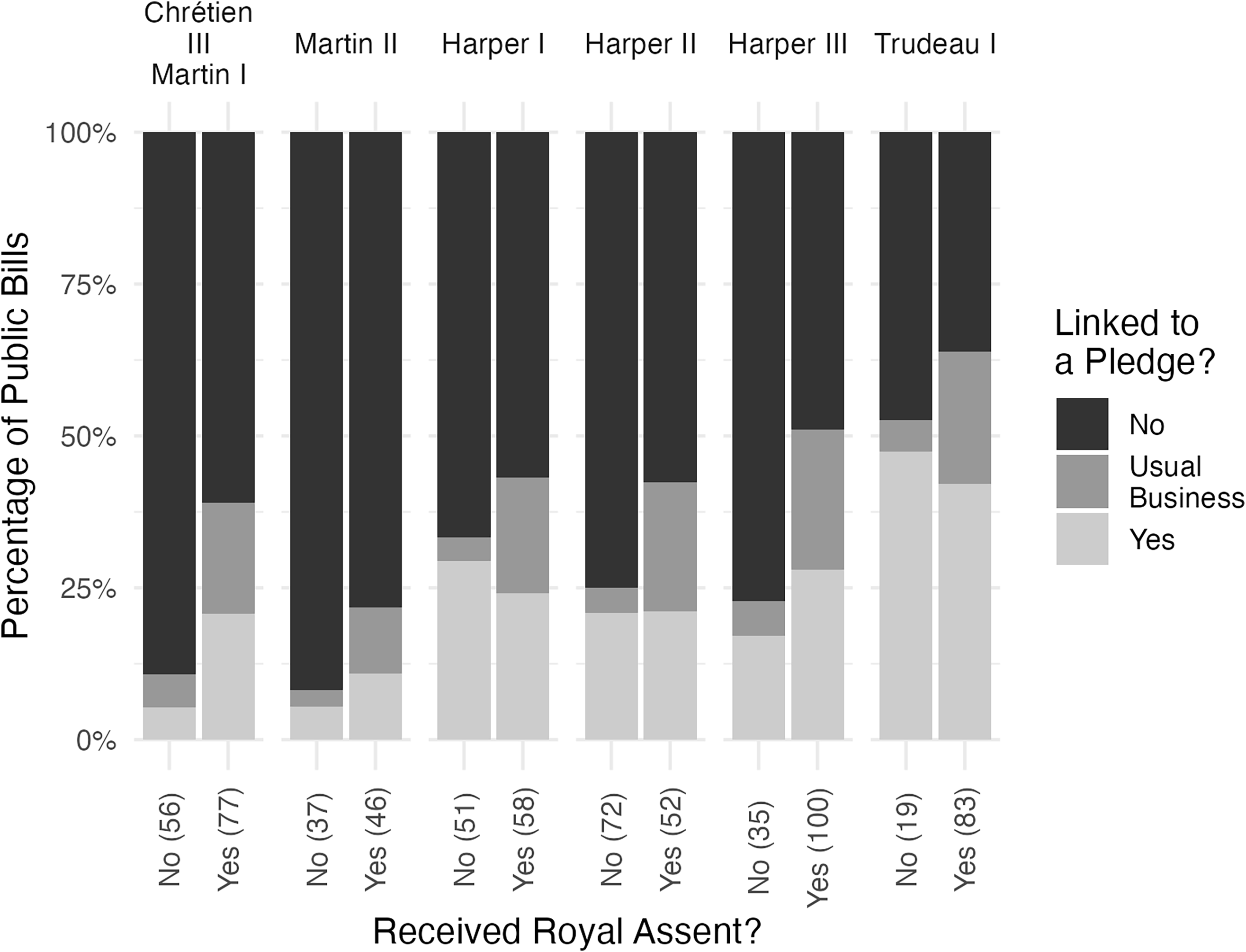
Figure 5 provides an overview of the six mandates through the lens of legislative success rates for the implicit mandate compared to the explicit mandate. One pattern appears for all mandates: the implicit mandate is associated with lower percentages of public bills which received royal assent and became law, thus providing evidence in support of Hypothesis 5. All governments, regardless of their status, were more successful in adopting legislation linked to election pledges and usual business bills than legislation from the implicit mandate. Usual business bills were particularly likely to receive royal assent. The fact that public bills from the implicit mandate are more likely to have been introduced in the latter half of the mandate may explain part of the pattern, but this time, the Trudeau I government is no exception, even though its implicit mandate was not more present in the latter half of the mandate. The extent to which the implicit mandate led to public bills which were abandoned varies between mandates, with Martin II, Harper I and Trudeau I—all newcomer governments—having more similar success for public bills of the implicit and explicit mandates than Chrétien II/Martin I, Harper II and Harper III.
Percentage of Public Bills Introduced Linked with Pledges by Government and Legislative Success.
Source: Compiled by authors.

Figure 5. Long description
A bar graph compares the percentage of public bills introduced linked with pledges by government and legislative success. The horizontal axis represents different governments, including Chretien III, Martin I, Martin II, Harper I, Harper II, Harper III, and Trudeau I. The vertical axis shows the percentage of public bills, ranging from 0 percent to 100 percent. The bars are grouped and stacked, indicating whether the bills received royal assent and if they are linked to a pledge. The color scheme includes dark gray for bills not linked to a pledge, light gray for usual business, and a medium gray for bills linked to a pledge. Each government has two bars, one for bills that did not receive royal assent and one for bills that did. Notable trends include a higher percentage of bills linked to pledges receiving royal assent in the Trudeau I government compared to others. The data suggests variations in the relationship between campaign manifestos and legislative activity across different governments.
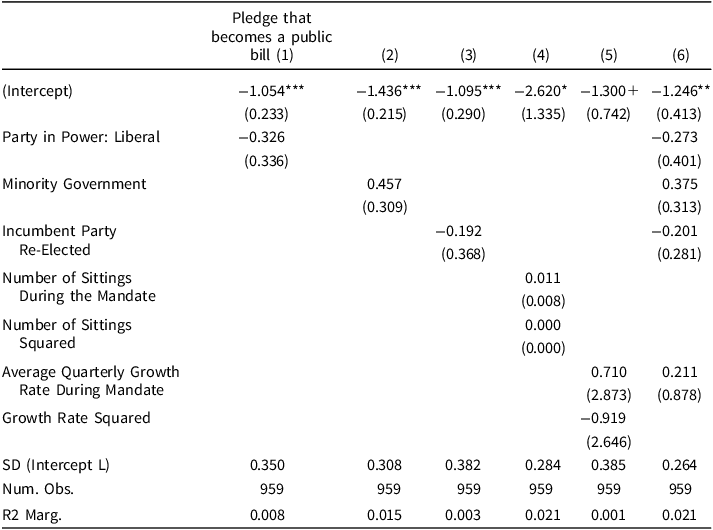
Table 2 shows the factors that can predict that a pledge will lead to legislative activity. Given that all included variables are constant throughout a mandate, they are included in separate models (1–5), while in model 6, all variables are tested at once. Number of sittings and economic growth are excluded from this model due to high multicollinearity. Contrary to expectations, none of the variables tested have a significant relationship with the outcome, that is, a binary variable indicating that the pledge led to at least one public bill. Liberal Party pledges are no more or less likely to lead to legislative activity compared with Conservative Party pledges. Minority government pledges are no more likely than majority government pledges to lead to legislative activity. Whether an incumbent government is re-elected does not have any relationship with the number of its pledges that lead to legislative activity, showing that governmental experience does not seem to change the pledge-to-legislative activity route. Longer mandates do not significantly differ from shorter mandates. The average quarterly growth rate during the mandate is unrelated to the number of pledge–public bill relations. Finally, in an empty model, mandate fixed effects explain only 3.7 per cent of the variance in pledge linkage to public bills—the core of the variance is located at the pledge level.
Prediction of Pledge Linkage to Public Bills

Table 2. Long description
The table presents factors that predict whether a pledge will lead to legislative activity. It includes six models, each testing different variables. The table has six columns and eleven rows, including the header row. The columns are labeled as follows: (1), (2), (3), (4), (5), and (6). The rows are labeled with the following factors: (Intercept), Party in Power: Liberal, Minority Government, Incumbent Party Re-Elected, AQ20 of Sittings in the Mandate, Number of Sittings Squared, Average Quarterly Growth Rate During Mandate, Growth Rate Squared, SD (Intercept L), Num. Obs., and R2 Marg. Each cell contains numerical values representing the coefficients and standard errors for each factor in the respective models. The table shows that none of the variables tested have a significant relationship with the outcome of a pledge leading to at least one public bill. The values in the table indicate the coefficients and their standard errors for each factor across the different models. For example, the intercept values range from -1.054 to -2.620, and the standard errors range from 0.215 to 1.335. The table also includes the number of observations and the marginal R-squared values for each model.
Note: + p < 0.1, *p < 0.05, **p < 0.01, ***p < 0.001. Logit regression with mandate fixed effects.
Reference categories: Party in Power: Conservative; Majority Government; Incumbent Party Defeated; Public Policy Domain: Government and Democracy.
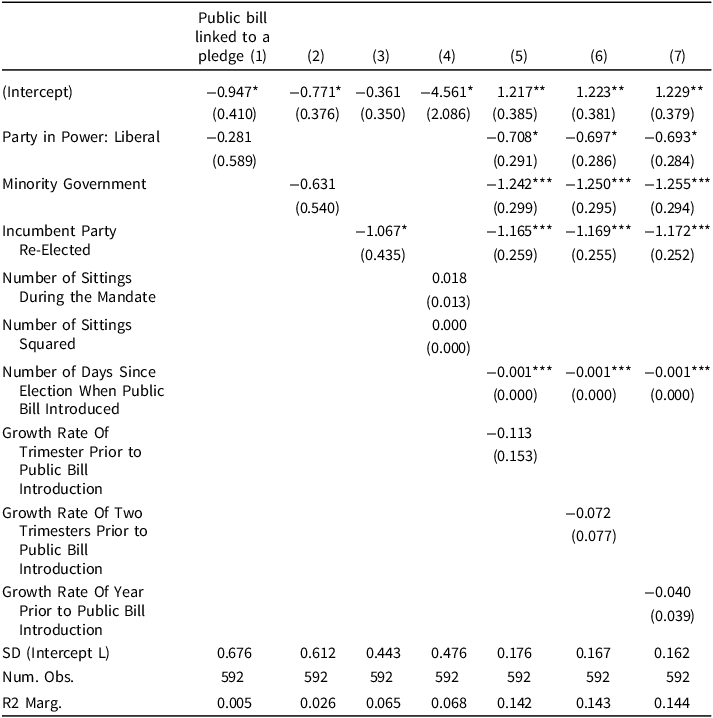
Table 3 shows the factors that can predict if a public bill is related to a pledge. It includes data about all public bills except appropriation bills and oaths of office bills, otherwise referred to as “usual business” bills. Again, included variables that are constant throughout a mandate are included in separate models (1–4), while in models 5–7, all variables are tested at once. Model 5 uses GDP growth data from the trimester prior to the public bill’s introduction as a predictor, model 6 instead uses GDP growth data from the two trimesters prior to the bill’s introduction, and model 7 uses data from the year prior to the bill’s introduction. In an empty model, mandate fixed effects explain 10.1 per cent of the variance in public bill linkage to pledges. Contrary to Table 2, several other variables are significantly related to public bill linkage to pledges when tested alongside each other—although when tested individually, only incumbency status has a small relationship with the outcome (p < 0.05). From the point of view of public bills, Conservative governments (p < 0.05), majority governments (p < 0.001), and first-time governments (p < 0.001) are all associated with more pledge-to-bill linkages. Using specifications from model 7, compared with Liberal governments, the odds that a government bill is related to a pledge are twice as high for Conservative governments. Similarly, the odds that a public bill is related to a pledge are 3.5 times higher in a majority government than a minority one. Compared with a re-elected incumbent government, the odds that a government bill is related to a pledge are 3.2 times higher for a first-mandate government. The number of sittings in the mandate does not seem to be related to pledge-to-public bill linkages. Models 5–7 all show similar effect sizes for all variables, including GDP growth rate, which does not seem to be related to a public bill’s linkage to an election pledge. The strongest predictor—in the statistical sense (p < 0.001)—that a public bill is related to a pledge is the amount of time spent since the previous election when the bill was introduced. If a public bill is introduced one year earlier in the mandate, the odds that it is related to a pledge are 1.4 times higher. This latest finding corroborates findings from Figure 3—as the mandate progresses, more and more public bills introduced are related to a government’s implicit mandate to manage public affairs, be they routine, non-partisan matters or ones that require value adjudication.
Predictions of Public Bill Linkage to Pledges

Table 3. Long description
A table with seven columns and eleven rows, including row and column headers. The table presents data on factors predicting if a public bill is related to a pledge. The columns are labeled as follows: (1), (2), (3), (4), (5), (6), and (7). The rows are labeled with various factors and their corresponding values. Row 1: (Intercept) with values -0.947*, -0.771*, -0.361, -4.561**, 1.217**, 1.223**, 1.229**. Row 2: Party in Power: Liberal with values -0.281, 0.708*, 0.697*, 0.693*. Row 3: Minority Government with values -0.631, -1.242***, -1.250***, -1.255***. Row 4: Incumbent Party Re-Elected with values -1.067*, -1.165***, -1.169***, -1.172***. Row 5: Number of Sittings in the Mandate with values 0.018. Row 6: Number of Sittings Squared with values 0.000. Row 7: Number of Days Since Election When Public Bill Introduced with values -0.001***, -0.001***, -0.001***. Row 8: Growth Rate Of Trimester Prior to Public Bill Introduction with values -0.113. Row 9: Growth Rate Of Two Trimesters Prior to Public Bill Introduction with values -0.072. Row 10: Growth Rate Of Year Prior to Public Bill Introduction with values -0.040. Row 11: SD (Intercept L) with values 0.676, 0.612, 0.443, 0.476, 0.176, 0.167, 0.162. Row 12: Num. Obs. with values 592 for all columns. Row 13: R2 Marg. with values 0.005, 0.026, 0.065, 0.068, 0.142, 0.143, 0.144. The table includes statistical significance indicators such as *, **, and *** to denote levels of significance.
Note: + p < 0.1, *p < 0.05, **p < 0.01, ***p < 0.001. Multilevel logit regression with mandate fixed effects.
Reference categories: Party in Power: Conservative; Majority Government; Incumbent Party Defeated.
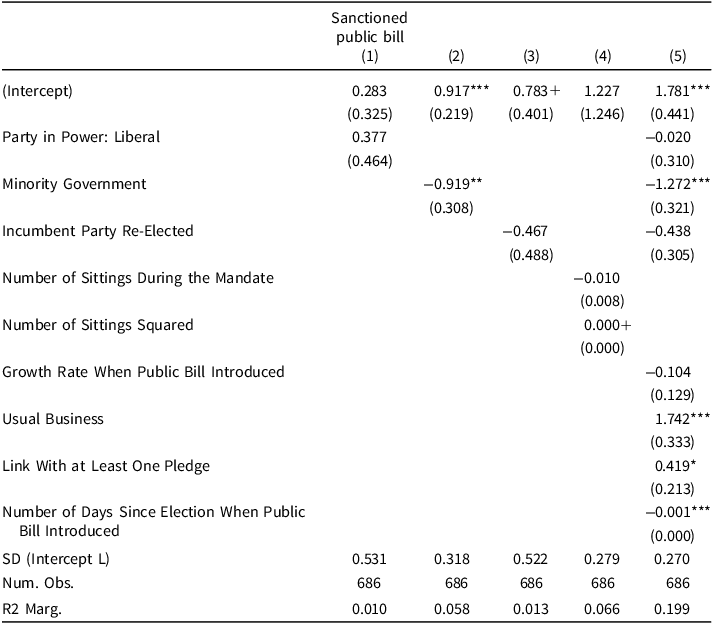
Table 4 shows the factors that can predict that a bill will be sanctioned. It includes data about all public bills. Again, included variables that are constant throughout a mandate are included in separate models (1–4), while model 5 tests all variables at once. In an empty model, mandate fixed effects explain 7.9 per cent of the variance in bill sanction. Majority governments (p < 0.001) seem to fare better in leading public bills through the legislative process up to the royal assent: compared with minority governments, the odds that a majority government bill will be sanctioned are 3.6 times higher. Usual business bills have 5.7 times as many odds to become law than bills unlinked to any pledges (p < 0.001), while bills that are related to at least one pledge are also 1.5 times less likely to die on the order paper than bills unlinked to any pledges (p < 0.05), which confirms Hypothesis 5 and findings from Figure 4 that governments care more about sanctioning public bills from their explicit mandate than implicit mandate, perhaps perceiving them as more important in voters’ assessments of governments than other issues that may arise through the mandate.Footnote 5 Indeed, studies do find that broken campaign pledges matter a lot to voters. Bills introduced earlier are also more likely to be sanctioned: if a public bill is introduced one year earlier in the mandate, the odds that it will be sanctioned are 1.5 times higher. Party in power, re-elected parties, number of sittings in the mandate, and growth rate are all unrelated to a public bill’s likelihood of becoming sanctioned.
Predictions of Public Bill Sanction

Table 4. Long description
The table presents factors that predict the sanction of public bills, including data about all public bills. It includes separate models for variables that are constant throughout a mandate and a model that tests all variables at once. The table has 10 rows and 5 columns. Column headers are Sanctioned public bill (1), (2), (3), (4), and (5). Row labels are (Intercept), Party in Power: Liberal, Minority Government, Incumbent Party Re-Elected, Number of Sittings in the Mandate, Number of Sittings Squared, Growth Rate When Public Bill Introduced, Usual Business, Link With at Least One Pledge, Number of Days Since Election When Public Bill Introduced, SD (Intercept L), Num. Obs., and R2 Marg. Row 1: (Intercept), 0.283 (0.325), 0.917*** (0.219), 0.783+ (0.401), 1.227 (1.246), 1.781*** (0.441). Row 2: Party in Power: Liberal, 0.377 (0.464),, , , -0.020 (0.310). Row 3: Minority Government,, -0.919** (0.308),, , -1.272*** (0.321). Row 4: Incumbent Party Re-Elected,, , -0.467 (0.488),, -0.438 (0.305). Row 5: Number of Sittings in the Mandate,, , , -0.010 (0.008). Row 6: Number of Sittings Squared,, , , 0.000+ (0.000). Row 7: Growth Rate When Public Bill Introduced,, , , , -0.104 (0.129). Row 8: Usual Business,, , , , 1.742*** (0.333). Row 9: Link With at Least One Pledge,, , , , 0.419* (0.213). Row 10: Number of Days Since Election When Public Bill Introduced,, , , , -0.001*** (0.000). Row 11: SD (Intercept L), 0.531, 0.318, 0.522, 0.279, 0.270. Row 12: Num. Obs., 686, 686, 686, 686, 686. Row 13: R2 Marg., 0.010, 0.058, 0.013, 0.066, 0.199.
Note: + p < 0.1, *p < 0.05, **p < 0.01, ***p < 0.001. Multilevel logit regression with mandate fixed effects.
Reference categories: Party in Power: Conservative; Majority Government; Incumbent Party Defeated; Bills with Policy Content; Link With No Pledge.
Discussion
There are several takeaways from this research. First, we have clarified how much pledges and public bills are related to one another in Canada—over six mandates governed by two political parties, 23.2 per cent of public bills are related to a government pledge, and 22.4 per cent of government pledges are introduced as legislation in parliament. This assessment is somewhat lower than what past studies have found in Canada, but we cover a longer period than they did, including minority and majority governments of different stripes. These results are in line with the literature suggesting other dynamics than pledges dominate the legislative agenda (Froio et al., Reference Froio, Bevan and Jennings2017). Pledges about law and order are the most likely to become legislation.
We have shown that public bills introduced early in the mandate are more often related to election pledges than those introduced later, and this remains the case when controlling for other relevant mandate-level variables. This finding is consistent with past research, which shows that governing parties try to fulfill their pledges early on in their mandates, when party supporters are most attentive (Duval and Pétry, Reference Duval and Pétry2019). As the mandate progresses and the next election campaign approaches, governing parties deviate from their policy pledges towards other issues of interest to citizens or to specific policy communities. This deviation may happen when external factors erode the explicit mandate’s strength as the mandate progresses, such as an economic crisis, the lack of cooperation of governments at other levels of power, shifts in public opinion regarding issue salience, or a surge in support for an opposition party. Most of these reasons can be due to governments trying to appeal to prospective voters in a logic close to that of anticipatory representation.
The implicit mandate to govern allows the governing party the flexibility to shift its focus away from the priorities of its campaign manifesto as other issues gain importance. Since citizens want their governments to address emerging issues and often prioritize these issues over pledge fulfillment, it is natural that governments progressively shift attention towards the various prerogatives of the implicit mandate. Governing parties accordingly prioritize other issues than pledges in their legislation in every year of their mandates, with only one exception in our dataset—the year 2017. Contrary to our expectations, even early in the mandate, pledges are simply not the typical output of government legislation. Our results support the idea that governing parties progressively drift away from promissory representation—especially towards the end of the mandate, where matters other than pledges dominate legislative output.
Our findings raise questions about how political parties decide what types of pledges to make. Pledge research indicates that legislation is not typically required to fulfill pledges and that governing parties tend to keep more pledges than they break. Our results confirm that most legislation was not about pledges while most pledges did not result in legislation. Is it therefore possible that parties knowingly limit the proportion of pledges that would require legislation to be kept because of the fulfillment risks that are inherent in the legislative process, especially for minority governments. Parties may prefer to concentrate on those pledges that require executive decisions, administrative actions and policy initiatives, such as strategic plans, consultations, program revisions, or collaboration with third parties, all of which are under the government’s control and thus easier to fulfill. Additional research would be needed to test this assumption.
While our results suggest that promissory representation is a relevant feature of the first part of the mandate whereas anticipatory representation dominates the second part of it, one could argue that (pledge- and non-pledge related) gyroscopic representation is rather at play all along. Experimental findings suggest that people process information through an ideological lens when faced with a political decision-making situation (Béchard, Reference Béchard2023), a feature that is likely to be present in politicians as well. Governments may simply want to fulfill pledges early in the mandate for their own purposes—not thinking about responsiveness to voters generally—and then focus on issues which they believe need to be addressed or that they are forced to address due to other agenda-setting dynamics—for example, a Supreme Court decision invalidating a clause in the Criminal Code. We encourage future studies to examine this possibility.
Justifications for why public bills unrelated to pledges were introduced varied. Bills sometimes sought the modernization of existing acts, the enactment of international treaties, court decisions, Indigenous treaties and agreements with provinces, but we did not find a single explanation for why governments introduce non-pledge-related public bills. We suggest that addressing public affairs that arise from post-election agenda-setting dynamics is part of the governing party’s implicit mandate to govern all public affairs according to its ideology for controversial matters and according to the logic of good government for relatively uncontroversial, more “technical” issues.
Not all public bills introduced are as likely to be sanctioned. More public bills related to a government’s explicit mandate became law than bills related to its implicit mandate. This finding suggests that governments tend to prioritize public bills related to election pledges when legislative action is required for pledge fulfillment.
Our findings suggest that governments are often able to act more quickly under pressure, although there are limits to this. Public bills introduced earlier in the mandate are more likely to be sanctioned than those introduced late in the mandate. Yet, public bills introduced later in the mandate often go through the steps of the legislative process faster, making it possible for governments to quickly fulfill some pledges at the end of their mandates. Majority governments also tend to prioritize the explicit mandate to a larger extent than minority governments do, possibly because they do not have to worry as much about non-confidence votes.
In several respects, our findings regarding the Trudeau I government are unique. This government has the largest number of pledges, the highest percentage of sanctioned public bills, and the lowest percentage of broken pledges. Contrary to other governments, most public bills introduced by this government were about government and democracy instead of law and order. The percentage of public bills related to election pledges was higher in the Trudeau I mandate, and these bills were mostly introduced in the second half of the mandate rather than the first, contrary to previous governments. The fact that more public bills were related to pledges is understandable given the large number of pledges made to the population by the Liberal Party in 2015. Proponents of deliverology are likely to claim that the Results and Delivery Unit created tangible results in terms of pledge fulfillment—and yet, it was abandoned after the Trudeau government’s first mandate. Birch and Jacob (Reference Birch and Jacob2019) are critical of this approach, suggesting it is too influenced by Barber (Reference Barber2007)’s approach, which deviates from scientific research and leans into private-sector performance management, which they view as ill-suited for running a government. More generally, Birch and Jacob suggest deliverology brings little in the Canadian context where results-based management with indicators and tools for tracking outcomes and output already existed prior to the Mandate Letter Tracker. Future studies should keep following these developments in Canada in the post-2019 period. Clearly, the large number of promises connects to research about political marketing, which suggests that governments increasingly target their communication strategies—including campaign announcements and pledges—towards and ever-larger number of smaller and smaller segments of the electorate (Lees-Marshment, Reference Lees-Marshment, Lees-Marshment, Conley, Elder, Pettitt, Raynauld and Turcotte2019).
Political marketing research would benefit from empirical studies that analyze how parties communicate about their pledges during election campaigns, how they communicate about pledge delivery after elections, how much voters notice these efforts, and what voters’ reactions are (Lees-Marshment, Reference Lees-Marshment, Lees-Marshment, Conley, Elder, Pettitt, Raynauld and Turcotte2019). Such research would deepen our understanding of the importance of pledge delivery for party brands and reputations. In the broader context, such research would contribute to understanding transparency and accountability mechanisms in Canadian democracy. While all Canadian federal political parties reveal their pledges in a series of press releases that they make available on their websites during an election campaign, most of them also publish a formal platform, either during the campaign or after the elections, and they also sometimes rely on social media to publicize some pledges.Footnote 6 How much they communicate via each strategy and how this varies across provinces would be worth digging into in future research, especially given the importance of party pledges—when a government breaks a high-profile promise, this decision typically results in a loss of points in the following election (Matthieß, Reference Matthieß2022).
We encourage scholars to extend this type of analysis to other countries and other jurisdictions for which pledge fulfillment data is available for a longer time frame. Similar comparative analyses involving other countries with different electoral systems and different traditions with regards to coalition governments would deepen our understanding of the influence of election pledges relative to other policy dynamics on legislative agendas. Case studies which incorporate in-depth qualitative analysis of a large set of pledges would also shed light on the factors that lead to high or low pledge fulfillment at different moments during a mandate. Moreover, interviews with politicians, decision-makers and party manifesto writers could provide further insight into how parties perceive mandates and expect citizens to behave with regards to fulfilled and broken pledges.
While the current study focused on pledge-to-legislation linkages, a study about pledge-to-executive action linkages would complement our findings in a relevant way. Much of a government’s output is not legislative but rather executive or administrative in nature. Whether governments’ executive actions center on pledges in the first half of a mandate more than in the second half would provide deeper insight into the evolution of a government’s explicit and implicit mandates.
One final area of inquiry which would be worth pursuing in our opinion is the relative importance of pledges and public bills. Our investigation provides helpful information about pledge-to-policy linkages, but it unfortunately treats all pledges as equal, despite the fact that some pledges are targeted towards a small subset of voters while others have important financial and social outcomes (Tremblay-Antoine et al., Reference Tremblay-Antoine, Côté, Dufresne and Birch2020). It is unclear whether the pledge-related public bills which receive royal sanction are more important for citizens, compared with pledge-related bills which do not become legislation. More generally, whether salient or non-salient pledges are more likely to be fulfilled has only been investigated by two studies to our knowledge—Bouillaud et al. (Reference Bouillaud, Guinaudeau and Persico2017), who consider the visibility of pledges in media coverage during the election campaign, and Mellon et al. (Reference Mellon, Prosser, Urban and Feldman2023), who weight pledges by their perceived centrality to the election campaign manifesto using public opinion data. We encourage the development of scholarly literature examining the relative importance of pledges and think it will provide deeper answers to questions about pledges’ legislative outcomes.
Supplementary material
The supplementary material for this article can be found at https://doi.org/10.1017/S0008423926101334
Data availability statement
The data are available on the Harvard Dataverse here: https://dataverse.harvard.edu/dataset.xhtml?persistentId=doi:10.7910/DVN/NGANLK
Acknowledgements
We wish to express our gratitude to the following research assistants at the Center for Public Policy Analysis (CAPP): Carrie-Ann Auger for her contributions to our dataset of sources as well as Camille Grondin and Félix Lévesque who participated actively in the content analysis and coding. We thank the Fonds de recherche du Québec—Société et culture (FQRSC) and Centre for the Study of Democratic Citizenship (CSDC) for their support of our research team. We thank the CAPP for allowing us to use this dataset.
Competing interests
The authors declare none.




 Open access

