Since the introduction of intravenous (IV) therapy, different venous access devices (VADs) have been developed and used increasingly for IV therapy in a wide variety of patients. The range of devices include peripheral IVs, peripherally inserted central catheters (PICC), central venous catheters (CVC), and port-o-caths (ports). Choosing the most suitable device for specific patients in different clinical scenarios is important (Reference Cheung, Baerlocher and Asch1). Repeated IVs are usually easy to insert in adults, more difficult in young children, and require frequent replacements to complete a course of therapy. PICCs provide secure central venous access through a peripheral vein, for short to medium length therapies.
Although the average cost for a peripheral IV (USD$108.49) is much lower than a PICC, patients have higher satisfaction with PICCs (Reference Polak, Anderson and Hagspiel2;Reference Schwengel, McGready and Berenholtz3). Complications associated with PICCs are significantly fewer compared with central devices (CVCs or ports) (Reference Smith, Friedell and Cheatham4). One central VAD is the tunneled CVC, intended for long-term therapy; they are more invasive and usually require general anesthesia or deep sedation to insert. Tunneled CVCs have lower infection rates than nontunneled CVCs (Reference O'Grady, Alexander and Burns5). If infection occurs, the management costs range from USD$70.60 to USD$198, 993.63 (Reference Keeler6). In one study, management of catheter related blood stream infections have exceeded $19,000 CDN per incident (Reference Raschka, Dempster and Bryce7). The other central VAD is the implantable port, entirely buried under the skin. They are used for long-term intermittent needs. They are more expensive to insert and remove (Reference O'Grady, Alexander and Burns5). The total insertion costs and charges for central VADs are estimated between USD $1,500 to USD $8,500 (Reference Di Carlo and Biffi8).
Previous studies commented that a PICC was a safe and cost-effective intervention, with greater reported patient satisfaction for establishing central venous access among adult hospitalized patients than other venous access options (Reference Schwengel, McGready and Berenholtz3;Reference Haider, Kumar and Salam9;Reference Periard, Monney and Waeber10). The insertion cost related to a PICC has been estimated at USD $690 per patient (Reference Periard, Monney and Waeber10). Another study reported the total insertion cost ranged from USD $173.6 to USD $440.7 (Reference Schwengel, McGready and Berenholtz3). It was estimated that the cost saving from using a PICC with home care, was USD $1,070 per day (Reference Smith, Friedell and Cheatham4).
When considering costs associated with PICCs one needs to include a broad range of costs, beyond merely the insertion costs. The direct cost to the health system and other sectors, the direct costs borne by the patient/family, and the indirect costs of productivity losses are considered (Reference Drummond, Sculpher and Torrance11). A comprehensive economic evaluation requires estimation of both direct and indirect costs; all costs are included irrespective of payer. However, there is a paucity of studies that have examined the various component costs and the cost determinants related to PICCs. Current literature has assessed only two components of the health system costs, namely, insertion costs and the costs associated with the treatment of their complications (Reference Smith, Friedell and Cheatham4;Reference Haider, Kumar and Salam9–Reference Moore, Wei and Smith14). Consequently, further research on costs related to PICCs is warranted. The purpose of this study is to assess costs associated with PICCs from a societal perspective and to detect factors that influence the total costs.
METHODS
This study was approved by the Research Ethics Board. A retrospective cost analysis was conducted on a cohort of pediatric patients who had PICCs inserted by interventional radiologists (IRs) using image guidance between January 1, 2008, and December 31, 2008, in a tertiary level pediatric hospital. Patients were excluded if their primary PICC insertions did not occur during the study period or if the PICC insertion was combined with other medical, surgical or IR interventions during their procedure. Patients were also excluded if there was a lack of follow-up data, for example, patients who were discharged to another province. When the patients had more than one PICC inserted during the year, only the first PICC was included. Consequently, 469 patients were retained for analysis and nineteen were excluded for lack of follow-up. Costing was based on an episode of care and the unit of analysis for this study was “per patient” to fully explore all the independent effects.
Costs Evaluation and Measurements
The following direct costs were included: insertion costs, complication costs, nurse and physician assessments, inpatient ward costs, catheter removal costs, home care costs, and out-of-pocket travel costs incurred by parents. To estimate the indirect costs, productivity losses incurred by parents were estimated. In this study, all costs from 2008 were reported in 2017 Canadian dollars ($1.00USD = $1.25CAD in 2017) after adjustment for growth in the health and personal care component of the consumer price index (Statistics Canada) (15). Details of the cost components and their measurements are included in Supplementary Tables 1 and 2.
There were three components of insertion costs: material costs, labor costs, and equipment costs. All insertion costs were derived from a dedicated prospectively maintained IR database (Esh–IGT; www.esh.ca) with patient-level cost data that contain both volumes and prices. Insertion time was calculated from the time the patient entered the IR room until they left the IR suite. Salaries were prorated based on this time.
Records of imaging examinations were obtained from the hospital Picture Archiving and Communication System (PACS) system. Medical histories were obtained from the Electronic Patient Chart System (EPC) as were records of laboratory tests, ER visits, or clinic visits. Data on the occurrence of complications for individual patients were collected from the hospital's Vascular Access Database. The Vascular Access Database has direct links to the hospitals PACS, laboratory, and vascular access nursing assessments for tracking complications. Fees for physician services to address complications were obtained from the Ontario Health Insurance Schedule of Benefits (OHIP SoB). Physician and Nurse Experts in the IR department were consulted regarding treatment time required to manage complications.
Total inpatient ward costs, specific to that ward in which the patient stayed, were provided by the hospital's Department of Decision Support. The ward cost included professional services, medications, nursing, laboratory tests, medical imaging, overhead (including administration, laundry, housekeeping, and other centralized institutional costs), and equipment costs during hospital stays. Ward costs were calculated by multiplying average per diem ward costs by each patient's total length of stay. Although patients may have changed wards during their inpatient stay, for purposes of cost calculations each patient was assigned to that ward in which they resided on the day before their discharge, acknowledging that most patients were at their most stable at that point. The total length of stay was calculated from the catheter insertion day to the discharge day, recognizing that the duration of stay reflected the patient's diagnosis, not the PICC insertion. In accordance with clinical practice, it was assumed that each line was assessed once by an IGT physician after the insertion. The fee for a general consultation was based on the OHIP SoB code C122 (16).
It was assumed based on actual institutional clinical practices, that a vascular access nurse (VAN) performed at least one assessment before a line insertion, one before removal, and a further assessment if a complication were to occur. The duration of each assessment was estimated by three nurse experts. Using the similar formula as home caregivers (see below), the assessment costs were calculated by multiplying the total assessment time in hours by a nurse's hourly wage that was inflated by 23 percent to account for fringe benefits and increased further by 52/46 to account for vacation and holiday benefits (Reference Hancock-Howard, Connolly and McMahon17). Regarding the catheter removal cost, a PICC could be removed either by a VAN (if uncuffed, or if cuffed but in situ for less than 4 weeks) or by an IR (if cuffed and in situ for longer than 4 weeks) with different associated costs. Removal costs by nurses were measured in the same way as the assessment costs while the removal costs by IR were obtained from the Esh-IGT database.
Travel costs incurred by patients’ families were included. It was assumed that if the driving distance between the patient's residence and the hospital was less than 430 kilometers, parents would drive to the hospital. The hospital's mileage claim rate of $0.35 per kilometer and $11 per day for parking were used to calculate driving costs. It was also assumed that if the patient's home was further than 430 km from the hospital, the patient would travel by plane with one parent, who would stay with their child on the ward. The nearest airport to the patient's residence was selected to determine air travel costs using the lowest cost economy airfare during the study period (Reference Guerriere, Zagorski and Fassbender18).
After discharge, patients’ PICCs were managed by home care nurses, who visited daily to perform general PICC maintenance (e.g., flushing the line, giving medications, dressing changes). Home care days were measured from date of discharge until the date of PICC removal. There were difficulties tracking each patient's every home visit, therefore, the cost of home-based nursing care was based on another home care services’ study by Guerriere et al. (Reference Guerriere, Zagorski and Fassbender18). In that study, the average cost for each home visit for nursing, personal support, and other allied health professionals (e.g., occupational therapy, physical therapy, etc.) was $88 per visit in 2008 ($104.4 in 2017) (Reference Guerriere, Zagorski and Fassbender18).
A societal perspective is recommended in pediatric economic evaluations due to the often substantial caregiver time costs, particularly for conditions requiring inpatient care (Reference Ungar, Ungar and Gerber19). Productivity losses incurred by parents during their child's hospitalization were estimated. For each day in hospital, it was assumed that one parent would miss one full day of work or usual activities. The human capital approach was used to estimate productivity loss costs (Reference Liljas20). Average hourly aged-based earnings from Statistics Canada were used to value the time loss, which is more generalizable than using participant reported income. It was assumed conservatively that parents would normally work 8 hours per day and only a single parent/caregiver's time was lost. According to Statistics Canada, the average hourly wage for people aged between 25 and 50 years of age was $23.87 in 2008 ($28.32 in 2017) (21).
Data Collection
Variables were collected based on elements of the Andersen and Newman's behavior model of health services use (Reference Andersen and Newman22) and/or identified from previous papers (Reference Periard, Monney and Waeber10–Reference Moore, Wei and Smith14). “Predisposing factors” are factors that yield effects by increasing or decreasing a person's motivation to undertake a service. “Predisposing” factors include demographic characteristics, social structures and health beliefs. In this study, age, sex, weight were selected as the predisposing factors for analysis. “Need” factors relate to individualized perceived health status and functional capacity that may influence a person's health service use.
As the purpose of this study was to assess costs associated with PICCs from a societal perspective and to detect factors that influence the total costs, all variables relevant to cost measurements and potential factors needed to be included. For this study, variables such as patients’ primary diagnosis, ward, indication for catheter insertion, access vein, type of anesthesia, catheter information including the size, type, and manufacturer, catheter dwell days, inpatient days, removal reason, complication during the catheter dwell period were all included as potential “need” co-variates. As catheter dwell days are related to many cost factors, interactions between “catheter dwell days” and all the other variables above were also investigated to avoid collinearity.
Based on details outlined above, all patients who underwent a successful PICC insertion were identified in the IR database, and the following data elements extracted: patients’ age, sex, weight, date of procedure, time of procedure, type of procedure, type of line used, operator information, sedation information, procedural complications, procedural costs. Vascular Access database provided data with the patients age, date of birth, date of death (if applicable), sex, hospital in-patient unit, primary diagnosis, reason for insertion, removal date, dwell days, type of catheter, manufacturer of the catheter, access route, date and type of complication (if applicable), and reason for removal. Information of patients’ address, ward unit, lab examinations, emergency room visits, and sedation methods were extracted from the EPC. EPC was also used to retrieve any data elements missing from the IR and Vascular Access Database. Cross referencing with the hospital's PACS ensured data reliability.
Statistical Analysis
The Statistical Package for the Social Sciences, version 17.0 (SPSS Inc., Chicago, IL) was used. Multiple linear regression analysis was used to explore the potential factors that were associated with PICC costs. The dependent variable was defined as the total cost per patient, which was the sum of all the cost components. As total costs per patient were skewed, they were natural log transformed to approximate a normal distribution. Thus, the dependent variable was transformed to the log of the total PICC cost. As the dependent variable involved a nonlinear transformation, the mean of the total cost and the estimated coefficients yielded by the regression cannot directly interpret the raw costs or be simply reversed because of the retransformation bias. The smearing estimator was used to mitigate the bias (Reference Manning23). A p-value of less than .05 was considered to be statistically significant to determine inclusion of independent variables in the regression model. Backward stepwise regression model was used. All potential independent variables were included in the starting model and variables were sequentially removed from that model. The residual sum of squares of these resulting models was compared to find the most appropriate model. The goodness of fit was captured by R2.
Sensitivity Analysis
Sensitivity analyses were conducted to test the robustness of the results to assumptions regarding uncertain data (24). As inpatient ward costs typically account for a significant majority of the total costs associated with PICCs and are a measure of the patient's underlying diagnosis rather than the PICC itself, ward costs were expected to dominate total costs. Therefore, an analysis excluding inpatient costs was conducted. One-way sensitivity analysis was performed to assess the impact of uncertainty associated with particular assumptions on total PICC costs.
RESULTS
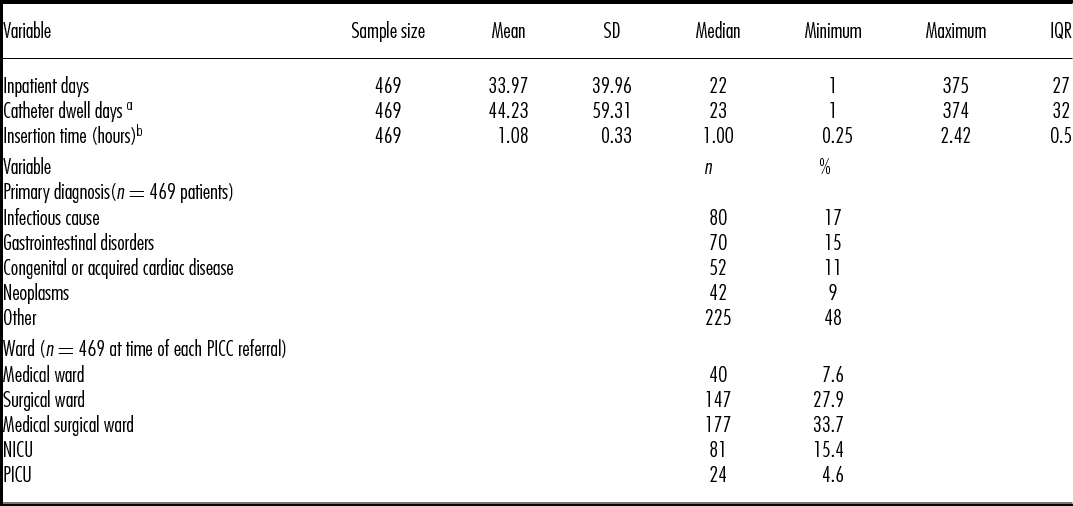
There were 469 patients included within the study period. Of these patients, 251 (47.7 percent) were boys. The median age at PICC insertion was 1.1 (0–17.9) years. The median weight at PICC insertion was 9.3 kg (0.6–120 kg). The common underlying diagnoses necessitating a PICC were grouped as follows: infectious causes (17 percent), gastrointestinal disorders (15 percent), congenital or acquired cardiac disease (11 percent), neoplasms (9 percent), prematurity (9 percent), and others (39 percent). Of the patients, fifty-seven (12.2 percent) died during the course of their hospital stay because of their underlying disease. The referral sources are outlined in Table 1, grouped broadly into medical or surgical wards. The median inpatient stay per patient was 22 days, and the median total catheter dwell day was 23 days (Table 1). The most common reason for PICC placement was medication administration and antibiotic therapy (MEDS/ABX), which accounted for 45.4 percent. Most PICC insertions (59.9 percent) were placed using local anesthesia alone (± sucrose in babies). Sixty percent of PICCs were placed by means of the basilic vein. With respect to removals, 82.8 percent of lines were removed at the end of therapy; 40.1 percent of catheters were removed by nurses, while 38.8 percent were removed by IRs.
Patient Health Characteristics

a Calculated from the date of insertion to the date of removal.
b Measured as time patient enters the IR room until patient leaves IR room.
IQR, interquartile range; NICU, neonatal intensive-care unit; PICC, peripherally inserted central catheter; PICU, pediatric intensive care unit; SD, standard deviation.
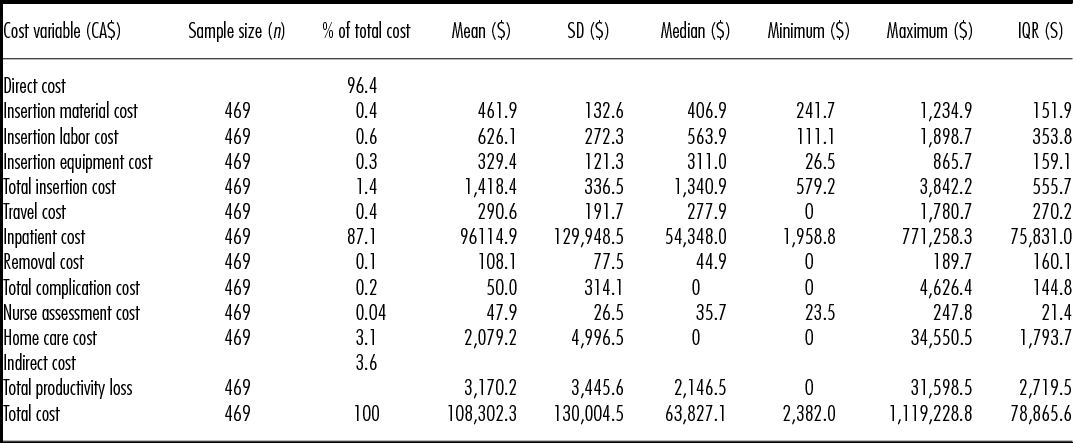
Direct costs accounted for 96.4 percent of the total costs. Of the direct costs, inpatient ward costs (87.1 percent) was the main component. Nurse assessment costs (<0.1 percent) accounted for the smallest contributor to total costs. There were 165 PICCs (31.4 percent) that were associated with a subsequent complication (14.9 complications per 1,000 catheter days). The complications included blockage (n = 61; 3.8/1,000 catheter days), breakage (n = 44; 2.8/1,000 catheter days), dislodgement (n = 33; 2.1/1,000 catheter days), infection (n = 34; 2.1/1,000 catheter days), malposition (n = 32; 2.0/1,000 catheter days), thrombosis (n = 8; 0.5/1,000 catheter days), and other problems (n = 25; 1.6/1,000 catheter days). In 107/165 the PICCs were associated with a single complication. The median cost to treat or manage a complication was $146.0 (range, $10.7 to $4,627.5), $24.7 ($0.3 to $722.0) per dwell day among the 165 patients.
The total estimated median travel cost incurred by parents was $277.9 ($0 to $1,780.7) per patient or $21.4 ($0 to $317.5) per patient per day spent in hospital. Early discharge with a PICC in situ occurred in 191 patients (36.3 percent) (Table 2). Of these 191 patients, the median home care cost per patient was $2,548.8 using an average cost per day of $104.4 at home (Reference Guerriere, Zagorski and Fassbender18). The median ward cost was $3,038.7 per day with a range from $1,965.0 to $4,177.7 during each patient's hospital stay. The average productivity loss was $3,169.9 with a median cost of $2,146.6 per patient or $211.1 per patient per day.
Descriptive Analysis of Cost per Patient

Note. Costs were updated to 2017 costs using Canada health and personal care Consumer Price Index.
IQR, interquartile range; SD, standard deviation.
Taking the inpatient ward costs into consideration, the median total cost per patient per catheter dwell day was $3,133.5 ($2,210.7 to $9,627.0). The adjusted mean cost per patient per catheter dwell day was $2,648.2 ($2,402.4 to $2,920.4) after retransformation of the data back to the original scale. When inpatient ward costs were excluded, the median total costs per patient per dwell day were $198.8 ($91.8 to $2,475.8). The adjusted mean cost per patient per catheter dwell day without inpatient costs was $362.7 ($341.0 to $386.0).
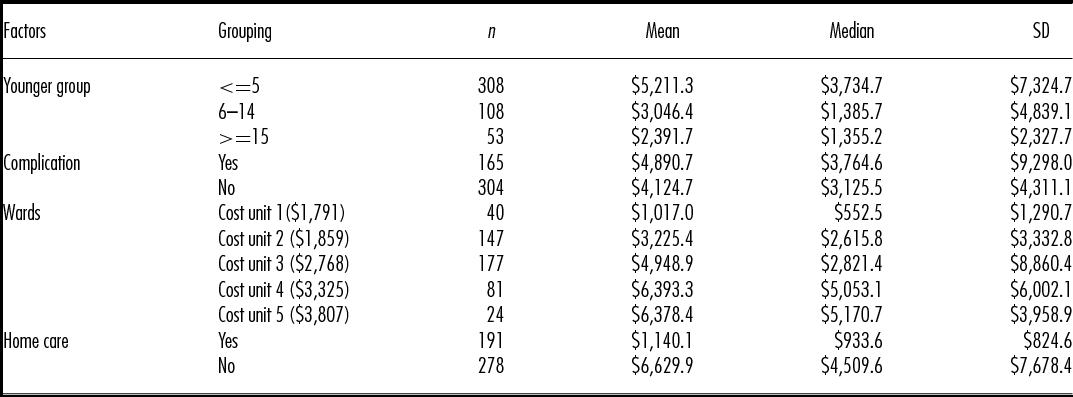
Many factors can affect the total cost of catheters. Multiple linear regression results showed that the following five factors were significantly associated with greater costs: younger age, more complications, greater number of catheter dwell days, wards associated with more intensive care, and those without home care (Table 3). Under this model, the R square was 0.531. To better inform clinical decision making, significant factors related to the PICC costs were further calculated by subgroups. Average total cost per patient per day was measured based on different scenarios (Table 4). Younger patients incurred more costs. Patients with complications were associated with higher costs than those without. Transferring to home care saved significantly in terms of cost.
Factors Influence Total PICC Costs with or without Inpatient Costs

CI, confidence interval; NICU, neonatal intensive care unit; PICC, peripherally inserted central catheter; SD, standard deviation
PICC Cost Scenarios (per Patient per Catheter Dwell Day)

PICC, peripherally inserted central catheter; SD, standard deviation.
Sensitivity Analysis
Regression analysis was run without inpatient ward costs. In the absence of ward costs, the procedural insertion time became a new significant factor associated with the variation of the total PICC costs. The longer the insertion time, the greater were total PICC costs. Previously identified factors, including home care and catheter dwell days, remained as significant factors (Table 3). Compared with the model with inpatient ward costs, a greater proportion of the variation in the total costs could be explained as the R2 increased to 0.627.
The sensitivity of the average total cost per patient per catheter dwell day to variations in the costs of uncertain parameters was assessed. The base case for the average total cost per patient per catheter dwell day was $2,348.4. Variation in inpatient ward costs had the greatest impact, which varied from $291.6 to $4,782.4. The total cost per patient per dwell day varied from $2,196.4 to $2,500.3 when the values for parent productivity costs were inserted. The travel costs varied from $2,347.3 to $2,460.5. Variations in home care costs and nurse assessment costs had little effect on total cost per patient per catheter dwell day.
DISCUSSION
The present study found the median total cost per patient per dwell day from the societal perspective was $3,133.5 with a range from $2,210.7 to $9,627.0, including median inpatient costs of $3,038.7 and median non–in-patient care costs of $198.8. In previous studies, insertion costs have been reported from USD $174 to $690 (Reference Schwengel, McGready and Berenholtz3;Reference Thiagarajan, Ramammoorthy and Gettmann13;Reference Murphy and Spry25), but those estimates only included labor time, equipment, and operating room time, whereas Murphy and Spry's study measured the total cost of insertion, maintenance, and management of complications, which was CDN $344 on average per line (Reference Murphy and Spry25).
Compared with the studies above, insertion costs were much higher in the study by Moore et al., where the insertion costs ranged from USD $1,363 to USD $1,954 in 2004 (Reference Moore, Wei and Smith14). Inpatient ward costs were also measured in some studies. The study by Van Winkle et al. comprised all general billable costs with inpatient ward costs estimated at USD $1,185 per day in 2006 (Reference Van Winkle, Whiffen and Liu12). The range of inpatient ward costs per day was much broader in the study by Moore et al., ranging from USD $927 to USD $7,198 due to the larger sample size and the wide variety of patients’ conditions (Reference Moore, Wei and Smith14). In the present study, the per diem inpatient ward cost ranged from CDN $1,965.0 to CDN $4,177.7, which was consistent with the studies described above.
Most of the above studies only focused on a subset of costs and did not provide details on how cost estimates were derived. The current study adopted a comprehensive approach to PICC costing, including both direct and indirect costs within a tertiary care pediatric population in the Canadian healthcare system. The cost estimates derived included cost components rarely assessed in previous studies, such as, complication costs, home care costs, nurse assessment costs, and the costs of productivity losses.
In the current study, five main factors are associated with greater total PICC costs. These include younger patient age, more complications, more catheter-dwell days, stay in intensive high acuity level care wards, and in-patient status (not receiving home care). Younger children may require more intensive care services and more expensive equipment for insertion procedures (e.g., small catheter/ wire combinations suitable for very small veins). Young children lack the ability to cooperate and require sedation or anesthesia during insertion also contributing to greater costs. More complications are associated with higher costs for PICCs. Longer catheter dwell days are associated with higher PICC related costs per day. The primary diagnosis and patient clinical acuity determine the assignment of the inpatient ward and length of stay, for example, more ill children are usually cared for in high acuity or intensive care wards. In the regression analysis, the more intensive the ward care, the greater the PICC cost. A major reason a PICC can be a cost saving device is because patients can be discharged earlier and continue their treatment outside hospitals, thus saving a large amount of hospitalized expenditures.
There are several strengths to this study. This study's sample size is much larger than previous studies, and all patient data were collected from a tertiary pediatric hospital, with heterogeneity in the sample. In addition, the present analysis provided more costing details, and descriptions of how these costs were estimated or measured. Most patient level costing data were extracted directly from the hospital's database, which is more accurate than previous studies. Previous studies only elaborated on insertion costs, or did not offer any cost measurement details. In addition, this is the first study that focused on a pediatric population, and we adopted a societal perspective as recommended in pediatric evaluations (Reference Ungar, Ungar and Gerber19).
There are several limitations to this study. As a retrospective study, there were occasional missing data elements. For example, patients’ addresses (13/469 patients have missing addresses) from which to measure the distance to the hospital and estimate the patient's travel cost; the exact discharge date from which to calculate inpatient days was missing (3/469 patients have missing discharge dates). In these instances, the average distance and average inpatient days were used. In all, nineteen patients (4.0 percent) were excluded from the study because of a lack of follow-up (discharged to a different jurisdiction); as a result, complications, associated costs, and the number of return visits for line related problems could not be obtained for these patients. As 4 percent is a small percentage, their exclusion does not impact the results. In addition, with respect to the adequacy of the sample size to represent the total population (Reference Eng26), according to John Eng's research, if the sample error is 5 percent, 385 patients would be required. Therefore, the random sample of 469 patients was sufficient to avoid selection bias and minimize the effect of missing data.
Second, some difficulties existed in obtaining certain costs at a hospital level and, therefore, assumptions had to be made. For example, inpatient ward costs were estimated based on the patients’ last day before discharge to yield a value for each patient based on the entire length of stay, instead of patient-level case costing day-by-day. This may systematically under-estimate the ward costs for patients as they are more likely to be in their most stable condition and in a less acute ward on the day before discharge. Some cost estimates depended on professional expert opinion. For example, for the nurse assessment times, three vascular access nurses were asked to estimate the assessment time and average time was calculated for cost estimation.
Third, this study's unit of analysis was an episode of care, with the requirement that the same patient be included only once. For patients undergoing multiple PICCs, only first PICC insertions were included to maintain sample heterogeneity, although patients requiring repeated PICCs could consume different health resources and may exhibit different average costs.
Fourth, although this is a detailed cost analysis from a societal perspective, it did not include a comparison with an alternative procedure. There is not a robust alternative within a pediatric setting. Home care with repeated IVs is not a realistic option in children and use of CVDs or ports do not serve the same clinical populations as PICCs.
Lastly, patients’ health outcomes, such as quality of life was not measured. PICCs save children the physical and psychological pain of multiple IV pokes and repeated blood work and may facilitate early discharge. The impact on patients with different diagnoses was not measured as they differ in clinical presentation, quality of life, and cost profiles. Further studies of quality of life effects of PICCs and other central venous access devices are needed.
This study represents an economic evaluation of PICCs in children. It provides information for healthcare providers about their costs. The total costs associated with PICCs were influenced by many factors such as the patient's age, occurrence of a complication, use of home care, the intensity of care on the ward, and the duration of catheter dwell days.
SUPPLEMENTARY MATERIAL
Supplementary Table 1: https://doi.org/10.1017/S026646231700109X
Supplementary Table 2: https://doi.org/10.1017/S026646231700109X
CONFLICTS OF INTEREST
The authors have nothing to disclose.