1. Introduction
Eclogites and associated (U)HP metamorphic rocks in orogenic belts record detailed P–T information that allows a reconstruction of the pressure and temperature paths of the subducted lithospheric crust with time (Carswell, Reference Carswell1990; Coleman & Wang, Reference Coleman and Wang1995; Ernst, Reference Ernst2001; Ernst & Liou, Reference Ernst and Liou2008). Eclogite-bearing terranes record information on the formation of tectonometamorphic belts that exhibit different types of regional metamorphic events and outline various tectonic settings (e.g. Chopin, Reference Chopin2003; Ernst, Hacker & Liou, Reference Ernst, Hacker, Liou, Sears, Harms and Evenchick2007; Zheng, Reference Zheng2012). Two distinct types of convergent plate boundaries have been identified: the so-called Alpine-type and Pacific-type collisional margins (Liou et al. Reference Liou, Ernst, Zhang, Tsujimori and Jahn2009). Eclogite from Alpine-type orogens is enclosed mainly in granulitic/tonalitic gneiss with minor intercalations of metapelite, as is the case for the Western Gneiss Region in SW Norway, and the Dabie-Sulu and North Qaidam orogens in China (e.g. Carswell & Cuthbert, Reference Carswell, Cuthbert, Carswell and Compagnoni2003; Zhang et al. Reference Zhang, Jahn, Liou, Yang, Chiu, Chung, Li and Lo2010, Reference Zhang, Bader, Zhang and van Roermund2017; Song et al. Reference Song, Niu, Su, Zhang and Zhang2014). In contrast, Pacific-type orogens represent the subduction of oceanic lithosphere, which develops a series comprising a fore-arc basin, an accretionary complex and/or a volcanic arc (Ernst & Liou, Reference Ernst and Liou1995; Maruyama, Liou & Terabayashi, Reference Maruyama, Liou and Terabayashi1996; Liou et al. Reference Liou, Tsujimori, Zhang, Katayama and Maruyama2004). Eclogite within Pacific-type orogens, mainly represented by structurally dismembered ophiolites, is always metamorphosed under high-pressure, low-temperature (HP–LT) conditions associated with relatively lower grade metamorphic mica schists, e.g. the Monviso massif in the Western Alps and the North Qilian and western Tianshan ultra-high-pressure (UHP) belts in western China (e.g. Chopin, Reference Chopin1984; Philippot & van Roermund, Reference Philippot and van Roermund1992; Zhang et al. Reference Zhang, Ellis, Arculus, Jiang and Wei2003; Song et al. Reference Song, Zhang, Niu, Su, Song and Liu2006). As the main component and usually the country rock of the eclogite in both types of orogen, metapelitic rocks record much information for understanding the evolution of subduction zones. However, owing to the various field occurrences and their simple mineral assemblages, it has for a long time been debated whether the relationship between the pelitic rocks and eclogite in a subduction zone represents ‘in situ metamorphism’ or ‘tectonic emplacement’. Some researchers support the in situ metamorphism theory on the basis of similar P–T trajectories and high-pressure index minerals in both the eclogite and the metapelite, like in the southwestern Tianshan, Qaidam and Dabieshan (U)HP metamorphic belts (Zheng et al. Reference Zheng, Fu, Gong and Li2003; Zhang et al. Reference Zhang, Mattinson, Meng, Wan and Tung2008; Du et al. Reference Du, Zhang, Lü and Chu2011; Zhang, C. et al. Reference Zhang, Santosh, Wang, Guo, Yang and Zhang2012). In contrast, other researchers insist that the eclogite and country rock were rather juxtaposed by tectonic events (Smith, Reference Smith1988). As felsic rocks contain a higher proportion of hydrous phases and are rheologically weaker than their mafic counterparts, (U)HP assemblages in felsic rocks are generally prone to being modified, and peak metamorphic mineral assemblages may not be preserved (e.g. Proyer, Reference Proyer2003; Menold et al. Reference Menold, Manning, Yin, Tropper, Chen and Wang2009). For this reason, it is difficult to constrain the relationship only by utilizing the preservation of (U)HP assemblages. More in-depth investigations, such as detailed mineralogy and accessory mineral geochronology, need to be performed in order to illustrate the metamorphic evolution, which may yield more specific behaviours of both the eclogite and metapelite in the subduction zone.
The Lhasa terrane in SW Tibet represent one of the major core components of the Himalayan–Tibetan orogeny (Fig. 1a, b), the Earth's youngest and probably also most spectacular orogenic belt that formed by continent–continent collision after closure of the intermediate Tethys Ocean that was located in between Laurasia (Qiangtang, Songpan–Ganze and Kunlun terranes) and Gondwana (Fig. 1b). Previous ideas divided the Lhasa terrane into northern, central and southern sub-terranes, separated by the Shiquanhe–Nam Tso Mélange and the Luobadui–Milashan Fault, respectively (Pan et al. Reference Pan, Mo, Hou, Zhu, Wang, Li, Zhao, Geng and Liao2006; Zhu et al. Reference Zhu, Zhao, Niu, Mo, Chung, Hou, Wang and Wu2011b). The dichotomy of the Lhasa terrane has been accepted since the discovery of UHP eclogite in the Sumdo Complex (Yang et al. Reference Yang, Xu, Geng, Li, Xu, Li, Ren, Li, Cai, Liang and Chen2006, Reference Yang, Xu, Li, Xu, Li, Ren, Li, Chen and Robinson2009). Geochemical and isotopic data show that the eclogites were derived from either a mid-ocean ridge basalt (MORB) or an oceanic island basalt (OIB) protolith and experienced eclogite-facies metamorphism during Late Permian to Early Triassic times (Yang et al. Reference Yang, Xu, Li, Xu, Li, Ren, Li, Chen and Robinson2009; Cheng et al. Reference Cheng, Zhang, Vervoort, Lu, Wang and Cao2012, Reference Cheng, Liu, Vervoort and Lu2015; Cao et al. Reference Cao, Cheng, Zhang and Wang2017; Zhang et al. Reference Zhang, Bader, van Roermund, Yang, Shen, Qiu, Li, Zhang, Zhang, Schertl and Wei2018). P–T conditions of the eclogite from the Sumdo Complex have been reported by several researchers, ranging from 450–800°C and 2.5–3.9 GPa (Yang et al. Reference Yang, Xu, Li, Xu, Li, Ren, Li, Chen and Robinson2009, Reference Yang, Zhang, Zhao and Zhu2014; Zhang, Zhang & Zhao, Reference Zhang, Zhang and Zhao2011; Cheng et al. Reference Cheng, Zhang, Vervoort, Lu, Wang and Cao2012, Reference Cheng, Liu, Vervoort and Lu2015; Zhang et al. Reference Zhang, Bader, van Roermund, Yang, Shen, Qiu, Li, Zhang, Zhang, Schertl and Wei2018). These P–T conditions are located within the lawsonite eclogite (LE), epidote eclogite (EE) or the dry eclogite stability fields formed by low-temperature (LT) to medium-temperature (MT) metamorphism. Despite the close relationship between the eclogite and the metapelitic rocks, little attention has been paid to the eclogite country rocks such as white mica- or biotite-bearing schist. Yang et al. (Reference Yang, He, Huang, Zhao and Dai2005) proposed that the Sumdo Complex formed at 0.93–1.15 GPa and 500–553°C, calculated by conventional garnet–biotite and garnet–hornblende geothermobarometry on biotite schist from the nearby Mozhugongka area. Li et al. (Reference Li, Xu, Yang, Cai, Chen and Tang2009) considered that the ductile shear processes in the Sumdo Complex occurred at 220–230 Ma, on the basis of 40Ar–39Ar muscovite isotopic dating. However, no attempt has been made to address the metamorphic processes and P–T conditions of the garnet-bearing mica schist in the Sumdo Complex, maybe because of the simple mineral assemblage, making it difficult to obtain the metamorphic conditions by conventional geothermobarometry (Le Goff & Bellevre, Reference Le Goff and Bellevre1990; Proyer, Reference Proyer2003; Wei et al. Reference Wei, Su, Lou and Li2009; Wei, Reference Wei2012).
(a) Outline map of China with the location of the Tibetan Plateau. (b) Sketch map of the Tibetan Orogen and its major blocks and suture zones. (c) Simplified geological map of the Sumdo area, showing the four major eclogite occurrences and the sampling location. Modified after Zhang et al. (Reference Zhang, Bader, van Roermund, Yang, Shen, Qiu, Li, Zhang, Zhang, Schertl and Wei2018).
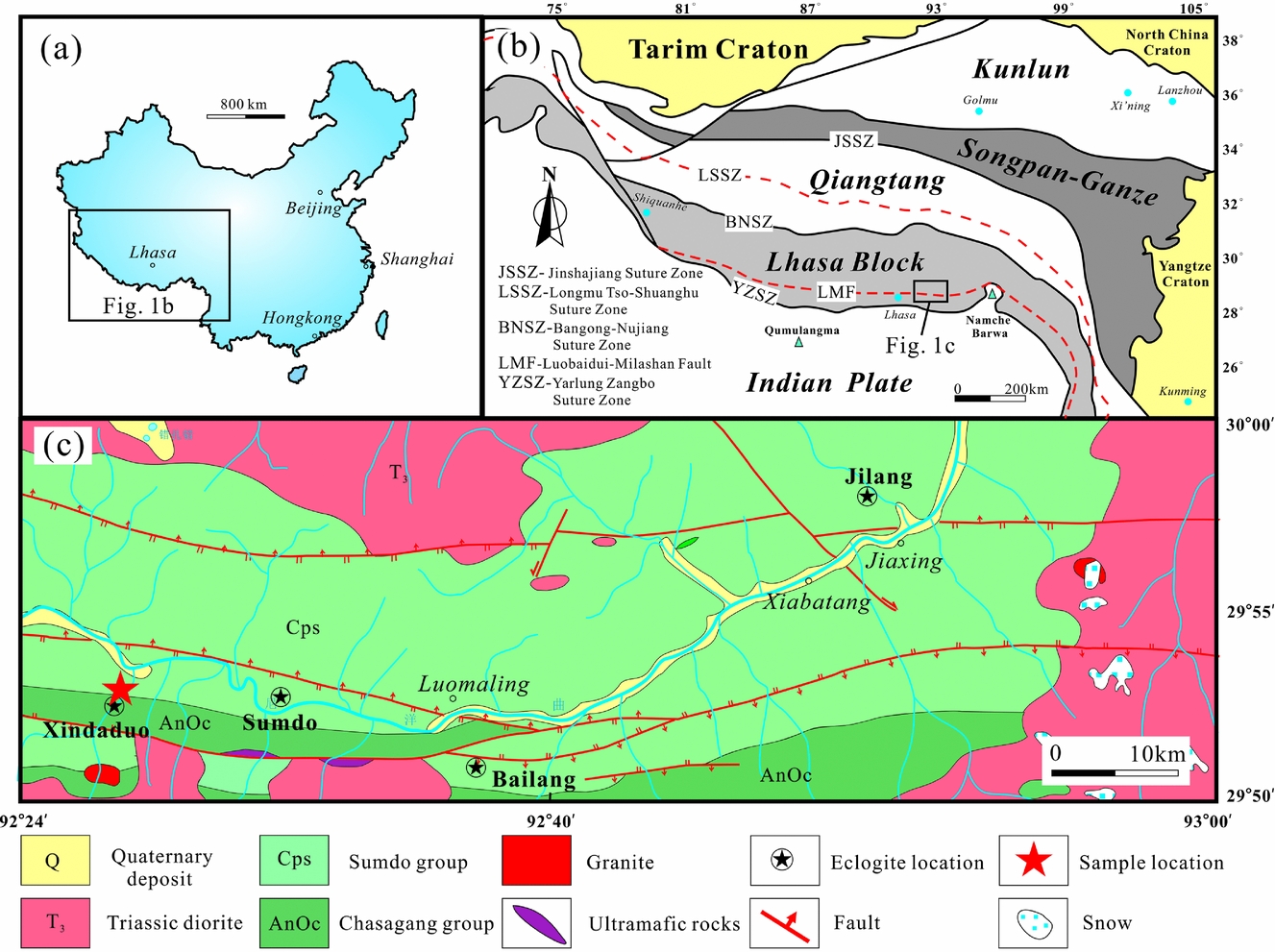
In this contribution, detailed mineralogical investigations have been applied to the garnet-bearing mica schist in the Xindaduo area (Fig. 1c) with the help of phase equilibrium calculations using Domino/Theriak software, which constrained a HP–LT eclogite-facies metamorphism followed by either heating decompression or an isothermal decompression process during retrogression. By means of the laser ablation multi-collector inductively coupled plasma mass spectrometry (LA-MC-ICP-MS) zircon U–Pb dating method, a Middle Triassic metamorphic age was also obtained from the same sample, which further restricted the relationship between the eclogite and the mica schist.
2. Geological setting
The Himalayan–Tibetan orogenic belt is classically considered to be composed of four continental terranes, called the Songpan–Ganzi, Qiangtang, Lhasa and Tethyan–Himalayan terranes from north to south (Fig. 1a, b), which are separated by the Jinsha suture zone (JSSZ), the Bangong–Nujiang suture zone (BNSZ) and the Yarlung Zangbo suture zone (YZSZ), interpreted to represent major structural elements of the Palaeo-, Meso- and Neo-Tethys oceanic domains, respectively (Yin & Harrison, Reference Yin and Harrison2000; Shi et al. Reference Shi, Yang, Xu and Qi2008; Gehrels et al. Reference Gehrels, Kapp, DeCelles, Pullen, Blakey, Weislogel, Ding, Guynn, Martin, McQuarrie and Yin2011). As one of the major components of the Himalayan–Tibetan orogen, the Lhasa terrane is located in the southern part of Tibet where it forms a large crustal segment with a width of 100–300 km and a length of c. 2000 km (Fig. 1b). It is composed predominantly of the underlying crystalline basement of Precambrian age, Palaeozoic to Mesozoic marine strata and Mesozoic to Cenozoic arc-type volcanic rocks and intrusions (Yin & Harrison, Reference Yin and Harrison2000; Zhu et al. Reference Zhu, Zhao, Niu, Mo, Chung, Hou, Wang and Wu2011b, Reference Zhu, Zhao, Niu, Dilek, Hou and Mo2013; Zhang & Santosh, Reference Zhang and Santosh2012). The Lhasa terrane used to be divided into three sub-terranes called the northern, central and southern sub-terranes, separated by the Shiquan River – Nam Tso and the Luobadui–Milashan faults, respectively. Nowadays, with the discovery of eclogite in the Sumdo Complex and blueschist in Pana, ~ 80 km west of Sumdo, a new subdivision scheme has been proposed, suggesting that the Lhasa terrane consists of two discrete crustal fragments, the south and north Lhasa terranes, the latter of which includes the former central and northern Lhasa sub-terranes as described above (Liu et al. Reference Liu, Liu, Theye and Massonne2009; Yang et al. Reference Yang, Xu, Li, Xu, Li, Ren, Li, Chen and Robinson2009; Xu, Z. et al. Reference Xu, Dilek, Cao, Yang, Robinson, Ma, Li, Jolivet, Roger and Chen2015).
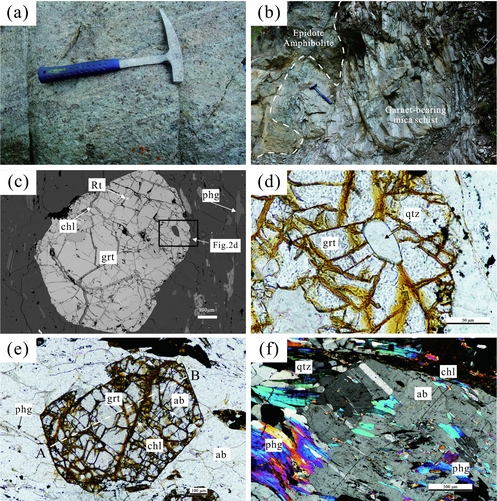
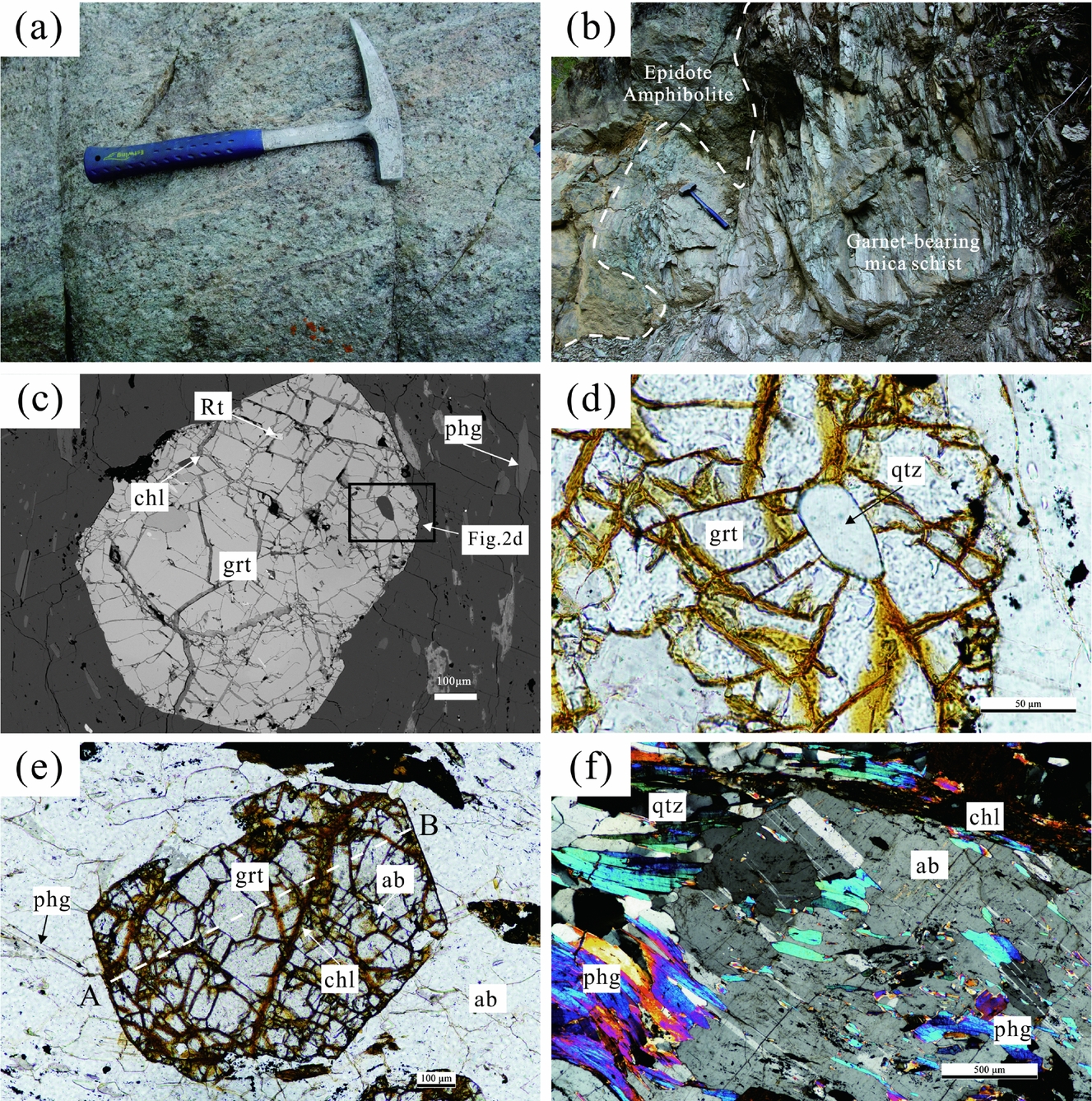
The eclogite-bearing Sumdo Complex in the Lhasa terrane forms an E–W-trending belt at least 100 km long, located c. 180 km east of Lhasa City. It consists predominantly of metamorphosed quartzite and pelitic schist, with minor marble, metabasic lenses and serpentinized ultramafic bodies. Eclogite occurs mainly in four locations in the Sumdo Complex, which are the Xindaduo, Sumdo, Bailang and Jilang areas from west to east (Fig. 1c). It can be divided into three types, bi-mineralic eclogite, phengite eclogite and glaucophane eclogite, by index mineral. The eclogite lenses are hosted by epidote-amphibolite, garnet-bearing mica schist and quartzite, occurring successively as the colour gradually becomes lighter. Fresh eclogites with garnet–omphacite mineral assemblages are preserved only in some of the cores of the metabasic boudins, which otherwise contain amphibolite-facies mineral assemblages in the boudin rims. The investigated garnet-bearing mica schist sample 13SD24 is located in the newly investigated Xindaduo area (29°51.8′N, 92°26.1′E) in the Sumdo Complex (Fig. 1c), c. 500 m from the fresh phengite eclogite bodies and in direct contact with the epidote-amphibolite and quartzite (Fig. 2a, b), the former of which is recognized as the retrograde equivalent of the eclogite.
Field occurrences and photomicrographs of the garnet-bearing mica schist 13SD24 from the Xindaduo area, Sumdo Complex. (a) The field occurrence of the garnet-bearing mica schist; hammer for scale is 30 cm long. (b) The relationship of the garnet-bearing mica schist and the epidote-amphibolite. (c) Back-scattered electron (BSE) image showing garnet porphyroblast with inclusions of rutile and quartz surrounded by radial cracks. (d) Quartz inclusion surrounded by chlorite-mineralized radial cracks in garnet; magnification of (c). (e) Garnet porphyroblast with idiomorphic rim, showing different stages of growth. The microprobe analysis profile is shown as line A–B. (f) Albite porphyroblast with muscovite and chlorite inclusions, showing the mineral assemblage in the matrix.
3. Petrology and mineralogy
The garnet-bearing mica schist is khaki or dark grey in surface colour and well foliated in hand specimen, consisting of garnet (5–10%), muscovite (15–20%), albite (10–15%) and quartz (50–55%), with minor chlorite, which is partly transformed from biotite, rutile, sphene and apatite. Garnet occurs as euhedral to subhedral porphyroblasts with varying sizes from 0.5 to 2.0 mm, containing inclusions of quartz and phengite in the core–mantle section and quartz, albite, rutile and apatite in the rim. A quartz inclusion with radial fractures was also found in the rim of one garnet porphyroblast (Fig. 2c, d). Some garnet grains are characterized by a subhedral core and surrounded by a newly grown euhedral rim. The rims of the garnet or edges along the cracks have been partly altered by chlorite during retrograde metamorphic stages (Fig. 2e).
Garnet and other rock-forming minerals were analysed by a JEOL JXA-8230 electron microprobe microanalyser (EPM) at the State Key Laboratory of Marine Geology (Tongji University). Operating conditions were 15 kV acceleration voltage, 10 nA beam current and 0–5 μm beam diameter. Natural and synthetic mineral standards (SPI) were used to calibrate all quantitative analyses and a ZAF correction was used for data reduction. Representative mineral compositions are listed in Table 1. A garnet porphyroblast (0.9 mm in diameter) in garnet-bearing mica schist sample 13SD24 is characterized by an almandine-rich core–mantle section (Alm75–80Prp5–12Grs7–9Spss2–11) and a grossular-rich rim (Alm56–68Prp6–11Grs21–29Spss1–9). The analytical results from the EPM show that XPrp increases a little bit from the core to the mantle and reaches its peak content (0.12) in the inner rim of the garnet and then decreases towards the outer rim (0.11–0.06). The XSpss profile is characterized by a bell-shaped pattern, which is the opposite trend to XPrp. The XGrs content is constant from the garnet core to the mantle (0.08–0.09) and increases rapidly from the inner rim to the outer rim (0.09–0.29) at the simultaneous expense of XAlm (Figs 2e, 3a; Table 1).
Representative EPM analysis for the garnet-bearing mica schist from the Xindaduo area of the Sumdo Complex.

Grt-c – garnet core; Grt-m – garnet mantle; Grt-r – garnet rim; Phg-g – phengite in garnet rim; Phg-m – matrix phengite. The mineral formulae were calculated with the program AX2.
(a) Microprobe analysis profile of the garnet porphyroblast in Figure 2e, showing the variation of four end-members. Prp – pyrope; Alm – almandine; Grs – grossular; Spss – spessartine. (b) The Si v. (Fe+Mg) diagram for phengite from the Xindaduo garnet-bearing mica schist.
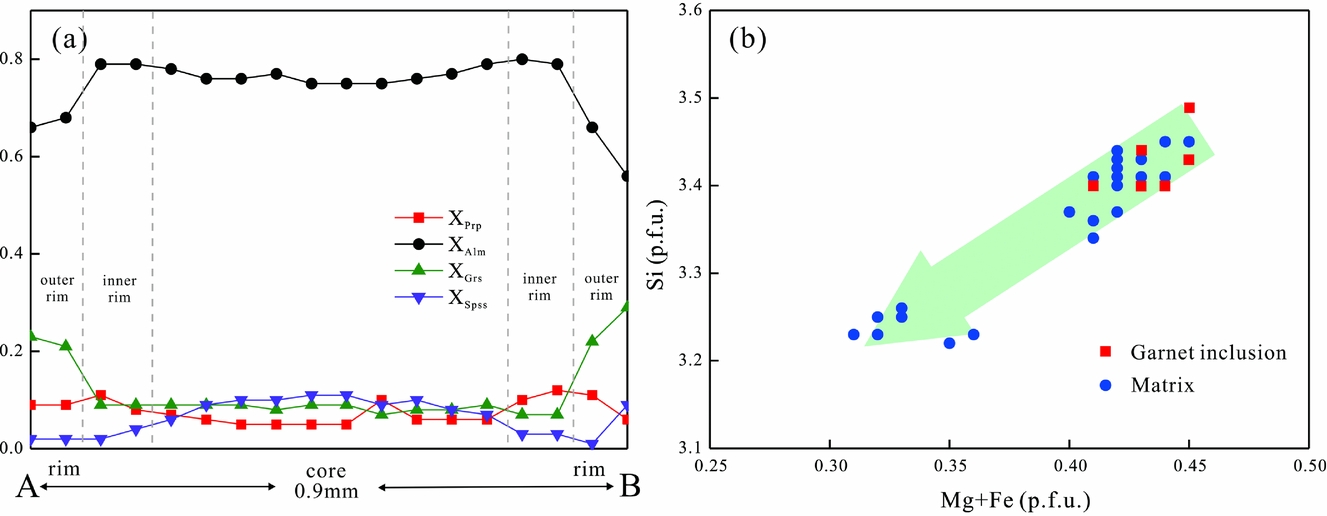
Phengite from the garnet-bearing mica schist is included in the garnet or in the matrix and coexists with albite (Fig. 2f). Some of the phengites in the garnets have higher Si (3.4–3.5 p.f.u.) and Mg+Fe contents compared with the ones in the matrix (Fig. 3b), which indicates a higher pressure is preserved in the garnet than in the matrix. Albite is subhedral with a rhombic cross-section and a size of 3–6 mm by 1–3 mm. It commonly contains inclusions of phengite yielding a typical sieve texture (Fig. 2f). Chlorite is mainly preserved in the matrix with quartz and muscovite. Some chlorite occurs within the rims or cracks of the garnet as an alteration product (Fig. 2d, f).
4. Phase equilibrium calculation
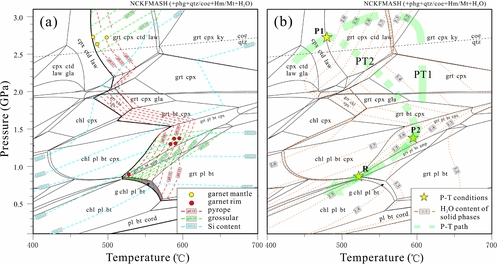
The X-ray fluorescence (XRF) analysis was obtained at the China National Research Centre for Geoanalysis. The bulk-rock composition analysed by XRF and the calculated molecular ratios for phase equilibrium modelling of the garnet-bearing mica schist 13SD24 are shown in Table 2. This sample is rich in SiO2 and Al2O3 and depleted in MgO, FeO and CaO, indicating a pelitic rock composition. According to the bulk-rock composition and mineral assemblage, the model system NCKFMASH (Na2O–CaO–K2O–FeO–MgO–Al2O3–SiO2–H2O) was chosen to calculate the P–T pseudosection. MnO is omitted as it is only preserved in garnet and has little effect on the phase relations according to the database used for the calculation. TiO2 is also omitted because it is only present in the accessory minerals like rutile and sphene. Quartz/coesite, phengite, iron oxide and H2O, assumed to be fluid phases, are considered to be in excess. Pseudosections were calculated with Domino/Theriak version 04 02 2017 (De Capitani & Petrakakis, Reference De Capitani and Petrakakis2010), using the tcdb55c2d database of Holland & Powell (Reference Holland and Powell1998). Activity–composition relationships are those presented for garnet (White, Pomroy & Powell, Reference White, Pomroy and Powell2005), clinopyroxene (Green, Holland & Powell, Reference Green, Holland and Powell2007), biotite (Powell & Holland, Reference Powell and Holland1999), chlorite (Holland, Baker & Powell, Reference Holland, Baker and Powell1998) and phengite (Coggon & Holland, Reference Coggon and Holland2002). Isopleths of XPrp and XGrs of garnet and the Si content of phengite contour the pseudosection to obtain the metamorphic conditions of different stages (Fig. 4a). Contours of the H2O content of solid phases in the system further constrain the metamorphic processes and provide the basis for the discussion on the fluid behaviour during prograde and retrograde metamorphism (Fig. 4b).
Bulk-rock composition and calculated modal amounts for the garnet-bearing mica schist from the Xindaduo area of the Sumdo Complex.

Pseudosection of the garnet-bearing mica schist calculated with Domino/Theriak in the model system NCKFMASH. (a) Pseudosection with isopleths of pyrope (red dashed line) and grossular (green dashed line) in garnet and Si in muscovite (blue dashed line). The garnet mantle and rim compositions are plotted as yellow and red dots, respectively. (b) Pseudosection with isopleths of the H2O content of all solid phases in the model system and the derived P–T path of the garnet-bearing mica schist.
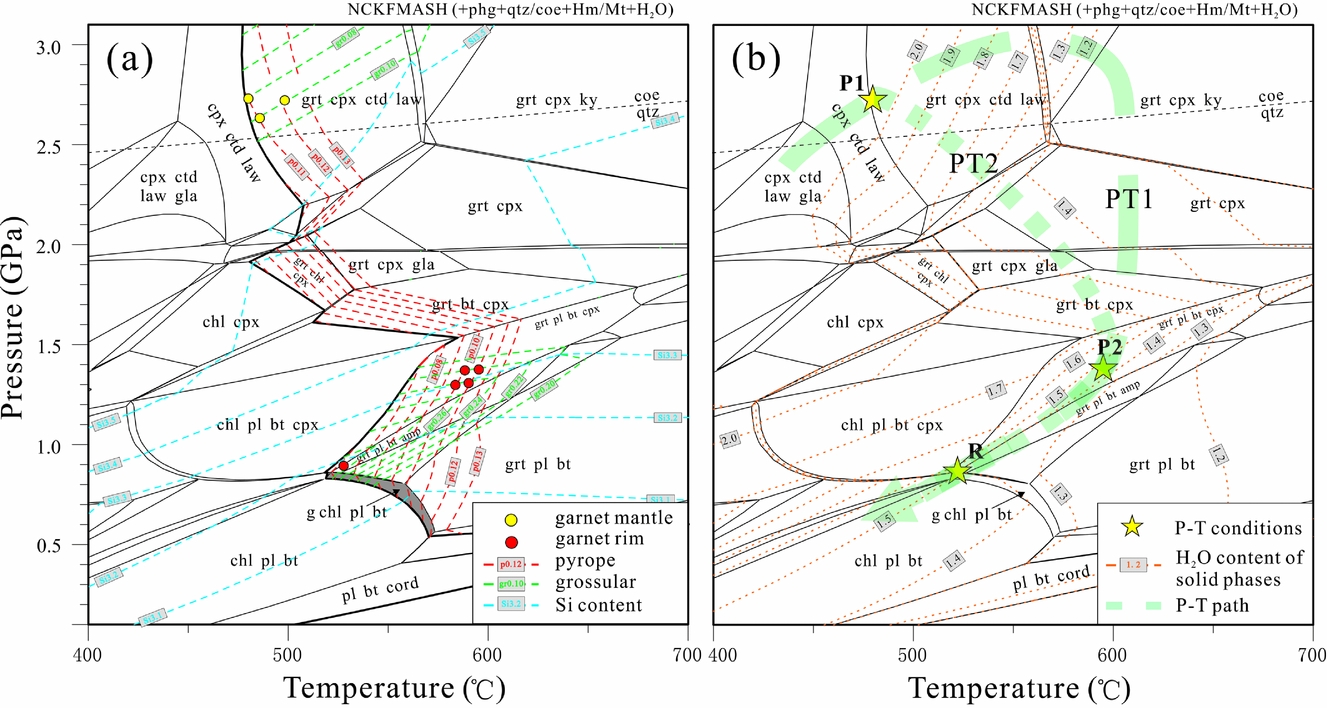
The pseudosection is calculated at temperatures from 400 to 700°C and at less than 3.0 GPa, within a low– medium-temperature metamorphic region. Garnet appears in the area of > c. 500°C and is replaced by chlorite at low pressure, which is concordant with the petrological investigations (Fig. 2c–e). The current stable assemblage of grt+chl+pl+bt (mu+qtz+hm+H2O) is equilibrated at c. 520–570°C, 0.5–0.9 GPa. As garnet is partially replaced by chlorite at the rim, notably the assemblage should exclude garnet and turn towards a low temperature (Fig. 4a). The isopleths of XPrp and XGrs were contoured to constrain the P–T conditions during the growth and regrowth of garnet. The red dashed line in Figure 4a indicates the XPrp isopleths of garnet with a steep slope and increase with temperature, which is suitable as the indicator of temperature. The XGrs isopleths with a green dashed line have a medium positive slope in the high-pressure area of the pseudosection (2.5–3.0 GPa). The ones with high XGrs values (0.2–0.3) were plotted in the medium-pressure field (0.8–1.5 GPa), showing both positive and negative gentle slopes. The variation of XGrs is based on the changes of pressure and is little effected by temperature, making it a good geobarometer for the investigated sample. The Si content isopleths of phengite were also plotted by a blue dashed line to constrain the variations in pressure of the calculated mineral assemblages (Fig. 4a).
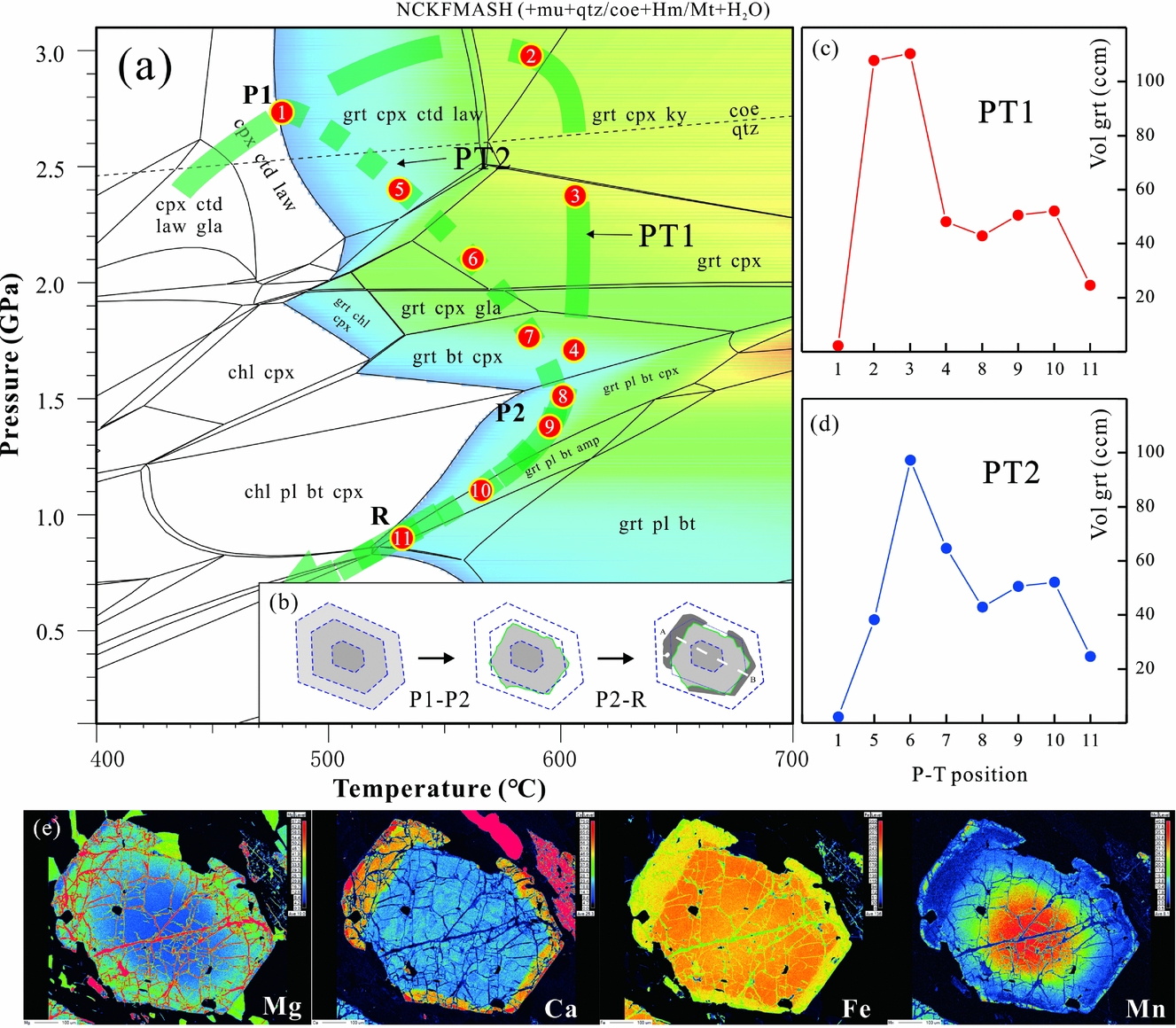
The results of the EPM analysis of the garnet, shown by the yellow and red circles, are plotted according to the calculated isopleth values on the pseudosection. The core–mantle section of the garnet porphyroblast (Figs 2e, 3a) was plotted with a yellow circle at 480–500°C and 2.6–2.7 GPa (stage P1 in Fig. 4b), which is in the LT–HP eclogite-facies metamorphic field. The inner rim with higher XGrs and similar XPrp values, shown by red circles, plots in a narrow P–T area of 580–600°C and pressure of 1.3–1.4 GPa (stage P2 in Fig. 4b). It also seems reasonable to obtain lower P–T conditions (c. 1 GPa) from this rim composition based on the lower intercept of the XGrs and XPrp. In combination with the Si contents (3.4 p.f.u.) of phengite included in the garnet rim, we deduced that the higher intercept with the higher pressure is more reliable. The temperature recorded by the garnet inner rim is c. 100°C higher than what is recorded by the adjacent garnet mantle. It is not difficult to figure out that the temperature interval is caused by the sudden changes of grossular contents in the garnet porphyroblast. However, what kind of kinetic mechanism caused this situation will be discussed in the following section. The EPM composition on the outer rim of the garnet is plotted at 530°C, 0.9 GPa (stage R in Fig. 4b), which is similar to the P–T conditions constrained by the current mineral assemblage. This amphibolite-facies condition was interpreted to represent the final metamorphic stage recorded by the garnet-bearing mica schist, as the fluid content of the solid phases in the system will be constant along the following retrograde P–T path, making it hard for the rock to record the later metamorphic processes (Guiraud, Powell & Rebay, Reference Guiraud, Powell and Rebay2001; Wei & Powell, Reference Wei and Powell2004). With the help of the EPM analytical results for the garnet and the calculated isopleths in the pseudosection, three metamorphic stages were recorded by the garnet porphyroblast (Fig. 2e), named as P1, P2 and R, representing the prograde, peak temperature and retrograde stages of the garnet-bearing mica schist in the Xindaduo area of the Sumdo Complex. Two tentative P–T paths were proposed to illustrate the metamorphic evolution, named as PT1 and PT2. They share the same trajectory from the peak temperature stage (P2) to the retrograde stage (R) and experienced cooling with decompression processes. However, there are two options for the process from stage P1 to P2. The rock experiences a P–T increase to the UHP peak metamorphic stage, followed by an isothermal decompression process along the PT1 path. During the P–T increase, the rock experiences a dehydration process with H2O content in the solid phases decreasing from > 2.0 to 1.2, and then rehydration when the pressure drops down to stage P2. Along the PT2 path, P1 was the peak pressure stage and reached a peak temperature P2 by heating while experiencing decompression. The fluids will also release from the system during this process as in the PT1 situation. It is worth noting that the H2O content decreased a little bit during retrogression in the P–T area of 590–610°C and 1.4–1.6 GPa in both the PT1 and PT2 paths, which may result in the regrowth of both rock-forming and accessory minerals like zircon, making it possible to relate the metamorphic process to the geochronological data.
5. LA-MC-ICP-MS zircon U–Pb ages
Zircons from the garnet-bearing mica schist sample 13SD24 were selected for isotopic U–Pb dating. Cathodoluminescence (CL) imaging was conducted with a FEI Nova nanoSEM 450 at the Institute of Geology, Chinese Academy of Geological Science. The zircon LA-MC-ICP-MS U–Pb isotopic analysis was performed at the Tianjin Institute of Geology and Mineral Resources on a Neptune mass spectrometer from the Thermo Fisher Company. Detailed instrumental parameters and analytical procedures are those described by Li et al. (Reference Li, Zhu, Xiang, Su, Lu, Zhou, Geng, Li and Yang2010). The age calculation, common Pb correction and concordia plots were made using the program from Andersen (Reference Andersen2002) and Isoplot (Ludwig, Reference Ludwig2003). Results of the zircon LA-MC-ICP-MS U–Pb dating are given in Table 3.
LA-MC-ICP-MS U–Pb analysis on zircons of the garnet-bearing mica schist from the Xindaduo area of the Sumdo Complex.

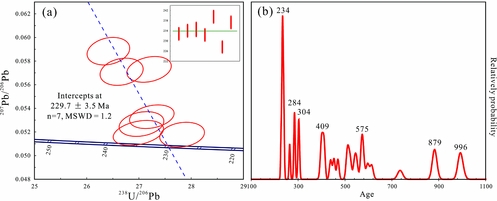
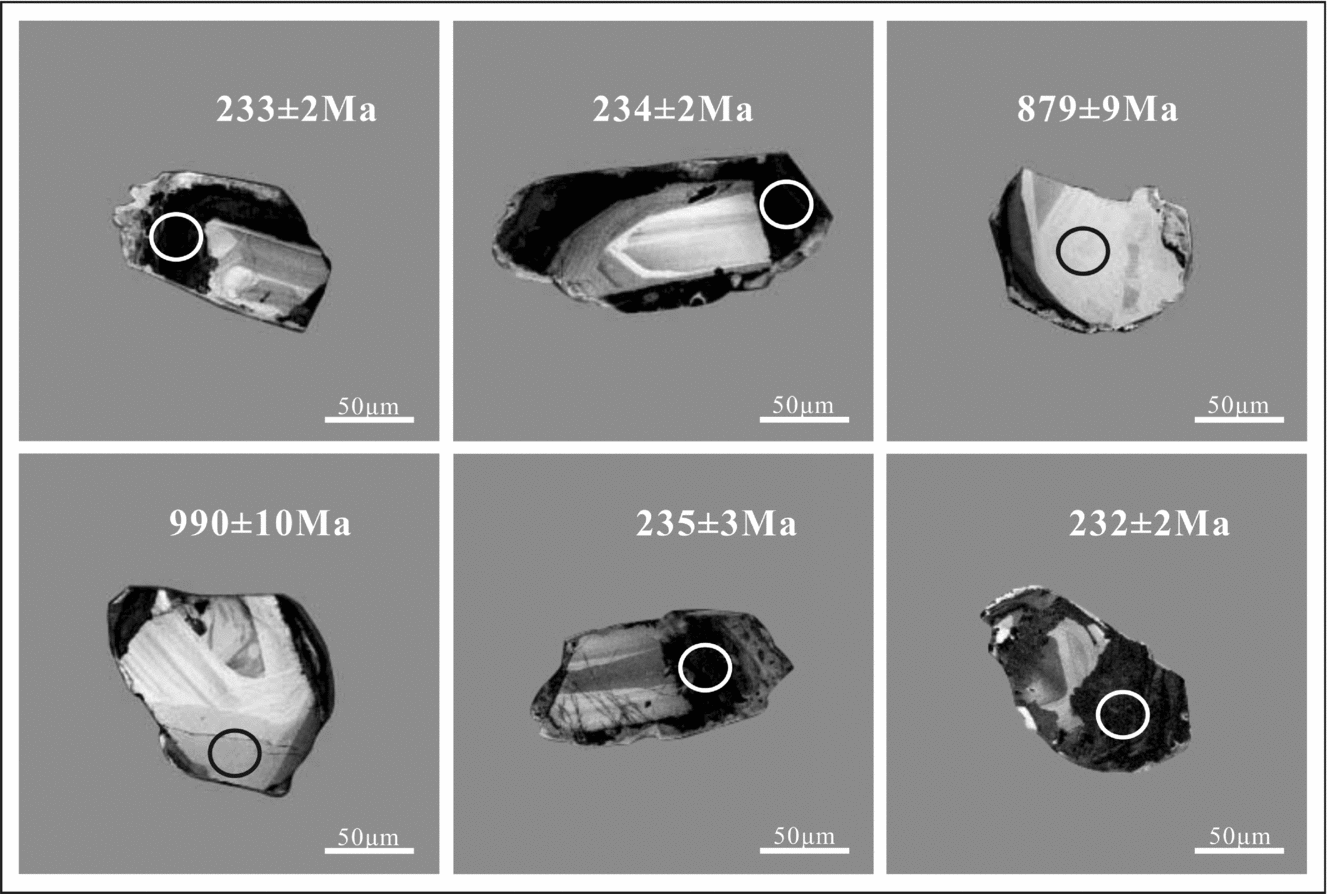
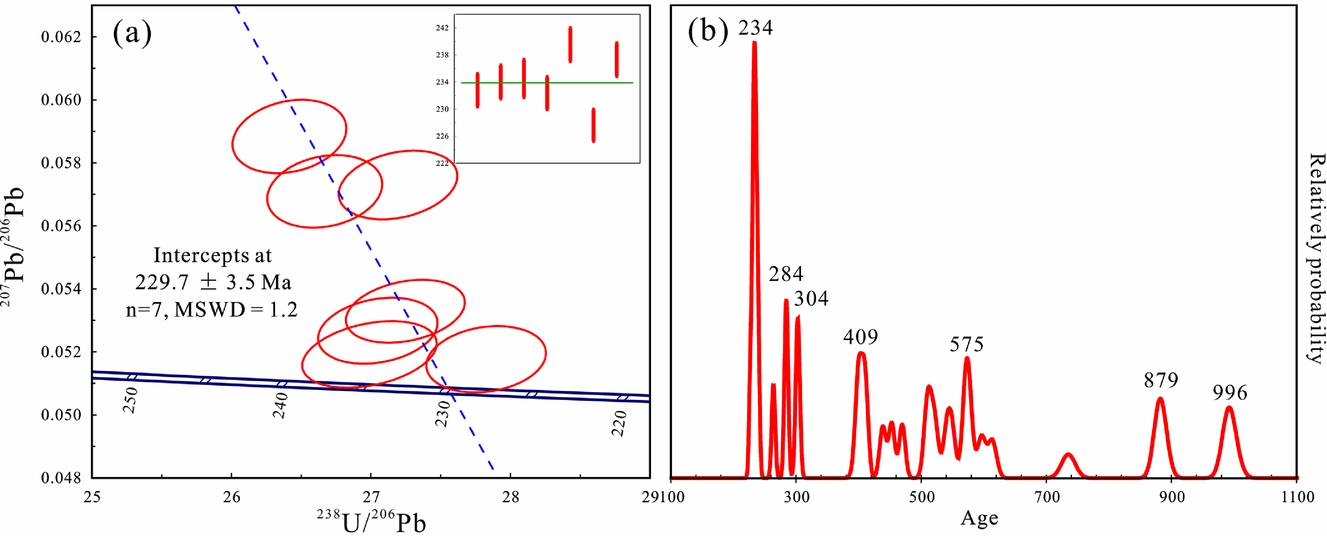
Zircons from the garnet-bearing mica schist are colourless, stubby, subhedral to euhedral in shape, and oblong to spherical, with lengths of c. 80–180 μm. CL images show obvious core–rim structures for some of the zircons, with partly oscillatory zoning or sector patterns of the cores, attributed to their detrital origin (Fig. 5). Zircon rims exhibit blurred patchy zoning or are homogeneous with low luminescence, suggesting recrystallization of detrital zircons or metamorphic growth (Corfu et al. Reference Corfu, Hanchar, Hoskin and Kinny2003; Wu & Zheng, Reference Wu and Zheng2004). Forty-five analyses were obtained with 206Pb–238U ages ranging from 228±2 Ma to 1816±19 Ma, with age peaks at 234 Ma, 409 Ma and 575 Ma, etc. from the relative probability diagram (Fig. 6b). Seven analyses from zircon rims appearing dark in CL imaging and with low Th/U ratios (0.01–0.05) yielded a lower intercept age of 229.7±3.5 Ma (MSWD = 1.2) from the Tera-Wasserburg concordia diagram, which is interpreted as dating the metamorphic event in Triassic time (Fig. 6a; Table 3).
Cathodoluminescence (CL) images of zircons from the garnet-bearing mica schist, showing the positions of the LA-ICP-MS analysis and ages.
(a) Tera-Wasserburg diagram showing the metamorphic ages of zircons from the garnet-bearing mica schist. The weighted mean age diagram is shown in the upper right corner. (b) Relative probability diagram showing the age peaks of the zircons from the garnet-bearing mica schist from the Xindaduo area.
6. Discussion
6.a. Metamorphic evolution of the garnet-bearing mica schist in the Xindaduo area
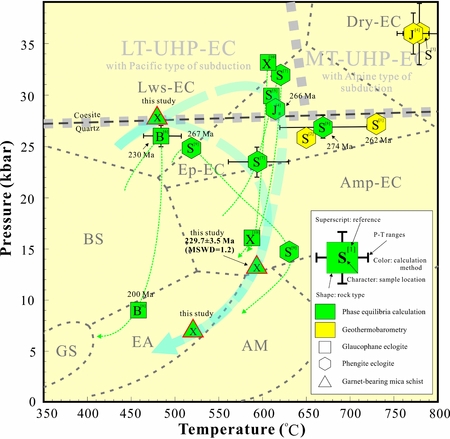
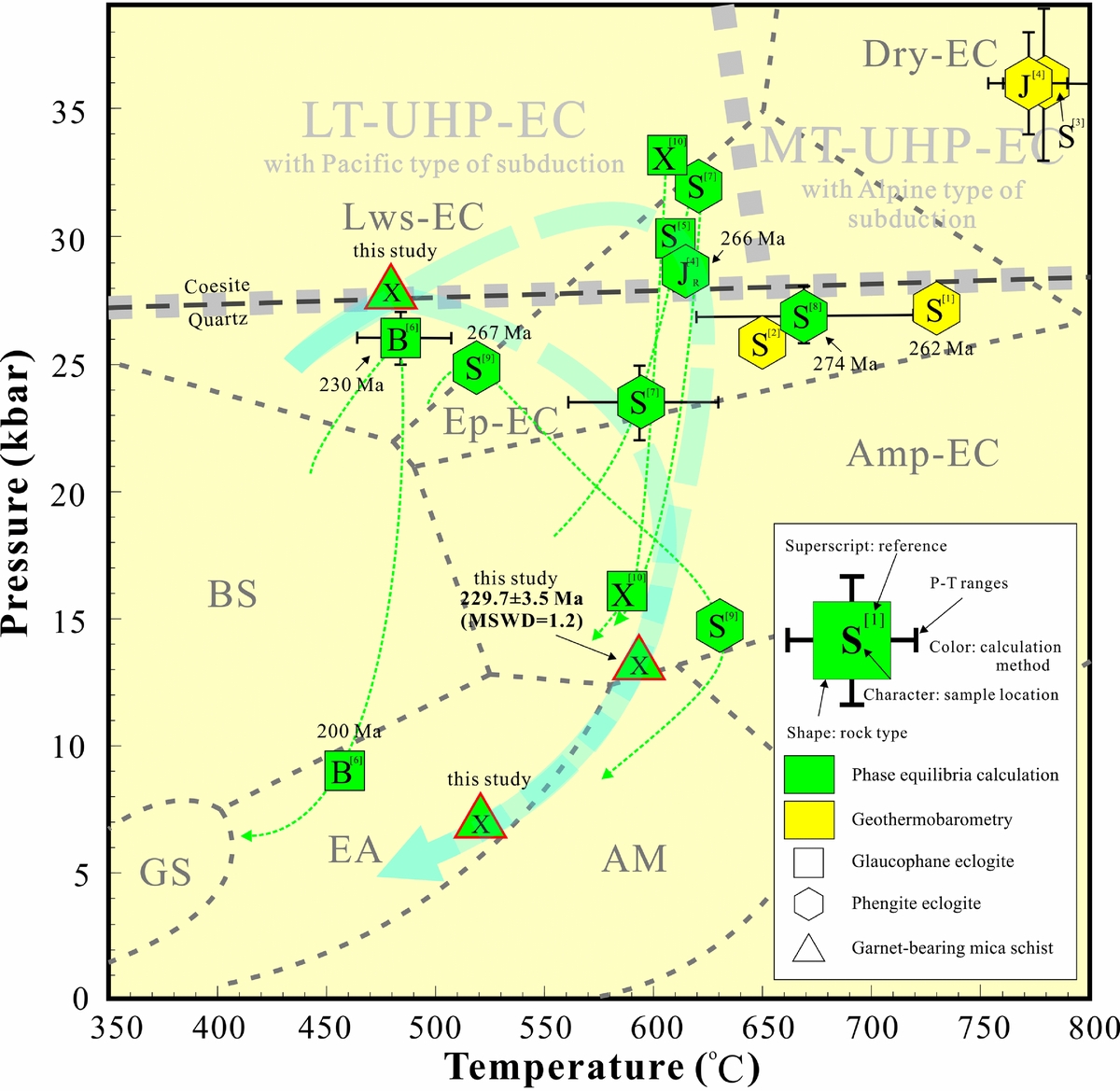
The Sumdo Complex is an E–W-trending, (U)HP metamorphic belt that extends for over 100 km across the middle part of the Lhasa terrane. The discovery of eclogite in several locations along the Sumdo Complex led to a reinterpretation of the tectonic evolution of the Lhasa terrane (Yang et al. Reference Yang, Xu, Li, Xu, Li, Ren, Li, Chen and Robinson2009; Xu, Z. et al. Reference Xu, Dilek, Cao, Yang, Robinson, Ma, Li, Jolivet, Roger and Chen2015). Two different thermodynamic techniques were applied to different kinds of eclogite in order to calculate the P–T path/P–T conditions of them and further constrain the physical conditions of the metamorphic processes affecting the Sumdo Complex. With conventional geothermobarometry (Krogh Ravna & Terry, Reference Krogh Ravna and Terry2004), P–T conditions of ~ 2.7 GPa, 730°C (Yang et al. Reference Yang, Xu, Li, Xu, Li, Ren, Li, Chen and Robinson2009) and 3.3–3.9 GPa, 760–800°C (Zhang, Zhang & Zhao, Reference Zhang, Zhang and Zhao2011) were calculated for the phengite eclogite in the Sumdo area and 3.4–3.8 GPa, 753–790°C for the Jilang eclogite (Cheng et al. Reference Cheng, Zhang, Vervoort, Lu, Wang and Cao2012) within the medium-temperature HP and UHP eclogite-facies condition field (Wei, Qian & Tian, Reference Wei, Qian and Tian2013). Using the alternative isopleth P–T constraint method for phase equilibrium calculations in Thermo-Calc (Powell, Holland & Worley, Reference Powell, Holland and Worley1998) and/or Domino/Theriak (De Capitani & Petrakakis, Reference De Capitani and Petrakakis2010), peak metamorphic P–T conditions of c. 2.7–3.2 GPa and 610–620°C were calculated for the phengite and glaucophane eclogites collected in the Sumdo, Xindaduo and Jilang areas, respectively (Fig. 8; Cheng et al. Reference Cheng, Zhang, Vervoort, Lu, Wang and Cao2012; Yang et al. Reference Yang, Zhang, Zhao and Zhu2014; Huang et al. Reference Huang, Tian, Zhang, Yang and Chen2015; Li et al. Reference Li, Zhang, Liu, Shen, Qiu and Yang2017). The c. 100°C temperature difference between the calculated metamorphic P–T conditions obtained by these two methods may be caused either by a different choice of equilibrium minerals or the complicated tectonic evolution of the Sumdo Complex (Zhang et al. Reference Zhang, Bader, van Roermund, Yang, Shen, Qiu, Li, Zhang, Zhang, Schertl and Wei2018). Although detailed petrological studies have been performed on eclogite in the Sumdo Complex, less attention has been paid to the metamorphic evolution of its country rock schist. We have chosen a garnet-bearing mica schist in the newly discovered Xindaduo area, which is in the western-most eclogite-bearing area of the Sumdo Complex so far, to perform petrological and geochronological investigations for the first time to clarify the metamorphic P–T evolution of this rock and further constrain the metamorphic behaviours of the enclosed eclogite.
Because of the simple mineral assemblage (grt+mu+pl+qtz±chl±bt) in the matrix, it is difficult to obtain the P–T conditions of the investigated schist with conventional geothermobarometry. The isopleths of XPrp and XGrs of garnet and Si content of phengite were contoured on the pseudosection using the Domino software. The P–T conditions for three metamorphic stages are constrained as P1 (480–500°C, 2.6–2.7 GPa), P2 (580–600°C, 1.3–1.4 GPa) and R (530°C, 0.9 GPa), which represent the prograde, temperature peak and retrograde stages. Taking into consideration the H2O isopleths of the solid phases in the system, two possible P–T paths were constructed, which experienced isothermal decompression (PT1) or heating with a decompression process (PT2). In order to restrict the behaviour of garnet during each possible P–T path, 11 P–T points were chosen on both paths to calculate the volume variation of the garnet. Points 1, 9 and 11 are equal to the P–T conditions of stages P1, P2 and R. The rainbow colour in Figure 7a shows the calculated values of the garnet volume in the system with warmer colours representing higher values. From point 1 to point 4 on the PT1 path, garnet volume increases rapidly during prograde metamorphism and maintains this high volume at the initial stage of the isothermal decompression then decreases to point 4 with a mineral assemblage of grt+bt+cpx (Fig. 7c). Garnet is replaced partly by biotite. The situation is similar to the volume variation trend along PT2, with points 1, 5, 6 and 7 with lower values (Fig. 7d). This process induces garnet growth at pressures higher than 2.0 GPa and consumption when the pressure continuously goes down until the presence of plagioclase in the system, which corresponds to the P1–P2 process in Figure 7b. From point 8 to point 10, both on PT1 and PT2, garnet regrows on the rim with high XGrs and decreases gradually towards point 11, where it is replaced by chlorite. The P2–R process in the cartoon in Figure 7b illustrates the above regrowth process of the high XGrs garnet rim, which explains the sharp and sudden changes in the composition in the garnet rim. The H2O content in the solid phase between the P–T conditions of points 8–10 also decreases, which can release a certain amount of water into the system not only for garnet growth, but also for the accessory minerals like zircon. With this observation, we infer that the metamorphic zircon rims of the garnet-bearing mica schist grew during P–T conditions of c. 600°C, 1.2–1.4 GPa at roughly the peak temperature stage (P2). The absence of the original garnet rim erases the peak pressure and part of the prograde information, making it difficult to discriminate the real P–T path from between PT1 and PT2. However, based on the close field relationship between the eclogite and the garnet-bearing mica schist and the P–T conditions of the eclogite in the area (Fig. 8), we infer that the PT1 path would be the most reliable scenario for the metamorphic evolution of the schist, which shares the same evolution with the eclogite. The newly reported heating with decompression P–T path of the phengite eclogite in the Sumdo area also demonstrates the possibility of a thermal relaxation process during the exhumation of the Sumdo Complex (Cao et al. Reference Cao, Cheng, Zhang and Wang2017).
Pseudosection illustrating the metamorphic evolution of garnet from the garnet-bearing mica schist. (a) The rainbow colour shading shows the calculated variation of the garnet volume in the system. The red circles indicate the P–T conditions on the P–T path. (b) Cartoon showing the metamorphic evolution of the garnet porphyroblast in Figure 2e. (c, d) The calculated volume variation of garnet along the P–T paths PT1 and PT2. (e) The wavelength dispersive spectroscopy (WDS) mapping of the garnet porphyroblast showing the regrowth process during retrogression
Schematic comparison of P–T conditions of metamorphic processes in the eclogites and the investigated garnet-bearing mica schist from the Lhasa terrane, modified after Zhang et al. (Reference Zhang, Bader, van Roermund, Yang, Shen, Qiu, Li, Zhang, Zhang, Schertl and Wei2018). The P–T boundaries of various metamorphic facies are indicated: AM – amphibolite; EA – epidote-amphibolite; GS – greenschist; BS – blueschist schist. The subdivision of eclogite (EC) into amphibole eclogite (Amp-EC), epidote eclogite (Ep-EC), lawsonite eclogite (Lws-EC) and dry eclogite (Dry-EC) is also shown. The discrimination between low-temperature ultrahigh-pressure eclogite (LT-UHP-EC) and medium-temperature ultrahigh-pressure eclogite (MT-UHP-EC) is taken from Wei, Qian & Tian (Reference Wei, Qian and Tian2013). Characters inside the P–T symbols are sample locations: S – Sumdo; J – Jilang; JR – Jilang recalculated conditions; B – Bailang; X – Xindaduo. References are 1. – Yang et al. (Reference Yang, Xu, Li, Xu, Li, Ren, Li, Chen and Robinson2009); 2. – Zeng et al. (Reference Zeng, Liu, Gao, Chen and Xie2009); 3. – Zhang, Zhang & Zhao (Reference Zhang, Zhang and Zhao2011); 4. – Cheng et al. (Reference Cheng, Zhang, Vervoort, Lu, Wang and Cao2012); 5. – Yang et al. (Reference Yang, Zhang, Zhao and Zhu2014); 6. – Cheng et al. (Reference Cheng, Liu, Vervoort and Lu2015); 7. – Huang et al. (Reference Huang, Tian, Zhang, Yang and Chen2015); 8. – Weller et al. (Reference Weller, St-Onge, Rayner, Waters, Searle and Palin2016); 9. – Cao et al. (Reference Cao, Cheng, Zhang and Wang2017); 10. – Li et al. (Reference Li, Zhang, Liu, Shen, Qiu and Yang2017).
6.b. Age constrains and tectonic significance
As one of the Earth's largest active continent–continent collisional orogens, the Tibetan plateau has received plenty of scientific investigations on its magmatism, geophysics, palaeomagnetism and metamorphism (Zhang, J. et al. Reference Zhang, Santosh, Wang, Guo, Yang and Zhang2012; Klootwijk, Reference Klootwijk2013; Hébert et al. Reference Hébert, Guilmette, Dostal, Bezard, Lesage, Bédard and Wang2014; Zhao et al. Reference Zhao, Zhao, Zhang, Liu, Huang, Cheng and Wang2014; Xu, Q. et al. Reference Xu, Zhao, Yuan, Liu and Pei2015; Li et al. Reference Li, Ding, Lippert, Song, Yue and van Hinsbergen2016). The Lhasa terrane in the central part of the Himalayan–Tibetan orogeny plays an important role in understanding the origin and evolution of this giant orogen and also the opening and closure of the Tethys oceans (Zhu et al. Reference Zhu, Zhao, Niu, Dilek and Mo2011a, Reference Zhu, Zhao, Niu, Dilek, Hou and Mo2013; Xu, Z. et al. Reference Xu, Dilek, Cao, Yang, Robinson, Ma, Li, Jolivet, Roger and Chen2015). Metamorphic studies of the Lhasa terrane consider it to have experienced multi-stage and multi-type metamorphism related to subduction and orogeny, including the Neoproterozoic HP to Early Palaeozoic MP metamorphic belt within the north Lhasa terrane, the Late Cretaceous HT/MP to Eocene MP metamorphic belt in the south Lhasa terrane and the Late Permian (U)HP to Triassic MP metamorphic belt represented by the Sumdo Complex (Zhang et al. Reference Zhang, Dong, Santosh and Zhao2014 and references therein). The Sumdo Complex divides the Lhasa terrane into the north Lhasa and south Lhasa terranes based on the existence of eclogite of MORB or OIB affinity, and was thought to form the remnants of the Palaeo-Tethys oceanic floor during Carboniferous time, followed by closure in an intra-oceanic supra-subduction zone environment, finally resulting in the accretion of the Lhasa terrane (Chen et al. Reference Chen, Yang, Luo, Li, Xu, Li, Ren and Li2007; Yang et al. Reference Yang, Xu, Li, Xu, Li, Ren, Li, Chen and Robinson2009; Cheng et al. Reference Cheng, Zhang, Vervoort, Lu, Wang and Cao2012, Reference Cheng, Liu, Vervoort and Lu2015; Zhang et al. Reference Zhang, Bader, van Roermund, Yang, Shen, Qiu, Li, Zhang, Zhang, Schertl and Wei2018).
SHRIMP and LA-ICP-MS U–Pb zircon dating as well as whole-rock mineral Sm–Nd and Lu–Hf isotopic dating methods have been performed on the eclogite and yielded 260–274 Ma eclogite-facies metamorphic ages in the Sumdo and Jilang areas (Yang et al. Reference Yang, Xu, Li, Xu, Li, Ren, Li, Chen and Robinson2009; Cheng et al. Reference Cheng, Zhang, Vervoort, Lu, Wang and Cao2012; Weller et al. Reference Weller, St-Onge, Rayner, Waters, Searle and Palin2016; Cao et al. Reference Cao, Cheng, Zhang and Wang2017) and an age of c. 230 Ma in the Bailang area for the Sumdo Complex, respectively (Cheng et al. Reference Cheng, Liu, Vervoort and Lu2015). No metamorphic ages were obtained from the country rocks of the eclogite until now because of the sedimentary origin of the zircons. Only an 40Ar–39Ar age of 220–230 Ma was obtained from the muscovite of the greenschists from the ductile shear zones in the Sumdo Complex (Li et al. Reference Li, Xu, Yang, Cai, Chen and Tang2009). The zircons from the garnet-bearing mica schist in the Xindaduo area were dated by the LA-MC-ICP-MS method. Except for the detrital age peaks shown in the relative probability diagram, seven analytical spots on the high U, low Th/U ratio zircon rims yield a 229.7±3.5 Ma metamorphic age. Based on the fluid content variation and garnet growth phenomenon of the garnet-bearing mica schist, this Triassic age was interpreted to date the amphibolite-facies metamorphism at c. 600°C, 1.2–1.4 GPa during the closure of the Palaeo-Tethys Ocean, which is also concordant with the metamorphic ages from the eclogite. Combined with the close relationship between the eclogite and garnet-bearing mica schist, and their similar P–T–t paths, it is reasonable to consider an in situ tectonic evolution for them both rather than their being juxtaposed during exhumation. With the 225–210 Ma medium-pressure metamorphism and simultaneous granitic magmatism of post-collisional pluton affinity in the same belt between the south and north Lhasa terranes (Zhang et al. Reference Zhang, Xu, Guo, Zong, Cai and Yuan2007, Reference Zhang, Dong, Santosh and Zhao2014; Dong et al. Reference Dong, Zhang, Liu, Wang, Yu and Shen2011), the Sumdo Complex is supposed to represent a Pacific-type subduction zone, resulting in the collision between the north and south Lhasa terranes.
7. Conclusion
In combination with petrological investigations and pseudosection modelling in the model system NCKFMASH, three metamorphic stages and two possible P–T paths are constrained for the garnet-bearing mica schist. P1 (480–500°C, 2.6–2.7 GPa), P2 (580–600°C, 1.3–1.4 GPa) and R (530°C, 0.9 GPa) represent the prograde, temperature peak and retrograde stages, while either isothermal decompression (PT1) or heating with a decompression process (PT2) during retrograde metamorphism is the case for the metamorphic evolution of the garnet-bearing mica schist. The LA-MC-ICP-MS metamorphic U–Pb age of 229.7±3.5 Ma (MSWD = 1.2) was obtained from the zircon rims from the garnet-bearing mica schist, which is interpreted to date the amphibolite-facies metamorphism at c. 600°C, 1.2–1.4 GPa during the closure of the Palaeo-Tethys Ocean, resulting from the collision between the north and south Lhasa terranes.
Acknowledgements
This research is financially supported by the National Science Foundation of China (Nos. 41572051, 41630207, 41572044, 41502039), the Research Founding from the Chinese Academy of Geological Sciences (No. YYWF201702) and the Basic Geological Survey Program of China (No. DD20160022-01). Dr. Chad Deering as the editor and two anonymous reviewers are thanked for their constructive comments that considerately improved the early version of this manuscript.