Introduction
Milk is a good source of protein, fat, lactose and other microelements (Tian et al., Reference Tian, Kubota, Sakashita, Izaike, Okano, Tabara, Curchoe, Jacob, Zhang, Smith, Bormann, Xu, Sato, Andrew and Yang2005; Haug et al., Reference Haug, Høstmark and Harstad2007). The nutritional composition can be influenced by genotype and environmental components (Ng-Kwai-Hang et al., Reference Ng-Kwai-Hang, Hayes, Moxley and Monardes1982; Rhone et al., Reference Rhone, Koonawootrittriron and Elzo2008; Sun et al., Reference Sun, Jia, Ma, Zhang, Wang, Yu and Zhang2009; Kulig et al., Reference Kulig, Kmieć, Kowalewska-Luczak and Andziak2014). Monitoring the changes of these parameters is a basic requirement to obtain high-quality milk products. To evaluate the nutritional composition, numerous methods including traditional chemical and instrumental analysis have been well-established. During recent years, the need for fast, cheap and high-throughput methods of chemical analysis has also led to the application of infrared spectroscopy in dairy products. Mid-infrared spectroscopy (MIRS), especially, has made great progress and has been applied successfully to predict milk protein, casein and casein fractions (Luginbühl, Reference Luginbühl2002; Sørensen et al., Reference Sørensen, Lund and Juul2003; Etzion et al., Reference Etzion, Linker, Cogan and Shmulevich2004; Bonfatti et al., Reference Bonfatti, Di Martino and Carnier2011). Meanwhile, several studies have also predicted milk fat and fat acid compositions using MIRS (Soyeurt et al., Reference Soyeurt, Dardenne, Dehareng, Lognay, Veselko, Marlier, Bertozzi, Mayeres and Gengler2006; Rutten et al., Reference Rutten, Bovenhuis, Hettinga, van Valenberg and van Arendonk2009; De Marchi et al., Reference De Marchi, Penasa, Cecchinato, Mele, Secchiari and Bittante2011; Ferrand et al., Reference Ferrand, Huquet, Barbey, Barillet, Faucon, Larroque, Leray, Trommenschlager and Brochard2011).
In the genomic era, phenomics is becoming a compulsory research field. This new science requires phenotypic data from a large scale (Houle et al., Reference Houle, Govindaraju and Omholt2010), and the phenotype can be described as the outcome of the developing interaction between the genotype of an individual and its specific environment throughout life (Bowman, Reference Bowman1974). Interest is rapidly growing in this method, which accurately measures and predicts animal characteristics (e.g. milk quality traits). Accurate phenotypes and efficient genotyping tools are the key ingredients to predict milk quality traits.
Hormones, growth factors and other regulatory proteins associated with the ‘somatotropic axis’ are suitable for quantitative trait analysis in dairy farm (Selvaggi et al., Reference Selvaggi, Dario, Normanno, Celano and Dario2009). Recently, the BAF60c gene has attracted a great deal of attention, because it is essential to activate both skeletal and cardiac muscle programmes and for the development of the heart (Lickert et al., Reference Lickert, Takeuchi, von Both, Walls, McAuliffe, Adamson, Henkelman, Wrana, Rossant and Bruneau2004; Puri and Mercola, Reference Puri and Mercola2012; Nakamura et al., Reference Nakamura, Koshiba-Takeuchi, Tsuchiya, Kojima, Miyazawa, Ito, Ogawa and Takeuchi2016). B AF 60 c is a member of the BAF60 family, a sub-unit of the SWI/SNF complex, which has three members: B AF 60a, B AF 60b and BAF60c (Wang et al., Reference Wang, Wong, Tang, Hudak, Yang, Duncan and Sul2013). It has been reported that the BAF60 isoforms play an important role in possessing different biological functions, perhaps by association with distinct regulators (Berkes et al., Reference Berkes, Bergstrom, Penn, Seaver, Knoepfler and Tapscott2004). The BAF60c gene is expressed in somatic cells (Albini et al., Reference Albini, Coutinho, Malecova, Giordani, Savchenko, Forcales and Puri2013) and is required for maintaining glycolytic capacity and the process of lipid metabolism in vivo (Meng et al., Reference Meng, Li, Wang, Ko, Lee, Jung, Okutsu, Yan, Kim and Lin2013). Also, BAF60c proteins are potential co-activators for retinoic acid receptors correlated with lipid metabolism (Flajollet et al., Reference Flajollet, Lefebvre, Cudejko, Staels and Lefebvre2007).
Based on the importance of the BAF60c gene in lipid metabolism and the glycolytic pathway in vivo, BAF60c could be an attractive candidate gene for milk quality traits.
Therefore, the objective of the current study is to detect mutations of BAF60c gene and to explore their possible association with milk quality traits. The absence of grading in pooled raw milk samples in large dairy markets (such as China) makes the need for such a test increasingly important. It is suggested that BAF60c gene mutations may underpin a gene-based approach to assessing and predicting milk quality.
Materials and methods
Sample collection, DNA extraction and milk composition analysis
Raw milk samples were collected at the first milking of the day from 507 randomly selected Chinese Holstein cows, all about 3 years old in a single herd. All milk samples were transported to the laboratory on ice packs (to maintain an optimum low temperature) and preserved at −80 °C until use. The major milk components (fat, protein, lactose and total solids) were estimated in fresh milk using MilkoScan 104A/B (FOSS A/S, Hillerød, Denmark). Meanwhile, bovine genomic DNA was extracted from milk samples according to a previously reported method (Liu et al., Reference Liu, Gao, Yang, Ku and Zan2014).
Detection of mutations and genotyping
The search for potential mutations in the BAF60c gene intron 4 was carried out using DNA sequencing, using DNA extracted from milk samples of ten typical cows. Based on the sequence of bovine BAF60c gene (GenBank accession No. NC_007308.5), one pair of primers (5′-GTT ACC TGC CCT GAA TGT GG-3′ and 5′-AGG ACA CCT GGA GAG ACC TG-3′) was designed to amplify a 526 bp product of the BAF60c intron 4. Polymerase chain reaction (PCR) was conducted in 10 µl reaction mixtures containing 1 µl of genomic DNA templates, 0.4 µM of assay-specific primer, 3.4 µl of 2 × TaqMan Universal PCR Master Mix (CWBIO, Beijing, China), with the volume made up to 10 µl with DNase-/DNA-free water. The PCR protocol was 95 °C for 5 min followed by 30 cycles of 94 °C for 30 s, 60 °C annealing for 40 s, and 72 °C for 50 s, and a final extension at 72 °C for 8 min. The PCR products were purified using a Wizard Prep PCR purification kit (Shanghai Bioasia Biotechnology, Shanghai, China) and sequenced (Beijing Aolaibo Biotechnology, Beijing, China; Applied Biosystems 3730xl DNA sequencer, Foster City, CA, USA; Borodina et al., Reference Borodina, Lehrach and Soldatov2003). Sequence alignment was performed to screen the single-nucleotide mutation of BAF60c gene using SeqMan software (DNASTAR, Inc., Madison, 77 WI, USA). The NebCutter 2.0 program (http://tools.neb.com/NEBcutter/index.php3) was used to find restriction endonucleases, enabling their further identification by the PCR-restricted fragment length polymorphism (RFLP) analysis.
Genotyping of milk samples was carried out using RFLP-Alu I. The 526-bp PCR products were digested with 5 U of Alu I nuclease (Promega, Beijing, China) at 37 °C for 10 h following the supplier's manual. The digested products were separated on 12% polyacrylamide gel stained with argentum nitricum, which was visualized under ultraviolet light and digitally photographed.
Statistical analysis
Following published approaches (Liu et al., Reference Liu, Zan, Li and Xin2013a, Reference Liu, Zan, Xin, Tian, Li and Wang2013b), genotypic frequencies, allelic frequencies, gene heterozygosity, effective allele numbers and polymorphism information content (PIC) were statistically analysed. Milk quality traits (milk protein percentage (MPP), milk fat percentage (MFP), lactose percentage (LP) and total solids contents (TSC)) were analysed by the least-squares method as applied in the general linear model procedure of SPSS software (v.18.0, SPSS Inc., USA), using the following statistical linear model:
 $$Y_i\, = \,\mu \, + \,G_i\, + \,\varepsilon_j$$
where Y i is the observed body measurement trait, μ is the overall mean for each trait, G i is the genotype effect and ε j is the random error effect. Values are represented with mean ± standard error of the mean (s.e.m.). A value of P < 0.05 was regarded as significant.
Results
Determination of mutations in BAF60c gene
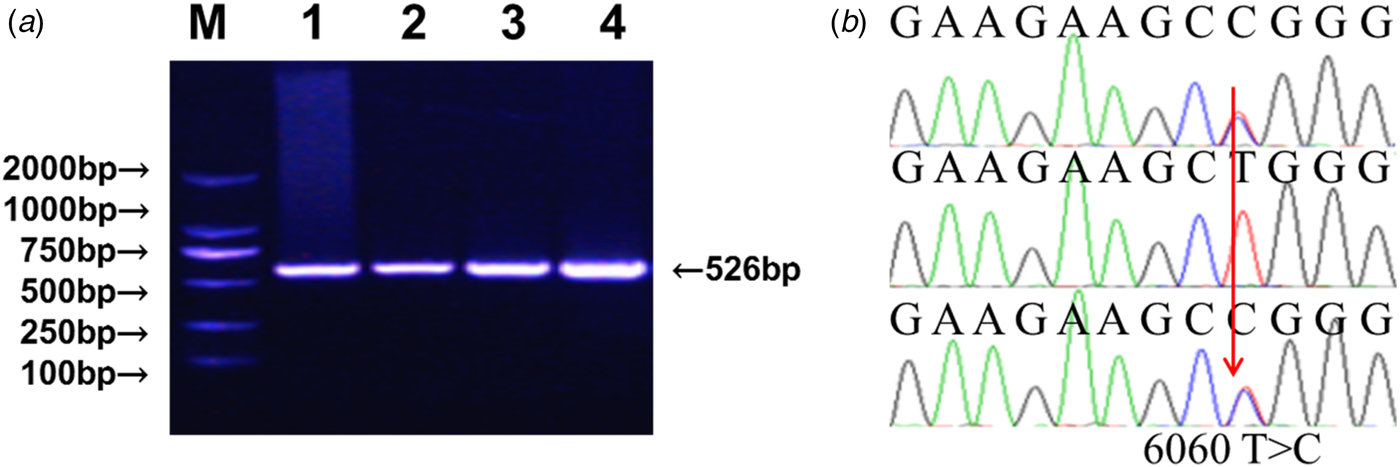
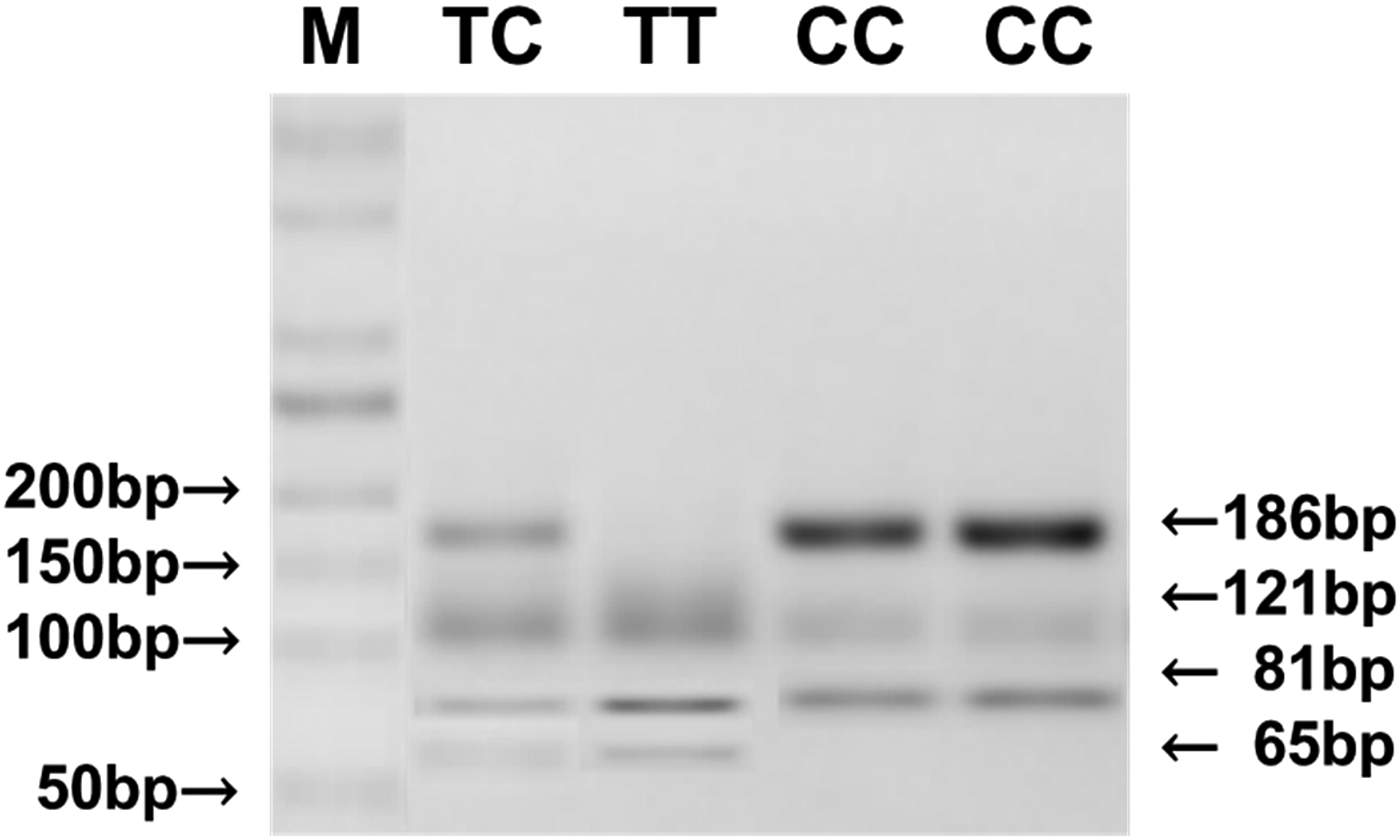
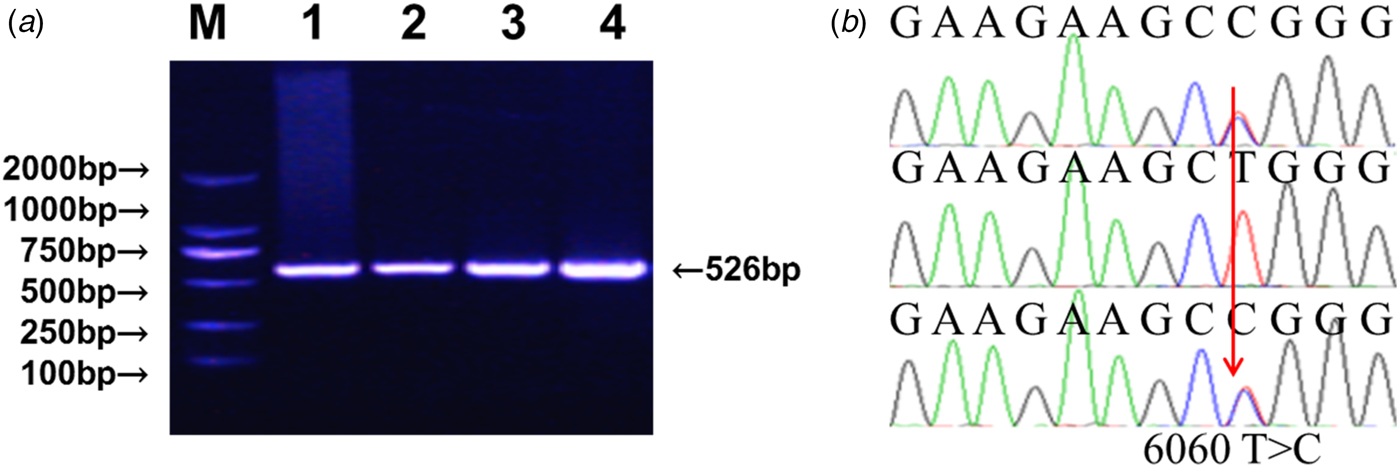
By direct DNA sequencing, one mutation (6060 T > C) was identified in intron 4 of the BAF60c gene. The DNA sequencing maps are shown in Fig. 1. Genotyping of milk samples at the newly found 6060 T > C mutation was carried out using RFLP-Alu I and three genotypes were identified (TT, TC and CC). The TT genotype (Fig. 2) has three restriction fragment bands (121, 81 and 65 bp), the TC genotype has four restriction fragment bands (186, 121, 81 and 65 bp) and the CC genotype has three restriction fragment bands (186, 121 and 81 bp).
The representative polymerase chain reaction results of BAF60c (a) and sequencing map (b). Colour online.
The enzyme digestion results of bovine BAF60c gene at 6060 T > C mutation site.

Analysis of bioinformatics parameters
The proportion of genotypes, allele frequencies, gene heterozygosity and PIC at BAF60c gene for the 6060 T > C mutation were analysed in 507 milk samples. The data demonstrated that the proportion of genotypes was 0.5819, 0.3118 and 0.1163, respectively (Table 1). Moreover, the frequencies of T/C allele were 0.7327/0.2673. Heterozygosity and PIC were 0.3917 and 0.3150, respectively.
Proportion of genotypes, allele frequencies, gene heterozygosity, effective allele numbers and PIC at BAF60c gene for the 6060 T > C mutation in 507 milk samples

PIC, polymorphism information content; TT, common allele; TC, heterozygotes; CC homozygotes.
Association between mutation and milk quality
The association between mutation at 6060 T > C locus and milk quality traits was analysed (Table 2). The 6060 T > C mutation is significantly associated with MPP (P = 0.042) and LP (P = 0.031), but not with MFP (P = 0.352) and TSC (P = 0.421). Raw milk with the CC genotype has the higher MPP (32.7 g/kg) and LP (52.7 g/kg) than other genotypes. Thus, the mutation could be used to pre-evaluate the MPP and LP. The estimated MPP ranged from 29.8 to 30.2, 28.4 to 29.0 and 32.2 to 33.2 g/kg for milk samples with TT, TC and CC genotypes, respectively. Lactose percentage was estimated at 50.2–50.6, 50.0–50.6 and 52.2–53.2 g/kg for TT, TC and CC genotypes, respectively. It should be also noted that although the associations of 6060 T > C with MFP and TSC did not attain statistical significance in the current study, the highest measurements of MFP (42.9 g/kg) and TSC (125.1 g/kg) were observed in the CC genotype. Indicating the quality (MPP, MFP, LP and TSC) of raw milk with the CC genotype is higher than that with TT and TC genotypes.
Association of 6060 T > C mutation in intron 4 of BAF60c gene with milk quality traits in the population of milk samples from 507 cowsa

a Values are given in mean ± s.e.
b TT, TC and CC represent the common allele, heterozygotes and homozygotes for the rare allele, respectively.
Discussion
A novel mutation in the BAF60c gene was identified; it displays variable heterozygosity, allelic frequency and PIC score. In genetic linkage analysis, the PIC value is often applied to detect specific mutations and polymorphisms within a population, and it depends on the number of available alleles and frequency distribution (Wenzl et al., Reference Wenzl, Carling, Kudrna, Jaccoud, Huttner, Kleinhofs and Kilian2004). More recently, PIC has been shown to be relevant regardless of the mode of phenotype inheritance (Shete et al., Reference Shete, Tiwari and Elston2000). The PIC also reflects the degree of polymorphism according to the differences of PIC values, which can be classified as low (PIC < 0.25), medium (0.25 < PIC < 0.50) or high (PIC > 0.50), with most populations being low or medium (Mateescu et al., Reference Mateescu, Zhang, Tsai, Phavaphutanon, Burton-Wurster, Lust, Quaas, Murphy, Acland and Todhunter2005). In the present study, PIC indicated a value of 0.3150, which showed that the population at 6060 T > C allele belongs to the median polymorphism level.
The association analysis revealed a significant relationship between 6060 T > C and MPP and LP, which indicates the potential of the mutation in predicting milk protein and lactose content. Both milk protein and lactose are the main nutrients, which can reflect the whole quality of raw milk. Milk proteins have gained interest in dairy organizations worldwide mainly for their role in cheese production and some aspects related to human nutrition, such as the release of peptides with biological functions (Caroli et al., Reference Caroli, Chessa and Erhardt2009). Lactose is the main carbohydrate in milk, which is also important to human nutrition, especially for the absorption of calcium (Favus and Angeid-Backman, Reference Favus and Angeid-Backman1984). In the present study, both MPP and LP were found to be higher in milk samples with the CC genotype, which should be used to produce high-quality dairy products. Interestingly, although there were no significant differences in MFP and TSC among the three genotypes, milk with the CC genotype also displays higher MFP and TSC levels, which further indicates that the allelic C has a positive influence on MPP, MFP, LP and TSC. Although a number of studies have reported the association of BAF60c gene with lipid and glucose metabolism pathway in vivo (Debril et al., Reference Debril, Gelman, Fayard, Annicotte, Rocchi and Auwerx2004; Meng et al., Reference Meng, Li, Wang, Ko, Lee, Jung, Okutsu, Yan, Kim and Lin2013; Wang et al., Reference Wang, Wong, Tang, Hudak, Yang, Duncan and Sul2013), there are still very few data relating this gene to milk quality traits in dairy herd populations, in which the biology of milk composition is of paramount importance as a determinant of food safety in a key worldwide human supply chain. The current study is a preliminary step in offering the essential tools for milk quality assessment and classification by analysing mutations and genetic effects at the bovine BAF60c gene locus. Further studies are needed to illuminate the mechanisms about how the mutation can affect milk quality traits.
In conclusion, a new gene-based method for milk quality assessment and classification based on 6060 T > C mutation in bovine BAF60c gene was developed, which was found to be significantly associated with MPP and LP. Notably, milk samples with genotype CC had the highest measures of MPP and LP. The current findings provide evidence that the prediction of quality traits can be achieved based on different genotypes of BAF60c gene, and suggest a simple and reliable approach by which producers of dairy products can select raw milk for desirable high-quality levels.
Acknowledgements
We thank T. L. Gao and M. S. Liu for field sampling, J. L. Gao and L. Zhao for technical help and statistical analysis. We also thank the crew of the Animal Product Science & Nutrition Laboratory in Shaanxi Normal University for their technical and field assistance.
Financial support
This work was supported by the Xi'an city science and technology plan projects of China (2017050NC/NY007-3) and the fundamental research funds for the central universities of China (GK201805002).
Conflict of interest
None.
Ethical standards
Not applicable.