1. INTRODUCTION
It could be said that time is fundamental to all art. In general terms, both the production of the artefacts of creative practice and their interpretation take place within a cultural and societal context which, like the river of Heraclitus, is dynamic and ever-changing. In addition, the ‘consumption’ of individual works happens over time. Performing arts and certain forms of visual art, such as video art, are obviously temporal, but even the reading of traditionally static forms such as painting and sculpture is non-instantaneous. It is traditionally in music, however, where a rigorous organisation of time can be seen. The materials of music–timbre, pitch, rhythm, form–are, as Stockhausen analysed, patterns in time and theories of music regulate these as absolute values–frequency, metre, beatsper-minute and so on (Stockhausen Reference Stockhausen1989a: 88–111).
Within theories of music in the Western tradition, such as common-practice harmony and Serialism, which are concerned with the regulation of metre and pitch–which is ultimately the regulation of frequency–the notion and treatment of sound as a time-based phenomenon is implicit. However, the same is also true of theories that are intended to describe the use of all sound in music. Smalley acknowledges this in his description of spectromorphology: ‘[s]pectral morphology cannot realistically be separated from time: spectra are perceived through time, and time is perceived as spectral motion’ (Smalley Reference Smalley1986: 65) In addition, Dack notes that, in Schaeffer’s organisation of the universe of sounds in the TARTYP diagram, ‘[t]he concept of variation and change within sound objects is incorporated … at the most fundamental stage’ (Dack Reference Dack2002), an approach that again assumes the fundamentally temporal nature of the sound arts.
While time is still fundamental to both Schaeffer’s and Smalley’s taxonomic descriptions of all sound, Russolo and Stockhausen sought to theorise the expansion of the palette of available sounds and to create new forms through challenging the perceived primacy of time in musical structures. Russolo problematised time in his advocacy of ‘noisy’ sounds over pitched instrumental sounds in his Futurist manifesto of 1913. Russolo argues that the perception of the contingency of time to music arises from Pythagoras’s mathematically determined music theory which, he argues, ‘[has] limited the domain of music until now and made almost impossible the harmony they were unaware of’ (Russolo Reference Russolo2004: 5). Russolo here is referring mainly to the prioritising of the melodic line over harmony, but implicit in this idea, and possibly subconsciously influencing Russolo’s thinking, is the nature of the tone as a periodic sound, that is a certain number of cycles of a waveform over time. Thus, Russolo is advocating a radical shift in the conception of music, from the horizontal to the vertical (the linear to the simultaneous). Where Russolo may see noise arising from the increasing harmonic complexity as a result of the abundance of simultaneous sounds, both pitched and unpitched, the importance of time and linearity becomes diminished.
In The Four Criteria of Electronic Music, Stockhausen (Reference Stockhausen1989a: 88–111) also recognises the fundamental nature of time for the conventional materials of music practice while seeking to challenge its importance. While observing how basic musical parameters–timbre, pitch, rhythm, form–can be viewed as patterns occurring over different timescales, Stockhausen attempts to reconfigure this relationship between time and music. He took the approach that, ‘the traditional concept is that things are in time, whereas the new concept is that time is in the things’ (Stockhausen Reference Stockhausen1989a: 96). One practical application of this idea was moment form first used in Momente (1961). Using a formal design arising from earlier experiments with indeterminacy, Stockhausen constructs a piece from self-sufficient sections of music, lasting from anywhere from a few seconds to a few minutes, that are internally complete and therefore do not form part of any larger macroscopic musical development or drama. Stockhausen (Reference Stockhausen1989b: 65) describes moment form as the ‘controlled randomness or mobility of the form as compared to one which is fixed and mobile’. Intriguingly, Stockhausen (Reference Stockhausen1989c: 59) sees this practice explicitly as looking beyond Western musical traditions to Asian ‘lyric’ forms: ‘in our western tradition the composition of lyric forms is very rare, given the predominance of sequential and developmental conventions. Not so in the oriental traditions, in Japan for instance …What counts there is the here and now; they do not always feel compelled to base their composition on what has gone before, or where a moment may be leading.’ Thus, moment form places the focus on the immediate musical moment rather than the construction in time of an over-arching musical argument.
In the above examples, the desire to expand the palette of musically acceptable sounds is accompanied by a challenge to the primacy of time in music. Therefore, this article argues that forms of music or sound art practice that do not prioritise temporal structuring enable the use of any sound material regardless of its spectral or dynamic properties. Further, it is argued that rather than time-based structure, it is the situating of a sound work in physical space that enables arbitrary sound material to be used. The focus of this article is on Ryoji Ikeda, whose work, it is argued, prioritises the audience experience of a work in space over an appreciation of its temporal structuring. However, before this, a clarification of how emphasising the spatial experience enables arbitrary sound to be part of a work is made using the examples of John Cage and Agostino Di Scipio.
2. NOISE AND SPACE
Ironically, given its title, it can be argued that Cage’s 4′33′′ is one work that privileges space over time. Although the work is for (silent) performer(s), one can read 4′33′′ as a composition for the performance space and its environs as the music comes from, or is made by, the site itself. The revealing of the site-specific nature of performance in 4′33′′ also brings out the immersive nature of watching performance. In a concert performance of 4′33”, a sound from any direction can be part of the composition. Each audience member is naturally surrounded by sound. The concepts of a musical ‘foreground’ and ‘background’ disappear. The listener is not viewed as an objective observer, at a distance, of a performance but is immersed in a performance environment where the space, performers and audience are viewed as a totality. The listener is a part of the space, immersed in it and subject to it.
Di Scipio (Reference Di Scipio2003) contrasts interactive systems where man responds to machine output with his system where the machine interacts with the environment. In his Audible Eco-Systemic Interface project, Di Scipio is concerned with ‘designing interactions’ so that an autonomous system is set up that responds to environmental conditions. Significantly, Di Scipio argues that ‘[t]he role of noise is crucial here. Noise is the medium itself where a sound-generating system is situated, strictly speaking, its ambience. In addition, noise is the energy supply by which a self-organising system can maintain itself and develop’ (2003: 271).
In both these examples, the temporal relationships between the works’ sound materials are not important. Instead the physical locations in which the works are sited and the relationship between location and work are paramount. In both cases, this relationship facilitates the presence of arbitrary sound within a composition. What this article argues is that some contemporary practices in electronic music and sound art challenge the primacy of time by emphasising the embodied experience of the work in physical space. One exemplar of this practice is Ryoji Ikeda. Ikeda may seem a counter-intuitive example given that his sound works are rigorously, even relentlessly, rhythmic. However, it is argued that the organisation of time in his work is secondary to the ephemeral experience of encountering his work in physical space. This will be argued through an examination of the works that form his datamatics project, in particular the dataphonics CD which is pertinent for being an homage to Pierre Schaeffer’s Solfege de l’objet sonore (Ikeda 2010c).
3. RYOJI IKEDA
Ryoji Ikeda (b. 1965) is a Japanese sound artist who, since his work with theatre company Dumb Type, has explored ideas through multi-work projects that consist of CDs, art installations and live performances. He has achieved commercial and critical success since his early CDs including 1000 fragments (1995) and +/− (1996), winning the Golden Nica in the ‘Digital Musics and Sound Art’ category at Ars Electronica in 2001 for his Matrix series of works that include a series of installations and a CD (Ars Electronica 2012). What is fascinating about Ikeda’s work is the enigmatic quality that arises through the ubiquity of two types of sound material, short sine-wave impulses and clicks, frequently arranged rhythmically into the ‘funky’ yet metronomic patterns reminiscent of electronic dance music. The sound materials he uses and the textures he creates raise questions on just how his work should be read.
The question of reading Ikeda’s work is laid plain in his datamatics project. This project is made up of two versions of the datamatics audiovisual concert, a series of installations–data.tron, data.matrix, data.scan, data.microfilm, data.film and data.spectra–each of which, save the last, exists in multiple formats or versions, the dataplex CD and the dataphonics concert, installation, book and CD. The material of these works supposedly derives from the visualisation and sonification of various datasets including DNA chromosome data, the molecular structure of proteins and astronomical star data. The artist himself describes the project as an exploration of ‘the potential to perceive the invisible multi-substance of data that permeates our world’ and the various works in the series ‘seek to materialise pure data’ (Ikeda Reference Ikeda2010a).
Characteristic of the sonic material in these works is the repetitive rhythmic pattern of sine tones suggestive of digital data transmissions. Sometimes, tones of two distinct durations are used suggestive of the ‘dots’ and ‘dashes’ of Morse code. The question these works raise is whether the sine tones or rhythms have some kind of structural or symbolic significance. Do these pitches have any meaning and if so what is the nature of that meaning? Are these tones serving a structural function within a piece? Is there an explicit linguistic meaning encoded in these tones, as one might suspect when presented as metrical ‘dots’ and ‘dashes’ suggestive of Morse code? Or is the listener to interpret them as sonic ‘illustrations’ of other phenomena? The paradox in Ikeda’s work is well encapsulated by Weil (Reference Weil2012) who says that ‘[t]he interpretation of Ikeda’s work can be considered totally open, yet it formally attains a state of extreme precision that implies the opposite’. To explore this paradox, the dataphonics CD, released in 2010, will be considered in detail alongside the test pattern CD from 2008.
3.1. The datamatics project
One reading of Ikeda’s work is influenced by its apparent formal precision and clarity. It has been claimed that this clarity arises from basing the structure of the work on mathematical principles. Harvard university mathematics professor Benedict Gross, who has collaborated with Ikeda, says that Ikeda knows ‘unbelievable amounts of mathematics’ and ‘thinks like a mathematician’ (Gross and Edwards Reference Gross and Edwards2009: 85, 87). Similarly Weil (Reference Weil2012: 123) claims that Ikeda ‘has developed a way of working that is increasingly grounded in mathematics. Indeed, for Ryoji Ikeda, the research led by mathematicians is the purest form of intellectual activity, and possibly as well the purest form of aesthetics, one that is also deemed the closest to absolute rationality and logic.’ This formal clarity suggests that a meaningful insight into Ikeda’s practice can be gleaned by analytical techniques that could be regarded as musically conventional in the sense hat the analysis is concerned with the placement of sound material. One work that is amenable to such an approach is the track ‘data.flex’ from the datamatics CD.
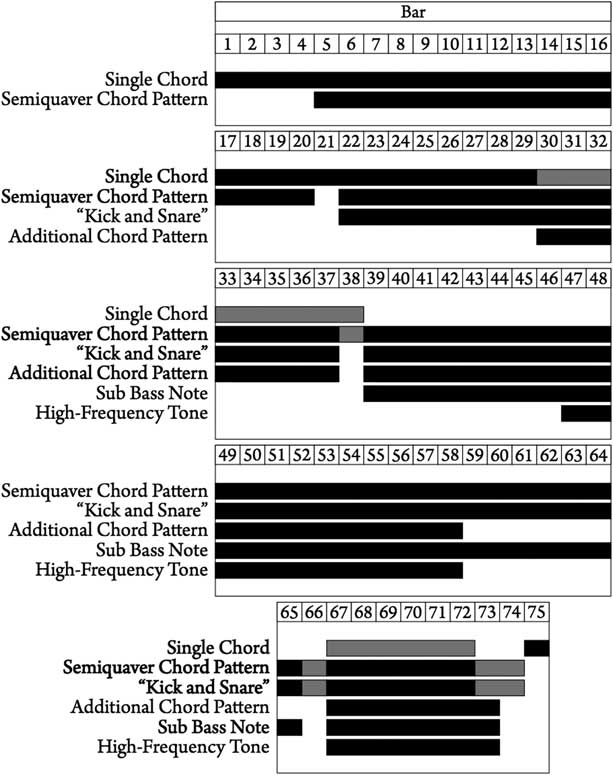
In ‘data.flex’, Ikeda’s practice approaches the stereotypical features of electronic dance music in terms of both the material used and the overall structure. The tempo of this track is 120 bpm, the metre is a clear common time and the layers in the sonic texture have a relationship to typical musical materials of dance music: rhythmic chordal patterns; a bass part; and a layer of percussive clicks resembling a kick-and-snare pattern. In addition, as can be seen in Figure 1, the formal procedure echoes that of dance music: the building up of the texture through the progressive entry of layers; the single bar ‘drop-outs’ (bars 21, 38 and 66) where parts stop or are varied to transition to the next section.
A structural analysis of data.flex, track 14 off the datamatics CD.
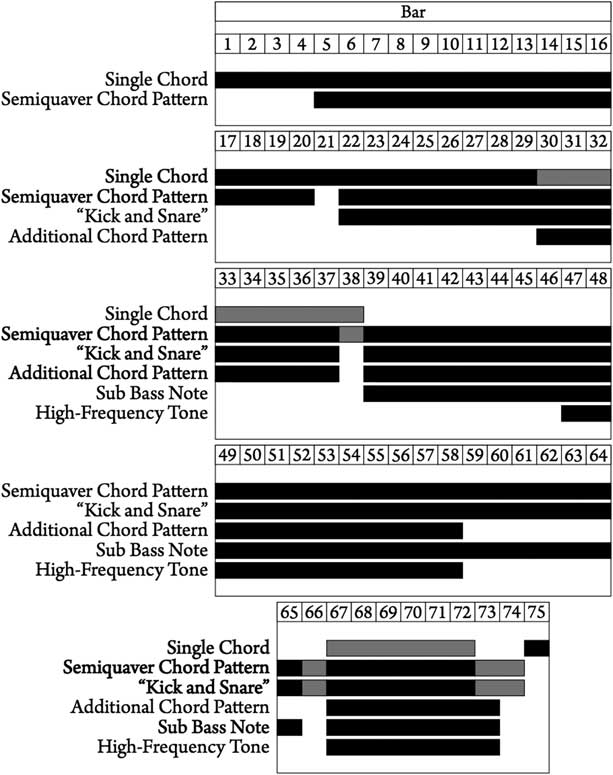
While data.flex follows the conventional structural procedure of dance music, what is interesting is the lack of emphasis on pitch in this structure. The bass part in this track is not a melodic line or riff but a single sine tone around 40 Hz lasting for a minim that occurs every two bars. The contribution of this material to the overall structure almost entirely depends therefore on its placement and has nothing to do with any pitch relationship to other material. Similarly, another layer is a tone at 11,025 Hz at an amplitude level that makes it barely perceptible. A two-bar rhythmic pattern of just two notes is made out of this tone but again with a constant pitch so that no frequency relationships are established. The dominant material in this track, a semiquaver chord pattern, is another example of a textural element where pitch is present but unimportant relative to its rhythm. As a consequence, the conventional pitch-based structural procedures of dance music–chord progressions, verse–chorus forms, modulations to different tonal centres–are missing. Typically, in dance music, sections based on static harmonies or pedal points may alternate with those based around regular chord changes on the bar or half-bar which, along with progressive building up of textures, builds musical momentum. In the case of data.flex however, this momentum is undermined by the lack of pitch movement within parts, which effectively creates a sense of stasis. Thus, while superficially conforming to the stereotypes of dance music in terms of its clear patterns of construction and temporal design, the primacy of time is subtly undermined.
What this analysis shows is that the overall formal design is not particularly significant. The next question to consider then is whether the rhythmic patterns that make up much of Ikeda’s work have any semantic, as opposed to structural or syntactic, meaning. If the conceit of the project involves the sonification of data, can the encoding of any data be found in the works that make up the datamatics project? A common sound element that appears in certain tracks is a pattern of high-frequency tones. This pattern appears, for example, in dataphonics track 1 ‘Principle’ and track 3 ‘Transmission’ and in test pattern track 1. These tones are all of a single pitch but create a pattern out of two durations of around 50 ms and 140 ms, which consequently give the listener an impression of radio communications such as Morse-code messages or radio teletype. Does this pattern encodes an explicit message and meaning or it is simply an evocation of such encodings.
A representation of this pattern is given in Figure 2 where the two tone durations are shown either by a ‘dot’ or a ‘dash’. This pattern of ‘dots’ and ‘dashes’ is made up of distinct word-like units separated by short pauses, indicated by forward slashes in Figure 2. However, this shows that the pattern is not true Morse code. For intelligible Morse code, there needs to be three distinct pause lengths to distinguish the gaps between individual symbols, letters and words which is not the case here. If the pauses between the individual units are word separators, the parsing of individual letters is impossible because there is too much ambiguity from most combinations of dots and dashes. On the other hand, if the pauses are supposed to separate letters, then the individual units of the pattern here do not generally correspond to recognisable letters of the Morse-code alphabet. So, while the possibility must remain that this pattern is a signifier of a specific meaning, the strong suspicion is that this combination of high-pitched ‘bleeps’ is a piece of sonic design that signifies a type of information rather than an actual data set. Moreover, a comparison of two CDs, dataphonics and test pattern, cast further doubt that the descriptions of the materials of these works should be taken literally.
The Morse-code like pattern of tones that features in several Ryoji Ikeda tracks. Tones of short duration are represented here by dots and those of longer duration by dashes. In the tracks, word-like combinations of dots and dashes are separated by short pauses, represented here by forward slashes.

3.2. The dataphonics and test pattern CDs
Ikeda’s dataphonics project, which forms part of the wider datamatics series of works, is made up of a series of programs for Radio France which was later converted into a multi-channel concert as well as a sound installation and book with CD. The back cover of the accompanying book describes the project as an, ‘homage to Musique Concrète pioneer Pierre Schaeffer’s Solfege de l’objet sonore’ (Ikeda 2010c).
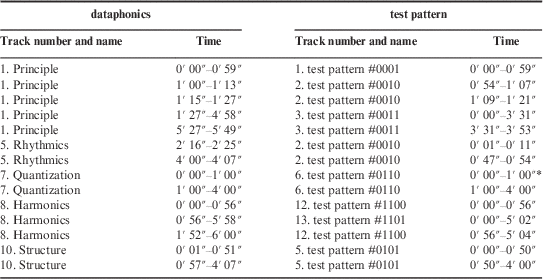
The test pattern project from 2008 is not officially included as part of the datamatics project, although they are materially and conceptually similar. While datamatics is concerned with the perception of natural or scientific data, test pattern works with arbitrary, generated data from texts, photographs and so on. The purpose of this project, ‘to examine the relationship between critical points of device performance and the threshold of human perception’ (Ikeda Reference Ikeda2010b), however, contrasts with the concerns of the datamatics project described earlier. However, a comparison of the two CDs reveals that there is, in fact, a considerable re-use of material between them. Table 1 lists some examples of sections in dataphonics that are re-used in test pattern. In many cases, the sections indicated in this table are identica; for example, the track ‘test pattern #0001’ corresponds exactly to the first minute of ‘Principle’, the first track on dataphonics. In other cases, material is adapted. Sections may be appropriated for use within a larger texture and thus mixed with other material. In the case of the first minute of ‘Quantization’ from dataphonics, this corresponds to the first minute of ‘test pattern #0110’ but reversed.
Re-use of material in dataphonics and test pattern
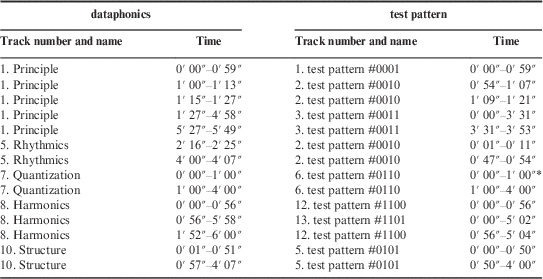
Notes: Each row shows extracts from tracks on the respective CDs that are in most cases identical. Certain extracts may show slight differences; for example, differences in amplitude or timing or additional low-level material mixed in one track.
* The material of the first minute of ‘test pattern #0110’ is a reversed form of the first minute of ‘Quantization’.
What this shows is that Ikeda’s working methods are more pragmatic than they may first appear. The conceptual descriptions of the datamatics project and the test pattern are different despite using, in places, the same material. Moreover, dataphonics itself is described as an homage to Pierre Schaeffer’s Solfège de l’Objet Sonore while simultaneously being part of the datamatics project. The conclusion here is that Ikeda’s stated conceptual aims are not so much descriptions of his process, but rather should be treated as paratext–information that leads the viewer down a particular path of thinking and guides their experiencing of the work. Thus the reference to Pierre Schaeffer may cause the reader to view the datamatics project from an essentialist perspective despite the material having no real connection to Schaefferian ideas.
This discussion above casts doubt about the primacy of structuring in Ikeda’s work, whether through the temporal arrangement of materials or the possible encoding of data in some form. This raises the question of the role of the paratext of Ikeda’s work. If the claims made in the paratextual materials around Ikeda’s work are not to be taken literally, how are they guiding the reader in understanding the work? It can be argued that this is where the importance of the spatial experience comes into play.
4. AWE AND THE SUBLIME
The question about the works of the datamatics project concerns the purpose of this supposed presentation of data. Are these works seeking to provide the audience with some insight into the nature of this information? Abe (Reference Abe2012: 106) discusses a section from the data.tron installation featuring a grid of rapidly changing numerical digits. In the version described in this passage, with an SXGA+ resolution projection, the screen is divided into a 350×175 grid meaning that at any one instant there are 61,250 digits on screen. The viewer’s perception of this mass of numerical data changes depending on their viewpoint: ‘[c]lose to the wall, the work is perceived as an uncompromising succession of numbers, but moving further away, the wall forms a single plane with grayscale dots that approximate blackness’ (Abe Reference Abe2012: 106). The sense that emerges from the experience is of being overwhelmed by the sheer quantity of this unrecognisable information.
Something of this experience can be gained from the studies in the datamatics book (Ikeda Reference Ikeda2012) where three irrational numbers – π, the mathematical constant e (Euler’s number) and the golden ratio φ–are shown to nearly four thousand decimal places. Thus with nearly twelve thousand individual digits compressed across two pages of the book, each digit is less than a millimetre in width and height. The significance of the data here is clearly unimportant as the viewer is not expected to derive any meaning from this mass of numerical data but what Ikeda does is to present the data in a way as to provide the potential of an aesthetic experience. Hence Abe (Reference Abe2012) refers to the ‘sublime’ in this work; the viewer is left in awe at this monumental amount of information.
The significance of the bodily experience in relation to Ikeda’s work is touched on by Abe (Reference Abe2012: 106) who asks in relation to the datamatics works if images and sound are presented as signals without meaning, ‘[h]ow does space exist, and how does the body exist in such conditions?’ This brings us back to the data.tron installation discussed earlier. Our bodily response to the work is closely dependent on our spatial relation to it; at a distance the contents of the screen is perceived as televisual static and it is only up close that we perceive the numerical data. In other versions of this installation, the display size is expanded to a resolution of 4200×1050. Abe (Reference Abe2012: 107) goes on to speculate that, if it were possible, Ikeda would expand this work across a thousand-metre wall in which case, ‘our synchronisation with it through physical perception becomes impossible, giving birth to a different dimension inside our brains.’
Ikeda’s installations such as data.tron are therefore more than just video projections. The projection is a part of the work but the totality of the work includes the space into which the images and sounds are thrown. This goes beyond the Heideggerian notion of the artwork revealing the space, for Ikeda the artwork is the space. The experience of these works are therefore not intellectual or emotional but, in the literal sense of the word, aesthetic. The notion of the sublime in Ikeda’s work is thus of paramount importance. The presentation of data in the works of datamatics or test pattern is not a sophisticated demonstration of how music and art can be formed out of ‘found’ information, neither is Ikeda presenting us with puzzles to be decoded, nor I would argue is Ikeda presenting data ‘as is’ or as text to be interpreted. Ikeda is using data to create powerful aesthetic experiences that leave the viewer awestruck.
Consequently, I feel that Ikeda emphasises the ephemeral nature and the immediacy of his work. Experiencing Ikeda’s work–whether CD, performance or installation–one is captured at that instant by the excitement of that experience, but afterwards, the detail of the work is forgotten. I find that Ikeda’s work is deeply unmemorable. This is not a criticism, however. On the contrary, it is a remarkable achievement to create work that so effectively creates a ‘moment’, but a moment that memory cannot reconstruct.
5. CONCLUSIONS
A consideration of the role and purpose of conventional musical analysis helps to explain the relationship between the importance of time in a form of music and the available palette of ‘musical’ sounds. Conventional analytic methods treat musical materials as quantities–pitch classes, durations, lengths. Sounds are thus described as absolute values or abstract symbols. Even in electro-acoustic forms, sound is described as archetypes or in terms of acoustic properties. Analysing such forms involves description of the temporal organisation of such abstractions.
The corollary of this is represented by the work of Ryoji Ikeda, the nature of whose practice can be little understood through traditional analytical approaches. There are two related concerns in his practice: what those materials signify as well as the aesthetic effect of experiencing the work. In other words, it is the conceptual concerns of the work that take priority over their temporal structuring. Such work, a conceptual sound-art, has been advocated by Kim-Cohen along with ‘an alternative, a qualitative, discursive form of musical analysis’ (Kim-Cohen Reference Kim-Cohen2009: 40). A music or sound art that prioritises space opens up the potential, therefore, for more qualitative analysis, taking into account the sources or signifying qualities of sounds rather than their inherent properties.
Work that privileges space over time, as has been seen with the examples of Cage and Di Scipio, enables the accepting of ‘noise’ materials. Noise lends itself to ‘site-specific’ sound art. What better way is there, in a literal sense, to reveal the acoustic properties of a space than to excite it with broadband frequency material, generating resonances and making plain its reverberant properties? For the audience then, their encounter with the work is experiential, inside an immersive sound environment, engaging bodily with the work’s aesthetic.
It is interesting to note that in theoretical physics the status of time as contingent has been challenged. Einstein’s theories of relativity showed that time does not proceed at a constant rate but slows down with speed, giving rise to the notion of space–time where space and time are not separate entities but parameters of a continuum. More recently, Barbour (Reference Barbour1999) argues for the possibility that the universe is timeless. This argument builds on the Wheeler–DeWitt equation, an admittedly controversial conjecture first published in 1967, that attempts to unify Einstein’s general theory of relativity with quantum theory and in which time is not present. In Barbour’s argument, there is no time and consequently no motion in the universe, but instead exists in a certain state in any one instant. Thus, ‘[h]istory is the passage of the universe through a unique sequence of states’ (Barbour Reference Barbour1999: 69). This progression through states does not imply the existence of time as there need not be a clock external to the universe measuring its progression. The change in state results from changes in the universe’s internal properties. Barbour (Reference Barbour1999: 69) explains that ‘[w]e must not think of the history of the universe in terms of some walker on a path who can move along it at different speeds. The history of the universe is the path’ (author’s italics).
However, trying to draw an analogy to this thought leads to an interesting conclusion. If we were to similarly say that we must not think of listening to music in terms of a walker on a path but rather that the music is the path, that conclusion would not be controversial. The notated score, privileged in the Western art music tradition, would be the path, music that is reified and timeless. The one distinction would be that Barbour’s theory has no room for cause and effect, antecedent and consequent. Similarly, the listening strategy for a music where time is de-prioritised would involve the imagining of moving through sound states with no regard for an over-arching musical structure.